Presentation on
SALINITY PROBLEM IN
IRRIGATED
LAND
Presented By :- Avinash Sahu
CONTENTS
 Introduction
 Origin and Cause of Salt
 Measurement of Salinity
 Causes of Development of Salinity and Alkalinity
 Effect on Plants and Soil
 Literature Review
 Management of salinity problem
 Conclusion
 References
INTRODUCTION
Irrigation water contains a mixture of naturally
occurring salts. Soils irrigated with this water
will contain a similar mix but usually at a higher
concentration than in the applied water. The
extent to which the salts accumulate in the soil
will depend upon the irrigation water quality,
irrigation management and the adequacy of
drainage. If salts become excessive, losses in
yield will result.
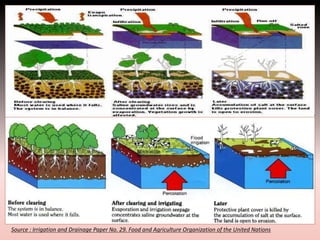
•ORIGIN AND CAUSES OF SALT
Where Does the Salt Come From?
Salt comes from the minerals of the earth's crust.
Weathering decomposes the minerals and releases the
salt in a soluble form.
Why Does Salt Accumulate in Soil?
Salt accumulates when water evaporates at the
surface, or is extracted by plant roots. Both processes
separate the salt from the water and the salt remains
behind.
Source : Irrigation and Drainage Paper No. 29. Food and Agriculture Organization of the United Nations
•How salinity is measured-
Water and soil salinity are measured by passing an electric
current between the two electrodes of a salinity meter in a
sample of soil or water. The electrical conductivity or EC of a soil
or water sample is influenced by the concentration and
composition of dissolved salts. Salts increase the ability of a
solution to conduct an electrical current, so a high EC value
indicates a high salinity level.
•FACTORS AFFECTING SALINATION
•Method of Irrigation
Water is usually in plentiful supply when an irrigation project begins.
Consequently, too much water is applied. This excess water often
does more harm than good, because it tends to raise the water table
and thus increases drainage problems.
•Type of Drainage
Adequate drainage is important in maintaining a low salinity level. If
a field is not adequately drained, water may accumulate in the root
zone and saturate the soil. This hastens the rise of the water table.
When the water table rises to within 5 or 6 feet of the surface,
ground water and its salt move upward in to the root zone and to
the soil surface.
Cont…
•Other Conditions
Some fields accumulate salt because of their location, because
they are not leveled, or because the soil is impermeable. Like
Low valleys located close to streams or high points on the field
which receives sufficient water or the cement like formation
underlie the soil.
Source : https://naldc.nal.usda.gov/naldc/download.xhtml?id=CAT87209914&content=PDF
•Types of salinity problem
Two types of salt problems exist which are very different: those
associated with the total salinity and those associated with sodium.
•Causes of development of salinity and alkalinity in soils
•Use of saline irrigation water
• Deposition of salts on soil surface from high sub soil water table
• Seepage from the canals
•Arid Climate
•Poor drainage
•Back water flow or intrusion of sea water in coastal areas
•EFFECT ON PLANTS AND SOILS
On Plants-
It prevents them from getting enough water, even though the
soil may be well watered. This results in stunted plants that
frequently have a characteristic blue-green color. If the salt is
evenly distributed in a field, all the plants will be stunted.
Yields may be reduced as much as 25 percent.
Literature Review – 1.Dave N. et. Al (2013) studied on Impact of
soil salinity and erosion in India and his finding and recommendations are
The findings of his study
 Use of poor quality water for
irrigation is one of the major
reasons behind the continuous
escalation in soil salinity
problems.
 Escalating soil salinity and land
degradation may decrease food
production and supply. It will
increase food inflation and
increase countries dependence on
food imports.
 Lack of any sustainable
agricultural development plan and
mitigation and adaptation strategy
for tackling the soil salinity and
erosion problem at national level.
The recommendations
 To improve the existing
capabilities of forecasting of short
and long term Drought.
 Agricultural areas coming under
arid and semi arid regions are
more prone to erosion and
degradation problems therefore
more emphasis should be given to
these areas.
 More and more projects related
with groundwater development
such as rainwater harvesting,
watershed management,
formation of artificial recharge
facilities with Waste water and
rainwater should be implemented.
Cont….
2) Abrahim S. et. Al (2013) Monitor and Predict Soil Salinity, Sodicity and Alkalinity in Sudan,
Using Soil Techniques, Remote Sensing and GIS Analysis his study area was in Sudan near Nile
river.
Methodology
•Four false color composite
(FCC) subsets images
covering the study area (300
Acers).
•Field work is done by using
GPS satellite for texture and
different soil properties.
•Soil samples were collected
from three different depths
(0-60cm).The soil samples
were analyzed in lab and the
following properties were
determined:
pH, EC, Soluble Ca & Mg, Na
,SAR
Results
•Soil analysis shows the
some areas are sodic which
is calculated by SAR.
•Field work and survey
revealed that soil
degradation is due to
mismanagement.
•pH of that area is found
between 6.5-8.5 means soil
is slightly alkaline.
Conclusion and
recommendation
•Sub soiling or ripping to a
depth of 30 to 45 cm or more
should be the practice to
break the compaction and to
improve the infiltration rates
of the soil of the study area.
• The reclamation of the
slightly saline and/or sodic
soils through the application
of organic manure for the
improvement of physical,
chemical and biological
properties.
Management of salinity problems
 By proper Drainage
 By Leaching
 Bioremediation
 Cultural and Irrigation Practices –
Land Smoothening
Timing of Irrigation
Placement of Seed
 Fertilizers
 Bio drainage
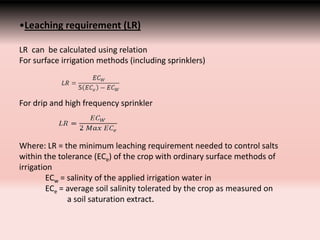
•Leaching requirement (LR)
LR can be calculated using relation
For surface irrigation methods (including sprinklers)
For drip and high frequency sprinkler
Where: LR = the minimum leaching requirement needed to control salts
within the tolerance (ECe) of the crop with ordinary surface methods of
irrigation
ECw = salinity of the applied irrigation water in
ECe = average soil salinity tolerated by the crop as measured on
a soil saturation extract.
•Conclusion
Many states in India are facing problems of salinity and thus being
an agrarian country it becomes essential to adopt various measures
so that the farmers may get the proper yield of their input. The soil
in areas of Madhya Pradesh have alkalinity problem and thus
measures like adding suitable admixture to convert the property of
soil and adopting cultural practices to control salinity problem .
•References
•Ayres, R.S. and D.W. Westcot.1976. Water Quality for Agriculture.
Irrigation and Drainage Paper No. 29. Food and Agriculture
Organization of the United Nations.
•Central soil salinity research institute
http://www.cssri.org/index.php?option=com_content&view=articl
e&id=122&Itemid=126
•Fipps Guy “Irrigation Water Quality Standards and Salinity
Management”, Department of Agricultural Engineering, The Texas
A&M System, College Station, Texas.
•Jeet , Dagar JC, Singh.G ,Lal.K, Tanwar VS, Shoeran SS,
Kaledhonkar MJ, SR Dar and Kumar M. 2008“Biodrainage eco-
friendly technique for combating waterlogging & salinity”
Technical Bulletin: CSSRI/ Karnal/9. Central soil salinity research
institute, Karnal (India)
•Michael A. M. 2008.“ Irrigation Theory and Practice” Second
edition,Vikas publication house
•Rolando C. and Francisca R. 2013 “Biodegradation of
Hazardous and Special Products” Moqsud M.A., Omine .K
“Bioremediation of Agricultural Land Damaged by Tsunami” CH-
3 Publisher: InTech
•Stephan R Gratton 2002 “Irrigation water salinity and crop
production” University of california publication 8066
Thank You

Soil salinity problem in irrigated lands

  • 1.
    Presentation on SALINITY PROBLEMIN IRRIGATED LAND Presented By :- Avinash Sahu
  • 2.
    CONTENTS  Introduction  Originand Cause of Salt  Measurement of Salinity  Causes of Development of Salinity and Alkalinity  Effect on Plants and Soil  Literature Review  Management of salinity problem  Conclusion  References
  • 3.
    INTRODUCTION Irrigation water containsa mixture of naturally occurring salts. Soils irrigated with this water will contain a similar mix but usually at a higher concentration than in the applied water. The extent to which the salts accumulate in the soil will depend upon the irrigation water quality, irrigation management and the adequacy of drainage. If salts become excessive, losses in yield will result.
  • 4.
    •ORIGIN AND CAUSESOF SALT Where Does the Salt Come From? Salt comes from the minerals of the earth's crust. Weathering decomposes the minerals and releases the salt in a soluble form. Why Does Salt Accumulate in Soil? Salt accumulates when water evaporates at the surface, or is extracted by plant roots. Both processes separate the salt from the water and the salt remains behind.
  • 5.
    Source : Irrigationand Drainage Paper No. 29. Food and Agriculture Organization of the United Nations
  • 6.
    •How salinity ismeasured- Water and soil salinity are measured by passing an electric current between the two electrodes of a salinity meter in a sample of soil or water. The electrical conductivity or EC of a soil or water sample is influenced by the concentration and composition of dissolved salts. Salts increase the ability of a solution to conduct an electrical current, so a high EC value indicates a high salinity level.
  • 7.
    •FACTORS AFFECTING SALINATION •Methodof Irrigation Water is usually in plentiful supply when an irrigation project begins. Consequently, too much water is applied. This excess water often does more harm than good, because it tends to raise the water table and thus increases drainage problems. •Type of Drainage Adequate drainage is important in maintaining a low salinity level. If a field is not adequately drained, water may accumulate in the root zone and saturate the soil. This hastens the rise of the water table. When the water table rises to within 5 or 6 feet of the surface, ground water and its salt move upward in to the root zone and to the soil surface.
  • 8.
    Cont… •Other Conditions Some fieldsaccumulate salt because of their location, because they are not leveled, or because the soil is impermeable. Like Low valleys located close to streams or high points on the field which receives sufficient water or the cement like formation underlie the soil.
  • 9.
  • 10.
    •Types of salinityproblem Two types of salt problems exist which are very different: those associated with the total salinity and those associated with sodium.
  • 11.
    •Causes of developmentof salinity and alkalinity in soils •Use of saline irrigation water • Deposition of salts on soil surface from high sub soil water table • Seepage from the canals •Arid Climate •Poor drainage •Back water flow or intrusion of sea water in coastal areas
  • 12.
    •EFFECT ON PLANTSAND SOILS On Plants- It prevents them from getting enough water, even though the soil may be well watered. This results in stunted plants that frequently have a characteristic blue-green color. If the salt is evenly distributed in a field, all the plants will be stunted. Yields may be reduced as much as 25 percent.
  • 13.
    Literature Review –1.Dave N. et. Al (2013) studied on Impact of soil salinity and erosion in India and his finding and recommendations are The findings of his study  Use of poor quality water for irrigation is one of the major reasons behind the continuous escalation in soil salinity problems.  Escalating soil salinity and land degradation may decrease food production and supply. It will increase food inflation and increase countries dependence on food imports.  Lack of any sustainable agricultural development plan and mitigation and adaptation strategy for tackling the soil salinity and erosion problem at national level. The recommendations  To improve the existing capabilities of forecasting of short and long term Drought.  Agricultural areas coming under arid and semi arid regions are more prone to erosion and degradation problems therefore more emphasis should be given to these areas.  More and more projects related with groundwater development such as rainwater harvesting, watershed management, formation of artificial recharge facilities with Waste water and rainwater should be implemented.
  • 14.
    Cont…. 2) Abrahim S.et. Al (2013) Monitor and Predict Soil Salinity, Sodicity and Alkalinity in Sudan, Using Soil Techniques, Remote Sensing and GIS Analysis his study area was in Sudan near Nile river. Methodology •Four false color composite (FCC) subsets images covering the study area (300 Acers). •Field work is done by using GPS satellite for texture and different soil properties. •Soil samples were collected from three different depths (0-60cm).The soil samples were analyzed in lab and the following properties were determined: pH, EC, Soluble Ca & Mg, Na ,SAR Results •Soil analysis shows the some areas are sodic which is calculated by SAR. •Field work and survey revealed that soil degradation is due to mismanagement. •pH of that area is found between 6.5-8.5 means soil is slightly alkaline. Conclusion and recommendation •Sub soiling or ripping to a depth of 30 to 45 cm or more should be the practice to break the compaction and to improve the infiltration rates of the soil of the study area. • The reclamation of the slightly saline and/or sodic soils through the application of organic manure for the improvement of physical, chemical and biological properties.
  • 15.
    Management of salinityproblems  By proper Drainage  By Leaching  Bioremediation  Cultural and Irrigation Practices – Land Smoothening Timing of Irrigation Placement of Seed  Fertilizers  Bio drainage
  • 16.
    •Leaching requirement (LR) LRcan be calculated using relation For surface irrigation methods (including sprinklers) For drip and high frequency sprinkler Where: LR = the minimum leaching requirement needed to control salts within the tolerance (ECe) of the crop with ordinary surface methods of irrigation ECw = salinity of the applied irrigation water in ECe = average soil salinity tolerated by the crop as measured on a soil saturation extract.
  • 18.
    •Conclusion Many states inIndia are facing problems of salinity and thus being an agrarian country it becomes essential to adopt various measures so that the farmers may get the proper yield of their input. The soil in areas of Madhya Pradesh have alkalinity problem and thus measures like adding suitable admixture to convert the property of soil and adopting cultural practices to control salinity problem .
  • 19.
    •References •Ayres, R.S. andD.W. Westcot.1976. Water Quality for Agriculture. Irrigation and Drainage Paper No. 29. Food and Agriculture Organization of the United Nations. •Central soil salinity research institute http://www.cssri.org/index.php?option=com_content&view=articl e&id=122&Itemid=126 •Fipps Guy “Irrigation Water Quality Standards and Salinity Management”, Department of Agricultural Engineering, The Texas A&M System, College Station, Texas.
  • 20.
    •Jeet , DagarJC, Singh.G ,Lal.K, Tanwar VS, Shoeran SS, Kaledhonkar MJ, SR Dar and Kumar M. 2008“Biodrainage eco- friendly technique for combating waterlogging & salinity” Technical Bulletin: CSSRI/ Karnal/9. Central soil salinity research institute, Karnal (India) •Michael A. M. 2008.“ Irrigation Theory and Practice” Second edition,Vikas publication house •Rolando C. and Francisca R. 2013 “Biodegradation of Hazardous and Special Products” Moqsud M.A., Omine .K “Bioremediation of Agricultural Land Damaged by Tsunami” CH- 3 Publisher: InTech •Stephan R Gratton 2002 “Irrigation water salinity and crop production” University of california publication 8066
  • 21.