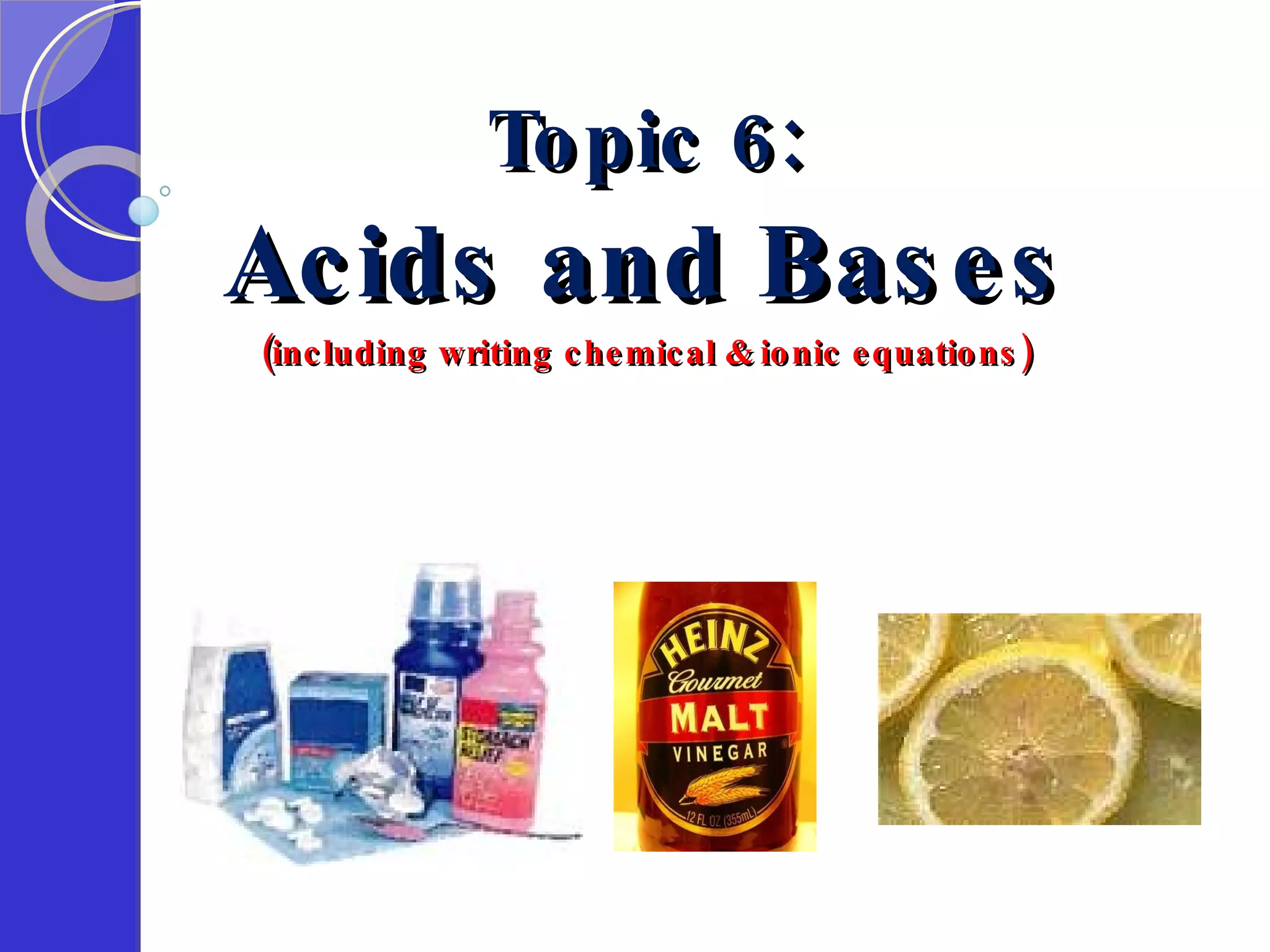
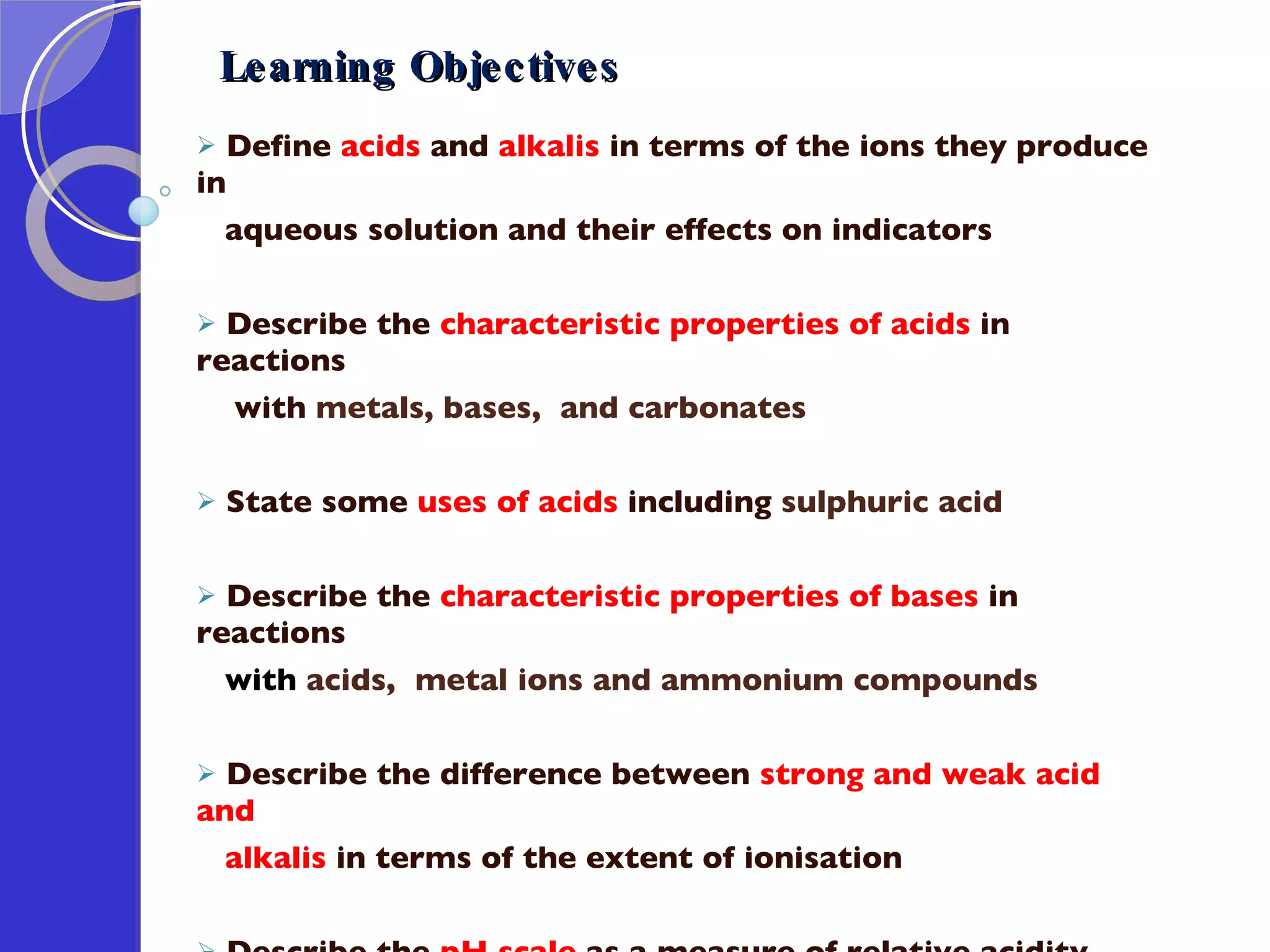
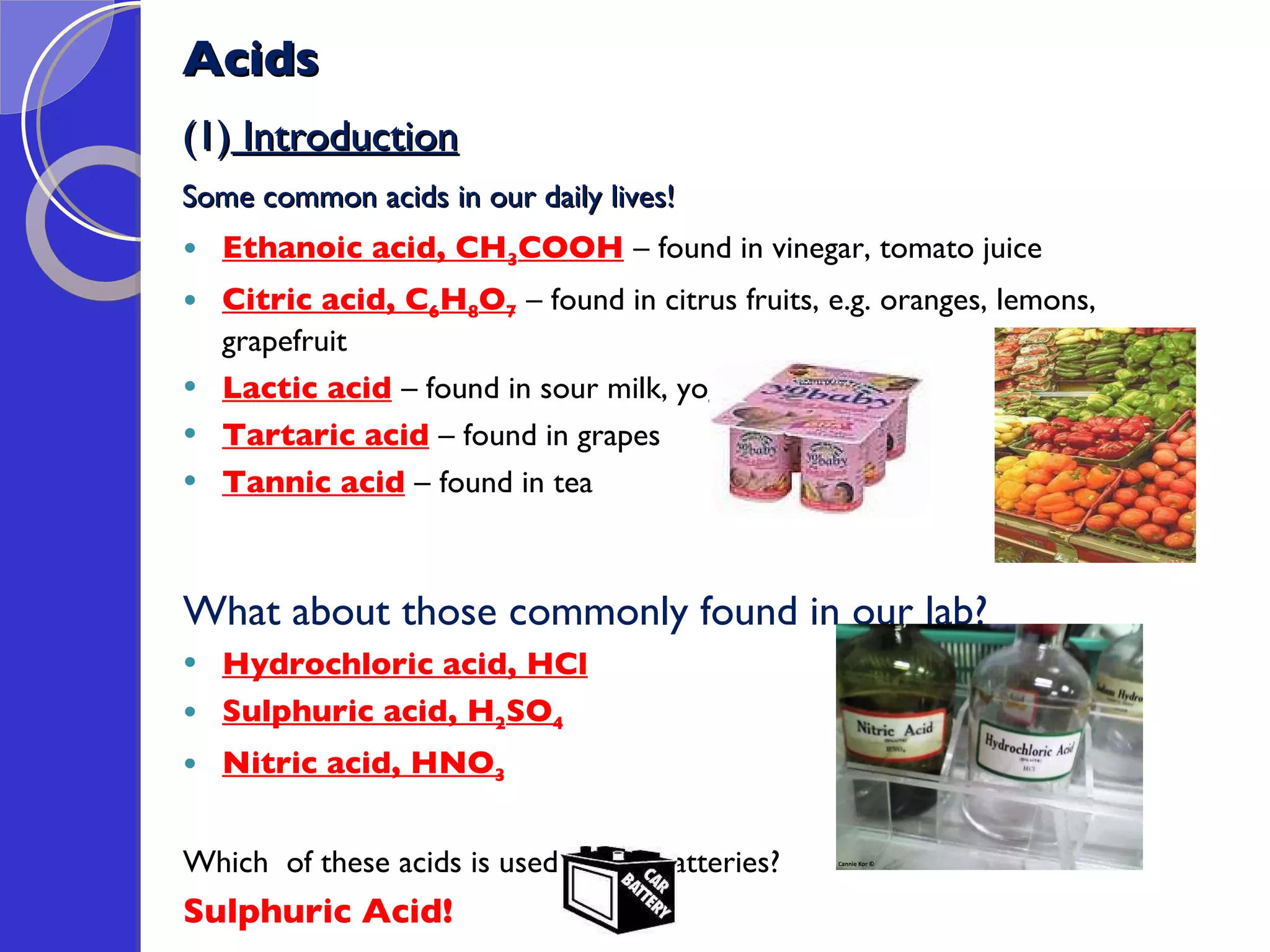
Topic 6: Acids and Bases (including writing chemical & ionic equations)
Learning Objectives Define  acids  and  alkalis  in terms of the ions they produce in aqueous solution and their effects on indicators Describe the  characteristic   properties of acids  in reactions  with  metals, bases,  and carbonates State some  uses of acids  including  sulphuric acid Describe the  characteristic properties of bases  in reactions  with   acids,  metal ions and ammonium compounds Describe the difference between  strong and weak acid and alkalis  in terms of the extent of ionisation Describe the  pH scale  as a measure of relative acidity and  alkalinity
Acids (1)  Introduction Some common acids in our daily lives! Ethanoic acid, CH 3 COOH   – found in vinegar, tomato juice Citric acid, C 6 H 8 O 7   – found in citrus fruits, e.g. oranges, lemons, grapefruit Lactic acid   – found in sour milk, yoghurt Tartaric acid   – found in grapes Tannic acid   – found in tea What about those commonly found in our lab? Hydrochloric acid, HCl Sulphuric acid, H 2 SO 4 Nitric acid, HNO 3 Which  of these acids is used in car  batteries? Sulphuric Acid!
Acids solutions used in the laboratory may be concentrated or dilute. Concentrated  acids contain a large amount of pure acid dissolved in water, while   dilute  acids contain small amounts of acid in water. Two bottles of HCl have concentrations of 5M & 0.5M.  Which is more concentrated?  Explain The one with 5 mol / dm3 5 M 0.5 M
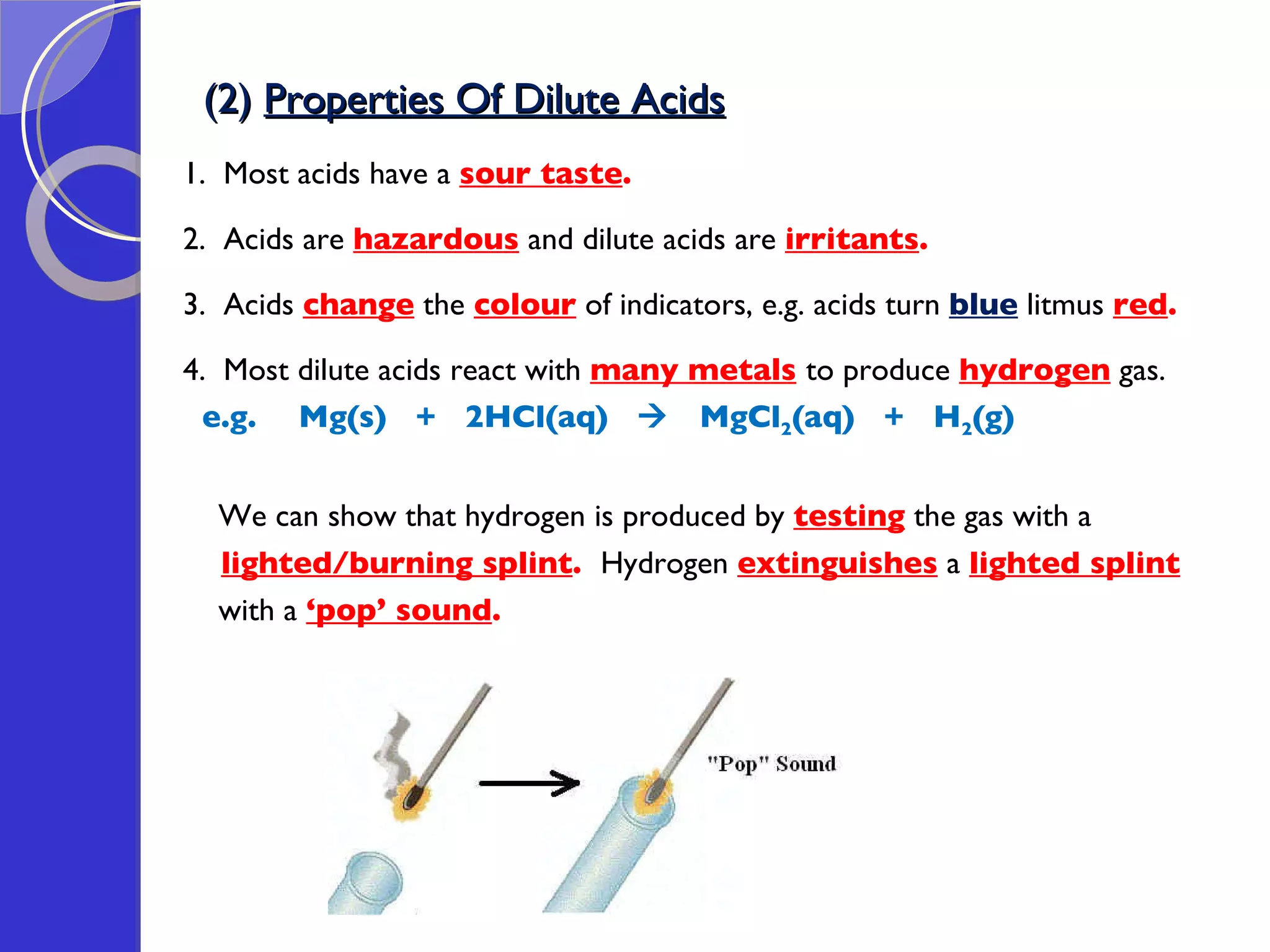
(2)  Properties Of Dilute Acids 1.  Most acids have a  sour taste . 2.  Acids are  hazardous  and dilute acids are  irritants .  3.  Acids  change  the  colour  of indicators, e.g. acids turn  blue  litmus  red .   4.  Most dilute acids react with  many metals   to produce  hydrogen  gas. e.g. Mg(s)  +  2HCl(aq)     MgCl 2 (aq)  +  H 2 (g) We can show that hydrogen is produced by  testing  the gas with a lighted/burning splint .  Hydrogen  extinguishes  a  lighted splint with a  ‘pop’ sound .
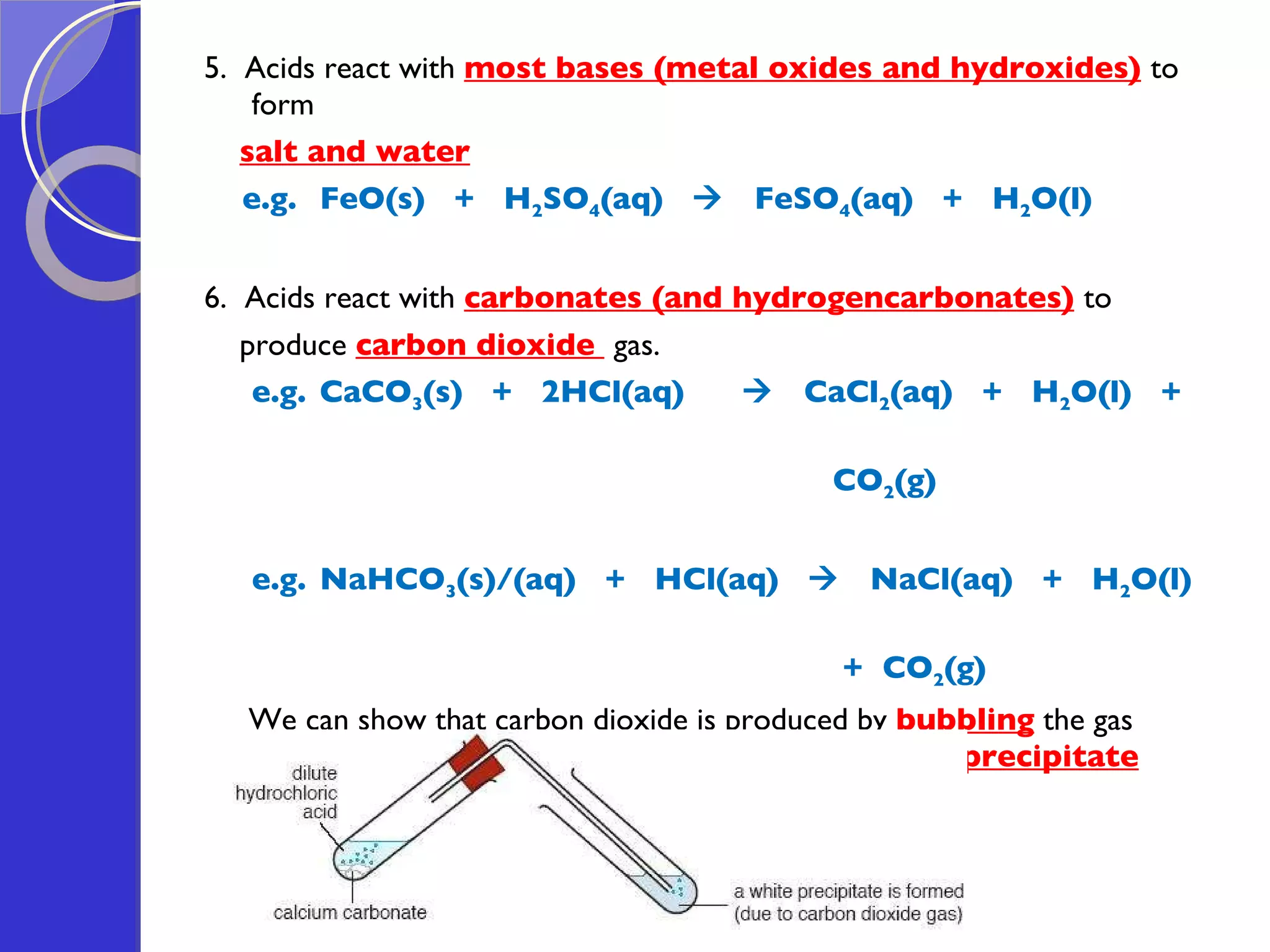
5.  Acids react with  most bases (metal oxides and hydroxides)   to form salt and water e.g. FeO(s)  +  H 2 SO 4 (aq)     FeSO 4 (aq)  +  H 2 O(l) 6.  Acids react with  carbonates (and hydrogencarbonates)   to  produce  carbon dioxide  gas. e.g. CaCO 3 (s)  +  2HCl(aq)     CaCl 2 (aq)  +  H 2 O(l)  +  CO 2 (g)  e.g. NaHCO 3 (s)/(aq)  +  HCl(aq)     NaCl(aq)  +  H 2 O(l)  +  CO 2 (g) We can show that carbon dioxide is produced by  bubbling  the gas  through limewater .  The  formation   of a  white precipitate   with  limewater  indicates the presence
Writing Ionic Equations What is an ionic equation?? An  ionic equation  is an equation involving  ions in aqueous  solution;  only the  ions   that are  involved in the reaction  are  included. In ionic equations: 1.  Formulae of  ions that are involved in the reaction are included,  while formulae of  ions that are not involved in the reaction are omitted. 2.  Formulae of  solids, liquids and gases  are written in full.
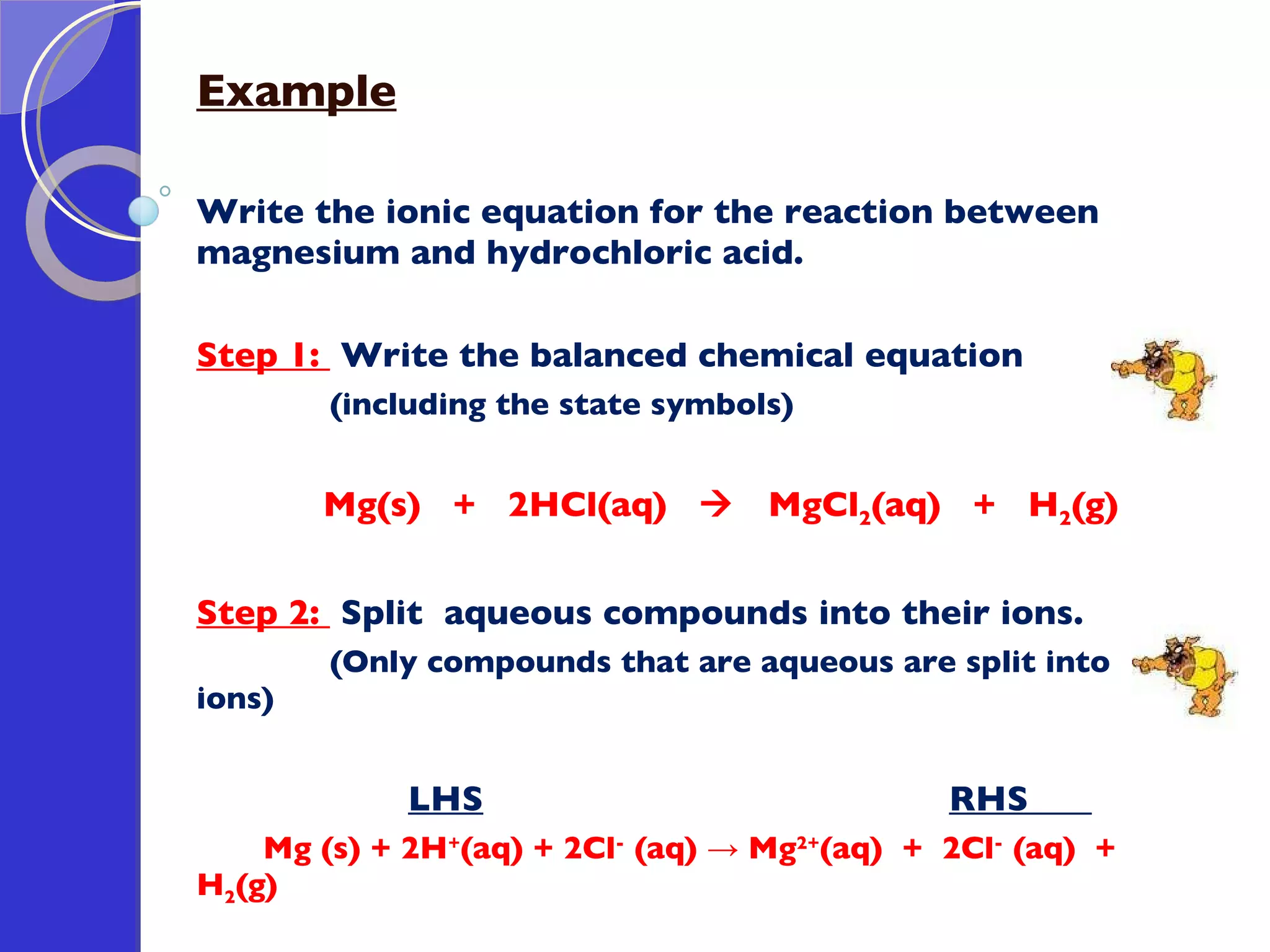
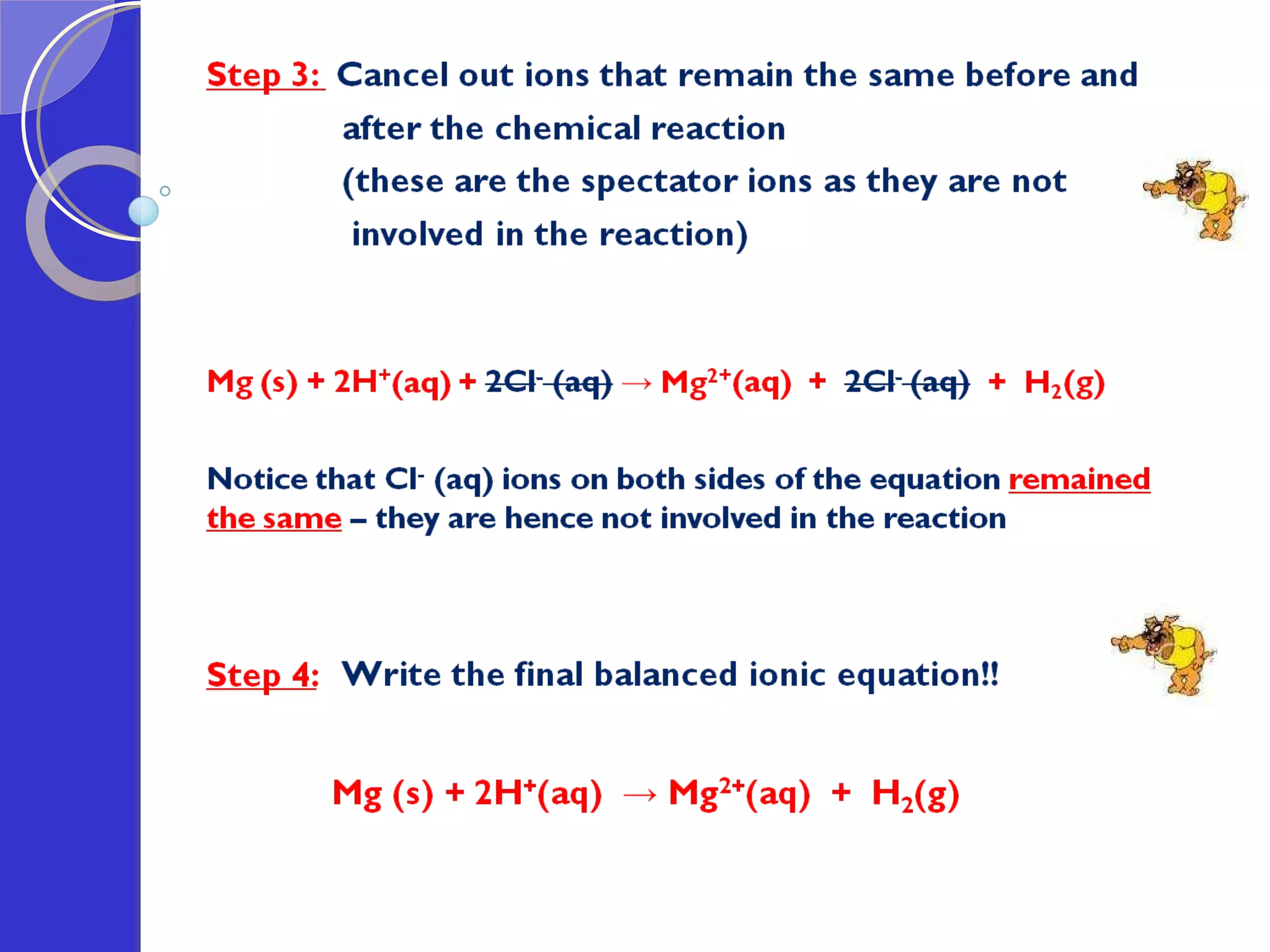
Example Write the ionic equation for the reaction between magnesium and hydrochloric acid. Step 1:  Write the balanced chemical equation (including the state symbols) Mg(s)  +  2HCl(aq)     MgCl 2 (aq)  +  H 2 (g) Step 2:  Split  aqueous compounds into their ions.  (Only compounds that are aqueous are split into ions) LHS   RHS  Mg (s) + 2H + (aq) + 2Cl -  (aq) ->  Mg 2 + (aq)  +  2Cl -  (aq)  +  H 2 (g)
 
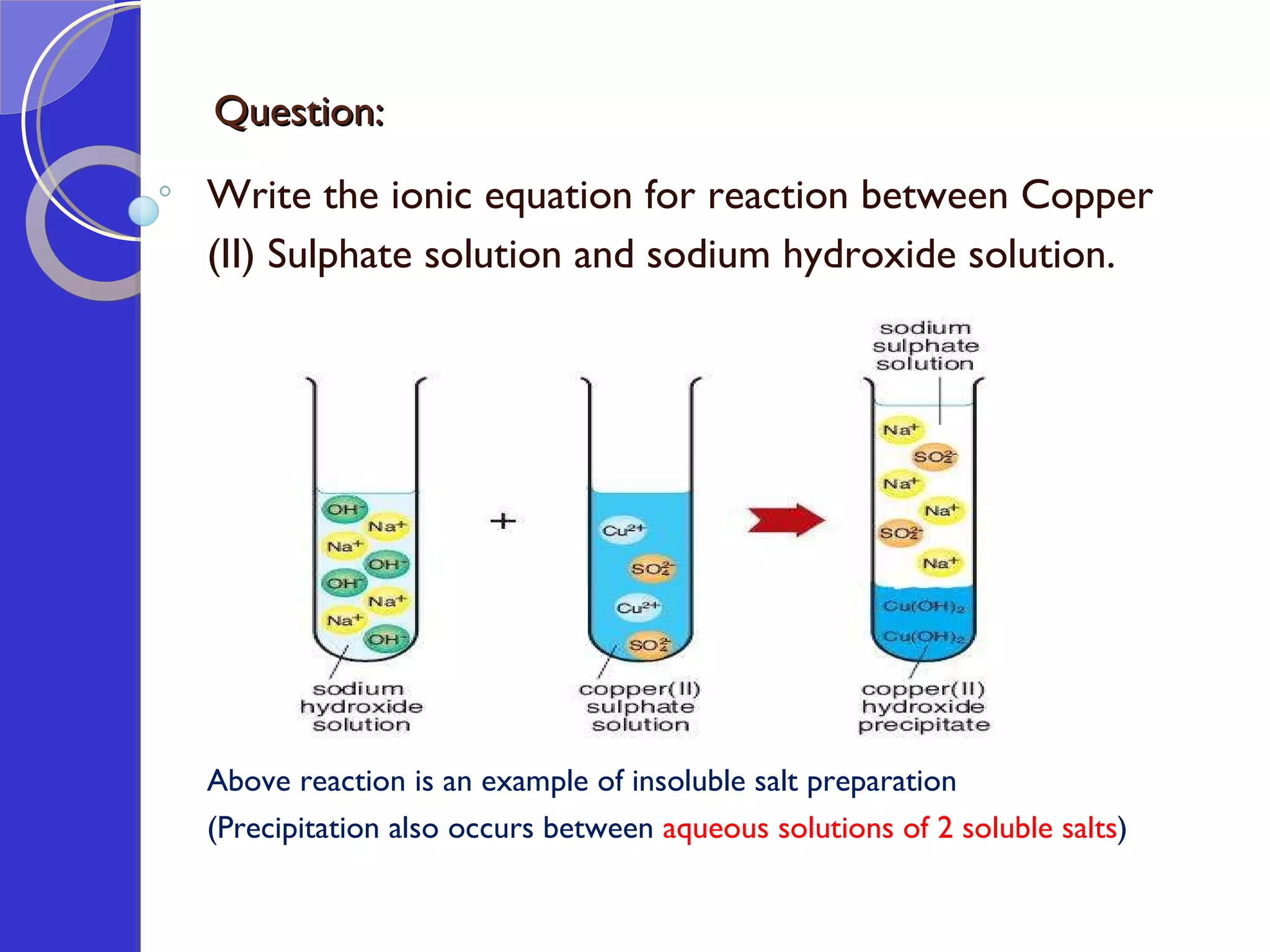
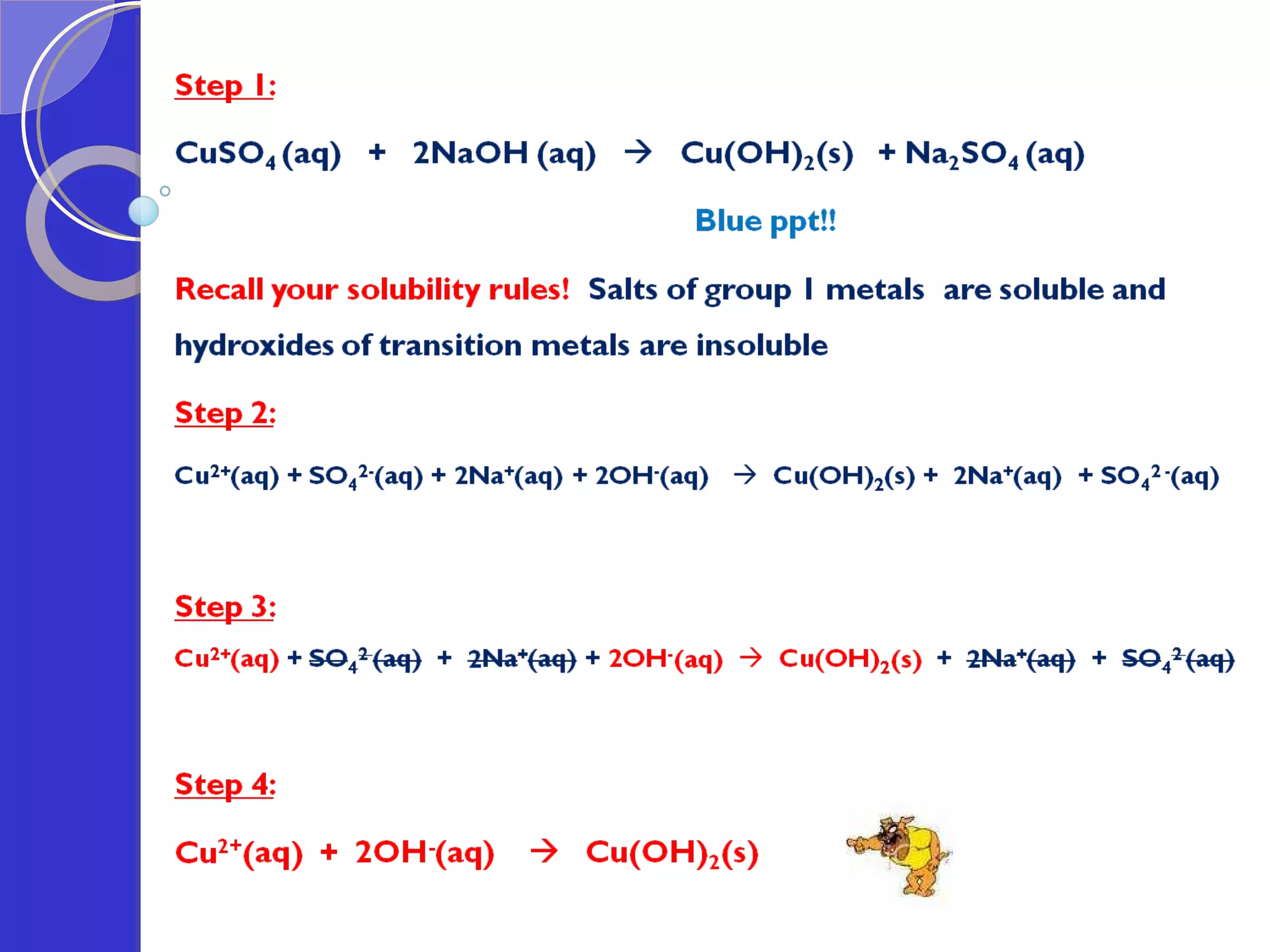
Question: Write the ionic equation for reaction between Copper (II) Sulphate solution and sodium hydroxide solution. Above reaction is an example of insoluble salt preparation (Precipitation also occurs between  aqueous solutions of 2 soluble salts )
 
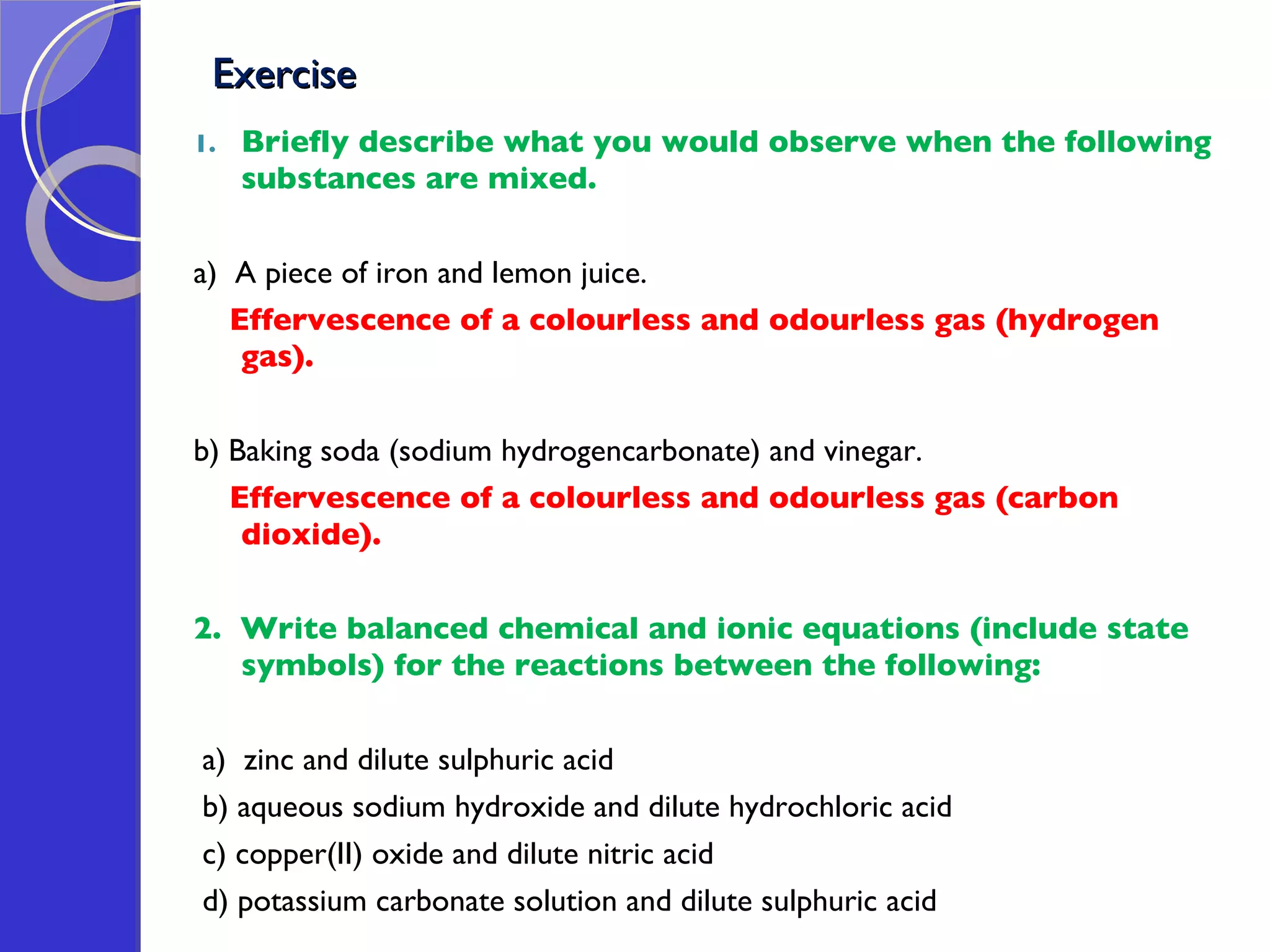
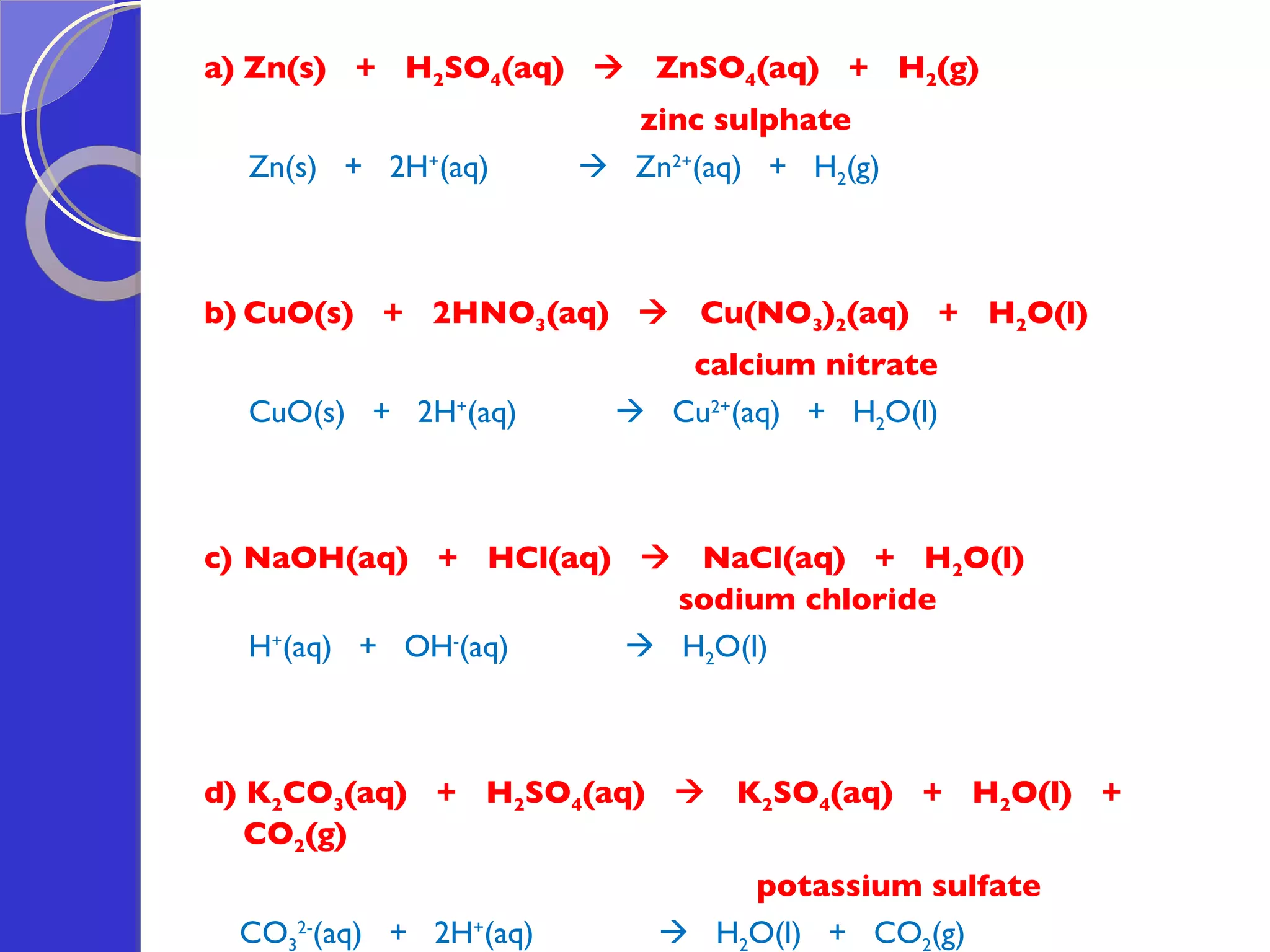
Exercise  Briefly describe what you would observe when the following substances are mixed. a)  A piece of iron and lemon juice. Effervescence of a colourless and odourless gas (hydrogen gas). b) Baking soda (sodium hydrogencarbonate) and vinegar. Effervescence of a colourless and odourless gas (carbon dioxide). 2.  Write balanced chemical and ionic equations (include state symbols) for the reactions between the following:  a)  zinc and dilute sulphuric acid b) aqueous sodium hydroxide and dilute hydrochloric acid c) copper(II) oxide and dilute nitric acid d) potassium carbonate solution and dilute sulphuric acid
a) Zn(s)  +  H 2 SO 4 (aq)     ZnSO 4 (aq)  +  H 2 (g)   zinc sulphate Zn(s)  +  2H + (aq)     Zn 2+ (aq)  +  H 2 (g)   b) CuO(s)  +  2HNO 3 (aq)     Cu(NO 3 ) 2 (aq)  +  H 2 O(l)   calcium nitrate CuO(s)  +  2H + (aq)     Cu 2+ (aq)  +  H 2 O(l) c) NaOH(aq)  +  HCl(aq)     NaCl(aq)  +  H 2 O(l)   sodium chloride H + (aq)  +  OH - (aq)     H 2 O(l) d) K 2 CO 3 (aq)  +  H 2 SO 4 (aq)     K 2 SO 4 (aq)  +  H 2 O(l)  +  CO 2 (g) potassium sulfate CO 3 2- (aq)  +  2H + (aq)     H 2 O(l)  +  CO 2 (g)
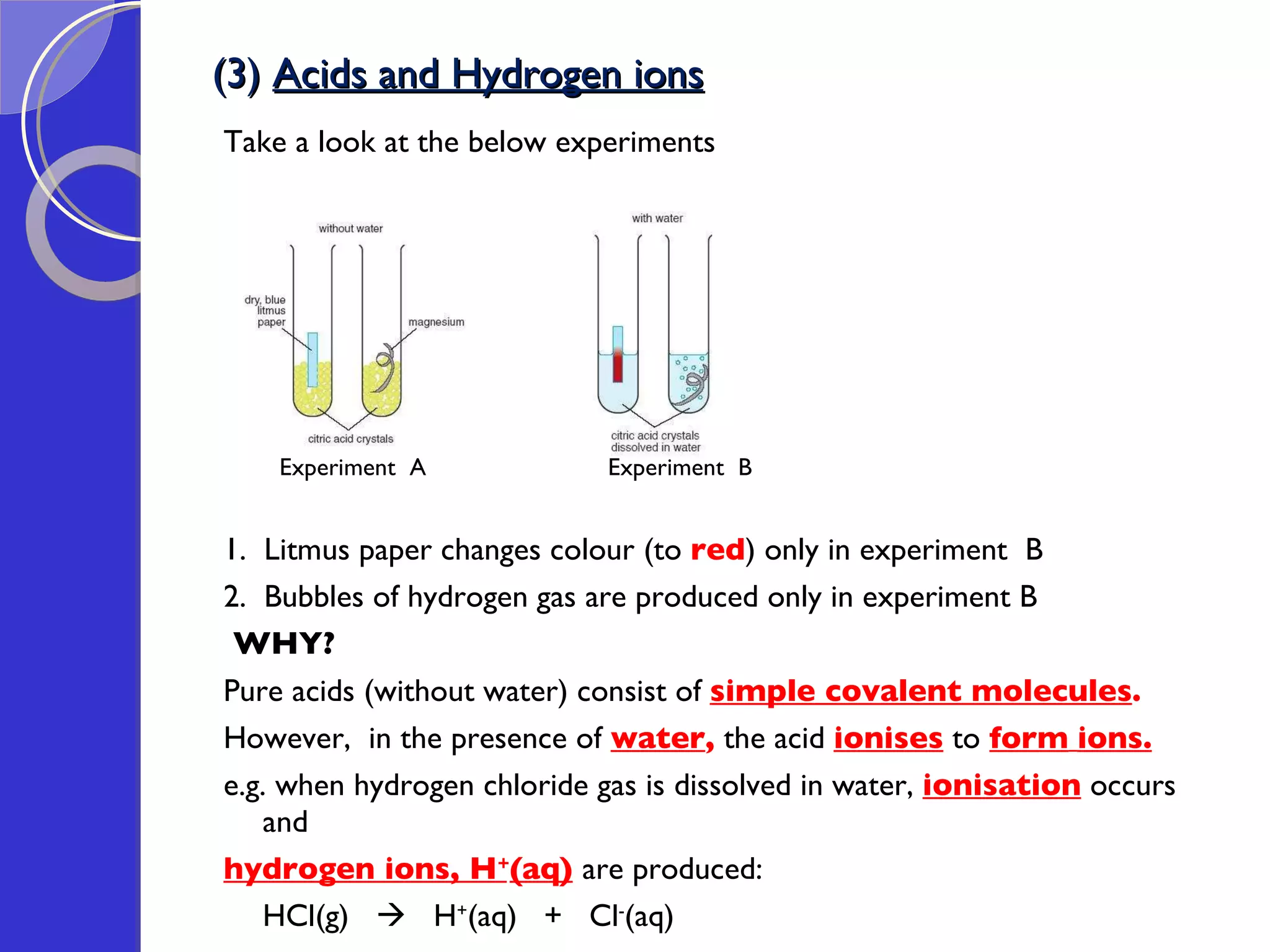
(3)  Acids and Hydrogen ions Take a look at the below experiments Experiment  A  Experiment  B 1.  Litmus paper changes colour (to  red ) only in experiment  B 2.  Bubbles of hydrogen gas are produced only in experiment B WHY? Pure acids (without water) consist of  simple covalent molecules . However,  in the presence of  water ,  the acid  ionises  to  form   ions. e.g. when hydrogen chloride gas is dissolved in water,  ionisation  occurs and  hydrogen ions, H + (aq)   are produced: HCl(g)     H + (aq)  +  Cl - (aq)
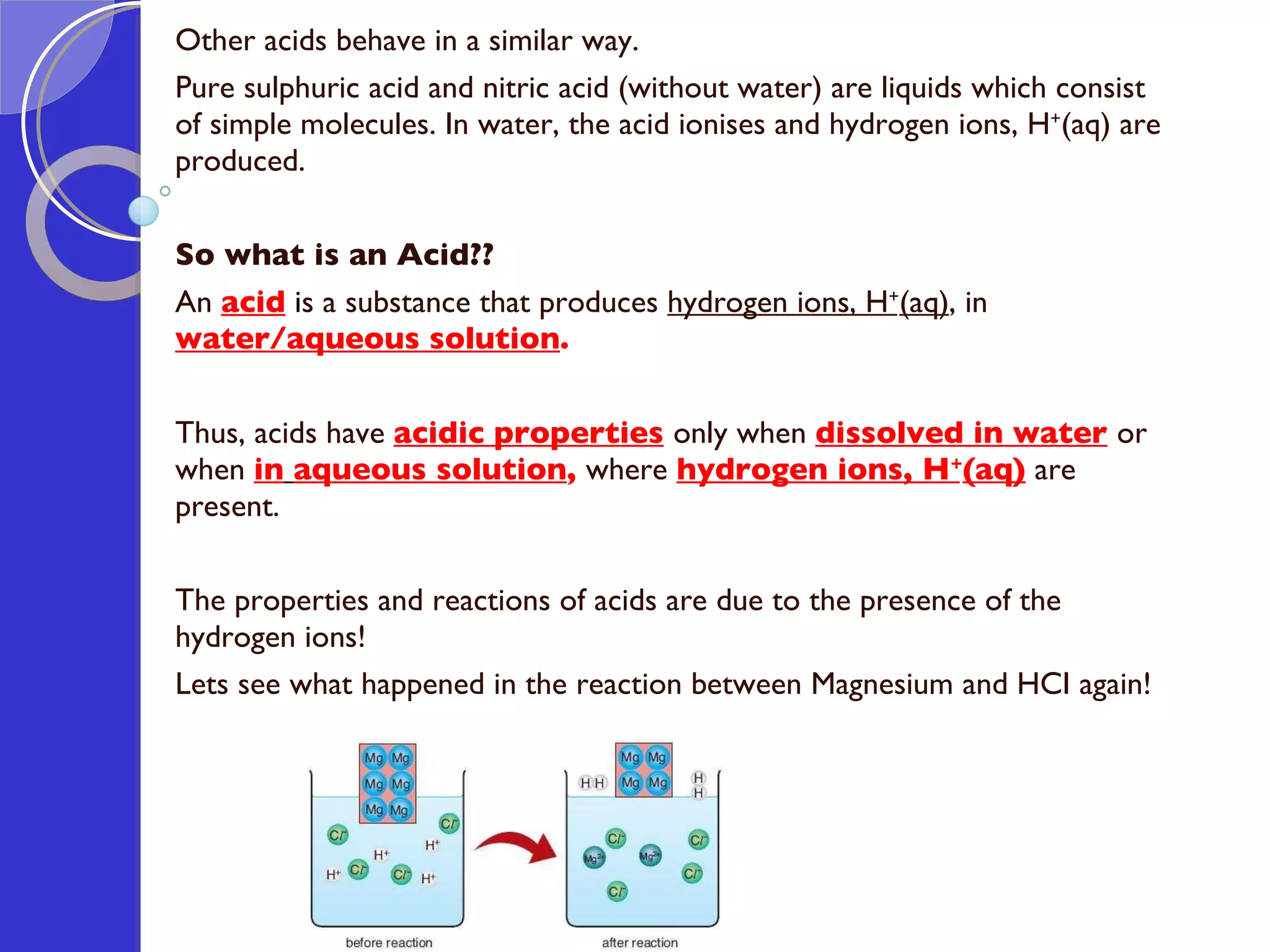
Other acids behave in a similar way.  Pure sulphuric acid and nitric acid (without water) are liquids which consist of simple molecules. In water, the acid ionises and hydrogen ions, H + (aq) are produced. So what is an Acid?? An  acid   i s a substance that produces  hydrogen ions, H + (aq) , in  water/aqueous solution . Thus, acids have  acidic properties   only when  dissolved in water   or when  in   aqueous solution ,  where  hydrogen ions, H + (aq)   are present. The properties and reactions of acids are due to the presence of the hydrogen ions! Lets see what happened in the reaction between Magnesium and HCI again!
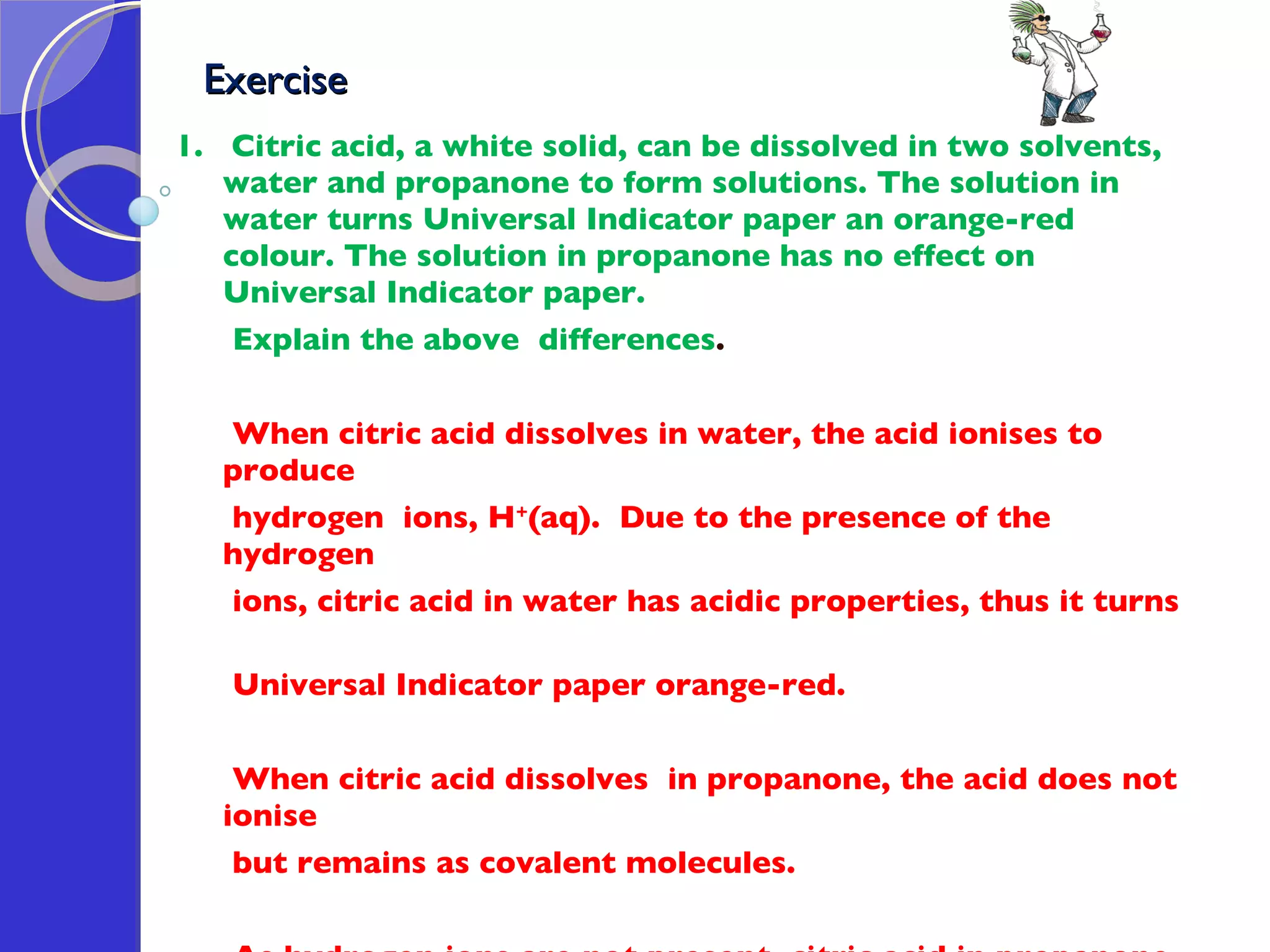
Exercise  1.  Citric acid, a white solid, can be dissolved in two solvents, water and propanone to form solutions. The solution in water turns Universal Indicator paper an orange-red colour. The solution in propanone has no effect on Universal Indicator paper.  Explain the above  differences . When citric acid dissolves in water, the acid ionises to produce  hydrogen  ions, H + (aq).  Due to the presence of the hydrogen ions, citric acid in water has acidic properties, thus it turns  Universal Indicator paper orange-red.  When citric acid dissolves  in propanone, the acid does not ionise  but remains as covalent molecules.  As hydrogen ions are not present, citric acid in propanone  does not have acidic properties, thus it has no effect on Universal  Indicator paper.
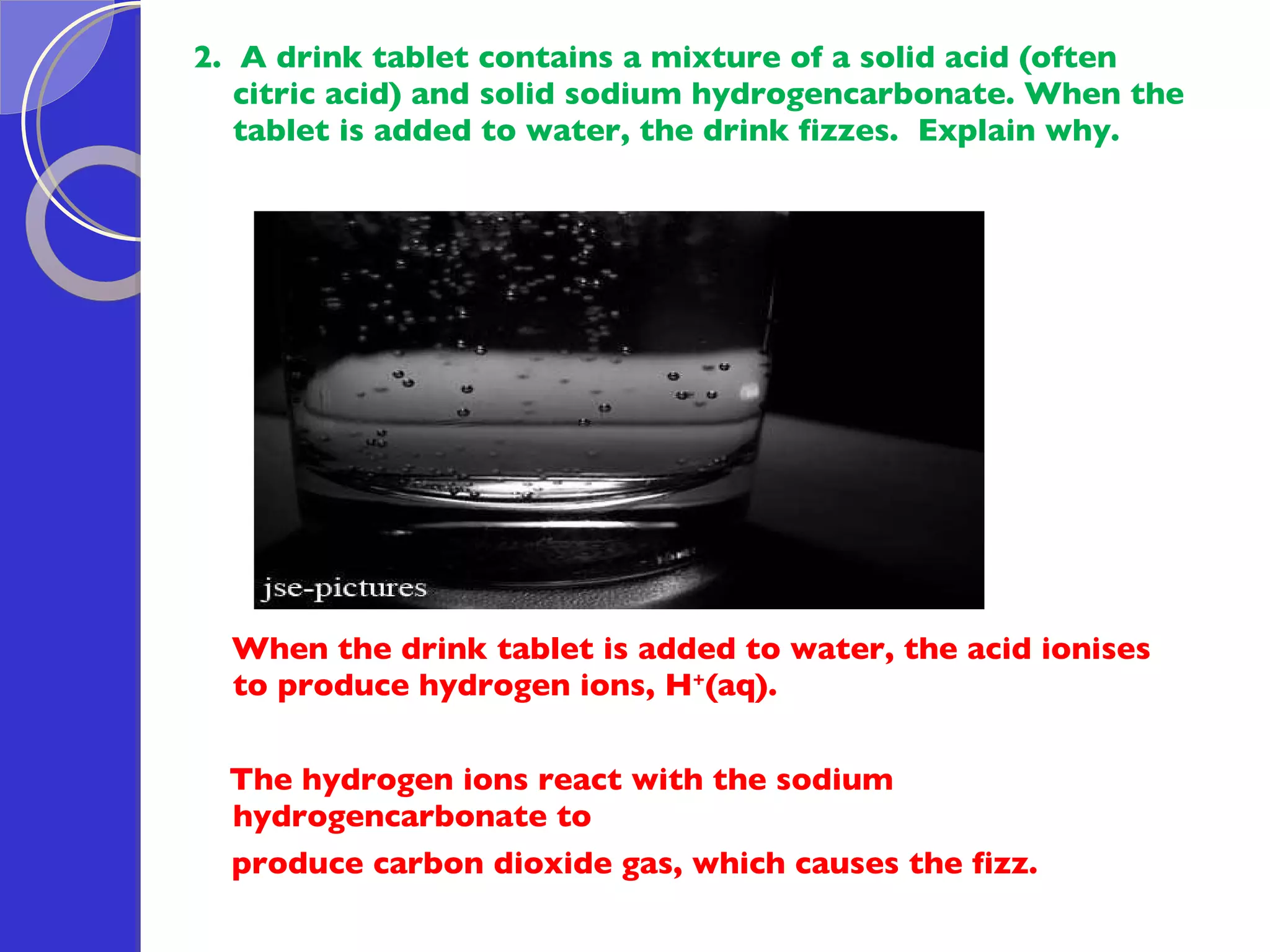
2.  A drink tablet contains a mixture of a solid acid (often citric acid) and solid sodium hydrogencarbonate. When the tablet is added to water, the drink fizzes.  Explain why. When the drink tablet is added to water, the acid ionises to produce hydrogen ions, H + (aq).  The hydrogen ions react with the sodium hydrogencarbonate to produce carbon dioxide gas, which causes the fizz.
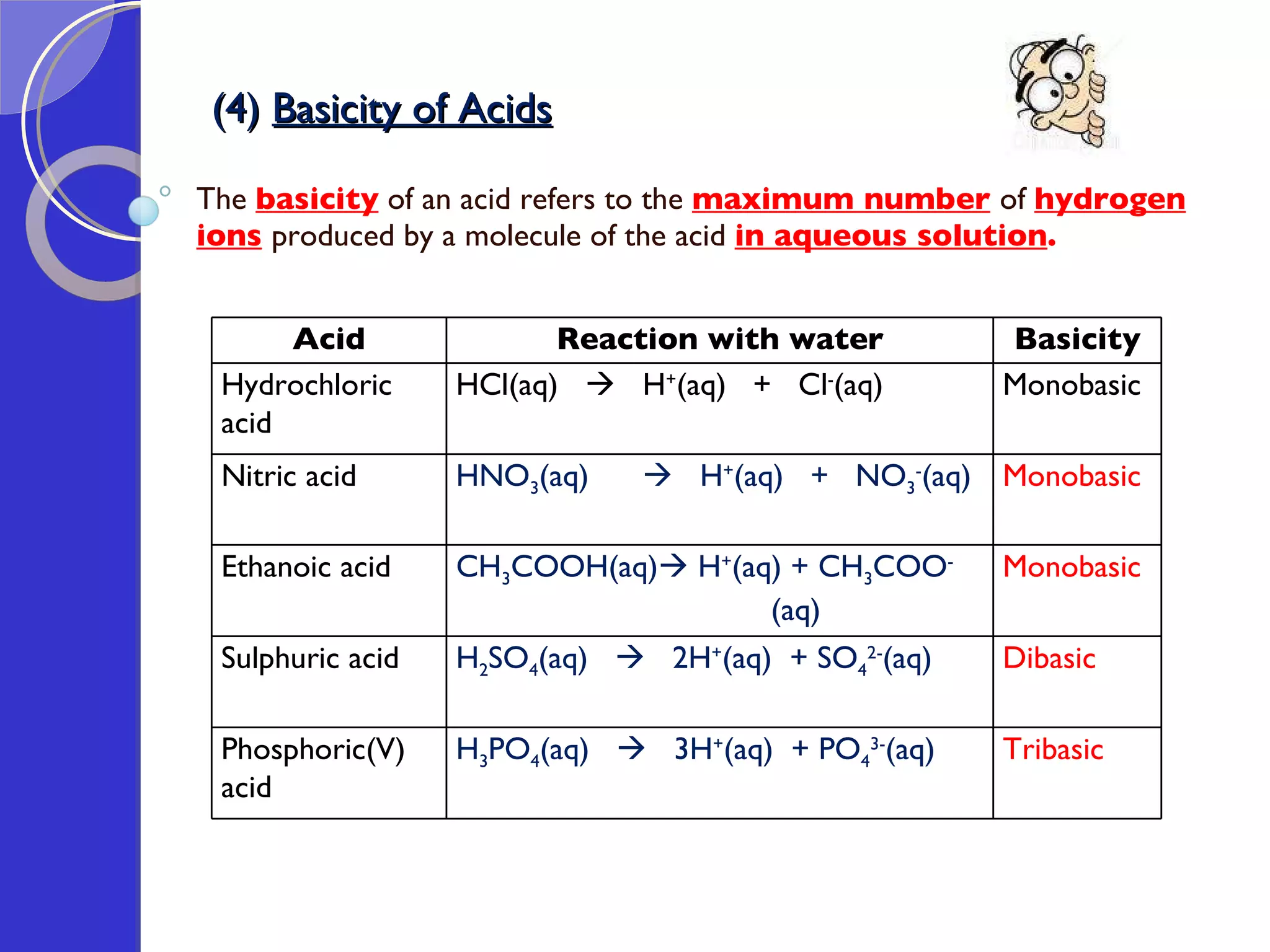
(4)  Basicity of Acids The  basicity  of an acid refers to the  maximum number   of  hydrogen ions   produced by a molecule of the acid  in aqueous solution .   Acid Reaction with water Basicity Hydrochloric acid HCl(aq)     H + (aq)  +  Cl - (aq) Monobasic Nitric acid HNO 3 (aq)     H + (aq)  +  NO 3 - (aq) Monobasic Ethanoic acid CH 3 COOH(aq)   H + (aq) + CH 3 COO -  (aq) Monobasic Sulphuric acid H 2 SO 4 (aq)     2H + (aq)  + SO 4 2- (aq) Dibasic Phosphoric(V) acid H 3 PO 4 (aq)     3H + (aq)  + PO 4 3- (aq) Tribasic
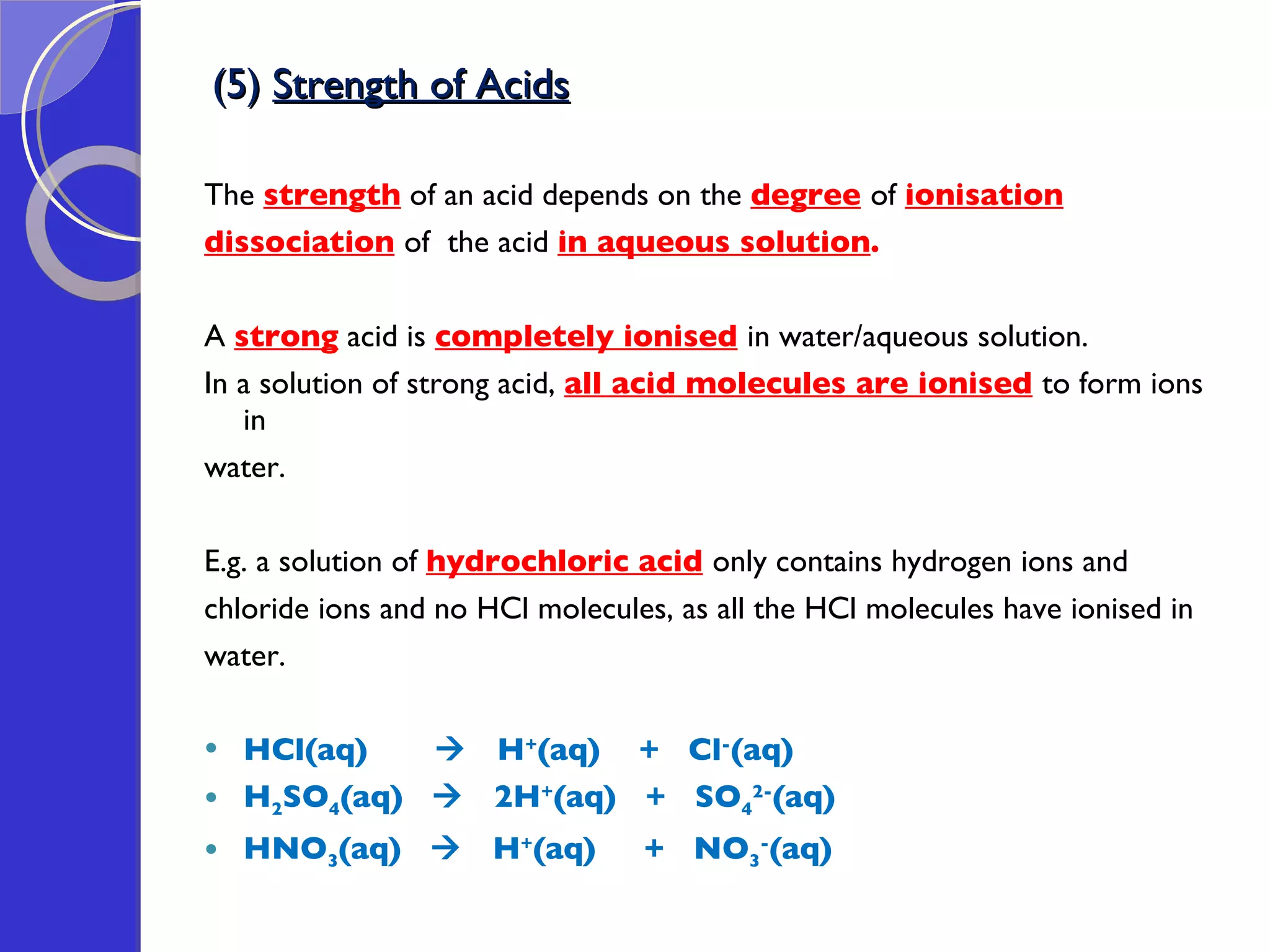
(5)  Strength of Acids The  strength  of an acid depends on the  degree   of  ionisation dissociation   of  the acid  in aqueous solution .   A  strong   acid is  completely ionised   in water/aqueous solution. In a solution of strong acid,  all acid molecules are ionised   to form ions in  water. E.g. a solution of  hydrochloric acid   only contains hydrogen ions and  chloride ions and no HCl molecules, as all the HCl molecules have ionised in  water.  HCl(aq)     H + (aq)  +  Cl - (aq) H 2 SO 4 (aq)     2H + (aq)  +  SO 4 2- (aq) HNO 3 (aq)     H + (aq)  +  NO 3 - (aq)
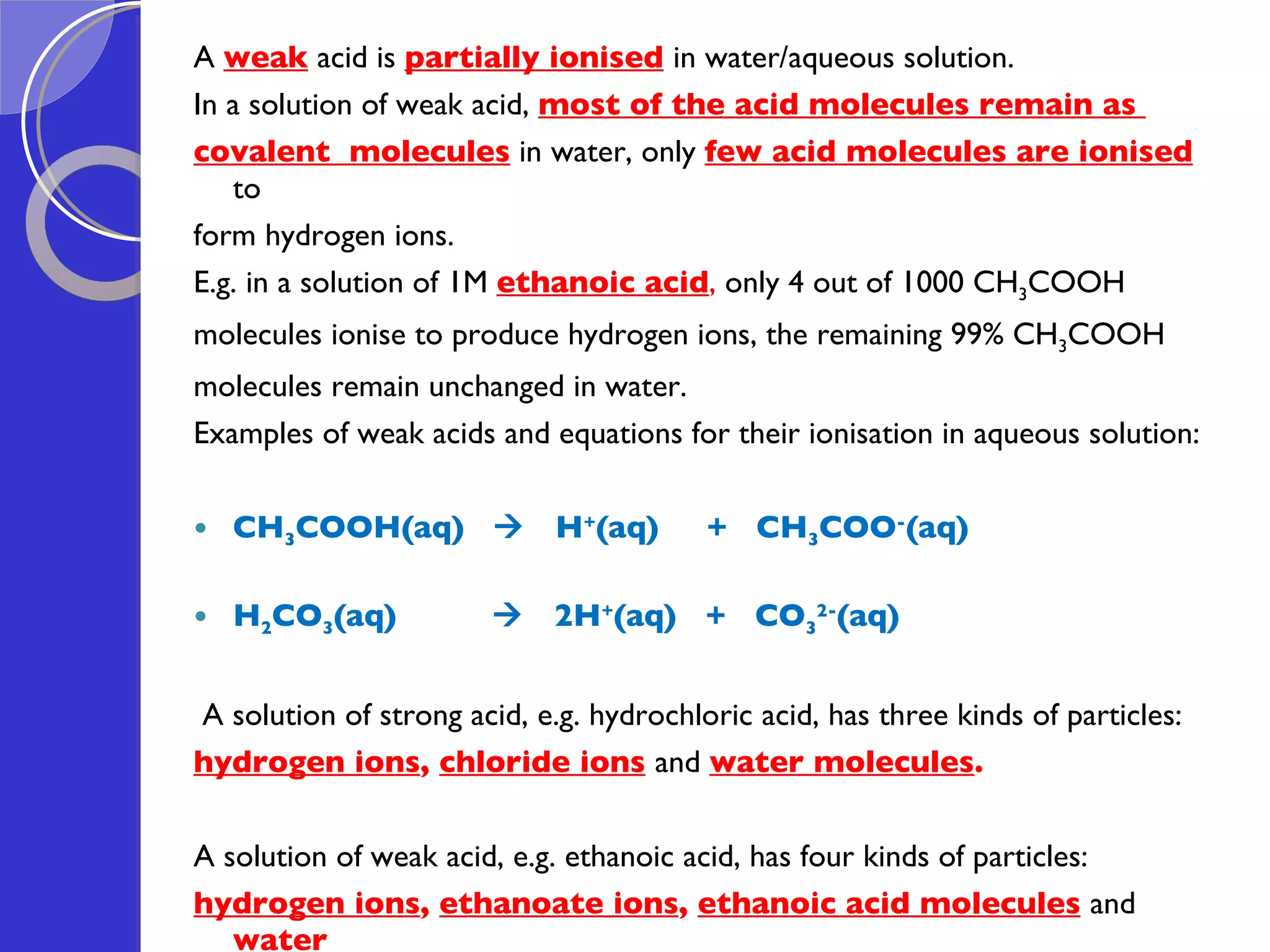
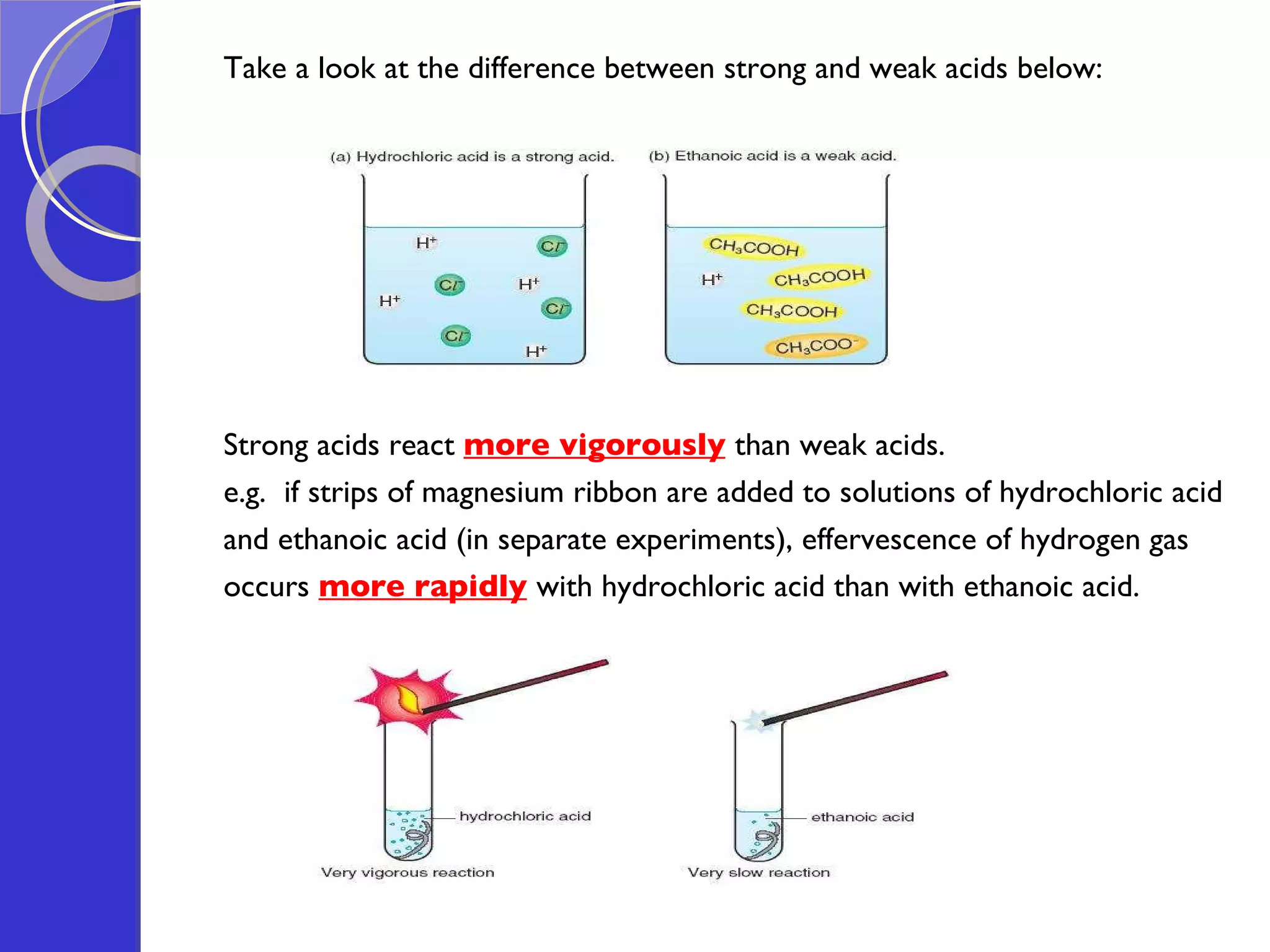
A  weak  acid is  partially ionised   in water/aqueous solution. In a solution of weak acid,  most of the acid molecules remain as  covalent  molecules   in water, only  few acid molecules are ionised   to  form hydrogen ions. E.g. in a solution of 1M  ethanoic acid ,  only 4 out of 1000 CH 3 COOH  molecules ionise to produce hydrogen ions, the remaining 99% CH 3 COOH molecules remain unchanged in water. Examples of weak acids and equations for their ionisation in aqueous solution: CH 3 COOH(aq)     H + (aq)  +  CH 3 COO - (aq) H 2 CO 3 (aq)     2H + (aq)  +  CO 3 2- (aq)     A solution of strong acid, e.g. hydrochloric acid, has three kinds of particles:  hydrogen ions ,  chloride ions   and  water molecules .   A solution of weak acid, e.g. ethanoic acid, has four kinds of particles:  hydrogen ions ,  ethanoate ions ,  ethanoic acid molecules   and  water  molecules .
Take a look at the difference between strong and weak acids below: Strong acids react  more vigorously   than weak acids. e.g.  if strips of magnesium ribbon are added to solutions of hydrochloric acid and ethanoic acid (in separate experiments), effervescence of hydrogen gas  occurs  more rapidly   with hydrochloric acid than with ethanoic acid.
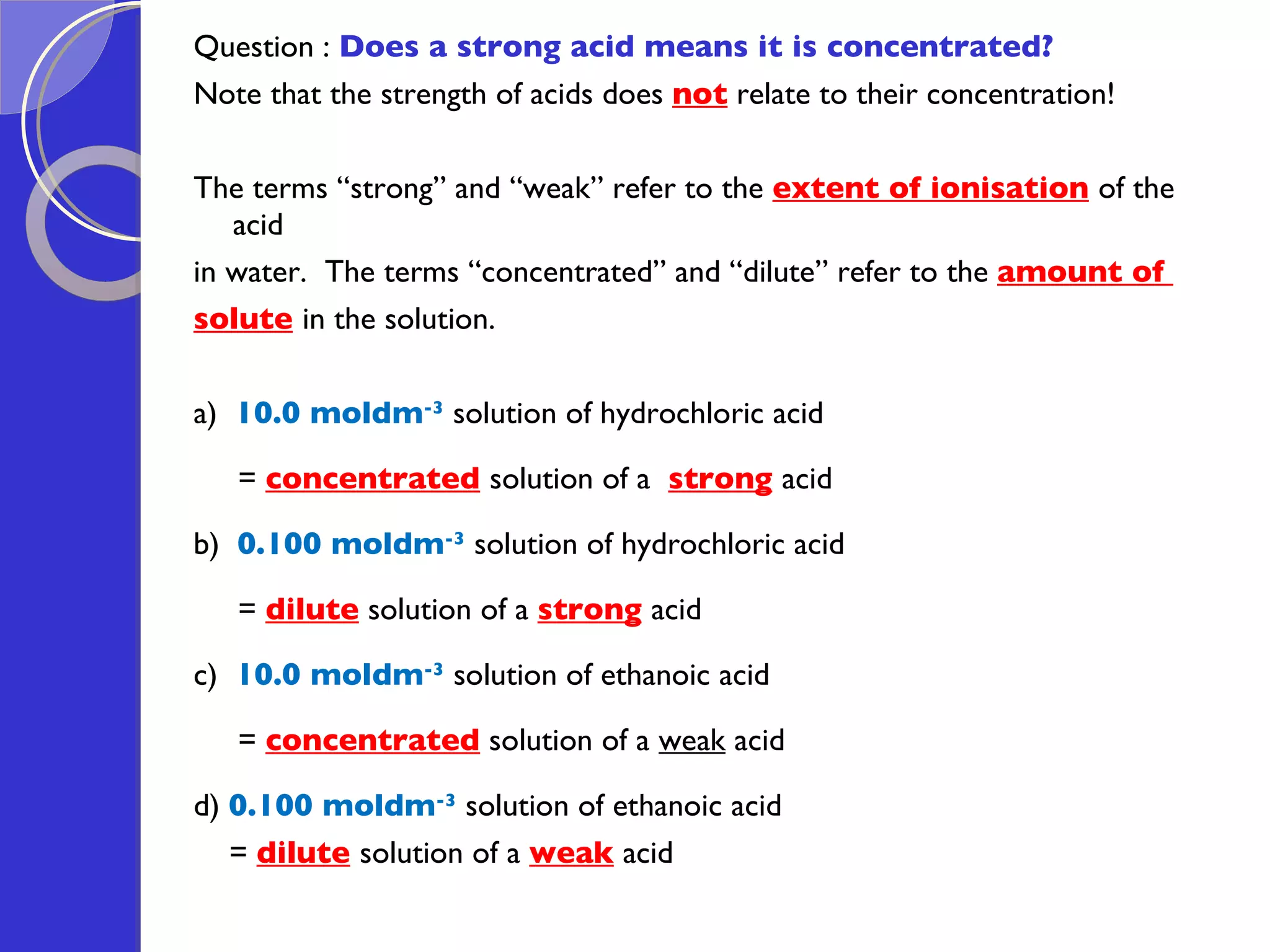
Question :  Does a strong acid means it is concentrated? Note that the strength of acids does  not  relate to their concentration! The terms “strong” and “weak” refer to the  extent of ionisation   of the acid  in water.   The terms “concentrated” and “dilute” refer to the  amount of  solute   in the solution.   a)  10.0 moldm -3   solution of hydrochloric acid  =   concentrated   solution of a  strong   acid b)  0.100 moldm -3   solution of hydrochloric acid  =  dilute  solution of a  strong   acid c)  10.0 moldm -3   solution of ethanoic acid  =  concentrated  solution of a  weak  acid d)  0.100 moldm -3   solution of ethanoic acid  =  dilute   solution of a  weak   acid
Question: a)  Is  H 2 SO 4 (l)  a good conduct of electricity? b)  Is  H 2 SO 4 (aq)  a good conduct of electricity? a)  No. Pure sulphuric acid (no water) consist of small  covalent molecules,  hence are poor electrical  conductors. b) Yes! (acids in water act as strong  electrolyte ) Why?  H 2 SO 4 (aq)     2H + (aq)  +  SO 4 2- (aq) Acids in water contain moving ions that could carry the electric current!
Question: How do strength and concentration affect conduction of  electricity? Explain why   dilute   sulphuric acid conducts electricity  better than   concentrated  sulphuric acid. In dilute sulphuric acid, the acid ionizes completely to  produce a high concentration of ions which move freely  to conduct electricity. In concentrated sulphuric acid, due to small amount of water  present, the acid is only partially ionized (although it is still a  strong acid), thus there are much less number of free-moving  ions present to conduct electricity.
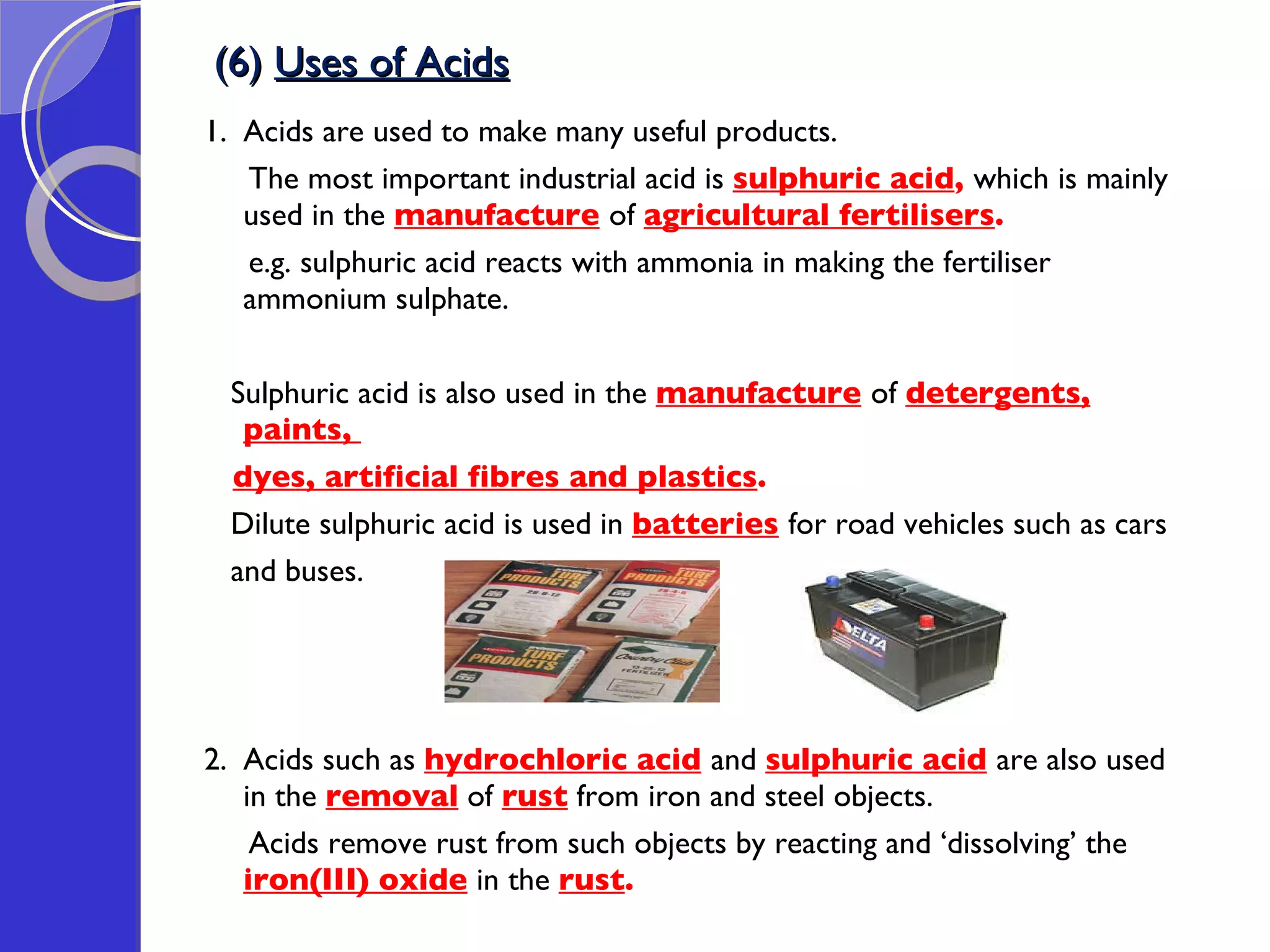
(6)  Uses of Acids 1.  Acids are used to make many useful products.  The most important industrial acid is  sulphuric acid ,  which is mainly used in the  manufacture   of  agricultural fertilisers .  e.g. sulphuric acid reacts with ammonia in making the fertiliser ammonium sulphate.  Sulphuric acid is also used in the  manufacture   of  detergents, paints,  dyes, artificial fibres and plastics .  Dilute sulphuric acid is used in  batteries   for road vehicles such as cars  and buses. 2.  Acids such as  hydrochloric acid   and  sulphuric acid   are also used in the  removal  of  rust  from iron and steel objects.  Acids remove rust from such objects by reacting and ‘dissolving’ the  iron(III) oxide  in the  rust .
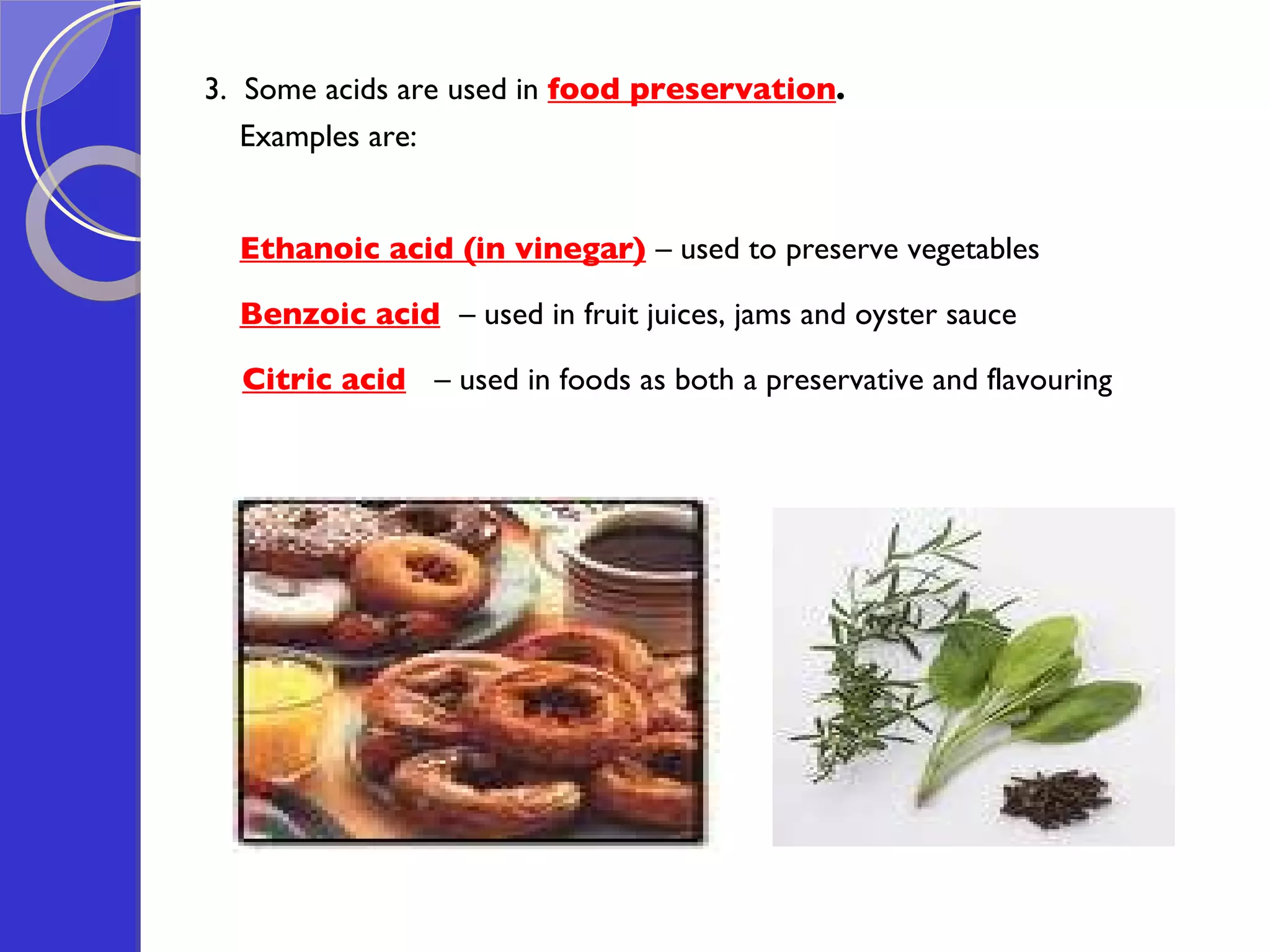
3.  Some acids are used in  food preservation .  Examples are: Ethanoic acid (in vinegar)   – used to preserve vegetables Benzoic acid   – used in fruit juices, jams and oyster sauce Citric acid   – used in foods as both a preservative and flavouring
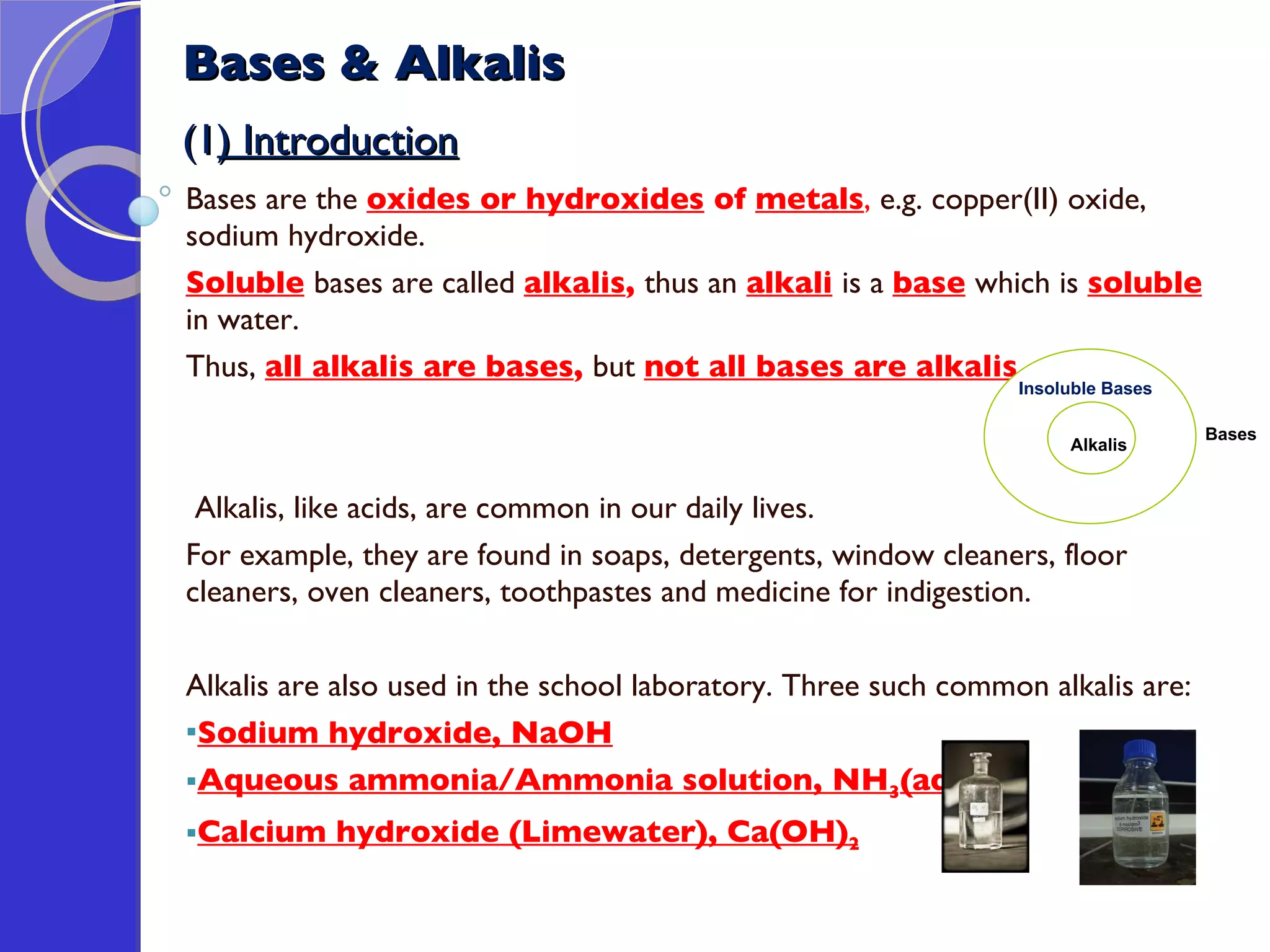
Bases & Alkalis (1 ) Introduction Bases are the  oxides or hydroxides  of  metals ,  e.g. copper(II) oxide, sodium hydroxide. Soluble   bases are called  alkalis ,  thus an  alkali   is a  base   which is  soluble   in water. Thus,  all alkalis are bases ,  but  not all bases are alkalis .   Alkalis, like acids, are common in our daily lives.  For example, they are found in soaps, detergents, window cleaners, floor cleaners, oven cleaners, toothpastes and medicine for indigestion. Alkalis are also used in the school laboratory. Three such common alkalis are: Sodium hydroxide, NaOH Aqueous ammonia/Ammonia solution, NH 3 (aq) Calcium hydroxide (Limewater), Ca(OH) 2   Insoluble Bases  Alkalis   Bases
(2)  Properties Of Dilute Alkalis 1.  Dilute solutions of alkalis have a  ‘slippery’ feel 2.  Alkalis are  hazardous   and like dilute acids, dilute solutions of sodium hydroxide and potassium hydroxide are  irritants . 3.  Concentrated solutions of sodium hydroxide and potassium hydroxide are  corrosive   and burn skin.  4.  Alkalis  change   the  colour   of indicators, e.g. alkalis turn  red   litmus  blue .  5.  Alkalis react with   acids   to form  a salt and water ,  in a reaction called  neutralisation . 6.  Alkalis react with  (solid) ammonium salts   on  warming  to produce  ammonia   gas. NH 4 Cl(s)  +  NaOH(aq)     NaCl(aq)  +  H 2 O(l)  +  NH 3 (g)
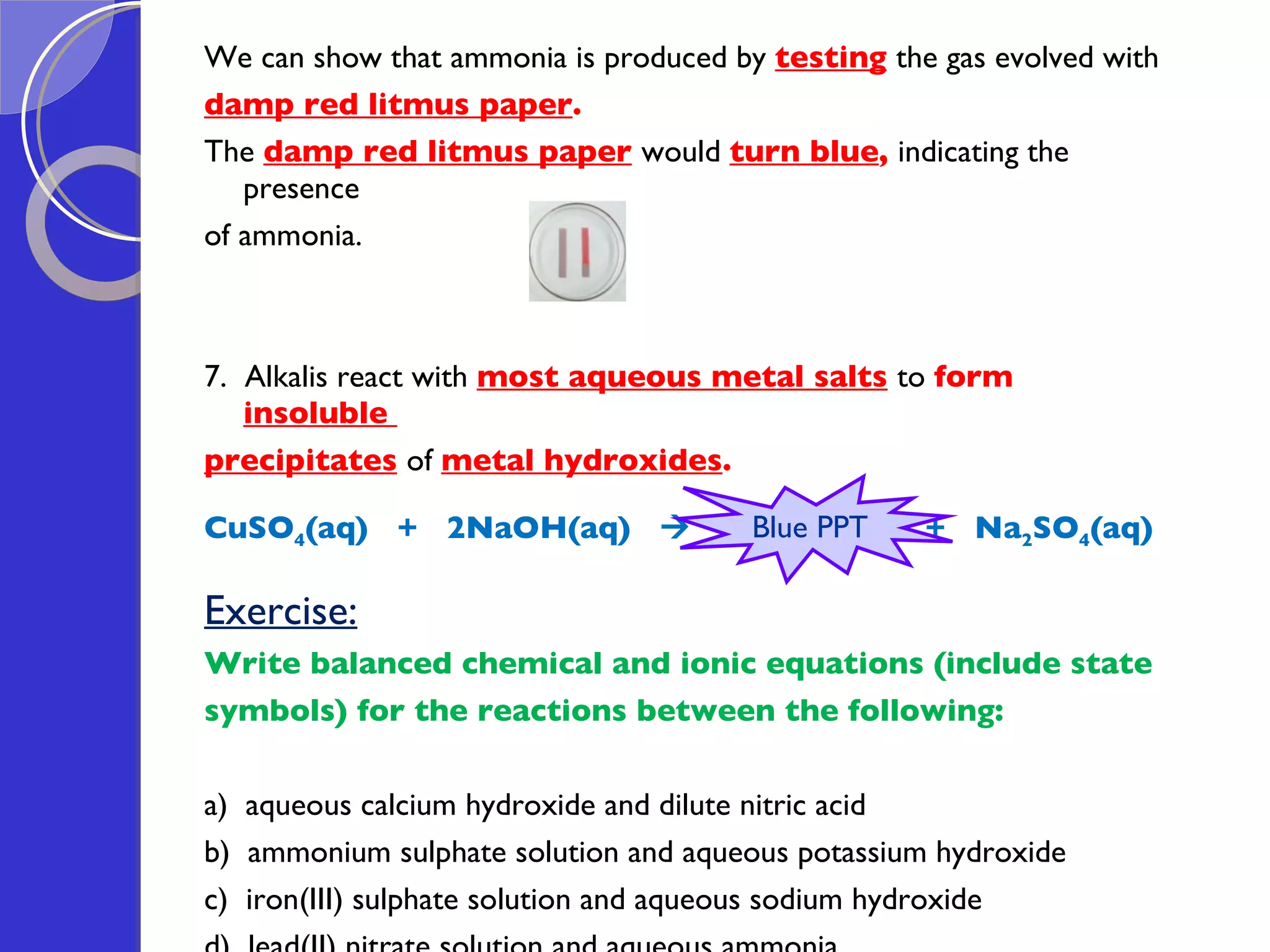
We can show that ammonia is produced by  testing   the gas evolved with  damp red litmus paper .  The  damp red litmus paper   would  turn blue ,  indicating the presence  of ammonia.  7.  Alkalis react with  most aqueous metal salts   to  form  insoluble  precipitates   of  metal hydroxides .  CuSO 4 (aq)  +  2NaOH(aq)     Cu(OH) 2 (s)  +  Na 2 SO 4 (aq) Exercise: Write balanced chemical and ionic equations (include state  symbols) for the reactions between the following:  a)  aqueous calcium hydroxide and dilute nitric acid b)  ammonium sulphate solution and aqueous potassium hydroxide c)  iron(III) sulphate solution and aqueous sodium hydroxide d)  lead(II) nitrate solution and aqueous ammonia  Blue PPT
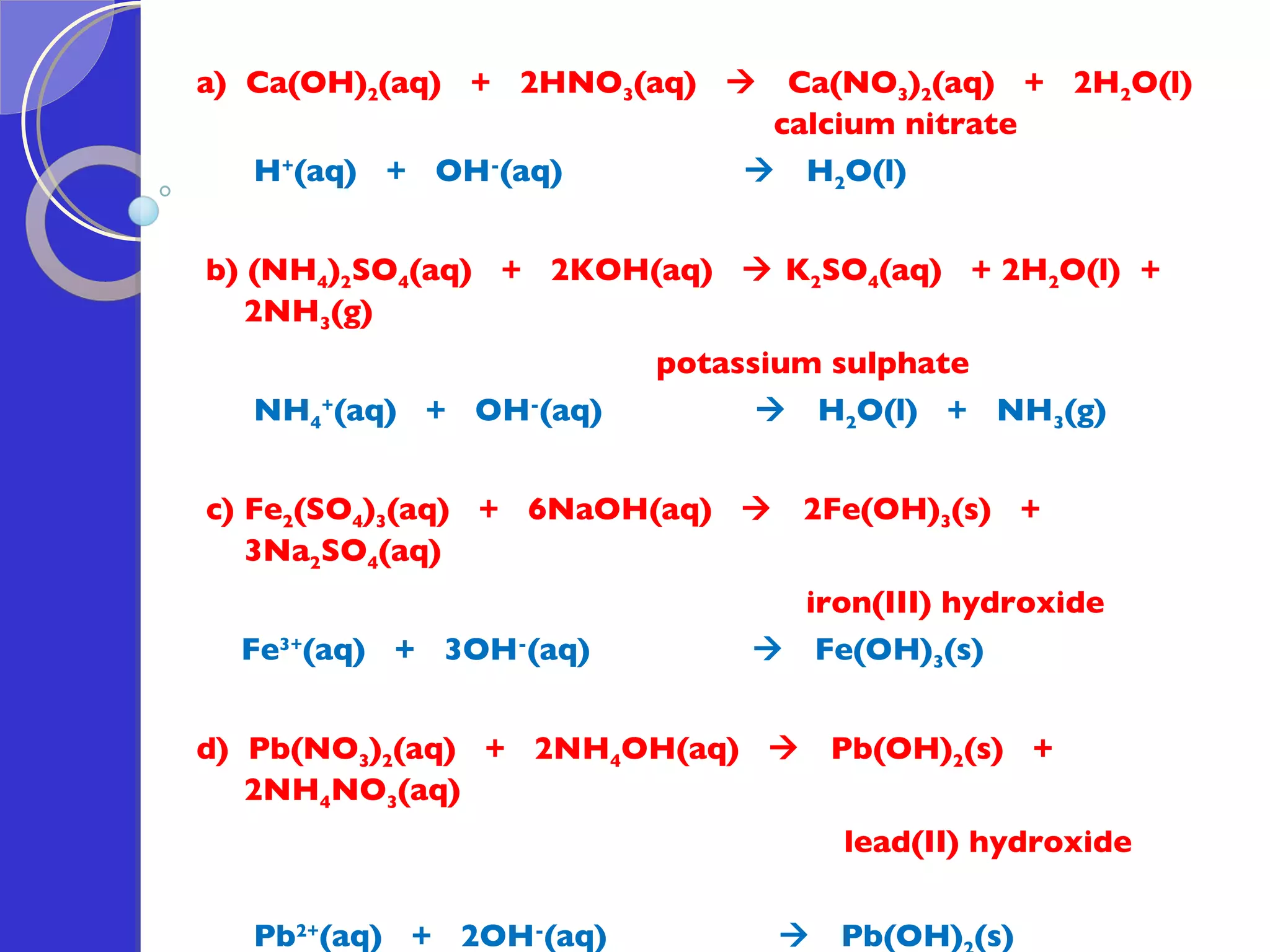
a)  Ca(OH) 2 (aq)  +  2HNO 3 (aq)     Ca(NO 3 ) 2 (aq)  +  2H 2 O(l)   calcium nitrate H + (aq)  +  OH - (aq)     H 2 O(l)     b) (NH 4 ) 2 SO 4 (aq)  +  2KOH(aq)    K 2 SO 4 (aq)  + 2H 2 O(l)  + 2NH 3 (g)   potassium sulphate NH 4 + (aq)  +  OH - (aq)     H 2 O(l)  +  NH 3 (g) c) Fe 2 (SO 4 ) 3 (aq)  +  6NaOH(aq)     2Fe(OH) 3 (s)  +  3Na 2 SO 4 (aq) iron(III) hydroxide Fe 3+ (aq)  +  3OH - (aq)     Fe(OH) 3 (s)   d)  Pb(NO 3 ) 2 (aq)  +  2NH 4 OH(aq)     Pb(OH) 2 (s)  +  2NH 4 NO 3 (aq) lead(II) hydroxide Pb 2+ (aq)  +  2OH - (aq)     Pb(OH) 2 (s)    
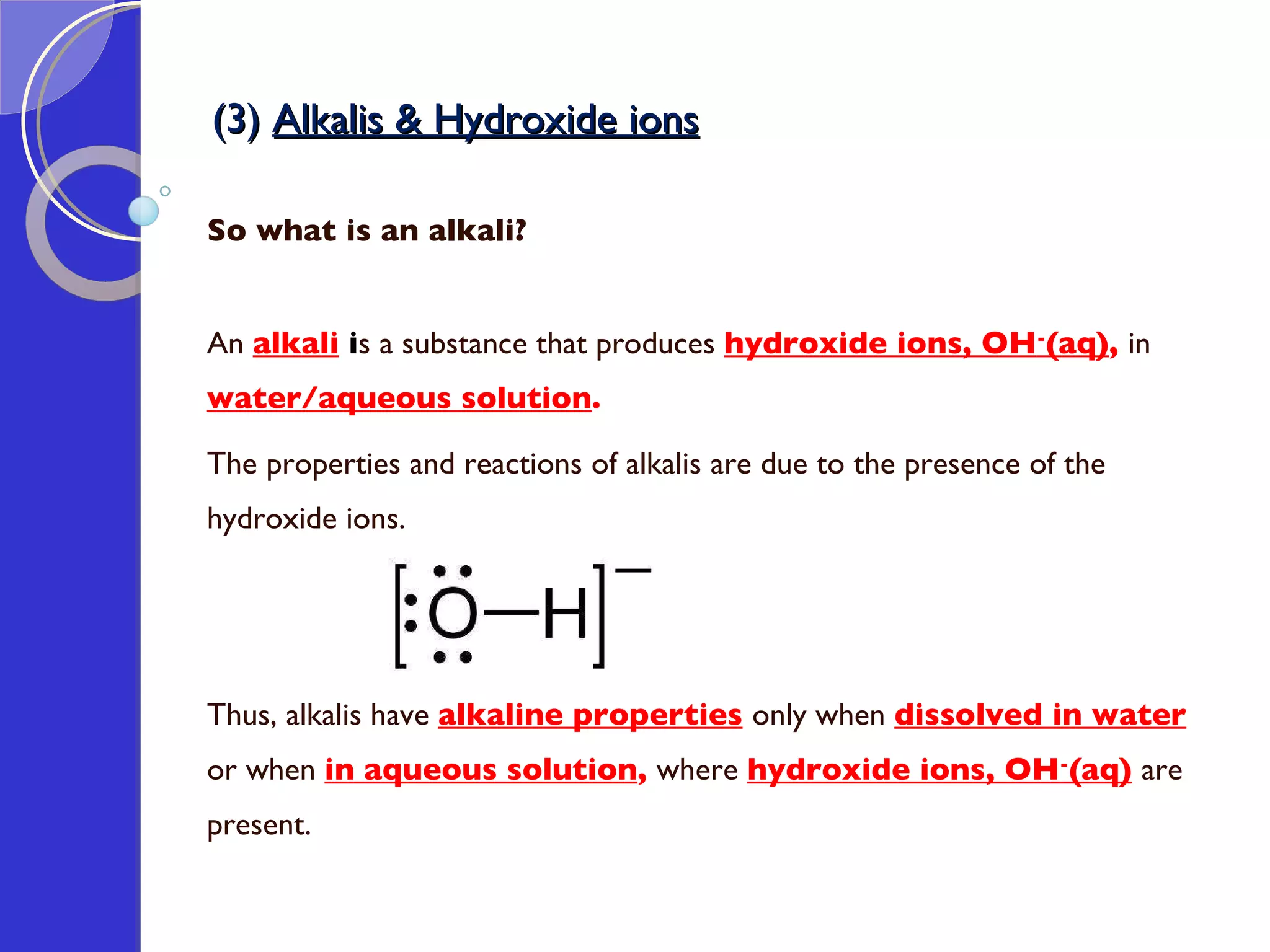
(3)  Alkalis & Hydroxide ions So what is an alkali? An  alkali   i s a substance that produces  hydroxide ions, OH - (aq) ,  in  water/aqueous solution .  The properties and reactions of alkalis are due to the presence of the hydroxide ions.  Thus, alkalis have  alkaline properties   only when  dissolved in water   or when  in aqueous solution ,  where  hydroxide ions, OH - (aq)   are present.
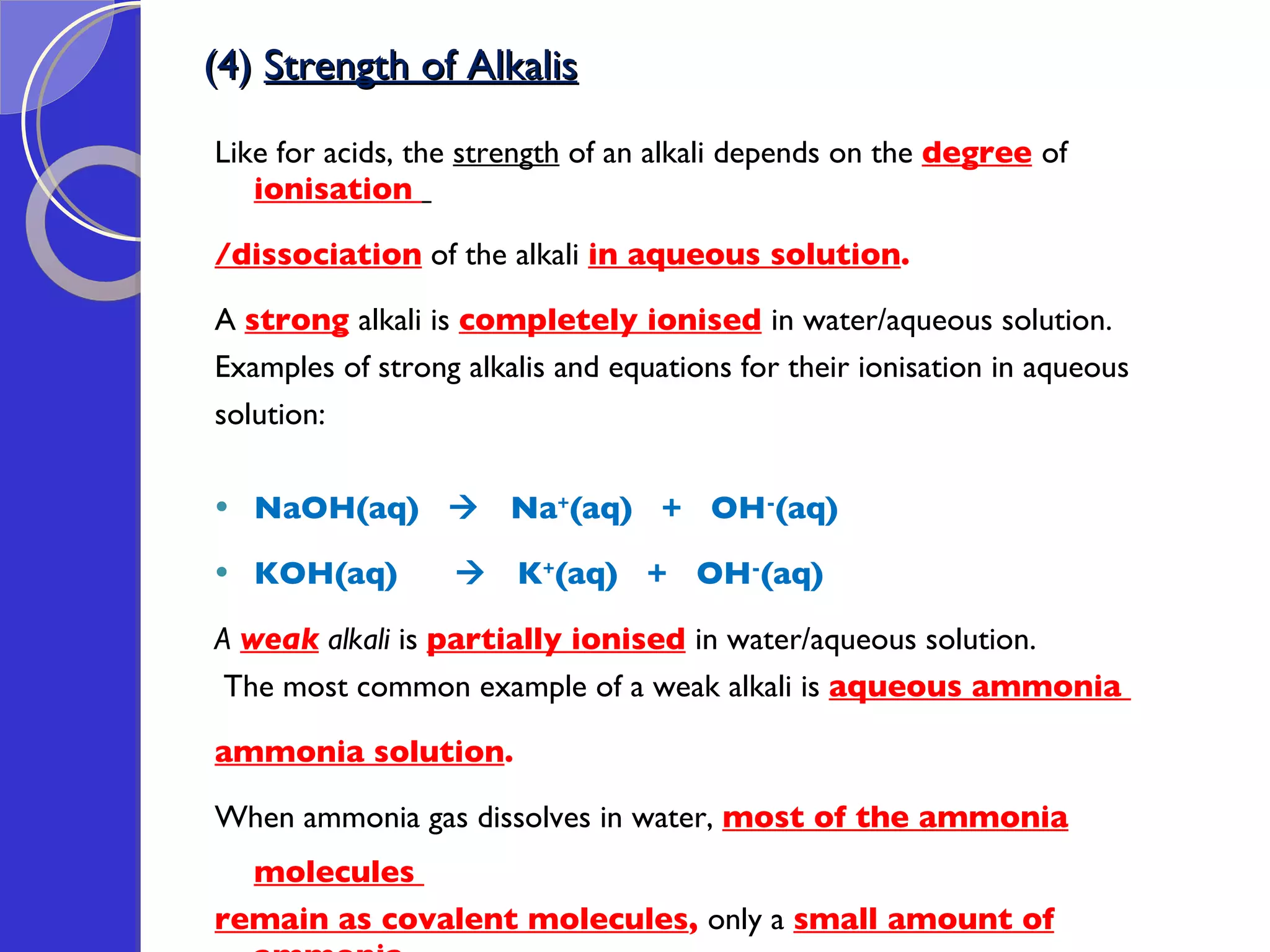
(4)  Strength of Alkalis Like for acids, the  strength  of an alkali depends on the  degree   of  ionisation  /dissociation  of the alkali  in aqueous solution .  A  strong   alkali is  completely ionised   in water/aqueous solution. Examples of strong alkalis and equations for their ionisation in aqueous  solution: NaOH(aq)     Na + (aq)  +  OH - (aq) KOH(aq)     K + (aq)  +  OH - (aq) A  weak  alkali  is  partially ionised   in water/aqueous solution.   The most common example of a weak alkali is  aqueous ammonia  ammonia solution .  When ammonia gas dissolves in water,  most of the ammonia molecules  remain as covalent molecules ,  only a  small amount of ammonia  molecules are ionised  to form hydroxide ions:   
(5)  Uses of Alkalis 1.  An alkali,  calcium hydroxide (slaked lime) ,  or the base  calcium oxide  (quicklime)   are added by farmers to  neutralise excess acids   in  soils   that  have become  too acidic   from extensive use of chemical fertilizers (e.g.  ammonium sulphate) and from acid rain.  2.  Mild alkalis are used in medicine such as  antacid  to  relieve   the  pain of  indigestion   as caused by  excess acid   in the  stomach .  Antacid contains a base such as  magnesium hydroxide   or  aluminium  hydroxide   that  neutralises  the excess acid.
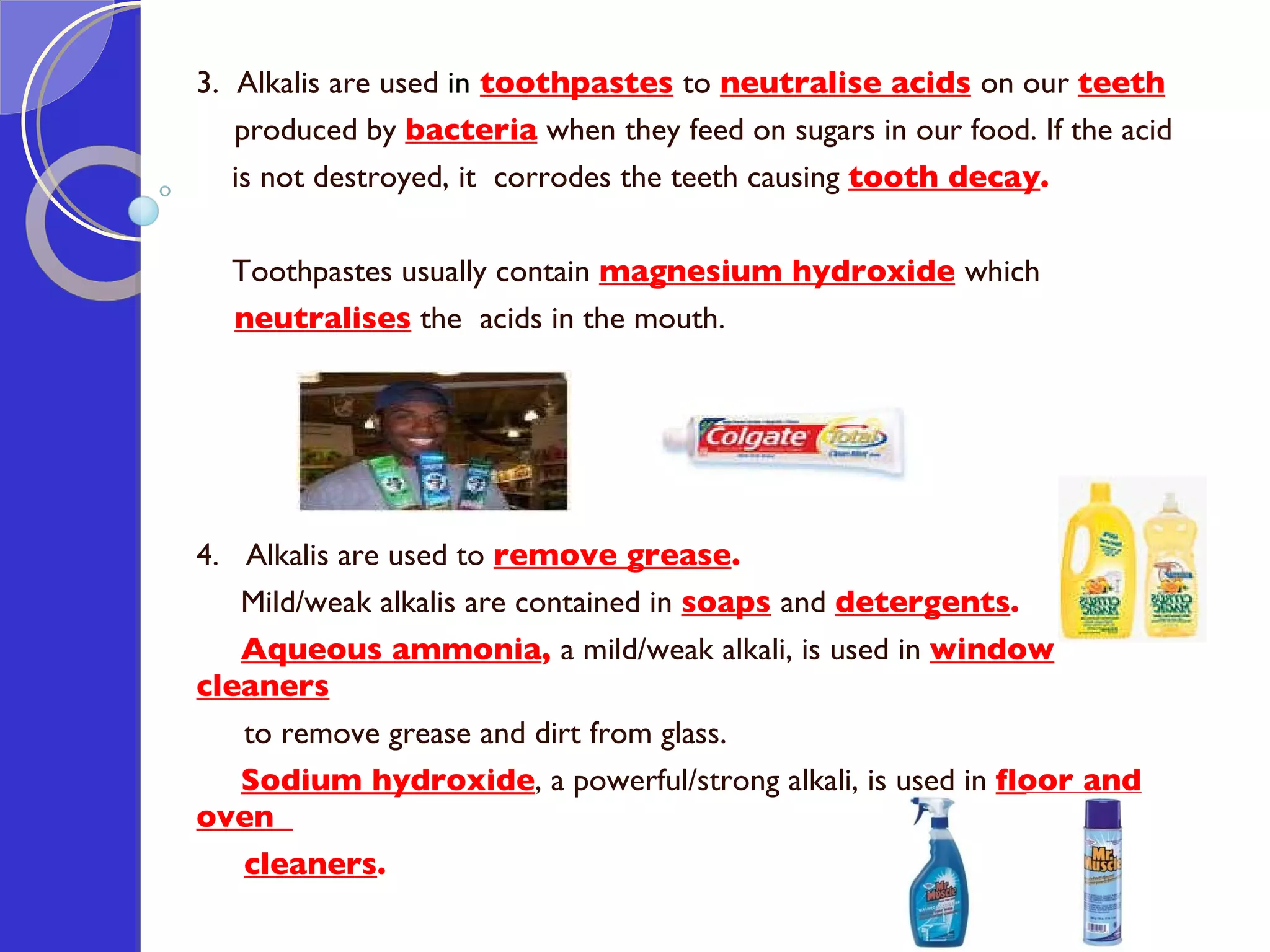
3.  Alkalis are used  in   toothpastes   to  neutralise acids   on our  teeth   produced by  bacteria  when they feed on sugars in our food. If the acid  is not destroyed, it  corrodes the teeth causing  tooth decay .  Toothpastes usually contain  magnesium hydroxide   which  neutralises  the  acids in the mouth. 4.  Alkalis are used to  remove grease . Mild/weak alkalis are contained in  soaps   and  detergents .  Aqueous ammonia ,  a mild/weak alkali, is used in  window cleaners   to remove grease and dirt from glass.  Sodium hydroxide , a powerful/strong alkali, is used in  floor and oven  cleaners .
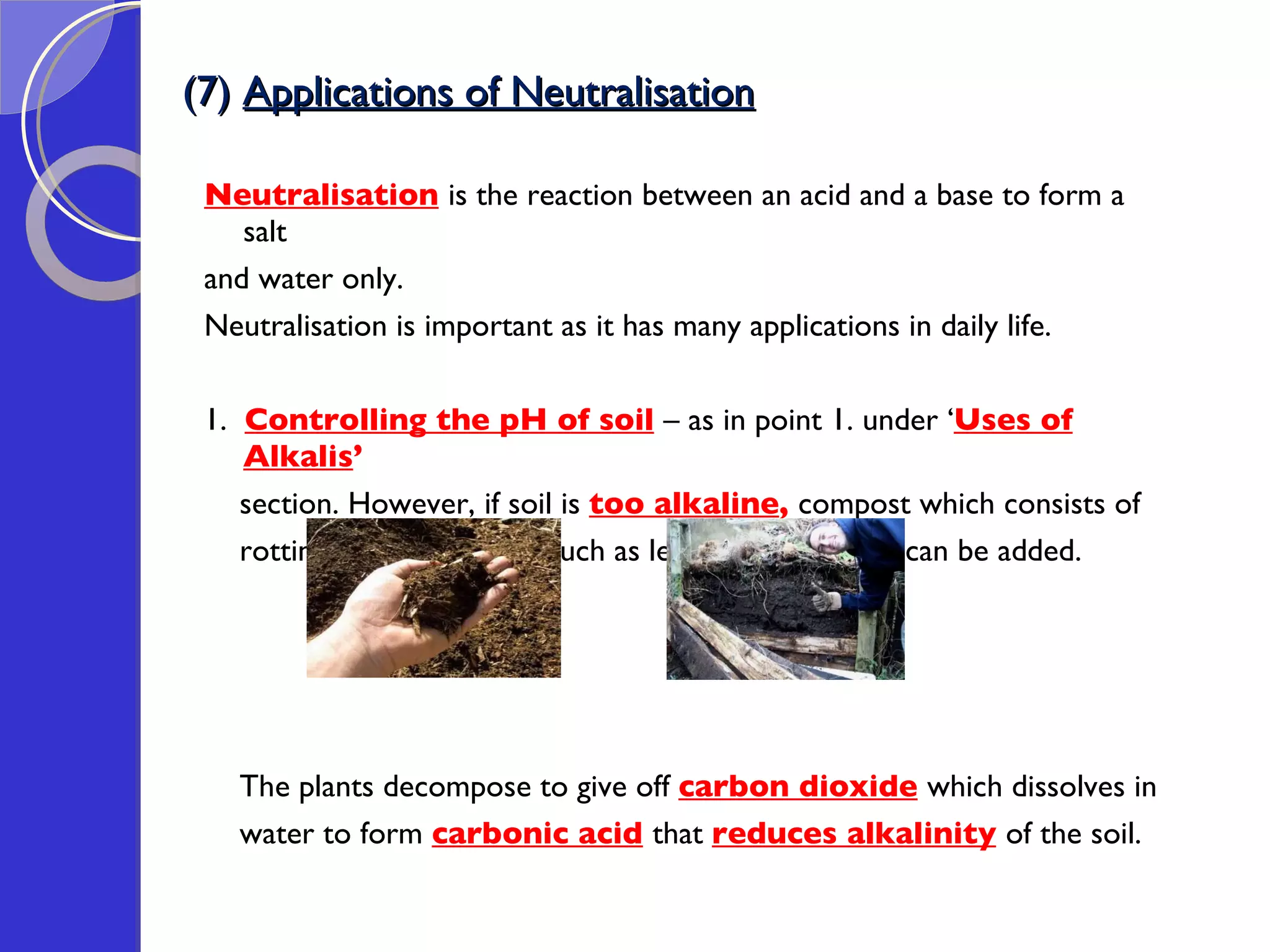
(7)  Applications of Neutralisation Neutralisation   is the reaction between an acid and a base to form a salt  and water only. Neutralisation is important as it has many applications in daily life.  1.  Controlling the pH of soil   – as in point 1. under ‘ Uses of Alkalis ’  section. However, if soil is  too alkaline ,  compost which consists of  rotting plant  material  such as leaves & vegetables can be added.  The plants decompose to give off  carbon dioxide   which dissolves in  water to form  carbonic acid   that  reduces alkalinity   of the soil.
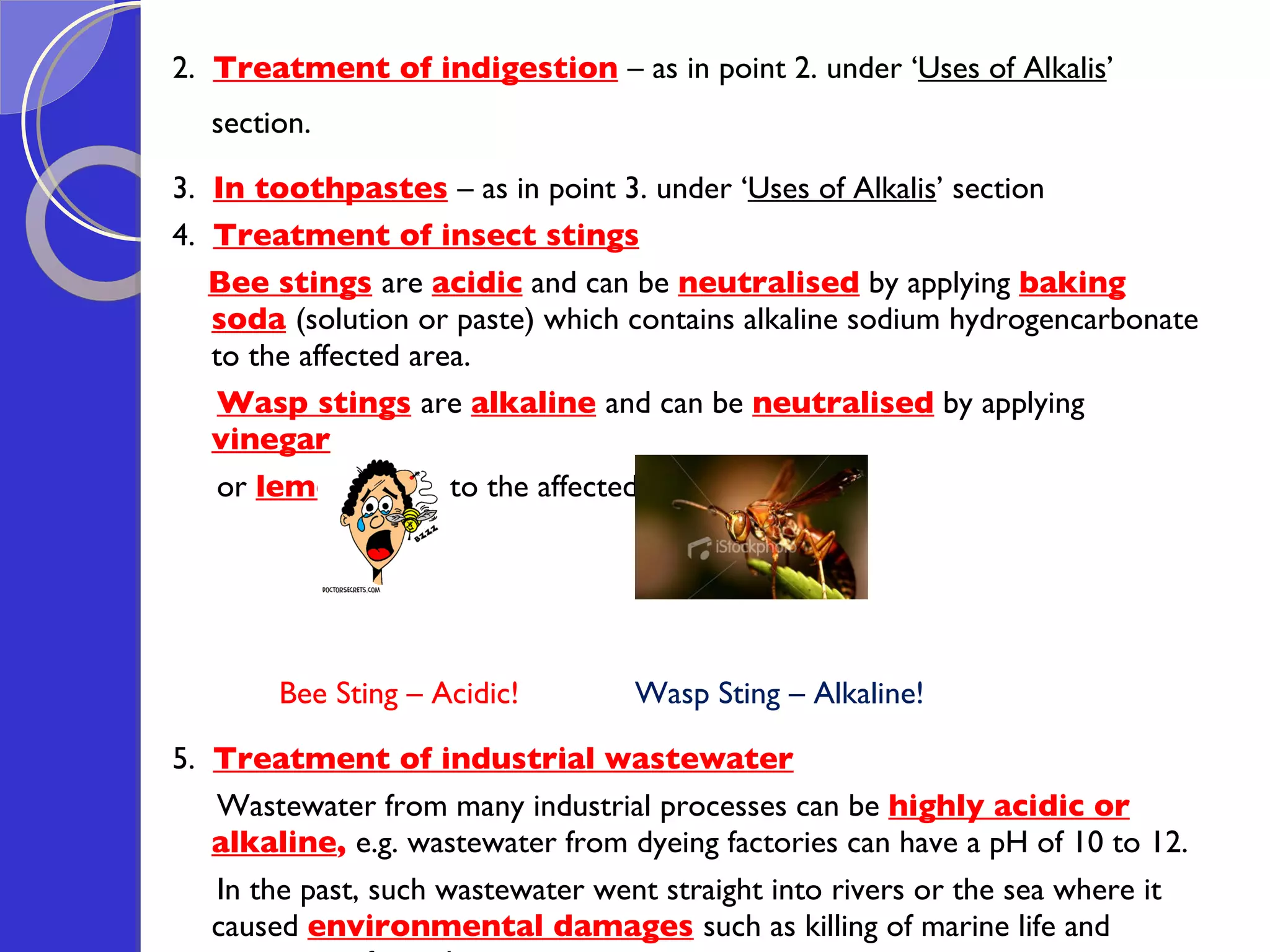
2.  Treatment of indigestion   – as in point 2. under ‘ Uses of Alkalis ’ section.  3.  In toothpastes   – as in point 3. under ‘ Uses of Alkalis ’ section 4.  Treatment of insect stings   Bee stings   are  acidic  and can be  neutralised  by applying  baking soda   (solution or paste) which contains alkaline sodium hydrogencarbonate to the affected area. Wasp stings   are  alkaline   and can be  neutralised  by applying  vinegar   or  lemon juice   to the affected area.  Bee Sting – Acidic!  Wasp Sting – Alkaline! 5.  Treatment of industrial wastewater Wastewater from many industrial processes can be  highly acidic or alkaline ,  e.g. wastewater from dyeing factories can have a pH of 10 to 12.  In the past, such wastewater went straight into rivers or the sea where it caused  environmental damages   such as killing of marine life and corrosion of metal pipes
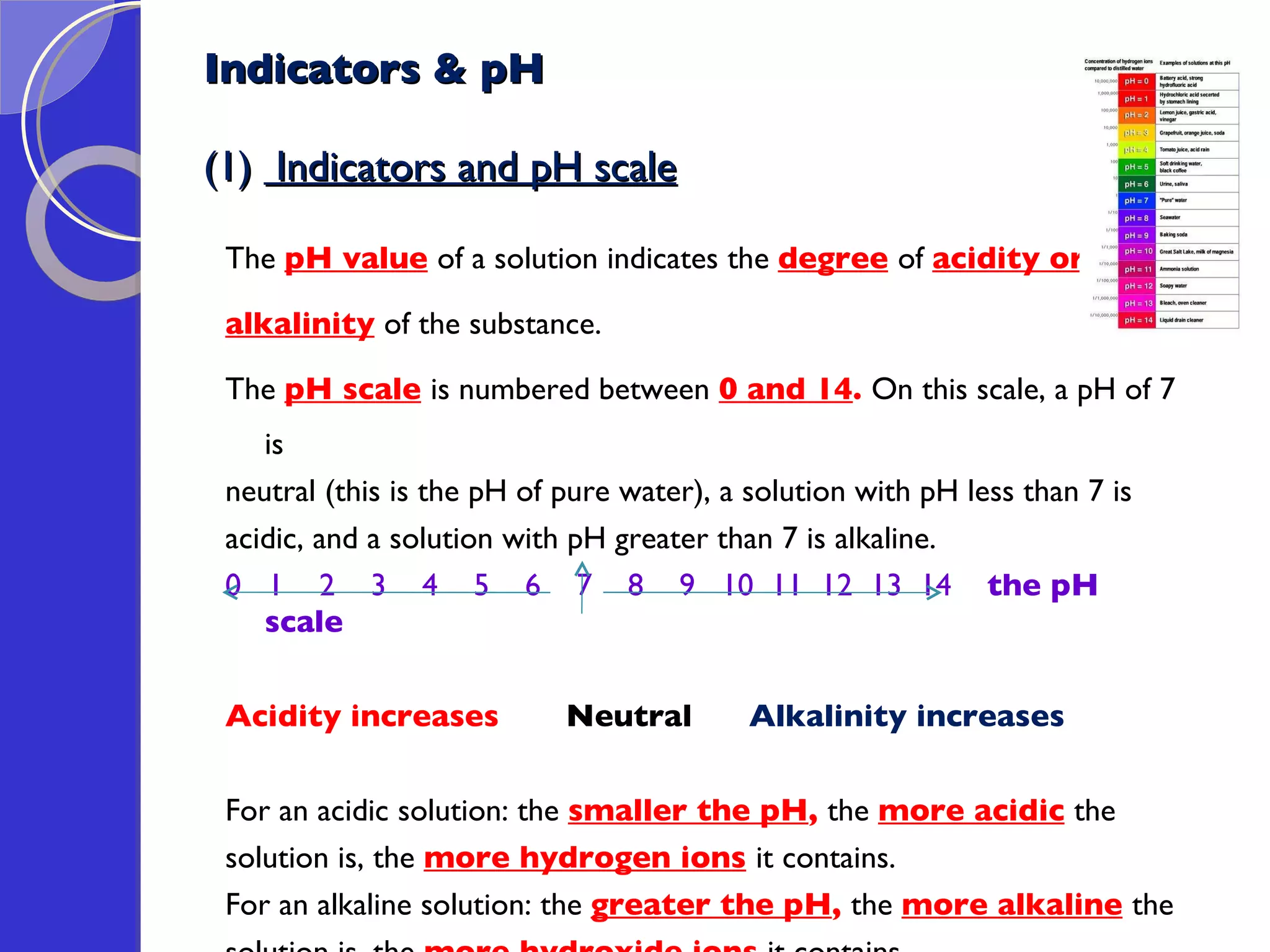
Indicators & pH (1)  Indicators and pH scale The  pH value   of a solution indicates the  degree   of  acidity or  alkalinity   of the substance.  The  pH scale   is numbered between  0 and 14 .  On this scale, a pH of 7 is  neutral (this is the pH of pure water), a solution with pH less than 7 is  acidic, and a solution with pH greater than 7 is alkaline. 0  1  2  3  4  5  6  7  8  9  10  11  12  13  14  the pH scale  Acidity increases  Neutral  Alkalinity increases  For an acidic solution: the  smaller the pH ,  the  more acidic   the solution is, the  more hydrogen ions   it contains. For an alkaline solution: the  greater the pH ,  the  more alkaline   the  solution is, the  more hydroxide ions   it contains.    
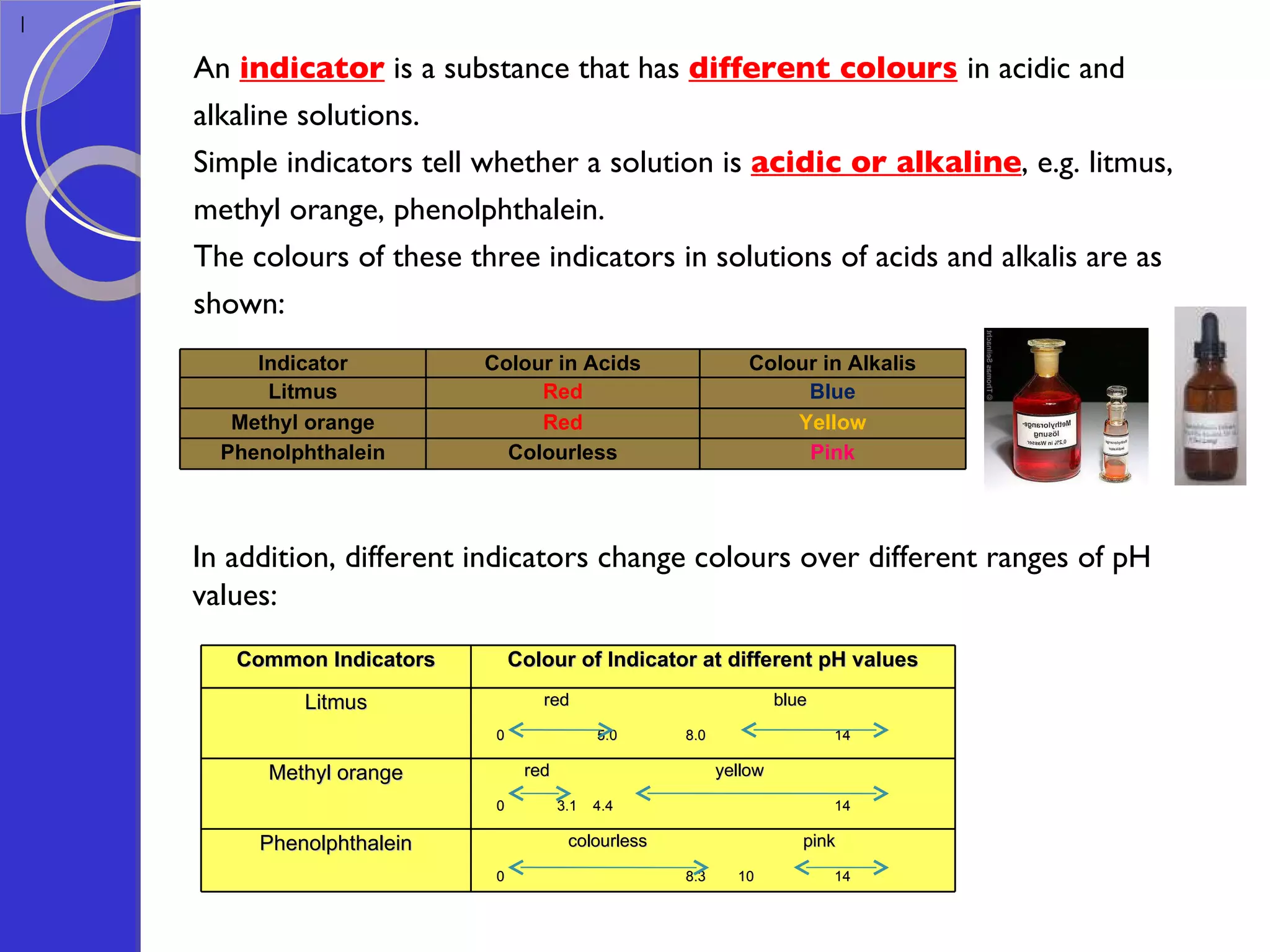
An  indicator  is a substance that has  different colours   in acidic and  alkaline solutions.  Simple indicators tell whether a solution is  acidic or alkaline , e.g. litmus,  methyl orange, phenolphthalein. The colours of these three indicators in solutions of acids and alkalis are as  shown: In addition, different indicators change colours over different ranges of pH values:  Indicator Colour in Acids Colour in Alkalis Litmus Red Blue Methyl orange Red Yellow Phenolphthalein Colourless Pink Common Indicators Colour of Indicator at different pH values Litmus red  blue 0  5.0  8.0  14 Methyl orange red  yellow 0  3.1  4.4  14 Phenolphthalein colourless  pink 0  8.3  10  14
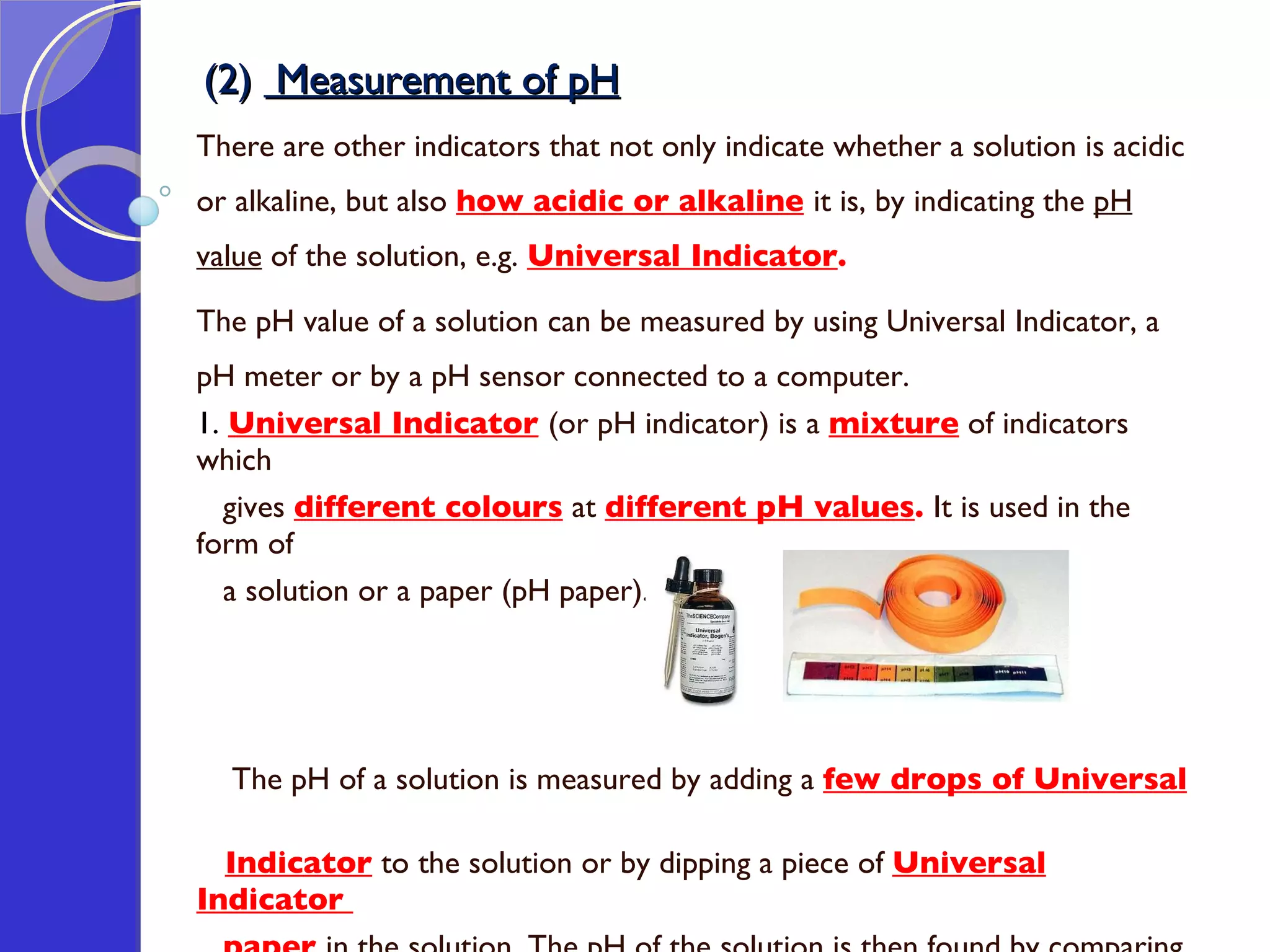
(2)  Measurement of pH There are other indicators that not only indicate whether a solution is acidic or alkaline, but also  how acidic or alkaline   it is, by indicating the  pH value  of the solution, e.g.  Universal Indicator . The pH value of a solution can be measured by using Universal Indicator, a pH meter or by a pH sensor connected to a computer. 1.  Universal Indicator   (or pH indicator) is a  mixture  of indicators which  gives  different colours  at  different pH values .  It is used in the form of  a solution or a paper (pH paper).  The pH of a solution is measured by adding a  few drops of Universal  Indicator  to the solution or by dipping a piece of  Universal Indicator  paper   in the solution.   The pH of the solution is then found by comparing  the colour obtained with a  colour chart .
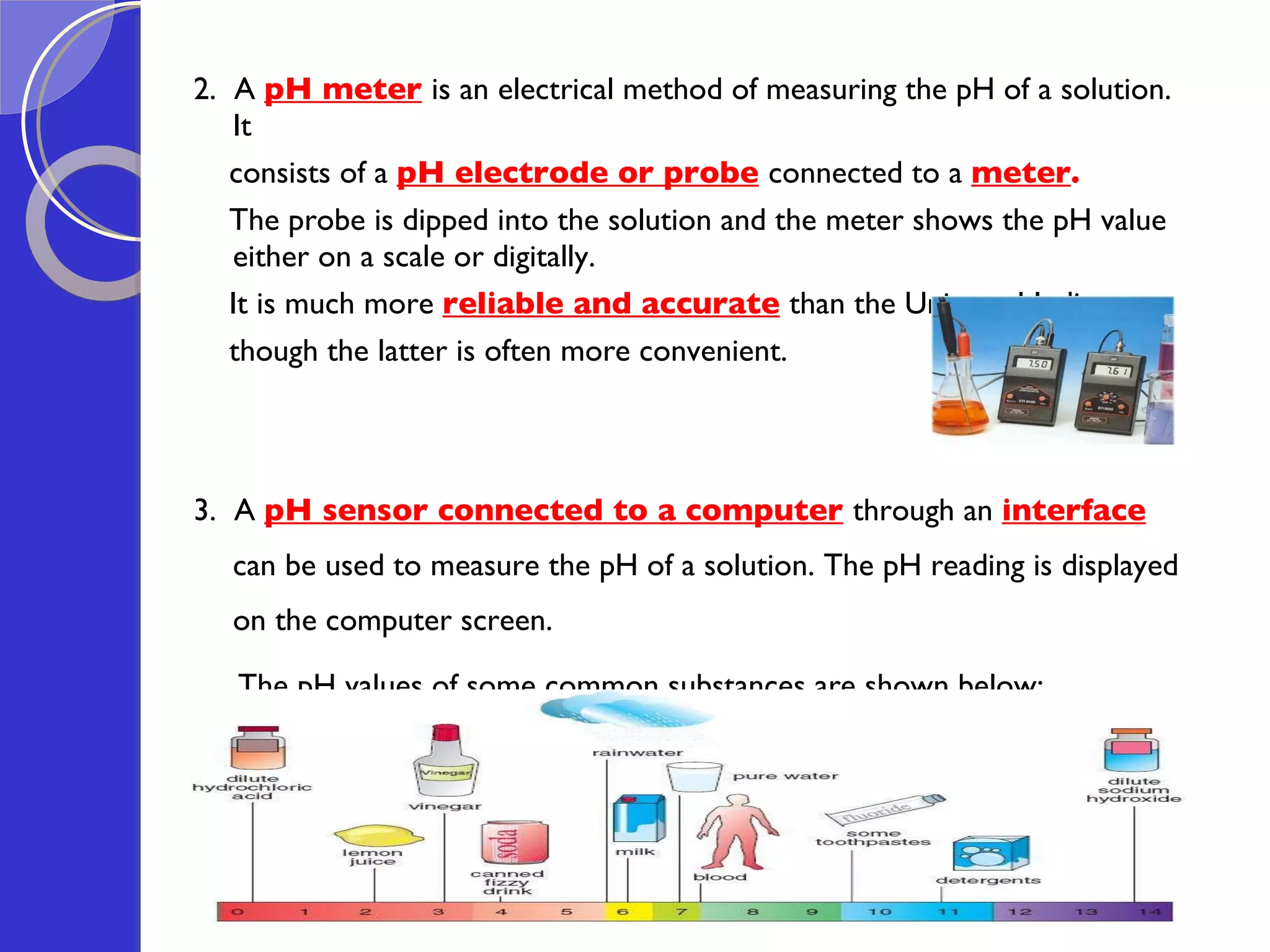
2.  A  pH meter   is an electrical method of measuring the pH of a solution. It  consists of a  pH electrode or probe   connected to a  meter .  The probe is dipped into the solution and the meter shows the pH value either on a scale or digitally.  It is much more  reliable and accurate   than the Universal Indicator,  though the latter is often more convenient.  3.  A  pH sensor connected to a computer   through an  interface  can be used to measure the pH of a solution. The pH reading is displayed on the computer screen.   The pH values of some common substances are shown below:
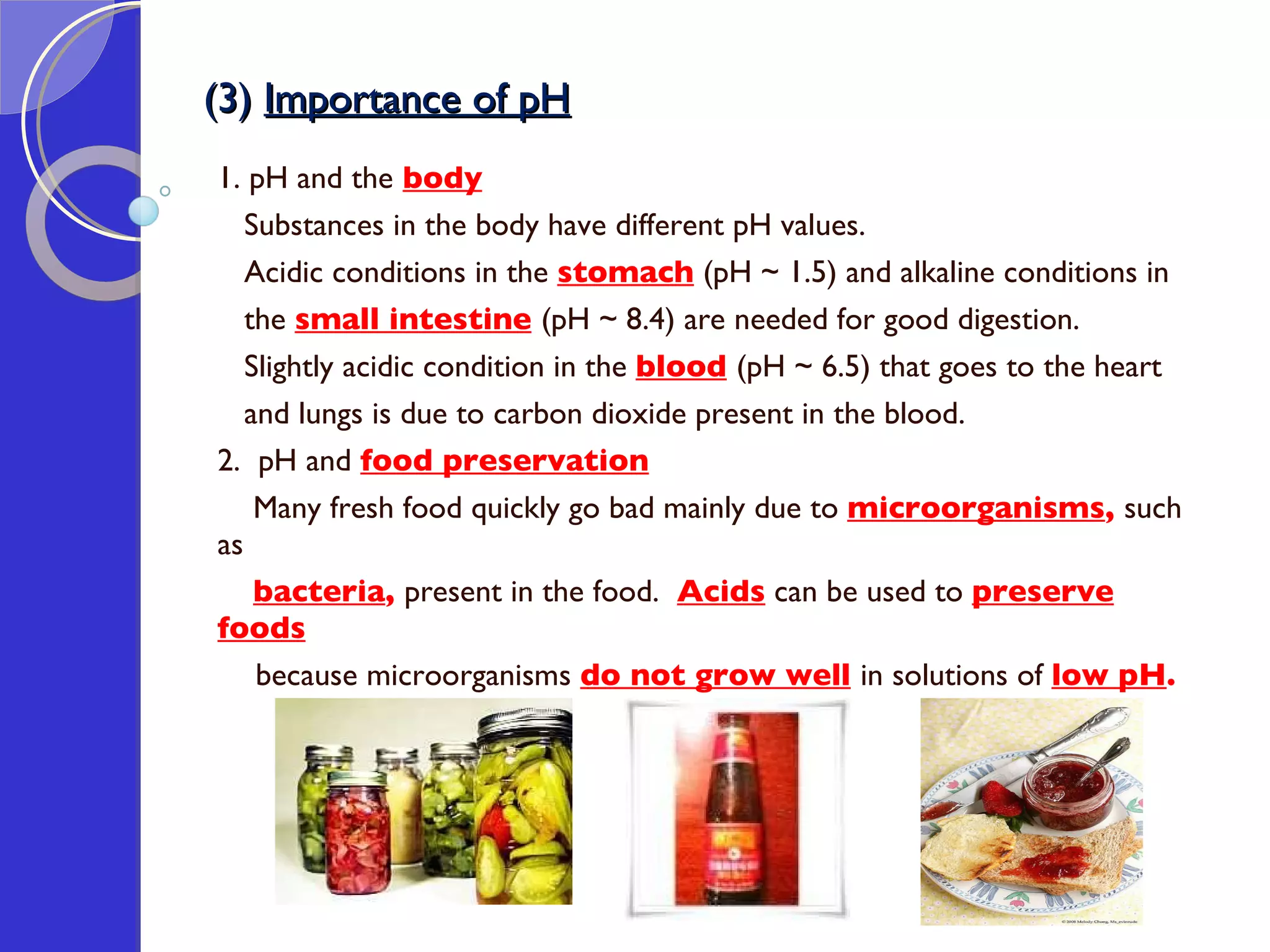
(3)  Importance of pH 1. pH and the   body   Substances in the body have different pH values.  Acidic conditions in the  stomach  (pH ~ 1.5) and alkaline conditions in  the  small intestine   (pH ~ 8.4) are needed for good digestion.  Slightly acidic condition in the  blood   (pH ~ 6.5) that goes to the heart  and lungs is due to carbon dioxide present in the blood. 2.  pH and  food preservation Many fresh food quickly go bad mainly due to  microorganisms ,  such as  bacteria ,  present in the food.   Acids  can be used to  preserve foods   because microorganisms  do not grow well   in solutions of  low pH .
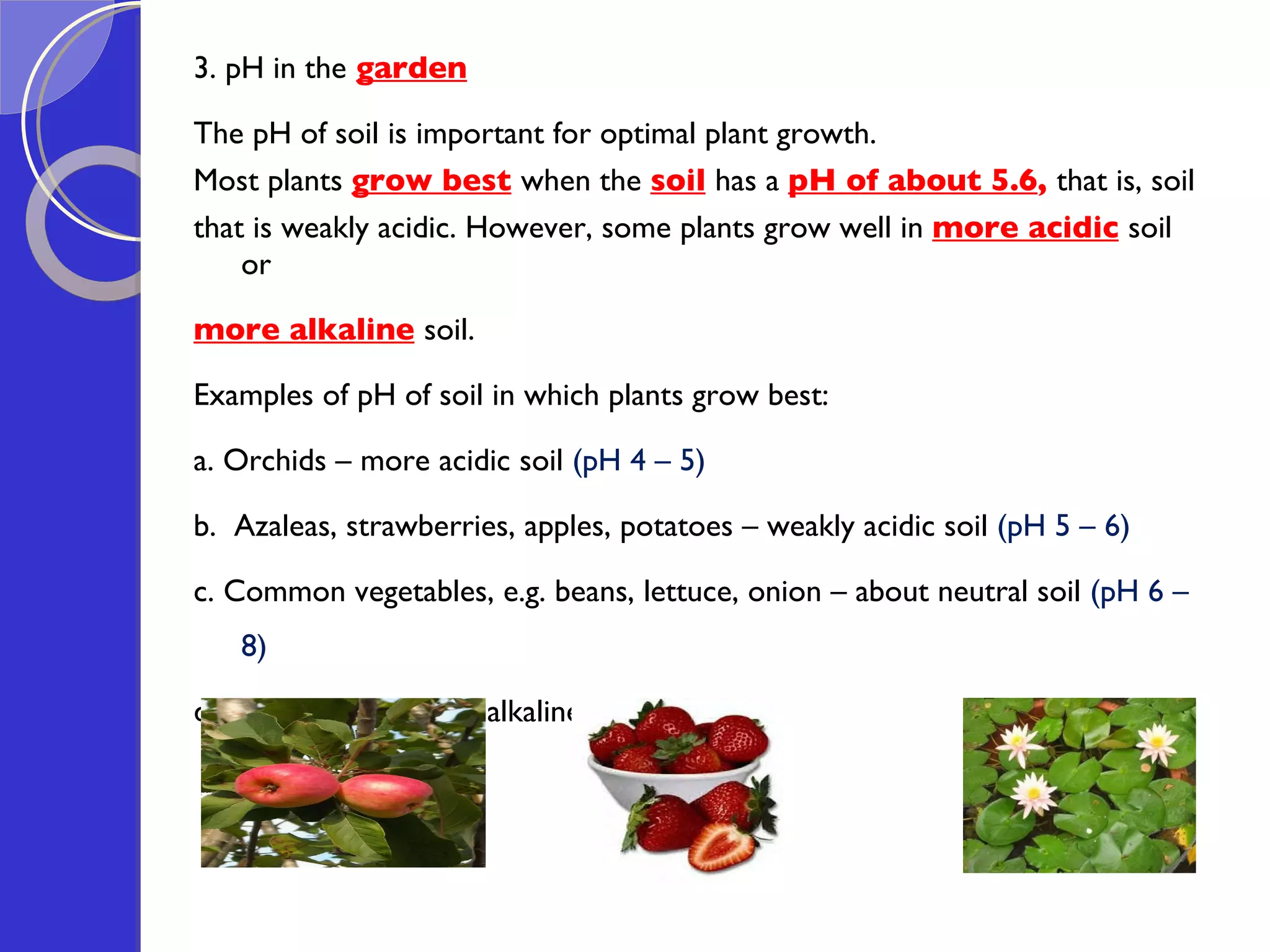
3. pH in the   garden   The pH of soil is important for optimal plant growth.  Most plants  grow best   when the  soil   has a  pH of about 5.6 ,  that is, soil  that is weakly acidic. However, some plants grow well in  more acidic   soil or  more alkaline   soil.  Examples of pH of soil in which plants grow best: a. Orchids – more acidic soil  (pH 4 – 5) b.  Azaleas, strawberries, apples, potatoes – weakly acidic soil  (pH 5 – 6) c. Common vegetables, e.g. beans, lettuce, onion – about neutral soil  (pH 6 – 8) d. Water lilies – more alkaline soil  (pH 8 – 9)
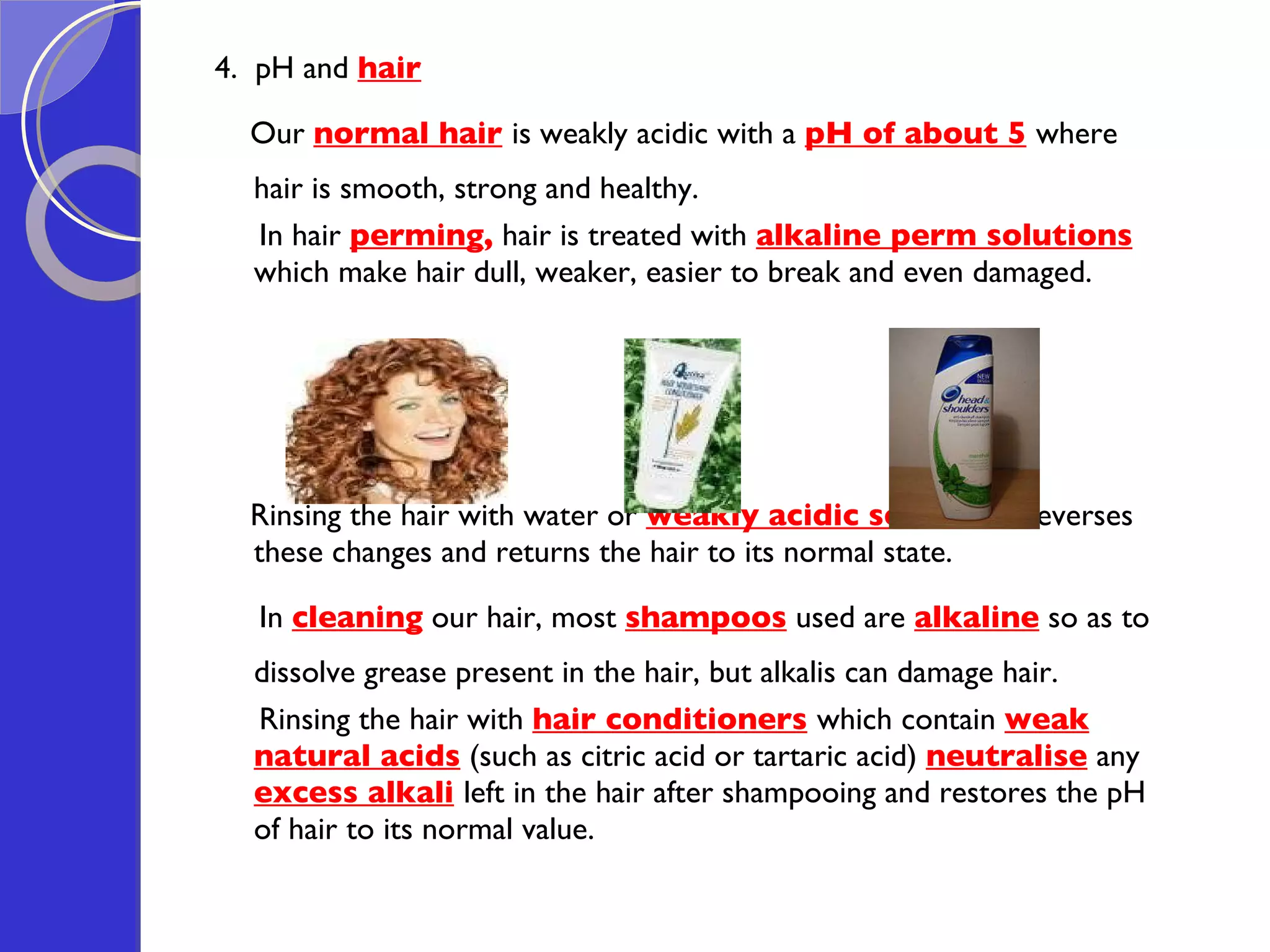
4.  pH and  hair Our  normal hair   is weakly acidic with a  pH of about 5   where hair is smooth, strong and healthy.  In hair  perming ,  hair is treated with  alkaline perm solutions   which make hair dull, weaker, easier to break and even damaged.  Rinsing the hair with water or  weakly acidic solutions   reverses these changes and returns the hair to its normal state. In  cleaning  our hair, most  shampoos  used are  alkaline  so as to dissolve grease present in the hair, but alkalis can damage hair.  Rinsing the hair with  hair conditioners   which contain  weak natural acids  (such as citric acid or tartaric acid)  neutralise  any  excess alkali   left in the hair after shampooing and restores the pH of hair to its normal value.
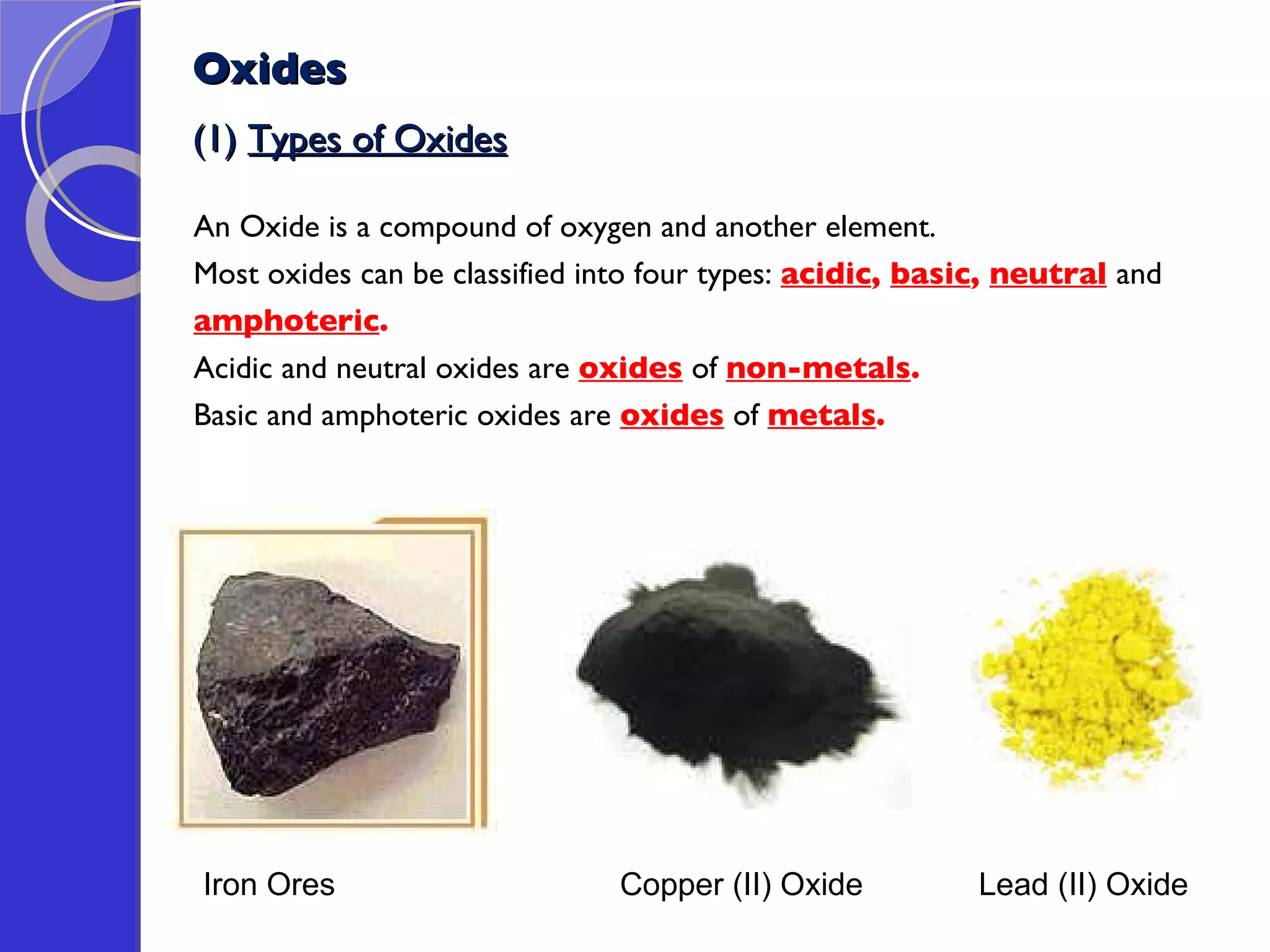
Oxides (1)  Types of Oxides An Oxide is a compound of oxygen and another element. Most oxides can be classified into four types:  acidic ,  basic ,  neutral   and  amphoteric .   Acidic and neutral oxides are  oxides  of  non-metals .  Basic and amphoteric oxides are  oxides  of  metals .  Iron Ores  Copper (II) Oxide  Lead (II) Oxide
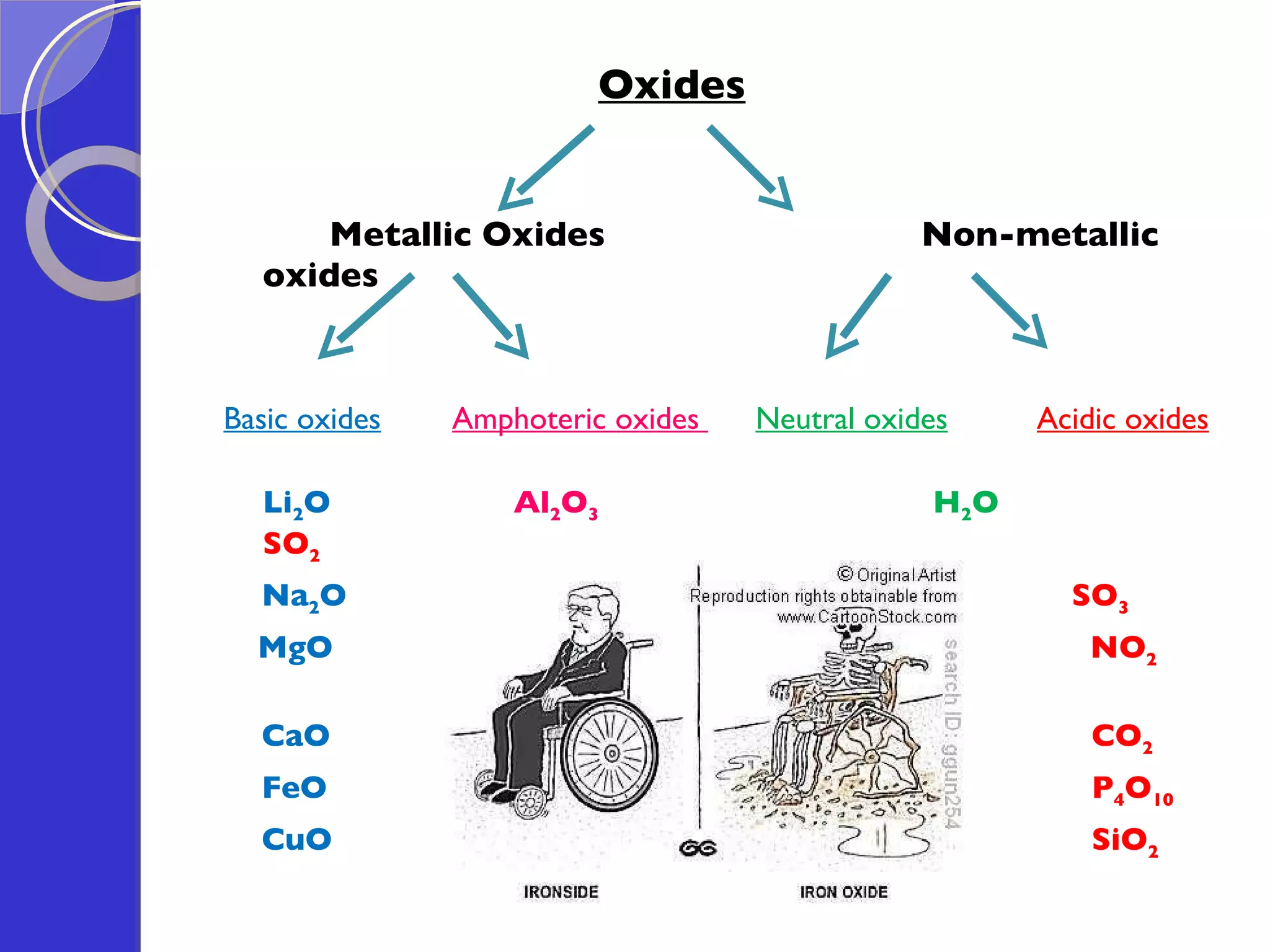
Oxides Metallic Oxides   Non-metallic oxides Basic oxides   Amphoteric oxides    Neutral oxides   Acidic oxides  Li 2 O   Al 2 O 3   H 2 O  SO 2 Na 2 O   ZnO   CO   SO 3 MgO   PbO   NO  NO 2  CaO   CO 2 FeO   P 4 O 10   CuO   SiO 2   etc…..
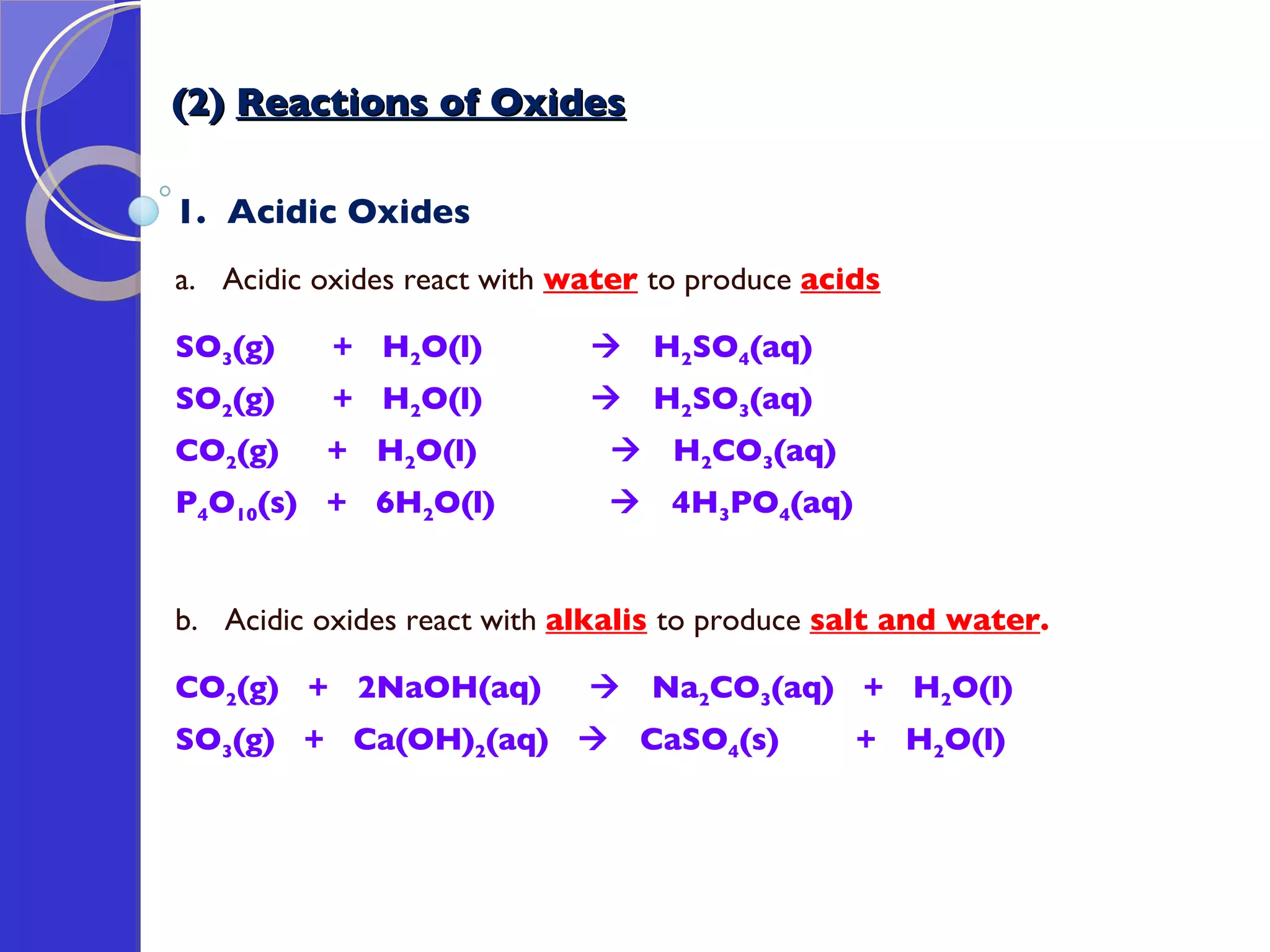
1.  Acidic Oxides a.  Acidic oxides react with  water   to produce  acids SO 3 (g)  +  H 2 O(l)       H 2 SO 4 (aq)  SO 2 (g)  +  H 2 O(l)       H 2 SO 3 (aq)  CO 2 (g)  +  H 2 O(l)     H 2 CO 3 (aq)  P 4 O 10 (s)  +  6H 2 O(l)     4H 3 PO 4 (aq) b.  Acidic oxides react with  alkalis   to produce  salt and water .  CO 2 (g)  +  2NaOH(aq)     Na 2 CO 3 (aq)  +  H 2 O(l)    SO 3 (g)  +  Ca(OH) 2 (aq)     CaSO 4 (s)  +  H 2 O(l)  (2)  Reactions of Oxides
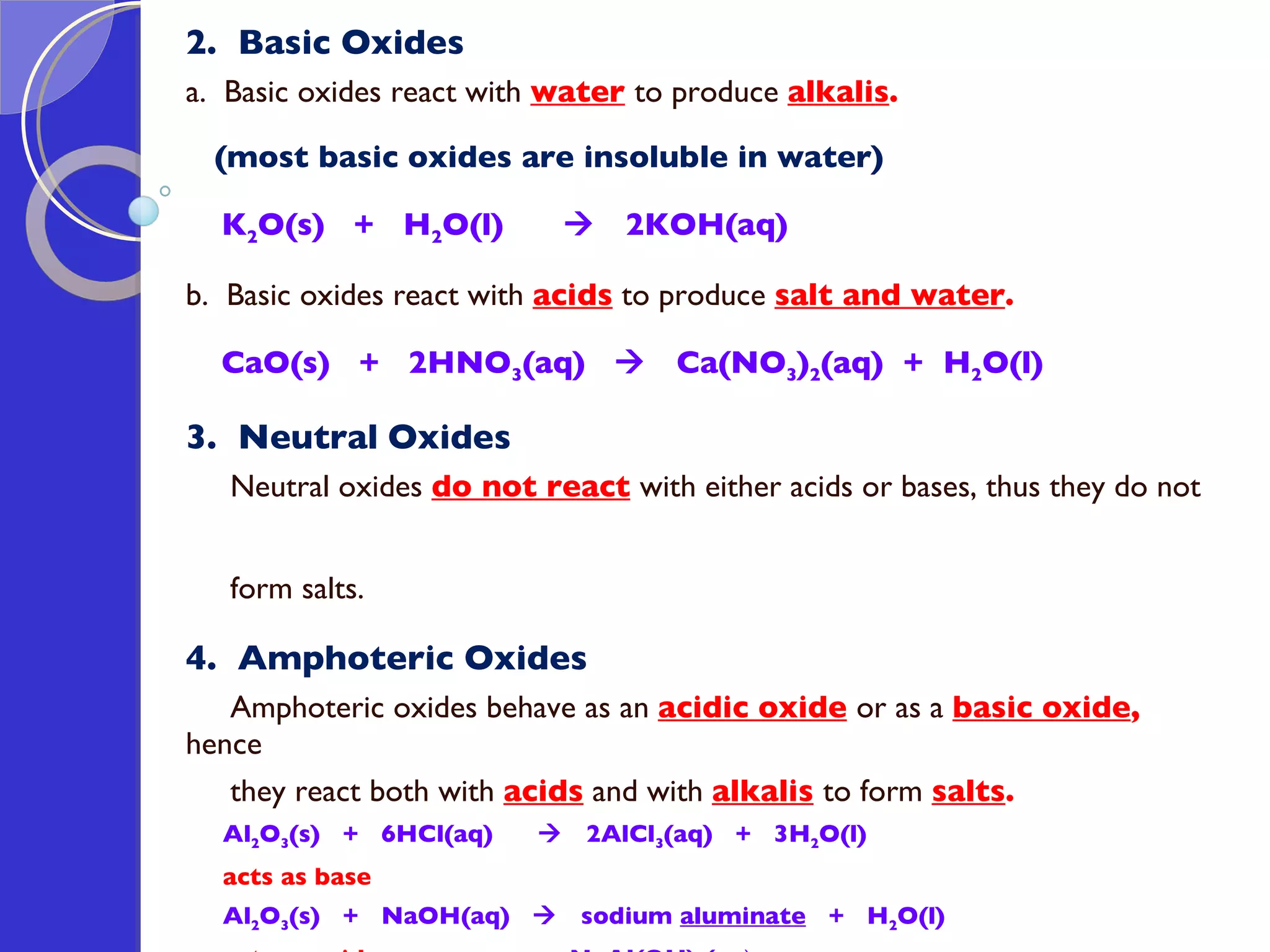
2.  Basic Oxides a.  Basic oxides react with  water   to produce  alkalis . (most basic oxides are insoluble in water) K 2 O(s)  +  H 2 O(l)     2KOH(aq)  b.  Basic oxides react with  acids  to produce  salt and water .  CaO(s)  +  2HNO 3 (aq)     Ca(NO 3 ) 2 (aq)  +  H 2 O(l)  3.  Neutral   Oxides Neutral oxides  do not react   with either acids or bases, thus they do not  form salts. 4.  Amphoteric Oxides Amphoteric oxides behave as an  acidic oxide   or as a  basic oxide ,  hence  they react both with  acids  and with  alkalis   to form  salts . Al 2 O 3 (s)  +  6HCl(aq)     2AlCl 3 (aq)  +  3H 2 O(l)  acts as base  Al 2 O 3 (s)  +  NaOH(aq)     sodium  aluminate   +  H 2 O(l)  acts as acid   NaAl(OH) 4 (aq )
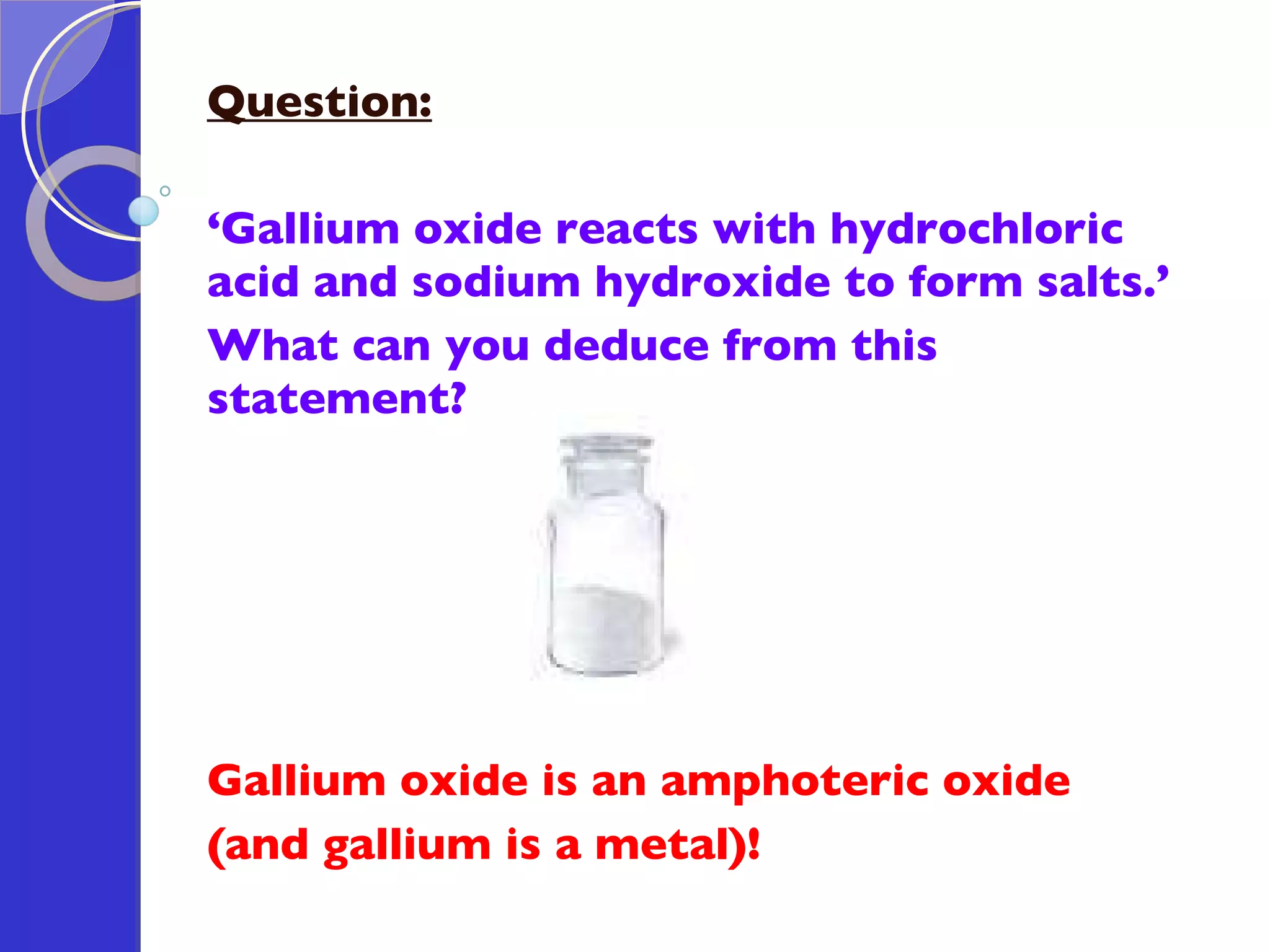
Question: ‘ Gallium oxide reacts with hydrochloric acid and sodium hydroxide to form salts.’  What can you deduce from this statement? Gallium oxide is an amphoteric oxide  (and gallium is a metal)!
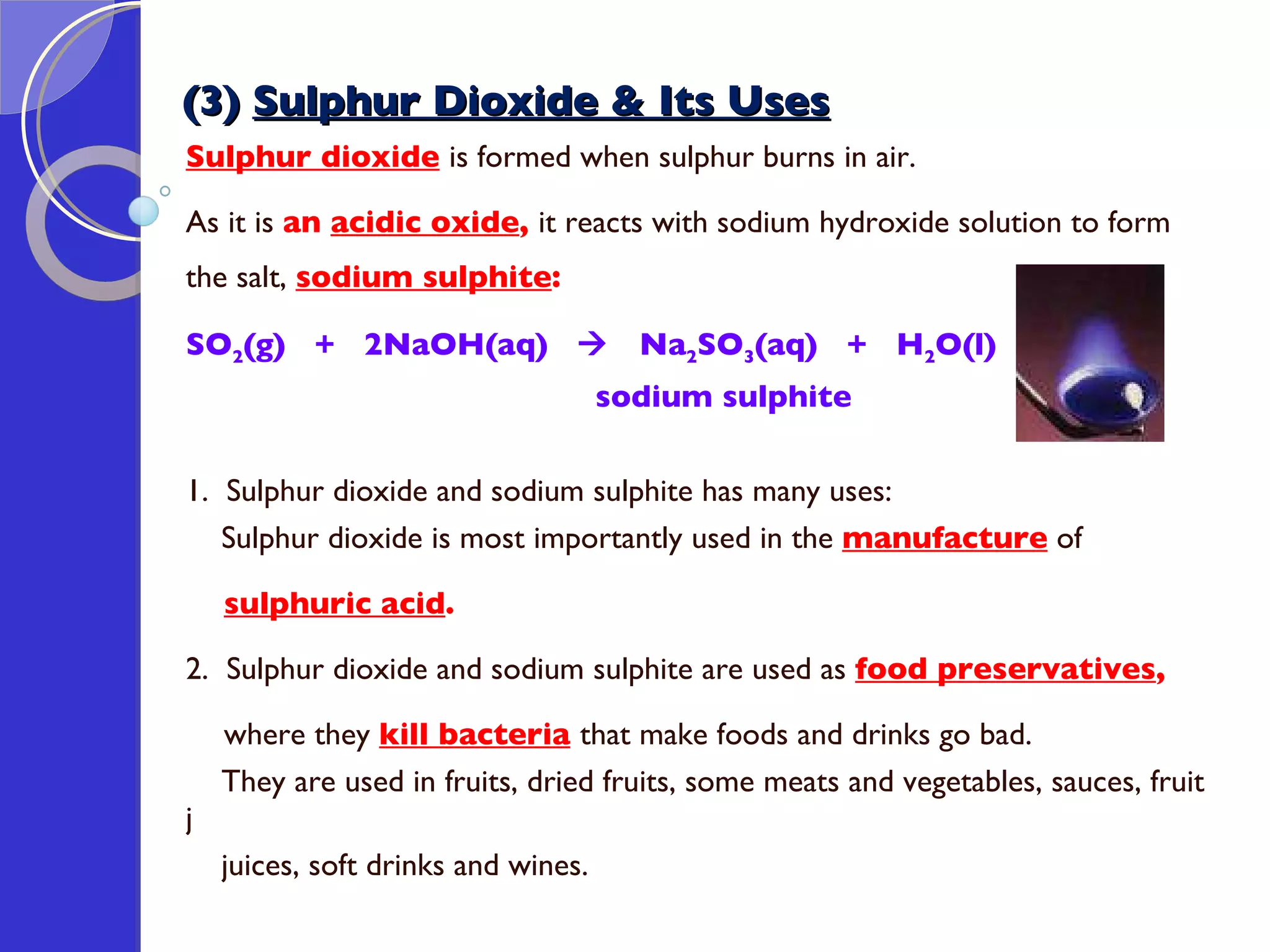
(3)  Sulphur Dioxide & Its Uses Sulphur dioxide   is formed when sulphur burns in air. As it is  an  acidic oxide ,  it reacts with sodium hydroxide solution to form the salt,  sodium sulphite : SO 2 (g)  +  2NaOH(aq)     Na 2 SO 3 (aq)  +  H 2 O(l)  sodium sulphite 1.  Sulphur dioxide and sodium sulphite has many uses: Sulphur dioxide is most importantly used in the  manufacture  of  sulphuric acid . 2.  Sulphur dioxide and sodium sulphite are used as  food preservatives ,  where they  kill bacteria   that make foods and drinks go bad.  They are used in fruits, dried fruits, some meats and vegetables, sauces, fruit j  juices, soft drinks and wines.
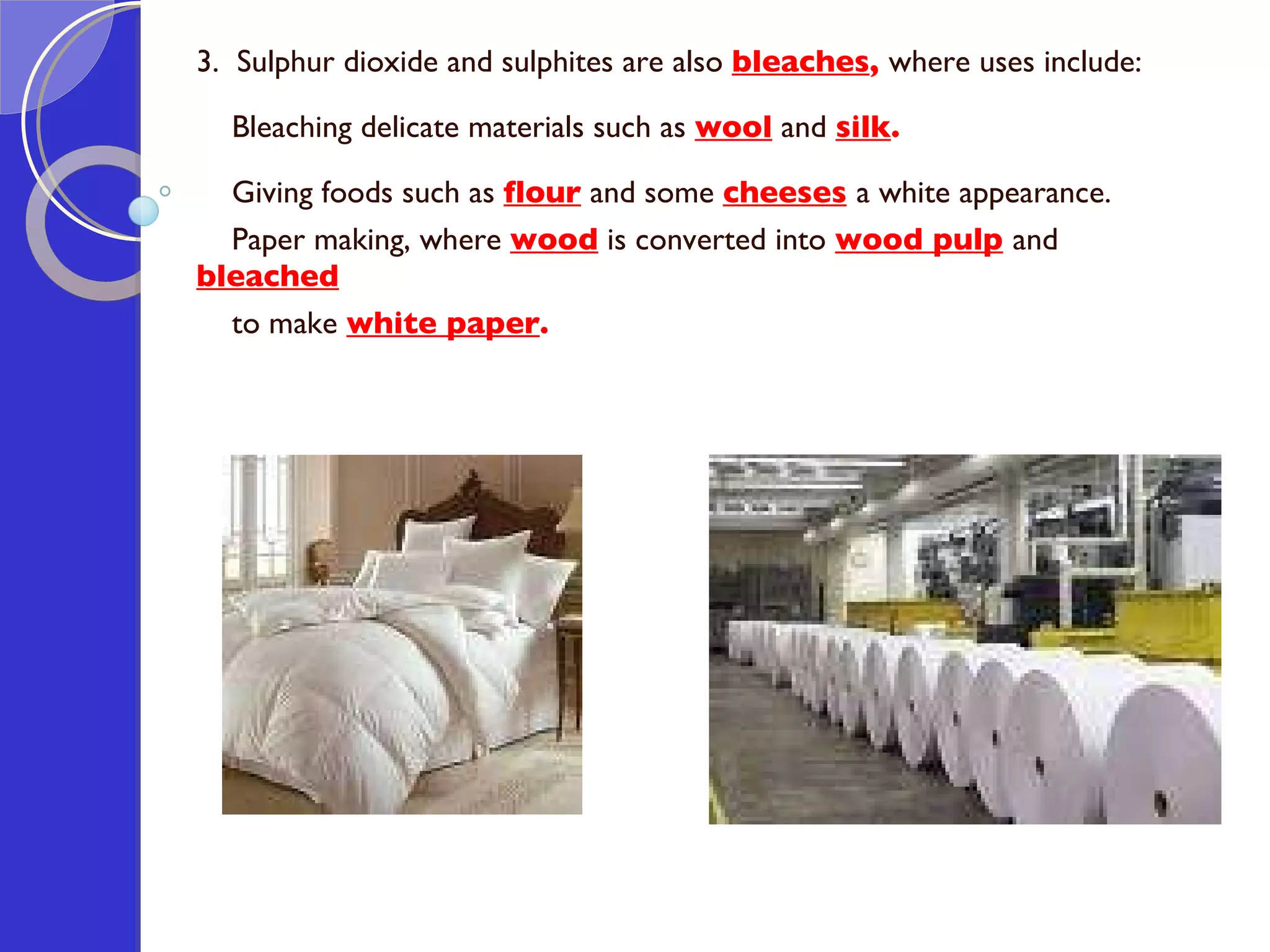
3.  Sulphur dioxide and sulphites are also  bleaches ,  where uses include: Bleaching delicate materials such as  wool  and  silk . Giving foods such as  flour  and some  cheeses   a white appearance. Paper making, where  wood  is converted into  wood pulp   and  bleached   to make  white paper .
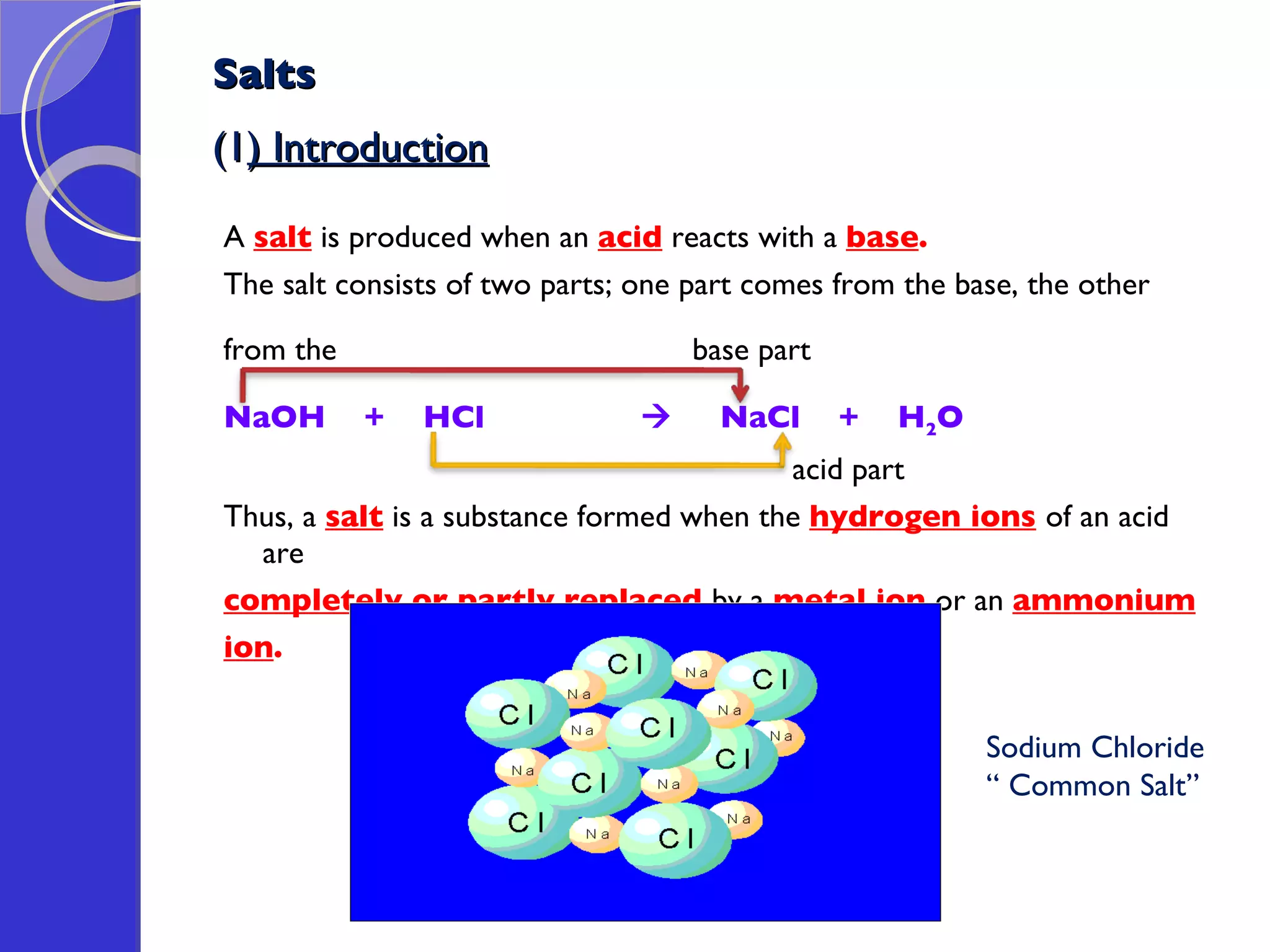
Salts (1 ) Introduction A  salt  is produced when an  acid  reacts with a  base .  The salt consists of two parts; one part comes from the base, the other  from the  base part NaOH  +  HCl       NaCl  +  H 2 O acid part Thus, a  salt  is a substance formed when the  hydrogen ions   of an acid are  completely or partly replaced   by a  metal ion   or an  ammonium  ion . Sodium Chloride “  Common Salt”
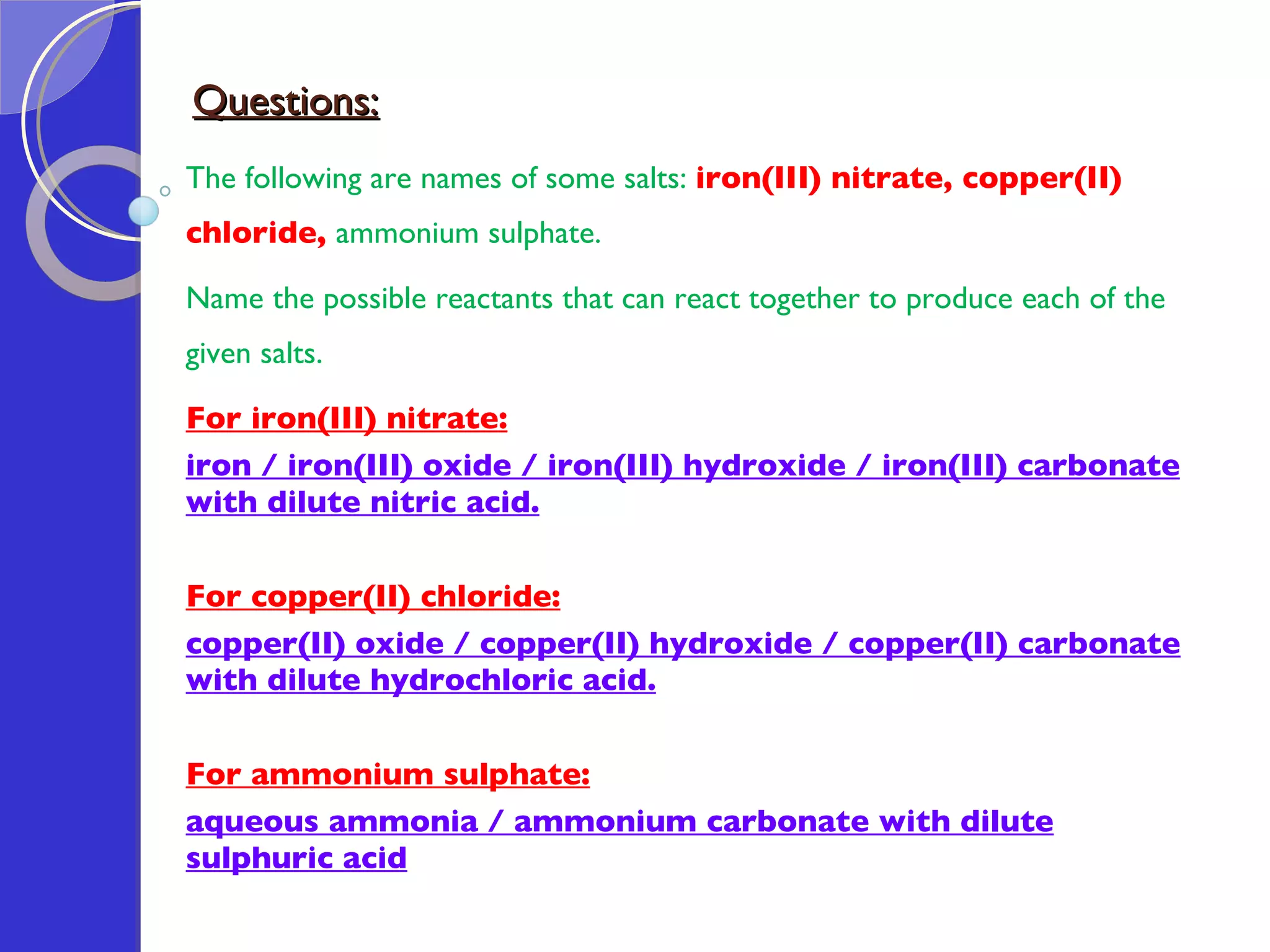
Questions: The following are names of some salts:  iron(III) nitrate, copper(II) chloride,  ammonium sulphate.  Name the possible reactants that can react together to produce each of the given salts.  For iron(III) nitrate: iron / iron(III) oxide / iron(III) hydroxide / iron(III) carbonate with dilute nitric acid.   For copper(II) chloride: copper(II) oxide / copper(II) hydroxide / copper(II) carbonate with dilute hydrochloric acid.   For ammonium sulphate: aqueous ammonia / ammonium carbonate with dilute sulphuric acid
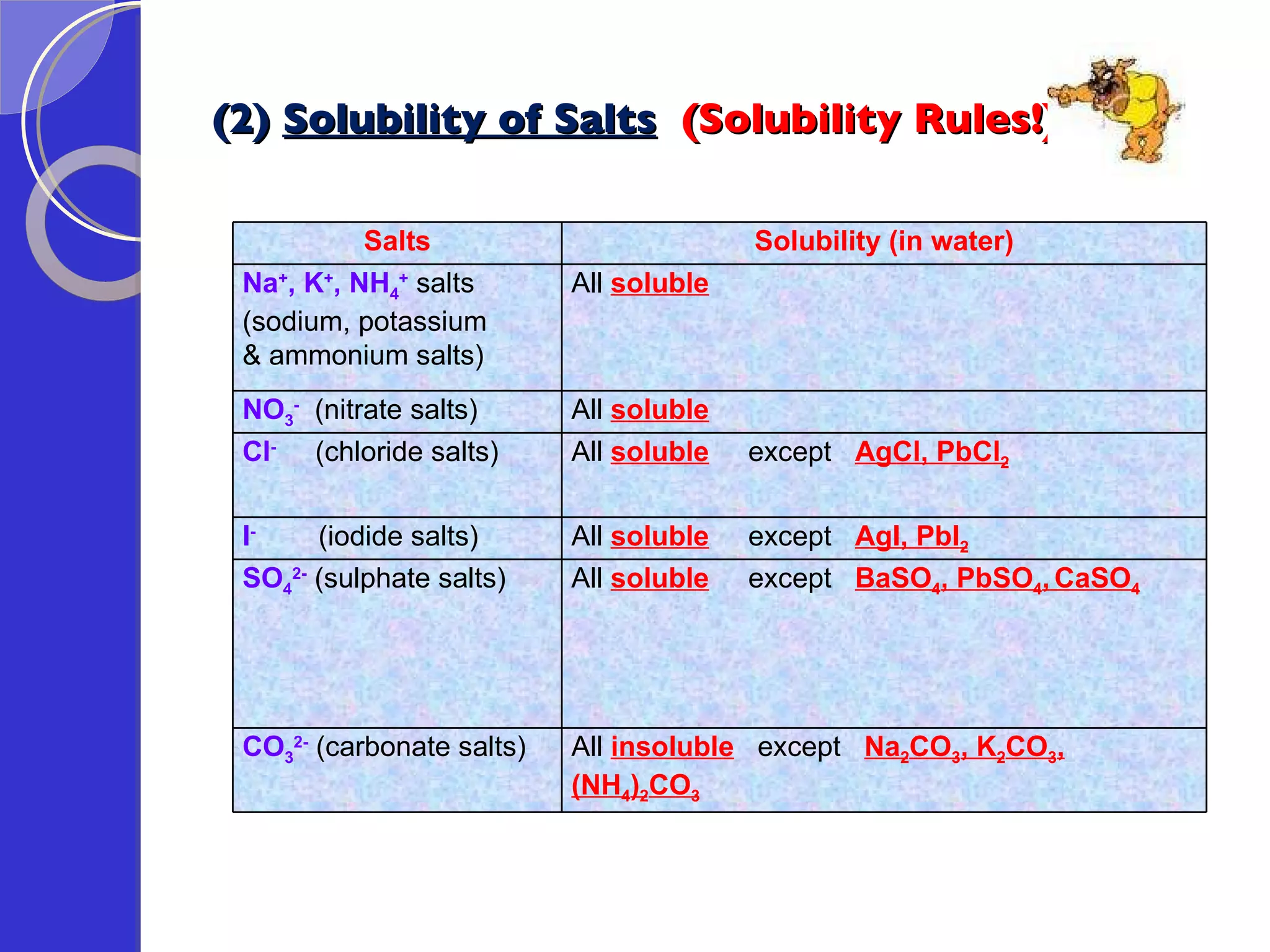
(2)  Solubility of Salts   (Solubility Rules!) Salts Solubility (in water) Na + , K + , NH 4 +   salts (sodium, potassium  & ammonium salts) All   soluble NO 3 -   (nitrate salts) All  soluble Cl -   (chloride salts) All  soluble   except  AgCl, PbCl 2 I -   (iodide salts) All  soluble   except  AgI, PbI 2 SO 4 2-   (sulphate salts) All  soluble   except  BaSO 4 , PbSO 4 ,   CaSO 4 CO 3 2-   (carbonate salts) All  insoluble   except  Na 2 CO 3 , K 2 CO 3 , (NH 4 ) 2 CO 3
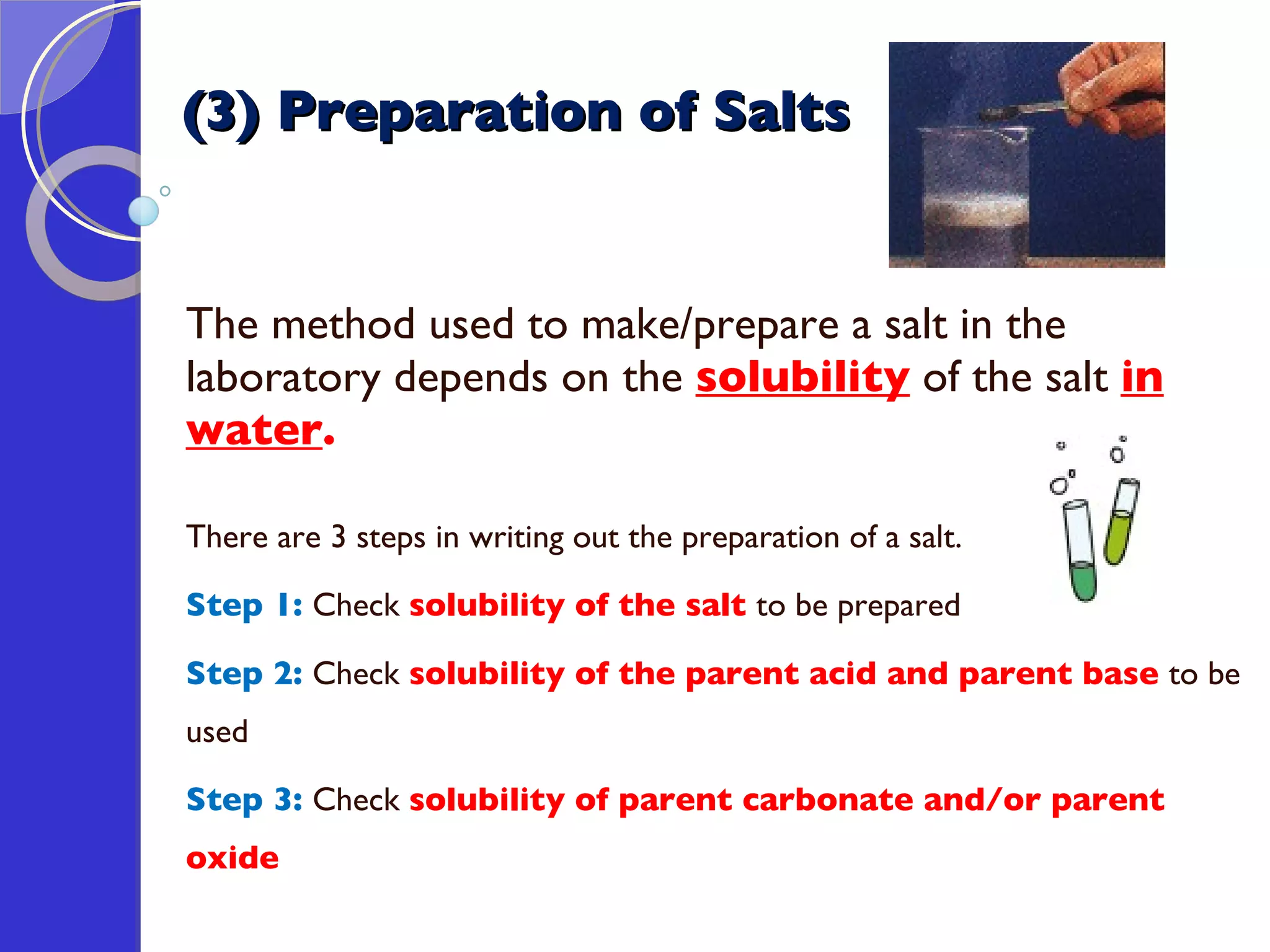
(3) Preparation of Salts The method used to make/prepare a salt in the laboratory depends on the  solubility  of the salt  in water .  There are 3 steps in writing out the preparation of a salt. Step 1:  Check  solubility of the salt  to be prepared Step 2:  Check  solubility of the parent acid and parent base  to be used Step 3:  Check  solubility of parent carbonate and/or parent oxide
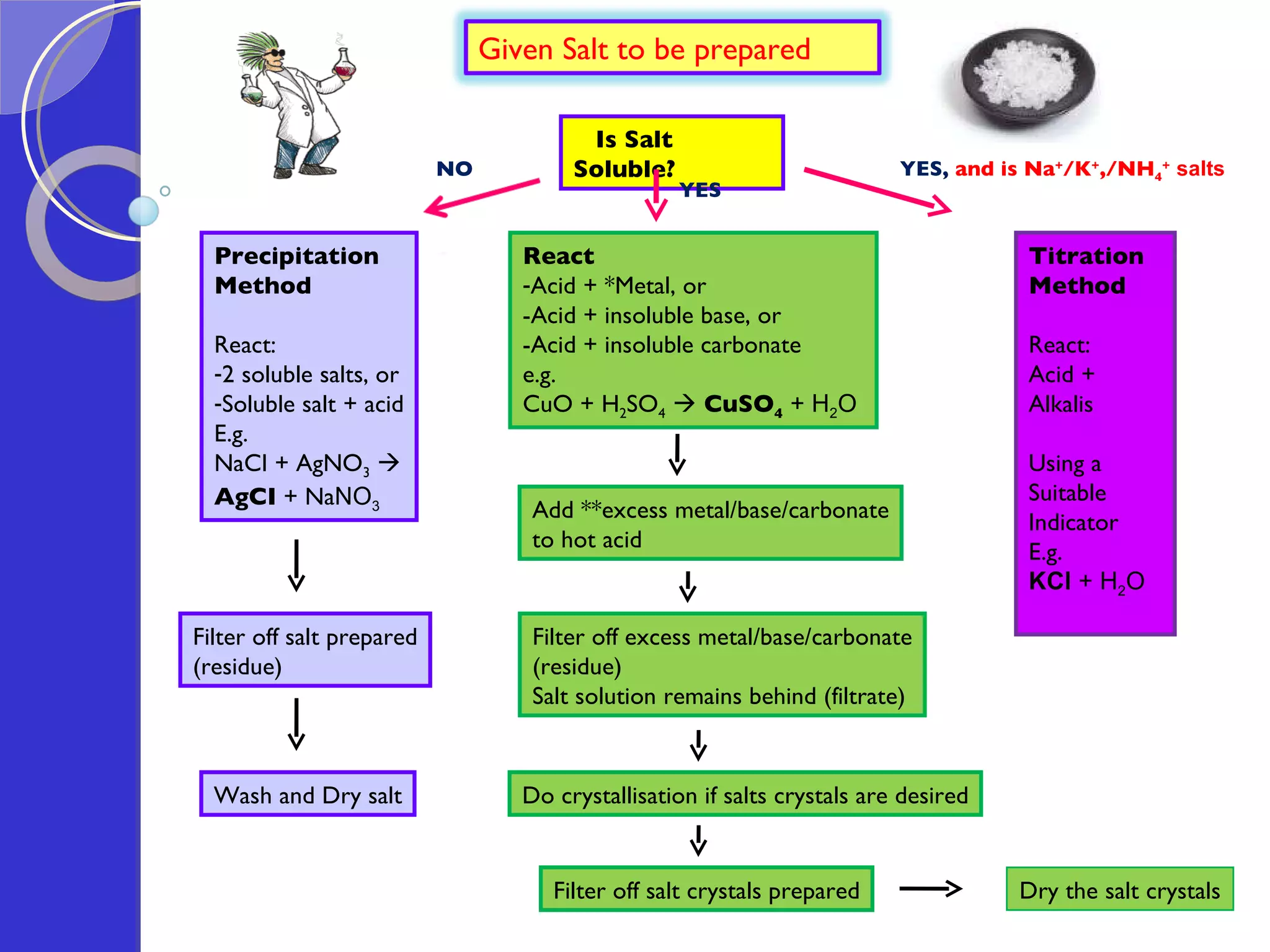
Is Salt Soluble? Precipitation  Method React: 2 soluble salts, or Soluble salt + acid E.g. NaCI + Ag NO 3    AgCI  + Na NO 3 React Acid + *Metal, or -Acid + insoluble base, or -Acid + insoluble carbonate e.g. CuO +  H 2 SO 4      CuSO 4   + H 2 O   Titration Method React: Acid + Alkalis Using a  Suitable Indicator E.g. KCl  + H 2 O Filter off salt prepared (residue) Wash and Dry salt Add **excess metal/base/carbonate to hot acid Filter off excess metal/base/carbonate (residue) Salt solution remains behind (filtrate) Do crystallisation if salts crystals are desired Filter off salt crystals prepared Dry the salt crystals NO YES,  and is Na + /K + ,/NH 4 +   salts YES Given Salt to be prepared
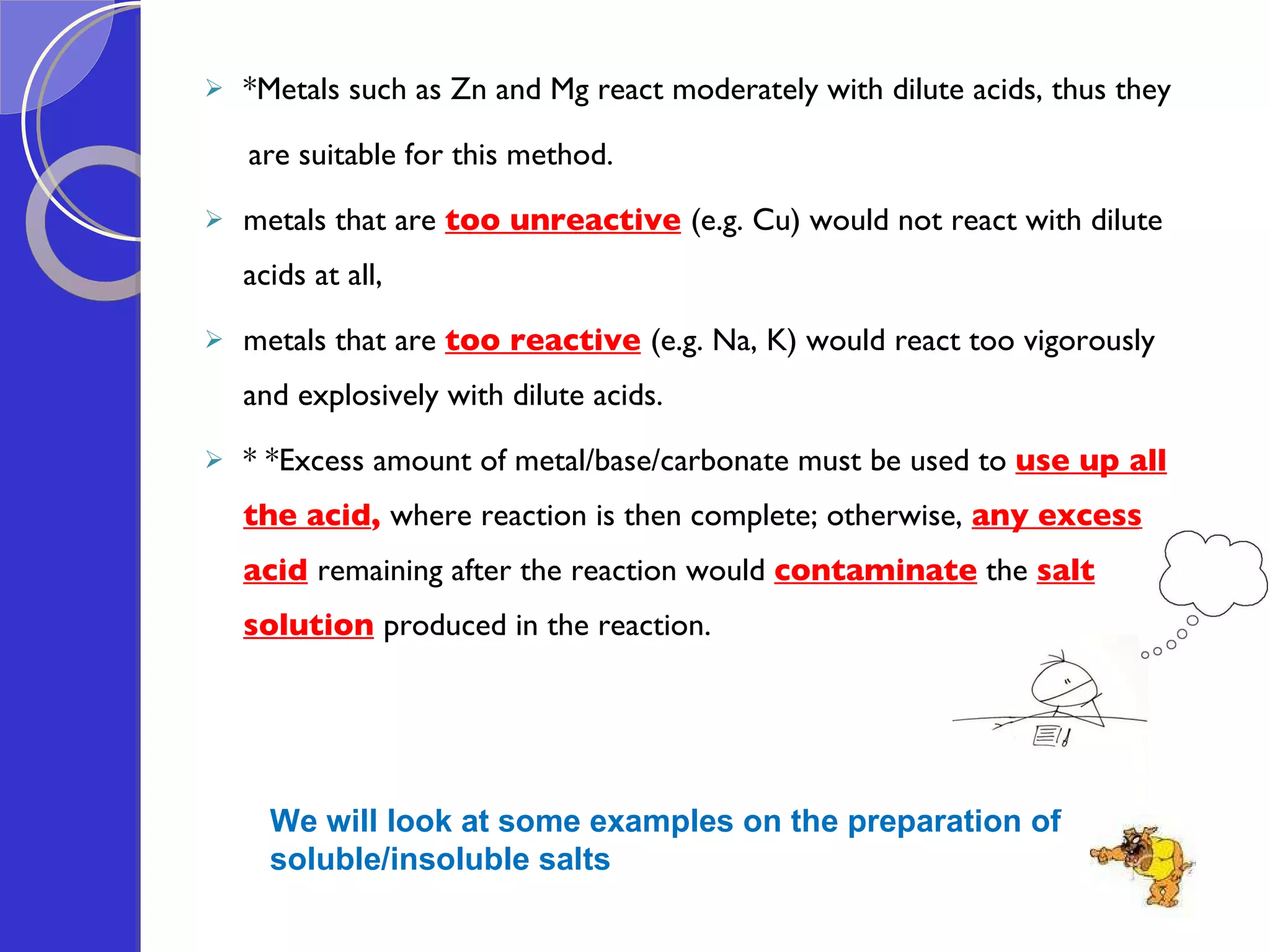
*Metals such as Zn and Mg react moderately with dilute acids, thus they  are suitable for this method. metals that are  too unreactive   (e.g. Cu) would not react with dilute  acids at all,  metals that are  too reactive   (e.g. Na, K) would react too vigorously and explosively with dilute acids.  * *Excess amount of metal/base/carbonate must be used to  use up all the acid ,  where reaction is then complete; otherwise,  any excess acid   remaining after the reaction would  contaminate  the  salt solution   produced in the reaction.   We will look at some examples on the preparation of  soluble/insoluble salts
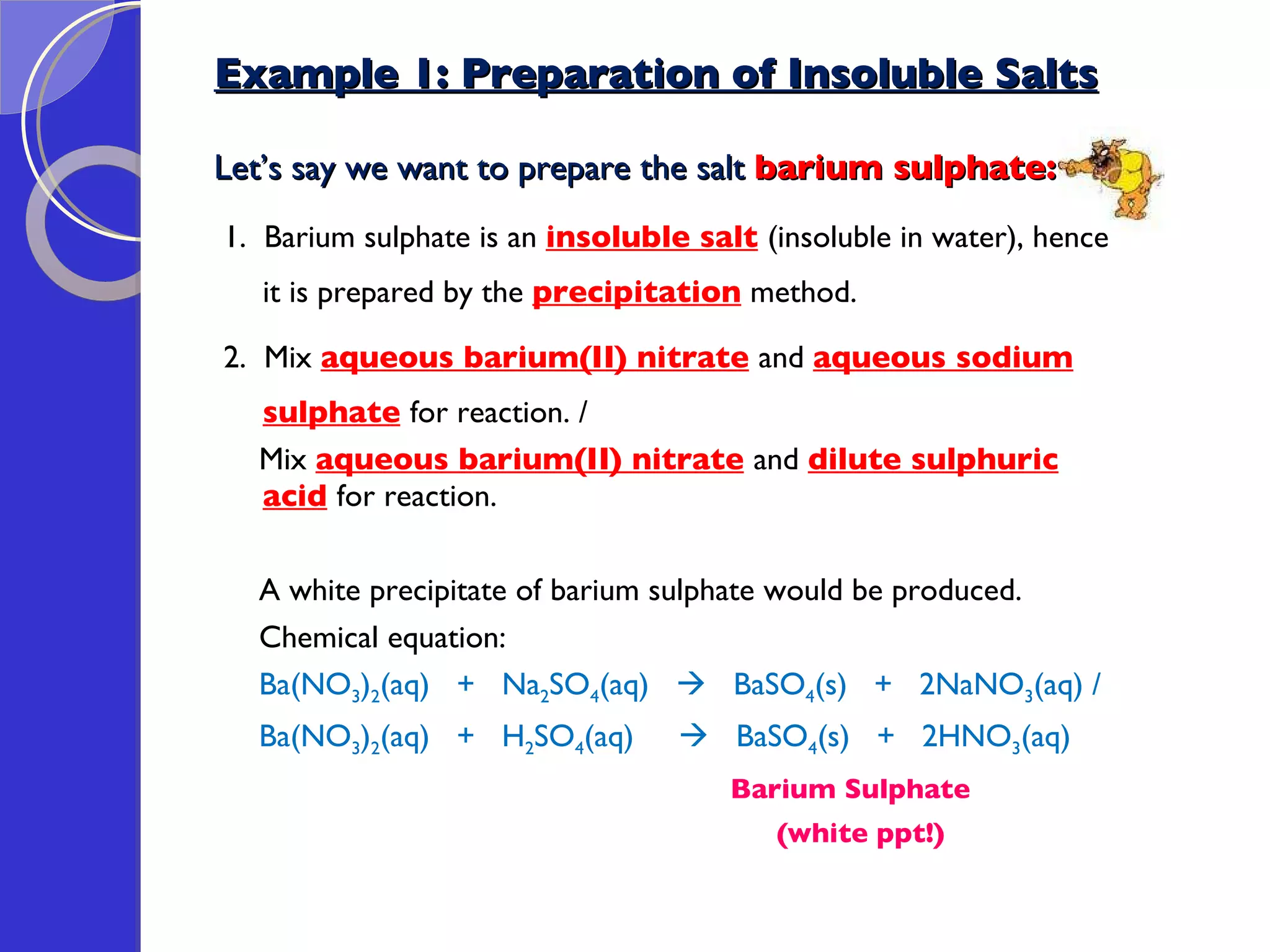
Example 1: Preparation of Insoluble Salts Let’s say we want to prepare the salt  barium sulphate: 1.  Barium sulphate is an  insoluble salt   (insoluble in water), hence it is prepared by the  precipitation  method.  2.  Mix  aqueous barium(II) nitrate   and  aqueous sodium sulphate   for reaction. / Mix  aqueous barium(II) nitrate   and  dilute sulphuric acid   for reaction. A white precipitate of barium sulphate would be produced. Chemical equation: Ba(NO 3 ) 2 (aq)  +  Na 2 SO 4 (aq)     BaSO 4 (s)  +  2NaNO 3 (aq) / Ba(NO 3 ) 2 (aq)  +  H 2 SO 4 (aq)     BaSO 4 (s)  +  2HNO 3 (aq) Barium Sulphate (white ppt!)
3.  Filter the mixture to obtain lead(II) iodide (the yellow precipitate) as the residue.  4.  Wash the lead(II) iodide (the residue) with distilled water.  5.  Dry the lead(II) iodide between pieces of filter paper.
Example 2: Preparation of soluble Salts Let’s say we want to prepare the salt  crystals of zinc sulphate: 1.  Zinc sulphate is a  soluble salt   (soluble in water), hence it is prepared by the reaction between  dilute sulphuric acid   and  zinc / zinc oxide / zinc carbonate . 2.  Add zinc powder / zinc oxide / zinc carbonate with stirring, to hot dilute  sulphuric acid for reaction. 3.  Continue adding until some of the zinc powder / zinc oxide / zinc carbonate no longer reacts with the acid.  The zinc powder / zinc oxide / zinc carbonate is now in excess, and the acid is used up.
Chemical equation: Zn(s)  +  H 2 SO 4 (aq)     ZnSO 4 (aq)  +  H 2 (g) / ZnO(s)  +  H 2 SO 4 (aq)     ZnSO 4 (aq)  +  H 2 O(l) /  ZnCO 3 (s)  +  H 2 SO 4 (aq)     ZnSO 4 (aq)  +  H 2 O(l)  +  CO 2 (g) 4.  Filter the mixture to remove excess zinc powder / zinc oxide / zinc carbonate as the residue, and to obtain zinc sulphate solution as the filtrate.   5.  Pour the zinc sulphate solution into an evaporating dish, and heat to  evaporate some of the water to obtain a hot saturated solution.   6.  Allow the hot saturated solution to cool, where crystals of zinc sulphate  would form.
7.  Filter this mixture to obtain zinc sulphate crystals as the residue.   8.  Dry the zinc sulphate crystals between pieces of filter paper.
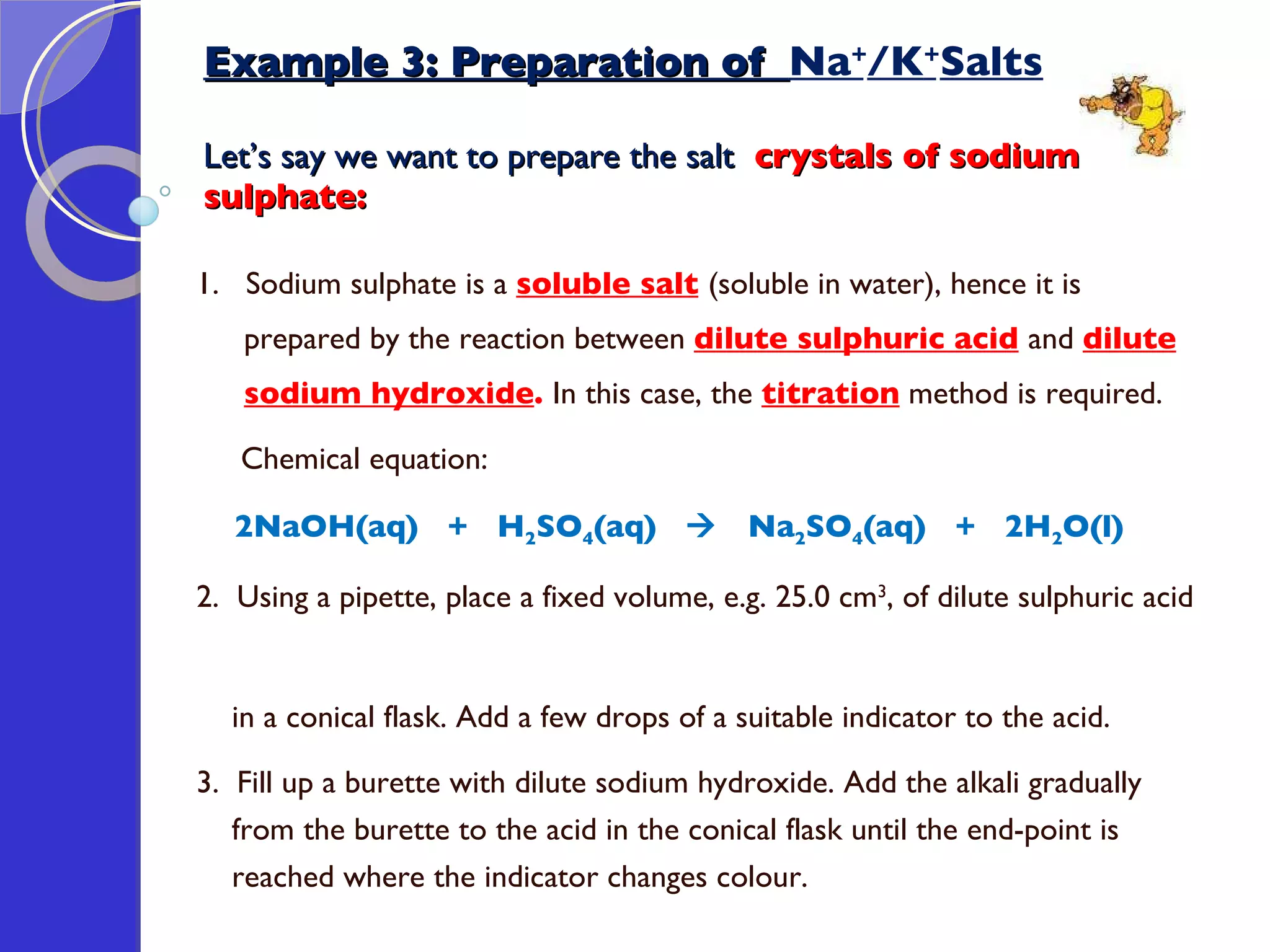
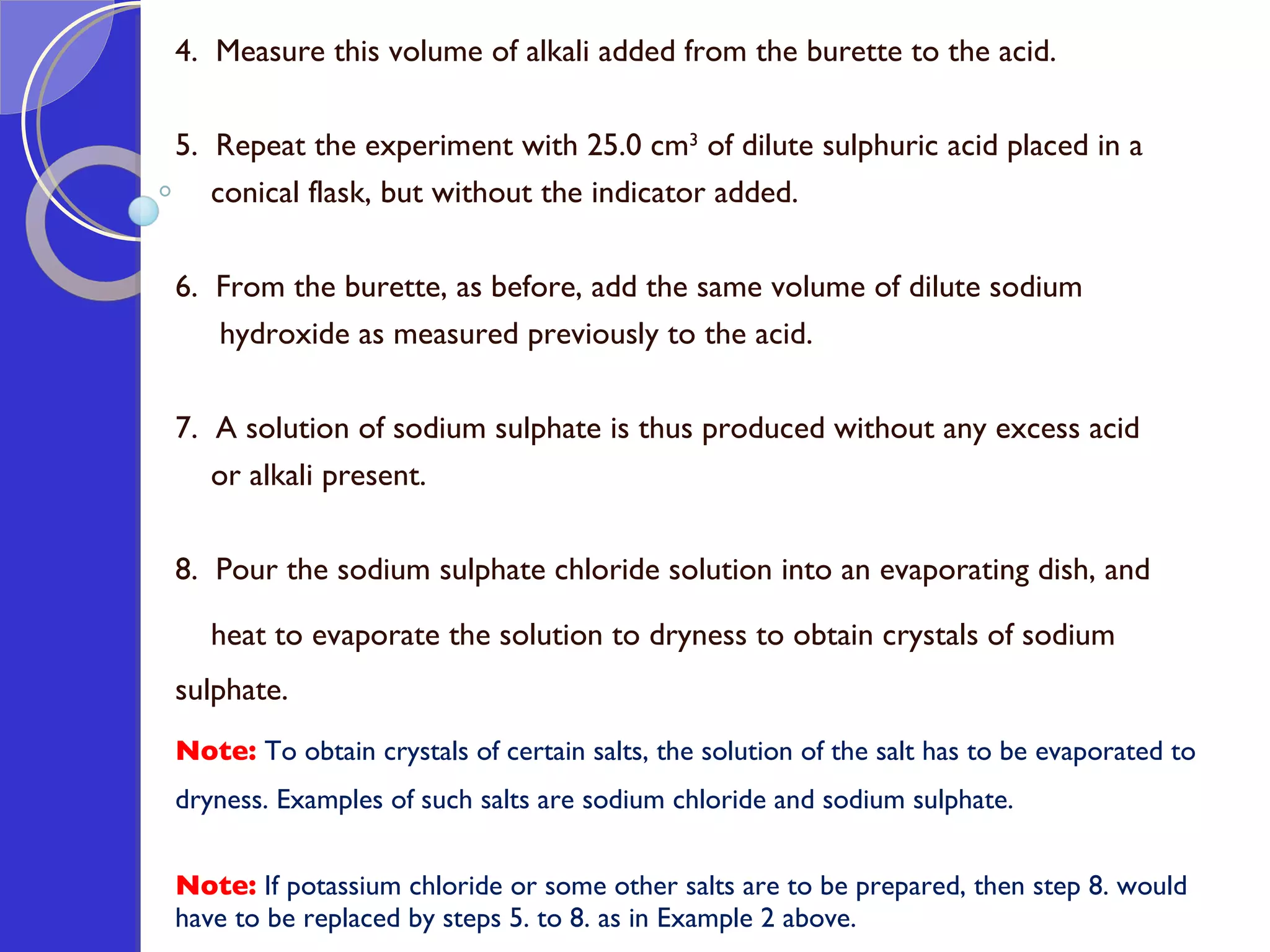
Example 3: Preparation of  Na + /K + Salts Let’s say we want to prepare the salt  crystals of sodium  sulphate: 1.  Sodium sulphate is a  soluble salt   (soluble in water), hence it is prepared by the reaction between  dilute sulphuric acid   and  dilute sodium hydroxide .  In this case, the  titration  method is required. Chemical equation: 2NaOH(aq)  +  H 2 SO 4 (aq)     Na 2 SO 4 (aq)  +  2H 2 O(l) 2.  Using a pipette, place a fixed volume, e.g. 25.0 cm 3 , of dilute sulphuric acid  in a conical flask. Add a few drops of a suitable indicator to the acid.  3.  Fill up a burette with dilute sodium hydroxide. Add the alkali gradually  from the burette to the acid in the conical flask until the end-point is  reached where the indicator changes colour.
4.  Measure this volume of alkali added from the burette to the acid.   5.  Repeat the experiment with 25.0 cm 3  of dilute sulphuric acid placed in a  conical flask, but without the indicator added.   6.  From the burette, as before, add the same volume of dilute sodium  hydroxide as measured previously to the acid.   7.  A solution of sodium sulphate is thus produced without any excess acid  or alkali present. 8.  Pour the sodium sulphate chloride solution into an evaporating dish, and  heat to evaporate the solution to dryness to obtain crystals of sodium sulphate.  Note:  To obtain crystals of certain salts, the solution of the salt has to be evaporated to dryness. Examples of such salts are sodium chloride and sodium sulphate.    Note:  If   potassium chloride or some other salts are to be prepared, then step 8. would have to be replaced by steps 5. to 8. as in Example 2 above.   
 
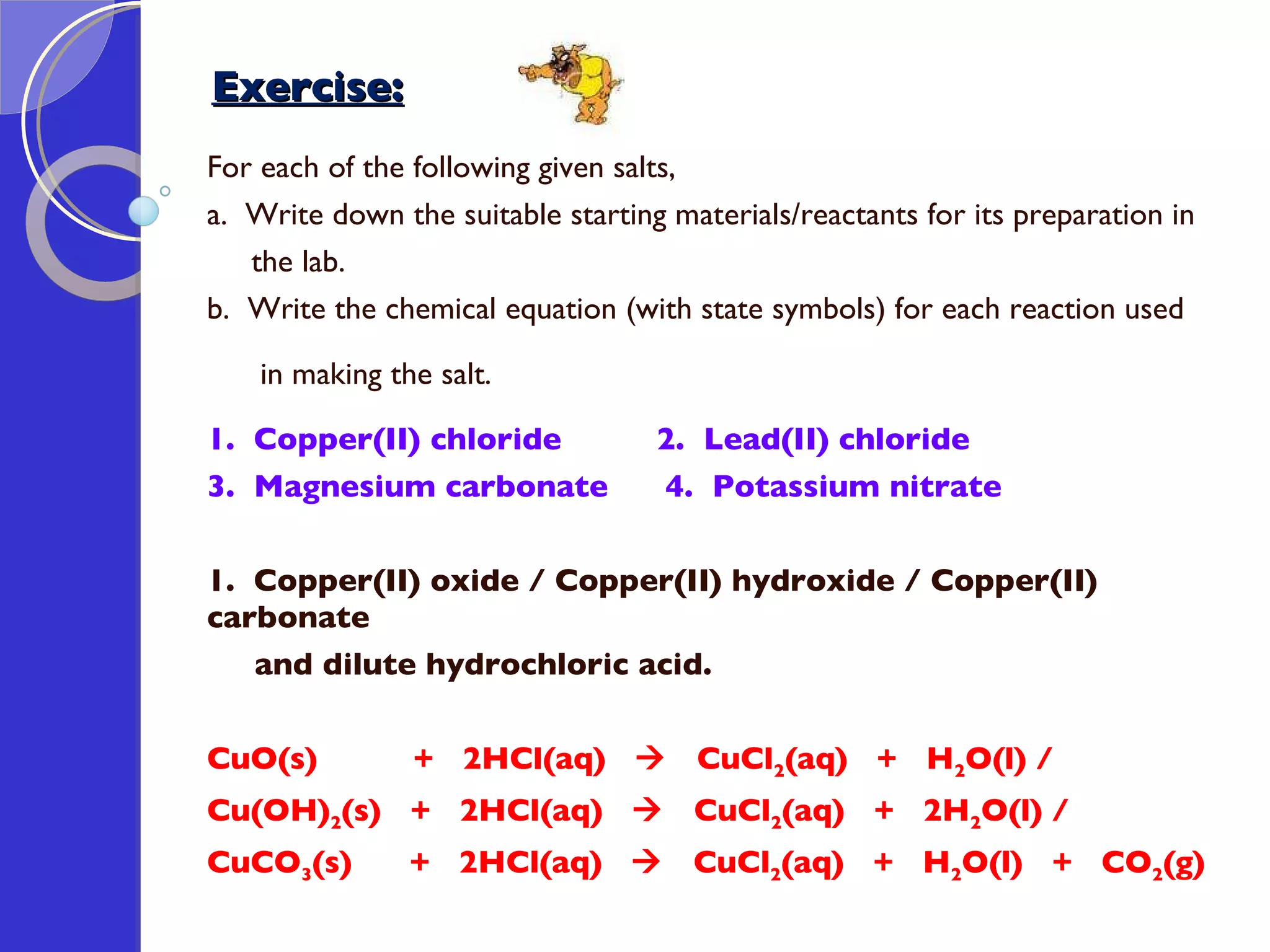
Exercise: For each of the following given salts, a.  Write down the suitable starting materials/reactants for its preparation in  the lab.  b.  Write the chemical equation (with state symbols) for each reaction used  in making the salt. 1.  Copper(II) chloride   2.  Lead(II) chloride 3.  Magnesium carbonate   4.  Potassium nitrate 1.  Copper(II) oxide / Copper(II) hydroxide / Copper(II) carbonate  and dilute hydrochloric acid.   CuO(s)  +  2HCl(aq)     CuCl 2 (aq)  +  H 2 O(l) /  Cu(OH) 2 (s)  +  2HCl(aq)     CuCl 2 (aq)  +  2H 2 O(l) /  CuCO 3 (s)  +  2HCl(aq)     CuCl 2 (aq)  +  H 2 O(l)  +  CO 2 (g)
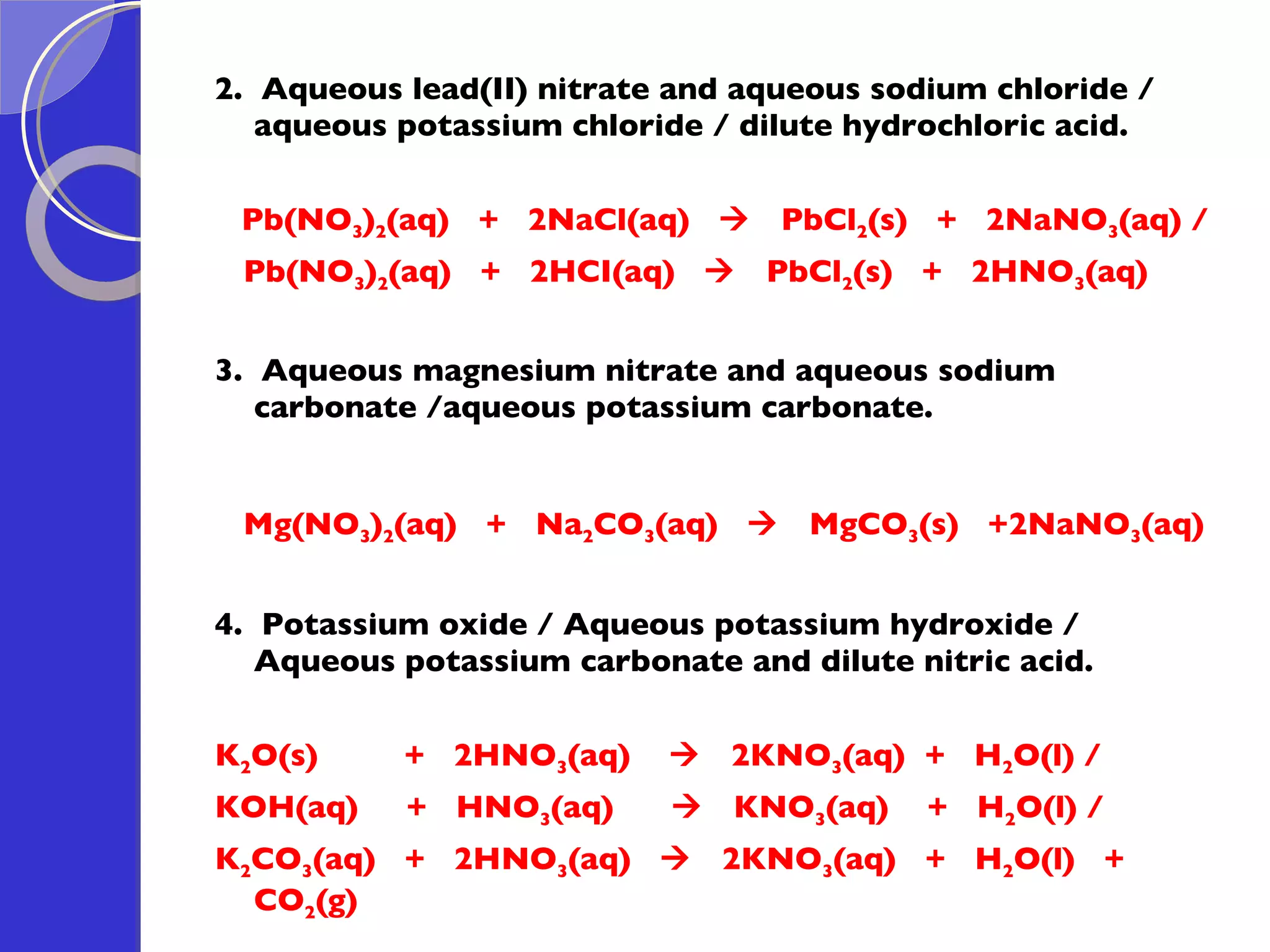
2.  Aqueous lead(II) nitrate and aqueous sodium chloride / aqueous potassium chloride / dilute hydrochloric acid. Pb(NO 3 ) 2 (aq)  +  2NaCl(aq)     PbCl 2 (s)  +  2NaNO 3 (aq) / Pb(NO 3 ) 2 (aq)  +  2HCI(aq)     PbCl 2 (s)  +  2HNO 3 (aq) 3.  Aqueous magnesium nitrate and aqueous sodium carbonate /aqueous potassium carbonate. Mg(NO 3 ) 2 (aq)  +  Na 2 CO 3 (aq)     MgCO 3 (s)  +2NaNO 3 (aq)   4.  Potassium oxide / Aqueous potassium hydroxide / Aqueous potassium carbonate and dilute nitric acid. K 2 O(s)  +  2HNO 3 (aq)     2KNO 3 (aq)  +  H 2 O(l) /  KOH(aq)  +  HNO 3 (aq)     KNO 3 (aq)  +  H 2 O(l) /  K 2 CO 3 (aq)  +  2HNO 3 (aq)     2KNO 3 (aq)  +  H 2 O(l)  + CO 2 (g)
Exercise: A student attempted to prepare  lead(II) sulphate  in the  laboratory by reacting  lead(II) oxide  and  dilute sulphuric acid.  Would he succeed in the preparation? Explain why. No, he would not succeed. This is because once the product, lead(II) sulphate is formed  during the reaction, being an insoluble salt (insoluble in water), it  would coat onto the unreacted lead(II) oxide, thus inhibiting  further reaction between lead(II) oxide and dilute sulphuric acid.    [in fact, since lead(II) sulphate is an insoluble salt, the  precipitation method should be used => e.g. using aqueous  lead(II) nitrate and aqueous sodium sulphate as reactants.]
(4)  Uses of Salts Salts are important to our bodies. Salt is lost from our bodies through  sweat  and urine ,  where it must be replaced through  food and drink .   Some uses of salts in society: 1.  Salts such as  ammonium sulphate   and  ammonium nitrate   are used as  fertilisers  in agriculture. 2. Salts such as  sodium sulphite ,  sodium nitrite   and  sodium citrate   are used as  food preservatives .  3.  Salts such as  sodium chloride   and  monosodium glutamate (MSG)   are used as  food flavourings . 4.  The salt  calcium sulphate   has medicinal uses, e.g. as  ‘ plaster of Paris’ .    5. The salt  sodium chloride   is used in  many chemicals   in the  industry .  6. Salts such as  silver salts   are used in  photography
Food preservatives Sodium nitrate Sodium sulphate Sodium citrate Photography Silver salts Sodium chloride in  industry Chemicals Medical Uses Plaster of Paris (calcium sulphate) Food Flavouring Sodium chloride monosodium glutamate (MSG) Fertilizers in agriculture Ammonium  Sulphate/Nitrate

Acids And Bases

  • 1.
    Topic 6: Acidsand Bases (including writing chemical & ionic equations)
  • 2.
    Learning Objectives Define acids and alkalis in terms of the ions they produce in aqueous solution and their effects on indicators Describe the characteristic properties of acids in reactions with metals, bases, and carbonates State some uses of acids including sulphuric acid Describe the characteristic properties of bases in reactions with acids, metal ions and ammonium compounds Describe the difference between strong and weak acid and alkalis in terms of the extent of ionisation Describe the pH scale as a measure of relative acidity and alkalinity
  • 3.
    Acids (1) Introduction Some common acids in our daily lives! Ethanoic acid, CH 3 COOH – found in vinegar, tomato juice Citric acid, C 6 H 8 O 7 – found in citrus fruits, e.g. oranges, lemons, grapefruit Lactic acid – found in sour milk, yoghurt Tartaric acid – found in grapes Tannic acid – found in tea What about those commonly found in our lab? Hydrochloric acid, HCl Sulphuric acid, H 2 SO 4 Nitric acid, HNO 3 Which of these acids is used in car batteries? Sulphuric Acid!
  • 4.
    Acids solutions usedin the laboratory may be concentrated or dilute. Concentrated acids contain a large amount of pure acid dissolved in water, while dilute acids contain small amounts of acid in water. Two bottles of HCl have concentrations of 5M & 0.5M. Which is more concentrated? Explain The one with 5 mol / dm3 5 M 0.5 M
  • 5.
    (2) PropertiesOf Dilute Acids 1. Most acids have a sour taste . 2. Acids are hazardous and dilute acids are irritants . 3. Acids change the colour of indicators, e.g. acids turn blue litmus red . 4. Most dilute acids react with many metals to produce hydrogen gas. e.g. Mg(s) + 2HCl(aq)  MgCl 2 (aq) + H 2 (g) We can show that hydrogen is produced by testing the gas with a lighted/burning splint . Hydrogen extinguishes a lighted splint with a ‘pop’ sound .
  • 6.
    5. Acidsreact with most bases (metal oxides and hydroxides) to form salt and water e.g. FeO(s) + H 2 SO 4 (aq)  FeSO 4 (aq) + H 2 O(l) 6. Acids react with carbonates (and hydrogencarbonates) to produce carbon dioxide gas. e.g. CaCO 3 (s) + 2HCl(aq)  CaCl 2 (aq) + H 2 O(l) + CO 2 (g) e.g. NaHCO 3 (s)/(aq) + HCl(aq)  NaCl(aq) + H 2 O(l) + CO 2 (g) We can show that carbon dioxide is produced by bubbling the gas through limewater . The formation of a white precipitate with limewater indicates the presence
  • 7.
    Writing Ionic EquationsWhat is an ionic equation?? An ionic equation is an equation involving ions in aqueous solution; only the ions that are involved in the reaction are included. In ionic equations: 1. Formulae of ions that are involved in the reaction are included, while formulae of ions that are not involved in the reaction are omitted. 2. Formulae of solids, liquids and gases are written in full.
  • 8.
    Example Write theionic equation for the reaction between magnesium and hydrochloric acid. Step 1: Write the balanced chemical equation (including the state symbols) Mg(s) + 2HCl(aq)  MgCl 2 (aq) + H 2 (g) Step 2: Split aqueous compounds into their ions. (Only compounds that are aqueous are split into ions) LHS RHS Mg (s) + 2H + (aq) + 2Cl - (aq) -> Mg 2 + (aq) + 2Cl - (aq) + H 2 (g)
  • 9.
  • 10.
    Question: Write theionic equation for reaction between Copper (II) Sulphate solution and sodium hydroxide solution. Above reaction is an example of insoluble salt preparation (Precipitation also occurs between aqueous solutions of 2 soluble salts )
  • 11.
  • 12.
    Exercise Brieflydescribe what you would observe when the following substances are mixed. a) A piece of iron and lemon juice. Effervescence of a colourless and odourless gas (hydrogen gas). b) Baking soda (sodium hydrogencarbonate) and vinegar. Effervescence of a colourless and odourless gas (carbon dioxide). 2. Write balanced chemical and ionic equations (include state symbols) for the reactions between the following:  a) zinc and dilute sulphuric acid b) aqueous sodium hydroxide and dilute hydrochloric acid c) copper(II) oxide and dilute nitric acid d) potassium carbonate solution and dilute sulphuric acid
  • 13.
    a) Zn(s) + H 2 SO 4 (aq)  ZnSO 4 (aq) + H 2 (g) zinc sulphate Zn(s) + 2H + (aq)  Zn 2+ (aq) + H 2 (g)   b) CuO(s) + 2HNO 3 (aq)  Cu(NO 3 ) 2 (aq) + H 2 O(l) calcium nitrate CuO(s) + 2H + (aq)  Cu 2+ (aq) + H 2 O(l) c) NaOH(aq) + HCl(aq)  NaCl(aq) + H 2 O(l) sodium chloride H + (aq) + OH - (aq)  H 2 O(l) d) K 2 CO 3 (aq) + H 2 SO 4 (aq)  K 2 SO 4 (aq) + H 2 O(l) + CO 2 (g) potassium sulfate CO 3 2- (aq) + 2H + (aq)  H 2 O(l) + CO 2 (g)
  • 14.
    (3) Acidsand Hydrogen ions Take a look at the below experiments Experiment A Experiment B 1. Litmus paper changes colour (to red ) only in experiment B 2. Bubbles of hydrogen gas are produced only in experiment B WHY? Pure acids (without water) consist of simple covalent molecules . However, in the presence of water , the acid ionises to form ions. e.g. when hydrogen chloride gas is dissolved in water, ionisation occurs and hydrogen ions, H + (aq) are produced: HCl(g)  H + (aq) + Cl - (aq)
  • 15.
    Other acids behavein a similar way. Pure sulphuric acid and nitric acid (without water) are liquids which consist of simple molecules. In water, the acid ionises and hydrogen ions, H + (aq) are produced. So what is an Acid?? An acid i s a substance that produces hydrogen ions, H + (aq) , in water/aqueous solution . Thus, acids have acidic properties only when dissolved in water or when in aqueous solution , where hydrogen ions, H + (aq) are present. The properties and reactions of acids are due to the presence of the hydrogen ions! Lets see what happened in the reaction between Magnesium and HCI again!
  • 16.
    Exercise 1. Citric acid, a white solid, can be dissolved in two solvents, water and propanone to form solutions. The solution in water turns Universal Indicator paper an orange-red colour. The solution in propanone has no effect on Universal Indicator paper. Explain the above differences . When citric acid dissolves in water, the acid ionises to produce hydrogen ions, H + (aq). Due to the presence of the hydrogen ions, citric acid in water has acidic properties, thus it turns Universal Indicator paper orange-red. When citric acid dissolves in propanone, the acid does not ionise but remains as covalent molecules. As hydrogen ions are not present, citric acid in propanone does not have acidic properties, thus it has no effect on Universal Indicator paper.
  • 17.
    2. Adrink tablet contains a mixture of a solid acid (often citric acid) and solid sodium hydrogencarbonate. When the tablet is added to water, the drink fizzes. Explain why. When the drink tablet is added to water, the acid ionises to produce hydrogen ions, H + (aq). The hydrogen ions react with the sodium hydrogencarbonate to produce carbon dioxide gas, which causes the fizz.
  • 18.
    (4) Basicityof Acids The basicity of an acid refers to the maximum number of hydrogen ions produced by a molecule of the acid in aqueous solution .   Acid Reaction with water Basicity Hydrochloric acid HCl(aq)  H + (aq) + Cl - (aq) Monobasic Nitric acid HNO 3 (aq)  H + (aq) + NO 3 - (aq) Monobasic Ethanoic acid CH 3 COOH(aq)  H + (aq) + CH 3 COO - (aq) Monobasic Sulphuric acid H 2 SO 4 (aq)  2H + (aq) + SO 4 2- (aq) Dibasic Phosphoric(V) acid H 3 PO 4 (aq)  3H + (aq) + PO 4 3- (aq) Tribasic
  • 19.
    (5) Strengthof Acids The strength of an acid depends on the degree of ionisation dissociation of the acid in aqueous solution .   A strong acid is completely ionised in water/aqueous solution. In a solution of strong acid, all acid molecules are ionised to form ions in water. E.g. a solution of hydrochloric acid only contains hydrogen ions and chloride ions and no HCl molecules, as all the HCl molecules have ionised in water. HCl(aq)  H + (aq) + Cl - (aq) H 2 SO 4 (aq)  2H + (aq) + SO 4 2- (aq) HNO 3 (aq)  H + (aq) + NO 3 - (aq)
  • 20.
    A weak acid is partially ionised in water/aqueous solution. In a solution of weak acid, most of the acid molecules remain as covalent molecules in water, only few acid molecules are ionised to form hydrogen ions. E.g. in a solution of 1M ethanoic acid , only 4 out of 1000 CH 3 COOH molecules ionise to produce hydrogen ions, the remaining 99% CH 3 COOH molecules remain unchanged in water. Examples of weak acids and equations for their ionisation in aqueous solution: CH 3 COOH(aq)  H + (aq) + CH 3 COO - (aq) H 2 CO 3 (aq)  2H + (aq) + CO 3 2- (aq)   A solution of strong acid, e.g. hydrochloric acid, has three kinds of particles: hydrogen ions , chloride ions and water molecules .   A solution of weak acid, e.g. ethanoic acid, has four kinds of particles: hydrogen ions , ethanoate ions , ethanoic acid molecules and water molecules .
  • 21.
    Take a lookat the difference between strong and weak acids below: Strong acids react more vigorously than weak acids. e.g. if strips of magnesium ribbon are added to solutions of hydrochloric acid and ethanoic acid (in separate experiments), effervescence of hydrogen gas occurs more rapidly with hydrochloric acid than with ethanoic acid.
  • 22.
    Question : Does a strong acid means it is concentrated? Note that the strength of acids does not relate to their concentration! The terms “strong” and “weak” refer to the extent of ionisation of the acid in water. The terms “concentrated” and “dilute” refer to the amount of solute in the solution.   a) 10.0 moldm -3 solution of hydrochloric acid = concentrated solution of a strong acid b) 0.100 moldm -3 solution of hydrochloric acid = dilute solution of a strong acid c) 10.0 moldm -3 solution of ethanoic acid = concentrated solution of a weak acid d) 0.100 moldm -3 solution of ethanoic acid = dilute solution of a weak acid
  • 23.
    Question: a) Is H 2 SO 4 (l) a good conduct of electricity? b) Is H 2 SO 4 (aq) a good conduct of electricity? a) No. Pure sulphuric acid (no water) consist of small covalent molecules, hence are poor electrical conductors. b) Yes! (acids in water act as strong electrolyte ) Why? H 2 SO 4 (aq)  2H + (aq) + SO 4 2- (aq) Acids in water contain moving ions that could carry the electric current!
  • 24.
    Question: How dostrength and concentration affect conduction of electricity? Explain why dilute sulphuric acid conducts electricity better than concentrated sulphuric acid. In dilute sulphuric acid, the acid ionizes completely to produce a high concentration of ions which move freely to conduct electricity. In concentrated sulphuric acid, due to small amount of water present, the acid is only partially ionized (although it is still a strong acid), thus there are much less number of free-moving ions present to conduct electricity.
  • 25.
    (6) Usesof Acids 1. Acids are used to make many useful products. The most important industrial acid is sulphuric acid , which is mainly used in the manufacture of agricultural fertilisers . e.g. sulphuric acid reacts with ammonia in making the fertiliser ammonium sulphate. Sulphuric acid is also used in the manufacture of detergents, paints, dyes, artificial fibres and plastics . Dilute sulphuric acid is used in batteries for road vehicles such as cars and buses. 2. Acids such as hydrochloric acid and sulphuric acid are also used in the removal of rust from iron and steel objects. Acids remove rust from such objects by reacting and ‘dissolving’ the iron(III) oxide in the rust .
  • 26.
    3. Someacids are used in food preservation . Examples are: Ethanoic acid (in vinegar) – used to preserve vegetables Benzoic acid – used in fruit juices, jams and oyster sauce Citric acid – used in foods as both a preservative and flavouring
  • 27.
    Bases & Alkalis(1 ) Introduction Bases are the oxides or hydroxides of metals , e.g. copper(II) oxide, sodium hydroxide. Soluble bases are called alkalis , thus an alkali is a base which is soluble in water. Thus, all alkalis are bases , but not all bases are alkalis .   Alkalis, like acids, are common in our daily lives. For example, they are found in soaps, detergents, window cleaners, floor cleaners, oven cleaners, toothpastes and medicine for indigestion. Alkalis are also used in the school laboratory. Three such common alkalis are: Sodium hydroxide, NaOH Aqueous ammonia/Ammonia solution, NH 3 (aq) Calcium hydroxide (Limewater), Ca(OH) 2   Insoluble Bases Alkalis Bases
  • 28.
    (2) PropertiesOf Dilute Alkalis 1. Dilute solutions of alkalis have a ‘slippery’ feel 2. Alkalis are hazardous and like dilute acids, dilute solutions of sodium hydroxide and potassium hydroxide are irritants . 3. Concentrated solutions of sodium hydroxide and potassium hydroxide are corrosive and burn skin. 4. Alkalis change the colour of indicators, e.g. alkalis turn red litmus blue . 5. Alkalis react with acids to form a salt and water , in a reaction called neutralisation . 6. Alkalis react with (solid) ammonium salts on warming to produce ammonia gas. NH 4 Cl(s) + NaOH(aq)  NaCl(aq) + H 2 O(l) + NH 3 (g)
  • 29.
    We can showthat ammonia is produced by testing the gas evolved with damp red litmus paper . The damp red litmus paper would turn blue , indicating the presence of ammonia. 7. Alkalis react with most aqueous metal salts to form insoluble precipitates of metal hydroxides . CuSO 4 (aq) + 2NaOH(aq)  Cu(OH) 2 (s) + Na 2 SO 4 (aq) Exercise: Write balanced chemical and ionic equations (include state symbols) for the reactions between the following:  a) aqueous calcium hydroxide and dilute nitric acid b) ammonium sulphate solution and aqueous potassium hydroxide c) iron(III) sulphate solution and aqueous sodium hydroxide d) lead(II) nitrate solution and aqueous ammonia Blue PPT
  • 30.
    a) Ca(OH)2 (aq) + 2HNO 3 (aq)  Ca(NO 3 ) 2 (aq) + 2H 2 O(l) calcium nitrate H + (aq) + OH - (aq)  H 2 O(l)     b) (NH 4 ) 2 SO 4 (aq) + 2KOH(aq)  K 2 SO 4 (aq) + 2H 2 O(l) + 2NH 3 (g) potassium sulphate NH 4 + (aq) + OH - (aq)  H 2 O(l) + NH 3 (g) c) Fe 2 (SO 4 ) 3 (aq) + 6NaOH(aq)  2Fe(OH) 3 (s) + 3Na 2 SO 4 (aq) iron(III) hydroxide Fe 3+ (aq) + 3OH - (aq)  Fe(OH) 3 (s)   d) Pb(NO 3 ) 2 (aq) + 2NH 4 OH(aq)  Pb(OH) 2 (s) + 2NH 4 NO 3 (aq) lead(II) hydroxide Pb 2+ (aq) + 2OH - (aq)  Pb(OH) 2 (s)    
  • 31.
    (3) Alkalis& Hydroxide ions So what is an alkali? An alkali i s a substance that produces hydroxide ions, OH - (aq) , in water/aqueous solution . The properties and reactions of alkalis are due to the presence of the hydroxide ions. Thus, alkalis have alkaline properties only when dissolved in water or when in aqueous solution , where hydroxide ions, OH - (aq) are present.
  • 32.
    (4) Strengthof Alkalis Like for acids, the strength of an alkali depends on the degree of ionisation /dissociation of the alkali in aqueous solution .  A strong alkali is completely ionised in water/aqueous solution. Examples of strong alkalis and equations for their ionisation in aqueous solution: NaOH(aq)  Na + (aq) + OH - (aq) KOH(aq)  K + (aq) + OH - (aq) A weak alkali is partially ionised in water/aqueous solution.   The most common example of a weak alkali is aqueous ammonia ammonia solution . When ammonia gas dissolves in water, most of the ammonia molecules remain as covalent molecules , only a small amount of ammonia molecules are ionised to form hydroxide ions:  
  • 33.
    (5) Usesof Alkalis 1. An alkali, calcium hydroxide (slaked lime) , or the base calcium oxide (quicklime) are added by farmers to neutralise excess acids in soils that have become too acidic from extensive use of chemical fertilizers (e.g. ammonium sulphate) and from acid rain. 2. Mild alkalis are used in medicine such as antacid to relieve the pain of indigestion as caused by excess acid in the stomach . Antacid contains a base such as magnesium hydroxide or aluminium hydroxide that neutralises the excess acid.
  • 34.
    3. Alkalisare used in toothpastes to neutralise acids on our teeth produced by bacteria when they feed on sugars in our food. If the acid is not destroyed, it corrodes the teeth causing tooth decay . Toothpastes usually contain magnesium hydroxide which neutralises the acids in the mouth. 4. Alkalis are used to remove grease . Mild/weak alkalis are contained in soaps and detergents . Aqueous ammonia , a mild/weak alkali, is used in window cleaners to remove grease and dirt from glass. Sodium hydroxide , a powerful/strong alkali, is used in floor and oven cleaners .
  • 35.
    (7) Applicationsof Neutralisation Neutralisation is the reaction between an acid and a base to form a salt and water only. Neutralisation is important as it has many applications in daily life. 1. Controlling the pH of soil – as in point 1. under ‘ Uses of Alkalis ’ section. However, if soil is too alkaline , compost which consists of rotting plant material such as leaves & vegetables can be added. The plants decompose to give off carbon dioxide which dissolves in water to form carbonic acid that reduces alkalinity of the soil.
  • 36.
    2. Treatmentof indigestion – as in point 2. under ‘ Uses of Alkalis ’ section.  3. In toothpastes – as in point 3. under ‘ Uses of Alkalis ’ section 4. Treatment of insect stings Bee stings are acidic and can be neutralised by applying baking soda (solution or paste) which contains alkaline sodium hydrogencarbonate to the affected area. Wasp stings are alkaline and can be neutralised by applying vinegar or lemon juice to the affected area. Bee Sting – Acidic! Wasp Sting – Alkaline! 5. Treatment of industrial wastewater Wastewater from many industrial processes can be highly acidic or alkaline , e.g. wastewater from dyeing factories can have a pH of 10 to 12. In the past, such wastewater went straight into rivers or the sea where it caused environmental damages such as killing of marine life and corrosion of metal pipes
  • 37.
    Indicators & pH(1) Indicators and pH scale The pH value of a solution indicates the degree of acidity or alkalinity of the substance. The pH scale is numbered between 0 and 14 . On this scale, a pH of 7 is neutral (this is the pH of pure water), a solution with pH less than 7 is acidic, and a solution with pH greater than 7 is alkaline. 0 1 2 3 4 5 6 7 8 9 10 11 12 13 14 the pH scale Acidity increases Neutral Alkalinity increases For an acidic solution: the smaller the pH , the more acidic the solution is, the more hydrogen ions it contains. For an alkaline solution: the greater the pH , the more alkaline the solution is, the more hydroxide ions it contains.  
  • 38.
    An indicator is a substance that has different colours in acidic and alkaline solutions. Simple indicators tell whether a solution is acidic or alkaline , e.g. litmus, methyl orange, phenolphthalein. The colours of these three indicators in solutions of acids and alkalis are as shown: In addition, different indicators change colours over different ranges of pH values: Indicator Colour in Acids Colour in Alkalis Litmus Red Blue Methyl orange Red Yellow Phenolphthalein Colourless Pink Common Indicators Colour of Indicator at different pH values Litmus red blue 0 5.0 8.0 14 Methyl orange red yellow 0 3.1 4.4 14 Phenolphthalein colourless pink 0 8.3 10 14
  • 39.
    (2) Measurementof pH There are other indicators that not only indicate whether a solution is acidic or alkaline, but also how acidic or alkaline it is, by indicating the pH value of the solution, e.g. Universal Indicator . The pH value of a solution can be measured by using Universal Indicator, a pH meter or by a pH sensor connected to a computer. 1. Universal Indicator (or pH indicator) is a mixture of indicators which gives different colours at different pH values . It is used in the form of a solution or a paper (pH paper). The pH of a solution is measured by adding a few drops of Universal Indicator to the solution or by dipping a piece of Universal Indicator paper in the solution. The pH of the solution is then found by comparing the colour obtained with a colour chart .
  • 40.
    2. A pH meter is an electrical method of measuring the pH of a solution. It consists of a pH electrode or probe connected to a meter . The probe is dipped into the solution and the meter shows the pH value either on a scale or digitally. It is much more reliable and accurate than the Universal Indicator, though the latter is often more convenient. 3. A pH sensor connected to a computer through an interface can be used to measure the pH of a solution. The pH reading is displayed on the computer screen.   The pH values of some common substances are shown below:
  • 41.
    (3) Importanceof pH 1. pH and the body Substances in the body have different pH values. Acidic conditions in the stomach (pH ~ 1.5) and alkaline conditions in the small intestine (pH ~ 8.4) are needed for good digestion. Slightly acidic condition in the blood (pH ~ 6.5) that goes to the heart and lungs is due to carbon dioxide present in the blood. 2. pH and food preservation Many fresh food quickly go bad mainly due to microorganisms , such as bacteria , present in the food. Acids can be used to preserve foods because microorganisms do not grow well in solutions of low pH .
  • 42.
    3. pH inthe garden The pH of soil is important for optimal plant growth. Most plants grow best when the soil has a pH of about 5.6 , that is, soil that is weakly acidic. However, some plants grow well in more acidic soil or more alkaline soil. Examples of pH of soil in which plants grow best: a. Orchids – more acidic soil (pH 4 – 5) b. Azaleas, strawberries, apples, potatoes – weakly acidic soil (pH 5 – 6) c. Common vegetables, e.g. beans, lettuce, onion – about neutral soil (pH 6 – 8) d. Water lilies – more alkaline soil (pH 8 – 9)
  • 43.
    4. pHand hair Our normal hair is weakly acidic with a pH of about 5 where hair is smooth, strong and healthy. In hair perming , hair is treated with alkaline perm solutions which make hair dull, weaker, easier to break and even damaged. Rinsing the hair with water or weakly acidic solutions reverses these changes and returns the hair to its normal state. In cleaning our hair, most shampoos used are alkaline so as to dissolve grease present in the hair, but alkalis can damage hair. Rinsing the hair with hair conditioners which contain weak natural acids (such as citric acid or tartaric acid) neutralise any excess alkali left in the hair after shampooing and restores the pH of hair to its normal value.
  • 44.
    Oxides (1) Types of Oxides An Oxide is a compound of oxygen and another element. Most oxides can be classified into four types: acidic , basic , neutral and amphoteric .   Acidic and neutral oxides are oxides of non-metals . Basic and amphoteric oxides are oxides of metals . Iron Ores Copper (II) Oxide Lead (II) Oxide
  • 45.
    Oxides Metallic Oxides Non-metallic oxides Basic oxides Amphoteric oxides Neutral oxides Acidic oxides Li 2 O Al 2 O 3 H 2 O SO 2 Na 2 O ZnO CO SO 3 MgO PbO NO NO 2 CaO CO 2 FeO P 4 O 10 CuO SiO 2 etc…..
  • 46.
    1. AcidicOxides a. Acidic oxides react with water to produce acids SO 3 (g) + H 2 O(l)  H 2 SO 4 (aq) SO 2 (g) + H 2 O(l)  H 2 SO 3 (aq) CO 2 (g) + H 2 O(l)  H 2 CO 3 (aq) P 4 O 10 (s) + 6H 2 O(l)  4H 3 PO 4 (aq) b. Acidic oxides react with alkalis to produce salt and water . CO 2 (g) + 2NaOH(aq)  Na 2 CO 3 (aq) + H 2 O(l) SO 3 (g) + Ca(OH) 2 (aq)  CaSO 4 (s) + H 2 O(l) (2) Reactions of Oxides
  • 47.
    2. BasicOxides a. Basic oxides react with water to produce alkalis . (most basic oxides are insoluble in water) K 2 O(s) + H 2 O(l)  2KOH(aq) b. Basic oxides react with acids to produce salt and water . CaO(s) + 2HNO 3 (aq)  Ca(NO 3 ) 2 (aq) + H 2 O(l) 3. Neutral Oxides Neutral oxides do not react with either acids or bases, thus they do not form salts. 4. Amphoteric Oxides Amphoteric oxides behave as an acidic oxide or as a basic oxide , hence they react both with acids and with alkalis to form salts . Al 2 O 3 (s) + 6HCl(aq)  2AlCl 3 (aq) + 3H 2 O(l) acts as base Al 2 O 3 (s) + NaOH(aq)  sodium aluminate + H 2 O(l) acts as acid NaAl(OH) 4 (aq )
  • 48.
    Question: ‘ Galliumoxide reacts with hydrochloric acid and sodium hydroxide to form salts.’ What can you deduce from this statement? Gallium oxide is an amphoteric oxide (and gallium is a metal)!
  • 49.
    (3) SulphurDioxide & Its Uses Sulphur dioxide is formed when sulphur burns in air. As it is an acidic oxide , it reacts with sodium hydroxide solution to form the salt, sodium sulphite : SO 2 (g) + 2NaOH(aq)  Na 2 SO 3 (aq) + H 2 O(l) sodium sulphite 1. Sulphur dioxide and sodium sulphite has many uses: Sulphur dioxide is most importantly used in the manufacture of sulphuric acid . 2. Sulphur dioxide and sodium sulphite are used as food preservatives , where they kill bacteria that make foods and drinks go bad. They are used in fruits, dried fruits, some meats and vegetables, sauces, fruit j juices, soft drinks and wines.
  • 50.
    3. Sulphurdioxide and sulphites are also bleaches , where uses include: Bleaching delicate materials such as wool and silk . Giving foods such as flour and some cheeses a white appearance. Paper making, where wood is converted into wood pulp and bleached to make white paper .
  • 51.
    Salts (1 )Introduction A salt is produced when an acid reacts with a base . The salt consists of two parts; one part comes from the base, the other from the base part NaOH + HCl  NaCl + H 2 O acid part Thus, a salt is a substance formed when the hydrogen ions of an acid are completely or partly replaced by a metal ion or an ammonium ion . Sodium Chloride “ Common Salt”
  • 52.
    Questions: The followingare names of some salts: iron(III) nitrate, copper(II) chloride, ammonium sulphate. Name the possible reactants that can react together to produce each of the given salts. For iron(III) nitrate: iron / iron(III) oxide / iron(III) hydroxide / iron(III) carbonate with dilute nitric acid.   For copper(II) chloride: copper(II) oxide / copper(II) hydroxide / copper(II) carbonate with dilute hydrochloric acid.   For ammonium sulphate: aqueous ammonia / ammonium carbonate with dilute sulphuric acid
  • 53.
    (2) Solubilityof Salts (Solubility Rules!) Salts Solubility (in water) Na + , K + , NH 4 + salts (sodium, potassium & ammonium salts) All soluble NO 3 - (nitrate salts) All soluble Cl - (chloride salts) All soluble except AgCl, PbCl 2 I - (iodide salts) All soluble except AgI, PbI 2 SO 4 2- (sulphate salts) All soluble except BaSO 4 , PbSO 4 , CaSO 4 CO 3 2- (carbonate salts) All insoluble except Na 2 CO 3 , K 2 CO 3 , (NH 4 ) 2 CO 3
  • 54.
    (3) Preparation ofSalts The method used to make/prepare a salt in the laboratory depends on the solubility of the salt in water . There are 3 steps in writing out the preparation of a salt. Step 1: Check solubility of the salt to be prepared Step 2: Check solubility of the parent acid and parent base to be used Step 3: Check solubility of parent carbonate and/or parent oxide
  • 55.
    Is Salt Soluble?Precipitation Method React: 2 soluble salts, or Soluble salt + acid E.g. NaCI + Ag NO 3  AgCI + Na NO 3 React Acid + *Metal, or -Acid + insoluble base, or -Acid + insoluble carbonate e.g. CuO + H 2 SO 4  CuSO 4 + H 2 O Titration Method React: Acid + Alkalis Using a Suitable Indicator E.g. KCl + H 2 O Filter off salt prepared (residue) Wash and Dry salt Add **excess metal/base/carbonate to hot acid Filter off excess metal/base/carbonate (residue) Salt solution remains behind (filtrate) Do crystallisation if salts crystals are desired Filter off salt crystals prepared Dry the salt crystals NO YES, and is Na + /K + ,/NH 4 + salts YES Given Salt to be prepared
  • 56.
    *Metals such asZn and Mg react moderately with dilute acids, thus they are suitable for this method. metals that are too unreactive (e.g. Cu) would not react with dilute acids at all, metals that are too reactive (e.g. Na, K) would react too vigorously and explosively with dilute acids. * *Excess amount of metal/base/carbonate must be used to use up all the acid , where reaction is then complete; otherwise, any excess acid remaining after the reaction would contaminate the salt solution produced in the reaction. We will look at some examples on the preparation of soluble/insoluble salts
  • 57.
    Example 1: Preparationof Insoluble Salts Let’s say we want to prepare the salt barium sulphate: 1. Barium sulphate is an insoluble salt (insoluble in water), hence it is prepared by the precipitation method.  2. Mix aqueous barium(II) nitrate and aqueous sodium sulphate for reaction. / Mix aqueous barium(II) nitrate and dilute sulphuric acid for reaction. A white precipitate of barium sulphate would be produced. Chemical equation: Ba(NO 3 ) 2 (aq) + Na 2 SO 4 (aq)  BaSO 4 (s) + 2NaNO 3 (aq) / Ba(NO 3 ) 2 (aq) + H 2 SO 4 (aq)  BaSO 4 (s) + 2HNO 3 (aq) Barium Sulphate (white ppt!)
  • 58.
    3. Filterthe mixture to obtain lead(II) iodide (the yellow precipitate) as the residue.  4. Wash the lead(II) iodide (the residue) with distilled water.  5. Dry the lead(II) iodide between pieces of filter paper.
  • 59.
    Example 2: Preparationof soluble Salts Let’s say we want to prepare the salt crystals of zinc sulphate: 1. Zinc sulphate is a soluble salt (soluble in water), hence it is prepared by the reaction between dilute sulphuric acid and zinc / zinc oxide / zinc carbonate . 2. Add zinc powder / zinc oxide / zinc carbonate with stirring, to hot dilute sulphuric acid for reaction. 3. Continue adding until some of the zinc powder / zinc oxide / zinc carbonate no longer reacts with the acid. The zinc powder / zinc oxide / zinc carbonate is now in excess, and the acid is used up.
  • 60.
    Chemical equation: Zn(s) + H 2 SO 4 (aq)  ZnSO 4 (aq) + H 2 (g) / ZnO(s) + H 2 SO 4 (aq)  ZnSO 4 (aq) + H 2 O(l) / ZnCO 3 (s) + H 2 SO 4 (aq)  ZnSO 4 (aq) + H 2 O(l) + CO 2 (g) 4. Filter the mixture to remove excess zinc powder / zinc oxide / zinc carbonate as the residue, and to obtain zinc sulphate solution as the filtrate.   5. Pour the zinc sulphate solution into an evaporating dish, and heat to evaporate some of the water to obtain a hot saturated solution.   6. Allow the hot saturated solution to cool, where crystals of zinc sulphate would form.
  • 61.
    7. Filterthis mixture to obtain zinc sulphate crystals as the residue.   8. Dry the zinc sulphate crystals between pieces of filter paper.
  • 62.
    Example 3: Preparationof Na + /K + Salts Let’s say we want to prepare the salt crystals of sodium sulphate: 1. Sodium sulphate is a soluble salt (soluble in water), hence it is prepared by the reaction between dilute sulphuric acid and dilute sodium hydroxide . In this case, the titration method is required. Chemical equation: 2NaOH(aq) + H 2 SO 4 (aq)  Na 2 SO 4 (aq) + 2H 2 O(l) 2. Using a pipette, place a fixed volume, e.g. 25.0 cm 3 , of dilute sulphuric acid in a conical flask. Add a few drops of a suitable indicator to the acid. 3. Fill up a burette with dilute sodium hydroxide. Add the alkali gradually from the burette to the acid in the conical flask until the end-point is reached where the indicator changes colour.
  • 63.
    4. Measurethis volume of alkali added from the burette to the acid.   5. Repeat the experiment with 25.0 cm 3 of dilute sulphuric acid placed in a conical flask, but without the indicator added.   6. From the burette, as before, add the same volume of dilute sodium hydroxide as measured previously to the acid.   7. A solution of sodium sulphate is thus produced without any excess acid or alkali present. 8. Pour the sodium sulphate chloride solution into an evaporating dish, and heat to evaporate the solution to dryness to obtain crystals of sodium sulphate. Note: To obtain crystals of certain salts, the solution of the salt has to be evaporated to dryness. Examples of such salts are sodium chloride and sodium sulphate.   Note: If potassium chloride or some other salts are to be prepared, then step 8. would have to be replaced by steps 5. to 8. as in Example 2 above.  
  • 64.
  • 65.
    Exercise: For eachof the following given salts, a. Write down the suitable starting materials/reactants for its preparation in the lab. b. Write the chemical equation (with state symbols) for each reaction used in making the salt. 1. Copper(II) chloride 2. Lead(II) chloride 3. Magnesium carbonate 4. Potassium nitrate 1. Copper(II) oxide / Copper(II) hydroxide / Copper(II) carbonate and dilute hydrochloric acid.   CuO(s) + 2HCl(aq)  CuCl 2 (aq) + H 2 O(l) / Cu(OH) 2 (s) + 2HCl(aq)  CuCl 2 (aq) + 2H 2 O(l) / CuCO 3 (s) + 2HCl(aq)  CuCl 2 (aq) + H 2 O(l) + CO 2 (g)
  • 66.
    2. Aqueouslead(II) nitrate and aqueous sodium chloride / aqueous potassium chloride / dilute hydrochloric acid. Pb(NO 3 ) 2 (aq) + 2NaCl(aq)  PbCl 2 (s) + 2NaNO 3 (aq) / Pb(NO 3 ) 2 (aq) + 2HCI(aq)  PbCl 2 (s) + 2HNO 3 (aq) 3. Aqueous magnesium nitrate and aqueous sodium carbonate /aqueous potassium carbonate. Mg(NO 3 ) 2 (aq) + Na 2 CO 3 (aq)  MgCO 3 (s) +2NaNO 3 (aq) 4. Potassium oxide / Aqueous potassium hydroxide / Aqueous potassium carbonate and dilute nitric acid. K 2 O(s) + 2HNO 3 (aq)  2KNO 3 (aq) + H 2 O(l) / KOH(aq) + HNO 3 (aq)  KNO 3 (aq) + H 2 O(l) / K 2 CO 3 (aq) + 2HNO 3 (aq)  2KNO 3 (aq) + H 2 O(l) + CO 2 (g)
  • 67.
    Exercise: A studentattempted to prepare lead(II) sulphate in the laboratory by reacting lead(II) oxide and dilute sulphuric acid. Would he succeed in the preparation? Explain why. No, he would not succeed. This is because once the product, lead(II) sulphate is formed during the reaction, being an insoluble salt (insoluble in water), it would coat onto the unreacted lead(II) oxide, thus inhibiting further reaction between lead(II) oxide and dilute sulphuric acid.   [in fact, since lead(II) sulphate is an insoluble salt, the precipitation method should be used => e.g. using aqueous lead(II) nitrate and aqueous sodium sulphate as reactants.]
  • 68.
    (4) Usesof Salts Salts are important to our bodies. Salt is lost from our bodies through sweat and urine , where it must be replaced through food and drink .   Some uses of salts in society: 1. Salts such as ammonium sulphate and ammonium nitrate are used as fertilisers in agriculture. 2. Salts such as sodium sulphite , sodium nitrite and sodium citrate are used as food preservatives . 3. Salts such as sodium chloride and monosodium glutamate (MSG) are used as food flavourings . 4. The salt calcium sulphate has medicinal uses, e.g. as ‘ plaster of Paris’ .   5. The salt sodium chloride is used in many chemicals in the industry . 6. Salts such as silver salts are used in photography
  • 69.
    Food preservatives Sodiumnitrate Sodium sulphate Sodium citrate Photography Silver salts Sodium chloride in industry Chemicals Medical Uses Plaster of Paris (calcium sulphate) Food Flavouring Sodium chloride monosodium glutamate (MSG) Fertilizers in agriculture Ammonium Sulphate/Nitrate