Gas Detection
Tubes and Sampling
Handbook
Second Edition
TableOfContents
1www.raesystems.com
Table Of Contents
1.	INTRODUCTION.....................................................................................3
2.	 QUALITY ASSURANCE PROCEDURES................................... 5
3.	 OPERATION OF DETECTION TUBES AND PUMPS............................7
3.1 Hand Pump Description...................................................................8
3.2 Tube Measurements…………………………………………...............8
		 3.2.1 Tube Description and Packaging......................................8
		 3.2.2 Testing Hand Pump for Leaks........................................10
		 3.2.3 Measurement Procedure................................................10
		 3.2.4 Reading Tubes…………………………………….............13
3.3 Maintenance of the LP-1200 Piston Hand Pump...........................14
3.4 Selection of Sampling Pump..........................................................15
3.5 Operation and Maintenance of Remote Sampler...........................15
4.	 TECHNICAL INFORMATION................................................................19
4.1 Theory of Operation.......................................................................19
4.2 Explanation of Data Sheets...........................................................20
4.3 Humidity, Temperature, Pressure and Matrix Effects.....................22
5.	 DATA SHEETS FOR GAS DETECTION TUBES.................................26
6.	 SPECIALTY TUBES............................................................................103
6.1 Smoke Generating Tubes............................................................103
6.2 RAE-Sep™ Tubes........................................................................105
6.3 PID Conditioning Tubes...............................................................109
7. APPENDICES..................................................................................... 117
7.1 Appendix 1. Alphabetical Tube List............................................. 117
7.2 Appendix 2. Tube List by Part Number....................................... 119
7.3 Appendix 3. Detectable Compounds...........................................121
7.4 Appendix 4. Equivalent Tubes of Other Manufacturers...............126
7.5 Appendix 5. Conversion Factors for Gas Concentrations...........129
7.6 Appendix 6. Humidity Conversion Tables....................................130
7.7 Appendix 7. Other RAE Systems Gas Detection Products.........131
7.8 Appendix 8. Warranty..................................................................132
7.9 Appendix 9. RAE Systems Contacts...........................................133
INTRODUCTION
INTRODUCTION
32 www.raesystems.com
This handbook describes the use and performance of gas detection tubes and
sampling pumps manufactured by RAE Systems Inc. RAE Systems began
manufacturing gas detection tubes in 1997 and is adding many new tubes to
its product line each year. Modern production facilities and techniques allow
us to offer high-quality tubes at a highly competitive price.
Gas detection tubes were first developed at Harvard University in the early
1900s for measuring carbon monoxide. In this method a gas sample is
pulled through a glass tube containing a reagent, and a reaction between
the gas and solid reagent forms a color that is related to the concentration
of the gas. The concept is similar to other colorimetric methods such as pH
paper for measuring acids and bases, and bleaching of dyes to determine
ozone or chlorine levels in water or air. Early tubes were designed mainly
for confined space entry, such as in the mining industry, where CO and
H2S are the main toxic gases. Since then, a large number of tubes
have been developed for a broad range of chemicals. With the coming
of OSHA regulations in the workplace in the 1970s, these compounds
have expanded from mostly inorganic, acutely toxic compounds to include
a large number of organic compounds whose health effects tend to be
more long term. Along with this change has come an increased need for
specificity in the measurements.
A few important factors limited the accuracy of early tube/hand pump systems.
First the tubes had no precalibrated markings. Some tubes were read using
a color comparison chart, which depended on the user’s interpretation of the
color. Other tubes came with an external scale that was slid into position by the
user. This introduced potential error in the position of the scale but, more im-
portant, did not allow for variations in the length of stain produced by different
batches of the same tubes. Modern tubes avoid such errors by having calibra-
tions performed on each batch, which are then marked directly on the tubes.
A second error source was in the volume of air sampled. Early pumps were
variations of a rubber squeeze bulb that gave poor reproducibility in the
amount of compression. Later, fixtures were added to the bulbs to ensure
a uniform compression and thus a fixed volume. The Draeger and MSA
bellows pumps function in the same way as the squeeze bulbs, but draw in
accurate sample volumes.
1. INTRODUCTION
WARNING
The products described herein will perform as designed only if they are
used, maintained, and serviced in accordance with the manufacturer’s
instructions. Failure to use, maintain, and operate products properly can
result in dangerously inaccurate readings.
CAUTION: For safety reasons, the equipment described here-
in must be operated and serviced by qualified personnel only.
Read and understand this instruction manual completely before
operating or servicing.
ATTENTION: Pour des raisons de sécurité, ces équipments
Doivent être utilisés, entretenus et réparés uniquement par un
personnel qualifié. Étudier le manuel d’instructions en entier
avant d’utiliser, d’entretenir ou de réparer l’équipement.
© 2013 by RAE Systems Inc. This handbook is fully protected by
copyright, and no part of it may be reproduced in any form without the
express written consent of RAE Systems Inc., 3775 N. First St., San
Jose, CA 95134-1708 USA.
Custom Tubes
Please contact RAE Systems about the availability of custom tubes not
included in this handbook. Contact information is included on page 128.
Application & Technical Notes
RAE Systems’ web site includes the Application Notes and Technical
Notes cited in this handbook, as well as many others. Visit our web site at:
www.raesystems.com.
QUALITYASSURANCE
5www.raesystems.com
INTRODUCTION
4
2. QUALITY ASSURANCE PROCEDURES FOR
GAS DETECTION TUBE MANUFACTURE
All RAE Systems gas detection tubes are developed in an ISO 9001
certified facility and manufactured in an ISO 9001 certified factory. All
procedures, work instructions, and quality records are documented and
maintained to ensure tube quality. The procedures are outlined below.
A.	 Tube Selection. Glass tubing is selected to fit a standard bore size to
ensure uniform length of color change.
B.	 Support Preparation. Silica, alumina, and other support materials
are chosen from the highest quality available and sieved to yield a
narrow particle size distribution. The supports are then further purified
as necessary and dried to well-defined levels depending on the
requirements of the tube reactions.
C.	 Reagent Loading. Chemicals are chosen according to strict purity
standards and loaded onto the support materials. Deposition of the
chemicals onto the support follows a protocol developed specifically
for each tube type. The loaded support material is then dried as
needed for the reaction.
D.	 Tube Filling and Sealing. End plugs are selected of materials that
do not react with the reagent. The tubes are filled under conditions
that minimize exposure to air, water vapor, or other gases that may
affect the quality of the tubes. The tubes are then packed tightly by
a combination of shaking and physical compression. The ends of the
tubes are then melted closed using an automated flame sealer. Any
necessary inert atmosphere is maintained through the tube-sealing
process.
E.	Calibration. Each batch of tubes is calibrated independently of other
batches. A series of standard gases are purchased or prepared by a
variety of methods, including flow dilution of gas primary standards,
permeation tubes, and diffusion tubes, or static dilution from liquid or
gas primary standards. Multiple tubes are used to determine each
calibration position, and these are then printed onto each tube in the
batch with an automated printing machine.
Air sampling can also be performed using piston pumps, which latch into
a precisely defined position to fix the volume. These pumps pull a strong
vacuum initially and thus create substantially higher flowrate than the
bellows pumps. Piston pumps generate a high flow initially followed by
an approximately exponential decay, whereas bellows pumps provide a
more steady flow initially followed by the slow decay. The difference in flow
patterns means that the pumps cannot be interchanged between types.
For example, piston pumps sometime cause a smearing of the color stain
when used on tubes originally developed for bellows pumps. This occurs
because the higher flow rates do not allow enough contact time to give
sharp endpoints when a piston pump is used.
For a period of time, attempts were made to improve accuracy by stabilizing
the flow rate using rate-limiting orifices. Some manufacturers supplied
as many as four different orifice sizes to match the particular tube being
used. However, exchanging limiting orifices proved to be cumbersome
and unnecessary as long as enough contact time was allowed to avoid
smearing the stain. Therefore, limiting orifices have fallen out of use and
it has now become standard practice to build the flow restriction into the
tube itself. This is done by selecting the particle size of the support material
and type of end plug that give a sampling time appropriate for the particular
chemical reaction of the tube.
As a result of these developments, modern tube/pump systems have
stabilized into two categories: (1) low-vacuum bellows pumps with less
flow resistance in the tubes, by virtue of being wider (~7 mm o.d.) and
having larger particles, and (2) high-vacuum piston pumps with greater
resistance in the tubes by being narrower (~5 mm) and having smaller
particles. The bellows pump/tube systems tend to have faster sampling
but require more pump strokes to complete a measurement, whereas the
piston pump systems generally need fewer strokes but longer sampling
time per stroke. RAE Systems tubes are primarily of the narrow-bore type
and are designed for use with a piston sampling pump.
76
OPERATION
OPERATION
www.raesystems.com
F.	Packaging. The tubes and their technical data sheets are packed
into labeled boxes with protective corrugated cardboard.
G.	 Quality Control Sampling Plan. A portion of each batch is sent to
the RAE Systems Quality Assurance Laboratory for independent QA
testing. The most widely used tubes pass the accuracy criterion of
≤±15% of length of stain. A separate set of tubes is stored in the QA
laboratory and the manufacturing facility for evaluation at later dates,
if necessary.
H.	 Accuracy and Precision. The accuracy is measured by testing
at least five tubes and calculating the average deviation from the
standard gas value. The precision is calculated as the standard
deviation from the average value of the five measurements. All tubes
meet the accuracy and precision criteria listed in Table 2-1:
Table 2-1. RAE Systems Tube Accuracy and Precision Specifications
Tube Type Conc.
Range
Precision
Accuracy
>20-100%
Full Scale
≤20% Full
Scale
CO, CO2, H2O, H2S, NH3,
PH3, SO2
>50 ppm 10% 10% 12%
CO, H2O , H2S, NH3, PH3,
SO2
≤50 ppm 12% 15% 20%
CO, Acetone, Benzene,
MEK, Toluene, Xylene
All 12% 15% 20%
Cl2, ClO2, HCN, HCl, HF,
NOx, NO2, RSH, RNH2,
Butane, Diesel, Ethanol,
Formaldehyde, Gasoline,
Methyl Bromide, Ozone,
Phenol, Trichloroethylene,
Vinyl Chloride, others
All 20% 20% 25%
I. 	 Interim Storage. Only batches that pass all quality assurance
procedures are sent to interim storage, where they are maintained at
3-7°C (37 - 45°F) in darkness until shipment.
3. OPERATION OF DETECTION TUBES & PUMPS
CAUTION:
	 Wear safety glasses and gloves when opening
tubes or handling open tubes with sharp edges.
Failure to wear protective equipment may lead to
cuts and other severe injuries to eyes and hands.
	 Always test the pump for leaks immediately before
using it for a series of measurements. Failure to
test the pump for leakage may lead to dangerously
inaccurate readings.
	 Avoid contact with tube contents in case of
accidental breakage. Exposure to tube contents
can result in significant health hazards.
	 Dispose of spent tubes according to local
regulations. Review the reaction principle and
other information listed in the Gas Detection Tube
Data Sheet supplied to identify materials that may
require special disposal procedures. (Data Sheets
for all currently available RAE Systems tubes are
included in Chapter 5.)
98
OPERATION
OPERATION
www.raesystems.com
3.1	 Hand Pump Description
Figure 3-1. LP-1200 Hand Pump with tube inserted.
The LP-1200 is a piston-type hand pump that draws a fixed volume of
gas, selectable at either 50 mL or 100 mL by rotating the handle. A tight
vacuum seal is formed by a greased plunger gasket. The tapered rubber
inlet accommodates a range of tube diameters for different types of tubes.
The inlet filter prevents glass pieces and dust from entering the shaft. An
end-of-flow indicator in the handle turns white when the gas sampling is
complete. A pump stroke counter is rotated to keep track of the number
of strokes completed.
3.2	 Tube Measurements
3.2.1	Tube Description & Packaging
Figure 3-2. Gas detection tube parts description.
Top: Standard single tube. Bottom: Pretreatment tube
connected to measurement tube with rubber connector.
1.	 Tube and Box. Figure 3-2 shows the key components of a RAE
Systems gas detection tube. The tubes are typically packaged in a box
of 10 tubes. Each box has quick instructions on the back. Some tubes
require preconditioning of the gas and are packaged with 5 pretreatment
tubes and 5 measurement tubes for a total of 5 measurements. The
concentration scale is printed on the tube and an arrow indicates the
direction in which the gas must enter. The standard number of 100 mL
strokes is indicated on one side, along with the total sample volume, the
unit of measure, the gas type, and the batch number.
2.	 Data Sheet. Each box is packaged with a Data Sheet that provides
detailed information on the tube performance. Figure 3-3 is an excerpt
of a typical data sheet. Complete data sheets are provided in Chapter
5 and discussed in detail in Chapters 4.2 and 4.3.
Gas Detection Tube Data Sheet
Hydrogen Sulfide H2
S	 No. 10-103-18
	
Extended
Range
Standard
Range
Extended
Range
Range (ppmv) 12.5 - 125 25 - 250 50 - 500
No. of Pump Strokes 2 1 0.5
Sample Volume (mL) 200 100 50
Sample Time (min) 2 x 1 1 1
Correction Factor (CF) 0.5 1 2
Figure 3-3. Excerpt of a Tube Data Sheet
3.	 Part Number. The 7-digit part number is indicated on the top right of
the data sheet. The second 3 digits indicate the tube chemical type,
and the last two digits number indicate the approximate range of the
tube. The higher the number, the higher the range.
4.	 Sampling Volume and Time. Using the standard number of pump
strokes, the concentration of the gas is read from stain length directly
matched to the printed scale after the listed sampling time has elapsed.
However, the range of the tube may be extended by using a smaller
or larger sample volume. In such cases, the scale reading must be
multiplied by a Correction Factor (CF) to adjust for the different sample
size. For example, the RAE Systems 10-103-18 hydrogen sulfide tube
has a standard range of 25-250 ppm. When used with the standard
one stroke, the readings will correspond directly to the printed scale
on the tube. When used with half a stroke, a Ccorrection Factor (CF)
of 2 is applied. An observed reading of 50 ppm then corresponds to
an actual concentration of:
50 x 2 = 100 ppm
1110
OPERATION
OPERATION
www.raesystems.com
5.	Cross-sensitivity. Gas detection tubes are generally quite selective,
but some compounds may interfere in the measurements. The Data
Sheet lists possible interfering compounds; others may also exist. In
most cases these compounds increase the stain length, but in some
cases they decrease the stain length. The user must be aware of
potential interferences, or incorrect readings may result.
3.2.2 Testing Hand Pump For Leaks
Before a series of measurements, the pump used must be tested for leaks.
Follow this procedure:
1.	 Insert an unopened tube snugly into the inlet of the aspirating pump.
2.	 Align the red dot on the plunger with the red dot on the pump shaft.
3.	 Pull the plunger one full stroke and wait 2 minutes.
4.	 Rotate the plunger dot away from the pump shaft alignment mark,
and allow the plunger to be drawn back into the pump shaft. Keep
your hand on the shaft to keep it from snapping back too suddenly.
There are no leaks if the plunger returns to within 3 mm of its original
position. If a leak is detected, refer to Section 3.3 for maintenance
procedures.
3.2.3 Measurement Procedure
1.	 Break both ends of a new detection tube using the tip breaker on the
side of the pump. Insert the tube until it stops, and then back off about 1
mm before breaking off the tip. The latter procedure allows the tip to fall
into the tip reservoir at the end of the pump shaft. The reservoir can be
emptied by opening the rubber cover on the opposite side of the pump.
Break tube open at both ends.
2.	 In cases where a pre-tube is provided (e.g., Benzene 10-101-01 and
NOx 10-109-20), connect the pre-tube to the measurement tube using
the rubber connector in the direction indicated on the tube.
3.	 Insert the measurement tube securely into the rubber pump inlet. Point
the tube arrow towards the pump (see Figs. 3-1 and 3-2).
Insert open tube with arrow pointing towards pump.
4.	 Select the sample volume desired and align the red dot on the plunger
with the red dot on the pump shaft. Pull the handle quickly until it
latches at ½ or 1 full stroke (50 or 100 mL) and wait for the sampling
time indicated on the data sheet to allow the air to be drawn through
the tube. The end-of-flow indicator is dark during sampling. Flow is
complete when the end-of-flow indicator returns to its white color.
Withdraw plunger sharply until it locks in place, and rotate stroke counter.
Wait for indicated sampling time when end-of-flow indicator turns white.
End-of-flow indicator is dark when sampling (left) and white when
sampling is complete (right).
5.	For additional pump strokes, rotate the handle ¼ turn clockwise or
counterclockwise and push it back fully without removing the tube from
1312
OPERATION
OPERATION
www.raesystems.com
the pump. Then repeat Step 4.
If additional strokes are needed, rotate plunger 90 degrees.
Push plunger back into pump shaft without removing tube.
Withdraw plunger for second stroke and repeat strokes as necessary.
Remove and read tube; return plunger and stroke counter to original position;
empty tube tip reservoir as necessary.
3.2.4 Reading Tubes
1.	The concentration of the compound being measured is read directly
from the scale printed on the tube.
2.	The reading is taken as the furthest distance along the tube that the
color change just becomes visible. If the leading edge is diagonal
instead of perpendicular to the axis of the tube, use the average of the
minimum and maximum values. The three tubes shown in Figure 3-4
are all read as 0.9.
Figure 3-4. Reading of various types of endpoints after sampling.
3.	 Read the tube immediately after gas sampling, as colors may change,
fade, or disperse with time.
4.	If a non-standard number of pump strokes was used for sampling,
multiply the reading by the Correction Factor given on the tube Data
Sheet (Chapter 5).
5.	 If humidity and temperature corrections are necessary as indicated on
the Data Sheets, multiply the observed readings by the given Correction
Factor(s) (CF) to obtain the true concentration. For more details and a
theoretical discussion, see Chapter 4.3 on the effects of humidity and
temperature.
6.	 The user must be aware of potential interfering compounds in the tube
measurements. Interferences can be either positive or negative.
CAUTION: Always examine the data sheet and other
available information for possible interferences. Failure to
consider interferences may lead to dangerously inaccurate
readings.
1514
OPERATION
OPERATION
www.raesystems.com
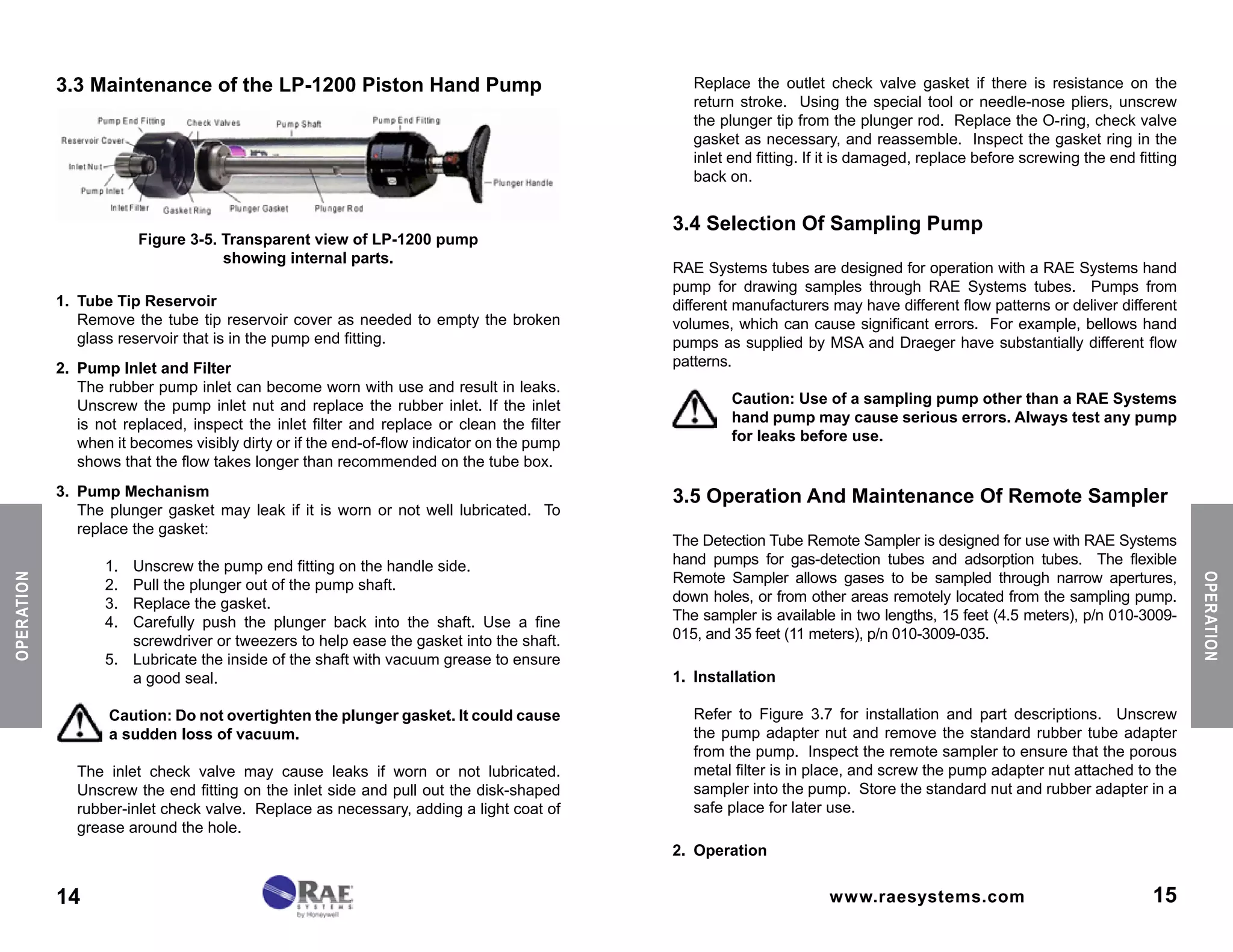
3.3 Maintenance of the LP-1200 Piston Hand Pump
Figure 3-5. Transparent view of LP-1200 pump
showing internal parts.
1.	 Tube Tip Reservoir
Remove the tube tip reservoir cover as needed to empty the broken
glass reservoir that is in the pump end fitting.
2.	 Pump Inlet and Filter
The rubber pump inlet can become worn with use and result in leaks.
Unscrew the pump inlet nut and replace the rubber inlet. If the inlet
is not replaced, inspect the inlet filter and replace or clean the filter
when it becomes visibly dirty or if the end-of-flow indicator on the pump
shows that the flow takes longer than recommended on the tube box.
3.	 Pump Mechanism
The plunger gasket may leak if it is worn or not well lubricated. To
replace the gasket:
1.	 Unscrew the pump end fitting on the handle side.
2.	 Pull the plunger out of the pump shaft.
3.	 Replace the gasket.
4.	 Carefully push the plunger back into the shaft. Use a fine
screwdriver or tweezers to help ease the gasket into the shaft.
5.	 Lubricate the inside of the shaft with vacuum grease to ensure
a good seal.
Caution: Do not overtighten the plunger gasket. It could cause
a sudden loss of vacuum.
The inlet check valve may cause leaks if worn or not lubricated.
Unscrew the end fitting on the inlet side and pull out the disk-shaped
rubber-inlet check valve. Replace as necessary, adding a light coat of
grease around the hole.
Replace the outlet check valve gasket if there is resistance on the
return stroke. Using the special tool or needle-nose pliers, unscrew
the plunger tip from the plunger rod. Replace the O-ring, check valve
gasket as necessary, and reassemble. Inspect the gasket ring in the
inlet end fitting. If it is damaged, replace before screwing the end fitting
back on.
3.4 Selection Of Sampling Pump
RAE Systems tubes are designed for operation with a RAE Systems hand
pump for drawing samples through RAE Systems tubes. Pumps from
different manufacturers may have different flow patterns or deliver different
volumes, which can cause significant errors. For example, bellows hand
pumps as supplied by MSA and Draeger have substantially different flow
patterns.
Caution: Use of a sampling pump other than a RAE Systems
hand pump may cause serious errors. Always test any pump
for leaks before use.
3.5 Operation And Maintenance Of Remote Sampler
The Detection Tube Remote Sampler is designed for use with RAE Systems
hand pumps for gas-detection tubes and adsorption tubes. The flexible
Remote Sampler allows gases to be sampled through narrow apertures,
down holes, or from other areas remotely located from the sampling pump.
The sampler is available in two lengths, 15 feet (4.5 meters), p/n 010-3009-
015, and 35 feet (11 meters), p/n 010-3009-035.
1.	Installation
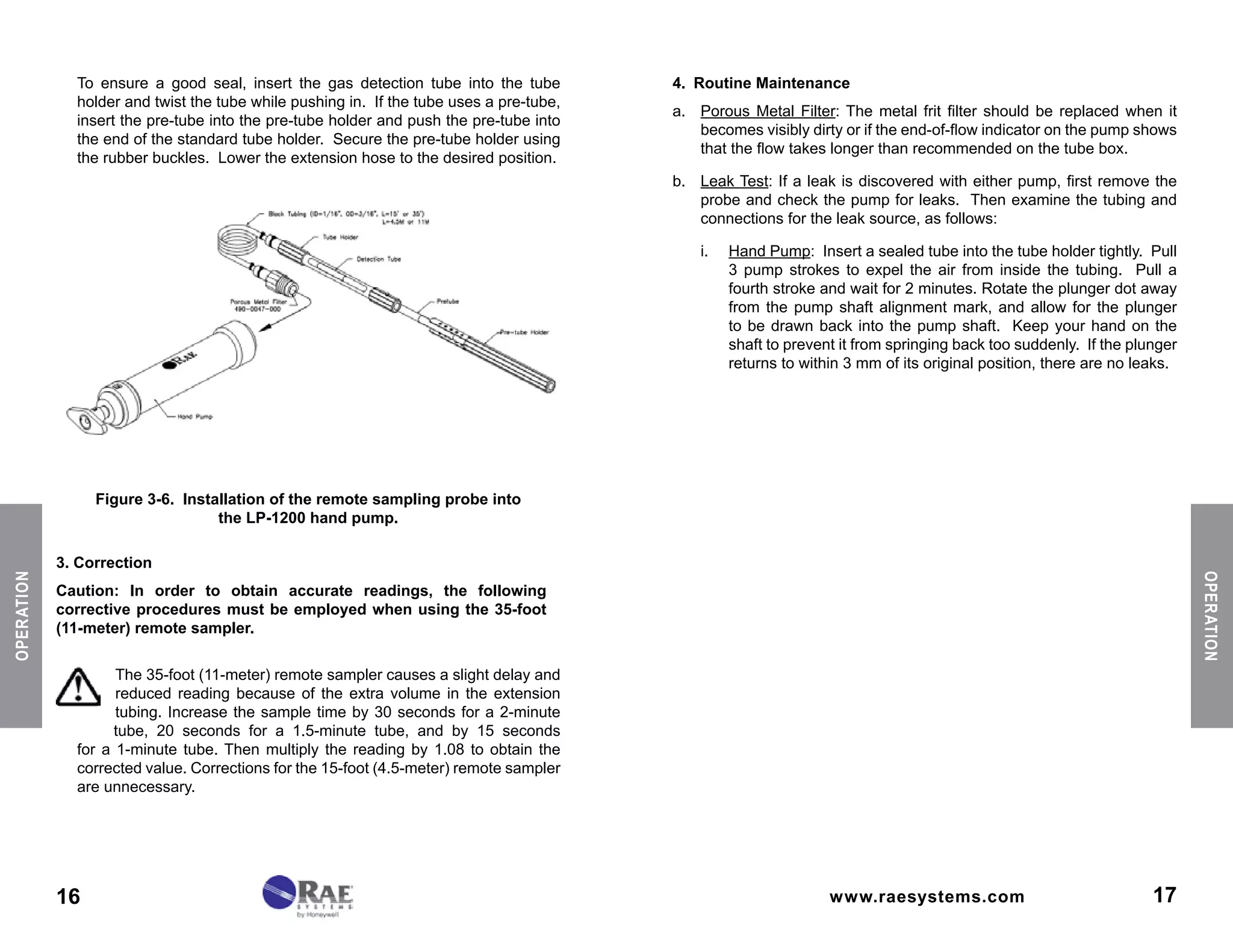
Refer to Figure 3.7 for installation and part descriptions. Unscrew
the pump adapter nut and remove the standard rubber tube adapter
from the pump. Inspect the remote sampler to ensure that the porous
metal filter is in place, and screw the pump adapter nut attached to the
sampler into the pump. Store the standard nut and rubber adapter in a
safe place for later use.
2. 	Operation
1716
OPERATION
OPERATION
www.raesystems.com
To ensure a good seal, insert the gas detection tube into the tube
holder and twist the tube while pushing in. If the tube uses a pre-tube,
insert the pre-tube into the pre-tube holder and push the pre-tube into
the end of the standard tube holder. Secure the pre-tube holder using
the rubber buckles. Lower the extension hose to the desired position.
Figure 3-6. Installation of the remote sampling probe into
the LP-1200 hand pump.
3. Correction
Caution: In order to obtain accurate readings, the following
corrective procedures must be employed when using the 35-foot
(11-meter) remote sampler.
The 35-foot (11-meter) remote sampler causes a slight delay and
reduced reading because of the extra volume in the extension
tubing. Increase the sample time by 30 seconds for a 2-minute
tube, 20 seconds for a 1.5-minute tube, and by 15 seconds
for a 1-minute tube. Then multiply the reading by 1.08 to obtain the
corrected value. Corrections for the 15-foot (4.5-meter) remote sampler
are unnecessary.
4. 	Routine Maintenance
a.	 Porous Metal Filter: The metal frit filter should be replaced when it
becomes visibly dirty or if the end-of-flow indicator on the pump shows
that the flow takes longer than recommended on the tube box.
b.	 Leak Test: If a leak is discovered with either pump, first remove the
probe and check the pump for leaks. Then examine the tubing and
connections for the leak source, as follows:
i.	 Hand Pump: Insert a sealed tube into the tube holder tightly. Pull
3 pump strokes to expel the air from inside the tubing. Pull a
fourth stroke and wait for 2 minutes. Rotate the plunger dot away
from the pump shaft alignment mark, and allow for the plunger
to be drawn back into the pump shaft. Keep your hand on the
shaft to prevent it from springing back too suddenly. If the plunger
returns to within 3 mm of its original position, there are no leaks.
19
TECHNICALINFORMATION
www.raesystems.com18
OPERATION
4. TECHNICAL INFORMATION
4.1 Gas Detection Tube Theory Of Operation
Gas detection tubes operate on a chemical reaction between the vapor-
phase compound and a liquid or solid detecting reagent, which is supported
on an inert matrix. The most common types of reactions are the following:
•	 Acid-base reactions These include reactions of acidic gases like HCl
and HF with bases, and reaction of alkaline vapors such as ammonia
with an acid in the tube. A dye present in the tube changes color as
the pH changes on exposure to the vapors.
•	 Reduction-oxidation (Red-ox) reactionsThese generate an oxidized
or reduced compound, which has a different color. The chlorine tube
uses oxidative coupling of colorless o-toluidine to form an orange azo-
dye. White di-iodine pentoxide is reduced by CO and many organic
vapors to form deep brown-colored iodine. Orange chromium (VI) is
reduced by many organic compounds to form brown or green-colored
Cr(III) compounds.
•	 Ligand-exchange reactions These generate new complexes that
are more colored than the starting reagents. The most notable is the
conversion of white lead acetate to brown-black lead sulfide in the
detection of H2
S. In the case of phosphine, the exchange of PH3
for
the chlorine ligand of HgCl2
releases HCl, which then causes a pH-
dependent dye-color change.
•	 Pre-layers or Pre-tubes These are used to condition the sample
by controlling humidity, removing interferences, or transforming the
analyte to another detectable compound. Examples include drying
agents in NH3
and HCl tubes, organic removal by charcoal or oxidation
in selective CO tubes, and oxidation of NO to NO2
in the nitrogen oxides
tube.
All RAE Systems detection tubes are length-of-stain types. In these
tubes, the reaction of the gas with the supported reagent is fast, compared
to the transport of the bulk air sample through the tube. Therefore, all
of the detected vapors are reacted within the tube. As a result, there is
not a strong dependence of the readings on the rate at which the gas is
sampled. However, a very high flow rate can cause some smearing to a
high reading. Conversely, low flow rates are less likely to affect the stain
2120
TECHNICALINFORMATION
www.raesystems.com
length, but can give low readings by concentrating the colored products in
a shorter section of the tube. In cases of flow extremes, errors outside the
standard 25% accuracy can be produced.
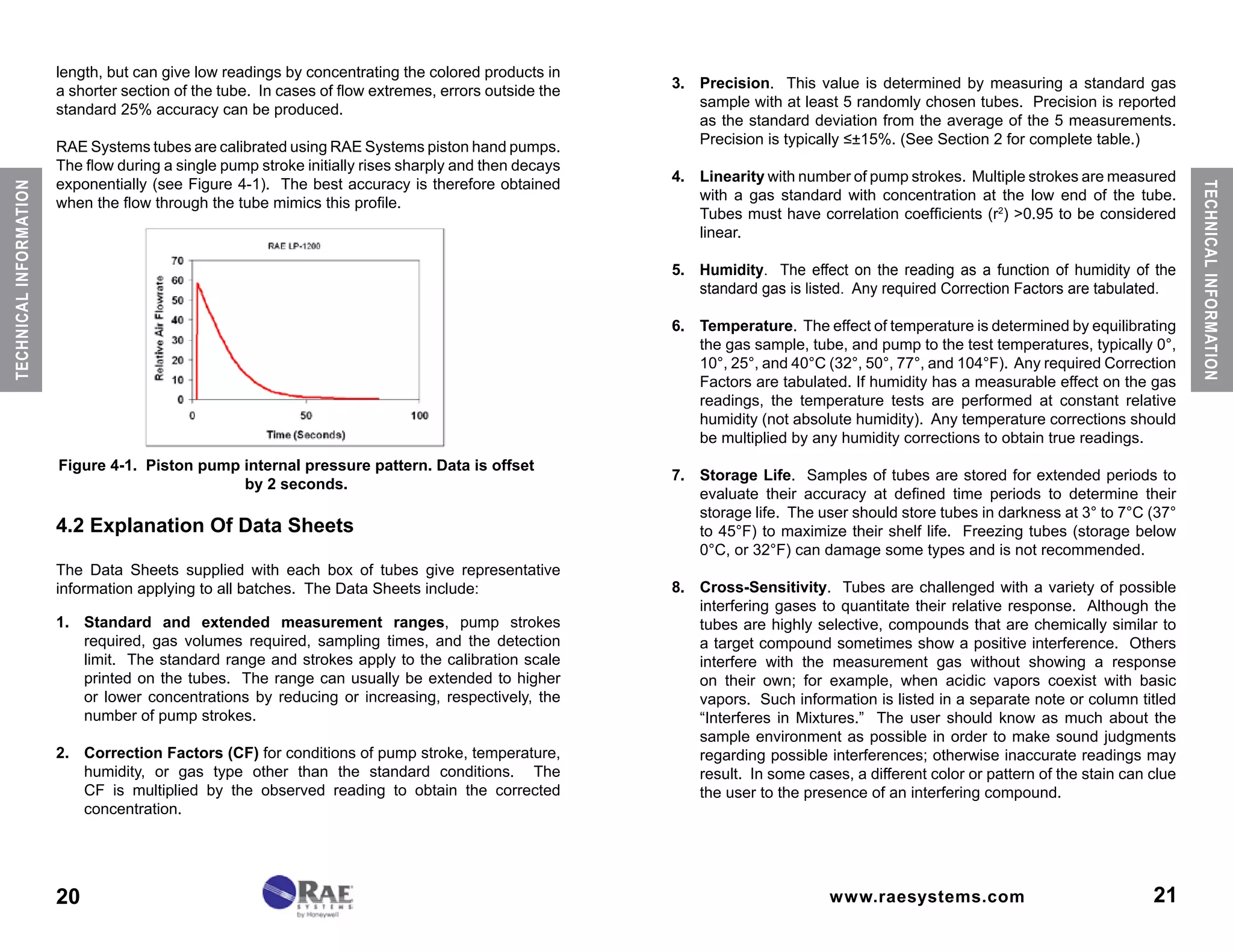
RAE Systems tubes are calibrated using RAE Systems piston hand pumps.
The flow during a single pump stroke initially rises sharply and then decays
exponentially (see Figure 4-1). The best accuracy is therefore obtained
when the flow through the tube mimics this profile.
Figure 4-1. Piston pump internal pressure pattern. Data is offset
by 2 seconds.
4.2 Explanation Of Data Sheets
The Data Sheets supplied with each box of tubes give representative
information applying to all batches. The Data Sheets include:
1.	 Standard and extended measurement ranges, pump strokes
required, gas volumes required, sampling times, and the detection
limit. The standard range and strokes apply to the calibration scale
printed on the tubes. The range can usually be extended to higher
or lower concentrations by reducing or increasing, respectively, the
number of pump strokes.
2.	 Correction Factors (CF) for conditions of pump stroke, temperature,
humidity, or gas type other than the standard conditions. The
CF is multiplied by the observed reading to obtain the corrected
concentration.
3.	Precision. This value is determined by measuring a standard gas
sample with at least 5 randomly chosen tubes. Precision is reported
as the standard deviation from the average of the 5 measurements.
Precision is typically ≤±15%. (See Section 2 for complete table.)
4.	Linearity with number of pump strokes. Multiple strokes are measured
with a gas standard with concentration at the low end of the tube.
Tubes must have correlation coefficients (r2
) >0.95 to be considered
linear.
5.	 Humidity. The effect on the reading as a function of humidity of the
standard gas is listed. Any required Correction Factors are tabulated.
6.	Temperature. The effect of temperature is determined by equilibrating
the gas sample, tube, and pump to the test temperatures, typically 0°,
10°, 25°, and 40°C (32°, 50°, 77°, and 104°F). Any required Correction
Factors are tabulated. If humidity has a measurable effect on the gas
readings, the temperature tests are performed at constant relative
humidity (not absolute humidity). Any temperature corrections should
be multiplied by any humidity corrections to obtain true readings.
7.	 Storage Life. Samples of tubes are stored for extended periods to
evaluate their accuracy at defined time periods to determine their
storage life. The user should store tubes in darkness at 3° to 7°C (37°
to 45°F) to maximize their shelf life. Freezing tubes (storage below
0°C, or 32°F) can damage some types and is not recommended.
8.	Cross-Sensitivity. Tubes are challenged with a variety of possible
interfering gases to quantitate their relative response. Although the
tubes are highly selective, compounds that are chemically similar to
a target compound sometimes show a positive interference. Others
interfere with the measurement gas without showing a response
on their own; for example, when acidic vapors coexist with basic
vapors. Such information is listed in a separate note or column titled
“Interferes in Mixtures.” The user should know as much about the
sample environment as possible in order to make sound judgments
regarding possible interferences; otherwise inaccurate readings may
result. In some cases, a different color or pattern of the stain can clue
the user to the presence of an interfering compound.
2322
TECHNICALINFORMATION
www.raesystems.com
4.3 Humidity, Temperature, Pressure, and Matrix Effects
1. Humidity
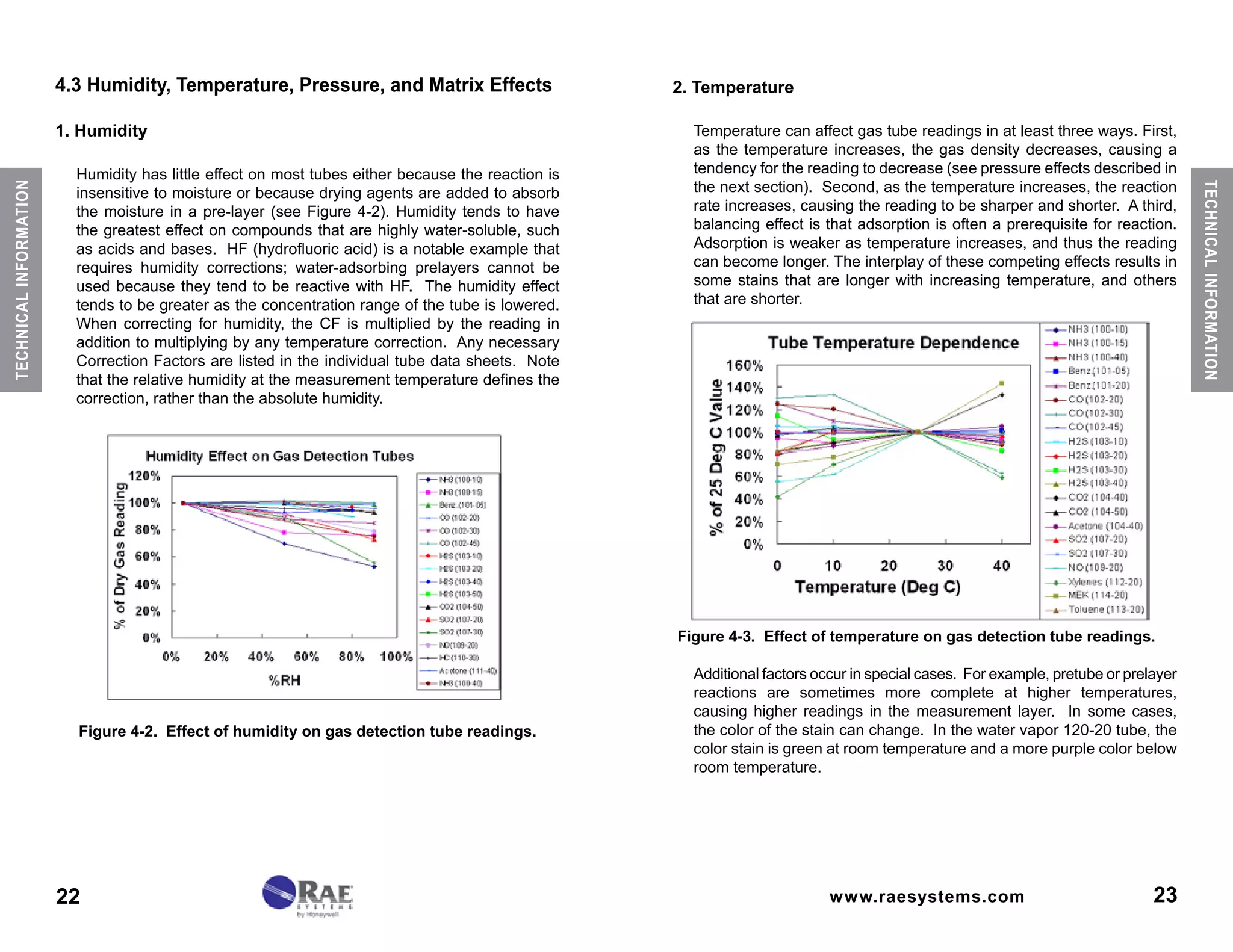
Humidity has little effect on most tubes either because the reaction is
insensitive to moisture or because drying agents are added to absorb
the moisture in a pre-layer (see Figure 4-2). Humidity tends to have
the greatest effect on compounds that are highly water-soluble, such
as acids and bases. HF (hydrofluoric acid) is a notable example that
requires humidity corrections; water-adsorbing prelayers cannot be
used because they tend to be reactive with HF. The humidity effect
tends to be greater as the concentration range of the tube is lowered.
When correcting for humidity, the CF is multiplied by the reading in
addition to multiplying by any temperature correction. Any necessary
Correction Factors are listed in the individual tube data sheets. Note
that the relative humidity at the measurement temperature defines the
correction, rather than the absolute humidity.
Figure 4-2. Effect of humidity on gas detection tube readings.
2. Temperature
Temperature can affect gas tube readings in at least three ways. First,
as the temperature increases, the gas density decreases, causing a
tendency for the reading to decrease (see pressure effects described in
the next section). Second, as the temperature increases, the reaction
rate increases, causing the reading to be sharper and shorter. A third,
balancing effect is that adsorption is often a prerequisite for reaction.
Adsorption is weaker as temperature increases, and thus the reading
can become longer. The interplay of these competing effects results in
some stains that are longer with increasing temperature, and others
that are shorter.
Figure 4-3. Effect of temperature on gas detection tube readings.
Additional factors occur in special cases. For example, pretube or prelayer
reactions are sometimes more complete at higher temperatures,
causing higher readings in the measurement layer. In some cases,
the color of the stain can change. In the water vapor 120-20 tube, the
color stain is green at room temperature and a more purple color below
room temperature.
2524
TECHNICALINFORMATION
www.raesystems.com
3. Pressure
Tubes change color in proportion to the mass of the compounds
reaching the reagent (i.e, the absolute concentration). Therefore, as
the pressure decreases at higher altitudes, the apparent response is
reduced because there are fewer molecules per unit volume sampled.
The conventional desired reading is in ppmv (parts per million by
volume), which is a relative concentration, such as a mole or volume
fraction (% of molecules of compound per molecules of total gas [air]),
rather than an absolute concentration.
All RAE Systems tubes are calibrated at 1 atmosphere (760 mm
Hg) pressure at sea level.
• For tubes calibrated in absolute concentrations such as lbs./MMCF or
mg/m3, no pressure corrections are needed.
• For tubes calibrated in relative concentrations (e.g., ppm), correct for
pressure using one of the following equations:
Corrected reading = Observed Reading x 760 mm Hg
				Pressure (mm Hg)
Corrected reading = Observed Reading x 101.3 kPa
				Pressure (kPa)
Corrected reading = Observed Reading x 14.7 psia
				Pressure (psia)
The pressure in mm Hg can be estimated as a function of altitude using
the following equation:
P (mm Hg) = 760exp(-0.1286[alt(km)]) below 2 km
Example Correction Factors are listed in the following table as a
function of altitude. Weather changes may also affect the atmospheric
pressure, but the necessary corrections are usually <10%.
Example Location Altitude
(km)
Altitude
(feet)
Pressure,
(mm Hg)
CF
San Francisco, CA 0 0 760 1.00
Atlanta, GA 0.3 1000 731 1.04
Spokane, WA 0.6 2000 703 1.08
Rapid City, SD 0.9 3000 676 1.12
Salt Lake City, UT 1.2 4000 650 1.17
Denver, CO 1.5 5000 625 1.22
Colo. Spgs., CO 1.8 6000 601 1.27
Santa Fe, NM 2.1 7000 578 1.32
Alta, UT 2.4 8000 555 1.37
Winter Park, CO 2.7 9000 534 1.42
Keystone, CO 3.0 10000 514 1.48
4. Matrix Gas
The matrix gas usually has little or no effect on the tube readings
as long as the gas does not chemically react with the tube reagents
or measured compound. Thus, readings in air, nitrogen, hydrogen,
helium, or carbon dioxide give essentially the same results. However,
the viscosity of the gas has a significant effect on the sampling time.
Thus, for example, the sampling time of the CO 10-102-18 tube is
about half as long in pure hydrogen (viscosity 9.0 μPa-s) as it is in air
(viscosity 18.6 μPa-s).
Matrix Gas
Viscosity
@ 27°C
(μPa-s)
Sampling Time
Relative to Air
Sampling Time
for a 90 second
Tube (seconds)
Air 18.6 1.00 90
n-Butane 7.5 0.40 36
Propane 8.3 0.45 40
Hydrogen 9.0 0.48 44
Ethane 9.5 0.51 46
Acetylene 10.4 0.56 50
Methane 11.2 0.60 54
Carbon Dioxide 15.0 0.81 73
Nitrogen 17.9 0.96 87
Helium 20.0 1.08 97
Oxygen 20.8 1.12 101
Argon 22.9 1.23 111
Neon 32.1 1.73 155
At a given viscosity, higher flow rates tend to give longer stains. However,
this is often compensated by higher diffusion rates to the reactive surface
in the less viscous gases, resulting in no significant effect on the readings.
27www.raesystems.com26
DataSheets
DataSheets
5. DATA SHEETS FOR GAS DETECTION TUBES
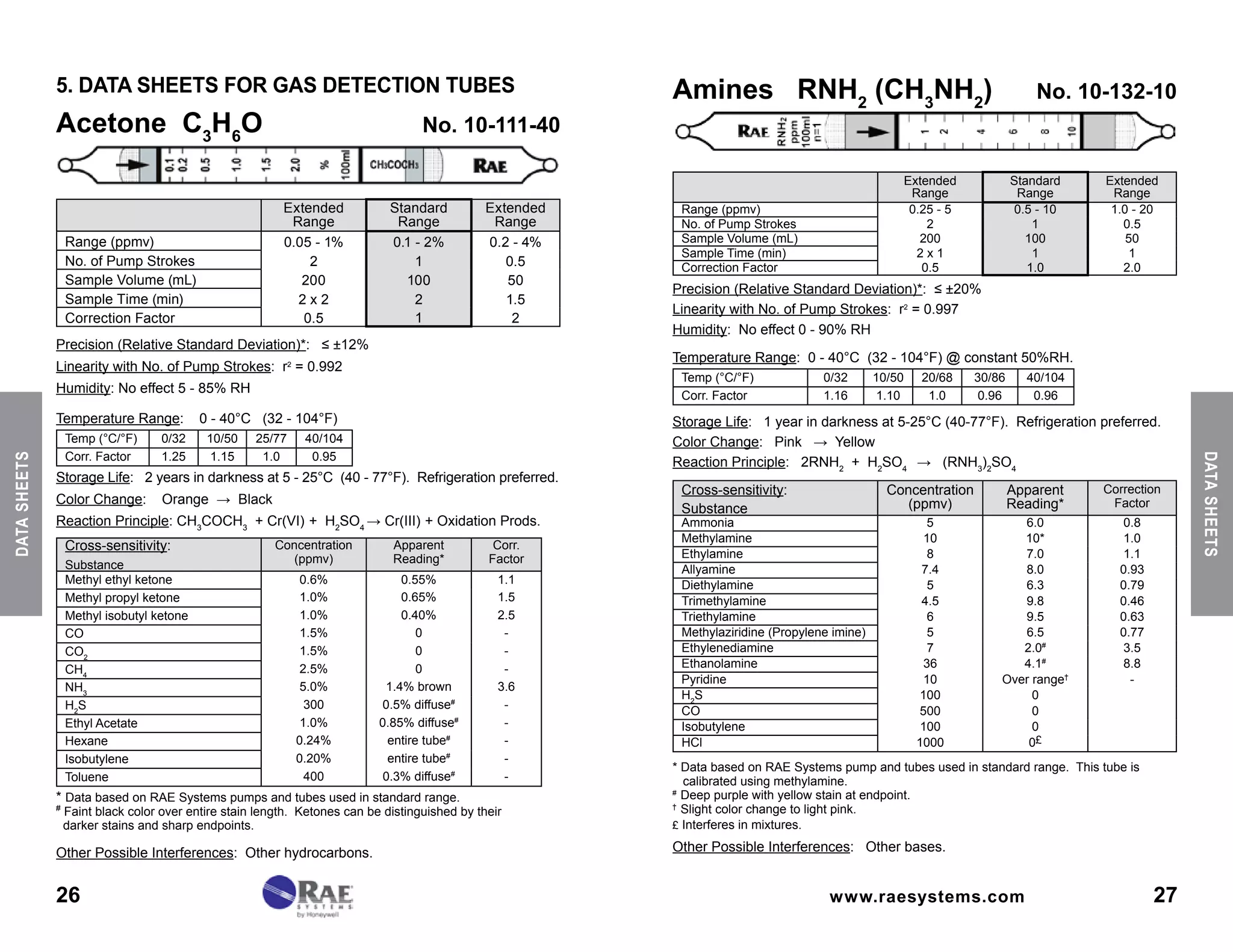
Acetone C3
H6
O	 No. 10-111-40
Extended
Range
Standard
Range
Extended
Range
Range (ppmv) 0.05 - 1% 0.1 - 2% 0.2 - 4%
No. of Pump Strokes 2 1 0.5
Sample Volume (mL) 200 100 50
Sample Time (min) 2 x 2 2 1.5
Correction Factor 0.5 1 2
Precision (Relative Standard Deviation)*: ≤ ±12%
Linearity with No. of Pump Strokes: r2
= 0.992
Humidity: No effect 5 - 85% RH
Temperature Range: 0 - 40°C (32 - 104°F)
Temp (°C/°F) 0/32 10/50 25/77 40/104
Corr. Factor 1.25 1.15 1.0 0.95
Storage Life: 2 years in darkness at 5 - 25°C (40 - 77°F). Refrigeration preferred.
Color Change: Orange → Black
Reaction Principle: CH3
COCH3
+ Cr(VI) + H2
SO4
→ Cr(III) + Oxidation Prods.
Cross-sensitivity:
Substance
Concentration
(ppmv)
Apparent
Reading*
Corr.
Factor
Methyl ethyl ketone 0.6% 0.55% 1.1
Methyl propyl ketone 1.0% 0.65% 1.5
Methyl isobutyl ketone 1.0% 0.40% 2.5
CO 1.5% 0 -
CO2
1.5% 0 -
CH4
2.5% 0 -
NH3
5.0% 1.4% brown 3.6
H2
S 300 0.5% diffuse#
-
Ethyl Acetate 1.0% 0.85% diffuse#
-
Hexane 0.24% entire tube#
-
Isobutylene 0.20% entire tube#
-
Toluene 400 0.3% diffuse#
-
* Data based on RAE Systems pumps and tubes used in standard range.
#
Faint black color over entire stain length. Ketones can be distinguished by their
darker stains and sharp endpoints.
Other Possible Interferences: Other hydrocarbons.
Amines RNH2
(CH3
NH2
) 	 No. 10-132-10
Extended
Range
Standard
Range
Extended
Range
Range (ppmv) 0.25 - 5 0.5 - 10 1.0 - 20
No. of Pump Strokes 2 1 0.5
Sample Volume (mL) 200 100 50
Sample Time (min) 2 x 1 1 1
Correction Factor 0.5 1.0 2.0
Precision (Relative Standard Deviation)*: ≤ ±20%
Linearity with No. of Pump Strokes: r2
= 0.997
Humidity: No effect 0 - 90% RH
Temperature Range: 0 - 40°C (32 - 104°F) @ constant 50%RH.
Temp (°C/°F) 0/32 10/50 20/68 30/86 40/104
Corr. Factor 1.16 1.10 1.0 0.96 0.96
Storage Life: 1 year in darkness at 5-25°C (40-77°F). Refrigeration preferred.
Color Change: Pink → Yellow
Reaction Principle: 2RNH2
+ H2
SO4
→ (RNH3
)2
SO4
Cross-sensitivity:
Substance
Concentration
(ppmv)
Apparent
Reading*
Correction
Factor
Ammonia 5 6.0 0.8
Methylamine 10 10* 1.0
Ethylamine 8 7.0 1.1
Allyamine 7.4 8.0 0.93
Diethylamine 5 6.3 0.79
Trimethylamine 4.5 9.8 0.46
Triethylamine 6 9.5 0.63
Methylaziridine (Propylene imine) 5 6.5 0.77
Ethylenediamine 7 2.0#
3.5
Ethanolamine 36 4.1#
8.8
Pyridine 10 Over range†
-
H2
S 100 0
CO 500 0
Isobutylene 100 0
HCl 1000 0£
* Data based on RAE Systems pump and tubes used in standard range. This tube is
calibrated using methylamine.
#
Deep purple with yellow stain at endpoint.
†
Slight color change to light pink.
£ Interferes in mixtures.
Other Possible Interferences: Other bases.
29www.raesystems.com28
DataSheets
DataSheets
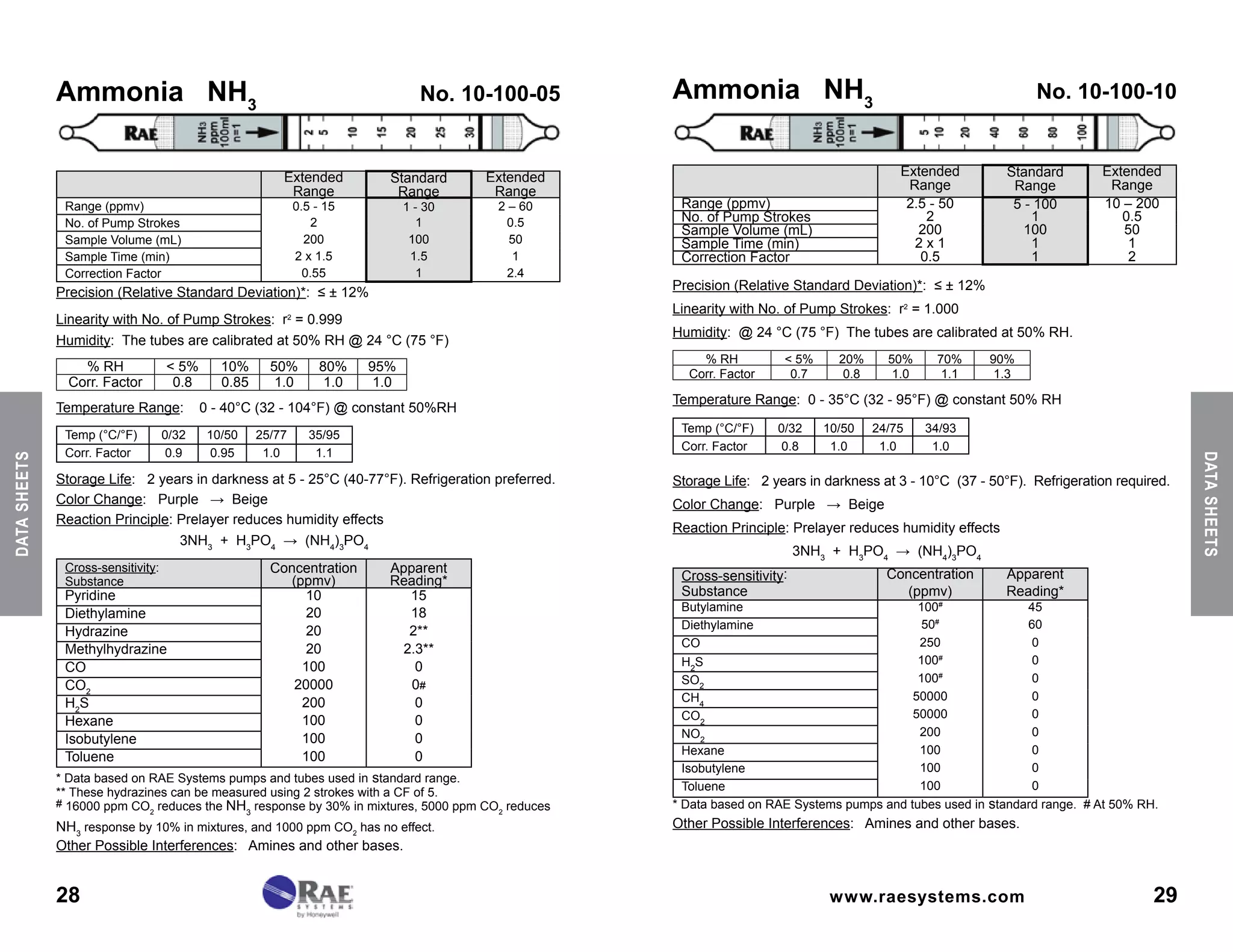
Ammonia NH3
		No. 10-100-05
Extended
Range
Standard
Range
Extended
Range
Range (ppmv) 0.5 - 15 1 - 30 2 – 60
No. of Pump Strokes 2 1 0.5
Sample Volume (mL) 200 100 50
Sample Time (min) 2 x 1.5 1.5 1
Correction Factor 0.55 1 2.4
Precision (Relative Standard Deviation)*: ≤ ± 12%
Linearity with No. of Pump Strokes: r2
= 0.999
Humidity: The tubes are calibrated at 50% RH @ 24 °C (75 °F)
% RH < 5% 10% 50% 80% 95%
Corr. Factor 0.8 0.85 1.0 1.0 1.0
Temperature Range: 0 - 40°C (32 - 104°F) @ constant 50%RH
Temp (°C/°F) 0/32 10/50 25/77 35/95
Corr. Factor 0.9 0.95 1.0 1.1
Storage Life: 2 years in darkness at 5 - 25°C (40-77°F). Refrigeration preferred.
Color Change: Purple → Beige
Reaction Principle: Prelayer reduces humidity effects
3NH3
+ H3
PO4
→ (NH4
)3
PO4
Cross-sensitivity:
Substance
Concentration
(ppmv)
Apparent
Reading*
Pyridine 10 15
Diethylamine 20 18
Hydrazine 20 2**
Methylhydrazine 20 2.3**
CO 100 0
CO2
20000 0#
H2
S 200 0
Hexane 100 0
Isobutylene 100 0
Toluene 100 0
* Data based on RAE Systems pumps and tubes used in standard range.
** These hydrazines can be measured using 2 strokes with a CF of 5.
# 16000 ppm CO2
reduces the NH3
response by 30% in mixtures, 5000 ppm CO2
reduces
NH3
response by 10% in mixtures, and 1000 ppm CO2
has no effect.
Other Possible Interferences: Amines and other bases.
Ammonia NH3
	 No. 10-100-10
	
Extended
Range
Standard
Range
Extended
Range
Range (ppmv) 2.5 - 50 5 - 100 10 – 200
No. of Pump Strokes 2 1 0.5
Sample Volume (mL) 200 100 50
Sample Time (min) 2 x 1 1 1
Correction Factor 0.5 1 2
Precision (Relative Standard Deviation)*: ≤ ± 12%
Linearity with No. of Pump Strokes: r2
= 1.000
Humidity: @ 24 °C (75 °F) The tubes are calibrated at 50% RH.
% RH < 5% 20% 50% 70% 90%
Corr. Factor 0.7 0.8 1.0 1.1 1.3
Temperature Range: 0 - 35°C (32 - 95°F) @ constant 50% RH
Temp (°C/°F) 0/32 10/50 24/75 34/93
Corr. Factor 0.8 1.0 1.0 1.0
Storage Life: 2 years in darkness at 3 - 10°C (37 - 50°F). Refrigeration required.
Color Change: Purple → Beige
Reaction Principle: Prelayer reduces humidity effects
3NH3
+ H3
PO4
→ (NH4
)3
PO4
Cross-sensitivity:
Substance
Concentration
(ppmv)
Apparent
Reading*
Butylamine 100#
45
Diethylamine 50#
60
CO 250 0
H2
S 100#
0
SO2
100#
0
CH4
50000 0
CO2
50000 0
NO2
200 0
Hexane 100 0
Isobutylene 100 0
Toluene 100 0
* Data based on RAE Systems pumps and tubes used in standard range. # At 50% RH.
Other Possible Interferences: Amines and other bases.
31www.raesystems.com30
DataSheets
DataSheets
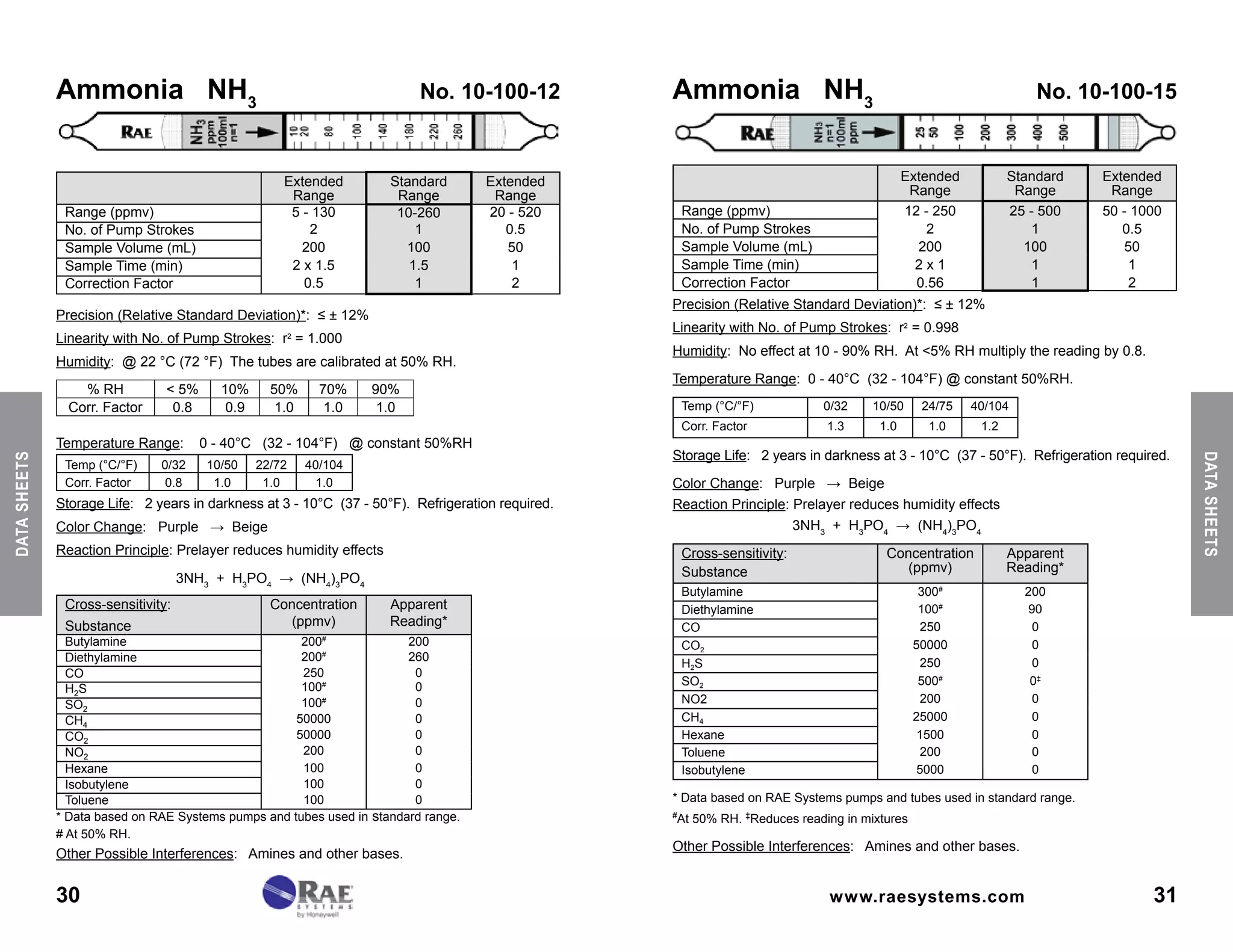
Ammonia NH3
	 No. 10-100-12
	
Extended
Range
Standard
Range
Extended
Range
Range (ppmv) 5 - 130 10-260 20 - 520
No. of Pump Strokes 2 1 0.5
Sample Volume (mL) 200 100 50
Sample Time (min) 2 x 1.5 1.5 1
Correction Factor 0.5 1 2
Precision (Relative Standard Deviation)*: ≤ ± 12%
Linearity with No. of Pump Strokes: r2
= 1.000
Humidity: @ 22 °C (72 °F) The tubes are calibrated at 50% RH.
% RH < 5% 10% 50% 70% 90%
Corr. Factor 0.8 0.9 1.0 1.0 1.0
Temperature Range: 0 - 40°C (32 - 104°F) @ constant 50%RH
Temp (°C/°F) 0/32 10/50 22/72 40/104
Corr. Factor 0.8 1.0 1.0 1.0
Storage Life: 2 years in darkness at 3 - 10°C (37 - 50°F). Refrigeration required.
Color Change: Purple → Beige
Reaction Principle: Prelayer reduces humidity effects
3NH3
+ H3
PO4
→ (NH4
)3
PO4
Cross-sensitivity:
Substance
Concentration
(ppmv)
Apparent
Reading*
Butylamine 200#
200
Diethylamine 200#
260
CO 250 0
H2S 100#
0
SO2
100#
0
CH4
50000 0
CO2
50000 0
NO2
200 0
Hexane 100 0
Isobutylene 100 0
Toluene 100 0
* Data based on RAE Systems pumps and tubes used in standard range.
# At 50% RH.
Other Possible Interferences: Amines and other bases.
Ammonia NH3
		No. 10-100-15
	
Extended
Range
Standard
Range
Extended
Range
Range (ppmv) 12 - 250 25 - 500 50 - 1000
No. of Pump Strokes 2 1 0.5
Sample Volume (mL) 200 100 50
Sample Time (min) 2 x 1 1 1
Correction Factor 0.56 1 2
Precision (Relative Standard Deviation)*: ≤ ± 12%
Linearity with No. of Pump Strokes: r2
= 0.998
Humidity: No effect at 10 - 90% RH. At <5% RH multiply the reading by 0.8.
Temperature Range: 0 - 40°C (32 - 104°F) @ constant 50%RH.
Temp (°C/°F) 0/32 10/50 24/75 40/104
Corr. Factor 1.3 1.0 1.0 1.2
Storage Life: 2 years in darkness at 3 - 10°C (37 - 50°F). Refrigeration required.
Color Change: Purple → Beige
Reaction Principle: Prelayer reduces humidity effects
3NH3
+ H3
PO4
→ (NH4
)3
PO4
Cross-sensitivity:
Substance
Concentration
(ppmv)
Apparent
Reading*
Butylamine 300#
200
Diethylamine 100#
90
CO 250 0
CO2 50000 0
H2S 250 0
SO2 500#
0‡
NO2 200 0
CH4 25000 0
Hexane 1500 0
Toluene 200 0
Isobutylene 5000 0
* Data based on RAE Systems pumps and tubes used in standard range.
#
At 50% RH. ‡
Reduces reading in mixtures
Other Possible Interferences: Amines and other bases.
33www.raesystems.com32
DataSheets
DataSheets
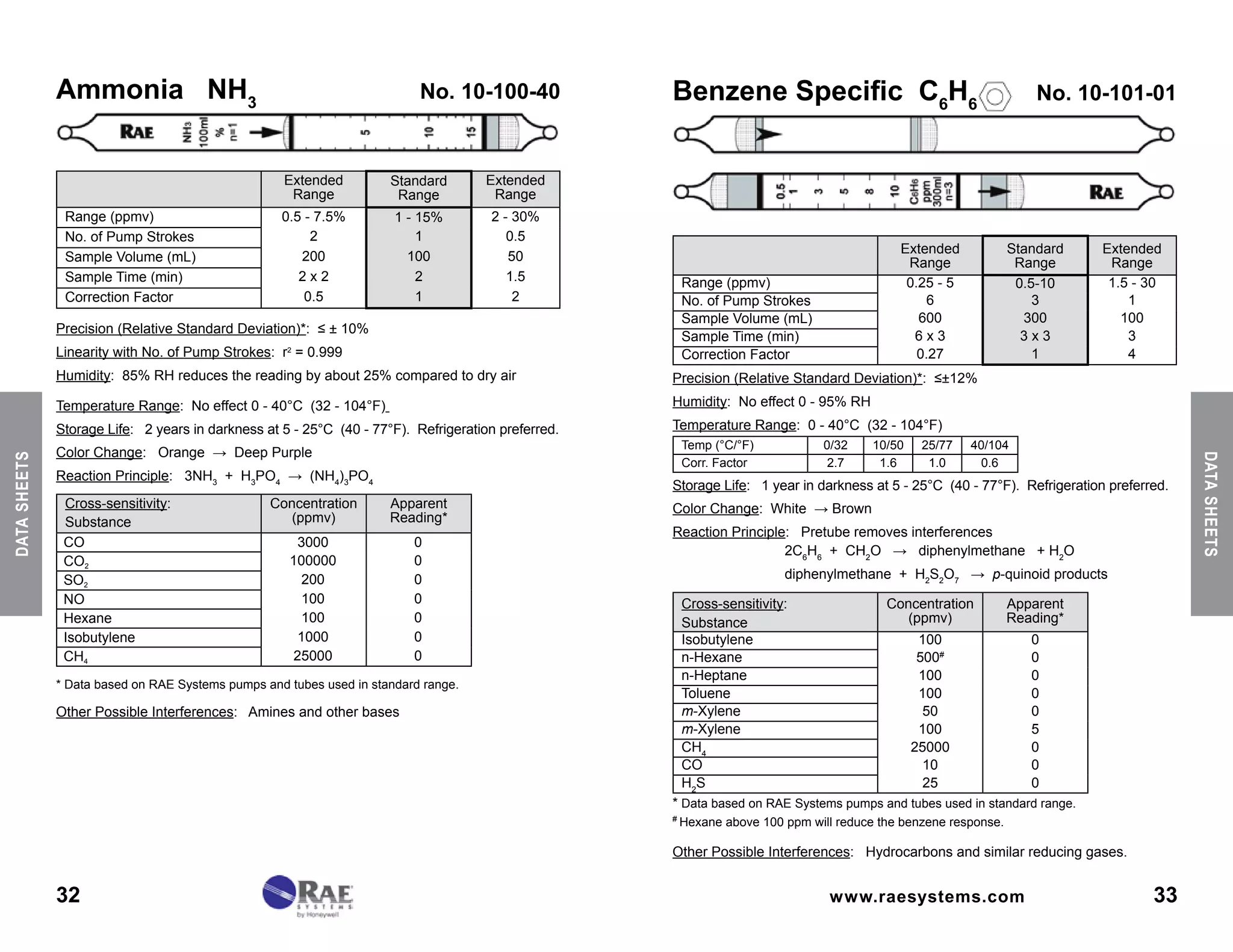
Ammonia NH3
		No. 10-100-40
Extended
Range
Standard
Range
Extended
Range
Range (ppmv) 0.5 - 7.5% 1 - 15% 2 - 30%
No. of Pump Strokes 2 1 0.5
Sample Volume (mL) 200 100 50
Sample Time (min) 2 x 2 2 1.5
Correction Factor 0.5 1 2
Precision (Relative Standard Deviation)*: ≤ ± 10%
Linearity with No. of Pump Strokes: r2
= 0.999
Humidity: 85% RH reduces the reading by about 25% compared to dry air
Temperature Range: No effect 0 - 40°C (32 - 104°F)
Storage Life: 2 years in darkness at 5 - 25°C (40 - 77°F). Refrigeration preferred.
Color Change: Orange → Deep Purple
Reaction Principle: 3NH3
+ H3
PO4
→ (NH4
)3
PO4
Cross-sensitivity:
Substance
Concentration
(ppmv)
Apparent
Reading*
CO 3000 0
CO2 100000 0
SO2 200 0
NO 100 0
Hexane 100 0
Isobutylene 1000 0
CH4 25000 0
* Data based on RAE Systems pumps and tubes used in standard range.
Other Possible Interferences: Amines and other bases
Benzene Specific C6
H6
	 No. 10-101-01
Extended
Range
Standard
Range
Extended
Range
Range (ppmv) 0.25 - 5 0.5-10 1.5 - 30
No. of Pump Strokes 6 3 1
Sample Volume (mL) 600 300 100
Sample Time (min) 6 x 3 3 x 3 3
Correction Factor 0.27 1 4
Precision (Relative Standard Deviation)*: ≤±12%
Humidity: No effect 0 - 95% RH
Temperature Range: 0 - 40°C (32 - 104°F)
Temp (°C/°F) 0/32 10/50 25/77 40/104
Corr. Factor 2.7 1.6 1.0 0.6
Storage Life: 1 year in darkness at 5 - 25°C (40 - 77°F). Refrigeration preferred.
Color Change: White → Brown
Reaction Principle: Pretube removes interferences
2C6
H6
+ CH2
O → diphenylmethane + H2
O
diphenylmethane + H2
S2
O7
→ p-quinoid products
Cross-sensitivity:
Substance
Concentration
(ppmv)
Apparent
Reading*
Isobutylene 100 0
n-Hexane 500#
0
n-Heptane 100 0
Toluene 100 0
m-Xylene 50 0
m-Xylene 100 5
CH4
25000 0
CO 10 0
H2
S 25 0
* Data based on RAE Systems pumps and tubes used in standard range.
#
Hexane above 100 ppm will reduce the benzene response.
Other Possible Interferences: Hydrocarbons and similar reducing gases.
35www.raesystems.com34
DataSheets
DataSheets
1,3-Butadiene CH2
=CHCH=CH2
	No. 10-135-04
Extended
Range
Standard
Range
Extended
Range
Range (ppmv) 0.25-2.5 0.5-5 1-10
No. of Pump Strokes 4 2 1
Sample Volume (mL) 400 200 100
Sample Time (min) 4 x 2 2 x 2 2
Correction Factor 0.43 1 2.4
Precision (Relative Standard Deviation)*: ≤ ± 15%
Linearity with No. of Pump Strokes: r2 >0.998
Humidity Range: no effect 0 - 90% RH.
Temperature Range:	0 - 40°C (32 - 104°F)
Temp (°C/°F) 0/32 10/50 20/68 30/86 40/104
Corr. Factor 1.5 1.15 1.0 0.85 0.8
Storage Life: 2 years in darkness below 10°C (50°F). Refrigeration required.
Color Change: Pink → White
Reaction Principle: CH2
=CHCH=CH2
+ KMnO2
→ Oxidation products
Cross-sensitivity:
Substance
Concentration
(ppmv)
Apparent
Reading*
Isobutylene 5 4.4
Ethylene 10 0**
Hexane 100 0
Toluene 100 0
CH4 75000 0
CO2 4000 0
CO 400 0
H2S 30 0
SO2 5 0.5
NO 8 1.9
NO2 10 0.5
NH3 50 0
HCN 10 0
*Data based on RAE pumps and tubes used in standard range.
** The entire tube changes to very light pink, no boundary.
Caution: Dispose of spent or expired tubes according to local regulations.
Possibly hazardous materials are given under the section Reaction Principle.
Benzene Specific C6
H6
		 No. 10-101-10
Extended
Range
Standard
Range
Extended
Range
Range (ppmv) 2.5 - 20 5 - 40 25 - 200
No. of Pump Strokes 10 5 1
Sample Volume (mL) 1000 500 100
Sample Time (min) 10 x 3 5 x 3 3
Correction Factor 0.5 1 5
Precision (Relative Standard Deviation)*: ≤ ± 12%
Humidity: No effect 5 - 100% RH
Temperature Range: No effect 0 - 40°C (32 - 104°F)
Storage Life: 1 year in darkness at 5 - 25°C (40 - 77°F). Refrigeration preferred.
Color Change: White → Light Brown
Reaction Principle: Pretube removes interferences
C6
H6
+ I2
O5
+ H2
S2
O7
→ I2
+ oxidation products
Cross-sensitivity:
Substance
Concentration
(ppmv)
Apparent
Reading*
Isobutylene 100 ~2 (faint)
n-Hexane 10 0
n-Octane 100 0
Toluene 35 0#
m-Xylene 50 0#
β-Pinene 50 ~2 (very faint)
CO 10 7
H2S 25 0
* Data based on RAE Systems pumps and tubes used in standard Range.
#With 10 strokes, toluene and xylene at 50 ppm read 2 ppm and 100 ppm
octane reads ≤2 ppm.
Other Data: Without the pretube the readings are 30% higher.
37www.raesystems.com36
DataSheets
DataSheets
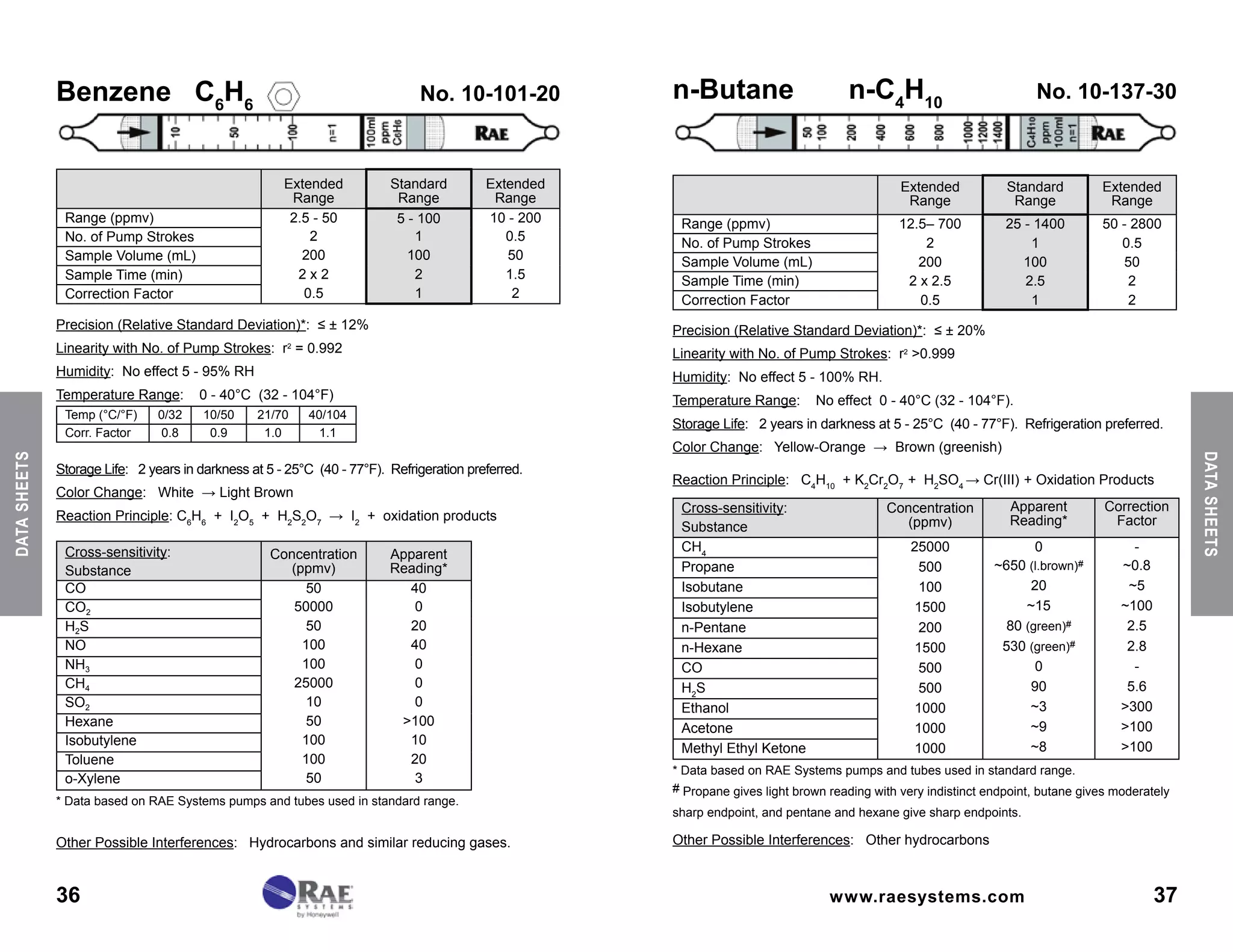
Benzene C6
H6
	 No. 10-101-20
	
Extended
Range
Standard
Range
Extended
Range
Range (ppmv) 2.5 - 50 5 - 100 10 - 200
No. of Pump Strokes 2 1 0.5
Sample Volume (mL) 200 100 50
Sample Time (min) 2 x 2 2 1.5
Correction Factor 0.5 1 2
Precision (Relative Standard Deviation)*: ≤ ± 12%
Linearity with No. of Pump Strokes: r2
= 0.992
Humidity: No effect 5 - 95% RH
Temperature Range: 0 - 40°C (32 - 104°F)
Temp (°C/°F) 0/32 10/50 21/70 40/104
Corr. Factor 0.8 0.9 1.0 1.1
Storage Life: 2 years in darkness at 5 - 25°C (40 - 77°F). Refrigeration preferred.
Color Change: White → Light Brown
Reaction Principle: C6
H6
+ I2
O5
+ H2
S2
O7
→ I2
+ oxidation products
Cross-sensitivity:
Substance
Concentration
(ppmv)
Apparent
Reading*
CO 50 40
CO2 50000 0
H2S 50 20
NO 100 40
NH3 100 0
CH4 25000 0
SO2 10 0
Hexane 50 >100
Isobutylene 100 10
Toluene 100 20
o-Xylene 50 3
* Data based on RAE Systems pumps and tubes used in standard range.
Other Possible Interferences: Hydrocarbons and similar reducing gases.
n-Butane n-C4
H10
	 No. 10-137-30
Extended
Range
Standard
Range
Extended
Range
Range (ppmv) 12.5– 700 25 - 1400 50 - 2800
No. of Pump Strokes 2 1 0.5
Sample Volume (mL) 200 100 50
Sample Time (min) 2 x 2.5 2.5 2
Correction Factor 0.5 1 2
Precision (Relative Standard Deviation)*: ≤ ± 20%
Linearity with No. of Pump Strokes: r2
>0.999
Humidity: No effect 5 - 100% RH.
Temperature Range: No effect 0 - 40°C (32 - 104°F).
Storage Life: 2 years in darkness at 5 - 25°C (40 - 77°F). Refrigeration preferred.
Color Change: Yellow-Orange → Brown (greenish)
Reaction Principle: C­4
H10
+ K2
Cr2
O7
+ H2
SO4
→ Cr(III) + Oxidation Products
Cross-sensitivity:
Substance
Concentration
(ppmv)
Apparent
Reading*
Correction
Factor
CH4
25000 0 -
Propane 500 ~650 (l.brown)# ~0.8
Isobutane 100 20 ~5
Isobutylene 1500 ~15 ~100
n-Pentane 200 80 (green)# 2.5
n-Hexane 1500 530 (green)# 2.8
CO 500 0 -
H2
S 500 90 5.6
Ethanol 1000 ~3 >300
Acetone 1000 ~9 >100
Methyl Ethyl Ketone 1000 ~8 >100
* Data based on RAE Systems pumps and tubes used in standard range.
# Propane gives light brown reading with very indistinct endpoint, butane gives moderately
sharp endpoint, and pentane and hexane give sharp endpoints.
Other Possible Interferences: Other hydrocarbons
39www.raesystems.com38
DataSheets
DataSheets
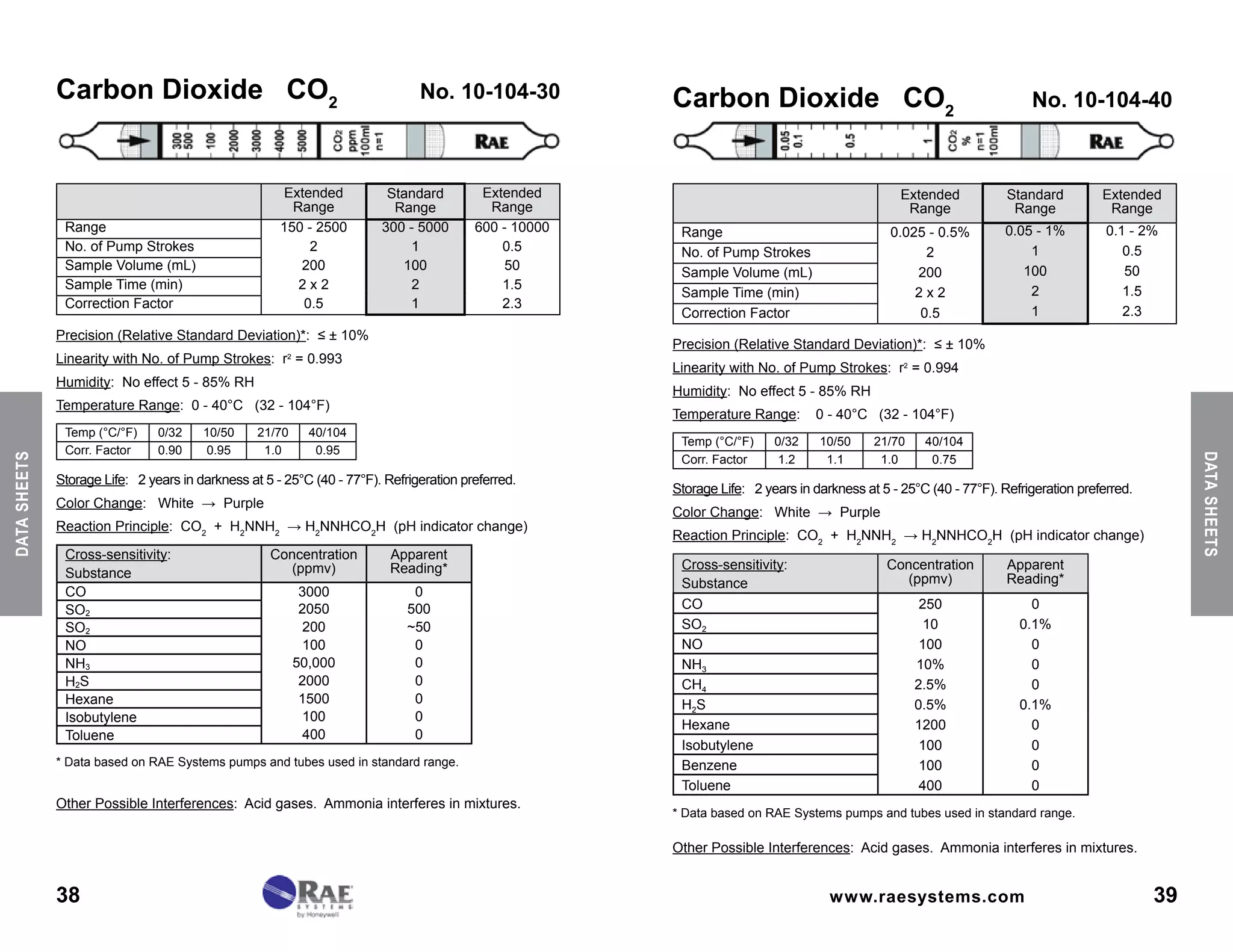
Carbon Dioxide CO2
	 No. 10-104-30
Extended
Range
Standard
Range
Extended
Range
Range 150 - 2500 300 - 5000 600 - 10000
No. of Pump Strokes 2 1 0.5
Sample Volume (mL) 200 100 50
Sample Time (min) 2 x 2 2 1.5
Correction Factor 0.5 1 2.3
Precision (Relative Standard Deviation)*: ≤ ± 10%
Linearity with No. of Pump Strokes: r2
= 0.993
Humidity: No effect 5 - 85% RH
Temperature Range: 0 - 40°C (32 - 104°F)
Temp (°C/°F) 0/32 10/50 21/70 40/104
Corr. Factor 0.90 0.95 1.0 0.95
Storage Life: 2 years in darkness at 5 - 25°C (40 - 77°F). Refrigeration preferred.
Color Change: White → Purple
Reaction Principle: CO2
+ H2
NNH2
→ H2
NNHCO2
H (pH indicator change)
Cross-sensitivity:
Substance
Concentration
(ppmv)
Apparent
Reading*
CO 3000 0
SO2 2050 500
SO2 200 ~50
NO 100 0
NH3 50,000 0
H2S 2000 0
Hexane 1500 0
Isobutylene 100 0
Toluene 400 0
* Data based on RAE Systems pumps and tubes used in standard range.
Other Possible Interferences: Acid gases. Ammonia interferes in mixtures.
Carbon Dioxide CO2
No. 10-104-40
Extended
Range
Standard
Range
Extended
Range
Range 0.025 - 0.5% 0.05 - 1% 0.1 - 2%
No. of Pump Strokes 2 1 0.5
Sample Volume (mL) 200 100 50
Sample Time (min) 2 x 2 2 1.5
Correction Factor 0.5 1 2.3
Precision (Relative Standard Deviation)*: ≤ ± 10%
Linearity with No. of Pump Strokes: r2
= 0.994
Humidity: No effect 5 - 85% RH
Temperature Range: 0 - 40°C (32 - 104°F)
Temp (°C/°F) 0/32 10/50 21/70 40/104
Corr. Factor 1.2 1.1 1.0 0.75
Storage Life: 2 years in darkness at 5 - 25°C (40 - 77°F). Refrigeration preferred.
Color Change: White → Purple
Reaction Principle: CO2
+ H2
NNH2
→ H2
NNHCO2
H (pH indicator change)
Cross-sensitivity:
Substance
Concentration
(ppmv)
Apparent
Reading*
CO 250 0
SO2 10 0.1%
NO 100 0
NH3 10% 0
CH4 2.5% 0
H2S 0.5% 0.1%
Hexane 1200 0
Isobutylene 100 0
Benzene 100 0
Toluene 400 0
* Data based on RAE Systems pumps and tubes used in standard range.
Other Possible Interferences: Acid gases. Ammonia interferes in mixtures.
41www.raesystems.com40
DataSheets
DataSheets
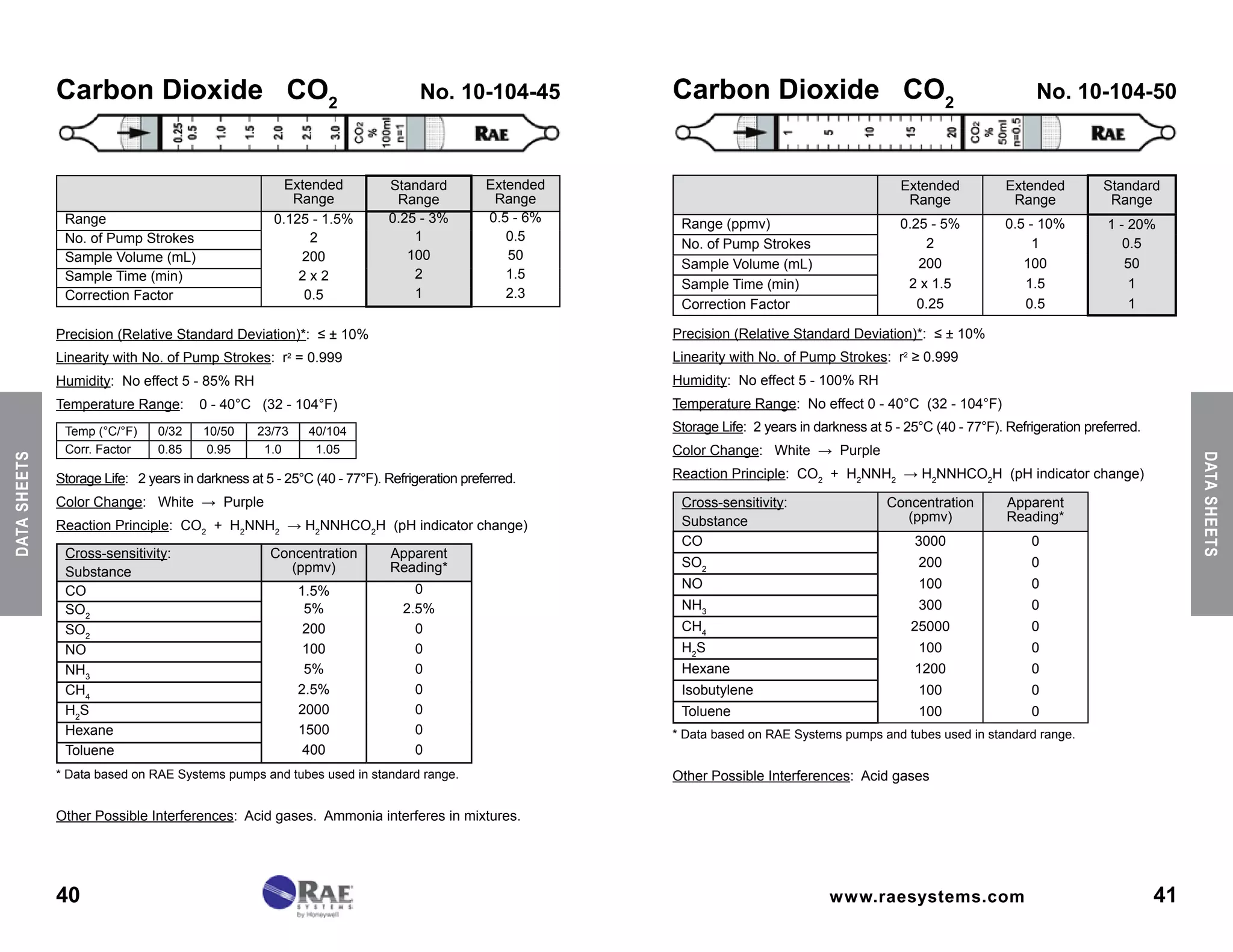
Carbon Dioxide CO2
	 No. 10-104-45
Extended
Range
Standard
Range
Extended
Range
Range 0.125 - 1.5% 0.25 - 3% 0.5 - 6%
No. of Pump Strokes 2 1 0.5
Sample Volume (mL) 200 100 50
Sample Time (min) 2 x 2 2 1.5
Correction Factor 0.5 1 2.3
Precision (Relative Standard Deviation)*: ≤ ± 10%
Linearity with No. of Pump Strokes: r2
= 0.999
Humidity: No effect 5 - 85% RH
Temperature Range: 0 - 40°C (32 - 104°F)
Temp (°C/°F) 0/32 10/50 23/73 40/104
Corr. Factor 0.85 0.95 1.0 1.05
Storage Life: 2 years in darkness at 5 - 25°C (40 - 77°F). Refrigeration preferred.
Color Change: White → Purple
Reaction Principle: CO2
+ H2
NNH2
→ H2
NNHCO2
H (pH indicator change)
Cross-sensitivity:
Substance
Concentration
(ppmv)
Apparent
Reading*
CO 1.5% 0
SO2
5% 2.5%
SO2
200 0
NO 100 0
NH3
5% 0
CH4
2.5% 0
H2
S 2000 0
Hexane 1500 0
Toluene 400 0
* Data based on RAE Systems pumps and tubes used in standard range.
Other Possible Interferences: Acid gases. Ammonia interferes in mixtures.
Carbon Dioxide CO2
	 No. 10-104-50
Extended
Range
Extended
Range
Standard
Range
Range (ppmv) 0.25 - 5% 0.5 - 10% 1 - 20%
No. of Pump Strokes 2 1 0.5
Sample Volume (mL) 200 100 50
Sample Time (min) 2 x 1.5 1.5 1
Correction Factor 0.25 0.5 1
Precision (Relative Standard Deviation)*: ≤ ± 10%
Linearity with No. of Pump Strokes: r2
≥ 0.999
Humidity: No effect 5 - 100% RH
Temperature Range: No effect 0 - 40°C (32 - 104°F)
Storage Life: 2 years in darkness at 5 - 25°C (40 - 77°F). Refrigeration preferred.
Color Change: White → Purple
Reaction Principle: CO2
+ H2
NNH2
→ H2
NNHCO2
H (pH indicator change)
Cross-sensitivity:
Substance
Concentration
(ppmv)
Apparent
Reading*
CO 3000 0
SO2
200 0
NO 100 0
NH3
300 0
CH4
25000 0
H2
S 100 0
Hexane 1200 0
Isobutylene 100 0
Toluene 100 0
* Data based on RAE Systems pumps and tubes used in standard range.
Other Possible Interferences: Acid gases
43www.raesystems.com42
DataSheets
DataSheets
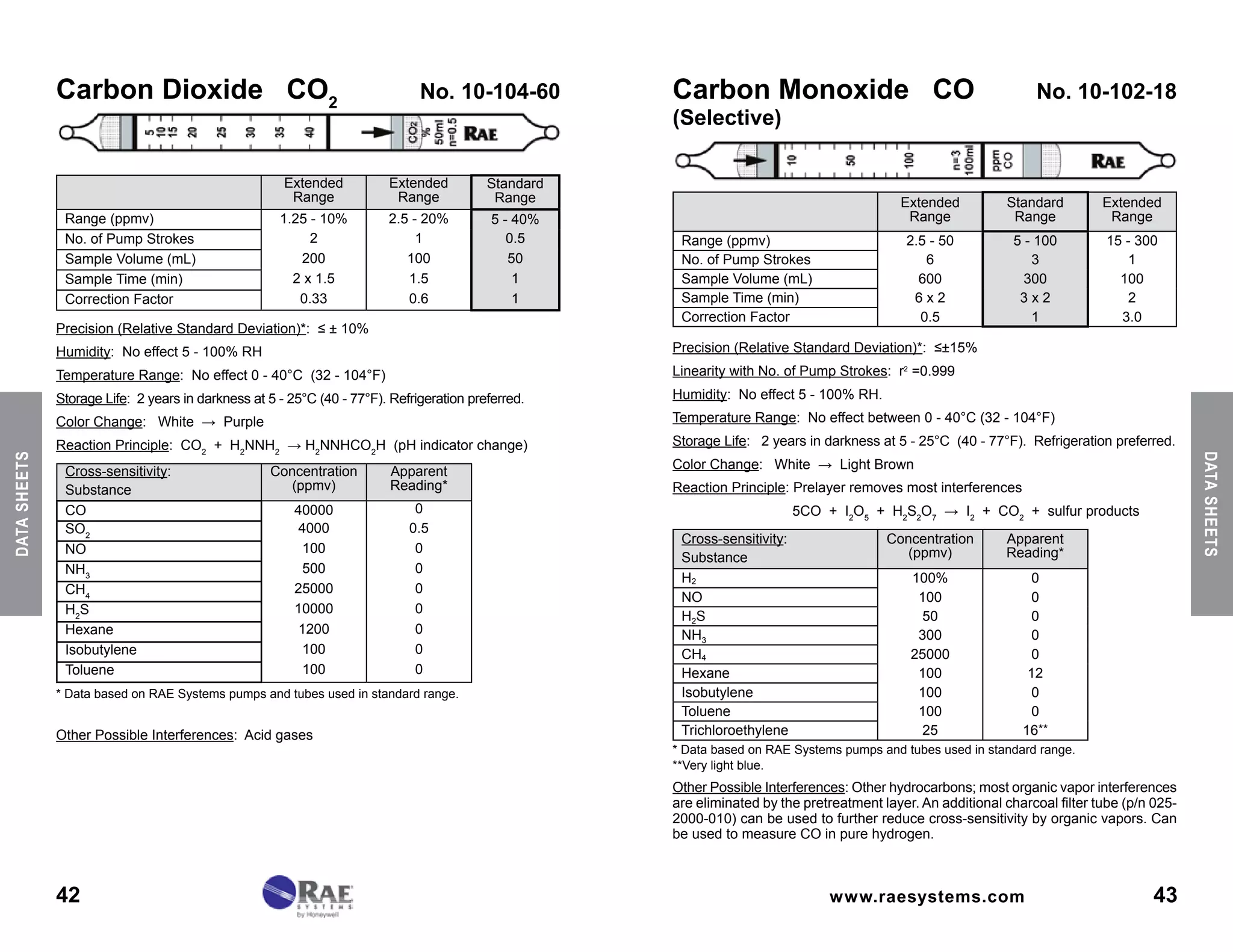
Carbon Dioxide CO2
	 No. 10-104-60
Extended
Range
Extended
Range
Standard
Range
Range (ppmv) 1.25 - 10% 2.5 - 20% 5 - 40%
No. of Pump Strokes 2 1 0.5
Sample Volume (mL) 200 100 50
Sample Time (min) 2 x 1.5 1.5 1
Correction Factor 0.33 0.6 1
Precision (Relative Standard Deviation)*: ≤ ± 10%
Humidity: No effect 5 - 100% RH
Temperature Range: No effect 0 - 40°C (32 - 104°F)
Storage Life: 2 years in darkness at 5 - 25°C (40 - 77°F). Refrigeration preferred.
Color Change: White → Purple
Reaction Principle: CO2
+ H2
NNH2
→ H2
NNHCO2
H (pH indicator change)
Cross-sensitivity:
Substance
Concentration
(ppmv)
Apparent
Reading*
CO 40000 0
SO2
4000 0.5
NO 100 0
NH3
500 0
CH4
25000 0
H2
S 10000 0
Hexane 1200 0
Isobutylene 100 0
Toluene 100 0
* Data based on RAE Systems pumps and tubes used in standard range.
Other Possible Interferences: Acid gases
Carbon Monoxide  CO	 No. 10-102-18
(Selective)	
Extended
Range
Standard
Range
Extended
Range
Range (ppmv) 2.5 - 50 5 - 100 15 - 300
No. of Pump Strokes 6 3 1
Sample Volume (mL) 600 300 100
Sample Time (min) 6 x 2 3 x 2 2
Correction Factor 0.5 1 3.0
Precision (Relative Standard Deviation)*: ≤±15%
Linearity with No. of Pump Strokes: r2
=0.999
Humidity: No effect 5 - 100% RH.
Temperature Range: No effect between 0 - 40°C (32 - 104°F)
Storage Life: 2 years in darkness at 5 - 25°C (40 - 77°F). Refrigeration preferred.
Color Change: White → Light Brown
Reaction Principle: Prelayer removes most interferences
5CO + I2
O5
+ H2
S2
O7
→ I2
+ CO2
+ sulfur products
Cross-sensitivity:
Substance
Concentration
(ppmv)
Apparent
Reading*
H2 100% 0
NO 100 0
H2S 50 0
NH3 300 0
CH4 25000 0
Hexane 100 12
Isobutylene 100 0
Toluene 100 0
Trichloroethylene 25 16**
* Data based on RAE Systems pumps and tubes used in standard range.
**Very light blue.
Other Possible Interferences: Other hydrocarbons; most organic vapor interferences
are eliminated by the pretreatment layer. An additional charcoal filter tube (p/n 025-
2000-010) can be used to further reduce cross-sensitivity by organic vapors. Can
be used to measure CO in pure hydrogen.
45www.raesystems.com44
DataSheets
DataSheets
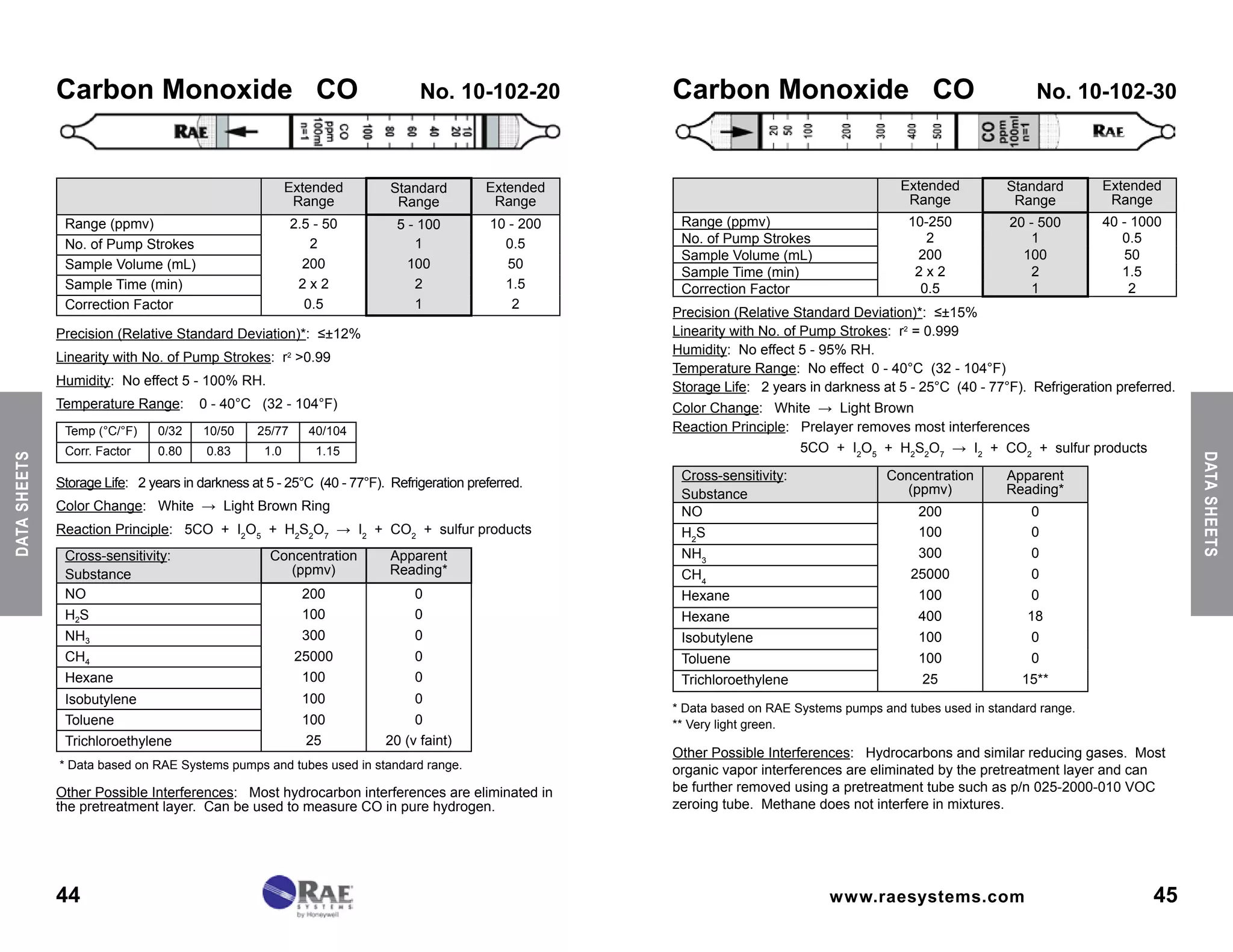
Carbon Monoxide CO	 No. 10-102-20
Extended
Range
Standard
Range
Extended
Range
Range (ppmv) 2.5 - 50 5 - 100 10 - 200
No. of Pump Strokes 2 1 0.5
Sample Volume (mL) 200 100 50
Sample Time (min) 2 x 2 2 1.5
Correction Factor 0.5 1 2
Precision (Relative Standard Deviation)*: ≤±12%
Linearity with No. of Pump Strokes: r2
>0.99
Humidity: No effect 5 - 100% RH.
Temperature Range: 0 - 40°C (32 - 104°F)
Temp (°C/°F) 0/32 10/50 25/77 40/104
Corr. Factor 0.80 0.83 1.0 1.15
Storage Life: 2 years in darkness at 5 - 25°C (40 - 77°F). Refrigeration preferred.
Color Change: White → Light Brown Ring
Reaction Principle: 5CO + I2
O5
+ H2
S2
O7
→ I2
+ CO2
+ sulfur products
Cross-sensitivity:
Substance
Concentration
(ppmv)
Apparent
Reading*
NO 200 0
H2S 100 0
NH3 300 0
CH4 25000 0
Hexane 100 0
Isobutylene 100 0
Toluene 100 0
Trichloroethylene 25 20 (v faint)
* Data based on RAE Systems pumps and tubes used in standard range.
Other Possible Interferences: Most hydrocarbon interferences are eliminated in
the pretreatment layer. Can be used to measure CO in pure hydrogen.
Carbon Monoxide CO	 No. 10-102-30
Extended
Range
Standard
Range
Extended
Range
Range (ppmv) 10-250 20 - 500 40 - 1000
No. of Pump Strokes 2 1 0.5
Sample Volume (mL) 200 100 50
Sample Time (min) 2 x 2 2 1.5
Correction Factor 0.5 1 2
Precision (Relative Standard Deviation)*: ≤±15%
Linearity with No. of Pump Strokes: r2
= 0.999
Humidity: No effect 5 - 95% RH.
Temperature Range: No effect 0 - 40°C (32 - 104°F)
Storage Life: 2 years in darkness at 5 - 25°C (40 - 77°F). Refrigeration preferred.
Color Change: White → Light Brown
Reaction Principle: Prelayer removes most interferences
		 5CO + I2
O5
+ H2
S2
O7
→ I2
+ CO2
+ sulfur products
Cross-sensitivity:
Substance
Concentration
(ppmv)
Apparent
Reading*
NO 200 0
H2
S 100 0
NH3
300 0
CH4
25000 0
Hexane 100 0
Hexane 400 18
Isobutylene 100 0
Toluene 100 0
Trichloroethylene 25 15**
* Data based on RAE Systems pumps and tubes used in standard range.
** Very light green.
Other Possible Interferences: Hydrocarbons and similar reducing gases. Most
organic vapor interferences are eliminated by the pretreatment layer and can
be further removed using a pretreatment tube such as p/n 025-2000-010 VOC
zeroing tube. Methane does not interfere in mixtures.
47www.raesystems.com46
DataSheets
DataSheets
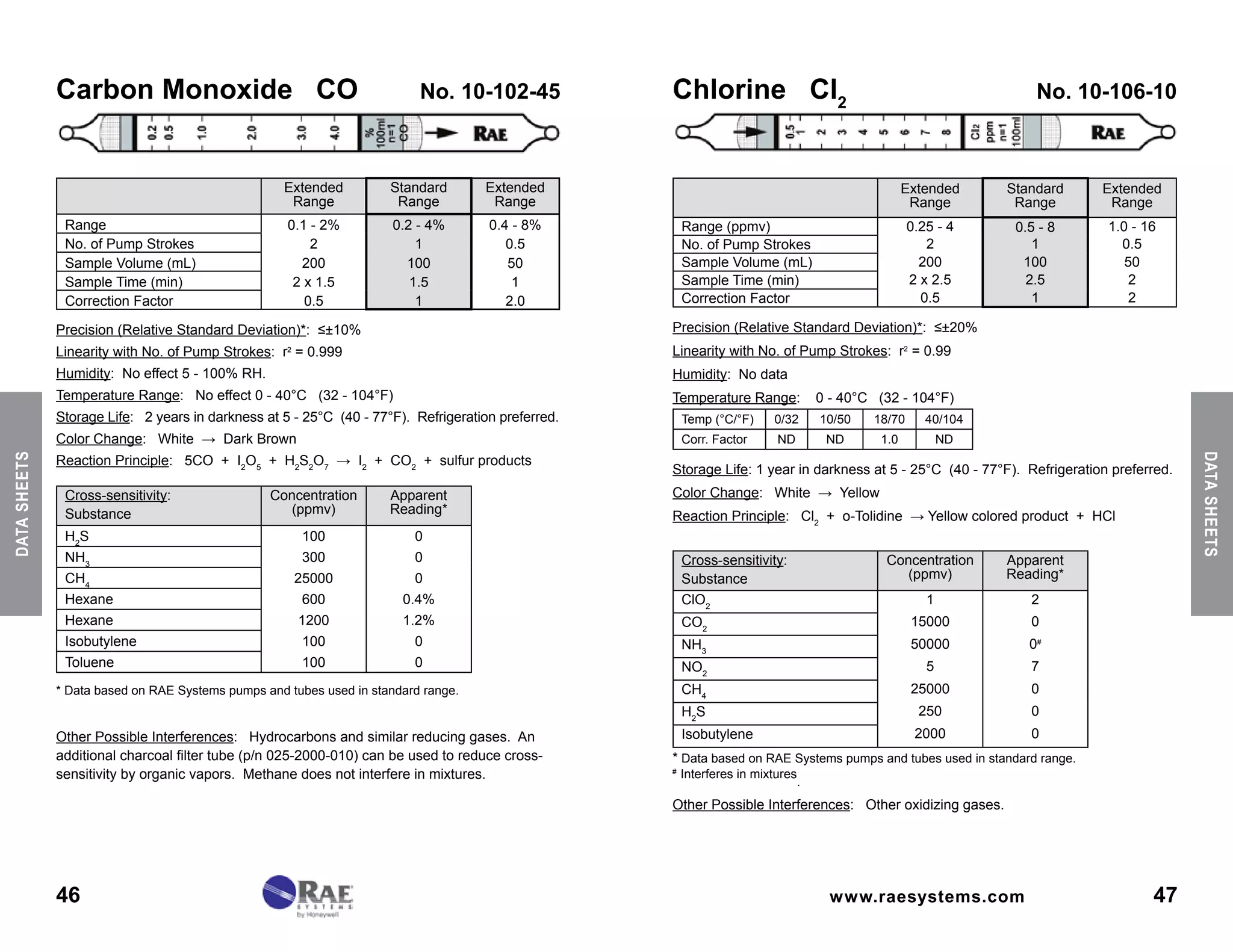
Carbon Monoxide CO	 No. 10-102-45
Extended
Range
Standard
Range
Extended
Range
Range 0.1 - 2% 0.2 - 4% 0.4 - 8%
No. of Pump Strokes 2 1 0.5
Sample Volume (mL) 200 100 50
Sample Time (min) 2 x 1.5 1.5 1
Correction Factor 0.5 1 2.0
Precision (Relative Standard Deviation)*: ≤±10%
Linearity with No. of Pump Strokes: r2
= 0.999
Humidity: No effect 5 - 100% RH.
Temperature Range: No effect 0 - 40°C (32 - 104°F)
Storage Life: 2 years in darkness at 5 - 25°C (40 - 77°F). Refrigeration preferred.
Color Change: White → Dark Brown
Reaction Principle: 5CO + I2
O5
+ H2
S2
O7
→ I2
+ CO2
+ sulfur products
Cross-sensitivity:
Substance
Concentration
(ppmv)
Apparent
Reading*
H2
S 100 0
NH3
300 0
CH4
25000 0
Hexane 600 0.4%
Hexane 1200 1.2%
Isobutylene 100 0
Toluene 100 0
* Data based on RAE Systems pumps and tubes used in standard range.
Other Possible Interferences: Hydrocarbons and similar reducing gases. An
additional charcoal filter tube (p/n 025-2000-010) can be used to reduce cross-
sensitivity by organic vapors. Methane does not interfere in mixtures.
Chlorine Cl2
	 No. 10-106-10
Extended
Range
Standard
Range
Extended
Range
Range (ppmv) 0.25 - 4 0.5 - 8 1.0 - 16
No. of Pump Strokes 2 1 0.5
Sample Volume (mL) 200 100 50
Sample Time (min) 2 x 2.5 2.5 2
Correction Factor 0.5 1 2
Precision (Relative Standard Deviation)*: ≤±20%
Linearity with No. of Pump Strokes: r2
= 0.99
Humidity: No data
Temperature Range: 0 - 40°C (32 - 104°F)
Temp (°C/°F) 0/32 10/50 18/70 40/104
Corr. Factor ND ND 1.0 ND
Storage Life: 1 year in darkness at 5 - 25°C (40 - 77°F). Refrigeration preferred.
Color Change: White → Yellow
Reaction Principle: Cl2
+ o-Tolidine → Yellow colored product + HCl
Cross-sensitivity:
Substance
Concentration
(ppmv)
Apparent
Reading*
ClO2
1 2
CO2
15000 0
NH3
50000 0#
NO2
5 7
CH4
25000 0
H2
S 250 0
Isobutylene 2000 0
* Data based on RAE Systems pumps and tubes used in standard range.
#
Interferes in mixtures
.
Other Possible Interferences: Other oxidizing gases.
49www.raesystems.com48
DataSheets
DataSheets
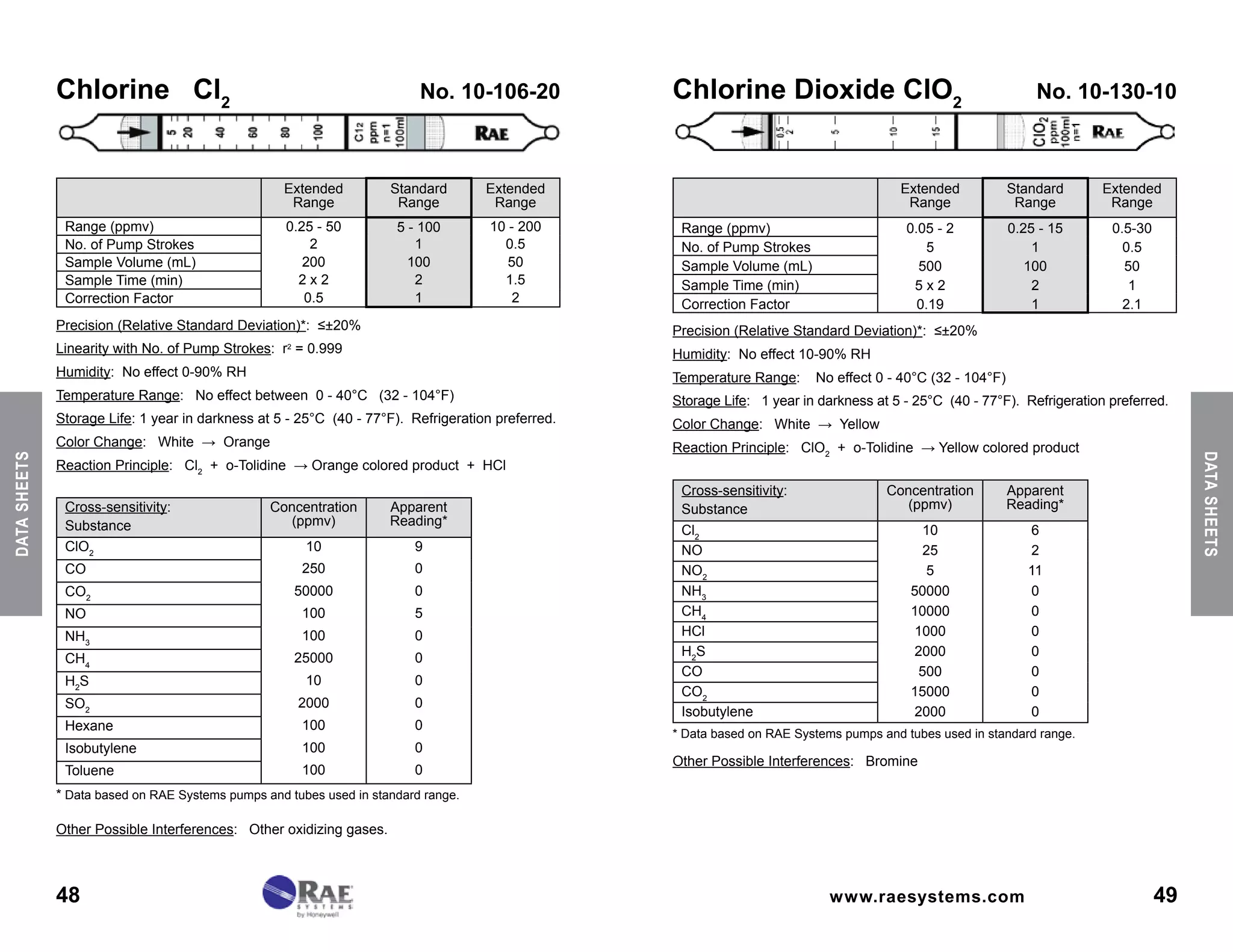
Chlorine Cl2
	 No. 10-106-20
Extended
Range
Standard
Range
Extended
Range
Range (ppmv) 0.25 - 50 5 - 100 10 - 200
No. of Pump Strokes 2 1 0.5
Sample Volume (mL) 200 100 50
Sample Time (min) 2 x 2 2 1.5
Correction Factor 0.5 1 2
Precision (Relative Standard Deviation)*: ≤±20%
Linearity with No. of Pump Strokes: r2
= 0.999
Humidity: No effect 0-90% RH
Temperature Range: No effect between 0 - 40°C (32 - 104°F)
Storage Life: 1 year in darkness at 5 - 25°C (40 - 77°F). Refrigeration preferred.
Color Change: White → Orange
Reaction Principle: Cl2
+ o-Tolidine → Orange colored product + HCl
Cross-sensitivity:
Substance
Concentration
(ppmv)
Apparent
Reading*
ClO2
10 9
CO 250 0
CO2
50000 0
NO 100 5
NH3
100 0
CH4
25000 0
H2
S 10 0
SO2
2000 0
Hexane 100 0
Isobutylene 100 0
Toluene 100 0
* Data based on RAE Systems pumps and tubes used in standard range.
Other Possible Interferences: Other oxidizing gases.
Chlorine Dioxide ClO2
	 No. 10-130-10
Extended
Range
Standard
Range
Extended
Range
Range (ppmv) 0.05 - 2 0.25 - 15 0.5-30
No. of Pump Strokes 5 1 0.5
Sample Volume (mL) 500 100 50
Sample Time (min) 5 x 2 2 1
Correction Factor 0.19 1 2.1
Precision (Relative Standard Deviation)*: ≤±20%
Humidity: No effect 10-90% RH
Temperature Range: No effect 0 - 40°C (32 - 104°F)
Storage Life: 1 year in darkness at 5 - 25°C (40 - 77°F). Refrigeration preferred.
Color Change: White → Yellow
Reaction Principle: ClO2
+ o-Tolidine → Yellow colored product
Cross-sensitivity:
Substance
Concentration
(ppmv)
Apparent
Reading*
Cl2
10 6
NO 25 2
NO2
5 11
NH3
50000 0
CH4
10000 0
HCl 1000 0
H2
S 2000 0
CO 500 0
CO2
15000 0
Isobutylene 2000 0
* Data based on RAE Systems pumps and tubes used in standard range.
Other Possible Interferences: Bromine
51www.raesystems.com50
DataSheets
DataSheets
Diesel & Jet Fuel No. 10-143-10
Extended
Range
Standard
Range
Extended
Range
Range (ppmv) 0.5 - 25
No. of Pump Strokes 4
Sample Volume (mL) Do not extend 400 Do not extend
Sample Time (min) 4 x 1.5
Correction Factor 1
Precision (Relative Standard Deviation)*: ≤±20% for undecane
Humidity: 0 - 95%RH
% RH <5% 30% 50% 80% 95%
Corr. Factor 1.0 0.8 0.7 0.7 0.7
Temperature Range: 0 - 40°C (32 - 104°F)
Temp (°C/°F) 0/32 10/50 20/68 40/104
Corr. Factor 1.9 1.3 1.0 0.8
Storage Life: 1 year in darkness at 5 - 25°C (40 - 77°F). Refrigeration preferred.
Color Change: White → Brown-green Ring (Over-Range: White → Pale Yellow)
Reaction Principle: Cn
Hm
+ I2
O5
+ H2
S2
O7
→ I2
+ Oxidation Products
Continued on next page
Cross-sensitivity:
Substance
Concentration
(ppmv)
Apparent
Reading*
Correction
Factor
Undecane (C11
H24
) 25 25 1.0#
Diesel, whole (Automotive or Marine) 50 20 2.5
Diesel vapors 10 ~20 ~0.4
JP-5, whole (kerosene) 25 22 1.1
JP-8, whole (kerosene) † 10 11.5 0.87†
Gasoline, whole 25 10 2.5
CO2
10000 0 -
CO 10 10 1.0
CH4
25000 0 -
H2
S 60 0 -
Butane 25 0 -
Propane 100 0 -
Hexane 25 0.5** ~50
Octane 5 10 0.5
Benzene 25 1** ~25
Toluene 25 0.5** ~50
Xylene 25 0.5 ~50
Styrene 20 0.4 ~50
Ethanol 2000 0 -
Isopropanol 200 0 -
Acetone 50 0 -
* Data based on RAE Systems pumps and tubes used in standard range.
# Calibrated to undecane.
** Very faint brown stain.
† Can use 1 stroke @ CF =7.2 or 2 strokes @ CF = 2.5.
Other Possible Interferences: No response to 50 ppm HCl, or 100 ppm SO2
, NH3
, or NO2
.
Diesel & Jet Fuel (continued) No. 10-143-10
53www.raesystems.com52
DataSheets
DataSheets
Ethanol C2
H5
OH	 No. 10-141-30
Extended
Range
Standard
Range
Extended
Range
Range (ppmv) 50-200# 100 - 2000
No. of Pump Strokes 2 1
Sample Volume (mL) 200 100 Do not extend
Sample Time (min) 2 x 3 3
Correction Factor 0.5# 1
# This CF only applies between 50-200 ppm; for higher concentrations use one stroke.
Precision (Relative Standard Deviation)*: ≤±20%
Linearity with No. of Pump Strokes: r2
= 0.87
Humidity: No effect 0-95% RH
Temperature Range: 0 - 40°C (32 - 104°F)
Storage Life: 2 years in darkness at 5 - 25°C (40 - 77°F). Refrigeration preferred.
Color Change: Orange Yellow → Pale Green
Reaction Principle: C2
H5
OH + Cr(VI) + H2
SO4
→ Cr(III) + Oxidation Products
Continued on next page
True concentration (ppm)
Ethanol C2
H5
OH (continued)	 No. 10-141-30
Cross-sensitivity:
Substance
Concentration
(ppmv)
Apparent
Reading*
Correction
Factor
Methanol 1000 1000 1.0
Isopropanol 1000 750 1.3
tert-Butanol 1000 1300 0.77
Methyl mercaptan 500 300 1.7
H2
S 100 0 -
CH4
25000 0 -
CO2
5000 0 -
CO 1000 0 -
NH3
400 0 -
NO 100 130 0.77
Benzene 100 0 -
n-Hexane 100 0 -
Ethyl acetate 1000 0** -
* Data based on RAE Systems pumps and tubes used in standard range.
** Faint brown color over entire tube, but no effect on ethanol reading.
Other Possible Interferences: Other alcohols and mercaptans.
55www.raesystems.com54
DataSheets
DataSheets
Formaldehyde HCHO No. 10-121-05	
Extended
Range
Standard
Range
Extended
Range
Range (ppmv) 0.1 - 5 0.8 - 40
No. of Pump Strokes 5 1
Sample Volume (mL) Do not extend 500 100
Sample Time (min) 5 x 2 2
Correction Factor 1 7.5
Precision (Relative Standard Deviation)*: ≤±20%
Linearity with No. of Pump Strokes: r2
> 0.995
Humidity: 0 - 95% RH
% RH <5% 30% 50% 80%
Corr. Factor 1.0 0.85 0.8 0.75
Temperature Range: 0 - 40°C (32 - 104°F)
Temp (°C/°F) 0/32 10/50 20/68 30/86 40/104
Corr. Factor 1.3 1.1 1.0 0.9 0.8
Storage Life: 2 years in darkness at 5 °C (40 - 77°F). Refrigeration preferred.
Color Change: Yellow → Reddish brown
Reaction Principle: 3HCHO + (NH2
OH)3
• H3
PO4
→ H3
PO4
+ 3H2
C=NOH + 3H2
O
H3
PO4
+ Base → Phosphate (dye color change)
Cross-sensitivity:
Substance
Concentration
(ppmv)
Apparent
Reading*
Acetaldehyde 3 3
Propionaldehyde 3 3
Acetone 3 Entire tube#
Methyl ethyl ketone 3 Entire tube#
CH4 25000 0
CO 500 0
CO2 1000 0
H2S 100 0
SO2 100 0
Hexane 2000 0
Toluene 100 0
Isobutylene 100 0.5
Isopropanol 2000 0
Phenol 25 0
Styrene 20 0
* Data based on RAE Systems pumps and tubes used in standard range.
#
Faint brown color over entire stain length. 100 ppm gives stronger color.
Note: In dry air the background color may change: read only reddish-brown color.
Gasoline Cn
Hm
	 No. 10-138-30
Extended
Range
Standard
Range
Extended
Range
Range (ppmv) 15 - 500 30 - 1000 60 - 2000
No. of Pump Strokes 4 2 1
Sample Volume (mL) 400 200 100
Sample Time (min) 4 x 2 2 x 2 2
Correction Factor 0.45 1 2.5
Precision (Relative Standard Deviation)*: ≤±20%
Linearity with No. of Pump Strokes: r2
= 0.999
Humidity: No effect 5 - 95% RH.
Temperature Range: 0 - 40°C (32 - 104°F)
Temp (°C/°F) 0/32 10/50 22/72 40/104
Corr. Factor 1.6 1.24 1.0 0.83
Storage Life: 2 years in darkness at 5 - 25°C(40 - 77°F). Refrigeration preferred.
Color Change: Orange → Dark Green
Reaction Principle: Prelayer removes humidity
Cn
Hm
+ K2
Cr2
O7
+ H2
SO4
→ Cr3+
+ Oxidation Products
Cross-sensitivity:
Substance
Concentration
(ppmv)
Apparent
Reading*
CH4
25000 0
CO 500 0
H2
S 100 30
SO2
500 0
Acetone 1000 20
Ethanol 1000 20
Butane 1000 Entire tube
Isopar L 500 115
Toluene 200 80
Benzene 500 900
* Data based on RAE Systems pumps and tubes used in standard range.
Note: The tube is calibrated using heptane as a standard for gasoline.
57www.raesystems.com56
DataSheets
DataSheets
Total Hydrocarbons HC	 No. 10-110-30
Extended
Range
Standard
Range
Extended
Range
Range (ppmv) 25 - 500 50 - 1000 100-2000
No. of Pump Strokes 4 2 1
Sample Volume (mL) 400 200 100
Sample Time (min) 4 x 2 2 x 2 2
Correction Factor 0.5 1 2
Precision (Relative Standard Deviation)*: ≤±20%
Linearity with No. of Pump Strokes: r2
= 0.994
Humidity: No effect 5 - 100% RH
Temperature Range: 0 - 40°C (32 - 104°F)
Temp (°C/°F) 0/32 10/50 25/77 40/104
Corr. Factor 1.2 1.1 1.0 0.85
Storage Life: 2 years in darkness at 5 - 25°C (40 - 77°F). Refrigeration preferred.
Color Change: Yellow-Orange → Green
Reaction Principle: HC + Cr(VI) + H2
SO4
→ Cr(III) + Oxidation Products
Cross-sensitivity:
Substance
Concentration
(ppmv)
Apparent Reading* Corr.
Factor
Methane 25000 0 -
Ethylene 100 165 0.6
Propane 100 Entire tube faint -
Isobutane 100 100 1.0
n-Pentane 500 700 0.7
n-Hexane 1200 870 1.4
n-Heptane 1000 525 1.9
n-Octane 400 103 3.9
n-Decane 1000 500 2.0
Benzene 500 Unclear endpoint -
Toluene 1000 110 9
Xylene 1000 60 17
Isobutylene 1000 20 50
Acetone 10000 60 170
Isopropanol 1000 20 50
Ethyl Acetate 1000 20 50
H2
S 1000 250 4.0
* Data based on RAE Systems pumps and tubes used in standard range.
Other Possible Interferences: No response to 3000 ppm CO, 300 ppm NH3
, or 200 ppm SO2
.
Hydrogen Chloride HCl 	 No. 10-108-09
Extended
Range
Standard
Range
Extended
Range
Range (ppmv) 0.5 - 10 1 - 20 2 - 40
No. of Pump Strokes 2 1 0.5
Sample Volume (mL) 200 100 50
Sample Time (min) 2 x 1 1 0.5
Correction Factor 0.5 1 2
Precision (Relative Standard Deviation)*: ≤±20%
Linearity with No. of Pump Strokes: r2
= 0.999
Humidity: Must be used @ 5% RH. Reading drops sharply above 5% RH.
Temperature Range: No effect between 0 - 40°C (32 - 104°F) at 5%RH.
Storage Life: 2 year in darkness at 5 - 25°C (40 - 77°F). Refrigeration preferred.
Color Change: Yellow → Pink
Reaction Principle: HCl + Base → Chloride Salt + H2
O (dye color change)
Cross-sensitivity:
Substance
Concentration
(ppmv)
Apparent
Reading*
CO 15,000 0
CO2 8,000 0
H2S 800 0
SO2 200 0
NO 100 0
NO2 200 20
NH3 100 0
HF 25 15
Cl2 10 0
CH4 25,000 0
Hexane 2400 0
Toluene 400 0
* Data based on RAE Systems pumps and tubes used in standard range.
Other Possible Interferences: Other acid vapors; amines and other bases.
59www.raesystems.com58
DataSheets
DataSheets
Hydrogen Chloride HCl	 No.10-108-10
Extended
Range
Standard
Range
Extended
Range
Range (ppmv) 0.5 - 10 1 - 20 2 - 40
No. of Pump Strokes 2 1 0.5
Sample Volume (mL) 200 100 50
Sample Time (min) 2 x 1 1 0.5
Correction Factor 0.5 1 2
Precision (Relative Standard Deviation)*: ≤±20%
Linearity with No. of Pump Strokes: r2
= 0.999
Humidity: Calibrated at 50% RH and 23 °C (73 °F).
% Relative Humidity  5% 30% 50% 70% 90%
Correction Factor @ 10 ppmv 0.7 0.8 1.0 1.1 2.7
Temperature Range: No effect between 0 - 40°C (32 - 104°F) at 5% RH.
Storage Life: 2 years in darkness at 5 - 25°C (40 - 77°F). Refrigeration preferred.
Color Change: Yellow → Pink
Reaction Principle: Pretube reduces humidity
HCl + NaOH → NaCl + H2
O (dye color change)
Cross-sensitivity:
Substance
Concentration
(ppmv)
Apparent
Reading*
CO 15,000 0
CO2 8,000 0
H2S 800 0
SO2 200 0
NO 100 0
NO2 200 20
NH3 100 0^
HF 25 15
Cl2 10 20
CH4 25,000 0
Hexane 2400 0
Toluene 400 0
* Data based on RAE Systems pumps and tubes used in standard range.
^Interferes in mixtures
Other Possible Interferences: Other acid vapors; amines and other bases.
Hydrogen Chloride HCl 	 No. 10-108-22	
Extended
Range
Standard
Range
Extended
Range
Range (ppmv) 10-250 20-500 40-1000
No. of Pump Strokes 2 1 0.5
Sample Volume (mL) 200 100 50
Sample Time (min) 2 x 1.5 1.5 1.0
Correction Factor 0.5 1 2.0
Precision (Relative Standard Deviation)*: ≤±20%
Linearity with No. of Pump Strokes: r2
 0.995
Humidity: No effect 5-95% RH.
Temperature Range: No effect 0 - 40°C (32 - 104°F); at -20°C, the response
is reduced by about 5%.
Storage Life: 2 years in darkness at 5 °C (40°F). Refrigeration required.
Color Change: Yellow → Red
Reaction Principle: HCl + Base → Chloride (dye color change)
Cross-sensitivity:
Substance
Concentration
(ppmv)
Apparent
Reading*
CH4
25000 0
CO 500 0
CO2
1000 0
H2
S 100 0
SO2
1000 0
NO 200 0
NO2
100 0
NH3
100 0
HF 100 0
Cl2
200 0
Hexane 2000 0
Toluene 2000 0
* Data based on RAE Systems pumps and tubes used in standard range.
61www.raesystems.com60
DataSheets
DataSheets
Hydrogen Cyanide HCN	 No. 10-126-10
Extended
Range
Standard
Range
Extended
Range
Range (ppmv) 1.25 - 30 2.5 - 60 5 - 120
No. of Pump Strokes 4 2 1
Sample Volume (mL) 400 200 100
Sample Time (min) 4 x 2.5 2 x 2.5 2.5
Correction Factor 0.4 1 2
Precision (Relative Standard Deviation)*: ≤±20%
Linearity with No. of Pump Strokes: r2
0.999
Humidity: 5% - 95%RH
% Relative Humidity  5% 10% 50% 95%
Correction Factor @ 10 ppmv 1.0 1.0 1.2 1.4
Temperature Range: No effect 0 - 40°C (32 - 104°F)
Storage Life: 1 year in darkness at 5 - 25°C (40 - 77°F). Refrigeration preferred.
Color Change: Yellow → Red (ignore light orange color formed in clean air)
Reaction Principle: 2HCN + HgCl2
→ Hg(CN)2
+ 2HCl
HCl + Base → Chloride Salt + H2
O (dye color change)
Cross-sensitivity:
Substance
Concentration
(ppmv)
Apparent
Reading*
H2 2000 0
CH4 25000 0
CO 300 0
H2S 100 1#
HCl 100 1#
SO2 20 20#
NH3 50 0
CO2 5000 0
* Data based on RAE Systems pumps and tubes used in standard range.
#
Measured in dry gas; at 20% RH, no response is observed by these gases.
Note: A light orange color may form when drawing in air with no HCN present. This
color can be ignored and does not affect true HCN readings, which form a bright
pinkish-red color. The color boundary is sharp in ambient, humid air and somewhat
diffuse in very dry air.
Hydrogen Fluoride HF	 No. 10-105-10
	
Extended
Range
Standard
Range
Extended
Range
Range (ppmv) 0.25 - 10 0.5 - 20 1 - 40
No. of Pump Strokes 8 4 2
Sample Volume (mL) 800 400 200
Sample Time (min) 8 x 0.5 4 x 0.5 2 x 0.5
Correction Factor 0.4 1 1.6
Precision (Relative Standard Deviation)*: ≤±20%
Linearity with No. of Pump Strokes: r2
= 0.98
Humidity: Calibrated at 50% RH and 23°C (73°F).
% Relative Humidity 30% 40% 50% 60% 70% 80% 90%
Correction Factor 0.3 0.4 1.0 1.3 1.6 2.0 2.6
Temperature Range: No effect 10 - 30°C (50 - 86°F) at constant 41% RH.
Storage Life: 2 years in darkness at 5 - 25°C (40 - 77°F). Refrigeration Preferred.
Color Change: Beige → Purple
Reaction Principle: HF + NaOH → NaF + H2
O
Cross-sensitivity:
Substance
Concentration
(ppmv)
Apparent
Reading*
CO 250 0
CO2 50000 0
NH3 300 0^
NO 100 0
H2S 800 0
SO2
200 0
CH4 25000 0
HCl 4 entire tube#
Cl2 15 entire tube#
* Data based on RAE Systems pumps and tubes used in standard range.
#
Pink color over entire tube length.
^ May interfere in mixtures.
Other Possible Interferences: Other acid vapors; amines and other bases. No
effect of 100 ppm toluene or 2400 ppm hexane.
63www.raesystems.com62
DataSheets
DataSheets
Hydrogen Sulfide H2S	 No. 10-103-04
Extended
Range
Standard
Range
Extended
Range
Range (ppmv) 0.1 - 1.5 0.2 - 3 0.4 - 6
No. of Pump Strokes 2 1 0.5
Sample Volume (mL) 200 100 50
Sample Time (min) 2 x 1.5 1.5 1
Correction Factor 0.5 1 2
Precision (Relative Standard Deviation)*: ≤±12%
Linearity with No. of Pump Strokes: r2
= 0.999
Humidity: Tubes must be used @ 5% RH. Reading drops sharply above 5% RH.
Temperature Range: No effect between 0 - 40°C (32 - 104°F).
Storage Life: 1 year in darkness at 5 - 25°C (40 - 77°F). Refrigeration preferred.
Color Change: Pale orange → Pink
Reaction Principle: H2
S + HgCl2
→ Mercury sulfide product + HCl
HCl + Base → Chloride Salt + H2
O (dye color change)
Cross-sensitivity:
Substance
Concentration
(ppmv)
Apparent
Reading*
Methyl mercaptan 2 0.4
Butyl mercaptan 2 0.3
NH3 100 0
NO2 5 0
SO2 100 0
CS2 100 0
CO 250 0
Hexane 100 0
Isobutylene 100 0^
Toluene 100 0
* Data based on RAE Systems pumps and tubes used in standard range.
^ Reduces response when mixed with H2
S.
Other Possible Interferences: HCl and other acids and bases.
Hydrogen Sulfide H2
S	 No. 10-103-05
Extended
Range
Standard
Range
Extended
Range
Range (ppmv) 0.1 - 1.5 0.2 - 3 0.4 - 6
No. of Pump Strokes 2 1 0.5
Sample Volume (mL) 200 100 50
Sample Time (min) 2 x 2 2 1
Correction Factor 0.5 1 2
Precision (Relative Standard Deviation)*: ≤±12%
Linearity with No. of Pump Strokes: r2
= 0.999
Humidity: No effect between 5 - 90% RH.
Temperature Range: No effect between 0 - 40°C (32 - 104°F).
Storage Life: 1 year in darkness at 5 - 25°C (40 - 77°F). Refrigeration preferred.
Color Change: Pale orange → Pink
Reaction Principle: Pretube eliminates humidity
H2
S + HgCl2
→ Mercury sulfide product + HCl
HCl + Base → Chloride Salt + H2
O (dye color change)
Cross-sensitivity:
Substance
Concentration
(ppmv)
Apparent
Reading*
Methyl mercaptan 3 0#
Butyl mercaptan 3 0#
NH3 100 0
NO2 5 0
SO2 100 0
CS2 100 0
CO 250 0
Hexane 100 0
Isobutylene 100 0^
Toluene 100 0
* Data based on RAE Systems pumps and tubes used in standard range.
#
Interferes at higher concentrations.
^ Reduces response when mixed with H2
S.
Other Possible Interferences: Acids and bases.
65www.raesystems.com64
DataSheets
DataSheets
Hydrogen Sulfide H2
S	 No. 10-103-06
Extended
Range
Extended
Range
Standard
Range
Range (ppmv) 0.25 – 1.75 0.5 – 3.5 1 - 7
No. of Pump Strokes 2 1 0.5
Sample Volume (mL) 200 100 50
Sample Time (min) 2 x 1.5 1.5 1
Correction Factor 0.25 0.5 1
Precision (Relative Standard Deviation)*: ≤±12%
Humidity: Tubes must be used @ 5% RH. Reading drops sharply above 5% RH.
Temperature Range: No effect between 0 - 40°C (32 - 104°F).
Storage Life: 1 year in darkness at 5 - 25°C (40 - 77°F). Refrigeration preferred.
Color Change: Pale orange → Pink
Reaction Principle: H2
S + HgCl2
→ Mercury sulfide product + HCl
HCl + Base → Chloride Salt + H2
O (dye color change)
Cross-sensitivity:
Substance
Concentration
(ppmv)
Apparent
Reading*
Methyl mercaptan 2 0.2
Butyl mercaptan 2 0.15
NH3
100 0
NO2
5 0
SO2
100 0
SO2
2000 0#
CS2
100 0
CO 250 0
Hexane 100 0
Isobutylene 100 0^
Toluene 100 0
* Data based on RAE Systems pumps and tubes used in standard range.
# Forms orange color over entire tube but pink H2
S reading is unaffected in mixtures.
^ Reduces response when mixed with H2
S.
Other Possible Interferences: HCl and other acids and bases.
Hydrogen Sulfide H2
S		 No. 10-103-10
Extended
Range
Standard
Range
Extended
Range
Range (ppmv) 1.25 - 30 2.5 - 60 5 - 120
No. of Pump Strokes 2 1 0.5
Sample Volume (mL) 200 100 50
Sample Time (min) 2 x 1.5 1.5 1
Correction Factor 0.5 1 2
Precision (Relative Standard Deviation)*: ≤±12%
Linearity with No. of Pump Strokes: r2
= 0.998
Humidity: No effect 5 - 85% RH
Temperature Range: 0 - 40°C (32 - 104°F)
Temp (°C/°F) 0/32 10/50 25/77 40/104
Corr. Factor 0.95 0.95 1.0 1.2
Storage Life: 1 year in darkness at 5 - 25°C (40 - 77°F). Refrigeration preferred.
Color Change: White → Light Brown
Reaction Principle: H2
S + Pb(OAc)2
→ PbS + 2HOAc
Cross-sensitivity:
Substance
Concentration
(ppmv)
Apparent
Reading*
H2 100% 0^
CO 250 0
CH4 25000 0
NH3 300 0
NO2 200 0‡
SO2 20 0
SO2 1800 0†
CS2 100 0
Methyl mercaptan 100 0#
Diethyl sulfide 100 0
Hexane 100 0
Isobutylene 100 0^
Toluene 100 0
* Data based on RAE Systems pumps and tubes used in standard range.
^ No effect in mixtures.
‡
Interferes in mixtures; may result in transient light brown H2
S response.
†
Interferes in mixtures; high SO2
concentrations suppress H2
S response.
#
Concentrations in the high % range leave a yellow color over the entire tube.
67www.raesystems.com66
DataSheets
DataSheets
Hydrogen Sulfide H2
S	 No. 10-103-15
Extended
Range
Standard
Range
Extended
Range
Range (ppmv) 5 - 60 10 - 120 20 - 240
No. of Pump Strokes 2 1 0.5
Sample Volume (mL) 200 100 50
Sample Time (min) 2 x 1.5 1.5 1
Correction Factor 0.5 1 2
Precision (Relative Standard Deviation)*: ≤±12%
Linearity with No. of Pump Strokes: r2
= 0.999
Humidity: No effect 5 - 85% RH
Temperature Range: 0 - 40°C (32 - 104°F)
Temp (°C/°F) 0/32 10/50 24/75 40/104
Corr. Factor 0.88 0.96 1.0 1.1
Storage Life: 2 years in darkness at 5 - 25°C (40 - 77°F). Refrigeration preferred.
Color Change: White → Brown
Reaction Principle: H2
S + Pb(OAc)2
→ PbS + 2HOAc
Cross-sensitivity:
Substance
Concentration
(ppmv)
Apparent
Reading*
CO 250 0
CH4
25000 0
NH3
100 0
NO2
200 0‡
CS2
100 0
Methyl mercaptan 1000 0#
Diethyl sulfide 100 0
Isobutylene 100 0
Toluene 100 0
* Data based on RAE Systems pumps and tubes used in standard range.
‡
Interferes in mixtures; may result in transient light brown H2S response.
#
No effect in mixtures. Concentrations in the high % range leave a yellow color over the
entire tube.
Hydrogen Sulfide H2
S	 No. 10-103-12
Extended
Range
Standard
Range
Extended
Range
Range (ppmv) 0 - 75 0 - 150 0 - 300
No. of Pump Strokes 2 1 0.5
Sample Volume (mL) 200 100 50
Sample Time (min) 2 x 1.5 1.5 1
Correction Factor 0.5 1 2
Precision (Relative Standard Deviation)*: ≤±12%
Linearity with No. of Pump Strokes: r2
= 0.999
Humidity: No effect 5 - 85% RH
Temperature Range: 0 - 40°C (32 - 104°F)
Temp (°C/°F) 0/32 10/50 24/75 40/104
Corr. Factor 0.88 0.96 1.0 1.1
Storage Life: 2 years in darkness at 5 - 25°C (40 - 77°F). Refrigeration preferred.
Color Change: White → Brown
Reaction Principle: H2
S + Pb(OAc)2
→ PbS + 2HOAc
Cross-sensitivity:
Substance
Concentration
(ppmv)
Apparent
Reading*
CO 250 0
CH4
25000 0
NH3
100 0
NO2
200 0‡
CS2
100 0
Methyl mercaptan 1000 0#
Diethyl sulfide 100 0
Isobutylene 100 0
Toluene 100 0
* Data based on RAE Systems pumps and tubes used in standard range.
‡
Interferes in mixtures; may result in transient light brown H2
S response.
#
No effect in mixtures. Concentrations in the high % range leave a yellow color over the
entire tube.
69www.raesystems.com68
DataSheets
DataSheets
Hydrogen Sulfide H2
S	 No. 10-103-18
Extended
Range
Standard
Range
Extended
Range
Range (ppmv) 12.5 - 125 25 - 250 50 - 500
No. of Pump Strokes 2 1 0.5
Sample Volume (mL) 200 100 50
Sample Time (min) 2 x 1 1 1
Correction Factor 0.5 1 2
Precision (Relative Standard Deviation)*: ≤±12%
Linearity with No. of Pump Strokes: r2
= 0.999
Humidity: No effect 5 - 85% RH
Temperature Range: 0 - 40°C (32 - 104°F)
Temp (°C/°F) 0/32 10/50 23/73 40/104
Corr. Factor 0.9 0.9 1.0 1.1
Storage Life: 2 years in darkness at 5 - 25°C (40 - 77°F). Refrigeration preferred.
Color Change: White → Brown
Reaction Principle: H2
S + Pb(OAc)2
→ PbS + 2HOAc
Cross-sensitivity:
Substance
Concentration
(ppmv)
Apparent
Reading*
CO 250 0
CH4
25000 0
NH3
100 0
NO2
200 0‡
CS2
100 0
Methyl mercaptan 500 0#
Diethyl sulfide 100 0
Isobutylene 100 0
Toluene 100 0
* Data based on RAE Systems pumps and tubes used in standard range.
‡
Interferes in mixtures; may result in transient brown H2
S response.
#
Concentrations in the high % range leave a yellow color over the entire tube.
Hydrogen Sulfide H2
S	 No. 10-103-20
Extended
Range
Standard
Range
Extended
Range
Range (ppmv) 25 - 400 50 - 800 100 - 1600
No. of Pump Strokes 2 1 0.5
Sample Volume (mL) 200 100 50
Sample Time (min) 2 x 2 2 1.5
Correction Factor 0.5 1 2
Precision (Relative Standard Deviation)*: ≤±10%
Linearity with No. of Pump Strokes: r2
= 0.989
Humidity: 80% RH reduces the reading by about 10% compared to dry air
Temperature Range: 0 - 40°C (32 - 104°F)
Temp (°C/°F) 0/32 10/50 25/77 40/104
Corr. Factor 1.0 1.0 1.0 1.2
Storage Life: 2 years in darkness at 5 - 25°C (40 - 77°F). Refrigeration preferred.
Color Change: White → Dark Brown
Reaction Principle: H2
S + Pb(OAc)2
→ PbS + 2HOAc
Cross-sensitivity:
Substance
Concentration
(ppmv)
Apparent
Reading*
CO 250 0
CH4 25000 0
NH3 300 0
NO2 200 0‡
SO2 20 0
CS2 100 0
Methyl mercaptan 500 50
Diethyl sulfide 1000 0
Hexane 100 0
Isobutylene 100 0
Toluene 100 0
* Data based on RAE Systems pumps and tubes used in standard range.
‡
Interferes in mixtures; may result in transient brown H2
S response.
71www.raesystems.com70
DataSheets
DataSheets
Hydrogen Sulfide H2
S	 No. 10-103-30
Extended
Range
Standard
Range
Extended
Range
Range (ppmv) 50 - 1000 100 - 2000 200 - 4000
No. of Pump Strokes 2 1 0.5
Sample Volume (mL) 200 100 50
Sample Time (min) 2 x 2 2 1.5
Correction Factor 0.5 1 2
Precision (Relative Standard Deviation)*: ≤±10%
Linearity with No. of Pump Strokes: r2
= 0.999
Humidity: No effect 5 - 85% RH
Temperature Range: 0 - 40°C (32 - 104°F)
Temp (°C/°F) 0/32 10/50 25/77 40/104
Corr. Factor 0.88 0.93 1.0 1.2
Storage Life: 2 years in darkness at 5 - 25°C (40 - 77°F). Refrigeration preferred.
Color Change: White → Black
Reaction Principle: H2
S + Pb(OAc)2
→ PbS + 2HOAc
Cross-sensitivity:
Substance
Concentration
(ppmv)
Apparent
Reading*
CO 250 0
CH4 25000 0
NH3 300 0
NO2 200 0‡
SO2 20 0
CS2 100 0
Hexane 100 0
Isobutylene 100 0
Toluene 100 0
* Data based on RAE Systems pumps and tubes used in standard range.
‡
Interferes in mixtures; may result in transient brown H2
S response.
Other Possible Interferences: No response to mercaptans and sulfides.
Hydrogen Sulfide H2
S	 No. 10-103-40
Extended
Range
Standard
Range
Extended
Range
Range (ppmv) 0.05 - 1% 0.1 - 2% 0.2 - 4%
No. of Pump Strokes 2 1 0.5
Sample Volume (mL) 200 100 50
Sample Time (min) 2 x 2 2 1.5
Correction Factor 0.5 1 2
Precision (Relative Standard Deviation)*: ≤±10%
Linearity with No. of Pump Strokes: r2
= 0.998
Humidity: No effect 5 - 85% RH
Temperature Range: 0 - 40°C (32 - 104°F)
Temp (°C/°F) 0/32 18/64 25/77 40/104
Corr. Factor 1.2 1.1 1.0 1.0
Storage Life: 2 years in darkness at 5 - 25°C (40 - 77°F). Refrigeration preferred.
Color Change: Light Blue → Black
Reaction Principle: H2
S + CuSO4
→ CuS + H2
SO4
Cross-sensitivity:
Substance
Concentration
(ppmv)
Apparent
Reading*
CO 3000 0
CH4
25000 0
NO 100 0
NO2
200 0
NH3
300 0
SO2
20 0
Methyl mercaptan 0.1% 0.1%#
Diethyl sulfide 1000 0
Isobutylene 100 0
Toluene 100 0
Hexane 1200 0
* Data based on RAE Systems pumps and tubes used in standard range.
#
Concentrations in the high % range leave a yellow color over the entire tube.
Other Possible Interferences: High Concentrations of ammonia; NO2
in mixtures.
No response to CS2
.
73www.raesystems.com72
DataSheets
DataSheets
Hydrogen Sulfide H2
S	 No. 10-103-50
Extended
Range
Extended
Range
Standard
Range
Range (ppmv) 0.5 - 10% 1 - 20% 2 - 40%
No. of Pump Strokes 2 1 0.5
Sample Volume (mL) 200 100 50
Sample Time (min) 2 x 1.5 1.5 1.5
Correction Factor 0.25 0.5 1
Precision (Relative Standard Deviation)*: ≤±10%
Linearity with No. of Pump Strokes: r2
= 0.999
Humidity: No effect 5 - 85% RH
Temperature Range: 0 - 40°C (32 - 104°F)
Temp (°C/°F) 0/32 10/50 18/64 40/104
Corr. Factor 0.75 1.0 1.0 1.0
Storage Life: 2 years in darkness at 5 - 25°C (40 - 77°F). Refrigeration preferred.
Color Change: Light Blue → Black
Reaction Principle: H2
S + CuSO4
→ CuS + H2
SO4
Cross-sensitivity:
Substance
Concentration
(ppmv)
Apparent
Reading*
CO 250 0
CO2
5% 0
NO 100 0
NH3 10% 3.5% (blue)
CH4 2.5% 0
SO2
10 0
Isobutylene 100 0
Hexane 100 0
Benzene 100 0
Toluene 100 0
* Data based on RAE Systems pumps and tubes used in standard range.
Other Possible Interferences: Mercaptans. No response to sulfides.
Note: Time measurement to exactly 2 minutes for best accuracy.
Mercaptans RSH No. 10-129-20	
Extended
Range
Standard
Range
Extended
Range
Range (ppmv) 2.5 - 60 5 - 120 10 - 240
No. of Pump Strokes 2 1 0.5
Sample Volume (mL) 200 100 50
Sample Time (min) 2 x 2.0 2.0 1.0
Correction Factor 0.5 1 2.1
Precision (Relative Standard Deviation)*: ≤±20%
Linearity with No. of Pump Strokes: r2
= 0.999
Humidity: No effect between 5 - 90% RH.
Temperature Range: No effect between 0 - 40°C (32 - 104°F)
Storage Life: 1 year in darkness at 5 - 25°C (40 - 77°F). Refrigeration preferred.
Color Change: White → Yellow
Reaction Principle: 2RSH + PdSO4
→ (RS)2
Pd + H2
SO4
Cross-sensitivity:
Substance
Concentration
(ppmv)
Apparent
Reading*
Corr.
Factor
H2S 500 01
-
CO 500 02
-
Diethyl sulfide 5000 303
-
Ethyl mercaptan 60 60 1.0
Propyl mercaptan 60 60 1.0
Butyl mercaptan 60 29 2.0
Acetylene 2000 04
-
Ethylene 2000 05
-
* Data based on RAE Systems pumps and tubes used in standard range.
1
Up to 500 ppm H2
S is trapped in the pretreatment layer.
2
Gray through the entire tube, will not affect RSH reading in mixtures.
3
Interferes in mixtures; may result in high response.
4
Pale brown through the entire tube, will not affect RSH reading in mixtures.
5
Light peach through the entire tube, will not affect RSH reading in mixtures.
75www.raesystems.com74
DataSheets
DataSheets
Methyl Bromide CH3
Br No. 10-131-10
Extended
Range
Standard
Range
Extended
Range
Range (ppmv) 0.5-9 1-18 2-36
No. of Pump Strokes 4 2 1
Sample Volume (mL) 400 200 100
Sample Time (min) 4 x 3 2 x 3 3
Correction Factor 0.48 1.0 2.1
Precision (Relative Standard Deviation)*: ≤±20%
Linearity with No. of Pump Strokes: r2
= 0.997
Humidity: No effect 5 - 100% RH
Temperature Range: 0 - 40°C (32 - 104°F)
Temp (°C/°F) 0/32 10/40 25/77 40/104
Corr. Factor 1.5 1.3 1.0 0.95
Storage Life: 2 years in darkness at 5 - 25°C (40 - 77°F). Refrigeration preferred.
Color Change: White → Orange
Reaction Principle: Pre-tube : C­­­­H3
Br + K2
Cr2
O7
+ H2
SO4
→ Br2
+ Other Prods
Measurement Tube: Br2
+ indicator dye → Orange product
Cross-sensitivity:
Substance
Concentration
(ppmv)
Apparent Reading*
Tetrachloroethylene 200 13
Trichloroethylene 100 4
Vinylidene Chloride 200 47
Vinyl Chloride 200 5
3-Chloro-2-Methylpropene 200 4
1,2-Dichloroethane 200 0
1,1,1- Trichloroethane 50 4.5
Cl2 10 21
NO 500 0.6
NO2 570 1.0
CH4 25000 0
CO 500 0
CO2 5000 0
* Data based on RAE Systems pumps and tubes used in standard range.
Other Possible Interferences: No response to 500 ppm propane, 100 ppm isobutylene or
1200 ppm hexane.
Methyl Bromide CH3
Br No. 10-131-30
Extended
Range
Standard
Range
Extended
Range
Range (ppmv) 10-150 20-300 40-600
No. of Pump Strokes 2 1 0.5
Sample Volume (mL) 200 100 50
Sample Time (min) 2 x 2 2 2 x 0.5
Correction Factor 0.43 1 2.2
Precision (Relative Standard Deviation)*: ≤ ± 15%
Linearity with No. of Pump Strokes: 0.999
Humidity: No effect 0 - 90% RH
Temperature Range: 0 - 40°C (32 - 104°F)
Temp (°C/°F) 0/32 10/50 20/68 30/86 40/104
Corr. Factor 1.7 1.3 1.0 0.8 0.7
Storage Life: 2 years in darkness at 10°C. Refrigeration preferred.
Color Change: White → Orange-yellow
Reaction Principle:	Pretube: 2CH3Br + I2O5 + H2S2O7 → Br2
	 Measurement Tube: Br2
+ o-Tolidine → Orange-yellow product
Cross-sensitivity:
Substance
Concentration
(ppmv)
Apparent Reading*
1,2-Dibromoethane 300 600
1,3-Dibromopropane 600 700
1,1,1-Trichloroethane 300 30
Trichloroethylene 80 15
Cl2 80 63
Ethanol 10000 0
Ethyl acetate 10000 0
Acetone 10000 0
CH4 25000 0
CO2 5000 0
CO 500 0
H2S 500 0
SO2 100 0
NO 460 0
NO2 110 0
* Data based on RAE Systems pumps and tubes used in standard range.
77www.raesystems.com76
DataSheets
DataSheets
Nitric Acid HNO3
No. 10-146-20
Extended
Range
Standard
Range
Extended
Range
Range (ppmv) 0.5-10 1-20 2-40
No. of Pump Strokes 2 1 0.5
Sample Volume (mL) 200 100 50
Sample Time (min) 2 x 1 1 0.5
Correction Factor 0.46 1 2.1
Precision (Relative Standard Deviation)*: ≤ ± 20%
Linearity with No. of Pump Strokes: r2
= 0.98
Humidity Range: 0 - 90% RH. Calibrated at 50% RH and 20°C (68°F)
% Relative Humidity 0% 30% 50% 70% 80% 90%
Correction Factor 0.7 0.8 1.0 1.3 1.8 1.9
Temperature Range: 0 - 40°C (32 - 104°F)
Temp(°C/°F) 0/32 10/50 20/68 30/86 40/104
Corr. Factor 1.3 1.2 1.0 0.9 0.8
Storage Life: 2 years in darkness at 5 - 25°C (40 - 77°F). Refrigeration preferred.
Color Change: Orange → Black
Reaction Principle: CH3
HNO3
+ Base → Dye color change
Cross-sensitivity: Substance Concentration (ppmv) Apparent Reading*
HCl 10 14
Cl2 5 13
HF 10 7
Acetic Acid saturated ≤2 (v. pale)
CO 250 0
CO2 50000 0
CH4 25000 0
NO 100 0
NO2 60 0
H2S 60 0
SO2 200 0
HCN 60 0
* Data based on RAE Systems pumps and tubes used in standard range.
Other Possible Interferences: Other acids may give a positive response and
bases may give a negative response in mixtures. Headspace from 85% H3PO4
and H2SO4 give ≤1 ppm response because of their low volatility.
Methyl Ethyl Ketone C4
H8
O No. 10-113-20	
Extended
Range
Standard
Range
Extended
Range
Range (ppmv) 0.01 - 0.3% 0.02 - 0.6% 0.06 - 1.8%
No. of Pump Strokes 6 3 1
Sample Volume (mL) 600 300 100
Sample Time (min) 6 x 2 3 x 2 2
Correction Factor 0.5 1 3
Precision (Relative Standard Deviation)*: ≤±12%
Linearity with No. of Pump Strokes: r2
= 0.996
Humidity: 85% RH increases the response by 15% compared to dry gas.
Temperature Range: 0 - 40°C (32 - 104°F)
Temp (°C/°F) 0/32 10/50 25/77 40/104
Corr. Factor 1.4 1.3 1.0 0.7
Storage Life: 2 years in darkness at 5 - 25°C (40 - 77°F). Refrigeration preferred.
Color Change: Orange → Black
Reaction Principle: CH3
COCH2
CH3
+ Cr(VI) + H2
SO4
→ Cr(III) + Oxidation Prods.
Cross-sensitivity:
Substance
Concentration
(ppmv)
Apparent
Reading*
Corr.
Factor
Acetone 0.4% 0.5% 0.8
Methyl propyl ketone 1.0% 0.7% 1.4
Methyl isobutyl ketone 1.0% 0.49% 2.0
CO 1.5% 0 -
CO2
1.5% 0 -
CH4
2.5% 0 -
NH3
5.0% 0.3% brown -
H2
S 250 0.2% diffuse#
-
Ethyl Acetate 1.0% 0.3% diffuse#
-
Hexane 0.24% entire tube#
-
Isobutylene 0.20% 0.5% 0.4
Toluene 400 0.3% diffuse#
-
* Data based on RAE Systems pumps and tubes used in standard range.
# Faint black color. Ketones can be distinguished by their darker stains and sharp endpoints.
Other Possible Interferences: Other hydrocarbons.
79www.raesystems.com78
DataSheets
DataSheets
Nitrogen Dioxide NO2
	 No. 10-117-10
Extended
Range
Standard
Range
Extended
Range
Range (ppmv)
Do Not Extend
0.5-30
Do Not Extend
No. of Pump Strokes 1
Sample Volume (mL) 100
Sample Time (min) 1.5
Correction Factor 1
Precision (Relative Standard Deviation)*: ≤±20%
Linearity with No. of Pump Strokes: Non-linear, do not extend
Humidity: No effect between 0-90%RH.
Temperature Range: No effect between 0 - 40°C (32 - 104°F)
Storage Life: 1 year in darkness at 5 - 25°C (40 - 77°F). Refrigeration preferred.
Color Change: White → Yellow
Reaction Principle: NO2
+ o-Tolidine → Nitrated yellow product
Cross-sensitivity:
Substance
Concentration
(ppmv)
Apparent
Reading*
CO 3000 0
CO2 200000 0
SO2 200 0
CH4 25000 0
H2S 100 0
Acetone 10000 0
Benzene 5 0
n-Hexane 100 0
Isobutylene 100 0
Toluene 100 0
Cl2 50 Entire tube˄
NO 500 1#
* Data based on RAE Systems pumps and tubes used in standard range.
˄
Cl2 results in light yellow stain.
#
NO results in orange stain.
Other Possible Interferences: Reducing gases.
Nitrogen Oxides NOX
	 No. 10-109-20
(Separate Quantification)	
Extended
Range
Standard
Range
Extended
Range
Range (ppmv) 0.5 - 25 1-50 2-100
No. of Pump Strokes 2 1 0.5
Sample Volume (mL) 200 100 50
Sample Time (min) 2 x 3 3 2.5
Correction Factor 0.5 1 2
Precision (Relative Standard Deviation)*: ≤±20%
Linearity with No. of Pump Strokes: r2
= 0.997
Humidity: 100% RH reduces the response by about 20% vs. dry air
Temperature Range: 0 - 40°C (32 - 104°F)
Temp (°C/°F) 0/32 10/50 25/77 40/104
Corr. Factor 1.8 1.6 1.0 1.0
Storage Life: 1 year in darkness at 5 - 25°C (40 - 77°F). Refrigeration preferred.
Color Change: White → Yellow
Reaction Principle: NO + CrO3
+ H2
SO4
→ NO2
		 Pre-tube
	 NO2
+ o-Tolidine → Nitrated yellow product 	 Meas. tube
Cross-sensitivity:
Substance
Concentration
(ppmv)
Apparent
Reading*
CO 3000 0
CO2 10% 0
SO2 200 0
CH4 25000 0
H2S 100 0
Acetone 10000 0
* Data based on RAE Systems pumps and tubes used in standard range.
Other Possible Interferences: Reducing gases. No response to 5 ppm benzene.
No response to 1200 ppm hexane, 100 ppm isobutylene, or 100 ppm toluene.
Separate Quantification: Sampling without the pre-tube gives NO2
only. Using
the pre-tube gives the sum of NO + NO2
. NO can be obtained by difference.
81www.raesystems.com80
DataSheets
DataSheets
Ozone O3
	 No. 10-133-03
Extended
Range
Standard
Range
Extended
Range
Range (ppmv) 0.05 – 0.6 0.15 – 1.8
No. of Pump Strokes 5 1
Sample Volume (mL) Do not extend 500 100
Sample Time (min) 5 x 2 2
Correction Factor 1 3
Precision (Relative Standard Deviation)*: ≤±20%
Linearity with No. of Pump Strokes: r2
= 0.990
Humidity: Calibration is based on approximately 50% relative humidity.
Temperature Range: 0 - 40°C (32 - 104°F)
Temp (°C/°F) 0/32 10/50 20/68 40/104
Corr. Factor 0.74 1.0 1.0 1.1
Storage Life: 1 year in darkness at 5 - 25°C (40 - 77°F). Refrigeration preferred.
Color Change: Blue → White
Reaction Principle: 2O3
+ C16
H10
N2
O2
→ 2C8
H5
NO2
+ 2O2
Cross-sensitivity:
Substance
Concentration
(ppmv)
Apparent
Reading*
Cl2
10 0
Cl2
≥10 ~0.1#
ClO2
1 entire tube#
CO 100 0
CO2
10,000 0
CH4
70,000 0
SO2
100 0
H2
S 120 0
NO 5 0
NO2
1 0
Isobutylene 100 0
* Data based on RAE Systems pumps and tubes used in standard range.
#
Slight discoloration and unclear demarcation.
Other Possible Interferences: Bromine and other oxidants.
Phenol C6
H5
OH 	 No. 10-139-05
Extended
Range
Standard
Range
Extended
Range
Extended
Range
Range (ppmv) 0.5 - 11 1 - 25 2.4 - 60 7 - 180
No. of Pump Strokes 4 2 1 0.5
Sample Volume (mL) 400 200 100 50
Sample Time (min) 4 x 1.5 2 x 1.5 1.5 1.0
Correction Factor 0.45 1 2.4 7.2
Precision (Relative Standard Deviation)*: ≤±20%
Linearity with No. of Pump Strokes: r2
= 0.996
Humidity:
% Relative Humidity 10% 30% 50% 90%
Correction Factor 1.0 1.25 1.6 1.8
Temperature Range: 10 - 40°C (50 - 104°F)
Storage Life: 1.5 years in darkness at 5 - 25°C (40 - 77°F). Refrigeration preferred.
Color Change: Pale Yellow → Gray
Reaction Principle: C6
H5
OH + Ce(NH4
)2
(NO3
)6
→ Cerium-Phenol complex
Continued on next page
True concentration (ppm)
83www.raesystems.com82
DataSheets
DataSheets
Phenol C6
H5
OH (continued) 	 No. 10-139-05
Cross-sensitivity:
Substance
Concentration
(ppmv)
Apparent
Reading*
H2
S 100 0
NH3
500 0
NO 400 0
NO2
400 0
SO2
200 0
CH4
25000 0
CO2
5000 0
CO 500 0
Formaldehyde (HCHO) 500 0
Acetone 2000 0
Isopropanol 2000 0
Isobutylene 100 0
n-Hexane 2000 0
Benzene 2000 0
Toluene 2000 0
Styrene 2000 0
* Data based on RAE Systems pumps and tubes used in standard range.
Phosphine PH3
No. 10-116-10	
Extended
Range
Standard
Range
Extended
Range
Range (ppmv) 2.5 - 25 5 - 50 10 - 100
No. of Pump Strokes 4 2 1
Sample Volume (mL) 400 200 100
Sample Time (min) 4 x 1.5 2 x 1.5 1.5
Correction Factor 0.5 1 1.7
Precision (Relative Standard Deviation)*: ≤±12%
Linearity with No. of Pump Strokes: r2
= 0.997
Humidity: No effect 5 - 90% RH.
Temperature Range: 0 - 40°C (32 - 104°F)
Temp (°C/°F) 0/32 10/50 25/77 40/104
Corr. Factor 0.85 0.90 1.0 1.0
Storage Life: 1 year in darkness at 5 - 25°C (40 - 77°F). Refrigeration preferred.
Color Change: White → Yellow
Reaction Principle: 2PH3
+ 6HgCl2
+ 3H2
O → Hg3
P2
•3HgCl2
•3H2
O + 6HCl
Cross-sensitivity:
Substance
Concentration
(ppmv)
Apparent
Reading*
H2
S 50 28 (l. brown)
SO2
200 0
NO 100 0
NH3
100 0
CO 100 0
CO2
50000 0
CH4
25000 0
Hexane 1500 0
Toluene 100 0
* Data based on RAE Systems pumps and tubes used in standard range.
Other Possible Interferences: Strongly reducing gases.
85www.raesystems.com84
DataSheets
DataSheets
Phosphine PH3
	 No. 10-116-20
Extended
Range
Standard
Range
Extended
Range
Range (ppmv) 12.5 - 250 25 - 500 50 - 1000
No. of Pump Strokes 2 1 0.5
Sample Volume (mL) 200 100 50
Sample Time (min) 2 x 1.5 1.5 1
Correction Factor 0.5 1 2
Precision (Relative Standard Deviation)*: ≤±12%
Linearity with No. of Pump Strokes: r2
= 0.99
Humidity: No effect 5 - 80% RH.
Temperature Range: 0 - 40°C (32 - 104°F)
Temp (°C/°F) 0/32 10/50 24/75 40/104
Corr. Factor 0.85 0.95 1.0 1.15
Storage Life: 1 year in darkness at 5 - 25°C (40 - 77°F). Refrigeration preferred.
Color Change: White → Yellow
Reaction Principle: 2PH3
+ 6HgCl2
+ 3H2
O → Hg3
P2
•3HgCl2
•3H2
O + 6HCl
Cross-sensitivity:
Substance
Concentration
(ppmv)
Apparent
Reading*
H2
S 50 35 (brown)
SO2
200 0
NO 100 0
NH3
100 0
CO 250 0
CO2
50000 0
CH4
25000 0
Hexane 1500 0
Toluene 100 0
* Data based on RAE Systems pumps and tubes used in standard range.
Other Possible Interferences: Strongly reducing gases.
Phosphine PH3
	 No. 10-116-25
Extended
Range
Standard
Range
Extended
Range
Range (ppmv) 25 - 500 50 - 1000 100 - 2000
No. of Pump Strokes 2 1 0.5
Sample Volume (mL) 200 100 50
Sample Time (min) 2 x 1.5 1.5 1
Correction Factor 0.5 1 2
Precision (Relative Standard Deviation)*: ≤±10%
Linearity with No. of Pump Strokes: r2
= 1.000
Humidity: No effect 5 - 80% RH.
Temperature Range: No effect between 0-40°C (32 - 104°F)
Storage Life: 1 year in darkness at 5 - 25°C (40 - 77°F). Refrigeration preferred.
Color Change: White → Yellow
Reaction Principle: 2PH3
+ 6HgCl2
+ 3H2
O → Hg3
P2
•3HgCl2
•3H2
O + 6HCl
Cross-sensitivity:
Substance
Concentration
(ppmv)
Apparent
Reading*
H2
S 200 140 ‡
SO2
3940 0
NO 100 0
NH3
100 0
CO 250 0
CO2
50000 0
CH4
25000 0
Hexane 1500 0
Toluene 100 0
* Data based on RAE Systems pumps and tubes used in standard range.
‡
Interferes in mixtures; may result in transient light brown H2S response.
Other Possible Interferences: Strongly reducing gases.
87www.raesystems.com86
DataSheets
DataSheets
Sulfur Dioxide SO2
	 No. 10-107-15
Extended
Range
Standard
Range
Extended
Range
Range (ppmv) 1 - 15 2 - 30 4 - 60
No. of Pump Strokes 4 2 1
Sample Volume (mL) 400 200 100
Sample Time (min) 4 x 2 2 x 2 2
Correction Factor 0.5 1 2
Precision (Relative Standard Deviation)*: ≤±12%
Linearity with No. of Pump Strokes: r2
= 0.991
Humidity: No effect 5 - 90% RH.
Temperature Range: 0 - 40°C (32 - 104°F)
Temp (°C/°F) 0/32 10/50 24/75 40/104
Corr. Factor 1.1 1.1 1.0 1.1
Storage Life: 2 years in darkness at 5 - 25°C (40 - 77°F). Refrigeration preferred.
Color Change: Blue-green → Yellow
Reaction Principle: SO2
+ 2NaOH → Na2
SO3
+ H2
O (pH indicator change)
Cross-sensitivity:
Substance
Concentration
(ppmv)
Apparent
Reading*
CO 15000 0
CO2 50000 0
NO 100 0
NH3 100 2 (blue)#
H2
S 2000 3 (blue)
PH3 30 0
HF 50 0.5
CH4 25000 0
Hexane 1500 0
Toluene 400 0
* Data based on RAE Systems pumps and tubes used in standard range.
#
Reduces reading in mixture.
Other Possible Interferences: Acid gases.
Sulfur Dioxide SO2
	 No. 10-107-20
Extended
Range
Standard
Range
Extended
Range
Range (ppmv) 2.5 - 50 5 - 100 10 - 200
No. of Pump Strokes 2 1 0.5
Sample Volume (mL) 200 100 50
Sample Time (min) 2 x 2 2 1.5
Correction Factor 0.5 1 2
Precision (Relative Standard Deviation)*: ≤±12%
Linearity with No. of Pump Strokes: r2
= 0.999
Humidity: No effect 5 - 50% RH; 100% RH reduces the response by about 25%
Temperature Range: 0 - 40°C (32 - 104°F)
Temp (°C/°F) 0/32 10/50 25/77 40/104
Corr. Factor 1.2 1.0 1.0 1.0
Storage Life: 2 years in darkness at 5 - 25°C (40 - 77°F). Refrigeration preferred.
Color Change: Blue → Yellow
Reaction Principle: SO2
+ 2NaOH → Na2
SO3
+ H2
O (pH indicator change)
Cross-sensitivity:
Substance
Concentration
(ppmv)
Apparent
Reading*
CO 3000 0
CO2 10% 0
NO 100 0
NH3 300 0#
CH4 25000 0
H2S 100 0
Isobutylene 100 0
Hexane 1200 0
Toluene 100 0
Acetone 10000 0
* Data based on RAE Systems pumps and tubes used in standard range.
#
Reduces reading in mixture.
Other Possible Interferences: Acid gases.
89www.raesystems.com88
DataSheets
DataSheets
Sulfur Dioxide SO2
	 No. 10-107-25
Extended
Range
Standard
Range
Extended
Range
Range (ppmv) 50 - 900 100 - 1800 200 - 3600
No. of Pump Strokes 2 1 0.5
Sample Volume (mL) 200 100 50
Sample Time (min) 2 x 2 2 1.5
Correction Factor 0.5 1 2
Precision (Relative Standard Deviation)*: ≤±10%
Linearity with No. of Pump Strokes: r2
= 0.999
Humidity: No effect 5 - 85% RH.
Temperature Range: 0 - 40°C (32 - 104°F)
Temp (°C/°F) 0/32 10/50 25/77 40/104
Corr. Factor 1.1 1.0 1.0 1.0
Storage Life: 2 years in darkness at 5 - 25°C (40 - 77°F). Refrigeration preferred.
Color Change: Blue → Yellow
Reaction Principle: SO2
+ 2NaOH → Na2
SO3
+ H2
O (pH indicator change)
Cross-sensitivity:
Substance
Concentration
(ppmv)
Apparent
Reading*
CO 3000 0
CO2
10% 0
NO 100 0
NH3
300 0#
CH4
25000 0
H2
S 100 0
Hexane 1200 0
Isobutylene 100 0
Toluene 100 0
* Data based on RAE Systems pumps and tubes used in standard range.
#
Reduces reading in mixture.
Other Possible Interferences: Acid gases.
Sulfur Dioxide SO2
	 No. 10-107-30
Extended
Range
Extended
Range
Standard
Range
Range (ppmv) 50 - 1000 100 - 2000 200 - 4000
No. of Pump Strokes 2 1 0.5
Sample Volume (mL) 200 100 50
Sample Time (min) 2 x 1 1 1
Correction Factor 0.25 0.5 1
Precision (Relative Standard Deviation)*: ≤±10%
Linearity with No. of Pump Strokes: r2
= 0.999
Humidity: No effect 5 - 50% RH; 100% RH reduces the response by about 40%
Temperature Range: 0 - 40°C (32 - 104°F)
Temp (°C/°F) 0/32 10/50 25/77 40/104
Corr. Factor 1.1 1.0 1.0 1.0
Storage Life: 2 years in darkness at 5 - 25°C (40 - 77°F). Refrigeration preferred.
Color Change: Blue → Yellow
Reaction Principle: SO2
+ 2NaOH → Na2
SO3
+ H2
O (pH indicator change)
Cross-sensitivity:
Substance
Concentration
(ppmv)
Apparent
Reading*
CO 3000 0
CO2
10% 0
NO 100 0
NH3
300 0#
CH4
25000 0
H2
S 100 0
Hexane 1200 0
Isobutylene 100 0
Toluene 100 0
* Data based on RAE Systems pumps and tubes used in standard range.
#
Reduces reading in mixture.
Other Possible Interferences: Acid gases.
91www.raesystems.com90
DataSheets
DataSheets
Sulfur Dioxide SO2
	 No. 10-107-40
Extended
Range
Standard
Range
Extended
Range
Range (ppmv) 0.1 – 2.5% 0.2 - 5% 0.4 - 10%
No. of Pump Strokes 2 1 0.5
Sample Volume (mL) 200 100 50
Sample Time (min) 2 x 2 2 1.5
Correction Factor 0.5 1 2
Precision (Relative Standard Deviation)*: ≤±10%
Linearity with No. of Pump Strokes: r2
= 0.999
Humidity: No effect 5 - 90% RH
Temperature Range: 0 - 40°C 	 (32 - 104°F)
Temp (°C/°F) 0/32 10/50 25/77 40/104
Corr. Factor 1.15 1.0 1.0 1.0
Storage Life: 2 years in darkness at 5 - 25°C (40 - 77°F). Refrigeration preferred.
Color Change: Yellow → Green
Reaction Principle: SO2
+ Cr(VI) + H2
O → H2
SO4
+ Cr(III)
Cross-sensitivity:
Substance
Concentration
(ppmv)
Apparent
Reading*
CO 3000 0
CO2
5% 0
NH3
5% 2.3% #
CH4
2.5% 0
H2
S 50 0
Hexane 1500 0
Isobutylene 2000 0
Benzene 100 0
* Data based on RAE Systems pumps and tubes used in standard range.
#
Forms a bright yellow color and reduces reading in mixture.
Other Possible Interferences: Reducing gases.
Toluene C7
H8
No. 10-114-20	
Extended
Range
Standard
Range
Extended
Range
Range (ppmv) 5 - 150 10 - 300 20 - 600
No. of Pump Strokes 2 1 0.5
Sample Volume (mL) 200 100 50
Sample Time (min) 2 x 2 2 1.5
Correction Factor 0.5 1 2
Precision (Relative Standard Deviation)*: ≤±12%
Linearity with No. of Pump Strokes: r2
= 0.994
Humidity: No effect 0 - 90% RH
Temperature Range: 0 - 40°C 	 (32 - 104°F)
Temp (°C/°F) 0/32 10/50 25/77 40/104
Corr. Factor 1.2 1.0 1.0 1.1
Storage Life: 2 years in darkness at 5 - 25°C (40 - 77°F). Refrigeration preferred.
Color Change: White → Brown
Reaction Principle: C8
H10
+ I2
O5
+ H2
SO4
→ I2
+ Oxidation Products
Cross-sensitivity:
Substance
Concentration
(ppmv)
Apparent
Reading*
Benzene 95 110 green-brown
p-Xylene 100 40
o-Xylene 100 35
m-Xylene 100 30
Ethylbenzene 100 70
Styrene 100 10
Ethylene 100 0
Isobutylene 100 0
Isobutylene 2000 100 (faint)
Hexane 100 7 (faint)
CO 3000 0
CO2 15000 0
H2S 50 55 (faint ring)
NH3 50000 0
CH4 25000 0
SO2 2050 0
* Data based on RAE Systems pumps and tubes used in standard range.
Other Possible Interferences: Other aromatics and reducing agents.
93www.raesystems.com92
DataSheets
DataSheets
Trichloroethylene CHCl=CCl2
No. 10-119-20	
Extended
Range
Standard
Range
Extended
Range
Range (ppmv) 2.5 - 50 5 - 100 10 - 230
No. of Pump Strokes 2 1 0.5
Sample Volume (mL) 200 100 50
Sample Time (min) 2 x 3 3 2
Correction Factor 0.5 1 2.3
Precision (Relative Standard Deviation)*: ≤±20%
Linearity with No. of Pump Strokes: r2
= 0.999
Humidity: No effect 0 - 95% RH
Temperature Range: 0 - 40°C 	 (32 - 104°F)
Temp (°C/°F) 0/32 10/50 25/77 40/104
Corr. Factor 1.6 1.3 1.0 1.1
Storage Life: 1 year in darkness at 5 - 25°C (40 - 77°F). Refrigeration preferred.
Color Change: Yellow → Purple
Reaction Principle: Cl2
C=CHCl + PbO2
+ H2
SO4
→ HCl
HCl + Base → Chloride (dye color change)
Cross-sensitivity:
Substance
Concentration
(ppmv)
Apparent
Reading*
Tetrachloroethylene 40 70
1,2-Dichloroethylene 100 20
Vinyl Chloride 100 10
1,1,2-Trichloroethane 100 0.5
Acetone 1000 0
Toluene 1000 0
p-Xylene 1000 0
Cl2 10 10 (pale beige)
HCl 50 21
NO 500 0
NO2 500 60 (pale beige)
* Data based on RAE Systems pumps and tubes used in standard range.
Other Possible Interferences: Acid gases. No response to H2
S, CO or CH4
.
Caution: Use of connector tubing other than that supplied may reduce response.
Vinyl Chloride CH2=CHCl No. 10-128-10
Extended
Range
Standard
Range
Extended
Range
Range (ppmv) 0.5-10 1-20 2-40
No. of Pump Strokes 2 1 0.5
Sample Volume (mL) 200 100 50
Sample Time (min) 2 x 3 3 3
Correction Factor 0.42 1.0 2.2
Precision (Relative Standard Deviation)*: ≤±20%
Linearity with No. of Pump Strokes: r2
= 0.991
Humidity: No effect 5 - 100% RH
Temperature Range: 0 - 40°C 	 (32 - 104°F)
Temp (°C/°F) 0/32 10/50 25/77 40/104
Corr. Factor 2.5 1.3 1.0 0.8
Storage Life: 2 years in darkness at 5 - 25°C (40 - 77°F). Refrigeration preferred.
Color Change: Yellow → Purple
Reaction Principle: Pretube: C­­­­2
H3
Cl + K2
Cr2
O7
+ H2
SO4
→ HCl + Other Prods
	 Measurement Tube: HCl + indicator dye → reddish purple color
Cross-sensitivity:
Substance
Concentration
(ppmv)
Apparent
Reading*
1,3-Dichloropropylene 20 20
1,1-Dichloroethylene 10 16
Trichloroethylene 10 3.5
Tetrachloroethylene 60 1.5
Ethyl Chloroformate 40 0.4
Methyl Chloroformate 120 0.1
1,2-Dichloroethane 100 0
Methyl chloride 2000 0
Chloroform 100 0
Ethylene 1000 0
Benzene 600 0
* Data based on RAE Systems pumps and tubes used in standard range.
Other Possible Interferences: HCl, chlorinated hydrocarbons. No response to
500 ppm CO, 5000 ppm CO2
, or 600 ppm toluene.
95www.raesystems.com94
DataSheets
DataSheets
Water Vapor (Pipeline) H2
O No. 10-120-10	
Extended
Range
Standard
Range
Extended
Range
Range (lbs/MMCF) 1 - 5 2 - 10 4 - 20
No. of Pump Strokes 4 2 1
Sample Volume (mL) 400 200 100
Sample Time (min) in air
(sec) in natural gas
4 x 1.5 min
4 x 45 sec
2 x 1.5 min
2 x 45 sec
1.5 min
45 sec
Correction Factor 0.51 1 2.22
Precision (Relative Standard Deviation)*: ≤±12%
Linearity with No. of Pump Strokes: r2
= 0.99
Temperature Range: 0 - 40°C (32 - 104°F)
Temp (°C/°F) 0/32 10/50 23/73 40/104
Corr. Factor 1.1 1.0 1.0 0.9
Storage Life: 2 years in darkness at 5 - 25°C (40 - 77°F) Refrigeration preferred.
Color Change: Yellow → Green
Reaction Principle: H2
O + Mg(ClO4
)2
→ Mg(ClO4
)2
•H2
O
Cross-sensitivity:
Substance
Concentration
(ppmv)
Reading* (lbs/
MMCF)
CH4 100% 0
Propane (C3H8) 10000 ≤2
Isobutylene 10000 0
Hexanes 3000 0
CO 200 0
CO2 3000 0
SO2 1500 0
H2S 2000 ~1
NH3 100 entire tube
HCl 300 0
Ethylene glycol saturated 0
Triethylene glycol saturated 0
Methanol 50 0‡
Toluene 400 ~1
* Data based on RAE Systems pumps and tubes used in standard range.
‡ Forms light green stain when methanol is above 70 ppm. Water can be measured in
a mixture with methanol by reading the dark green stain only, ignoring the light green
methanol stain beyond dark green end point. See Technical Note 179 (rev 1 wh 11-04) for
pictures.
Other Possible Interferences: Amines, alcohols. No response to heptanes,
octanes as present in “rich” natural gas or commonly called “condensate.”
Water Vapor (Pipeline) H2
O No. 10-120-20	
Extended
Range
Standard
Range
Extended
Range
Range (lbs/MMCF) 3 - 20 6 - 40 12 - 80
No. of Pump Strokes 2 1 0.5
Sample Volume (mL) 200 100 50
Sample Time (min) 2 x 1.5 1.5 1
Correction Factor 0.45 1 2.3
Precision (Relative Standard Deviation)*: ≤±20%
Linearity with No. of Pump Strokes: r2
= 0.994
Temperature Range: 0 - 40°C (32 - 104°F)
Temp (°C/°F) 0/32 10/50 25/77 40/104
Corr. Factor 1.3 1.1 1.0 0.74
Storage Life: 2 years in darkness at 5 - 25°C (40 - 77°F) Refrigeration preferred
Color Change: Yellow → Dark Green**
Reaction Principle: H2
O + Mg(ClO4
)2
→ Mg(ClO4
)2
•H2
O
Cross-sensitivity:
Substance
Concentration
(ppmv)
Reading* (lbs/
MMCF)
CH4 100% 0
CO 200 0#
CO2 10% 0#
SO2 1500 0#
H2S 2000 3#
NH3 250 35
HCl 300 0#
Methanol 80 0‡
Gasoline saturated 0
Heptane saturated 0
Ethylene glycol saturated 0
Triethylene glycol saturated 0
Toluene saturated 0
* Data based on RAE Systems pumps and tubes used in standard range.
# No interference in mixtures with water vapor. ‡ No response below 80 ppm. Light green
stain when methanol is above 80 ppm, 340 ppm alone reads ~30 lbs/MMCF. Water can be
measured in a mixture with methanol by reading the dark green stain only, ignoring the light
green methanol stain beyond the dark green end point.
**Note: Color tends towards purple as temperature decreases.
Other Possible Interferences: Amines, alcohols; no effect of 500 ppm PH3
.
97www.raesystems.com96
DataSheets
DataSheets
TN-179					 Technical Note
Effect of Methanol  Glycols on Water Vapor Tubes
Introduction
Colorimetric tubes for water vapor are commonly used to measure the humidity of
natural gas because of their rapid response compared to instrumental methods.
To minimize corrosion and to obtain a better selling price for the gas, water vapor
levels are often reduced by passing the gas through a liquid scrubber containing
ethylene glycol or triethylene glycol. In addition, methanol is sometimes added to
the natural gas pipeline as an antifreeze so that ice does not accumulate during
cold weather. This technical note describes how to read water vapor tubes that
may have interference from these chemicals.
Resistance to Glycol Response and “Rich” Gas
Newer versions of RAE Systems water vapor tubes have been improved to
remove any response to ethylene glycol or triethylene glycol. These changes were
implemented in the 6-40 lbs/MMCF tubes (p/n 10-120-20) shipped after November
2003 and in the 2-10 lbs/MMCF tubes (p/n 10-120-10) shipped after November
2004. Higher alkanes such as pentane, hexanes and octanes present in rich
natural gas also cause no response.
Effect of Methanol
Methanol alone causes a light green response in both 120-10 and 120-20 tubes
when its concentration is above about 80 ppm. When water and methanol are
present together, a two-tone stain is seen. On the 120-10 (2-10 lbs/MMCF) tubes,
the water forms a medium-dark green stain followed by a light green stain for
methanol (see Figure 1).
Figure 1. Methanol response on 120-10 (2-10 lbs/MMCF) tube.
H2O: 0 Methanol: 60 ppm
H2O: 6 lbs/MMCF Methanol: 60 ppm
H2O: 0 Methanol: 100 ppm
H2O: 8 lbs/MMCF Methanol: 100 ppm
On the 120-20 (6-40 lbs/MMCF) tubes, the water forms a purple stain followed by a
light green stain for methanol (see Figure 2). This light green color can be ignored
and only the darker stain read to obtain the water vapor concentration.
Figure 2. Methanol response on 120-20 (6-40 lbs/MMCF) tube.
Figure 3. Effect of Temperature on 120-20 tube.
Figure 3 shows that the color stain for water vapor is greener at higher temperatures
and tends towards purple as the temperature is lowered. Therefore the distinction
between methanol and water vapor response is clearer at lower temperatures.
H2O: 10 lbs/MMCF Methanol: 79 ppm
H2O: 20 lbs/MMCF Methanol: 158 ppm
H2O: 30 lbs/MMCF Methanol: 237 ppm
H2O: 40 lbs/MMCF Methanol: 316 ppm
0°C/32°F H2O: 20 lbs/MMCF Methanol: 100 ppm
20°C/68°F H2O: 20 lbs/MMCF Methanol: 100 ppm
30°C/86°F H2O: 20 lbs/MMCF Methanol: 100 ppm
99www.raesystems.com98
DataSheets
DataSheets
Water Vapor (Metric) H2
O	 No. 10-120-30
Extended
Range
Standard
Range
Extended
Range
Range (mg/L) 0.025 - 0.5 0.05 - 1.0 0.1 - 2.0
No. of Pump Strokes 2 1 0.5
Sample Volume (mL) 200 100 50
Sample Time (min) 2 x 1.5 1.5 1
Correction Factor 0.46 1 2.1
Precision (Relative Standard Deviation)*: ≤±12%
Linearity with No. of Pump Strokes: r2
= 0.999
Temperature Range: 0 - 40°C (32 - 104°F)
Temp (°C/°F) 0/32 10/50 25/77 40/104
Corr. Factor 0.95 0.95 1.0 1.0
Storage Life: 2 years in darkness at 5 - 25°C (40 - 77°F) Refrigeration preferred.
Color Change: Yellow → Dark Green**
Reaction Principle: H2
O + Mg(ClO4
)2
→ Mg(ClO4
)2
•H2
O
Cross-sensitivity:
Substance
Concentration
(ppmv)
Reading*
(mg/L)
CH4 100% 0
Propane (C3H8) 10000 0
CO 200 0#
CO2 10% 0#
SO2 1500 0#
H2S 600 0#
NH3 250 0.6
PH3 500 0
HCl 300 0#
Methanol 100 ~0.02‡
Triethylene glycol Saturated ~0.05
Toluene 400 0.1
* Data based on RAE Systems pumps and tubes used in standard range.
# No interference in mixtures with water vapor.
‡ No response below 100 ppm. Positive interference when methanol is above 100 ppm.
250 ppm alone reads ~0.5 mg/L.
** Note: Read tube at end of dark green stain. Color tends towards purple as temperature
decreases.
Other Possible Interferences: Amines, alcohols.
Water Vapor (Metric) H2
O	 No. 10-120-40
Extended
Range
Standard
Range
Extended
Range
Range (mg/L) 0.5 - 4 1 - 18 2 - 32
No. of Pump Strokes 2 1 0.5
Sample Volume (mL) 200 100 50
Sample Time (min) 2 x 1.5 1.5 1
Correction Factor 0.4 1 See Fig. 2
Precision (Relative Standard Deviation)*: ≤±20%
Linearity with No. of Pump Strokes: r2
= 0.959
Temperature Range: Refer to Figures 1 and 2. Requires accurate temperature
measurement.
Storage Life: 1 year in darkness at 5 - 25°C (40 - 77°F). Refrigeration preferred.
Color Change: Yellow green → Purple
Reaction Principle: H2
O + Mg(ClO4
)2
→ Mg(ClO4
)2
•H2
O
Cross-sensitivity:
Substance
Concentration
(ppmv)
Reading*
(mg/L)
CH4
25000 0
CO2
200000 0
CO 500 0
H2
S 1000 0
SO2
3500 0
HCl 2000 0
NO2
460 0
NH3
460 1
PH3
40 0
Acetone 1000 1 (green)
Ethanol 2000 1.5
* Data based on RAE Systems pumps and tubes used in standard range.
Continued on next page
101www.raesystems.com100
DataSheets
DataSheets
Water Vapor H2
O (Continued) 	No. 10-120-40 Xylenes C8
H10
		 No. 10-112-20
Extended
Range
Standard
Range
Extended
Range
Range (ppmv) 5 - 100 10 - 200 20 - 400
No. of Pump Strokes 4 2 1
Sample Volume (mL) 400 200 100
Sample Time (min) 4 x 2 2 x 2 2
Correction Factor 0.5 1 2
Precision (Relative Standard Deviation)*: ≤±12%
Linearity with No. of Pump Strokes: r2
= 0.991
Humidity: No effect 5 - 95% RH
Temperature Range: 0 - 40°C 	 (32 - 104°F)
Temp (°C/°F) 0/32 10/50 21/70 40/104
Corr. Factor 2.4 1.4 1.0 1.7
Storage Life: 2 years in darkness at 5 - 25°C (40 - 77°F). Refrigeration preferred.
Color Change: White → Reddish Brown
Reaction Principle: C8
H10
+ I2
O5
+ H2
SO4
→ I2
+ oxidation products
Cross-sensitivity:
Substance
Concentration
(ppmv)
Apparent
Reading*
p-Xylene 100 100
o-Xylene 100 40 (brown)
m-Xylene 100 20 (brown)
Toluene 20 50 (brown)
Benzene 10 10 (v.faint)
Hexane 100 0
Isobutylene 100 0
CO 250 0
CO2 50000 0
H2S 5000 0
NO 100 3 (v.faint)
NH3 100 0
CH4 25000 0
SO2 10 0
*Data based on RAE Systems pumps and tubes used in standard range.
Note: The tube is calibrated to p-xylene.
Other Possible Interferences: Other aromatics.
103
SPECIALTYTUBES
www.raesystems.com102
DataSheets
6. SPECIALTY TUBES
6.1	 Smoke Generating Tubes
Smoke generating tubes are designed for use in respirator fit tests. These
tubes are of the stannic chloride type required by OSHA for use in the
irritant smoke fit test procedure. The tubes can also be used for visualizing
air currents, such as in testing the performance of fume hoods or in
detecting leaks from an air duct.
1.	Operation
Smoke tubes are operated by simply breaking open each end and inserting
into a rubber squeeze bulb or other pump. Air pushed through the tube
releases the stannic chloride, which decomposes on contact with moisture
in the air to form a smoke. The tubes can be re-used until no more smoke
is evolved. Rubber caps are provided to seal the tubes between uses.
2.	 Smoke Tube Kit
The Smoke Tube Kit (Part no. 010-0004-000) contains the following:
•	 Aspirator bulb
•	 Tube tip breaker
•	 1 Box of 6 smoke tubes
•	 Soft carrying case
Figure 6.1. Use of smoke tube for visualizing fume hood air
currents.
105104
SPECIALTYTUBES
SPECIALTYTUBES
www.raesystems.com
Gas Generation Tube Data Sheet
Irritant Smoke	 No. 10-123-01
Color: A white smoke is generated. The tube changes from a dark reddish brown to a
lighter reddish brown. The tube can be used repeatedly until it is spent. Keep the tube
closed between uses with the supplied rubber caps.
Reagent Type: Stannic chloride
Reaction Principle: SnCl4
+ H2
O → stannic oxychlorides + 2HCl
Humidity Range: 10 - 95% RH. The smoke generating life increases about 10% at 20%
RH and decreases about 10% at 80% RH (incoming air humidity).
Temperature Range: 0 - 40°C (32 - 104°F). As temperature decreases the smoke lasts
longer and is less intense.
Storage Life and Conditions: 2 years in darkness at 5 - 25°C (40 - 77°F)
CAUTIONS ON USE:
•	 Read, understand and comply with all labels, warnings and instructions accompanying
these tubes before use. Failure to comply may cause serious injury or death.
•	 For use in respirator fit testing according to OSHA 29 CFR 1910.134 (appendix A) and
OSHA 1910.139.
•	 Wear safety glasses and gloves to protect against chemical exposure and flying
glass. Wear a respirator when exposed to smoke. Vapors are corrosive to skin and
overexposure can result in serious injury or death.
•	 DO NOT inhale smoke directly. If inhaled enough to cause coughing, remove victim to
fresh air. If coughing persists, provide oxygen and contact a physician.
•	 Use only in a well-ventilated area. DO NOT use in a confined space.
•	 DO NOT use under a respirator fit testing hood or other enclosed space because fume
concentrations may build up to levels that can cause serious injury or death.
•	 Avoid contact of smoke with skin. DO NOT direct smoke stream directly at the skin
during fit testing. If smoke contacts skin for prolonged time, skin burns can result; flush
with copious amounts of water for 15 minutes and contact a physician.
•	 If smoke contacts eyes, immediately flush with water for 15 minutes and contact a
physician. Eyes should be kept tightly closed during fit testing.
•	 Use only the pump(s) and flow rates specified in OSHA CFR 1910.134 and 29 CFR
1910.139. If the pump is operated at non-specified flow rates it could increase the
smoke and fume concentrations and cause serious injury or death.
•	 Do not use smoke tubes in areas that may contact food or food eating areas. Ingestion
of tube contents or fodd exposed to smoke may cause serious injury or death.
•	 Do not use for fit testing on persons with pre-existing respiratory or related medical
conditions or are allergic to tin compounds or hydrochloric acid.
•	 When using for visualizing air currents, avoid exposure to persons downstream of the air flow.
Disposal: Dispose of spent or expired tubes according to local regulations. Each tube
contains 1.0 g of stannic chloride before use. Tube contents generate hydrochloric acid on
contact with water.
6.2 RAE-Sep™
Tubes
RAE-Sep™tubesareshortseparationtubesdesigned
for use with the UltraRAE 3000 Specific Compound
Monitor. The UltraRAE 3000 is a photoionization
detector (PID) that measures the concentration of
the target compound after a fixed sampling time.
The tubes themselves are not calibrated, but rather
serve as filters before the PID to allow selective
measurements in defined applications. Current
applications include ben­zene in gasoline vapors and
refinery processes, butadiene in polymer and rubber
manufacturing, and halocarbons such as methylene
chloride in the presence of other organic solvents
in the petrochemical industry. RAE-Sep™ tubes
achieve their selectivity by a combination of chemical
absorption and physical adsorption of potentially
interfering compounds. Each RAE-Sep tube must be
used with its dedicated lamp in order to guarantee
accurate measurement.
Measurements are initiated by inserting an opened
tube and pushing the Start key. The unit then
samples for a pre-defined interval and displays the
result at the end. Each tube is intended for a single
use to avoid breakthrough of interfering compounds.
Figure 6.2.
UltraRAE 3000 Specific Compound Monitor.
107106
SPECIALTYTUBES
SPECIALTYTUBES
www.raesystems.com
RAE-Sep™
Tube Data Sheet
Benzene C6
H6
	 No. 012-3022-010
Standard Lamp Typical Range (ppmv)
9.8 eV 0.1 - 1000
Temperature Range: 2 - 40°C (36 - 104°F)
Temp (°C) 2-10 10-15 15-30 30-40
Temp (°F) 36-50 50-60 60-86 86-104
Measure Time (sec) 150 90 60 40
Sample Vol. (mL) 900 540 360 240
Calibration should be performed at the same temperature as the measurement.
It is preferable to recalibrate when changing batches.
Humidity: No effect on reading 0 - 95% RH. Humid, clean air drawn through the
tube before measurement will reduce VOC capacity. Caution: Drawing humid air
for extended periods or liquid water through the tubes may damage the instrument.
Storage Life and Conditions: Unopened tubes can be stored for 1 year in darkness
at 5 - 25°C (40 - 77°F). Refrigeration is preferred. Open tubes should be used
within one hour to avoid loss of capacity.
Color Change: Yellow → Brown → Green
The benzene reading may be high if the green color extends to more than ¾ of the
length. The tube may still have some capacity if there is no green color.
Cross-sensitivity:
Substance
Test
Conc.
(ppmv)*
Apparent
Benzene
Response
Substance
Test
Conc.
(ppmv)*
Apparent
Benzene
Response
Toluene 400 0.1 n-Hexane 100#
0.0
o-Xylene 200 0.0 Cyclohexane 10#
0.4
Ethylbenzene 200 0.0 n-Octane 300 0.1
Styrene 100 0.0 β-Pinene 50 0.0
Nitrobenzene 100 0.0 Ethanol 50 0.0
Phenol 100#
0.0 Isopropanol 100 0.0
Chlorobenzene 20 2.5 Acetone 100 0.0
Dichlorobenzene 50 0.1 Cyclohexanone 200 0.0
Hydrogen Sulfide 150 0.0 Tetrahydrofuran 100 0.0
Methane 25000** 0.0 Methyl t-butyl ether 100 0.0
Propane 1000 0.0 Ethyl acetate 100 0.0
Isobutane 100 0.0 Acrylonitrile 100 0.0
Isobutylene 500 0.0 Epichlorohydrin 100 0.0
1,3-Butadiene 300 0.0 Trichloroethylene 100 66
n-Pentane 1500 0.0 Perchloroethylene 50 38
* Not necessarily the maximum allowable conc. ** No effect on tube capacity. Propane and
higher hydrocarbons do affect capacity. #
Higher amounts may reduced benzene response.
Note: Each tube contains 3 mg of chromium compounds.
RAE-Sep™
Tube Data Sheet
Butadiene (Polymer) C4
H6
No. 012-3024-010
Standard Lamp Typical Range (ppmv)
9.8 eV 0.1 - 200
Temperature Range: 5 - 40°C (41 - 104°F)
Temp (°C) 5-18 18-30 30-40
Temp (°F) 41-64 64-86 86-104
Measure Time (sec) 180 75 50
Sample Vol. (mL) 1500 600 400
Calibration should be performed at the same temperature as the measurement.
Humidity: 0 - 95% RH.
RH 5% 50% 80%
Correction Factor (CF) 1.0 1.5 1.6
When calibrated with dry gas, multiply the reading by the CF to obtain true value.
Color Change: None
Storage Life and Conditions: Unopened tubes can be stored for 2 years in
darkness at 0 - 40°C (32 - 104°F). Open tubes may be stored for up to 8 hours
in clean air without significant loss of capacity.
Cross-sensitivity:
Substance
Test
Conc.
(ppmv)*
Apparent
Butadiene
Response
Substance
Test
Conc.
(ppmv)*
Apparent
Butadiene
Response
Acrylonitrile 100 0.0 Propane 1000 0.0
Styrene 100 0.0 Isobutane 100 0.0
Ethylbenzene 200 0.0 Isobutylene 50 40
Toluene 100 0.2 n-Hexane 200 0.0
Toluene 200 2 Cyclohexane 50 0.5
Benzene 10 0.3 Vinyl Chloride## 40 17##
Benzene 100 7 1,2-Dichloroethane 40 0
Methane 25000** 0.0 Vinylidene Chloride 40 20
Methyl Bromide# 5 3# Trichloroethylene 40 0
Ammonia 50 3‡ Perchloroethylene 40 0
* Not necessarily the maximum allowable concentration. ** Methane above 1% by volume
reduces the PID response, but has no effect on tube capacity. Butane and higher hydrocarbons
reduce capacity. # Methyl bromide can be measured using a 10.6 eV lamp and a 60 sec.
sampling time at 22°C. ## Vinyl chloride can be measured using a 10.6 eV lamp and a 30 sec.
sampling time at 22°C. 1,2-DCA, TCA, TCE, and PCE do not interfere. 1,1-DCE gives about
a 30% cross-sensitivity. ‡ Ammonia can be measured using a 10.6 eV lamp and a 75 sec.
sampling time at 22°C. Adjust time at other temperatures proportionately.
Note 1: Unused tubes contain no hazardous components but may adsorb toxic
compounds from the environment.
Note 2: For more details on tube operation see Technical Note 147.
109108
SPECIALTYTUBES
SPECIALTYTUBES
www.raesystems.com
RAE-Sep™
Tube Data Sheet
Halocarbon (CH2
Cl2
) No. 012-3023-010
Standard Lamp Typical Range (ppmv)
11.7 eV 0.1 - 200
				 Temperature Range: 2-40°C (41-104°F)
Substance
Meas.
Time
(sec)
Vol.
(mL)
Temp
(°C)
2-10 10-15 15-30 30-40
Methyl Chloride 30 180 Temp
(°F)
36-50 50-60 60-86 86-104
Methylene Chloride
(MC)
30 180 Time
(sec)
3x 2x 1x 0.67x
Chloroform 45 260
Carbon Tetrachloride 60 350
Calibration should be performed at the same temperature as the measurement.
Humidity: No effect on reading 0 - 95% RH. Humid, clean air drawn through the
tube before measurement will reduce VOC capacity. Caution: Drawing humid air
for extended periods or liquid water through the tubes may damage the instrument.
Storage Life and Conditions: Unopened tubes can be stored for 1 year in darkness
at 5 - 25°C (40 - 77°F). Open tubes may be stored for up to 8 hours in clean air at
50% RH without significant loss of capacity.
Color Change: Orange → Brown
Reading may be high if tube is discolored to more than ¾ of its length.
Storage Life and Conditions: Unopened tubes can be stored for 1 year in darkness
at 0 - 40°C (32 - 104°F). Open tubes may be stored for up to 8 hours in clean air
without significant loss of capacity.
Cross-sensitivity:
Substance
Test Conc.
(ppmv)*
Apparent MC
Response
Acetone 300 0.0
Ethanol 300 0.0
Ethyl acetate 300 0.0
Toluene 300 0.0
Methane 25000** 0.0
Isobutylene 500 0.1
n-Octane 200 0.0
Tetrahydrofuran 50 0.5
* Not necessarily the maximum allowable concentration.
** Methane above 1% by volume reduces the PID response, but has no effect on tube
capacity. Butane and higher hydrocarbons reduce tube capacity.
Note 1: Each tube contains about 3 mg of chromium compounds.
Note 2: For more details on tube operation see Technical Note 133.
6.3 PID Conditioning Tubes
Three types of tubes, VOC Zeroing, VOC/CO2 Zeroing, and Humidity
Filtering, are designed primarily for use with photoionization detectors
(PIDs), but may have uses as pre-filters in other applications as well.
These tubes are not calibrated and show no color change. They have the
same 7 mm diameter as RAE-Sep™ tubes and require an adapter (p/n
025-3002-000) to connect to a PID or other instrument.
VOC Zeroing Tubes
VOC Zeroing tubes are single-use charcoal filters intended for zero
calibration, especially for the ppbRAE 3000, where a zero gas with 5 ppb
isobutylene-equivalent response is required. Other charcoal tubes with
higher capacity might also be used for this purpose, but once they have
been opened for some time, they tend to absorb VOCs from the ambient
air and then release ppb levels of VOCs back into the zero calibration
stream. The VOC Zeroing tubes ensure a clean background by virtue
of being sealed in glass until just before use. These tubes could also
be used to remove organic vapor interferences in other sensors such as
electrochemical CO sensors or unfiltered CO tubes.
VOC/CO2 Zeroing Tubes
These tubes are identical to the VOC Zeroing Tubes, but with an additional
layer to remove CO2 for multi-gas meters having both PID and CO2
sensors.
Humidity Filtering Tubes
The Humidity Filtering II tubes are designed to dry the sample gas stream
and thus avoid humidity effects on PID measurements. High humidity
reduces PID response by up to 50% with a properly maintained PID. If
the PID sensor is dirty, humidity over 80% can cause a current leakage
that appears as a drifting, irreproducible rise in readings. By reducing
the sample humidity to 20%, the Humidity Filtering II tubes remove both
effects. The tubes last for approximately 1/2 hour and can be reused
until spent. They are especially useful in soil remediation applications that
have high humidity, and common contaminants are non-polar compounds
such as gasoline and trichloroethylene. Losses of some compounds
are observed especially for polar compounds like amines, and at low
temperatures and concentrations.
111110
SPECIALTYTUBES
SPECIALTYTUBES
www.raesystems.com
Tube Data Sheet
VOC Zeroing Tube 	 No. 025-2000-010
This tube is used to purify ambient air to form a zero standard for calibrating VOC
detectors in ambient background. Calibration should be performed at the same
temperature, humidity and flow as the measurement. To connect to a ppbRAE
3000, MiniRAE 3000 and MultiRAE Pro, use Inlet Tube Adapter p/n 025-3002-000
according to the instructions on the reverse side. See Technical Notes 150, 172
and 178 for more details on use and how to connect other monitors.
Storage Life: 3 years
Temperature Range: -10 to +50°C
Filtering efficiency for VOCs:
Compound Concentration
(ppbv)
Apparent Reading
(ppbv)^
Methane 10000 10000*
Ethylene 100000 100000*
Propane 100000 0
Butane 10000 0
Isobutylene 100000 0
Butadiene 10000 0
n-Hexane 10000 0
Gasoline 10000 0
Toluene 10000 0
Ethanol 100000 0
Acetone 100000 0
Ethylene oxide 10000 0
Benzene 10000 0
^ Measured with ppbRAE Plus after 2-min exposure (methane measured with an LEL sensor).
* This tube can not remove methane, ethane or ethylene.
Cautions:
•	 Single use only
•	 Attach tube shortly before zeroing to avoid loss of adsorption capacity.
•	 Will not absorb CO; partially absorbs H2
S. May not absorb some other
inorganic compounds.
•	 The contents of the tubes are non-hazardous, but may absorb hazardous
components from the sample gas.
Connections:
Connection to MiniRAE Plus 2000 or ppbRAE
Connection to Multi Gas monitors
Zeroing Procedure:
1)	 Insert the tip of the Flex-I-Probe or other probe into the smaller end of
the Tube Adapter.
2)	 Break the two ends of a VOC zeroing tube using the smaller hole on the
side of the Tube Adapter.
3)	Insert one end (black arrow indicates the right direction) of the open
VOC zeroing tube into the bigger end of the adapter.
4)	 Run the zeroing calibration procedure of the instrument.
5)	 Discard the used VOC zeroing tube (single use only).
Tube Adapter
(p/n 025-3002-000)
Water Trap Adapter
(10-pack, p/n 025-3002-000)
4mm o.d. Teflon™
tubing
tip cut at an angle
(p/n 025-3002-000)
Flex-I-Probe
(p/n 023-3012-000)
Tube Tip Breaker
Tube Adapter
(p/n 025-3002-000)
VOC Zeroing Tube
(10-pack, p/n 025-2000-010)
113112
SPECIALTYTUBES
SPECIALTYTUBES
www.raesystems.com
Tube Data Sheet
VOC/CO2 Zeroing Tube No. 025-2003-010
This tube is used to purify ambient air to form a zero standard for calibrating both CO2

VOC sensors in ambient background. Calibration should be performed at the same
temperature, humidity and flow as the measurement. To connect to an instrument,
use Inlet TubeAdapter p/n 025-3002-000 according to the instructions on the reverse
side. See Technical Notes 172 and 178 for more details on use and how to connect
other monitors. This tube contains the same VOC zeroing layer as tube 025-2000-
010 with an additional CO2
absorbing layer.
Storage Life: 3 years
Temperature Range: -10 to +50°C
VOC Filtering Capacity:
Compound Concentration
(ppbv)
Apparent
Reading
(ppbv)^
Methane 10000 10000*
Ethylene 100000 100000*
Propane 100000 0
Butane 10000 0
Isobutylene 100000 0
Butadiene 10000 0
n-Hexane 10000 0
Gasoline 10000 0
Toluene 10000 0
Ethanol 100000 0
Acetone 100000 0
Ethylene oxide 10000 0
Benzene 10000 0
^ Measured with ppbRAE Plus after 2-min exposure (methane measured with an LEL sensor).
* This tube can not remove methane, ethane, or ethylene (methane measured with an LELsensor).
It does not absorb CO and some other inorganic compounds, and partially absorbs H2
S.
CO2
Absorption
Reaction Principle: 2OH-
+ CO2	
→ H2
O + CO3
2-
Continued on next page
Connections:
Connection to handled PID monitors
Connection to Multi-gas monitors
Zeroing Procedure
1)	 Insert the tip of the probe into the smaller end of the Tube Adapter.
2)	 Break the two ends of a VOC/CO2
zeroing tube using the smaller hole on the
side of the Tube Adapter.
3)	 Insert one end (black arrow indicates the right direction) of the open VOC/CO2
zeroing tube into the wider end of the adapter.
4)	 Run the zero calibration procedures of the instrument for both VOC and CO2
. It
is preferable to zero the CO2
sensor first because the tube’s capacity for VOCs
is often greater than for CO2
.
5)	 Discard the used VOC/CO2
zeroing tube.
Cautions:
• Single use only.
• Attach tube shortly before zeroing to avoid loss of adsorption capacity.
Tube Adapter
(p/n 025-3002-000)
Water Trap Adapter
(10-pack, p/n 025-3002-000)
4mm o.d. Teflon™
tubing
tip cut at an angle
(p/n 025-3002-000)
Table2. CO2
Absorption Capacity at 500 ppm CO2
RH (%) Breakthrough time (min @ 500 cc/min)
95 14
~50 18
5 10
Note: The data in Table 2 were generated in ambient air with 500 ppm CO2
.
At higher concentrations, the breakthrough time will decrease.
Flex-I-Probe
(p/n 023-3012-000)
Tube Tip Breaker
Tube Adapter
(p/n 025-3002-000)
VOC Zeroing Tube
(10-pack, p/n 025-2000-010)
115114
SPECIALTYTUBES
SPECIALTYTUBES
www.raesystems.com
Tube Data Sheet
Humidity Filtering II	 No. 025-2002-010
This tube is used to remove ambient humidity when connected to RAE Systems
pumped monitors. It is particularly useful for reducing humidity effects when
measuring VOCs with photoionization detectors (PIDs). At a flow rate of 500 cc/min,
the relative humidity is reduced to 10% until breakthrough. To connect the tube,
the instrument is fitted with a Flex-I-Probe (p/n 023-3012-000) and tube adapter (p/n
025-3002-000). The tube has no effect on volatile, non-polar compounds such as
isobutylene, hexane, benzene, and trichloroethylene (see Table 2), but may affect
other compounds. See RAE Systems Technical Note 178 for more details.
CAUTION: The tube may delay or reduce the response of polar, heavy,
and reactive compounds and therefore due caution should be used when
measuring such compounds (see Table 2). Contact RAE Systems Technical
Support if the compound of interest is not in Table 2.
CAUTION: Response time effects depend on concentration, with more
significant absorption losses at lower concentrations (see Table 2).
CAUTION: Not for use in unknown chemical environments such as HazMat
Response. A false low or zero reading may result.
NOTE: Use tubes within 1 hour of opening to avoid loss of humidity capacity.
Temperature Range: -20 to +50°C	
Storage Life: 3 years
Color Change: White powder forms a glassy gel when moist
Table 1. Humidity Filtering Capacity	
T
(°C)
T
(°F)
RH
(%)
Run time to t10
(min @ 500 cc/min)
Run time to t20
(min @ 500 cc/min)
45 113 99 12 14
75 17 18
50 35 40
25 40 40
40 104 100 18 20
75 25 30
50 40 40
30 86 100 22 26
75 28 32
50 40 40
20 68 100 23
75 34 40
50 40
Note: The contents of the tubes are non-hazardous, but may absorb hazardous
components from the sample gas. Continued on next page
Table 2. Effect on VOC Response
Compound
Conc.
(ppm)
T
(°C) t90 (sec) CF#
Isobutylene 100 22 3 1.0
Isobutylene 10 0 5 1.17
Cyclohexane 10 22 3 1.0
Octane 100 22 3 1.0
Undecane 100 22 60 1.1
Benzene 5 22 3 1.0
Toluene 10 22 3 1.0
Xylenes 100 22 10 1.05
Styrene 50 22 10 1.0
Gasoline 100 22 15 1.05
Gasoline 10 22 15 1.0
Gasoline 10 0 28 1.6
Jet Fuel JP-5 10 22 65 1.0
Diesel Fuel 100 22 110 1.3
Vinyl Chloride 10 22 3 1.0
Trichloroethylene 10 22 3 1.0
Trichloroethylene 10 0 5 1.2
Perchloroethylene 10 22 4 1.0
Glutaraldehyde 10 22 NR* (480) NR*
(1.05)
Ethanol 1000 22 3 1.0
Ethanol 100 22 40 1.0
Isopropanol 10 22 90 1.15
Acetone 1000 22 3 1.0
Acetone 100 22 20 1.0
Acetone 10 22 80 1.0
Acetone 10 0 115 1.17
PGMEA (propylene glycol methyl ether acetate) 10 22 240 1.1
Phenol 20 22 150 1.0
Methyl methacrylate 10 22 150 1.05
Dimethyl sulfide 10 22 3 1.0
Ethyl mercaptan 10 22 4 1.05
Butyl mercaptan 10 22 5 1.05
Hydrogen sulfide 7 22 3 1.0
Ethylamine high 22 NR* NR*
Ammonia 50 22 NR* NR*
#
CF = Correction Factor. Multiply by reading to get true concentration to correct for some loss.
* Not recommended because of severe losses.
Note: The data in Table 2 were generated in dry air at about 22°C (72°C). Tests showed that
50% RH does not affect the response time to isobutylene, benzene, PGMEA, dimethyl sulfide,
phenol, acetone or ethanol, but causes total loss of ammonia. 80% RH does not affect the
response time of isobutylene, benzene, or H2
S. The response time for polar compounds is
not significantly different between a fresh tube and a partially used tube up to 20% humidity
breakthrough.
Other compounds: Volatile ethers, esters, haloalkanes, and olefins should not be affected
except for possible slower response. Glycols, aldehydes and alcoholamines are expected to
have slower and/or lower response. Acids and bases may be lost on the tube. Compounds that
hydrolyze easily, such as acetic anhydride, isocyanates, or hexamethydisilazane may be lost.
117
APPENDICES
www.raesystems.com116
SPECIALTYTUBES
7 APPENDICES
7.1 Appendix 1. Alphabetical Tube List
Compound
Tube
Number
Standard
Range
(ppmv unless
noted)
Total Meas.
Range
(ppmv unless
noted)
Standard Meas.
Time
(Strokes x min.
per stroke)
Acetone 10-111-40 0.1- 2% 0.05 - 4% 1 x 2
Amines 10-132-10 0.5 - 10 0.25 - 20 1 x 1
Ammonia 10-100-05 1 - 30 0.5 - 60 1 x 1.5
10-100-10 5 - 100 2.5 - 200 1 x 1
10-100-12 10 - 260 5 - 520 1 x 1.5
10-100-15 25 - 500 12 - 1000 1 x 1
10-100-40 1 - 15% 0.5 - 30% 1 x 2
Benzene 10-101-01 0.5 - 10 0.25 - 30 3 x 3
10-101-10 5 - 40 25 - 200 5 x 3
10-101-20 5 - 100 2.5 - 200 1 x 2
1,3-Butadiene 10-135-04 0.5 - 5 0.25 - 10 2 X 2
Butane 10-137-30 25 - 1400 12.5 – 2800 1 x 2.5
Carbon Dioxide 10-104-30 300 - 5000 150 - 10000 1 x 2
10-104-40 0.05 - 1% 0.025 - 2% 1 x 2
10-104-45 0.25 - 3% 0.12 - 6% 1 x 2
10-104-50 1 - 20% 0.25 - 20% 0.5 x 1
10-104-60 5 - 40% 1.25 - 40% 0.5 x 1
Carbon Monoxide 10-102-18 5 - 100 2.5 - 200 3 x 3
10-102-20 5 - 100 2.5 - 200 1 x 2
10-102-30 20 - 500 10 - 1000 1 x 1.5
10-102-45 0.2 - 4% 0.05 - 4% 0.5 x 1
Chlorine 10-106-10 0.5 - 8 0.25 - 16 1 x 2.5
10-106-20 5 - 100 2.5 - 200 1 x 2
Chlorine Dioxide 10-130-10 0.25 - 15 0.05 - 30 1 x 2
Diesel  Jet Fuel 10-143-10 0.25 - 25 N/A 4 x 1.5
Ethanol 10-141-30 100 - 2000 50 - 2000 1 x 3
Formaldehyde 10-121-05 0.1 - 5 0.1 - 40 5 x 2
Gasoline 10-138-30 30 - 1000 15 - 2000 2 x 2
Hydrocarbons 10-110-30 50 - 1000 25 - 2000 2 x 2
Hydrogen Chloride 10-108-09 1 - 20 0.5 - 40 1 x 1
10-108-10 1 - 20 0.5 - 40 1 x 1
10-108-22 20 - 500 10 - 1000 1 x 1.5
Hydrogen Cyanide 10-126-10 2.5 - 60 1.25 - 120 2 x 2.5
Hydrogen Fluoride 10-105-10 0.5 - 20 0.25 - 40 4 x 0.5
Hydrogen Sulfide 10-103-04 0.2 - 3 0.1 - 6 1 x 1.5
10-103-05 0.2 - 3 0.1 - 6 1 x 2
119118
APPENDICES
APPENDICES
www.raesystems.com
Appendix 1 (Continued). Alphabetical Tube List
Compound
Tube
Number
Standard
Range
(ppmv unless
noted)
Total Meas.
Range
(ppmv unless
noted)
Standard
Meas. Time
(Strokes x min.
per stroke)
Hydrogen Sulfide
(cont.)
10-103-06 1 - 7 0.25 - 7 0.5 x 1
10-103-10 2.5 - 60 1.25 - 120 1 x 1.5
10-103-12 0 - 150 0 - 300 1 x 1.5
10-103-15 10 - 120 5 - 240 1 x 1.5
10-103-18 25 - 250 12.5 - 500 1 x 1
10-103-20 50 - 800 25 - 1600 1 x 2
10-103-30 100 - 2000 50 - 4000 1 x 2
10-103-40 0.1 - 2% 0.05 - 4% 1 x 2
10-103-50 2 - 40% 0.5 - 40% 0.5 x 2
Mercaptans 10-129-20 5 - 120 2.5 - 240 1 x 2
Methyl Bromide 10-131-10 1 - 18 0.5 - 36 2 x 3
10-131-30 20- 300 10 - 600 1 X 2
Methyl Ethyl Ketone 10-113-20 0.02 - 0.6% 0.01 - 1.8% 3 x 2
Nitric Acid 10-146-20 1 - 20 0.5 - 40 1 X 1
Nitrogen Dioxide 10-117-10 0.5 - 30 N/A 1 x 1.5
Nitrogen Oxides 10-109-20 1 - 50 0.5 - 100 1 x 3
Ozone 10-133-03 0.05 - 0.6 0.05 - 1.8 5 x 2
Phenol 10-139-05 1 - 25 0.5 - 180 2 x 1.5
Phosphine 10-116-10 5 - 50 2.5 - 100 2 x 1.5
10-116-20 25 - 500 12.5 - 1000 1 x 1.5
10-116-25 50 - 1000 25 - 2000 1 x 1.5
Sulfur Dioxide 10-107-15 2 - 30 1 - 60 2 x 2
10-107-20 5 - 100 2.5 - 200 1 x 2
10-107-25 100 - 1800 50 - 3600 1 x 2
10-107-30 200 - 4000 50 - 4000 0.5 x 1
10-107-40 0.2 - 5% 0.1 - 10% 1 x 2
Toluene 10-114-20 10 - 300 5 - 600 1 x 2
Trichloroethylene 10-119-20 5 - 100 2.5 - 230 1 x 3
Vinyl Chloride 10-128-10 1 - 20 0.5 - 40 1 x 3
Water Vapor 10-120-10 2-10 lbs/MMCF 1-20 lbs/MMCF 2 x 1.5
10-120-20 6-40 lbs/MMCF 3-80 lbs/MMCF 1 x 1.5
10-120-30 0.05 - 1 mg/L 0.025 - 2 mg/L 1 x 1.5
10-120-40 1 - 18 mg/L 0.5 - 32 mg/L 1 x 1.5
Xylenes 10-112-20 10 - 200 5 - 400 2 x 2
7.2 Appendix 2. Tube List by Part Number
Tube Number Compound Standard Range
(ppmv unless noted)
Total Measurement
Range
(ppmv unless noted)
10-100-05 Ammonia 1 - 30 0.5 - 60
10-100-10 5 - 100 2.5 - 200
10-100-12 10 - 260 5 - 520
10-100-15 25 - 500 12 - 1000
10-100-40 1 - 15% 0.5 - 30%
10-101-01 Benzene 0.5 - 10 0.25 - 30
10-101-10 5 - 40 25 - 200
10-101-20 5 - 100 2.5 - 200
10-102-18 Carbon Monoxide 5 - 100 2.5 - 200
10-102-20 5 - 100 2.5 - 200
10-102-30 20 - 500 10 - 1000
10-102-45 0.2 - 4% 0.05 - 4%
10-103-04 Hydrogen Sulfide 0.2 - 3 0.1 - 6
10-103-05 0.2 - 3 0.1 - 6
10-103-06 1 - 7 0.25 - 7
10-103-10 2.5 - 60 1.25 - 120
10-103-12 0 - 150 0 - 300
10-103-15 10 - 120 5 - 240
10-103-18 25 - 250 12.5 - 500
10-103-20 50 - 800 25 - 1600
10-103-30 100 - 2000 50 - 4000
10-103-40 0.1 - 2% 0.05 - 4%
10-103-50 2 - 40% 0.5 - 40%
10-104-30 Carbon Dioxide 300 - 5000 150 - 10000
10-104-40 0.05 - 1% 0.025 - 2%
10-104-45 0.25 - 3% 0.12 - 6%
10-104-50 1 - 20% 0.25 - 20%
10-104-60 5 - 40% 1.25 - 40%
10-105-10 Hydrogen Fluoride 0.5 - 20 0.25 - 40
10-106-10 Chlorine 0.5 - 8 0.25 - 16
10-106-20 5 - 100 2.5 - 200
10-107-15 Sulfur Dioxide 2 - 30 1 - 60
10-107-20 5 - 100 2.5 - 200
10-107-25 100 - 1800 50 - 3600
10-107-30 200 - 4000 50 - 4000
10-107-40 0.2 - 5% 0.1 - 10%
10-108-09 Hydrogen Chloride 1 - 20 0.5 - 40
10-108-10 1 - 20 0.5 - 40
10-108-22 20 - 500 10 - 1000
10-109-20 Nitrogen Oxides 1 - 50 0.5 - 100
10-110-30 Hydrocarbons 50 - 1000 25 - 2000
10-111-40 Acetone 0.1- 2% 0.05 - 4%
10-112-20 Xylenes 10 - 200 5 - 400
121120
APPENDICES
APPENDICES
www.raesystems.com
Appendix 2 (Continued). Tube List by Part Number
Tube Number Compound Standard Range
(ppmv unless noted)
Total Measurement
Range
(ppmv unless noted)
10-113-20 Methyl Ethyl Ketone 0.02 - 0.6% 0.01 - 1.8%
10-114-20 Toluene 10 - 300 5 - 600
10-116-10 Phosphine 5 - 50 2.5 - 100
10-116-20 25 - 500 12.5 - 1000
10-116-25 50 - 1000 25 - 2000
10-117-10 Nitrogen Dioxide 0.5 - 30 N/A
10-119-20 Trichloroethylene 5 - 100 2.5 - 230
10-120-10 Water Vapor 2-10 lbs/MMCF 1-20 lbs/MMCF
10-120-20 6-40 lbs/MMCF 3-80 lbs/MMCF
10-120-30 0.05 - 1 mg/L 0.025 - 2 mg/L
10-120-40 1 - 18 mg/L 0.5 - 32 mg/L
10-121-05 Formaldehyde 0.1 - 5 0.1 - 40
10-126-10 Hydrogen Cyanide 2.5 - 60 1.25 - 120
10-128-10 Vinyl Chloride 1 - 20 0.5 - 40
10-129-20 Mercaptans 5 - 120 2.5 - 240
10-130-10 Chlorine Dioxide 0.25 - 15 0.05 - 30
10-131-10 Methyl Bromide 1 - 18 0.5 - 36
10-131-30 20- 300 10 - 600
10-132-10 Amines 0.5 - 10 0.25 - 20
10-133-03 Ozone 0.05 - 0.6 0.05 - 1.8
10-135-04 1,3-Butadiene 0.5 - 5 0.25 - 10
10-137-30 Butane 25 - 1400 12.5 - 2800
10-138-30 Gasoline 30 - 1000 15 - 2000
10-139-05 Phenol 1 - 25 0.5 - 180
10-141-30 Ethanol 100 - 2000 50 - 2000
10-143-10 Diesel  Jet Fuel 0.25 - 25 N/A
10-146-20 Nitric Acid 1 - 20 0.5 - 40
7.3 Appendix 3. Detectable Compounds
Compound to be
Measured
Tube Used Tube Number Standard Range
(ppmv unless noted)
Acetaldehyde Formaldehyde 10-121-05 0.1 - 5
Acetone Acetone 10-111-40 0.1- 2%
Methyl Ethyl Ketone 10-113-20
Ammonia Ammonia 10-100-05 1 - 30
10-100-10 5 - 100
10-100-12 10 - 260
10-100-15 25 - 500
10-100-40 1 - 15%
Amines 10-132-10
Hydrogen Sulfide 10-103-50
Sulfur Dioxide 10-107-40
Allylamine Amines 10-132-10
Benzene Benzene 10-101-01 0.5 - 10
10-101-10 5 - 40
10-101-20 5 - 100
Toluene 10-114-20
Gasoline 10-138-30
1,3-Butadiene 1,3-Butadiene 10-135-04 0.5 - 5
Butane Butane 10-137-30 25 - 1400
Hydrocarbons 10-110-30
t-Butanol Ethanol 10-141-30
2-Butanone Methyl Ethyl Ketone 10-113-20 0.02 - 0.6%
Butylamine Ammonia 10-100-05
10-100-10
10-100-12
10-100-15
Butyl Mercaptan Mercaptans 10-129-20
Hydrogen Sulfide 10-103-04
10-103-06
Carbon Dioxide Carbon Dioxide 10-104-30 300 - 5000
10-104-40 0.05 - 1%
10-104-45 0.25 - 3%
10-104-50 1 - 20%
10-104-60 5 - 40%
Carbon Monoxide Carbon Monoxide 10-102-18 5 - 100
10-102-20 5 - 100
10-102-30 20 - 500
10-102-45 0.2 - 4%
Benzene 10-101-10
10-101-20
Diesel  Jet Fuel 10-143-10
123122
APPENDICES
APPENDICES
www.raesystems.com
Appendix 3 (Continued). Detectable Compounds
Compound to be
Measured
Tube Used Tube Number Standard Range
(ppmv unless noted)
Chloride Methyl Bromide 10-131-30 20- 300
Chlorine Chlorine 10-106-10 0.5 - 8
10-106-20 5 - 100
Chlorine Dioxide 10-130-10
Methyl Bromide 10-131-10
Chlorine Dioxide Chlorine Dioxide 10-130-10 0.25 - 15
Chlorine 10-106-10
10-106-20
n-Decane Hydrocarbons 10-110-30
1,2-Dibromoethane Methyl Bromide 10-131-30 20- 300
1,3-Dibromopropane Methyl Bromide 10-131-30 20- 300
Diesel Fuel Diesel  Jet Fuel 10-143-10 0.5 - 25
Diethylamine Amines 10-132-10 0.5 - 10
Ammonia 10-100-05
10-100-10
10-100-12
10-100-15
1,1-Dichloroethylene Vinyl Chloride 10-128-10
Methyl Bromide 10-131-10
1,2- Dichloroethylene Trichloroethylene 10-119-20
1,3-Dichloropropylene Vinyl Chloride 10-128-10 1 - 20
Ethanol Ethanol 10-141-30 100 - 2000
Ethanolamine Amines 10-132-10
Ethylamine Amines 10-132-10 0.5 - 10
Ethylbenzene Toluene 10-114-20
Ethylene Hydrocarbons 10-110-30
Ethylenediamine Amines 10-132-10
Ethyl Mercaptan Mercaptans 10-129-20 5 - 120
Formaldehyde Formaldehyde 10-121-05 0.1 - 5
Gasoline Gasoline 10-138-30 30 - 1000
Diesel  Jet Fuel 10-143-10
n-Heptane Hydrocarbons 10-110-30
n-Hexane Hydrocarbons 10-110-30
Butane 10-137-30
Carbon Monoxide 10-102-30
Hydrocarbons Hydrocarbons 10-110-30 50 - 1000
Hydrogen Chloride Hydrogen Chloride 10-108-09 1 - 20
10-108-10 1 - 20
10-108-22 20 - 500
Nitric Acid 10-146-20 1 - 20
Hydrogen Cyanide Hydrogen Cyanide 10-126-10 2.5 - 60
Appendix 3 (Continued). Detectable Compounds
Compound to be
Measured
Tube Used Tube Number Standard Range
(ppmv unless noted)
Hydrogen Fluoride Hydrogen Fluoride 10-105-10 0.5 - 20
Hydrogen Chloride 10-108-09
Nitric Acid 10-146-20 1 - 20
Hydrogen Sulfide Hydrogen Sulfide 10-103-04 0.2 - 3
10-103-05 0.2 - 3
10-103-06 1 - 7
10-103-10 2.5 - 60
10-103-12 0 - 150
10-103-15 10 - 120
10-103-18 25 - 250
10-103-20 50 - 800
10-103-30 100 - 2000
10-103-40 0.1 – 2%
10-103-50 2 - 40%
Benzene 10-101-20
Gasoline 10-138-30
Hydrocarbons 10-110-30
Phosphine 10-116-10
10-116-20
10-116-25
Isobutane Hydrocarbons 10-110-30 50 - 1000
Butane 10-137-30
Isobutylene Methyl Ethyl Ketone 10-113-20
1,3-Butadiene 10-135-04 0.5 - 5
Isopar L Gasoline 10-138-30
Isopropanol Ethanol 10-141-30
Jet Fuel JP-5, JP-8 Diesel  Jet Fuel 10-143-10 0.5 - 25
Methanol Ethanol 10-141-30 100 - 2000
Methylamine Amines 10-132-10 0.5 - 10
Methyl Bromide Methyl Bromide 10-131-10 1 - 18
10-131-30 20- 300
Methyl Ethyl Ketone (MEK) Methyl Ethyl Ketone 10-113-20 0.02 - 0.6%
Acetone 10-111-40
Methyl Isobutyl Ketone Methyl Ethyl Ketone 10-113-20
Acetone 10-111-40
Methyl Mercaptan Mercaptans 10-129-20 5 - 120
Ethanol 10-141-30
Hydrogen Sulfide 10-103-04
Hydrogen Sulfide 10-103-06
Hydrogen Sulfide 10-103-40
Methyl Propyl Ketone Methyl Ethyl Ketone 10-113-20
Acetone 10-111-40
125124
APPENDICES
APPENDICES
www.raesystems.com
Appendix 3 (Continued). Detectable Compounds
Compound to be
Measured
Tube Used Tube Number Standard Range
(ppmv unless noted)
Nitric Acid Nitric Acid 10-146-20 1 - 20
Nitric Oxide Nitrogen Oxides 10-109-20
Benzene 10-101-20
Carbon Monoxide 10-102-20
Carbon Monoxide 10-102-30
Ethanol 10-141-30
Nitrogen Dioxide Nitrogen Dioxide 10-117-10 0.5 - 30
Nitrogen Oxides 10-109-20 1 - 50
Chlorine 10-106-10
10-106-20
Chlorine Dioxide 10-130-10
Nitrogen Oxides Nitrogen Oxides 10-109-20 1 - 50
n-Octane Diesel  Jet Fuel 10-143-10
Hydrocarbons 10-110-30
Ozone Ozone 10-133-03 0.05 – 0.6
n-Pentane Hydrocarbons 10-110-30
Butane 10-137-30
Perchloroethylene Trichloroethylene 10-119-20
Petroleum Naphtha Hydrocarbons 10-110-30
Phenol Phenol 10-139-05 1 - 25
Phosphine Phosphine 10-116-10 5 - 50
10-116-20 25 - 500
10-116-25 50 - 1000
Propionaldehyde Formaldehyde 10-121-05 0.1 - 5
Propane Butane 10-137-30
Propyleneimine Amines 10-132-10
Propyl Mercaptan Mercaptans 10-129-20 5 - 120
Sulfur Dioxide Sulfur Dioxide 10-107-15 2 - 30
10-107-20 5 - 100
10-107-25 100 - 1800
10-107-30 200 - 4000
10-107-40 0.2 - 5%
Carbon Dioxide 10-104-30
10-104-45
Hydrogen Cyanide 10-126-10
Styrene Toluene 10-114-20
Tetrachloroethylene Trichloroethylene 10-119-20
Toluene Toluene 10-114-20 10 - 300
Benzene 10-101-20
Gasoline 10-138-30
Hydrocarbons 10-110-30
Xylenes 10-112-20
Appendix 3 (Continued). Detectable Compounds
Compound to be
Measured
Tube Used Tube Number Standard Range
(ppmv unless noted)
1,1,1-Trichloroethane Methyl Bromide 10-131-10
Trichloroethylene Trichloroethylene 10-119-20 5 - 100
Carbon Monoxide 10-102-20
Carbon Monoxide 10-102-30
Vinyl Chloride 10-128-10
Trimethylamine Amines 10-132-10
Undecane Diesel  Jet Fuel 10-143-10 0.5 - 25
Water Vapor Water Vapor 10-120-10 2 - 10 lbs/MMCF
10-120-20 6 - 40 lbs/MMCF
10-120-30 0.05 - 1 mg/L
10-120-40 1 - 18 mg/L
m-Xylene Xylenes 10-112-20
Toluene 10-114-20
o-Xylene Xylenes 10-112-20
Toluene 10-114-20
p-Xylene Xylenes 10-112-20 10 - 200
Toluene 10-114-20
127126
APPENDICES
APPENDICES
www.raesystems.com
7.4Appendix4.EquivalentTubesofOtherManufacturers
RAESYSTEMSGastecKitagawaDraegerMSA-AUER
CompoundTube#Range*Tube#Range*Tube#Range*Tube#Range*MSA#AUER#Range*
Acetone10-111-400.1-2%1510.01-0.8%102SC0.01-4%8041415086-8290.01-1%
Amines10-132-100.5-10180L0.5-10227S1-2067332312-30
Ammonia10-100-101-303L1-30105SD1-2067332312-308041345086-8164-55
10-100-105-1003La5-100105SC5-13081019415-1008044055085-84510-500
10-100-1210-260105SC10-260
10-100-1525-5003M25-500105SB50-9008003005085-81420-1000
10-100-401-15%3H1-15%105SA0.5-10%CH319010.5-10%8044065085-8150.5-10%
Benzene10-101-010.5-10121SP0.5-1081018410.5-108070245086-8351-25
10-101-105-40121SL1-20118SB5-20081012312-60
10-101-205-1001215-60118SC4-10067280715-508044115085-8165-100
1,3-Butadiene10-135-040.5-5174LL0.5-5168SE0.1-2
Butane10-137-3025-140010425-1400221SA500-6000
2-Butanone(MEK)10-113-200.02-0.6%1520.02-0.6%139SB0.01-1.4%8133345086-8370.005-0.4%
CarbonDioxide10-104-30300-5,0002LL300-5000126SC300-70008101811100-30004976065086-814100-3000
10-104-400.05-1%126SB0.05-1.0%
10-104-450.25-3%2L0.25-3%126SA0.1-2.6%CH235010.5-6%4873335085-8170.5-7%
10-104-501-20%2H1-10%126SH1-20%CH251011-20%8044195085-8411-20%
10-104-605-40%2HH5-40%126UH5-50%CH203015-60%
CarbonMonoxide10-102-185-1001LK5-100CH197018-150
10-102-205-1001LL5-50106SB5-5067285115-150
10-102-3020-5001La25-500106S10-2508039435085-83650-1000
10-102-450.2-4%1H0.2-5%106SH0.1-2.0%8044235085-8220.1-1.0%
Chlorine10-106-100.5-88La0.5-8109SB0.5-1067284110.3-58039445085-8012-30
10-106-205-1008H50-500178S50-140CH2070150-500
ChlorineDioxide10-130-100.25-151161-208041335086-8120.25-15
*Unitsareppmvunlessnoted.
Appendix4(Continued).EquivalentTubesofOtherManufacturers
RAEGastecKitagawaDraegerMSA-AUER
CompoundTube#Range*Tube#Range*Tube#Range*Tube#Range*MSA#AUER#Range*
DieselJetFuel10-143-100.5-25
Ethanol10-141-30100-2000112L100-2000119U20-1000CH29701100-30008041365086-818100-3000
Formaldehyde10-121-050.1-591L0.1-5171SC0.1-467330810.5-54976495086-8131-10
Gasoline10-138-3030-1000101L30-1000110S500-60004928705085-89830-600
Hydrocarbons10-110-3050-1,000105200-3000187S50-1400
HydrogenChloride10-108-091-20
10-108-101-2014L1-20173SB2-20CH295011-108039485085-8461-30
10-108-2220-50014M20-500173SA20-600672818150-500
HydrogenCyanide10-126-102.5-6012L2.5-60112B2-100CH257012-308039455085-8245-50
HydrogenFluoride10-105-100.5-20170.5-20156S1-30CH303011.5-158041425086-8305-50
HydrogenSulfide10-103-040.2-34LT0.2-2120UP0.2-381019910.2-6
10-103-050.2-34LT0.2-2120U0.2-381019910.2-6
10-103-061-781019910.2-6
10-103-102.5-604LL2.5-60120SD5-60CH298012-60
10-103-120-1504L10-120120SB10-20067190013-1504873395085-82610-200
10-103-1510-1204L10-120120SB10-20067190013-1504873395085-82610-200
10-103-1825-2504M25-250672882120-2004873395085-82610-200
10-103-2050-8004HM50-800120SC5-1600
10-103-30100-20004H100-2000120SA100-2000CH29101100-20004873405085-827100-4000
10-103-400.1-2%4HH0.1-2%120SH0.2-7%CH281010.1-4.0%
10-103-502-40%4HT2-20%120UH2-40%81012112-20%
Mercaptans10-129-205-120705-120164SA5-140810187120-1008045895086-81510-80
MethylBromide10-131-101-18136LA1-18157SC1-1081016710.5-5
10-131-3020-300136H20-300157SA10-500CH273015-507103915086-8452-100
NitricAcid10-146-201-2015L1-20233S2-2067283111-50
*Unitsareppmvunlessnoted.
129128
APPENDICES
APPENDICES
www.raesystems.com
Appendix4(Continued).EquivalentTubesofOtherManufacturers
RAEGastecKitagawaDraegerMSA-AUER
CompoundTube#Range*Tube#Range*Tube#Range*Tube#Range*MSA#AUER#Range*
NitrogenDioxide10-117-100.5-309L0.5-30117SB0.5-30CH300010.5-104873415085-8050.5-50
NitrogenOxides10-109-20Jan-50105-200175UFeb-50CH310011.0-504873415085-8050.5-50
Ozone10-133-030.05-0.618L0.05-0.6182U0.05-167331810.05-0.78041405086-8280.05-1
Phenol10-139-051-25601-25183U0.5-2581016411-208137785086-8381-25
Phosphine10-116-105-5075-50121SB10-10081018015-904856805085-8300.1-10
10-116-2025-5007J25-500121SC20-700
10-116-2550-1000121SC40-1400CH2120150-10004891195085-83150-2000
SulfurDioxide10-107-152-305La2-30103SD1-2567284911-604873385085-8031-25
10-107-205-1005L5-100103SC20-200CH2420120-3004976625085-8135-120
10-107-25100-18005M100-1800
10-107-30200-4000103SB400-80008101531200-30004976615085-825500-4000
10-107-400.2-5%5H0.5-4%103SA0.1-3.0%
Toluene10-114-2010-30012210-300124SA50-400810170110-5008039475085-8285-1000
Trichloroethylene10-119-205-100132M5-100134SA5-150672854120-2504873425085-84220-250
VinylChloride10-128-101-20131La1-20132SC0.4-1281017215-308039505085-8375-70
WaterVapor10-120-102-10lbs/MMCF6LLP2-10lbs/MMCF177UR2-12lbs/
MMCF
67285314889085085-8511.4-9.1lbs/MMCF‡
10-120-206-40lbs/MMCF6LP6-40lbs/MMCF177UL3-80lbs/
MMCF
81013216.4-128lbs/
MMCF‡
10-120-300.05-1mg/L6L0.05-1mg/L177U0.1-2mg/L81013210.1-1mg/L
Xylenes10-112-2010-20012310-250143S10-40067331615-1000
*Unitsareppmvunlessnoted.
‡Actualscaleontubesisinmg/L,butisconvertedheretolbs/MMCFforeaseofcomparison.
7.5 Appendix 5. Conversion Factors for Gas
Concentrations
To convert from the units on the left to the units on top, multiply by:
To:
From:
Vol. % ppmv ppbv mg/m3 mg/L
vol. % - 104 107 104(mw.P)
MV
10 (mw.P)
MV
ppmv 10-4 - 103 (mw.P)
MV
10-3(mw.P)
MV
ppbv 10-7 10-3 - 10-3(mw.P)
MV
10-6(mw.P)
MV
mg/m3 10-4MV
(mw.P)
MV
(mw.P)
103MV
(mw.P)
- 10-3
mg/L 0.1MV
(mw.P)
103MV
(mw.P)
106MV
(mw.P)
103 -
Key:	 P = pressure in atmospheres
	 MV = molar volume of gas (for air, see table below)
	 mw = molecular weight of compound in g/mole
1 Atmosphere
Equivalents
Temp.
(°C)
Temp.
(°F)
Air Molar
Volume (MV)
1013 hPa -10 14 21.59
101.3 kPa -5 23 22.00
1.013 bar 0 32 22.41
1013 mbar 5 41 22.82
760 mm Hg 10 50 23.23
29.9 in. Hg 15 59 23.64
33.9 ft. H2O 20 68 24.05
14.7 psia 25 77 24.46
30 86 24.87
35 95 25.28
40 104 25.69
45 113 26.10
50 122 26.51
131130
APPENDICES
APPENDICES
www.raesystems.com
7.6 Appendix 6. Humidity Conversion Tables
Dew Pt. or Temp. ppmv %RH %RH
°C °F mg/L lbs/MMCF at 25°C at 25°C at 20°C
-85 -121 0.0005 0.03 0.7 0.002% 0.003%
-80 -112 0.0011 0.07 1.6 0.005% 0.007%
-75 -103 0.0025 0.15 3.4 0.011% 0.015%
-70 -94 0.005 0.31 6.9 0.02% 0.031%
-65 -85 0.010 0.62 13.5 0.04% 0.061%
-60 -76 0.019 1.17 25.6 0.08% 0.12%
-55 -67 0.034 2.14 46.8 0.15% 0.21%
-50 -58 0.061 3.80 82.8 0.26% 0.37%
-45 -49 0.10 6.52 142 0.45% 0.64%
-40 -40 0.17 10.9 238 0.76% 1.1%
-35 -31 0.29 17.8 388 1.2% 1.7%
-30 -22 0.45 28.3 617 2.0% 2.8%
-25 -13 0.71 44.0 960 3.1% 4.3%
-20 -4 1.1 67.1 1464 4.7% 6.6%
-15 5 1.6 100 2190 7.0% 9.9%
-10 14 2.4 148 3218 10% 14%
-5 23 3.4 213 4650 15% 21%
0 32 4.9 303 6615 21% 30%
5 41 6.8 425 9272 30% 42%
10 50 9.4 587 12816 41% 58%
15 59 12.9 801 17487 56% 79%
16 60.8 13.7 852 18581 59% 84%
17 62.6 14.5 904 19733 63% 89%
18 64.4 15.4 960 20947 67% 94%
19 66.2 16.3 1019 22225 71% 100%
20 68 17.3 1080 23569 75% 106%
21 69.8 18.4 1145 24984 80% 112%
22 71.6 19.5 1213 26471 84% 119%
23 73.4 20.6 1285 28034 89% 126%
24 75.2 21.8 1360 29677 95% 134%
25 77 23.1 1439 31401 100% 141%
26 78.8 24.4 1522 33211 106% 149%
27 80.6 25.8 1609 35111 112% 158%
28 82.4 27.3 1700 37103 118% 167%
29 84.2 28.8 1796 39192 125% 176%
30 86 30.4 1897 41381 132% 186%
31 87.8 32.1 2002 43674 139% 197%
32 89.6 33.9 2112 46075 147% 207%
33 91.4 35.7 2227 48589 155% 219%
34 93.2 37.7 2347 51219 163% 230%
35 95 39.7 2474 53971 172% 243%
40 104 51.3 3195 69707 222% 314%
45 113 65.6 4088 89203 284% 401%
50 122 83.2 5186 113153 360% 509%
7.7 Appendix 7. Other RAE Systems
Gas Detection Products
RAE Systems offers a broad array of products used to detect and measure
a wide variety of dangerous atmospheric contaminants and conditions
such as combustible gas and vapor accumulations, oxygen deficiencies,
radiation, and toxic gases including carbon monoxide, hydrogen sulfide,
carbon dioxide, and many other commonly encountered atmospheric
hazards. RAE Systems’proprietary, patent-protected technology has made
it the world’s leading manufacturer of instruments equipped with portable
photoionization detectors (PIDs). RAE Systems’ PIDs allow dependable,
linear readings for many toxic gases and vapors in the low parts-per-
billion to thousands of parts-per-million range, and are particularly well
suited for the measurement of volatile organic compounds such as
gasoline, benzene, paints, degreasers, jet fuel, and most organic solvents.
The company’s products are used in weapons of mass destruction
(WMD), environmental, safety, HazMat, toxic industrial chemical (TIC),
petrochemical, semiconductor, and confined space entry applications.
Complete data sheets and other information on all RAE Systems products
can be found at the RAE Systems web site, http://www.raesystems.com.
133132
APPENDICES
APPENDICES
www.raesystems.com
7.8 Appendix 8. Limited Product Warranty
RAE Systems Inc. (RAE) warrants manual (hand-operated) pumps to be
free of defects in workmanship for the life of use by the original owner. All
other consumable items such as inlet filters, rubber inlets, plunger gaskets,
which by their nature are consumed or depleted during normal operation,
are excluded from this standard warranty.
RAE’s obligation under this warranty is limited to replacing or repairing,
at RAE’s option, any defective or damaged part if returned to a RAE
authorized factory repair center, with shipping charges prepaid by the
buyer.
To maintain warranty, Purchaser must perform maintenance and calibration
as prescribed in the Operation and Maintenance manual. In the event
of a defect or damage, Purchaser will notify a RAE designated factory
repair center in advance and if trouble diagnosis procedures are unable
to determine and remedy the condition, a Return Material Authorization
(RMA) will be issued to assure proper repair and logistics tracking.
RAE neither assumes nor authorizes any other firm or person to assume
on RAE’s behalf any liability in any way connected with the sale of RAE
products.
Warranty does not extend to any equipment malfunction or damage that
results from alteration, theft, misuse, abuse, abnormal use, or improper or
unauthorized repairs.
This express warranty shall extend to buyer of record only and not to
sales made by buyer’s customers. Except for the warranty of title, the
foregoing express warranty is in lieu of any and all other warranties,
whether expressed or implied, including the implied warranties of fitness
for a particular purpose and merchantability. Seller’s liability under the
warranty provided herein exclusive of insurance process shall be limited
to a refund of purchase price.
7.9 Appendix 9. RAE Systems Contacts
RAE Systems World Headquarters
3775 N. First St.
San Jose, CA 95134-1708 USA
Phone: 408.952.8200
Fax: 408.952.8480
	
E-mail: customerserv@raesystems.com
Web Site: www.raesystems.com
RAE Systems Technical Support
Monday through Friday, 7:00AM to 5:00PM Pacific Time
+1.408.585.3546
+1.888.723.4800 (toll-free)
email: tech@raesystems.com
Life-critical after-hours support is available
+1.408.952.8200, select option 9
TB-1001-02
Real-time gas detection
For real-time decisions
www.raesystems.com
Second Edition
Gas Detection
Tubes and Sampling
Handbook

RAE Systems Gas Detection And Tube Sampling Handbook

  • 1.
    Gas Detection Tubes andSampling Handbook Second Edition
  • 2.
    TableOfContents 1www.raesystems.com Table Of Contents 1. INTRODUCTION.....................................................................................3 2. QUALITY ASSURANCE PROCEDURES................................... 5 3. OPERATION OF DETECTION TUBES AND PUMPS............................7 3.1 Hand Pump Description...................................................................8 3.2 Tube Measurements…………………………………………...............8 3.2.1 Tube Description and Packaging......................................8 3.2.2 Testing Hand Pump for Leaks........................................10 3.2.3 Measurement Procedure................................................10 3.2.4 Reading Tubes…………………………………….............13 3.3 Maintenance of the LP-1200 Piston Hand Pump...........................14 3.4 Selection of Sampling Pump..........................................................15 3.5 Operation and Maintenance of Remote Sampler...........................15 4. TECHNICAL INFORMATION................................................................19 4.1 Theory of Operation.......................................................................19 4.2 Explanation of Data Sheets...........................................................20 4.3 Humidity, Temperature, Pressure and Matrix Effects.....................22 5. DATA SHEETS FOR GAS DETECTION TUBES.................................26 6. SPECIALTY TUBES............................................................................103 6.1 Smoke Generating Tubes............................................................103 6.2 RAE-Sep™ Tubes........................................................................105 6.3 PID Conditioning Tubes...............................................................109 7. APPENDICES..................................................................................... 117 7.1 Appendix 1. Alphabetical Tube List............................................. 117 7.2 Appendix 2. Tube List by Part Number....................................... 119 7.3 Appendix 3. Detectable Compounds...........................................121 7.4 Appendix 4. Equivalent Tubes of Other Manufacturers...............126 7.5 Appendix 5. Conversion Factors for Gas Concentrations...........129 7.6 Appendix 6. Humidity Conversion Tables....................................130 7.7 Appendix 7. Other RAE Systems Gas Detection Products.........131 7.8 Appendix 8. Warranty..................................................................132 7.9 Appendix 9. RAE Systems Contacts...........................................133
  • 3.
    INTRODUCTION INTRODUCTION 32 www.raesystems.com This handbookdescribes the use and performance of gas detection tubes and sampling pumps manufactured by RAE Systems Inc. RAE Systems began manufacturing gas detection tubes in 1997 and is adding many new tubes to its product line each year. Modern production facilities and techniques allow us to offer high-quality tubes at a highly competitive price. Gas detection tubes were first developed at Harvard University in the early 1900s for measuring carbon monoxide. In this method a gas sample is pulled through a glass tube containing a reagent, and a reaction between the gas and solid reagent forms a color that is related to the concentration of the gas. The concept is similar to other colorimetric methods such as pH paper for measuring acids and bases, and bleaching of dyes to determine ozone or chlorine levels in water or air. Early tubes were designed mainly for confined space entry, such as in the mining industry, where CO and H2S are the main toxic gases. Since then, a large number of tubes have been developed for a broad range of chemicals. With the coming of OSHA regulations in the workplace in the 1970s, these compounds have expanded from mostly inorganic, acutely toxic compounds to include a large number of organic compounds whose health effects tend to be more long term. Along with this change has come an increased need for specificity in the measurements. A few important factors limited the accuracy of early tube/hand pump systems. First the tubes had no precalibrated markings. Some tubes were read using a color comparison chart, which depended on the user’s interpretation of the color. Other tubes came with an external scale that was slid into position by the user. This introduced potential error in the position of the scale but, more im- portant, did not allow for variations in the length of stain produced by different batches of the same tubes. Modern tubes avoid such errors by having calibra- tions performed on each batch, which are then marked directly on the tubes. A second error source was in the volume of air sampled. Early pumps were variations of a rubber squeeze bulb that gave poor reproducibility in the amount of compression. Later, fixtures were added to the bulbs to ensure a uniform compression and thus a fixed volume. The Draeger and MSA bellows pumps function in the same way as the squeeze bulbs, but draw in accurate sample volumes. 1. INTRODUCTION WARNING The products described herein will perform as designed only if they are used, maintained, and serviced in accordance with the manufacturer’s instructions. Failure to use, maintain, and operate products properly can result in dangerously inaccurate readings. CAUTION: For safety reasons, the equipment described here- in must be operated and serviced by qualified personnel only. Read and understand this instruction manual completely before operating or servicing. ATTENTION: Pour des raisons de sécurité, ces équipments Doivent être utilisés, entretenus et réparés uniquement par un personnel qualifié. Étudier le manuel d’instructions en entier avant d’utiliser, d’entretenir ou de réparer l’équipement. © 2013 by RAE Systems Inc. This handbook is fully protected by copyright, and no part of it may be reproduced in any form without the express written consent of RAE Systems Inc., 3775 N. First St., San Jose, CA 95134-1708 USA. Custom Tubes Please contact RAE Systems about the availability of custom tubes not included in this handbook. Contact information is included on page 128. Application & Technical Notes RAE Systems’ web site includes the Application Notes and Technical Notes cited in this handbook, as well as many others. Visit our web site at: www.raesystems.com.
  • 4.
    QUALITYASSURANCE 5www.raesystems.com INTRODUCTION 4 2. QUALITY ASSURANCEPROCEDURES FOR GAS DETECTION TUBE MANUFACTURE All RAE Systems gas detection tubes are developed in an ISO 9001 certified facility and manufactured in an ISO 9001 certified factory. All procedures, work instructions, and quality records are documented and maintained to ensure tube quality. The procedures are outlined below. A. Tube Selection. Glass tubing is selected to fit a standard bore size to ensure uniform length of color change. B. Support Preparation. Silica, alumina, and other support materials are chosen from the highest quality available and sieved to yield a narrow particle size distribution. The supports are then further purified as necessary and dried to well-defined levels depending on the requirements of the tube reactions. C. Reagent Loading. Chemicals are chosen according to strict purity standards and loaded onto the support materials. Deposition of the chemicals onto the support follows a protocol developed specifically for each tube type. The loaded support material is then dried as needed for the reaction. D. Tube Filling and Sealing. End plugs are selected of materials that do not react with the reagent. The tubes are filled under conditions that minimize exposure to air, water vapor, or other gases that may affect the quality of the tubes. The tubes are then packed tightly by a combination of shaking and physical compression. The ends of the tubes are then melted closed using an automated flame sealer. Any necessary inert atmosphere is maintained through the tube-sealing process. E. Calibration. Each batch of tubes is calibrated independently of other batches. A series of standard gases are purchased or prepared by a variety of methods, including flow dilution of gas primary standards, permeation tubes, and diffusion tubes, or static dilution from liquid or gas primary standards. Multiple tubes are used to determine each calibration position, and these are then printed onto each tube in the batch with an automated printing machine. Air sampling can also be performed using piston pumps, which latch into a precisely defined position to fix the volume. These pumps pull a strong vacuum initially and thus create substantially higher flowrate than the bellows pumps. Piston pumps generate a high flow initially followed by an approximately exponential decay, whereas bellows pumps provide a more steady flow initially followed by the slow decay. The difference in flow patterns means that the pumps cannot be interchanged between types. For example, piston pumps sometime cause a smearing of the color stain when used on tubes originally developed for bellows pumps. This occurs because the higher flow rates do not allow enough contact time to give sharp endpoints when a piston pump is used. For a period of time, attempts were made to improve accuracy by stabilizing the flow rate using rate-limiting orifices. Some manufacturers supplied as many as four different orifice sizes to match the particular tube being used. However, exchanging limiting orifices proved to be cumbersome and unnecessary as long as enough contact time was allowed to avoid smearing the stain. Therefore, limiting orifices have fallen out of use and it has now become standard practice to build the flow restriction into the tube itself. This is done by selecting the particle size of the support material and type of end plug that give a sampling time appropriate for the particular chemical reaction of the tube. As a result of these developments, modern tube/pump systems have stabilized into two categories: (1) low-vacuum bellows pumps with less flow resistance in the tubes, by virtue of being wider (~7 mm o.d.) and having larger particles, and (2) high-vacuum piston pumps with greater resistance in the tubes by being narrower (~5 mm) and having smaller particles. The bellows pump/tube systems tend to have faster sampling but require more pump strokes to complete a measurement, whereas the piston pump systems generally need fewer strokes but longer sampling time per stroke. RAE Systems tubes are primarily of the narrow-bore type and are designed for use with a piston sampling pump.
  • 5.
    76 OPERATION OPERATION www.raesystems.com F. Packaging. The tubesand their technical data sheets are packed into labeled boxes with protective corrugated cardboard. G. Quality Control Sampling Plan. A portion of each batch is sent to the RAE Systems Quality Assurance Laboratory for independent QA testing. The most widely used tubes pass the accuracy criterion of ≤±15% of length of stain. A separate set of tubes is stored in the QA laboratory and the manufacturing facility for evaluation at later dates, if necessary. H. Accuracy and Precision. The accuracy is measured by testing at least five tubes and calculating the average deviation from the standard gas value. The precision is calculated as the standard deviation from the average value of the five measurements. All tubes meet the accuracy and precision criteria listed in Table 2-1: Table 2-1. RAE Systems Tube Accuracy and Precision Specifications Tube Type Conc. Range Precision Accuracy >20-100% Full Scale ≤20% Full Scale CO, CO2, H2O, H2S, NH3, PH3, SO2 >50 ppm 10% 10% 12% CO, H2O , H2S, NH3, PH3, SO2 ≤50 ppm 12% 15% 20% CO, Acetone, Benzene, MEK, Toluene, Xylene All 12% 15% 20% Cl2, ClO2, HCN, HCl, HF, NOx, NO2, RSH, RNH2, Butane, Diesel, Ethanol, Formaldehyde, Gasoline, Methyl Bromide, Ozone, Phenol, Trichloroethylene, Vinyl Chloride, others All 20% 20% 25% I. Interim Storage. Only batches that pass all quality assurance procedures are sent to interim storage, where they are maintained at 3-7°C (37 - 45°F) in darkness until shipment. 3. OPERATION OF DETECTION TUBES & PUMPS CAUTION: Wear safety glasses and gloves when opening tubes or handling open tubes with sharp edges. Failure to wear protective equipment may lead to cuts and other severe injuries to eyes and hands. Always test the pump for leaks immediately before using it for a series of measurements. Failure to test the pump for leakage may lead to dangerously inaccurate readings. Avoid contact with tube contents in case of accidental breakage. Exposure to tube contents can result in significant health hazards. Dispose of spent tubes according to local regulations. Review the reaction principle and other information listed in the Gas Detection Tube Data Sheet supplied to identify materials that may require special disposal procedures. (Data Sheets for all currently available RAE Systems tubes are included in Chapter 5.)
  • 6.
    98 OPERATION OPERATION www.raesystems.com 3.1 Hand PumpDescription Figure 3-1. LP-1200 Hand Pump with tube inserted. The LP-1200 is a piston-type hand pump that draws a fixed volume of gas, selectable at either 50 mL or 100 mL by rotating the handle. A tight vacuum seal is formed by a greased plunger gasket. The tapered rubber inlet accommodates a range of tube diameters for different types of tubes. The inlet filter prevents glass pieces and dust from entering the shaft. An end-of-flow indicator in the handle turns white when the gas sampling is complete. A pump stroke counter is rotated to keep track of the number of strokes completed. 3.2 Tube Measurements 3.2.1 Tube Description & Packaging Figure 3-2. Gas detection tube parts description. Top: Standard single tube. Bottom: Pretreatment tube connected to measurement tube with rubber connector. 1. Tube and Box. Figure 3-2 shows the key components of a RAE Systems gas detection tube. The tubes are typically packaged in a box of 10 tubes. Each box has quick instructions on the back. Some tubes require preconditioning of the gas and are packaged with 5 pretreatment tubes and 5 measurement tubes for a total of 5 measurements. The concentration scale is printed on the tube and an arrow indicates the direction in which the gas must enter. The standard number of 100 mL strokes is indicated on one side, along with the total sample volume, the unit of measure, the gas type, and the batch number. 2. Data Sheet. Each box is packaged with a Data Sheet that provides detailed information on the tube performance. Figure 3-3 is an excerpt of a typical data sheet. Complete data sheets are provided in Chapter 5 and discussed in detail in Chapters 4.2 and 4.3. Gas Detection Tube Data Sheet Hydrogen Sulfide H2 S No. 10-103-18 Extended Range Standard Range Extended Range Range (ppmv) 12.5 - 125 25 - 250 50 - 500 No. of Pump Strokes 2 1 0.5 Sample Volume (mL) 200 100 50 Sample Time (min) 2 x 1 1 1 Correction Factor (CF) 0.5 1 2 Figure 3-3. Excerpt of a Tube Data Sheet 3. Part Number. The 7-digit part number is indicated on the top right of the data sheet. The second 3 digits indicate the tube chemical type, and the last two digits number indicate the approximate range of the tube. The higher the number, the higher the range. 4. Sampling Volume and Time. Using the standard number of pump strokes, the concentration of the gas is read from stain length directly matched to the printed scale after the listed sampling time has elapsed. However, the range of the tube may be extended by using a smaller or larger sample volume. In such cases, the scale reading must be multiplied by a Correction Factor (CF) to adjust for the different sample size. For example, the RAE Systems 10-103-18 hydrogen sulfide tube has a standard range of 25-250 ppm. When used with the standard one stroke, the readings will correspond directly to the printed scale on the tube. When used with half a stroke, a Ccorrection Factor (CF) of 2 is applied. An observed reading of 50 ppm then corresponds to an actual concentration of: 50 x 2 = 100 ppm
  • 7.
    1110 OPERATION OPERATION www.raesystems.com 5. Cross-sensitivity. Gas detectiontubes are generally quite selective, but some compounds may interfere in the measurements. The Data Sheet lists possible interfering compounds; others may also exist. In most cases these compounds increase the stain length, but in some cases they decrease the stain length. The user must be aware of potential interferences, or incorrect readings may result. 3.2.2 Testing Hand Pump For Leaks Before a series of measurements, the pump used must be tested for leaks. Follow this procedure: 1. Insert an unopened tube snugly into the inlet of the aspirating pump. 2. Align the red dot on the plunger with the red dot on the pump shaft. 3. Pull the plunger one full stroke and wait 2 minutes. 4. Rotate the plunger dot away from the pump shaft alignment mark, and allow the plunger to be drawn back into the pump shaft. Keep your hand on the shaft to keep it from snapping back too suddenly. There are no leaks if the plunger returns to within 3 mm of its original position. If a leak is detected, refer to Section 3.3 for maintenance procedures. 3.2.3 Measurement Procedure 1. Break both ends of a new detection tube using the tip breaker on the side of the pump. Insert the tube until it stops, and then back off about 1 mm before breaking off the tip. The latter procedure allows the tip to fall into the tip reservoir at the end of the pump shaft. The reservoir can be emptied by opening the rubber cover on the opposite side of the pump. Break tube open at both ends. 2. In cases where a pre-tube is provided (e.g., Benzene 10-101-01 and NOx 10-109-20), connect the pre-tube to the measurement tube using the rubber connector in the direction indicated on the tube. 3. Insert the measurement tube securely into the rubber pump inlet. Point the tube arrow towards the pump (see Figs. 3-1 and 3-2). Insert open tube with arrow pointing towards pump. 4. Select the sample volume desired and align the red dot on the plunger with the red dot on the pump shaft. Pull the handle quickly until it latches at ½ or 1 full stroke (50 or 100 mL) and wait for the sampling time indicated on the data sheet to allow the air to be drawn through the tube. The end-of-flow indicator is dark during sampling. Flow is complete when the end-of-flow indicator returns to its white color. Withdraw plunger sharply until it locks in place, and rotate stroke counter. Wait for indicated sampling time when end-of-flow indicator turns white. End-of-flow indicator is dark when sampling (left) and white when sampling is complete (right). 5. For additional pump strokes, rotate the handle ¼ turn clockwise or counterclockwise and push it back fully without removing the tube from
  • 8.
    1312 OPERATION OPERATION www.raesystems.com the pump. Thenrepeat Step 4. If additional strokes are needed, rotate plunger 90 degrees. Push plunger back into pump shaft without removing tube. Withdraw plunger for second stroke and repeat strokes as necessary. Remove and read tube; return plunger and stroke counter to original position; empty tube tip reservoir as necessary. 3.2.4 Reading Tubes 1. The concentration of the compound being measured is read directly from the scale printed on the tube. 2. The reading is taken as the furthest distance along the tube that the color change just becomes visible. If the leading edge is diagonal instead of perpendicular to the axis of the tube, use the average of the minimum and maximum values. The three tubes shown in Figure 3-4 are all read as 0.9. Figure 3-4. Reading of various types of endpoints after sampling. 3. Read the tube immediately after gas sampling, as colors may change, fade, or disperse with time. 4. If a non-standard number of pump strokes was used for sampling, multiply the reading by the Correction Factor given on the tube Data Sheet (Chapter 5). 5. If humidity and temperature corrections are necessary as indicated on the Data Sheets, multiply the observed readings by the given Correction Factor(s) (CF) to obtain the true concentration. For more details and a theoretical discussion, see Chapter 4.3 on the effects of humidity and temperature. 6. The user must be aware of potential interfering compounds in the tube measurements. Interferences can be either positive or negative. CAUTION: Always examine the data sheet and other available information for possible interferences. Failure to consider interferences may lead to dangerously inaccurate readings.
  • 9.
    1514 OPERATION OPERATION www.raesystems.com 3.3 Maintenance ofthe LP-1200 Piston Hand Pump Figure 3-5. Transparent view of LP-1200 pump showing internal parts. 1. Tube Tip Reservoir Remove the tube tip reservoir cover as needed to empty the broken glass reservoir that is in the pump end fitting. 2. Pump Inlet and Filter The rubber pump inlet can become worn with use and result in leaks. Unscrew the pump inlet nut and replace the rubber inlet. If the inlet is not replaced, inspect the inlet filter and replace or clean the filter when it becomes visibly dirty or if the end-of-flow indicator on the pump shows that the flow takes longer than recommended on the tube box. 3. Pump Mechanism The plunger gasket may leak if it is worn or not well lubricated. To replace the gasket: 1. Unscrew the pump end fitting on the handle side. 2. Pull the plunger out of the pump shaft. 3. Replace the gasket. 4. Carefully push the plunger back into the shaft. Use a fine screwdriver or tweezers to help ease the gasket into the shaft. 5. Lubricate the inside of the shaft with vacuum grease to ensure a good seal. Caution: Do not overtighten the plunger gasket. It could cause a sudden loss of vacuum. The inlet check valve may cause leaks if worn or not lubricated. Unscrew the end fitting on the inlet side and pull out the disk-shaped rubber-inlet check valve. Replace as necessary, adding a light coat of grease around the hole. Replace the outlet check valve gasket if there is resistance on the return stroke. Using the special tool or needle-nose pliers, unscrew the plunger tip from the plunger rod. Replace the O-ring, check valve gasket as necessary, and reassemble. Inspect the gasket ring in the inlet end fitting. If it is damaged, replace before screwing the end fitting back on. 3.4 Selection Of Sampling Pump RAE Systems tubes are designed for operation with a RAE Systems hand pump for drawing samples through RAE Systems tubes. Pumps from different manufacturers may have different flow patterns or deliver different volumes, which can cause significant errors. For example, bellows hand pumps as supplied by MSA and Draeger have substantially different flow patterns. Caution: Use of a sampling pump other than a RAE Systems hand pump may cause serious errors. Always test any pump for leaks before use. 3.5 Operation And Maintenance Of Remote Sampler The Detection Tube Remote Sampler is designed for use with RAE Systems hand pumps for gas-detection tubes and adsorption tubes. The flexible Remote Sampler allows gases to be sampled through narrow apertures, down holes, or from other areas remotely located from the sampling pump. The sampler is available in two lengths, 15 feet (4.5 meters), p/n 010-3009- 015, and 35 feet (11 meters), p/n 010-3009-035. 1. Installation Refer to Figure 3.7 for installation and part descriptions. Unscrew the pump adapter nut and remove the standard rubber tube adapter from the pump. Inspect the remote sampler to ensure that the porous metal filter is in place, and screw the pump adapter nut attached to the sampler into the pump. Store the standard nut and rubber adapter in a safe place for later use. 2. Operation
  • 10.
    1716 OPERATION OPERATION www.raesystems.com To ensure agood seal, insert the gas detection tube into the tube holder and twist the tube while pushing in. If the tube uses a pre-tube, insert the pre-tube into the pre-tube holder and push the pre-tube into the end of the standard tube holder. Secure the pre-tube holder using the rubber buckles. Lower the extension hose to the desired position. Figure 3-6. Installation of the remote sampling probe into the LP-1200 hand pump. 3. Correction Caution: In order to obtain accurate readings, the following corrective procedures must be employed when using the 35-foot (11-meter) remote sampler. The 35-foot (11-meter) remote sampler causes a slight delay and reduced reading because of the extra volume in the extension tubing. Increase the sample time by 30 seconds for a 2-minute tube, 20 seconds for a 1.5-minute tube, and by 15 seconds for a 1-minute tube. Then multiply the reading by 1.08 to obtain the corrected value. Corrections for the 15-foot (4.5-meter) remote sampler are unnecessary. 4. Routine Maintenance a. Porous Metal Filter: The metal frit filter should be replaced when it becomes visibly dirty or if the end-of-flow indicator on the pump shows that the flow takes longer than recommended on the tube box. b. Leak Test: If a leak is discovered with either pump, first remove the probe and check the pump for leaks. Then examine the tubing and connections for the leak source, as follows: i. Hand Pump: Insert a sealed tube into the tube holder tightly. Pull 3 pump strokes to expel the air from inside the tubing. Pull a fourth stroke and wait for 2 minutes. Rotate the plunger dot away from the pump shaft alignment mark, and allow for the plunger to be drawn back into the pump shaft. Keep your hand on the shaft to prevent it from springing back too suddenly. If the plunger returns to within 3 mm of its original position, there are no leaks.
  • 11.
    19 TECHNICALINFORMATION www.raesystems.com18 OPERATION 4. TECHNICAL INFORMATION 4.1Gas Detection Tube Theory Of Operation Gas detection tubes operate on a chemical reaction between the vapor- phase compound and a liquid or solid detecting reagent, which is supported on an inert matrix. The most common types of reactions are the following: • Acid-base reactions These include reactions of acidic gases like HCl and HF with bases, and reaction of alkaline vapors such as ammonia with an acid in the tube. A dye present in the tube changes color as the pH changes on exposure to the vapors. • Reduction-oxidation (Red-ox) reactionsThese generate an oxidized or reduced compound, which has a different color. The chlorine tube uses oxidative coupling of colorless o-toluidine to form an orange azo- dye. White di-iodine pentoxide is reduced by CO and many organic vapors to form deep brown-colored iodine. Orange chromium (VI) is reduced by many organic compounds to form brown or green-colored Cr(III) compounds. • Ligand-exchange reactions These generate new complexes that are more colored than the starting reagents. The most notable is the conversion of white lead acetate to brown-black lead sulfide in the detection of H2 S. In the case of phosphine, the exchange of PH3 for the chlorine ligand of HgCl2 releases HCl, which then causes a pH- dependent dye-color change. • Pre-layers or Pre-tubes These are used to condition the sample by controlling humidity, removing interferences, or transforming the analyte to another detectable compound. Examples include drying agents in NH3 and HCl tubes, organic removal by charcoal or oxidation in selective CO tubes, and oxidation of NO to NO2 in the nitrogen oxides tube. All RAE Systems detection tubes are length-of-stain types. In these tubes, the reaction of the gas with the supported reagent is fast, compared to the transport of the bulk air sample through the tube. Therefore, all of the detected vapors are reacted within the tube. As a result, there is not a strong dependence of the readings on the rate at which the gas is sampled. However, a very high flow rate can cause some smearing to a high reading. Conversely, low flow rates are less likely to affect the stain
  • 12.
    2120 TECHNICALINFORMATION TECHNICALINFORMATION www.raesystems.com length, but cangive low readings by concentrating the colored products in a shorter section of the tube. In cases of flow extremes, errors outside the standard 25% accuracy can be produced. RAE Systems tubes are calibrated using RAE Systems piston hand pumps. The flow during a single pump stroke initially rises sharply and then decays exponentially (see Figure 4-1). The best accuracy is therefore obtained when the flow through the tube mimics this profile. Figure 4-1. Piston pump internal pressure pattern. Data is offset by 2 seconds. 4.2 Explanation Of Data Sheets The Data Sheets supplied with each box of tubes give representative information applying to all batches. The Data Sheets include: 1. Standard and extended measurement ranges, pump strokes required, gas volumes required, sampling times, and the detection limit. The standard range and strokes apply to the calibration scale printed on the tubes. The range can usually be extended to higher or lower concentrations by reducing or increasing, respectively, the number of pump strokes. 2. Correction Factors (CF) for conditions of pump stroke, temperature, humidity, or gas type other than the standard conditions. The CF is multiplied by the observed reading to obtain the corrected concentration. 3. Precision. This value is determined by measuring a standard gas sample with at least 5 randomly chosen tubes. Precision is reported as the standard deviation from the average of the 5 measurements. Precision is typically ≤±15%. (See Section 2 for complete table.) 4. Linearity with number of pump strokes. Multiple strokes are measured with a gas standard with concentration at the low end of the tube. Tubes must have correlation coefficients (r2 ) >0.95 to be considered linear. 5. Humidity. The effect on the reading as a function of humidity of the standard gas is listed. Any required Correction Factors are tabulated. 6. Temperature. The effect of temperature is determined by equilibrating the gas sample, tube, and pump to the test temperatures, typically 0°, 10°, 25°, and 40°C (32°, 50°, 77°, and 104°F). Any required Correction Factors are tabulated. If humidity has a measurable effect on the gas readings, the temperature tests are performed at constant relative humidity (not absolute humidity). Any temperature corrections should be multiplied by any humidity corrections to obtain true readings. 7. Storage Life. Samples of tubes are stored for extended periods to evaluate their accuracy at defined time periods to determine their storage life. The user should store tubes in darkness at 3° to 7°C (37° to 45°F) to maximize their shelf life. Freezing tubes (storage below 0°C, or 32°F) can damage some types and is not recommended. 8. Cross-Sensitivity. Tubes are challenged with a variety of possible interfering gases to quantitate their relative response. Although the tubes are highly selective, compounds that are chemically similar to a target compound sometimes show a positive interference. Others interfere with the measurement gas without showing a response on their own; for example, when acidic vapors coexist with basic vapors. Such information is listed in a separate note or column titled “Interferes in Mixtures.” The user should know as much about the sample environment as possible in order to make sound judgments regarding possible interferences; otherwise inaccurate readings may result. In some cases, a different color or pattern of the stain can clue the user to the presence of an interfering compound.
  • 13.
    2322 TECHNICALINFORMATION TECHNICALINFORMATION www.raesystems.com 4.3 Humidity, Temperature,Pressure, and Matrix Effects 1. Humidity Humidity has little effect on most tubes either because the reaction is insensitive to moisture or because drying agents are added to absorb the moisture in a pre-layer (see Figure 4-2). Humidity tends to have the greatest effect on compounds that are highly water-soluble, such as acids and bases. HF (hydrofluoric acid) is a notable example that requires humidity corrections; water-adsorbing prelayers cannot be used because they tend to be reactive with HF. The humidity effect tends to be greater as the concentration range of the tube is lowered. When correcting for humidity, the CF is multiplied by the reading in addition to multiplying by any temperature correction. Any necessary Correction Factors are listed in the individual tube data sheets. Note that the relative humidity at the measurement temperature defines the correction, rather than the absolute humidity. Figure 4-2. Effect of humidity on gas detection tube readings. 2. Temperature Temperature can affect gas tube readings in at least three ways. First, as the temperature increases, the gas density decreases, causing a tendency for the reading to decrease (see pressure effects described in the next section). Second, as the temperature increases, the reaction rate increases, causing the reading to be sharper and shorter. A third, balancing effect is that adsorption is often a prerequisite for reaction. Adsorption is weaker as temperature increases, and thus the reading can become longer. The interplay of these competing effects results in some stains that are longer with increasing temperature, and others that are shorter. Figure 4-3. Effect of temperature on gas detection tube readings. Additional factors occur in special cases. For example, pretube or prelayer reactions are sometimes more complete at higher temperatures, causing higher readings in the measurement layer. In some cases, the color of the stain can change. In the water vapor 120-20 tube, the color stain is green at room temperature and a more purple color below room temperature.
  • 14.
    2524 TECHNICALINFORMATION TECHNICALINFORMATION www.raesystems.com 3. Pressure Tubes changecolor in proportion to the mass of the compounds reaching the reagent (i.e, the absolute concentration). Therefore, as the pressure decreases at higher altitudes, the apparent response is reduced because there are fewer molecules per unit volume sampled. The conventional desired reading is in ppmv (parts per million by volume), which is a relative concentration, such as a mole or volume fraction (% of molecules of compound per molecules of total gas [air]), rather than an absolute concentration. All RAE Systems tubes are calibrated at 1 atmosphere (760 mm Hg) pressure at sea level. • For tubes calibrated in absolute concentrations such as lbs./MMCF or mg/m3, no pressure corrections are needed. • For tubes calibrated in relative concentrations (e.g., ppm), correct for pressure using one of the following equations: Corrected reading = Observed Reading x 760 mm Hg Pressure (mm Hg) Corrected reading = Observed Reading x 101.3 kPa Pressure (kPa) Corrected reading = Observed Reading x 14.7 psia Pressure (psia) The pressure in mm Hg can be estimated as a function of altitude using the following equation: P (mm Hg) = 760exp(-0.1286[alt(km)]) below 2 km Example Correction Factors are listed in the following table as a function of altitude. Weather changes may also affect the atmospheric pressure, but the necessary corrections are usually <10%. Example Location Altitude (km) Altitude (feet) Pressure, (mm Hg) CF San Francisco, CA 0 0 760 1.00 Atlanta, GA 0.3 1000 731 1.04 Spokane, WA 0.6 2000 703 1.08 Rapid City, SD 0.9 3000 676 1.12 Salt Lake City, UT 1.2 4000 650 1.17 Denver, CO 1.5 5000 625 1.22 Colo. Spgs., CO 1.8 6000 601 1.27 Santa Fe, NM 2.1 7000 578 1.32 Alta, UT 2.4 8000 555 1.37 Winter Park, CO 2.7 9000 534 1.42 Keystone, CO 3.0 10000 514 1.48 4. Matrix Gas The matrix gas usually has little or no effect on the tube readings as long as the gas does not chemically react with the tube reagents or measured compound. Thus, readings in air, nitrogen, hydrogen, helium, or carbon dioxide give essentially the same results. However, the viscosity of the gas has a significant effect on the sampling time. Thus, for example, the sampling time of the CO 10-102-18 tube is about half as long in pure hydrogen (viscosity 9.0 μPa-s) as it is in air (viscosity 18.6 μPa-s). Matrix Gas Viscosity @ 27°C (μPa-s) Sampling Time Relative to Air Sampling Time for a 90 second Tube (seconds) Air 18.6 1.00 90 n-Butane 7.5 0.40 36 Propane 8.3 0.45 40 Hydrogen 9.0 0.48 44 Ethane 9.5 0.51 46 Acetylene 10.4 0.56 50 Methane 11.2 0.60 54 Carbon Dioxide 15.0 0.81 73 Nitrogen 17.9 0.96 87 Helium 20.0 1.08 97 Oxygen 20.8 1.12 101 Argon 22.9 1.23 111 Neon 32.1 1.73 155 At a given viscosity, higher flow rates tend to give longer stains. However, this is often compensated by higher diffusion rates to the reactive surface in the less viscous gases, resulting in no significant effect on the readings.
  • 15.
    27www.raesystems.com26 DataSheets DataSheets 5. DATA SHEETSFOR GAS DETECTION TUBES Acetone C3 H6 O No. 10-111-40 Extended Range Standard Range Extended Range Range (ppmv) 0.05 - 1% 0.1 - 2% 0.2 - 4% No. of Pump Strokes 2 1 0.5 Sample Volume (mL) 200 100 50 Sample Time (min) 2 x 2 2 1.5 Correction Factor 0.5 1 2 Precision (Relative Standard Deviation)*: ≤ ±12% Linearity with No. of Pump Strokes: r2 = 0.992 Humidity: No effect 5 - 85% RH Temperature Range: 0 - 40°C (32 - 104°F) Temp (°C/°F) 0/32 10/50 25/77 40/104 Corr. Factor 1.25 1.15 1.0 0.95 Storage Life: 2 years in darkness at 5 - 25°C (40 - 77°F). Refrigeration preferred. Color Change: Orange → Black Reaction Principle: CH3 COCH3 + Cr(VI) + H2 SO4 → Cr(III) + Oxidation Prods. Cross-sensitivity: Substance Concentration (ppmv) Apparent Reading* Corr. Factor Methyl ethyl ketone 0.6% 0.55% 1.1 Methyl propyl ketone 1.0% 0.65% 1.5 Methyl isobutyl ketone 1.0% 0.40% 2.5 CO 1.5% 0 - CO2 1.5% 0 - CH4 2.5% 0 - NH3 5.0% 1.4% brown 3.6 H2 S 300 0.5% diffuse# - Ethyl Acetate 1.0% 0.85% diffuse# - Hexane 0.24% entire tube# - Isobutylene 0.20% entire tube# - Toluene 400 0.3% diffuse# - * Data based on RAE Systems pumps and tubes used in standard range. # Faint black color over entire stain length. Ketones can be distinguished by their darker stains and sharp endpoints. Other Possible Interferences: Other hydrocarbons. Amines RNH2 (CH3 NH2 ) No. 10-132-10 Extended Range Standard Range Extended Range Range (ppmv) 0.25 - 5 0.5 - 10 1.0 - 20 No. of Pump Strokes 2 1 0.5 Sample Volume (mL) 200 100 50 Sample Time (min) 2 x 1 1 1 Correction Factor 0.5 1.0 2.0 Precision (Relative Standard Deviation)*: ≤ ±20% Linearity with No. of Pump Strokes: r2 = 0.997 Humidity: No effect 0 - 90% RH Temperature Range: 0 - 40°C (32 - 104°F) @ constant 50%RH. Temp (°C/°F) 0/32 10/50 20/68 30/86 40/104 Corr. Factor 1.16 1.10 1.0 0.96 0.96 Storage Life: 1 year in darkness at 5-25°C (40-77°F). Refrigeration preferred. Color Change: Pink → Yellow Reaction Principle: 2RNH2 + H2 SO4 → (RNH3 )2 SO4 Cross-sensitivity: Substance Concentration (ppmv) Apparent Reading* Correction Factor Ammonia 5 6.0 0.8 Methylamine 10 10* 1.0 Ethylamine 8 7.0 1.1 Allyamine 7.4 8.0 0.93 Diethylamine 5 6.3 0.79 Trimethylamine 4.5 9.8 0.46 Triethylamine 6 9.5 0.63 Methylaziridine (Propylene imine) 5 6.5 0.77 Ethylenediamine 7 2.0# 3.5 Ethanolamine 36 4.1# 8.8 Pyridine 10 Over range† - H2 S 100 0 CO 500 0 Isobutylene 100 0 HCl 1000 0£ * Data based on RAE Systems pump and tubes used in standard range. This tube is calibrated using methylamine. # Deep purple with yellow stain at endpoint. † Slight color change to light pink. £ Interferes in mixtures. Other Possible Interferences: Other bases.
  • 16.
    29www.raesystems.com28 DataSheets DataSheets Ammonia NH3 No. 10-100-05 Extended Range Standard Range Extended Range Range(ppmv) 0.5 - 15 1 - 30 2 – 60 No. of Pump Strokes 2 1 0.5 Sample Volume (mL) 200 100 50 Sample Time (min) 2 x 1.5 1.5 1 Correction Factor 0.55 1 2.4 Precision (Relative Standard Deviation)*: ≤ ± 12% Linearity with No. of Pump Strokes: r2 = 0.999 Humidity: The tubes are calibrated at 50% RH @ 24 °C (75 °F) % RH < 5% 10% 50% 80% 95% Corr. Factor 0.8 0.85 1.0 1.0 1.0 Temperature Range: 0 - 40°C (32 - 104°F) @ constant 50%RH Temp (°C/°F) 0/32 10/50 25/77 35/95 Corr. Factor 0.9 0.95 1.0 1.1 Storage Life: 2 years in darkness at 5 - 25°C (40-77°F). Refrigeration preferred. Color Change: Purple → Beige Reaction Principle: Prelayer reduces humidity effects 3NH3 + H3 PO4 → (NH4 )3 PO4 Cross-sensitivity: Substance Concentration (ppmv) Apparent Reading* Pyridine 10 15 Diethylamine 20 18 Hydrazine 20 2** Methylhydrazine 20 2.3** CO 100 0 CO2 20000 0# H2 S 200 0 Hexane 100 0 Isobutylene 100 0 Toluene 100 0 * Data based on RAE Systems pumps and tubes used in standard range. ** These hydrazines can be measured using 2 strokes with a CF of 5. # 16000 ppm CO2 reduces the NH3 response by 30% in mixtures, 5000 ppm CO2 reduces NH3 response by 10% in mixtures, and 1000 ppm CO2 has no effect. Other Possible Interferences: Amines and other bases. Ammonia NH3 No. 10-100-10 Extended Range Standard Range Extended Range Range (ppmv) 2.5 - 50 5 - 100 10 – 200 No. of Pump Strokes 2 1 0.5 Sample Volume (mL) 200 100 50 Sample Time (min) 2 x 1 1 1 Correction Factor 0.5 1 2 Precision (Relative Standard Deviation)*: ≤ ± 12% Linearity with No. of Pump Strokes: r2 = 1.000 Humidity: @ 24 °C (75 °F) The tubes are calibrated at 50% RH. % RH < 5% 20% 50% 70% 90% Corr. Factor 0.7 0.8 1.0 1.1 1.3 Temperature Range: 0 - 35°C (32 - 95°F) @ constant 50% RH Temp (°C/°F) 0/32 10/50 24/75 34/93 Corr. Factor 0.8 1.0 1.0 1.0 Storage Life: 2 years in darkness at 3 - 10°C (37 - 50°F). Refrigeration required. Color Change: Purple → Beige Reaction Principle: Prelayer reduces humidity effects 3NH3 + H3 PO4 → (NH4 )3 PO4 Cross-sensitivity: Substance Concentration (ppmv) Apparent Reading* Butylamine 100# 45 Diethylamine 50# 60 CO 250 0 H2 S 100# 0 SO2 100# 0 CH4 50000 0 CO2 50000 0 NO2 200 0 Hexane 100 0 Isobutylene 100 0 Toluene 100 0 * Data based on RAE Systems pumps and tubes used in standard range. # At 50% RH. Other Possible Interferences: Amines and other bases.
  • 17.
    31www.raesystems.com30 DataSheets DataSheets Ammonia NH3 No.10-100-12 Extended Range Standard Range Extended Range Range (ppmv) 5 - 130 10-260 20 - 520 No. of Pump Strokes 2 1 0.5 Sample Volume (mL) 200 100 50 Sample Time (min) 2 x 1.5 1.5 1 Correction Factor 0.5 1 2 Precision (Relative Standard Deviation)*: ≤ ± 12% Linearity with No. of Pump Strokes: r2 = 1.000 Humidity: @ 22 °C (72 °F) The tubes are calibrated at 50% RH. % RH < 5% 10% 50% 70% 90% Corr. Factor 0.8 0.9 1.0 1.0 1.0 Temperature Range: 0 - 40°C (32 - 104°F) @ constant 50%RH Temp (°C/°F) 0/32 10/50 22/72 40/104 Corr. Factor 0.8 1.0 1.0 1.0 Storage Life: 2 years in darkness at 3 - 10°C (37 - 50°F). Refrigeration required. Color Change: Purple → Beige Reaction Principle: Prelayer reduces humidity effects 3NH3 + H3 PO4 → (NH4 )3 PO4 Cross-sensitivity: Substance Concentration (ppmv) Apparent Reading* Butylamine 200# 200 Diethylamine 200# 260 CO 250 0 H2S 100# 0 SO2 100# 0 CH4 50000 0 CO2 50000 0 NO2 200 0 Hexane 100 0 Isobutylene 100 0 Toluene 100 0 * Data based on RAE Systems pumps and tubes used in standard range. # At 50% RH. Other Possible Interferences: Amines and other bases. Ammonia NH3 No. 10-100-15 Extended Range Standard Range Extended Range Range (ppmv) 12 - 250 25 - 500 50 - 1000 No. of Pump Strokes 2 1 0.5 Sample Volume (mL) 200 100 50 Sample Time (min) 2 x 1 1 1 Correction Factor 0.56 1 2 Precision (Relative Standard Deviation)*: ≤ ± 12% Linearity with No. of Pump Strokes: r2 = 0.998 Humidity: No effect at 10 - 90% RH. At <5% RH multiply the reading by 0.8. Temperature Range: 0 - 40°C (32 - 104°F) @ constant 50%RH. Temp (°C/°F) 0/32 10/50 24/75 40/104 Corr. Factor 1.3 1.0 1.0 1.2 Storage Life: 2 years in darkness at 3 - 10°C (37 - 50°F). Refrigeration required. Color Change: Purple → Beige Reaction Principle: Prelayer reduces humidity effects 3NH3 + H3 PO4 → (NH4 )3 PO4 Cross-sensitivity: Substance Concentration (ppmv) Apparent Reading* Butylamine 300# 200 Diethylamine 100# 90 CO 250 0 CO2 50000 0 H2S 250 0 SO2 500# 0‡ NO2 200 0 CH4 25000 0 Hexane 1500 0 Toluene 200 0 Isobutylene 5000 0 * Data based on RAE Systems pumps and tubes used in standard range. # At 50% RH. ‡ Reduces reading in mixtures Other Possible Interferences: Amines and other bases.
  • 18.
    33www.raesystems.com32 DataSheets DataSheets Ammonia NH3 No. 10-100-40 Extended Range Standard Range Extended Range Range(ppmv) 0.5 - 7.5% 1 - 15% 2 - 30% No. of Pump Strokes 2 1 0.5 Sample Volume (mL) 200 100 50 Sample Time (min) 2 x 2 2 1.5 Correction Factor 0.5 1 2 Precision (Relative Standard Deviation)*: ≤ ± 10% Linearity with No. of Pump Strokes: r2 = 0.999 Humidity: 85% RH reduces the reading by about 25% compared to dry air Temperature Range: No effect 0 - 40°C (32 - 104°F) Storage Life: 2 years in darkness at 5 - 25°C (40 - 77°F). Refrigeration preferred. Color Change: Orange → Deep Purple Reaction Principle: 3NH3 + H3 PO4 → (NH4 )3 PO4 Cross-sensitivity: Substance Concentration (ppmv) Apparent Reading* CO 3000 0 CO2 100000 0 SO2 200 0 NO 100 0 Hexane 100 0 Isobutylene 1000 0 CH4 25000 0 * Data based on RAE Systems pumps and tubes used in standard range. Other Possible Interferences: Amines and other bases Benzene Specific C6 H6 No. 10-101-01 Extended Range Standard Range Extended Range Range (ppmv) 0.25 - 5 0.5-10 1.5 - 30 No. of Pump Strokes 6 3 1 Sample Volume (mL) 600 300 100 Sample Time (min) 6 x 3 3 x 3 3 Correction Factor 0.27 1 4 Precision (Relative Standard Deviation)*: ≤±12% Humidity: No effect 0 - 95% RH Temperature Range: 0 - 40°C (32 - 104°F) Temp (°C/°F) 0/32 10/50 25/77 40/104 Corr. Factor 2.7 1.6 1.0 0.6 Storage Life: 1 year in darkness at 5 - 25°C (40 - 77°F). Refrigeration preferred. Color Change: White → Brown Reaction Principle: Pretube removes interferences 2C6 H6 + CH2 O → diphenylmethane + H2 O diphenylmethane + H2 S2 O7 → p-quinoid products Cross-sensitivity: Substance Concentration (ppmv) Apparent Reading* Isobutylene 100 0 n-Hexane 500# 0 n-Heptane 100 0 Toluene 100 0 m-Xylene 50 0 m-Xylene 100 5 CH4 25000 0 CO 10 0 H2 S 25 0 * Data based on RAE Systems pumps and tubes used in standard range. # Hexane above 100 ppm will reduce the benzene response. Other Possible Interferences: Hydrocarbons and similar reducing gases.
  • 19.
    35www.raesystems.com34 DataSheets DataSheets 1,3-Butadiene CH2 =CHCH=CH2 No. 10-135-04 Extended Range Standard Range Extended Range Range(ppmv) 0.25-2.5 0.5-5 1-10 No. of Pump Strokes 4 2 1 Sample Volume (mL) 400 200 100 Sample Time (min) 4 x 2 2 x 2 2 Correction Factor 0.43 1 2.4 Precision (Relative Standard Deviation)*: ≤ ± 15% Linearity with No. of Pump Strokes: r2 >0.998 Humidity Range: no effect 0 - 90% RH. Temperature Range: 0 - 40°C (32 - 104°F) Temp (°C/°F) 0/32 10/50 20/68 30/86 40/104 Corr. Factor 1.5 1.15 1.0 0.85 0.8 Storage Life: 2 years in darkness below 10°C (50°F). Refrigeration required. Color Change: Pink → White Reaction Principle: CH2 =CHCH=CH2 + KMnO2 → Oxidation products Cross-sensitivity: Substance Concentration (ppmv) Apparent Reading* Isobutylene 5 4.4 Ethylene 10 0** Hexane 100 0 Toluene 100 0 CH4 75000 0 CO2 4000 0 CO 400 0 H2S 30 0 SO2 5 0.5 NO 8 1.9 NO2 10 0.5 NH3 50 0 HCN 10 0 *Data based on RAE pumps and tubes used in standard range. ** The entire tube changes to very light pink, no boundary. Caution: Dispose of spent or expired tubes according to local regulations. Possibly hazardous materials are given under the section Reaction Principle. Benzene Specific C6 H6 No. 10-101-10 Extended Range Standard Range Extended Range Range (ppmv) 2.5 - 20 5 - 40 25 - 200 No. of Pump Strokes 10 5 1 Sample Volume (mL) 1000 500 100 Sample Time (min) 10 x 3 5 x 3 3 Correction Factor 0.5 1 5 Precision (Relative Standard Deviation)*: ≤ ± 12% Humidity: No effect 5 - 100% RH Temperature Range: No effect 0 - 40°C (32 - 104°F) Storage Life: 1 year in darkness at 5 - 25°C (40 - 77°F). Refrigeration preferred. Color Change: White → Light Brown Reaction Principle: Pretube removes interferences C6 H6 + I2 O5 + H2 S2 O7 → I2 + oxidation products Cross-sensitivity: Substance Concentration (ppmv) Apparent Reading* Isobutylene 100 ~2 (faint) n-Hexane 10 0 n-Octane 100 0 Toluene 35 0# m-Xylene 50 0# β-Pinene 50 ~2 (very faint) CO 10 7 H2S 25 0 * Data based on RAE Systems pumps and tubes used in standard Range. #With 10 strokes, toluene and xylene at 50 ppm read 2 ppm and 100 ppm octane reads ≤2 ppm. Other Data: Without the pretube the readings are 30% higher.
  • 20.
    37www.raesystems.com36 DataSheets DataSheets Benzene C6 H6 No.10-101-20 Extended Range Standard Range Extended Range Range (ppmv) 2.5 - 50 5 - 100 10 - 200 No. of Pump Strokes 2 1 0.5 Sample Volume (mL) 200 100 50 Sample Time (min) 2 x 2 2 1.5 Correction Factor 0.5 1 2 Precision (Relative Standard Deviation)*: ≤ ± 12% Linearity with No. of Pump Strokes: r2 = 0.992 Humidity: No effect 5 - 95% RH Temperature Range: 0 - 40°C (32 - 104°F) Temp (°C/°F) 0/32 10/50 21/70 40/104 Corr. Factor 0.8 0.9 1.0 1.1 Storage Life: 2 years in darkness at 5 - 25°C (40 - 77°F). Refrigeration preferred. Color Change: White → Light Brown Reaction Principle: C6 H6 + I2 O5 + H2 S2 O7 → I2 + oxidation products Cross-sensitivity: Substance Concentration (ppmv) Apparent Reading* CO 50 40 CO2 50000 0 H2S 50 20 NO 100 40 NH3 100 0 CH4 25000 0 SO2 10 0 Hexane 50 >100 Isobutylene 100 10 Toluene 100 20 o-Xylene 50 3 * Data based on RAE Systems pumps and tubes used in standard range. Other Possible Interferences: Hydrocarbons and similar reducing gases. n-Butane n-C4 H10 No. 10-137-30 Extended Range Standard Range Extended Range Range (ppmv) 12.5– 700 25 - 1400 50 - 2800 No. of Pump Strokes 2 1 0.5 Sample Volume (mL) 200 100 50 Sample Time (min) 2 x 2.5 2.5 2 Correction Factor 0.5 1 2 Precision (Relative Standard Deviation)*: ≤ ± 20% Linearity with No. of Pump Strokes: r2 >0.999 Humidity: No effect 5 - 100% RH. Temperature Range: No effect 0 - 40°C (32 - 104°F). Storage Life: 2 years in darkness at 5 - 25°C (40 - 77°F). Refrigeration preferred. Color Change: Yellow-Orange → Brown (greenish) Reaction Principle: C­4 H10 + K2 Cr2 O7 + H2 SO4 → Cr(III) + Oxidation Products Cross-sensitivity: Substance Concentration (ppmv) Apparent Reading* Correction Factor CH4 25000 0 - Propane 500 ~650 (l.brown)# ~0.8 Isobutane 100 20 ~5 Isobutylene 1500 ~15 ~100 n-Pentane 200 80 (green)# 2.5 n-Hexane 1500 530 (green)# 2.8 CO 500 0 - H2 S 500 90 5.6 Ethanol 1000 ~3 >300 Acetone 1000 ~9 >100 Methyl Ethyl Ketone 1000 ~8 >100 * Data based on RAE Systems pumps and tubes used in standard range. # Propane gives light brown reading with very indistinct endpoint, butane gives moderately sharp endpoint, and pentane and hexane give sharp endpoints. Other Possible Interferences: Other hydrocarbons
  • 21.
    39www.raesystems.com38 DataSheets DataSheets Carbon Dioxide CO2 No. 10-104-30 Extended Range Standard Range Extended Range Range 150 - 2500 300 - 5000 600 - 10000 No. of Pump Strokes 2 1 0.5 Sample Volume (mL) 200 100 50 Sample Time (min) 2 x 2 2 1.5 Correction Factor 0.5 1 2.3 Precision (Relative Standard Deviation)*: ≤ ± 10% Linearity with No. of Pump Strokes: r2 = 0.993 Humidity: No effect 5 - 85% RH Temperature Range: 0 - 40°C (32 - 104°F) Temp (°C/°F) 0/32 10/50 21/70 40/104 Corr. Factor 0.90 0.95 1.0 0.95 Storage Life: 2 years in darkness at 5 - 25°C (40 - 77°F). Refrigeration preferred. Color Change: White → Purple Reaction Principle: CO2 + H2 NNH2 → H2 NNHCO2 H (pH indicator change) Cross-sensitivity: Substance Concentration (ppmv) Apparent Reading* CO 3000 0 SO2 2050 500 SO2 200 ~50 NO 100 0 NH3 50,000 0 H2S 2000 0 Hexane 1500 0 Isobutylene 100 0 Toluene 400 0 * Data based on RAE Systems pumps and tubes used in standard range. Other Possible Interferences: Acid gases. Ammonia interferes in mixtures. Carbon Dioxide CO2 No. 10-104-40 Extended Range Standard Range Extended Range Range 0.025 - 0.5% 0.05 - 1% 0.1 - 2% No. of Pump Strokes 2 1 0.5 Sample Volume (mL) 200 100 50 Sample Time (min) 2 x 2 2 1.5 Correction Factor 0.5 1 2.3 Precision (Relative Standard Deviation)*: ≤ ± 10% Linearity with No. of Pump Strokes: r2 = 0.994 Humidity: No effect 5 - 85% RH Temperature Range: 0 - 40°C (32 - 104°F) Temp (°C/°F) 0/32 10/50 21/70 40/104 Corr. Factor 1.2 1.1 1.0 0.75 Storage Life: 2 years in darkness at 5 - 25°C (40 - 77°F). Refrigeration preferred. Color Change: White → Purple Reaction Principle: CO2 + H2 NNH2 → H2 NNHCO2 H (pH indicator change) Cross-sensitivity: Substance Concentration (ppmv) Apparent Reading* CO 250 0 SO2 10 0.1% NO 100 0 NH3 10% 0 CH4 2.5% 0 H2S 0.5% 0.1% Hexane 1200 0 Isobutylene 100 0 Benzene 100 0 Toluene 400 0 * Data based on RAE Systems pumps and tubes used in standard range. Other Possible Interferences: Acid gases. Ammonia interferes in mixtures.
  • 22.
    41www.raesystems.com40 DataSheets DataSheets Carbon Dioxide CO2 No. 10-104-45 Extended Range Standard Range Extended Range Range 0.125 - 1.5% 0.25 - 3% 0.5 - 6% No. of Pump Strokes 2 1 0.5 Sample Volume (mL) 200 100 50 Sample Time (min) 2 x 2 2 1.5 Correction Factor 0.5 1 2.3 Precision (Relative Standard Deviation)*: ≤ ± 10% Linearity with No. of Pump Strokes: r2 = 0.999 Humidity: No effect 5 - 85% RH Temperature Range: 0 - 40°C (32 - 104°F) Temp (°C/°F) 0/32 10/50 23/73 40/104 Corr. Factor 0.85 0.95 1.0 1.05 Storage Life: 2 years in darkness at 5 - 25°C (40 - 77°F). Refrigeration preferred. Color Change: White → Purple Reaction Principle: CO2 + H2 NNH2 → H2 NNHCO2 H (pH indicator change) Cross-sensitivity: Substance Concentration (ppmv) Apparent Reading* CO 1.5% 0 SO2 5% 2.5% SO2 200 0 NO 100 0 NH3 5% 0 CH4 2.5% 0 H2 S 2000 0 Hexane 1500 0 Toluene 400 0 * Data based on RAE Systems pumps and tubes used in standard range. Other Possible Interferences: Acid gases. Ammonia interferes in mixtures. Carbon Dioxide CO2 No. 10-104-50 Extended Range Extended Range Standard Range Range (ppmv) 0.25 - 5% 0.5 - 10% 1 - 20% No. of Pump Strokes 2 1 0.5 Sample Volume (mL) 200 100 50 Sample Time (min) 2 x 1.5 1.5 1 Correction Factor 0.25 0.5 1 Precision (Relative Standard Deviation)*: ≤ ± 10% Linearity with No. of Pump Strokes: r2 ≥ 0.999 Humidity: No effect 5 - 100% RH Temperature Range: No effect 0 - 40°C (32 - 104°F) Storage Life: 2 years in darkness at 5 - 25°C (40 - 77°F). Refrigeration preferred. Color Change: White → Purple Reaction Principle: CO2 + H2 NNH2 → H2 NNHCO2 H (pH indicator change) Cross-sensitivity: Substance Concentration (ppmv) Apparent Reading* CO 3000 0 SO2 200 0 NO 100 0 NH3 300 0 CH4 25000 0 H2 S 100 0 Hexane 1200 0 Isobutylene 100 0 Toluene 100 0 * Data based on RAE Systems pumps and tubes used in standard range. Other Possible Interferences: Acid gases
  • 23.
    43www.raesystems.com42 DataSheets DataSheets Carbon Dioxide CO2 No. 10-104-60 Extended Range Extended Range Standard Range Range (ppmv) 1.25 - 10% 2.5 - 20% 5 - 40% No. of Pump Strokes 2 1 0.5 Sample Volume (mL) 200 100 50 Sample Time (min) 2 x 1.5 1.5 1 Correction Factor 0.33 0.6 1 Precision (Relative Standard Deviation)*: ≤ ± 10% Humidity: No effect 5 - 100% RH Temperature Range: No effect 0 - 40°C (32 - 104°F) Storage Life: 2 years in darkness at 5 - 25°C (40 - 77°F). Refrigeration preferred. Color Change: White → Purple Reaction Principle: CO2 + H2 NNH2 → H2 NNHCO2 H (pH indicator change) Cross-sensitivity: Substance Concentration (ppmv) Apparent Reading* CO 40000 0 SO2 4000 0.5 NO 100 0 NH3 500 0 CH4 25000 0 H2 S 10000 0 Hexane 1200 0 Isobutylene 100 0 Toluene 100 0 * Data based on RAE Systems pumps and tubes used in standard range. Other Possible Interferences: Acid gases Carbon Monoxide  CO No. 10-102-18 (Selective) Extended Range Standard Range Extended Range Range (ppmv) 2.5 - 50 5 - 100 15 - 300 No. of Pump Strokes 6 3 1 Sample Volume (mL) 600 300 100 Sample Time (min) 6 x 2 3 x 2 2 Correction Factor 0.5 1 3.0 Precision (Relative Standard Deviation)*: ≤±15% Linearity with No. of Pump Strokes: r2 =0.999 Humidity: No effect 5 - 100% RH. Temperature Range: No effect between 0 - 40°C (32 - 104°F) Storage Life: 2 years in darkness at 5 - 25°C (40 - 77°F). Refrigeration preferred. Color Change: White → Light Brown Reaction Principle: Prelayer removes most interferences 5CO + I2 O5 + H2 S2 O7 → I2 + CO2 + sulfur products Cross-sensitivity: Substance Concentration (ppmv) Apparent Reading* H2 100% 0 NO 100 0 H2S 50 0 NH3 300 0 CH4 25000 0 Hexane 100 12 Isobutylene 100 0 Toluene 100 0 Trichloroethylene 25 16** * Data based on RAE Systems pumps and tubes used in standard range. **Very light blue. Other Possible Interferences: Other hydrocarbons; most organic vapor interferences are eliminated by the pretreatment layer. An additional charcoal filter tube (p/n 025- 2000-010) can be used to further reduce cross-sensitivity by organic vapors. Can be used to measure CO in pure hydrogen.
  • 24.
    45www.raesystems.com44 DataSheets DataSheets Carbon Monoxide CO No. 10-102-20 Extended Range Standard Range Extended Range Range (ppmv) 2.5 - 50 5 - 100 10 - 200 No. of Pump Strokes 2 1 0.5 Sample Volume (mL) 200 100 50 Sample Time (min) 2 x 2 2 1.5 Correction Factor 0.5 1 2 Precision (Relative Standard Deviation)*: ≤±12% Linearity with No. of Pump Strokes: r2 >0.99 Humidity: No effect 5 - 100% RH. Temperature Range: 0 - 40°C (32 - 104°F) Temp (°C/°F) 0/32 10/50 25/77 40/104 Corr. Factor 0.80 0.83 1.0 1.15 Storage Life: 2 years in darkness at 5 - 25°C (40 - 77°F). Refrigeration preferred. Color Change: White → Light Brown Ring Reaction Principle: 5CO + I2 O5 + H2 S2 O7 → I2 + CO2 + sulfur products Cross-sensitivity: Substance Concentration (ppmv) Apparent Reading* NO 200 0 H2S 100 0 NH3 300 0 CH4 25000 0 Hexane 100 0 Isobutylene 100 0 Toluene 100 0 Trichloroethylene 25 20 (v faint) * Data based on RAE Systems pumps and tubes used in standard range. Other Possible Interferences: Most hydrocarbon interferences are eliminated in the pretreatment layer. Can be used to measure CO in pure hydrogen. Carbon Monoxide CO No. 10-102-30 Extended Range Standard Range Extended Range Range (ppmv) 10-250 20 - 500 40 - 1000 No. of Pump Strokes 2 1 0.5 Sample Volume (mL) 200 100 50 Sample Time (min) 2 x 2 2 1.5 Correction Factor 0.5 1 2 Precision (Relative Standard Deviation)*: ≤±15% Linearity with No. of Pump Strokes: r2 = 0.999 Humidity: No effect 5 - 95% RH. Temperature Range: No effect 0 - 40°C (32 - 104°F) Storage Life: 2 years in darkness at 5 - 25°C (40 - 77°F). Refrigeration preferred. Color Change: White → Light Brown Reaction Principle: Prelayer removes most interferences 5CO + I2 O5 + H2 S2 O7 → I2 + CO2 + sulfur products Cross-sensitivity: Substance Concentration (ppmv) Apparent Reading* NO 200 0 H2 S 100 0 NH3 300 0 CH4 25000 0 Hexane 100 0 Hexane 400 18 Isobutylene 100 0 Toluene 100 0 Trichloroethylene 25 15** * Data based on RAE Systems pumps and tubes used in standard range. ** Very light green. Other Possible Interferences: Hydrocarbons and similar reducing gases. Most organic vapor interferences are eliminated by the pretreatment layer and can be further removed using a pretreatment tube such as p/n 025-2000-010 VOC zeroing tube. Methane does not interfere in mixtures.
  • 25.
    47www.raesystems.com46 DataSheets DataSheets Carbon Monoxide CO No. 10-102-45 Extended Range Standard Range Extended Range Range 0.1 - 2% 0.2 - 4% 0.4 - 8% No. of Pump Strokes 2 1 0.5 Sample Volume (mL) 200 100 50 Sample Time (min) 2 x 1.5 1.5 1 Correction Factor 0.5 1 2.0 Precision (Relative Standard Deviation)*: ≤±10% Linearity with No. of Pump Strokes: r2 = 0.999 Humidity: No effect 5 - 100% RH. Temperature Range: No effect 0 - 40°C (32 - 104°F) Storage Life: 2 years in darkness at 5 - 25°C (40 - 77°F). Refrigeration preferred. Color Change: White → Dark Brown Reaction Principle: 5CO + I2 O5 + H2 S2 O7 → I2 + CO2 + sulfur products Cross-sensitivity: Substance Concentration (ppmv) Apparent Reading* H2 S 100 0 NH3 300 0 CH4 25000 0 Hexane 600 0.4% Hexane 1200 1.2% Isobutylene 100 0 Toluene 100 0 * Data based on RAE Systems pumps and tubes used in standard range. Other Possible Interferences: Hydrocarbons and similar reducing gases. An additional charcoal filter tube (p/n 025-2000-010) can be used to reduce cross- sensitivity by organic vapors. Methane does not interfere in mixtures. Chlorine Cl2 No. 10-106-10 Extended Range Standard Range Extended Range Range (ppmv) 0.25 - 4 0.5 - 8 1.0 - 16 No. of Pump Strokes 2 1 0.5 Sample Volume (mL) 200 100 50 Sample Time (min) 2 x 2.5 2.5 2 Correction Factor 0.5 1 2 Precision (Relative Standard Deviation)*: ≤±20% Linearity with No. of Pump Strokes: r2 = 0.99 Humidity: No data Temperature Range: 0 - 40°C (32 - 104°F) Temp (°C/°F) 0/32 10/50 18/70 40/104 Corr. Factor ND ND 1.0 ND Storage Life: 1 year in darkness at 5 - 25°C (40 - 77°F). Refrigeration preferred. Color Change: White → Yellow Reaction Principle: Cl2 + o-Tolidine → Yellow colored product + HCl Cross-sensitivity: Substance Concentration (ppmv) Apparent Reading* ClO2 1 2 CO2 15000 0 NH3 50000 0# NO2 5 7 CH4 25000 0 H2 S 250 0 Isobutylene 2000 0 * Data based on RAE Systems pumps and tubes used in standard range. # Interferes in mixtures . Other Possible Interferences: Other oxidizing gases.
  • 26.
    49www.raesystems.com48 DataSheets DataSheets Chlorine Cl2 No.10-106-20 Extended Range Standard Range Extended Range Range (ppmv) 0.25 - 50 5 - 100 10 - 200 No. of Pump Strokes 2 1 0.5 Sample Volume (mL) 200 100 50 Sample Time (min) 2 x 2 2 1.5 Correction Factor 0.5 1 2 Precision (Relative Standard Deviation)*: ≤±20% Linearity with No. of Pump Strokes: r2 = 0.999 Humidity: No effect 0-90% RH Temperature Range: No effect between 0 - 40°C (32 - 104°F) Storage Life: 1 year in darkness at 5 - 25°C (40 - 77°F). Refrigeration preferred. Color Change: White → Orange Reaction Principle: Cl2 + o-Tolidine → Orange colored product + HCl Cross-sensitivity: Substance Concentration (ppmv) Apparent Reading* ClO2 10 9 CO 250 0 CO2 50000 0 NO 100 5 NH3 100 0 CH4 25000 0 H2 S 10 0 SO2 2000 0 Hexane 100 0 Isobutylene 100 0 Toluene 100 0 * Data based on RAE Systems pumps and tubes used in standard range. Other Possible Interferences: Other oxidizing gases. Chlorine Dioxide ClO2 No. 10-130-10 Extended Range Standard Range Extended Range Range (ppmv) 0.05 - 2 0.25 - 15 0.5-30 No. of Pump Strokes 5 1 0.5 Sample Volume (mL) 500 100 50 Sample Time (min) 5 x 2 2 1 Correction Factor 0.19 1 2.1 Precision (Relative Standard Deviation)*: ≤±20% Humidity: No effect 10-90% RH Temperature Range: No effect 0 - 40°C (32 - 104°F) Storage Life: 1 year in darkness at 5 - 25°C (40 - 77°F). Refrigeration preferred. Color Change: White → Yellow Reaction Principle: ClO2 + o-Tolidine → Yellow colored product Cross-sensitivity: Substance Concentration (ppmv) Apparent Reading* Cl2 10 6 NO 25 2 NO2 5 11 NH3 50000 0 CH4 10000 0 HCl 1000 0 H2 S 2000 0 CO 500 0 CO2 15000 0 Isobutylene 2000 0 * Data based on RAE Systems pumps and tubes used in standard range. Other Possible Interferences: Bromine
  • 27.
    51www.raesystems.com50 DataSheets DataSheets Diesel & JetFuel No. 10-143-10 Extended Range Standard Range Extended Range Range (ppmv) 0.5 - 25 No. of Pump Strokes 4 Sample Volume (mL) Do not extend 400 Do not extend Sample Time (min) 4 x 1.5 Correction Factor 1 Precision (Relative Standard Deviation)*: ≤±20% for undecane Humidity: 0 - 95%RH % RH <5% 30% 50% 80% 95% Corr. Factor 1.0 0.8 0.7 0.7 0.7 Temperature Range: 0 - 40°C (32 - 104°F) Temp (°C/°F) 0/32 10/50 20/68 40/104 Corr. Factor 1.9 1.3 1.0 0.8 Storage Life: 1 year in darkness at 5 - 25°C (40 - 77°F). Refrigeration preferred. Color Change: White → Brown-green Ring (Over-Range: White → Pale Yellow) Reaction Principle: Cn Hm + I2 O5 + H2 S2 O7 → I2 + Oxidation Products Continued on next page Cross-sensitivity: Substance Concentration (ppmv) Apparent Reading* Correction Factor Undecane (C11 H24 ) 25 25 1.0# Diesel, whole (Automotive or Marine) 50 20 2.5 Diesel vapors 10 ~20 ~0.4 JP-5, whole (kerosene) 25 22 1.1 JP-8, whole (kerosene) † 10 11.5 0.87† Gasoline, whole 25 10 2.5 CO2 10000 0 - CO 10 10 1.0 CH4 25000 0 - H2 S 60 0 - Butane 25 0 - Propane 100 0 - Hexane 25 0.5** ~50 Octane 5 10 0.5 Benzene 25 1** ~25 Toluene 25 0.5** ~50 Xylene 25 0.5 ~50 Styrene 20 0.4 ~50 Ethanol 2000 0 - Isopropanol 200 0 - Acetone 50 0 - * Data based on RAE Systems pumps and tubes used in standard range. # Calibrated to undecane. ** Very faint brown stain. † Can use 1 stroke @ CF =7.2 or 2 strokes @ CF = 2.5. Other Possible Interferences: No response to 50 ppm HCl, or 100 ppm SO2 , NH3 , or NO2 . Diesel & Jet Fuel (continued) No. 10-143-10
  • 28.
    53www.raesystems.com52 DataSheets DataSheets Ethanol C2 H5 OH No.10-141-30 Extended Range Standard Range Extended Range Range (ppmv) 50-200# 100 - 2000 No. of Pump Strokes 2 1 Sample Volume (mL) 200 100 Do not extend Sample Time (min) 2 x 3 3 Correction Factor 0.5# 1 # This CF only applies between 50-200 ppm; for higher concentrations use one stroke. Precision (Relative Standard Deviation)*: ≤±20% Linearity with No. of Pump Strokes: r2 = 0.87 Humidity: No effect 0-95% RH Temperature Range: 0 - 40°C (32 - 104°F) Storage Life: 2 years in darkness at 5 - 25°C (40 - 77°F). Refrigeration preferred. Color Change: Orange Yellow → Pale Green Reaction Principle: C2 H5 OH + Cr(VI) + H2 SO4 → Cr(III) + Oxidation Products Continued on next page True concentration (ppm) Ethanol C2 H5 OH (continued) No. 10-141-30 Cross-sensitivity: Substance Concentration (ppmv) Apparent Reading* Correction Factor Methanol 1000 1000 1.0 Isopropanol 1000 750 1.3 tert-Butanol 1000 1300 0.77 Methyl mercaptan 500 300 1.7 H2 S 100 0 - CH4 25000 0 - CO2 5000 0 - CO 1000 0 - NH3 400 0 - NO 100 130 0.77 Benzene 100 0 - n-Hexane 100 0 - Ethyl acetate 1000 0** - * Data based on RAE Systems pumps and tubes used in standard range. ** Faint brown color over entire tube, but no effect on ethanol reading. Other Possible Interferences: Other alcohols and mercaptans.
  • 29.
    55www.raesystems.com54 DataSheets DataSheets Formaldehyde HCHO No.10-121-05 Extended Range Standard Range Extended Range Range (ppmv) 0.1 - 5 0.8 - 40 No. of Pump Strokes 5 1 Sample Volume (mL) Do not extend 500 100 Sample Time (min) 5 x 2 2 Correction Factor 1 7.5 Precision (Relative Standard Deviation)*: ≤±20% Linearity with No. of Pump Strokes: r2 > 0.995 Humidity: 0 - 95% RH % RH <5% 30% 50% 80% Corr. Factor 1.0 0.85 0.8 0.75 Temperature Range: 0 - 40°C (32 - 104°F) Temp (°C/°F) 0/32 10/50 20/68 30/86 40/104 Corr. Factor 1.3 1.1 1.0 0.9 0.8 Storage Life: 2 years in darkness at 5 °C (40 - 77°F). Refrigeration preferred. Color Change: Yellow → Reddish brown Reaction Principle: 3HCHO + (NH2 OH)3 • H3 PO4 → H3 PO4 + 3H2 C=NOH + 3H2 O H3 PO4 + Base → Phosphate (dye color change) Cross-sensitivity: Substance Concentration (ppmv) Apparent Reading* Acetaldehyde 3 3 Propionaldehyde 3 3 Acetone 3 Entire tube# Methyl ethyl ketone 3 Entire tube# CH4 25000 0 CO 500 0 CO2 1000 0 H2S 100 0 SO2 100 0 Hexane 2000 0 Toluene 100 0 Isobutylene 100 0.5 Isopropanol 2000 0 Phenol 25 0 Styrene 20 0 * Data based on RAE Systems pumps and tubes used in standard range. # Faint brown color over entire stain length. 100 ppm gives stronger color. Note: In dry air the background color may change: read only reddish-brown color. Gasoline Cn Hm No. 10-138-30 Extended Range Standard Range Extended Range Range (ppmv) 15 - 500 30 - 1000 60 - 2000 No. of Pump Strokes 4 2 1 Sample Volume (mL) 400 200 100 Sample Time (min) 4 x 2 2 x 2 2 Correction Factor 0.45 1 2.5 Precision (Relative Standard Deviation)*: ≤±20% Linearity with No. of Pump Strokes: r2 = 0.999 Humidity: No effect 5 - 95% RH. Temperature Range: 0 - 40°C (32 - 104°F) Temp (°C/°F) 0/32 10/50 22/72 40/104 Corr. Factor 1.6 1.24 1.0 0.83 Storage Life: 2 years in darkness at 5 - 25°C(40 - 77°F). Refrigeration preferred. Color Change: Orange → Dark Green Reaction Principle: Prelayer removes humidity Cn Hm + K2 Cr2 O7 + H2 SO4 → Cr3+ + Oxidation Products Cross-sensitivity: Substance Concentration (ppmv) Apparent Reading* CH4 25000 0 CO 500 0 H2 S 100 30 SO2 500 0 Acetone 1000 20 Ethanol 1000 20 Butane 1000 Entire tube Isopar L 500 115 Toluene 200 80 Benzene 500 900 * Data based on RAE Systems pumps and tubes used in standard range. Note: The tube is calibrated using heptane as a standard for gasoline.
  • 30.
    57www.raesystems.com56 DataSheets DataSheets Total Hydrocarbons HC No. 10-110-30 Extended Range Standard Range Extended Range Range (ppmv) 25 - 500 50 - 1000 100-2000 No. of Pump Strokes 4 2 1 Sample Volume (mL) 400 200 100 Sample Time (min) 4 x 2 2 x 2 2 Correction Factor 0.5 1 2 Precision (Relative Standard Deviation)*: ≤±20% Linearity with No. of Pump Strokes: r2 = 0.994 Humidity: No effect 5 - 100% RH Temperature Range: 0 - 40°C (32 - 104°F) Temp (°C/°F) 0/32 10/50 25/77 40/104 Corr. Factor 1.2 1.1 1.0 0.85 Storage Life: 2 years in darkness at 5 - 25°C (40 - 77°F). Refrigeration preferred. Color Change: Yellow-Orange → Green Reaction Principle: HC + Cr(VI) + H2 SO4 → Cr(III) + Oxidation Products Cross-sensitivity: Substance Concentration (ppmv) Apparent Reading* Corr. Factor Methane 25000 0 - Ethylene 100 165 0.6 Propane 100 Entire tube faint - Isobutane 100 100 1.0 n-Pentane 500 700 0.7 n-Hexane 1200 870 1.4 n-Heptane 1000 525 1.9 n-Octane 400 103 3.9 n-Decane 1000 500 2.0 Benzene 500 Unclear endpoint - Toluene 1000 110 9 Xylene 1000 60 17 Isobutylene 1000 20 50 Acetone 10000 60 170 Isopropanol 1000 20 50 Ethyl Acetate 1000 20 50 H2 S 1000 250 4.0 * Data based on RAE Systems pumps and tubes used in standard range. Other Possible Interferences: No response to 3000 ppm CO, 300 ppm NH3 , or 200 ppm SO2 . Hydrogen Chloride HCl No. 10-108-09 Extended Range Standard Range Extended Range Range (ppmv) 0.5 - 10 1 - 20 2 - 40 No. of Pump Strokes 2 1 0.5 Sample Volume (mL) 200 100 50 Sample Time (min) 2 x 1 1 0.5 Correction Factor 0.5 1 2 Precision (Relative Standard Deviation)*: ≤±20% Linearity with No. of Pump Strokes: r2 = 0.999 Humidity: Must be used @ 5% RH. Reading drops sharply above 5% RH. Temperature Range: No effect between 0 - 40°C (32 - 104°F) at 5%RH. Storage Life: 2 year in darkness at 5 - 25°C (40 - 77°F). Refrigeration preferred. Color Change: Yellow → Pink Reaction Principle: HCl + Base → Chloride Salt + H2 O (dye color change) Cross-sensitivity: Substance Concentration (ppmv) Apparent Reading* CO 15,000 0 CO2 8,000 0 H2S 800 0 SO2 200 0 NO 100 0 NO2 200 20 NH3 100 0 HF 25 15 Cl2 10 0 CH4 25,000 0 Hexane 2400 0 Toluene 400 0 * Data based on RAE Systems pumps and tubes used in standard range. Other Possible Interferences: Other acid vapors; amines and other bases.
  • 31.
    59www.raesystems.com58 DataSheets DataSheets Hydrogen Chloride HCl No.10-108-10 Extended Range Standard Range Extended Range Range (ppmv) 0.5 - 10 1 - 20 2 - 40 No. of Pump Strokes 2 1 0.5 Sample Volume (mL) 200 100 50 Sample Time (min) 2 x 1 1 0.5 Correction Factor 0.5 1 2 Precision (Relative Standard Deviation)*: ≤±20% Linearity with No. of Pump Strokes: r2 = 0.999 Humidity: Calibrated at 50% RH and 23 °C (73 °F). % Relative Humidity 5% 30% 50% 70% 90% Correction Factor @ 10 ppmv 0.7 0.8 1.0 1.1 2.7 Temperature Range: No effect between 0 - 40°C (32 - 104°F) at 5% RH. Storage Life: 2 years in darkness at 5 - 25°C (40 - 77°F). Refrigeration preferred. Color Change: Yellow → Pink Reaction Principle: Pretube reduces humidity HCl + NaOH → NaCl + H2 O (dye color change) Cross-sensitivity: Substance Concentration (ppmv) Apparent Reading* CO 15,000 0 CO2 8,000 0 H2S 800 0 SO2 200 0 NO 100 0 NO2 200 20 NH3 100 0^ HF 25 15 Cl2 10 20 CH4 25,000 0 Hexane 2400 0 Toluene 400 0 * Data based on RAE Systems pumps and tubes used in standard range. ^Interferes in mixtures Other Possible Interferences: Other acid vapors; amines and other bases. Hydrogen Chloride HCl No. 10-108-22 Extended Range Standard Range Extended Range Range (ppmv) 10-250 20-500 40-1000 No. of Pump Strokes 2 1 0.5 Sample Volume (mL) 200 100 50 Sample Time (min) 2 x 1.5 1.5 1.0 Correction Factor 0.5 1 2.0 Precision (Relative Standard Deviation)*: ≤±20% Linearity with No. of Pump Strokes: r2 0.995 Humidity: No effect 5-95% RH. Temperature Range: No effect 0 - 40°C (32 - 104°F); at -20°C, the response is reduced by about 5%. Storage Life: 2 years in darkness at 5 °C (40°F). Refrigeration required. Color Change: Yellow → Red Reaction Principle: HCl + Base → Chloride (dye color change) Cross-sensitivity: Substance Concentration (ppmv) Apparent Reading* CH4 25000 0 CO 500 0 CO2 1000 0 H2 S 100 0 SO2 1000 0 NO 200 0 NO2 100 0 NH3 100 0 HF 100 0 Cl2 200 0 Hexane 2000 0 Toluene 2000 0 * Data based on RAE Systems pumps and tubes used in standard range.
  • 32.
    61www.raesystems.com60 DataSheets DataSheets Hydrogen Cyanide HCN No. 10-126-10 Extended Range Standard Range Extended Range Range (ppmv) 1.25 - 30 2.5 - 60 5 - 120 No. of Pump Strokes 4 2 1 Sample Volume (mL) 400 200 100 Sample Time (min) 4 x 2.5 2 x 2.5 2.5 Correction Factor 0.4 1 2 Precision (Relative Standard Deviation)*: ≤±20% Linearity with No. of Pump Strokes: r2 0.999 Humidity: 5% - 95%RH % Relative Humidity 5% 10% 50% 95% Correction Factor @ 10 ppmv 1.0 1.0 1.2 1.4 Temperature Range: No effect 0 - 40°C (32 - 104°F) Storage Life: 1 year in darkness at 5 - 25°C (40 - 77°F). Refrigeration preferred. Color Change: Yellow → Red (ignore light orange color formed in clean air) Reaction Principle: 2HCN + HgCl2 → Hg(CN)2 + 2HCl HCl + Base → Chloride Salt + H2 O (dye color change) Cross-sensitivity: Substance Concentration (ppmv) Apparent Reading* H2 2000 0 CH4 25000 0 CO 300 0 H2S 100 1# HCl 100 1# SO2 20 20# NH3 50 0 CO2 5000 0 * Data based on RAE Systems pumps and tubes used in standard range. # Measured in dry gas; at 20% RH, no response is observed by these gases. Note: A light orange color may form when drawing in air with no HCN present. This color can be ignored and does not affect true HCN readings, which form a bright pinkish-red color. The color boundary is sharp in ambient, humid air and somewhat diffuse in very dry air. Hydrogen Fluoride HF No. 10-105-10 Extended Range Standard Range Extended Range Range (ppmv) 0.25 - 10 0.5 - 20 1 - 40 No. of Pump Strokes 8 4 2 Sample Volume (mL) 800 400 200 Sample Time (min) 8 x 0.5 4 x 0.5 2 x 0.5 Correction Factor 0.4 1 1.6 Precision (Relative Standard Deviation)*: ≤±20% Linearity with No. of Pump Strokes: r2 = 0.98 Humidity: Calibrated at 50% RH and 23°C (73°F). % Relative Humidity 30% 40% 50% 60% 70% 80% 90% Correction Factor 0.3 0.4 1.0 1.3 1.6 2.0 2.6 Temperature Range: No effect 10 - 30°C (50 - 86°F) at constant 41% RH. Storage Life: 2 years in darkness at 5 - 25°C (40 - 77°F). Refrigeration Preferred. Color Change: Beige → Purple Reaction Principle: HF + NaOH → NaF + H2 O Cross-sensitivity: Substance Concentration (ppmv) Apparent Reading* CO 250 0 CO2 50000 0 NH3 300 0^ NO 100 0 H2S 800 0 SO2 200 0 CH4 25000 0 HCl 4 entire tube# Cl2 15 entire tube# * Data based on RAE Systems pumps and tubes used in standard range. # Pink color over entire tube length. ^ May interfere in mixtures. Other Possible Interferences: Other acid vapors; amines and other bases. No effect of 100 ppm toluene or 2400 ppm hexane.
  • 33.
    63www.raesystems.com62 DataSheets DataSheets Hydrogen Sulfide H2S No. 10-103-04 Extended Range Standard Range Extended Range Range (ppmv) 0.1 - 1.5 0.2 - 3 0.4 - 6 No. of Pump Strokes 2 1 0.5 Sample Volume (mL) 200 100 50 Sample Time (min) 2 x 1.5 1.5 1 Correction Factor 0.5 1 2 Precision (Relative Standard Deviation)*: ≤±12% Linearity with No. of Pump Strokes: r2 = 0.999 Humidity: Tubes must be used @ 5% RH. Reading drops sharply above 5% RH. Temperature Range: No effect between 0 - 40°C (32 - 104°F). Storage Life: 1 year in darkness at 5 - 25°C (40 - 77°F). Refrigeration preferred. Color Change: Pale orange → Pink Reaction Principle: H2 S + HgCl2 → Mercury sulfide product + HCl HCl + Base → Chloride Salt + H2 O (dye color change) Cross-sensitivity: Substance Concentration (ppmv) Apparent Reading* Methyl mercaptan 2 0.4 Butyl mercaptan 2 0.3 NH3 100 0 NO2 5 0 SO2 100 0 CS2 100 0 CO 250 0 Hexane 100 0 Isobutylene 100 0^ Toluene 100 0 * Data based on RAE Systems pumps and tubes used in standard range. ^ Reduces response when mixed with H2 S. Other Possible Interferences: HCl and other acids and bases. Hydrogen Sulfide H2 S No. 10-103-05 Extended Range Standard Range Extended Range Range (ppmv) 0.1 - 1.5 0.2 - 3 0.4 - 6 No. of Pump Strokes 2 1 0.5 Sample Volume (mL) 200 100 50 Sample Time (min) 2 x 2 2 1 Correction Factor 0.5 1 2 Precision (Relative Standard Deviation)*: ≤±12% Linearity with No. of Pump Strokes: r2 = 0.999 Humidity: No effect between 5 - 90% RH. Temperature Range: No effect between 0 - 40°C (32 - 104°F). Storage Life: 1 year in darkness at 5 - 25°C (40 - 77°F). Refrigeration preferred. Color Change: Pale orange → Pink Reaction Principle: Pretube eliminates humidity H2 S + HgCl2 → Mercury sulfide product + HCl HCl + Base → Chloride Salt + H2 O (dye color change) Cross-sensitivity: Substance Concentration (ppmv) Apparent Reading* Methyl mercaptan 3 0# Butyl mercaptan 3 0# NH3 100 0 NO2 5 0 SO2 100 0 CS2 100 0 CO 250 0 Hexane 100 0 Isobutylene 100 0^ Toluene 100 0 * Data based on RAE Systems pumps and tubes used in standard range. # Interferes at higher concentrations. ^ Reduces response when mixed with H2 S. Other Possible Interferences: Acids and bases.
  • 34.
    65www.raesystems.com64 DataSheets DataSheets Hydrogen Sulfide H2 S No. 10-103-06 Extended Range Extended Range Standard Range Range (ppmv) 0.25 – 1.75 0.5 – 3.5 1 - 7 No. of Pump Strokes 2 1 0.5 Sample Volume (mL) 200 100 50 Sample Time (min) 2 x 1.5 1.5 1 Correction Factor 0.25 0.5 1 Precision (Relative Standard Deviation)*: ≤±12% Humidity: Tubes must be used @ 5% RH. Reading drops sharply above 5% RH. Temperature Range: No effect between 0 - 40°C (32 - 104°F). Storage Life: 1 year in darkness at 5 - 25°C (40 - 77°F). Refrigeration preferred. Color Change: Pale orange → Pink Reaction Principle: H2 S + HgCl2 → Mercury sulfide product + HCl HCl + Base → Chloride Salt + H2 O (dye color change) Cross-sensitivity: Substance Concentration (ppmv) Apparent Reading* Methyl mercaptan 2 0.2 Butyl mercaptan 2 0.15 NH3 100 0 NO2 5 0 SO2 100 0 SO2 2000 0# CS2 100 0 CO 250 0 Hexane 100 0 Isobutylene 100 0^ Toluene 100 0 * Data based on RAE Systems pumps and tubes used in standard range. # Forms orange color over entire tube but pink H2 S reading is unaffected in mixtures. ^ Reduces response when mixed with H2 S. Other Possible Interferences: HCl and other acids and bases. Hydrogen Sulfide H2 S No. 10-103-10 Extended Range Standard Range Extended Range Range (ppmv) 1.25 - 30 2.5 - 60 5 - 120 No. of Pump Strokes 2 1 0.5 Sample Volume (mL) 200 100 50 Sample Time (min) 2 x 1.5 1.5 1 Correction Factor 0.5 1 2 Precision (Relative Standard Deviation)*: ≤±12% Linearity with No. of Pump Strokes: r2 = 0.998 Humidity: No effect 5 - 85% RH Temperature Range: 0 - 40°C (32 - 104°F) Temp (°C/°F) 0/32 10/50 25/77 40/104 Corr. Factor 0.95 0.95 1.0 1.2 Storage Life: 1 year in darkness at 5 - 25°C (40 - 77°F). Refrigeration preferred. Color Change: White → Light Brown Reaction Principle: H2 S + Pb(OAc)2 → PbS + 2HOAc Cross-sensitivity: Substance Concentration (ppmv) Apparent Reading* H2 100% 0^ CO 250 0 CH4 25000 0 NH3 300 0 NO2 200 0‡ SO2 20 0 SO2 1800 0† CS2 100 0 Methyl mercaptan 100 0# Diethyl sulfide 100 0 Hexane 100 0 Isobutylene 100 0^ Toluene 100 0 * Data based on RAE Systems pumps and tubes used in standard range. ^ No effect in mixtures. ‡ Interferes in mixtures; may result in transient light brown H2 S response. † Interferes in mixtures; high SO2 concentrations suppress H2 S response. # Concentrations in the high % range leave a yellow color over the entire tube.
  • 35.
    67www.raesystems.com66 DataSheets DataSheets Hydrogen Sulfide H2 S No. 10-103-15 Extended Range Standard Range Extended Range Range (ppmv) 5 - 60 10 - 120 20 - 240 No. of Pump Strokes 2 1 0.5 Sample Volume (mL) 200 100 50 Sample Time (min) 2 x 1.5 1.5 1 Correction Factor 0.5 1 2 Precision (Relative Standard Deviation)*: ≤±12% Linearity with No. of Pump Strokes: r2 = 0.999 Humidity: No effect 5 - 85% RH Temperature Range: 0 - 40°C (32 - 104°F) Temp (°C/°F) 0/32 10/50 24/75 40/104 Corr. Factor 0.88 0.96 1.0 1.1 Storage Life: 2 years in darkness at 5 - 25°C (40 - 77°F). Refrigeration preferred. Color Change: White → Brown Reaction Principle: H2 S + Pb(OAc)2 → PbS + 2HOAc Cross-sensitivity: Substance Concentration (ppmv) Apparent Reading* CO 250 0 CH4 25000 0 NH3 100 0 NO2 200 0‡ CS2 100 0 Methyl mercaptan 1000 0# Diethyl sulfide 100 0 Isobutylene 100 0 Toluene 100 0 * Data based on RAE Systems pumps and tubes used in standard range. ‡ Interferes in mixtures; may result in transient light brown H2S response. # No effect in mixtures. Concentrations in the high % range leave a yellow color over the entire tube. Hydrogen Sulfide H2 S No. 10-103-12 Extended Range Standard Range Extended Range Range (ppmv) 0 - 75 0 - 150 0 - 300 No. of Pump Strokes 2 1 0.5 Sample Volume (mL) 200 100 50 Sample Time (min) 2 x 1.5 1.5 1 Correction Factor 0.5 1 2 Precision (Relative Standard Deviation)*: ≤±12% Linearity with No. of Pump Strokes: r2 = 0.999 Humidity: No effect 5 - 85% RH Temperature Range: 0 - 40°C (32 - 104°F) Temp (°C/°F) 0/32 10/50 24/75 40/104 Corr. Factor 0.88 0.96 1.0 1.1 Storage Life: 2 years in darkness at 5 - 25°C (40 - 77°F). Refrigeration preferred. Color Change: White → Brown Reaction Principle: H2 S + Pb(OAc)2 → PbS + 2HOAc Cross-sensitivity: Substance Concentration (ppmv) Apparent Reading* CO 250 0 CH4 25000 0 NH3 100 0 NO2 200 0‡ CS2 100 0 Methyl mercaptan 1000 0# Diethyl sulfide 100 0 Isobutylene 100 0 Toluene 100 0 * Data based on RAE Systems pumps and tubes used in standard range. ‡ Interferes in mixtures; may result in transient light brown H2 S response. # No effect in mixtures. Concentrations in the high % range leave a yellow color over the entire tube.
  • 36.
    69www.raesystems.com68 DataSheets DataSheets Hydrogen Sulfide H2 S No. 10-103-18 Extended Range Standard Range Extended Range Range (ppmv) 12.5 - 125 25 - 250 50 - 500 No. of Pump Strokes 2 1 0.5 Sample Volume (mL) 200 100 50 Sample Time (min) 2 x 1 1 1 Correction Factor 0.5 1 2 Precision (Relative Standard Deviation)*: ≤±12% Linearity with No. of Pump Strokes: r2 = 0.999 Humidity: No effect 5 - 85% RH Temperature Range: 0 - 40°C (32 - 104°F) Temp (°C/°F) 0/32 10/50 23/73 40/104 Corr. Factor 0.9 0.9 1.0 1.1 Storage Life: 2 years in darkness at 5 - 25°C (40 - 77°F). Refrigeration preferred. Color Change: White → Brown Reaction Principle: H2 S + Pb(OAc)2 → PbS + 2HOAc Cross-sensitivity: Substance Concentration (ppmv) Apparent Reading* CO 250 0 CH4 25000 0 NH3 100 0 NO2 200 0‡ CS2 100 0 Methyl mercaptan 500 0# Diethyl sulfide 100 0 Isobutylene 100 0 Toluene 100 0 * Data based on RAE Systems pumps and tubes used in standard range. ‡ Interferes in mixtures; may result in transient brown H2 S response. # Concentrations in the high % range leave a yellow color over the entire tube. Hydrogen Sulfide H2 S No. 10-103-20 Extended Range Standard Range Extended Range Range (ppmv) 25 - 400 50 - 800 100 - 1600 No. of Pump Strokes 2 1 0.5 Sample Volume (mL) 200 100 50 Sample Time (min) 2 x 2 2 1.5 Correction Factor 0.5 1 2 Precision (Relative Standard Deviation)*: ≤±10% Linearity with No. of Pump Strokes: r2 = 0.989 Humidity: 80% RH reduces the reading by about 10% compared to dry air Temperature Range: 0 - 40°C (32 - 104°F) Temp (°C/°F) 0/32 10/50 25/77 40/104 Corr. Factor 1.0 1.0 1.0 1.2 Storage Life: 2 years in darkness at 5 - 25°C (40 - 77°F). Refrigeration preferred. Color Change: White → Dark Brown Reaction Principle: H2 S + Pb(OAc)2 → PbS + 2HOAc Cross-sensitivity: Substance Concentration (ppmv) Apparent Reading* CO 250 0 CH4 25000 0 NH3 300 0 NO2 200 0‡ SO2 20 0 CS2 100 0 Methyl mercaptan 500 50 Diethyl sulfide 1000 0 Hexane 100 0 Isobutylene 100 0 Toluene 100 0 * Data based on RAE Systems pumps and tubes used in standard range. ‡ Interferes in mixtures; may result in transient brown H2 S response.
  • 37.
    71www.raesystems.com70 DataSheets DataSheets Hydrogen Sulfide H2 S No. 10-103-30 Extended Range Standard Range Extended Range Range (ppmv) 50 - 1000 100 - 2000 200 - 4000 No. of Pump Strokes 2 1 0.5 Sample Volume (mL) 200 100 50 Sample Time (min) 2 x 2 2 1.5 Correction Factor 0.5 1 2 Precision (Relative Standard Deviation)*: ≤±10% Linearity with No. of Pump Strokes: r2 = 0.999 Humidity: No effect 5 - 85% RH Temperature Range: 0 - 40°C (32 - 104°F) Temp (°C/°F) 0/32 10/50 25/77 40/104 Corr. Factor 0.88 0.93 1.0 1.2 Storage Life: 2 years in darkness at 5 - 25°C (40 - 77°F). Refrigeration preferred. Color Change: White → Black Reaction Principle: H2 S + Pb(OAc)2 → PbS + 2HOAc Cross-sensitivity: Substance Concentration (ppmv) Apparent Reading* CO 250 0 CH4 25000 0 NH3 300 0 NO2 200 0‡ SO2 20 0 CS2 100 0 Hexane 100 0 Isobutylene 100 0 Toluene 100 0 * Data based on RAE Systems pumps and tubes used in standard range. ‡ Interferes in mixtures; may result in transient brown H2 S response. Other Possible Interferences: No response to mercaptans and sulfides. Hydrogen Sulfide H2 S No. 10-103-40 Extended Range Standard Range Extended Range Range (ppmv) 0.05 - 1% 0.1 - 2% 0.2 - 4% No. of Pump Strokes 2 1 0.5 Sample Volume (mL) 200 100 50 Sample Time (min) 2 x 2 2 1.5 Correction Factor 0.5 1 2 Precision (Relative Standard Deviation)*: ≤±10% Linearity with No. of Pump Strokes: r2 = 0.998 Humidity: No effect 5 - 85% RH Temperature Range: 0 - 40°C (32 - 104°F) Temp (°C/°F) 0/32 18/64 25/77 40/104 Corr. Factor 1.2 1.1 1.0 1.0 Storage Life: 2 years in darkness at 5 - 25°C (40 - 77°F). Refrigeration preferred. Color Change: Light Blue → Black Reaction Principle: H2 S + CuSO4 → CuS + H2 SO4 Cross-sensitivity: Substance Concentration (ppmv) Apparent Reading* CO 3000 0 CH4 25000 0 NO 100 0 NO2 200 0 NH3 300 0 SO2 20 0 Methyl mercaptan 0.1% 0.1%# Diethyl sulfide 1000 0 Isobutylene 100 0 Toluene 100 0 Hexane 1200 0 * Data based on RAE Systems pumps and tubes used in standard range. # Concentrations in the high % range leave a yellow color over the entire tube. Other Possible Interferences: High Concentrations of ammonia; NO2 in mixtures. No response to CS2 .
  • 38.
    73www.raesystems.com72 DataSheets DataSheets Hydrogen Sulfide H2 S No. 10-103-50 Extended Range Extended Range Standard Range Range (ppmv) 0.5 - 10% 1 - 20% 2 - 40% No. of Pump Strokes 2 1 0.5 Sample Volume (mL) 200 100 50 Sample Time (min) 2 x 1.5 1.5 1.5 Correction Factor 0.25 0.5 1 Precision (Relative Standard Deviation)*: ≤±10% Linearity with No. of Pump Strokes: r2 = 0.999 Humidity: No effect 5 - 85% RH Temperature Range: 0 - 40°C (32 - 104°F) Temp (°C/°F) 0/32 10/50 18/64 40/104 Corr. Factor 0.75 1.0 1.0 1.0 Storage Life: 2 years in darkness at 5 - 25°C (40 - 77°F). Refrigeration preferred. Color Change: Light Blue → Black Reaction Principle: H2 S + CuSO4 → CuS + H2 SO4 Cross-sensitivity: Substance Concentration (ppmv) Apparent Reading* CO 250 0 CO2 5% 0 NO 100 0 NH3 10% 3.5% (blue) CH4 2.5% 0 SO2 10 0 Isobutylene 100 0 Hexane 100 0 Benzene 100 0 Toluene 100 0 * Data based on RAE Systems pumps and tubes used in standard range. Other Possible Interferences: Mercaptans. No response to sulfides. Note: Time measurement to exactly 2 minutes for best accuracy. Mercaptans RSH No. 10-129-20 Extended Range Standard Range Extended Range Range (ppmv) 2.5 - 60 5 - 120 10 - 240 No. of Pump Strokes 2 1 0.5 Sample Volume (mL) 200 100 50 Sample Time (min) 2 x 2.0 2.0 1.0 Correction Factor 0.5 1 2.1 Precision (Relative Standard Deviation)*: ≤±20% Linearity with No. of Pump Strokes: r2 = 0.999 Humidity: No effect between 5 - 90% RH. Temperature Range: No effect between 0 - 40°C (32 - 104°F) Storage Life: 1 year in darkness at 5 - 25°C (40 - 77°F). Refrigeration preferred. Color Change: White → Yellow Reaction Principle: 2RSH + PdSO4 → (RS)2 Pd + H2 SO4 Cross-sensitivity: Substance Concentration (ppmv) Apparent Reading* Corr. Factor H2S 500 01 - CO 500 02 - Diethyl sulfide 5000 303 - Ethyl mercaptan 60 60 1.0 Propyl mercaptan 60 60 1.0 Butyl mercaptan 60 29 2.0 Acetylene 2000 04 - Ethylene 2000 05 - * Data based on RAE Systems pumps and tubes used in standard range. 1 Up to 500 ppm H2 S is trapped in the pretreatment layer. 2 Gray through the entire tube, will not affect RSH reading in mixtures. 3 Interferes in mixtures; may result in high response. 4 Pale brown through the entire tube, will not affect RSH reading in mixtures. 5 Light peach through the entire tube, will not affect RSH reading in mixtures.
  • 39.
    75www.raesystems.com74 DataSheets DataSheets Methyl Bromide CH3 BrNo. 10-131-10 Extended Range Standard Range Extended Range Range (ppmv) 0.5-9 1-18 2-36 No. of Pump Strokes 4 2 1 Sample Volume (mL) 400 200 100 Sample Time (min) 4 x 3 2 x 3 3 Correction Factor 0.48 1.0 2.1 Precision (Relative Standard Deviation)*: ≤±20% Linearity with No. of Pump Strokes: r2 = 0.997 Humidity: No effect 5 - 100% RH Temperature Range: 0 - 40°C (32 - 104°F) Temp (°C/°F) 0/32 10/40 25/77 40/104 Corr. Factor 1.5 1.3 1.0 0.95 Storage Life: 2 years in darkness at 5 - 25°C (40 - 77°F). Refrigeration preferred. Color Change: White → Orange Reaction Principle: Pre-tube : C­­­­H3 Br + K2 Cr2 O7 + H2 SO4 → Br2 + Other Prods Measurement Tube: Br2 + indicator dye → Orange product Cross-sensitivity: Substance Concentration (ppmv) Apparent Reading* Tetrachloroethylene 200 13 Trichloroethylene 100 4 Vinylidene Chloride 200 47 Vinyl Chloride 200 5 3-Chloro-2-Methylpropene 200 4 1,2-Dichloroethane 200 0 1,1,1- Trichloroethane 50 4.5 Cl2 10 21 NO 500 0.6 NO2 570 1.0 CH4 25000 0 CO 500 0 CO2 5000 0 * Data based on RAE Systems pumps and tubes used in standard range. Other Possible Interferences: No response to 500 ppm propane, 100 ppm isobutylene or 1200 ppm hexane. Methyl Bromide CH3 Br No. 10-131-30 Extended Range Standard Range Extended Range Range (ppmv) 10-150 20-300 40-600 No. of Pump Strokes 2 1 0.5 Sample Volume (mL) 200 100 50 Sample Time (min) 2 x 2 2 2 x 0.5 Correction Factor 0.43 1 2.2 Precision (Relative Standard Deviation)*: ≤ ± 15% Linearity with No. of Pump Strokes: 0.999 Humidity: No effect 0 - 90% RH Temperature Range: 0 - 40°C (32 - 104°F) Temp (°C/°F) 0/32 10/50 20/68 30/86 40/104 Corr. Factor 1.7 1.3 1.0 0.8 0.7 Storage Life: 2 years in darkness at 10°C. Refrigeration preferred. Color Change: White → Orange-yellow Reaction Principle: Pretube: 2CH3Br + I2O5 + H2S2O7 → Br2 Measurement Tube: Br2 + o-Tolidine → Orange-yellow product Cross-sensitivity: Substance Concentration (ppmv) Apparent Reading* 1,2-Dibromoethane 300 600 1,3-Dibromopropane 600 700 1,1,1-Trichloroethane 300 30 Trichloroethylene 80 15 Cl2 80 63 Ethanol 10000 0 Ethyl acetate 10000 0 Acetone 10000 0 CH4 25000 0 CO2 5000 0 CO 500 0 H2S 500 0 SO2 100 0 NO 460 0 NO2 110 0 * Data based on RAE Systems pumps and tubes used in standard range.
  • 40.
    77www.raesystems.com76 DataSheets DataSheets Nitric Acid HNO3 No.10-146-20 Extended Range Standard Range Extended Range Range (ppmv) 0.5-10 1-20 2-40 No. of Pump Strokes 2 1 0.5 Sample Volume (mL) 200 100 50 Sample Time (min) 2 x 1 1 0.5 Correction Factor 0.46 1 2.1 Precision (Relative Standard Deviation)*: ≤ ± 20% Linearity with No. of Pump Strokes: r2 = 0.98 Humidity Range: 0 - 90% RH. Calibrated at 50% RH and 20°C (68°F) % Relative Humidity 0% 30% 50% 70% 80% 90% Correction Factor 0.7 0.8 1.0 1.3 1.8 1.9 Temperature Range: 0 - 40°C (32 - 104°F) Temp(°C/°F) 0/32 10/50 20/68 30/86 40/104 Corr. Factor 1.3 1.2 1.0 0.9 0.8 Storage Life: 2 years in darkness at 5 - 25°C (40 - 77°F). Refrigeration preferred. Color Change: Orange → Black Reaction Principle: CH3 HNO3 + Base → Dye color change Cross-sensitivity: Substance Concentration (ppmv) Apparent Reading* HCl 10 14 Cl2 5 13 HF 10 7 Acetic Acid saturated ≤2 (v. pale) CO 250 0 CO2 50000 0 CH4 25000 0 NO 100 0 NO2 60 0 H2S 60 0 SO2 200 0 HCN 60 0 * Data based on RAE Systems pumps and tubes used in standard range. Other Possible Interferences: Other acids may give a positive response and bases may give a negative response in mixtures. Headspace from 85% H3PO4 and H2SO4 give ≤1 ppm response because of their low volatility. Methyl Ethyl Ketone C4 H8 O No. 10-113-20 Extended Range Standard Range Extended Range Range (ppmv) 0.01 - 0.3% 0.02 - 0.6% 0.06 - 1.8% No. of Pump Strokes 6 3 1 Sample Volume (mL) 600 300 100 Sample Time (min) 6 x 2 3 x 2 2 Correction Factor 0.5 1 3 Precision (Relative Standard Deviation)*: ≤±12% Linearity with No. of Pump Strokes: r2 = 0.996 Humidity: 85% RH increases the response by 15% compared to dry gas. Temperature Range: 0 - 40°C (32 - 104°F) Temp (°C/°F) 0/32 10/50 25/77 40/104 Corr. Factor 1.4 1.3 1.0 0.7 Storage Life: 2 years in darkness at 5 - 25°C (40 - 77°F). Refrigeration preferred. Color Change: Orange → Black Reaction Principle: CH3 COCH2 CH3 + Cr(VI) + H2 SO4 → Cr(III) + Oxidation Prods. Cross-sensitivity: Substance Concentration (ppmv) Apparent Reading* Corr. Factor Acetone 0.4% 0.5% 0.8 Methyl propyl ketone 1.0% 0.7% 1.4 Methyl isobutyl ketone 1.0% 0.49% 2.0 CO 1.5% 0 - CO2 1.5% 0 - CH4 2.5% 0 - NH3 5.0% 0.3% brown - H2 S 250 0.2% diffuse# - Ethyl Acetate 1.0% 0.3% diffuse# - Hexane 0.24% entire tube# - Isobutylene 0.20% 0.5% 0.4 Toluene 400 0.3% diffuse# - * Data based on RAE Systems pumps and tubes used in standard range. # Faint black color. Ketones can be distinguished by their darker stains and sharp endpoints. Other Possible Interferences: Other hydrocarbons.
  • 41.
    79www.raesystems.com78 DataSheets DataSheets Nitrogen Dioxide NO2 No. 10-117-10 Extended Range Standard Range Extended Range Range (ppmv) Do Not Extend 0.5-30 Do Not Extend No. of Pump Strokes 1 Sample Volume (mL) 100 Sample Time (min) 1.5 Correction Factor 1 Precision (Relative Standard Deviation)*: ≤±20% Linearity with No. of Pump Strokes: Non-linear, do not extend Humidity: No effect between 0-90%RH. Temperature Range: No effect between 0 - 40°C (32 - 104°F) Storage Life: 1 year in darkness at 5 - 25°C (40 - 77°F). Refrigeration preferred. Color Change: White → Yellow Reaction Principle: NO2 + o-Tolidine → Nitrated yellow product Cross-sensitivity: Substance Concentration (ppmv) Apparent Reading* CO 3000 0 CO2 200000 0 SO2 200 0 CH4 25000 0 H2S 100 0 Acetone 10000 0 Benzene 5 0 n-Hexane 100 0 Isobutylene 100 0 Toluene 100 0 Cl2 50 Entire tube˄ NO 500 1# * Data based on RAE Systems pumps and tubes used in standard range. ˄ Cl2 results in light yellow stain. # NO results in orange stain. Other Possible Interferences: Reducing gases. Nitrogen Oxides NOX No. 10-109-20 (Separate Quantification) Extended Range Standard Range Extended Range Range (ppmv) 0.5 - 25 1-50 2-100 No. of Pump Strokes 2 1 0.5 Sample Volume (mL) 200 100 50 Sample Time (min) 2 x 3 3 2.5 Correction Factor 0.5 1 2 Precision (Relative Standard Deviation)*: ≤±20% Linearity with No. of Pump Strokes: r2 = 0.997 Humidity: 100% RH reduces the response by about 20% vs. dry air Temperature Range: 0 - 40°C (32 - 104°F) Temp (°C/°F) 0/32 10/50 25/77 40/104 Corr. Factor 1.8 1.6 1.0 1.0 Storage Life: 1 year in darkness at 5 - 25°C (40 - 77°F). Refrigeration preferred. Color Change: White → Yellow Reaction Principle: NO + CrO3 + H2 SO4 → NO2 Pre-tube NO2 + o-Tolidine → Nitrated yellow product Meas. tube Cross-sensitivity: Substance Concentration (ppmv) Apparent Reading* CO 3000 0 CO2 10% 0 SO2 200 0 CH4 25000 0 H2S 100 0 Acetone 10000 0 * Data based on RAE Systems pumps and tubes used in standard range. Other Possible Interferences: Reducing gases. No response to 5 ppm benzene. No response to 1200 ppm hexane, 100 ppm isobutylene, or 100 ppm toluene. Separate Quantification: Sampling without the pre-tube gives NO2 only. Using the pre-tube gives the sum of NO + NO2 . NO can be obtained by difference.
  • 42.
    81www.raesystems.com80 DataSheets DataSheets Ozone O3 No.10-133-03 Extended Range Standard Range Extended Range Range (ppmv) 0.05 – 0.6 0.15 – 1.8 No. of Pump Strokes 5 1 Sample Volume (mL) Do not extend 500 100 Sample Time (min) 5 x 2 2 Correction Factor 1 3 Precision (Relative Standard Deviation)*: ≤±20% Linearity with No. of Pump Strokes: r2 = 0.990 Humidity: Calibration is based on approximately 50% relative humidity. Temperature Range: 0 - 40°C (32 - 104°F) Temp (°C/°F) 0/32 10/50 20/68 40/104 Corr. Factor 0.74 1.0 1.0 1.1 Storage Life: 1 year in darkness at 5 - 25°C (40 - 77°F). Refrigeration preferred. Color Change: Blue → White Reaction Principle: 2O3 + C16 H10 N2 O2 → 2C8 H5 NO2 + 2O2 Cross-sensitivity: Substance Concentration (ppmv) Apparent Reading* Cl2 10 0 Cl2 ≥10 ~0.1# ClO2 1 entire tube# CO 100 0 CO2 10,000 0 CH4 70,000 0 SO2 100 0 H2 S 120 0 NO 5 0 NO2 1 0 Isobutylene 100 0 * Data based on RAE Systems pumps and tubes used in standard range. # Slight discoloration and unclear demarcation. Other Possible Interferences: Bromine and other oxidants. Phenol C6 H5 OH No. 10-139-05 Extended Range Standard Range Extended Range Extended Range Range (ppmv) 0.5 - 11 1 - 25 2.4 - 60 7 - 180 No. of Pump Strokes 4 2 1 0.5 Sample Volume (mL) 400 200 100 50 Sample Time (min) 4 x 1.5 2 x 1.5 1.5 1.0 Correction Factor 0.45 1 2.4 7.2 Precision (Relative Standard Deviation)*: ≤±20% Linearity with No. of Pump Strokes: r2 = 0.996 Humidity: % Relative Humidity 10% 30% 50% 90% Correction Factor 1.0 1.25 1.6 1.8 Temperature Range: 10 - 40°C (50 - 104°F) Storage Life: 1.5 years in darkness at 5 - 25°C (40 - 77°F). Refrigeration preferred. Color Change: Pale Yellow → Gray Reaction Principle: C6 H5 OH + Ce(NH4 )2 (NO3 )6 → Cerium-Phenol complex Continued on next page True concentration (ppm)
  • 43.
    83www.raesystems.com82 DataSheets DataSheets Phenol C6 H5 OH (continued) No. 10-139-05 Cross-sensitivity: Substance Concentration (ppmv) Apparent Reading* H2 S 100 0 NH3 500 0 NO 400 0 NO2 400 0 SO2 200 0 CH4 25000 0 CO2 5000 0 CO 500 0 Formaldehyde (HCHO) 500 0 Acetone 2000 0 Isopropanol 2000 0 Isobutylene 100 0 n-Hexane 2000 0 Benzene 2000 0 Toluene 2000 0 Styrene 2000 0 * Data based on RAE Systems pumps and tubes used in standard range. Phosphine PH3 No. 10-116-10 Extended Range Standard Range Extended Range Range (ppmv) 2.5 - 25 5 - 50 10 - 100 No. of Pump Strokes 4 2 1 Sample Volume (mL) 400 200 100 Sample Time (min) 4 x 1.5 2 x 1.5 1.5 Correction Factor 0.5 1 1.7 Precision (Relative Standard Deviation)*: ≤±12% Linearity with No. of Pump Strokes: r2 = 0.997 Humidity: No effect 5 - 90% RH. Temperature Range: 0 - 40°C (32 - 104°F) Temp (°C/°F) 0/32 10/50 25/77 40/104 Corr. Factor 0.85 0.90 1.0 1.0 Storage Life: 1 year in darkness at 5 - 25°C (40 - 77°F). Refrigeration preferred. Color Change: White → Yellow Reaction Principle: 2PH3 + 6HgCl2 + 3H2 O → Hg3 P2 •3HgCl2 •3H2 O + 6HCl Cross-sensitivity: Substance Concentration (ppmv) Apparent Reading* H2 S 50 28 (l. brown) SO2 200 0 NO 100 0 NH3 100 0 CO 100 0 CO2 50000 0 CH4 25000 0 Hexane 1500 0 Toluene 100 0 * Data based on RAE Systems pumps and tubes used in standard range. Other Possible Interferences: Strongly reducing gases.
  • 44.
    85www.raesystems.com84 DataSheets DataSheets Phosphine PH3 No.10-116-20 Extended Range Standard Range Extended Range Range (ppmv) 12.5 - 250 25 - 500 50 - 1000 No. of Pump Strokes 2 1 0.5 Sample Volume (mL) 200 100 50 Sample Time (min) 2 x 1.5 1.5 1 Correction Factor 0.5 1 2 Precision (Relative Standard Deviation)*: ≤±12% Linearity with No. of Pump Strokes: r2 = 0.99 Humidity: No effect 5 - 80% RH. Temperature Range: 0 - 40°C (32 - 104°F) Temp (°C/°F) 0/32 10/50 24/75 40/104 Corr. Factor 0.85 0.95 1.0 1.15 Storage Life: 1 year in darkness at 5 - 25°C (40 - 77°F). Refrigeration preferred. Color Change: White → Yellow Reaction Principle: 2PH3 + 6HgCl2 + 3H2 O → Hg3 P2 •3HgCl2 •3H2 O + 6HCl Cross-sensitivity: Substance Concentration (ppmv) Apparent Reading* H2 S 50 35 (brown) SO2 200 0 NO 100 0 NH3 100 0 CO 250 0 CO2 50000 0 CH4 25000 0 Hexane 1500 0 Toluene 100 0 * Data based on RAE Systems pumps and tubes used in standard range. Other Possible Interferences: Strongly reducing gases. Phosphine PH3 No. 10-116-25 Extended Range Standard Range Extended Range Range (ppmv) 25 - 500 50 - 1000 100 - 2000 No. of Pump Strokes 2 1 0.5 Sample Volume (mL) 200 100 50 Sample Time (min) 2 x 1.5 1.5 1 Correction Factor 0.5 1 2 Precision (Relative Standard Deviation)*: ≤±10% Linearity with No. of Pump Strokes: r2 = 1.000 Humidity: No effect 5 - 80% RH. Temperature Range: No effect between 0-40°C (32 - 104°F) Storage Life: 1 year in darkness at 5 - 25°C (40 - 77°F). Refrigeration preferred. Color Change: White → Yellow Reaction Principle: 2PH3 + 6HgCl2 + 3H2 O → Hg3 P2 •3HgCl2 •3H2 O + 6HCl Cross-sensitivity: Substance Concentration (ppmv) Apparent Reading* H2 S 200 140 ‡ SO2 3940 0 NO 100 0 NH3 100 0 CO 250 0 CO2 50000 0 CH4 25000 0 Hexane 1500 0 Toluene 100 0 * Data based on RAE Systems pumps and tubes used in standard range. ‡ Interferes in mixtures; may result in transient light brown H2S response. Other Possible Interferences: Strongly reducing gases.
  • 45.
    87www.raesystems.com86 DataSheets DataSheets Sulfur Dioxide SO2 No. 10-107-15 Extended Range Standard Range Extended Range Range (ppmv) 1 - 15 2 - 30 4 - 60 No. of Pump Strokes 4 2 1 Sample Volume (mL) 400 200 100 Sample Time (min) 4 x 2 2 x 2 2 Correction Factor 0.5 1 2 Precision (Relative Standard Deviation)*: ≤±12% Linearity with No. of Pump Strokes: r2 = 0.991 Humidity: No effect 5 - 90% RH. Temperature Range: 0 - 40°C (32 - 104°F) Temp (°C/°F) 0/32 10/50 24/75 40/104 Corr. Factor 1.1 1.1 1.0 1.1 Storage Life: 2 years in darkness at 5 - 25°C (40 - 77°F). Refrigeration preferred. Color Change: Blue-green → Yellow Reaction Principle: SO2 + 2NaOH → Na2 SO3 + H2 O (pH indicator change) Cross-sensitivity: Substance Concentration (ppmv) Apparent Reading* CO 15000 0 CO2 50000 0 NO 100 0 NH3 100 2 (blue)# H2 S 2000 3 (blue) PH3 30 0 HF 50 0.5 CH4 25000 0 Hexane 1500 0 Toluene 400 0 * Data based on RAE Systems pumps and tubes used in standard range. # Reduces reading in mixture. Other Possible Interferences: Acid gases. Sulfur Dioxide SO2 No. 10-107-20 Extended Range Standard Range Extended Range Range (ppmv) 2.5 - 50 5 - 100 10 - 200 No. of Pump Strokes 2 1 0.5 Sample Volume (mL) 200 100 50 Sample Time (min) 2 x 2 2 1.5 Correction Factor 0.5 1 2 Precision (Relative Standard Deviation)*: ≤±12% Linearity with No. of Pump Strokes: r2 = 0.999 Humidity: No effect 5 - 50% RH; 100% RH reduces the response by about 25% Temperature Range: 0 - 40°C (32 - 104°F) Temp (°C/°F) 0/32 10/50 25/77 40/104 Corr. Factor 1.2 1.0 1.0 1.0 Storage Life: 2 years in darkness at 5 - 25°C (40 - 77°F). Refrigeration preferred. Color Change: Blue → Yellow Reaction Principle: SO2 + 2NaOH → Na2 SO3 + H2 O (pH indicator change) Cross-sensitivity: Substance Concentration (ppmv) Apparent Reading* CO 3000 0 CO2 10% 0 NO 100 0 NH3 300 0# CH4 25000 0 H2S 100 0 Isobutylene 100 0 Hexane 1200 0 Toluene 100 0 Acetone 10000 0 * Data based on RAE Systems pumps and tubes used in standard range. # Reduces reading in mixture. Other Possible Interferences: Acid gases.
  • 46.
    89www.raesystems.com88 DataSheets DataSheets Sulfur Dioxide SO2 No. 10-107-25 Extended Range Standard Range Extended Range Range (ppmv) 50 - 900 100 - 1800 200 - 3600 No. of Pump Strokes 2 1 0.5 Sample Volume (mL) 200 100 50 Sample Time (min) 2 x 2 2 1.5 Correction Factor 0.5 1 2 Precision (Relative Standard Deviation)*: ≤±10% Linearity with No. of Pump Strokes: r2 = 0.999 Humidity: No effect 5 - 85% RH. Temperature Range: 0 - 40°C (32 - 104°F) Temp (°C/°F) 0/32 10/50 25/77 40/104 Corr. Factor 1.1 1.0 1.0 1.0 Storage Life: 2 years in darkness at 5 - 25°C (40 - 77°F). Refrigeration preferred. Color Change: Blue → Yellow Reaction Principle: SO2 + 2NaOH → Na2 SO3 + H2 O (pH indicator change) Cross-sensitivity: Substance Concentration (ppmv) Apparent Reading* CO 3000 0 CO2 10% 0 NO 100 0 NH3 300 0# CH4 25000 0 H2 S 100 0 Hexane 1200 0 Isobutylene 100 0 Toluene 100 0 * Data based on RAE Systems pumps and tubes used in standard range. # Reduces reading in mixture. Other Possible Interferences: Acid gases. Sulfur Dioxide SO2 No. 10-107-30 Extended Range Extended Range Standard Range Range (ppmv) 50 - 1000 100 - 2000 200 - 4000 No. of Pump Strokes 2 1 0.5 Sample Volume (mL) 200 100 50 Sample Time (min) 2 x 1 1 1 Correction Factor 0.25 0.5 1 Precision (Relative Standard Deviation)*: ≤±10% Linearity with No. of Pump Strokes: r2 = 0.999 Humidity: No effect 5 - 50% RH; 100% RH reduces the response by about 40% Temperature Range: 0 - 40°C (32 - 104°F) Temp (°C/°F) 0/32 10/50 25/77 40/104 Corr. Factor 1.1 1.0 1.0 1.0 Storage Life: 2 years in darkness at 5 - 25°C (40 - 77°F). Refrigeration preferred. Color Change: Blue → Yellow Reaction Principle: SO2 + 2NaOH → Na2 SO3 + H2 O (pH indicator change) Cross-sensitivity: Substance Concentration (ppmv) Apparent Reading* CO 3000 0 CO2 10% 0 NO 100 0 NH3 300 0# CH4 25000 0 H2 S 100 0 Hexane 1200 0 Isobutylene 100 0 Toluene 100 0 * Data based on RAE Systems pumps and tubes used in standard range. # Reduces reading in mixture. Other Possible Interferences: Acid gases.
  • 47.
    91www.raesystems.com90 DataSheets DataSheets Sulfur Dioxide SO2 No. 10-107-40 Extended Range Standard Range Extended Range Range (ppmv) 0.1 – 2.5% 0.2 - 5% 0.4 - 10% No. of Pump Strokes 2 1 0.5 Sample Volume (mL) 200 100 50 Sample Time (min) 2 x 2 2 1.5 Correction Factor 0.5 1 2 Precision (Relative Standard Deviation)*: ≤±10% Linearity with No. of Pump Strokes: r2 = 0.999 Humidity: No effect 5 - 90% RH Temperature Range: 0 - 40°C (32 - 104°F) Temp (°C/°F) 0/32 10/50 25/77 40/104 Corr. Factor 1.15 1.0 1.0 1.0 Storage Life: 2 years in darkness at 5 - 25°C (40 - 77°F). Refrigeration preferred. Color Change: Yellow → Green Reaction Principle: SO2 + Cr(VI) + H2 O → H2 SO4 + Cr(III) Cross-sensitivity: Substance Concentration (ppmv) Apparent Reading* CO 3000 0 CO2 5% 0 NH3 5% 2.3% # CH4 2.5% 0 H2 S 50 0 Hexane 1500 0 Isobutylene 2000 0 Benzene 100 0 * Data based on RAE Systems pumps and tubes used in standard range. # Forms a bright yellow color and reduces reading in mixture. Other Possible Interferences: Reducing gases. Toluene C7 H8 No. 10-114-20 Extended Range Standard Range Extended Range Range (ppmv) 5 - 150 10 - 300 20 - 600 No. of Pump Strokes 2 1 0.5 Sample Volume (mL) 200 100 50 Sample Time (min) 2 x 2 2 1.5 Correction Factor 0.5 1 2 Precision (Relative Standard Deviation)*: ≤±12% Linearity with No. of Pump Strokes: r2 = 0.994 Humidity: No effect 0 - 90% RH Temperature Range: 0 - 40°C (32 - 104°F) Temp (°C/°F) 0/32 10/50 25/77 40/104 Corr. Factor 1.2 1.0 1.0 1.1 Storage Life: 2 years in darkness at 5 - 25°C (40 - 77°F). Refrigeration preferred. Color Change: White → Brown Reaction Principle: C8 H10 + I2 O5 + H2 SO4 → I2 + Oxidation Products Cross-sensitivity: Substance Concentration (ppmv) Apparent Reading* Benzene 95 110 green-brown p-Xylene 100 40 o-Xylene 100 35 m-Xylene 100 30 Ethylbenzene 100 70 Styrene 100 10 Ethylene 100 0 Isobutylene 100 0 Isobutylene 2000 100 (faint) Hexane 100 7 (faint) CO 3000 0 CO2 15000 0 H2S 50 55 (faint ring) NH3 50000 0 CH4 25000 0 SO2 2050 0 * Data based on RAE Systems pumps and tubes used in standard range. Other Possible Interferences: Other aromatics and reducing agents.
  • 48.
    93www.raesystems.com92 DataSheets DataSheets Trichloroethylene CHCl=CCl2 No. 10-119-20 Extended Range Standard Range Extended Range Range(ppmv) 2.5 - 50 5 - 100 10 - 230 No. of Pump Strokes 2 1 0.5 Sample Volume (mL) 200 100 50 Sample Time (min) 2 x 3 3 2 Correction Factor 0.5 1 2.3 Precision (Relative Standard Deviation)*: ≤±20% Linearity with No. of Pump Strokes: r2 = 0.999 Humidity: No effect 0 - 95% RH Temperature Range: 0 - 40°C (32 - 104°F) Temp (°C/°F) 0/32 10/50 25/77 40/104 Corr. Factor 1.6 1.3 1.0 1.1 Storage Life: 1 year in darkness at 5 - 25°C (40 - 77°F). Refrigeration preferred. Color Change: Yellow → Purple Reaction Principle: Cl2 C=CHCl + PbO2 + H2 SO4 → HCl HCl + Base → Chloride (dye color change) Cross-sensitivity: Substance Concentration (ppmv) Apparent Reading* Tetrachloroethylene 40 70 1,2-Dichloroethylene 100 20 Vinyl Chloride 100 10 1,1,2-Trichloroethane 100 0.5 Acetone 1000 0 Toluene 1000 0 p-Xylene 1000 0 Cl2 10 10 (pale beige) HCl 50 21 NO 500 0 NO2 500 60 (pale beige) * Data based on RAE Systems pumps and tubes used in standard range. Other Possible Interferences: Acid gases. No response to H2 S, CO or CH4 . Caution: Use of connector tubing other than that supplied may reduce response. Vinyl Chloride CH2=CHCl No. 10-128-10 Extended Range Standard Range Extended Range Range (ppmv) 0.5-10 1-20 2-40 No. of Pump Strokes 2 1 0.5 Sample Volume (mL) 200 100 50 Sample Time (min) 2 x 3 3 3 Correction Factor 0.42 1.0 2.2 Precision (Relative Standard Deviation)*: ≤±20% Linearity with No. of Pump Strokes: r2 = 0.991 Humidity: No effect 5 - 100% RH Temperature Range: 0 - 40°C (32 - 104°F) Temp (°C/°F) 0/32 10/50 25/77 40/104 Corr. Factor 2.5 1.3 1.0 0.8 Storage Life: 2 years in darkness at 5 - 25°C (40 - 77°F). Refrigeration preferred. Color Change: Yellow → Purple Reaction Principle: Pretube: C­­­­2 H3 Cl + K2 Cr2 O7 + H2 SO4 → HCl + Other Prods Measurement Tube: HCl + indicator dye → reddish purple color Cross-sensitivity: Substance Concentration (ppmv) Apparent Reading* 1,3-Dichloropropylene 20 20 1,1-Dichloroethylene 10 16 Trichloroethylene 10 3.5 Tetrachloroethylene 60 1.5 Ethyl Chloroformate 40 0.4 Methyl Chloroformate 120 0.1 1,2-Dichloroethane 100 0 Methyl chloride 2000 0 Chloroform 100 0 Ethylene 1000 0 Benzene 600 0 * Data based on RAE Systems pumps and tubes used in standard range. Other Possible Interferences: HCl, chlorinated hydrocarbons. No response to 500 ppm CO, 5000 ppm CO2 , or 600 ppm toluene.
  • 49.
    95www.raesystems.com94 DataSheets DataSheets Water Vapor (Pipeline)H2 O No. 10-120-10 Extended Range Standard Range Extended Range Range (lbs/MMCF) 1 - 5 2 - 10 4 - 20 No. of Pump Strokes 4 2 1 Sample Volume (mL) 400 200 100 Sample Time (min) in air (sec) in natural gas 4 x 1.5 min 4 x 45 sec 2 x 1.5 min 2 x 45 sec 1.5 min 45 sec Correction Factor 0.51 1 2.22 Precision (Relative Standard Deviation)*: ≤±12% Linearity with No. of Pump Strokes: r2 = 0.99 Temperature Range: 0 - 40°C (32 - 104°F) Temp (°C/°F) 0/32 10/50 23/73 40/104 Corr. Factor 1.1 1.0 1.0 0.9 Storage Life: 2 years in darkness at 5 - 25°C (40 - 77°F) Refrigeration preferred. Color Change: Yellow → Green Reaction Principle: H2 O + Mg(ClO4 )2 → Mg(ClO4 )2 •H2 O Cross-sensitivity: Substance Concentration (ppmv) Reading* (lbs/ MMCF) CH4 100% 0 Propane (C3H8) 10000 ≤2 Isobutylene 10000 0 Hexanes 3000 0 CO 200 0 CO2 3000 0 SO2 1500 0 H2S 2000 ~1 NH3 100 entire tube HCl 300 0 Ethylene glycol saturated 0 Triethylene glycol saturated 0 Methanol 50 0‡ Toluene 400 ~1 * Data based on RAE Systems pumps and tubes used in standard range. ‡ Forms light green stain when methanol is above 70 ppm. Water can be measured in a mixture with methanol by reading the dark green stain only, ignoring the light green methanol stain beyond dark green end point. See Technical Note 179 (rev 1 wh 11-04) for pictures. Other Possible Interferences: Amines, alcohols. No response to heptanes, octanes as present in “rich” natural gas or commonly called “condensate.” Water Vapor (Pipeline) H2 O No. 10-120-20 Extended Range Standard Range Extended Range Range (lbs/MMCF) 3 - 20 6 - 40 12 - 80 No. of Pump Strokes 2 1 0.5 Sample Volume (mL) 200 100 50 Sample Time (min) 2 x 1.5 1.5 1 Correction Factor 0.45 1 2.3 Precision (Relative Standard Deviation)*: ≤±20% Linearity with No. of Pump Strokes: r2 = 0.994 Temperature Range: 0 - 40°C (32 - 104°F) Temp (°C/°F) 0/32 10/50 25/77 40/104 Corr. Factor 1.3 1.1 1.0 0.74 Storage Life: 2 years in darkness at 5 - 25°C (40 - 77°F) Refrigeration preferred Color Change: Yellow → Dark Green** Reaction Principle: H2 O + Mg(ClO4 )2 → Mg(ClO4 )2 •H2 O Cross-sensitivity: Substance Concentration (ppmv) Reading* (lbs/ MMCF) CH4 100% 0 CO 200 0# CO2 10% 0# SO2 1500 0# H2S 2000 3# NH3 250 35 HCl 300 0# Methanol 80 0‡ Gasoline saturated 0 Heptane saturated 0 Ethylene glycol saturated 0 Triethylene glycol saturated 0 Toluene saturated 0 * Data based on RAE Systems pumps and tubes used in standard range. # No interference in mixtures with water vapor. ‡ No response below 80 ppm. Light green stain when methanol is above 80 ppm, 340 ppm alone reads ~30 lbs/MMCF. Water can be measured in a mixture with methanol by reading the dark green stain only, ignoring the light green methanol stain beyond the dark green end point. **Note: Color tends towards purple as temperature decreases. Other Possible Interferences: Amines, alcohols; no effect of 500 ppm PH3 .
  • 50.
    97www.raesystems.com96 DataSheets DataSheets TN-179 Technical Note Effectof Methanol Glycols on Water Vapor Tubes Introduction Colorimetric tubes for water vapor are commonly used to measure the humidity of natural gas because of their rapid response compared to instrumental methods. To minimize corrosion and to obtain a better selling price for the gas, water vapor levels are often reduced by passing the gas through a liquid scrubber containing ethylene glycol or triethylene glycol. In addition, methanol is sometimes added to the natural gas pipeline as an antifreeze so that ice does not accumulate during cold weather. This technical note describes how to read water vapor tubes that may have interference from these chemicals. Resistance to Glycol Response and “Rich” Gas Newer versions of RAE Systems water vapor tubes have been improved to remove any response to ethylene glycol or triethylene glycol. These changes were implemented in the 6-40 lbs/MMCF tubes (p/n 10-120-20) shipped after November 2003 and in the 2-10 lbs/MMCF tubes (p/n 10-120-10) shipped after November 2004. Higher alkanes such as pentane, hexanes and octanes present in rich natural gas also cause no response. Effect of Methanol Methanol alone causes a light green response in both 120-10 and 120-20 tubes when its concentration is above about 80 ppm. When water and methanol are present together, a two-tone stain is seen. On the 120-10 (2-10 lbs/MMCF) tubes, the water forms a medium-dark green stain followed by a light green stain for methanol (see Figure 1). Figure 1. Methanol response on 120-10 (2-10 lbs/MMCF) tube. H2O: 0 Methanol: 60 ppm H2O: 6 lbs/MMCF Methanol: 60 ppm H2O: 0 Methanol: 100 ppm H2O: 8 lbs/MMCF Methanol: 100 ppm On the 120-20 (6-40 lbs/MMCF) tubes, the water forms a purple stain followed by a light green stain for methanol (see Figure 2). This light green color can be ignored and only the darker stain read to obtain the water vapor concentration. Figure 2. Methanol response on 120-20 (6-40 lbs/MMCF) tube. Figure 3. Effect of Temperature on 120-20 tube. Figure 3 shows that the color stain for water vapor is greener at higher temperatures and tends towards purple as the temperature is lowered. Therefore the distinction between methanol and water vapor response is clearer at lower temperatures. H2O: 10 lbs/MMCF Methanol: 79 ppm H2O: 20 lbs/MMCF Methanol: 158 ppm H2O: 30 lbs/MMCF Methanol: 237 ppm H2O: 40 lbs/MMCF Methanol: 316 ppm 0°C/32°F H2O: 20 lbs/MMCF Methanol: 100 ppm 20°C/68°F H2O: 20 lbs/MMCF Methanol: 100 ppm 30°C/86°F H2O: 20 lbs/MMCF Methanol: 100 ppm
  • 51.
    99www.raesystems.com98 DataSheets DataSheets Water Vapor (Metric)H2 O No. 10-120-30 Extended Range Standard Range Extended Range Range (mg/L) 0.025 - 0.5 0.05 - 1.0 0.1 - 2.0 No. of Pump Strokes 2 1 0.5 Sample Volume (mL) 200 100 50 Sample Time (min) 2 x 1.5 1.5 1 Correction Factor 0.46 1 2.1 Precision (Relative Standard Deviation)*: ≤±12% Linearity with No. of Pump Strokes: r2 = 0.999 Temperature Range: 0 - 40°C (32 - 104°F) Temp (°C/°F) 0/32 10/50 25/77 40/104 Corr. Factor 0.95 0.95 1.0 1.0 Storage Life: 2 years in darkness at 5 - 25°C (40 - 77°F) Refrigeration preferred. Color Change: Yellow → Dark Green** Reaction Principle: H2 O + Mg(ClO4 )2 → Mg(ClO4 )2 •H2 O Cross-sensitivity: Substance Concentration (ppmv) Reading* (mg/L) CH4 100% 0 Propane (C3H8) 10000 0 CO 200 0# CO2 10% 0# SO2 1500 0# H2S 600 0# NH3 250 0.6 PH3 500 0 HCl 300 0# Methanol 100 ~0.02‡ Triethylene glycol Saturated ~0.05 Toluene 400 0.1 * Data based on RAE Systems pumps and tubes used in standard range. # No interference in mixtures with water vapor. ‡ No response below 100 ppm. Positive interference when methanol is above 100 ppm. 250 ppm alone reads ~0.5 mg/L. ** Note: Read tube at end of dark green stain. Color tends towards purple as temperature decreases. Other Possible Interferences: Amines, alcohols. Water Vapor (Metric) H2 O No. 10-120-40 Extended Range Standard Range Extended Range Range (mg/L) 0.5 - 4 1 - 18 2 - 32 No. of Pump Strokes 2 1 0.5 Sample Volume (mL) 200 100 50 Sample Time (min) 2 x 1.5 1.5 1 Correction Factor 0.4 1 See Fig. 2 Precision (Relative Standard Deviation)*: ≤±20% Linearity with No. of Pump Strokes: r2 = 0.959 Temperature Range: Refer to Figures 1 and 2. Requires accurate temperature measurement. Storage Life: 1 year in darkness at 5 - 25°C (40 - 77°F). Refrigeration preferred. Color Change: Yellow green → Purple Reaction Principle: H2 O + Mg(ClO4 )2 → Mg(ClO4 )2 •H2 O Cross-sensitivity: Substance Concentration (ppmv) Reading* (mg/L) CH4 25000 0 CO2 200000 0 CO 500 0 H2 S 1000 0 SO2 3500 0 HCl 2000 0 NO2 460 0 NH3 460 1 PH3 40 0 Acetone 1000 1 (green) Ethanol 2000 1.5 * Data based on RAE Systems pumps and tubes used in standard range. Continued on next page
  • 52.
    101www.raesystems.com100 DataSheets DataSheets Water Vapor H2 O(Continued) No. 10-120-40 Xylenes C8 H10 No. 10-112-20 Extended Range Standard Range Extended Range Range (ppmv) 5 - 100 10 - 200 20 - 400 No. of Pump Strokes 4 2 1 Sample Volume (mL) 400 200 100 Sample Time (min) 4 x 2 2 x 2 2 Correction Factor 0.5 1 2 Precision (Relative Standard Deviation)*: ≤±12% Linearity with No. of Pump Strokes: r2 = 0.991 Humidity: No effect 5 - 95% RH Temperature Range: 0 - 40°C (32 - 104°F) Temp (°C/°F) 0/32 10/50 21/70 40/104 Corr. Factor 2.4 1.4 1.0 1.7 Storage Life: 2 years in darkness at 5 - 25°C (40 - 77°F). Refrigeration preferred. Color Change: White → Reddish Brown Reaction Principle: C8 H10 + I2 O5 + H2 SO4 → I2 + oxidation products Cross-sensitivity: Substance Concentration (ppmv) Apparent Reading* p-Xylene 100 100 o-Xylene 100 40 (brown) m-Xylene 100 20 (brown) Toluene 20 50 (brown) Benzene 10 10 (v.faint) Hexane 100 0 Isobutylene 100 0 CO 250 0 CO2 50000 0 H2S 5000 0 NO 100 3 (v.faint) NH3 100 0 CH4 25000 0 SO2 10 0 *Data based on RAE Systems pumps and tubes used in standard range. Note: The tube is calibrated to p-xylene. Other Possible Interferences: Other aromatics.
  • 53.
    103 SPECIALTYTUBES www.raesystems.com102 DataSheets 6. SPECIALTY TUBES 6.1 Smoke Generating Tubes Smoke generating tubes are designed for use in respirator fit tests. These tubes are of the stannic chloride type required by OSHA for use in the irritant smoke fit test procedure. The tubes can also be used for visualizing air currents, such as in testing the performance of fume hoods or in detecting leaks from an air duct. 1. Operation Smoke tubes are operated by simply breaking open each end and inserting into a rubber squeeze bulb or other pump. Air pushed through the tube releases the stannic chloride, which decomposes on contact with moisture in the air to form a smoke. The tubes can be re-used until no more smoke is evolved. Rubber caps are provided to seal the tubes between uses. 2. Smoke Tube Kit The Smoke Tube Kit (Part no. 010-0004-000) contains the following: • Aspirator bulb • Tube tip breaker • 1 Box of 6 smoke tubes • Soft carrying case Figure 6.1. Use of smoke tube for visualizing fume hood air currents.
  • 54.
    105104 SPECIALTYTUBES SPECIALTYTUBES www.raesystems.com Gas Generation TubeData Sheet Irritant Smoke No. 10-123-01 Color: A white smoke is generated. The tube changes from a dark reddish brown to a lighter reddish brown. The tube can be used repeatedly until it is spent. Keep the tube closed between uses with the supplied rubber caps. Reagent Type: Stannic chloride Reaction Principle: SnCl4 + H2 O → stannic oxychlorides + 2HCl Humidity Range: 10 - 95% RH. The smoke generating life increases about 10% at 20% RH and decreases about 10% at 80% RH (incoming air humidity). Temperature Range: 0 - 40°C (32 - 104°F). As temperature decreases the smoke lasts longer and is less intense. Storage Life and Conditions: 2 years in darkness at 5 - 25°C (40 - 77°F) CAUTIONS ON USE: • Read, understand and comply with all labels, warnings and instructions accompanying these tubes before use. Failure to comply may cause serious injury or death. • For use in respirator fit testing according to OSHA 29 CFR 1910.134 (appendix A) and OSHA 1910.139. • Wear safety glasses and gloves to protect against chemical exposure and flying glass. Wear a respirator when exposed to smoke. Vapors are corrosive to skin and overexposure can result in serious injury or death. • DO NOT inhale smoke directly. If inhaled enough to cause coughing, remove victim to fresh air. If coughing persists, provide oxygen and contact a physician. • Use only in a well-ventilated area. DO NOT use in a confined space. • DO NOT use under a respirator fit testing hood or other enclosed space because fume concentrations may build up to levels that can cause serious injury or death. • Avoid contact of smoke with skin. DO NOT direct smoke stream directly at the skin during fit testing. If smoke contacts skin for prolonged time, skin burns can result; flush with copious amounts of water for 15 minutes and contact a physician. • If smoke contacts eyes, immediately flush with water for 15 minutes and contact a physician. Eyes should be kept tightly closed during fit testing. • Use only the pump(s) and flow rates specified in OSHA CFR 1910.134 and 29 CFR 1910.139. If the pump is operated at non-specified flow rates it could increase the smoke and fume concentrations and cause serious injury or death. • Do not use smoke tubes in areas that may contact food or food eating areas. Ingestion of tube contents or fodd exposed to smoke may cause serious injury or death. • Do not use for fit testing on persons with pre-existing respiratory or related medical conditions or are allergic to tin compounds or hydrochloric acid. • When using for visualizing air currents, avoid exposure to persons downstream of the air flow. Disposal: Dispose of spent or expired tubes according to local regulations. Each tube contains 1.0 g of stannic chloride before use. Tube contents generate hydrochloric acid on contact with water. 6.2 RAE-Sep™ Tubes RAE-Sep™tubesareshortseparationtubesdesigned for use with the UltraRAE 3000 Specific Compound Monitor. The UltraRAE 3000 is a photoionization detector (PID) that measures the concentration of the target compound after a fixed sampling time. The tubes themselves are not calibrated, but rather serve as filters before the PID to allow selective measurements in defined applications. Current applications include ben­zene in gasoline vapors and refinery processes, butadiene in polymer and rubber manufacturing, and halocarbons such as methylene chloride in the presence of other organic solvents in the petrochemical industry. RAE-Sep™ tubes achieve their selectivity by a combination of chemical absorption and physical adsorption of potentially interfering compounds. Each RAE-Sep tube must be used with its dedicated lamp in order to guarantee accurate measurement. Measurements are initiated by inserting an opened tube and pushing the Start key. The unit then samples for a pre-defined interval and displays the result at the end. Each tube is intended for a single use to avoid breakthrough of interfering compounds. Figure 6.2. UltraRAE 3000 Specific Compound Monitor.
  • 55.
    107106 SPECIALTYTUBES SPECIALTYTUBES www.raesystems.com RAE-Sep™ Tube Data Sheet BenzeneC6 H6 No. 012-3022-010 Standard Lamp Typical Range (ppmv) 9.8 eV 0.1 - 1000 Temperature Range: 2 - 40°C (36 - 104°F) Temp (°C) 2-10 10-15 15-30 30-40 Temp (°F) 36-50 50-60 60-86 86-104 Measure Time (sec) 150 90 60 40 Sample Vol. (mL) 900 540 360 240 Calibration should be performed at the same temperature as the measurement. It is preferable to recalibrate when changing batches. Humidity: No effect on reading 0 - 95% RH. Humid, clean air drawn through the tube before measurement will reduce VOC capacity. Caution: Drawing humid air for extended periods or liquid water through the tubes may damage the instrument. Storage Life and Conditions: Unopened tubes can be stored for 1 year in darkness at 5 - 25°C (40 - 77°F). Refrigeration is preferred. Open tubes should be used within one hour to avoid loss of capacity. Color Change: Yellow → Brown → Green The benzene reading may be high if the green color extends to more than ¾ of the length. The tube may still have some capacity if there is no green color. Cross-sensitivity: Substance Test Conc. (ppmv)* Apparent Benzene Response Substance Test Conc. (ppmv)* Apparent Benzene Response Toluene 400 0.1 n-Hexane 100# 0.0 o-Xylene 200 0.0 Cyclohexane 10# 0.4 Ethylbenzene 200 0.0 n-Octane 300 0.1 Styrene 100 0.0 β-Pinene 50 0.0 Nitrobenzene 100 0.0 Ethanol 50 0.0 Phenol 100# 0.0 Isopropanol 100 0.0 Chlorobenzene 20 2.5 Acetone 100 0.0 Dichlorobenzene 50 0.1 Cyclohexanone 200 0.0 Hydrogen Sulfide 150 0.0 Tetrahydrofuran 100 0.0 Methane 25000** 0.0 Methyl t-butyl ether 100 0.0 Propane 1000 0.0 Ethyl acetate 100 0.0 Isobutane 100 0.0 Acrylonitrile 100 0.0 Isobutylene 500 0.0 Epichlorohydrin 100 0.0 1,3-Butadiene 300 0.0 Trichloroethylene 100 66 n-Pentane 1500 0.0 Perchloroethylene 50 38 * Not necessarily the maximum allowable conc. ** No effect on tube capacity. Propane and higher hydrocarbons do affect capacity. # Higher amounts may reduced benzene response. Note: Each tube contains 3 mg of chromium compounds. RAE-Sep™ Tube Data Sheet Butadiene (Polymer) C4 H6 No. 012-3024-010 Standard Lamp Typical Range (ppmv) 9.8 eV 0.1 - 200 Temperature Range: 5 - 40°C (41 - 104°F) Temp (°C) 5-18 18-30 30-40 Temp (°F) 41-64 64-86 86-104 Measure Time (sec) 180 75 50 Sample Vol. (mL) 1500 600 400 Calibration should be performed at the same temperature as the measurement. Humidity: 0 - 95% RH. RH 5% 50% 80% Correction Factor (CF) 1.0 1.5 1.6 When calibrated with dry gas, multiply the reading by the CF to obtain true value. Color Change: None Storage Life and Conditions: Unopened tubes can be stored for 2 years in darkness at 0 - 40°C (32 - 104°F). Open tubes may be stored for up to 8 hours in clean air without significant loss of capacity. Cross-sensitivity: Substance Test Conc. (ppmv)* Apparent Butadiene Response Substance Test Conc. (ppmv)* Apparent Butadiene Response Acrylonitrile 100 0.0 Propane 1000 0.0 Styrene 100 0.0 Isobutane 100 0.0 Ethylbenzene 200 0.0 Isobutylene 50 40 Toluene 100 0.2 n-Hexane 200 0.0 Toluene 200 2 Cyclohexane 50 0.5 Benzene 10 0.3 Vinyl Chloride## 40 17## Benzene 100 7 1,2-Dichloroethane 40 0 Methane 25000** 0.0 Vinylidene Chloride 40 20 Methyl Bromide# 5 3# Trichloroethylene 40 0 Ammonia 50 3‡ Perchloroethylene 40 0 * Not necessarily the maximum allowable concentration. ** Methane above 1% by volume reduces the PID response, but has no effect on tube capacity. Butane and higher hydrocarbons reduce capacity. # Methyl bromide can be measured using a 10.6 eV lamp and a 60 sec. sampling time at 22°C. ## Vinyl chloride can be measured using a 10.6 eV lamp and a 30 sec. sampling time at 22°C. 1,2-DCA, TCA, TCE, and PCE do not interfere. 1,1-DCE gives about a 30% cross-sensitivity. ‡ Ammonia can be measured using a 10.6 eV lamp and a 75 sec. sampling time at 22°C. Adjust time at other temperatures proportionately. Note 1: Unused tubes contain no hazardous components but may adsorb toxic compounds from the environment. Note 2: For more details on tube operation see Technical Note 147.
  • 56.
    109108 SPECIALTYTUBES SPECIALTYTUBES www.raesystems.com RAE-Sep™ Tube Data Sheet Halocarbon(CH2 Cl2 ) No. 012-3023-010 Standard Lamp Typical Range (ppmv) 11.7 eV 0.1 - 200 Temperature Range: 2-40°C (41-104°F) Substance Meas. Time (sec) Vol. (mL) Temp (°C) 2-10 10-15 15-30 30-40 Methyl Chloride 30 180 Temp (°F) 36-50 50-60 60-86 86-104 Methylene Chloride (MC) 30 180 Time (sec) 3x 2x 1x 0.67x Chloroform 45 260 Carbon Tetrachloride 60 350 Calibration should be performed at the same temperature as the measurement. Humidity: No effect on reading 0 - 95% RH. Humid, clean air drawn through the tube before measurement will reduce VOC capacity. Caution: Drawing humid air for extended periods or liquid water through the tubes may damage the instrument. Storage Life and Conditions: Unopened tubes can be stored for 1 year in darkness at 5 - 25°C (40 - 77°F). Open tubes may be stored for up to 8 hours in clean air at 50% RH without significant loss of capacity. Color Change: Orange → Brown Reading may be high if tube is discolored to more than ¾ of its length. Storage Life and Conditions: Unopened tubes can be stored for 1 year in darkness at 0 - 40°C (32 - 104°F). Open tubes may be stored for up to 8 hours in clean air without significant loss of capacity. Cross-sensitivity: Substance Test Conc. (ppmv)* Apparent MC Response Acetone 300 0.0 Ethanol 300 0.0 Ethyl acetate 300 0.0 Toluene 300 0.0 Methane 25000** 0.0 Isobutylene 500 0.1 n-Octane 200 0.0 Tetrahydrofuran 50 0.5 * Not necessarily the maximum allowable concentration. ** Methane above 1% by volume reduces the PID response, but has no effect on tube capacity. Butane and higher hydrocarbons reduce tube capacity. Note 1: Each tube contains about 3 mg of chromium compounds. Note 2: For more details on tube operation see Technical Note 133. 6.3 PID Conditioning Tubes Three types of tubes, VOC Zeroing, VOC/CO2 Zeroing, and Humidity Filtering, are designed primarily for use with photoionization detectors (PIDs), but may have uses as pre-filters in other applications as well. These tubes are not calibrated and show no color change. They have the same 7 mm diameter as RAE-Sep™ tubes and require an adapter (p/n 025-3002-000) to connect to a PID or other instrument. VOC Zeroing Tubes VOC Zeroing tubes are single-use charcoal filters intended for zero calibration, especially for the ppbRAE 3000, where a zero gas with 5 ppb isobutylene-equivalent response is required. Other charcoal tubes with higher capacity might also be used for this purpose, but once they have been opened for some time, they tend to absorb VOCs from the ambient air and then release ppb levels of VOCs back into the zero calibration stream. The VOC Zeroing tubes ensure a clean background by virtue of being sealed in glass until just before use. These tubes could also be used to remove organic vapor interferences in other sensors such as electrochemical CO sensors or unfiltered CO tubes. VOC/CO2 Zeroing Tubes These tubes are identical to the VOC Zeroing Tubes, but with an additional layer to remove CO2 for multi-gas meters having both PID and CO2 sensors. Humidity Filtering Tubes The Humidity Filtering II tubes are designed to dry the sample gas stream and thus avoid humidity effects on PID measurements. High humidity reduces PID response by up to 50% with a properly maintained PID. If the PID sensor is dirty, humidity over 80% can cause a current leakage that appears as a drifting, irreproducible rise in readings. By reducing the sample humidity to 20%, the Humidity Filtering II tubes remove both effects. The tubes last for approximately 1/2 hour and can be reused until spent. They are especially useful in soil remediation applications that have high humidity, and common contaminants are non-polar compounds such as gasoline and trichloroethylene. Losses of some compounds are observed especially for polar compounds like amines, and at low temperatures and concentrations.
  • 57.
    111110 SPECIALTYTUBES SPECIALTYTUBES www.raesystems.com Tube Data Sheet VOCZeroing Tube No. 025-2000-010 This tube is used to purify ambient air to form a zero standard for calibrating VOC detectors in ambient background. Calibration should be performed at the same temperature, humidity and flow as the measurement. To connect to a ppbRAE 3000, MiniRAE 3000 and MultiRAE Pro, use Inlet Tube Adapter p/n 025-3002-000 according to the instructions on the reverse side. See Technical Notes 150, 172 and 178 for more details on use and how to connect other monitors. Storage Life: 3 years Temperature Range: -10 to +50°C Filtering efficiency for VOCs: Compound Concentration (ppbv) Apparent Reading (ppbv)^ Methane 10000 10000* Ethylene 100000 100000* Propane 100000 0 Butane 10000 0 Isobutylene 100000 0 Butadiene 10000 0 n-Hexane 10000 0 Gasoline 10000 0 Toluene 10000 0 Ethanol 100000 0 Acetone 100000 0 Ethylene oxide 10000 0 Benzene 10000 0 ^ Measured with ppbRAE Plus after 2-min exposure (methane measured with an LEL sensor). * This tube can not remove methane, ethane or ethylene. Cautions: • Single use only • Attach tube shortly before zeroing to avoid loss of adsorption capacity. • Will not absorb CO; partially absorbs H2 S. May not absorb some other inorganic compounds. • The contents of the tubes are non-hazardous, but may absorb hazardous components from the sample gas. Connections: Connection to MiniRAE Plus 2000 or ppbRAE Connection to Multi Gas monitors Zeroing Procedure: 1) Insert the tip of the Flex-I-Probe or other probe into the smaller end of the Tube Adapter. 2) Break the two ends of a VOC zeroing tube using the smaller hole on the side of the Tube Adapter. 3) Insert one end (black arrow indicates the right direction) of the open VOC zeroing tube into the bigger end of the adapter. 4) Run the zeroing calibration procedure of the instrument. 5) Discard the used VOC zeroing tube (single use only). Tube Adapter (p/n 025-3002-000) Water Trap Adapter (10-pack, p/n 025-3002-000) 4mm o.d. Teflon™ tubing tip cut at an angle (p/n 025-3002-000) Flex-I-Probe (p/n 023-3012-000) Tube Tip Breaker Tube Adapter (p/n 025-3002-000) VOC Zeroing Tube (10-pack, p/n 025-2000-010)
  • 58.
    113112 SPECIALTYTUBES SPECIALTYTUBES www.raesystems.com Tube Data Sheet VOC/CO2Zeroing Tube No. 025-2003-010 This tube is used to purify ambient air to form a zero standard for calibrating both CO2 VOC sensors in ambient background. Calibration should be performed at the same temperature, humidity and flow as the measurement. To connect to an instrument, use Inlet TubeAdapter p/n 025-3002-000 according to the instructions on the reverse side. See Technical Notes 172 and 178 for more details on use and how to connect other monitors. This tube contains the same VOC zeroing layer as tube 025-2000- 010 with an additional CO2 absorbing layer. Storage Life: 3 years Temperature Range: -10 to +50°C VOC Filtering Capacity: Compound Concentration (ppbv) Apparent Reading (ppbv)^ Methane 10000 10000* Ethylene 100000 100000* Propane 100000 0 Butane 10000 0 Isobutylene 100000 0 Butadiene 10000 0 n-Hexane 10000 0 Gasoline 10000 0 Toluene 10000 0 Ethanol 100000 0 Acetone 100000 0 Ethylene oxide 10000 0 Benzene 10000 0 ^ Measured with ppbRAE Plus after 2-min exposure (methane measured with an LEL sensor). * This tube can not remove methane, ethane, or ethylene (methane measured with an LELsensor). It does not absorb CO and some other inorganic compounds, and partially absorbs H2 S. CO2 Absorption Reaction Principle: 2OH- + CO2 → H2 O + CO3 2- Continued on next page Connections: Connection to handled PID monitors Connection to Multi-gas monitors Zeroing Procedure 1) Insert the tip of the probe into the smaller end of the Tube Adapter. 2) Break the two ends of a VOC/CO2 zeroing tube using the smaller hole on the side of the Tube Adapter. 3) Insert one end (black arrow indicates the right direction) of the open VOC/CO2 zeroing tube into the wider end of the adapter. 4) Run the zero calibration procedures of the instrument for both VOC and CO2 . It is preferable to zero the CO2 sensor first because the tube’s capacity for VOCs is often greater than for CO2 . 5) Discard the used VOC/CO2 zeroing tube. Cautions: • Single use only. • Attach tube shortly before zeroing to avoid loss of adsorption capacity. Tube Adapter (p/n 025-3002-000) Water Trap Adapter (10-pack, p/n 025-3002-000) 4mm o.d. Teflon™ tubing tip cut at an angle (p/n 025-3002-000) Table2. CO2 Absorption Capacity at 500 ppm CO2 RH (%) Breakthrough time (min @ 500 cc/min) 95 14 ~50 18 5 10 Note: The data in Table 2 were generated in ambient air with 500 ppm CO2 . At higher concentrations, the breakthrough time will decrease. Flex-I-Probe (p/n 023-3012-000) Tube Tip Breaker Tube Adapter (p/n 025-3002-000) VOC Zeroing Tube (10-pack, p/n 025-2000-010)
  • 59.
    115114 SPECIALTYTUBES SPECIALTYTUBES www.raesystems.com Tube Data Sheet HumidityFiltering II No. 025-2002-010 This tube is used to remove ambient humidity when connected to RAE Systems pumped monitors. It is particularly useful for reducing humidity effects when measuring VOCs with photoionization detectors (PIDs). At a flow rate of 500 cc/min, the relative humidity is reduced to 10% until breakthrough. To connect the tube, the instrument is fitted with a Flex-I-Probe (p/n 023-3012-000) and tube adapter (p/n 025-3002-000). The tube has no effect on volatile, non-polar compounds such as isobutylene, hexane, benzene, and trichloroethylene (see Table 2), but may affect other compounds. See RAE Systems Technical Note 178 for more details. CAUTION: The tube may delay or reduce the response of polar, heavy, and reactive compounds and therefore due caution should be used when measuring such compounds (see Table 2). Contact RAE Systems Technical Support if the compound of interest is not in Table 2. CAUTION: Response time effects depend on concentration, with more significant absorption losses at lower concentrations (see Table 2). CAUTION: Not for use in unknown chemical environments such as HazMat Response. A false low or zero reading may result. NOTE: Use tubes within 1 hour of opening to avoid loss of humidity capacity. Temperature Range: -20 to +50°C Storage Life: 3 years Color Change: White powder forms a glassy gel when moist Table 1. Humidity Filtering Capacity T (°C) T (°F) RH (%) Run time to t10 (min @ 500 cc/min) Run time to t20 (min @ 500 cc/min) 45 113 99 12 14 75 17 18 50 35 40 25 40 40 40 104 100 18 20 75 25 30 50 40 40 30 86 100 22 26 75 28 32 50 40 40 20 68 100 23 75 34 40 50 40 Note: The contents of the tubes are non-hazardous, but may absorb hazardous components from the sample gas. Continued on next page Table 2. Effect on VOC Response Compound Conc. (ppm) T (°C) t90 (sec) CF# Isobutylene 100 22 3 1.0 Isobutylene 10 0 5 1.17 Cyclohexane 10 22 3 1.0 Octane 100 22 3 1.0 Undecane 100 22 60 1.1 Benzene 5 22 3 1.0 Toluene 10 22 3 1.0 Xylenes 100 22 10 1.05 Styrene 50 22 10 1.0 Gasoline 100 22 15 1.05 Gasoline 10 22 15 1.0 Gasoline 10 0 28 1.6 Jet Fuel JP-5 10 22 65 1.0 Diesel Fuel 100 22 110 1.3 Vinyl Chloride 10 22 3 1.0 Trichloroethylene 10 22 3 1.0 Trichloroethylene 10 0 5 1.2 Perchloroethylene 10 22 4 1.0 Glutaraldehyde 10 22 NR* (480) NR* (1.05) Ethanol 1000 22 3 1.0 Ethanol 100 22 40 1.0 Isopropanol 10 22 90 1.15 Acetone 1000 22 3 1.0 Acetone 100 22 20 1.0 Acetone 10 22 80 1.0 Acetone 10 0 115 1.17 PGMEA (propylene glycol methyl ether acetate) 10 22 240 1.1 Phenol 20 22 150 1.0 Methyl methacrylate 10 22 150 1.05 Dimethyl sulfide 10 22 3 1.0 Ethyl mercaptan 10 22 4 1.05 Butyl mercaptan 10 22 5 1.05 Hydrogen sulfide 7 22 3 1.0 Ethylamine high 22 NR* NR* Ammonia 50 22 NR* NR* # CF = Correction Factor. Multiply by reading to get true concentration to correct for some loss. * Not recommended because of severe losses. Note: The data in Table 2 were generated in dry air at about 22°C (72°C). Tests showed that 50% RH does not affect the response time to isobutylene, benzene, PGMEA, dimethyl sulfide, phenol, acetone or ethanol, but causes total loss of ammonia. 80% RH does not affect the response time of isobutylene, benzene, or H2 S. The response time for polar compounds is not significantly different between a fresh tube and a partially used tube up to 20% humidity breakthrough. Other compounds: Volatile ethers, esters, haloalkanes, and olefins should not be affected except for possible slower response. Glycols, aldehydes and alcoholamines are expected to have slower and/or lower response. Acids and bases may be lost on the tube. Compounds that hydrolyze easily, such as acetic anhydride, isocyanates, or hexamethydisilazane may be lost.
  • 60.
    117 APPENDICES www.raesystems.com116 SPECIALTYTUBES 7 APPENDICES 7.1 Appendix1. Alphabetical Tube List Compound Tube Number Standard Range (ppmv unless noted) Total Meas. Range (ppmv unless noted) Standard Meas. Time (Strokes x min. per stroke) Acetone 10-111-40 0.1- 2% 0.05 - 4% 1 x 2 Amines 10-132-10 0.5 - 10 0.25 - 20 1 x 1 Ammonia 10-100-05 1 - 30 0.5 - 60 1 x 1.5 10-100-10 5 - 100 2.5 - 200 1 x 1 10-100-12 10 - 260 5 - 520 1 x 1.5 10-100-15 25 - 500 12 - 1000 1 x 1 10-100-40 1 - 15% 0.5 - 30% 1 x 2 Benzene 10-101-01 0.5 - 10 0.25 - 30 3 x 3 10-101-10 5 - 40 25 - 200 5 x 3 10-101-20 5 - 100 2.5 - 200 1 x 2 1,3-Butadiene 10-135-04 0.5 - 5 0.25 - 10 2 X 2 Butane 10-137-30 25 - 1400 12.5 – 2800 1 x 2.5 Carbon Dioxide 10-104-30 300 - 5000 150 - 10000 1 x 2 10-104-40 0.05 - 1% 0.025 - 2% 1 x 2 10-104-45 0.25 - 3% 0.12 - 6% 1 x 2 10-104-50 1 - 20% 0.25 - 20% 0.5 x 1 10-104-60 5 - 40% 1.25 - 40% 0.5 x 1 Carbon Monoxide 10-102-18 5 - 100 2.5 - 200 3 x 3 10-102-20 5 - 100 2.5 - 200 1 x 2 10-102-30 20 - 500 10 - 1000 1 x 1.5 10-102-45 0.2 - 4% 0.05 - 4% 0.5 x 1 Chlorine 10-106-10 0.5 - 8 0.25 - 16 1 x 2.5 10-106-20 5 - 100 2.5 - 200 1 x 2 Chlorine Dioxide 10-130-10 0.25 - 15 0.05 - 30 1 x 2 Diesel Jet Fuel 10-143-10 0.25 - 25 N/A 4 x 1.5 Ethanol 10-141-30 100 - 2000 50 - 2000 1 x 3 Formaldehyde 10-121-05 0.1 - 5 0.1 - 40 5 x 2 Gasoline 10-138-30 30 - 1000 15 - 2000 2 x 2 Hydrocarbons 10-110-30 50 - 1000 25 - 2000 2 x 2 Hydrogen Chloride 10-108-09 1 - 20 0.5 - 40 1 x 1 10-108-10 1 - 20 0.5 - 40 1 x 1 10-108-22 20 - 500 10 - 1000 1 x 1.5 Hydrogen Cyanide 10-126-10 2.5 - 60 1.25 - 120 2 x 2.5 Hydrogen Fluoride 10-105-10 0.5 - 20 0.25 - 40 4 x 0.5 Hydrogen Sulfide 10-103-04 0.2 - 3 0.1 - 6 1 x 1.5 10-103-05 0.2 - 3 0.1 - 6 1 x 2
  • 61.
    119118 APPENDICES APPENDICES www.raesystems.com Appendix 1 (Continued).Alphabetical Tube List Compound Tube Number Standard Range (ppmv unless noted) Total Meas. Range (ppmv unless noted) Standard Meas. Time (Strokes x min. per stroke) Hydrogen Sulfide (cont.) 10-103-06 1 - 7 0.25 - 7 0.5 x 1 10-103-10 2.5 - 60 1.25 - 120 1 x 1.5 10-103-12 0 - 150 0 - 300 1 x 1.5 10-103-15 10 - 120 5 - 240 1 x 1.5 10-103-18 25 - 250 12.5 - 500 1 x 1 10-103-20 50 - 800 25 - 1600 1 x 2 10-103-30 100 - 2000 50 - 4000 1 x 2 10-103-40 0.1 - 2% 0.05 - 4% 1 x 2 10-103-50 2 - 40% 0.5 - 40% 0.5 x 2 Mercaptans 10-129-20 5 - 120 2.5 - 240 1 x 2 Methyl Bromide 10-131-10 1 - 18 0.5 - 36 2 x 3 10-131-30 20- 300 10 - 600 1 X 2 Methyl Ethyl Ketone 10-113-20 0.02 - 0.6% 0.01 - 1.8% 3 x 2 Nitric Acid 10-146-20 1 - 20 0.5 - 40 1 X 1 Nitrogen Dioxide 10-117-10 0.5 - 30 N/A 1 x 1.5 Nitrogen Oxides 10-109-20 1 - 50 0.5 - 100 1 x 3 Ozone 10-133-03 0.05 - 0.6 0.05 - 1.8 5 x 2 Phenol 10-139-05 1 - 25 0.5 - 180 2 x 1.5 Phosphine 10-116-10 5 - 50 2.5 - 100 2 x 1.5 10-116-20 25 - 500 12.5 - 1000 1 x 1.5 10-116-25 50 - 1000 25 - 2000 1 x 1.5 Sulfur Dioxide 10-107-15 2 - 30 1 - 60 2 x 2 10-107-20 5 - 100 2.5 - 200 1 x 2 10-107-25 100 - 1800 50 - 3600 1 x 2 10-107-30 200 - 4000 50 - 4000 0.5 x 1 10-107-40 0.2 - 5% 0.1 - 10% 1 x 2 Toluene 10-114-20 10 - 300 5 - 600 1 x 2 Trichloroethylene 10-119-20 5 - 100 2.5 - 230 1 x 3 Vinyl Chloride 10-128-10 1 - 20 0.5 - 40 1 x 3 Water Vapor 10-120-10 2-10 lbs/MMCF 1-20 lbs/MMCF 2 x 1.5 10-120-20 6-40 lbs/MMCF 3-80 lbs/MMCF 1 x 1.5 10-120-30 0.05 - 1 mg/L 0.025 - 2 mg/L 1 x 1.5 10-120-40 1 - 18 mg/L 0.5 - 32 mg/L 1 x 1.5 Xylenes 10-112-20 10 - 200 5 - 400 2 x 2 7.2 Appendix 2. Tube List by Part Number Tube Number Compound Standard Range (ppmv unless noted) Total Measurement Range (ppmv unless noted) 10-100-05 Ammonia 1 - 30 0.5 - 60 10-100-10 5 - 100 2.5 - 200 10-100-12 10 - 260 5 - 520 10-100-15 25 - 500 12 - 1000 10-100-40 1 - 15% 0.5 - 30% 10-101-01 Benzene 0.5 - 10 0.25 - 30 10-101-10 5 - 40 25 - 200 10-101-20 5 - 100 2.5 - 200 10-102-18 Carbon Monoxide 5 - 100 2.5 - 200 10-102-20 5 - 100 2.5 - 200 10-102-30 20 - 500 10 - 1000 10-102-45 0.2 - 4% 0.05 - 4% 10-103-04 Hydrogen Sulfide 0.2 - 3 0.1 - 6 10-103-05 0.2 - 3 0.1 - 6 10-103-06 1 - 7 0.25 - 7 10-103-10 2.5 - 60 1.25 - 120 10-103-12 0 - 150 0 - 300 10-103-15 10 - 120 5 - 240 10-103-18 25 - 250 12.5 - 500 10-103-20 50 - 800 25 - 1600 10-103-30 100 - 2000 50 - 4000 10-103-40 0.1 - 2% 0.05 - 4% 10-103-50 2 - 40% 0.5 - 40% 10-104-30 Carbon Dioxide 300 - 5000 150 - 10000 10-104-40 0.05 - 1% 0.025 - 2% 10-104-45 0.25 - 3% 0.12 - 6% 10-104-50 1 - 20% 0.25 - 20% 10-104-60 5 - 40% 1.25 - 40% 10-105-10 Hydrogen Fluoride 0.5 - 20 0.25 - 40 10-106-10 Chlorine 0.5 - 8 0.25 - 16 10-106-20 5 - 100 2.5 - 200 10-107-15 Sulfur Dioxide 2 - 30 1 - 60 10-107-20 5 - 100 2.5 - 200 10-107-25 100 - 1800 50 - 3600 10-107-30 200 - 4000 50 - 4000 10-107-40 0.2 - 5% 0.1 - 10% 10-108-09 Hydrogen Chloride 1 - 20 0.5 - 40 10-108-10 1 - 20 0.5 - 40 10-108-22 20 - 500 10 - 1000 10-109-20 Nitrogen Oxides 1 - 50 0.5 - 100 10-110-30 Hydrocarbons 50 - 1000 25 - 2000 10-111-40 Acetone 0.1- 2% 0.05 - 4% 10-112-20 Xylenes 10 - 200 5 - 400
  • 62.
    121120 APPENDICES APPENDICES www.raesystems.com Appendix 2 (Continued).Tube List by Part Number Tube Number Compound Standard Range (ppmv unless noted) Total Measurement Range (ppmv unless noted) 10-113-20 Methyl Ethyl Ketone 0.02 - 0.6% 0.01 - 1.8% 10-114-20 Toluene 10 - 300 5 - 600 10-116-10 Phosphine 5 - 50 2.5 - 100 10-116-20 25 - 500 12.5 - 1000 10-116-25 50 - 1000 25 - 2000 10-117-10 Nitrogen Dioxide 0.5 - 30 N/A 10-119-20 Trichloroethylene 5 - 100 2.5 - 230 10-120-10 Water Vapor 2-10 lbs/MMCF 1-20 lbs/MMCF 10-120-20 6-40 lbs/MMCF 3-80 lbs/MMCF 10-120-30 0.05 - 1 mg/L 0.025 - 2 mg/L 10-120-40 1 - 18 mg/L 0.5 - 32 mg/L 10-121-05 Formaldehyde 0.1 - 5 0.1 - 40 10-126-10 Hydrogen Cyanide 2.5 - 60 1.25 - 120 10-128-10 Vinyl Chloride 1 - 20 0.5 - 40 10-129-20 Mercaptans 5 - 120 2.5 - 240 10-130-10 Chlorine Dioxide 0.25 - 15 0.05 - 30 10-131-10 Methyl Bromide 1 - 18 0.5 - 36 10-131-30 20- 300 10 - 600 10-132-10 Amines 0.5 - 10 0.25 - 20 10-133-03 Ozone 0.05 - 0.6 0.05 - 1.8 10-135-04 1,3-Butadiene 0.5 - 5 0.25 - 10 10-137-30 Butane 25 - 1400 12.5 - 2800 10-138-30 Gasoline 30 - 1000 15 - 2000 10-139-05 Phenol 1 - 25 0.5 - 180 10-141-30 Ethanol 100 - 2000 50 - 2000 10-143-10 Diesel Jet Fuel 0.25 - 25 N/A 10-146-20 Nitric Acid 1 - 20 0.5 - 40 7.3 Appendix 3. Detectable Compounds Compound to be Measured Tube Used Tube Number Standard Range (ppmv unless noted) Acetaldehyde Formaldehyde 10-121-05 0.1 - 5 Acetone Acetone 10-111-40 0.1- 2% Methyl Ethyl Ketone 10-113-20 Ammonia Ammonia 10-100-05 1 - 30 10-100-10 5 - 100 10-100-12 10 - 260 10-100-15 25 - 500 10-100-40 1 - 15% Amines 10-132-10 Hydrogen Sulfide 10-103-50 Sulfur Dioxide 10-107-40 Allylamine Amines 10-132-10 Benzene Benzene 10-101-01 0.5 - 10 10-101-10 5 - 40 10-101-20 5 - 100 Toluene 10-114-20 Gasoline 10-138-30 1,3-Butadiene 1,3-Butadiene 10-135-04 0.5 - 5 Butane Butane 10-137-30 25 - 1400 Hydrocarbons 10-110-30 t-Butanol Ethanol 10-141-30 2-Butanone Methyl Ethyl Ketone 10-113-20 0.02 - 0.6% Butylamine Ammonia 10-100-05 10-100-10 10-100-12 10-100-15 Butyl Mercaptan Mercaptans 10-129-20 Hydrogen Sulfide 10-103-04 10-103-06 Carbon Dioxide Carbon Dioxide 10-104-30 300 - 5000 10-104-40 0.05 - 1% 10-104-45 0.25 - 3% 10-104-50 1 - 20% 10-104-60 5 - 40% Carbon Monoxide Carbon Monoxide 10-102-18 5 - 100 10-102-20 5 - 100 10-102-30 20 - 500 10-102-45 0.2 - 4% Benzene 10-101-10 10-101-20 Diesel Jet Fuel 10-143-10
  • 63.
    123122 APPENDICES APPENDICES www.raesystems.com Appendix 3 (Continued).Detectable Compounds Compound to be Measured Tube Used Tube Number Standard Range (ppmv unless noted) Chloride Methyl Bromide 10-131-30 20- 300 Chlorine Chlorine 10-106-10 0.5 - 8 10-106-20 5 - 100 Chlorine Dioxide 10-130-10 Methyl Bromide 10-131-10 Chlorine Dioxide Chlorine Dioxide 10-130-10 0.25 - 15 Chlorine 10-106-10 10-106-20 n-Decane Hydrocarbons 10-110-30 1,2-Dibromoethane Methyl Bromide 10-131-30 20- 300 1,3-Dibromopropane Methyl Bromide 10-131-30 20- 300 Diesel Fuel Diesel Jet Fuel 10-143-10 0.5 - 25 Diethylamine Amines 10-132-10 0.5 - 10 Ammonia 10-100-05 10-100-10 10-100-12 10-100-15 1,1-Dichloroethylene Vinyl Chloride 10-128-10 Methyl Bromide 10-131-10 1,2- Dichloroethylene Trichloroethylene 10-119-20 1,3-Dichloropropylene Vinyl Chloride 10-128-10 1 - 20 Ethanol Ethanol 10-141-30 100 - 2000 Ethanolamine Amines 10-132-10 Ethylamine Amines 10-132-10 0.5 - 10 Ethylbenzene Toluene 10-114-20 Ethylene Hydrocarbons 10-110-30 Ethylenediamine Amines 10-132-10 Ethyl Mercaptan Mercaptans 10-129-20 5 - 120 Formaldehyde Formaldehyde 10-121-05 0.1 - 5 Gasoline Gasoline 10-138-30 30 - 1000 Diesel Jet Fuel 10-143-10 n-Heptane Hydrocarbons 10-110-30 n-Hexane Hydrocarbons 10-110-30 Butane 10-137-30 Carbon Monoxide 10-102-30 Hydrocarbons Hydrocarbons 10-110-30 50 - 1000 Hydrogen Chloride Hydrogen Chloride 10-108-09 1 - 20 10-108-10 1 - 20 10-108-22 20 - 500 Nitric Acid 10-146-20 1 - 20 Hydrogen Cyanide Hydrogen Cyanide 10-126-10 2.5 - 60 Appendix 3 (Continued). Detectable Compounds Compound to be Measured Tube Used Tube Number Standard Range (ppmv unless noted) Hydrogen Fluoride Hydrogen Fluoride 10-105-10 0.5 - 20 Hydrogen Chloride 10-108-09 Nitric Acid 10-146-20 1 - 20 Hydrogen Sulfide Hydrogen Sulfide 10-103-04 0.2 - 3 10-103-05 0.2 - 3 10-103-06 1 - 7 10-103-10 2.5 - 60 10-103-12 0 - 150 10-103-15 10 - 120 10-103-18 25 - 250 10-103-20 50 - 800 10-103-30 100 - 2000 10-103-40 0.1 – 2% 10-103-50 2 - 40% Benzene 10-101-20 Gasoline 10-138-30 Hydrocarbons 10-110-30 Phosphine 10-116-10 10-116-20 10-116-25 Isobutane Hydrocarbons 10-110-30 50 - 1000 Butane 10-137-30 Isobutylene Methyl Ethyl Ketone 10-113-20 1,3-Butadiene 10-135-04 0.5 - 5 Isopar L Gasoline 10-138-30 Isopropanol Ethanol 10-141-30 Jet Fuel JP-5, JP-8 Diesel Jet Fuel 10-143-10 0.5 - 25 Methanol Ethanol 10-141-30 100 - 2000 Methylamine Amines 10-132-10 0.5 - 10 Methyl Bromide Methyl Bromide 10-131-10 1 - 18 10-131-30 20- 300 Methyl Ethyl Ketone (MEK) Methyl Ethyl Ketone 10-113-20 0.02 - 0.6% Acetone 10-111-40 Methyl Isobutyl Ketone Methyl Ethyl Ketone 10-113-20 Acetone 10-111-40 Methyl Mercaptan Mercaptans 10-129-20 5 - 120 Ethanol 10-141-30 Hydrogen Sulfide 10-103-04 Hydrogen Sulfide 10-103-06 Hydrogen Sulfide 10-103-40 Methyl Propyl Ketone Methyl Ethyl Ketone 10-113-20 Acetone 10-111-40
  • 64.
    125124 APPENDICES APPENDICES www.raesystems.com Appendix 3 (Continued).Detectable Compounds Compound to be Measured Tube Used Tube Number Standard Range (ppmv unless noted) Nitric Acid Nitric Acid 10-146-20 1 - 20 Nitric Oxide Nitrogen Oxides 10-109-20 Benzene 10-101-20 Carbon Monoxide 10-102-20 Carbon Monoxide 10-102-30 Ethanol 10-141-30 Nitrogen Dioxide Nitrogen Dioxide 10-117-10 0.5 - 30 Nitrogen Oxides 10-109-20 1 - 50 Chlorine 10-106-10 10-106-20 Chlorine Dioxide 10-130-10 Nitrogen Oxides Nitrogen Oxides 10-109-20 1 - 50 n-Octane Diesel Jet Fuel 10-143-10 Hydrocarbons 10-110-30 Ozone Ozone 10-133-03 0.05 – 0.6 n-Pentane Hydrocarbons 10-110-30 Butane 10-137-30 Perchloroethylene Trichloroethylene 10-119-20 Petroleum Naphtha Hydrocarbons 10-110-30 Phenol Phenol 10-139-05 1 - 25 Phosphine Phosphine 10-116-10 5 - 50 10-116-20 25 - 500 10-116-25 50 - 1000 Propionaldehyde Formaldehyde 10-121-05 0.1 - 5 Propane Butane 10-137-30 Propyleneimine Amines 10-132-10 Propyl Mercaptan Mercaptans 10-129-20 5 - 120 Sulfur Dioxide Sulfur Dioxide 10-107-15 2 - 30 10-107-20 5 - 100 10-107-25 100 - 1800 10-107-30 200 - 4000 10-107-40 0.2 - 5% Carbon Dioxide 10-104-30 10-104-45 Hydrogen Cyanide 10-126-10 Styrene Toluene 10-114-20 Tetrachloroethylene Trichloroethylene 10-119-20 Toluene Toluene 10-114-20 10 - 300 Benzene 10-101-20 Gasoline 10-138-30 Hydrocarbons 10-110-30 Xylenes 10-112-20 Appendix 3 (Continued). Detectable Compounds Compound to be Measured Tube Used Tube Number Standard Range (ppmv unless noted) 1,1,1-Trichloroethane Methyl Bromide 10-131-10 Trichloroethylene Trichloroethylene 10-119-20 5 - 100 Carbon Monoxide 10-102-20 Carbon Monoxide 10-102-30 Vinyl Chloride 10-128-10 Trimethylamine Amines 10-132-10 Undecane Diesel Jet Fuel 10-143-10 0.5 - 25 Water Vapor Water Vapor 10-120-10 2 - 10 lbs/MMCF 10-120-20 6 - 40 lbs/MMCF 10-120-30 0.05 - 1 mg/L 10-120-40 1 - 18 mg/L m-Xylene Xylenes 10-112-20 Toluene 10-114-20 o-Xylene Xylenes 10-112-20 Toluene 10-114-20 p-Xylene Xylenes 10-112-20 10 - 200 Toluene 10-114-20
  • 65.
    127126 APPENDICES APPENDICES www.raesystems.com 7.4Appendix4.EquivalentTubesofOtherManufacturers RAESYSTEMSGastecKitagawaDraegerMSA-AUER CompoundTube#Range*Tube#Range*Tube#Range*Tube#Range*MSA#AUER#Range* Acetone10-111-400.1-2%1510.01-0.8%102SC0.01-4%8041415086-8290.01-1% Amines10-132-100.5-10180L0.5-10227S1-2067332312-30 Ammonia10-100-101-303L1-30105SD1-2067332312-308041345086-8164-55 10-100-105-1003La5-100105SC5-13081019415-1008044055085-84510-500 10-100-1210-260105SC10-260 10-100-1525-5003M25-500105SB50-9008003005085-81420-1000 10-100-401-15%3H1-15%105SA0.5-10%CH319010.5-10%8044065085-8150.5-10% Benzene10-101-010.5-10121SP0.5-1081018410.5-108070245086-8351-25 10-101-105-40121SL1-20118SB5-20081012312-60 10-101-205-1001215-60118SC4-10067280715-508044115085-8165-100 1,3-Butadiene10-135-040.5-5174LL0.5-5168SE0.1-2 Butane10-137-3025-140010425-1400221SA500-6000 2-Butanone(MEK)10-113-200.02-0.6%1520.02-0.6%139SB0.01-1.4%8133345086-8370.005-0.4% CarbonDioxide10-104-30300-5,0002LL300-5000126SC300-70008101811100-30004976065086-814100-3000 10-104-400.05-1%126SB0.05-1.0% 10-104-450.25-3%2L0.25-3%126SA0.1-2.6%CH235010.5-6%4873335085-8170.5-7% 10-104-501-20%2H1-10%126SH1-20%CH251011-20%8044195085-8411-20% 10-104-605-40%2HH5-40%126UH5-50%CH203015-60% CarbonMonoxide10-102-185-1001LK5-100CH197018-150 10-102-205-1001LL5-50106SB5-5067285115-150 10-102-3020-5001La25-500106S10-2508039435085-83650-1000 10-102-450.2-4%1H0.2-5%106SH0.1-2.0%8044235085-8220.1-1.0% Chlorine10-106-100.5-88La0.5-8109SB0.5-1067284110.3-58039445085-8012-30 10-106-205-1008H50-500178S50-140CH2070150-500 ChlorineDioxide10-130-100.25-151161-208041335086-8120.25-15 *Unitsareppmvunlessnoted. Appendix4(Continued).EquivalentTubesofOtherManufacturers RAEGastecKitagawaDraegerMSA-AUER CompoundTube#Range*Tube#Range*Tube#Range*Tube#Range*MSA#AUER#Range* DieselJetFuel10-143-100.5-25 Ethanol10-141-30100-2000112L100-2000119U20-1000CH29701100-30008041365086-818100-3000 Formaldehyde10-121-050.1-591L0.1-5171SC0.1-467330810.5-54976495086-8131-10 Gasoline10-138-3030-1000101L30-1000110S500-60004928705085-89830-600 Hydrocarbons10-110-3050-1,000105200-3000187S50-1400 HydrogenChloride10-108-091-20 10-108-101-2014L1-20173SB2-20CH295011-108039485085-8461-30 10-108-2220-50014M20-500173SA20-600672818150-500 HydrogenCyanide10-126-102.5-6012L2.5-60112B2-100CH257012-308039455085-8245-50 HydrogenFluoride10-105-100.5-20170.5-20156S1-30CH303011.5-158041425086-8305-50 HydrogenSulfide10-103-040.2-34LT0.2-2120UP0.2-381019910.2-6 10-103-050.2-34LT0.2-2120U0.2-381019910.2-6 10-103-061-781019910.2-6 10-103-102.5-604LL2.5-60120SD5-60CH298012-60 10-103-120-1504L10-120120SB10-20067190013-1504873395085-82610-200 10-103-1510-1204L10-120120SB10-20067190013-1504873395085-82610-200 10-103-1825-2504M25-250672882120-2004873395085-82610-200 10-103-2050-8004HM50-800120SC5-1600 10-103-30100-20004H100-2000120SA100-2000CH29101100-20004873405085-827100-4000 10-103-400.1-2%4HH0.1-2%120SH0.2-7%CH281010.1-4.0% 10-103-502-40%4HT2-20%120UH2-40%81012112-20% Mercaptans10-129-205-120705-120164SA5-140810187120-1008045895086-81510-80 MethylBromide10-131-101-18136LA1-18157SC1-1081016710.5-5 10-131-3020-300136H20-300157SA10-500CH273015-507103915086-8452-100 NitricAcid10-146-201-2015L1-20233S2-2067283111-50 *Unitsareppmvunlessnoted.
  • 66.
    129128 APPENDICES APPENDICES www.raesystems.com Appendix4(Continued).EquivalentTubesofOtherManufacturers RAEGastecKitagawaDraegerMSA-AUER CompoundTube#Range*Tube#Range*Tube#Range*Tube#Range*MSA#AUER#Range* NitrogenDioxide10-117-100.5-309L0.5-30117SB0.5-30CH300010.5-104873415085-8050.5-50 NitrogenOxides10-109-20Jan-50105-200175UFeb-50CH310011.0-504873415085-8050.5-50 Ozone10-133-030.05-0.618L0.05-0.6182U0.05-167331810.05-0.78041405086-8280.05-1 Phenol10-139-051-25601-25183U0.5-2581016411-208137785086-8381-25 Phosphine10-116-105-5075-50121SB10-10081018015-904856805085-8300.1-10 10-116-2025-5007J25-500121SC20-700 10-116-2550-1000121SC40-1400CH2120150-10004891195085-83150-2000 SulfurDioxide10-107-152-305La2-30103SD1-2567284911-604873385085-8031-25 10-107-205-1005L5-100103SC20-200CH2420120-3004976625085-8135-120 10-107-25100-18005M100-1800 10-107-30200-4000103SB400-80008101531200-30004976615085-825500-4000 10-107-400.2-5%5H0.5-4%103SA0.1-3.0% Toluene10-114-2010-30012210-300124SA50-400810170110-5008039475085-8285-1000 Trichloroethylene10-119-205-100132M5-100134SA5-150672854120-2504873425085-84220-250 VinylChloride10-128-101-20131La1-20132SC0.4-1281017215-308039505085-8375-70 WaterVapor10-120-102-10lbs/MMCF6LLP2-10lbs/MMCF177UR2-12lbs/ MMCF 67285314889085085-8511.4-9.1lbs/MMCF‡ 10-120-206-40lbs/MMCF6LP6-40lbs/MMCF177UL3-80lbs/ MMCF 81013216.4-128lbs/ MMCF‡ 10-120-300.05-1mg/L6L0.05-1mg/L177U0.1-2mg/L81013210.1-1mg/L Xylenes10-112-2010-20012310-250143S10-40067331615-1000 *Unitsareppmvunlessnoted. ‡Actualscaleontubesisinmg/L,butisconvertedheretolbs/MMCFforeaseofcomparison. 7.5 Appendix 5.Conversion Factors for Gas Concentrations To convert from the units on the left to the units on top, multiply by: To: From: Vol. % ppmv ppbv mg/m3 mg/L vol. % - 104 107 104(mw.P) MV 10 (mw.P) MV ppmv 10-4 - 103 (mw.P) MV 10-3(mw.P) MV ppbv 10-7 10-3 - 10-3(mw.P) MV 10-6(mw.P) MV mg/m3 10-4MV (mw.P) MV (mw.P) 103MV (mw.P) - 10-3 mg/L 0.1MV (mw.P) 103MV (mw.P) 106MV (mw.P) 103 - Key: P = pressure in atmospheres MV = molar volume of gas (for air, see table below) mw = molecular weight of compound in g/mole 1 Atmosphere Equivalents Temp. (°C) Temp. (°F) Air Molar Volume (MV) 1013 hPa -10 14 21.59 101.3 kPa -5 23 22.00 1.013 bar 0 32 22.41 1013 mbar 5 41 22.82 760 mm Hg 10 50 23.23 29.9 in. Hg 15 59 23.64 33.9 ft. H2O 20 68 24.05 14.7 psia 25 77 24.46 30 86 24.87 35 95 25.28 40 104 25.69 45 113 26.10 50 122 26.51
  • 67.
    131130 APPENDICES APPENDICES www.raesystems.com 7.6 Appendix 6.Humidity Conversion Tables Dew Pt. or Temp. ppmv %RH %RH °C °F mg/L lbs/MMCF at 25°C at 25°C at 20°C -85 -121 0.0005 0.03 0.7 0.002% 0.003% -80 -112 0.0011 0.07 1.6 0.005% 0.007% -75 -103 0.0025 0.15 3.4 0.011% 0.015% -70 -94 0.005 0.31 6.9 0.02% 0.031% -65 -85 0.010 0.62 13.5 0.04% 0.061% -60 -76 0.019 1.17 25.6 0.08% 0.12% -55 -67 0.034 2.14 46.8 0.15% 0.21% -50 -58 0.061 3.80 82.8 0.26% 0.37% -45 -49 0.10 6.52 142 0.45% 0.64% -40 -40 0.17 10.9 238 0.76% 1.1% -35 -31 0.29 17.8 388 1.2% 1.7% -30 -22 0.45 28.3 617 2.0% 2.8% -25 -13 0.71 44.0 960 3.1% 4.3% -20 -4 1.1 67.1 1464 4.7% 6.6% -15 5 1.6 100 2190 7.0% 9.9% -10 14 2.4 148 3218 10% 14% -5 23 3.4 213 4650 15% 21% 0 32 4.9 303 6615 21% 30% 5 41 6.8 425 9272 30% 42% 10 50 9.4 587 12816 41% 58% 15 59 12.9 801 17487 56% 79% 16 60.8 13.7 852 18581 59% 84% 17 62.6 14.5 904 19733 63% 89% 18 64.4 15.4 960 20947 67% 94% 19 66.2 16.3 1019 22225 71% 100% 20 68 17.3 1080 23569 75% 106% 21 69.8 18.4 1145 24984 80% 112% 22 71.6 19.5 1213 26471 84% 119% 23 73.4 20.6 1285 28034 89% 126% 24 75.2 21.8 1360 29677 95% 134% 25 77 23.1 1439 31401 100% 141% 26 78.8 24.4 1522 33211 106% 149% 27 80.6 25.8 1609 35111 112% 158% 28 82.4 27.3 1700 37103 118% 167% 29 84.2 28.8 1796 39192 125% 176% 30 86 30.4 1897 41381 132% 186% 31 87.8 32.1 2002 43674 139% 197% 32 89.6 33.9 2112 46075 147% 207% 33 91.4 35.7 2227 48589 155% 219% 34 93.2 37.7 2347 51219 163% 230% 35 95 39.7 2474 53971 172% 243% 40 104 51.3 3195 69707 222% 314% 45 113 65.6 4088 89203 284% 401% 50 122 83.2 5186 113153 360% 509% 7.7 Appendix 7. Other RAE Systems Gas Detection Products RAE Systems offers a broad array of products used to detect and measure a wide variety of dangerous atmospheric contaminants and conditions such as combustible gas and vapor accumulations, oxygen deficiencies, radiation, and toxic gases including carbon monoxide, hydrogen sulfide, carbon dioxide, and many other commonly encountered atmospheric hazards. RAE Systems’proprietary, patent-protected technology has made it the world’s leading manufacturer of instruments equipped with portable photoionization detectors (PIDs). RAE Systems’ PIDs allow dependable, linear readings for many toxic gases and vapors in the low parts-per- billion to thousands of parts-per-million range, and are particularly well suited for the measurement of volatile organic compounds such as gasoline, benzene, paints, degreasers, jet fuel, and most organic solvents. The company’s products are used in weapons of mass destruction (WMD), environmental, safety, HazMat, toxic industrial chemical (TIC), petrochemical, semiconductor, and confined space entry applications. Complete data sheets and other information on all RAE Systems products can be found at the RAE Systems web site, http://www.raesystems.com.
  • 68.
    133132 APPENDICES APPENDICES www.raesystems.com 7.8 Appendix 8.Limited Product Warranty RAE Systems Inc. (RAE) warrants manual (hand-operated) pumps to be free of defects in workmanship for the life of use by the original owner. All other consumable items such as inlet filters, rubber inlets, plunger gaskets, which by their nature are consumed or depleted during normal operation, are excluded from this standard warranty. RAE’s obligation under this warranty is limited to replacing or repairing, at RAE’s option, any defective or damaged part if returned to a RAE authorized factory repair center, with shipping charges prepaid by the buyer. To maintain warranty, Purchaser must perform maintenance and calibration as prescribed in the Operation and Maintenance manual. In the event of a defect or damage, Purchaser will notify a RAE designated factory repair center in advance and if trouble diagnosis procedures are unable to determine and remedy the condition, a Return Material Authorization (RMA) will be issued to assure proper repair and logistics tracking. RAE neither assumes nor authorizes any other firm or person to assume on RAE’s behalf any liability in any way connected with the sale of RAE products. Warranty does not extend to any equipment malfunction or damage that results from alteration, theft, misuse, abuse, abnormal use, or improper or unauthorized repairs. This express warranty shall extend to buyer of record only and not to sales made by buyer’s customers. Except for the warranty of title, the foregoing express warranty is in lieu of any and all other warranties, whether expressed or implied, including the implied warranties of fitness for a particular purpose and merchantability. Seller’s liability under the warranty provided herein exclusive of insurance process shall be limited to a refund of purchase price. 7.9 Appendix 9. RAE Systems Contacts RAE Systems World Headquarters 3775 N. First St. San Jose, CA 95134-1708 USA Phone: 408.952.8200 Fax: 408.952.8480 E-mail: customerserv@raesystems.com Web Site: www.raesystems.com RAE Systems Technical Support Monday through Friday, 7:00AM to 5:00PM Pacific Time +1.408.585.3546 +1.888.723.4800 (toll-free) email: tech@raesystems.com Life-critical after-hours support is available +1.408.952.8200, select option 9
  • 69.
    TB-1001-02 Real-time gas detection Forreal-time decisions www.raesystems.com Second Edition Gas Detection Tubes and Sampling Handbook