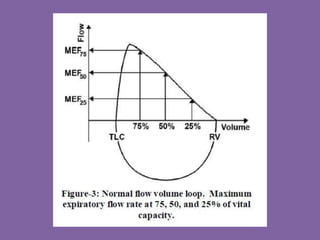
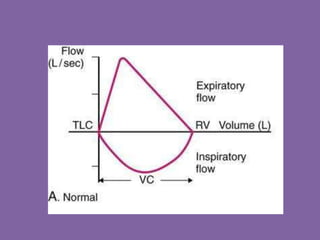
Pulmonary Flow Volume Loops
Dr.Padmesh
http://oscepediatrics.blogspot.in/
The abnormality can be due to either
Obstructive or Restrictive ventilatory defects.
• In Obstructive ventilatory defect,
-Level of obstruction ie., intrathoracic (below
6th tracheal ring) or extrathoracic,
-Fixed or variable
-Reversibility to bronchodilators
• In Restrictive defect,
-Stage of disease (early or late)
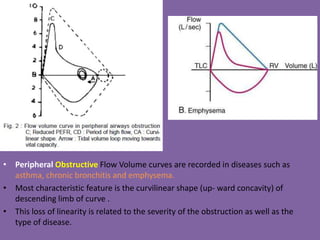
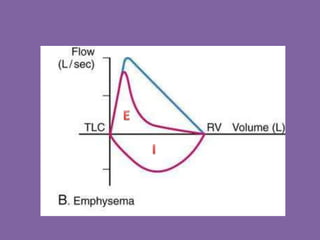
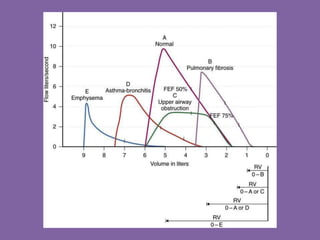
• Peripheral Obstructive Flow Volume curves are recorded in diseases such as
asthma, chronic bronchitis and emphysema.
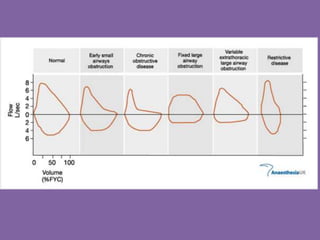
• Most characteristic feature is the curvilinear shape (up- ward concavity) of
descending limb of curve .
• This loss of linearity is related to the severity of the obstruction as well as the
type of disease.
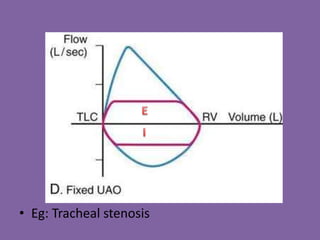
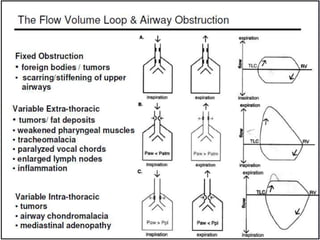
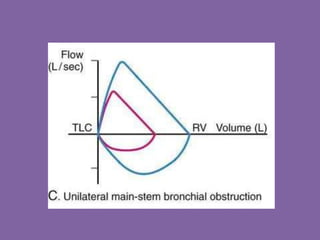
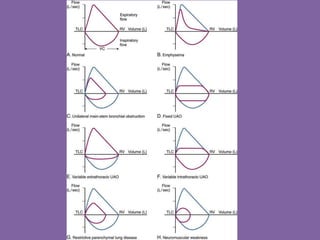
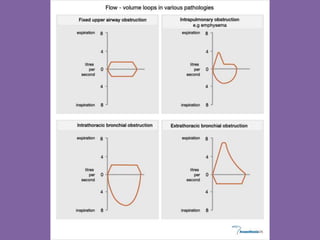
• i) Fixed upper airway obstruction: Both the inspiratory and expiratory limbs are truncated.
The shape is quite characteristic with more or less equal restriction of both inspiratory and
expiratory flow rates.
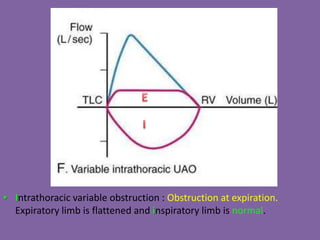
• ii) Intrathoracic variable obstruction : Obstruction at expiration. Expiratory limb is flattened
and inspiratory limb is normal.
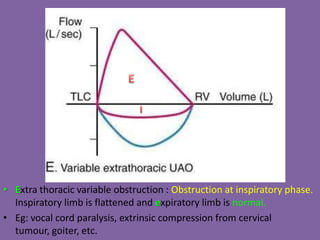
• iii) Extra thoracic variable obstruction : Obstruction at inspiratory phase. Inspiratory limb is
flattened and expiratory limb is normal.
• Eg: Tracheal stenosis
• Extra thoracic variable obstruction : Obstruction at inspiratory phase.
Inspiratory limb is flattened and expiratory limb is normal.
• Eg: vocal cord paralysis, extrinsic compression from cervical
tumour, goiter, etc.
• Intrathoracic variable obstruction : Obstruction at expiration.
Expiratory limb is flattened and inspiratory limb is normal.
• Restrictive Ventilatory Defect
• Any disease which decreases the lung expansion either by chest wall diseases or by
space occupying lesion in the pleural cavity or lung causes restrictive type of
abnormality.
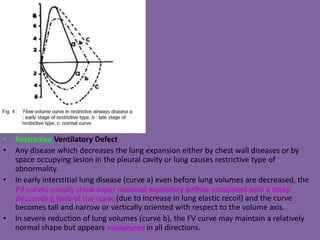
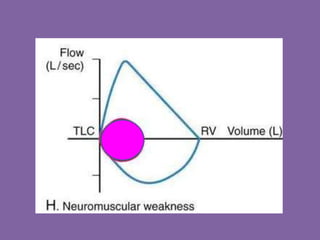
• In early interstitial lung disease (curve a) even before lung volumes are decreased, the
FV curves usually show super maximal expiratory airflow associated with a steep
descending limb of the curve (due to increase in lung elastic recoil) and the curve
becomes tall and narrow or vertically oriented with respect to the volume axis.
• In severe reduction of lung volumes (curve b), the FV curve may maintain a relatively
normal shape but appears miniatured in all directions.
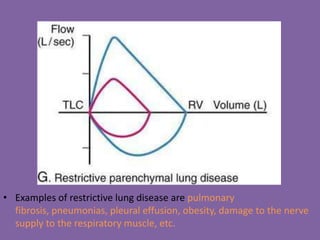
• Examples of restrictive lung disease are pulmonary
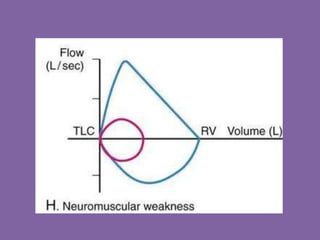
fibrosis, pneumonias, pleural effusion, obesity, damage to the nerve
supply to the respiratory muscle, etc.
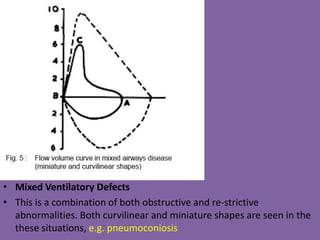
• Mixed Ventilatory Defects
• This is a combination of both obstructive and re-strictive
abnormalities. Both curvilinear and miniature shapes are seen in the
these situations, e.g. pneumoconiosis
•Thank you!
http://oscepediatrics.blogspot.in/

Pulmonary Flow Volume Loops.. Dr.Padmesh

  • 1.
    Pulmonary Flow VolumeLoops Dr.Padmesh http://oscepediatrics.blogspot.in/
  • 6.
    The abnormality canbe due to either Obstructive or Restrictive ventilatory defects. • In Obstructive ventilatory defect, -Level of obstruction ie., intrathoracic (below 6th tracheal ring) or extrathoracic, -Fixed or variable -Reversibility to bronchodilators • In Restrictive defect, -Stage of disease (early or late)
  • 8.
    • Peripheral ObstructiveFlow Volume curves are recorded in diseases such as asthma, chronic bronchitis and emphysema. • Most characteristic feature is the curvilinear shape (up- ward concavity) of descending limb of curve . • This loss of linearity is related to the severity of the obstruction as well as the type of disease.
  • 10.
    • i) Fixedupper airway obstruction: Both the inspiratory and expiratory limbs are truncated. The shape is quite characteristic with more or less equal restriction of both inspiratory and expiratory flow rates. • ii) Intrathoracic variable obstruction : Obstruction at expiration. Expiratory limb is flattened and inspiratory limb is normal. • iii) Extra thoracic variable obstruction : Obstruction at inspiratory phase. Inspiratory limb is flattened and expiratory limb is normal.
  • 11.
  • 12.
    • Extra thoracicvariable obstruction : Obstruction at inspiratory phase. Inspiratory limb is flattened and expiratory limb is normal. • Eg: vocal cord paralysis, extrinsic compression from cervical tumour, goiter, etc.
  • 13.
    • Intrathoracic variableobstruction : Obstruction at expiration. Expiratory limb is flattened and inspiratory limb is normal.
  • 16.
    • Restrictive VentilatoryDefect • Any disease which decreases the lung expansion either by chest wall diseases or by space occupying lesion in the pleural cavity or lung causes restrictive type of abnormality. • In early interstitial lung disease (curve a) even before lung volumes are decreased, the FV curves usually show super maximal expiratory airflow associated with a steep descending limb of the curve (due to increase in lung elastic recoil) and the curve becomes tall and narrow or vertically oriented with respect to the volume axis. • In severe reduction of lung volumes (curve b), the FV curve may maintain a relatively normal shape but appears miniatured in all directions.
  • 17.
    • Examples ofrestrictive lung disease are pulmonary fibrosis, pneumonias, pleural effusion, obesity, damage to the nerve supply to the respiratory muscle, etc.
  • 20.
    • Mixed VentilatoryDefects • This is a combination of both obstructive and re-strictive abnormalities. Both curvilinear and miniature shapes are seen in the these situations, e.g. pneumoconiosis
  • 25.