Unit 6 (c): : PHENOMENOLOGY
Ms. Chanda Jabeen
Lecturer
RN, RM, BSN
M.Phil. Epidemiology & Public Health
PhD (Scholar) Epidemiology & Public Health
OBJECTIVES
At the completion of this unit learners will be
able to:
• Describe methods/approaches/types of
qualitative research i.e. Phenomenological.
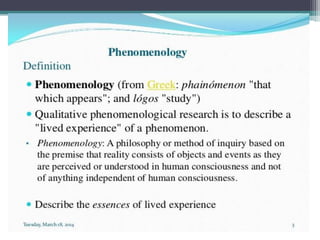
Phenomenology, rooted in a philosophical
tradition developed by Husserl and Heidegger, is
an approach to discovering the meaning of
people’s life experiences.
• Phenomenological researchers ask:
What is the essence of this phenomenon as
experienced by these people and what does it
mean?
Phenomenology
• Describes the meaning of the lived experience
from the perspective of the participant
• Seeks to achieve a deep understanding of the
phenomenon by rigorous, systematic examination
of it
• Its purpose is to describe the essences of lived
experiences
ESSENCES
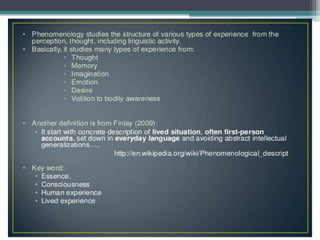
• Elements related to the true meaning of
something that gives common understanding to
the phenomenon under study
Goal of phenomenological research
The goal of phenomenological inquiry is to fully
describe lived experience and the perceptions to
which it gives rise.
Four aspects of lived experience that are of
interest to phenomenologists are
I. Lived space or spatiality;
II. Lived body or corporeality;
III. Lived time or temporality;
IV. and Lived human relation or relationality.
Philosophical Tenets
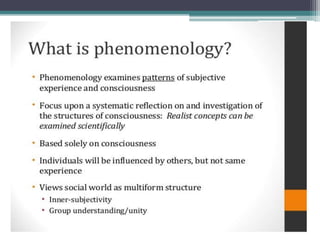
• Whatever is known must appear in
consciousness
• Consciousness provides access to the world
• All phenomenologists believe in multiple
realities constructed by individuals within the
social context of their lives
Developing the Question
• Focus is to describe the meaning of the lived
experience from the perspective of the
participant
• Broad question: “What is the meaning of
one’s lived experience?”
• Central overarching question & sub questions
Role of Researcher
• Is the instrument for data collection
• Establishes good rapport with participants
• Explicates beliefs through bracketing
• The meaning of the lived experience is
interpreted from the participants’ stories
Sample
• Small purposive sample
• Participants are able & willing to talk about their
experience and describe their feelings
• Large enough to get a rich description of the
research phenomenon
Data Collection
In a phenomenological study, the main data
source is in-depth conversations, with
researchers and informants as full
coparticipants.
The researcher helps the informant to describe
lived experiences without leading the
discussion.
Data Analysis
• Immersion with the data
• Read, re-read transcripts, may return to
participants for clarification or description
• Comparative analysis to identify themes in data
• Look for similarities & differences in data to identify
themes
• Reduce data into smaller & smaller number of
categories to arrive at a consistent description of the
meaning of the lived experience
• Share description with participants for verification
Review of Literature
• Conducted after data collection & analysis are
complete
• Places findings within the context of what is
known about the phenomenon
Findings
• reports the essence of the experience
• reader should get an understanding of what it is
like to experience the phenomenon
  phenomenology

phenomenology

  • 1.
    Unit 6 (c):: PHENOMENOLOGY Ms. Chanda Jabeen Lecturer RN, RM, BSN M.Phil. Epidemiology & Public Health PhD (Scholar) Epidemiology & Public Health
  • 2.
    OBJECTIVES At the completionof this unit learners will be able to: • Describe methods/approaches/types of qualitative research i.e. Phenomenological.
  • 3.
    Phenomenology, rooted ina philosophical tradition developed by Husserl and Heidegger, is an approach to discovering the meaning of people’s life experiences. • Phenomenological researchers ask: What is the essence of this phenomenon as experienced by these people and what does it mean?
  • 5.
    Phenomenology • Describes themeaning of the lived experience from the perspective of the participant • Seeks to achieve a deep understanding of the phenomenon by rigorous, systematic examination of it • Its purpose is to describe the essences of lived experiences
  • 9.
    ESSENCES • Elements relatedto the true meaning of something that gives common understanding to the phenomenon under study
  • 11.
    Goal of phenomenologicalresearch The goal of phenomenological inquiry is to fully describe lived experience and the perceptions to which it gives rise. Four aspects of lived experience that are of interest to phenomenologists are I. Lived space or spatiality; II. Lived body or corporeality; III. Lived time or temporality; IV. and Lived human relation or relationality.
  • 12.
    Philosophical Tenets • Whateveris known must appear in consciousness • Consciousness provides access to the world • All phenomenologists believe in multiple realities constructed by individuals within the social context of their lives
  • 13.
    Developing the Question •Focus is to describe the meaning of the lived experience from the perspective of the participant • Broad question: “What is the meaning of one’s lived experience?” • Central overarching question & sub questions
  • 14.
    Role of Researcher •Is the instrument for data collection • Establishes good rapport with participants • Explicates beliefs through bracketing • The meaning of the lived experience is interpreted from the participants’ stories
  • 17.
    Sample • Small purposivesample • Participants are able & willing to talk about their experience and describe their feelings • Large enough to get a rich description of the research phenomenon
  • 18.
    Data Collection In aphenomenological study, the main data source is in-depth conversations, with researchers and informants as full coparticipants. The researcher helps the informant to describe lived experiences without leading the discussion.
  • 19.
    Data Analysis • Immersionwith the data • Read, re-read transcripts, may return to participants for clarification or description • Comparative analysis to identify themes in data • Look for similarities & differences in data to identify themes • Reduce data into smaller & smaller number of categories to arrive at a consistent description of the meaning of the lived experience • Share description with participants for verification
  • 21.
    Review of Literature •Conducted after data collection & analysis are complete • Places findings within the context of what is known about the phenomenon
  • 22.
    Findings • reports theessence of the experience • reader should get an understanding of what it is like to experience the phenomenon