NOR MIZIANA BINTI ZAILAN (2013364506)
AMIRA BINTI AHMAD MAHMUD (2013146821)
ZAHIDAH BINTI AB AZIZ (2013770077)
NORAZLINA BINTI ABD RAHIM (2013984201)
• Is the study of structure of consciousness as experienced from the first – person point of view.
• It describe as ‘ lives experience’ mostly base on the person lived experience
• The central structure of an experience is its intentionally, its being directed toward something or as an
experience of or some object.
• It was another discipline but it also related to another key of disciplines in philosophy such as:
• Ontology
• Epistemology
• Logic
• Ethics
• Its commonly understood in two ways:
• Disciplinary field in philosophy
• Movement in the history of philosophy
• In the recent philosophy of mind, the term “phenomenology” is often restricted to the characterization of
sensory qualities of seeing, hearing .
• Another definition is
Patton (1990):
"…a phenomenological study…is one that focused on descriptions of what people experience and
how it is that they experience what they experience. One can employ a general phenomenological
perspective to elucidate the importance of using methods that capture people's experience of the world
without conducting a phenomenological study that focuses on the essence of shared experience." (p.71)
http://www.personal.psu.edu/wxh139/pheno.htm
• Phenomenology studies the structure of various types of experience from the perception,
thought, including linguistic activity.
• Basically, it studies many types of experience from:
• Thought
• Memory
• Imagination
• Emotion
• Desire
• Volition to bodily awareness
• Another definition is from Finlay (2009):
• It start with concrete description of lived situation, often first-person accounts, set
down in everyday language and avoiding abstract intellectual generalizations…..
http://en.wikipedia.org/wiki/Phenomenological_descript
• Key word:
• Essence,
• Consciousness
• Human experience
• Lived experience
 First used by Johann Heinrich Lambert
Later used by Immanuel Kant and Johann Gottlieb Fichte
Made popular in 1807 in G. W. F. Hegel’s book titled
Phänomenologie des Geistes (usually translated as
Phenomenology of Spirit)
 Edmund Husserl (1859-1938) later refined the meaning into
more of what we use today.
- Phenomena can be studied only subjectively, not
objectively—thus phenomenology is a close cousin of
existentialism
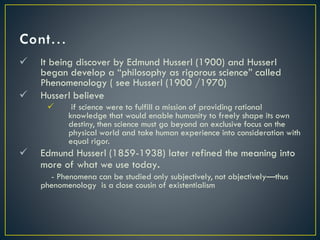
 It being discover by Edmund Husserl (1900) and Husserl
began develop a “philosophy as rigorous science” called
Phenomenology ( see Husserl (1900 /1970)
 Husserl believe
 if science were to fulfill a mission of providing rational
knowledge that would enable humanity to freely shape its own
destiny, then science must go beyond an exclusive focus on the
physical world and take human experience into consideration with
equal rigor.
 Edmund Husserl (1859-1938) later refined the meaning into
more of what we use today.
- Phenomena can be studied only subjectively, not objectively—thus
phenomenology is a close cousin of existentialism
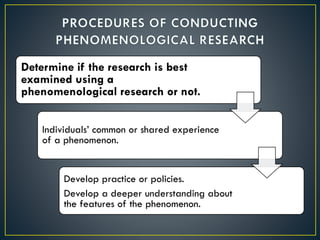
Determine if the research is best
examined using a
phenomenological research or not.
Individuals’ common or shared experience
of a phenomenon.
Develop practice or policies.
Develop a deeper understanding about
the features of the phenomenon.
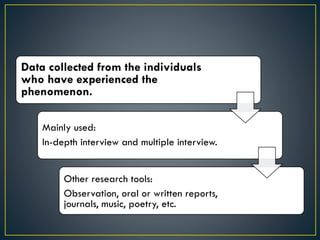
Data collected from the individuals
who have experienced the
phenomenon.
Mainly used:
In-depth interview and multiple interview.
Other research tools:
Observation, oral or written reports,
journals, music, poetry, etc.
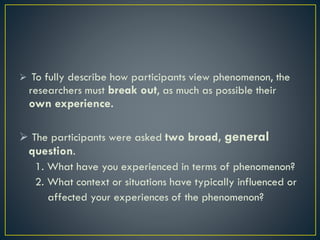
 To fully describe how participants view phenomenon, the
researchers must break out, as much as possible their
own experience.
 The participants were asked two broad, general
question.
1. What have you experienced in terms of phenomenon?
2. What context or situations have typically influenced or
affected your experiences of the phenomenon?
 Open-ended question may also be asked.
 Focus attention on gathering data that will lead to
TEXTURAL DESCRIPTION or STRUCTURAL
DESCRIPTION, and provide an understanding of the
common experience of the participants.
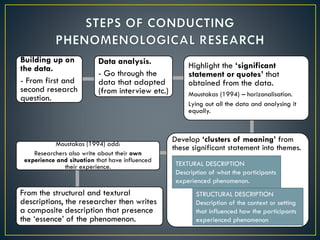
Building up on
the data.
- From first and
second research
question.
Data analysis.
- Go through the
data that adapted
(from interview etc.)
Highlight the ‘significant
statement or quotes’ that
obtained from the data.
Moustakas (1994) – horizonalisation.
Lying out all the data and analysing it
equally.
Develop ‘clusters of meaning’ from
these significant statement into themes.Moustakas (1994) add:
Researchers also write about their own
experience and situation that have influenced
their experience.
From the structural and textural
descriptions, the researcher then writes
a composite description that presence
the ‘essence’ of the phenomenon.
TEXTURAL DESCRIPTION
Description of what the participants
experienced phenomenon.
STRUCTURAL DESCRIPTION
Description of the context or setting
that influenced how the participants
experienced phenomenon
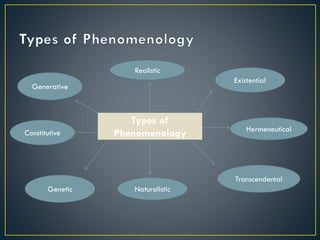
Types of
Phenomenology
Realistic
Hermeneutical
Naturalistic
Generative
Existential
Transcendental
Genetic
Constitutive
Realistic Phenomenology
 Studies about the universal enssences of various sort of matters and
structure of consciousness and not somehow brought into being by
consciousness.
Existential Phenomenology
 Studies concrete human existence, including our experience of free choice
or action in concrete situations.
Hermeneutical Phenomenology
Studies about interpretative structure of experiences. The issues adressed in
hermeneutical phenomenology include simply all of those that were
added to the agenda in the previous tendencies and stages.
Transcendental Phenomenology
 Studies how objects are constituted in pure of transcendantal
consciousness, setting aside questions of any relation to the natural
world around us.
Transcendental Phenomenology
 Studies how objects are constituted in pure of transcendantal consciousness,
setting aside questions of any relation to the natural world around us.
Naturalistic Phenomenology
 Studies how conciousness constitutes or takes things in the world of nature,
assuming with the natural attitude that consciouness is part of nature.
Genetic Phenomenology
 Studies the genesis of meanings of things within ones,s own stream of
experience.
Generative historical phenomenology
 Studies how meaning, as found in our experience, is generated in historical
process of collective experience over time.
• Holistic, Qualitative, Idiographic
• complete description of human existence
• taking the individual’s own perspective
• Phenomenological Method
• focus on individual experience of the world
• focus on interpretation of events, not the events themselves
Research purpose :
- To describe one or more individual’s experiences of a
phenomenon
2. Disciplinary Origin : Philosophy
3. Primary Data Collection Method :
- In depth interviews with up to 10 – 15 people
4. Data Analysis Approach :
- List significant statements, determine meaning of statement &
identify the essence of the phenomenon
5. Narrative report focus :
- Rich description of the essential or invariant structures
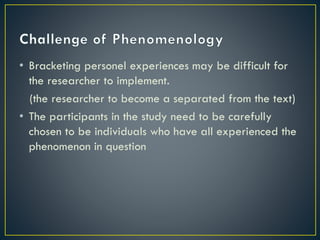
• Bracketing personel experiences may be difficult for
the researcher to implement.
(the researcher to become a separated from the text)
• The participants in the study need to be carefully
chosen to be individuals who have all experienced the
phenomenon in question
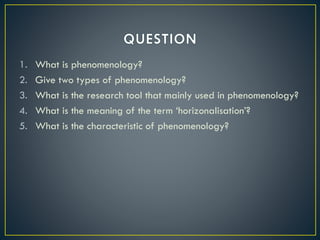
1. What is phenomenology?
2. Give two types of phenomenology?
3. What is the research tool that mainly used in phenomenology?
4. What is the meaning of the term ‘horizonalisation’?
5. What is the characteristic of phenomenology?

Phenomenology

  • 1.
    NOR MIZIANA BINTIZAILAN (2013364506) AMIRA BINTI AHMAD MAHMUD (2013146821) ZAHIDAH BINTI AB AZIZ (2013770077) NORAZLINA BINTI ABD RAHIM (2013984201)
  • 2.
    • Is thestudy of structure of consciousness as experienced from the first – person point of view. • It describe as ‘ lives experience’ mostly base on the person lived experience • The central structure of an experience is its intentionally, its being directed toward something or as an experience of or some object. • It was another discipline but it also related to another key of disciplines in philosophy such as: • Ontology • Epistemology • Logic • Ethics • Its commonly understood in two ways: • Disciplinary field in philosophy • Movement in the history of philosophy • In the recent philosophy of mind, the term “phenomenology” is often restricted to the characterization of sensory qualities of seeing, hearing . • Another definition is Patton (1990): "…a phenomenological study…is one that focused on descriptions of what people experience and how it is that they experience what they experience. One can employ a general phenomenological perspective to elucidate the importance of using methods that capture people's experience of the world without conducting a phenomenological study that focuses on the essence of shared experience." (p.71) http://www.personal.psu.edu/wxh139/pheno.htm
  • 3.
    • Phenomenology studiesthe structure of various types of experience from the perception, thought, including linguistic activity. • Basically, it studies many types of experience from: • Thought • Memory • Imagination • Emotion • Desire • Volition to bodily awareness • Another definition is from Finlay (2009): • It start with concrete description of lived situation, often first-person accounts, set down in everyday language and avoiding abstract intellectual generalizations….. http://en.wikipedia.org/wiki/Phenomenological_descript • Key word: • Essence, • Consciousness • Human experience • Lived experience
  • 4.
     First usedby Johann Heinrich Lambert Later used by Immanuel Kant and Johann Gottlieb Fichte Made popular in 1807 in G. W. F. Hegel’s book titled Phänomenologie des Geistes (usually translated as Phenomenology of Spirit)  Edmund Husserl (1859-1938) later refined the meaning into more of what we use today. - Phenomena can be studied only subjectively, not objectively—thus phenomenology is a close cousin of existentialism
  • 5.
     It beingdiscover by Edmund Husserl (1900) and Husserl began develop a “philosophy as rigorous science” called Phenomenology ( see Husserl (1900 /1970)  Husserl believe  if science were to fulfill a mission of providing rational knowledge that would enable humanity to freely shape its own destiny, then science must go beyond an exclusive focus on the physical world and take human experience into consideration with equal rigor.  Edmund Husserl (1859-1938) later refined the meaning into more of what we use today. - Phenomena can be studied only subjectively, not objectively—thus phenomenology is a close cousin of existentialism
  • 6.
    Determine if theresearch is best examined using a phenomenological research or not. Individuals’ common or shared experience of a phenomenon. Develop practice or policies. Develop a deeper understanding about the features of the phenomenon.
  • 7.
    Data collected fromthe individuals who have experienced the phenomenon. Mainly used: In-depth interview and multiple interview. Other research tools: Observation, oral or written reports, journals, music, poetry, etc.
  • 8.
     To fullydescribe how participants view phenomenon, the researchers must break out, as much as possible their own experience.  The participants were asked two broad, general question. 1. What have you experienced in terms of phenomenon? 2. What context or situations have typically influenced or affected your experiences of the phenomenon?
  • 9.
     Open-ended questionmay also be asked.  Focus attention on gathering data that will lead to TEXTURAL DESCRIPTION or STRUCTURAL DESCRIPTION, and provide an understanding of the common experience of the participants.
  • 10.
    Building up on thedata. - From first and second research question. Data analysis. - Go through the data that adapted (from interview etc.) Highlight the ‘significant statement or quotes’ that obtained from the data. Moustakas (1994) – horizonalisation. Lying out all the data and analysing it equally. Develop ‘clusters of meaning’ from these significant statement into themes.Moustakas (1994) add: Researchers also write about their own experience and situation that have influenced their experience. From the structural and textural descriptions, the researcher then writes a composite description that presence the ‘essence’ of the phenomenon. TEXTURAL DESCRIPTION Description of what the participants experienced phenomenon. STRUCTURAL DESCRIPTION Description of the context or setting that influenced how the participants experienced phenomenon
  • 11.
  • 12.
    Realistic Phenomenology  Studiesabout the universal enssences of various sort of matters and structure of consciousness and not somehow brought into being by consciousness. Existential Phenomenology  Studies concrete human existence, including our experience of free choice or action in concrete situations. Hermeneutical Phenomenology Studies about interpretative structure of experiences. The issues adressed in hermeneutical phenomenology include simply all of those that were added to the agenda in the previous tendencies and stages. Transcendental Phenomenology  Studies how objects are constituted in pure of transcendantal consciousness, setting aside questions of any relation to the natural world around us.
  • 13.
    Transcendental Phenomenology  Studieshow objects are constituted in pure of transcendantal consciousness, setting aside questions of any relation to the natural world around us. Naturalistic Phenomenology  Studies how conciousness constitutes or takes things in the world of nature, assuming with the natural attitude that consciouness is part of nature. Genetic Phenomenology  Studies the genesis of meanings of things within ones,s own stream of experience. Generative historical phenomenology  Studies how meaning, as found in our experience, is generated in historical process of collective experience over time.
  • 14.
    • Holistic, Qualitative,Idiographic • complete description of human existence • taking the individual’s own perspective • Phenomenological Method • focus on individual experience of the world • focus on interpretation of events, not the events themselves
  • 15.
    Research purpose : -To describe one or more individual’s experiences of a phenomenon 2. Disciplinary Origin : Philosophy 3. Primary Data Collection Method : - In depth interviews with up to 10 – 15 people
  • 16.
    4. Data AnalysisApproach : - List significant statements, determine meaning of statement & identify the essence of the phenomenon 5. Narrative report focus : - Rich description of the essential or invariant structures
  • 17.
    • Bracketing personelexperiences may be difficult for the researcher to implement. (the researcher to become a separated from the text) • The participants in the study need to be carefully chosen to be individuals who have all experienced the phenomenon in question
  • 19.
    1. What isphenomenology? 2. Give two types of phenomenology? 3. What is the research tool that mainly used in phenomenology? 4. What is the meaning of the term ‘horizonalisation’? 5. What is the characteristic of phenomenology?