Chapter Nine:
Learning and Memory


                      9-1
Chapter 9: Learning and memory
1. Nature of learning
2. Differences between classical conditioning,
     operant (instrumental) conditioning and
     cognitive learning
3.   Main characteristics of learning
4.   Understand how consumers learn
5.   How knowledge about learning can be
     incorporated into marketing strategies
6.   Importance of brand image and product
     positioning
                                               9-2
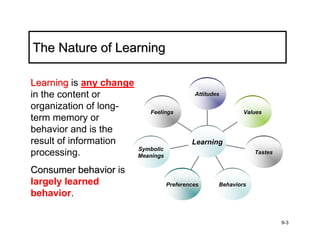
The Nature of Learning

Learning is any change
in the content or                            Attitudes

organization of long-
                            Feelings                         Values
term memory or
behavior and is the
result of information                       Learning
                         Symbolic
processing.              Meanings
                                                                 Tastes


Consumer behavior is
largely learned                     Preferences      Behaviors
behavior.

                                                                          9-3
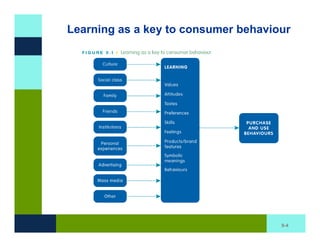
Learning as a key to consumer behaviour


                                     9-4
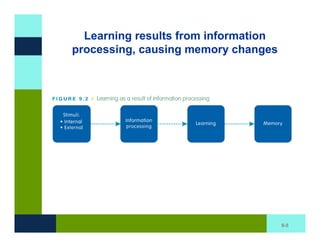
Learning results from information
processing, causing memory changes


                                      9-5
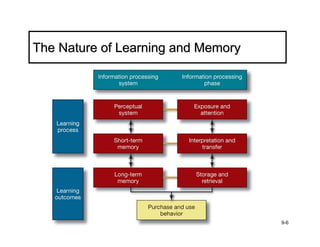
The Nature of Learning and Memory


                                    9-6
Involvement and learning
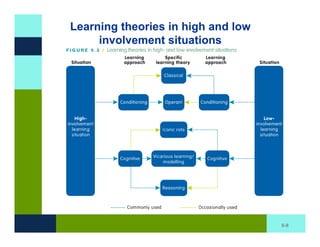
• Learning under high-involvement conditions
   – Consumer has a high motivation to learn


• Learning under low-involvement conditions
   – Most consumer learning is in a low-involvement
     context


                                                      9-7
Learning Under High and Low Involvement
A High-involvement learning situation is one in which
the consumer is motivated to process or learn the
material.
A Low-involvement learning situation is one in which
the consumer has little or no motivation to process or
learn the material.
Most consumer learning occurs in relatively low
involvement contexts.
The way a communication should be structured differs
depending on the level of involvement the audience is
expected to have.
                                                         9-8
Learning theories in high and low
     involvement situations


                                    9-9
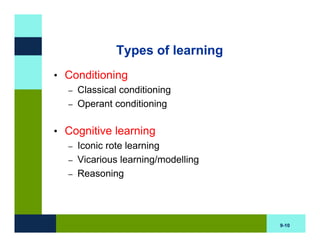
Types of learning
• Conditioning
  – Classical conditioning
  – Operant conditioning


• Cognitive learning
  – Iconic rote learning
  – Vicarious learning/modelling
  – Reasoning


                                   9-10
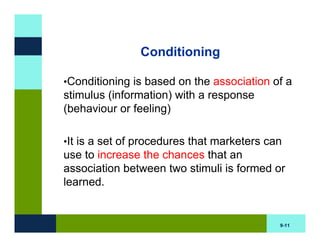
Conditioning

•Conditioning is based on the association of a
stimulus (information) with a response
(behaviour or feeling)

•It is a set of procedures that marketers can
use to increase the chances that an
association between two stimuli is formed or
learned.


                                            9-11
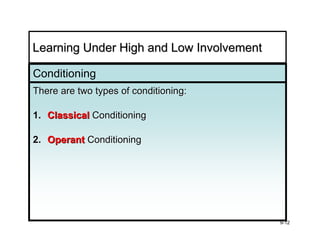
Learning Under High and Low Involvement

Conditioning
There are two types of conditioning:

1. Classical Conditioning

2. Operant Conditioning


                                          9-12
Classical conditioning
• Establishing a relationship between stimulus
  and response to bring about the learning of
  the same response to a different stimulus
• Most common in low-involvement situations
• Learning is more often a feeling or emotion
  than information


                                            9-13
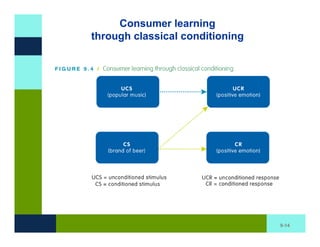
Consumer learning
through classical conditioning


                                 9-14
Learning Under High and Low Involvement

                   Operant Conditioning
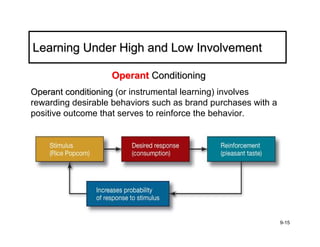
Operant conditioning (or instrumental learning) involves
rewarding desirable behaviors such as brand purchases with a
positive outcome that serves to reinforce the behavior.


                                                               9-15
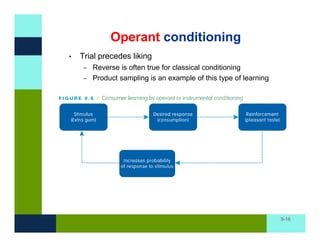
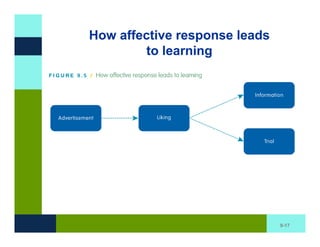
Operant conditioning
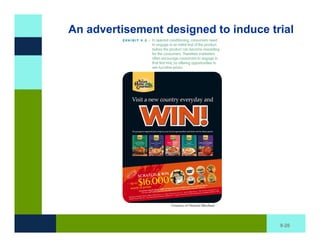
•   Trial precedes liking
     –   Reverse is often true for classical conditioning
     –   Product sampling is an example of this type of learning


                                                                   9-16
How affective response leads
         to learning


                               9-17
Products using the Heart Foundation’s tick
     are associated with good health


                                         9-18
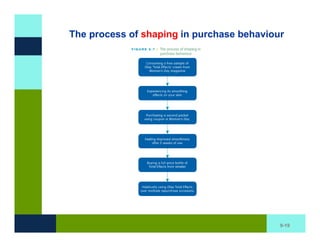
The process of shaping in purchase behaviour


                                           9-19
An advertisement designed to induce trial


                                      9-20
Learning Under High and Low Involvement

  Cognitive Learning
  •   Cognitive learning encompasses all the mental
      activities of humans as they work to solve
      problems or cope with situations.
  •   It involves learning ideas, concepts, attitudes, and
      fact that contribute to our ability to reason, solve
      problems, and learn relationships without direct
      experience or reinforcement.


                                                             9-21
Learning Under High and Low Involvement

Cognitive Learning

1. Iconic Rote Learning

2. Vicarious Learning/Modeling

3. Analytical Reasoning


                                          9-22
Cognitive learning
• Iconic rote learning
   –   Association between two or more concepts in the
       absence of conditioning
         a substantial amount of low-involvement
         learning involves iconic rote learning
         achieved by repeated advertising messages
• In iconic rote learning there is neither an
  unconditioned stimulus (classical) nor a direct reward
  or reinforcement (operant) involved.
• Repetition tends to be critical to iconic rote learning.


                                                         9-23
Cognitive learning (cont.)

• Vicarious learning/modelling
  – Observe others' behaviour and adjust their own
    accordingly
       common in both high-involvement and low-
       involvement situations
• Reasoning
  – Most complex form of cognitive learning
      most high-involvement decisions generate
      some reasoning


                                                 9-24
Learning Under High and Low Involvement

              Vicarious Learning/Modeling

Vicarious learning or modeling can include observing the
outcomes of others’ behaviors and adjusting their own
accordingly. In addition, they can use imagery to
anticipate the outcome of various courses of action.
This type of learning is common in both low- and high-
involvement situation.
Many ads encourage consumers to imagine the feeling
and experience of using a product. Such images not only
enhance learning about the product, but may even
influence how the product is evaluated after an actual trial.
                                                            9-25
Learning Under High and Low Involvement

                    Analytical Reasoning
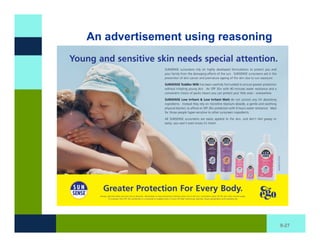
Analytical reasoning is the most complex form of cognitive
learning.
learning
   •Individuals engage in creative thinking to restructure and
   recombine existing information as well as new information to
   form new associations and concepts.
   •Information from a credible source that contradicts or
   challenges one’s existing beliefs will often trigger reasoning.
   •Analogical reasoning allows consumers to use an existing
   knowledge base to understand a new situation or object.


                                                                 9-26
An advertisement using reasoning


                                   9-27
General characteristics of learning
• The strength of learning is influenced by:
   – Importance and relevance
        separates high and low-involvement learning
        situations
   – Involvement
   – Mood
   – Reinforcement (or punishment)
   – Stimulus repetitions (practice sessions)
   – Imagery


                                                  9-28
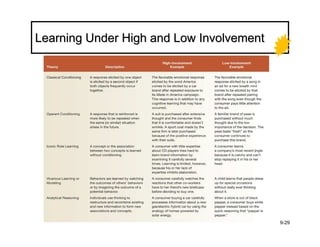
Learning Under High and Low Involvement


                                          9-29
Learning, Memory, and Retrieval

  Strength of Learning

  Memory Interference

  Response Environment


                                  9-30
Learning, Memory, and Retrieval

                    Strength of learning

What is required to bring about a long-lasting learned
response?

One factor is strength of learning.
                          learning

The stronger the original learning (e.g., of nodes and links
between nodes), the more likely relevant information will
be retrieved when required.


                                                           9-31
Learning, Memory, and Retrieval
Strength of Learning

Strength of learning is enhanced by six factors:
1. Importance
2. Message Involvement
3. Mood
4. Reinforcement
5. Number of stimulus repititions
6. The amount of imagery contained in the material
                                                     9-32
Learning, Memory, and Retrieval

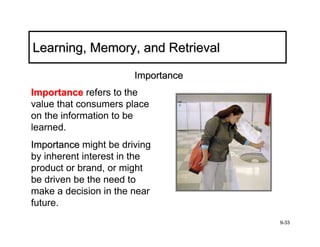
                       Importance
Importance refers to the
value that consumers place
on the information to be
learned.
Importance might be driving
by inherent interest in the
product or brand, or might
be driven be the need to
make a decision in the near
future.
                                    9-33
Learning, Memory, and Retrieval

                   Message Involvement
When a consumer is not motivated to learn the material,
processing can be increased by causing the person to
become involved with the message itself.

   • Example:  Playing an instrumental version of a popular
   song with lyrics related to product attributes may cause
   people to “sing along,” either out loud or mentally.

Self referencing uses second-person pronouns (you, your)
in ads to encourage consumers to relate brand information
to themselves.
                                                              9-34
Learning, Memory, and Retrieval

                          Mood

A positive mood during the presentation of information
such as brand names enhances learning.

     A positive mood during the reception of information
   appears to enhance its relational elaboration—it is
   compared with and evaluated against more categories.

      This produces a more complete and stronger set of
   linkages among a variety of other brands and
   concepts, which in turn enhances retrieval (access to
   the information).
                                                           9-35
Learning, Memory, and Retrieval

                          Reinforcement

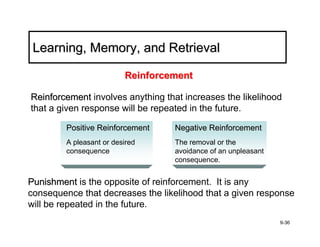
Reinforcement involves anything that increases the likelihood
that a given response will be repeated in the future.

         Positive Reinforcement    Negative Reinforcement
         A pleasant or desired     The removal or the
         consequence               avoidance of an unpleasant
                                   consequence.


Punishment is the opposite of reinforcement. It is any
consequence that decreases the likelihood that a given response
will be repeated in the future.
                                                                9-36
Learning, Memory, and Retrieval

                        Repetition
Repetition enhances learning and memory by increasing
accessibility of information or by strengthening the
associative linkages between concepts.
    Repetition depends on importance and reinforcement.
     Less repetition of an advertising message is needed if
   importance is high or if there is a great deal of relevant
   reinforcement.


                                                           9-37
General characteristics of learning (cont.)

• Extinction
  –  Forgetting occurs when reinforcement for
     learning is withdrawn
• Stimulus generalisation
  – Brand equity
  – Brand leverage


                                            9-38
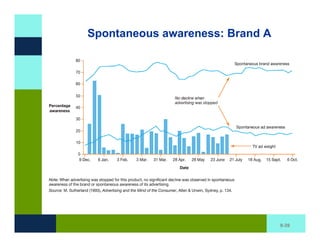
Spontaneous awareness: Brand A


                                 9-39
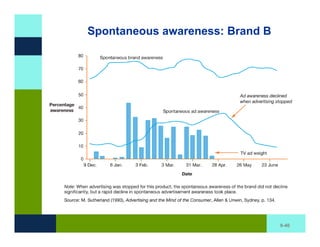
Spontaneous awareness: Brand B


                                 9-40
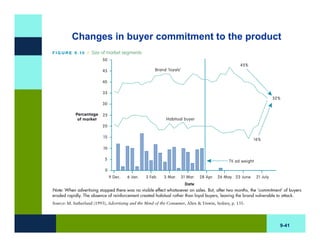
Changes in buyer commitment to the product


                                         9-41
Learning Under High and Low Involvement

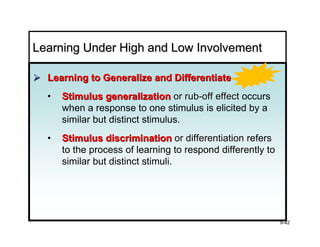
  Learning to Generalize and Differentiate
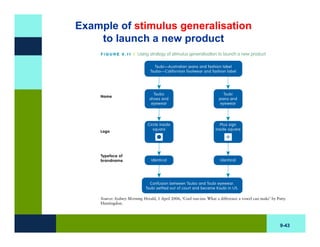
  •   Stimulus generalization or rub-off effect occurs
      when a response to one stimulus is elicited by a
      similar but distinct stimulus.
  •   Stimulus discrimination or differentiation refers
      to the process of learning to respond differently to
      similar but distinct stimuli.


                                                             9-42
Example of stimulus generalisation
    to launch a new product


                                     9-43
General characteristics of learning (cont.)


• Stimulus discrimination
  – Why your brand is different

• Response environment
  – Strength of original learning
  – Similarity of original learning environment to the
    retrieval environment


                                                     9-44
The response environment

• Strength of original learning affects ability to
  retrieve relevant information
• Similarity of the original learning and the type
  of learning is important
• Marketers aim to replicate these situations


                                                 9-45
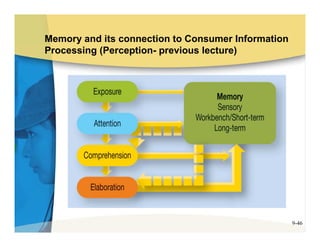
Memory and its connection to Consumer Information
Processing (Perception- previous lecture)


                                                    9-46
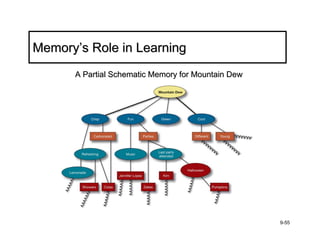
Memory’s Role in Learning
Memory consists of two interrelated components:
                                    components
1. Short-term Memory (STM) a.k.a. working memory
  •   is that portion of total memory that is currently activated
      or in use.
2. Long-term Memory (LTM)
  •   is that portion of total memory devoted to permanent
      information storage.
      •   Semantic memory is the basic knowledge and
          feelings an individual has about a concept.
      •   Episodic memory is the memory of a sequence of
          events in which a person participated.
                                                                9-47
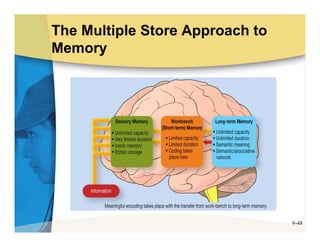
The Multiple Store Approach to
Memory


                                 9-48
Memory’s Role in Learning
Short-Term Memory
  STM is Short Lived
  •   Consumers must constantly refresh information through
      maintenance rehearsal or it will be lost.
  STM has Limited Capacity
  •   Consumers can only hold so much information in
      current memory.
  Elaborative Activities Occur in STM
  •   Elaborative activities serve to redefine or add new
      elements to memory and can involve both concepts and
      imagery.
      imagery
                                                          9-49
Short term memory

Two kinds of information processing:
• Elaborative activities:
   –   Use of previously stored experiences, values,
       attitudes, beliefs and feelings to interpret and
       evaluate information in the working memory.
• Maintenance rehearsal:
  – The continual repetition of a piece of information
    in order to hold it in working memory to solve
    problems. Repeating a brand name is an
    example of this.


                                                      9-50
Memory (cont.)
• Long-term memory
   – Unlimited permanent storage
   – Schematic memory
       linking to ‘chunks’ of information


                                            9-51
Memory’s Role in Learning
Long-Term Memory

  Schemas (a.k.a. schematic memory)

  Scripts

  Retrieval from LTM


                                      9-52
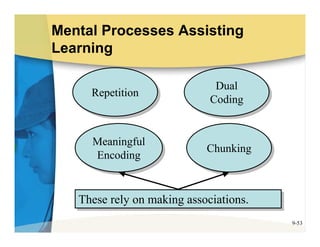
Mental Processes Assisting
Learning

                             Dual
                             Dual
     Repetition
     Repetition             Coding
                            Coding


     Meaningful
     Meaningful             Chunking
                            Chunking
     Encoding
      Encoding


   These rely on making associations.
   These rely on making associations.
                                        9-53
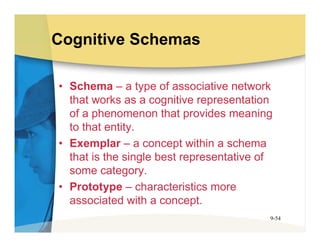
Cognitive Schemas

• Schema – a type of associative network
  that works as a cognitive representation
  of a phenomenon that provides meaning
  to that entity.
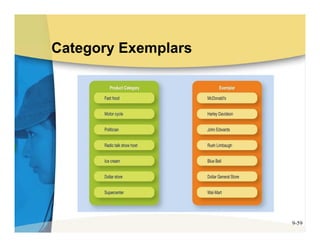
• Exemplar – a concept within a schema
  that is the single best representative of
  some category.
• Prototype – characteristics more
  associated with a concept.
                                          9-54
Memory’s Role in Learning
      A Partial Schematic Memory for Mountain Dew


                                                    9-55
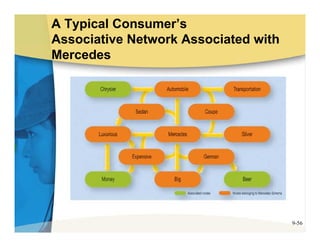
A Typical Consumer’s
Associative Network Associated with
Mercedes


                                      9-56
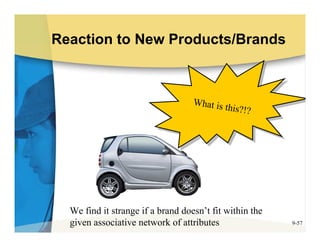
Reaction to New Products/Brands


                                   Whaa is
                                   Wh tt isthis?
                                            this?!?
                                                 !?


  We find it strange if a brand doesn’t fit within the
  given associative network of attributes                9-57
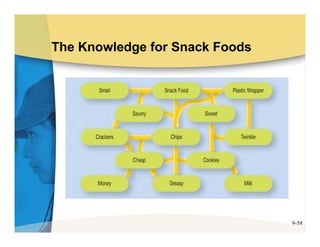
The Knowledge for Snack Foods


                                9-58
Category Exemplars


                     9-59
Memory’s Role in Learning

       Retrieval: Knowing versus Remembering

Explicit memory is
characterized by the
conscious recollection of
an exposure event.
Implicit memory
involves the
nonconscious retrieval of
previously encountered
stimuli.

                                               9-60
Learning, Memory, and Retrieval

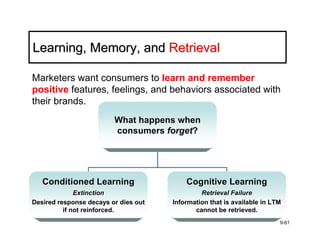
Marketers want consumers to learn and remember
positive features, feelings, and behaviors associated with
their brands.
                         What happens when
                         consumers forget?


   Conditioned Learning                   Cognitive Learning
              Extinction                       Retrieval Failure
Desired response decays or dies out   Information that is available in LTM
          if not reinforced.                 cannot be retrieved.
                                                                         9-61
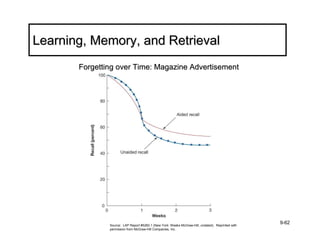
Learning, Memory, and Retrieval
       Forgetting over Time: Magazine Advertisement


               Source: LAP Report #5260.1 (New York: Weeks McGraw-Hill, undated). Reprinted with
                                                                                                   9-62
               permission from McGraw-Hill Companies, Inc.
Learning, Memory, and Retrieval
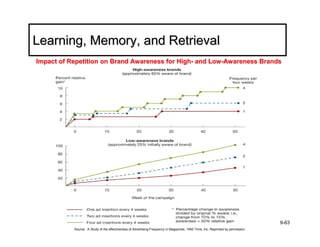
Impact of Repetition on Brand Awareness for High- and Low-Awareness Brands


                                                                                                                                  9-63
           Source: A Study of the effectiveness of Advertising Frequency in Magazines, 1993 Time, Inc. Reprinted by permission.
Learning, Memory, and Retrieval
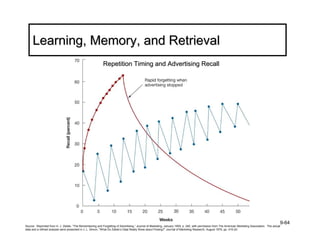
                                                            Repetition Timing and Advertising Recall


                                                                                                                                                                                                     9-64
Source: Reprinted from H. J. Zielski, “The Remembering and Forgetting of Advertising,” Journal of Marketing, January 1959, p. 240, with permission from The American Marketing Association. The actual
data and a refined analysis were presented in J. L. Simon, “What Do Zielski’s Data Really Show about Pulsing?” Journal of Marketing Research, August 1979, pp. 415-20.
Learning, Memory, and Retrieval

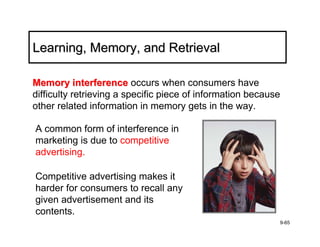
Memory interference occurs when consumers have
difficulty retrieving a specific piece of information because
other related information in memory gets in the way.

A common form of interference in
marketing is due to competitive
advertising.

Competitive advertising makes it
harder for consumers to recall any
given advertisement and its
contents.
                                                            9-65
Learning, Memory, and Retrieval

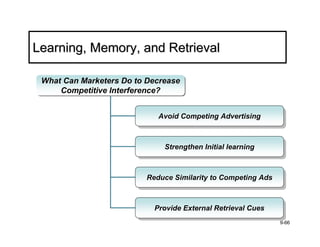
 What Can Marketers Do to Decrease
 What Can Marketers Do to Decrease
     Competitive Interference?
     Competitive Interference?


                            Avoid Competing Advertising
                            Avoid Competing Advertising


                              Strengthen Initial learning
                               Strengthen Initial learning


                         Reduce Similarity to Competing Ads
                         Reduce Similarity to Competing Ads


                           Provide External Retrieval Cues
                            Provide External Retrieval Cues
                                                              9-66
Learning, Memory, and Retrieval

                Response Environment

Retrieval is also affected by the similarity of the retrieval
(response) environment to the original learning
environment and type of learning.

The more the retrieval situation offers cues similar to the
cues present during learning, the more likely effective
retrieval is to occur.


                                                                9-67
Product positioning strategy

• Brand image
• Product positioning
• Perceptual mapping
• Product repositioning


                                      9-68
Brand Image and Product Positioning

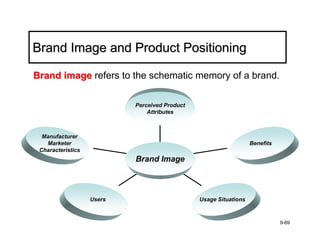
Brand image refers to the schematic memory of a brand.

                           Perceived Product
                               Attributes


  Manufacturer
   Marketer                                                       Benefits
 Characteristics
                           Brand Image


                   Users                       Usage Situations


                                                                             9-69
Brand Image and Product Positioning

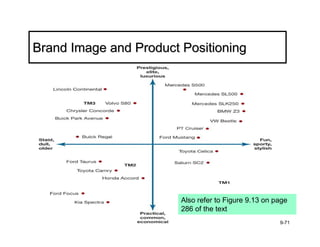
Product positioning is a decision by a marketer to try to
achieve a defined brand image relative to competition
within a market segment.

An important component of brand image is the appropriate
usage situations for the product or brand.

Perceptual mapping offers marketing managers a useful
technique for measuring and developing a product’s
position.


                                                            9-70
Brand Image and Product Positioning
             Perceptual Map for Automobiles


                                   Also refer to Figure 9.13 on page
                                   286 of the text
                                                                 9-71
Brand Image and Product Positioning

Product repositioning refers to a deliberate decision to
significantly alter the way the market views a product. This
can involve
     level of performance
     the feelings it evokes
     the situations in which it should be used, or
     who uses the product


                                                           9-72
Brand Equity and Brand Leverage

Brand equity is the value consumers assign to a brand
above and beyond the functional characteristics of the
product.

Brand leverage, often termed family branding, brand
        leverage
extensions, or umbrella branding, refers to marketers
                        branding
capitalizing on brand equity by using an existing brand
name for new products.


                                                          9-73

BB Chapter Nine : Learning and Memory

  • 1.
  • 2.
    Chapter 9: Learningand memory 1. Nature of learning 2. Differences between classical conditioning, operant (instrumental) conditioning and cognitive learning 3. Main characteristics of learning 4. Understand how consumers learn 5. How knowledge about learning can be incorporated into marketing strategies 6. Importance of brand image and product positioning 9-2
  • 3.
    The Nature ofLearning Learning is any change in the content or Attitudes organization of long- Feelings Values term memory or behavior and is the result of information Learning Symbolic processing. Meanings Tastes Consumer behavior is largely learned Preferences Behaviors behavior. 9-3
  • 4.
    Learning as akey to consumer behaviour 9-4
  • 5.
    Learning results frominformation processing, causing memory changes 9-5
  • 6.
    The Nature ofLearning and Memory 9-6
  • 7.
    Involvement and learning •Learning under high-involvement conditions – Consumer has a high motivation to learn • Learning under low-involvement conditions – Most consumer learning is in a low-involvement context 9-7
  • 8.
    Learning Under Highand Low Involvement A High-involvement learning situation is one in which the consumer is motivated to process or learn the material. A Low-involvement learning situation is one in which the consumer has little or no motivation to process or learn the material. Most consumer learning occurs in relatively low involvement contexts. The way a communication should be structured differs depending on the level of involvement the audience is expected to have. 9-8
  • 9.
    Learning theories inhigh and low involvement situations 9-9
  • 10.
    Types of learning •Conditioning – Classical conditioning – Operant conditioning • Cognitive learning – Iconic rote learning – Vicarious learning/modelling – Reasoning 9-10
  • 11.
    Conditioning •Conditioning is basedon the association of a stimulus (information) with a response (behaviour or feeling) •It is a set of procedures that marketers can use to increase the chances that an association between two stimuli is formed or learned. 9-11
  • 12.
    Learning Under Highand Low Involvement Conditioning There are two types of conditioning: 1. Classical Conditioning 2. Operant Conditioning 9-12
  • 13.
    Classical conditioning • Establishinga relationship between stimulus and response to bring about the learning of the same response to a different stimulus • Most common in low-involvement situations • Learning is more often a feeling or emotion than information 9-13
  • 14.
  • 15.
    Learning Under Highand Low Involvement Operant Conditioning Operant conditioning (or instrumental learning) involves rewarding desirable behaviors such as brand purchases with a positive outcome that serves to reinforce the behavior. 9-15
  • 16.
    Operant conditioning • Trial precedes liking – Reverse is often true for classical conditioning – Product sampling is an example of this type of learning 9-16
  • 17.
    How affective responseleads to learning 9-17
  • 18.
    Products using theHeart Foundation’s tick are associated with good health 9-18
  • 19.
    The process ofshaping in purchase behaviour 9-19
  • 20.
    An advertisement designedto induce trial 9-20
  • 21.
    Learning Under Highand Low Involvement Cognitive Learning • Cognitive learning encompasses all the mental activities of humans as they work to solve problems or cope with situations. • It involves learning ideas, concepts, attitudes, and fact that contribute to our ability to reason, solve problems, and learn relationships without direct experience or reinforcement. 9-21
  • 22.
    Learning Under Highand Low Involvement Cognitive Learning 1. Iconic Rote Learning 2. Vicarious Learning/Modeling 3. Analytical Reasoning 9-22
  • 23.
    Cognitive learning • Iconicrote learning – Association between two or more concepts in the absence of conditioning a substantial amount of low-involvement learning involves iconic rote learning achieved by repeated advertising messages • In iconic rote learning there is neither an unconditioned stimulus (classical) nor a direct reward or reinforcement (operant) involved. • Repetition tends to be critical to iconic rote learning. 9-23
  • 24.
    Cognitive learning (cont.) •Vicarious learning/modelling – Observe others' behaviour and adjust their own accordingly common in both high-involvement and low- involvement situations • Reasoning – Most complex form of cognitive learning most high-involvement decisions generate some reasoning 9-24
  • 25.
    Learning Under Highand Low Involvement Vicarious Learning/Modeling Vicarious learning or modeling can include observing the outcomes of others’ behaviors and adjusting their own accordingly. In addition, they can use imagery to anticipate the outcome of various courses of action. This type of learning is common in both low- and high- involvement situation. Many ads encourage consumers to imagine the feeling and experience of using a product. Such images not only enhance learning about the product, but may even influence how the product is evaluated after an actual trial. 9-25
  • 26.
    Learning Under Highand Low Involvement Analytical Reasoning Analytical reasoning is the most complex form of cognitive learning. learning •Individuals engage in creative thinking to restructure and recombine existing information as well as new information to form new associations and concepts. •Information from a credible source that contradicts or challenges one’s existing beliefs will often trigger reasoning. •Analogical reasoning allows consumers to use an existing knowledge base to understand a new situation or object. 9-26
  • 27.
    An advertisement usingreasoning 9-27
  • 28.
    General characteristics oflearning • The strength of learning is influenced by: – Importance and relevance separates high and low-involvement learning situations – Involvement – Mood – Reinforcement (or punishment) – Stimulus repetitions (practice sessions) – Imagery 9-28
  • 29.
    Learning Under Highand Low Involvement 9-29
  • 30.
    Learning, Memory, andRetrieval Strength of Learning Memory Interference Response Environment 9-30
  • 31.
    Learning, Memory, andRetrieval Strength of learning What is required to bring about a long-lasting learned response? One factor is strength of learning. learning The stronger the original learning (e.g., of nodes and links between nodes), the more likely relevant information will be retrieved when required. 9-31
  • 32.
    Learning, Memory, andRetrieval Strength of Learning Strength of learning is enhanced by six factors: 1. Importance 2. Message Involvement 3. Mood 4. Reinforcement 5. Number of stimulus repititions 6. The amount of imagery contained in the material 9-32
  • 33.
    Learning, Memory, andRetrieval Importance Importance refers to the value that consumers place on the information to be learned. Importance might be driving by inherent interest in the product or brand, or might be driven be the need to make a decision in the near future. 9-33
  • 34.
    Learning, Memory, andRetrieval Message Involvement When a consumer is not motivated to learn the material, processing can be increased by causing the person to become involved with the message itself. • Example: Playing an instrumental version of a popular song with lyrics related to product attributes may cause people to “sing along,” either out loud or mentally. Self referencing uses second-person pronouns (you, your) in ads to encourage consumers to relate brand information to themselves. 9-34
  • 35.
    Learning, Memory, andRetrieval Mood A positive mood during the presentation of information such as brand names enhances learning. A positive mood during the reception of information appears to enhance its relational elaboration—it is compared with and evaluated against more categories. This produces a more complete and stronger set of linkages among a variety of other brands and concepts, which in turn enhances retrieval (access to the information). 9-35
  • 36.
    Learning, Memory, andRetrieval Reinforcement Reinforcement involves anything that increases the likelihood that a given response will be repeated in the future. Positive Reinforcement Negative Reinforcement A pleasant or desired The removal or the consequence avoidance of an unpleasant consequence. Punishment is the opposite of reinforcement. It is any consequence that decreases the likelihood that a given response will be repeated in the future. 9-36
  • 37.
    Learning, Memory, andRetrieval Repetition Repetition enhances learning and memory by increasing accessibility of information or by strengthening the associative linkages between concepts. Repetition depends on importance and reinforcement. Less repetition of an advertising message is needed if importance is high or if there is a great deal of relevant reinforcement. 9-37
  • 38.
    General characteristics oflearning (cont.) • Extinction – Forgetting occurs when reinforcement for learning is withdrawn • Stimulus generalisation – Brand equity – Brand leverage 9-38
  • 39.
  • 40.
  • 41.
    Changes in buyercommitment to the product 9-41
  • 42.
    Learning Under Highand Low Involvement Learning to Generalize and Differentiate • Stimulus generalization or rub-off effect occurs when a response to one stimulus is elicited by a similar but distinct stimulus. • Stimulus discrimination or differentiation refers to the process of learning to respond differently to similar but distinct stimuli. 9-42
  • 43.
    Example of stimulusgeneralisation to launch a new product 9-43
  • 44.
    General characteristics oflearning (cont.) • Stimulus discrimination – Why your brand is different • Response environment – Strength of original learning – Similarity of original learning environment to the retrieval environment 9-44
  • 45.
    The response environment •Strength of original learning affects ability to retrieve relevant information • Similarity of the original learning and the type of learning is important • Marketers aim to replicate these situations 9-45
  • 46.
    Memory and itsconnection to Consumer Information Processing (Perception- previous lecture) 9-46
  • 47.
    Memory’s Role inLearning Memory consists of two interrelated components: components 1. Short-term Memory (STM) a.k.a. working memory • is that portion of total memory that is currently activated or in use. 2. Long-term Memory (LTM) • is that portion of total memory devoted to permanent information storage. • Semantic memory is the basic knowledge and feelings an individual has about a concept. • Episodic memory is the memory of a sequence of events in which a person participated. 9-47
  • 48.
    The Multiple StoreApproach to Memory 9-48
  • 49.
    Memory’s Role inLearning Short-Term Memory STM is Short Lived • Consumers must constantly refresh information through maintenance rehearsal or it will be lost. STM has Limited Capacity • Consumers can only hold so much information in current memory. Elaborative Activities Occur in STM • Elaborative activities serve to redefine or add new elements to memory and can involve both concepts and imagery. imagery 9-49
  • 50.
    Short term memory Twokinds of information processing: • Elaborative activities: – Use of previously stored experiences, values, attitudes, beliefs and feelings to interpret and evaluate information in the working memory. • Maintenance rehearsal: – The continual repetition of a piece of information in order to hold it in working memory to solve problems. Repeating a brand name is an example of this. 9-50
  • 51.
    Memory (cont.) • Long-termmemory – Unlimited permanent storage – Schematic memory linking to ‘chunks’ of information 9-51
  • 52.
    Memory’s Role inLearning Long-Term Memory Schemas (a.k.a. schematic memory) Scripts Retrieval from LTM 9-52
  • 53.
    Mental Processes Assisting Learning Dual Dual Repetition Repetition Coding Coding Meaningful Meaningful Chunking Chunking Encoding Encoding These rely on making associations. These rely on making associations. 9-53
  • 54.
    Cognitive Schemas • Schema– a type of associative network that works as a cognitive representation of a phenomenon that provides meaning to that entity. • Exemplar – a concept within a schema that is the single best representative of some category. • Prototype – characteristics more associated with a concept. 9-54
  • 55.
    Memory’s Role inLearning A Partial Schematic Memory for Mountain Dew 9-55
  • 56.
    A Typical Consumer’s AssociativeNetwork Associated with Mercedes 9-56
  • 57.
    Reaction to NewProducts/Brands Whaa is Wh tt isthis? this?!? !? We find it strange if a brand doesn’t fit within the given associative network of attributes 9-57
  • 58.
    The Knowledge forSnack Foods 9-58
  • 59.
  • 60.
    Memory’s Role inLearning Retrieval: Knowing versus Remembering Explicit memory is characterized by the conscious recollection of an exposure event. Implicit memory involves the nonconscious retrieval of previously encountered stimuli. 9-60
  • 61.
    Learning, Memory, andRetrieval Marketers want consumers to learn and remember positive features, feelings, and behaviors associated with their brands. What happens when consumers forget? Conditioned Learning Cognitive Learning Extinction Retrieval Failure Desired response decays or dies out Information that is available in LTM if not reinforced. cannot be retrieved. 9-61
  • 62.
    Learning, Memory, andRetrieval Forgetting over Time: Magazine Advertisement Source: LAP Report #5260.1 (New York: Weeks McGraw-Hill, undated). Reprinted with 9-62 permission from McGraw-Hill Companies, Inc.
  • 63.
    Learning, Memory, andRetrieval Impact of Repetition on Brand Awareness for High- and Low-Awareness Brands 9-63 Source: A Study of the effectiveness of Advertising Frequency in Magazines, 1993 Time, Inc. Reprinted by permission.
  • 64.
    Learning, Memory, andRetrieval Repetition Timing and Advertising Recall 9-64 Source: Reprinted from H. J. Zielski, “The Remembering and Forgetting of Advertising,” Journal of Marketing, January 1959, p. 240, with permission from The American Marketing Association. The actual data and a refined analysis were presented in J. L. Simon, “What Do Zielski’s Data Really Show about Pulsing?” Journal of Marketing Research, August 1979, pp. 415-20.
  • 65.
    Learning, Memory, andRetrieval Memory interference occurs when consumers have difficulty retrieving a specific piece of information because other related information in memory gets in the way. A common form of interference in marketing is due to competitive advertising. Competitive advertising makes it harder for consumers to recall any given advertisement and its contents. 9-65
  • 66.
    Learning, Memory, andRetrieval What Can Marketers Do to Decrease What Can Marketers Do to Decrease Competitive Interference? Competitive Interference? Avoid Competing Advertising Avoid Competing Advertising Strengthen Initial learning Strengthen Initial learning Reduce Similarity to Competing Ads Reduce Similarity to Competing Ads Provide External Retrieval Cues Provide External Retrieval Cues 9-66
  • 67.
    Learning, Memory, andRetrieval Response Environment Retrieval is also affected by the similarity of the retrieval (response) environment to the original learning environment and type of learning. The more the retrieval situation offers cues similar to the cues present during learning, the more likely effective retrieval is to occur. 9-67
  • 68.
    Product positioning strategy •Brand image • Product positioning • Perceptual mapping • Product repositioning 9-68
  • 69.
    Brand Image andProduct Positioning Brand image refers to the schematic memory of a brand. Perceived Product Attributes Manufacturer Marketer Benefits Characteristics Brand Image Users Usage Situations 9-69
  • 70.
    Brand Image andProduct Positioning Product positioning is a decision by a marketer to try to achieve a defined brand image relative to competition within a market segment. An important component of brand image is the appropriate usage situations for the product or brand. Perceptual mapping offers marketing managers a useful technique for measuring and developing a product’s position. 9-70
  • 71.
    Brand Image andProduct Positioning Perceptual Map for Automobiles Also refer to Figure 9.13 on page 286 of the text 9-71
  • 72.
    Brand Image andProduct Positioning Product repositioning refers to a deliberate decision to significantly alter the way the market views a product. This can involve level of performance the feelings it evokes the situations in which it should be used, or who uses the product 9-72
  • 73.
    Brand Equity andBrand Leverage Brand equity is the value consumers assign to a brand above and beyond the functional characteristics of the product. Brand leverage, often termed family branding, brand leverage extensions, or umbrella branding, refers to marketers branding capitalizing on brand equity by using an existing brand name for new products. 9-73