The Communication Transaction
Sara Henneberger Shifen Xu  Curtis Franklin
 
An introduction to the Active Audience theory Background information on Active Audience The philosophical foundation of Active Audience Topics for further research Criticism of Active Audience Applications of Active Audience theory Questions and answers
D ifferent audiences can understand a media message but can have different responses to it. Some people believe and accept the message, others reject it using knowledge from their own experience or can use processes of logic or other rationales to criticize what is being said. Miller and Philo, 2001
Effects Analysis—Hypodermic Needle Model Developed in the 1920s The first theory to explain how mass audiences might react to mass media Information passes from media to audience unmediated The audience is passive
Limited Effects Paradigm --Two-step Flow Theory Bring out by Paul Lazarsfeld, Bernard Berelson, and Hazel Gaudet during a 1940 presidential election campaign in The People's Choice  Opinion leaders & Social factors
Function Analysis --Uses & Gratifications Theory 1948, Lasswell suggests media texts have the functions of surveillance, correlation, entertainment and cultural transmission 1974, Blulmer and Katz expand the theory, state individuals choose and use a text for the purpose of diversion, personal relationships, personal identity and surveillance.
Deconstructionism Jacques Derrida Michel Foucault Birmingham Center for Contemporary Cultural Studies Stuart Hall The Obstinate Audience Raymond A. Bauer
Obstinate Audience Theory --Raymond A. Bauer “ one-way influence”   “transactional model” Bauer-Eberhart Study --Audience can filter out, distort or fail to recognize perceptual events which do not fit their points of view Zimmerman-Bauer Study --Audience plays a large part in influencing the message Advertising Study --People who like advertising found ads enjoyable while people who don’t like advertising found ads annoying and offensive
Interpretative Analysis --Reception Theory (Active Audience Theory) 1980s & 1990s Stuart Hall’s encoding/decoding model of the relationship between text and audience Preferred reading
1970s-1980s Stuart Hall: encoding/decoding model 1980s-1990s David Morley: ‘Nationwide’ Audience Dorothy Hobson: women viewers of soap opera Crossroads Tania Modleski &Janice Radway:  women consumers of soap opera  and romance Ien Ang, Tamar Liebes & Elihu Katz Kim Schroder & Jostein Gripsrud: international cross cultural  consumption of American drama series, such as Dallas and Dynasty.
British sociologist Stuart Hall proposed a model of mass communication which highlighted the importance of active interpretation within relevant codes. Stuart Hall stressed the role of social positioning in the interpretation of mass media texts by different social groups.  Corner, 1983 & Hall, 1980
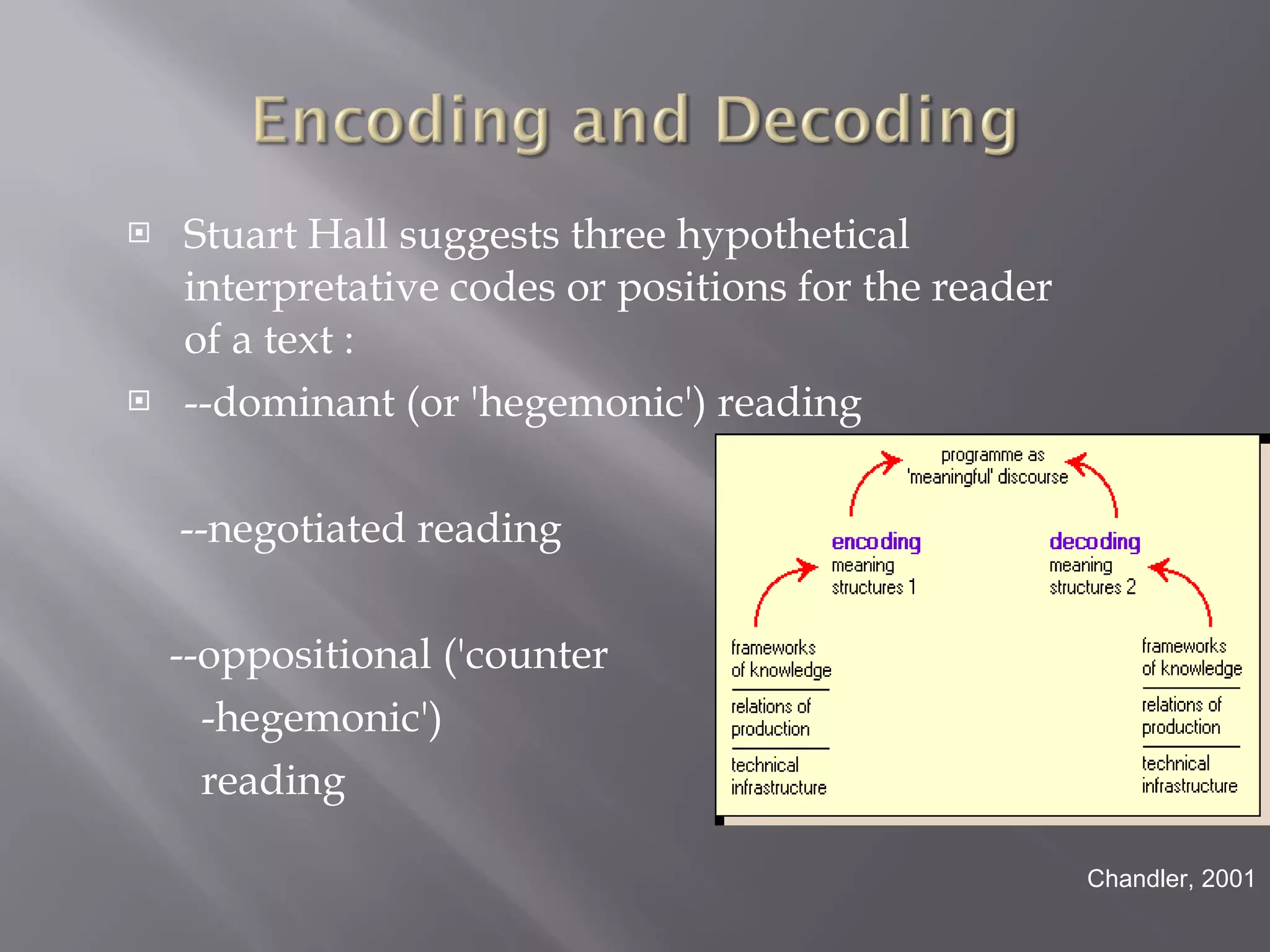
Stuart Hall suggests three hypothetical interpretative codes or positions for the reader of a text : --dominant (or 'hegemonic') reading --negotiated reading --oppositional ('counter -hegemonic')  reading Chandler, 2001
John Corner’s definition --the moment of encoding: 'the institutional practices and organizational conditions and practices of production' --the moment of the text: 'the... symbolic construction, arrangement and perhaps performance... The form and content of what is published or broadcast' --the moment of decoding: 'the moment of reception [or] consumption... by... the reader/hearer/viewer' which is regarded by most theorists as 'closer to a form of "construction"' than to 'the passivity... suggested by the term "reception"'. Chandler, 2001
Professor, Dept of Media and Communications,  Goldsmiths, University of London Field: Audiences, User research, Technical rationality Selected publications:  (2006)  The Geography of the New: Media, Modernity and Technology (2005)  Media and Cultural Theory (2000)  Home Territories: media, mobility and identity (2001)  British Cultural  (1996)  Stuart Hall: Critical Dialogues in Cultural Studies   (1996)  Spaces of Identity: global media, electronic landscapes and cultural boundaries   (1996)  Cultural Studies and Communication  (1992)  Television Audiences and Cultural Studies
David Morley’s study of the former television program  Nationwide  which was conducted at the  Centre for Contemporary Cultural Studies (CCCS)  at the University of Birmingham between 1975 and 1979.  In this study, Morley’s major concern was 'with the extent to which individual interpretation of programs could be shown to vary systematically in relation to... socio-cultural background' (1981b, p 56).  He was investigating 'the degree of complementarity between the codes of the program and the interpretive codes of various sociocultural groups... [and] the extent to which decodings take place within the limits of the preferred (or dominant) manner in which the message has been initially encoded' (1983, p. 106).  Although it has many limitations, Morley's study of The 'Nationwide' Audience (published in 1980) has become one of the most-widely cited studies of the television audience. Morley, 1981& Morley, 1983
Models of the “active audience” Questions of cultural power Global media and transnational audiences Methodologies in audience research Problems of essentialism in the conceptualization of categories of audience members The strengths and limitations of the encoding/decoding model Models of intellectual progress in the field The new media and technologies of “newness” Morley, 2006
Audiences offer resistance against existing meanings by creating their own meanings Media is a “cultural battlefield” of resistance, incorporation, hegemony, and oppression Van Bauwel, 2006
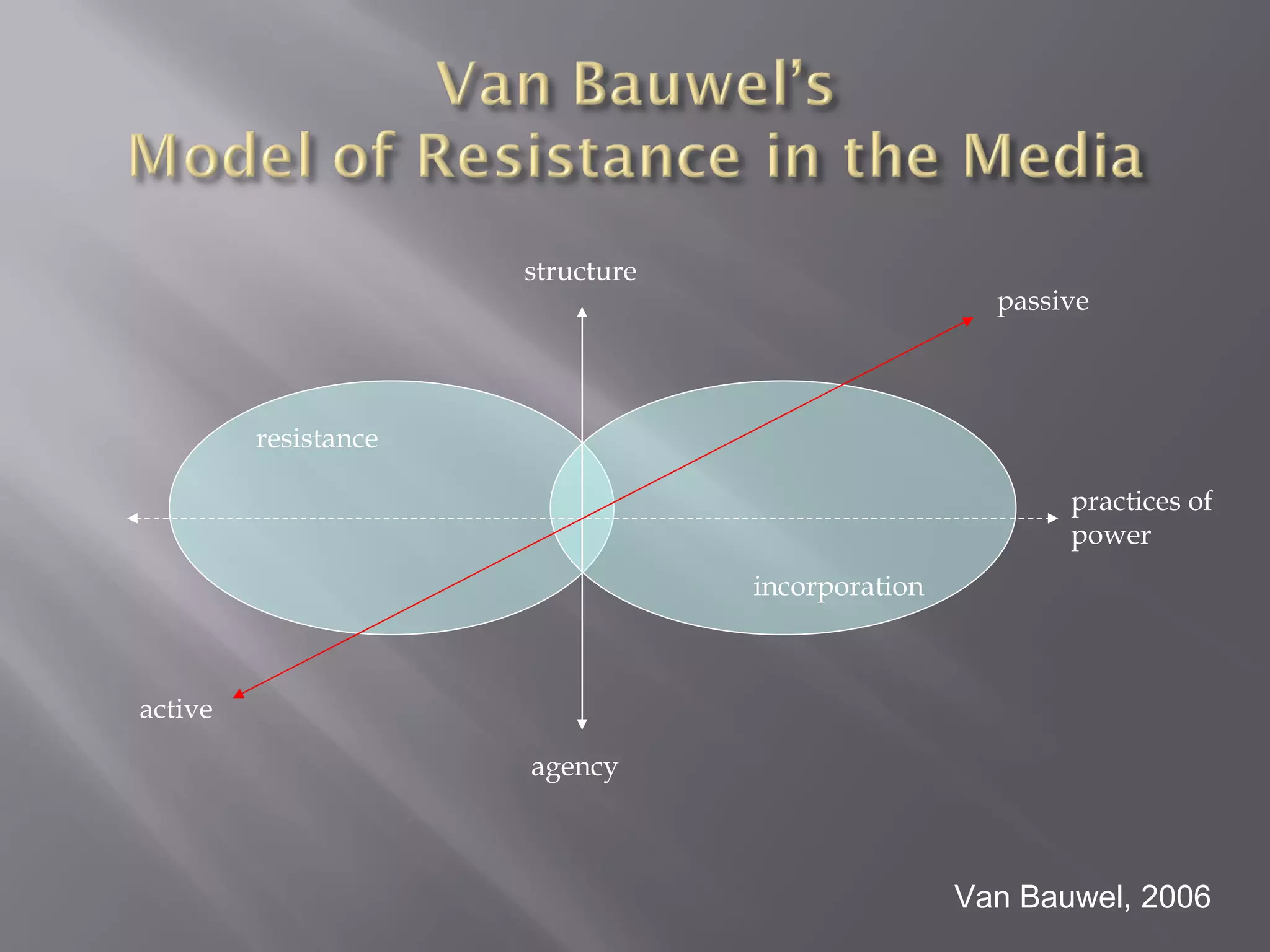
resistance incorporation structure agency practices of power passive active Van Bauwel, 2006
Concept of “resistance” influenced by Marxism Media producers and consumers should have co-equal role in interpreting texts Active audience theory has received harsh criticism, in part because it seems to suggest moral relativism If every meaning is up for negotiation, there are no absolute meanings – and no universal truths Can truth be “constructed”?
What determines audience members’ political opinions? According to John Zaller: “ Political sophistication” including political knowledge, interest, and intellectual engagement in politics Ideological or partisan leanings The greater one’s political sophistication, the more likely she/he is to comprehend and retain political news provided by the media,  and  to filter the news through predispositional attitudes, leading to specific opinions Zaller, 1992 Politics and Active Audience
Lodge et al. found that “political sophisticates” who were asked to evaluate complex political issues drew upon information stored in their memory – not just the information they were presented with. “ Political sophisticates” are those who scored highest on a test of factual political knowledge Lodge et al., 1989 Politics and Active Audience
According to Zaller, political sophisticates are also the most susceptible to biases Although people filter political news through their own “belief filter,” the media still helped shape those foundational orientations in the first place Zaller, 1992 Politics and Active Audience
The way the media frames stories can determine which opinion are expressed Non-verbal cues and genre are more effective in shaping attitudes and eliciting specific opinions than “reason” http://www.youtube.com/watch?v=XsP-YdOLAu4 http://www.youtube.com/watch?v=tMLoElp_s5c&feature=related Zaller, 1992
 
 
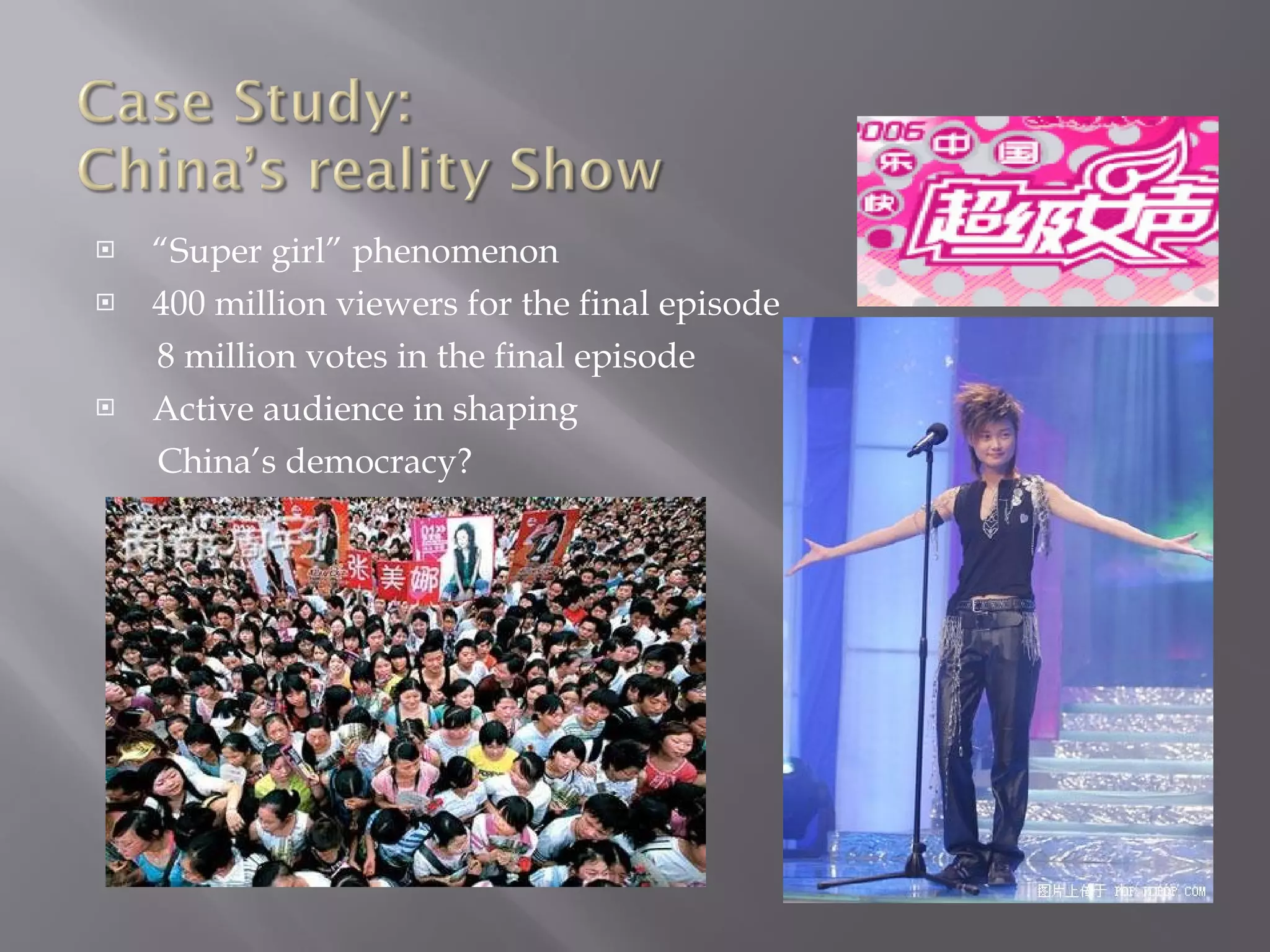
“ Super girl” phenomenon 400 million viewers for the final episode 8 million votes in the final episode Active audience in shaping  China’s democracy?
Media plays a crucial role in creating our belief foundations – do our opinions reflect the biases of the media? Even when we play the role of “active audience,” are we just reflecting something we picked up on in the media?
Some audiences are inactive – they attribute no meaning to what they see, resulting in meaningless media use May be difficult for audiences to fairly evaluate media messages when many of their core beliefs are already rooted in them
Some media texts very transparent – how many “meanings” can they really have? Concept of “active audience” may be very different – or nonexistent –  in other cultures If every media text is open to reinterpretation, slippery slope to moral relativism
Has the active audience approach overestimated the capacity of audiences to construct their own meanings? Can we equate an active audience with a resisting public?
Media plays a crucial role in creating our belief foundations – do our opinions reflect the biases of the media? Even when we play the role of “active audience,” are we just reflecting something we picked up on in the media?
Is active audience theory Anglo-centric? How do you think it might work (or not work) in different cultures?
If every media text is open to interpretation, what happens to the idea of “absolute truth”? Can “truth” be constructed by the audience?
Chandler, D. (2001).  Semiotics for Beginners . Retrieved Nov. 25, 2007 from  http://www.aber.ac.uk/media/Documents/S4B/sem08c.html Connor, G. (2001).  Audience . Retrieved Nov. 25, 2001 from http://www.mediaed.org.uk/posted_documents/Audience.html#The%20active%20audience Delli Carpini, M. (2004). Mediating democratic engagement: the impact of communications on citizens’ involvement in political civic life. In L. Kaid (Ed.),  Handbook of Political Communication Research.  Mahwah, New Jersey: Lawrence Erlbaum Associates, Publishers. Lodge, M., McGraw, K.M. & Stroh, P. (1989). An impression-driven model of candidate evaluation.  American Political Science Review ,  83 , 399-419. Morley, D. (1993). Active audience theory: pendulums and pitfalls.  Journal of Communication ,   43(4), Autumn. Morley, D . (1980).  The ‘nationwide’ audience . London: BFI. Morley, D. (1981b).  Interpreting television: In popular culture and everyday life . Milton Keynes: Open University Press.
Selmer, D. (2000).  The obstinate audience theory . Retrieved Nov. 25, 2007 from http://www.colostate.edu/Depts/Speech/rccs/theory18.htm Van Bauwel, S. (2006). Rearticulating resistance as concept in the field of media studies: a case study on the resistance against hegemonic gender identities in popular visual culture.  Conference Papers – International Communication Association . Zaller, J. (1992).  The nature and origins of mass opinion . New York: Cambridge University Press. Morley, D. (Eds).  (1983). “Culture transformations: The politics of Resistance’. In David, H., & Walton, P (Eds.),  Language, image, media . Oxford: Basil Blackwell. Morley, D. (2006). Unanswered questions in audience research.  The Communication Review , 9, 101-121.
Bauer, Raymond A. "The Obstinate Audience: The Influence Process from the Point of View of Social Communication."  The Process and Effects of Mass Communication.  Ed. Wilbur Schramm and Donald F. Roberts. Urbana: U of Illinois P, 1971. 326-346.  Bauer, Raymond A., Stephen A. Greyser, Donald L. Kanter, William M. Weilbacher and Alice E. Courtney.  Advertising in America.  Boston: Harvard, 1968. Bauer, Raymond A., ed. "Detection and Anticipation of Impact: The Nature of the Task"  Social Indicators.  By Raymond A. Bauer. Cambridge: The M.I.T. P, 1966. Bauer, Raymond A. "Risk Handling in Drug Adoption: The Role of Company Preference."  Public Opinion Quarterly  25 (1961): 546-559. Bauer, Raymond A. "The Initiative of the Audience."  Journal of Advertising Research  3 (1963): 2-7. Bauer R.A. and Claire Zimmerman. "The Effects of an Audience on What is Remembered."  Public Opinion Quarterly  20.1 (1956): 238-48. Bauer, Raymond A. "Communication as a Transaction: A Comment on 'On the Concept of Influence"  Public Opinion Quarterly  27.1 1963: 83-6. Bauer R.A. "Americans and Advertising: Thirty Years of Public Opinion."  Public Opinion Quarterly  30.1 (1966): 69-78. Bauer, Raymond A. "The Obstinate Audience"  American Psychologist  19 (1964): 319-328.  Bauer, Raymond A. and A. Bauer. "America, Mass Society and Mass Media."  Journal of Social Issues  10 (1960):3-66.

Active audience

  • 1.
  • 2.
    Sara Henneberger ShifenXu Curtis Franklin
  • 3.
  • 4.
    An introduction tothe Active Audience theory Background information on Active Audience The philosophical foundation of Active Audience Topics for further research Criticism of Active Audience Applications of Active Audience theory Questions and answers
  • 5.
    D ifferent audiencescan understand a media message but can have different responses to it. Some people believe and accept the message, others reject it using knowledge from their own experience or can use processes of logic or other rationales to criticize what is being said. Miller and Philo, 2001
  • 6.
    Effects Analysis—Hypodermic NeedleModel Developed in the 1920s The first theory to explain how mass audiences might react to mass media Information passes from media to audience unmediated The audience is passive
  • 7.
    Limited Effects Paradigm--Two-step Flow Theory Bring out by Paul Lazarsfeld, Bernard Berelson, and Hazel Gaudet during a 1940 presidential election campaign in The People's Choice Opinion leaders & Social factors
  • 8.
    Function Analysis --Uses& Gratifications Theory 1948, Lasswell suggests media texts have the functions of surveillance, correlation, entertainment and cultural transmission 1974, Blulmer and Katz expand the theory, state individuals choose and use a text for the purpose of diversion, personal relationships, personal identity and surveillance.
  • 9.
    Deconstructionism Jacques DerridaMichel Foucault Birmingham Center for Contemporary Cultural Studies Stuart Hall The Obstinate Audience Raymond A. Bauer
  • 10.
    Obstinate Audience Theory--Raymond A. Bauer “ one-way influence”  “transactional model” Bauer-Eberhart Study --Audience can filter out, distort or fail to recognize perceptual events which do not fit their points of view Zimmerman-Bauer Study --Audience plays a large part in influencing the message Advertising Study --People who like advertising found ads enjoyable while people who don’t like advertising found ads annoying and offensive
  • 11.
    Interpretative Analysis --ReceptionTheory (Active Audience Theory) 1980s & 1990s Stuart Hall’s encoding/decoding model of the relationship between text and audience Preferred reading
  • 12.
    1970s-1980s Stuart Hall:encoding/decoding model 1980s-1990s David Morley: ‘Nationwide’ Audience Dorothy Hobson: women viewers of soap opera Crossroads Tania Modleski &Janice Radway: women consumers of soap opera and romance Ien Ang, Tamar Liebes & Elihu Katz Kim Schroder & Jostein Gripsrud: international cross cultural consumption of American drama series, such as Dallas and Dynasty.
  • 13.
    British sociologist StuartHall proposed a model of mass communication which highlighted the importance of active interpretation within relevant codes. Stuart Hall stressed the role of social positioning in the interpretation of mass media texts by different social groups. Corner, 1983 & Hall, 1980
  • 14.
    Stuart Hall suggeststhree hypothetical interpretative codes or positions for the reader of a text : --dominant (or 'hegemonic') reading --negotiated reading --oppositional ('counter -hegemonic') reading Chandler, 2001
  • 15.
    John Corner’s definition--the moment of encoding: 'the institutional practices and organizational conditions and practices of production' --the moment of the text: 'the... symbolic construction, arrangement and perhaps performance... The form and content of what is published or broadcast' --the moment of decoding: 'the moment of reception [or] consumption... by... the reader/hearer/viewer' which is regarded by most theorists as 'closer to a form of "construction"' than to 'the passivity... suggested by the term "reception"'. Chandler, 2001
  • 16.
    Professor, Dept ofMedia and Communications, Goldsmiths, University of London Field: Audiences, User research, Technical rationality Selected publications: (2006) The Geography of the New: Media, Modernity and Technology (2005) Media and Cultural Theory (2000) Home Territories: media, mobility and identity (2001) British Cultural (1996) Stuart Hall: Critical Dialogues in Cultural Studies (1996) Spaces of Identity: global media, electronic landscapes and cultural boundaries (1996) Cultural Studies and Communication (1992) Television Audiences and Cultural Studies
  • 17.
    David Morley’s studyof the former television program Nationwide which was conducted at the Centre for Contemporary Cultural Studies (CCCS) at the University of Birmingham between 1975 and 1979. In this study, Morley’s major concern was 'with the extent to which individual interpretation of programs could be shown to vary systematically in relation to... socio-cultural background' (1981b, p 56). He was investigating 'the degree of complementarity between the codes of the program and the interpretive codes of various sociocultural groups... [and] the extent to which decodings take place within the limits of the preferred (or dominant) manner in which the message has been initially encoded' (1983, p. 106). Although it has many limitations, Morley's study of The 'Nationwide' Audience (published in 1980) has become one of the most-widely cited studies of the television audience. Morley, 1981& Morley, 1983
  • 18.
    Models of the“active audience” Questions of cultural power Global media and transnational audiences Methodologies in audience research Problems of essentialism in the conceptualization of categories of audience members The strengths and limitations of the encoding/decoding model Models of intellectual progress in the field The new media and technologies of “newness” Morley, 2006
  • 19.
    Audiences offer resistanceagainst existing meanings by creating their own meanings Media is a “cultural battlefield” of resistance, incorporation, hegemony, and oppression Van Bauwel, 2006
  • 20.
    resistance incorporation structureagency practices of power passive active Van Bauwel, 2006
  • 21.
    Concept of “resistance”influenced by Marxism Media producers and consumers should have co-equal role in interpreting texts Active audience theory has received harsh criticism, in part because it seems to suggest moral relativism If every meaning is up for negotiation, there are no absolute meanings – and no universal truths Can truth be “constructed”?
  • 22.
    What determines audiencemembers’ political opinions? According to John Zaller: “ Political sophistication” including political knowledge, interest, and intellectual engagement in politics Ideological or partisan leanings The greater one’s political sophistication, the more likely she/he is to comprehend and retain political news provided by the media, and to filter the news through predispositional attitudes, leading to specific opinions Zaller, 1992 Politics and Active Audience
  • 23.
    Lodge et al.found that “political sophisticates” who were asked to evaluate complex political issues drew upon information stored in their memory – not just the information they were presented with. “ Political sophisticates” are those who scored highest on a test of factual political knowledge Lodge et al., 1989 Politics and Active Audience
  • 24.
    According to Zaller,political sophisticates are also the most susceptible to biases Although people filter political news through their own “belief filter,” the media still helped shape those foundational orientations in the first place Zaller, 1992 Politics and Active Audience
  • 25.
    The way themedia frames stories can determine which opinion are expressed Non-verbal cues and genre are more effective in shaping attitudes and eliciting specific opinions than “reason” http://www.youtube.com/watch?v=XsP-YdOLAu4 http://www.youtube.com/watch?v=tMLoElp_s5c&feature=related Zaller, 1992
  • 26.
  • 27.
  • 28.
    “ Super girl”phenomenon 400 million viewers for the final episode 8 million votes in the final episode Active audience in shaping China’s democracy?
  • 29.
    Media plays acrucial role in creating our belief foundations – do our opinions reflect the biases of the media? Even when we play the role of “active audience,” are we just reflecting something we picked up on in the media?
  • 30.
    Some audiences areinactive – they attribute no meaning to what they see, resulting in meaningless media use May be difficult for audiences to fairly evaluate media messages when many of their core beliefs are already rooted in them
  • 31.
    Some media textsvery transparent – how many “meanings” can they really have? Concept of “active audience” may be very different – or nonexistent – in other cultures If every media text is open to reinterpretation, slippery slope to moral relativism
  • 32.
    Has the activeaudience approach overestimated the capacity of audiences to construct their own meanings? Can we equate an active audience with a resisting public?
  • 33.
    Media plays acrucial role in creating our belief foundations – do our opinions reflect the biases of the media? Even when we play the role of “active audience,” are we just reflecting something we picked up on in the media?
  • 34.
    Is active audiencetheory Anglo-centric? How do you think it might work (or not work) in different cultures?
  • 35.
    If every mediatext is open to interpretation, what happens to the idea of “absolute truth”? Can “truth” be constructed by the audience?
  • 36.
    Chandler, D. (2001). Semiotics for Beginners . Retrieved Nov. 25, 2007 from http://www.aber.ac.uk/media/Documents/S4B/sem08c.html Connor, G. (2001). Audience . Retrieved Nov. 25, 2001 from http://www.mediaed.org.uk/posted_documents/Audience.html#The%20active%20audience Delli Carpini, M. (2004). Mediating democratic engagement: the impact of communications on citizens’ involvement in political civic life. In L. Kaid (Ed.), Handbook of Political Communication Research. Mahwah, New Jersey: Lawrence Erlbaum Associates, Publishers. Lodge, M., McGraw, K.M. & Stroh, P. (1989). An impression-driven model of candidate evaluation. American Political Science Review , 83 , 399-419. Morley, D. (1993). Active audience theory: pendulums and pitfalls. Journal of Communication , 43(4), Autumn. Morley, D . (1980). The ‘nationwide’ audience . London: BFI. Morley, D. (1981b). Interpreting television: In popular culture and everyday life . Milton Keynes: Open University Press.
  • 37.
    Selmer, D. (2000). The obstinate audience theory . Retrieved Nov. 25, 2007 from http://www.colostate.edu/Depts/Speech/rccs/theory18.htm Van Bauwel, S. (2006). Rearticulating resistance as concept in the field of media studies: a case study on the resistance against hegemonic gender identities in popular visual culture. Conference Papers – International Communication Association . Zaller, J. (1992). The nature and origins of mass opinion . New York: Cambridge University Press. Morley, D. (Eds). (1983). “Culture transformations: The politics of Resistance’. In David, H., & Walton, P (Eds.), Language, image, media . Oxford: Basil Blackwell. Morley, D. (2006). Unanswered questions in audience research. The Communication Review , 9, 101-121.
  • 38.
    Bauer, Raymond A."The Obstinate Audience: The Influence Process from the Point of View of Social Communication." The Process and Effects of Mass Communication. Ed. Wilbur Schramm and Donald F. Roberts. Urbana: U of Illinois P, 1971. 326-346. Bauer, Raymond A., Stephen A. Greyser, Donald L. Kanter, William M. Weilbacher and Alice E. Courtney. Advertising in America. Boston: Harvard, 1968. Bauer, Raymond A., ed. "Detection and Anticipation of Impact: The Nature of the Task" Social Indicators. By Raymond A. Bauer. Cambridge: The M.I.T. P, 1966. Bauer, Raymond A. "Risk Handling in Drug Adoption: The Role of Company Preference." Public Opinion Quarterly 25 (1961): 546-559. Bauer, Raymond A. "The Initiative of the Audience." Journal of Advertising Research 3 (1963): 2-7. Bauer R.A. and Claire Zimmerman. "The Effects of an Audience on What is Remembered." Public Opinion Quarterly 20.1 (1956): 238-48. Bauer, Raymond A. "Communication as a Transaction: A Comment on 'On the Concept of Influence" Public Opinion Quarterly 27.1 1963: 83-6. Bauer R.A. "Americans and Advertising: Thirty Years of Public Opinion." Public Opinion Quarterly 30.1 (1966): 69-78. Bauer, Raymond A. "The Obstinate Audience" American Psychologist 19 (1964): 319-328. Bauer, Raymond A. and A. Bauer. "America, Mass Society and Mass Media." Journal of Social Issues 10 (1960):3-66.

Editor's Notes

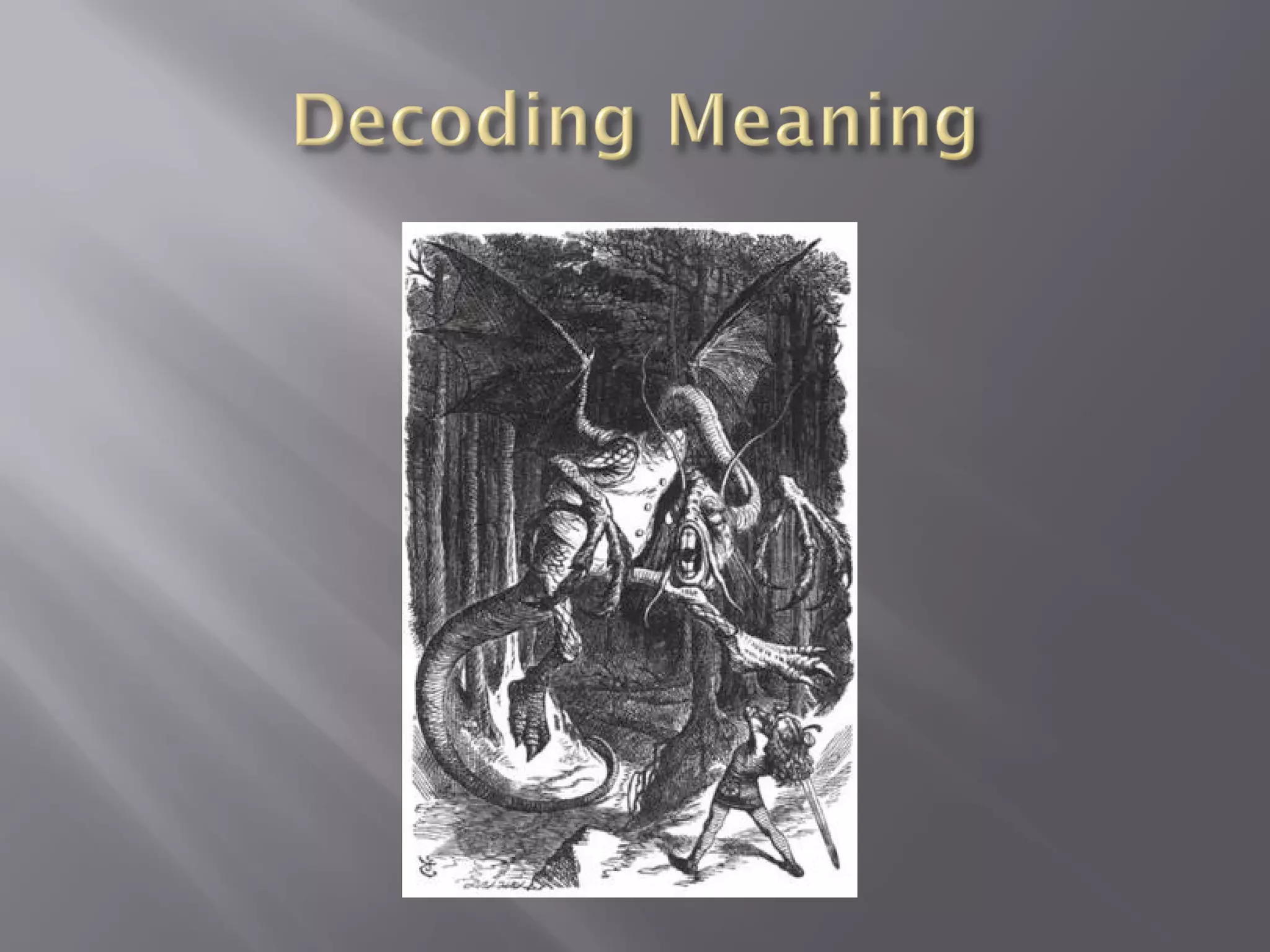
  • #4 `Twas brillig, and the slithy toves   Did gyre and gimble in the wabe: All mimsy were the borogoves,   And the mome raths outgrabe. "Beware the Jabberwock, my son!   The jaws that bite, the claws that catch! Beware the Jubjub bird, and shun   The frumious Bandersnatch!" He took his vorpal sword in hand:   Long time the manxome foe he sought -- So rested he by the Tumtum tree,   And stood awhile in thought. And, as in uffish thought he stood,   The Jabberwock, with eyes of flame, Came whiffling through the tulgey wood,   And burbled as it came! One, two! One, two! And through and through   The vorpal blade went snicker-snack! He left it dead, and with its head   He went galumphing back. "And, has thou slain the Jabberwock?   Come to my arms, my beamish boy! O frabjous day! Callooh! Callay!'   He chortled in his joy. `Twas brillig, and the slithy toves   Did gyre and gimble in the wabe; All mimsy were the borogoves,   And the mome raths outgrabe. from Through the Looking-Glass and What Alice Found There , 1872 Lewis Carrol
  • #10 Derrida, in deconstructionism, posited that readers of a text constructed their own meaning for the text and, with the writer of the text, created a unique reality around that meaning. This theory gives the reader a power at least as great as that of the writer in establishing the meaning of the text, and assumes that each reader will create their own unique meaning. Foucault, in moving toward structuralism, built an argument that truth and meaning depend on the content and structure of the historical discourse – that the practical method of putting forth a statement has an essential bearing on the contents (especially the truth of the contents) of the message. Cultural studies
  • #20 Sophie Van Bauwel
  • #21 Resistance: a reaction against the dominant political, economic, and/or social order Incorporation: the adoption of something that goes against the dominant order Agency: activity Structure: No activity Practices of power: the real-life practice of resistance
  • #22 Notion of the masses “rising up” and resisting
  • #23 Active audience theory has been of particular interest to those in the field of political communications. What exactly determines audiences’ political opinions?
  • #24 Milton Lodge
  • #26 First is a clip from the New Hour with Jim Lehrer. It’s an interview with Democratic candidate Mike Gravel. The News Hour with Jim Lehrer gets about 5% of the evening news audience – even less among young people. The second clip is from the Daily Show with Jon Stewart, interviewing John McCain. According to the Pew Research Center poll: During the 2004 presidential campaign, 21% of people ages 18-29 said that the Daily Show was where they regularly turned for campaign news. In the 2000 campaign, only 9% of young people pointed to comedy shows as their source of campaign news. Second clip: start at :27 or 2:23
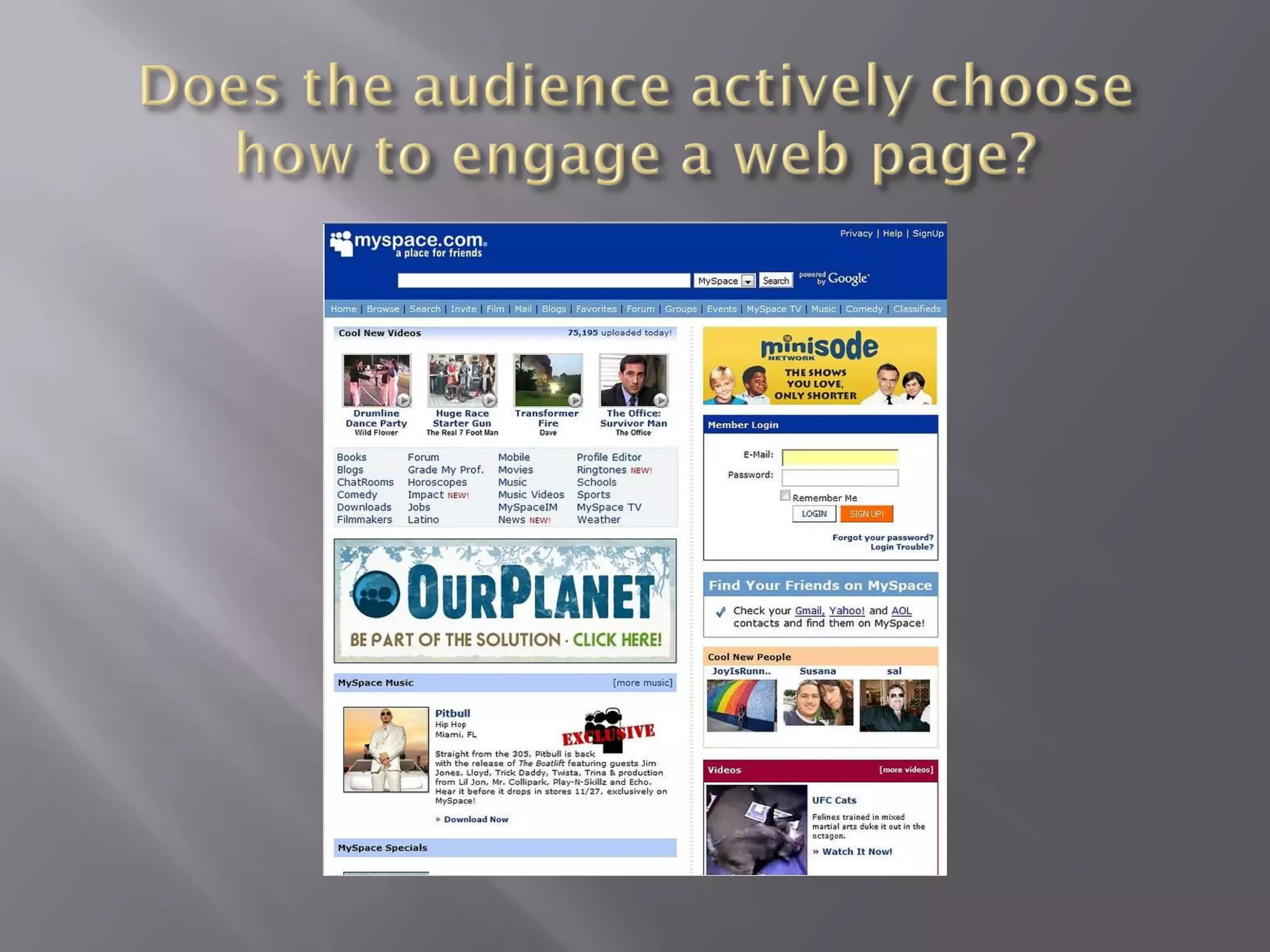
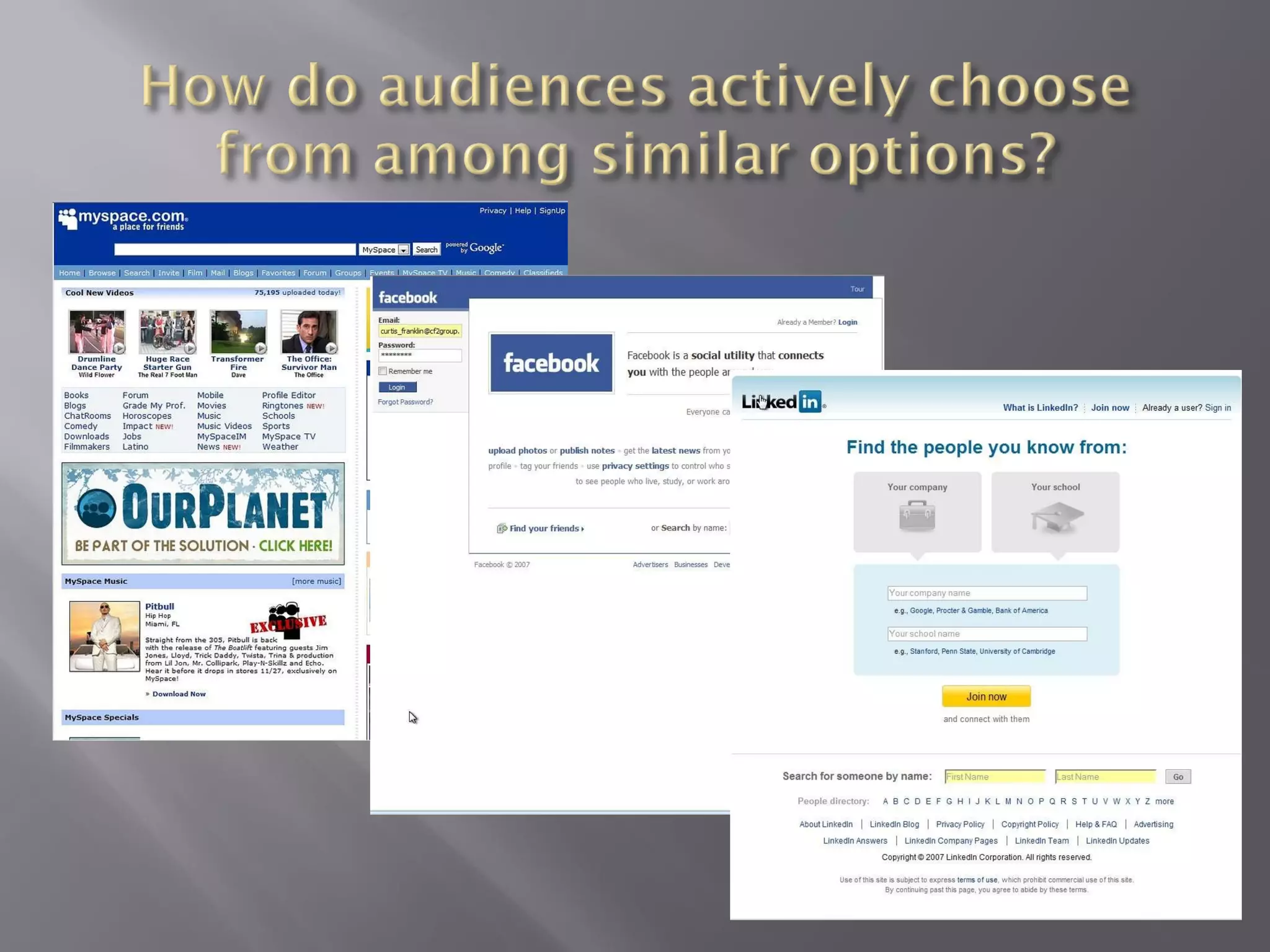
  • #27 This web page, an example of a “portal”, has a large number of options for the reader to consider as they choose how to engage the page. The response of each individual will depend on their information needs, their prior experience with the page, and their expectation of positive results from the engagement with the page (among other factors).
  • #28 The structure and appearance of each page is designed to appeal to members of the target audience for the page…whether that audience is young individuals, college students and those just out of college, or established working professionals. The colors, typefaces, and layout of each page is unique among its peers, and intended to establish a positive expectation of results among first-time visitors.
  • #30 In other words, how “free” are we in our opinions?
  • #33 Many TV texts are not fully open, and there is a preferred reading, and a limit to what audiences can do with a text.
  • #34 In other words, how “free” are we in our opinions?