Consumer Learning
Importance of Learning
• Marketers must teach consumers:
– where to buy
– how to use
– how to maintain
– how to dispose of products
ConsumerConsumer
LearningLearning
A process by which
individuals acquire the
purchase and
consumption
knowledge
and experience
that they apply to
future related behavior.
Learning Processes
• Intentional:
learning acquired
as a result of a
careful search for
information
• Incidental:
learning acquired
by accident or
without much effort
Learning Theories
• Behavioral Theories:
Theories based on the
premise that learning
takes place as the
result of observable
responses to external
stimuli. Also known
as Stimulus Response
Theory.
• Cognitive Theories:
A theory of learning
based on mental
information
processing, often in
response to problem
solving.
Behavioral Learning Theories
• Classical Conditioning
• Instrumental Conditioning
• Modeling or Observational Learning
ClassicalClassical
ConditioningConditioning
A behavioral
learning theory
according to which a
stimulus is paired
with another stimulus
that elicits a known
response that serves
to produce the same
response when used
alone.
Pavlovian Model of Classical
Conditioning
Unconditioned Stimulus
Meat paste
Conditioned Stimulus
Bell
Unconditioned Response
Salivation
Conditioned Stimulus
Bell
Conditioned Response
Salivation
AFTER REPEATED PAIRINGS
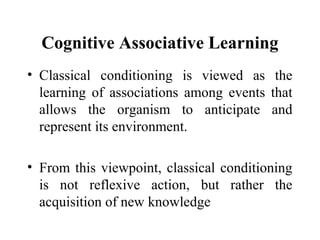
Cognitive Associative Learning
• Classical conditioning is viewed as the
learning of associations among events that
allows the organism to anticipate and
represent its environment.
• From this viewpoint, classical conditioning
is not reflexive action, but rather the
acquisition of new knowledge
Strategic Applications of Classical
Conditioning
• Repetition
• Stimulus Generalization
• Stimulus Discrimination
Repetition
• Repetition
increases strength
of associations and
slows forgetting but
over time may
result in advertising
wear out.
Stimulus Generalization
• Learning is also depends upon the ability of
individuals to generalize
• Making the same response to slightly
different stimuli is called stimulus
generalization
StimulusStimulus
DiscriminationDiscrimination
The ability to select
a specific stimulus
from among similar
stimuli because of
perceived
differences.
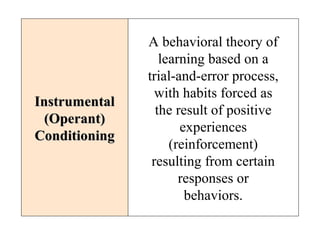
InstrumentalInstrumental
(Operant)(Operant)
ConditioningConditioning
A behavioral theory of
learning based on a
trial-and-error process,
with habits forced as
the result of positive
experiences
(reinforcement)
resulting from certain
responses or
behaviors.
A Model of Instrumental Conditioning
Stimulus
Situation
(Need good-
looking jeans)
Try
Brand D
Try
Brand C
Try
Brand B
Try
Brand A
Unrewarded
Legs too tight
Unrewarded
Tight in seat
Unrewarded
Baggy in seat
Reward
Perfect fit
Repeat Behavior
Instrumental Conditioning
• Consumers learn by means of trial and error
process in which some purchase behaviors
result in more favorable outcomes (rewards)
than other purchase behaviors.
• A favorable experience is instrumental in
teaching the individual to repeat a specific
behavior.
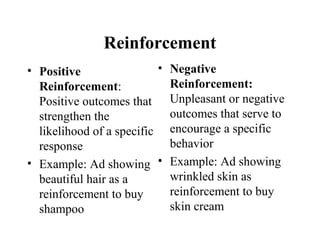
Reinforcement
• Positive
Reinforcement:
Positive outcomes that
strengthen the
likelihood of a specific
response
• Example: Ad showing
beautiful hair as a
reinforcement to buy
shampoo
• Negative
Reinforcement:
Unpleasant or negative
outcomes that serve to
encourage a specific
behavior
• Example: Ad showing
wrinkled skin as
reinforcement to buy
skin cream
Other Concepts in Reinforcement
• Punishment
– Choose reinforcement rather than punishment
• Extinction
– Combat with consumer satisfaction
• Forgetting
– Combat with repetition
ObservationalObservational
LearningLearning
A process by which
individuals observe
the behavior of
others, and
consequences of
such behavior. Also
known as modeling
or vicarious
learning.
CognitiveCognitive
LearningLearning
TheoryTheory
Holds that the kind
of learning most
characteristic of
human beings is
problem solving,
which enables
individuals to gain
some control over
their environment.
Involvement
Theory
A theory of consumer
learning which
postulates that
consumers engage in a
range of information
processing activity
from extensive to
limited problem
solving, depending on
the relevance of the
purchase.
7-22
`
HOPE YOU
“LEARN”

Consumer Learning