Consumer Learning
By: Shivika Malhotra & Jagdeep Singh
Learning Objectives
1. To understand the elements of learning in the context of
consumer behavior.
2. To understand behavioral learning, classical conditioning, and
the roles of stimulus generalization and discrimination in
developing and branding new products.
3. To understand instrumental conditioning and the objectives and
methods of reinforcement.
4. To understand the role of observational learning in consumer
behavior.
5. To understand the elements of information processing,
including receiving, storing, and retrieving consumption-related
information.
6. To understand cognitive learning as a framework for consumer
decision-making.
7. To understand consumer involvement and passive learning, and
their impact on purchase decisions and the retention and recall of
promotional communications.
8. To understand how to measure the results of consumer
Let us understand the concept
For consumers who are familiar with SNICKERS®, seeing the ad is
followed by thoughts of a rich, very tasty, and satisfying chocolate
bar and the pleasure associated with eating it. Like any successful
company, Mars, the company that makes SNICKERS®, is always
looking to expand its product line and target new markets, and
introduced a new Mars product—SNICKERS® Peanut Butter
Squared. The ads are aimed at peanut butter enthusiasts and carry
the same message: If you like peanut butter and chocolate, you’ll
love SNICKERS® and peanut butter. Peanut butter packages, such
as cups and jars, are round, just like small wheels. The reference to
“training wheels” subtly tells peanut butter lovers to “move on” and
try SNICKERS® Peanut Butter, which, unlike round peanut butter
cups, come in individually wrapped squares. Mars cleverly named
the new product “peanut butter squared,” which tells consumers
that peanut butter does not have to be round and can come in
squares.
Definition
Learning is the process by which individuals acquire the purchase and
consumption knowledge and experience they apply to future, related
behavior. Consumer learning is a process that evolves and changes as
consumers acquire knowledge from experience, observation, and
interactions with others and newly acquired knowledge affects future
behavior.
It ranges from simple and often reflexive responses to marketing stimuli
(such as packaging, product colors, and promotional messages), to
learning abstract concepts and making decisions about purchasing
complex and expensive products.
Learning consists of four elements: motives, cues, responses, and
reinforcement.
The Elements Of Consumer Learning
Motives: Uncovering consumer motives is the primary objective of
marketers, who seek to teach consumers how they can fill their needs
by buying certain products and brands. Unfilled needs lead to
motivation, which spurs learning. The degree of relevance, or
“involvement,” determines the consumer’s level of motivation to
search for information about a product or service and, potentially,
engage in learning.
Cues : Cues are stimuli that direct motivated behavior. An
advertisement for an exotic trip that includes bike riding may serve
as a cue for bike riders, who may suddenly “recognize” that they
“need” a vacation. The ad is the cue (or stimulus) that suggests a
specific way to satisfy a salient motive. In marketing, price, styling,
packaging, advertising, and store displays are cues designed to
persuade consumers to fulfill their needs by buying specific
products.
 Responses : In the context of learning, response is an
individual’s reaction to a drive or cue. Learning can occur
even when responses are not overt. The automobile
manufacturer that provides consistent cues to a
may not always succeed in stimulating a purchase.
However, if the manufacturer succeeds in forming a
favorable image of a particular automobile model in the
consumer’s mind, it is likely that the consumer will
consider that make or model when he or she is ready to
buy a car. A response is not tied to a need in a one-to-
one fashion. Indeed, a need or motive may evoke a
variety of responses.
 Reinforcement: Reinforcement is the reward—the pleasure, enjoyment,
and benefits—that the consumer receives after buying and using a
product or service. For the marketer, the challenge is to continue to
provide consumers with an ongoing positive product or service, thus
reinforcing future purchases.
Lets talk about a case of PROCTER & GAMBLE’s case
BEHAVIORAL LEARNING
CLASSICAL
CONDITIONING
INSTRUMENTAL
CONDITIONING
OBSERVATIONAL
LEARNING
CLASSICAL CONDITIONING
A form of behavioural learning stating that animal and
human alike,can be taught behaviors and associations
among stimuli through repetition. Some describe it as
a “knee jerk”(or automatic) response to a drive that
builds up through repeated exposure to a stimulus.
Ivan Pavlov, a Russian physiologist, developed the
concept of classical conditioning. Pavlov maintained
that conditioned learning results when a stimulus that
is paired with another stimulus that elicits a known
response produces the same response when used
alone.
Models of Classical Conditioning
Analogous Model of Classical
Conditioning
Strategic Applications of Classical
Conditioning
Increases the association
between the conditioned and
unconditioned stimulus
Slows the pace of
forgetting
Although some overlearning
aids retention, at some point
an individual can become
satiated with numerous
exposures, and both attention
and retention will decline.
Basic Concepts
Repetition
Stimulus
generalization
Stimulus
discrimination
Strategic Applications of Classical
Conditioning
Having the same
response to slightly
different stimuli
Useful in product
extensions
Basic Concepts
Repetition
Stimulus
generalization
Stimulus
discrimination
Strategic Applications of Classical
Conditioning
Selection of a specific
stimulus from among
similar stimuli
This discrimination is
the basis of positioning
which looks for unique
ways to fill needs
Basic Concepts
Repetition
Stimulus
generalization
Stimulus
discrimination
Instrumental Conditioning
Instrumental conditioning (or operant conditioning) is based on the
notion that learning occurs through a trial-and-error process, with
habits formed as a result of rewards received for certain responses or
behaviors.
Reinforcing behavior
Positive
Reinforcement
Negative
Reinforcement
Extinction & Forgetting
Customer satisfaction and retention
Shaping
Retailers offer popular products at severely
discounted prices to the first hundred or so customers to
arrive, because those customers are likely to buy more
products at the store rather than only the discounted
items.
Loss leaders
Massed v/s Distributed learning
Research shows that distributed practice has far more impact
on your consumer than massed practice. On average, retailers
who have undertaken distributed practice achieved
15% higher than who had only completed massed practice
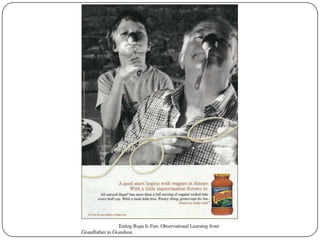
Observational Learning
Observational learning (or modeling) is the process through which
individuals learn behavior by observing the behavior of others and the
consequences of such behavior. For this type of learning to occur,
reinforcement must take place.
Advertisers recognize the importance of observational learning in
selecting the models they feature in advertisements, whether
celebrities or unknowns
Consumers imitate the behavior of those they see rewarded,
expecting to be rewarded similarly if they adopt the same behavior
Information Processing
Information processing is related to both the consumer’s cognitive
ability and the complexity of the information to be processed.
Consumers process product information by attributes, brands,
comparisons between brands, or a combination of these factors.
Consumers with higher cognitive ability apparently acquire more
product information and are more capable of integrating
information on several product attributes than consumers with
lesser ability.
Information Processing and
Memory Stores
Information Rehearsal and
Encoding
Facebook launched a short film
underscoring the power of
connections, and its brand belief
that people can do ‘More
Together’ than alone.
The creative concept
introduces 'duality' to
highlight the
contrasting flavors of
sweet and salty in one
biscuit.
Consumer Involvement and Hemispheric
Lateralization
Consumer involvement is the degree of personal
relevance that the product or purchase holds for the
consumer
High-involvement purchases are very important to the
consumer (e.g., in terms of perceived risk) and thus
provoke extensive problem solving and information
processing.
Low-involvement purchases are not very important, hold
little relevance, have little perceived risk, and provoke
limited information processing
Hemispheric Lateralization
Hemispheric lateralization (split-brain theory) stems from medical
research done in the 1960s; its premise is that the human brain is
divided into two distinct cerebral hemispheres that operate together,
but “specialize” in processing different types of cognitions.
Strong visuals in TV commercials and in-store displays
generate familiarity with the brand and induce purchase behavior.
Pictorial cues are more effective at generating recall and familiarity
with the product, whereas verbal cues (which trigger left-brain
processing) generate cognitive activity that encourages consumers to
evaluate the advantages and disadvantages of the product.
More Room
throughout
Coach, only on
AmericanAirlines
Outcomes and Measures of
Consumer Learning
Recognition and Recall Measures:
Recognition tests are based on aided recall, whereas recall
tests use unaided recall.
In a recognition test, the consumer is shown an ad and
asked whether he or she remembers seeing it and can
remember any of its salient points.
In a recall test, the consumer is asked whether he or she
has read a specific magazine or watched a specific
television show, and, if so, whether he or she can recall
any ads or commercials seen, the product and brand
advertised, and any notable points about the offerings
promoted.
Brand Loyalty
Marketers agree that brand loyalty has two
components—behaviors and attitudes—and that both
must be measured. Attitudinal measures gauge
consumers’ overall feelings about the brand, including
future purchase intentions. Behavioral measures focus on
observable, factual behaviors, such as the quantity
purchased, purchase frequency, and repeated buying.
There are three types of brand loyalty:
1. Covetous brand loyalty includes no consistent
purchase of a given brand, in spite of strong
attachment to it.
2. Inertia brand loyalty is purchasing the brand
because of habit and convenience, but without any
emotional attachment to it.
3. Premium brand loyalty means high attachment to
the brand and repeat purchase
Brand Equity
The term brand equity represents the intrinsic value of a brand name.
This value stems from the foundations of brand loyalty: The
consumer’s perception of the brand’s superiority, the social esteem
that using it provides, and the customer’s trust and identification with
the brand.
Summary
Learning is the process by which individuals acquire the purchase and
consumption knowledge and experience they apply to future, related
behavior. Consumer learning is a process that evolves and changes as
consumers acquire knowledge from experience, observation, and
interactions with others and newly acquired knowledge affects future
behavior. It ranges from simple and often reflexive responses to
marketing stimuli (such as packaging, product colors, and
promotional messages), to learning abstract concepts and making
decisions about purchasing complex and expensive products. The
elements of learning are motives (drives), cues, responses, and
reinforcement.
Thank you !

Consumer learning

  • 1.
    Consumer Learning By: ShivikaMalhotra & Jagdeep Singh
  • 2.
    Learning Objectives 1. Tounderstand the elements of learning in the context of consumer behavior. 2. To understand behavioral learning, classical conditioning, and the roles of stimulus generalization and discrimination in developing and branding new products. 3. To understand instrumental conditioning and the objectives and methods of reinforcement. 4. To understand the role of observational learning in consumer behavior. 5. To understand the elements of information processing, including receiving, storing, and retrieving consumption-related information. 6. To understand cognitive learning as a framework for consumer decision-making. 7. To understand consumer involvement and passive learning, and their impact on purchase decisions and the retention and recall of promotional communications. 8. To understand how to measure the results of consumer
  • 3.
    Let us understandthe concept
  • 4.
    For consumers whoare familiar with SNICKERS®, seeing the ad is followed by thoughts of a rich, very tasty, and satisfying chocolate bar and the pleasure associated with eating it. Like any successful company, Mars, the company that makes SNICKERS®, is always looking to expand its product line and target new markets, and introduced a new Mars product—SNICKERS® Peanut Butter Squared. The ads are aimed at peanut butter enthusiasts and carry the same message: If you like peanut butter and chocolate, you’ll love SNICKERS® and peanut butter. Peanut butter packages, such as cups and jars, are round, just like small wheels. The reference to “training wheels” subtly tells peanut butter lovers to “move on” and try SNICKERS® Peanut Butter, which, unlike round peanut butter cups, come in individually wrapped squares. Mars cleverly named the new product “peanut butter squared,” which tells consumers that peanut butter does not have to be round and can come in squares.
  • 5.
    Definition Learning is theprocess by which individuals acquire the purchase and consumption knowledge and experience they apply to future, related behavior. Consumer learning is a process that evolves and changes as consumers acquire knowledge from experience, observation, and interactions with others and newly acquired knowledge affects future behavior. It ranges from simple and often reflexive responses to marketing stimuli (such as packaging, product colors, and promotional messages), to learning abstract concepts and making decisions about purchasing complex and expensive products. Learning consists of four elements: motives, cues, responses, and reinforcement.
  • 6.
    The Elements OfConsumer Learning Motives: Uncovering consumer motives is the primary objective of marketers, who seek to teach consumers how they can fill their needs by buying certain products and brands. Unfilled needs lead to motivation, which spurs learning. The degree of relevance, or “involvement,” determines the consumer’s level of motivation to search for information about a product or service and, potentially, engage in learning.
  • 7.
    Cues : Cuesare stimuli that direct motivated behavior. An advertisement for an exotic trip that includes bike riding may serve as a cue for bike riders, who may suddenly “recognize” that they “need” a vacation. The ad is the cue (or stimulus) that suggests a specific way to satisfy a salient motive. In marketing, price, styling, packaging, advertising, and store displays are cues designed to persuade consumers to fulfill their needs by buying specific products.
  • 8.
     Responses :In the context of learning, response is an individual’s reaction to a drive or cue. Learning can occur even when responses are not overt. The automobile manufacturer that provides consistent cues to a may not always succeed in stimulating a purchase. However, if the manufacturer succeeds in forming a favorable image of a particular automobile model in the consumer’s mind, it is likely that the consumer will consider that make or model when he or she is ready to buy a car. A response is not tied to a need in a one-to- one fashion. Indeed, a need or motive may evoke a variety of responses.
  • 9.
     Reinforcement: Reinforcementis the reward—the pleasure, enjoyment, and benefits—that the consumer receives after buying and using a product or service. For the marketer, the challenge is to continue to provide consumers with an ongoing positive product or service, thus reinforcing future purchases. Lets talk about a case of PROCTER & GAMBLE’s case
  • 11.
  • 12.
    CLASSICAL CONDITIONING A formof behavioural learning stating that animal and human alike,can be taught behaviors and associations among stimuli through repetition. Some describe it as a “knee jerk”(or automatic) response to a drive that builds up through repeated exposure to a stimulus. Ivan Pavlov, a Russian physiologist, developed the concept of classical conditioning. Pavlov maintained that conditioned learning results when a stimulus that is paired with another stimulus that elicits a known response produces the same response when used alone.
  • 14.
    Models of ClassicalConditioning
  • 15.
    Analogous Model ofClassical Conditioning
  • 16.
    Strategic Applications ofClassical Conditioning Increases the association between the conditioned and unconditioned stimulus Slows the pace of forgetting Although some overlearning aids retention, at some point an individual can become satiated with numerous exposures, and both attention and retention will decline. Basic Concepts Repetition Stimulus generalization Stimulus discrimination
  • 18.
    Strategic Applications ofClassical Conditioning Having the same response to slightly different stimuli Useful in product extensions Basic Concepts Repetition Stimulus generalization Stimulus discrimination
  • 20.
    Strategic Applications ofClassical Conditioning Selection of a specific stimulus from among similar stimuli This discrimination is the basis of positioning which looks for unique ways to fill needs Basic Concepts Repetition Stimulus generalization Stimulus discrimination
  • 22.
    Instrumental Conditioning Instrumental conditioning(or operant conditioning) is based on the notion that learning occurs through a trial-and-error process, with habits formed as a result of rewards received for certain responses or behaviors.
  • 24.
  • 25.
  • 26.
  • 27.
    Shaping Retailers offer popularproducts at severely discounted prices to the first hundred or so customers to arrive, because those customers are likely to buy more products at the store rather than only the discounted items. Loss leaders
  • 28.
    Massed v/s Distributedlearning Research shows that distributed practice has far more impact on your consumer than massed practice. On average, retailers who have undertaken distributed practice achieved 15% higher than who had only completed massed practice
  • 29.
    Observational Learning Observational learning(or modeling) is the process through which individuals learn behavior by observing the behavior of others and the consequences of such behavior. For this type of learning to occur, reinforcement must take place. Advertisers recognize the importance of observational learning in selecting the models they feature in advertisements, whether celebrities or unknowns Consumers imitate the behavior of those they see rewarded, expecting to be rewarded similarly if they adopt the same behavior
  • 31.
    Information Processing Information processingis related to both the consumer’s cognitive ability and the complexity of the information to be processed. Consumers process product information by attributes, brands, comparisons between brands, or a combination of these factors. Consumers with higher cognitive ability apparently acquire more product information and are more capable of integrating information on several product attributes than consumers with lesser ability.
  • 32.
  • 33.
  • 34.
    Facebook launched ashort film underscoring the power of connections, and its brand belief that people can do ‘More Together’ than alone. The creative concept introduces 'duality' to highlight the contrasting flavors of sweet and salty in one biscuit.
  • 37.
    Consumer Involvement andHemispheric Lateralization Consumer involvement is the degree of personal relevance that the product or purchase holds for the consumer High-involvement purchases are very important to the consumer (e.g., in terms of perceived risk) and thus provoke extensive problem solving and information processing. Low-involvement purchases are not very important, hold little relevance, have little perceived risk, and provoke limited information processing
  • 38.
    Hemispheric Lateralization Hemispheric lateralization(split-brain theory) stems from medical research done in the 1960s; its premise is that the human brain is divided into two distinct cerebral hemispheres that operate together, but “specialize” in processing different types of cognitions. Strong visuals in TV commercials and in-store displays generate familiarity with the brand and induce purchase behavior. Pictorial cues are more effective at generating recall and familiarity with the product, whereas verbal cues (which trigger left-brain processing) generate cognitive activity that encourages consumers to evaluate the advantages and disadvantages of the product.
  • 39.
  • 40.
    Outcomes and Measuresof Consumer Learning Recognition and Recall Measures: Recognition tests are based on aided recall, whereas recall tests use unaided recall. In a recognition test, the consumer is shown an ad and asked whether he or she remembers seeing it and can remember any of its salient points. In a recall test, the consumer is asked whether he or she has read a specific magazine or watched a specific television show, and, if so, whether he or she can recall any ads or commercials seen, the product and brand advertised, and any notable points about the offerings promoted.
  • 41.
    Brand Loyalty Marketers agreethat brand loyalty has two components—behaviors and attitudes—and that both must be measured. Attitudinal measures gauge consumers’ overall feelings about the brand, including future purchase intentions. Behavioral measures focus on observable, factual behaviors, such as the quantity purchased, purchase frequency, and repeated buying.
  • 42.
    There are threetypes of brand loyalty: 1. Covetous brand loyalty includes no consistent purchase of a given brand, in spite of strong attachment to it. 2. Inertia brand loyalty is purchasing the brand because of habit and convenience, but without any emotional attachment to it. 3. Premium brand loyalty means high attachment to the brand and repeat purchase
  • 43.
    Brand Equity The termbrand equity represents the intrinsic value of a brand name. This value stems from the foundations of brand loyalty: The consumer’s perception of the brand’s superiority, the social esteem that using it provides, and the customer’s trust and identification with the brand.
  • 47.
    Summary Learning is theprocess by which individuals acquire the purchase and consumption knowledge and experience they apply to future, related behavior. Consumer learning is a process that evolves and changes as consumers acquire knowledge from experience, observation, and interactions with others and newly acquired knowledge affects future behavior. It ranges from simple and often reflexive responses to marketing stimuli (such as packaging, product colors, and promotional messages), to learning abstract concepts and making decisions about purchasing complex and expensive products. The elements of learning are motives (drives), cues, responses, and reinforcement.
  • 48.