Chapter Fifteen:
  Social Class


                   15-1
Chapter 15: Social class
1. Concept of social class
2. How social classes are measured
3. Measurement problems marketing
   managers face
4. The effect of social position on the
   consumption process
5. How marketing managers can use their
   knowledge of social stratification to develop
   marketing strategies

                                              15-2
Social Stratification

We are all familiar with the concept of social class, but
most of us would have difficulty explaining our class
system to a foreigner.
Social rank is one’s position relative to others on one or
more dimensions valued by society, also referred to as
social class and social standing.
A social class system is a hierarchical division of a society
into relatively distinct and homogeneous groups with
respect to attitudes, values, and lifestyles. "Pure” social
classes do not exist in the U.S. or most other
industrialized societies.
                                                             15-3
Social class
• Social class and consumption
• Social class
  – Cultural differences
  – Components of social class
  – Measurements of social class

• Social class and consumption differences
  – Global similarities
  – Segmenting the affluent

• Status symbols


                                             15-4
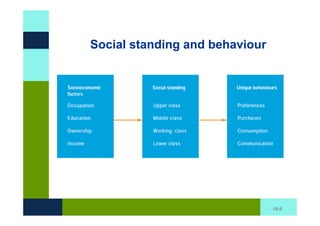
Social standing and behaviour


                                15-5
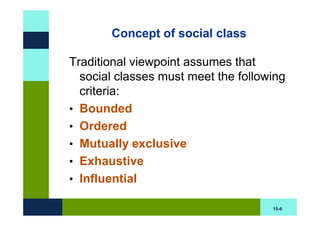
Concept of social class

Traditional viewpoint assumes that
  social classes must meet the following
  criteria:
• Bounded
• Ordered
• Mutually exclusive
• Exhaustive
• Influential

                                     15-6
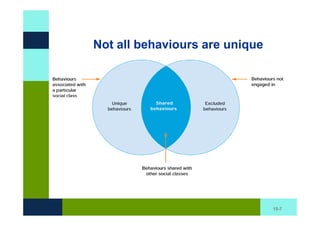
Not all behaviours are unique


                                15-7
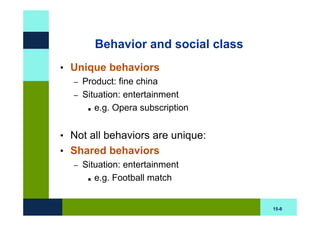
Behavior and social class
• Unique behaviors
  – Product: fine china
  – Situation: entertainment
       e.g. Opera subscription


• Not all behaviors are unique:
• Shared behaviors
  – Situation: entertainment
       e.g. Football match


                                    15-8
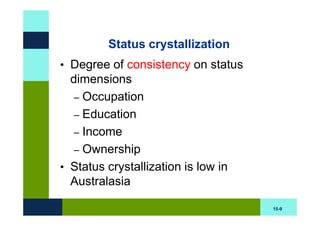
Status crystallization
• Degree of consistency on status
  dimensions
   – Occupation
   – Education
   – Income
   – Ownership
• Status crystallization is low in
  Australasia

                                     15-9
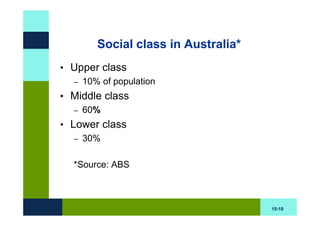
Social class in Australia*
• Upper class
  – 10% of population

• Middle class
  – 60%

• Lower class
   – 30%


   *Source: ABS


                                     15-10
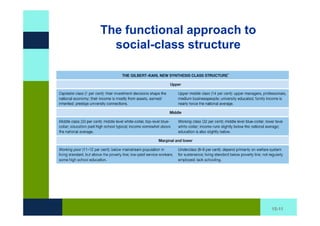
The functional approach to
  social-class structure


                             15-11
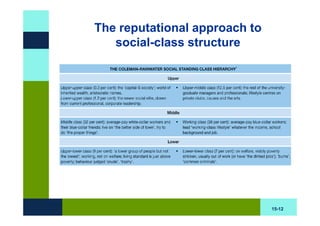
The reputational approach to
   social-class structure


                               15-12
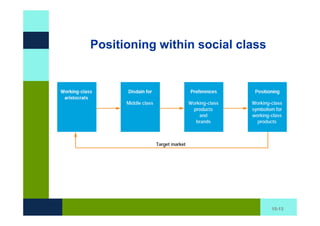
Positioning within social class


                                  15-13
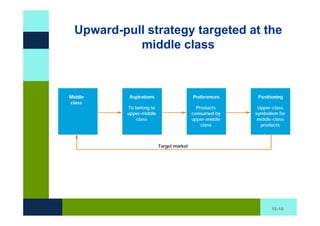
Upward-pull strategy targeted at the
          middle class


                                  15-14
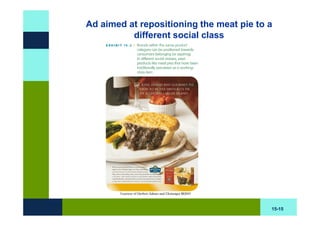
Ad aimed at repositioning the meat pie to a
          different social class


                                          15-15
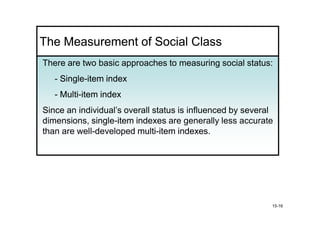
The Measurement of Social Class
There are two basic approaches to measuring social status:
   - Single-item index
     Single-
   - Multi-item index
     Multi-
Since an individual’s overall status is influenced by several
dimensions, single-item indexes are generally less accurate
             single-
than are well-developed multi-item indexes
                         multi-      indexes.


                                                            15-16
Measurement of social class

• Single-item indexes
  – E.g. education
  – E.g. occupation


• Multiple-item indexes
  – E.g. Hollingshead Index of Social Position


                                                 15-17
The Measurement of Social Class
• Single-Item Index
  Single-
     Education

     Occupation

     Income

• Marketers generally think of these as direct
  influencers of consumption behavior rather than
  determinants of status that then influence behavior.
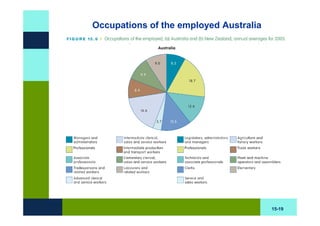
Occupations of the employed Australia


                                        15-19
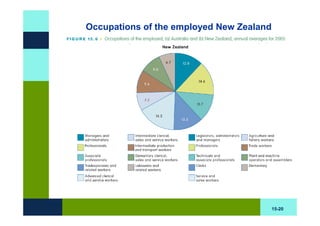
Occupations of the employed New Zealand


                                          15-20
Measurement of social class and its
     application to marketing strategy

• Uses:
  – Differences in product consumption
       instant coffee
       snack foods
       imported wine


                                         15-21
Income
Income has been used as a measure of status
• Poses a number of measurement problems
  –   Individual or family income?
  –   Income before or after taxes and allowances?
  –   Salary or total income?


                                                     15-22
Multiple-item indexes
       e.g. Hollingshead's Index
• Two-item index using occupation and
  education
• Designed or measure overall a family’s
  overall position in society
  Exceptions could arise from someone with:
  – Only secondary schooling and running a
    successful small-medium business
  – Doctor or lawyer working with charities


                                              15-23
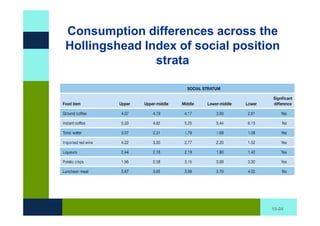
Consumption differences across the
Hollingshead Index of social position
               strata


                                   15-24
The Measurement of Social Class
          Demographics or Social Status?
Social status is largely derived from demographics; that is,
                                      demographics
one’s income, education, and occupation go a long way
toward determining one's social class or status.
Should marketers use an overall measure of social status
(a multi-item index) or a demographic variable such as
income?
Unless the marketer is interested social standing per se,
he/she will most likely focus on demographic
characteristics as direct influencers on consumer
behavior!
                                                            15-25
Which scale to use?
• No one scale is suitable for measuring all
  status dimensions
       Hollingshead’s multi-item index could be
       used for measuring personal status in a
       study of opinion leadership
       Studies of intellectually oriented
       activities, e.g. magazine subscription &
       TV viewing could consider using
       education
       Occupation could be used for studies on
       leisure-time pursuits

                                                  15-26
Social Stratification and Marketing Strategy

While social stratification does not explain all consumption
behaviors, it is certainly relevant for some product
categories.
  You can clearly see this by visiting a furniture store in a
working-class neighborhood and then an upper-class
furniture store.
 A product or brand may have different meanings to
members of different social strata, for example, a watch.
  Likewise, different purchase motivations for the same
product may exist between social strata.
                                                                15-27
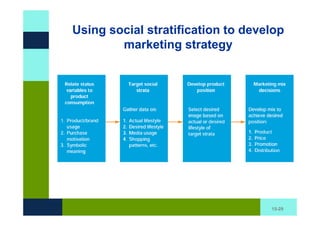
Social class and marketing strategy
• Relate status variables to product
  consumption
   –   Usage, motivation, symbolic meaning
• Target social status
   – Actual lifestyle, desired lifestyle, media, etc.

• Develop product position
  – Select desired position (based on actual/desired
    lifestyle)
• Marketing mix decisions
  – Develop mix


                                                        15-28
Using social stratification to develop
        marketing strategy


                                   15-29
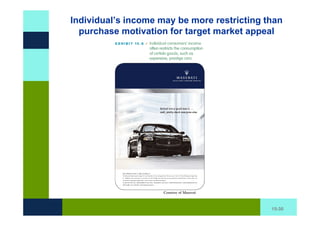
Individual’s income may be more restricting than
  purchase motivation for target market appeal


                                             15-30

BB Chapter Fifteen : Social Class

  • 1.
    Chapter Fifteen: Social Class 15-1
  • 2.
    Chapter 15: Socialclass 1. Concept of social class 2. How social classes are measured 3. Measurement problems marketing managers face 4. The effect of social position on the consumption process 5. How marketing managers can use their knowledge of social stratification to develop marketing strategies 15-2
  • 3.
    Social Stratification We areall familiar with the concept of social class, but most of us would have difficulty explaining our class system to a foreigner. Social rank is one’s position relative to others on one or more dimensions valued by society, also referred to as social class and social standing. A social class system is a hierarchical division of a society into relatively distinct and homogeneous groups with respect to attitudes, values, and lifestyles. "Pure” social classes do not exist in the U.S. or most other industrialized societies. 15-3
  • 4.
    Social class • Socialclass and consumption • Social class – Cultural differences – Components of social class – Measurements of social class • Social class and consumption differences – Global similarities – Segmenting the affluent • Status symbols 15-4
  • 5.
    Social standing andbehaviour 15-5
  • 6.
    Concept of socialclass Traditional viewpoint assumes that social classes must meet the following criteria: • Bounded • Ordered • Mutually exclusive • Exhaustive • Influential 15-6
  • 7.
    Not all behavioursare unique 15-7
  • 8.
    Behavior and socialclass • Unique behaviors – Product: fine china – Situation: entertainment e.g. Opera subscription • Not all behaviors are unique: • Shared behaviors – Situation: entertainment e.g. Football match 15-8
  • 9.
    Status crystallization • Degreeof consistency on status dimensions – Occupation – Education – Income – Ownership • Status crystallization is low in Australasia 15-9
  • 10.
    Social class inAustralia* • Upper class – 10% of population • Middle class – 60% • Lower class – 30% *Source: ABS 15-10
  • 11.
    The functional approachto social-class structure 15-11
  • 12.
    The reputational approachto social-class structure 15-12
  • 13.
  • 14.
    Upward-pull strategy targetedat the middle class 15-14
  • 15.
    Ad aimed atrepositioning the meat pie to a different social class 15-15
  • 16.
    The Measurement ofSocial Class There are two basic approaches to measuring social status: - Single-item index Single- - Multi-item index Multi- Since an individual’s overall status is influenced by several dimensions, single-item indexes are generally less accurate single- than are well-developed multi-item indexes multi- indexes. 15-16
  • 17.
    Measurement of socialclass • Single-item indexes – E.g. education – E.g. occupation • Multiple-item indexes – E.g. Hollingshead Index of Social Position 15-17
  • 18.
    The Measurement ofSocial Class • Single-Item Index Single- Education Occupation Income • Marketers generally think of these as direct influencers of consumption behavior rather than determinants of status that then influence behavior.
  • 19.
    Occupations of theemployed Australia 15-19
  • 20.
    Occupations of theemployed New Zealand 15-20
  • 21.
    Measurement of socialclass and its application to marketing strategy • Uses: – Differences in product consumption instant coffee snack foods imported wine 15-21
  • 22.
    Income Income has beenused as a measure of status • Poses a number of measurement problems – Individual or family income? – Income before or after taxes and allowances? – Salary or total income? 15-22
  • 23.
    Multiple-item indexes e.g. Hollingshead's Index • Two-item index using occupation and education • Designed or measure overall a family’s overall position in society Exceptions could arise from someone with: – Only secondary schooling and running a successful small-medium business – Doctor or lawyer working with charities 15-23
  • 24.
    Consumption differences acrossthe Hollingshead Index of social position strata 15-24
  • 25.
    The Measurement ofSocial Class Demographics or Social Status? Social status is largely derived from demographics; that is, demographics one’s income, education, and occupation go a long way toward determining one's social class or status. Should marketers use an overall measure of social status (a multi-item index) or a demographic variable such as income? Unless the marketer is interested social standing per se, he/she will most likely focus on demographic characteristics as direct influencers on consumer behavior! 15-25
  • 26.
    Which scale touse? • No one scale is suitable for measuring all status dimensions Hollingshead’s multi-item index could be used for measuring personal status in a study of opinion leadership Studies of intellectually oriented activities, e.g. magazine subscription & TV viewing could consider using education Occupation could be used for studies on leisure-time pursuits 15-26
  • 27.
    Social Stratification andMarketing Strategy While social stratification does not explain all consumption behaviors, it is certainly relevant for some product categories. You can clearly see this by visiting a furniture store in a working-class neighborhood and then an upper-class furniture store. A product or brand may have different meanings to members of different social strata, for example, a watch. Likewise, different purchase motivations for the same product may exist between social strata. 15-27
  • 28.
    Social class andmarketing strategy • Relate status variables to product consumption – Usage, motivation, symbolic meaning • Target social status – Actual lifestyle, desired lifestyle, media, etc. • Develop product position – Select desired position (based on actual/desired lifestyle) • Marketing mix decisions – Develop mix 15-28
  • 29.
    Using social stratificationto develop marketing strategy 15-29
  • 30.
    Individual’s income maybe more restricting than purchase motivation for target market appeal 15-30