Difference Between Cost
Accounting ,Financial
Accounting and Management
Submitted by
Aavani Sivadasan
MBA I Batch B
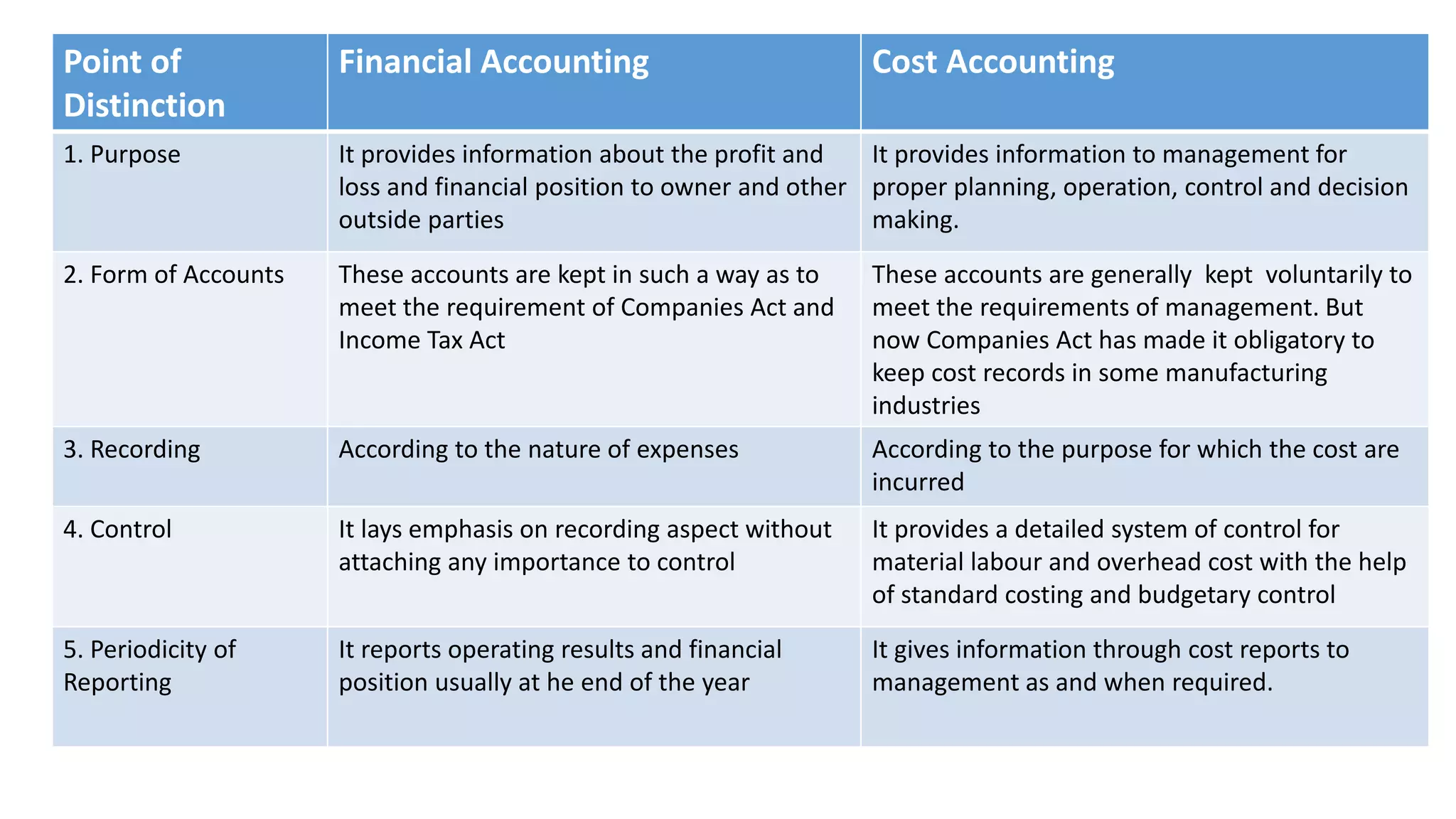
Point of
Distinction
Financial Accounting Cost Accounting
1. Purpose It provides information about the profit and
loss and financial position to owner and other
outside parties
It provides information to management for
proper planning, operation, control and decision
making.
2. Form of Accounts These accounts are kept in such a way as to
meet the requirement of Companies Act and
Income Tax Act
These accounts are generally kept voluntarily to
meet the requirements of management. But
now Companies Act has made it obligatory to
keep cost records in some manufacturing
industries
3. Recording According to the nature of expenses According to the purpose for which the cost are
incurred
4. Control It lays emphasis on recording aspect without
attaching any importance to control
It provides a detailed system of control for
material labour and overhead cost with the help
of standard costing and budgetary control
5. Periodicity of
Reporting
It reports operating results and financial
position usually at he end of the year
It gives information through cost reports to
management as and when required.
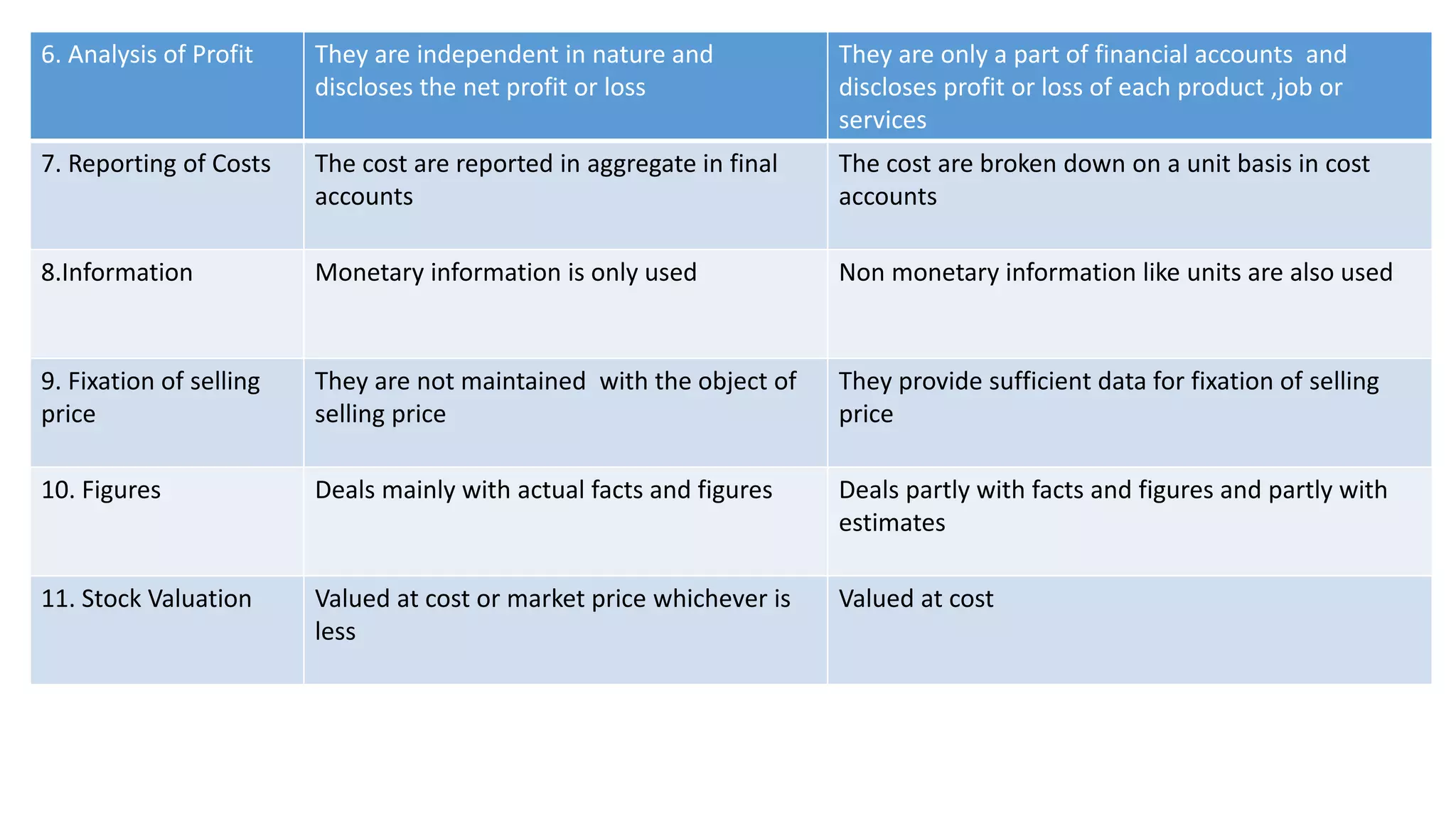
6. Analysis of Profit They are independent in nature and
discloses the net profit or loss
They are only a part of financial accounts and
discloses profit or loss of each product ,job or
services
7. Reporting of Costs The cost are reported in aggregate in final
accounts
The cost are broken down on a unit basis in cost
accounts
8.Information Monetary information is only used Non monetary information like units are also used
9. Fixation of selling
price
They are not maintained with the object of
selling price
They provide sufficient data for fixation of selling
price
10. Figures Deals mainly with actual facts and figures Deals partly with facts and figures and partly with
estimates
11. Stock Valuation Valued at cost or market price whichever is
less
Valued at cost
Point of
Distinction
Cost Accounting Management Accounting
1. Meaning They revolve around cost computation cost
control and cost reduction
They helps in making effective decision in
business
2. Application Prevent a business from incurring cost
beyond budget
Offers a big picture of how management
should categorise
3. Scope Scope is much narrow Scope is much broader
4. Measurement grid Quantitative Both quantitative and qualitative
5. Sub-Set Cost Accounting is the sub set of
management accounting
Management accounting itself is pretty vast
6. Decision Making Historic information is used Both historic and predictive are used
7. Statutory Requirement Statutory audit of cost accounting is a
requirement in big business house
Audit of management accounting has no
statutory requirement
8. Dependence Cost account is independent Management account ids dependable both to
cost and financial accounting
9. Used for Management, shareholders and vendors Only for management
Point of
distinction
Financial Accounting Management Accounting
1. Objectives The main objectives of financial accounting are to
disclose the end results of the business, and the
financial condition of the business on a particular
date.
The main objective of managerial accounting is
to help management by providing information
that is used to plan, set goals and evaluate these
goals.
2. Audience Financial accounting produces information that is
used by external parties, such as shareholders
and lenders.
Managerial accounting produces information
that is used within an organization, by managers
and employees.
3. Required It is legally required to prepare financial
accounting reports and share them with
investors.
Managerial accounting reports are not legally
required.
4. Segment
Reporting
Pertains to the entire organization. Certain
figures may be broken out for materially
significant business units.
Pertains to individual departments in addition to
the entire organization.
5. Focus Financial accounting focuses on history; reports
on the prior quarter or year.
Managerial accounting focuses on the present
and forecasts for the future.
6. Format Financial accounts are reported in a specific
format, so that different organizations can
be easily compared
Format is informal and is on a per
department/company basis as needed.
7. Rules Rules in financial accounting are prescribed
by standards such as GAAP or IFRS. There
are legal requirements for companies to
follow financial accounting standards.
Managerial accounting reports are only used
internally within the organization; so they are
not subject to the legal requirements that
financial accounts are.
8. Reporting Frequency
and duration
Defined - annually, semi-annually,
quarterly, yearly.
As needed - daily, weekly, monthly.
9. Information Monetary, verifiable information. Monetary and company goal driven
information.

Difference between cost accounting ,financial accounting and

  • 1.
    Difference Between Cost Accounting,Financial Accounting and Management Submitted by Aavani Sivadasan MBA I Batch B
  • 2.
    Point of Distinction Financial AccountingCost Accounting 1. Purpose It provides information about the profit and loss and financial position to owner and other outside parties It provides information to management for proper planning, operation, control and decision making. 2. Form of Accounts These accounts are kept in such a way as to meet the requirement of Companies Act and Income Tax Act These accounts are generally kept voluntarily to meet the requirements of management. But now Companies Act has made it obligatory to keep cost records in some manufacturing industries 3. Recording According to the nature of expenses According to the purpose for which the cost are incurred 4. Control It lays emphasis on recording aspect without attaching any importance to control It provides a detailed system of control for material labour and overhead cost with the help of standard costing and budgetary control 5. Periodicity of Reporting It reports operating results and financial position usually at he end of the year It gives information through cost reports to management as and when required.
  • 3.
    6. Analysis ofProfit They are independent in nature and discloses the net profit or loss They are only a part of financial accounts and discloses profit or loss of each product ,job or services 7. Reporting of Costs The cost are reported in aggregate in final accounts The cost are broken down on a unit basis in cost accounts 8.Information Monetary information is only used Non monetary information like units are also used 9. Fixation of selling price They are not maintained with the object of selling price They provide sufficient data for fixation of selling price 10. Figures Deals mainly with actual facts and figures Deals partly with facts and figures and partly with estimates 11. Stock Valuation Valued at cost or market price whichever is less Valued at cost
  • 4.
    Point of Distinction Cost AccountingManagement Accounting 1. Meaning They revolve around cost computation cost control and cost reduction They helps in making effective decision in business 2. Application Prevent a business from incurring cost beyond budget Offers a big picture of how management should categorise 3. Scope Scope is much narrow Scope is much broader 4. Measurement grid Quantitative Both quantitative and qualitative 5. Sub-Set Cost Accounting is the sub set of management accounting Management accounting itself is pretty vast
  • 5.
    6. Decision MakingHistoric information is used Both historic and predictive are used 7. Statutory Requirement Statutory audit of cost accounting is a requirement in big business house Audit of management accounting has no statutory requirement 8. Dependence Cost account is independent Management account ids dependable both to cost and financial accounting 9. Used for Management, shareholders and vendors Only for management
  • 6.
    Point of distinction Financial AccountingManagement Accounting 1. Objectives The main objectives of financial accounting are to disclose the end results of the business, and the financial condition of the business on a particular date. The main objective of managerial accounting is to help management by providing information that is used to plan, set goals and evaluate these goals. 2. Audience Financial accounting produces information that is used by external parties, such as shareholders and lenders. Managerial accounting produces information that is used within an organization, by managers and employees. 3. Required It is legally required to prepare financial accounting reports and share them with investors. Managerial accounting reports are not legally required. 4. Segment Reporting Pertains to the entire organization. Certain figures may be broken out for materially significant business units. Pertains to individual departments in addition to the entire organization. 5. Focus Financial accounting focuses on history; reports on the prior quarter or year. Managerial accounting focuses on the present and forecasts for the future.
  • 7.
    6. Format Financialaccounts are reported in a specific format, so that different organizations can be easily compared Format is informal and is on a per department/company basis as needed. 7. Rules Rules in financial accounting are prescribed by standards such as GAAP or IFRS. There are legal requirements for companies to follow financial accounting standards. Managerial accounting reports are only used internally within the organization; so they are not subject to the legal requirements that financial accounts are. 8. Reporting Frequency and duration Defined - annually, semi-annually, quarterly, yearly. As needed - daily, weekly, monthly. 9. Information Monetary, verifiable information. Monetary and company goal driven information.