Unit-1
INTRODUCTION TO MANAGEMENT
ACCOUNTING
Dr. Priti Dawande
Department of Commerce
Dr. D. Y. Patil Arts, Commerce & Science
College, Pimpri, Pune-18
• Introduction- Accounting is an ancient art as old as money itself; however the role of
accounting has changing with economic and social developments. The traditional
view of accounting as a historical description of financial activities is no longer
acceptable. Accounting now is regarded as service activity the function of which is
to provide quantitative information about economic activities.
• Development of accounting -In India chanakya in his artha shastra had emphasized
the existence and need of proper accounting and auditing.
• However modern system of accounting owes its origin to pacoili who lived in Italy
in the 15th century.
• The advent of industrial revolution has resulted in large scale production, cut throat
competition and widening of the market. This has resulted in decentralization of
authority and control.
• Accounting today, therefore cannot be the same as it used to be about half a century
ago. Changes in technology have also brought a remarkable change in the filed of
accounting.
• Accountancy is the art of communicating financial
information about a business entity to users such as
shareholders and managers. The communication is generally
in the financial form statements that show in money terms the
economic resources under the control of management; the art
lies in selecting the information that is relevant to the user and
is reliable.
• Classification of accounts.
1. Financial accounting
2. Management accounting
3. Cost accounting
• Financial accounting –According to the American institute of certified Public
accountants “the art of recording , Classifying and summarizing in a significant
manner and in terms of money transactions and events which are in part at
least of a financial character and interpreting the results thereof”
• Functions of Financial accounting –
1. Recording
2. Classification of data
3. Summarizing
4. Deals with Financial Transactions
5. Interpreting Financial information
• Limitations of Financial Accounting:
1. Historical in nature
2. Provides information about the concern as a whole
3. Not helpful in price Fixation
4. Only Actual costs are Recorded.
5. Not Helpful in Taking Strategic Decisions.
6. Chances of manipulation.
• Cost accounting-
Costing is a specialized branch of accounting. In management Cost refers to
expenditure and not the price. Costing is the technique and process of ascertaining
costs. It consists of the principles and rules which are used for ascertaining the costs of
products and services.
• Objectives of cost Accounting.
1. Analysis and Ascertainment of costs.
2. Presentation of costs for Cost reduction and cost control
3. Planning and Decision making
• Importance and Advantages of cost accounting.
1. Cost accounting as an aid to management
2. Advantages to employees
3. Advantages to creditors, investors and Bankers
4. Advantages to the government and the society.
• Management Accounting- The Term management Accounting Refers to
accounting for the management I,e accounting which provides necessary
information to the management for discharging its functions. The functions
are planning , organizing ,directing and controlling of business operations.
• ICWAI published Glossary of management accounting terms Defining
Management accounting as a “system of collection and presentations of
relevant economic information relating to an enterprise for planning,
controlling and decision making”.
• Charactersitics of Manangement accounting.
1. Providing Accounting Information – The collection and classification of data is the
primary function of accounting department.(I,e from cost and financial
accounting).The information so collected is used by the management for taking
policy decisions. Management Accounting is a service function and it provides
necessary information to different levels of Mgt.
2. Cause and effect analysis –Financial accounting is limited to the preparation of
profits and loss A/c and finding out the ultimate result I,e Profit and loss
.Management Accounting goes a step further.
If there is a loss, the reasons for the loss are probed: if there is a profit the factors
directly influencing the profitability are also studied.
3. Helps to take important decisions: - Which are operational based and strategic in
nature.
4. Helps in achieving of objectives:- Management accounting helps in achieving
organizational objectives.
Historical data is used for formulating plans & setting up objective
Actual performance is compared with the targeted figures and corrective action if
necessary.
5 No fixed norms Followed –In financial Accounting Certain rules are followed for
preparing Different accounting books. On the other hand no specific rules are
followed in management accounting as there is scope for flexibility in their
preparations and moreover outsiders have no access to them.
6 Increase in efficiency – Since Management accounting helps the management to
take a decision about the future ,the efficiency can be achieved by setting up goals
for each Department or section.
The performance Appraisal will pin point efficient and inefficient spots.
7 Helps in co-ordination- Management accounting techniques of planning also
helps in coordinating various business activities. Ex While Preparing budgets for
various Departments like production ,sales , purchases etc there should be
coordination among all the three depts. than contradiction.
• Scope of Management accounting-
1. Financial accounting –Management accounting is mainly concerned
with the rearrangement of the information provided by financial
accounting. Thus for an effective and successful management
accounting there should be a proper and well designed financial
accounting system.
2. Cost accounting – Many of the techniques of cost control like standard
costing, budgetary control etc are used by management accounting
3. Budgeting and forecasting – This includes framing of budgets.in order
to plan business activities for the future forecasting and budgeting play
a very significant role. Comparison of actual performance with the
budgeted performance ,computation of variances, finding their causes.
4. Inventory control- Inventory Control denotes raw materials, goods in the process
of manufacture and finished products. Inventory control is significant as it
involves large sums. The management should determine different levels of stock
I,e minimum, maximum and reorder level. The control of inventory will help in
controlling costs of products. Management accountant will guide management as
to when and from where to purchase and how much to purchase.
5. Financial Management – Financial management is concerned with the planning
and controlling of the financial resources of the firm. It deals with raising funds
and their effective utilization.
6. Reporting to management- One of the functions of management accountant is to
report to the management. The reports are presented in the form of graphs,
diagrams , statistical techniques. The reports may cover profit and loss statement,
Cash and fund flow statement, Stock reports etc. The reports may be monthly,
quarterly and half yearly.
7. Cost control procedures – Any system of management accounting is incomplete
with out effective cost control procedures like inventory control ,
labour control,budgetrary control etc.
8. Internal Audit – Management accountant heavily depends on internal financial
controls like internal audit and internal check to plug the loop holes in the
financial systems of the concern. Internal audit system is necessary to judge the
performance of different individuals.
9. Tax accounting- Tax planning is an important part of management accounting .
Income statements are prepared and liabilities are calculated. The management is
informed about the tax burden from central, state and local governments. Tax
returns are to filed with different departments.
10. Office services – Management accountant is expected to deal with data
processing. filing. copying ,duplicating, communicating etc.
• Differences Between Managment accounting and financial accounting
The main points of discussion are discussed below
• Object -
➢ Financial accounting is designed to supply information in the form of profit and loss
a/c and balance sheet ( to find out the financial position)) to external parties like
shareholders, creditors , banks , investors and government.
➢ Management accounting is essential to help management in formulating policies
and plans which is internal.
• Analyzing performance –
➢ Financial accounting portrays the position of business as a whole. The financial
statements like income statement and balance sheet report on overall performance of
the business.
➢ On the other hand management accounting directs its attention to various
divisions ,departments of the business and reports about the profitability,
performance etc. of each of them.
• Nature –
➢ Financial accounting is mainly concerned with the historical data. It records only
those transactions which have already taken place.
➢ Management accounting deals with projection of data for the future and therefore it
supplies data for the present and future duly analysed and in detail in the
management language.
• Monetary Management –
➢ In Financial accounting only such economic events find place which can be
described in money.
➢ However the management is equally interested in non monetary economic events viz
technical innovations, personnel in the organization etc
• Precision –
➢ There is less emphasis on precision in case of management accounting.
➢ Where as in financial accounting only exact figures are taken to arrive at precision..
• Reporting –
➢ Financial accounting reports are meant for outsiders like
bankers , Investors , shareholders, govt agencies etc.
➢ Where as management accounting are meant for internal use
only.
• Legal compulsion –
➢ Financial accounting has become compulsory for companies
where as management accounting is not.
___________________________________________
End of Unit-1
Unit 2
3-19
Intro to Consolidations: Objectives
1. Recognize the benefits and limitations of
consolidated financial statements.
2. Understand the requirements for inclusion
of a subsidiary in consolidated financial
statements.
3. Apply the consolidation concepts to parent
company recording of the investment in a
subsidiary at the date of acquisition.
4. Allocate the excess of the fair value over
© Pearson Education, Inc.
publishing as Prentice Hall
3-20
Objectives (continued)
5. Learn the concept of noncontrolling interest
when the parent company acquires less than
100% of the subsidiary's outstanding
common stock.
6. Amortize the excess of the fair value over
the book value in periods subsequent to the
acquisition.
7. Prepare consolidated balance sheets
subsequent to the date of acquisition,
including preparation of elimination entries.
© Pearson Education, Inc.
publishing as Prentice Hall
3-21
1: BENEFITS & LIMITATIONS
An Introduction to Consolidated Financial Statements
© Pearson Education, Inc.
publishing as Prentice Hall
3-22
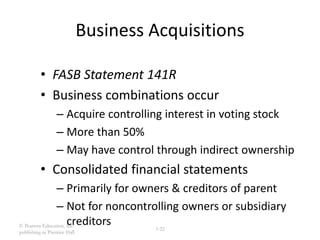
Business Acquisitions
• FASB Statement 141R
• Business combinations occur
– Acquire controlling interest in voting stock
– More than 50%
– May have control through indirect ownership
• Consolidated financial statements
– Primarily for owners & creditors of parent
– Not for noncontrolling owners or subsidiary
creditors
© Pearson Education, Inc.
publishing as Prentice Hall
3-23
2: SUBSIDIARIES
An Introduction to Consolidated Financial Statements
© Pearson Education, Inc.
publishing as Prentice Hall
3-24
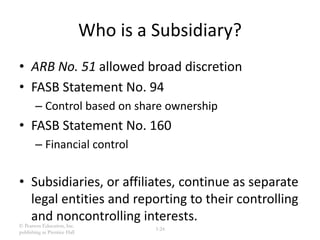
Who is a Subsidiary?
• ARB No. 51 allowed broad discretion
• FASB Statement No. 94
– Control based on share ownership
• FASB Statement No. 160
– Financial control
• Subsidiaries, or affiliates, continue as separate
legal entities and reporting to their controlling
and noncontrolling interests.
© Pearson Education, Inc.
publishing as Prentice Hall
3-25
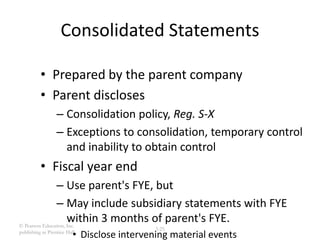
Consolidated Statements
• Prepared by the parent company
• Parent discloses
– Consolidation policy, Reg. S-X
– Exceptions to consolidation, temporary control
and inability to obtain control
• Fiscal year end
– Use parent's FYE, but
– May include subsidiary statements with FYE
within 3 months of parent's FYE.
• Disclose intervening material events
© Pearson Education, Inc.
publishing as Prentice Hall
3-26
3: PARENT COMPANY RECORDING
An Introduction to Consolidated Financial Statements
© Pearson Education, Inc.
publishing as Prentice Hall
3-27
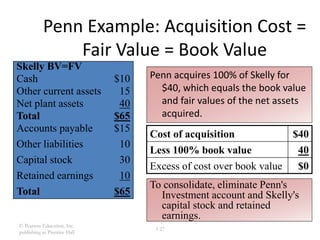
Penn Example: Acquisition Cost =
Fair Value = Book Value
Penn acquires 100% of Skelly for
$40, which equals the book value
and fair values of the net assets
acquired.
Cost of acquisition $40
Less 100% book value 40
Excess of cost over book value $0
Skelly BV=FV
Cash $10
Other current assets 15
Net plant assets 40
Total $65
Accounts payable $15
Other liabilities 10
Capital stock 30
Retained earnings 10
Total $65
To consolidate, eliminate Penn's
Investment account and Skelly's
capital stock and retained
earnings.
© Pearson Education, Inc.
publishing as Prentice Hall
3-28
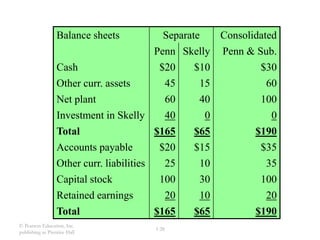
Balance sheets Separate Consolidated
Penn Skelly Penn & Sub.
Cash $20 $10 $30
Other curr. assets 45 15 60
Net plant 60 40 100
Investment in Skelly 40 0 0
Total $165 $65 $190
Accounts payable $20 $15 $35
Other curr. liabilities 25 10 35
Capital stock 100 30 100
Retained earnings 20 10 20
Total $165 $65 $190
© Pearson Education, Inc.
publishing as Prentice Hall
3-29
4: ALLOCATIONS AT ACQUISITION DATE
An Introduction to Consolidated Financial Statements
© Pearson Education, Inc.
publishing as Prentice Hall
3-30
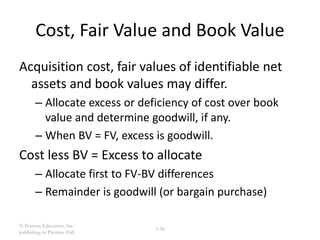
Cost, Fair Value and Book Value
Acquisition cost, fair values of identifiable net
assets and book values may differ.
– Allocate excess or deficiency of cost over book
value and determine goodwill, if any.
– When BV = FV, excess is goodwill.
Cost less BV = Excess to allocate
– Allocate first to FV-BV differences
– Remainder is goodwill (or bargain purchase)
© Pearson Education, Inc.
publishing as Prentice Hall
3-31
Balance Sheets After Acquisition
In preparing a consolidated balance sheet
– Eliminate the parent's Investment in
Subsidiary
– Eliminate the subsidiary's equity accounts
(common stock, retained earnings, etc.)
– Adjust asset and liability accounts for any
unamortized excess balance
– Record goodwill, if any
– Record Noncontrolling Interest, if any
© Pearson Education, Inc.
publishing as Prentice Hall
3-32
Key Balance Sheet Items
• Investment in Subsidiary does not exist on the
consolidated balance sheet
• Equity on the consolidated balance sheet
consists of the parent's equity plus the
noncontrolling interest.
• Noncontrolling interest is proportional to the
Investment in Subsidiary account when the
equity method is used.
$101 = $404 x .20/.80
Unit 3
20-34
Liquidations
• Liquidations are administered by the
bankruptcy courts.
• The intent in liquidation is to maximize the net
dollar amount recovered from disposal of the
debtor’s assets.
• Bankruptcy courts appoint accountants,
attorneys, or experienced business managers
as trustees to administer the liquidation.
• The liquidation process is often completed
within 6 to 12 months, during which the
trustees must make periodic reports to the
20-35
Classes of Creditors
• A very important aspect of liquidation is
determining the legal rights of each creditor
and establishing priorities for those rights.
• The Bankruptcy Code specifies three classes of
creditors, whose claims have the following
priorities: (1) secured creditors, (2) creditors
with priority, and (3) unsecured creditors.
• The priority of claims determines the order
and source of payment to each creditor.
20-36
Secured Creditors
• Secured creditors have liens, or security
interests, on specific assets, often called
“collateral.”
• A creditor with such a legal interest in a
specific asset has the highest priority claim
on that asset. For example, a mortgage
payable is secured by the company’s land
and plant.
20-37
Summary--Creditors with Priority
• Costs of administering the bankruptcy, including accounting
and legal costs for experts appointed by the
bankruptcy court.
• Liabilities arising in the ordinary course of business
during the bankruptcy proceedings.
• Certain wages, salaries, or commissions. (limited to $10,000
per employee in the last 180 days)
• Certain contributions to employee benefit plans. (limited to
the same $10,000 as above)
• Certain deposits of customers. (Limited to the first $1,800 per
individual)
• Unsecured tax claims of government units. (Property, income,
excise, etc.)
20-38
General Unsecured Creditors
• The lowest priority is given to claims by
general unsecured creditors.
• These creditors are paid only after secured
creditors and unsecured creditors with priority
are satisfied to the extent of any legal limits.
• Often, the general unsecured creditors receive
less than the full amount of their claim.
20-39
Statement of Affairs
• The accounting statement of affairs is the
basic accounting report made at the beginning
of the liquidation process to present the
expected realizable amounts from disposal of
the assets, the order of creditors’ claims, and
the expected amount unsecured creditors will
receive as a result of the liquidation.
20-40
Statement of Affairs
• The statement of affairs presents the balance
sheet accounts in order of priority for
liquidation.
• The statement of affairs presents estimated
current fair values and expected gains or
losses on the disposal of the assets.
20-41
Trustee Accounting and Reporting
• Bankruptcy courts appoint trustees to manage
a company under Chapter 11 reorganizations
in cases of management fraud, dishonesty,
incompetence, or gross mismanagement. The
trustee then attempts to rehabilitate the
business.
20-42
Trustee Accounting and Reporting
• In Chapter 7 liquidations, the trustee normally
has the responsibility to expeditiously
liquidate the bankrupt company and pay
creditors in conformity with the legal status of
their secured or unsecured interests.
20-43
Receivership
• Sometimes the trustee receives title to all
assets as a receivership, becomes responsible
for the actual management of the debtor, and
must direct a plan of reorganization or
liquidation.
• A trustee who takes title to the debtor’s assets
in a liquidation must make periodic financial
reports to the bankruptcy court, reporting on
the progress of the liquidation and on the
fiduciary relationship held.
20-44
Statement of Realization and Liquidation
• A monthly report, called a statement of
realization and liquidation, is prepared for the
bankruptcy court. It shows the results of the
trustee’s fiduciary actions beginning at the
point the trustee accepts the debtor’s assets.
• The statement has three major sections:
• Assets
• Supplementary items
• Liabilities
20-45
Statement of Realization and Liquidation
• The statement presents the assets transferred
to the trustee, the additional assets acquired
by the trustee, and the ending balance of
unrealized assets still to be converted into
cash.
• The statement also reports on the debtor’s
liabilities discharged by the trustee as well as
the additional liabilities incurred by the
trustee.
• Supplementary charges include the trustee’s
administration fees and any cash expenses
Unit 4
Valuation of shares
Need for valuation:
1. At the time of amalgamation.
2. When loan is granted on the security of shares.
3. When preference shares or debentures are converted
into equity shares.
4. When equity shareholders are to be compensated on
acquisition of their shares by the govt. under a scheme of
nationalisation.
Factors affecting valuation of shares
• Nature of the business
• Demand and supply for shares
• Govt. policy
• Past performance of the company
• Growth prospectus of the company
• The management of the company
• The economic climate
• Accumulated reserves
• Prospects of bonus or rights issue
Methods for valuation
• Net assets basis (or intrinsic value) method
• Yield basis method
• Dual (or fair value) method
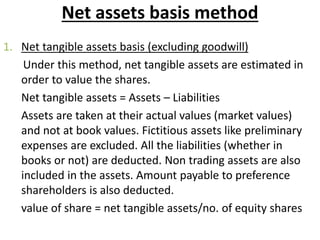
Net assets basis method
1. Net tangible assets basis (excluding goodwill)
Under this method, net tangible assets are estimated in
order to value the shares.
Net tangible assets = Assets – Liabilities
Assets are taken at their actual values (market values)
and not at book values. Fictitious assets like preliminary
expenses are excluded. All the liabilities (whether in
books or not) are deducted. Non trading assets are also
included in the assets. Amount payable to preference
shareholders is also deducted.
value of share = net tangible assets/no. of equity shares
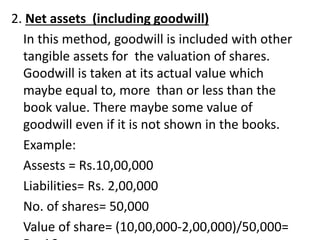
2. Net assets (including goodwill)
In this method, goodwill is included with other
tangible assets for the valuation of shares.
Goodwill is taken at its actual value which
maybe equal to, more than or less than the
book value. There maybe some value of
goodwill even if it is not shown in the books.
Example:
Assests = Rs.10,00,000
Liabilities= Rs. 2,00,000
No. of shares= 50,000
Value of share= (10,00,000-2,00,000)/50,000=
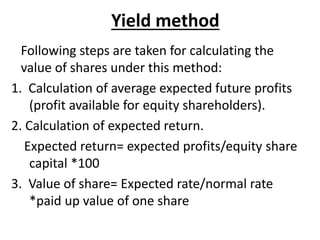
Yield method
Following steps are taken for calculating the
value of shares under this method:
1. Calculation of average expected future profits
(profit available for equity shareholders).
2. Calculation of expected return.
Expected return= expected profits/equity share
capital *100
3. Value of share= Expected rate/normal rate
*paid up value of one share
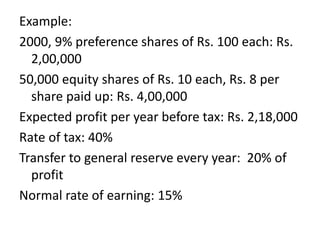
Example:
2000, 9% preference shares of Rs. 100 each: Rs.
2,00,000
50,000 equity shares of Rs. 10 each, Rs. 8 per
share paid up: Rs. 4,00,000
Expected profit per year before tax: Rs. 2,18,000
Rate of tax: 40%
Transfer to general reserve every year: 20% of
profit
Normal rate of earning: 15%
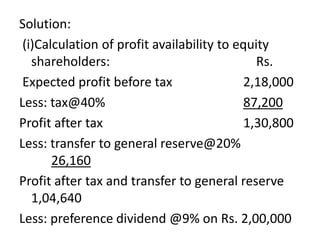
Solution:
(i)Calculation of profit availability to equity
shareholders: Rs.
Expected profit before tax 2,18,000
Less: tax@40% 87,200
Profit after tax 1,30,800
Less: transfer to general reserve@20%
26,160
Profit after tax and transfer to general reserve
1,04,640
Less: preference dividend @9% on Rs. 2,00,000
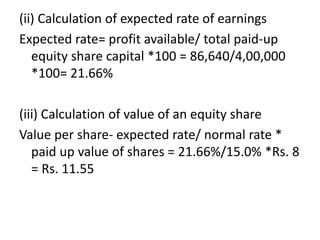
(ii) Calculation of expected rate of earnings
Expected rate= profit available/ total paid-up
equity share capital *100 = 86,640/4,00,000
*100= 21.66%
(iii) Calculation of value of an equity share
Value per share- expected rate/ normal rate *
paid up value of shares = 21.66%/15.0% *Rs. 8
= Rs. 11.55
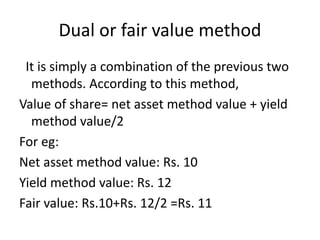
Dual or fair value method
It is simply a combination of the previous two
methods. According to this method,
Value of share= net asset method value + yield
method value/2
For eg:
Net asset method value: Rs. 10

Yield method value: Rs. 12
Fair value: Rs.10+Rs. 12/2 =Rs. 11
VALUATION OF
GOODWILL
A software company may have net assets
(consisting primarily of miscellaneous
equipment, and assuming no debt) valued
at Rs 1crore, but the company's overall
value (including brand, customers,
intellectual capital) is valued at Rs 4 crore.
Anybody buying that company would book
Rs 4 crore in total assets acquired,
comprising Rs1 crore physical assets, and
Rs 3 crore in goodwill.
GOODWILL
“Goodwill is nothing more than
the probability that the old
customer will resort to the old
place.”
-lord Eldon
When a man pays for goodwill, he pays
for something which places him in the
position of being able to earn more than
he would be able to do by his own
unaided efforts. Goodwill is, thus,
present value of a firm’s anticipated
super normal earnings.
FEATURES OF GOODWILL
• It is an intangible asset.
• It may be purchased or inherent in the
business.
• It is capable of transfer from one person to
another.
• Value of goodwill generally fluctuates from
time to time.
• It can be sold only with entire business and
not separately.
Elements of Goodwill
• Patents
• Franchises
• Customer lists
• Copyrights
• Organization cost
• Special location advantage
FACTORS DETERMINING THE
VALUE OF GOODWILL
• LOCATION ADVANTAGE
• CAPITAL REQUIRED
• SKILL OF MANAGEMENT
• TRADE NAME
• PROFIT TREND
• QUALITY
• SPECIAL CONTRACT
METHOD OF VALUING
GOODWILL
• Arbitrary Assessment
• Capitalization Method
• Purchase of Past Average Profit
• Super profit-
(i)Purchase of Super Profit
(ii)Annuity Method
(iii)Capitalization of Super Profit
Method
ARBITRARY ASSESSMENT
The valuation of goodwill is arrived at by making a
valuation by one of the parties, vendor or purchaser
to which the other agrees. If a company decide to
purchase the business of another concern and it
mutually agreed upon that the purchasing company
will pay a specific amount for goodwill in lump sum.
The amount so agreed upon is called an arbitrary
assessment.
Example:-
X ltd. Purchases the business of Y ltd.
And it is mutually agreed upon that X
ltd. Will pay to Y ltd. a sum of Rs. 1 lac
on account of goodwill. This is the case
of arbitrary assessment of valuation of
goodwill.
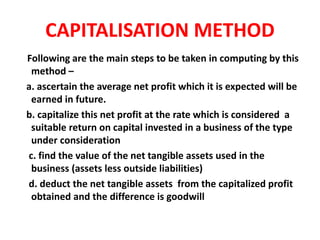
CAPITALISATION METHOD
Following are the main steps to be taken in computing by this
method –
a. ascertain the average net profit which it is expected will be
earned in future.
b. capitalize this net profit at the rate which is considered a
suitable return on capital invested in a business of the type
under consideration
c. find the value of the net tangible assets used in the
business (assets less outside liabilities)
d. deduct the net tangible assets from the capitalized profit
obtained and the difference is goodwill
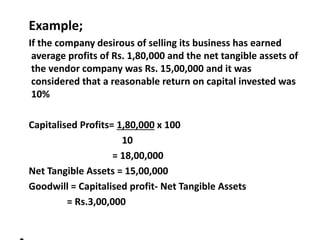
Example;
If the company desirous of selling its business has earned
average profits of Rs. 1,80,000 and the net tangible assets of
the vendor company was Rs. 15,00,000 and it was
considered that a reasonable return on capital invested was
10%
Capitalised Profits= 1,80,000 x 100
10
= 18,00,000
Net Tangible Assets = 15,00,000
Goodwill = Capitalised profit- Net Tangible Assets
= Rs.3,00,000
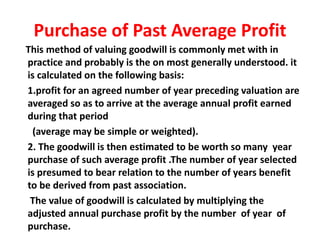
Purchase of Past Average Profit
This method of valuing goodwill is commonly met with in
practice and probably is the on most generally understood. it
is calculated on the following basis:
1.profit for an agreed number of year preceding valuation are
averaged so as to arrive at the average annual profit earned
during that period
(average may be simple or weighted).
2. The goodwill is then estimated to be worth so many year
purchase of such average profit .The number of year selected
is presumed to bear relation to the number of years benefit
to be derived from past association.
The value of goodwill is calculated by multiplying the
adjusted annual purchase profit by the number of year of
purchase.
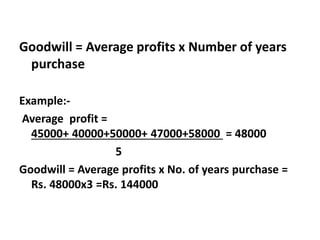
Goodwill = Average profits x Number of years
purchase
Example:-
Average profit =
45000+ 40000+50000+ 47000+58000 = 48000
5
Goodwill = Average profits x No. of years purchase =
Rs. 48000x3 =Rs. 144000
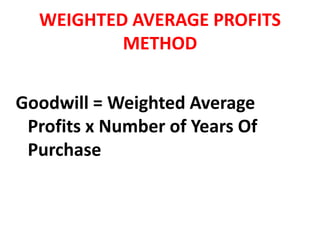
WEIGHTED AVERAGE PROFITS
METHOD
Goodwill = Weighted Average
Profits x Number of Years Of
Purchase
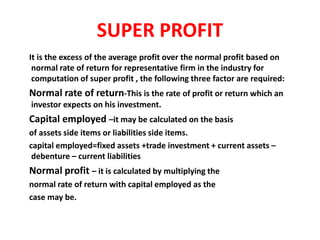
SUPER PROFIT
It is the excess of the average profit over the normal profit based on
normal rate of return for representative firm in the industry for
computation of super profit , the following three factor are required:
Normal rate of return-This is the rate of profit or return which an
investor expects on his investment.
Capital employed –it may be calculated on the basis
of assets side items or liabilities side items.
capital employed=fixed assets +trade investment + current assets –
debenture – current liabilities
Normal profit – it is calculated by multiplying the
normal rate of return with capital employed as the
case may be.
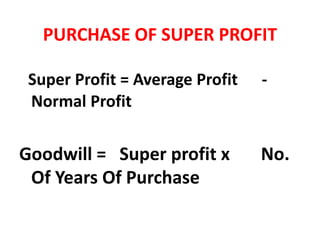
PURCHASE OF SUPER PROFIT
Super Profit = Average Profit -
Normal Profit
Goodwill = Super profit x No.
Of Years Of Purchase
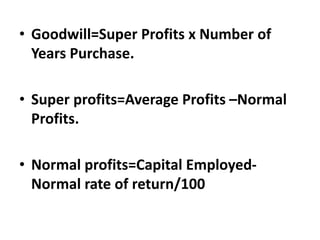
• Goodwill=Super Profits x Number of
Years Purchase.
• Super profits=Average Profits –Normal
Profits.
• Normal profits=Capital Employed-
Normal rate of return/100
EXAMPLE;
X Ltd. is running its business with a capital of Rs. 20,00,000.on
the basis of previous records , it is expected that the
company will earn Rs. 5,00,000 in future. The normal rate of
return is 15%. The super normal profits of X Ltd. Will be
calculated as;
Profits expected in future RS.5,00,000
LESS: Normal profits = [20,00,00 x15%]
= Rs.3,00,000
Super profits = Rs.2,00,000
Goodwill= 2,00,000 x 5 =Rs.10,00,000
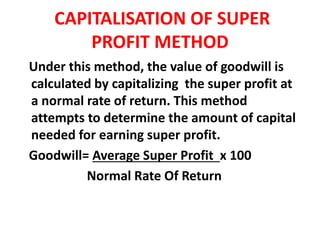
CAPITALISATION OF SUPER
PROFIT METHOD
Under this method, the value of goodwill is
calculated by capitalizing the super profit at
a normal rate of return. This method
attempts to determine the amount of capital
needed for earning super profit.
Goodwill= Average Super Profit x 100
Normal Rate Of Return
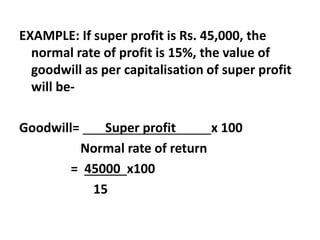
EXAMPLE: If super profit is Rs. 45,000, the
normal rate of profit is 15%, the value of
goodwill as per capitalisation of super profit
will be-
Goodwill= Super profit x 100
Normal rate of return
= 45000 x100
15
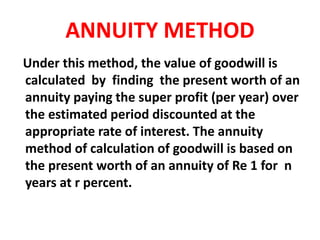
ANNUITY METHOD
Under this method, the value of goodwill is
calculated by finding the present worth of an
annuity paying the super profit (per year) over
the estimated period discounted at the
appropriate rate of interest. The annuity
method of calculation of goodwill is based on
the present worth of an annuity of Re 1 for n
years at r percent.
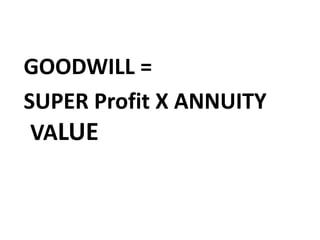
GOODWILL =
SUPER Profit X ANNUITY
VALUE
EXAMPLE;
The amount of super profits amounts to Rs.
2,00,000.A reference to annuity table shows
that Re.1 paid annually for 5 years at 10%
rate of interest is equal to Rs.3.78
immediately. Hence Goodwill=Super profits x
value of an annuity
=2,00,000 x 3.78 =Rs. 7,56,000
CONCLUSION
“Just as cement binds together the
bricks and other building material into
walls, similarly goodwill binds together
or unites the other assets and aspects of
the business into cohesive whole.”

Management-Accounting.pdf

  • 1.
    Unit-1 INTRODUCTION TO MANAGEMENT ACCOUNTING Dr.Priti Dawande Department of Commerce Dr. D. Y. Patil Arts, Commerce & Science College, Pimpri, Pune-18
  • 2.
    • Introduction- Accountingis an ancient art as old as money itself; however the role of accounting has changing with economic and social developments. The traditional view of accounting as a historical description of financial activities is no longer acceptable. Accounting now is regarded as service activity the function of which is to provide quantitative information about economic activities.
  • 3.
    • Development ofaccounting -In India chanakya in his artha shastra had emphasized the existence and need of proper accounting and auditing. • However modern system of accounting owes its origin to pacoili who lived in Italy in the 15th century. • The advent of industrial revolution has resulted in large scale production, cut throat competition and widening of the market. This has resulted in decentralization of authority and control. • Accounting today, therefore cannot be the same as it used to be about half a century ago. Changes in technology have also brought a remarkable change in the filed of accounting.
  • 4.
    • Accountancy isthe art of communicating financial information about a business entity to users such as shareholders and managers. The communication is generally in the financial form statements that show in money terms the economic resources under the control of management; the art lies in selecting the information that is relevant to the user and is reliable.
  • 5.
    • Classification ofaccounts. 1. Financial accounting 2. Management accounting 3. Cost accounting • Financial accounting –According to the American institute of certified Public accountants “the art of recording , Classifying and summarizing in a significant manner and in terms of money transactions and events which are in part at least of a financial character and interpreting the results thereof” • Functions of Financial accounting – 1. Recording 2. Classification of data 3. Summarizing 4. Deals with Financial Transactions 5. Interpreting Financial information
  • 6.
    • Limitations ofFinancial Accounting: 1. Historical in nature 2. Provides information about the concern as a whole 3. Not helpful in price Fixation 4. Only Actual costs are Recorded. 5. Not Helpful in Taking Strategic Decisions. 6. Chances of manipulation.
  • 7.
    • Cost accounting- Costingis a specialized branch of accounting. In management Cost refers to expenditure and not the price. Costing is the technique and process of ascertaining costs. It consists of the principles and rules which are used for ascertaining the costs of products and services. • Objectives of cost Accounting. 1. Analysis and Ascertainment of costs. 2. Presentation of costs for Cost reduction and cost control 3. Planning and Decision making
  • 8.
    • Importance andAdvantages of cost accounting. 1. Cost accounting as an aid to management 2. Advantages to employees 3. Advantages to creditors, investors and Bankers 4. Advantages to the government and the society.
  • 9.
    • Management Accounting-The Term management Accounting Refers to accounting for the management I,e accounting which provides necessary information to the management for discharging its functions. The functions are planning , organizing ,directing and controlling of business operations. • ICWAI published Glossary of management accounting terms Defining Management accounting as a “system of collection and presentations of relevant economic information relating to an enterprise for planning, controlling and decision making”.
  • 10.
    • Charactersitics ofManangement accounting. 1. Providing Accounting Information – The collection and classification of data is the primary function of accounting department.(I,e from cost and financial accounting).The information so collected is used by the management for taking policy decisions. Management Accounting is a service function and it provides necessary information to different levels of Mgt. 2. Cause and effect analysis –Financial accounting is limited to the preparation of profits and loss A/c and finding out the ultimate result I,e Profit and loss .Management Accounting goes a step further. If there is a loss, the reasons for the loss are probed: if there is a profit the factors directly influencing the profitability are also studied. 3. Helps to take important decisions: - Which are operational based and strategic in nature. 4. Helps in achieving of objectives:- Management accounting helps in achieving organizational objectives. Historical data is used for formulating plans & setting up objective Actual performance is compared with the targeted figures and corrective action if necessary.
  • 11.
    5 No fixednorms Followed –In financial Accounting Certain rules are followed for preparing Different accounting books. On the other hand no specific rules are followed in management accounting as there is scope for flexibility in their preparations and moreover outsiders have no access to them. 6 Increase in efficiency – Since Management accounting helps the management to take a decision about the future ,the efficiency can be achieved by setting up goals for each Department or section. The performance Appraisal will pin point efficient and inefficient spots. 7 Helps in co-ordination- Management accounting techniques of planning also helps in coordinating various business activities. Ex While Preparing budgets for various Departments like production ,sales , purchases etc there should be coordination among all the three depts. than contradiction.
  • 12.
    • Scope ofManagement accounting- 1. Financial accounting –Management accounting is mainly concerned with the rearrangement of the information provided by financial accounting. Thus for an effective and successful management accounting there should be a proper and well designed financial accounting system. 2. Cost accounting – Many of the techniques of cost control like standard costing, budgetary control etc are used by management accounting 3. Budgeting and forecasting – This includes framing of budgets.in order to plan business activities for the future forecasting and budgeting play a very significant role. Comparison of actual performance with the budgeted performance ,computation of variances, finding their causes.
  • 13.
    4. Inventory control-Inventory Control denotes raw materials, goods in the process of manufacture and finished products. Inventory control is significant as it involves large sums. The management should determine different levels of stock I,e minimum, maximum and reorder level. The control of inventory will help in controlling costs of products. Management accountant will guide management as to when and from where to purchase and how much to purchase. 5. Financial Management – Financial management is concerned with the planning and controlling of the financial resources of the firm. It deals with raising funds and their effective utilization. 6. Reporting to management- One of the functions of management accountant is to report to the management. The reports are presented in the form of graphs, diagrams , statistical techniques. The reports may cover profit and loss statement, Cash and fund flow statement, Stock reports etc. The reports may be monthly, quarterly and half yearly. 7. Cost control procedures – Any system of management accounting is incomplete with out effective cost control procedures like inventory control , labour control,budgetrary control etc.
  • 14.
    8. Internal Audit– Management accountant heavily depends on internal financial controls like internal audit and internal check to plug the loop holes in the financial systems of the concern. Internal audit system is necessary to judge the performance of different individuals. 9. Tax accounting- Tax planning is an important part of management accounting . Income statements are prepared and liabilities are calculated. The management is informed about the tax burden from central, state and local governments. Tax returns are to filed with different departments. 10. Office services – Management accountant is expected to deal with data processing. filing. copying ,duplicating, communicating etc.
  • 15.
    • Differences BetweenManagment accounting and financial accounting The main points of discussion are discussed below • Object - ➢ Financial accounting is designed to supply information in the form of profit and loss a/c and balance sheet ( to find out the financial position)) to external parties like shareholders, creditors , banks , investors and government. ➢ Management accounting is essential to help management in formulating policies and plans which is internal. • Analyzing performance – ➢ Financial accounting portrays the position of business as a whole. The financial statements like income statement and balance sheet report on overall performance of the business. ➢ On the other hand management accounting directs its attention to various divisions ,departments of the business and reports about the profitability, performance etc. of each of them.
  • 16.
    • Nature – ➢Financial accounting is mainly concerned with the historical data. It records only those transactions which have already taken place. ➢ Management accounting deals with projection of data for the future and therefore it supplies data for the present and future duly analysed and in detail in the management language. • Monetary Management – ➢ In Financial accounting only such economic events find place which can be described in money. ➢ However the management is equally interested in non monetary economic events viz technical innovations, personnel in the organization etc • Precision – ➢ There is less emphasis on precision in case of management accounting. ➢ Where as in financial accounting only exact figures are taken to arrive at precision..
  • 17.
    • Reporting – ➢Financial accounting reports are meant for outsiders like bankers , Investors , shareholders, govt agencies etc. ➢ Where as management accounting are meant for internal use only. • Legal compulsion – ➢ Financial accounting has become compulsory for companies where as management accounting is not. ___________________________________________ End of Unit-1
  • 18.
  • 19.
    3-19 Intro to Consolidations:Objectives 1. Recognize the benefits and limitations of consolidated financial statements. 2. Understand the requirements for inclusion of a subsidiary in consolidated financial statements. 3. Apply the consolidation concepts to parent company recording of the investment in a subsidiary at the date of acquisition. 4. Allocate the excess of the fair value over
  • 20.
    © Pearson Education,Inc. publishing as Prentice Hall 3-20 Objectives (continued) 5. Learn the concept of noncontrolling interest when the parent company acquires less than 100% of the subsidiary's outstanding common stock. 6. Amortize the excess of the fair value over the book value in periods subsequent to the acquisition. 7. Prepare consolidated balance sheets subsequent to the date of acquisition, including preparation of elimination entries.
  • 21.
    © Pearson Education,Inc. publishing as Prentice Hall 3-21 1: BENEFITS & LIMITATIONS An Introduction to Consolidated Financial Statements
  • 22.
    © Pearson Education,Inc. publishing as Prentice Hall 3-22 Business Acquisitions • FASB Statement 141R • Business combinations occur – Acquire controlling interest in voting stock – More than 50% – May have control through indirect ownership • Consolidated financial statements – Primarily for owners & creditors of parent – Not for noncontrolling owners or subsidiary creditors
  • 23.
    © Pearson Education,Inc. publishing as Prentice Hall 3-23 2: SUBSIDIARIES An Introduction to Consolidated Financial Statements
  • 24.
    © Pearson Education,Inc. publishing as Prentice Hall 3-24 Who is a Subsidiary? • ARB No. 51 allowed broad discretion • FASB Statement No. 94 – Control based on share ownership • FASB Statement No. 160 – Financial control • Subsidiaries, or affiliates, continue as separate legal entities and reporting to their controlling and noncontrolling interests.
  • 25.
    © Pearson Education,Inc. publishing as Prentice Hall 3-25 Consolidated Statements • Prepared by the parent company • Parent discloses – Consolidation policy, Reg. S-X – Exceptions to consolidation, temporary control and inability to obtain control • Fiscal year end – Use parent's FYE, but – May include subsidiary statements with FYE within 3 months of parent's FYE. • Disclose intervening material events
  • 26.
    © Pearson Education,Inc. publishing as Prentice Hall 3-26 3: PARENT COMPANY RECORDING An Introduction to Consolidated Financial Statements
  • 27.
    © Pearson Education,Inc. publishing as Prentice Hall 3-27 Penn Example: Acquisition Cost = Fair Value = Book Value Penn acquires 100% of Skelly for $40, which equals the book value and fair values of the net assets acquired. Cost of acquisition $40 Less 100% book value 40 Excess of cost over book value $0 Skelly BV=FV Cash $10 Other current assets 15 Net plant assets 40 Total $65 Accounts payable $15 Other liabilities 10 Capital stock 30 Retained earnings 10 Total $65 To consolidate, eliminate Penn's Investment account and Skelly's capital stock and retained earnings.
  • 28.
    © Pearson Education,Inc. publishing as Prentice Hall 3-28 Balance sheets Separate Consolidated Penn Skelly Penn & Sub. Cash $20 $10 $30 Other curr. assets 45 15 60 Net plant 60 40 100 Investment in Skelly 40 0 0 Total $165 $65 $190 Accounts payable $20 $15 $35 Other curr. liabilities 25 10 35 Capital stock 100 30 100 Retained earnings 20 10 20 Total $165 $65 $190
  • 29.
    © Pearson Education,Inc. publishing as Prentice Hall 3-29 4: ALLOCATIONS AT ACQUISITION DATE An Introduction to Consolidated Financial Statements
  • 30.
    © Pearson Education,Inc. publishing as Prentice Hall 3-30 Cost, Fair Value and Book Value Acquisition cost, fair values of identifiable net assets and book values may differ. – Allocate excess or deficiency of cost over book value and determine goodwill, if any. – When BV = FV, excess is goodwill. Cost less BV = Excess to allocate – Allocate first to FV-BV differences – Remainder is goodwill (or bargain purchase)
  • 31.
    © Pearson Education,Inc. publishing as Prentice Hall 3-31 Balance Sheets After Acquisition In preparing a consolidated balance sheet – Eliminate the parent's Investment in Subsidiary – Eliminate the subsidiary's equity accounts (common stock, retained earnings, etc.) – Adjust asset and liability accounts for any unamortized excess balance – Record goodwill, if any – Record Noncontrolling Interest, if any
  • 32.
    © Pearson Education,Inc. publishing as Prentice Hall 3-32 Key Balance Sheet Items • Investment in Subsidiary does not exist on the consolidated balance sheet • Equity on the consolidated balance sheet consists of the parent's equity plus the noncontrolling interest. • Noncontrolling interest is proportional to the Investment in Subsidiary account when the equity method is used. $101 = $404 x .20/.80
  • 33.
  • 34.
    20-34 Liquidations • Liquidations areadministered by the bankruptcy courts. • The intent in liquidation is to maximize the net dollar amount recovered from disposal of the debtor’s assets. • Bankruptcy courts appoint accountants, attorneys, or experienced business managers as trustees to administer the liquidation. • The liquidation process is often completed within 6 to 12 months, during which the trustees must make periodic reports to the
  • 35.
    20-35 Classes of Creditors •A very important aspect of liquidation is determining the legal rights of each creditor and establishing priorities for those rights. • The Bankruptcy Code specifies three classes of creditors, whose claims have the following priorities: (1) secured creditors, (2) creditors with priority, and (3) unsecured creditors. • The priority of claims determines the order and source of payment to each creditor.
  • 36.
    20-36 Secured Creditors • Securedcreditors have liens, or security interests, on specific assets, often called “collateral.” • A creditor with such a legal interest in a specific asset has the highest priority claim on that asset. For example, a mortgage payable is secured by the company’s land and plant.
  • 37.
    20-37 Summary--Creditors with Priority •Costs of administering the bankruptcy, including accounting and legal costs for experts appointed by the bankruptcy court. • Liabilities arising in the ordinary course of business during the bankruptcy proceedings. • Certain wages, salaries, or commissions. (limited to $10,000 per employee in the last 180 days) • Certain contributions to employee benefit plans. (limited to the same $10,000 as above) • Certain deposits of customers. (Limited to the first $1,800 per individual) • Unsecured tax claims of government units. (Property, income, excise, etc.)
  • 38.
    20-38 General Unsecured Creditors •The lowest priority is given to claims by general unsecured creditors. • These creditors are paid only after secured creditors and unsecured creditors with priority are satisfied to the extent of any legal limits. • Often, the general unsecured creditors receive less than the full amount of their claim.
  • 39.
    20-39 Statement of Affairs •The accounting statement of affairs is the basic accounting report made at the beginning of the liquidation process to present the expected realizable amounts from disposal of the assets, the order of creditors’ claims, and the expected amount unsecured creditors will receive as a result of the liquidation.
  • 40.
    20-40 Statement of Affairs •The statement of affairs presents the balance sheet accounts in order of priority for liquidation. • The statement of affairs presents estimated current fair values and expected gains or losses on the disposal of the assets.
  • 41.
    20-41 Trustee Accounting andReporting • Bankruptcy courts appoint trustees to manage a company under Chapter 11 reorganizations in cases of management fraud, dishonesty, incompetence, or gross mismanagement. The trustee then attempts to rehabilitate the business.
  • 42.
    20-42 Trustee Accounting andReporting • In Chapter 7 liquidations, the trustee normally has the responsibility to expeditiously liquidate the bankrupt company and pay creditors in conformity with the legal status of their secured or unsecured interests.
  • 43.
    20-43 Receivership • Sometimes thetrustee receives title to all assets as a receivership, becomes responsible for the actual management of the debtor, and must direct a plan of reorganization or liquidation. • A trustee who takes title to the debtor’s assets in a liquidation must make periodic financial reports to the bankruptcy court, reporting on the progress of the liquidation and on the fiduciary relationship held.
  • 44.
    20-44 Statement of Realizationand Liquidation • A monthly report, called a statement of realization and liquidation, is prepared for the bankruptcy court. It shows the results of the trustee’s fiduciary actions beginning at the point the trustee accepts the debtor’s assets. • The statement has three major sections: • Assets • Supplementary items • Liabilities
  • 45.
    20-45 Statement of Realizationand Liquidation • The statement presents the assets transferred to the trustee, the additional assets acquired by the trustee, and the ending balance of unrealized assets still to be converted into cash. • The statement also reports on the debtor’s liabilities discharged by the trustee as well as the additional liabilities incurred by the trustee. • Supplementary charges include the trustee’s administration fees and any cash expenses
  • 46.
  • 47.
    Valuation of shares Needfor valuation: 1. At the time of amalgamation. 2. When loan is granted on the security of shares. 3. When preference shares or debentures are converted into equity shares. 4. When equity shareholders are to be compensated on acquisition of their shares by the govt. under a scheme of nationalisation.
  • 48.
    Factors affecting valuationof shares • Nature of the business • Demand and supply for shares • Govt. policy • Past performance of the company • Growth prospectus of the company • The management of the company • The economic climate • Accumulated reserves • Prospects of bonus or rights issue
  • 49.
    Methods for valuation •Net assets basis (or intrinsic value) method • Yield basis method • Dual (or fair value) method
  • 50.
    Net assets basismethod 1. Net tangible assets basis (excluding goodwill) Under this method, net tangible assets are estimated in order to value the shares. Net tangible assets = Assets – Liabilities Assets are taken at their actual values (market values) and not at book values. Fictitious assets like preliminary expenses are excluded. All the liabilities (whether in books or not) are deducted. Non trading assets are also included in the assets. Amount payable to preference shareholders is also deducted. value of share = net tangible assets/no. of equity shares
  • 51.
    2. Net assets(including goodwill) In this method, goodwill is included with other tangible assets for the valuation of shares. Goodwill is taken at its actual value which maybe equal to, more than or less than the book value. There maybe some value of goodwill even if it is not shown in the books. Example: Assests = Rs.10,00,000 Liabilities= Rs. 2,00,000 No. of shares= 50,000 Value of share= (10,00,000-2,00,000)/50,000=
  • 52.
    Yield method Following stepsare taken for calculating the value of shares under this method: 1. Calculation of average expected future profits (profit available for equity shareholders). 2. Calculation of expected return. Expected return= expected profits/equity share capital *100 3. Value of share= Expected rate/normal rate *paid up value of one share
  • 53.
    Example: 2000, 9% preferenceshares of Rs. 100 each: Rs. 2,00,000 50,000 equity shares of Rs. 10 each, Rs. 8 per share paid up: Rs. 4,00,000 Expected profit per year before tax: Rs. 2,18,000 Rate of tax: 40% Transfer to general reserve every year: 20% of profit Normal rate of earning: 15%
  • 54.
    Solution: (i)Calculation of profitavailability to equity shareholders: Rs. Expected profit before tax 2,18,000 Less: tax@40% 87,200 Profit after tax 1,30,800 Less: transfer to general reserve@20% 26,160 Profit after tax and transfer to general reserve 1,04,640 Less: preference dividend @9% on Rs. 2,00,000
  • 55.
    (ii) Calculation ofexpected rate of earnings Expected rate= profit available/ total paid-up equity share capital *100 = 86,640/4,00,000 *100= 21.66% (iii) Calculation of value of an equity share Value per share- expected rate/ normal rate * paid up value of shares = 21.66%/15.0% *Rs. 8 = Rs. 11.55
  • 56.
    Dual or fairvalue method It is simply a combination of the previous two methods. According to this method, Value of share= net asset method value + yield method value/2 For eg: Net asset method value: Rs. 10 Yield method value: Rs. 12 Fair value: Rs.10+Rs. 12/2 =Rs. 11
  • 57.
  • 59.
    A software companymay have net assets (consisting primarily of miscellaneous equipment, and assuming no debt) valued at Rs 1crore, but the company's overall value (including brand, customers, intellectual capital) is valued at Rs 4 crore. Anybody buying that company would book Rs 4 crore in total assets acquired, comprising Rs1 crore physical assets, and Rs 3 crore in goodwill.
  • 60.
    GOODWILL “Goodwill is nothingmore than the probability that the old customer will resort to the old place.” -lord Eldon
  • 62.
    When a manpays for goodwill, he pays for something which places him in the position of being able to earn more than he would be able to do by his own unaided efforts. Goodwill is, thus, present value of a firm’s anticipated super normal earnings.
  • 63.
    FEATURES OF GOODWILL •It is an intangible asset. • It may be purchased or inherent in the business. • It is capable of transfer from one person to another. • Value of goodwill generally fluctuates from time to time. • It can be sold only with entire business and not separately.
  • 64.
    Elements of Goodwill •Patents • Franchises • Customer lists • Copyrights • Organization cost • Special location advantage
  • 65.
    FACTORS DETERMINING THE VALUEOF GOODWILL • LOCATION ADVANTAGE • CAPITAL REQUIRED • SKILL OF MANAGEMENT • TRADE NAME • PROFIT TREND • QUALITY • SPECIAL CONTRACT
  • 66.
    METHOD OF VALUING GOODWILL •Arbitrary Assessment • Capitalization Method • Purchase of Past Average Profit • Super profit- (i)Purchase of Super Profit (ii)Annuity Method (iii)Capitalization of Super Profit Method
  • 67.
    ARBITRARY ASSESSMENT The valuationof goodwill is arrived at by making a valuation by one of the parties, vendor or purchaser to which the other agrees. If a company decide to purchase the business of another concern and it mutually agreed upon that the purchasing company will pay a specific amount for goodwill in lump sum. The amount so agreed upon is called an arbitrary assessment.
  • 68.
    Example:- X ltd. Purchasesthe business of Y ltd. And it is mutually agreed upon that X ltd. Will pay to Y ltd. a sum of Rs. 1 lac on account of goodwill. This is the case of arbitrary assessment of valuation of goodwill.
  • 69.
    CAPITALISATION METHOD Following arethe main steps to be taken in computing by this method – a. ascertain the average net profit which it is expected will be earned in future. b. capitalize this net profit at the rate which is considered a suitable return on capital invested in a business of the type under consideration c. find the value of the net tangible assets used in the business (assets less outside liabilities) d. deduct the net tangible assets from the capitalized profit obtained and the difference is goodwill
  • 70.
    Example; If the companydesirous of selling its business has earned average profits of Rs. 1,80,000 and the net tangible assets of the vendor company was Rs. 15,00,000 and it was considered that a reasonable return on capital invested was 10% Capitalised Profits= 1,80,000 x 100 10 = 18,00,000 Net Tangible Assets = 15,00,000 Goodwill = Capitalised profit- Net Tangible Assets = Rs.3,00,000
  • 71.
    Purchase of PastAverage Profit This method of valuing goodwill is commonly met with in practice and probably is the on most generally understood. it is calculated on the following basis: 1.profit for an agreed number of year preceding valuation are averaged so as to arrive at the average annual profit earned during that period (average may be simple or weighted). 2. The goodwill is then estimated to be worth so many year purchase of such average profit .The number of year selected is presumed to bear relation to the number of years benefit to be derived from past association. The value of goodwill is calculated by multiplying the adjusted annual purchase profit by the number of year of purchase.
  • 72.
    Goodwill = Averageprofits x Number of years purchase Example:- Average profit = 45000+ 40000+50000+ 47000+58000 = 48000 5 Goodwill = Average profits x No. of years purchase = Rs. 48000x3 =Rs. 144000
  • 73.
    WEIGHTED AVERAGE PROFITS METHOD Goodwill= Weighted Average Profits x Number of Years Of Purchase
  • 74.
    SUPER PROFIT It isthe excess of the average profit over the normal profit based on normal rate of return for representative firm in the industry for computation of super profit , the following three factor are required: Normal rate of return-This is the rate of profit or return which an investor expects on his investment. Capital employed –it may be calculated on the basis of assets side items or liabilities side items. capital employed=fixed assets +trade investment + current assets – debenture – current liabilities Normal profit – it is calculated by multiplying the normal rate of return with capital employed as the case may be.
  • 75.
    PURCHASE OF SUPERPROFIT Super Profit = Average Profit - Normal Profit Goodwill = Super profit x No. Of Years Of Purchase
  • 76.
    • Goodwill=Super Profitsx Number of Years Purchase. • Super profits=Average Profits –Normal Profits. • Normal profits=Capital Employed- Normal rate of return/100
  • 77.
    EXAMPLE; X Ltd. isrunning its business with a capital of Rs. 20,00,000.on the basis of previous records , it is expected that the company will earn Rs. 5,00,000 in future. The normal rate of return is 15%. The super normal profits of X Ltd. Will be calculated as; Profits expected in future RS.5,00,000 LESS: Normal profits = [20,00,00 x15%] = Rs.3,00,000 Super profits = Rs.2,00,000 Goodwill= 2,00,000 x 5 =Rs.10,00,000
  • 78.
    CAPITALISATION OF SUPER PROFITMETHOD Under this method, the value of goodwill is calculated by capitalizing the super profit at a normal rate of return. This method attempts to determine the amount of capital needed for earning super profit. Goodwill= Average Super Profit x 100 Normal Rate Of Return
  • 79.
    EXAMPLE: If superprofit is Rs. 45,000, the normal rate of profit is 15%, the value of goodwill as per capitalisation of super profit will be- Goodwill= Super profit x 100 Normal rate of return = 45000 x100 15
  • 80.
    ANNUITY METHOD Under thismethod, the value of goodwill is calculated by finding the present worth of an annuity paying the super profit (per year) over the estimated period discounted at the appropriate rate of interest. The annuity method of calculation of goodwill is based on the present worth of an annuity of Re 1 for n years at r percent.
  • 81.
    GOODWILL = SUPER ProfitX ANNUITY VALUE
  • 82.
    EXAMPLE; The amount ofsuper profits amounts to Rs. 2,00,000.A reference to annuity table shows that Re.1 paid annually for 5 years at 10% rate of interest is equal to Rs.3.78 immediately. Hence Goodwill=Super profits x value of an annuity =2,00,000 x 3.78 =Rs. 7,56,000
  • 83.
    CONCLUSION “Just as cementbinds together the bricks and other building material into walls, similarly goodwill binds together or unites the other assets and aspects of the business into cohesive whole.”