AccountingFor Managers 1
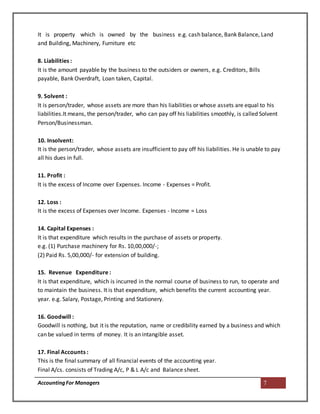
Unit I
Introduction to Concepts & Conventions of Accounting
Financial, Cost & Management Accounting
Accounting serves the purpose of providing financial information relating to activities of
a business. Such information is provided to shareholders, managers, creditors, debenture
holders, bankers, tax authorities and others. Broadly speaking, on the basis of type of
accounting information and the purpose for which such information is used, accounting may be
divided into three categories:
1. Financial Accounting (or General Accounting),
2. Cost Accounting, and
3. Management Accounting.
Financial Accounting
Financial accounting is mainly concerned with recording business transactions in the
books of accounts for the purpose of presenting final accounts to management, shareholders
and tax authorities, etc.
The information supplied by financial accounting is summarised in the following two
Statements at the end of the accounting period, generally one year.
(a) Profit and Loss Account showing the net profit or loss during the period.
(b) Balance Sheet showing the financial position of the firm at a point of time.
The objective of financial accounting is to present a true and fair view of company's
income and financial position at regular intervals of one year.
Limitations of Financial Accounting
Financial accounting suffers from certain limitations which have led to the emergence of
cost accounting.
1. Shows only overall performance.
Financial accounting provides information about profit, loss, cost, etc., of the collective
activities of the business as a whole. It does not give data regarding costs by departments,
products, processes and sales territories, etc.
2. Historical in nature.
Financial accounting is historical, since the data are summarised only at the end of the
accounting period. There is no system of computing day-to-day cost and also computing
predetermined costs.
AccountingFor Managers 2
3. No performance appraisal.
In financial A/c, there is no system of developing norms and standards to appraise the
efficiency in the use of materials, labour and other costs by comparing the actual performance
with what should have been accomplished during a given period of time.
4. No material control system.
Generally, there is no proper system of control of materials which may result in losses in the
form of obsolescence, deterioration, excessive scrap and misappropriation, etc.
5. No labour cost control.
In financial accounting, there is no system of recording cost of labour time, i.e. idle time.
Labour cost is not recorded by jobs, processes or departments
6. No proper classification of costs.
In financial accounting, expenses are not classified into direct and indirect, fixed and variable
and controllable and uncontrollable, etc. These classifications have utility of their own.
7. No analysis of losses.
Financial accounting does not fully analyse the losses due to idle time, idle plant capacity,
inefficient labour, sub-standard materials, etc. Thus, exact causes of the losses are not known.
8. Inadequate information for price fixation.
Costs are not available as an aid in determining prices of products,
services or production orders.
9. No cost comparison.
Comparison is the foundation of modern management control. But financial accounting does
not provide data for comparison of costs of different periods, different jobs or departments or
sales territories, etc.
10. Fails to supply useful data to management
Financial accounting fails to supply useful data to management for taking various decisions
like replacement of labour by machines, introduction of new products make or buy decisions
AccountingFor Managers 3
Management Accounting
Financial accounting had its beginning in earlier times along with the development of
trade and industry. Later, cost accounting came into the field. The management accounting
has come up out of cost accounting and the two are interlinked.
Management accounting is a system of accounting which is concerned with internal
reporting of information to management for:
(a) planning and controlling operations,
(b) decision-making on special matters, and
(c) formulating long-range plans.
Management accounting involves collecting, analyzing, interpreting and presenting all
accounting information which is useful to management. It reports not only historical data but
also estimates for future.
Objectives of Management Accounting
The primary objective of management accounting is to enable the management to
maximise profits or minimise losses. The fundamental object of management accounting is
to assist management in their functions of formulating policies, making decisions, planning
activities and controlling business operations. The evolution of management accounting has
given a new approach to the function of accounting. The main objectives or purposes of
management accounting can be summarised as follows :
1.Planning and Policy Formulation : Planning is one of the primary functions of management
It involves forecasting on the basis of available information, setting goals, framing policies,
determining the alternative courses of action and deciding on the programme of activities to
be undertaken. Management accounting can help greatly in these processes. Management
accounting facilitates for the preparation of statements in the light of past results and gives
estimation for the future.
2.Help in the Interpretation process : The main object of management accounting is to
present financial information to the management. Financial information is of technical
nature Therefore, the financial information must be presented in such a way that it is easily
understood apart from simple language. The management accounting presents accounting
information in intelligible manner and explains with the help of statistical devices like charts,
diagrams, graph index numbers etc.
3.Helps in Decision-making : Management accounting makes decision-making process
more modern and scientific by providing significant information relating to various alternatives
in terms of cost and revenue. With the help of techniques provided by management
accounting, details relating to cost, price, profit and savings for each of the available
alternatives are collected and analysed and provides a base for taking sound decisions.
AccountingFor Managers 4
4.Controlling : Management accounting is a useful device of managerial control. Management
accounting devices like standard costing and budgetary control are helpful in
controlling performance. The actual results are compared with pre-determined objectives.
Cost control is effected through the use of standard costing and departmental control is
made possible through the use of budgets. The management is able to control performance of
each and every individual with the help of management accounting devices.
5.Reporting : One of the primary objectives of management accounting is to keep the
management fully informed about the latest position of the concern. This facilitates
management to take proper and timely decisions. The object of management accounting is to
provide data. It presents the different alternative plans before the management in a
comparative manner. The performance of various departments is also regularly
communicated to the top management.
6.Motivating : Delegation increases the job satisfaction of employees and encourage
them to look forward. So it serves as a motivational device. Targets are laid down for
employees. The setting of goals, planning the best and economical course of action,
measuring the results etc. increase the effectiveness of the organisation and motivate the
workers.
7.Helps in Organising : "Return on Capital Employed" is one of the tools of management
accounting. Since management accounting stresses more on budget centres, investment
centres, cost centres and profit centres, with a view to control costs and responsibilities, it also
contributes to principles of decentralisation to a greater extent. All these aspects are
helpful in setting up an effective and efficient organisation framework.
8 Coordinating Operations : Management accounting helps in overallcontrol and coordination
of business operations. It provides tools which are helpful in coordinating the activities of
different
sections or departments. Budgets are important means of coordination
Cost Accounting
Cost Accounting was born to fulfill the needs of management of manufacturing
Companies for a detailed information about cost. It is a mechanism through which the
cost of product or services are ascertained.
Institute of Cost and works Accountants defines, “Cost Accounting is the technique and
process of ascertainment of costs, which begins with recording of expenses or the bases
on which they are calculated and ends with preparation of statistical data.”
Objectives of cost Accounting:
1. Ascertainment of Cost:
The object of cost accounting is to ascertain the true cost of every operation,
through a close watch – cost analysis and interpretation.
AccountingFor Managers 5
2. Fixation of Selling Price:
The cost data is useful for fixing selling price or quotation Apart from cost
ascertainment the cost accountant analyses cost into fixed and variable proportion.
The scientific way of reducing prices is possible only where a sound costing system
exists
3. Cost Control:
The object is to minimise the cost of manufacturing. Comparision of actual cost with
standard reveals discrepancies.
4. Matching cost with revenue:
The determination of profitability of each product, process, department is an
important object of costing
5. Special Cost Studies and Investigations:
It includes investigation for expansion or contraction programmes, product mix, price
reduction in depression
6. Preparation of financial statements:
While preparing the financial statements value of stock, WIP , Finished Goods is
facilitated by Cost accounting records
Cost Accounting Vs. Management Accounting
Cost Accounting:
1. Cost accountantisprimarilyconcernedwiththe ascertainment of cost and profitability and with
the control of costs through budgetary control, standard costing etc.
2. Cost accounting evolved out of financial accounting.
3. Cost Accountantsuggeststothe management the best of the alternatives by use of differential cost
method.
4. Cost accounting provides just cost information for managerial purpose.
Management Accounting:
1. The management accountant is concerned with all such matters in a wider perspective
which go to assist the management in the formulation of policies, improvement of
productivity, profitability etc.
2. Management accounting evolved out of cost accounting.
3. Management accountant takes into consideration the other non-cost factors also while
AccountingFor Managers 6
deciding upon alternatives.
4. Management accounting provides all accounting information. It utilises the principles and
practice of cost accounting and financial accounting in the best interests of the business.
Basic Terminologies inFinancial Accounting :
1. Goods :
These are the commodities/articles or things, with which a trader deals his business.
e.g. All stationery items are goods for stationery merchant.
All readymade garments are goods for M/s. Hira Dresses
T.V., Washing machines are goods for Kulkarni Electronics.
2. Capital :
It is the timely investment made by the trader to start, to operate and to expand the business.
The Capital in Company form of Organisation is the Share Capital . There are 2 types of Capital :
1. Equity share Capital
2. Preference share Capital
Preference share capital has preferential right in case of Dividend and Repayment of Capital at
the time of Liquidation of the Co.
The Rate of dividend on Preference share Capital is Fixed , the same is not true in case of
Equity share Capital
3. Drawings:
Drawings are withdrawals of a trader from business for personal use or domestic use. Goods or
cash or both can be withdrawn by a trader for personal use.
4. Creditor :
Creditor is a person, from whom goods are purchased on credit. He is supplier..
5. Bad Debts :
It is the amount, which is not recoverable from debtor or customer. Bad debts is a loss to the
business.
6. Reserve For Bad And Doubtful Debts : [R.D.D] :
It is the provision made to recover the loss of Bad Debts in the future/next year. R.D.D. is a
provision for future.
7. Assets :
AccountingFor Managers 7
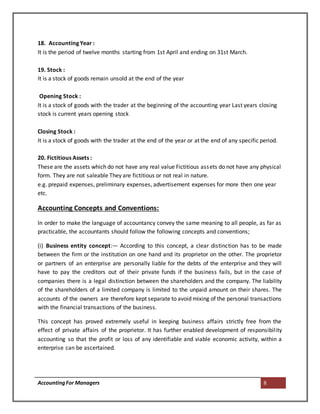
It is property which is owned by the business e.g. cash balance, Bank Balance, Land
and Building, Machinery, Furniture etc
8. Liabilities :
It is the amount payable by the business to the outsiders or owners, e.g. Creditors, Bills
payable, Bank Overdraft, Loan taken, Capital.
9. Solvent :
It is person/trader, whose assets are more than his liabilities or whose assets are equal to his
liabilities.It means, the person/trader, who can pay off his liabilities smoothly, is called Solvent
Person/Businessman.
10. Insolvent:
It is the person/trader, whose assets are insufficient to pay off his liabilities. He is unable to pay
all his dues in full.
11. Profit :
It is the excess of Income over Expenses. Income - Expenses = Profit.
12. Loss :
It is the excess of Expenses over Income. Expenses - Income = Loss
14. Capital Expenses :
It is that expenditure which results in the purchase of assets or property.
e.g. (1) Purchase machinery for Rs. 10,00,000/-;
(2) Paid Rs. 5,00,000/- for extension of building.
15. Revenue Expenditure :
It is that expenditure, which is incurred in the normal course of business to run, to operate and
to maintain the business. It is that expenditure, which benefits the current accounting year.
year. e.g. Salary, Postage, Printing and Stationery.
16. Goodwill :
Goodwill is nothing, but it is the reputation, name or credibility earned by a business and which
can be valued in terms of money. It is an intangible asset.
17. Final Accounts :
This is the final summary of all financial events of the accounting year.
Final A/cs. consists of Trading A/c, P & L A/c and Balance sheet.
AccountingFor Managers 8
18. Accounting Year :
It is the period of twelve months starting from 1st April and ending on 31st March.
19. Stock :
It is a stock of goods remain unsold at the end of the year
Opening Stock :
It is a stock of goods with the trader at the beginning of the accounting year Last years closing
stock is current years opening stock
Closing Stock :
It is a stock of goods with the trader at the end of the year or at the end of any specific period.
20. Fictitious Assets :
These are the assets which do not have any real value Fictitious assets do not have any physical
form. They are not saleable They are fictitious or not real in nature.
e.g. prepaid expenses, preliminary expenses, advertisement expenses for more then one year
etc.
Accounting Concepts and Conventions:
In order to make the language of accountancy convey the same meaning to all people, as far as
practicable, the accountants should follow the following concepts and conventions;
(i) Business entity concept:— According to this concept, a clear distinction has to be made
between the firm or the institution on one hand and its proprietor on the other. The proprietor
or partners of an enterprise are personally liable for the debts of the enterprise and they will
have to pay the creditors out of their private funds if the business fails, but in the case of
companies there is a legal distinction between the shareholders and the company. The liability
of the shareholders of a limited company is limited to the unpaid amount on their shares. The
accounts of the owners are therefore kept separate to avoid mixing of the personal transactions
with the financial transactions of the business.
This concept has proved extremely useful in keeping business affairs strictly free from the
effect of private affairs of the proprietor. It has further enabled development of responsibility
accounting so that the profit or loss of any identifiable and viable economic activity, within a
enterprise can be ascertained.
AccountingFor Managers 9
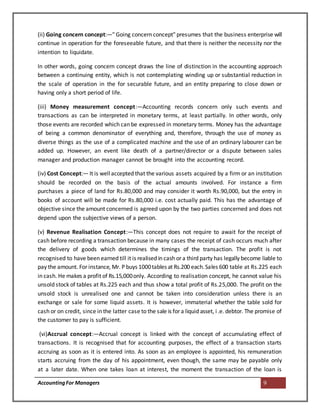
(ii) Going concern concept:—" Going concern concept" presumes that the business enterprise will
continue in operation for the foreseeable future, and that there is neither the necessity nor the
intention to liquidate.
In other words, going concern concept draws the line of distinction in the accounting approach
between a continuing entity, which is not contemplating winding up or substantial reduction in
the scale of operation in the for securable future, and an entity preparing to close down or
having only a short period of life.
(iii) Money measurement concept:—Accounting records concern only such events and
transactions as can be interpreted in monetary terms, at least partially. In other words, only
those events are recorded which can be expressed in monetary terms. Money has the advantage
of being a common denominator of everything and, therefore, through the use of money as
diverse things as the use of a complicated machine and the use of an ordinary labourer can be
added up. However, an event like death of a partner/director or a dispute between sales
manager and production manager cannot be brought into the accounting record.
(iv) Cost Concept:— It is wellaccepted that the various assets acquired by a firm or an institution
should be recorded on the basis of the actual amounts involved. For instance a firm
purchases a piece of land for Rs.80,000 and may consider it worth Rs.90,000, but the entry in
books of account will be made for Rs.80,000 i.e. cost actually paid. This has the advantage of
objective since the amount concerned is agreed upon by the two parties concerned and does not
depend upon the subjective views of a person.
(v) Revenue Realisation Concept:—This concept does not require to await for the receipt of
cash before recording a transaction because in many cases the receipt of cash occurs much after
the delivery of goods which determines the timings of the transaction. The profit is not
recognised to have been earned till it is realised in cash or a third party has legally become liable to
pay the amount. For instance, Mr. P buys 1000tables at Rs.200 each.Sales 600 table at Rs.225 each
in cash. He makes a profit of Rs.15,000only. According to realisation concept, he cannot value his
unsold stock of tables at Rs.225 each and thus show a total profit of Rs.25,000. The profit on the
unsold stock is unrealised one and cannot be taken into consideration unless there is an
exchange or sale for some liquid assets. It is however, immaterial whether the table sold for
cash or on credit, since in the latter case to the sale is for a liquid asset, i.e. debtor. The promise of
the customer to pay is sufficient.
(vi)Accrual concept:—Accrual concept is linked with the concept of accumulating effect of
transactions. It is recognised that for accounting purposes, the effect of a transaction starts
accruing as soon as it is entered into. As soon as an employee is appointed, his remuneration
starts accruing from the day of his appointment, even though, the same may be payable only
at a later date. When one takes loan at interest, the moment the transaction of the loan is
AccountingFor Managers 10
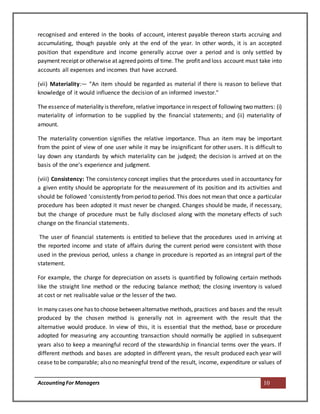
recognised and entered in the books of account, interest payable thereon starts accruing and
accumulating, though payable only at the end of the year. In other words, it is an accepted
position that expenditure and income generally accrue over a period and is only settled by
payment receipt or otherwise at agreed points of time. The profit and loss account must take into
accounts all expenses and incomes that have accrued.
(vii) Materiality:— “An item should be regarded as material if there is reason to believe that
knowledge of it would influence the decision of an informed investor."
The essence of materiality is therefore, relative importance in respect of following two matters: (i)
materiality of information to be supplied by the financial statements; and (ii) materiality of
amount.
The materiality convention signifies the relative importance. Thus an item may be important
from the point of view of one user while it may be insignificant for other users. It is difficult to
lay down any standards by which materiality can be judged; the decision is arrived at on the
basis of the one's experience and judgment.
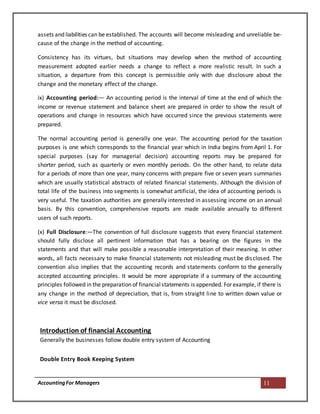
(viii) Consistency: The consistency concept implies that the procedures used in accountancy for
a given entity should be appropriate for the measurement of its position and its activities and
should be followed 'consistently fromperiod to period. This does not mean that once a particular
procedure has been adopted it must never be changed. Changes should be made, if necessary,
but the change of procedure must be fully disclosed along with the monetary effects of such
change on the financial statements.
The user of financial statements is entitled to believe that the procedures used in arriving at
the reported income and state of affairs during the current period were consistent with those
used in the previous period, unless a change in procedure is reported as an integral part of the
statement.
For example, the charge for depreciation on assets is quantified by following certain methods
like the straight line method or the reducing balance method; the closing inventory is valued
at cost or net realisable value or the lesser of the two.
In many cases one has to choose between alternative methods, practices and bases and the result
produced by the chosen method is generally not in agreement with the result that the
alternative would produce. In view of this, it is essential that the method, base or procedure
adopted for measuring any accounting transaction should normally be applied in subsequent
years also to keep a meaningful record of the stewardship in financial terms over the years. If
different methods and bases are adopted in different years, the result produced each year will
cease to be comparable; also no meaningful trend of the result, income, expenditure or values of
AccountingFor Managers 11
assets and liabilities can be established. The accounts will become misleading and unreliable be-
cause of the change in the method of accounting.
Consistency has its virtues, but situations may develop when the method of accounting
measurement adopted earlier needs a change to reflect a more realistic result. In such a
situation, a departure from this concept is permissible only with due disclosure about the
change and the monetary effect of the change.
ix) Accounting period:— An accounting period is the interval of time at the end of which the
income or revenue statement and balance sheet are prepared in order to show the result of
operations and change in resources which have occurred since the previous statements were
prepared.
The normal accounting period is generally one year. The accounting period for the taxation
purposes is one which corresponds to the financial year which in India begins from April 1. For
special purposes (say for managerial decision) accounting reports may be prepared for
shorter period, such as quarterly or even monthly periods. On the other hand, to relate data
for a periods of more than one year, many concerns with prepare five or seven years summaries
which are usually statistical abstracts of related financial statements. Although the division of
total life of the business into segments is somewhat artificial, the idea of accounting periods is
very useful. The taxation authorities are generally interested in assessing income on an annual
basis. By this convention, comprehensive reports are made available annually to different
users of such reports.
(x) Full Disclosure:—The convention of full disclosure suggests that every financial statement
should fully disclose all pertinent information that has a bearing on the figures in the
statements and that will make possible a reasonable interpretation of their meaning. In other
words, all facts necessary to make financial statements not misleading must be disclosed. The
convention also implies that the accounting records and statements conform to the generally
accepted accounting principles. It would be more appropriate if a summary of the accounting
principles followed in the preparation of financialstatements is appended. For example, if there is
any change in the method of depreciation, that is, from straight line to written down value or
vice versa it must be disclosed.
Introduction of financial Accounting
Generally the businesses follow double entry system of Accounting
Double Entry Book Keeping System
AccountingFor Managers 12
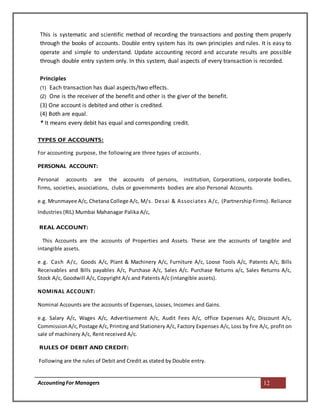
This is systematic and scientific method of recording the transactions and posting them properly
through the books of accounts. Double entry system has its own principles and rules. It is easy to
operate and simple to understand. Update accounting record and accurate results are possible
through double entry system only. In this system, dual aspects of every transaction is recorded.
Principles
(1) Each transaction has dual aspects/two effects.
(2) One is the receiver of the benefit and other is the giver of the benefit.
(3) One account is debited and other is credited.
(4) Both are equal.
* It means every debit has equal and corresponding credit.
TYPES OF ACCOUNTS:
For accounting purpose, the following are three types of accounts.
PERSONAL ACCOUNT:
Personal accounts are the accounts of persons, institution, Corporations, corporate bodies,
firms, societies, associations, clubs or governments bodies are also Personal Accounts.
e.g. Mrunmayee A/c, Chetana College A/c, M/s. Desai & Associates A/c, (Partnership Firms). Reliance
Industries (RIL) Mumbai Mahanagar Palika A/c,
REAL ACCOUNT:
This Accounts are the accounts of Properties and Assets. These are the accounts of tangible and
intangible assets.
e.g. Cash A/c, Goods A/c, Plant & Machinery A/c, Furniture A/c, Loose Tools A/c, Patents A/c, Bills
Receivables and Bills payables A/c, Purchase A/c, Sales A/c. Purchase Returns a/c, Sales Returns A/c,
Stock A/c, Goodwill A/c, Copyright A/c and Patents A/c (intangible assets).
NOMINAL ACCOUNT:
Nominal Accounts are the accounts of Expenses, Losses, Incomes and Gains.
e.g. Salary A/c, Wages A/c, Advertisement A/c, Audit Fees A/c, office Expenses A/c, Discount A/c,
CommissionA/c,Postage A/c, Printing and Stationery A/c, Factory Expenses A/c, Loss by fire A/c, profit on
sale of machinery A/c, Rent received A/c.
RULES OF DEBIT AND CREDIT:
Following are the rules of Debit and Credit as stated by Double entry.
AccountingFor Managers 13
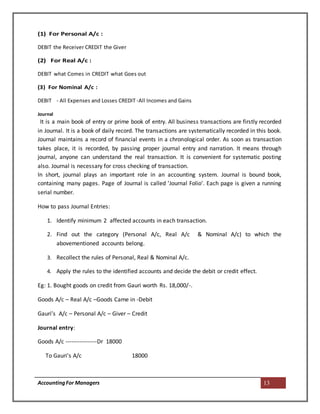
(1) For Personal A/c :
DEBIT the Receiver CREDIT the Giver
(2) For Real A/c :
DEBIT what Comes in CREDIT what Goes out
(3) For Nominal A/c :
DEBIT - All Expenses and Losses CREDIT -All Incomes and Gains
Journal
It is a main book of entry or prime book of entry. All business transactions are firstly recorded
in Journal. It is a book of daily record. The transactions are systematically recorded in this book.
Journal maintains a record of financial events in a chronological order. As soon as transaction
takes place, it is recorded, by passing proper journal entry and narration. It means through
journal, anyone can understand the real transaction. It is convenient for systematic posting
also. Journal is necessary for cross checking of transaction.
In short, journal plays an important role in an accounting system. Journal is bound book,
containing many pages. Page of Journal is called 'Journal Folio'. Each page is given a running
serial number.
How to pass Journal Entries:
1. Identify minimum 2 affected accounts in each transaction.
2. Find out the category (Personal A/c, Real A/c & Nominal A/c) to which the
abovementioned accounts belong.
3. Recollect the rules of Personal, Real & Nominal A/c.
4. Apply the rules to the identified accounts and decide the debit or credit effect.
Eg: 1. Bought goods on credit from Gauri worth Rs. 18,000/-.
Goods A/c – Real A/c –Goods Came in -Debit
Gauri’s A/c – Personal A/c – Giver – Credit
Journal entry:
Goods A/c ----------------Dr 18000
To Gauri’s A/c 18000
AccountingFor Managers 14
2. Bought goods from Radhika for cash Rs. 20000/-
Goods A/c – Real A/c –Goods Came in -Debit
Cash A/c – Real A/c –Cash gone out – Credit
Journal entry:
Goods A/c ----------------Dr 20000
To Cash A/c 20000
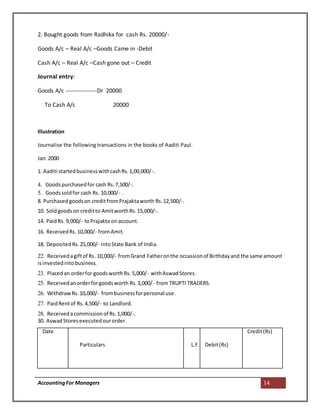
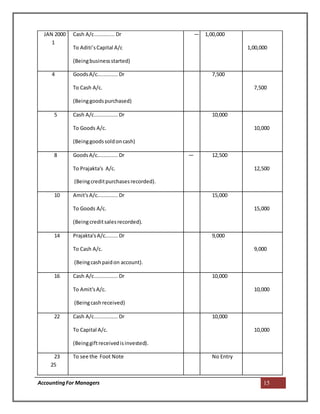
Illustration
Journalise the following transactions in the books of Aaditi Paul.
Jan.2000
1. Aaditi startedbusinesswithcashRs.1,00,000/-.
4. Goodspurchasedfor cash Rs.7,500/-.
5. Goodssoldfor cash Rs. 10,000/- .
8. Purchasedgoodson creditfromPrajaktaworth Rs.12,500/-.
10. Soldgoodson creditto AmitworthRs.15,000/-.
14. PaidRs. 9,000/- toPrajakta onaccount.
16. ReceivedRs.10,000/- fromAmit.
18. DepositedRs.25,000/- intoState Bank of India.
22. Receivedagiftof Rs. 10,000/- fromGrand Fatheronthe occassionof Birthdayand the same amount
isinvestedintobusiness.
23. Placedan orderfor goodsworthRs. 5,000/- withAswadStores.
25. Receivedanorderforgoodsworth Rs.3,000/- from TRUPTI TRADERS.
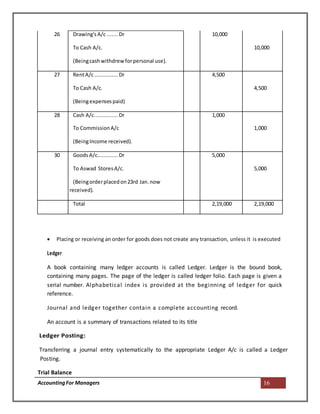
26. WithdrawRs.10,000/- frombusinessforpersonal use.
27. PaidRentof Rs.4,500/- to Landlord.
28. Receivedacommissionof Rs.1,000/-.
30. AswadStoresexecutedourorder.
Date Credit(Rs)
Particulars L.F. Debit(Rs)
AccountingFor Managers 15
JAN 2000
1
Cash A/c............. Dr
To Aditi’sCapital A/c
(Beingbusinessstarted)
— 1,00,000
1,00,000
4 GoodsA/c............. Dr
To Cash A/c.
(Beinggoodspurchased)
7,500
7,500
5 Cash A/c............... Dr
To Goods A/c.
(Beinggoodssoldoncash)
10,000
10,000
8 GoodsA/c............. Dr
To Prajakta's A/c.
(Beingcreditpurchasesrecorded).
— 12,500
12,500
10 Amit'sA/c............. Dr
To Goods A/c.
(Beingcreditsalesrecorded).
15,000
15,000
14 Prajakta'sA/c........ Dr
To Cash A/c.
(Beingcashpaidon account).
9,000
9,000
16 Cash A/c............... Dr
To Amit'sA/c.
(Beingcashreceived)
10,000
10,000
22 Cash A/c............... Dr
To Capital A/c.
(Beinggiftreceivedisinvested).
10,000
10,000
23
25
To see the Foot Note No Entry
AccountingFor Managers 16
 Placing or receiving an order for goods does not create any transaction, unless it is executed
Ledger
A book containing many ledger accounts is called Ledger. Ledger is the bound book,
containing many pages. The page of the ledger is called ledger folio. Each page is given a
serial number. Alphabetical index is provided at the beginning of ledger for quick
reference.
Journal and ledger together contain a complete accounting record.
An account is a summary of transactions related to its title
Ledger Posting:
Transferring a journal entry systematically to the appropriate Ledger A/c is called a Ledger
Posting.
Trial Balance
26 Drawing'sA/c ....... Dr
To Cash A/c.
(Beingcashwithdrewforpersonal use).
10,000
10,000
27 RentA/c............... Dr
To Cash A/c.
(Beingexpensespaid)
4,500
4,500
28 Cash A/c............... Dr
To CommissionA/c
(BeingIncome received).
1,000
1,000
30 GoodsA/c............. Dr
To Aswad StoresA/c.
(Beingorderplacedon23rd Jan.now
received).
5,000
5,000
Total 2,19,000 2,19,000
AccountingFor Managers 17
We know that the fundamental principle of Double Entry System of Accounting is that for every
debit there must be corresponding credit. It follows, therefore, that the sum total of debit
amounts should equal to the credit amounts of the ledger at any date. But if the various
accounts in the ledger are balanced then the total of all debit balance amount should be equal
to the total of all credit balances, if the books of accounts are arithmetically accurate.
Thus, at the end of the financial year or at any other date, the balances of all the ledger
accounts are extracted and are written up in a statement known as Trial Balance and finally
totaled up to see if the total of debit balances is equal to the total of credit balances.
The agreement of the Trial Balance reveals that both the aspects of each transaction have been
recorded and that the books are arithmetically accurate. If the Trial Balance does not agree, it
shows that there are some errors which must be detected and rectified if the correct final
accounts are to be prepared. Thus, Trial Balance forms a connecting link between the ledger
accounts and the final accounts.
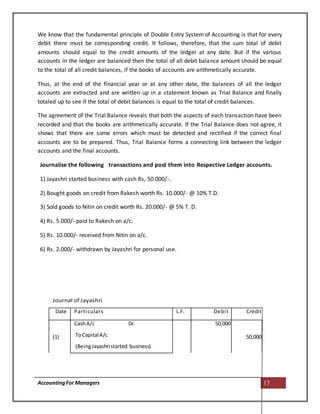
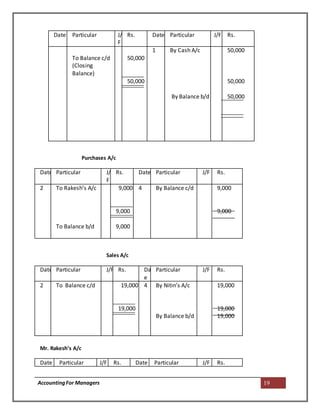
Journalise the following transactions and post them into Respective Ledger accounts.
1) Jayashri started business with cash Rs, 50.000/-.
2) Bought goods on credit from Rakesh worth Rs. 10.000/- @ 10% T.D.
3) Sold goods to Nitin on credit worth Rs. 20.000/- @ 5% T. D.
4) Rs. 5.000/- paid to Rakesh on a/c.
5) Rs. 10.000/- received from Nitin on a/c.
6) Rs. 2.000/- withdrawn by Jayashri for personal use.
Journal of Jayashri
Date Particulars L.F. Debit Credit
(1)
(2)
(3)
CashA/c Dr.
ToCapitalA/c.
(BeingJayashristarted business)
50,000
9,000
19,000
50,000
9,000
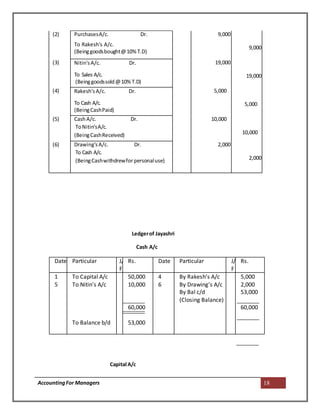
AccountingFor Managers 18
Ledgerof Jayashri
Cash A/c
Date Particular J/
F
Rs. Date Particular J/
F
Rs.
1
5
To Capital A/c
To Nitin’s A/c
To Balance b/d
50,000
10,000
60,000
53,000
4
6
By Rakesh’s A/c
By Drawing’s A/c
By Bal c/d
(Closing Balance)
5,000
2,000
53,000
60,000
Capital A/c
(2) PurchasesA/c. Dr.
To Rakesh's A/c.
(Beinggoodsbought@10% T.D)
9,000
9,000
(3) Nitin'sA/c. Dr.
To Sales A/c.
(Beinggoodssold@10%T.D)
19,000
19,000
(4) Rakesh's A/c. Dr.
To Cash A/c.
(BeingCashPaid)
5,000
5,000
(5) CashA/c. Dr.
ToNitin'sA/c.
(BeingCashReceived)
10,000
10,000
(6) Drawing'sA/c. Dr.
To Cash A/c.
(BeingCashwithdrewforpersonaluse)
2,000
2,000
AccountingFor Managers 19
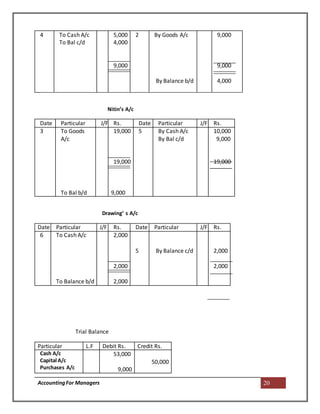
Date Particular J/
F
Rs. Date Particular J/F Rs.
To Balance c/d
(Closing
Balance)
50,000
50,000
1 By Cash A/c
By Balance b/d
50,000
50,000
50,000
Purchases A/c
Sales A/c
Mr. Rakesh’s A/c
Date Particular J/F Rs. Date Particular J/F Rs.
Date Particular J/
F
Rs. Date Particular J/F Rs.
2 To Rakesh’s A/c
To Balance b/d
9,000
9,000
9,000
4 By Balance c/d 9,000
9,000
Date Particular J/F Rs. Dat
e
Particular J/F Rs.
2 To Balance c/d 19,000
19,000
4 By Nitin’s A/c
By Balance b/d
19,000
19,000
19,000
AccountingFor Managers 20
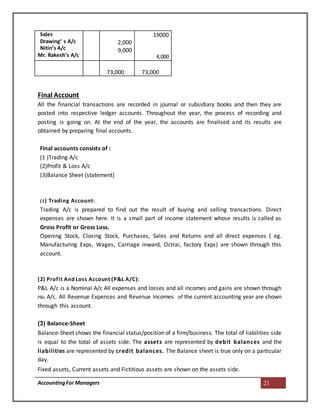
4 To Cash A/c
To Bal c/d
5,000
4,000
9,000
2 By Goods A/c
By Balance b/d
9,000
9,000
4,000
Nitin’s A/c
Date Particular J/F Rs. Date Particular J/F Rs.
3 To Goods
A/c
To Bal b/d
19,000
19,000
9,000
5 By Cash A/c
By Bal c/d
10,000
9,000
19,000
Drawing‘ s A/c
Date Particular J/F Rs. Date Particular J/F Rs.
6 To Cash A/c
To Balance b/d
2,000
2,000
2,000
5 By Balance c/d 2,000
2,000
Trial Balance
Particular L.F Debit Rs. Credit Rs.
Cash A/c
Capital A/c
Purchases A/c
53,000
9,000
50,000
AccountingFor Managers 21
Sales
Drawing‘ s A/c
Nitin’s A/c
Mr. Rakesh’s A/c
2,000
9,000
19000
4,000
73,000 73,000
Final Account
All the financial transactions are recorded in journal or subsidiary books and then they are
posted into respective ledger accounts. Throughout the year, the process of recording and
posting is going on. At the end of the year, the accounts are finalised and its results are
obtained by preparing final accounts.
Final accounts consists of :
(1 )Trading A/c
(2)Profit & Loss A/c
(3)Balance Sheet (statement)
(1) Trading Account:
Trading A/c is prepared to find out the result of buying and selling transactions. Direct
expenses are shown here. It is a small part of income statement whose results is called as
Gross Profit or Gross Loss.
Opening Stock, Closing Stock, Purchases, Sales and Returns and all direct expenses ( eg.
Manufacturing Exps, Wages, Carriage inward, Octrai, factory Exps) are shown through this
account.
(2) Profit And Loss Account (P&L A/C):
P&L A/c is a Nominal A/c All expenses and losses and all incomes and gains are shown through
P&L A/c. All Revenue Expenses and Revenue Incomes of the current accounting year are shown
through this account.
(3) Balance-Sheet
Balance-Sheet shows the financial status/position of a firm/business. The total of liabilities side
is equal to the total of assets side. The assets are represented by debit balances and the
liabilities are represented by credit balances. The Balance sheet is true only on a particular
day.
Fixed assets, Current assets and Fictitious assets are shown on the assets side.
AccountingFor Managers 22
Fixed liabilities, Current Liabilities and Contingent liabilities are shown on the liability side of
Balance sheet.
Adjustments:
Def.: It is an unrecorded transaction and it should be recorded at the end of the year through
final accounts by giving two equal effects, (i.e. Debit and Credit).
e.g. Depreciation, Outstanding expenses, Prepaid expenses etc are recorded at the end of the
year through final accounts
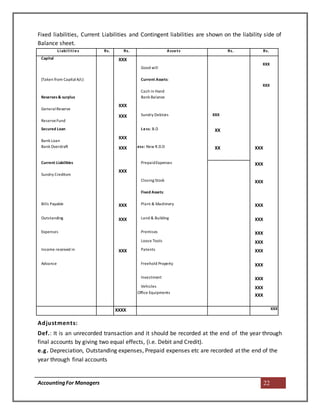
Liabilities Rs. Rs. Assets Rs. Rs.
Capital XXX
Good will
XXX
(Taken from CapitalA/c) Current Assets:
Cash in Hand
XXX
Reserves& surplus
GeneralReserve
XXX
Bank Balance
ReserveFund
XXX Sundry Debtors XXX
Secured Loan
Bank Loan
XXX
Less: B.D XX
Bank Overdraft XXX LesLess: New R.D.D XX XXX
Current Liabilities
Sundry Creditors
XXX
PrepaidExpenses XXX
Closing Stock
Fixed Assets:
XXX
Bills Payable XXX Plant & Machinery XXX
Outstanding XXX Land & Building XXX
Expenses Premises XXX
Loose Tools XXX
Income received in XXX Patents XXX
Advance Freehold Property XXX
Investment XXX
Vehicles
Office Equipments
XXX
XXX
XXXX XXX
AccountingFor Managers 23
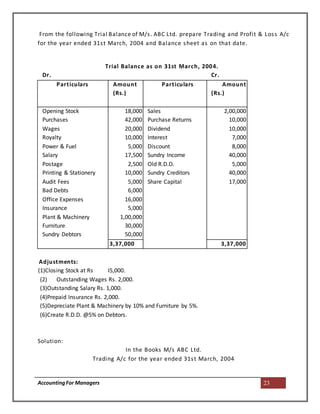
From the following Trial Balance of M/s. ABC Ltd. prepare Trading and Profit & Loss A/c
for the year ended 31st March, 2004 and Balance sheet as on that date.
Trial Balance as on 31st March, 2004.
Dr. Cr.
Particulars Amount Particulars Amount
(Rs.) (Rs.)
Opening Stock 18,000 Sales 2,00,000
Purchases 42,000 Purchase Returns 10,000
Wages 20,000 Dividend 10,000
Royalty 10,000 Interest 7,000
Power & Fuel 5,000 Discount 8,000
Salary 17,500 Sundry Income 40,000
Postage 2,500 Old R.D.D. 5,000
Printing & Stationery 10,000 Sundry Creditors 40,000
Audit Fees 5,000 Share Capital 17,000
Bad Debts 6,000
Office Expenses 16,000
Insurance 5,000
Plant & Machinery 1,00,000
Furniture 30,000
Sundry Debtors 50,000
3,37,000 3,37,000
Adjustments:
(1) (1)Closing Stock at Rs 3535,000.
(2) Outstanding Wages Rs. 2,000.
(3)Outstanding Salary Rs. 1,000.
(4)Prepaid Insurance Rs. 2,000.
(5)Depreciate Plant & Machinery by 10% and Furniture by 5%.
(6)Create R.D.D. @5% on Debtors.
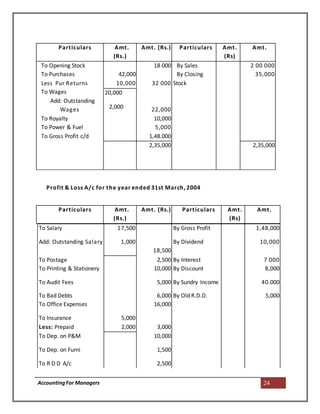
Solution:
In the Books M/s ABC Ltd.
Trading A/c for the year ended 31st March, 2004
AccountingFor Managers 24
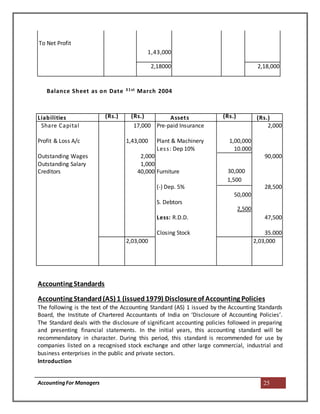
Profit & Loss A/c for the year ended 31st March, 2004
To Salary 17,500 By Gross Profit 1,48,000
Add: Outstanding Salary 1,000
18,500
By Dividend 10,000
To Postage 2,500 By Interest 7 000
To Printing & Stationery 10,000 By Discount 8,000
To Audit Fees 5,000 By Sundry Income 40.000
To Bad Debts 6,000 By Old R.D.D. 5,000
To Office Expenses 16,000
To Insurance 5,000
Less: Prepaid 2,000 3,000
To Dep. on P&M 10,000
To Dep. on Furni 1,500
To R D D A/c 2,500
Particulars Amt.
(Rs.)
Amt. (Rs.) Particulars Amt.
(Rs)
Amt.
To Opening Stock
To Purchases
Less Pur Returns
To Wages
Add: Outstanding
Wages
To Royalty
To Power & Fuel
To Gross Profit c/d
42,000
10,000
20,000
2,000
18 000
32 000
22,000
10,000
5,000
1,48.000
By Sales
By Closing
Stock
2 00 000
35,000
2,35,000 2,35,000
Particulars Amt.
(Rs.)
Amt. (Rs.) Particulars Amt.
(Rs)
Amt.
AccountingFor Managers 25
To Net Profit
1,43,000
2,18000 2,18,000
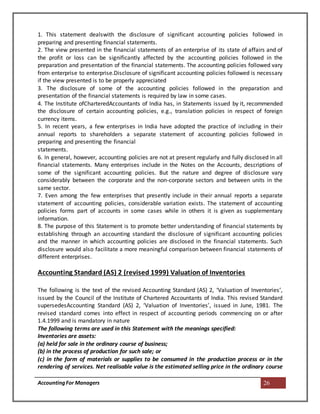
Balance Sheet as on Date 31st March 2004
Accounting Standards
Accounting Standard(AS) 1 (issued1979) Disclosureof Accounting Policies
The following is the text of the Accounting Standard (AS) 1 issued by the Accounting Standards
Board, the Institute of Chartered Accountants of India on ‘Disclosure of Accounting Policies’.
The Standard deals with the disclosure of significant accounting policies followed in preparing
and presenting financial statements. In the initial years, this accounting standard will be
recommendatory in character. During this period, this standard is recommended for use by
companies listed on a recognised stock exchange and other large commercial, industrial and
business enterprises in the public and private sectors.
Introduction
Liabilities (Rs.) (Rs.) Assets (Rs.) (Rs.)
Share Capital
Profit & Loss A/c
Outstanding Wages
Outstanding Salary
Creditors
17,000
1,43,000
2,000
1,000
40,000
Pre-paid Insurance
Plant & Machinery
Less: Dep 10%
Furniture
(-) Dep. 5%
S. Debtors
Less: R.D.D.
Closing Stock
1,00,000
10.000
30,000
1,500
50,000
2,500
2,000
90,000
28,500
47,500
35.000
2,03,000 2,03,000
AccountingFor Managers 26
1. This statement dealswith the disclosure of significant accounting policies followed in
preparing and presenting financial statements.
2. The view presented in the financial statements of an enterprise of its state of affairs and of
the profit or loss can be significantly affected by the accounting policies followed in the
preparation and presentation of the financial statements. The accounting policies followed vary
from enterprise to enterprise.Disclosure of significant accounting policies followed is necessary
if the view presented is to be properly appreciated
3. The disclosure of some of the accounting policies followed in the preparation and
presentation of the financial statements is required by law in some cases.
4. The Institute ofCharteredAccountants of India has, in Statements issued by it, recommended
the disclosure of certain accounting policies, e.g., translation policies in respect of foreign
currency items.
5. In recent years, a few enterprises in India have adopted the practice of including in their
annual reports to shareholders a separate statement of accounting policies followed in
preparing and presenting the financial
statements.
6. In general, however, accounting policies are not at present regularly and fully disclosed in all
financial statements. Many enterprises include in the Notes on the Accounts, descriptions of
some of the significant accounting policies. But the nature and degree of disclosure vary
considerably between the corporate and the non-corporate sectors and between units in the
same sector.
7. Even among the few enterprises that presently include in their annual reports a separate
statement of accounting policies, considerable variation exists. The statement of accounting
policies forms part of accounts in some cases while in others it is given as supplementary
information.
8. The purpose of this Statement is to promote better understanding of financial statements by
establishing through an accounting standard the disclosure of significant accounting policies
and the manner in which accounting policies are disclosed in the financial statements. Such
disclosure would also facilitate a more meaningful comparison between financial statements of
different enterprises.
Accounting Standard (AS) 2 (revised 1999) Valuation of Inventories
The following is the text of the revised Accounting Standard (AS) 2, ‘Valuation of Inventories’,
issued by the Council of the Institute of Chartered Accountants of India. This revised Standard
supersedesAccounting Standard (AS) 2, ‘Valuation of Inventories’, issued in June, 1981. The
revised standard comes into effect in respect of accounting periods commencing on or after
1.4.1999 and is mandatory in nature
The following terms are used in this Statement with the meanings specified:
Inventories are assets:
(a) held for sale in the ordinary course of business;
(b) in the process of production for such sale; or
(c) in the form of materials or supplies to be consumed in the production process or in the
rendering of services. Net realisable value is the estimated selling price in the ordinary course
AccountingFor Managers 27
of business less the estimated costs of completion and the estimated costs necessary to make
the sale.
4. Inventories encompass goods purchased and held for resale, for example, merchandise
purchased by a retailer and held for resale, computer software held for resale, or land and
other property held for resale. Inventories also encompass finished goods produced, or work in
progress being produced, by the enterprise and include materials, maintenance supplies,
consumables and loose tools awaiting use in the production process. Inventories do not include
machinery spares which can be used only in connection with an itemof fixed asset and whose
use is expected to be irregular; suchmachinery spares are accounted for in accordance with
Accounting Standard (AS) 10, Accounting for Fixed Assets.
Accounting Standard (AS) 3 (revised 1997)
Accounting Standard (AS) 3, ‘Cash Flow Statements’ (revised 1997), issued by the Council of the
Institute of Chartered Accountants of India, comes into effect in respect of accounting periods
commencing on or after
1-4-1997. This Standard supersedes Accounting Standard (AS) 3, ‘Changes in Financial Position’,
issued in June 1981. This Standard is mandatory in nature2 in respect of accounting periods
commencing on or after 1-4-20043 for the enterprises which fall in any one or more of the
following categories, at any time during the accounting period:
(i) Enterprises whose equity or debt securities are listed whether in India or outside India.
(ii) Enterprises which are in the process of listing their equity or debt securities as evidenced by
the board of directors’ resolution in this regard.
(iii) Banks including co-operative banks.
(iv) Financial institutions.
(v) Enterprises carrying on insurance business.
(vi) All commercial, industrial and business reporting enterprises, whose turnover for the
immediately preceding accounting period on the basis of audited financial statements exceeds
Rs. 50 crore. Turnover does not include ‘other income’.
(vii) All commercial, industrial and business reporting enterprises having borrowings, including
public deposits, in excess of Rs. 10 crore at any time during the accounting period.
(viii)Holding and subsidiary enterprises of any one of the above at any time during the
accounting period. The enterprises which do not fall in any of the above categories are
encouraged, but are not required, to apply this Standard. Where an enterprise has been
covered in any one or more of the above categories and subsequently, ceases to be so covered,
the enterprise will not qualify for exemption from application of this Standard, until the
enterprise ceases to be covered in any of the above categories for two consecutive years.
Where an enterprise has previously qualified for exemption from application of this Standard
(being not covered by any of the above categories) but no longer qualifies for exemption in the
current accounting period, this Standard
becomes applicable from the current period. However, the corresponding previous period
figures need not be disclosed. An enterprise, which, pursuant to the above provisions, does not
present a cash flow statement, should disclose the fact.
AccountingFor Managers 28
Definitions
The following terms are used in this Statement with the meanings specified:
 Cash comprises cash on hand and demand deposits with banks.
 Cash equivalents are short term, highly liquid investments that are readily convertible
into known amounts of cash and which are subject to an insignificant risk of changes in
value.
 Cash flows are inflows and outflows of cash and cash equivalents. Operating activities
are the principal revenue-producing activities of the enterprise and other activities that
are not investing or financing activities. Investing activities are the acquisition and
disposal of long-term assetsand other investments not included in cash equivalents.
Financing activities are activities that result in changes in the size and composition of the
owners’ capital (including preference share capital in the case of a company) and
borrowings of the enterprise.
Accounting Standard (AS) 5 (revised 1997) ‘Net Profit or Loss for the Period,
Prior Period Items and Changes in Accounting Policies’
The following is the text of the revised Accounting Standard (AS) 5, ‘Net Profit or Loss for the
Period, Prior Period Items and Changes in Accounting Policies’, issued by the Council of the
Institute of Chartered Accountants of India. This revised standard comes into effect in respect
of accounting periods commencing on or after 1.4.1996 and is mandatory in nature.2 It is
clarified that in respect of accounting periods commencing on a date prior to 1.4.1996,
Accounting Standard 5 as originally issued in November, 1982 (and subsequently made
mandatory) will apply.
Definitions
The following terms are used in this Statement with the meanings specified:
Ordinary activities are any activities which are undertaken by an enterprise as part of its
business and such related activities in which the enterprise engages in furtherance of, incidental
to, or arising from, these activities. Extraordinary items are income or expenses that arise from
events or transactions that are clearly distinct from the ordinary activities of the enterprise and,
therefore, are not expected to recur frequently or regularly. Prior period items are income or
expenses which arise in the current period as a result of errors or omissions in the preparation of
the financial statements of one or more prior periods. Accounting policies are the specific
accounting principles and themethods of applying those principles adopted by an enterprise in
the preparation and presentation of financial statements.
Accounting Standard (AS) 6 (revised 1994) Depreciation Accounting
This Statement deals with depreciation accounting and applies to all depreciable assets, except
the following items to which special considerations apply:—
(i) forests, plantations and similar regenerative natural resources;
(ii) wasting assets including expenditure on the exploration for and extraction ofminerals, oils,
natural gas and similar non-regenerative resources;
(iii) expenditure on research and development ;
(iv) goodwill;
AccountingFor Managers 29
(v) live stock.
This statement also does not apply to land unless it has a limited useful life for the enterprise.
2. Different accounting policies for depreciation are adopted by different enterprises.
Disclosure of accounting policies for depreciation followed by an enterprise is necessary to
appreciate the view presented in the financial statements of the enterprise.
Definitions
The following terms are used in this Statement with the meanings specified:
Depreciation is a measure of the wearing out, consumption or other loss of value of a
depreciable asset arising from use, effluxion of time or obsolescence through technology and
market changes. Depreciation is allocated so as to charge a fair proportion of the depreciable
amount in each accounting period during the expected useful life of the asset. Depreciation
includes amortisation of assets whose useful life is predetermined. Depreciable assets are
assets which
(i) are expected to be used during more than one accounting period; And
(ii) have a limited useful life; and
(iii) (iii) are held by an enterprise for use in the production or supply of goods and
services, for rental to others, or for administrative purposes and not for the purpose
of sale in the ordinary course of
business. Useful life is either (i) the period over which a depreciable asset is expected to be
used by the enterprise; or (ii) the number of production or
similarunitsexpectedtobeobtainedfromtheuseof theassetbytheenterprise. Depreciable amount
of a depreciable asset is its historical cost, or other amount substituted for historical cost in the
financial statements, less the estimated residual value.
Accounting Standard (AS) 9 (issued 1985) Revenue Recognition
The following is the text of the Accounting Standard (AS) 9 issued by the Institute of Chartered
Accountants of India on ‘Revenue Recognition’. In the initial years, this accounting standard will
be recommendatory in character. During this period, this standard is recommended for use by
companies listed on a recognised stock exchange and other large commercial, industrial and
business enterprises in the public and private sectors.
Introduction
1. This Statement deals with the bases for recognition of revenue in the statement of profit and
loss of an enterprise. The Statement is concerned with the recognition of revenue arising in the
course of the ordinary activities of the enterprise from
— the sale of goods
— the rendering of services, and
— the use by others of enterprise resources yielding interest, royalties and dividends.
2. This Statement does not deal with the following aspects of revenue recognition to which
special considerations apply:
(i) Revenue arising from construction contracts;5
(ii) Revenue arising from hire-purchase, lease agreements;
(iii) Revenue arising from government grants and other similar subsidies;
(iv) Revenue of insurance companies arising frominsurance contracts.
AccountingFor Managers 30
3. Examples of items not included within the definition of “revenue” for the purpose of this
Statement are:
(i) Realised gains resulting fromthe disposal of, and unrealised gains resulting fromthe holding
of, non-current assets e.g. appreciation in the value of fixed assets;
(ii) Unrealised holding gains resulting from the change in value of current assets, and the
natural increases in herds and agricultural and forest products;
(iii) Realised or unrealised gains resulting from changes in foreign exchange rates and
adjustments arising on the translation of foreign currency financial statements;
(iv) Realised gains resulting from the discharge of an obligation at less than its carrying amount;
(v) Unrealised gains resulting from the restatement of the carrying amount of an obligation.
Definitions
Revenue Recognition 131
The following terms are used in this Statement with the meanings specified:
1. Revenue is the gross inflow of cash, receivables or other consideration arising in the
course of the ordinary activities of an enterprise6 from the sale of goods, from the
rendering of services, and from the use by others of enterprise resources yielding
interest, royalties and dividends. Revenue is measured by the charges made to
customers or clients for goods supplied and services rendered to them and by the
charges and rewards arising from the use of resources by them. In an agency
relationship, the revenue is the amount of commission and not the gross inflow of cash,
receivables or other consideration. Completed service contract method is a method of
accounting which recognises revenue in the statement of profit and loss onlywhen the
rendering of services under a contract is completed or substantially completed.
2. Proportionate completion method is a method of accounting which recognises revenue
in the statement of profit and loss proportionately with the degree of completion of
services under a contract.
Accounting Standard (AS) 10 (issued 1985) Accounting for Fixed Assets
The following is the text of theAccounting Standard (AS) 10 issued by the Institute of Chartered
Accountants of India on ‘Accounting for Fixed Assets’. In the initial years, this accounting
standard will be recommendatory in character. During this period, this standard is
recommended for use by companies listed on a recognised stock exchange and other large
commercial, industrial and business enterprises in the public and private sectors.
Introduction
1. Financial statements disclose certain information relating to fixed assets. In many enterprises
these assets are grouped into various categories, such as land, buildings, plant and machinery,
vehicles, furniture and fittings,goodwill, patents, trade marks and designs. This statement deals
with accounting for such fixed assets except as described in paragraphs 2 to 5 below 2. This
statement does not deal with the specialised aspects of accounting for fixed assets that arise
under a comprehensive system reflecting the effects of changing prices but applies to financial
statements prepared on historical cost basis.
3. This statement does not deal with accounting for the following items to which special
considerations apply:
AccountingFor Managers 31
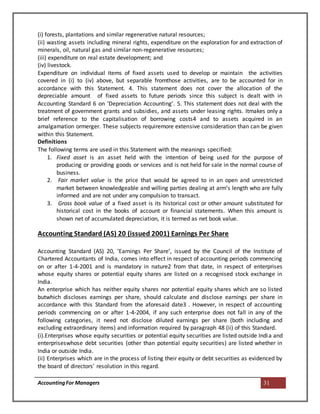
(i) forests, plantations and similar regenerative natural resources;
(ii) wasting assets including mineral rights, expenditure on the exploration for and extraction of
minerals, oil, natural gas and similar non-regenerative resources;
(iii) expenditure on real estate development; and
(iv) livestock.
Expenditure on individual items of fixed assets used to develop or maintain the activities
covered in (i) to (iv) above, but separable fromthose activities, are to be accounted for in
accordance with this Statement. 4. This statement does not cover the allocation of the
depreciable amount of fixed assets to future periods since this subject is dealt with in
Accounting Standard 6 on ‘Depreciation Accounting’. 5. This statement does not deal with the
treatment of government grants and subsidies, and assets under leasing rights. Itmakes only a
brief reference to the capitalisation of borrowing costs4 and to assets acquired in an
amalgamation ormerger. These subjects requiremore extensive consideration than can be given
within this Statement.
Definitions
The following terms are used in this Statement with the meanings specified:
1. Fixed asset is an asset held with the intention of being used for the purpose of
producing or providing goods or services and is not held for sale in the normal course of
business.
2. Fair market value is the price that would be agreed to in an open and unrestricted
market between knowledgeable and willing parties dealing at arm’s length who are fully
informed and are not under any compulsion to transact.
3. Gross book value of a fixed asset is its historical cost or other amount substituted for
historical cost in the books of account or financial statements. When this amount is
shown net of accumulated depreciation, it is termed as net book value.
Accounting Standard (AS) 20 (issued 2001) Earnings Per Share
Accounting Standard (AS) 20, ‘Earnings Per Share’, issued by the Council of the Institute of
Chartered Accountants of India, comes into effect in respect of accounting periods commencing
on or after 1-4-2001 and is mandatory in nature2 from that date, in respect of enterprises
whose equity shares or potential equity shares are listed on a recognised stock exchange in
India.
An enterprise which has neither equity shares nor potential equity shares which are so listed
butwhich discloses earnings per share, should calculate and disclose earnings per share in
accordance with this Standard from the aforesaid date3 . However, in respect of accounting
periods commencing on or after 1-4-2004, if any such enterprise does not fall in any of the
following categories, it need not disclose diluted earnings per share (both including and
excluding extraordinary items) and information required by paragraph 48 (ii) of this Standard.
(i).Enterprises whose equity securities or potential equity securities are listed outside India and
enterpriseswhose debt securities (other than potential equity securities) are listed whether in
India or outside India.
(ii) Enterprises which are in the process of listing their equity or debt securities as evidenced by
the board of directors’ resolution in this regard.
AccountingFor Managers 32
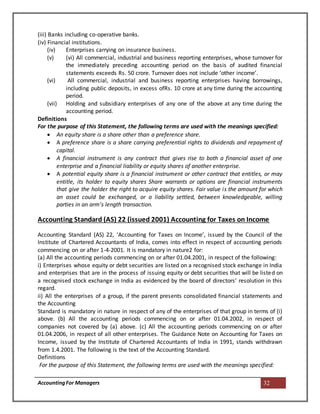
(iii) Banks including co-operative banks.
(iv) Financial institutions.
(iv) Enterprises carrying on insurance business.
(v) (vi) All commercial, industrial and business reporting enterprises, whose turnover for
the immediately preceding accounting period on the basis of audited financial
statements exceeds Rs. 50 crore. Turnover does not include ‘other income’.
(vi) All commercial, industrial and business reporting enterprises having borrowings,
including public deposits, in excess ofRs. 10 crore at any time during the accounting
period.
(vii) Holding and subsidiary enterprises of any one of the above at any time during the
accounting period.
Definitions
For the purpose of this Statement, the following terms are used with the meanings specified:
 An equity share is a share other than a preference share.
 A preference share is a share carrying preferential rights to dividends and repayment of
capital.
 A financial instrument is any contract that gives rise to both a financial asset of one
enterprise and a financial liability or equity shares of another enterprise.
 A potential equity share is a financial instrument or other contract that entitles, or may
entitle, its holder to equity shares Share warrants or options are financial instruments
that give the holder the right to acquire equity shares. Fair value is the amount for which
an asset could be exchanged, or a liability settled, between knowledgeable, willing
parties in an arm’s length transaction.
Accounting Standard (AS) 22 (issued 2001) Accounting for Taxes on Income
Accounting Standard (AS) 22, ‘Accounting for Taxes on Income’, issued by the Council of the
Institute of Chartered Accountants of India, comes into effect in respect of accounting periods
commencing on or after 1-4-2001. It is mandatory in nature2 for:
(a) All the accounting periods commencing on or after 01.04.2001, in respect of the following:
i) Enterprises whose equity or debt securities are listed on a recognised stock exchange in India
and enterprises that are in the process of issuing equity or debt securities that will be listed on
a recognised stock exchange in India as evidenced by the board of directors’ resolution in this
regard.
ii) All the enterprises of a group, if the parent presents consolidated financial statements and
the Accounting
Standard is mandatory in nature in respect of any of the enterprises of that group in terms of (i)
above. (b) All the accounting periods commencing on or after 01.04.2002, in respect of
companies not covered by (a) above. (c) All the accounting periods commencing on or after
01.04.2006, in respect of all other enterprises. The Guidance Note on Accounting for Taxes on
Income, issued by the Institute of Chartered Accountants of India in 1991, stands withdrawn
from 1.4.2001. The following is the text of the Accounting Standard.
Definitions
For the purpose of this Statement, the following terms are used with the meanings specified:
AccountingFor Managers 33
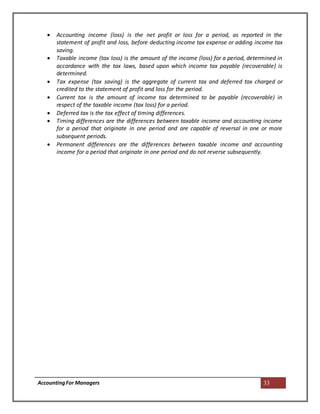
 Accounting income (loss) is the net profit or loss for a period, as reported in the
statement of profit and loss, before deducting income tax expense or adding income tax
saving.
 Taxable income (tax loss) is the amount of the income (loss) for a period, determined in
accordance with the tax laws, based upon which income tax payable (recoverable) is
determined.
 Tax expense (tax saving) is the aggregate of current tax and deferred tax charged or
credited to the statement of profit and loss for the period.
 Current tax is the amount of income tax determined to be payable (recoverable) in
respect of the taxable income (tax loss) for a period.
 Deferred tax is the tax effect of timing differences.
 Timing differences are the differences between taxable income and accounting income
for a period that originate in one period and are capable of reversal in one or more
subsequent periods.
 Permanent differences are the differences between taxable income and accounting
income for a period that originate in one period and do not reverse subsequently.
AccountingFor Managers 34
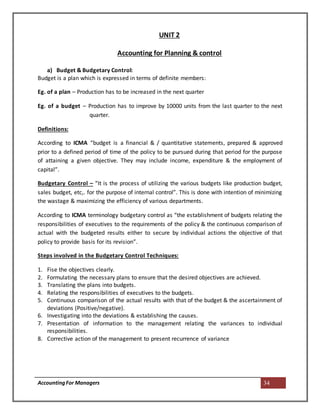
UNIT 2
Accounting for Planning & control
a) Budget & Budgetary Control:
Budget is a plan which is expressed in terms of definite members:
Eg. of a plan – Production has to be increased in the next quarter
Eg. of a budget – Production has to improve by 10000 units from the last quarter to the next
quarter.
Definitions:
According to ICMA “budget is a financial & / quantitative statements, prepared & approved
prior to a defined period of time of the policy to be pursued during that period for the purpose
of attaining a given objective. They may include income, expenditure & the employment of
capital”.
Budgetary Control – “It is the process of utilizing the various budgets like production budget,
sales budget, etc,. for the purpose of internal control”. This is done with intention of minimizing
the wastage & maximizing the efficiency of various departments.
According to ICMA terminology budgetary control as “the establishment of budgets relating the
responsibilities of executives to the requirements of the policy & the continuous comparison of
actual with the budgeted results either to secure by individual actions the objective of that
policy to provide basis for its revision”.
Steps involved in the Budgetary Control Techniques:
1. Fise the objectives clearly.
2. Formulating the necessary plans to ensure that the desired objectives are achieved.
3. Translating the plans into budgets.
4. Relating the responsibilities of executives to the budgets.
5. Continuous comparison of the actual results with that of the budget & the ascertainment of
deviations (Positive/negative).
6. Investigating into the deviations & establishing the causes.
7. Presentation of information to the management relating the variances to individual
responsibilities.
8. Corrective action of the management to present recurrence of variance
AccountingFor Managers 35
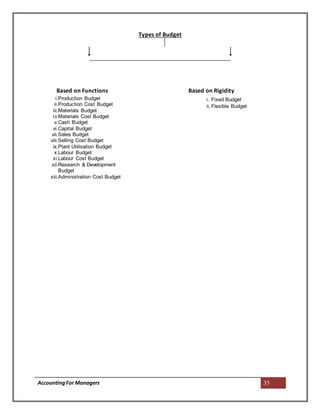
Types of Budget
Based on Functions Based on Rigidity
i.Production Budget
ii.Production Cost Budget
iii.Materials Budget
iv.Materials Cost Budget
v.Cash Budget
vi.Capital Budget
vii.Sales Budget
viii.Selling Cost Budget
ix.Plant Utilisation Budget
x.Labour Budget
xi.Labour Cost Budget
xii.Research & Development
Budget
xiii.Administration Cost Budget
i. Fixed Budget
ii. Flexible Budget
AccountingFor Managers 36
Master Budget:- It is a budget which summarises all the functional budgets.
According to ICMA, “A master budget is the summary budget incorporating its components
functional budgets & which is finally approved, adapted & employed”.
According to ICMA, “A budget which is designed to remain unchanged irrespective of the
volume of output/turnover attained”. – Fixed Budget.
* According to ICMA, “A budget which, by recognising the difference in behaviour between
fixed & variable cost in relation to fluctuations in output/turnover, is designed to change
appropriately with such fluctuations”.
BUDGETARY CONTROL
Meaning of Budget:
According to Brown and Howard, “A budget is a pre-determined statement of management
policy during a given period which provides a standard for comparison with the results actually
achieved.”
Budgeting:
The act of preparing budgets is called budgeting. In the words of Batty, “the entire process of
preparing the budgets is known as budgeting.
Meaning of Budgetary Control:
Budgetary control is a system of controlling costs through preparation of budgets. Budgeting is
thus only a part of budgetary control. According to CIMA, “Budgetary control is the
establishment of budgets relating the responsibilities of executives of a policy & the continuous
comparison of the actual with the budgeted results, either to secure by individual actions the
objective of that policy to provide basis for its revision”.
Forecast & Budget:
It is important to note carefully the distinction between a forecast and a budget.
A forecast is a prediction of what may happen as a result of a given set of circumstances. It is an
assessment of probable future events. A budget, on other hand, is a planned exercise to
AccountingFor Managers 37
achieve a target. It is based on the pros and Cons of a forecast. Forecasting thus precedes the
preparation of a budget.
Thus the main point of distinction between the two is that forecast is concerned with ‘probable
events’ while budget relates to ‘planned events’. Furthermore, forecast can be made by
anybody, whereas a budget, being an enterprise objective, can be set only by the authorized
management.
Objectives of Budgetary Control
The following are the objectives of a budgetary control system:
1. Planning: A budget provides a detailed plan of action for a business over definite period of
time. Detailed plans relating to production, sales, raw material requirements, labour needs,
advertising and sales promotion performance, research and development activities, capital
additions etc., are drawn up. By planning many problems are anticipated long before they
arise and solutions can be sought through careful study. Thus most business emergencies
can be avoided by planning. In brief, budgeting forces the management to think ahead, to
anticipate and prepare for the anticipated conditions.
2. Co-ordination: Budgeting aids managers in co-ordinating their efforts so that objectives of
the organisation as a whole harmonise with the objectives of its divisions. Effective planning
and organisation contributes a lot in achieving coordination. There should be coordination
in the budgets of various departments. For example, the budget of sales should be in
coordination with the budget of production. Similarly, production budget should be
prepared in co-ordination with the purchase budget, and so on.
3. Communication: A budget is a communication device. The approved budget copies are
distributed to all management personnel which provides not only adequate understanding
and knowledge of the programmes and policies to be followed but also gives knowledge
about the restrictions to be adhered to. It is not the budget itself that facilitates
communication, but the vital information is communicated in the act of preparing budgets
and participation of all responsible individuals in this act.
4. Motivation: A budget is a useful device for motivating managers to perform in line with the
company objectives. If individuals have actively participated in the preparation of budgets,
it act as a strong motivating force to achieve the targets.
5. Control: Control is necessary to ensure that plans and objectives as laid down in the
budgets are being achieved. Control, as applied to budgeting, is a systematized effort to
keep the management informed of whether planned performance is being achieved or not.
For this purpose, a comparison is made between plans and actual performance. The
difference between the two is reported to the management for taking corrective action.
6. Performance Evaluation: A budget provides a useful means of informing managers how
well they are performing in meeting targets they have previously helped to set. In many
companies, there is a practice of rewarding employees on the basis of their achieving the
budget targets or promotion of a manager may be linked to his budget achievement record.
AccountingFor Managers 38
Advantages of Budgetary Control:
Budgetary control provides the following advantages:
1. Budgeting compels managers to think ahead i.e. to anticipate and prepare for changing
conditions.
2. Budgeting co-ordinates the activities of various departments and functions of the business.
3. It increase production efficiency, eliminates waste and controls the costs.
4. It pinpoints efficiency or lack of it.
5. Budgetary control aims at maximization of profits through careful planning and control.
6. It provides a yardstick against which actual results can be compared.
7. It shows management where action is needed to remedy a situation.
8. It ensures that working capital is available for the efficient operation of the business.
9. It directs capital expenditure in the most profitable direction.
10. It instills into all levels of management a timely, careful and adequate consideration of all
factors before reaching important decisions.
11. A budget motivates executives to attain the given goals.
12. Budgetary also aids in obtaining bank credit.
13. Budgeting also aids in obtaining bank credit.
14. A budgetary control system assists in delegation of authority and assignment of
responsibility.
15. Budgeting creates cost consciousness and introduces an attitude of mind in which waste
and efficiency cannot thrive.
Limitations of Budgetary Control
The list of advantages given above is impressive, but a budget is not a cure all for organisational
ills. Budgetary control system suffers from certain limitations and those using the system
should be fully aware of them.
1. The budget plan is based on estimates: Budgets are based on forecasting cannot be an
exact science. Absolute accuracy, therefore, is not possible in forecasting and budgeting.
The strength or weakness of the budgetary control system depends to a large extent, on the
accuracy with which estimates are made. Thus, while using the system, the fact that budget
is based on estimates must be kept in view.
2. Danger of rigidity: A budget programme must be dynamic and continuously deal with the
changing business conditions. Budgets will lose much of their usefulness if they acquire
rigidity and are not revised with the changing circumstances.
3. Budgeting is only a tool of management: Budgeting cannot take the place of management
but is only a tool of management. ‘The budget should be regarded not as a master, but as a
servant.’ Sometimes it is believed that introduction of a budget programme alone is
sufficient to ensure its success. Execution of a budget will not occur automatically. It is
necessary that the entire organisation must participate enthusiastically in the programme
for the realisation of the budgetary goals.
AccountingFor Managers 39
4. Expensive Technique: The installation and operation of a budgetary control system is a
costly affair as it requires the employment of specialised staff and involves other
expenditure which small concerns may find difficult to incur. However, it is essential that
the cost of introducing and operating a budgetary control system should not exceed the
benefits derived therefrom.
Essentials of Effective Budgeting:
A budgetary control system can prove successful only when certain conditions and attitudes
exist, absence of which will negate to a large extent the value of a budget system in any
business. Such conditions and attitudes which are essential for effective budgeting are as
follows:
1. Support of Top Management: If the budget system is to be successful, it must be fully
supported by every member of the management and the impetus and direction must come
from the very top management. No control system can be effective unless the organisation
is convinced that the top management considers the system to be import.
2. Participation by Responsible Executives: Those entrusted with the performance of the
budgets should participate in the process of setting the budget figures. This will ensure
proper implementation of budget programmes.
3. Reasonable Goals: The budget figures should be realistic and represent reasonably
attainable goals. The responsible executives should agree that the budget goals are
reasonable and attainable.
4. Clearly Defined Organisation: In order to derive maximum benefits from the budget
system, well defined responsibility centres should be built up within the organisation. The
controllable costs for each responsibility centres should be separately shown.
5. Continuous Budget Education: The best way to ensure the active interest of the responsible
supervisors is continuous budget education in respect of objectives, potentials & techniques
of budgeting. This may be accomplished through written manuals, meetings etc., whereby
preparation of budgets, actual results achieved etc., may be discussed.
6. Adequate Accounting System: There is close relationship between budgeting and
accounting. For the preparation of budgets, one has to depend on the accounting
department for reliable historical data which primarily forms the basis for many estimates.
The accounting system should be so designed so as to set up accounts in terms of areas of
managerial responsibility. In other words, responsibility accounting is essential for
successful budgetary control.
7. Constant Vigilance: Reports comparing budget and actual results should be promptly
prepared and special attention focused on significant exceptions i.e. figures that are
significantly different from those expected.
8. Maximum Profit: The ultimate object of realizing the maximum profit should always be
kept uppermost.
9. Cost of the System: The budget system should not cost more than it is worth. Since it is not
practicable to calculate exactly what a budget system is worth, it only implies a caution
against adding expensive refinements unless their value clearly justifies them.
AccountingFor Managers 40
10. Integration with Standard Costing System: Where standard costing system is also used, it
should be completely integrated with the budget programme, in respect of both budget
preparation and variance analysis.
Standard Costing VS. Budgetary Control
Standard costing and budgetary control have the common objective of cost control by
establishing pre-determined targets. The actual performances are measured and compared
with the pre-determined targets for control purposes. Both the techniques are of importance in
their respective fields and are complementary to each other.
Points of Similarity:
There are certain basic principles which are common to both standard costing and budgetary
control. These are:
1. The establishment of pre-determined targets of performance
2. The measurement of actual performance
3. The comparison of actual performance with the pre-determined targets.
4. The analysis of variances between the actual and the standard performance
5. To take corrective measures, where necessary.
Points of Difference:
In spite of so much similarity between standard costing and budgetary control, there are some
important differences between the two, which are as follows:
Standard Costing Budgetary Control
Scope Standard costs are developed mainly
for the manufacturing function and
sometimes also for making and
administration functions
Budgets are compiled functions of
the business such as sales,
purchase, production, cash, capital
expenditure, research &
development, etc.,
Intensity Standard costing is intensive in
application as it calls for detailed
analysis of variances
Budgetary control is extensive in
nature and the intensity of analysis
tends to be much less than that in
standard costing.
Relation to accounts In standard costing, variances are
usually revealed through accounts
In budgetary control, variances are
normally not revealed through
accounts and control is exercised by
statistically putting budgets and
AccountingFor Managers 41
actuals side by side.
Usefulness Standard costs represent realistic
yardsticks and, are therefore, more
useful for controlling and reducing
costs.
Budgets usually represent an upper
limit on spending without
considering the effectiveness of the
expenditure in terms for output.
Basis Standard cost are usually established
after considering such vital matters as
production capacity, methods
employed and other factors which
require attention when determining
an acceptable level of efficiency.
Budgets may be based on previous
year’s costs without any attention
being paid to efficiency.
Projection Standard cost is a projection of cost
accounts
Budget is a projection of financial
accounts.
AccountingFor Managers 42
AccountingFor Managers 43
2. Sales Budget:
AccountingFor Managers 44
Problem no. 1
Rahul & Co. manufactures two products “Phool” and “Kante” and operates foe selling them in
the market. From the following information, prepare a sales budget for the year 2010 which is
to be presented to the budget committee.
Problem no.2
AccountingFor Managers 45
AccountingFor Managers 46
3. Flexible Budget:
AccountingFor Managers 47
Problem no. 1
AccountingFor Managers 48
AccountingFor Managers 49
Problemno. 3
AccountingFor Managers 50
Problemno.4
AccountingFor Managers 51
AccountingFor Managers 52
5. Cash Budget:
Problem no. 1
You are given the following further information.
(a) Plant costing Rs.16,000 is due for delivery in July payable 10% on delivery and the
balance after three months.
(b) Advance Tax of Rs.8,000 is payable in March and June each.
(c) Period of credit allowed (i) by suppliers 2 months and (ii) to customers 1month.
(d) Lag in payment of manufacturing expenses ½ month.
(e) Lag in payment of all other expenses 1 month.
You are required to prepare a cash budget for three months starting on 1st May, 2000
when there was a cash balance of Rs.8,000.
AccountingFor Managers 53
AccountingFor Managers 54
Problem no. 2
AccountingFor Managers 55
AccountingFor Managers 56
Problem no. 3
AccountingFor Managers 57
AccountingFor Managers 58
b) Standard Costing
INTRODUCTION
Cost control is a basic objective of cost accountancy. Standard costing is the most powerful
system ever invented for cost control. Historical costing or actual costing is nothing but, a
record of what happened in the past. It does not provide any ‘Norms’ or ‘Yardsticks’ for cost
control. The actual costs lose their relevance after that particular accounting period. But, it is
necessary to plan the costs, to determine what should be the cost of a product or service. It the
actual costs do not conform to what the costs should be, the reasons for the change should be
assessed and appropriate action should be initiated to eliminate the causes.
Standard costing fulfills the need to compensate the short comings of Historical costing from
the point of view of cost control. (a) It provides the norms or yardsticks in the form of
standards- specifying what costs should be or yardsticks in the form of standards- specifying
what cost should be (b) comparison of actual costs with standards is facilitated to ascertain
variances for each element of cost. (c) The variances are further analysed for contributory
reasons. Responsibility is fixed on the basis of the reasons for each variance. (d) Corrective
measures are under taken to eliminate the unfavourable variances wherever possible. Thus,
standard costing is a costing technique specifically evolved to provide complete ‘Infrastructure’
and ‘Systematic approach’ for cost control.
DEFINITION: STANDARD, STANDARD COST, STANDARD COSTING
Standard. According to Prof. Eric L.Kohler, “Standard is a desired attainable objective, a
performance, a goal, a model”. Standard may be used to a predetermined rate or a
predetermined amount or a predetermined cost.
Standard Cost: Standard cost is predetermined cost or forecast estimate of cost. I.C.M.A.
Terminology defines Standard Cost as, “a predetermined cost, which is calculated from
management standards of efficient operations and the relevant necessary expenditure. It may
be used as a basis for price-fixing and for cost control through variance analysis”. The other
names for standard costs are predetermined costs, budgeted costs, projected costs, model
costs, measured costs, specifications costs etc. Standard cost is a predetermined estimate of
cost to manufacture a single unit or a number of units of a product during a future period.
Actual costs are compared with these standard costs.
Standard Costing is defined by I.C.M.A. Terminology as, “The preparation and use of standard
costs, their comparison with actual costs and the analysis of variances to their causes and
points of incidence”. “Standard costing is a method of ascertaining the costs whereby statistics
are prepared to show (a) the standard cost (b) the actual cost (c) the difference between these
costs, which is termed the variance” says Wheldon. Thus the technique of standard cost study
comprises of:
1. Pre-determination of standard costs;
2. Use of standard costs;
3. Comparison of actual cost with the standard costs;
4. Find out and analyse reasons for variances;
5. Reporting to management for proper action to maximize efficiency.
AccountingFor Managers 59
ADVANTAGES OF STANDARD COSTING
Cost control:
Standard costing is universally recognised as a powerful cost control system. Controlling
and reducing costs becomes a systematic practice under standard costing.
Elimination of wastage and inefficiency:
Wastage and inefficiency in all aspects of the manufacturing process are curtailed,
reduced and eliminated over a period of time if standard costing is in continuous
operation.
Norms:
Standard costing provides the norms and yard sticks with which the actual performance
can be measured and assessed.
Locates sources of inefficiency:
It pin points the areas where operational inefficiency exists. It also measures the extent
of the inefficiency.
Fixing responsibility:
Variance analysis can determine the persons responsible for each variance. Shifting or
evading responsibility is not easy under this system.
Management by exception:
The principle of ‘management by exception can be easily followed because problem
areas are highlighted by negative variances.
Improvement in methods and operations:
Standards are set on the basis of systematic study of the methods and operations. As a
consequence, cost reduction is possible through improved methods and operations.
Guidance for production and pricing policies:
Standards are valuable guides to the management in the formulation of pricing policies
and production decisions.
Planning and Budgeting:
Budgetary control is far more effective in conjunction with standard costing. Being
predetermined costs on scientific basis, standard costs are also useful in planning the
operations.
Inventory valuation:
Valuation of stocks becomes a simple process by valuing them at standard cost.
AccountingFor Managers 60
LIMITATION OF STANDARD COSTING
1. It is costly, as the setting of standards needs high technical skill.
2. Keeping of up-to-date standard is a problem. Periodic revision of standard is a costly
thing.
3. Inefficient staff is incapable of operating this system.
4. Since it is difficult to set correct standards, it is difficult to ascertain correct variance.
APPLICABILITY OF STANDARD COSTING
Standard Costing is a control device. It is not a separate method of product costing. Any
activity of recurring nature is susceptible for setting standards. The standard-cost
process is mostly used to control the operating tasks. Manufacturing activities are
routine and frequent and therefore easy for establishing standards. Industries where
standardized and uniform work of repetitive nature is done are suitable for introduction
of standard costing. Standard costing system is of little use or no use where works vary
form job to job or contract to contract.
SETTING THE STANDARDS
While setting standard cost for operations, process or product, the following
preliminaries must be gone through:
i) There must be Standard Committee, similar to Budget Committee, in which Purchase
Manager, Personnel Manger, and Production Manager are, represented. The Cost
Accountant coordinates the functions of the Standard Committee.
ii) Study the existing costing system, cost records and forms in use. If necessary, review
the existing system.
iii) A technical survey of the existing methods of production should be undertaken so
that accurate and reliable standards can be established.
iv) Determine the type of standard to be used.
v) Fix standard for each element of cost.
vi) Determine standard costs for each product.
vii) Fix the responsibility for setting standards.
viii) Classify the accounts properly so that variances may be accounted for in the manner
desired.
ix) Comparison of actual costs with pre-determined standards to ascertain the
deviations.
x) Action to be taken by management to ensure that adverse variances are not
repeated.
INTRODUCTION OF STANDARD COSTING SYSTEM
AccountingFor Managers 61
Introducing standard costing in any establishment requires the fulfillment of following
preliminaries.
1. Establishment of cost centres;
2. Classification and codification of accounts;
3. Determining the types of standards and their basis;
4. Determining the expected level of activity;
5. Setting standards
Establishment of cost centres
A cost centre is a location, person or item of equipment for which costs may be
ascertained and used for the purpose of cost control. The cost centres divide an entire
organisation into convenient parts for costing purpose. The nature of production and
operations, the organisational structure, etc. influence the process of establishing cost
centres. No hard and fast rule can be laid down in this regard. Establishment of the cost
centres is essential for pin pointing responsibility for variances.
Classification and codification of accounts
The need for quick collection and analysis of cost information necessitates classification
and codification. Accounts are to be classified according to different items of expenses
under suitable headings. Each of the headings is to be given a separate code number.
The codes and symbols used in the process facilitate introduction of computerization.
Determining the types of standards and their basis
Standards can be classified into two broad categories on the basis of the length of use.
(a) Current standards: These are standards which are related to current conditions,
particularly of the budget period. They are for short-term use and are more suitable for
control purpose. They are also more amenable for combining with budgeting.
(b) Basic standards: These are long-term standards, some of them intended to be in use
for even decades. They are helpful for planning long-term operations and growth. Basic
standards are established for some base year and are not changed for a long period of
time. It is preferable to use both kinds of standards depending on the nature and type of
activity or cost for which they are fixed. Generally, the number of basic standards may
be very few and current standards are predominant in number.
Basic for standards
There can be significant difference in the standards set depending on the base used for
them. The following are the different bases for setting standard, whether they are
current standards for short-term or basic standards for long-term use.
AccountingFor Managers 62
(a) Ideal standards: These standards reflect the best performance in every aspect. They
are like 100 marks in a paper for students taking up examinations. What is possible
under ideal circumstances in all aspects is reflected in theses standards. They are
impractical and unattainable in practice. There utility for control purpose is negligible.
(b) Past performance based standards: The actual performance attained in the past
may be taken as basis and the same may be retained as standard. Such standards do not
provide any incentive or challenge to the employees. They are too easy to attain. Their
value from cost control point of view is minimal.
(c) Normal standard: It is defined as “the average standard which, it is anticipated can
be attained over a future period of time, preferably long enough to cover one trade
cycle”. They are average standard reflecting the average performance over a complete
trade cycle which may take three to five years. For a specific period, say a budget
period, their relevance is negligible.
(d) Attainable high performance standards: They are based on what can be achieved
with reasonable hard work and efforts. They are based on the current conditions and
capability of the workers. These standards are considered to be of great practical value
because they provide sufficient incentive and challenge to the workers to attain them.
Any variances from such standard are really significant because the standard which is
attainable with effort is not attained.
Determining the expected level of activity
Capacity of operation or level of activity expected over a future period is vital in fixing
current or short-term standards. When the activity level is decided on the basis of sales
or production, whichever is the limiting factor, all standard can be developed with the
activity level as the focal point. The purchase of material, usage of material, labour
hours to be worked, etc. are solely governed by the planned level of activity.
Setting standards
Setting standards may also be called developing standards or establishment of standard
cost because as a consequence of setting standards for various aspects, standard cost
can be computed. Setting standards is like laying a building foundation. The success of
standard costing system depends on the care with which the standards are developed. It
is preferable, particularly in large firms, to establish ‘Standard committee’ which is
responsible for determining standards in all aspects of the business and also making
suitable revisions in due course. The standards committee usually consists of all the
functional managers like purchase, production and sales, technical experts like
Production Engineer, the General Manager and the Cost Accountant. It is the Cost
Accountant’s role which is crucial because he has to assign the monetary values for the
different standards set by the other experts in each area or function. The following is a
brief discussion on the setting of standards for each element of cost:
AccountingFor Managers 63
(1) Standards for Direct Material Cost
Direct material standards are broadly divided into standards for usage or quantity
standards and standards for material price. There may be several materials used in the
production of a product. It is necessary to set standards for each of the important
materials.
Material usage or Quantity standards
These standards deal with the quantity of material needed for each unit of finished
product, the quality specifications and tolerances like length, breadth, strength, volume,
etc. Based on the past experience, the normal loss to be expected has to be determined.
Based on the expected or permitted loss, the quantity standard per unit is fixed. It two
or more materials are mixed in the production; the standard proportion of each material
has to be fixed. The production manager and technical expert play the most important
role in setting quantity standards. Their knowledge, experience and the shop floor
situation are instrumental in deciding upon the quality and quantity of each material.
The following are the usual quantity standards set.
(a) Quantity of material per unit of finished product.
(b) Standard loss permitted in the production process.
(c) The proportion of different materials, if more than one material is used.
(d) The yield expected from material.
Material price standards: Price standards for the material are the most difficult to set
because material prices are subject to the market forces. Usually, current market price
for each material, the trends observed and the forecasts of the purchasing department
are the determining factors. While fixing price standards, the other terms like trade
discounts, freight, credit terms, etc., are also considered. Material price should also
include the cost of purchasing and storing including the handling costs. It is customary
to prepare a standard ‘Bill of Materials’ which is a list of all the direct materials to be
used and incorporate therein all the standards set for each material sot that it acts like a
ready reckoned.
(2) Standards for direct labour cost
The two major aspects for which standards are developed relating to labour are (A)
Labour time and (B) Labour rate.
(A) Labour Time Standards: These standards represent the time to be taken by the
direct labour in the production of one unit of product or performing a specific
operation. It may be determined with the help of (1) Time and Motion study; (2)
Technical estimates; (3) Trial runs; (4) Past experience; (5) Caliber of the workers; (6)
Working conditions.
Since, human factor is involved, the cooperation of workers should be obtained by
suitable briefing about the purpose and significance of the exercise. If different kinds of
labour have to perform group tasks, standards should also be fixed for labour mix or
AccountingFor Managers 64
gang. The most ticklish problem in setting the labour time standards is the provision for
idle time. Idle time includes rest pauses, personal needs of the workers, etc. the care
with which the idle time standards are fixed determines the level of arguments and
quarrels on the production lines. The following are the usual labour time standards etc.
(a) Standard time to be taken for one unit of output.
(b) Idle time permitted
(c) Proportion of different kinds of labour where two or more kinds of workers are
involved.
(B) Labour rate standards:
Labour rates are generally governed by agreements with trade unions, the firm’s wage
policy and incentive systems in use. However, the following factors influence the labour
rate standards:
(i) Existing, labour rates;
(ii) Rates paid by similar firms;
(iii) Type or kind of labour needed for production and
(iv) Labour laws governing the industry. Wage rate standards differ for different grades
or kinds of labour. The rate is also subject to revision whenever new agreements are
concluded with the unions.
(3) Standards for overhead cost
Overheads are usually segregated into fixed and variable. It is necessary to fix standard
overhead rates separately for fixed overheads and variable overheads. Separate rates
have to be determined for factory, office, selling and distribution overheads- both fixed
and variable. While determining the overhead rates, the factors to be considered are:
(a) Standard level of activity;
(b) Number of units to be produced
(c) Labour and machine hours to be worked. Standard overhead costs – both fixed and
variable should be determined. Based upon the standard output and standard hours,
the overhead rates are finalized.
Standard output and its standard cost
Once all the cost standards are finalized, it is possible to consolidate them in the shape
of ‘standard cost for standard output’. The direct material cost per unit, direct wages
per unit, fixed and variable overheads per unit can be listed out. The total of all of these
represents standard cost per unit. This can be multiplied with the standard output for
the budget period or a specified period to ascertain the standard cost of the standard
output.
AccountingFor Managers 65
Standard hour
If a single product is produced in a firm, the output can be expressed in terms of the
units of that product. However, several different products may be produced and they
may be measured in different units like kgs, Tons, liters, gallons, barrels, etc. Though all
of these can not be expressed in terms of a single measure, it possible to express all of
theme in terms of ‘Time’. Time taken to produce is the common factor for all output.
Production, expressed in terms of hours needed to produce them is called ‘Standard
hours’. According to I.C.M.A., England, “Standard hours are a hypothetical hour which
represents the amount of work which should be performed in one hour under standard
conditions”. The ‘Standard hour’ is very useful is ascertaining overhead variances. The
total output of a firm comprising different products is expressed in the form of standard
hours and the fixed and variable overhead rates are set for standard hours.
Revision of standards
Current or short-term standards have to be periodically revised. Long-term or basic
standards may be used for longer periods. They may also need revision when the factors
affecting the standard change. Revision may be needed in all the following cases:
(a) Change in market price of materials
(b) Permanent change in labour rates
(c) Major alterations in products or method of production or materials used
(d) Basic change in product specifications or design.
(e) Errors in setting of the original standards.
VARIANCE ANALYSIS
INTRODUCTION
Variance analysis is the process of analysing variance by sub-dividing the total variance
in such a way that management can assign responsibility for off standard performance.
It, thus, involves the measurement of the deviation of actual performance from the
intended performance. That is, variance analysis is a tool to measure performances and
based on the principle of management by exception. In variance analysis, the attention
of management is drawn not only to the monetary value of unfavourable and
favourable managerial performance but also to the responsibility and causes for the
same. After the standard costs have been fixed, the next stage in the operation of
standard costing is to ascertain the actual cost of each element and compare them with
the standard already set. Computation and analysis of variances is the main objective of
standard costing. Actual cost and the standard cost is known as the ‘cost variance’.
DEFINITION
As per I.C.M.A, Variance Analysis is “the resolution into constituent parts and
explanation of variances”. The definition indicates two aspects-resolutions into
constituent parts is the first aspect which is nothing but subdivision of the total cost
AccountingFor Managers 66
variance. Explanation of variance includes the probing and inquiry for causes and
responsible persons.
FAVOURABLE AND UNFAVOURABLE VARIANCE
Variances may be favourable or unfavourable depending upon whether the actual
resulting cost is less or more than the standard cost.
Favourable variance:
When the actual cost incurred is less than the standard cost, the deviation is known as
favourable variance. The effect of the favourable variance increases the profit. Again,
favourable variance would result when the actual cost is lower than the standard cost. It
is also known as positive or credit variance and viewed only as savings.
Unfavourable variance:
When the actual cost incurred is mote than the standard cost, there is a variance,
known as unfavourable or adverse variance. unfavourable variance refers to deviation
to the loss of the business. It is also known as negative or debit variance and viewed as
additional costs or losses. When the profit is greater than the standard profit, it is
known as favourable variance. When the profit is less than the standard profit, it is
known as unfavourable variance. This favourable variance is a sign or efficiency of the
organisation and the unfacourable variance is a sign of inefficiency of the organisation.
UTILITY OF VARIANCES ANALYSIS
i) Variance analysis sub divides the total variance based on difference contributory
causes. This gives a clear picture of the different reasons for the overall variance.
ii) The sub division of variance establishes and highlights the interrelationship between
different variances.
iii) Variance analysis ‘explains’ the causes for each variance. It paves way for fixing
responsibility for all variances.
iv) It highlights all inefficient performances and the extent of inefficiency.
v) It is a powerful tool leading to cost control.
vi) It enables the top management to practice ‘management by exception’ by focusing
on the problem areas.
vii) It segregates variance into controllable and uncontrollable, thereby indicating where
action is warranted.
viii) It acts as the basis for profit planning
ix) By revealing each and every deviation, along with the causes, variance analysis
creates and nurtures ‘cost consciousness’ among the employees.
AccountingFor Managers 67
TYPES OF VARIANCE ANALYSIS
The following are the different types of variances.
(1) Direct material cost variances
(2) Direct labour cost variance
(3)Overheads cost variances
(4) Sales variances.
Material
(1) Direct Material Cost Variance (MCV): It is the difference between standard materials
cost and actual materials cost. If the actual cost is less than the standard cost, the
variance is favourable and vice versa. MCV arises due to change in the price of the
materials or a change in the usage of materials,
MCV = (SQ x SP) – (AQ x AP)
SQ = Standard Quantity AQ = Actual Price
SP = Standard Price AP = Actual Price
The following chart show the components of material cost variance:
(2) Material Price Variance (MPV): It is that part of material cost variance which is due
to the difference between the standard price specified and the actual price paid.
MPV = (SP – AP) AQ
MPV arises due to the following reasons:
(a) Changes in the market prices of materials
(b) Uneconomical size of purchase orders
(c) Uneconomical transport cost
(d) Failure to obtain cash discount
(e) Failure to purchase materials at proper time.
MPV is mainly the responsibility of the purchase manager. However, a general increase
in prices would be uncontrollable.
(3) Material Usage Variance (MUV): It is the difference between the standard quantity
specified and the actual quantity used.
AccountingFor Managers 68
MUV = (SQ – AQ) SP
MUV may arise due to (a) carelessness in use of materials (b) loss due to pilferage (c)
faulty workmanship (d) defect in plant and machinery causing excessive consumption of
materials. Production manager will be responsible for material usage variance.
(4) Material Mix Variance (MMV): It is that part of material usage variance which arises
due to change in standard and actual composition of mix. MMV = (RSQ – AQ) SP; RSQ –
Revised Standard Quantity
S tandard Quantity
=----------------------------- x Total Quantity
Total Standard Qty.
This variance arises in industries like chemical, rubber etc. where definite proportions of
different raw materials are mixed to get a product. Variations may arise due to general
shortage or non purchase of materials at the proper time.
(5) Material Yield Variance (MYV): It is a part of material usage variance. It is the
difference between standard yield specified and actual yield obtained. MYV = (Standard
yield – Actual yield) Average standard price p.u. Or (Standard loss on actual input -
Actual loss) Average standard price p.u.
Labour
(1) Labour Cost Variance (LCV): This is the difference between the standard wages
specified and the actual wages paid. LCV – (SH x SR) – (AH x AR). This is further divided
into the following variances.
(2) Labour Rate Variance (LRV): It is the difference between the standard rate of wage
specified and the actual rate paid. LRV = (SR – AR) AH Labour rate variance arises due to
(a) changes in the basic wage rates (b) use of different methods of wage payment (c)
unscheduled overtime.
(3) Labour Efficiency Variance (LEV): It is a part of labour cost variance. It is the
difference between standard labour hours specified and actual labour hours spent.
LEV = (SH – AH) SR This variance arises due to (a) lack of proper supervision (b)
insufficient training (c) poor working conditions (d) increase in labour grades utilized
(4) Labour Mix Variance (LMV): This is the difference between the standard labour
grade specified and the actual labour grade utilised.
LMV = (RSH – AH) SR
Standard Hours
RSH = ------------------- x Total Actual Hours
Total S tandard Hours
SH = Standard Hour SR = Standard Rate AH = Actual Hours
AR = Actual Rate RSH = Revised Standard Hour.
AccountingFor Managers 69
(5) Labour Yield Variance (LYV): It is a part of labour efficiency variance. It arises due to
the difference between standard yield and actual yield.
LYV = (Standard yield – Actual yield) Average Standard Rate p.u.
Or
(Standard loss on actual input – Actual loss) Average Standard Rate p.u.
Over head
Overhead Cost Variance: This is the difference between the standard overhead
specified and the actual overhead incurred. Overhead Cost Variance = Standard
overhead – Actual overhead. Generally, variances in overhead costs are divided into (a)
Variable overhead variance and (b) Fixed overhead variance. Variable overheads
variance is the difference between the standard and actual variable overheads. Fixed
overheads variance is the difference between the standard and actual fixed overheads.
Overheads variance is further divided into the following categories.
(i) Budget Variance or Expenditure Variance: This represents the difference between
the budgeted expenses and the actual expenses incurred. Budget Variance = Budgeted
overhead – Actual overhead. This variance arises due to (a) inflation (b) lack of control
over expenditure (c) change in production method.
(ii) Volume Variance: It is caused due to the difference between the budgeted output.
In other words, this is the difference between the standard cost of overhead absorbed
in actual output and the standard allowance allowed for the output. Volume variance =
(Actual production – Budgeted production) SR
(iii) Efficiency Variance: It is that portion of volume variance which is due to the
difference between the budgeted efficiency (in standard units) and the actual efficiency
attained. Efficiency variance = (Actual production – Standard production) SR
(iv) Capacity Variance: It is the portion of volume variance which arises on account of
over or under utilization of plant and equipment. It may be caused by idle time, strike
and lock out, failure of power, machine break-down etc. Capacity variance = (Standard
production – Budgeted production) SR
(v) Calendar Variance: It is a part of capacity variance. This variance arises due to the
difference actual working days and the budgeted working days. Calendar variance =
(Revised budgeted production – Budgeted production) SR.
Note: SR refers to standard overhead rate per unit.
AccountingFor Managers 70
UNIT III
Accounting For Managerial Decision Making
a) Preparation, Analysis & Interpretation of Financial Statements
INTRODUCTIONS OF FINANCIAL ANALYSIS
A basic limitation of traditional statements composing the Balance sheet and the profit
and loss analysis is that they do not give all the information related to the financial operations
of a firm. Thus financial statement provides summarized view of the financial position and
operation of a firm. Due to this reasons and to have much more study of the financial position
of the organizations financial analysis proved to be important aid. Financial analysis is the
process of determining financial strength and weakness of the company by establishing
strategic relationship between the component of balance sheets and profit and loss statements
and other operative data.
Financial analysis is thus an attempts to dissect the financial statements into there
components on the basis of the purpose in hand and establish relationship between these
components on one hand and as between indivisual component and totals of these items, on
the other way.
It is the assessment of a firm past, present and anticipated future financial conditions.
The tools of financial analysis are used to study accounting data so as to determine the
continuity of the operating policies, investment value of the business, credit Ratings and testing
the efficiency of operations.
The joint stock company is the third form of organization. It emerges due to the need of
large amount of capital from the wide spread investors. It is the time of divorce between
ownership and management that has sighted many significant change one of these changes is
the formal and strict reporting by the professional managers to the wide spread owners. The
major form of reporting is through financial statements.
An overwhelming weight is placed by analysts and investors on the information
contained in the financial statements of firms. One critical reason for this reliance in the
vouchsafed nature of the statements is because of their form and content is controlled under a
variety of rules and regulations. The vast majority of these statements are attested by
independent auditors. In nutshell investors tend to accept financial statements as the closest
thing to complete credibility in information available to them.
AccountingFor Managers 71
FINANCIAL STATEMENTAS PROXIES OF REAL PROCESS:
Accounting is a proxy that has been developed for representing real processes and real
goods. Accounts and statements are devices created to summarize certain type of information
about real corporate goods and processes.
As such, these statements, to a larger extent, form the basis for action by investors,
potential investors, creditors, and potential creditors of the corporation. Because of this,
analysts must understand in a general way, how these statements are prepared so that they
can better interpret their true meaning. A good beginning point for investment analysis and
ultimately investment decision-making is to be aware of the historical record of the firm in a
financial sense. This historical record of the firm’s earnings and financial position can often give
the analyst insight into the inner workings of the firm and thus assist him in projecting the
future. This investigation of the past is a vital step taken by the investment analyst.
Someone had set that accounting statements are like the tips of icebergs: what you see
is interesting, but what you do not see is significant! A good investment analyst must judge
financial statements as they meet the tests of (1) Correctness (2) Completeness (3)
Consistency (4) Comparability.
Correctness, or accuracy, is normally established through the presence of an “qualified”
auditor’s certifications. Nearly all public corporations retain public accounting firms to audit and
certify the fairness of financial statements. Unaudited statements are not necessarily
inaccurate or fraudulently prepared: they simply lack the intrinsic credibility of audited
statements accompanied by the certification given by public accountant .
Completeness is matter of disclosure. Inasmuch as accounting is only a proxy of real
goods and processes, it cannot and does not pretend to tell everything. Many, many bits of
information about a business were never intended to be incorporated into established financial
report and statements. The securities and Exchange commission, the American; institute of
certified public accountants (AICPA), and the financial Accounting standards Board ( FASB) have
worked together, and at times at odds, in dealing with the matter of full disclosure. Auditors
have primary responsibility of ensuring that change’s n reporting over time are justified and
brought to the attention of the public. Consistency is vital in making comparisons of the
performance of a firm over time. Data constructed differently at various points in time lack
meaningful continuity unless reconciled prior to analysis.
No area of accounting information has created more debate and difficulties for the
analyst than comparability. Using audited financial statements for a firm, most of the time an
analyst can work toward more complete an consistent information on his own. However,
investment decision-making involves comparing alternatives- or, as it was, comparing the data
derived form the financial statements of different firms. The problem: are the financial
statements of different firm prepared under the same ground rules? Is it valid to make choices
between two companies on the basis of financial information if the information is not
generated on a uniform basis?
AccountingFor Managers 72
Accounting for revenue, costs, and profits is not done under a set of rigid rules whereby
each event and transactions, regardless of the firm is handled in one way only. To the exist that
accounting provide options in handling certain transactions, compatibility diminishes.
One set of accounting rules in the name of uniformity is perhaps an unrealistic ideal.
Highly flexible accounting practices have grown up over the years to recognize the wide
diversity of circumstances within American business. However, from an analyst/investor point
of view, the need for uniformity is obvious because investment decisions are the product of
comparative analysis of data for the determination of relative values.
WHATIS A ‘FINANCIAL STATEMENTS’?
A Financial Statement is a collection of data organized according to logical and
consistent accounting procedures, which indicate the financial position of the Firm. Financial
Statement is prepared primarily for decision accounting. On other words” Financial Statements
provide a summary of the accounts of business enterprise, the balance sheet reflecting the
assets, liabilities and capital as on a certain date and the income statement showing the results
of operation during a certain period”. It is prepared as an end result of financial accounting and
it is the major sources of financial information of an enterprise.
OBJECTIVES OF FINANCIAL STATEMENTS:
Financial Statements are the sources of information on the basis of which conclusions
are drawn about the profitability and financial position of the concern.
The objectives of Financial Statements are: To provide reliable financial information
about the Business Firm. To provide other needed information about changes in economic
resources and obligations. To provide financial information’s that assist in estimating the
earning potentials of business. To disclose, to the extent possible, other information related to
the financial statements that is relevant to the needs of the users of these statements.
TYPES OF FINANCIAL STATEMENTS:
Financial Statements primarily comprise two basic statements i.e., Balance Sheet and
the profit and Loss Account.
BALANCE SHEET:
“A tabular statement of summary of balances carried forward after and actual and
constructive closing of books of account and kept according to principles of accounting is
known as Balance Sheet or Position Statement.”
American Institute of Certified Public Accountants
AccountingFor Managers 73
Balance Sheet shows on one hand the properties that it utilizes and on the other the
sources of those properties. It shows all the assets owned by concern and all liabilities owes to
owner. It is prepared in such a way that true financial position is revealed in a form, which is
easily readable (i.e. in tabular form) and more rapidly understood. It is only historic rather than
futuristic. Its basic object is to provide an opportunity of judging from time to time the financial
soundness and firmness of the business.
INCOME STATEMENT:
Income Statement is prepared to determine the operational position of the concern.
Income Statement is an important tool of financial statement and this statement is used to find
out the Net Profit or Net Loss of the firm.
Income Statements a statement of revenues earned and the expenses incurred for
earning that revenue. The income Statement is also known as a Profit and Loss account.
LIMITATIONS OF FINANCIAL STATEMENTS:
Financial statements are relevant and relevant and useful for the concern but still they
do not present a final picture of the concern. That means it also depended upon some
limitation. The analysis and interpretation of these statements should be done very carefully
otherwise mistake may be possible. The limitation of financial statements are:
1. Financial Statements do not give the final picture and they are at the most interim
reports. It also does not give exact or accurate position of the concern.
2. The financial Statements are prepared on the bases of historical costs or original costs,
the value of assets decreased with the passage of time current price changes are not a
taken into account.
3. Financial Statements take into consideration on the financial factors. They fail to bring
out the significance of not financial factors such as loyalty and deficiency of worker,
image of the company etc.
WHAT DOES ANALYSIS OF FINANCIAL STATEMENTS MEANS?
Significance of financial statement lies not in their preparation and presentation but in
its analysis and interpretation. Analysis of financial statement is a process of evaluating the
relationship between component parts of a financial statement to obtain a better
understanding of firm’s position and performance, a view of past performance and a basic for
the management to know the future prospects for earnings, ability to pay interest and debt
maturities and on the basis of the is the management can formulate its strategies for the
future.
METHODS OR DEVICES OF FINANCIAL ANALYSIS:
AccountingFor Managers 74
The analysis and interpretation of financial statements is used to determine the financial
position and results of operations as well. A numbers of methods or devices are used to study
the relationship between different statements.
The following methods are generally used:
1. Comparative Statements: comparative analysis
2. Trend Analysis
3. Common Size Statement
4. Ratio Analysis
5. Working Capital
1. COMPARATIVE STATEMENTS:
Financial Comparative statements is an important tool of analysis, nature and trend of
the change affecting the business are easily and clearly discernible by the use of this statement.
This statement summaries and present the related accounting data for number of years
incorporating the change in the individual items. Following are the comparative statements.
1. Comparative Balance Sheet
2. Comparative Income Statement
2. TREND ANALYSIS:
The financial statements may be analyzed by computing trends of series of information
.It occupies an important place in the analysis and interpretation of financial statements .This
method determines the direction upwards or downwards and involve the computation of the
percentage relationship that each statement item bears to the same item in base year.
3. COMMON SIZE STATEMENT:
Common size statement is a financial tool of studying key changes and trends financial
position of a company. In common size statement, the figures are shown as percentages of
total Liabilities and total Sale.
4. RATIO ANALYSIS:
Generally speaking a ratio is simply one figure expressed in terms of another and thus it
is an assessment of one number in relation to other. An analysis of a statement with the help of
ratios is called Ratio Analysis. A ratio is mathematical relationship between the items expressed
in quantities form ratio may be expressed as in proportion, in rate or times and in percentages.
5. WORKING CAPITAL:
There are two concepts of working capital:
AccountingFor Managers 75
1) Gross Working Capital - It refers to the firm’s investments in total current or circulating
assets.
2) Net Working Capital – It is defined in two different ways:
a) It is the excess of current assets over current liabilities.
b) It is that portion of a firm’s current assets which is financed by long-term funds.
AccountingFor Managers 76
UNIT IV
Management of Working Capital
Introduction:-
Working capital refers to the cash a business requires for its day to day operations or more
specifically for financing the conversion of raw material into finished goods, which the company
sells for payment.
It is a measure of both a company’s efficiency and its short term financial health.
DEFINITION :-
“Working capital is the excess of current assets over current liabilities of any business at
any time.”
It is calculated by the following formula:-
Working capital = Current Assets - Current Liabilities
If a company’s current assets do not exceed its current liabilities, then it may run into trouble
paying back creditors in the short run. The worst case scenario is bankruptcy. A declining
working capital ratio over a longer time period is also a danger (Red Flag) that warrants further
analysis.
Working Capital also gives investors an idea of the company’s underlying operational
efficiency.
The primary objective of Working Capital Management is to ensure that sufficient cash is
available to:
 Meet day to day cash flow needs.
 Pay wages and salaries when they fall due.
 Pay creditors to ensure continued supplies of goods and services
 Ensure long term survival of the business entity.
Thus working capital management is an attempt to manage and control the current assets and
current liabilities in order to maximize profitability and proper liquidity in the business. To keep
the business alive you need to manage working capital, so the cash flows quickly around the
business.
AccountingFor Managers 77
Concept of Working Capital :-
Working capital differs from fixed capital in terms of time required to recover the
investment in a given asset. In case of fixed capital or long term assets (such as land, building
and equipment), a firm usually needs several years or more to recover the initial investment. In
contrast, working capital is turned over or circulated at a relatively rapid rate.
There are two concepts of working capital: - Gross and Net
“The two concepts of working capital gross and net are not exclusive rather they have
equal significance from the management view point.”
Gross Working Capital:-
It refers to the firm’s investment in current assets. Current assets are the assets that can be
converted into cash within an accounting year and include cash, short term securities, debtors,
bills receivable and stock.
Net working capital:-
It refers to the difference between current assets and current liabilities. It can also be
defined as that portion of a firm’s current assets which is finance with long term funds. Current
liabilities are those claims of outsiders that are expected to mature for payment within an
accounting year and include creditors, bills payable and outstanding expenses.
AccountingFor Managers 78
The firm should maintain working capital position. It should have adequate Working Capital to
run its business operation. Both excessive as well as inadequate Working Capital positions are
dangerous from the firm’s point of view. Excessive working capital means idle funds which earn
no profits for the firm.
The graph is showing types of working capital.
Working capital is also of permanent and variable nature. There is always a minimum level of
current assets that is continuously required by the firm to carry on its business operations. This
minimum level of current asset is referred to as “permanent or fixed working capital.” The extra
working capital needed to support the changing production and sales activities is called
‘fluctuating or variable working capital.
Short
Term
Finance
Long
term
Finance
FixedAsset
FixedElementsof workingcapital
TYPES OF WORKINGCAPITAL
NET W C
TYPES OF W C
GROSS W C
TEMPORARY W C
PERMANENTW C
AccountingFor Managers 79
Needof Working Capital:-
The need of gross working capital or currant asset can not be overemphasized. The object of any
business to earn profit. The main factor affecting the magnitude of sales of the business. But the
sales can not be converted in to cash immediately. There is a time lag between the sales of goods
and realization of cash. There is need of working capital in the form of current assets to fill up
this time lag, this is called as operating cycle or working capital cycle, which is the heart for need
of working capital.
Operating cycle
IMPORTANCE OF WORKING CAPITAL MANAGEMENT :-
The task of the financial manager in managing working capital efficiency is to ensure sufficient
liquidity in the operations of the enterprise. The liquidity of a business firm is measured by its
ability to satisfy short term obligations as they become due.
1. Time devotedtoworking capital management:-
Surveys indicate that the largest portion of a financial manager’s time is devoted to the day
to day internal operations of the firm; this may be appropriately subsumed under the heading
“Working Capital Management”
2. Investment incurrent assets:-
Characteristically, current assets represent more than half of the total assets of the business firm.
Because they represent a large investment and it tends to be relatively volatile, current assets are
worth of the financial manager’s careful attention.
3. Importance for small firms:-
Working capital management is particularly important for small firms. A small firm may
minimize its investment in fixed assets by renting or by leasing plant and equipment, but there is
no way it can avoid investment in cash, receivables and inventory. Therefore, current assets are
particularly significant for the financial manager of a small firm. Further, because a small firm
has relatively limited access to the long term capital markets; it must necessarily rely on trade
credit and short term bank loans, both of which affect net working capital by increased current
liabilities.
Sundry debtors
Cashhh
Raw material
Finished goods Work inprogress
AccountingFor Managers 80
4. Exploitation of favourable market conditions:-
Only concerns with adequate working capital can exploit favourable market conditions such as
purchasing its requirement in bulk when the prices are lower and by holding inventories for
higher prices.
Factors Affecting Working Capital:-
The amount of working capital required depends upon a number of factors which can be stated
as below:
1. Nature of business:-
Some businesses are such, due to their very nature, that their requirement of fixed capital is
more than working capital. These business sell services and not the commodities and too on
cash basis. As such no funds are blockedin piling inventories and also no funds are blocked
in receivable. Eg .public utility services like railway. On the other hand, there are some
business like trading activity, where the requirement of the fixed capital is less but more
money is blocked in inventories and debtors, their requirement of the working capital is
obviously more.
2. Length of production cycle:-
In some business like machine tool industry, the time gap between the acquisition of raw
material till the end of final production of finished product itself is quite high.as such more
amount may be blocked either in raw material, or work in progress or finished goods or
even in debtors. Naturally, their needsof working capital are higher. On the other hand, if
the production cycle is cycle is shorter, the requirements of working capital are also less.
3. Size and growth of business:-
In very small companies the working capital requirements are quite high due to high
overheads, higher buying and selling costs etc. As such, the medium sized companies
positively have an edge over the small companies. But if the business starts growing after a
certain limit, the working capital requirement may be adversely affected by the increasing
size.
4. Business / trade cycle:-
If the company is operating in the period of boom, the working capital requirements may
be more as the company may like to buy more R M, may increase the production and sales
to take the benefits of favourable markets, due to the increased sales, there may be more
and more amount of funds blocked in stock and debtors etc. Similarly in case of depression
also, the working capital requirement may be high as the sales in terms of value and
quantity may be reducing, there may be unnecessary pilling up of stock without getting
sold, the receivable may not be recovered in time etc.
AccountingFor Managers 81
5. Terms of purchase and sales:-
Sometimes, due to competition or custom, it may be necessary for the company to extend
more and more credit to the customers, as a result of which more and more amount is
blocked up in debtors or bills receivables which increases working capital requirements. On
the other hand, in case of purchases, if credit is offered by the suppliers of goods and
services, a part of working capital requirement may be financed by them, but if it is
necessary to purchase these goods or services on cash basis, the working capital
requirement will be higher.
6.Profitability:-
The profitability of the business may vary in each and every individual case,which in turns
may depend upon numerous factors, but high profitability will positively reduces the strain
on working capital requirements of the company,because the profit to the extent that they
are earned in cash, may be used to meet the working capital requirements of the company.
However , profitability has to be considered from one more angle so that it can be
considered as one of the ways in which strain on working capital requirements of the
company may be relieved. And these angles are:
Taxation policy: how much is required to be paid by the company towards its taxliabililty ?
Dividend policy: how much of the profits earned by the company are distributed by
way of dividend ?
7.Operating efficiency:-
If the business is carried on more efficiently, it can operate in profits which may reduce the
strain on working capital, it may ensure proper utilisation of existing resources by eliminating
waste and improved coordination etc.
Operating Cycle:-
“The working capital cycle is the period of time between the points at which cash is first spent
on the production of a product and the final collection of cash from a customer.”
The operating cycle involves 3 phases:-
 Acquisition of resources such as raw material, labour, power and fuel.
 Manufacture of the product which includes conversion of raw material into work in
progress into finished goods
 Sale of a product either for cash or on credit. Credit sales create account receivables for
collection.
AccountingFor Managers 82
Source of finance for working capital:-
Following are the financial sources for working capital:
1. Trade credit
2. Bank credit
1.Trade credit:-
Trade credit is an arrangement between businesses to buy goods or services on account,
that is, without making immediate cash payment. The supplier typically provides the
customer with an agreement to bill them later, stipulating a fixed number of days or other
date by which the customer should pay. It can be viewed as an essential element of
capitalization in an operating business because it can reduce the required capital
investment required to operate the business if it is managed properly. In other words,
trade credit is “buy now, pay later.” Some suppliers call this an "open account," because
they keep your account open and you can buy from them on credit as long as you continue
to pay regularly.
2.Bank credit:-
Banks in india today constitute the major suppliers of working capital credit to any business
activity. The two committies viz, Tandon committee and Chore committee have evolved
OPERATINGCYCLE
ccccccccccCYCLE
W
R
D
C
OPERATING CYCLE = R +W + F + D -C
R = RAW MATERIAL STORAGE PERIOD
W = WORK IN PROGRESS HOLDING PERIOD
F = FINISHED GOODS STORAGEPERIOD
D = DEBTORES COLLECTION PERIOD
C = CREDITPERIOD AVAILABLE
F
Operating cycle
AccountingFor Managers 83
definite guidelines and parameters in working capital financing, which have laid the
foundation for development and innovation in this area.
Forms of bank credit:-
The bank credit will generally in the following form:
Cash credit: this facility will be given by the banker to the customers by giving certain
amount of credit facility on continuous basis.
Bank overdraft: it is a short-term borrowing facility made available to the companies in case
of urgent need of funds. The bank will impose limits on the amount they can lend.
Bill discounting: The company which sells goods on credit, will normally draw a bill on the
buyer who will accept it and sends it to the seller of goods. The seller, in turn discounts the
bill with his banker.
Line of credit: line of credit is a commitment by a bank to lend a certain amount of funds on
demand specifying the maximum amount of unsecured credit the bank will permit the
customer to lend at any point of time.
Other sources of working capital finance:
Intercorpporate Loans and Deposits: in present corporate world, it is a comman practice that
the company with surplus cash will lend other companies for short period normally ranging
from 60 days to 180 days. The rate of interest will be higher than the bank rate of interest.
Commercial Paper: C P is a debt instrument for short term borrowing, that enables highly rated
corporate borrowers to diversify their sources of short term borrowing s, and provides an
additional financial instrument to investors with a freely negotiable interest rate. The maturity
period ranges from 3 months to less than one year.
Funds Generated from Operations: funds generated from operations, during an accounting
period, increases working capital by an equivalent amount. The two main components of funds
generated from operations are retained profit and depreciation. Working capital will increase
by the extent of funds generated from operation.
Retained profit: profit is the accertain of fund which is available for free finance internally, to
the extent it is retained in the organisation . retained profit are an important sources of
working capital finance.
Estimation of working capital requirements:-
For the estimation of working capital requirements, first of all estimates of current assets
should be made. These current assets may include stock, debtors, cash/bank balance, prepaid
expenses’ etc. This should be followed by the estimations of all current liabilities which may
include sundry creditors, outstanding expences etc. Difference between the estimated current
AccountingFor Managers 84
assets and estimated current liabilities will represent the working capital requirements. This
technique is known as ‘ Cash Cost ‘ techniques of estimating of working capital requirements.
There is another technique ie.’ Balance Sheet Method ‘. in this, the forecast is made of various
assets and liabilities, the difference between assets and liabilities indicating either the surplus
or deficiency of cash.
Problem no. 1
AccountingFor Managers 85
AccountingFor Managers 86
AccountingFor Managers 87
Problem no. 2
AccountingFor Managers 88
Problem no. 3
AccountingFor Managers 89
Problem no. 4
AccountingFor Managers 90

Management accounting

  • 1.
    AccountingFor Managers 1 UnitI Introduction to Concepts & Conventions of Accounting Financial, Cost & Management Accounting Accounting serves the purpose of providing financial information relating to activities of a business. Such information is provided to shareholders, managers, creditors, debenture holders, bankers, tax authorities and others. Broadly speaking, on the basis of type of accounting information and the purpose for which such information is used, accounting may be divided into three categories: 1. Financial Accounting (or General Accounting), 2. Cost Accounting, and 3. Management Accounting. Financial Accounting Financial accounting is mainly concerned with recording business transactions in the books of accounts for the purpose of presenting final accounts to management, shareholders and tax authorities, etc. The information supplied by financial accounting is summarised in the following two Statements at the end of the accounting period, generally one year. (a) Profit and Loss Account showing the net profit or loss during the period. (b) Balance Sheet showing the financial position of the firm at a point of time. The objective of financial accounting is to present a true and fair view of company's income and financial position at regular intervals of one year. Limitations of Financial Accounting Financial accounting suffers from certain limitations which have led to the emergence of cost accounting. 1. Shows only overall performance. Financial accounting provides information about profit, loss, cost, etc., of the collective activities of the business as a whole. It does not give data regarding costs by departments, products, processes and sales territories, etc. 2. Historical in nature. Financial accounting is historical, since the data are summarised only at the end of the accounting period. There is no system of computing day-to-day cost and also computing predetermined costs.
  • 2.
    AccountingFor Managers 2 3.No performance appraisal. In financial A/c, there is no system of developing norms and standards to appraise the efficiency in the use of materials, labour and other costs by comparing the actual performance with what should have been accomplished during a given period of time. 4. No material control system. Generally, there is no proper system of control of materials which may result in losses in the form of obsolescence, deterioration, excessive scrap and misappropriation, etc. 5. No labour cost control. In financial accounting, there is no system of recording cost of labour time, i.e. idle time. Labour cost is not recorded by jobs, processes or departments 6. No proper classification of costs. In financial accounting, expenses are not classified into direct and indirect, fixed and variable and controllable and uncontrollable, etc. These classifications have utility of their own. 7. No analysis of losses. Financial accounting does not fully analyse the losses due to idle time, idle plant capacity, inefficient labour, sub-standard materials, etc. Thus, exact causes of the losses are not known. 8. Inadequate information for price fixation. Costs are not available as an aid in determining prices of products, services or production orders. 9. No cost comparison. Comparison is the foundation of modern management control. But financial accounting does not provide data for comparison of costs of different periods, different jobs or departments or sales territories, etc. 10. Fails to supply useful data to management Financial accounting fails to supply useful data to management for taking various decisions like replacement of labour by machines, introduction of new products make or buy decisions
  • 3.
    AccountingFor Managers 3 ManagementAccounting Financial accounting had its beginning in earlier times along with the development of trade and industry. Later, cost accounting came into the field. The management accounting has come up out of cost accounting and the two are interlinked. Management accounting is a system of accounting which is concerned with internal reporting of information to management for: (a) planning and controlling operations, (b) decision-making on special matters, and (c) formulating long-range plans. Management accounting involves collecting, analyzing, interpreting and presenting all accounting information which is useful to management. It reports not only historical data but also estimates for future. Objectives of Management Accounting The primary objective of management accounting is to enable the management to maximise profits or minimise losses. The fundamental object of management accounting is to assist management in their functions of formulating policies, making decisions, planning activities and controlling business operations. The evolution of management accounting has given a new approach to the function of accounting. The main objectives or purposes of management accounting can be summarised as follows : 1.Planning and Policy Formulation : Planning is one of the primary functions of management It involves forecasting on the basis of available information, setting goals, framing policies, determining the alternative courses of action and deciding on the programme of activities to be undertaken. Management accounting can help greatly in these processes. Management accounting facilitates for the preparation of statements in the light of past results and gives estimation for the future. 2.Help in the Interpretation process : The main object of management accounting is to present financial information to the management. Financial information is of technical nature Therefore, the financial information must be presented in such a way that it is easily understood apart from simple language. The management accounting presents accounting information in intelligible manner and explains with the help of statistical devices like charts, diagrams, graph index numbers etc. 3.Helps in Decision-making : Management accounting makes decision-making process more modern and scientific by providing significant information relating to various alternatives in terms of cost and revenue. With the help of techniques provided by management accounting, details relating to cost, price, profit and savings for each of the available alternatives are collected and analysed and provides a base for taking sound decisions.
  • 4.
    AccountingFor Managers 4 4.Controlling: Management accounting is a useful device of managerial control. Management accounting devices like standard costing and budgetary control are helpful in controlling performance. The actual results are compared with pre-determined objectives. Cost control is effected through the use of standard costing and departmental control is made possible through the use of budgets. The management is able to control performance of each and every individual with the help of management accounting devices. 5.Reporting : One of the primary objectives of management accounting is to keep the management fully informed about the latest position of the concern. This facilitates management to take proper and timely decisions. The object of management accounting is to provide data. It presents the different alternative plans before the management in a comparative manner. The performance of various departments is also regularly communicated to the top management. 6.Motivating : Delegation increases the job satisfaction of employees and encourage them to look forward. So it serves as a motivational device. Targets are laid down for employees. The setting of goals, planning the best and economical course of action, measuring the results etc. increase the effectiveness of the organisation and motivate the workers. 7.Helps in Organising : "Return on Capital Employed" is one of the tools of management accounting. Since management accounting stresses more on budget centres, investment centres, cost centres and profit centres, with a view to control costs and responsibilities, it also contributes to principles of decentralisation to a greater extent. All these aspects are helpful in setting up an effective and efficient organisation framework. 8 Coordinating Operations : Management accounting helps in overallcontrol and coordination of business operations. It provides tools which are helpful in coordinating the activities of different sections or departments. Budgets are important means of coordination Cost Accounting Cost Accounting was born to fulfill the needs of management of manufacturing Companies for a detailed information about cost. It is a mechanism through which the cost of product or services are ascertained. Institute of Cost and works Accountants defines, “Cost Accounting is the technique and process of ascertainment of costs, which begins with recording of expenses or the bases on which they are calculated and ends with preparation of statistical data.” Objectives of cost Accounting: 1. Ascertainment of Cost: The object of cost accounting is to ascertain the true cost of every operation, through a close watch – cost analysis and interpretation.
  • 5.
    AccountingFor Managers 5 2.Fixation of Selling Price: The cost data is useful for fixing selling price or quotation Apart from cost ascertainment the cost accountant analyses cost into fixed and variable proportion. The scientific way of reducing prices is possible only where a sound costing system exists 3. Cost Control: The object is to minimise the cost of manufacturing. Comparision of actual cost with standard reveals discrepancies. 4. Matching cost with revenue: The determination of profitability of each product, process, department is an important object of costing 5. Special Cost Studies and Investigations: It includes investigation for expansion or contraction programmes, product mix, price reduction in depression 6. Preparation of financial statements: While preparing the financial statements value of stock, WIP , Finished Goods is facilitated by Cost accounting records Cost Accounting Vs. Management Accounting Cost Accounting: 1. Cost accountantisprimarilyconcernedwiththe ascertainment of cost and profitability and with the control of costs through budgetary control, standard costing etc. 2. Cost accounting evolved out of financial accounting. 3. Cost Accountantsuggeststothe management the best of the alternatives by use of differential cost method. 4. Cost accounting provides just cost information for managerial purpose. Management Accounting: 1. The management accountant is concerned with all such matters in a wider perspective which go to assist the management in the formulation of policies, improvement of productivity, profitability etc. 2. Management accounting evolved out of cost accounting. 3. Management accountant takes into consideration the other non-cost factors also while
  • 6.
    AccountingFor Managers 6 decidingupon alternatives. 4. Management accounting provides all accounting information. It utilises the principles and practice of cost accounting and financial accounting in the best interests of the business. Basic Terminologies inFinancial Accounting : 1. Goods : These are the commodities/articles or things, with which a trader deals his business. e.g. All stationery items are goods for stationery merchant. All readymade garments are goods for M/s. Hira Dresses T.V., Washing machines are goods for Kulkarni Electronics. 2. Capital : It is the timely investment made by the trader to start, to operate and to expand the business. The Capital in Company form of Organisation is the Share Capital . There are 2 types of Capital : 1. Equity share Capital 2. Preference share Capital Preference share capital has preferential right in case of Dividend and Repayment of Capital at the time of Liquidation of the Co. The Rate of dividend on Preference share Capital is Fixed , the same is not true in case of Equity share Capital 3. Drawings: Drawings are withdrawals of a trader from business for personal use or domestic use. Goods or cash or both can be withdrawn by a trader for personal use. 4. Creditor : Creditor is a person, from whom goods are purchased on credit. He is supplier.. 5. Bad Debts : It is the amount, which is not recoverable from debtor or customer. Bad debts is a loss to the business. 6. Reserve For Bad And Doubtful Debts : [R.D.D] : It is the provision made to recover the loss of Bad Debts in the future/next year. R.D.D. is a provision for future. 7. Assets :
  • 7.
    AccountingFor Managers 7 Itis property which is owned by the business e.g. cash balance, Bank Balance, Land and Building, Machinery, Furniture etc 8. Liabilities : It is the amount payable by the business to the outsiders or owners, e.g. Creditors, Bills payable, Bank Overdraft, Loan taken, Capital. 9. Solvent : It is person/trader, whose assets are more than his liabilities or whose assets are equal to his liabilities.It means, the person/trader, who can pay off his liabilities smoothly, is called Solvent Person/Businessman. 10. Insolvent: It is the person/trader, whose assets are insufficient to pay off his liabilities. He is unable to pay all his dues in full. 11. Profit : It is the excess of Income over Expenses. Income - Expenses = Profit. 12. Loss : It is the excess of Expenses over Income. Expenses - Income = Loss 14. Capital Expenses : It is that expenditure which results in the purchase of assets or property. e.g. (1) Purchase machinery for Rs. 10,00,000/-; (2) Paid Rs. 5,00,000/- for extension of building. 15. Revenue Expenditure : It is that expenditure, which is incurred in the normal course of business to run, to operate and to maintain the business. It is that expenditure, which benefits the current accounting year. year. e.g. Salary, Postage, Printing and Stationery. 16. Goodwill : Goodwill is nothing, but it is the reputation, name or credibility earned by a business and which can be valued in terms of money. It is an intangible asset. 17. Final Accounts : This is the final summary of all financial events of the accounting year. Final A/cs. consists of Trading A/c, P & L A/c and Balance sheet.
  • 8.
    AccountingFor Managers 8 18.Accounting Year : It is the period of twelve months starting from 1st April and ending on 31st March. 19. Stock : It is a stock of goods remain unsold at the end of the year Opening Stock : It is a stock of goods with the trader at the beginning of the accounting year Last years closing stock is current years opening stock Closing Stock : It is a stock of goods with the trader at the end of the year or at the end of any specific period. 20. Fictitious Assets : These are the assets which do not have any real value Fictitious assets do not have any physical form. They are not saleable They are fictitious or not real in nature. e.g. prepaid expenses, preliminary expenses, advertisement expenses for more then one year etc. Accounting Concepts and Conventions: In order to make the language of accountancy convey the same meaning to all people, as far as practicable, the accountants should follow the following concepts and conventions; (i) Business entity concept:— According to this concept, a clear distinction has to be made between the firm or the institution on one hand and its proprietor on the other. The proprietor or partners of an enterprise are personally liable for the debts of the enterprise and they will have to pay the creditors out of their private funds if the business fails, but in the case of companies there is a legal distinction between the shareholders and the company. The liability of the shareholders of a limited company is limited to the unpaid amount on their shares. The accounts of the owners are therefore kept separate to avoid mixing of the personal transactions with the financial transactions of the business. This concept has proved extremely useful in keeping business affairs strictly free from the effect of private affairs of the proprietor. It has further enabled development of responsibility accounting so that the profit or loss of any identifiable and viable economic activity, within a enterprise can be ascertained.
  • 9.
    AccountingFor Managers 9 (ii)Going concern concept:—" Going concern concept" presumes that the business enterprise will continue in operation for the foreseeable future, and that there is neither the necessity nor the intention to liquidate. In other words, going concern concept draws the line of distinction in the accounting approach between a continuing entity, which is not contemplating winding up or substantial reduction in the scale of operation in the for securable future, and an entity preparing to close down or having only a short period of life. (iii) Money measurement concept:—Accounting records concern only such events and transactions as can be interpreted in monetary terms, at least partially. In other words, only those events are recorded which can be expressed in monetary terms. Money has the advantage of being a common denominator of everything and, therefore, through the use of money as diverse things as the use of a complicated machine and the use of an ordinary labourer can be added up. However, an event like death of a partner/director or a dispute between sales manager and production manager cannot be brought into the accounting record. (iv) Cost Concept:— It is wellaccepted that the various assets acquired by a firm or an institution should be recorded on the basis of the actual amounts involved. For instance a firm purchases a piece of land for Rs.80,000 and may consider it worth Rs.90,000, but the entry in books of account will be made for Rs.80,000 i.e. cost actually paid. This has the advantage of objective since the amount concerned is agreed upon by the two parties concerned and does not depend upon the subjective views of a person. (v) Revenue Realisation Concept:—This concept does not require to await for the receipt of cash before recording a transaction because in many cases the receipt of cash occurs much after the delivery of goods which determines the timings of the transaction. The profit is not recognised to have been earned till it is realised in cash or a third party has legally become liable to pay the amount. For instance, Mr. P buys 1000tables at Rs.200 each.Sales 600 table at Rs.225 each in cash. He makes a profit of Rs.15,000only. According to realisation concept, he cannot value his unsold stock of tables at Rs.225 each and thus show a total profit of Rs.25,000. The profit on the unsold stock is unrealised one and cannot be taken into consideration unless there is an exchange or sale for some liquid assets. It is however, immaterial whether the table sold for cash or on credit, since in the latter case to the sale is for a liquid asset, i.e. debtor. The promise of the customer to pay is sufficient. (vi)Accrual concept:—Accrual concept is linked with the concept of accumulating effect of transactions. It is recognised that for accounting purposes, the effect of a transaction starts accruing as soon as it is entered into. As soon as an employee is appointed, his remuneration starts accruing from the day of his appointment, even though, the same may be payable only at a later date. When one takes loan at interest, the moment the transaction of the loan is
  • 10.
    AccountingFor Managers 10 recognisedand entered in the books of account, interest payable thereon starts accruing and accumulating, though payable only at the end of the year. In other words, it is an accepted position that expenditure and income generally accrue over a period and is only settled by payment receipt or otherwise at agreed points of time. The profit and loss account must take into accounts all expenses and incomes that have accrued. (vii) Materiality:— “An item should be regarded as material if there is reason to believe that knowledge of it would influence the decision of an informed investor." The essence of materiality is therefore, relative importance in respect of following two matters: (i) materiality of information to be supplied by the financial statements; and (ii) materiality of amount. The materiality convention signifies the relative importance. Thus an item may be important from the point of view of one user while it may be insignificant for other users. It is difficult to lay down any standards by which materiality can be judged; the decision is arrived at on the basis of the one's experience and judgment. (viii) Consistency: The consistency concept implies that the procedures used in accountancy for a given entity should be appropriate for the measurement of its position and its activities and should be followed 'consistently fromperiod to period. This does not mean that once a particular procedure has been adopted it must never be changed. Changes should be made, if necessary, but the change of procedure must be fully disclosed along with the monetary effects of such change on the financial statements. The user of financial statements is entitled to believe that the procedures used in arriving at the reported income and state of affairs during the current period were consistent with those used in the previous period, unless a change in procedure is reported as an integral part of the statement. For example, the charge for depreciation on assets is quantified by following certain methods like the straight line method or the reducing balance method; the closing inventory is valued at cost or net realisable value or the lesser of the two. In many cases one has to choose between alternative methods, practices and bases and the result produced by the chosen method is generally not in agreement with the result that the alternative would produce. In view of this, it is essential that the method, base or procedure adopted for measuring any accounting transaction should normally be applied in subsequent years also to keep a meaningful record of the stewardship in financial terms over the years. If different methods and bases are adopted in different years, the result produced each year will cease to be comparable; also no meaningful trend of the result, income, expenditure or values of
  • 11.
    AccountingFor Managers 11 assetsand liabilities can be established. The accounts will become misleading and unreliable be- cause of the change in the method of accounting. Consistency has its virtues, but situations may develop when the method of accounting measurement adopted earlier needs a change to reflect a more realistic result. In such a situation, a departure from this concept is permissible only with due disclosure about the change and the monetary effect of the change. ix) Accounting period:— An accounting period is the interval of time at the end of which the income or revenue statement and balance sheet are prepared in order to show the result of operations and change in resources which have occurred since the previous statements were prepared. The normal accounting period is generally one year. The accounting period for the taxation purposes is one which corresponds to the financial year which in India begins from April 1. For special purposes (say for managerial decision) accounting reports may be prepared for shorter period, such as quarterly or even monthly periods. On the other hand, to relate data for a periods of more than one year, many concerns with prepare five or seven years summaries which are usually statistical abstracts of related financial statements. Although the division of total life of the business into segments is somewhat artificial, the idea of accounting periods is very useful. The taxation authorities are generally interested in assessing income on an annual basis. By this convention, comprehensive reports are made available annually to different users of such reports. (x) Full Disclosure:—The convention of full disclosure suggests that every financial statement should fully disclose all pertinent information that has a bearing on the figures in the statements and that will make possible a reasonable interpretation of their meaning. In other words, all facts necessary to make financial statements not misleading must be disclosed. The convention also implies that the accounting records and statements conform to the generally accepted accounting principles. It would be more appropriate if a summary of the accounting principles followed in the preparation of financialstatements is appended. For example, if there is any change in the method of depreciation, that is, from straight line to written down value or vice versa it must be disclosed. Introduction of financial Accounting Generally the businesses follow double entry system of Accounting Double Entry Book Keeping System
  • 12.
    AccountingFor Managers 12 Thisis systematic and scientific method of recording the transactions and posting them properly through the books of accounts. Double entry system has its own principles and rules. It is easy to operate and simple to understand. Update accounting record and accurate results are possible through double entry system only. In this system, dual aspects of every transaction is recorded. Principles (1) Each transaction has dual aspects/two effects. (2) One is the receiver of the benefit and other is the giver of the benefit. (3) One account is debited and other is credited. (4) Both are equal. * It means every debit has equal and corresponding credit. TYPES OF ACCOUNTS: For accounting purpose, the following are three types of accounts. PERSONAL ACCOUNT: Personal accounts are the accounts of persons, institution, Corporations, corporate bodies, firms, societies, associations, clubs or governments bodies are also Personal Accounts. e.g. Mrunmayee A/c, Chetana College A/c, M/s. Desai & Associates A/c, (Partnership Firms). Reliance Industries (RIL) Mumbai Mahanagar Palika A/c, REAL ACCOUNT: This Accounts are the accounts of Properties and Assets. These are the accounts of tangible and intangible assets. e.g. Cash A/c, Goods A/c, Plant & Machinery A/c, Furniture A/c, Loose Tools A/c, Patents A/c, Bills Receivables and Bills payables A/c, Purchase A/c, Sales A/c. Purchase Returns a/c, Sales Returns A/c, Stock A/c, Goodwill A/c, Copyright A/c and Patents A/c (intangible assets). NOMINAL ACCOUNT: Nominal Accounts are the accounts of Expenses, Losses, Incomes and Gains. e.g. Salary A/c, Wages A/c, Advertisement A/c, Audit Fees A/c, office Expenses A/c, Discount A/c, CommissionA/c,Postage A/c, Printing and Stationery A/c, Factory Expenses A/c, Loss by fire A/c, profit on sale of machinery A/c, Rent received A/c. RULES OF DEBIT AND CREDIT: Following are the rules of Debit and Credit as stated by Double entry.
  • 13.
    AccountingFor Managers 13 (1)For Personal A/c : DEBIT the Receiver CREDIT the Giver (2) For Real A/c : DEBIT what Comes in CREDIT what Goes out (3) For Nominal A/c : DEBIT - All Expenses and Losses CREDIT -All Incomes and Gains Journal It is a main book of entry or prime book of entry. All business transactions are firstly recorded in Journal. It is a book of daily record. The transactions are systematically recorded in this book. Journal maintains a record of financial events in a chronological order. As soon as transaction takes place, it is recorded, by passing proper journal entry and narration. It means through journal, anyone can understand the real transaction. It is convenient for systematic posting also. Journal is necessary for cross checking of transaction. In short, journal plays an important role in an accounting system. Journal is bound book, containing many pages. Page of Journal is called 'Journal Folio'. Each page is given a running serial number. How to pass Journal Entries: 1. Identify minimum 2 affected accounts in each transaction. 2. Find out the category (Personal A/c, Real A/c & Nominal A/c) to which the abovementioned accounts belong. 3. Recollect the rules of Personal, Real & Nominal A/c. 4. Apply the rules to the identified accounts and decide the debit or credit effect. Eg: 1. Bought goods on credit from Gauri worth Rs. 18,000/-. Goods A/c – Real A/c –Goods Came in -Debit Gauri’s A/c – Personal A/c – Giver – Credit Journal entry: Goods A/c ----------------Dr 18000 To Gauri’s A/c 18000
  • 14.
    AccountingFor Managers 14 2.Bought goods from Radhika for cash Rs. 20000/- Goods A/c – Real A/c –Goods Came in -Debit Cash A/c – Real A/c –Cash gone out – Credit Journal entry: Goods A/c ----------------Dr 20000 To Cash A/c 20000 Illustration Journalise the following transactions in the books of Aaditi Paul. Jan.2000 1. Aaditi startedbusinesswithcashRs.1,00,000/-. 4. Goodspurchasedfor cash Rs.7,500/-. 5. Goodssoldfor cash Rs. 10,000/- . 8. Purchasedgoodson creditfromPrajaktaworth Rs.12,500/-. 10. Soldgoodson creditto AmitworthRs.15,000/-. 14. PaidRs. 9,000/- toPrajakta onaccount. 16. ReceivedRs.10,000/- fromAmit. 18. DepositedRs.25,000/- intoState Bank of India. 22. Receivedagiftof Rs. 10,000/- fromGrand Fatheronthe occassionof Birthdayand the same amount isinvestedintobusiness. 23. Placedan orderfor goodsworthRs. 5,000/- withAswadStores. 25. Receivedanorderforgoodsworth Rs.3,000/- from TRUPTI TRADERS. 26. WithdrawRs.10,000/- frombusinessforpersonal use. 27. PaidRentof Rs.4,500/- to Landlord. 28. Receivedacommissionof Rs.1,000/-. 30. AswadStoresexecutedourorder. Date Credit(Rs) Particulars L.F. Debit(Rs)
  • 15.
    AccountingFor Managers 15 JAN2000 1 Cash A/c............. Dr To Aditi’sCapital A/c (Beingbusinessstarted) — 1,00,000 1,00,000 4 GoodsA/c............. Dr To Cash A/c. (Beinggoodspurchased) 7,500 7,500 5 Cash A/c............... Dr To Goods A/c. (Beinggoodssoldoncash) 10,000 10,000 8 GoodsA/c............. Dr To Prajakta's A/c. (Beingcreditpurchasesrecorded). — 12,500 12,500 10 Amit'sA/c............. Dr To Goods A/c. (Beingcreditsalesrecorded). 15,000 15,000 14 Prajakta'sA/c........ Dr To Cash A/c. (Beingcashpaidon account). 9,000 9,000 16 Cash A/c............... Dr To Amit'sA/c. (Beingcashreceived) 10,000 10,000 22 Cash A/c............... Dr To Capital A/c. (Beinggiftreceivedisinvested). 10,000 10,000 23 25 To see the Foot Note No Entry
  • 16.
    AccountingFor Managers 16 Placing or receiving an order for goods does not create any transaction, unless it is executed Ledger A book containing many ledger accounts is called Ledger. Ledger is the bound book, containing many pages. The page of the ledger is called ledger folio. Each page is given a serial number. Alphabetical index is provided at the beginning of ledger for quick reference. Journal and ledger together contain a complete accounting record. An account is a summary of transactions related to its title Ledger Posting: Transferring a journal entry systematically to the appropriate Ledger A/c is called a Ledger Posting. Trial Balance 26 Drawing'sA/c ....... Dr To Cash A/c. (Beingcashwithdrewforpersonal use). 10,000 10,000 27 RentA/c............... Dr To Cash A/c. (Beingexpensespaid) 4,500 4,500 28 Cash A/c............... Dr To CommissionA/c (BeingIncome received). 1,000 1,000 30 GoodsA/c............. Dr To Aswad StoresA/c. (Beingorderplacedon23rd Jan.now received). 5,000 5,000 Total 2,19,000 2,19,000
  • 17.
    AccountingFor Managers 17 Weknow that the fundamental principle of Double Entry System of Accounting is that for every debit there must be corresponding credit. It follows, therefore, that the sum total of debit amounts should equal to the credit amounts of the ledger at any date. But if the various accounts in the ledger are balanced then the total of all debit balance amount should be equal to the total of all credit balances, if the books of accounts are arithmetically accurate. Thus, at the end of the financial year or at any other date, the balances of all the ledger accounts are extracted and are written up in a statement known as Trial Balance and finally totaled up to see if the total of debit balances is equal to the total of credit balances. The agreement of the Trial Balance reveals that both the aspects of each transaction have been recorded and that the books are arithmetically accurate. If the Trial Balance does not agree, it shows that there are some errors which must be detected and rectified if the correct final accounts are to be prepared. Thus, Trial Balance forms a connecting link between the ledger accounts and the final accounts. Journalise the following transactions and post them into Respective Ledger accounts. 1) Jayashri started business with cash Rs, 50.000/-. 2) Bought goods on credit from Rakesh worth Rs. 10.000/- @ 10% T.D. 3) Sold goods to Nitin on credit worth Rs. 20.000/- @ 5% T. D. 4) Rs. 5.000/- paid to Rakesh on a/c. 5) Rs. 10.000/- received from Nitin on a/c. 6) Rs. 2.000/- withdrawn by Jayashri for personal use. Journal of Jayashri Date Particulars L.F. Debit Credit (1) (2) (3) CashA/c Dr. ToCapitalA/c. (BeingJayashristarted business) 50,000 9,000 19,000 50,000 9,000
  • 18.
    AccountingFor Managers 18 LedgerofJayashri Cash A/c Date Particular J/ F Rs. Date Particular J/ F Rs. 1 5 To Capital A/c To Nitin’s A/c To Balance b/d 50,000 10,000 60,000 53,000 4 6 By Rakesh’s A/c By Drawing’s A/c By Bal c/d (Closing Balance) 5,000 2,000 53,000 60,000 Capital A/c (2) PurchasesA/c. Dr. To Rakesh's A/c. (Beinggoodsbought@10% T.D) 9,000 9,000 (3) Nitin'sA/c. Dr. To Sales A/c. (Beinggoodssold@10%T.D) 19,000 19,000 (4) Rakesh's A/c. Dr. To Cash A/c. (BeingCashPaid) 5,000 5,000 (5) CashA/c. Dr. ToNitin'sA/c. (BeingCashReceived) 10,000 10,000 (6) Drawing'sA/c. Dr. To Cash A/c. (BeingCashwithdrewforpersonaluse) 2,000 2,000
  • 19.
    AccountingFor Managers 19 DateParticular J/ F Rs. Date Particular J/F Rs. To Balance c/d (Closing Balance) 50,000 50,000 1 By Cash A/c By Balance b/d 50,000 50,000 50,000 Purchases A/c Sales A/c Mr. Rakesh’s A/c Date Particular J/F Rs. Date Particular J/F Rs. Date Particular J/ F Rs. Date Particular J/F Rs. 2 To Rakesh’s A/c To Balance b/d 9,000 9,000 9,000 4 By Balance c/d 9,000 9,000 Date Particular J/F Rs. Dat e Particular J/F Rs. 2 To Balance c/d 19,000 19,000 4 By Nitin’s A/c By Balance b/d 19,000 19,000 19,000
  • 20.
    AccountingFor Managers 20 4To Cash A/c To Bal c/d 5,000 4,000 9,000 2 By Goods A/c By Balance b/d 9,000 9,000 4,000 Nitin’s A/c Date Particular J/F Rs. Date Particular J/F Rs. 3 To Goods A/c To Bal b/d 19,000 19,000 9,000 5 By Cash A/c By Bal c/d 10,000 9,000 19,000 Drawing‘ s A/c Date Particular J/F Rs. Date Particular J/F Rs. 6 To Cash A/c To Balance b/d 2,000 2,000 2,000 5 By Balance c/d 2,000 2,000 Trial Balance Particular L.F Debit Rs. Credit Rs. Cash A/c Capital A/c Purchases A/c 53,000 9,000 50,000
  • 21.
    AccountingFor Managers 21 Sales Drawing‘s A/c Nitin’s A/c Mr. Rakesh’s A/c 2,000 9,000 19000 4,000 73,000 73,000 Final Account All the financial transactions are recorded in journal or subsidiary books and then they are posted into respective ledger accounts. Throughout the year, the process of recording and posting is going on. At the end of the year, the accounts are finalised and its results are obtained by preparing final accounts. Final accounts consists of : (1 )Trading A/c (2)Profit & Loss A/c (3)Balance Sheet (statement) (1) Trading Account: Trading A/c is prepared to find out the result of buying and selling transactions. Direct expenses are shown here. It is a small part of income statement whose results is called as Gross Profit or Gross Loss. Opening Stock, Closing Stock, Purchases, Sales and Returns and all direct expenses ( eg. Manufacturing Exps, Wages, Carriage inward, Octrai, factory Exps) are shown through this account. (2) Profit And Loss Account (P&L A/C): P&L A/c is a Nominal A/c All expenses and losses and all incomes and gains are shown through P&L A/c. All Revenue Expenses and Revenue Incomes of the current accounting year are shown through this account. (3) Balance-Sheet Balance-Sheet shows the financial status/position of a firm/business. The total of liabilities side is equal to the total of assets side. The assets are represented by debit balances and the liabilities are represented by credit balances. The Balance sheet is true only on a particular day. Fixed assets, Current assets and Fictitious assets are shown on the assets side.
  • 22.
    AccountingFor Managers 22 Fixedliabilities, Current Liabilities and Contingent liabilities are shown on the liability side of Balance sheet. Adjustments: Def.: It is an unrecorded transaction and it should be recorded at the end of the year through final accounts by giving two equal effects, (i.e. Debit and Credit). e.g. Depreciation, Outstanding expenses, Prepaid expenses etc are recorded at the end of the year through final accounts Liabilities Rs. Rs. Assets Rs. Rs. Capital XXX Good will XXX (Taken from CapitalA/c) Current Assets: Cash in Hand XXX Reserves& surplus GeneralReserve XXX Bank Balance ReserveFund XXX Sundry Debtors XXX Secured Loan Bank Loan XXX Less: B.D XX Bank Overdraft XXX LesLess: New R.D.D XX XXX Current Liabilities Sundry Creditors XXX PrepaidExpenses XXX Closing Stock Fixed Assets: XXX Bills Payable XXX Plant & Machinery XXX Outstanding XXX Land & Building XXX Expenses Premises XXX Loose Tools XXX Income received in XXX Patents XXX Advance Freehold Property XXX Investment XXX Vehicles Office Equipments XXX XXX XXXX XXX
  • 23.
    AccountingFor Managers 23 Fromthe following Trial Balance of M/s. ABC Ltd. prepare Trading and Profit & Loss A/c for the year ended 31st March, 2004 and Balance sheet as on that date. Trial Balance as on 31st March, 2004. Dr. Cr. Particulars Amount Particulars Amount (Rs.) (Rs.) Opening Stock 18,000 Sales 2,00,000 Purchases 42,000 Purchase Returns 10,000 Wages 20,000 Dividend 10,000 Royalty 10,000 Interest 7,000 Power & Fuel 5,000 Discount 8,000 Salary 17,500 Sundry Income 40,000 Postage 2,500 Old R.D.D. 5,000 Printing & Stationery 10,000 Sundry Creditors 40,000 Audit Fees 5,000 Share Capital 17,000 Bad Debts 6,000 Office Expenses 16,000 Insurance 5,000 Plant & Machinery 1,00,000 Furniture 30,000 Sundry Debtors 50,000 3,37,000 3,37,000 Adjustments: (1) (1)Closing Stock at Rs 3535,000. (2) Outstanding Wages Rs. 2,000. (3)Outstanding Salary Rs. 1,000. (4)Prepaid Insurance Rs. 2,000. (5)Depreciate Plant & Machinery by 10% and Furniture by 5%. (6)Create R.D.D. @5% on Debtors. Solution: In the Books M/s ABC Ltd. Trading A/c for the year ended 31st March, 2004
  • 24.
    AccountingFor Managers 24 Profit& Loss A/c for the year ended 31st March, 2004 To Salary 17,500 By Gross Profit 1,48,000 Add: Outstanding Salary 1,000 18,500 By Dividend 10,000 To Postage 2,500 By Interest 7 000 To Printing & Stationery 10,000 By Discount 8,000 To Audit Fees 5,000 By Sundry Income 40.000 To Bad Debts 6,000 By Old R.D.D. 5,000 To Office Expenses 16,000 To Insurance 5,000 Less: Prepaid 2,000 3,000 To Dep. on P&M 10,000 To Dep. on Furni 1,500 To R D D A/c 2,500 Particulars Amt. (Rs.) Amt. (Rs.) Particulars Amt. (Rs) Amt. To Opening Stock To Purchases Less Pur Returns To Wages Add: Outstanding Wages To Royalty To Power & Fuel To Gross Profit c/d 42,000 10,000 20,000 2,000 18 000 32 000 22,000 10,000 5,000 1,48.000 By Sales By Closing Stock 2 00 000 35,000 2,35,000 2,35,000 Particulars Amt. (Rs.) Amt. (Rs.) Particulars Amt. (Rs) Amt.
  • 25.
    AccountingFor Managers 25 ToNet Profit 1,43,000 2,18000 2,18,000 Balance Sheet as on Date 31st March 2004 Accounting Standards Accounting Standard(AS) 1 (issued1979) Disclosureof Accounting Policies The following is the text of the Accounting Standard (AS) 1 issued by the Accounting Standards Board, the Institute of Chartered Accountants of India on ‘Disclosure of Accounting Policies’. The Standard deals with the disclosure of significant accounting policies followed in preparing and presenting financial statements. In the initial years, this accounting standard will be recommendatory in character. During this period, this standard is recommended for use by companies listed on a recognised stock exchange and other large commercial, industrial and business enterprises in the public and private sectors. Introduction Liabilities (Rs.) (Rs.) Assets (Rs.) (Rs.) Share Capital Profit & Loss A/c Outstanding Wages Outstanding Salary Creditors 17,000 1,43,000 2,000 1,000 40,000 Pre-paid Insurance Plant & Machinery Less: Dep 10% Furniture (-) Dep. 5% S. Debtors Less: R.D.D. Closing Stock 1,00,000 10.000 30,000 1,500 50,000 2,500 2,000 90,000 28,500 47,500 35.000 2,03,000 2,03,000
  • 26.
    AccountingFor Managers 26 1.This statement dealswith the disclosure of significant accounting policies followed in preparing and presenting financial statements. 2. The view presented in the financial statements of an enterprise of its state of affairs and of the profit or loss can be significantly affected by the accounting policies followed in the preparation and presentation of the financial statements. The accounting policies followed vary from enterprise to enterprise.Disclosure of significant accounting policies followed is necessary if the view presented is to be properly appreciated 3. The disclosure of some of the accounting policies followed in the preparation and presentation of the financial statements is required by law in some cases. 4. The Institute ofCharteredAccountants of India has, in Statements issued by it, recommended the disclosure of certain accounting policies, e.g., translation policies in respect of foreign currency items. 5. In recent years, a few enterprises in India have adopted the practice of including in their annual reports to shareholders a separate statement of accounting policies followed in preparing and presenting the financial statements. 6. In general, however, accounting policies are not at present regularly and fully disclosed in all financial statements. Many enterprises include in the Notes on the Accounts, descriptions of some of the significant accounting policies. But the nature and degree of disclosure vary considerably between the corporate and the non-corporate sectors and between units in the same sector. 7. Even among the few enterprises that presently include in their annual reports a separate statement of accounting policies, considerable variation exists. The statement of accounting policies forms part of accounts in some cases while in others it is given as supplementary information. 8. The purpose of this Statement is to promote better understanding of financial statements by establishing through an accounting standard the disclosure of significant accounting policies and the manner in which accounting policies are disclosed in the financial statements. Such disclosure would also facilitate a more meaningful comparison between financial statements of different enterprises. Accounting Standard (AS) 2 (revised 1999) Valuation of Inventories The following is the text of the revised Accounting Standard (AS) 2, ‘Valuation of Inventories’, issued by the Council of the Institute of Chartered Accountants of India. This revised Standard supersedesAccounting Standard (AS) 2, ‘Valuation of Inventories’, issued in June, 1981. The revised standard comes into effect in respect of accounting periods commencing on or after 1.4.1999 and is mandatory in nature The following terms are used in this Statement with the meanings specified: Inventories are assets: (a) held for sale in the ordinary course of business; (b) in the process of production for such sale; or (c) in the form of materials or supplies to be consumed in the production process or in the rendering of services. Net realisable value is the estimated selling price in the ordinary course
  • 27.
    AccountingFor Managers 27 ofbusiness less the estimated costs of completion and the estimated costs necessary to make the sale. 4. Inventories encompass goods purchased and held for resale, for example, merchandise purchased by a retailer and held for resale, computer software held for resale, or land and other property held for resale. Inventories also encompass finished goods produced, or work in progress being produced, by the enterprise and include materials, maintenance supplies, consumables and loose tools awaiting use in the production process. Inventories do not include machinery spares which can be used only in connection with an itemof fixed asset and whose use is expected to be irregular; suchmachinery spares are accounted for in accordance with Accounting Standard (AS) 10, Accounting for Fixed Assets. Accounting Standard (AS) 3 (revised 1997) Accounting Standard (AS) 3, ‘Cash Flow Statements’ (revised 1997), issued by the Council of the Institute of Chartered Accountants of India, comes into effect in respect of accounting periods commencing on or after 1-4-1997. This Standard supersedes Accounting Standard (AS) 3, ‘Changes in Financial Position’, issued in June 1981. This Standard is mandatory in nature2 in respect of accounting periods commencing on or after 1-4-20043 for the enterprises which fall in any one or more of the following categories, at any time during the accounting period: (i) Enterprises whose equity or debt securities are listed whether in India or outside India. (ii) Enterprises which are in the process of listing their equity or debt securities as evidenced by the board of directors’ resolution in this regard. (iii) Banks including co-operative banks. (iv) Financial institutions. (v) Enterprises carrying on insurance business. (vi) All commercial, industrial and business reporting enterprises, whose turnover for the immediately preceding accounting period on the basis of audited financial statements exceeds Rs. 50 crore. Turnover does not include ‘other income’. (vii) All commercial, industrial and business reporting enterprises having borrowings, including public deposits, in excess of Rs. 10 crore at any time during the accounting period. (viii)Holding and subsidiary enterprises of any one of the above at any time during the accounting period. The enterprises which do not fall in any of the above categories are encouraged, but are not required, to apply this Standard. Where an enterprise has been covered in any one or more of the above categories and subsequently, ceases to be so covered, the enterprise will not qualify for exemption from application of this Standard, until the enterprise ceases to be covered in any of the above categories for two consecutive years. Where an enterprise has previously qualified for exemption from application of this Standard (being not covered by any of the above categories) but no longer qualifies for exemption in the current accounting period, this Standard becomes applicable from the current period. However, the corresponding previous period figures need not be disclosed. An enterprise, which, pursuant to the above provisions, does not present a cash flow statement, should disclose the fact.
  • 28.
    AccountingFor Managers 28 Definitions Thefollowing terms are used in this Statement with the meanings specified:  Cash comprises cash on hand and demand deposits with banks.  Cash equivalents are short term, highly liquid investments that are readily convertible into known amounts of cash and which are subject to an insignificant risk of changes in value.  Cash flows are inflows and outflows of cash and cash equivalents. Operating activities are the principal revenue-producing activities of the enterprise and other activities that are not investing or financing activities. Investing activities are the acquisition and disposal of long-term assetsand other investments not included in cash equivalents. Financing activities are activities that result in changes in the size and composition of the owners’ capital (including preference share capital in the case of a company) and borrowings of the enterprise. Accounting Standard (AS) 5 (revised 1997) ‘Net Profit or Loss for the Period, Prior Period Items and Changes in Accounting Policies’ The following is the text of the revised Accounting Standard (AS) 5, ‘Net Profit or Loss for the Period, Prior Period Items and Changes in Accounting Policies’, issued by the Council of the Institute of Chartered Accountants of India. This revised standard comes into effect in respect of accounting periods commencing on or after 1.4.1996 and is mandatory in nature.2 It is clarified that in respect of accounting periods commencing on a date prior to 1.4.1996, Accounting Standard 5 as originally issued in November, 1982 (and subsequently made mandatory) will apply. Definitions The following terms are used in this Statement with the meanings specified: Ordinary activities are any activities which are undertaken by an enterprise as part of its business and such related activities in which the enterprise engages in furtherance of, incidental to, or arising from, these activities. Extraordinary items are income or expenses that arise from events or transactions that are clearly distinct from the ordinary activities of the enterprise and, therefore, are not expected to recur frequently or regularly. Prior period items are income or expenses which arise in the current period as a result of errors or omissions in the preparation of the financial statements of one or more prior periods. Accounting policies are the specific accounting principles and themethods of applying those principles adopted by an enterprise in the preparation and presentation of financial statements. Accounting Standard (AS) 6 (revised 1994) Depreciation Accounting This Statement deals with depreciation accounting and applies to all depreciable assets, except the following items to which special considerations apply:— (i) forests, plantations and similar regenerative natural resources; (ii) wasting assets including expenditure on the exploration for and extraction ofminerals, oils, natural gas and similar non-regenerative resources; (iii) expenditure on research and development ; (iv) goodwill;
  • 29.
    AccountingFor Managers 29 (v)live stock. This statement also does not apply to land unless it has a limited useful life for the enterprise. 2. Different accounting policies for depreciation are adopted by different enterprises. Disclosure of accounting policies for depreciation followed by an enterprise is necessary to appreciate the view presented in the financial statements of the enterprise. Definitions The following terms are used in this Statement with the meanings specified: Depreciation is a measure of the wearing out, consumption or other loss of value of a depreciable asset arising from use, effluxion of time or obsolescence through technology and market changes. Depreciation is allocated so as to charge a fair proportion of the depreciable amount in each accounting period during the expected useful life of the asset. Depreciation includes amortisation of assets whose useful life is predetermined. Depreciable assets are assets which (i) are expected to be used during more than one accounting period; And (ii) have a limited useful life; and (iii) (iii) are held by an enterprise for use in the production or supply of goods and services, for rental to others, or for administrative purposes and not for the purpose of sale in the ordinary course of business. Useful life is either (i) the period over which a depreciable asset is expected to be used by the enterprise; or (ii) the number of production or similarunitsexpectedtobeobtainedfromtheuseof theassetbytheenterprise. Depreciable amount of a depreciable asset is its historical cost, or other amount substituted for historical cost in the financial statements, less the estimated residual value. Accounting Standard (AS) 9 (issued 1985) Revenue Recognition The following is the text of the Accounting Standard (AS) 9 issued by the Institute of Chartered Accountants of India on ‘Revenue Recognition’. In the initial years, this accounting standard will be recommendatory in character. During this period, this standard is recommended for use by companies listed on a recognised stock exchange and other large commercial, industrial and business enterprises in the public and private sectors. Introduction 1. This Statement deals with the bases for recognition of revenue in the statement of profit and loss of an enterprise. The Statement is concerned with the recognition of revenue arising in the course of the ordinary activities of the enterprise from — the sale of goods — the rendering of services, and — the use by others of enterprise resources yielding interest, royalties and dividends. 2. This Statement does not deal with the following aspects of revenue recognition to which special considerations apply: (i) Revenue arising from construction contracts;5 (ii) Revenue arising from hire-purchase, lease agreements; (iii) Revenue arising from government grants and other similar subsidies; (iv) Revenue of insurance companies arising frominsurance contracts.
  • 30.
    AccountingFor Managers 30 3.Examples of items not included within the definition of “revenue” for the purpose of this Statement are: (i) Realised gains resulting fromthe disposal of, and unrealised gains resulting fromthe holding of, non-current assets e.g. appreciation in the value of fixed assets; (ii) Unrealised holding gains resulting from the change in value of current assets, and the natural increases in herds and agricultural and forest products; (iii) Realised or unrealised gains resulting from changes in foreign exchange rates and adjustments arising on the translation of foreign currency financial statements; (iv) Realised gains resulting from the discharge of an obligation at less than its carrying amount; (v) Unrealised gains resulting from the restatement of the carrying amount of an obligation. Definitions Revenue Recognition 131 The following terms are used in this Statement with the meanings specified: 1. Revenue is the gross inflow of cash, receivables or other consideration arising in the course of the ordinary activities of an enterprise6 from the sale of goods, from the rendering of services, and from the use by others of enterprise resources yielding interest, royalties and dividends. Revenue is measured by the charges made to customers or clients for goods supplied and services rendered to them and by the charges and rewards arising from the use of resources by them. In an agency relationship, the revenue is the amount of commission and not the gross inflow of cash, receivables or other consideration. Completed service contract method is a method of accounting which recognises revenue in the statement of profit and loss onlywhen the rendering of services under a contract is completed or substantially completed. 2. Proportionate completion method is a method of accounting which recognises revenue in the statement of profit and loss proportionately with the degree of completion of services under a contract. Accounting Standard (AS) 10 (issued 1985) Accounting for Fixed Assets The following is the text of theAccounting Standard (AS) 10 issued by the Institute of Chartered Accountants of India on ‘Accounting for Fixed Assets’. In the initial years, this accounting standard will be recommendatory in character. During this period, this standard is recommended for use by companies listed on a recognised stock exchange and other large commercial, industrial and business enterprises in the public and private sectors. Introduction 1. Financial statements disclose certain information relating to fixed assets. In many enterprises these assets are grouped into various categories, such as land, buildings, plant and machinery, vehicles, furniture and fittings,goodwill, patents, trade marks and designs. This statement deals with accounting for such fixed assets except as described in paragraphs 2 to 5 below 2. This statement does not deal with the specialised aspects of accounting for fixed assets that arise under a comprehensive system reflecting the effects of changing prices but applies to financial statements prepared on historical cost basis. 3. This statement does not deal with accounting for the following items to which special considerations apply:
  • 31.
    AccountingFor Managers 31 (i)forests, plantations and similar regenerative natural resources; (ii) wasting assets including mineral rights, expenditure on the exploration for and extraction of minerals, oil, natural gas and similar non-regenerative resources; (iii) expenditure on real estate development; and (iv) livestock. Expenditure on individual items of fixed assets used to develop or maintain the activities covered in (i) to (iv) above, but separable fromthose activities, are to be accounted for in accordance with this Statement. 4. This statement does not cover the allocation of the depreciable amount of fixed assets to future periods since this subject is dealt with in Accounting Standard 6 on ‘Depreciation Accounting’. 5. This statement does not deal with the treatment of government grants and subsidies, and assets under leasing rights. Itmakes only a brief reference to the capitalisation of borrowing costs4 and to assets acquired in an amalgamation ormerger. These subjects requiremore extensive consideration than can be given within this Statement. Definitions The following terms are used in this Statement with the meanings specified: 1. Fixed asset is an asset held with the intention of being used for the purpose of producing or providing goods or services and is not held for sale in the normal course of business. 2. Fair market value is the price that would be agreed to in an open and unrestricted market between knowledgeable and willing parties dealing at arm’s length who are fully informed and are not under any compulsion to transact. 3. Gross book value of a fixed asset is its historical cost or other amount substituted for historical cost in the books of account or financial statements. When this amount is shown net of accumulated depreciation, it is termed as net book value. Accounting Standard (AS) 20 (issued 2001) Earnings Per Share Accounting Standard (AS) 20, ‘Earnings Per Share’, issued by the Council of the Institute of Chartered Accountants of India, comes into effect in respect of accounting periods commencing on or after 1-4-2001 and is mandatory in nature2 from that date, in respect of enterprises whose equity shares or potential equity shares are listed on a recognised stock exchange in India. An enterprise which has neither equity shares nor potential equity shares which are so listed butwhich discloses earnings per share, should calculate and disclose earnings per share in accordance with this Standard from the aforesaid date3 . However, in respect of accounting periods commencing on or after 1-4-2004, if any such enterprise does not fall in any of the following categories, it need not disclose diluted earnings per share (both including and excluding extraordinary items) and information required by paragraph 48 (ii) of this Standard. (i).Enterprises whose equity securities or potential equity securities are listed outside India and enterpriseswhose debt securities (other than potential equity securities) are listed whether in India or outside India. (ii) Enterprises which are in the process of listing their equity or debt securities as evidenced by the board of directors’ resolution in this regard.
  • 32.
    AccountingFor Managers 32 (iii)Banks including co-operative banks. (iv) Financial institutions. (iv) Enterprises carrying on insurance business. (v) (vi) All commercial, industrial and business reporting enterprises, whose turnover for the immediately preceding accounting period on the basis of audited financial statements exceeds Rs. 50 crore. Turnover does not include ‘other income’. (vi) All commercial, industrial and business reporting enterprises having borrowings, including public deposits, in excess ofRs. 10 crore at any time during the accounting period. (vii) Holding and subsidiary enterprises of any one of the above at any time during the accounting period. Definitions For the purpose of this Statement, the following terms are used with the meanings specified:  An equity share is a share other than a preference share.  A preference share is a share carrying preferential rights to dividends and repayment of capital.  A financial instrument is any contract that gives rise to both a financial asset of one enterprise and a financial liability or equity shares of another enterprise.  A potential equity share is a financial instrument or other contract that entitles, or may entitle, its holder to equity shares Share warrants or options are financial instruments that give the holder the right to acquire equity shares. Fair value is the amount for which an asset could be exchanged, or a liability settled, between knowledgeable, willing parties in an arm’s length transaction. Accounting Standard (AS) 22 (issued 2001) Accounting for Taxes on Income Accounting Standard (AS) 22, ‘Accounting for Taxes on Income’, issued by the Council of the Institute of Chartered Accountants of India, comes into effect in respect of accounting periods commencing on or after 1-4-2001. It is mandatory in nature2 for: (a) All the accounting periods commencing on or after 01.04.2001, in respect of the following: i) Enterprises whose equity or debt securities are listed on a recognised stock exchange in India and enterprises that are in the process of issuing equity or debt securities that will be listed on a recognised stock exchange in India as evidenced by the board of directors’ resolution in this regard. ii) All the enterprises of a group, if the parent presents consolidated financial statements and the Accounting Standard is mandatory in nature in respect of any of the enterprises of that group in terms of (i) above. (b) All the accounting periods commencing on or after 01.04.2002, in respect of companies not covered by (a) above. (c) All the accounting periods commencing on or after 01.04.2006, in respect of all other enterprises. The Guidance Note on Accounting for Taxes on Income, issued by the Institute of Chartered Accountants of India in 1991, stands withdrawn from 1.4.2001. The following is the text of the Accounting Standard. Definitions For the purpose of this Statement, the following terms are used with the meanings specified:
  • 33.
    AccountingFor Managers 33 Accounting income (loss) is the net profit or loss for a period, as reported in the statement of profit and loss, before deducting income tax expense or adding income tax saving.  Taxable income (tax loss) is the amount of the income (loss) for a period, determined in accordance with the tax laws, based upon which income tax payable (recoverable) is determined.  Tax expense (tax saving) is the aggregate of current tax and deferred tax charged or credited to the statement of profit and loss for the period.  Current tax is the amount of income tax determined to be payable (recoverable) in respect of the taxable income (tax loss) for a period.  Deferred tax is the tax effect of timing differences.  Timing differences are the differences between taxable income and accounting income for a period that originate in one period and are capable of reversal in one or more subsequent periods.  Permanent differences are the differences between taxable income and accounting income for a period that originate in one period and do not reverse subsequently.
  • 34.
    AccountingFor Managers 34 UNIT2 Accounting for Planning & control a) Budget & Budgetary Control: Budget is a plan which is expressed in terms of definite members: Eg. of a plan – Production has to be increased in the next quarter Eg. of a budget – Production has to improve by 10000 units from the last quarter to the next quarter. Definitions: According to ICMA “budget is a financial & / quantitative statements, prepared & approved prior to a defined period of time of the policy to be pursued during that period for the purpose of attaining a given objective. They may include income, expenditure & the employment of capital”. Budgetary Control – “It is the process of utilizing the various budgets like production budget, sales budget, etc,. for the purpose of internal control”. This is done with intention of minimizing the wastage & maximizing the efficiency of various departments. According to ICMA terminology budgetary control as “the establishment of budgets relating the responsibilities of executives to the requirements of the policy & the continuous comparison of actual with the budgeted results either to secure by individual actions the objective of that policy to provide basis for its revision”. Steps involved in the Budgetary Control Techniques: 1. Fise the objectives clearly. 2. Formulating the necessary plans to ensure that the desired objectives are achieved. 3. Translating the plans into budgets. 4. Relating the responsibilities of executives to the budgets. 5. Continuous comparison of the actual results with that of the budget & the ascertainment of deviations (Positive/negative). 6. Investigating into the deviations & establishing the causes. 7. Presentation of information to the management relating the variances to individual responsibilities. 8. Corrective action of the management to present recurrence of variance
  • 35.
    AccountingFor Managers 35 Typesof Budget Based on Functions Based on Rigidity i.Production Budget ii.Production Cost Budget iii.Materials Budget iv.Materials Cost Budget v.Cash Budget vi.Capital Budget vii.Sales Budget viii.Selling Cost Budget ix.Plant Utilisation Budget x.Labour Budget xi.Labour Cost Budget xii.Research & Development Budget xiii.Administration Cost Budget i. Fixed Budget ii. Flexible Budget
  • 36.
    AccountingFor Managers 36 MasterBudget:- It is a budget which summarises all the functional budgets. According to ICMA, “A master budget is the summary budget incorporating its components functional budgets & which is finally approved, adapted & employed”. According to ICMA, “A budget which is designed to remain unchanged irrespective of the volume of output/turnover attained”. – Fixed Budget. * According to ICMA, “A budget which, by recognising the difference in behaviour between fixed & variable cost in relation to fluctuations in output/turnover, is designed to change appropriately with such fluctuations”. BUDGETARY CONTROL Meaning of Budget: According to Brown and Howard, “A budget is a pre-determined statement of management policy during a given period which provides a standard for comparison with the results actually achieved.” Budgeting: The act of preparing budgets is called budgeting. In the words of Batty, “the entire process of preparing the budgets is known as budgeting. Meaning of Budgetary Control: Budgetary control is a system of controlling costs through preparation of budgets. Budgeting is thus only a part of budgetary control. According to CIMA, “Budgetary control is the establishment of budgets relating the responsibilities of executives of a policy & the continuous comparison of the actual with the budgeted results, either to secure by individual actions the objective of that policy to provide basis for its revision”. Forecast & Budget: It is important to note carefully the distinction between a forecast and a budget. A forecast is a prediction of what may happen as a result of a given set of circumstances. It is an assessment of probable future events. A budget, on other hand, is a planned exercise to
  • 37.
    AccountingFor Managers 37 achievea target. It is based on the pros and Cons of a forecast. Forecasting thus precedes the preparation of a budget. Thus the main point of distinction between the two is that forecast is concerned with ‘probable events’ while budget relates to ‘planned events’. Furthermore, forecast can be made by anybody, whereas a budget, being an enterprise objective, can be set only by the authorized management. Objectives of Budgetary Control The following are the objectives of a budgetary control system: 1. Planning: A budget provides a detailed plan of action for a business over definite period of time. Detailed plans relating to production, sales, raw material requirements, labour needs, advertising and sales promotion performance, research and development activities, capital additions etc., are drawn up. By planning many problems are anticipated long before they arise and solutions can be sought through careful study. Thus most business emergencies can be avoided by planning. In brief, budgeting forces the management to think ahead, to anticipate and prepare for the anticipated conditions. 2. Co-ordination: Budgeting aids managers in co-ordinating their efforts so that objectives of the organisation as a whole harmonise with the objectives of its divisions. Effective planning and organisation contributes a lot in achieving coordination. There should be coordination in the budgets of various departments. For example, the budget of sales should be in coordination with the budget of production. Similarly, production budget should be prepared in co-ordination with the purchase budget, and so on. 3. Communication: A budget is a communication device. The approved budget copies are distributed to all management personnel which provides not only adequate understanding and knowledge of the programmes and policies to be followed but also gives knowledge about the restrictions to be adhered to. It is not the budget itself that facilitates communication, but the vital information is communicated in the act of preparing budgets and participation of all responsible individuals in this act. 4. Motivation: A budget is a useful device for motivating managers to perform in line with the company objectives. If individuals have actively participated in the preparation of budgets, it act as a strong motivating force to achieve the targets. 5. Control: Control is necessary to ensure that plans and objectives as laid down in the budgets are being achieved. Control, as applied to budgeting, is a systematized effort to keep the management informed of whether planned performance is being achieved or not. For this purpose, a comparison is made between plans and actual performance. The difference between the two is reported to the management for taking corrective action. 6. Performance Evaluation: A budget provides a useful means of informing managers how well they are performing in meeting targets they have previously helped to set. In many companies, there is a practice of rewarding employees on the basis of their achieving the budget targets or promotion of a manager may be linked to his budget achievement record.
  • 38.
    AccountingFor Managers 38 Advantagesof Budgetary Control: Budgetary control provides the following advantages: 1. Budgeting compels managers to think ahead i.e. to anticipate and prepare for changing conditions. 2. Budgeting co-ordinates the activities of various departments and functions of the business. 3. It increase production efficiency, eliminates waste and controls the costs. 4. It pinpoints efficiency or lack of it. 5. Budgetary control aims at maximization of profits through careful planning and control. 6. It provides a yardstick against which actual results can be compared. 7. It shows management where action is needed to remedy a situation. 8. It ensures that working capital is available for the efficient operation of the business. 9. It directs capital expenditure in the most profitable direction. 10. It instills into all levels of management a timely, careful and adequate consideration of all factors before reaching important decisions. 11. A budget motivates executives to attain the given goals. 12. Budgetary also aids in obtaining bank credit. 13. Budgeting also aids in obtaining bank credit. 14. A budgetary control system assists in delegation of authority and assignment of responsibility. 15. Budgeting creates cost consciousness and introduces an attitude of mind in which waste and efficiency cannot thrive. Limitations of Budgetary Control The list of advantages given above is impressive, but a budget is not a cure all for organisational ills. Budgetary control system suffers from certain limitations and those using the system should be fully aware of them. 1. The budget plan is based on estimates: Budgets are based on forecasting cannot be an exact science. Absolute accuracy, therefore, is not possible in forecasting and budgeting. The strength or weakness of the budgetary control system depends to a large extent, on the accuracy with which estimates are made. Thus, while using the system, the fact that budget is based on estimates must be kept in view. 2. Danger of rigidity: A budget programme must be dynamic and continuously deal with the changing business conditions. Budgets will lose much of their usefulness if they acquire rigidity and are not revised with the changing circumstances. 3. Budgeting is only a tool of management: Budgeting cannot take the place of management but is only a tool of management. ‘The budget should be regarded not as a master, but as a servant.’ Sometimes it is believed that introduction of a budget programme alone is sufficient to ensure its success. Execution of a budget will not occur automatically. It is necessary that the entire organisation must participate enthusiastically in the programme for the realisation of the budgetary goals.
  • 39.
    AccountingFor Managers 39 4.Expensive Technique: The installation and operation of a budgetary control system is a costly affair as it requires the employment of specialised staff and involves other expenditure which small concerns may find difficult to incur. However, it is essential that the cost of introducing and operating a budgetary control system should not exceed the benefits derived therefrom. Essentials of Effective Budgeting: A budgetary control system can prove successful only when certain conditions and attitudes exist, absence of which will negate to a large extent the value of a budget system in any business. Such conditions and attitudes which are essential for effective budgeting are as follows: 1. Support of Top Management: If the budget system is to be successful, it must be fully supported by every member of the management and the impetus and direction must come from the very top management. No control system can be effective unless the organisation is convinced that the top management considers the system to be import. 2. Participation by Responsible Executives: Those entrusted with the performance of the budgets should participate in the process of setting the budget figures. This will ensure proper implementation of budget programmes. 3. Reasonable Goals: The budget figures should be realistic and represent reasonably attainable goals. The responsible executives should agree that the budget goals are reasonable and attainable. 4. Clearly Defined Organisation: In order to derive maximum benefits from the budget system, well defined responsibility centres should be built up within the organisation. The controllable costs for each responsibility centres should be separately shown. 5. Continuous Budget Education: The best way to ensure the active interest of the responsible supervisors is continuous budget education in respect of objectives, potentials & techniques of budgeting. This may be accomplished through written manuals, meetings etc., whereby preparation of budgets, actual results achieved etc., may be discussed. 6. Adequate Accounting System: There is close relationship between budgeting and accounting. For the preparation of budgets, one has to depend on the accounting department for reliable historical data which primarily forms the basis for many estimates. The accounting system should be so designed so as to set up accounts in terms of areas of managerial responsibility. In other words, responsibility accounting is essential for successful budgetary control. 7. Constant Vigilance: Reports comparing budget and actual results should be promptly prepared and special attention focused on significant exceptions i.e. figures that are significantly different from those expected. 8. Maximum Profit: The ultimate object of realizing the maximum profit should always be kept uppermost. 9. Cost of the System: The budget system should not cost more than it is worth. Since it is not practicable to calculate exactly what a budget system is worth, it only implies a caution against adding expensive refinements unless their value clearly justifies them.
  • 40.
    AccountingFor Managers 40 10.Integration with Standard Costing System: Where standard costing system is also used, it should be completely integrated with the budget programme, in respect of both budget preparation and variance analysis. Standard Costing VS. Budgetary Control Standard costing and budgetary control have the common objective of cost control by establishing pre-determined targets. The actual performances are measured and compared with the pre-determined targets for control purposes. Both the techniques are of importance in their respective fields and are complementary to each other. Points of Similarity: There are certain basic principles which are common to both standard costing and budgetary control. These are: 1. The establishment of pre-determined targets of performance 2. The measurement of actual performance 3. The comparison of actual performance with the pre-determined targets. 4. The analysis of variances between the actual and the standard performance 5. To take corrective measures, where necessary. Points of Difference: In spite of so much similarity between standard costing and budgetary control, there are some important differences between the two, which are as follows: Standard Costing Budgetary Control Scope Standard costs are developed mainly for the manufacturing function and sometimes also for making and administration functions Budgets are compiled functions of the business such as sales, purchase, production, cash, capital expenditure, research & development, etc., Intensity Standard costing is intensive in application as it calls for detailed analysis of variances Budgetary control is extensive in nature and the intensity of analysis tends to be much less than that in standard costing. Relation to accounts In standard costing, variances are usually revealed through accounts In budgetary control, variances are normally not revealed through accounts and control is exercised by statistically putting budgets and
  • 41.
    AccountingFor Managers 41 actualsside by side. Usefulness Standard costs represent realistic yardsticks and, are therefore, more useful for controlling and reducing costs. Budgets usually represent an upper limit on spending without considering the effectiveness of the expenditure in terms for output. Basis Standard cost are usually established after considering such vital matters as production capacity, methods employed and other factors which require attention when determining an acceptable level of efficiency. Budgets may be based on previous year’s costs without any attention being paid to efficiency. Projection Standard cost is a projection of cost accounts Budget is a projection of financial accounts.
  • 42.
  • 43.
  • 44.
    AccountingFor Managers 44 Problemno. 1 Rahul & Co. manufactures two products “Phool” and “Kante” and operates foe selling them in the market. From the following information, prepare a sales budget for the year 2010 which is to be presented to the budget committee. Problem no.2
  • 45.
  • 46.
  • 47.
  • 48.
  • 49.
  • 50.
  • 51.
  • 52.
    AccountingFor Managers 52 5.Cash Budget: Problem no. 1 You are given the following further information. (a) Plant costing Rs.16,000 is due for delivery in July payable 10% on delivery and the balance after three months. (b) Advance Tax of Rs.8,000 is payable in March and June each. (c) Period of credit allowed (i) by suppliers 2 months and (ii) to customers 1month. (d) Lag in payment of manufacturing expenses ½ month. (e) Lag in payment of all other expenses 1 month. You are required to prepare a cash budget for three months starting on 1st May, 2000 when there was a cash balance of Rs.8,000.
  • 53.
  • 54.
  • 55.
  • 56.
  • 57.
  • 58.
    AccountingFor Managers 58 b)Standard Costing INTRODUCTION Cost control is a basic objective of cost accountancy. Standard costing is the most powerful system ever invented for cost control. Historical costing or actual costing is nothing but, a record of what happened in the past. It does not provide any ‘Norms’ or ‘Yardsticks’ for cost control. The actual costs lose their relevance after that particular accounting period. But, it is necessary to plan the costs, to determine what should be the cost of a product or service. It the actual costs do not conform to what the costs should be, the reasons for the change should be assessed and appropriate action should be initiated to eliminate the causes. Standard costing fulfills the need to compensate the short comings of Historical costing from the point of view of cost control. (a) It provides the norms or yardsticks in the form of standards- specifying what costs should be or yardsticks in the form of standards- specifying what cost should be (b) comparison of actual costs with standards is facilitated to ascertain variances for each element of cost. (c) The variances are further analysed for contributory reasons. Responsibility is fixed on the basis of the reasons for each variance. (d) Corrective measures are under taken to eliminate the unfavourable variances wherever possible. Thus, standard costing is a costing technique specifically evolved to provide complete ‘Infrastructure’ and ‘Systematic approach’ for cost control. DEFINITION: STANDARD, STANDARD COST, STANDARD COSTING Standard. According to Prof. Eric L.Kohler, “Standard is a desired attainable objective, a performance, a goal, a model”. Standard may be used to a predetermined rate or a predetermined amount or a predetermined cost. Standard Cost: Standard cost is predetermined cost or forecast estimate of cost. I.C.M.A. Terminology defines Standard Cost as, “a predetermined cost, which is calculated from management standards of efficient operations and the relevant necessary expenditure. It may be used as a basis for price-fixing and for cost control through variance analysis”. The other names for standard costs are predetermined costs, budgeted costs, projected costs, model costs, measured costs, specifications costs etc. Standard cost is a predetermined estimate of cost to manufacture a single unit or a number of units of a product during a future period. Actual costs are compared with these standard costs. Standard Costing is defined by I.C.M.A. Terminology as, “The preparation and use of standard costs, their comparison with actual costs and the analysis of variances to their causes and points of incidence”. “Standard costing is a method of ascertaining the costs whereby statistics are prepared to show (a) the standard cost (b) the actual cost (c) the difference between these costs, which is termed the variance” says Wheldon. Thus the technique of standard cost study comprises of: 1. Pre-determination of standard costs; 2. Use of standard costs; 3. Comparison of actual cost with the standard costs; 4. Find out and analyse reasons for variances; 5. Reporting to management for proper action to maximize efficiency.
  • 59.
    AccountingFor Managers 59 ADVANTAGESOF STANDARD COSTING Cost control: Standard costing is universally recognised as a powerful cost control system. Controlling and reducing costs becomes a systematic practice under standard costing. Elimination of wastage and inefficiency: Wastage and inefficiency in all aspects of the manufacturing process are curtailed, reduced and eliminated over a period of time if standard costing is in continuous operation. Norms: Standard costing provides the norms and yard sticks with which the actual performance can be measured and assessed. Locates sources of inefficiency: It pin points the areas where operational inefficiency exists. It also measures the extent of the inefficiency. Fixing responsibility: Variance analysis can determine the persons responsible for each variance. Shifting or evading responsibility is not easy under this system. Management by exception: The principle of ‘management by exception can be easily followed because problem areas are highlighted by negative variances. Improvement in methods and operations: Standards are set on the basis of systematic study of the methods and operations. As a consequence, cost reduction is possible through improved methods and operations. Guidance for production and pricing policies: Standards are valuable guides to the management in the formulation of pricing policies and production decisions. Planning and Budgeting: Budgetary control is far more effective in conjunction with standard costing. Being predetermined costs on scientific basis, standard costs are also useful in planning the operations. Inventory valuation: Valuation of stocks becomes a simple process by valuing them at standard cost.
  • 60.
    AccountingFor Managers 60 LIMITATIONOF STANDARD COSTING 1. It is costly, as the setting of standards needs high technical skill. 2. Keeping of up-to-date standard is a problem. Periodic revision of standard is a costly thing. 3. Inefficient staff is incapable of operating this system. 4. Since it is difficult to set correct standards, it is difficult to ascertain correct variance. APPLICABILITY OF STANDARD COSTING Standard Costing is a control device. It is not a separate method of product costing. Any activity of recurring nature is susceptible for setting standards. The standard-cost process is mostly used to control the operating tasks. Manufacturing activities are routine and frequent and therefore easy for establishing standards. Industries where standardized and uniform work of repetitive nature is done are suitable for introduction of standard costing. Standard costing system is of little use or no use where works vary form job to job or contract to contract. SETTING THE STANDARDS While setting standard cost for operations, process or product, the following preliminaries must be gone through: i) There must be Standard Committee, similar to Budget Committee, in which Purchase Manager, Personnel Manger, and Production Manager are, represented. The Cost Accountant coordinates the functions of the Standard Committee. ii) Study the existing costing system, cost records and forms in use. If necessary, review the existing system. iii) A technical survey of the existing methods of production should be undertaken so that accurate and reliable standards can be established. iv) Determine the type of standard to be used. v) Fix standard for each element of cost. vi) Determine standard costs for each product. vii) Fix the responsibility for setting standards. viii) Classify the accounts properly so that variances may be accounted for in the manner desired. ix) Comparison of actual costs with pre-determined standards to ascertain the deviations. x) Action to be taken by management to ensure that adverse variances are not repeated. INTRODUCTION OF STANDARD COSTING SYSTEM
  • 61.
    AccountingFor Managers 61 Introducingstandard costing in any establishment requires the fulfillment of following preliminaries. 1. Establishment of cost centres; 2. Classification and codification of accounts; 3. Determining the types of standards and their basis; 4. Determining the expected level of activity; 5. Setting standards Establishment of cost centres A cost centre is a location, person or item of equipment for which costs may be ascertained and used for the purpose of cost control. The cost centres divide an entire organisation into convenient parts for costing purpose. The nature of production and operations, the organisational structure, etc. influence the process of establishing cost centres. No hard and fast rule can be laid down in this regard. Establishment of the cost centres is essential for pin pointing responsibility for variances. Classification and codification of accounts The need for quick collection and analysis of cost information necessitates classification and codification. Accounts are to be classified according to different items of expenses under suitable headings. Each of the headings is to be given a separate code number. The codes and symbols used in the process facilitate introduction of computerization. Determining the types of standards and their basis Standards can be classified into two broad categories on the basis of the length of use. (a) Current standards: These are standards which are related to current conditions, particularly of the budget period. They are for short-term use and are more suitable for control purpose. They are also more amenable for combining with budgeting. (b) Basic standards: These are long-term standards, some of them intended to be in use for even decades. They are helpful for planning long-term operations and growth. Basic standards are established for some base year and are not changed for a long period of time. It is preferable to use both kinds of standards depending on the nature and type of activity or cost for which they are fixed. Generally, the number of basic standards may be very few and current standards are predominant in number. Basic for standards There can be significant difference in the standards set depending on the base used for them. The following are the different bases for setting standard, whether they are current standards for short-term or basic standards for long-term use.
  • 62.
    AccountingFor Managers 62 (a)Ideal standards: These standards reflect the best performance in every aspect. They are like 100 marks in a paper for students taking up examinations. What is possible under ideal circumstances in all aspects is reflected in theses standards. They are impractical and unattainable in practice. There utility for control purpose is negligible. (b) Past performance based standards: The actual performance attained in the past may be taken as basis and the same may be retained as standard. Such standards do not provide any incentive or challenge to the employees. They are too easy to attain. Their value from cost control point of view is minimal. (c) Normal standard: It is defined as “the average standard which, it is anticipated can be attained over a future period of time, preferably long enough to cover one trade cycle”. They are average standard reflecting the average performance over a complete trade cycle which may take three to five years. For a specific period, say a budget period, their relevance is negligible. (d) Attainable high performance standards: They are based on what can be achieved with reasonable hard work and efforts. They are based on the current conditions and capability of the workers. These standards are considered to be of great practical value because they provide sufficient incentive and challenge to the workers to attain them. Any variances from such standard are really significant because the standard which is attainable with effort is not attained. Determining the expected level of activity Capacity of operation or level of activity expected over a future period is vital in fixing current or short-term standards. When the activity level is decided on the basis of sales or production, whichever is the limiting factor, all standard can be developed with the activity level as the focal point. The purchase of material, usage of material, labour hours to be worked, etc. are solely governed by the planned level of activity. Setting standards Setting standards may also be called developing standards or establishment of standard cost because as a consequence of setting standards for various aspects, standard cost can be computed. Setting standards is like laying a building foundation. The success of standard costing system depends on the care with which the standards are developed. It is preferable, particularly in large firms, to establish ‘Standard committee’ which is responsible for determining standards in all aspects of the business and also making suitable revisions in due course. The standards committee usually consists of all the functional managers like purchase, production and sales, technical experts like Production Engineer, the General Manager and the Cost Accountant. It is the Cost Accountant’s role which is crucial because he has to assign the monetary values for the different standards set by the other experts in each area or function. The following is a brief discussion on the setting of standards for each element of cost:
  • 63.
    AccountingFor Managers 63 (1)Standards for Direct Material Cost Direct material standards are broadly divided into standards for usage or quantity standards and standards for material price. There may be several materials used in the production of a product. It is necessary to set standards for each of the important materials. Material usage or Quantity standards These standards deal with the quantity of material needed for each unit of finished product, the quality specifications and tolerances like length, breadth, strength, volume, etc. Based on the past experience, the normal loss to be expected has to be determined. Based on the expected or permitted loss, the quantity standard per unit is fixed. It two or more materials are mixed in the production; the standard proportion of each material has to be fixed. The production manager and technical expert play the most important role in setting quantity standards. Their knowledge, experience and the shop floor situation are instrumental in deciding upon the quality and quantity of each material. The following are the usual quantity standards set. (a) Quantity of material per unit of finished product. (b) Standard loss permitted in the production process. (c) The proportion of different materials, if more than one material is used. (d) The yield expected from material. Material price standards: Price standards for the material are the most difficult to set because material prices are subject to the market forces. Usually, current market price for each material, the trends observed and the forecasts of the purchasing department are the determining factors. While fixing price standards, the other terms like trade discounts, freight, credit terms, etc., are also considered. Material price should also include the cost of purchasing and storing including the handling costs. It is customary to prepare a standard ‘Bill of Materials’ which is a list of all the direct materials to be used and incorporate therein all the standards set for each material sot that it acts like a ready reckoned. (2) Standards for direct labour cost The two major aspects for which standards are developed relating to labour are (A) Labour time and (B) Labour rate. (A) Labour Time Standards: These standards represent the time to be taken by the direct labour in the production of one unit of product or performing a specific operation. It may be determined with the help of (1) Time and Motion study; (2) Technical estimates; (3) Trial runs; (4) Past experience; (5) Caliber of the workers; (6) Working conditions. Since, human factor is involved, the cooperation of workers should be obtained by suitable briefing about the purpose and significance of the exercise. If different kinds of labour have to perform group tasks, standards should also be fixed for labour mix or
  • 64.
    AccountingFor Managers 64 gang.The most ticklish problem in setting the labour time standards is the provision for idle time. Idle time includes rest pauses, personal needs of the workers, etc. the care with which the idle time standards are fixed determines the level of arguments and quarrels on the production lines. The following are the usual labour time standards etc. (a) Standard time to be taken for one unit of output. (b) Idle time permitted (c) Proportion of different kinds of labour where two or more kinds of workers are involved. (B) Labour rate standards: Labour rates are generally governed by agreements with trade unions, the firm’s wage policy and incentive systems in use. However, the following factors influence the labour rate standards: (i) Existing, labour rates; (ii) Rates paid by similar firms; (iii) Type or kind of labour needed for production and (iv) Labour laws governing the industry. Wage rate standards differ for different grades or kinds of labour. The rate is also subject to revision whenever new agreements are concluded with the unions. (3) Standards for overhead cost Overheads are usually segregated into fixed and variable. It is necessary to fix standard overhead rates separately for fixed overheads and variable overheads. Separate rates have to be determined for factory, office, selling and distribution overheads- both fixed and variable. While determining the overhead rates, the factors to be considered are: (a) Standard level of activity; (b) Number of units to be produced (c) Labour and machine hours to be worked. Standard overhead costs – both fixed and variable should be determined. Based upon the standard output and standard hours, the overhead rates are finalized. Standard output and its standard cost Once all the cost standards are finalized, it is possible to consolidate them in the shape of ‘standard cost for standard output’. The direct material cost per unit, direct wages per unit, fixed and variable overheads per unit can be listed out. The total of all of these represents standard cost per unit. This can be multiplied with the standard output for the budget period or a specified period to ascertain the standard cost of the standard output.
  • 65.
    AccountingFor Managers 65 Standardhour If a single product is produced in a firm, the output can be expressed in terms of the units of that product. However, several different products may be produced and they may be measured in different units like kgs, Tons, liters, gallons, barrels, etc. Though all of these can not be expressed in terms of a single measure, it possible to express all of theme in terms of ‘Time’. Time taken to produce is the common factor for all output. Production, expressed in terms of hours needed to produce them is called ‘Standard hours’. According to I.C.M.A., England, “Standard hours are a hypothetical hour which represents the amount of work which should be performed in one hour under standard conditions”. The ‘Standard hour’ is very useful is ascertaining overhead variances. The total output of a firm comprising different products is expressed in the form of standard hours and the fixed and variable overhead rates are set for standard hours. Revision of standards Current or short-term standards have to be periodically revised. Long-term or basic standards may be used for longer periods. They may also need revision when the factors affecting the standard change. Revision may be needed in all the following cases: (a) Change in market price of materials (b) Permanent change in labour rates (c) Major alterations in products or method of production or materials used (d) Basic change in product specifications or design. (e) Errors in setting of the original standards. VARIANCE ANALYSIS INTRODUCTION Variance analysis is the process of analysing variance by sub-dividing the total variance in such a way that management can assign responsibility for off standard performance. It, thus, involves the measurement of the deviation of actual performance from the intended performance. That is, variance analysis is a tool to measure performances and based on the principle of management by exception. In variance analysis, the attention of management is drawn not only to the monetary value of unfavourable and favourable managerial performance but also to the responsibility and causes for the same. After the standard costs have been fixed, the next stage in the operation of standard costing is to ascertain the actual cost of each element and compare them with the standard already set. Computation and analysis of variances is the main objective of standard costing. Actual cost and the standard cost is known as the ‘cost variance’. DEFINITION As per I.C.M.A, Variance Analysis is “the resolution into constituent parts and explanation of variances”. The definition indicates two aspects-resolutions into constituent parts is the first aspect which is nothing but subdivision of the total cost
  • 66.
    AccountingFor Managers 66 variance.Explanation of variance includes the probing and inquiry for causes and responsible persons. FAVOURABLE AND UNFAVOURABLE VARIANCE Variances may be favourable or unfavourable depending upon whether the actual resulting cost is less or more than the standard cost. Favourable variance: When the actual cost incurred is less than the standard cost, the deviation is known as favourable variance. The effect of the favourable variance increases the profit. Again, favourable variance would result when the actual cost is lower than the standard cost. It is also known as positive or credit variance and viewed only as savings. Unfavourable variance: When the actual cost incurred is mote than the standard cost, there is a variance, known as unfavourable or adverse variance. unfavourable variance refers to deviation to the loss of the business. It is also known as negative or debit variance and viewed as additional costs or losses. When the profit is greater than the standard profit, it is known as favourable variance. When the profit is less than the standard profit, it is known as unfavourable variance. This favourable variance is a sign or efficiency of the organisation and the unfacourable variance is a sign of inefficiency of the organisation. UTILITY OF VARIANCES ANALYSIS i) Variance analysis sub divides the total variance based on difference contributory causes. This gives a clear picture of the different reasons for the overall variance. ii) The sub division of variance establishes and highlights the interrelationship between different variances. iii) Variance analysis ‘explains’ the causes for each variance. It paves way for fixing responsibility for all variances. iv) It highlights all inefficient performances and the extent of inefficiency. v) It is a powerful tool leading to cost control. vi) It enables the top management to practice ‘management by exception’ by focusing on the problem areas. vii) It segregates variance into controllable and uncontrollable, thereby indicating where action is warranted. viii) It acts as the basis for profit planning ix) By revealing each and every deviation, along with the causes, variance analysis creates and nurtures ‘cost consciousness’ among the employees.
  • 67.
    AccountingFor Managers 67 TYPESOF VARIANCE ANALYSIS The following are the different types of variances. (1) Direct material cost variances (2) Direct labour cost variance (3)Overheads cost variances (4) Sales variances. Material (1) Direct Material Cost Variance (MCV): It is the difference between standard materials cost and actual materials cost. If the actual cost is less than the standard cost, the variance is favourable and vice versa. MCV arises due to change in the price of the materials or a change in the usage of materials, MCV = (SQ x SP) – (AQ x AP) SQ = Standard Quantity AQ = Actual Price SP = Standard Price AP = Actual Price The following chart show the components of material cost variance: (2) Material Price Variance (MPV): It is that part of material cost variance which is due to the difference between the standard price specified and the actual price paid. MPV = (SP – AP) AQ MPV arises due to the following reasons: (a) Changes in the market prices of materials (b) Uneconomical size of purchase orders (c) Uneconomical transport cost (d) Failure to obtain cash discount (e) Failure to purchase materials at proper time. MPV is mainly the responsibility of the purchase manager. However, a general increase in prices would be uncontrollable. (3) Material Usage Variance (MUV): It is the difference between the standard quantity specified and the actual quantity used.
  • 68.
    AccountingFor Managers 68 MUV= (SQ – AQ) SP MUV may arise due to (a) carelessness in use of materials (b) loss due to pilferage (c) faulty workmanship (d) defect in plant and machinery causing excessive consumption of materials. Production manager will be responsible for material usage variance. (4) Material Mix Variance (MMV): It is that part of material usage variance which arises due to change in standard and actual composition of mix. MMV = (RSQ – AQ) SP; RSQ – Revised Standard Quantity S tandard Quantity =----------------------------- x Total Quantity Total Standard Qty. This variance arises in industries like chemical, rubber etc. where definite proportions of different raw materials are mixed to get a product. Variations may arise due to general shortage or non purchase of materials at the proper time. (5) Material Yield Variance (MYV): It is a part of material usage variance. It is the difference between standard yield specified and actual yield obtained. MYV = (Standard yield – Actual yield) Average standard price p.u. Or (Standard loss on actual input - Actual loss) Average standard price p.u. Labour (1) Labour Cost Variance (LCV): This is the difference between the standard wages specified and the actual wages paid. LCV – (SH x SR) – (AH x AR). This is further divided into the following variances. (2) Labour Rate Variance (LRV): It is the difference between the standard rate of wage specified and the actual rate paid. LRV = (SR – AR) AH Labour rate variance arises due to (a) changes in the basic wage rates (b) use of different methods of wage payment (c) unscheduled overtime. (3) Labour Efficiency Variance (LEV): It is a part of labour cost variance. It is the difference between standard labour hours specified and actual labour hours spent. LEV = (SH – AH) SR This variance arises due to (a) lack of proper supervision (b) insufficient training (c) poor working conditions (d) increase in labour grades utilized (4) Labour Mix Variance (LMV): This is the difference between the standard labour grade specified and the actual labour grade utilised. LMV = (RSH – AH) SR Standard Hours RSH = ------------------- x Total Actual Hours Total S tandard Hours SH = Standard Hour SR = Standard Rate AH = Actual Hours AR = Actual Rate RSH = Revised Standard Hour.
  • 69.
    AccountingFor Managers 69 (5)Labour Yield Variance (LYV): It is a part of labour efficiency variance. It arises due to the difference between standard yield and actual yield. LYV = (Standard yield – Actual yield) Average Standard Rate p.u. Or (Standard loss on actual input – Actual loss) Average Standard Rate p.u. Over head Overhead Cost Variance: This is the difference between the standard overhead specified and the actual overhead incurred. Overhead Cost Variance = Standard overhead – Actual overhead. Generally, variances in overhead costs are divided into (a) Variable overhead variance and (b) Fixed overhead variance. Variable overheads variance is the difference between the standard and actual variable overheads. Fixed overheads variance is the difference between the standard and actual fixed overheads. Overheads variance is further divided into the following categories. (i) Budget Variance or Expenditure Variance: This represents the difference between the budgeted expenses and the actual expenses incurred. Budget Variance = Budgeted overhead – Actual overhead. This variance arises due to (a) inflation (b) lack of control over expenditure (c) change in production method. (ii) Volume Variance: It is caused due to the difference between the budgeted output. In other words, this is the difference between the standard cost of overhead absorbed in actual output and the standard allowance allowed for the output. Volume variance = (Actual production – Budgeted production) SR (iii) Efficiency Variance: It is that portion of volume variance which is due to the difference between the budgeted efficiency (in standard units) and the actual efficiency attained. Efficiency variance = (Actual production – Standard production) SR (iv) Capacity Variance: It is the portion of volume variance which arises on account of over or under utilization of plant and equipment. It may be caused by idle time, strike and lock out, failure of power, machine break-down etc. Capacity variance = (Standard production – Budgeted production) SR (v) Calendar Variance: It is a part of capacity variance. This variance arises due to the difference actual working days and the budgeted working days. Calendar variance = (Revised budgeted production – Budgeted production) SR. Note: SR refers to standard overhead rate per unit.
  • 70.
    AccountingFor Managers 70 UNITIII Accounting For Managerial Decision Making a) Preparation, Analysis & Interpretation of Financial Statements INTRODUCTIONS OF FINANCIAL ANALYSIS A basic limitation of traditional statements composing the Balance sheet and the profit and loss analysis is that they do not give all the information related to the financial operations of a firm. Thus financial statement provides summarized view of the financial position and operation of a firm. Due to this reasons and to have much more study of the financial position of the organizations financial analysis proved to be important aid. Financial analysis is the process of determining financial strength and weakness of the company by establishing strategic relationship between the component of balance sheets and profit and loss statements and other operative data. Financial analysis is thus an attempts to dissect the financial statements into there components on the basis of the purpose in hand and establish relationship between these components on one hand and as between indivisual component and totals of these items, on the other way. It is the assessment of a firm past, present and anticipated future financial conditions. The tools of financial analysis are used to study accounting data so as to determine the continuity of the operating policies, investment value of the business, credit Ratings and testing the efficiency of operations. The joint stock company is the third form of organization. It emerges due to the need of large amount of capital from the wide spread investors. It is the time of divorce between ownership and management that has sighted many significant change one of these changes is the formal and strict reporting by the professional managers to the wide spread owners. The major form of reporting is through financial statements. An overwhelming weight is placed by analysts and investors on the information contained in the financial statements of firms. One critical reason for this reliance in the vouchsafed nature of the statements is because of their form and content is controlled under a variety of rules and regulations. The vast majority of these statements are attested by independent auditors. In nutshell investors tend to accept financial statements as the closest thing to complete credibility in information available to them.
  • 71.
    AccountingFor Managers 71 FINANCIALSTATEMENTAS PROXIES OF REAL PROCESS: Accounting is a proxy that has been developed for representing real processes and real goods. Accounts and statements are devices created to summarize certain type of information about real corporate goods and processes. As such, these statements, to a larger extent, form the basis for action by investors, potential investors, creditors, and potential creditors of the corporation. Because of this, analysts must understand in a general way, how these statements are prepared so that they can better interpret their true meaning. A good beginning point for investment analysis and ultimately investment decision-making is to be aware of the historical record of the firm in a financial sense. This historical record of the firm’s earnings and financial position can often give the analyst insight into the inner workings of the firm and thus assist him in projecting the future. This investigation of the past is a vital step taken by the investment analyst. Someone had set that accounting statements are like the tips of icebergs: what you see is interesting, but what you do not see is significant! A good investment analyst must judge financial statements as they meet the tests of (1) Correctness (2) Completeness (3) Consistency (4) Comparability. Correctness, or accuracy, is normally established through the presence of an “qualified” auditor’s certifications. Nearly all public corporations retain public accounting firms to audit and certify the fairness of financial statements. Unaudited statements are not necessarily inaccurate or fraudulently prepared: they simply lack the intrinsic credibility of audited statements accompanied by the certification given by public accountant . Completeness is matter of disclosure. Inasmuch as accounting is only a proxy of real goods and processes, it cannot and does not pretend to tell everything. Many, many bits of information about a business were never intended to be incorporated into established financial report and statements. The securities and Exchange commission, the American; institute of certified public accountants (AICPA), and the financial Accounting standards Board ( FASB) have worked together, and at times at odds, in dealing with the matter of full disclosure. Auditors have primary responsibility of ensuring that change’s n reporting over time are justified and brought to the attention of the public. Consistency is vital in making comparisons of the performance of a firm over time. Data constructed differently at various points in time lack meaningful continuity unless reconciled prior to analysis. No area of accounting information has created more debate and difficulties for the analyst than comparability. Using audited financial statements for a firm, most of the time an analyst can work toward more complete an consistent information on his own. However, investment decision-making involves comparing alternatives- or, as it was, comparing the data derived form the financial statements of different firms. The problem: are the financial statements of different firm prepared under the same ground rules? Is it valid to make choices between two companies on the basis of financial information if the information is not generated on a uniform basis?
  • 72.
    AccountingFor Managers 72 Accountingfor revenue, costs, and profits is not done under a set of rigid rules whereby each event and transactions, regardless of the firm is handled in one way only. To the exist that accounting provide options in handling certain transactions, compatibility diminishes. One set of accounting rules in the name of uniformity is perhaps an unrealistic ideal. Highly flexible accounting practices have grown up over the years to recognize the wide diversity of circumstances within American business. However, from an analyst/investor point of view, the need for uniformity is obvious because investment decisions are the product of comparative analysis of data for the determination of relative values. WHATIS A ‘FINANCIAL STATEMENTS’? A Financial Statement is a collection of data organized according to logical and consistent accounting procedures, which indicate the financial position of the Firm. Financial Statement is prepared primarily for decision accounting. On other words” Financial Statements provide a summary of the accounts of business enterprise, the balance sheet reflecting the assets, liabilities and capital as on a certain date and the income statement showing the results of operation during a certain period”. It is prepared as an end result of financial accounting and it is the major sources of financial information of an enterprise. OBJECTIVES OF FINANCIAL STATEMENTS: Financial Statements are the sources of information on the basis of which conclusions are drawn about the profitability and financial position of the concern. The objectives of Financial Statements are: To provide reliable financial information about the Business Firm. To provide other needed information about changes in economic resources and obligations. To provide financial information’s that assist in estimating the earning potentials of business. To disclose, to the extent possible, other information related to the financial statements that is relevant to the needs of the users of these statements. TYPES OF FINANCIAL STATEMENTS: Financial Statements primarily comprise two basic statements i.e., Balance Sheet and the profit and Loss Account. BALANCE SHEET: “A tabular statement of summary of balances carried forward after and actual and constructive closing of books of account and kept according to principles of accounting is known as Balance Sheet or Position Statement.” American Institute of Certified Public Accountants
  • 73.
    AccountingFor Managers 73 BalanceSheet shows on one hand the properties that it utilizes and on the other the sources of those properties. It shows all the assets owned by concern and all liabilities owes to owner. It is prepared in such a way that true financial position is revealed in a form, which is easily readable (i.e. in tabular form) and more rapidly understood. It is only historic rather than futuristic. Its basic object is to provide an opportunity of judging from time to time the financial soundness and firmness of the business. INCOME STATEMENT: Income Statement is prepared to determine the operational position of the concern. Income Statement is an important tool of financial statement and this statement is used to find out the Net Profit or Net Loss of the firm. Income Statements a statement of revenues earned and the expenses incurred for earning that revenue. The income Statement is also known as a Profit and Loss account. LIMITATIONS OF FINANCIAL STATEMENTS: Financial statements are relevant and relevant and useful for the concern but still they do not present a final picture of the concern. That means it also depended upon some limitation. The analysis and interpretation of these statements should be done very carefully otherwise mistake may be possible. The limitation of financial statements are: 1. Financial Statements do not give the final picture and they are at the most interim reports. It also does not give exact or accurate position of the concern. 2. The financial Statements are prepared on the bases of historical costs or original costs, the value of assets decreased with the passage of time current price changes are not a taken into account. 3. Financial Statements take into consideration on the financial factors. They fail to bring out the significance of not financial factors such as loyalty and deficiency of worker, image of the company etc. WHAT DOES ANALYSIS OF FINANCIAL STATEMENTS MEANS? Significance of financial statement lies not in their preparation and presentation but in its analysis and interpretation. Analysis of financial statement is a process of evaluating the relationship between component parts of a financial statement to obtain a better understanding of firm’s position and performance, a view of past performance and a basic for the management to know the future prospects for earnings, ability to pay interest and debt maturities and on the basis of the is the management can formulate its strategies for the future. METHODS OR DEVICES OF FINANCIAL ANALYSIS:
  • 74.
    AccountingFor Managers 74 Theanalysis and interpretation of financial statements is used to determine the financial position and results of operations as well. A numbers of methods or devices are used to study the relationship between different statements. The following methods are generally used: 1. Comparative Statements: comparative analysis 2. Trend Analysis 3. Common Size Statement 4. Ratio Analysis 5. Working Capital 1. COMPARATIVE STATEMENTS: Financial Comparative statements is an important tool of analysis, nature and trend of the change affecting the business are easily and clearly discernible by the use of this statement. This statement summaries and present the related accounting data for number of years incorporating the change in the individual items. Following are the comparative statements. 1. Comparative Balance Sheet 2. Comparative Income Statement 2. TREND ANALYSIS: The financial statements may be analyzed by computing trends of series of information .It occupies an important place in the analysis and interpretation of financial statements .This method determines the direction upwards or downwards and involve the computation of the percentage relationship that each statement item bears to the same item in base year. 3. COMMON SIZE STATEMENT: Common size statement is a financial tool of studying key changes and trends financial position of a company. In common size statement, the figures are shown as percentages of total Liabilities and total Sale. 4. RATIO ANALYSIS: Generally speaking a ratio is simply one figure expressed in terms of another and thus it is an assessment of one number in relation to other. An analysis of a statement with the help of ratios is called Ratio Analysis. A ratio is mathematical relationship between the items expressed in quantities form ratio may be expressed as in proportion, in rate or times and in percentages. 5. WORKING CAPITAL: There are two concepts of working capital:
  • 75.
    AccountingFor Managers 75 1)Gross Working Capital - It refers to the firm’s investments in total current or circulating assets. 2) Net Working Capital – It is defined in two different ways: a) It is the excess of current assets over current liabilities. b) It is that portion of a firm’s current assets which is financed by long-term funds.
  • 76.
    AccountingFor Managers 76 UNITIV Management of Working Capital Introduction:- Working capital refers to the cash a business requires for its day to day operations or more specifically for financing the conversion of raw material into finished goods, which the company sells for payment. It is a measure of both a company’s efficiency and its short term financial health. DEFINITION :- “Working capital is the excess of current assets over current liabilities of any business at any time.” It is calculated by the following formula:- Working capital = Current Assets - Current Liabilities If a company’s current assets do not exceed its current liabilities, then it may run into trouble paying back creditors in the short run. The worst case scenario is bankruptcy. A declining working capital ratio over a longer time period is also a danger (Red Flag) that warrants further analysis. Working Capital also gives investors an idea of the company’s underlying operational efficiency. The primary objective of Working Capital Management is to ensure that sufficient cash is available to:  Meet day to day cash flow needs.  Pay wages and salaries when they fall due.  Pay creditors to ensure continued supplies of goods and services  Ensure long term survival of the business entity. Thus working capital management is an attempt to manage and control the current assets and current liabilities in order to maximize profitability and proper liquidity in the business. To keep the business alive you need to manage working capital, so the cash flows quickly around the business.
  • 77.
    AccountingFor Managers 77 Conceptof Working Capital :- Working capital differs from fixed capital in terms of time required to recover the investment in a given asset. In case of fixed capital or long term assets (such as land, building and equipment), a firm usually needs several years or more to recover the initial investment. In contrast, working capital is turned over or circulated at a relatively rapid rate. There are two concepts of working capital: - Gross and Net “The two concepts of working capital gross and net are not exclusive rather they have equal significance from the management view point.” Gross Working Capital:- It refers to the firm’s investment in current assets. Current assets are the assets that can be converted into cash within an accounting year and include cash, short term securities, debtors, bills receivable and stock. Net working capital:- It refers to the difference between current assets and current liabilities. It can also be defined as that portion of a firm’s current assets which is finance with long term funds. Current liabilities are those claims of outsiders that are expected to mature for payment within an accounting year and include creditors, bills payable and outstanding expenses.
  • 78.
    AccountingFor Managers 78 Thefirm should maintain working capital position. It should have adequate Working Capital to run its business operation. Both excessive as well as inadequate Working Capital positions are dangerous from the firm’s point of view. Excessive working capital means idle funds which earn no profits for the firm. The graph is showing types of working capital. Working capital is also of permanent and variable nature. There is always a minimum level of current assets that is continuously required by the firm to carry on its business operations. This minimum level of current asset is referred to as “permanent or fixed working capital.” The extra working capital needed to support the changing production and sales activities is called ‘fluctuating or variable working capital. Short Term Finance Long term Finance FixedAsset FixedElementsof workingcapital TYPES OF WORKINGCAPITAL NET W C TYPES OF W C GROSS W C TEMPORARY W C PERMANENTW C
  • 79.
    AccountingFor Managers 79 NeedofWorking Capital:- The need of gross working capital or currant asset can not be overemphasized. The object of any business to earn profit. The main factor affecting the magnitude of sales of the business. But the sales can not be converted in to cash immediately. There is a time lag between the sales of goods and realization of cash. There is need of working capital in the form of current assets to fill up this time lag, this is called as operating cycle or working capital cycle, which is the heart for need of working capital. Operating cycle IMPORTANCE OF WORKING CAPITAL MANAGEMENT :- The task of the financial manager in managing working capital efficiency is to ensure sufficient liquidity in the operations of the enterprise. The liquidity of a business firm is measured by its ability to satisfy short term obligations as they become due. 1. Time devotedtoworking capital management:- Surveys indicate that the largest portion of a financial manager’s time is devoted to the day to day internal operations of the firm; this may be appropriately subsumed under the heading “Working Capital Management” 2. Investment incurrent assets:- Characteristically, current assets represent more than half of the total assets of the business firm. Because they represent a large investment and it tends to be relatively volatile, current assets are worth of the financial manager’s careful attention. 3. Importance for small firms:- Working capital management is particularly important for small firms. A small firm may minimize its investment in fixed assets by renting or by leasing plant and equipment, but there is no way it can avoid investment in cash, receivables and inventory. Therefore, current assets are particularly significant for the financial manager of a small firm. Further, because a small firm has relatively limited access to the long term capital markets; it must necessarily rely on trade credit and short term bank loans, both of which affect net working capital by increased current liabilities. Sundry debtors Cashhh Raw material Finished goods Work inprogress
  • 80.
    AccountingFor Managers 80 4.Exploitation of favourable market conditions:- Only concerns with adequate working capital can exploit favourable market conditions such as purchasing its requirement in bulk when the prices are lower and by holding inventories for higher prices. Factors Affecting Working Capital:- The amount of working capital required depends upon a number of factors which can be stated as below: 1. Nature of business:- Some businesses are such, due to their very nature, that their requirement of fixed capital is more than working capital. These business sell services and not the commodities and too on cash basis. As such no funds are blockedin piling inventories and also no funds are blocked in receivable. Eg .public utility services like railway. On the other hand, there are some business like trading activity, where the requirement of the fixed capital is less but more money is blocked in inventories and debtors, their requirement of the working capital is obviously more. 2. Length of production cycle:- In some business like machine tool industry, the time gap between the acquisition of raw material till the end of final production of finished product itself is quite high.as such more amount may be blocked either in raw material, or work in progress or finished goods or even in debtors. Naturally, their needsof working capital are higher. On the other hand, if the production cycle is cycle is shorter, the requirements of working capital are also less. 3. Size and growth of business:- In very small companies the working capital requirements are quite high due to high overheads, higher buying and selling costs etc. As such, the medium sized companies positively have an edge over the small companies. But if the business starts growing after a certain limit, the working capital requirement may be adversely affected by the increasing size. 4. Business / trade cycle:- If the company is operating in the period of boom, the working capital requirements may be more as the company may like to buy more R M, may increase the production and sales to take the benefits of favourable markets, due to the increased sales, there may be more and more amount of funds blocked in stock and debtors etc. Similarly in case of depression also, the working capital requirement may be high as the sales in terms of value and quantity may be reducing, there may be unnecessary pilling up of stock without getting sold, the receivable may not be recovered in time etc.
  • 81.
    AccountingFor Managers 81 5.Terms of purchase and sales:- Sometimes, due to competition or custom, it may be necessary for the company to extend more and more credit to the customers, as a result of which more and more amount is blocked up in debtors or bills receivables which increases working capital requirements. On the other hand, in case of purchases, if credit is offered by the suppliers of goods and services, a part of working capital requirement may be financed by them, but if it is necessary to purchase these goods or services on cash basis, the working capital requirement will be higher. 6.Profitability:- The profitability of the business may vary in each and every individual case,which in turns may depend upon numerous factors, but high profitability will positively reduces the strain on working capital requirements of the company,because the profit to the extent that they are earned in cash, may be used to meet the working capital requirements of the company. However , profitability has to be considered from one more angle so that it can be considered as one of the ways in which strain on working capital requirements of the company may be relieved. And these angles are: Taxation policy: how much is required to be paid by the company towards its taxliabililty ? Dividend policy: how much of the profits earned by the company are distributed by way of dividend ? 7.Operating efficiency:- If the business is carried on more efficiently, it can operate in profits which may reduce the strain on working capital, it may ensure proper utilisation of existing resources by eliminating waste and improved coordination etc. Operating Cycle:- “The working capital cycle is the period of time between the points at which cash is first spent on the production of a product and the final collection of cash from a customer.” The operating cycle involves 3 phases:-  Acquisition of resources such as raw material, labour, power and fuel.  Manufacture of the product which includes conversion of raw material into work in progress into finished goods  Sale of a product either for cash or on credit. Credit sales create account receivables for collection.
  • 82.
    AccountingFor Managers 82 Sourceof finance for working capital:- Following are the financial sources for working capital: 1. Trade credit 2. Bank credit 1.Trade credit:- Trade credit is an arrangement between businesses to buy goods or services on account, that is, without making immediate cash payment. The supplier typically provides the customer with an agreement to bill them later, stipulating a fixed number of days or other date by which the customer should pay. It can be viewed as an essential element of capitalization in an operating business because it can reduce the required capital investment required to operate the business if it is managed properly. In other words, trade credit is “buy now, pay later.” Some suppliers call this an "open account," because they keep your account open and you can buy from them on credit as long as you continue to pay regularly. 2.Bank credit:- Banks in india today constitute the major suppliers of working capital credit to any business activity. The two committies viz, Tandon committee and Chore committee have evolved OPERATINGCYCLE ccccccccccCYCLE W R D C OPERATING CYCLE = R +W + F + D -C R = RAW MATERIAL STORAGE PERIOD W = WORK IN PROGRESS HOLDING PERIOD F = FINISHED GOODS STORAGEPERIOD D = DEBTORES COLLECTION PERIOD C = CREDITPERIOD AVAILABLE F Operating cycle
  • 83.
    AccountingFor Managers 83 definiteguidelines and parameters in working capital financing, which have laid the foundation for development and innovation in this area. Forms of bank credit:- The bank credit will generally in the following form: Cash credit: this facility will be given by the banker to the customers by giving certain amount of credit facility on continuous basis. Bank overdraft: it is a short-term borrowing facility made available to the companies in case of urgent need of funds. The bank will impose limits on the amount they can lend. Bill discounting: The company which sells goods on credit, will normally draw a bill on the buyer who will accept it and sends it to the seller of goods. The seller, in turn discounts the bill with his banker. Line of credit: line of credit is a commitment by a bank to lend a certain amount of funds on demand specifying the maximum amount of unsecured credit the bank will permit the customer to lend at any point of time. Other sources of working capital finance: Intercorpporate Loans and Deposits: in present corporate world, it is a comman practice that the company with surplus cash will lend other companies for short period normally ranging from 60 days to 180 days. The rate of interest will be higher than the bank rate of interest. Commercial Paper: C P is a debt instrument for short term borrowing, that enables highly rated corporate borrowers to diversify their sources of short term borrowing s, and provides an additional financial instrument to investors with a freely negotiable interest rate. The maturity period ranges from 3 months to less than one year. Funds Generated from Operations: funds generated from operations, during an accounting period, increases working capital by an equivalent amount. The two main components of funds generated from operations are retained profit and depreciation. Working capital will increase by the extent of funds generated from operation. Retained profit: profit is the accertain of fund which is available for free finance internally, to the extent it is retained in the organisation . retained profit are an important sources of working capital finance. Estimation of working capital requirements:- For the estimation of working capital requirements, first of all estimates of current assets should be made. These current assets may include stock, debtors, cash/bank balance, prepaid expenses’ etc. This should be followed by the estimations of all current liabilities which may include sundry creditors, outstanding expences etc. Difference between the estimated current
  • 84.
    AccountingFor Managers 84 assetsand estimated current liabilities will represent the working capital requirements. This technique is known as ‘ Cash Cost ‘ techniques of estimating of working capital requirements. There is another technique ie.’ Balance Sheet Method ‘. in this, the forecast is made of various assets and liabilities, the difference between assets and liabilities indicating either the surplus or deficiency of cash. Problem no. 1
  • 85.
  • 86.
  • 87.
  • 88.
  • 89.
  • 90.