22BAB05-ACCONTING
FOR DECISION MAKING
UNIT-I
INTRODUCTION TO FINANCIAL
ACCOUNTING
MEANING AND DEFINITION
OF ACCOUNTING
• Accounting involves the procedure of
recording the financial transaction in the
books of accounts which are helpful to its
users for analysis and interpreting the
financial soundness of business.
Branches of accounting
Financial accounting-The main purpose of
financial accounting is to ascertain profit or
loss during a specific period, to show
financial condition of the business. It is the
original form of accounting. It is mainly
concerned with the preparation of financial
statements for the outsiders like
shareholders, debenture holders, Creditors,
banks and financial institutions.
• Management accounting-The main
objective of managerial accounting is to
maximize profit and minimize losses.
• The main objective of management
accounting is to help the internal
management.
• Management accounting is the
presentation of accounting information in
such a way as to assist management in
the creation of policy and day-to-day
operation of an undertaking.
• Cost accounting- Cost accounting is
prepared for managerial decision making.
Cost accounting is the classifying,
recording and appropriate allocation of
expenditure for the determination of the
costs of products or services, and for the
presentation of suitably arranged data for
the purpose of control and guidance of
management.
Financial Accounting
• Financial Accounting provides the requisite
information necessary for taking
investment decisions.
• According to American accounting
association is “The process of identifying,
measuring and communicating economic
information to permit informed judgments
and decisions by users of the information”.
FEATURES OF FINANCIAL
ACCOUNTING
• Monetary Transaction-Expressed in terms
of money
• Historical nature-transaction already taken
place in past.
• Legal requirement-Mandatory
• Disclosure of financial status-Performance
during a particular period.
• Financial accounting process-Various
process adopted by various
companies.EX-Valuation of inventory,
calculation of depreciation,etc.
Book Keeping Vs Accounting
• Book keeping in simple terms the
recording of all the financial transactions
such as purchase,sales,receipts,payments
pertaining to an individual or organisation.
• Accounting is the next stage which starts
after book keeping process.
OBJECTIVES OF FINANCIAL ACCOUNTING
• To keep systematic records-maintenance of
proper and systematic record of all business
transactions.
• To determine profit or loss-profit or loss durning
an academic year
• To ascertain financial position-balance sheet
depicts the statement of assets and liabilities of
a business entity as on a particular date.
• To communicate the information-decision
making process by providing financial data and
other vital information to stakeholders.
FUNCTIONS OF FINANCIAL
ACCOUNTING
• Identification of the transactions.-types of
accounts(Personal ac,Real Account,Nominal
Account)
• Recording of business transactions.-Journal
• Classifying various business transactions-
ledger-to know the total expenditure incurred or
income earned(sale of goods, Interest on bank
Deposit,commission) under the head(purchase
of raw
material,wages,salaries,rent,tax,advertisement
etc.)
• summarising information analysis of
financial statement-business transaction of
an organisation is useful to the
stakeholders(both internal and external)
• Analysing of FS-An in depth analysis of
financial statements.profit or loss
account,balancesheet-strength and
weakness of the business.
• Interpretation of the financial statements-
decision making process and formulating
business strategy with regard to
growth,expansion and diversification.
• Communicating financial data to other
stakeholders
Advantages of Financial
Accounting
• Helps in management-a company to
perform their job in an efficient manner by
appropriate planning,monitoring and taking
decisions.
• substitute to memory-recording of all the
business transactions in a scientific and
classified manner.
• Ssettlement of taxation liability-assessment of
tax liability
• Evidence in court-business transaction may be
produced in the court of law-good evidence
• Assistance to an insolvent person-Individual
becoming insolvent, he is required to explain a
number of business activities undertaken during
the conduct of business.
• Comparative study-profit and loss
a/c,balancesheet which allows the management
of a company to compare the annual result of a
year and initiate requisite actions neccessary for
the growth of the business.
DISADVANTAGES OF FINANCIAL
ACCOUNTING
• Non monetary items overlooked-completely out of
purview of the existing Accounting System.
• Original cost-true value is not reflected in the balance
sheet of the business entity
• Possibility of manipulation-profit to be the only parameter
to assess the performance of the company
management.(R&D,Advertisement are excluded).
• Bases on estimates-estimation instead of the actual)
• Rule of consistency-fail to observe the basic tenents of
accounting.Principles are compromised in certain
cases.(depreciation on fixed assets)
Users of accounting information
• INTERNAL USERS
• Owners-shareholders,partners,and
Proprietors
• Management
• Employees
EXTERNAL USERS
• Creditors-supplier of raw material
• Investors
• Government agencies
• Customers
• Researchers
• Foreigners
• Others
3 Different types of accounts
• Personal Account
• Real Account
• Nominal Account.
• A personal account is an account for use
by an individual for that person's own
needs.
• (1) Natural personal accounts
• (2) Artificial personal accounts
• (3) Representative personal account.
• A Real Account is a general ledger
account relating to Assets and Liabilities
other than people accounts. These are
accounts that don't close at year-end and
are carried forward. An example of a Real
Account is a Bank Account.
• Nominal Accounts are accounts related to
and associated with losses, expenses,
income, or gains. Examples include a
purchase account, sales account, salary
A/C, commission A/C, etc. The outcome of
a nominal account is either profit or loss,
which is then ultimately transferred to the
capital account.
GOLDEN RULES OF
ACCOUNTING
MANAGEMENT ACCOUNTING
• Management accounting is the
presentation of accounting information in
such a way as to assist management in
the creation of a policy and in day-to-day
operation of an undertaking.
Objectives of Management
Accounting
• Measuring performance
• Assessing Risks
• Allocating Resources
Scope of Accounting
• Financial Accounting
• Cost accounting
• Statistical methods
• Operations research
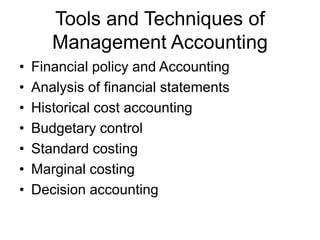
Tools and Techniques of
Management Accounting
• Financial policy and Accounting
• Analysis of financial statements
• Historical cost accounting
• Budgetary control
• Standard costing
• Marginal costing
• Decision accounting
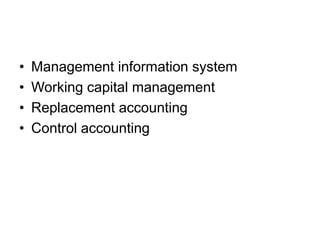
• Management information system
• Working capital management
• Replacement accounting
• Control accounting
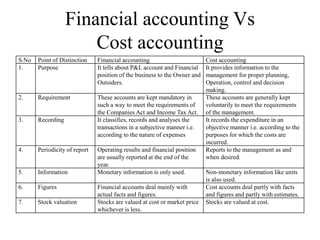
Financial accounting Vs
Cost accounting
S.No Point of Distinction Financial accounting Cost accounting
1. Purpose It tells about P&L account and Financial
position of the business to the Owner and
Outsiders.
It provides information to the
management for proper planning,
Operation, control and decision
making.
2. Requirement These accounts are kept mandatory in
such a way to meet the requirements of
the Companies Act and Income Tax Act.
These accounts are generally kept
voluntarily to meet the requirements
of the management.
3. Recording It classifies, records and analyses the
transactions in a subjective manner i.e.
according to the nature of expenses
It records the expenditure in an
objective manner i.e. according to the
purposes for which the costs are
incurred.
4. Periodicity of report Operating results and financial position
are usually reported at the end of the
year.
Reports to the management as and
when desired.
5. Information Monetary information is only used. Non-monetary information like units
is also used.
6. Figures Financial accounts deal mainly with
actual facts and figures.
Cost accounts deal partly with facts
and figures and partly with estimates.
7. Stock valuation Stocks are valued at cost or market price
whichever is less.
Stocks are valued at cost.
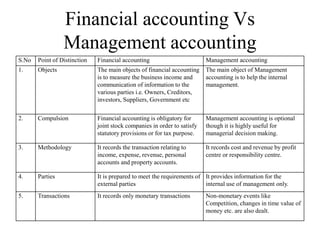
Financial accounting Vs
Management accounting
S.No Point of Distinction Financial accounting Management accounting
1. Objects The main objects of financial accounting
is to measure the business income and
communication of information to the
various parties i.e. Owners, Creditors,
investors, Suppliers, Government etc
The main object of Management
accounting is to help the internal
management.
2. Compulsion Financial accounting is obligatory for
joint stock companies in order to satisfy
statutory provisions or for tax purpose.
Management accounting is optional
though it is highly useful for
managerial decision making.
3. Methodology It records the transaction relating to
income, expense, revenue, personal
accounts and property accounts.
It records cost and revenue by profit
centre or responsibility centre.
4. Parties It is prepared to meet the requirements of
external parties
It provides information for the
internal use of management only.
5. Transactions It records only monetary transactions Non-monetary events like
Competition, changes in time value of
money etc. are also dealt.

Ppt for fundamental accounts.pptx

  • 1.
  • 2.
    MEANING AND DEFINITION OFACCOUNTING • Accounting involves the procedure of recording the financial transaction in the books of accounts which are helpful to its users for analysis and interpreting the financial soundness of business.
  • 3.
    Branches of accounting Financialaccounting-The main purpose of financial accounting is to ascertain profit or loss during a specific period, to show financial condition of the business. It is the original form of accounting. It is mainly concerned with the preparation of financial statements for the outsiders like shareholders, debenture holders, Creditors, banks and financial institutions.
  • 4.
    • Management accounting-Themain objective of managerial accounting is to maximize profit and minimize losses. • The main objective of management accounting is to help the internal management. • Management accounting is the presentation of accounting information in such a way as to assist management in the creation of policy and day-to-day operation of an undertaking.
  • 5.
    • Cost accounting-Cost accounting is prepared for managerial decision making. Cost accounting is the classifying, recording and appropriate allocation of expenditure for the determination of the costs of products or services, and for the presentation of suitably arranged data for the purpose of control and guidance of management.
  • 6.
    Financial Accounting • FinancialAccounting provides the requisite information necessary for taking investment decisions. • According to American accounting association is “The process of identifying, measuring and communicating economic information to permit informed judgments and decisions by users of the information”.
  • 7.
    FEATURES OF FINANCIAL ACCOUNTING •Monetary Transaction-Expressed in terms of money • Historical nature-transaction already taken place in past. • Legal requirement-Mandatory • Disclosure of financial status-Performance during a particular period.
  • 8.
    • Financial accountingprocess-Various process adopted by various companies.EX-Valuation of inventory, calculation of depreciation,etc.
  • 9.
    Book Keeping VsAccounting • Book keeping in simple terms the recording of all the financial transactions such as purchase,sales,receipts,payments pertaining to an individual or organisation. • Accounting is the next stage which starts after book keeping process.
  • 10.
    OBJECTIVES OF FINANCIALACCOUNTING • To keep systematic records-maintenance of proper and systematic record of all business transactions. • To determine profit or loss-profit or loss durning an academic year • To ascertain financial position-balance sheet depicts the statement of assets and liabilities of a business entity as on a particular date. • To communicate the information-decision making process by providing financial data and other vital information to stakeholders.
  • 11.
    FUNCTIONS OF FINANCIAL ACCOUNTING •Identification of the transactions.-types of accounts(Personal ac,Real Account,Nominal Account) • Recording of business transactions.-Journal • Classifying various business transactions- ledger-to know the total expenditure incurred or income earned(sale of goods, Interest on bank Deposit,commission) under the head(purchase of raw material,wages,salaries,rent,tax,advertisement etc.)
  • 12.
    • summarising informationanalysis of financial statement-business transaction of an organisation is useful to the stakeholders(both internal and external) • Analysing of FS-An in depth analysis of financial statements.profit or loss account,balancesheet-strength and weakness of the business.
  • 13.
    • Interpretation ofthe financial statements- decision making process and formulating business strategy with regard to growth,expansion and diversification. • Communicating financial data to other stakeholders
  • 14.
    Advantages of Financial Accounting •Helps in management-a company to perform their job in an efficient manner by appropriate planning,monitoring and taking decisions. • substitute to memory-recording of all the business transactions in a scientific and classified manner.
  • 15.
    • Ssettlement oftaxation liability-assessment of tax liability • Evidence in court-business transaction may be produced in the court of law-good evidence • Assistance to an insolvent person-Individual becoming insolvent, he is required to explain a number of business activities undertaken during the conduct of business. • Comparative study-profit and loss a/c,balancesheet which allows the management of a company to compare the annual result of a year and initiate requisite actions neccessary for the growth of the business.
  • 16.
    DISADVANTAGES OF FINANCIAL ACCOUNTING •Non monetary items overlooked-completely out of purview of the existing Accounting System. • Original cost-true value is not reflected in the balance sheet of the business entity • Possibility of manipulation-profit to be the only parameter to assess the performance of the company management.(R&D,Advertisement are excluded). • Bases on estimates-estimation instead of the actual) • Rule of consistency-fail to observe the basic tenents of accounting.Principles are compromised in certain cases.(depreciation on fixed assets)
  • 17.
    Users of accountinginformation • INTERNAL USERS • Owners-shareholders,partners,and Proprietors • Management • Employees
  • 18.
    EXTERNAL USERS • Creditors-supplierof raw material • Investors • Government agencies • Customers • Researchers • Foreigners • Others
  • 19.
    3 Different typesof accounts • Personal Account • Real Account • Nominal Account.
  • 20.
    • A personalaccount is an account for use by an individual for that person's own needs. • (1) Natural personal accounts • (2) Artificial personal accounts • (3) Representative personal account.
  • 21.
    • A RealAccount is a general ledger account relating to Assets and Liabilities other than people accounts. These are accounts that don't close at year-end and are carried forward. An example of a Real Account is a Bank Account.
  • 22.
    • Nominal Accountsare accounts related to and associated with losses, expenses, income, or gains. Examples include a purchase account, sales account, salary A/C, commission A/C, etc. The outcome of a nominal account is either profit or loss, which is then ultimately transferred to the capital account.
  • 23.
  • 24.
    MANAGEMENT ACCOUNTING • Managementaccounting is the presentation of accounting information in such a way as to assist management in the creation of a policy and in day-to-day operation of an undertaking.
  • 25.
    Objectives of Management Accounting •Measuring performance • Assessing Risks • Allocating Resources
  • 26.
    Scope of Accounting •Financial Accounting • Cost accounting • Statistical methods • Operations research
  • 27.
    Tools and Techniquesof Management Accounting • Financial policy and Accounting • Analysis of financial statements • Historical cost accounting • Budgetary control • Standard costing • Marginal costing • Decision accounting
  • 28.
    • Management informationsystem • Working capital management • Replacement accounting • Control accounting
  • 29.
    Financial accounting Vs Costaccounting S.No Point of Distinction Financial accounting Cost accounting 1. Purpose It tells about P&L account and Financial position of the business to the Owner and Outsiders. It provides information to the management for proper planning, Operation, control and decision making. 2. Requirement These accounts are kept mandatory in such a way to meet the requirements of the Companies Act and Income Tax Act. These accounts are generally kept voluntarily to meet the requirements of the management. 3. Recording It classifies, records and analyses the transactions in a subjective manner i.e. according to the nature of expenses It records the expenditure in an objective manner i.e. according to the purposes for which the costs are incurred. 4. Periodicity of report Operating results and financial position are usually reported at the end of the year. Reports to the management as and when desired. 5. Information Monetary information is only used. Non-monetary information like units is also used. 6. Figures Financial accounts deal mainly with actual facts and figures. Cost accounts deal partly with facts and figures and partly with estimates. 7. Stock valuation Stocks are valued at cost or market price whichever is less. Stocks are valued at cost.
  • 30.
    Financial accounting Vs Managementaccounting S.No Point of Distinction Financial accounting Management accounting 1. Objects The main objects of financial accounting is to measure the business income and communication of information to the various parties i.e. Owners, Creditors, investors, Suppliers, Government etc The main object of Management accounting is to help the internal management. 2. Compulsion Financial accounting is obligatory for joint stock companies in order to satisfy statutory provisions or for tax purpose. Management accounting is optional though it is highly useful for managerial decision making. 3. Methodology It records the transaction relating to income, expense, revenue, personal accounts and property accounts. It records cost and revenue by profit centre or responsibility centre. 4. Parties It is prepared to meet the requirements of external parties It provides information for the internal use of management only. 5. Transactions It records only monetary transactions Non-monetary events like Competition, changes in time value of money etc. are also dealt.