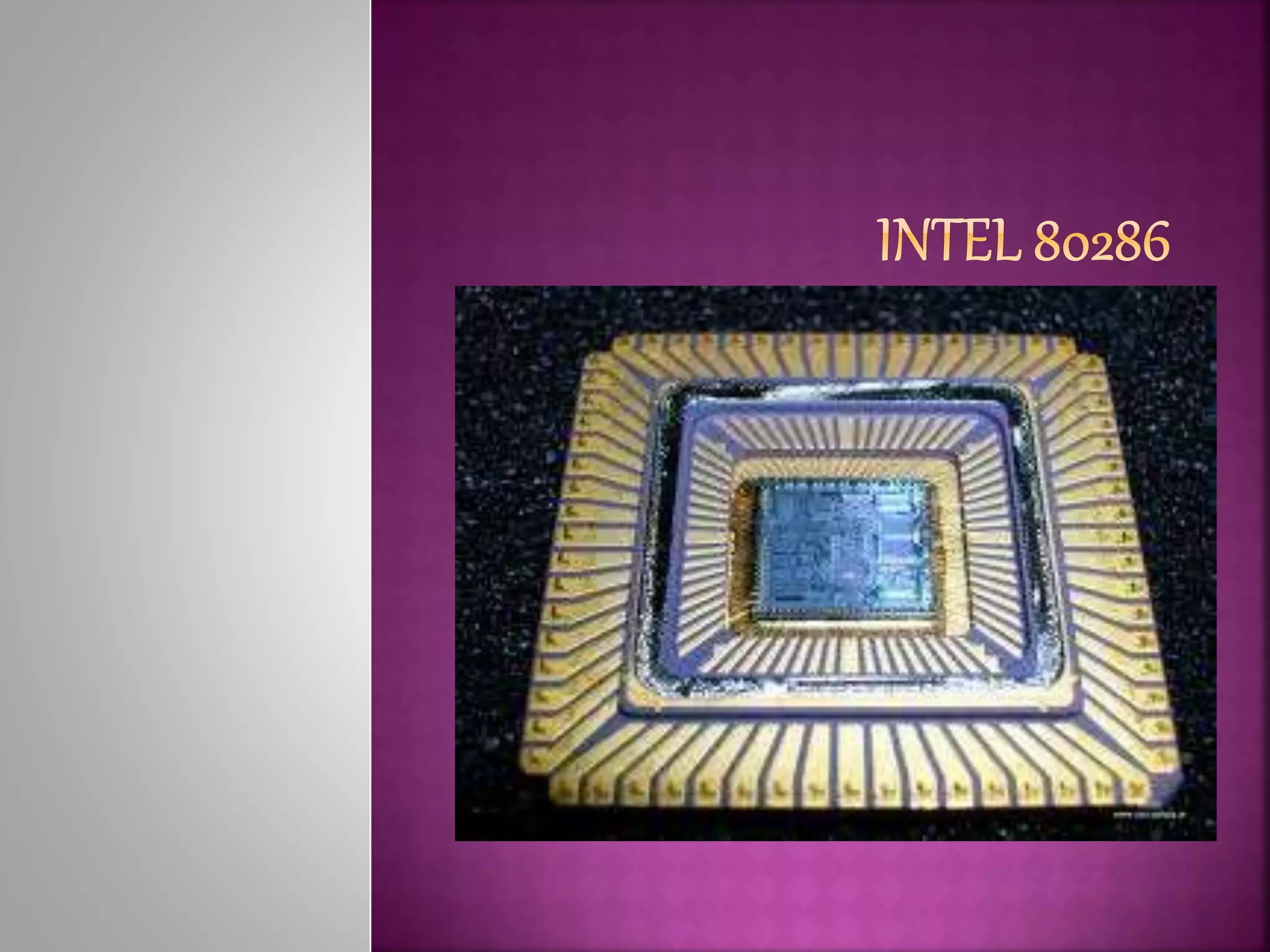
 The Intel 80286 also called iAPX 286
 Introduced on 1 February 1982 was a 16-bit x86
microprocessor with 134,000 transistors .
 The 80286 is the first member of the family of
advanced microprocessors with memory management
and wide protection abilities.
 The 80286 was designed for multi-user systems with
multitasking applications, including communications
(such as automated PBXs) and real-time process control.
 80286 offers two mode of operation
 Real mode
 Protection mode
 A no: of changes have been made to both s/w and h/w
architecture of the 80286,primarily to improve its
performance.
 Additional pipeline for higher performance
 Instruction set is modified
 Address and Data bus are de-multiplexed to
simplify system design
 It had 134,000 transistors .It is manufactures using the
high-performance metal oxide semiconductor.
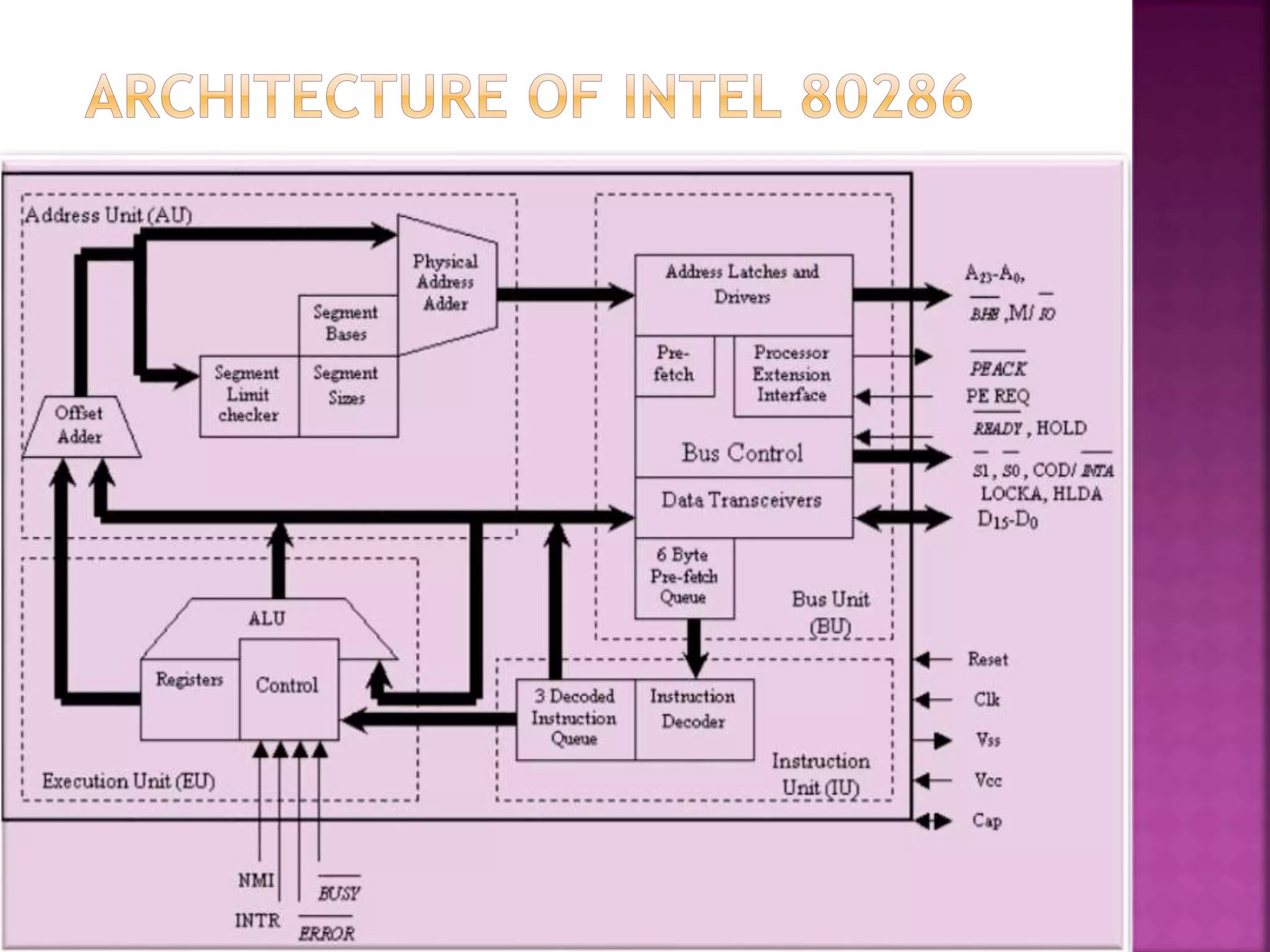
 It consist of four independent units: address unit, bus unit,
instruction unit and execution unit.
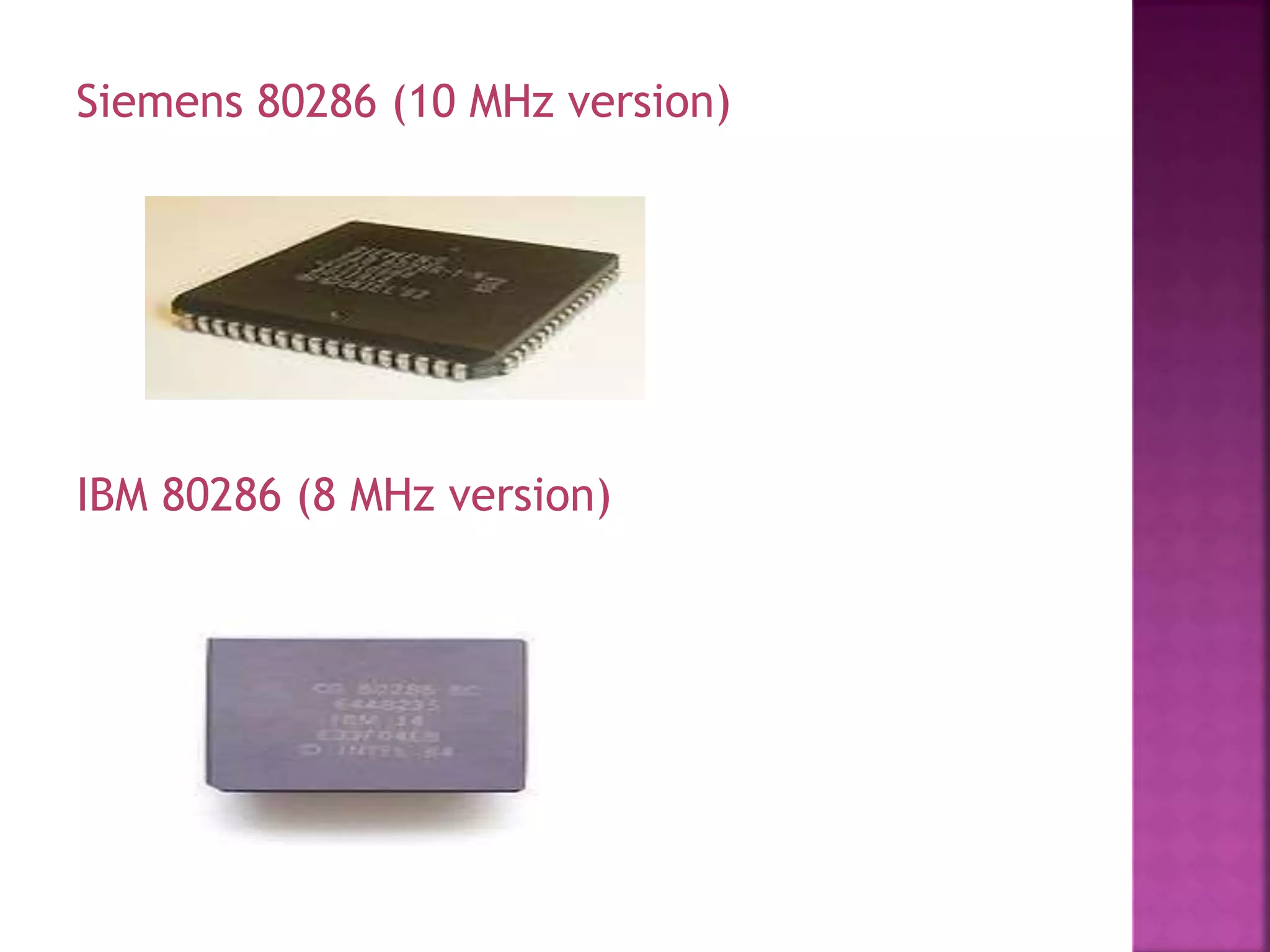
Siemens 80286 (10 MHz version)
IBM 80286 (8 MHz version)
Internal Architecture
 The 80286 is internally partitioned into four
 Bus Unit
 Instruction Unit
 Execution Unit
 Address Unit
Bus Unit
 The bus unit interface with the outside world . It provide
a 16 bit data bus, 24 bit address bus and the signals
needed to control bus transfers buses are de-multiplexed.
 Bus unit is responsible for performing all external bus
operation.
 Processing unit contain the latches and drives for address
bus and transceivers for the data buses.
 Bus unit also contains element called the pre-fetcher and
prefetch queue..together these elements implement a
mechanism know as an instruction stream queue.
Address Unit
 Address unit is provides the memory management and
protection services for the 80286.
 It off-load the responsibility for performing high speed
address calculation ,virtual to physical transition and limit
and access right attributes checks.
 Address unit calculate the next instruction to be fetched.
 Address unit perform more function ,it perform the various
address transaction and protection checks needed when
performing protected mode bus cycle.
Instruction Unit
 The IU access the output end of the prefetch queue. It
read one instruction byte after the other from the output
of the queue and decode them into the 69-bit instruction
format used by the 80286 EU.
 IU off-load the responsibility for instruction decoding from
the execution unit.
 Instruction queue within the instruction unit permit three
fully decoded instruction to be waiting for execution by
the execution unit.
Execution Unit
 EU include the ALU and a control ROM .Block labeled
registers represents all the uses –accessible registers.
 Control Rom contain the microcode sequences that define
the operation performed by the 80286’s instruction.
 EU read decoded instructions from the instruction queue
and perform the operations that they specify.
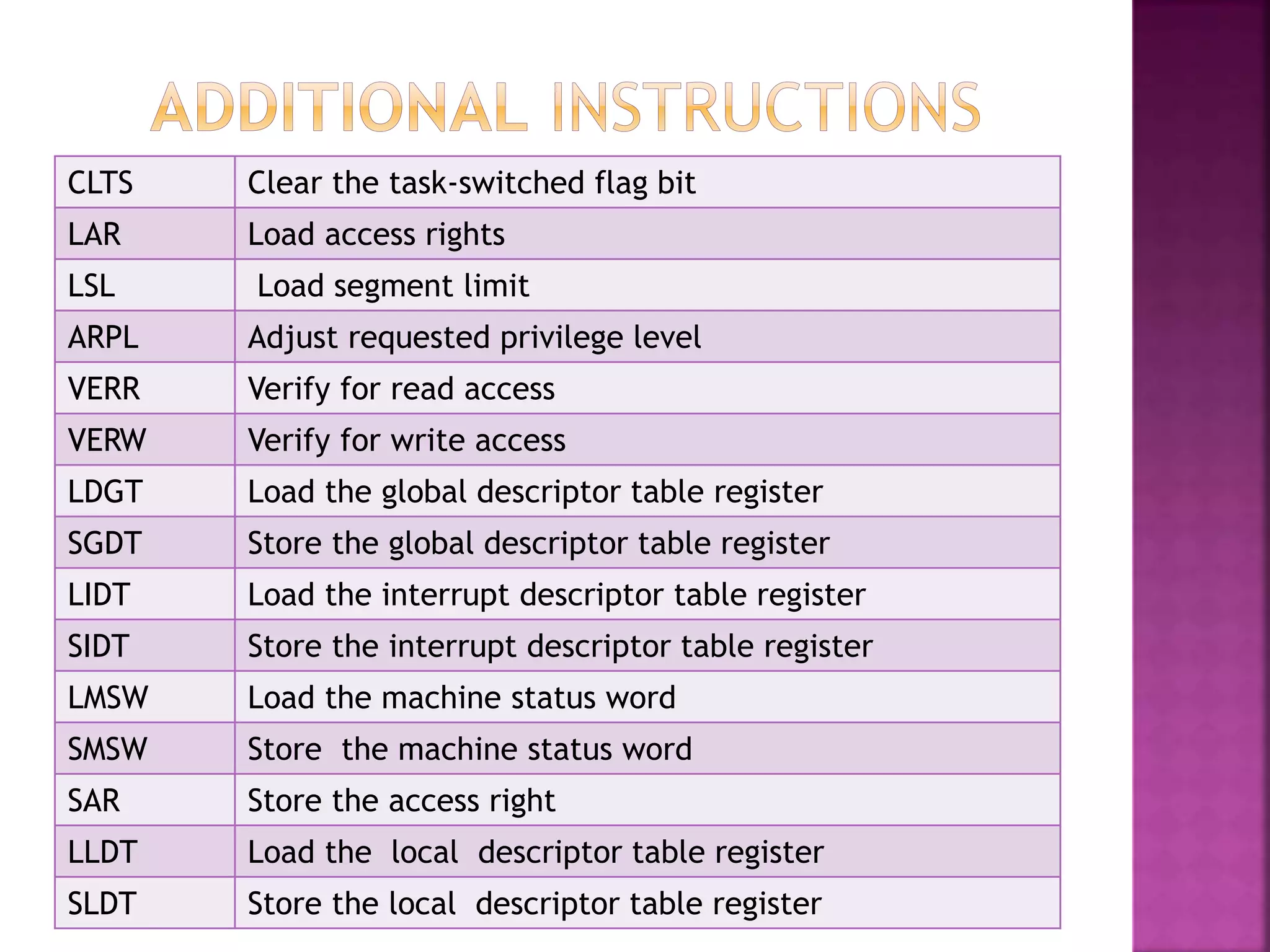
CLTS Clear the task-switched flag bit
LAR Load access rights
LSL Load segment limit
ARPL Adjust requested privilege level
VERR Verify for read access
VERW Verify for write access
LDGT Load the global descriptor table register
SGDT Store the global descriptor table register
LIDT Load the interrupt descriptor table register
SIDT Store the interrupt descriptor table register
LMSW Load the machine status word
SMSW Store the machine status word
SAR Store the access right
LLDT Load the local descriptor table register
SLDT Store the local descriptor table register
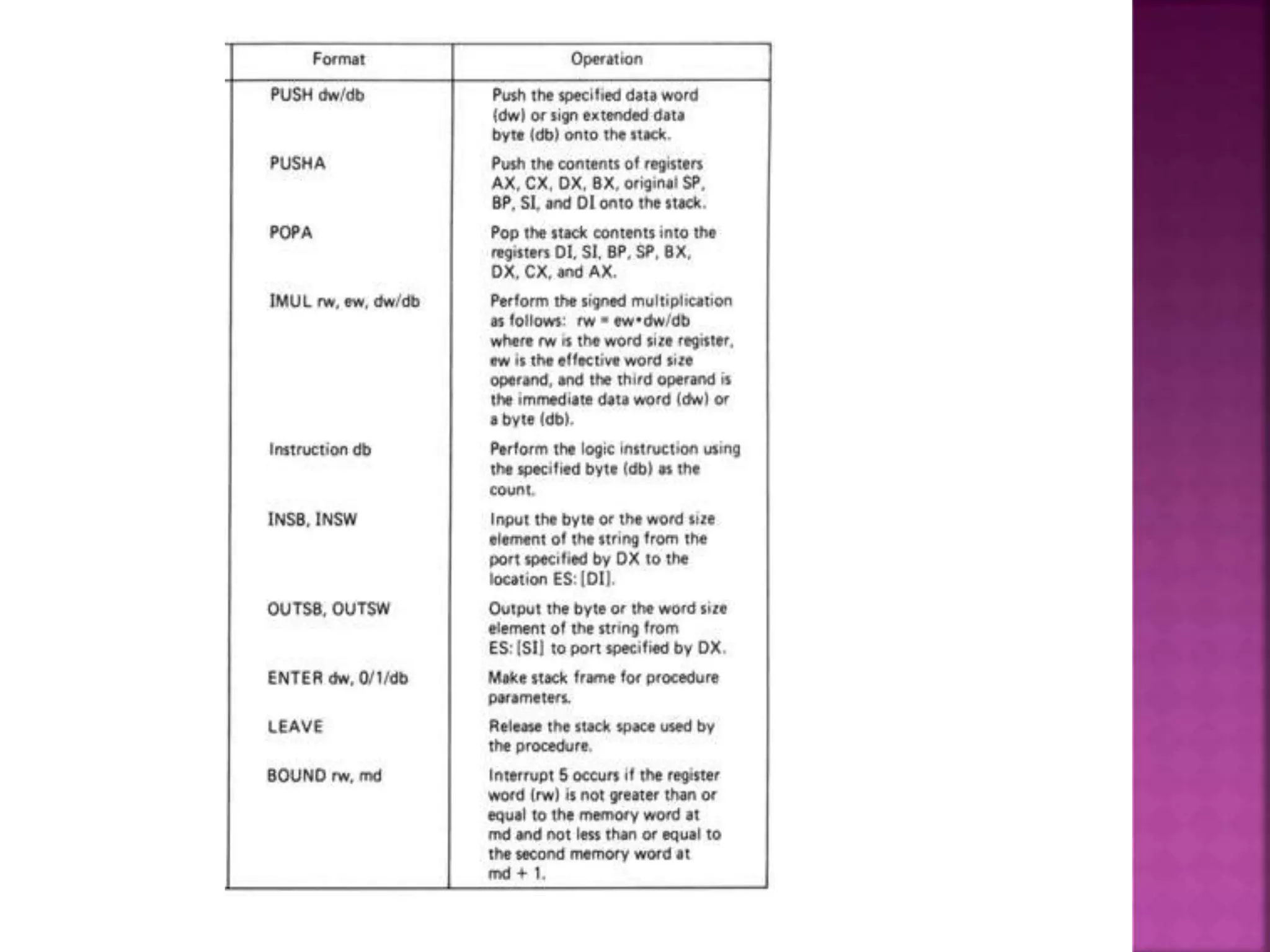
 PUSHA & POPA:
80286 have two modes of operations
 Real mode
 Protected mode or soft ware
Real mode
 Real mode is a normal mode or 80286 is power on it comes
up in the real mode.
 When in the real mode , the 80286 can be used to execute
the base instruction set of the 8086.
 The code for the base instruction of the 80286 is identical
to that of the 8086.
 No: of new instruction have been added in the instruction
set of the 80286 to enhance performance and function .
 A new register called the machine status word register
(MSW).This is used to switch the 80286 from real mode to
protected mode.
Memory Addressing in 80286
 Address is 20 bit with 16 bit segment and 16 bit offset. When
80286 is hardware reset, it automatically enters real address
mode.
Protected mode
 1 Gbyte of virtual memory and 16 Mbyte of physical
memory. The address is 24 bit. To enter PVAM mode,
Processor Status Word (PSW) is loaded by the instruction
LPSW.
 In Protected virtual address mode (PVAM) the 80286 has its
multitasking capability.
 The 80286 PVAM extends use of segments in such a way
that the segment of several tasks can reside in memory at
the same time and can by dynamically loaded as the need
arises.
 In order to provide protection between segments with in a
task , segments are assigned to one of four privileged
levels. Thus the various tasks and segment are protected
form unwanted access by type segment ,level and task
protection mechanism.
Operating system task
Application Task
Application Task
1
2
3
4
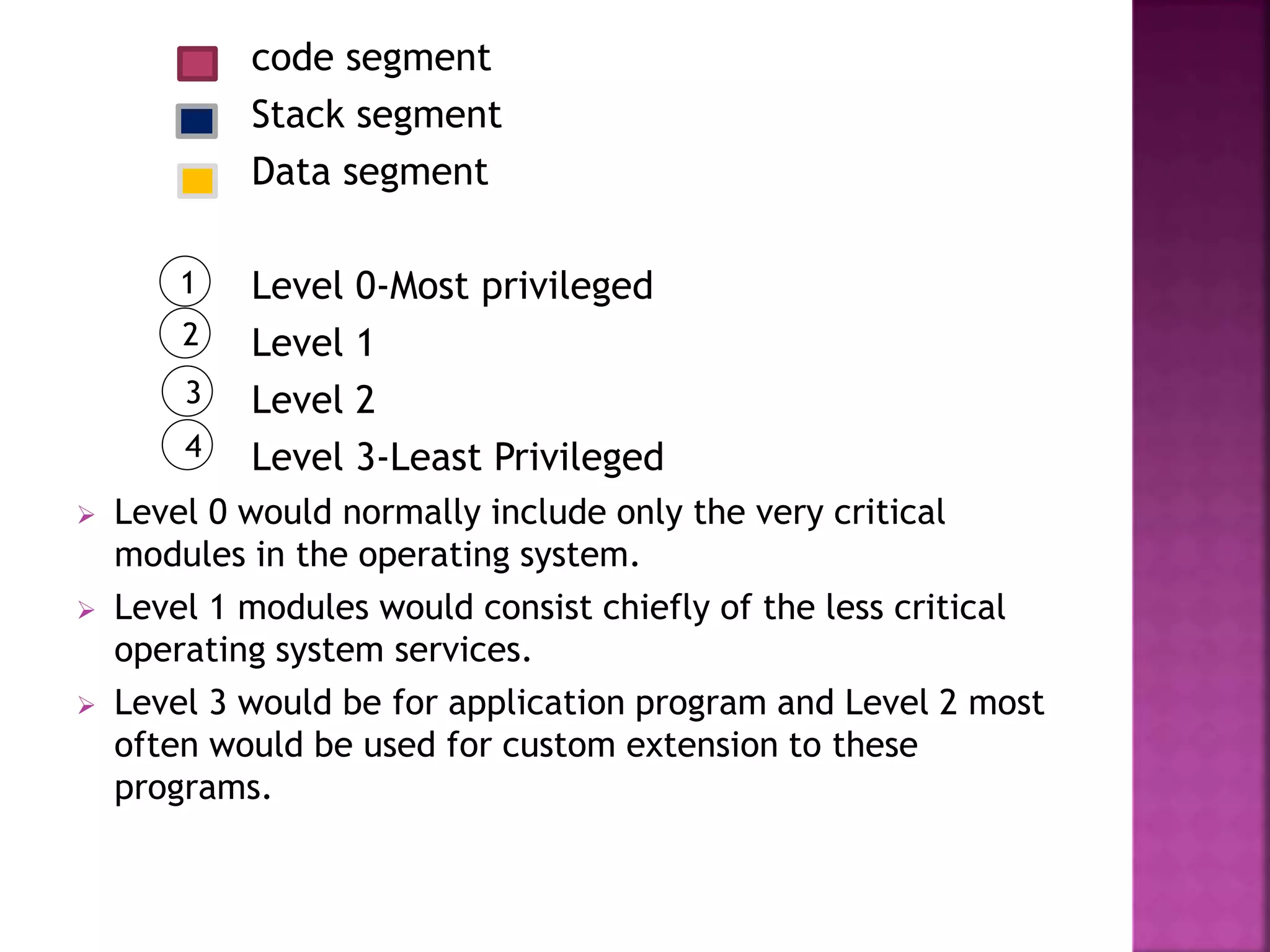
code segment
Stack segment
Data segment
Level 0-Most privileged
Level 1
Level 2
Level 3-Least Privileged
 Level 0 would normally include only the very critical
modules in the operating system.
 Level 1 modules would consist chiefly of the less critical
operating system services.
 Level 3 would be for application program and Level 2 most
often would be used for custom extension to these
programs.
1
2
3
4
Multi Tasking
 In 80286 we improve the multitasking capability by adding
necessary memory management and task switching in such
way that there is adequate protection
 Between the application task and the system and other
more privileged task
 For separating the from each other
 Between the code and data module
 Again unwanted accessing or changing the data or code.
 The primary key to multi-tasking in the ability to break the
various entities to be processed into part in such a way that
the part can easily function together and adequate
protection is maintained .
 Modularity is important in that it allow the programmer to
view the entire system as collection of modules that make up
the task and subtask.so that operating system module that
include critical code and data table can be protected from
application program.
 Second key to multi tasking is the ability to change quickly
and smoothly from one task to another.
 The task containing the module that is currently executing
is called current task.
 As the time progresses ,it is necessary to change the
current task ie:- to set aside logically the segments that
comprise the current task and make the segment in
another task the current task . This is called
task switching.

Intel 80286

  • 2.
     The Intel80286 also called iAPX 286  Introduced on 1 February 1982 was a 16-bit x86 microprocessor with 134,000 transistors .  The 80286 is the first member of the family of advanced microprocessors with memory management and wide protection abilities.  The 80286 was designed for multi-user systems with multitasking applications, including communications (such as automated PBXs) and real-time process control.
  • 3.
     80286 offerstwo mode of operation  Real mode  Protection mode  A no: of changes have been made to both s/w and h/w architecture of the 80286,primarily to improve its performance.  Additional pipeline for higher performance  Instruction set is modified  Address and Data bus are de-multiplexed to simplify system design  It had 134,000 transistors .It is manufactures using the high-performance metal oxide semiconductor.  It consist of four independent units: address unit, bus unit, instruction unit and execution unit.
  • 4.
    Siemens 80286 (10MHz version) IBM 80286 (8 MHz version)
  • 6.
    Internal Architecture  The80286 is internally partitioned into four  Bus Unit  Instruction Unit  Execution Unit  Address Unit Bus Unit  The bus unit interface with the outside world . It provide a 16 bit data bus, 24 bit address bus and the signals needed to control bus transfers buses are de-multiplexed.  Bus unit is responsible for performing all external bus operation.  Processing unit contain the latches and drives for address bus and transceivers for the data buses.
  • 7.
     Bus unitalso contains element called the pre-fetcher and prefetch queue..together these elements implement a mechanism know as an instruction stream queue. Address Unit  Address unit is provides the memory management and protection services for the 80286.  It off-load the responsibility for performing high speed address calculation ,virtual to physical transition and limit and access right attributes checks.  Address unit calculate the next instruction to be fetched.  Address unit perform more function ,it perform the various address transaction and protection checks needed when performing protected mode bus cycle.
  • 8.
    Instruction Unit  TheIU access the output end of the prefetch queue. It read one instruction byte after the other from the output of the queue and decode them into the 69-bit instruction format used by the 80286 EU.  IU off-load the responsibility for instruction decoding from the execution unit.  Instruction queue within the instruction unit permit three fully decoded instruction to be waiting for execution by the execution unit. Execution Unit  EU include the ALU and a control ROM .Block labeled registers represents all the uses –accessible registers.  Control Rom contain the microcode sequences that define the operation performed by the 80286’s instruction.  EU read decoded instructions from the instruction queue and perform the operations that they specify.
  • 9.
    CLTS Clear thetask-switched flag bit LAR Load access rights LSL Load segment limit ARPL Adjust requested privilege level VERR Verify for read access VERW Verify for write access LDGT Load the global descriptor table register SGDT Store the global descriptor table register LIDT Load the interrupt descriptor table register SIDT Store the interrupt descriptor table register LMSW Load the machine status word SMSW Store the machine status word SAR Store the access right LLDT Load the local descriptor table register SLDT Store the local descriptor table register
  • 11.
  • 12.
    80286 have twomodes of operations  Real mode  Protected mode or soft ware Real mode  Real mode is a normal mode or 80286 is power on it comes up in the real mode.  When in the real mode , the 80286 can be used to execute the base instruction set of the 8086.  The code for the base instruction of the 80286 is identical to that of the 8086.  No: of new instruction have been added in the instruction set of the 80286 to enhance performance and function .  A new register called the machine status word register (MSW).This is used to switch the 80286 from real mode to protected mode. Memory Addressing in 80286
  • 13.
     Address is20 bit with 16 bit segment and 16 bit offset. When 80286 is hardware reset, it automatically enters real address mode. Protected mode  1 Gbyte of virtual memory and 16 Mbyte of physical memory. The address is 24 bit. To enter PVAM mode, Processor Status Word (PSW) is loaded by the instruction LPSW.  In Protected virtual address mode (PVAM) the 80286 has its multitasking capability.  The 80286 PVAM extends use of segments in such a way that the segment of several tasks can reside in memory at the same time and can by dynamically loaded as the need arises.  In order to provide protection between segments with in a task , segments are assigned to one of four privileged levels. Thus the various tasks and segment are protected form unwanted access by type segment ,level and task protection mechanism.
  • 14.
    Operating system task ApplicationTask Application Task 1 2 3 4
  • 15.
    code segment Stack segment Datasegment Level 0-Most privileged Level 1 Level 2 Level 3-Least Privileged  Level 0 would normally include only the very critical modules in the operating system.  Level 1 modules would consist chiefly of the less critical operating system services.  Level 3 would be for application program and Level 2 most often would be used for custom extension to these programs. 1 2 3 4
  • 16.
    Multi Tasking  In80286 we improve the multitasking capability by adding necessary memory management and task switching in such way that there is adequate protection  Between the application task and the system and other more privileged task  For separating the from each other  Between the code and data module  Again unwanted accessing or changing the data or code.  The primary key to multi-tasking in the ability to break the various entities to be processed into part in such a way that the part can easily function together and adequate protection is maintained .  Modularity is important in that it allow the programmer to view the entire system as collection of modules that make up the task and subtask.so that operating system module that include critical code and data table can be protected from application program.
  • 17.
     Second keyto multi tasking is the ability to change quickly and smoothly from one task to another.  The task containing the module that is currently executing is called current task.  As the time progresses ,it is necessary to change the current task ie:- to set aside logically the segments that comprise the current task and make the segment in another task the current task . This is called task switching.

Editor's Notes

  • #5 kijhijhbSiemens 80286 (10 MHz version) Siemens 80286 (10 MHz version) Siemens 80286 (10 MHz version) Siemens 80286 (10 MHz version)
  • #15 Division of an 80286 system into task, level and segments