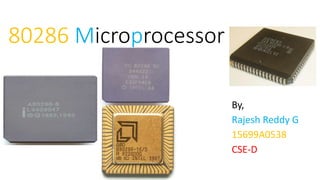

80286 Microprocessor
By,
Rajesh Reddy G
15699A0538
CSE-D
What I’m Gonna Discuss?
 What is microprocessor?
 About 80286
 Comparison
 Pin Diagram
 Salient features
 Block Diagram
 Register organization
 Conclusion
What is microprocessor?
The microprocessor is a multipurpose, programmable device that accepts digital
data as input, processes it according to instructions stored in it’s memory and
provide results as output.
It is an example of digital logic and it uses binary and hexadecimal numerical
systems
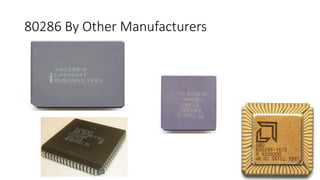
80286 By Other Manufacturers
About…
• introduced on 1 February 1982
• maximal clock rate of 4, 6 or 8 MHz and later releases for 12.5 MHz
• 16-bit microprocessor having 24 address lines and 16 data lines.
• first 8086 based CPU with separate, non-multiplexed address and data buses
• approximately 134,000 transistors in its original nMOS (HMOS)
• upwardly compatible with 8086 in terms of instruction set.
• Advanced Memory management
• It is available in variety of pin packages such as 68-pin PLCC (Plastic Leaded Chip Carrier),
Ceramic LCC (Leadless Chip Carrier), and PGA(Pin Grid Array).
• Specially designed for Multiuser & Multitasking systems.
• 4-level memory protection & support for virtual memory & operating system.
• Better Pipelining method
• 4 independent functional unit in internal architecture
• The 6 MHz, 10 MHz and 12 MHz models were reportedly measured to operate at
0.9 MIPS, 1.5 MIPS and 2.66 MIPS respectively.
About…
Intel family of microprocessor, bus and
memory sizes
Microprocessor Data bus
width
Address bus
width
Memory size
8086 16 20 1M
80186 16 20 1M
80286 16 24 16M
80386 DX 32 32 4G
80486 32 32 4G
Pentium 4 & core 2 64 40 1T
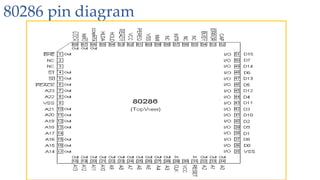
80286 pin diagram
80286 Salient features
• Two mode of operation
• More Addressable Memory
• Virtual Memory in Protected Mode
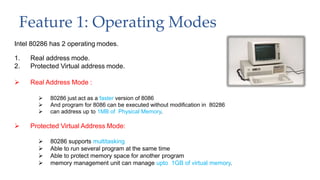
Feature 1: Operating Modes
Intel 80286 has 2 operating modes.
1. Real address mode.
2. Protected Virtual address mode.
 Real Address Mode :
 80286 just act as a faster version of 8086
 And program for 8086 can be executed without modification in 80286
 can address up to 1MB of Physical Memory.
 Protected Virtual Address Mode:
 80286 supports multitasking
 Able to run several program at the same time
 Able to protect memory space for another program
 memory management unit can manage upto 1GB of virtual memory.
Feature 2: More Addressable
Memory
• In protected mode 80286 can address 16 megabytes of physical
memory
• Where 8086 can address only 1 megabyte
Feature 3: Virtual Memory in
Protected Mode
• 80286 can treat external storage as it were physical memory
• Execute programs that are too large to be contained in physical memory
• Program can be upto 230 bytes
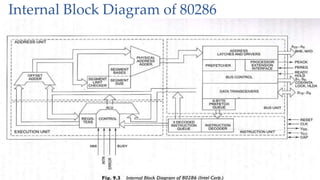
Internal Block Diagram of 80286
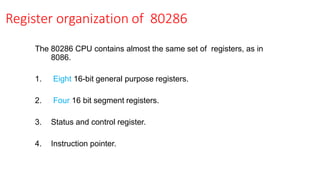
Register organization of 80286
The 80286 CPU contains almost the same set of registers, as in
8086.
1. Eight 16-bit general purpose registers.
2. Four 16 bit segment registers.
3. Status and control register.
4. Instruction pointer.
Graphical View of 80286 Registers
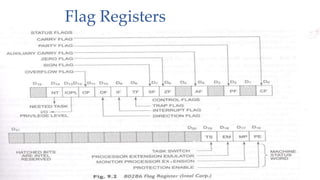
Flag Registers
o PE - Protection enable
 Protection enable flag places the 80286 in protected mode,if set. This can only be cleared by
resetting the CPU.
o MP – Monitor processor extension
 flag allows WAIT instruction to generate a processor extension.
o EM – Emulate processor extension flag,
 if set , causes a processor extension absent exceptionand permits the emulation of
processor extension by CPU.
o TS – Task switch
 if set this flag indicates the next instruction using extension will generate exception 7,
permitting the CPU to test whether the current processor extension is for current task.
• 80286 took vital role for today’s high end desktop pc’s.Now we have many high
end processors for desktop,notebook,laptop ,mobile phone etc
Conclusion
80286 microprocessors

80286 microprocessors

  • 1.
  • 2.
    What I’m GonnaDiscuss?  What is microprocessor?  About 80286  Comparison  Pin Diagram  Salient features  Block Diagram  Register organization  Conclusion
  • 3.
    What is microprocessor? Themicroprocessor is a multipurpose, programmable device that accepts digital data as input, processes it according to instructions stored in it’s memory and provide results as output. It is an example of digital logic and it uses binary and hexadecimal numerical systems
  • 4.
    80286 By OtherManufacturers
  • 5.
    About… • introduced on1 February 1982 • maximal clock rate of 4, 6 or 8 MHz and later releases for 12.5 MHz • 16-bit microprocessor having 24 address lines and 16 data lines. • first 8086 based CPU with separate, non-multiplexed address and data buses • approximately 134,000 transistors in its original nMOS (HMOS) • upwardly compatible with 8086 in terms of instruction set. • upwardly compatible with 8086 in terms of instruction set.
  • 6.
    • Advanced Memorymanagement • It is available in variety of pin packages such as 68-pin PLCC (Plastic Leaded Chip Carrier), Ceramic LCC (Leadless Chip Carrier), and PGA(Pin Grid Array). • Specially designed for Multiuser & Multitasking systems. • 4-level memory protection & support for virtual memory & operating system. • Better Pipelining method • 4 independent functional unit in internal architecture • The 6 MHz, 10 MHz and 12 MHz models were reportedly measured to operate at 0.9 MIPS, 1.5 MIPS and 2.66 MIPS respectively. About…
  • 7.
    Intel family ofmicroprocessor, bus and memory sizes Microprocessor Data bus width Address bus width Memory size 8086 16 20 1M 80186 16 20 1M 80286 16 24 16M 80386 DX 32 32 4G 80486 32 32 4G Pentium 4 & core 2 64 40 1T
  • 8.
  • 9.
    80286 Salient features •Two mode of operation • More Addressable Memory • Virtual Memory in Protected Mode
  • 10.
    Feature 1: OperatingModes Intel 80286 has 2 operating modes. 1. Real address mode. 2. Protected Virtual address mode.  Real Address Mode :  80286 just act as a faster version of 8086  And program for 8086 can be executed without modification in 80286  can address up to 1MB of Physical Memory.  Protected Virtual Address Mode:  80286 supports multitasking  Able to run several program at the same time  Able to protect memory space for another program  memory management unit can manage upto 1GB of virtual memory.
  • 11.
    Feature 2: MoreAddressable Memory • In protected mode 80286 can address 16 megabytes of physical memory • Where 8086 can address only 1 megabyte
  • 12.
    Feature 3: VirtualMemory in Protected Mode • 80286 can treat external storage as it were physical memory • Execute programs that are too large to be contained in physical memory • Program can be upto 230 bytes
  • 13.
  • 14.
    Register organization of80286 The 80286 CPU contains almost the same set of registers, as in 8086. 1. Eight 16-bit general purpose registers. 2. Four 16 bit segment registers. 3. Status and control register. 4. Instruction pointer.
  • 15.
    Graphical View of80286 Registers
  • 16.
  • 17.
    o PE -Protection enable  Protection enable flag places the 80286 in protected mode,if set. This can only be cleared by resetting the CPU. o MP – Monitor processor extension  flag allows WAIT instruction to generate a processor extension. o EM – Emulate processor extension flag,  if set , causes a processor extension absent exceptionand permits the emulation of processor extension by CPU. o TS – Task switch  if set this flag indicates the next instruction using extension will generate exception 7, permitting the CPU to test whether the current processor extension is for current task.
  • 18.
    • 80286 tookvital role for today’s high end desktop pc’s.Now we have many high end processors for desktop,notebook,laptop ,mobile phone etc Conclusion