
RESOLUTION IN THE
PROPOSITIONAL CALCULUS
The Basis of Resolution
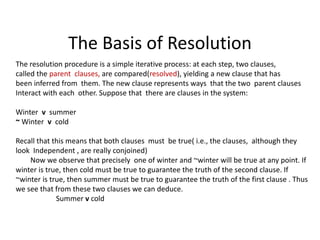
The resolution procedure is a simple iterative process: at each step, two clauses,
called the parent clauses, are compared(resolved), yielding a new clause that has
been inferred from them. The new clause represents ways that the two parent clauses
Interact with each other. Suppose that there are clauses in the system:
Winter v summer
~ Winter v cold
Recall that this means that both clauses must be true( i.e., the clauses, although they
look Independent , are really conjoined)
Now we observe that precisely one of winter and ~winter will be true at any point. If
winter is true, then cold must be true to guarantee the truth of the second clause. If
~winter is true, then summer must be true to guarantee the truth of the first clause . Thus
we see that from these two clauses we can deduce.
Summer v cold
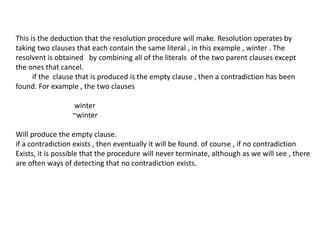
This is the deduction that the resolution procedure will make. Resolution operates by
taking two clauses that each contain the same literal , in this example , winter . The
resolvent is obtained by combining all of the literals of the two parent clauses except
the ones that cancel.
if the clause that is produced is the empty clause , then a contradiction has been
found. For example , the two clauses
winter
~winter
Will produce the empty clause.
if a contradiction exists , then eventually it will be found. of course , if no contradiction
Exists, it is possible that the procedure will never terminate, although as we will see , there
are often ways of detecting that no contradiction exists.
Resolution in propositional logic
in propositional logic , the procedure for producing a proof by resolution of
proposition P with respect to a set of axioms F is the following.
Algorithm: Propositional Resolution
1. Convert all the propositions of F to clause form.
2. Negate P and convert the result to clause form. Add it to the set of clauses
obtained in step 1.
3. Repeat until either a contradiction is found or no progress can be made:
a. Select two clauses . Call these the parent clauses .
b. Resolve them together . The resulting clause, called the resolvent , will be the
disjunction of all of the literals of both of the parent clauses with the following
exception: if there are any pairs of literals of both of the parent clauses with the
following exception: if there are any pairs of literals L and ~L such that one of the
parent clauses contains L and the other contains ~L, then select one such pair and
eliminate both L and ~L, then select one such pair and eliminate both L and ~L
from the resolvent.
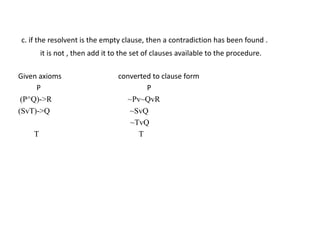
c. if the resolvent is the empty clause, then a contradiction has been found .
it is not , then add it to the set of clauses available to the procedure.
Given axioms converted to clause form
P P
(P^Q)->R ~Pv~QvR
(SvT)->Q ~SvQ
~TvQ
T T
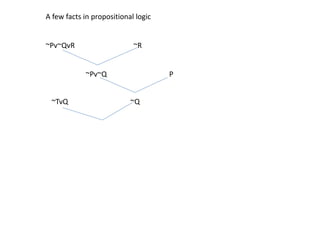
A few facts in propositional logic
~Pv~QvR ~R
~Pv~Q P
~TvQ ~Q
resolution in the propositional calculus

resolution in the propositional calculus

  • 1.
  • 2.
    The Basis ofResolution The resolution procedure is a simple iterative process: at each step, two clauses, called the parent clauses, are compared(resolved), yielding a new clause that has been inferred from them. The new clause represents ways that the two parent clauses Interact with each other. Suppose that there are clauses in the system: Winter v summer ~ Winter v cold Recall that this means that both clauses must be true( i.e., the clauses, although they look Independent , are really conjoined) Now we observe that precisely one of winter and ~winter will be true at any point. If winter is true, then cold must be true to guarantee the truth of the second clause. If ~winter is true, then summer must be true to guarantee the truth of the first clause . Thus we see that from these two clauses we can deduce. Summer v cold
  • 3.
    This is thededuction that the resolution procedure will make. Resolution operates by taking two clauses that each contain the same literal , in this example , winter . The resolvent is obtained by combining all of the literals of the two parent clauses except the ones that cancel. if the clause that is produced is the empty clause , then a contradiction has been found. For example , the two clauses winter ~winter Will produce the empty clause. if a contradiction exists , then eventually it will be found. of course , if no contradiction Exists, it is possible that the procedure will never terminate, although as we will see , there are often ways of detecting that no contradiction exists.
  • 4.
    Resolution in propositionallogic in propositional logic , the procedure for producing a proof by resolution of proposition P with respect to a set of axioms F is the following. Algorithm: Propositional Resolution 1. Convert all the propositions of F to clause form. 2. Negate P and convert the result to clause form. Add it to the set of clauses obtained in step 1. 3. Repeat until either a contradiction is found or no progress can be made: a. Select two clauses . Call these the parent clauses . b. Resolve them together . The resulting clause, called the resolvent , will be the disjunction of all of the literals of both of the parent clauses with the following exception: if there are any pairs of literals of both of the parent clauses with the following exception: if there are any pairs of literals L and ~L such that one of the parent clauses contains L and the other contains ~L, then select one such pair and eliminate both L and ~L, then select one such pair and eliminate both L and ~L from the resolvent.
  • 5.
    c. if theresolvent is the empty clause, then a contradiction has been found . it is not , then add it to the set of clauses available to the procedure. Given axioms converted to clause form P P (P^Q)->R ~Pv~QvR (SvT)->Q ~SvQ ~TvQ T T
  • 6.
    A few factsin propositional logic ~Pv~QvR ~R ~Pv~Q P ~TvQ ~Q