Patent Foramen Ovale
& Atrial Septal Aneurysm
• Prenatal oxygenation of
blood bypasses lungs.
• Oxygenated blood passes
from right to left atrium
through the foramen ovale
(FO).
Fetal Circulation
Septum primum and secundum
overlap.
Septa create an opening to allow
direct shunting of fetal blood.
• Following birth the pressure of
each chamber changes.
• Pressure changes force septum
primum to close over septum
secundum.
• In a period of 1-2 weeks 70% of
population have fusion of septa
primum and secundum.
Neonatal Septal Development
Patent Foramen Ovale
• PFO, a type of ASD, is a
flap-like opening
between the atrial
septa primum and
secundum
Anatomy
• Remnant of the fetal circulation
• Oxygenated placental blood  IVC  RA - crosses valve of
foramen ovale  systemic arterial system
• IVC flow preferentially directed towards IAS and FO
• At birth: ↓PVRI  reversed ∆LA – RA – flap of FO (septum
primum) close against septum secundum.
• Complete fusion within 1st two years
• 25% oblique slit like defect – valve like function.
Prevalence in general population
autopsy studies
Thomson (1930) Hagen (1984)
Number 1100 965
Prevalence 29% (2 – 5mm)
6% (6 – 10mm)
27.3% (1 – 19mm)
Mean -- 5mm
Prevalence decrease with age – 34% (upto 3rd decade) vs 20%
(beyond 8th decade)
Diagnosis
• Transthoracic echo: Colour doppler / Saline contrast
injection. Appearance of at least one micro bubble of
contrast in the LA within four cardiac cycles / 3 seconds
of opacification of RA
• Transesophageal echo: Colour doppler / Saline contrast
injection is the method of choice
• Transcranial doppler: After saline contrast injection,
circulating cerebral micro emboli produce a
characteristic visible and audible high-intensity signal of
short duration within the transcranial doppler
frequency in the middle cerebral artery between 4 – 20
seconds.
Contrast Echocardiography
• Performed with agitated saline prepared by hand agitation of
saline between two 10 ml syringes connected to a three way
tap.
• Approximately 10ml saline should be rapidly injected from
one syringe to the other until it appears opaque but with no
large visible air bubble.
• Contrast should be injected immediately after preparation.
• Micro air bubbles: too large to cross the pulmonary vascular
bed - aid visualization of the right heart.
• Any significant contrast in the left heart  intra cardiac shunt.
Contrast echocardiography
• Initial study  during normal respiration, when normal reversal
of atrial pressure gradient in early systole  allow shunting if a
large defect is present
• If negative repeat during provocative maneuvers: transiently
raise right atrial pressure above left - Valsalva maneuver,
coughing or firm abdominal pressure
• Valsalva maneuver – most effective; Patient to strain at the
time of injection and release breath as the right atrium begins
to opacify.
• If successfully performed, the atrial septum can be seen to bow
transiently from right to left.
Contrast echocardiography
Shunt quantification
• PFO  >3 microbubbles pass from RA  LA within three
cardiac cycles of right atrial opacification.
• Spontaneous or provoked R  L shunt at the end of a sustained
valsalva is graded semi quantitatively by no. of bubbles crossing
the septum
1. Grade 0 : none
2. Grade 1 : 3 - 10 (small)
3. Grade 2 : 10 - 20 (medium)
4. Grade 3 : >20 bubbles (large)
Associated anatomical structures
Atrial septal
aneurysm
Redundant part of IAS with a base width ≥
15mm with at least 10mm excursion into
either LA and RA
Prevalence Silver (1978) Olivares (1997)
Autopsy TTE (N = 10,803)
1% 1.9%
Chiari network Remnants of right valve of sinus venosus:
fibers connecting eustachian valve to IAS /
RA wall
Clinical significance of PFO
• Decompression illness in divers, high altitude aviators and
astronauts: Increased prevalence of brain lesions / neurological
dysfunction in divers even in the absence of decompression
illness in the presence of PFO.
Mechanism  venous gas bubbles formed by sudden reduction
in ambient pressure -- liberated after the diver’s rise to the
surface -- enter the systemic circulation through PFO and
embolize into the central nervous system (CNS).
• Migraine: 2 – 5 fold increased prevalence in PFO carriers.
Mechanisms: small emboli or serotonin not metabolized in the
lung could be the cause
Clinical significance of PFO
Platypnea orthodeoxia: Elderly patients become cyanotic and
dyspneic while sitting up and normalize on lying down
• Right to left atrial shunt in the absence of an elevated RA
pressure
• Prominent eustachian valve redirected to the foramen ovale
with aging / with general enlargement of heart chambers and
aortic root or by a positional change in entire heart due to
obesity or spinal shortening.
PAH: cause R L shunting across PFO causing persistent
desaturation and cyanosis
• ASA association:
Atrial septal aneurysm has been associated with congenital heart
diseases such as patent foramen ovale (PFO), atrial septal defects
(ASD), ventricular septal defects (VSD), valvular prolapse (VP),
patent ductus arteriosus (PDA), Ebstein’s anomaly, and tricuspid
and pulmonary atresia as well as acquired heart diseases
including valvular disease, cardiomyopathy, systemic and
pulmonary hypertension, ischemic heart disease, arrhythmias and
thrombus formation.
• No identifiable cause despite thorough evaluation
• Approximately 25% to 40%
• Up to 25% of patients experience recurrent stroke or
TIA within 4 years of initial event despite medical
therapy
Cryptogenic Stroke
• Association was first reported in 1988 by Lechat et al
• Numerous observational studies suggest strong
association
• More convincingly demonstrated for younger (< 55
years age) than older patients (>55 years)
PFO And CS
Lechat P, Mas JL, Lascault G, Loron P, Theard M, Klimczac M,
Drobinski G, Thomas D, Grosgogeat Y. Prevalence of patent foramen ovale
in patients with stroke.
N Engl J Med. 1988;318:1148 –1152.
Atrial septal abnormalities and stroke Metaanalysis
(28 case-control studies)
Overell et al. Neurology 2000
PFO ASA
All strokes 10 – 44% 2 – 17%
Cryptogenic 31 – 77% 4 – 25%
Non cryptogenic 4 – 25% 0.2 – 22%
Normals 3 – 22% 0 – 15%
TEE characteristics of PFO in cryptogenic
stroke (Homma Stroke 1994 n= 74)
• Morphological characteristics of PFO predicting
increased risk
1) Presence of a Eustachian valve directed toward the PFO
2) Gaping diameter of the PFO
3) Number of microbubbles present in LA during the first
seconds after release of the Valsalva maneuver during a
bubble test.
TEE characteristics of PFO in cryptogenic stroke
(Homma Stroke 1994 n= 74)
• Larger size of PFO in patients with cryptogenic stroke
vs those with identifiable cause (2.1 ± 1.7mm vs 0.57
± 0.78mm p < 0.01)
• Larger R  L shunt across PFO (13.9 ± 10.7 vs 1.6 ±
0.8 p < 0.005)
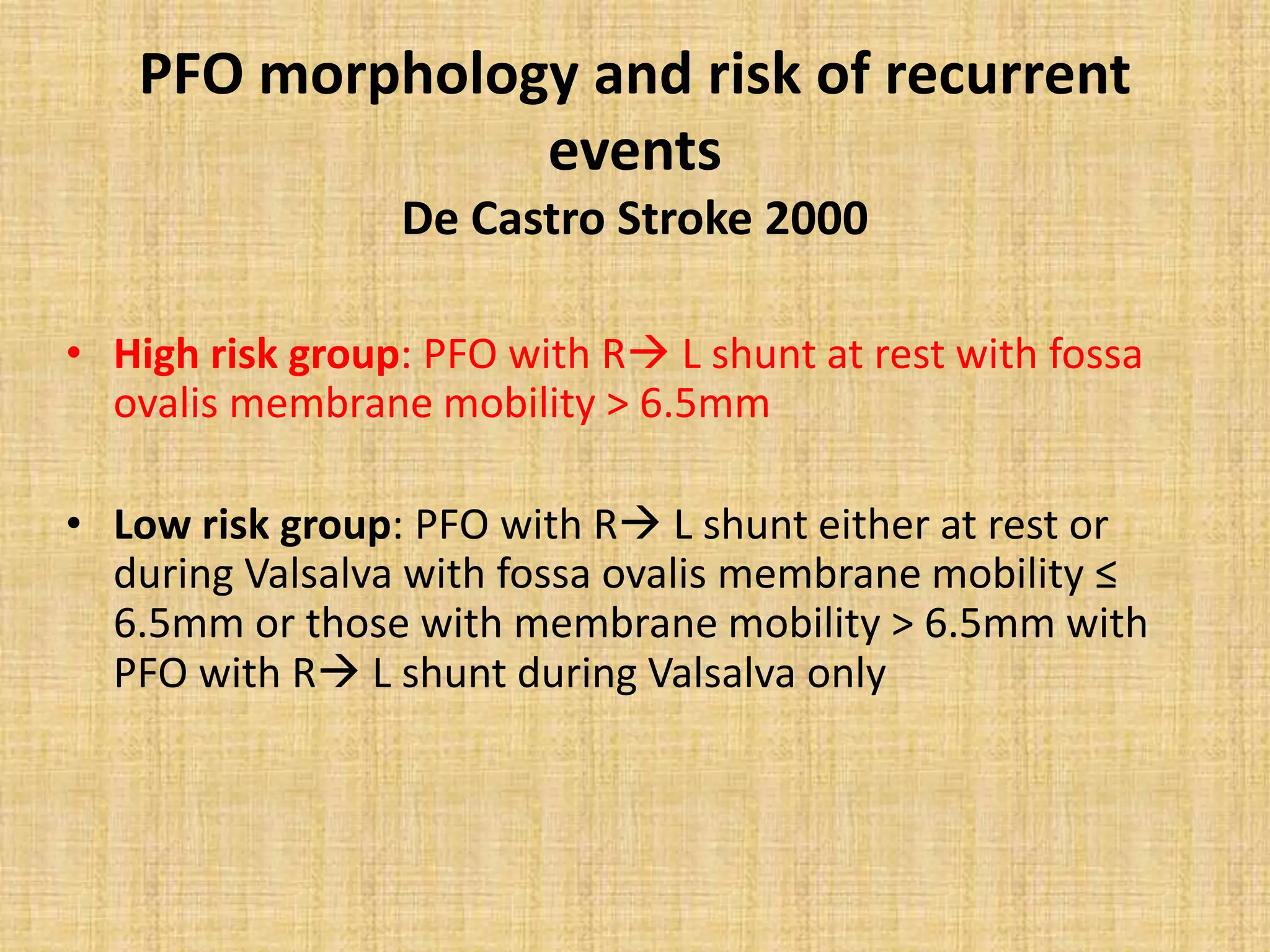
PFO morphology and risk of recurrent
events
De Castro Stroke 2000
• High risk group: PFO with R L shunt at rest with fossa
ovalis membrane mobility > 6.5mm
• Low risk group: PFO with R L shunt either at rest or
during Valsalva with fossa ovalis membrane mobility ≤
6.5mm or those with membrane mobility > 6.5mm with
PFO with R L shunt during Valsalva only
PFO morphology and risk of recurrent
events
De Castro Stroke 2000 (n = 101)
3 year risk of stroke / TIA recurrence
PFO 7.2%
Low risk PFO 4.3%
(p = 0.05)High risk PFO 12.5%
PELVIS study: case control study: prevalence of pelvic
vein thrombosis on MRV done within 72 hrs of symptom onset.
Stroke 2004
Cryptogenic stroke
(n=46)
Stroke with determined origin
(n=49)
20% 4%
Topography of Cerebral infarcts
• Topography of cerebral infarcts in cryptogenic
stroke suggests embolic etiology.
Steiner et al., Stroke, 1998
Sacco et al., Ann Neurol, 1989
Thrombus in transit
Clinical significance of PFO
• ↑ RA pressure: RA  LA shunting of deoxygenated blood or
emboli (“paradoxical embolism”)
• Transiently : during sneezing or during “Valsalva” maneuvers
such as weightlifting, straining during urination or defecation
• Persistently : RVMI, tricuspid valve disease, acute pulmonary
embolism
• Direct evidence : >30 case reports of impending paradoxical
embolism – thrombus visualized in transit through a PFO 
acute pulmonary embolism with systemic arterial
embolization involving limbs, viscera, coronary arteries or
the cerebral circulation.
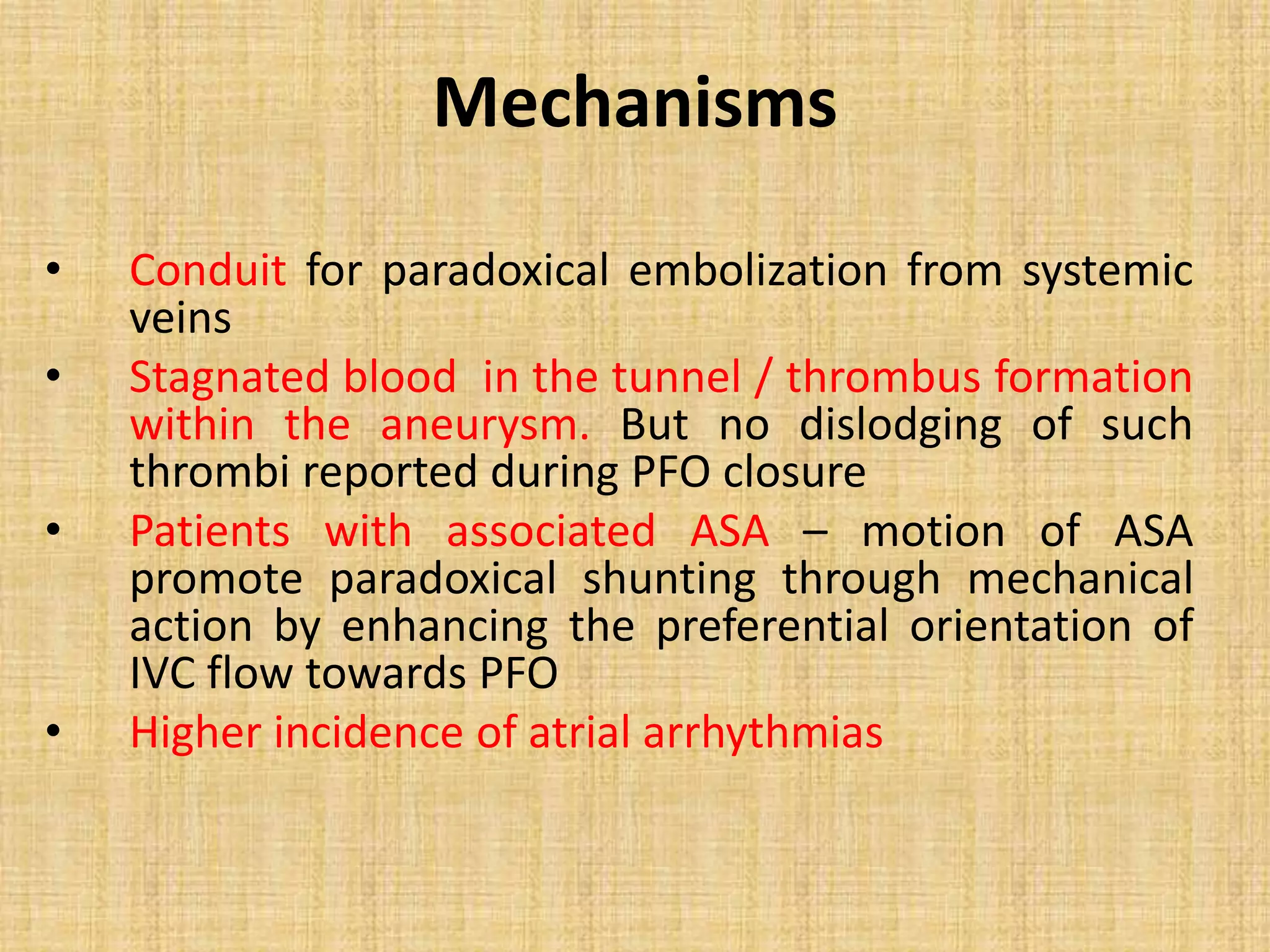
Mechanisms
• Conduit for paradoxical embolization from systemic
veins
• Stagnated blood in the tunnel / thrombus formation
within the aneurysm. But no dislodging of such
thrombi reported during PFO closure
• Patients with associated ASA – motion of ASA
promote paradoxical shunting through mechanical
action by enhancing the preferential orientation of
IVC flow towards PFO
• Higher incidence of atrial arrhythmias
PFO and cryptogenic stroke
• Most patients with possible embolic disease  trans-septal
thrombus is not visualized by cardiac imaging.
• Diagnosis of paradoxical embolism via PFO ideally requires 
triad of PFO, ↑ RA pressure and a venous source of thrombus.
• Venous thrombus identified in only 10% of patients with PFO
and stroke (Lethen AJC 1996 ) by phlebography.
• This inability to exclude venous thrombosis  potentially
pathological role of PFO difficult to exclude especially among
young adults with strokes that are unexplained (or
cryptogenic) despite extensive investigation.
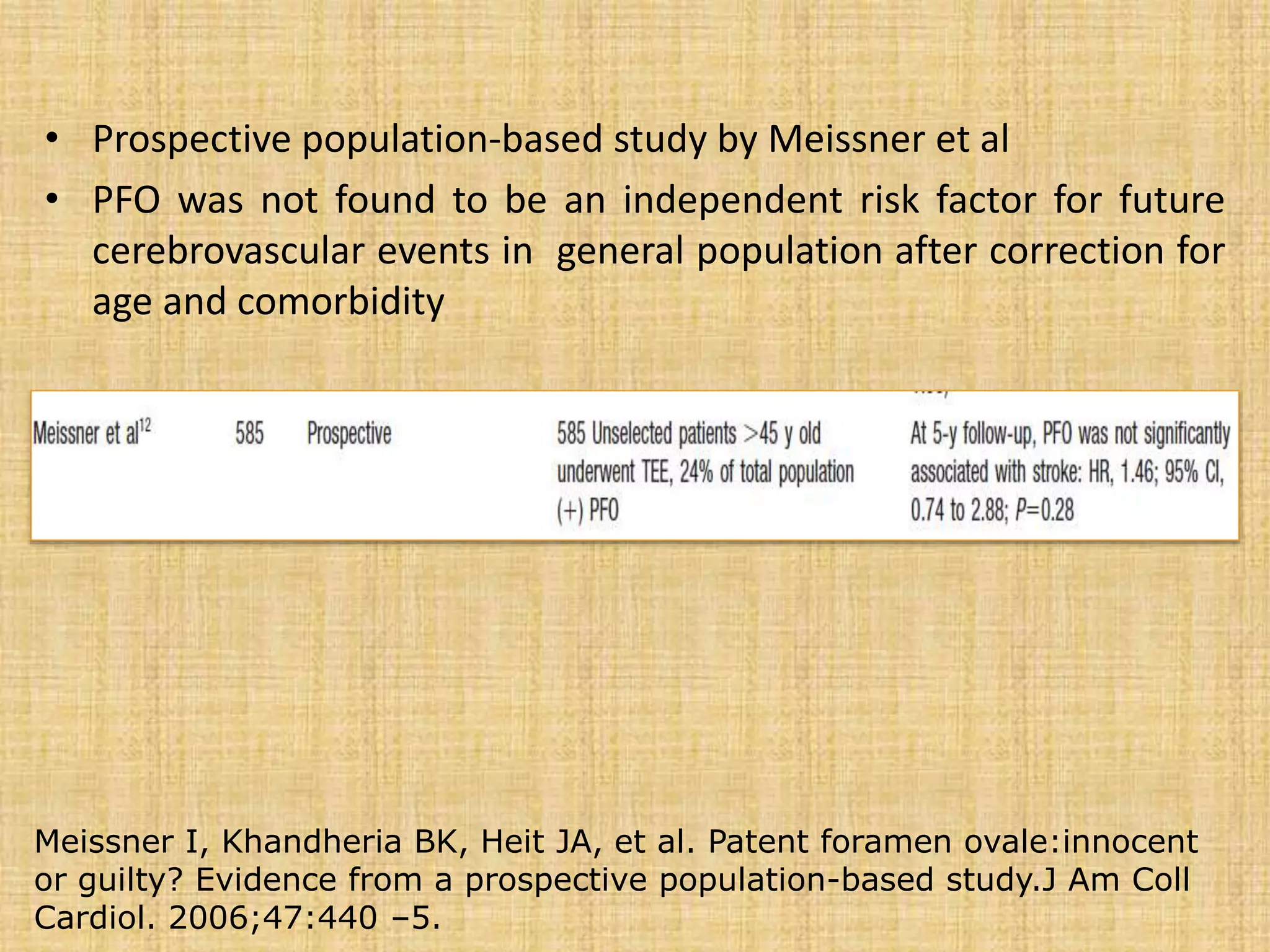
• Prospective population-based study by Meissner et al
• PFO was not found to be an independent risk factor for future
cerebrovascular events in general population after correction for
age and comorbidity
Meissner I, Khandheria BK, Heit JA, et al. Patent foramen ovale:innocent
or guilty? Evidence from a prospective population-based study.J Am Coll
Cardiol. 2006;47:440 –5.
• Northern Manhattan Study (NOMAS)
• PFO not associated with increased stroke risk in a
multiethnic cohort of both men and women or in
patients younger or older than 60 years
Di Tullio MR, Sacco RL, Sciacca RR, Jin Z, Homma S. Patent foramen
ovale and the risk of ischemic stroke in a multiethnic population. J Am
Coll Cardiol. 2007;49:797– 802.
Prevention of recurrent stroke
Medical therapy or PFO closure?
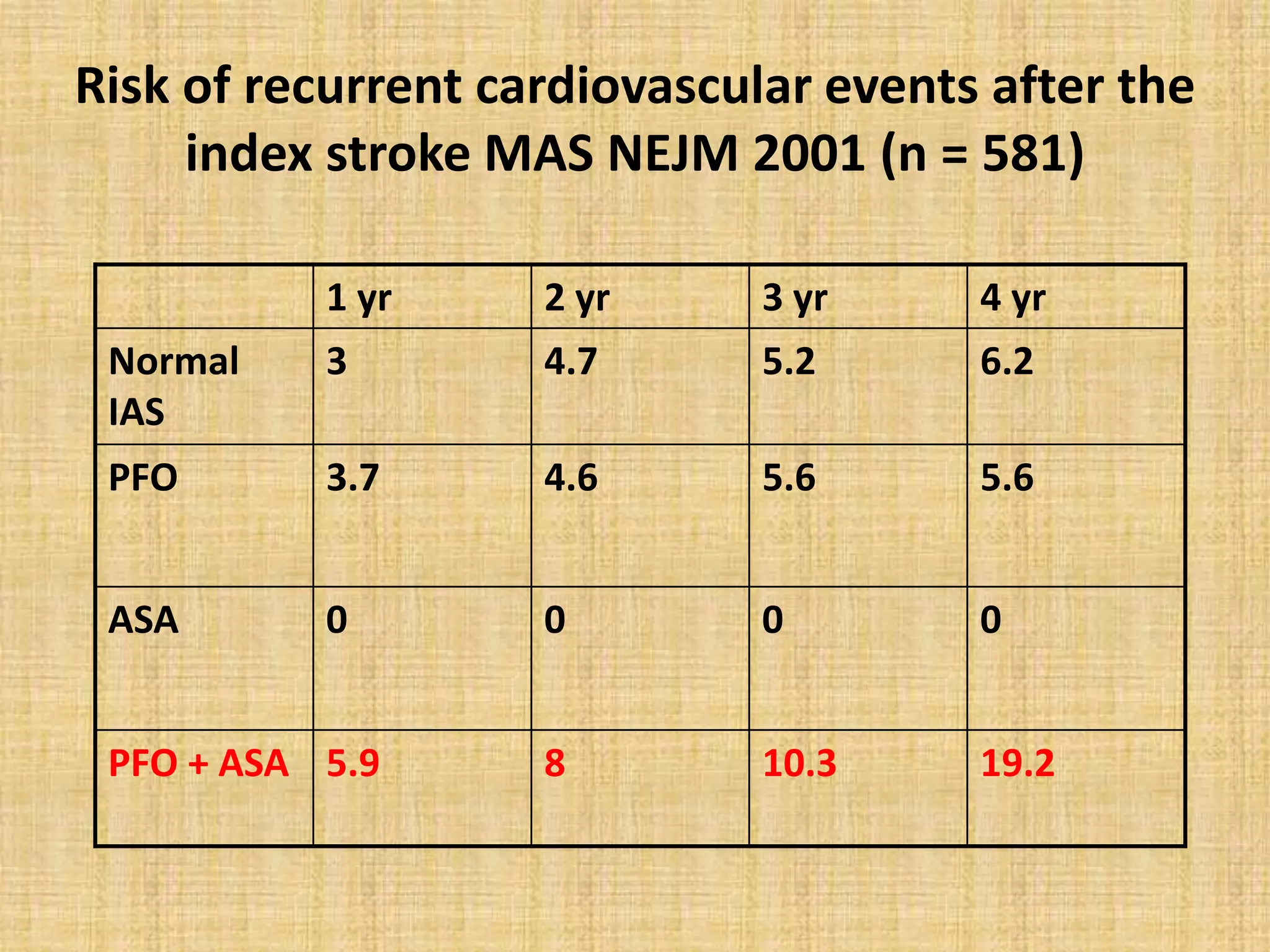
Risk of recurrent cardiovascular events after the
index stroke MAS NEJM 2001 (n = 581)
1 yr 2 yr 3 yr 4 yr
Normal
IAS
3 4.7 5.2 6.2
PFO 3.7 4.6 5.6 5.6
ASA 0 0 0 0
PFO + ASA 5.9 8 10.3 19.2
PICSS trial – Homma(2002)
Aspirin vs Warfarin in cryptogenic stroke
Aspirin
(n = 56)
Warfarin
(n = 42)
p
Recurrent stroke or death 17.9% 9.5% 0.28
All events 23.2% 16.7% 0.48
Major bleeding 1.78 1.98 1.0
Minor 8.7 22.9 <0.001
Study not powered to assess therapeutic equivalence
Catheter – Based PFO closure
• Bridges (1992): 36 patients - PFO closure with
Clamshell device - 8.4 months follow up - no
recurrent stroke
• New devices specifically designed for closure of PFO
have been developed
• CardioSEAL device and Amplatzer PFO occluder are
most popular devices used
Incidence of recurrent events by patient age (medical therapy and
transcatheter closure of patent foramen)
Khairy et al., Systematic review of studies of Medical therapy or transcatheter PFO closure; Ann
Int Med 2003
Transcatheter closure vs medical
management
(Khairy et al, Ann Int Med 2003)
Transcatheter
closure
Medical
management
N 1355 895
1year recurrence
rates
0 – 4.9% 3.8 – 12%
Complication rate Major: 1.5%
Minor: 7.9%
Major: 2%
Minor: 8 – 23%
Schuchlenz et al, Int J cardiol 2005
Observational study
• N= 280
• Recurrent events
– 13% with antiplatelets
– 5.6% with anticoagulants
– 0.6% with device closure
• Hazard ratio compared to oral anticoagulation
– For device closure: 0.06 (95%CI 0.12-0.29)
– For antiplatelet: 2.3 ( 95% CI 0.9-5.5 )
Kaplan–Meier event free survival curves (stroke and transient ischemic attack [TIA])
of patients with cryptogenic cerebrovascular events and a patent foramen ovale
according to different treatment strategies. *The log-rank test was used to calculate
the P value.
Kaplan–Meier event free survival curves (stroke and transient ischemic attack [TIA] and
treatment related complications) of patients with cryptogenic cerebrovascular events and a
patent foramen ovale according to different treatment strategies. Complications include
procedure and device problems such as puncture site bleeding, thrombus on the device,
hemopericardium or failed implantation requiring another device and major bleeding
associated with oral anticoagulation. *The log-rank test was used to calculate the P value.
Randomized controlled Trials
• RESPECT trial: Amplatzer device
• PC trial: Amplatzer device
• CARDIA STAR trial: Cardia Star PFO closure device
• CLOSURE I trial: STARFlex occluder
Randomization
Randomization
1 : 1
STARFlex®
Closure (within 30 Days)
6 Months Aspirin and Clopidigrel
followed by 18 Months Aspirin
Best Medical Therapy
24 Months Aspirin Or Warfarin
Or Combination
Between June 23, 2003 and October 24, 2008, 909 patients were
randomized at 87 sites in the United States and Canada. Block randomization
with stratification by study site and by the presence or absence of an ASA viewed by
TEE.
N = 909
N=447 N=462
STARFlex®
• Double umbrella
comprised of MP35N
framework with
attached polyester
fabric
• 23mm, 28mm, 33mm
• CLOSURE I is the first completed, prospective, randomized,
independently adjudicated PFO device closure study
• Superiority of PFO closure with STARFlex® plus medical therapy over
medical therapy alone was not demonstrated
– no significant benefit related to degree of initial shunt
– no significant benefit with atrial septal aneurysm
– insignificant trend (1.8%) favoring device driven by TIA
– 2 year stroke rate essentially identical in both arms (3%)
• Major vascular (procedural) complications in 3% of device arm
• Significantly higher rate of atrial fibrillation in device arm (5.7%)
– 60% periprocedural
 Percutaneous transcatheter device
 Self-expanding double-disc design
 Nitinol wire mesh with polyester
fabric/thread
 Radiopaque marker bands
 Sizes: 18, 25, 35 mm
 Recapturable and repositionable
AMPLATZER PFO Occluder
RESPECT Trial provides evidence of benefit in stroke risk reduction from closure
with AMPLATZER PFO occluder over medical management alone
 Primary analysis of ITT cohort was not statistically significant but trended
towards superiority while secondary analyses suggested superiority
 Stroke risk reduction was observed across totality of analyses with rates
ranging from 46.6% - 72.7%
 Very low risk of device or procedure-related complications
Predictors of recurrent events
• Presence of a residual shunt
• Coexistence of ASA with PFO didn’t predict increased
recurrence rates
• Other reasons: PFO not responsible for index event, small
emboli formed on the left side of device
Current indications for PFO closure in
cryptogenic stroke patients
• Large PFO (passage of > 20 microbubbles without
provocative maneuvers) with recurrent
symptoms despite optimal medical treatment
• PFO with ASA
• Triad necessary for paradoxical embolism is
present (PFO, venous thrombosis, ↑right heart
pressures)
• PFO closure may be considered for patients with
recurrent CS despite optimal medical therapy
(Class IIb, Level of Evidence: C)
United States Food and Drug Administration approved indications for
patent foramen ovale closure under humanitarian device exemption
regulations
The CardioSEAL Occluder and Amplatzer PFO Occluder are indicated for
the following:
Recurrent cryptogenic stroke due to presumed paradoxical embolism
through a PFO and who have failed conventional drug therapy.
Other patent foramen ovale closure ‘‘off-label’’ uses or
indications that are under investigation
Cryptogenic stroke due to presumed paradoxical embolism through a PFO
•After the first clinical event
•Patients who have contraindications to anticoagulant treatment
•As an alternative to medical therapy or surgical closure
Cryptogenic TIA due to presumed paradoxical embolism through a PFO
Presumed paradoxical peripheral or coronary arterial embolism through a PFO.
Cryptogenic stroke, TIA, or peripheral or coronary embolism due to presumed
paradoxical embolism through a PFO that is associated with a
hypercoagulability state.
Technique
• PFO can be passed by sliding along the septum primum coming from
IVC with a wire or a curved catheter (multipurpose catheter).
• Transseptal sheath is placed in the LA exchanging over a 0.035” guide
wire.
• The PFO occluder is delivered through the transseptal sheath
• Position checked by TEE or right atrial contrast echocardiography
• The left sided disk is unfolded and pulled back against the septum
pulling septum primum against secundum and closing the slit valve.
• Right sided disk is then deployed and device released
• Perfect apposition confirmed by echo / angio
• Aspirin and clopidogrel post procedure .
Major Complications
• Death
• Hemorrhage requiring blood transfusion
• Cardiac tamponade
• Need for surgical intervention
• Massive pulmonary emboli
Minor complications
• Bleeding not requiring transfusion
• Periprocedural atrial arrhythmias
• Transient atrioventricular node block
• Device arm fracture
• Device embolization with successful catheter retrieval
• Asymptomatic device thrombosis
• Need for recatheterization
• Symptomatic air embolism
• Transient ST elevation
• Arteriovenous fistula formation
• Femoral hematoma
Thank You !!

PFO CLOSURE

  • 1.
    Patent Foramen Ovale &Atrial Septal Aneurysm
  • 2.
    • Prenatal oxygenationof blood bypasses lungs. • Oxygenated blood passes from right to left atrium through the foramen ovale (FO). Fetal Circulation
  • 3.
    Septum primum andsecundum overlap. Septa create an opening to allow direct shunting of fetal blood.
  • 4.
    • Following birththe pressure of each chamber changes. • Pressure changes force septum primum to close over septum secundum. • In a period of 1-2 weeks 70% of population have fusion of septa primum and secundum. Neonatal Septal Development
  • 5.
    Patent Foramen Ovale •PFO, a type of ASD, is a flap-like opening between the atrial septa primum and secundum
  • 6.
    Anatomy • Remnant ofthe fetal circulation • Oxygenated placental blood  IVC  RA - crosses valve of foramen ovale  systemic arterial system • IVC flow preferentially directed towards IAS and FO • At birth: ↓PVRI  reversed ∆LA – RA – flap of FO (septum primum) close against septum secundum. • Complete fusion within 1st two years • 25% oblique slit like defect – valve like function.
  • 7.
    Prevalence in generalpopulation autopsy studies Thomson (1930) Hagen (1984) Number 1100 965 Prevalence 29% (2 – 5mm) 6% (6 – 10mm) 27.3% (1 – 19mm) Mean -- 5mm Prevalence decrease with age – 34% (upto 3rd decade) vs 20% (beyond 8th decade)
  • 8.
    Diagnosis • Transthoracic echo:Colour doppler / Saline contrast injection. Appearance of at least one micro bubble of contrast in the LA within four cardiac cycles / 3 seconds of opacification of RA • Transesophageal echo: Colour doppler / Saline contrast injection is the method of choice • Transcranial doppler: After saline contrast injection, circulating cerebral micro emboli produce a characteristic visible and audible high-intensity signal of short duration within the transcranial doppler frequency in the middle cerebral artery between 4 – 20 seconds.
  • 9.
    Contrast Echocardiography • Performedwith agitated saline prepared by hand agitation of saline between two 10 ml syringes connected to a three way tap. • Approximately 10ml saline should be rapidly injected from one syringe to the other until it appears opaque but with no large visible air bubble. • Contrast should be injected immediately after preparation. • Micro air bubbles: too large to cross the pulmonary vascular bed - aid visualization of the right heart. • Any significant contrast in the left heart  intra cardiac shunt.
  • 10.
    Contrast echocardiography • Initialstudy  during normal respiration, when normal reversal of atrial pressure gradient in early systole  allow shunting if a large defect is present • If negative repeat during provocative maneuvers: transiently raise right atrial pressure above left - Valsalva maneuver, coughing or firm abdominal pressure • Valsalva maneuver – most effective; Patient to strain at the time of injection and release breath as the right atrium begins to opacify. • If successfully performed, the atrial septum can be seen to bow transiently from right to left.
  • 11.
  • 12.
    Shunt quantification • PFO >3 microbubbles pass from RA  LA within three cardiac cycles of right atrial opacification. • Spontaneous or provoked R  L shunt at the end of a sustained valsalva is graded semi quantitatively by no. of bubbles crossing the septum 1. Grade 0 : none 2. Grade 1 : 3 - 10 (small) 3. Grade 2 : 10 - 20 (medium) 4. Grade 3 : >20 bubbles (large)
  • 13.
    Associated anatomical structures Atrialseptal aneurysm Redundant part of IAS with a base width ≥ 15mm with at least 10mm excursion into either LA and RA Prevalence Silver (1978) Olivares (1997) Autopsy TTE (N = 10,803) 1% 1.9% Chiari network Remnants of right valve of sinus venosus: fibers connecting eustachian valve to IAS / RA wall
  • 15.
    Clinical significance ofPFO • Decompression illness in divers, high altitude aviators and astronauts: Increased prevalence of brain lesions / neurological dysfunction in divers even in the absence of decompression illness in the presence of PFO. Mechanism  venous gas bubbles formed by sudden reduction in ambient pressure -- liberated after the diver’s rise to the surface -- enter the systemic circulation through PFO and embolize into the central nervous system (CNS). • Migraine: 2 – 5 fold increased prevalence in PFO carriers. Mechanisms: small emboli or serotonin not metabolized in the lung could be the cause
  • 16.
    Clinical significance ofPFO Platypnea orthodeoxia: Elderly patients become cyanotic and dyspneic while sitting up and normalize on lying down • Right to left atrial shunt in the absence of an elevated RA pressure • Prominent eustachian valve redirected to the foramen ovale with aging / with general enlargement of heart chambers and aortic root or by a positional change in entire heart due to obesity or spinal shortening. PAH: cause R L shunting across PFO causing persistent desaturation and cyanosis
  • 17.
    • ASA association: Atrialseptal aneurysm has been associated with congenital heart diseases such as patent foramen ovale (PFO), atrial septal defects (ASD), ventricular septal defects (VSD), valvular prolapse (VP), patent ductus arteriosus (PDA), Ebstein’s anomaly, and tricuspid and pulmonary atresia as well as acquired heart diseases including valvular disease, cardiomyopathy, systemic and pulmonary hypertension, ischemic heart disease, arrhythmias and thrombus formation.
  • 18.
    • No identifiablecause despite thorough evaluation • Approximately 25% to 40% • Up to 25% of patients experience recurrent stroke or TIA within 4 years of initial event despite medical therapy Cryptogenic Stroke
  • 19.
    • Association wasfirst reported in 1988 by Lechat et al • Numerous observational studies suggest strong association • More convincingly demonstrated for younger (< 55 years age) than older patients (>55 years) PFO And CS Lechat P, Mas JL, Lascault G, Loron P, Theard M, Klimczac M, Drobinski G, Thomas D, Grosgogeat Y. Prevalence of patent foramen ovale in patients with stroke. N Engl J Med. 1988;318:1148 –1152.
  • 20.
    Atrial septal abnormalitiesand stroke Metaanalysis (28 case-control studies) Overell et al. Neurology 2000 PFO ASA All strokes 10 – 44% 2 – 17% Cryptogenic 31 – 77% 4 – 25% Non cryptogenic 4 – 25% 0.2 – 22% Normals 3 – 22% 0 – 15%
  • 21.
    TEE characteristics ofPFO in cryptogenic stroke (Homma Stroke 1994 n= 74) • Morphological characteristics of PFO predicting increased risk 1) Presence of a Eustachian valve directed toward the PFO 2) Gaping diameter of the PFO 3) Number of microbubbles present in LA during the first seconds after release of the Valsalva maneuver during a bubble test.
  • 22.
    TEE characteristics ofPFO in cryptogenic stroke (Homma Stroke 1994 n= 74) • Larger size of PFO in patients with cryptogenic stroke vs those with identifiable cause (2.1 ± 1.7mm vs 0.57 ± 0.78mm p < 0.01) • Larger R  L shunt across PFO (13.9 ± 10.7 vs 1.6 ± 0.8 p < 0.005)
  • 23.
    PFO morphology andrisk of recurrent events De Castro Stroke 2000 • High risk group: PFO with R L shunt at rest with fossa ovalis membrane mobility > 6.5mm • Low risk group: PFO with R L shunt either at rest or during Valsalva with fossa ovalis membrane mobility ≤ 6.5mm or those with membrane mobility > 6.5mm with PFO with R L shunt during Valsalva only
  • 24.
    PFO morphology andrisk of recurrent events De Castro Stroke 2000 (n = 101) 3 year risk of stroke / TIA recurrence PFO 7.2% Low risk PFO 4.3% (p = 0.05)High risk PFO 12.5%
  • 25.
    PELVIS study: casecontrol study: prevalence of pelvic vein thrombosis on MRV done within 72 hrs of symptom onset. Stroke 2004 Cryptogenic stroke (n=46) Stroke with determined origin (n=49) 20% 4%
  • 26.
    Topography of Cerebralinfarcts • Topography of cerebral infarcts in cryptogenic stroke suggests embolic etiology. Steiner et al., Stroke, 1998 Sacco et al., Ann Neurol, 1989
  • 27.
  • 30.
    Clinical significance ofPFO • ↑ RA pressure: RA  LA shunting of deoxygenated blood or emboli (“paradoxical embolism”) • Transiently : during sneezing or during “Valsalva” maneuvers such as weightlifting, straining during urination or defecation • Persistently : RVMI, tricuspid valve disease, acute pulmonary embolism • Direct evidence : >30 case reports of impending paradoxical embolism – thrombus visualized in transit through a PFO  acute pulmonary embolism with systemic arterial embolization involving limbs, viscera, coronary arteries or the cerebral circulation.
  • 31.
    Mechanisms • Conduit forparadoxical embolization from systemic veins • Stagnated blood in the tunnel / thrombus formation within the aneurysm. But no dislodging of such thrombi reported during PFO closure • Patients with associated ASA – motion of ASA promote paradoxical shunting through mechanical action by enhancing the preferential orientation of IVC flow towards PFO • Higher incidence of atrial arrhythmias
  • 32.
    PFO and cryptogenicstroke • Most patients with possible embolic disease  trans-septal thrombus is not visualized by cardiac imaging. • Diagnosis of paradoxical embolism via PFO ideally requires  triad of PFO, ↑ RA pressure and a venous source of thrombus. • Venous thrombus identified in only 10% of patients with PFO and stroke (Lethen AJC 1996 ) by phlebography. • This inability to exclude venous thrombosis  potentially pathological role of PFO difficult to exclude especially among young adults with strokes that are unexplained (or cryptogenic) despite extensive investigation.
  • 33.
    • Prospective population-basedstudy by Meissner et al • PFO was not found to be an independent risk factor for future cerebrovascular events in general population after correction for age and comorbidity Meissner I, Khandheria BK, Heit JA, et al. Patent foramen ovale:innocent or guilty? Evidence from a prospective population-based study.J Am Coll Cardiol. 2006;47:440 –5.
  • 34.
    • Northern ManhattanStudy (NOMAS) • PFO not associated with increased stroke risk in a multiethnic cohort of both men and women or in patients younger or older than 60 years Di Tullio MR, Sacco RL, Sciacca RR, Jin Z, Homma S. Patent foramen ovale and the risk of ischemic stroke in a multiethnic population. J Am Coll Cardiol. 2007;49:797– 802.
  • 35.
    Prevention of recurrentstroke Medical therapy or PFO closure?
  • 36.
    Risk of recurrentcardiovascular events after the index stroke MAS NEJM 2001 (n = 581) 1 yr 2 yr 3 yr 4 yr Normal IAS 3 4.7 5.2 6.2 PFO 3.7 4.6 5.6 5.6 ASA 0 0 0 0 PFO + ASA 5.9 8 10.3 19.2
  • 37.
    PICSS trial –Homma(2002) Aspirin vs Warfarin in cryptogenic stroke Aspirin (n = 56) Warfarin (n = 42) p Recurrent stroke or death 17.9% 9.5% 0.28 All events 23.2% 16.7% 0.48 Major bleeding 1.78 1.98 1.0 Minor 8.7 22.9 <0.001 Study not powered to assess therapeutic equivalence
  • 38.
    Catheter – BasedPFO closure • Bridges (1992): 36 patients - PFO closure with Clamshell device - 8.4 months follow up - no recurrent stroke • New devices specifically designed for closure of PFO have been developed • CardioSEAL device and Amplatzer PFO occluder are most popular devices used
  • 40.
    Incidence of recurrentevents by patient age (medical therapy and transcatheter closure of patent foramen) Khairy et al., Systematic review of studies of Medical therapy or transcatheter PFO closure; Ann Int Med 2003
  • 41.
    Transcatheter closure vsmedical management (Khairy et al, Ann Int Med 2003) Transcatheter closure Medical management N 1355 895 1year recurrence rates 0 – 4.9% 3.8 – 12% Complication rate Major: 1.5% Minor: 7.9% Major: 2% Minor: 8 – 23%
  • 42.
    Schuchlenz et al,Int J cardiol 2005 Observational study • N= 280 • Recurrent events – 13% with antiplatelets – 5.6% with anticoagulants – 0.6% with device closure • Hazard ratio compared to oral anticoagulation – For device closure: 0.06 (95%CI 0.12-0.29) – For antiplatelet: 2.3 ( 95% CI 0.9-5.5 )
  • 43.
    Kaplan–Meier event freesurvival curves (stroke and transient ischemic attack [TIA]) of patients with cryptogenic cerebrovascular events and a patent foramen ovale according to different treatment strategies. *The log-rank test was used to calculate the P value.
  • 44.
    Kaplan–Meier event freesurvival curves (stroke and transient ischemic attack [TIA] and treatment related complications) of patients with cryptogenic cerebrovascular events and a patent foramen ovale according to different treatment strategies. Complications include procedure and device problems such as puncture site bleeding, thrombus on the device, hemopericardium or failed implantation requiring another device and major bleeding associated with oral anticoagulation. *The log-rank test was used to calculate the P value.
  • 45.
    Randomized controlled Trials •RESPECT trial: Amplatzer device • PC trial: Amplatzer device • CARDIA STAR trial: Cardia Star PFO closure device • CLOSURE I trial: STARFlex occluder
  • 47.
    Randomization Randomization 1 : 1 STARFlex® Closure(within 30 Days) 6 Months Aspirin and Clopidigrel followed by 18 Months Aspirin Best Medical Therapy 24 Months Aspirin Or Warfarin Or Combination Between June 23, 2003 and October 24, 2008, 909 patients were randomized at 87 sites in the United States and Canada. Block randomization with stratification by study site and by the presence or absence of an ASA viewed by TEE. N = 909 N=447 N=462
  • 48.
    STARFlex® • Double umbrella comprisedof MP35N framework with attached polyester fabric • 23mm, 28mm, 33mm
  • 49.
    • CLOSURE Iis the first completed, prospective, randomized, independently adjudicated PFO device closure study • Superiority of PFO closure with STARFlex® plus medical therapy over medical therapy alone was not demonstrated – no significant benefit related to degree of initial shunt – no significant benefit with atrial septal aneurysm – insignificant trend (1.8%) favoring device driven by TIA – 2 year stroke rate essentially identical in both arms (3%) • Major vascular (procedural) complications in 3% of device arm • Significantly higher rate of atrial fibrillation in device arm (5.7%) – 60% periprocedural
  • 51.
     Percutaneous transcatheterdevice  Self-expanding double-disc design  Nitinol wire mesh with polyester fabric/thread  Radiopaque marker bands  Sizes: 18, 25, 35 mm  Recapturable and repositionable AMPLATZER PFO Occluder AMPLATZER PFO Occluder
  • 52.
    RESPECT Trial providesevidence of benefit in stroke risk reduction from closure with AMPLATZER PFO occluder over medical management alone  Primary analysis of ITT cohort was not statistically significant but trended towards superiority while secondary analyses suggested superiority  Stroke risk reduction was observed across totality of analyses with rates ranging from 46.6% - 72.7%  Very low risk of device or procedure-related complications
  • 54.
    Predictors of recurrentevents • Presence of a residual shunt • Coexistence of ASA with PFO didn’t predict increased recurrence rates • Other reasons: PFO not responsible for index event, small emboli formed on the left side of device
  • 55.
    Current indications forPFO closure in cryptogenic stroke patients • Large PFO (passage of > 20 microbubbles without provocative maneuvers) with recurrent symptoms despite optimal medical treatment • PFO with ASA • Triad necessary for paradoxical embolism is present (PFO, venous thrombosis, ↑right heart pressures)
  • 56.
    • PFO closuremay be considered for patients with recurrent CS despite optimal medical therapy (Class IIb, Level of Evidence: C)
  • 57.
    United States Foodand Drug Administration approved indications for patent foramen ovale closure under humanitarian device exemption regulations The CardioSEAL Occluder and Amplatzer PFO Occluder are indicated for the following: Recurrent cryptogenic stroke due to presumed paradoxical embolism through a PFO and who have failed conventional drug therapy.
  • 58.
    Other patent foramenovale closure ‘‘off-label’’ uses or indications that are under investigation Cryptogenic stroke due to presumed paradoxical embolism through a PFO •After the first clinical event •Patients who have contraindications to anticoagulant treatment •As an alternative to medical therapy or surgical closure Cryptogenic TIA due to presumed paradoxical embolism through a PFO Presumed paradoxical peripheral or coronary arterial embolism through a PFO. Cryptogenic stroke, TIA, or peripheral or coronary embolism due to presumed paradoxical embolism through a PFO that is associated with a hypercoagulability state.
  • 59.
    Technique • PFO canbe passed by sliding along the septum primum coming from IVC with a wire or a curved catheter (multipurpose catheter). • Transseptal sheath is placed in the LA exchanging over a 0.035” guide wire. • The PFO occluder is delivered through the transseptal sheath • Position checked by TEE or right atrial contrast echocardiography • The left sided disk is unfolded and pulled back against the septum pulling septum primum against secundum and closing the slit valve. • Right sided disk is then deployed and device released • Perfect apposition confirmed by echo / angio • Aspirin and clopidogrel post procedure .
  • 63.
    Major Complications • Death •Hemorrhage requiring blood transfusion • Cardiac tamponade • Need for surgical intervention • Massive pulmonary emboli
  • 64.
    Minor complications • Bleedingnot requiring transfusion • Periprocedural atrial arrhythmias • Transient atrioventricular node block • Device arm fracture • Device embolization with successful catheter retrieval • Asymptomatic device thrombosis • Need for recatheterization • Symptomatic air embolism • Transient ST elevation • Arteriovenous fistula formation • Femoral hematoma
  • 72.