Sydney Adventist Hospital
Hornsby Ku-ring-gai Hospital
Dr Jason Sharp MB BS FRACP FCSANZ
Consultant Cardiologist
History
 1877 – Conheim autopsy
 1972 – only 128 cases of unexplained stroke had been
reported in the literature
 1997 – Amplatzer ASD closure device used in animals –
nitinol double umbrella filled with polyester (Dacron)
fabric
 2012 – CLOSURE-I trial published
Ms EW case of a persistent neurologist
 43yo female. Sensory stroke symptoms but
clouded with history of possible migraine.
Subtle changes on MRI + page missing but on
further review it was felt there was a right
thalamic stroke fitting with the symptoms.
Mildly abnormal procoagulant screen. OCP
(ceased).
 TOE initially showed negative bubble study
via antecubital vein, no PFO, mobile
interatrial septum.
 Referred to me for second opinion.
Ms EW
 RepeatTOE revealed atrial septal aneurysm
and PFO with positive bubble study via right
femoral vein.
 Admitted to hospital for PFO closure. Lesion
unable to be crossed. Multiple bubble studies
negative while patient ventilated.
 Recommendation?
Ms EW continued…
 Readmitted to another hospital with
subsequent successful closure.
PFO detection
 TOE
 Bubble study
 Femoral vs ante-cubital vein (SVC blood directed
toward tricuspid valve, IVC blood directed toward
PFO).
 Saline vs dedicated echo contrast media
 Valsalva
 Degree of shunting (<5, 5-25, >25 bubbles)
 Transcranial doppler
Methods do matter
 Hamann et al: TOE/TCD detection rate was:
 11.4%/4.5% via antecubital injection
 18%/13.6% via antecubital injection plus the Valsalva
manoeuvre
 38.6%/36% via femoral injection alone
 50%/50% via femoral injection plus the Valsalva
manoeuvre
(Neurology 1998, 50: 1423-1428)
What is an Atrial Septal
Aneurysm?
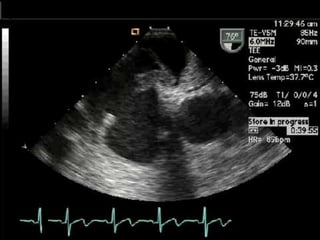
 Redundant and hypermobile portion of
interatrial septum with >10mm excursion
from the centreline during the cardiac cycle.
 Some papers define >15mm total excursion.
 2.2% ofTOE patients
 4.3% of PFO patients
How does PFO and / or ASA cause
stroke?
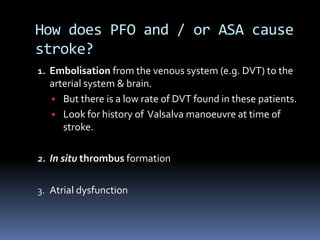
1. Embolisation from the venous system (e.g. DVT) to the
arterial system & brain.
• But there is a low rate of DVT found in these patients.
• Look for history of Valsalva manoeuvre at time of
stroke.
2. In situ thrombus formation
3. Atrial dysfunction
Is PFO a stroke risk?
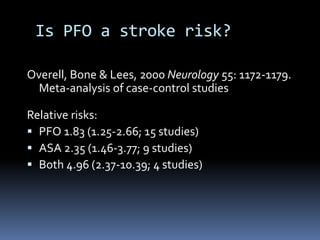
Overell, Bone & Lees, 2000 Neurology 55: 1172-1179.
Meta-analysis of case-control studies
Relative risks:
 PFO 1.83 (1.25-2.66; 15 studies)
 ASA 2.35 (1.46-3.77; 9 studies)
 Both 4.96 (2.37-10.39; 4 studies)
Is PFO a stroke risk?
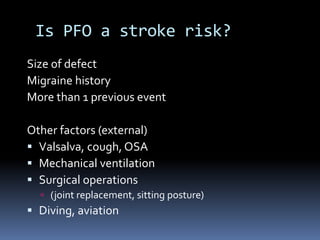
Size of defect
Migraine history
More than 1 previous event
Other factors (external)
 Valsalva, cough, OSA
 Mechanical ventilation
 Surgical operations
 (joint replacement, sitting posture)
 Diving, aviation
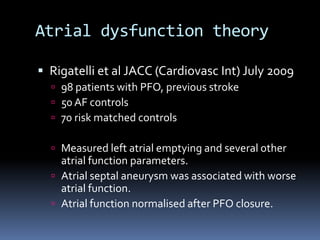
Atrial dysfunction theory
 Rigatelli et al JACC (Cardiovasc Int) July 2009
 98 patients with PFO, previous stroke
 50 AF controls
 70 risk matched controls
 Measured left atrial emptying and several other
atrial function parameters.
 Atrial septal aneurysm was associated with worse
atrial function.
 Atrial function normalised after PFO closure.
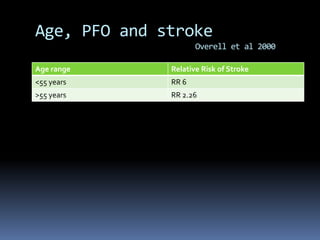
Age, PFO and stroke
Overell et al 2000
Age range Relative Risk of Stroke
<55 years RR 6
>55 years RR 2.26
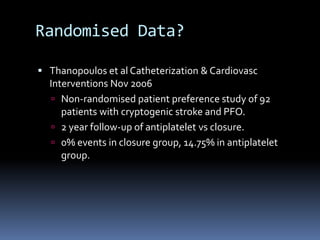
Randomised Data?
 Thanopoulos et al Catheterization & Cardiovasc
Interventions Nov 2006
 Non-randomised patient preference study of 92
patients with cryptogenic stroke and PFO.
 2 year follow-up of antiplatelet vs closure.
 0% events in closure group, 14.75% in antiplatelet
group.
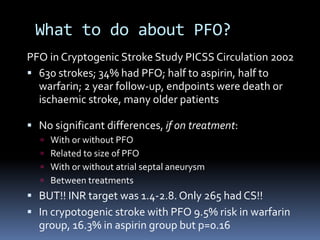
What to do about PFO?
PFO in Cryptogenic Stroke Study PICSS Circulation 2002
 630 strokes; 34% had PFO; half to aspirin, half to
warfarin; 2 year follow-up, endpoints were death or
ischaemic stroke, many older patients
 No significant differences, if on treatment:
 With or without PFO
 Related to size of PFO
 With or without atrial septal aneurysm
 Between treatments
 BUT!! INR target was 1.4-2.8. Only 265 had CS!!
 In crypotogenic stroke with PFO 9.5% risk in warfarin
group, 16.3% in aspirin group but p=0.16
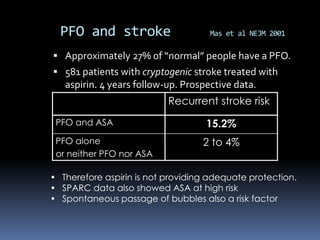
PFO and stroke Mas et al NEJM 2001
 Approximately 27% of “normal” people have a PFO.
 581 patients with cryptogenic stroke treated with
aspirin. 4 years follow-up. Prospective data.
Recurrent stroke risk
PFO and ASA 15.2%
PFO alone
or neither PFO nor ASA
2 to 4%
• Therefore aspirin is not providing adequate protection.
• SPARC data also showed ASA at high risk
• Spontaneous passage of bubbles also a risk factor
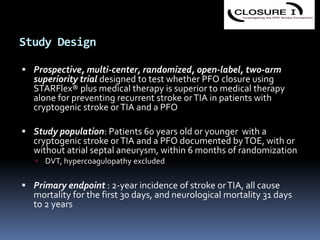
Study Design
 Prospective, multi-center, randomized, open-label, two-arm
superiority trial designed to test whether PFO closure using
STARFlex® plus medical therapy is superior to medical therapy
alone for preventing recurrent stroke orTIA in patients with
cryptogenic stroke orTIA and a PFO
 Study population: Patients 60 years old or younger with a
cryptogenic stroke orTIA and a PFO documented byTOE, with or
without atrial septal aneurysm, within 6 months of randomization
 DVT, hypercoagulopathy excluded
 Primary endpoint : 2-year incidence of stroke orTIA, all cause
mortality for the first 30 days, and neurological mortality 31 days
to 2 years
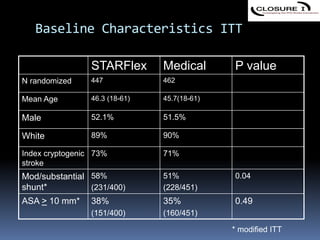
Baseline Characteristics ITT
STARFlex Medical P value
N randomized 447 462
Mean Age 46.3 (18-61) 45.7(18-61)
Male 52.1% 51.5%
White 89% 90%
Index cryptogenic
stroke
73% 71%
Mod/substantial
shunt*
58%
(231/400)
51%
(228/451)
0.04
ASA > 10 mm* 38%
(151/400)
35%
(160/451)
0.49
* modified ITT
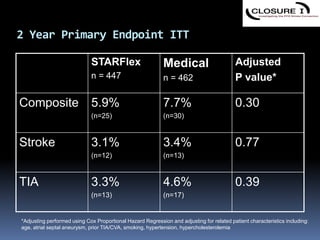
2 Year Primary Endpoint ITT
STARFlex
n = 447
Medical
n = 462
Adjusted
P value*
Composite 5.9%
(n=25)
7.7%
(n=30)
0.30
Stroke 3.1%
(n=12)
3.4%
(n=13)
0.77
TIA 3.3%
(n=13)
4.6%
(n=17)
0.39
*Adjusting performed using Cox Proportional Hazard Regression and adjusting for related patient characteristics including:
age, atrial septal aneurysm, prior TIA/CVA, smoking, hypertension, hypercholesterolemia
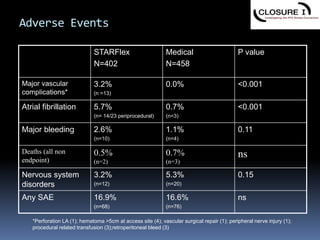
Adverse Events
STARFlex
N=402
Medical
N=458
P value
Major vascular
complications*
3.2%
(n =13)
0.0% <0.001
Atrial fibrillation 5.7%
(n= 14/23 periprocedural)
0.7%
(n=3)
<0.001
Major bleeding 2.6%
(n=10)
1.1%
(n=4)
0.11
Deaths (all non
endpoint)
0.5%
(n=2)
0.7%
(n=3)
ns
Nervous system
disorders
3.2%
(n=12)
5.3%
(n=20)
0.15
Any SAE 16.9%
(n=68)
16.6%
(n=76)
ns
*Perforation LA (1); hematoma >5cm at access site (4); vascular surgical repair (1); peripheral nerve injury (1);
procedural related transfusion (3);retroperitoneal bleed (3)
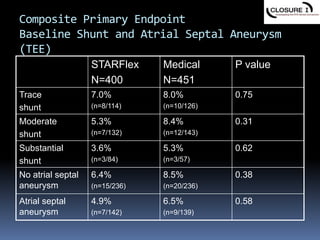
Composite Primary Endpoint
Baseline Shunt and Atrial Septal Aneurysm
(TEE)
STARFlex
N=400
Medical
N=451
P value
Trace
shunt
7.0%
(n=8/114)
8.0%
(n=10/126)
0.75
Moderate
shunt
5.3%
(n=7/132)
8.4%
(n=12/143)
0.31
Substantial
shunt
3.6%
(n=3/84)
5.3%
(n=3/57)
0.62
No atrial septal
aneurysm
6.4%
(n=15/236)
8.5%
(n=20/236)
0.38
Atrial septal
aneurysm
4.9%
(n=7/142)
6.5%
(n=9/139)
0.58
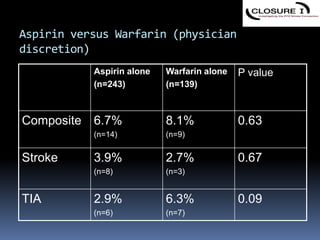
Aspirin versus Warfarin (physician
discretion)
Aspirin alone
(n=243)
Warfarin alone
(n=139)
P value
Composite 6.7%
(n=14)
8.1%
(n=9)
0.63
Stroke 3.9%
(n=8)
2.7%
(n=3)
0.67
TIA 2.9%
(n=6)
6.3%
(n=7)
0.09
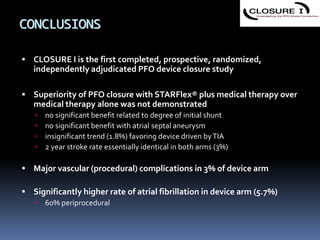
CONCLUSIONS
 CLOSURE I is the first completed, prospective, randomized,
independently adjudicated PFO device closure study
 Superiority of PFO closure with STARFlex® plus medical therapy over
medical therapy alone was not demonstrated
 no significant benefit related to degree of initial shunt
 no significant benefit with atrial septal aneurysm
 insignificant trend (1.8%) favoring device driven byTIA
 2 year stroke rate essentially identical in both arms (3%)
 Major vascular (procedural) complications in 3% of device arm
 Significantly higher rate of atrial fibrillation in device arm (5.7%)
 60% periprocedural
CONCLUSIONS
 Alternative explanation unrelated to paradoxical embolism
present in 80% of patients with recurrent stroke orTIA
 cryptogenic stroke andTIA include multiple etiologies
 in many patients with cryptogenic stroke orTIA a PFO may be
coincidental
 diagnostic criteria for paradoxical embolism are imprecise
 potential efficacy of PFO device closure in better defined patient
subgroups requires further study
 Percutaneous closure with STARFlex® plus medical therapy does not
offer any significant benefit over medical therapy alone for the
prevention of recurrent stroke orTIA in patients < age 60 presenting
with cryptogenic stroke orTIA and a PFO
CLOSURE-I trial - Issues
 Procedural success 90%. “Effective closure” 86%.
 So ITT closure only 77%.
 BUT! “Effective closure” included trace shunting
or no shunting. Pre-procedure 114 of 400
Starflex patients had trace shunting.Therefore
real closure rate even lower (possibly as low as
50%).
 Thrombus on device 1%.
 Small absolute numbers of events.
 Slow recruitment. Short follow-up.
 Results incongruent with previous data
Incidental PFO?
 Alsheikh-Ali et al, Stroke 2009
 Analysis of 23 case-control studies examining
presence of PFO in pts with CS (total approx
2300 pts).
 In patients with CS
 1/3 of PFOs are likely to be incidental in all age
groups
 1/5 in younger age group
 1/10 if ASA + PFO
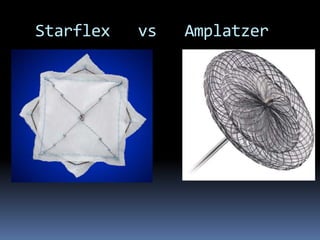
Starflex vs Amplatzer
Where to from here?
 RESPECT trial
 Maybe RCTs are not the answer?
 Good quality registry needed.
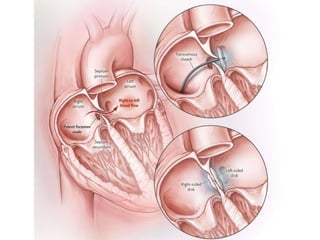
Patent foramen ovale

Patent foramen ovale

  • 1.
    Sydney Adventist Hospital HornsbyKu-ring-gai Hospital Dr Jason Sharp MB BS FRACP FCSANZ Consultant Cardiologist
  • 2.
    History  1877 –Conheim autopsy  1972 – only 128 cases of unexplained stroke had been reported in the literature  1997 – Amplatzer ASD closure device used in animals – nitinol double umbrella filled with polyester (Dacron) fabric  2012 – CLOSURE-I trial published
  • 3.
    Ms EW caseof a persistent neurologist  43yo female. Sensory stroke symptoms but clouded with history of possible migraine. Subtle changes on MRI + page missing but on further review it was felt there was a right thalamic stroke fitting with the symptoms. Mildly abnormal procoagulant screen. OCP (ceased).  TOE initially showed negative bubble study via antecubital vein, no PFO, mobile interatrial septum.  Referred to me for second opinion.
  • 4.
    Ms EW  RepeatTOErevealed atrial septal aneurysm and PFO with positive bubble study via right femoral vein.  Admitted to hospital for PFO closure. Lesion unable to be crossed. Multiple bubble studies negative while patient ventilated.  Recommendation?
  • 5.
    Ms EW continued… Readmitted to another hospital with subsequent successful closure.
  • 6.
    PFO detection  TOE Bubble study  Femoral vs ante-cubital vein (SVC blood directed toward tricuspid valve, IVC blood directed toward PFO).  Saline vs dedicated echo contrast media  Valsalva  Degree of shunting (<5, 5-25, >25 bubbles)  Transcranial doppler
  • 7.
    Methods do matter Hamann et al: TOE/TCD detection rate was:  11.4%/4.5% via antecubital injection  18%/13.6% via antecubital injection plus the Valsalva manoeuvre  38.6%/36% via femoral injection alone  50%/50% via femoral injection plus the Valsalva manoeuvre (Neurology 1998, 50: 1423-1428)
  • 8.
    What is anAtrial Septal Aneurysm?  Redundant and hypermobile portion of interatrial septum with >10mm excursion from the centreline during the cardiac cycle.  Some papers define >15mm total excursion.  2.2% ofTOE patients  4.3% of PFO patients
  • 9.
    How does PFOand / or ASA cause stroke? 1. Embolisation from the venous system (e.g. DVT) to the arterial system & brain. • But there is a low rate of DVT found in these patients. • Look for history of Valsalva manoeuvre at time of stroke. 2. In situ thrombus formation 3. Atrial dysfunction
  • 10.
    Is PFO astroke risk? Overell, Bone & Lees, 2000 Neurology 55: 1172-1179. Meta-analysis of case-control studies Relative risks:  PFO 1.83 (1.25-2.66; 15 studies)  ASA 2.35 (1.46-3.77; 9 studies)  Both 4.96 (2.37-10.39; 4 studies)
  • 11.
    Is PFO astroke risk? Size of defect Migraine history More than 1 previous event Other factors (external)  Valsalva, cough, OSA  Mechanical ventilation  Surgical operations  (joint replacement, sitting posture)  Diving, aviation
  • 13.
    Atrial dysfunction theory Rigatelli et al JACC (Cardiovasc Int) July 2009  98 patients with PFO, previous stroke  50 AF controls  70 risk matched controls  Measured left atrial emptying and several other atrial function parameters.  Atrial septal aneurysm was associated with worse atrial function.  Atrial function normalised after PFO closure.
  • 14.
    Age, PFO andstroke Overell et al 2000 Age range Relative Risk of Stroke <55 years RR 6 >55 years RR 2.26
  • 15.
    Randomised Data?  Thanopouloset al Catheterization & Cardiovasc Interventions Nov 2006  Non-randomised patient preference study of 92 patients with cryptogenic stroke and PFO.  2 year follow-up of antiplatelet vs closure.  0% events in closure group, 14.75% in antiplatelet group.
  • 16.
    What to doabout PFO? PFO in Cryptogenic Stroke Study PICSS Circulation 2002  630 strokes; 34% had PFO; half to aspirin, half to warfarin; 2 year follow-up, endpoints were death or ischaemic stroke, many older patients  No significant differences, if on treatment:  With or without PFO  Related to size of PFO  With or without atrial septal aneurysm  Between treatments  BUT!! INR target was 1.4-2.8. Only 265 had CS!!  In crypotogenic stroke with PFO 9.5% risk in warfarin group, 16.3% in aspirin group but p=0.16
  • 17.
    PFO and strokeMas et al NEJM 2001  Approximately 27% of “normal” people have a PFO.  581 patients with cryptogenic stroke treated with aspirin. 4 years follow-up. Prospective data. Recurrent stroke risk PFO and ASA 15.2% PFO alone or neither PFO nor ASA 2 to 4% • Therefore aspirin is not providing adequate protection. • SPARC data also showed ASA at high risk • Spontaneous passage of bubbles also a risk factor
  • 18.
    Study Design  Prospective,multi-center, randomized, open-label, two-arm superiority trial designed to test whether PFO closure using STARFlex® plus medical therapy is superior to medical therapy alone for preventing recurrent stroke orTIA in patients with cryptogenic stroke orTIA and a PFO  Study population: Patients 60 years old or younger with a cryptogenic stroke orTIA and a PFO documented byTOE, with or without atrial septal aneurysm, within 6 months of randomization  DVT, hypercoagulopathy excluded  Primary endpoint : 2-year incidence of stroke orTIA, all cause mortality for the first 30 days, and neurological mortality 31 days to 2 years
  • 19.
    Baseline Characteristics ITT STARFlexMedical P value N randomized 447 462 Mean Age 46.3 (18-61) 45.7(18-61) Male 52.1% 51.5% White 89% 90% Index cryptogenic stroke 73% 71% Mod/substantial shunt* 58% (231/400) 51% (228/451) 0.04 ASA > 10 mm* 38% (151/400) 35% (160/451) 0.49 * modified ITT
  • 20.
    2 Year PrimaryEndpoint ITT STARFlex n = 447 Medical n = 462 Adjusted P value* Composite 5.9% (n=25) 7.7% (n=30) 0.30 Stroke 3.1% (n=12) 3.4% (n=13) 0.77 TIA 3.3% (n=13) 4.6% (n=17) 0.39 *Adjusting performed using Cox Proportional Hazard Regression and adjusting for related patient characteristics including: age, atrial septal aneurysm, prior TIA/CVA, smoking, hypertension, hypercholesterolemia
  • 21.
    Adverse Events STARFlex N=402 Medical N=458 P value Majorvascular complications* 3.2% (n =13) 0.0% <0.001 Atrial fibrillation 5.7% (n= 14/23 periprocedural) 0.7% (n=3) <0.001 Major bleeding 2.6% (n=10) 1.1% (n=4) 0.11 Deaths (all non endpoint) 0.5% (n=2) 0.7% (n=3) ns Nervous system disorders 3.2% (n=12) 5.3% (n=20) 0.15 Any SAE 16.9% (n=68) 16.6% (n=76) ns *Perforation LA (1); hematoma >5cm at access site (4); vascular surgical repair (1); peripheral nerve injury (1); procedural related transfusion (3);retroperitoneal bleed (3)
  • 22.
    Composite Primary Endpoint BaselineShunt and Atrial Septal Aneurysm (TEE) STARFlex N=400 Medical N=451 P value Trace shunt 7.0% (n=8/114) 8.0% (n=10/126) 0.75 Moderate shunt 5.3% (n=7/132) 8.4% (n=12/143) 0.31 Substantial shunt 3.6% (n=3/84) 5.3% (n=3/57) 0.62 No atrial septal aneurysm 6.4% (n=15/236) 8.5% (n=20/236) 0.38 Atrial septal aneurysm 4.9% (n=7/142) 6.5% (n=9/139) 0.58
  • 23.
    Aspirin versus Warfarin(physician discretion) Aspirin alone (n=243) Warfarin alone (n=139) P value Composite 6.7% (n=14) 8.1% (n=9) 0.63 Stroke 3.9% (n=8) 2.7% (n=3) 0.67 TIA 2.9% (n=6) 6.3% (n=7) 0.09
  • 24.
    CONCLUSIONS  CLOSURE Iis the first completed, prospective, randomized, independently adjudicated PFO device closure study  Superiority of PFO closure with STARFlex® plus medical therapy over medical therapy alone was not demonstrated  no significant benefit related to degree of initial shunt  no significant benefit with atrial septal aneurysm  insignificant trend (1.8%) favoring device driven byTIA  2 year stroke rate essentially identical in both arms (3%)  Major vascular (procedural) complications in 3% of device arm  Significantly higher rate of atrial fibrillation in device arm (5.7%)  60% periprocedural
  • 25.
    CONCLUSIONS  Alternative explanationunrelated to paradoxical embolism present in 80% of patients with recurrent stroke orTIA  cryptogenic stroke andTIA include multiple etiologies  in many patients with cryptogenic stroke orTIA a PFO may be coincidental  diagnostic criteria for paradoxical embolism are imprecise  potential efficacy of PFO device closure in better defined patient subgroups requires further study  Percutaneous closure with STARFlex® plus medical therapy does not offer any significant benefit over medical therapy alone for the prevention of recurrent stroke orTIA in patients < age 60 presenting with cryptogenic stroke orTIA and a PFO
  • 26.
    CLOSURE-I trial -Issues  Procedural success 90%. “Effective closure” 86%.  So ITT closure only 77%.  BUT! “Effective closure” included trace shunting or no shunting. Pre-procedure 114 of 400 Starflex patients had trace shunting.Therefore real closure rate even lower (possibly as low as 50%).  Thrombus on device 1%.  Small absolute numbers of events.  Slow recruitment. Short follow-up.  Results incongruent with previous data
  • 27.
    Incidental PFO?  Alsheikh-Aliet al, Stroke 2009  Analysis of 23 case-control studies examining presence of PFO in pts with CS (total approx 2300 pts).  In patients with CS  1/3 of PFOs are likely to be incidental in all age groups  1/5 in younger age group  1/10 if ASA + PFO
  • 28.
  • 29.
    Where to fromhere?  RESPECT trial  Maybe RCTs are not the answer?  Good quality registry needed.