Memory T waves
Amit Gulati, M.D.
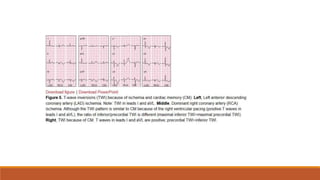
Cardiac memory (CM) refers to the persistent T-wave changes on the ECG after a period of wide QRS rhythms that become evident once normal
ventricular activation pattern is restored.
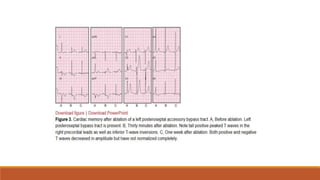
The direction of the T waves in sinus rhythm follows (remembers) the direction of the QRS complex during preceding episode of abnormal activation.
The amplitude of memory T waves increases the longer abnormal conduction continues.
Repeat episodes of abnormal activation after complete normalization of T waves result in more rapid and prominent accumulation of T-wave changes
(hence the term memory).
Molecular changes observed in the setting of CM include alterations of multiple ion channels, receptors, and cell coupling, including the transient
outward current, Ito, IKr, ICa, Na/Ca exchanger, AT1 receptors, stretch-activated receptors, and gap junction redistribution.
The combination of:
1. Positive T in lead aVL and positive/isoelectric T in lead I; and
2. Precordial TWI>inferior TWI produces a unique pacing-induced CM signature that was 92% sensitive and 100% specific in differentiating pacing-
induced TWI from ischemia in a retrospective study
Thank You

Memory T waves on EKG: pathogenesis and evaluation

  • 1.
    Memory T waves AmitGulati, M.D.
  • 2.
    Cardiac memory (CM)refers to the persistent T-wave changes on the ECG after a period of wide QRS rhythms that become evident once normal ventricular activation pattern is restored. The direction of the T waves in sinus rhythm follows (remembers) the direction of the QRS complex during preceding episode of abnormal activation. The amplitude of memory T waves increases the longer abnormal conduction continues. Repeat episodes of abnormal activation after complete normalization of T waves result in more rapid and prominent accumulation of T-wave changes (hence the term memory). Molecular changes observed in the setting of CM include alterations of multiple ion channels, receptors, and cell coupling, including the transient outward current, Ito, IKr, ICa, Na/Ca exchanger, AT1 receptors, stretch-activated receptors, and gap junction redistribution.
  • 6.
    The combination of: 1.Positive T in lead aVL and positive/isoelectric T in lead I; and 2. Precordial TWI>inferior TWI produces a unique pacing-induced CM signature that was 92% sensitive and 100% specific in differentiating pacing- induced TWI from ischemia in a retrospective study
  • 7.