SHOCK
DR. AMITHA
DEPT OF ORAL & MAXILLOFACIAL
PATHOLOGY
 WHAT IS SHOCK
 TYPES OF SHOCK
 ETIOLOGY AND PATHOGENESIS OF SHOCK
 STAGES OF SHOCK
 PATHOPHYSIOLOGIC CHANGES
 CLASSIFICATION OF SHOCK
 HYPOVOLEMIC SHOCK
 SEPTIC SHOCK
 TRAUMATIC SHOCK
 NEUROGENIC SHOCK
 DISTRIBUTIVE SHOCK
 ANAPHYLATIC SHOCK
 BURN SHOCK
 TREATMENT OF SHOCK.
CONTENTS
Shock or Cardiovascular
collapse
 Shock may be defined as a condition in which
circulation fails to meet the nutritional needs of
the cells and at the same time fails to remove the
metabolic waste products.
 A final common pathway for many potentially
lethal clinical events (hemorrhage,trauma, burns,
large MI, massive pulmonary embolism microbial
sepsis)
Shock is also defined as a clinical state of cardiovascular
collapse characterised by:
An acute reduction of effective circulating blood
volume
An adequate perfusion of cells and tissues.
The end result is hypotension and cellular hypoxia and
if uncompensated may lead to impaired cellular
metabolism and death.
1)Primary or Initial shock
Is a transient and usually benign vasovagal attack resulting from sudden
reduction of venous return to the heart caused by neurogenic
vasodilatation and consequent peripheral pooling of the blood.
It can occur immediately following
Trauma
Severe pain
Emotional overreaction due to
a) Fear
b) Sorrow and surprise
c) Sight of blood
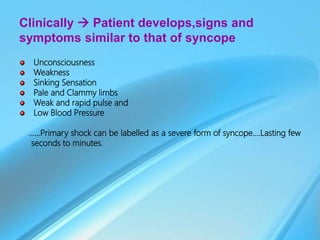
Clinically  Patient develops,signs and
symptoms similar to that of syncope
Unconsciousness
Weakness
Sinking Sensation
Pale and Clammy limbs
Weak and rapid pulse and
Low Blood Pressure
……Primary shock can be labelled as a severe form of syncope….Lasting few
seconds to minutes.
2) Secondary (or) True shock
……occurs due to haemodynomic derangements with hypoperfusion of the
cells, this type of shock is the ‘true shock’.
Systemic
hypoperfusion
Initially
Hypotension
Impaired tissue
perfusion
Cellular hypoxia
Persistence causes
reduction in -cardiac output or
-effective circulating
blood volume
Reversible cellular
injury
Irreversible tissue injury
Death
Shock
ETIOLOGY AND PATHOGENESIS OF SHOCK
Stages of shock
Deteriotion of the circulation in shock is a progressive
phenomenon and can be devided arbitarily into 3 stages:
1. Non – progressive (initial. Compensated reversible)shock
2. Progressive decompensated shock
3. Decompensated (irreversible) shock.
 Widespread vasoconstriction: In resaponse to
reduced blood flow(hypotension) and tissue anoxia,
the neural and hormonal factors(e.g.
Baroreceptors,chemoreceptors, catecholamines,
renin VEM or Vasoexitor material from hypoxic
kidney). Are activated. All these bring about
vasoconstriction , partiularly in the vessels of the skin
and abdominal viscera. It is a protective mechanism
as it causes increased peripheral reasistance,
increased heart rate(tacchycadia). And incresesd
blood pressure.
IRREVERSIBLE STAGE
 It is the progression of shock to a stage where therapy does not help.
 The Brain fails to function due to cerebral ischemia
 Even infusion of blood fails to restore blood pressure
 Multiple organ failure occurs.
 Depression of cellular high energy phosphates
 Finally, cardiac failure occurs due to decreased myocardial activity and
decreased arterial tone.
If Low Perfusion States persists:
IRREVERSIBLE DEATH IMMINENT!!
In the early stage of shock, an attempt to maintain adequate
cerebral and coronary blood supply by redistribution of blood
so that the vital organs(brain and heart) are adequately
perfused and oxygeneted. This is achieved by activation of
various neurohormonal mechanism causing WIDESPREAD
VASOCONSTRICTION and by FLUID CONSERVATION BY THE
KIDNEY.
Non – progressive (initial. Compensated
reversible)shock
 Hypotension
 Oliguria
 Tachypnea, due to pulmonary hypoperfusion
 Acute Respiratory Distress Syndrome (ARDS) …….. due to pulmonary
hypoperfusion.
 Acidosis due to anoxia of liver causing reduced clearance of lactate.
Clinically in progressive shock…….
Fluid conservation by the kidney: the following factors
may assist in restoring the blood volume and improve
vennous return to the heart :
release of aldosterone from hypoxic kidney.
Release of ADH due to to decreased effective
circulayting blood volume.
Reduced glomerular filtration tate
Shifting of tissue fluid into plasma due to lawered
capillary hydrostatic pressure.
 PROGRESSIVE DECOMPENSATED SHOCK:
 This is a stage when the patients suffer from some
stress or risk factors besides persistance of of the shock
so that there is progressive deterioration.
 DECOMPENSATED (IRREVERIBLE) SH0CK At this stage
patient has features like coma, worsened heart function
and progressive renal failure and it is characterised by
irrreversibility of shock with tissue anoxia occupying
central role an dthese are under
 1.PERSISTANCE OF WIDESPREAD VASOCONSTRICTION
 2.VASODILATION AND INCREASED VASCULAR
PERMEABILITY
 3.MYOCARDIAL ISCHAEMIA
 4.CEREBRAL ISCHAEMIA
 5.VASODEPPRESOR MATERIAL(VDM)
 6.TUMOR NECROSIS FACTORS(TNF)
 7.INTESTINAL FACTORS
 8.BACTERIAL FACTORS
 9.HYPERCOAGULABILITY OF BLOOD
PATHOPHYSIOLOGIC CHANGES
 When cardiac output fall…..Cardiogenic, Hypovolaemic or obstructive
shock….BP remain stable as long as a compensatory increase in the
peripheral vascular resistance occurs.
Low B.P.
Baroreceptors
Hypothalmous impulse
Adrenal Medulla
Catcholamines
Increased peripheral vascular
resistance
Chronotropic and
inotropic effect
Incresaed blood flow to
heart & brain
Decreased blood flow to
the extremities
ULTIMATE EFFECTS OF ANAEROBIC METABOLISM
Inadequate
Energy
Production
Metabolic
Failure
Lactic
Acid
Production
Metabolic
Acidosis
CELL
DEATH
Inadequate
Cellular
Oxygen
Delivery
Anaerobic
Metabolism
CLASSIFICATION of shock
 Hematogenic / hypovolemic shock
 Septic shock
 Cardiogenic shock
 Traumatic shock
 Neurogenic shock
 Miscellaneous shock (anaphylactic shock, insulin
shock etc)
Hypovolaemic shock
 Results from loss of blood or plasma volume.
 This may be caused by hemorrhage, fluid loss
from severe burns, or trauma.
 Hemorrhage usually occurs from the small veins
and systemic venules.
Clinical features
Mild shock Moderate shock Severe shock
<20% loss of
volume
20-40% loss of
blood volume
>40% loss of
volume
Collapse of
subcutaneous
of extremities,
– pale & cool
Features of mild
shock + oliguria
Pallor, low urinary
output
Sweat – forehead,
palms, feet
Pulse rate
increased (but
<100). BP remains
normal initially,
fall in later stages
Rapid pulse, low
Urinary output,
pulse rate, BP
normal
Treatment
 Resuscitation
 Control of bleeding
 Extracellular fluid replacement
 If there is blood loss, it is best replaced by blood.
Blood substitutes cannot replace blood
Septic shock
 Septic shock is caused by systemic response to a
severe infection.
 Occurs most frequently in elderly or
immunocompromised patients or those who have
undergone invasive procedure in which bacterial
contamination has occurred.
Septic shock is the most common cause of mortality in the intensive care
unit.
It is the 13th leading cause of death overall
mortality ranges from 15% in patients with sepsis to 40-60% in patients
with septic shock.
There is a continuum of clinical manifestations from SIRS ----sepsis ----
severe sepsis ---septic shock to Multiple Organ Dysfunction Syndrome
(MODS).
Overview of septic shock
 In these instances, widespread vasodilation causes a sudden
increase in the vascular bed capacitance, which is not adequately
filled by the normal circulating blood volume
 hypotension, tissue hypoperfusion, and cellular anoxia result
 Patients go into shock and even die within the hour
 The risk of anaphylaxis must be borne in mind when certain
therapeutic agents are administered. Although patients at
risk can generally be identified by a previous history of some
form of allergy, the absence of such a history does not
preclude the possibility of an anaphylactic reaction.
Etiology
 Most commonly, this occurs in the setting of gram-negative and
gram positive infections, though any agent that is capable of
producing infection (viruses, fungi, parasites).
 The most common organisms which cause septic shock are E.coli,
Klebsiella, Proteus, Pseudomonas, Bacteroids in decreasing
frequency.
Pathophysiology
 Sepsis is triggered by bacteria or fungi that ordinarily do not cause
systemic disease in immunocompetent hosts.
 Microbes exploit deficiency in the host defenses to survive in the
body.
 Pathogens in turn overcome the defenses by elaborating toxins or
other virulence factors.
 Body fails to kill the invaders and mount a severe sepsis.
 Animals have exquisite mechanisms for recognizing and
responding to conserved microbial molecules.
 The endotoxins of a gram negative bacterial cell wall is the best
example.
 The lipopolysaccharides (LPS) present on the cell wall account for
their endotoxic activity.
LPS consists of 3 regions
 Region I – polysaccharide portion
 Region II – core polysaccharide.
 Region III – glycolipid (lipid A) = responsible for
endotoxic activity.
 Engagement of TLR on endothelial cells can lead directly to down-
regulation of natural anticoagulation mechanisms.
 Profound mononuclear cell activation
 Presumably, this series of responses helps to isolate organisms and
to trigger elements of the immune system to efficiently eradicate
invading microbes.
 Unfortunately, depending on the dosage and numbers of
macrophages that are activated, the secondary effects of LPS
release can also cause severe pathologic changes, including fatal
shock.
At low doses, LPS predominantly serves to activate monocytes and
macrophages, with effects intended to enhance their ability to
eliminate invading bacteria
With moderately severe infections, and therefore with higher levels of
LPS, cytokine-induced secondary effectors become significant.
Systemic effects of the cytokines such as TNF and IL-1 may begin
to be seen - fever and increased synthesis of acute phase reactants
At still higher levels of LPS, the syndrome of septic shock supervenes
the same cytokines and secondary mediators, now at high levels,
result in:
 Systemic vasodilation (hypotension)
 Diminished myocardial contractility
 Widespread endothelial injury and activation, causing systemic
leukocyte adhesion and pulmonary alveolar capillary damage
 Activation of the coagulation system, culminating in DIC
 Skin remains warm, pink well perfused
 Cutaneous veins remains full
 Pulse rate is high
 Intermittent spikes of fever with bouts of chills.
Treatment
 Treatment of infection by early surgical debridement
or drainage , appropriate antibiotics
 Treatment of shock- fluid replacement, steroids
Traumatic shock
 Caused by major fractures, crush injuries, burns,
extensive soft tissue injuries.
 Hypovolemia due to bleeding externally and
internally and due to toxic factors resulting
fragments of tissue entering blood stream.
 The traumatized tissue activate coagulation
cascade and release microthrombi into circulation.
 They occlude pulmonary vasculature.
 Microthrombi induce a generalized increase in
capillary permeability.
 Loss of plasma into interstitial tissue throughout the
body.
 Depletes the vascular volume to great extent
Clinical features
 Similar to those of hypovolemic shock.
 2 differentiating features
- Presence of peripheral and pulmonary edema in
traumatic shock.
- Infusion of large volumes of fluid may be adequate
for pure hypovolemic shock, is usually inadequate
for traumatic shock.
Treatment
 Resuscitation
 Local treatment of trauma and control of bleeding.
 Fluid replacement
 Full body anticoagulation (1 IV dose of 10,000 U of
heparin)
Cardiogenic shock
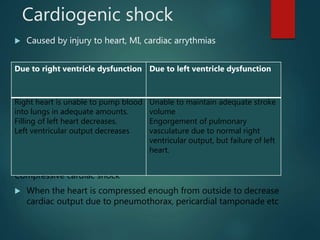
 Caused by injury to heart, MI, cardiac arrythmias
Compressive cardiac shock
 When the heart is compressed enough from outside to decrease
cardiac output due to pneumothorax, pericardial tamponade etc
Due to right ventricle dysfunction Due to left ventricle dysfunction
Right heart is unable to pump blood
into lungs in adequate amounts.
Filling of left heart decreases.
Left ventricular output decreases
Unable to maintain adequate stroke
volume
Engorgement of pulmonary
vasculature due to normal right
ventricular output, but failure of left
heart.
Clinical features
 Initially skin is pale and cool
 Urine output is low
 Pulse becomes rapid, arterial BP is low
 Right ventricular dysfunction – neck veins
distended, liver enlarged
 Left ventricular dysfunction – bronchial rales
heard. Gradually heart is enlarged, later neck
veins are also distended.
Treatment
 Airway is cleared with adequate oxygenation
 Large doses of heparin IV (if shock is due to
massive pulmonary embolism)
 For pain – morphine
Neurogenic shock
 Caused by paraplegia, quadriplegia, trauma to
spinal cord or spinal anesthesia.
 Loss of arterial and venous tone with pooling of
blood in dilated peripheral venous system.
 heart does not fill normally = CO falls
Clinical features
 Skin is warm ,pink & well perfused
 Urine output may be normal
 Heart rate is rapid, BP is low
Treatment
 Elevation of legs
 Fluids
 Vasoconstrictor drugs
DISTRIBUTIVE SHOCK
This occurs when the blood volume is normal but the capacity of the circulation
is increased by marked vasodilatation
Also called as “Warm shock as the skin is not cold and clammy, as it is in
Hypovolemia shock
Eg: Anaphylactic shock and neurogenic shock
ANAPHYLACTIC SHOCK
It is an allergic condition in which the cardiac output and arterial pressure
often fall dramatically.
A rapidly developing, severe allergic relation that sometimes occur when an
individual who has previously been sensitized to an antigen is exposed to it.
CLINICAL FEATURES
Signs of profound vasodilatation
a) Warm peripheries
b) Low blood pressure
Erythema, Urticaria Angioedema, Pallor, Cyanosis
Bronchospasm, Rhinitis
Odema of the Face, Pharynx and Larynx
Pulmonary odema
Hypovolaemia due to capillary leak
Nausea, vomiting, abdominal cramps.
Anaphylactic shock
 In humans, systemic anaphylaxis may occur after administration
of foreign proteins (e.g., antisera), hormones, enzymes,
polysaccharides, and drugs (such as the antibiotic penicillin).
 Initiated by a generalized IgE-mediated hypersensitivity
response
 Said to be due to increased histamine release by combination of
antigen with IgE on mast cell and basophils
 The severity of the disorder varies with the level of sensitization.
 Extremely small doses of antigen may trigger anaphylaxis,
 Within minutes after exposure, itching, hives, and skin erythema
appear, followed shortly thereafter by a striking contraction of
respiratory bronchioles and respiratory distress
 Laryngeal edema results in hoarseness.
 Vomiting, abdominal cramps, diarrhea, and laryngeal obstruction
follow, systemic vasodilation and increased vascular permeability
BURN SHOCK
The most apparent abnormality in this is loss of plasma as exudates from
burned surface
• So there is increased – Hematocrit and Hemoconcentration found.
• Complex metabolic changes seen in such patients.
Biochemical Changes Seen In Such
Patients
Electrolyte imbalance:.
Hypoproteinaemia:
Hyperglycemia
Increased blood urea creatinene levels due to kidney
damage in extensive burns.
CHANGES IN BLOOD
Hemoconcentration due to outpouring of serum
Increased number of RBC due to outpouring of serum
Sludging of blood – intravascular agglutination
An abrupt fall in eosinophil count during the first 12 hour
which slowly begun to increase
Increased blood viscosity.
HYPOADRENAL SHOCK
The normal host response to the stress of illness,
operation, or trauma requires that the adrenals glands
hyper secrete cortisol in excess of that normally required.
Hypoadrenal shock occurs in settings in which the
unrecognized adrenal insufficiency complicates the host
response to the stress induced by acute illness or major
surgery.
Treatment for shock
 BLOOD TRANSFUSION
 PLASMA TRANSFUSION
 ADMINISTATION OF PLASMA SUBSTITUTES
 ADMINISTRATION OF YMPATHOMIMITIC DRUGS
LIKE EPINEPHRINE AND NOREPINEPHRINE.
 ADMINISTATION OF GLUCOCORTICOIDS
 OXYGEN THERAPHY
 BY CHANGING THE POSTURE
Thank you

Shock

  • 1.
    SHOCK DR. AMITHA DEPT OFORAL & MAXILLOFACIAL PATHOLOGY
  • 2.
     WHAT ISSHOCK  TYPES OF SHOCK  ETIOLOGY AND PATHOGENESIS OF SHOCK  STAGES OF SHOCK  PATHOPHYSIOLOGIC CHANGES  CLASSIFICATION OF SHOCK  HYPOVOLEMIC SHOCK  SEPTIC SHOCK  TRAUMATIC SHOCK  NEUROGENIC SHOCK  DISTRIBUTIVE SHOCK  ANAPHYLATIC SHOCK  BURN SHOCK  TREATMENT OF SHOCK. CONTENTS
  • 3.
    Shock or Cardiovascular collapse Shock may be defined as a condition in which circulation fails to meet the nutritional needs of the cells and at the same time fails to remove the metabolic waste products.  A final common pathway for many potentially lethal clinical events (hemorrhage,trauma, burns, large MI, massive pulmonary embolism microbial sepsis)
  • 4.
    Shock is alsodefined as a clinical state of cardiovascular collapse characterised by: An acute reduction of effective circulating blood volume An adequate perfusion of cells and tissues. The end result is hypotension and cellular hypoxia and if uncompensated may lead to impaired cellular metabolism and death.
  • 5.
    1)Primary or Initialshock Is a transient and usually benign vasovagal attack resulting from sudden reduction of venous return to the heart caused by neurogenic vasodilatation and consequent peripheral pooling of the blood. It can occur immediately following Trauma Severe pain Emotional overreaction due to a) Fear b) Sorrow and surprise c) Sight of blood
  • 6.
    Clinically  Patientdevelops,signs and symptoms similar to that of syncope Unconsciousness Weakness Sinking Sensation Pale and Clammy limbs Weak and rapid pulse and Low Blood Pressure ……Primary shock can be labelled as a severe form of syncope….Lasting few seconds to minutes.
  • 7.
    2) Secondary (or)True shock ……occurs due to haemodynomic derangements with hypoperfusion of the cells, this type of shock is the ‘true shock’.
  • 8.
    Systemic hypoperfusion Initially Hypotension Impaired tissue perfusion Cellular hypoxia Persistencecauses reduction in -cardiac output or -effective circulating blood volume Reversible cellular injury Irreversible tissue injury Death Shock
  • 9.
  • 10.
    Stages of shock Deteriotionof the circulation in shock is a progressive phenomenon and can be devided arbitarily into 3 stages: 1. Non – progressive (initial. Compensated reversible)shock 2. Progressive decompensated shock 3. Decompensated (irreversible) shock.
  • 11.
     Widespread vasoconstriction:In resaponse to reduced blood flow(hypotension) and tissue anoxia, the neural and hormonal factors(e.g. Baroreceptors,chemoreceptors, catecholamines, renin VEM or Vasoexitor material from hypoxic kidney). Are activated. All these bring about vasoconstriction , partiularly in the vessels of the skin and abdominal viscera. It is a protective mechanism as it causes increased peripheral reasistance, increased heart rate(tacchycadia). And incresesd blood pressure.
  • 12.
    IRREVERSIBLE STAGE  Itis the progression of shock to a stage where therapy does not help.  The Brain fails to function due to cerebral ischemia  Even infusion of blood fails to restore blood pressure  Multiple organ failure occurs.  Depression of cellular high energy phosphates  Finally, cardiac failure occurs due to decreased myocardial activity and decreased arterial tone. If Low Perfusion States persists: IRREVERSIBLE DEATH IMMINENT!!
  • 13.
    In the earlystage of shock, an attempt to maintain adequate cerebral and coronary blood supply by redistribution of blood so that the vital organs(brain and heart) are adequately perfused and oxygeneted. This is achieved by activation of various neurohormonal mechanism causing WIDESPREAD VASOCONSTRICTION and by FLUID CONSERVATION BY THE KIDNEY. Non – progressive (initial. Compensated reversible)shock
  • 14.
     Hypotension  Oliguria Tachypnea, due to pulmonary hypoperfusion  Acute Respiratory Distress Syndrome (ARDS) …….. due to pulmonary hypoperfusion.  Acidosis due to anoxia of liver causing reduced clearance of lactate. Clinically in progressive shock…….
  • 15.
    Fluid conservation bythe kidney: the following factors may assist in restoring the blood volume and improve vennous return to the heart : release of aldosterone from hypoxic kidney. Release of ADH due to to decreased effective circulayting blood volume. Reduced glomerular filtration tate Shifting of tissue fluid into plasma due to lawered capillary hydrostatic pressure.
  • 16.
     PROGRESSIVE DECOMPENSATEDSHOCK:  This is a stage when the patients suffer from some stress or risk factors besides persistance of of the shock so that there is progressive deterioration.  DECOMPENSATED (IRREVERIBLE) SH0CK At this stage patient has features like coma, worsened heart function and progressive renal failure and it is characterised by irrreversibility of shock with tissue anoxia occupying central role an dthese are under  1.PERSISTANCE OF WIDESPREAD VASOCONSTRICTION  2.VASODILATION AND INCREASED VASCULAR PERMEABILITY  3.MYOCARDIAL ISCHAEMIA  4.CEREBRAL ISCHAEMIA  5.VASODEPPRESOR MATERIAL(VDM)  6.TUMOR NECROSIS FACTORS(TNF)  7.INTESTINAL FACTORS  8.BACTERIAL FACTORS  9.HYPERCOAGULABILITY OF BLOOD
  • 18.
    PATHOPHYSIOLOGIC CHANGES  Whencardiac output fall…..Cardiogenic, Hypovolaemic or obstructive shock….BP remain stable as long as a compensatory increase in the peripheral vascular resistance occurs. Low B.P. Baroreceptors Hypothalmous impulse Adrenal Medulla Catcholamines Increased peripheral vascular resistance Chronotropic and inotropic effect Incresaed blood flow to heart & brain Decreased blood flow to the extremities
  • 19.
    ULTIMATE EFFECTS OFANAEROBIC METABOLISM Inadequate Energy Production Metabolic Failure Lactic Acid Production Metabolic Acidosis CELL DEATH Inadequate Cellular Oxygen Delivery Anaerobic Metabolism
  • 20.
    CLASSIFICATION of shock Hematogenic / hypovolemic shock  Septic shock  Cardiogenic shock  Traumatic shock  Neurogenic shock  Miscellaneous shock (anaphylactic shock, insulin shock etc)
  • 22.
    Hypovolaemic shock  Resultsfrom loss of blood or plasma volume.  This may be caused by hemorrhage, fluid loss from severe burns, or trauma.  Hemorrhage usually occurs from the small veins and systemic venules.
  • 23.
    Clinical features Mild shockModerate shock Severe shock <20% loss of volume 20-40% loss of blood volume >40% loss of volume Collapse of subcutaneous of extremities, – pale & cool Features of mild shock + oliguria Pallor, low urinary output Sweat – forehead, palms, feet Pulse rate increased (but <100). BP remains normal initially, fall in later stages Rapid pulse, low Urinary output, pulse rate, BP normal
  • 24.
    Treatment  Resuscitation  Controlof bleeding  Extracellular fluid replacement  If there is blood loss, it is best replaced by blood. Blood substitutes cannot replace blood
  • 25.
    Septic shock  Septicshock is caused by systemic response to a severe infection.  Occurs most frequently in elderly or immunocompromised patients or those who have undergone invasive procedure in which bacterial contamination has occurred.
  • 26.
    Septic shock isthe most common cause of mortality in the intensive care unit. It is the 13th leading cause of death overall mortality ranges from 15% in patients with sepsis to 40-60% in patients with septic shock. There is a continuum of clinical manifestations from SIRS ----sepsis ---- severe sepsis ---septic shock to Multiple Organ Dysfunction Syndrome (MODS). Overview of septic shock
  • 27.
     In theseinstances, widespread vasodilation causes a sudden increase in the vascular bed capacitance, which is not adequately filled by the normal circulating blood volume  hypotension, tissue hypoperfusion, and cellular anoxia result  Patients go into shock and even die within the hour  The risk of anaphylaxis must be borne in mind when certain therapeutic agents are administered. Although patients at risk can generally be identified by a previous history of some form of allergy, the absence of such a history does not preclude the possibility of an anaphylactic reaction.
  • 28.
    Etiology  Most commonly,this occurs in the setting of gram-negative and gram positive infections, though any agent that is capable of producing infection (viruses, fungi, parasites).  The most common organisms which cause septic shock are E.coli, Klebsiella, Proteus, Pseudomonas, Bacteroids in decreasing frequency.
  • 29.
    Pathophysiology  Sepsis istriggered by bacteria or fungi that ordinarily do not cause systemic disease in immunocompetent hosts.  Microbes exploit deficiency in the host defenses to survive in the body.  Pathogens in turn overcome the defenses by elaborating toxins or other virulence factors.  Body fails to kill the invaders and mount a severe sepsis.
  • 30.
     Animals haveexquisite mechanisms for recognizing and responding to conserved microbial molecules.  The endotoxins of a gram negative bacterial cell wall is the best example.  The lipopolysaccharides (LPS) present on the cell wall account for their endotoxic activity. LPS consists of 3 regions  Region I – polysaccharide portion  Region II – core polysaccharide.  Region III – glycolipid (lipid A) = responsible for endotoxic activity.
  • 31.
     Engagement ofTLR on endothelial cells can lead directly to down- regulation of natural anticoagulation mechanisms.  Profound mononuclear cell activation  Presumably, this series of responses helps to isolate organisms and to trigger elements of the immune system to efficiently eradicate invading microbes.  Unfortunately, depending on the dosage and numbers of macrophages that are activated, the secondary effects of LPS release can also cause severe pathologic changes, including fatal shock.
  • 32.
    At low doses,LPS predominantly serves to activate monocytes and macrophages, with effects intended to enhance their ability to eliminate invading bacteria With moderately severe infections, and therefore with higher levels of LPS, cytokine-induced secondary effectors become significant. Systemic effects of the cytokines such as TNF and IL-1 may begin to be seen - fever and increased synthesis of acute phase reactants
  • 33.
    At still higherlevels of LPS, the syndrome of septic shock supervenes the same cytokines and secondary mediators, now at high levels, result in:  Systemic vasodilation (hypotension)  Diminished myocardial contractility  Widespread endothelial injury and activation, causing systemic leukocyte adhesion and pulmonary alveolar capillary damage  Activation of the coagulation system, culminating in DIC
  • 34.
     Skin remainswarm, pink well perfused  Cutaneous veins remains full  Pulse rate is high  Intermittent spikes of fever with bouts of chills.
  • 35.
    Treatment  Treatment ofinfection by early surgical debridement or drainage , appropriate antibiotics  Treatment of shock- fluid replacement, steroids
  • 36.
    Traumatic shock  Causedby major fractures, crush injuries, burns, extensive soft tissue injuries.  Hypovolemia due to bleeding externally and internally and due to toxic factors resulting fragments of tissue entering blood stream.  The traumatized tissue activate coagulation cascade and release microthrombi into circulation.
  • 37.
     They occludepulmonary vasculature.  Microthrombi induce a generalized increase in capillary permeability.  Loss of plasma into interstitial tissue throughout the body.  Depletes the vascular volume to great extent
  • 38.
    Clinical features  Similarto those of hypovolemic shock.  2 differentiating features - Presence of peripheral and pulmonary edema in traumatic shock. - Infusion of large volumes of fluid may be adequate for pure hypovolemic shock, is usually inadequate for traumatic shock.
  • 39.
    Treatment  Resuscitation  Localtreatment of trauma and control of bleeding.  Fluid replacement  Full body anticoagulation (1 IV dose of 10,000 U of heparin)
  • 40.
    Cardiogenic shock  Causedby injury to heart, MI, cardiac arrythmias Compressive cardiac shock  When the heart is compressed enough from outside to decrease cardiac output due to pneumothorax, pericardial tamponade etc Due to right ventricle dysfunction Due to left ventricle dysfunction Right heart is unable to pump blood into lungs in adequate amounts. Filling of left heart decreases. Left ventricular output decreases Unable to maintain adequate stroke volume Engorgement of pulmonary vasculature due to normal right ventricular output, but failure of left heart.
  • 41.
    Clinical features  Initiallyskin is pale and cool  Urine output is low  Pulse becomes rapid, arterial BP is low  Right ventricular dysfunction – neck veins distended, liver enlarged  Left ventricular dysfunction – bronchial rales heard. Gradually heart is enlarged, later neck veins are also distended.
  • 42.
    Treatment  Airway iscleared with adequate oxygenation  Large doses of heparin IV (if shock is due to massive pulmonary embolism)  For pain – morphine
  • 43.
    Neurogenic shock  Causedby paraplegia, quadriplegia, trauma to spinal cord or spinal anesthesia.  Loss of arterial and venous tone with pooling of blood in dilated peripheral venous system.  heart does not fill normally = CO falls
  • 44.
    Clinical features  Skinis warm ,pink & well perfused  Urine output may be normal  Heart rate is rapid, BP is low Treatment  Elevation of legs  Fluids  Vasoconstrictor drugs
  • 45.
    DISTRIBUTIVE SHOCK This occurswhen the blood volume is normal but the capacity of the circulation is increased by marked vasodilatation Also called as “Warm shock as the skin is not cold and clammy, as it is in Hypovolemia shock Eg: Anaphylactic shock and neurogenic shock
  • 46.
    ANAPHYLACTIC SHOCK It isan allergic condition in which the cardiac output and arterial pressure often fall dramatically. A rapidly developing, severe allergic relation that sometimes occur when an individual who has previously been sensitized to an antigen is exposed to it.
  • 47.
    CLINICAL FEATURES Signs ofprofound vasodilatation a) Warm peripheries b) Low blood pressure Erythema, Urticaria Angioedema, Pallor, Cyanosis Bronchospasm, Rhinitis Odema of the Face, Pharynx and Larynx Pulmonary odema Hypovolaemia due to capillary leak Nausea, vomiting, abdominal cramps.
  • 48.
    Anaphylactic shock  Inhumans, systemic anaphylaxis may occur after administration of foreign proteins (e.g., antisera), hormones, enzymes, polysaccharides, and drugs (such as the antibiotic penicillin).  Initiated by a generalized IgE-mediated hypersensitivity response  Said to be due to increased histamine release by combination of antigen with IgE on mast cell and basophils
  • 49.
     The severityof the disorder varies with the level of sensitization.  Extremely small doses of antigen may trigger anaphylaxis,  Within minutes after exposure, itching, hives, and skin erythema appear, followed shortly thereafter by a striking contraction of respiratory bronchioles and respiratory distress  Laryngeal edema results in hoarseness.  Vomiting, abdominal cramps, diarrhea, and laryngeal obstruction follow, systemic vasodilation and increased vascular permeability
  • 50.
    BURN SHOCK The mostapparent abnormality in this is loss of plasma as exudates from burned surface • So there is increased – Hematocrit and Hemoconcentration found. • Complex metabolic changes seen in such patients.
  • 51.
    Biochemical Changes SeenIn Such Patients Electrolyte imbalance:. Hypoproteinaemia: Hyperglycemia Increased blood urea creatinene levels due to kidney damage in extensive burns.
  • 52.
    CHANGES IN BLOOD Hemoconcentrationdue to outpouring of serum Increased number of RBC due to outpouring of serum Sludging of blood – intravascular agglutination An abrupt fall in eosinophil count during the first 12 hour which slowly begun to increase Increased blood viscosity.
  • 53.
    HYPOADRENAL SHOCK The normalhost response to the stress of illness, operation, or trauma requires that the adrenals glands hyper secrete cortisol in excess of that normally required. Hypoadrenal shock occurs in settings in which the unrecognized adrenal insufficiency complicates the host response to the stress induced by acute illness or major surgery.
  • 54.
    Treatment for shock BLOOD TRANSFUSION  PLASMA TRANSFUSION  ADMINISTATION OF PLASMA SUBSTITUTES  ADMINISTRATION OF YMPATHOMIMITIC DRUGS LIKE EPINEPHRINE AND NOREPINEPHRINE.  ADMINISTATION OF GLUCOCORTICOIDS  OXYGEN THERAPHY  BY CHANGING THE POSTURE
  • 55.