DEVELOPMENT
OF THE
MANDIBLE
D R A M I T H A G , B D S , M D S
O R A L A N D M A X I L L O F A C I A L P A T H O L O G Y
PRENATAL GROWTH OF MANDIBLE
Occurs between the 4th and 7th week of intrauterine life.
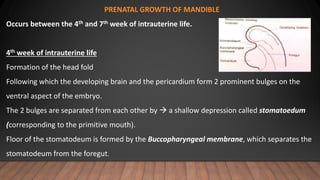
4th week of intrauterine life
Formation of the head fold
Following which the developing brain and the pericardium form 2 prominent bulges on the
ventral aspect of the embryo.
The 2 bulges are separated from each other by ๏ƒ  a shallow depression called stomatoedum
(corresponding to the primitive mouth).
Floor of the stomatodeum is formed by the Buccopharyngeal membrane, which separates the
stomatodeum from the foregut.
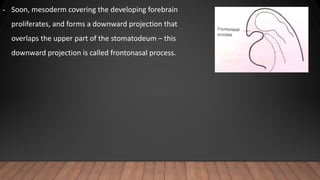
- Soon, mesoderm covering the developing forebrain
proliferates, and forms a downward projection that
overlaps the upper part of the stomatodeum โ€“ this
downward projection is called frontonasal process.
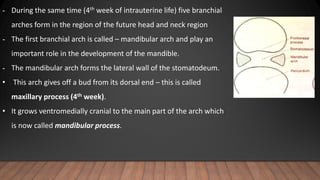
- During the same time (4th week of intrauterine life) five branchial
arches form in the region of the future head and neck region
- The first branchial arch is called โ€“ mandibular arch and play an
important role in the development of the mandible.
- The mandibular arch forms the lateral wall of the stomatodeum.
โ€ข This arch gives off a bud from its dorsal end โ€“ this is called
maxillary process (4th week).
โ€ข It grows ventromedially cranial to the main part of the arch which
is now called mandibular process.
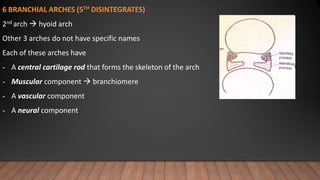
6 BRANCHIAL ARCHES (5TH DISINTEGRATES)
2nd arch ๏ƒ  hyoid arch
Other 3 arches do not have specific names
Each of these arches have
- A central cartilage rod that forms the skeleton of the arch
- Muscular component ๏ƒ  branchiomere
- A vascular component
- A neural component
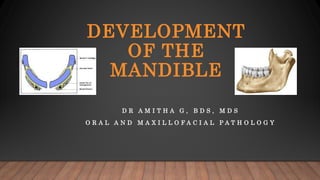
MECKELโ€™S CARTILAGE
- Is derived from the 1st branchial arch
- Develops at around 41st โ€“ 45th day of intrauterine life
- It extends from the cartilaginous otic capsule to the midline (symphysis)
- It provides a template for guiding the growth of the mandible.
- A major portion of the Meckelโ€™s cartilage disappears during the growth and the remaining
part develops into the following structures
๏ƒ˜ Mental ossicles
๏ƒ˜ Incus & malleus
๏ƒ˜ Spine of sphenoid
๏ƒ˜ Anterior ligament of malleus
๏ƒ˜ Spheno mandibular ligament
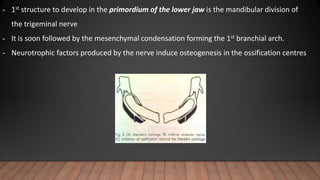
- 1st structure to develop in the primordium of the lower jaw is the mandibular division of
the trigeminal nerve
- It is soon followed by the mesenchymal condensation forming the 1st branchial arch.
- Neurotrophic factors produced by the nerve induce osteogenesis in the ossification centres
6TH WEEK OF INTRAUTERINE LIFE
- Fusion of the 2 mandibular processes in the midline occurs.
- A single ossification centre for each half of the mandible arises in the region of the
bifurcation of the inferior alveolar nerve into mental and incisive branches.
- Ossifying membrane is located lateral to the Meckelโ€™s cartilage and its accompanying
neurovascular bundle.
- From this primary centre, ossification spreads
๏ƒ˜ Below and around the inferior alveolar nerve and its incisive branch and
๏ƒ˜ Upwards to form a trough accommodating the developing tooth buds.
- Spread of the intramembranous ossification dorsally and ventrally forms the body and
ramus of the mandible.
- As the ossification continues ๏ƒ  Meckelโ€™s cartilage ๏ƒ  becomes surrounded and invaded by
bone.
- Ossification stops at the site that will later become mandibular lingula from where the
Meckelโ€™s cartilage continues into the middle ear and develops into auditory ossicles
(Malleus and incus)
- Spenomandibular ligament which extends from the lingula of the mandible to the sphenoid
bone also forms a remnant of the Meckelโ€™s cartilage.
ENDOCHONDRIAL BONE FORMATION
- Is seen only in 3 areas of the mandible
o Condylar process
o Coronoid process
o Mental region
- Condylar process
๏ƒ˜ 5th week of intrauterine life ๏ƒ  area of mesenchymal condensation can be seen above the ventral part of the
developing mandible
๏ƒ˜ 10th week ๏ƒ  This develops into a cone shaped cartilage
๏ƒ˜ 14th week ๏ƒ  ossification starts
๏ƒ˜ In 4 months ๏ƒ  it them migrates inferiorly and fuses with the mandibular ramus
๏ƒ˜ Middle of fetal life ๏ƒ  much of the cone shaped cartilage ๏ƒ  is replaced by bone
๏ƒ˜ But its upper end persists ๏ƒ  till adulthood and ๏ƒ  act as growth cartilage or articular cartilage
CORONOID PROCESS
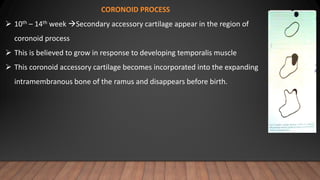
๏ƒ˜ 10th โ€“ 14th week ๏ƒ Secondary accessory cartilage appear in the region of
coronoid process
๏ƒ˜ This is believed to grow in response to developing temporalis muscle
๏ƒ˜ This coronoid accessory cartilage becomes incorporated into the expanding
intramembranous bone of the ramus and disappears before birth.
MENTAL REGION
๏ƒ˜ 7th month of intrauterine life ๏ƒ  On either sides of the symphysis ๏ƒ  1 or 2 small cartilages
appear and ossify ๏ƒ  to form variable number of mental ossicles in the fibrous tissues of the
symphysis.
๏ƒ˜ First year of post natal life ๏ƒ  These ossicles become incorporated into the intra
membranous bone when the symphysis ossifies completely
POST NATAL GROWTH
- Of the facial bones mandible
๏ƒ˜ Undergoes largest amount of post natal growth
๏ƒ˜ And also exhibits largest variability in morphology.
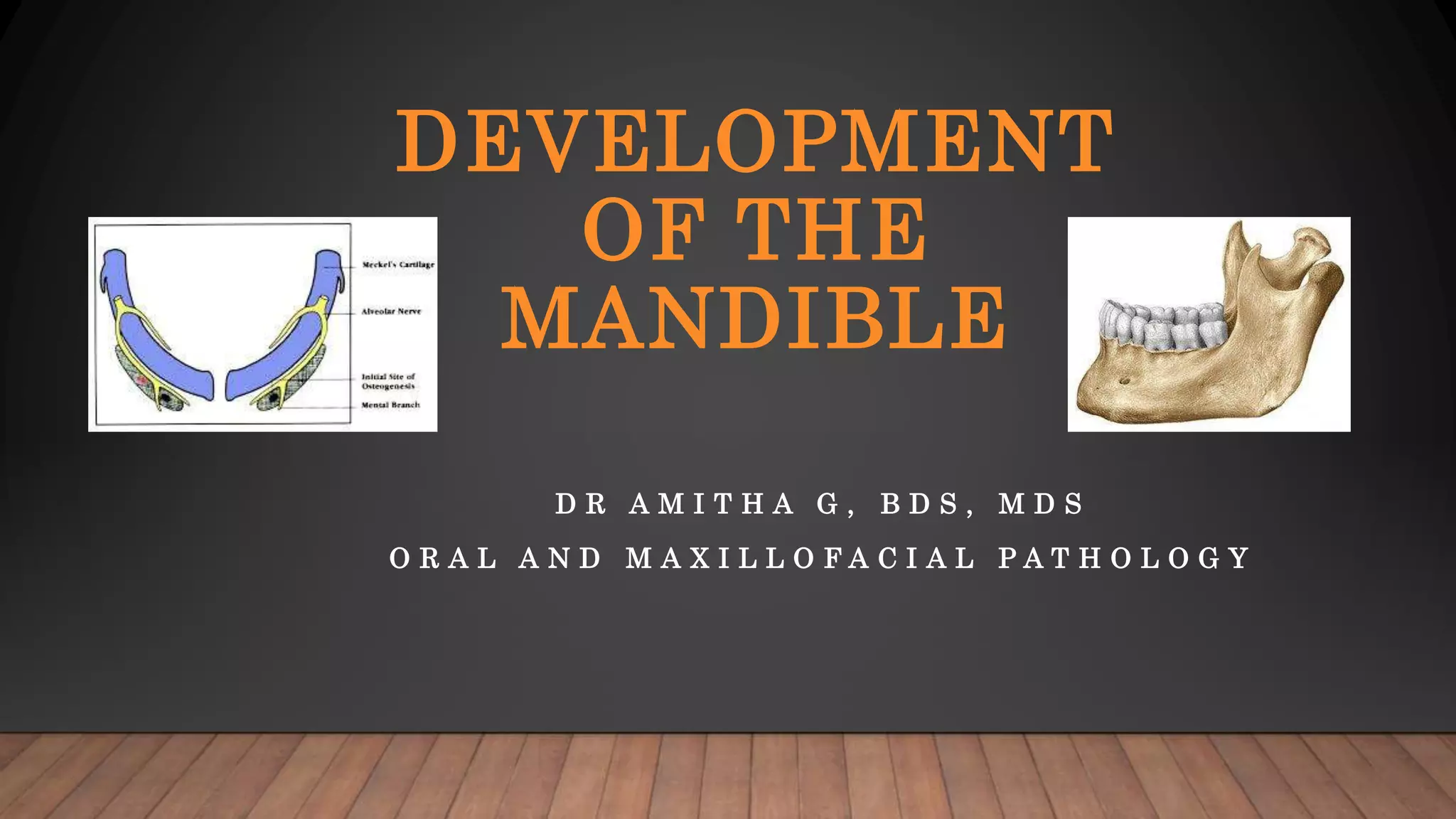
- In adults ๏ƒ  mandible appears to be a single bone
- But develeopmentally and functionally ๏ƒ  divided into several subunits
- Several subunits are
๏ƒ˜ Basal bone or body of the mandible
๏ƒ˜ Alveolar process
๏ƒ˜ Coronoid process
๏ƒ˜ Condylar process
๏ƒ˜ Angular process
๏ƒ˜ Ramus
๏ƒ˜ Lingual tuberosity
๏ƒ˜ Chin
RAMUS
- Ramus ๏ƒ  moves posteriorly ๏ƒ  by combination of deposition and resorption
- Anterior part ๏ƒ  resorption
- Posterior part ๏ƒ  deposition
- This results in the drift of ramus ๏ƒ  in posterior direction
- This remodeling of ramus is to
๏ƒ˜ Accommodate the increasing mass of mascticatory muscles inserted into it
๏ƒ˜ To accommodate enlarged breadth of the pharyngeal space
๏ƒ˜ To facilitate the lengthening of the mandibular body ๏ƒ  which in turn accommodates ๏ƒ 
erupting molars.
BODY OF THE MANDIBLE
- Anterior body ๏ƒ  resorption
- Posterior body ๏ƒ  deposition
- Displacement of the ramus results in converseion of former ramal bone into posterior part
of the body of the mandible ๏ƒ  this manner ๏ƒ  body of mandible ๏ƒ  lengthenes
- This accommodates the eruptin gpermanent molars.
ANGLE OF THE MANDIBLE
- Lingual side of the angle
- Posterior-inferior aspect ๏ƒ  resorption
- Antero-superior aspect ๏ƒ  deposition
- Buccal aspect
- Posterior-inferior aspect ๏ƒ  deposition
- Antero-superior aspect ๏ƒ  resorption
- This results in flaring of the mandible as age advances
LINGUAL TUBEROSITY
- Is a direct equivalent to the maxillary tuberosity.
- Forms a major site of growth for the lower bony arch
- Forms the boundary between the ramus and body
- Lingual tuberosity ๏ƒ  moves posteriorly
- Posteriorly facing surface of tuberosity ๏ƒ  deposition
ALVEOLAR PROCESS
- Alveolar process develops in response to the presence of tooth buds.
- As the teeth erupts ๏ƒ  bone deposition at the margins ๏ƒ  alveolar process develops and
increases in height
- Alveolar bone adds to the height and thickness of the body of the mandible and is
particularly manifested as a ledge extending lingual to the ramus to accommodate the 3rd
molars
- In case of absence of teeth ๏ƒ  alveolar bone fails to develop and it resorbs in the even tog
tooth extraction
CHIN
- Infancy ๏ƒ  chin ๏ƒ  underdeveloped
- As age advances ๏ƒ  growth of the chin ๏ƒ  becomes ๏ƒ  significant
- Males ๏ƒ  prominent chin compared to females
- Mental protuberance forms by deposition of bone during childhood
CONDYLE
- Condyle ๏ƒ  is an important growth site
- Head of condylar ๏ƒ  covered by a thin layer of cartilage ๏ƒ  condylar cartilage
- Condylar cartilage ๏ƒ  is an adaptation to withstand compression that occurs at the joint
- 2 schools of thought regarding the role of condyle
- Growth occurs at the surface of the condylar cartilage ๏ƒ  by bone deposition ๏ƒ  thus
condyle growa towards the cranial base ๏ƒ  as the condyle pushes against the cranial base
๏ƒ  the entire mandible gest displaced forwards and downwards
- Growth of the soft tissues including muscles and CT carries the mandible forwards away
from the cranial base (carry away phenomenon) ๏ƒ  bone growth follow secondarily at the
condyle to maintain constant contact with the cranial base.
- Condylar growth rate increases at puberty reaching a peak between 12 ยฝ - 14 years.
- Growth ceases around 20 years of age
CORONOID PROCESS
- Growth of the condylar process follows ๏ƒ  enlarging V principle
LONGITUDINAL SECTION VIEW
- Lingual (medial) surface of left and right coronoid process ๏ƒ  Deposition
- Although additions takes place on the lingual side, the vertical dimension of the coronois
process also increases ๏ƒ  this follows enlarging V principle
OCCLUSAL ASPECT VIEW
- Deposition on the lingual of the coronoid process brings about a posterior growth
movement in the V pattern.
- Briefly, the coronoid process has a propeller like twist, so that its lingual side faces 3 general
direction all at once, i.e. posteriorly, superiorly and medially
THANK YOU

Developmental Of The Mandible

  • 1.
    DEVELOPMENT OF THE MANDIBLE D RA M I T H A G , B D S , M D S O R A L A N D M A X I L L O F A C I A L P A T H O L O G Y
  • 2.
    PRENATAL GROWTH OFMANDIBLE Occurs between the 4th and 7th week of intrauterine life. 4th week of intrauterine life Formation of the head fold Following which the developing brain and the pericardium form 2 prominent bulges on the ventral aspect of the embryo. The 2 bulges are separated from each other by ๏ƒ  a shallow depression called stomatoedum (corresponding to the primitive mouth). Floor of the stomatodeum is formed by the Buccopharyngeal membrane, which separates the stomatodeum from the foregut.
  • 3.
    - Soon, mesodermcovering the developing forebrain proliferates, and forms a downward projection that overlaps the upper part of the stomatodeum โ€“ this downward projection is called frontonasal process.
  • 4.
    - During thesame time (4th week of intrauterine life) five branchial arches form in the region of the future head and neck region - The first branchial arch is called โ€“ mandibular arch and play an important role in the development of the mandible. - The mandibular arch forms the lateral wall of the stomatodeum. โ€ข This arch gives off a bud from its dorsal end โ€“ this is called maxillary process (4th week). โ€ข It grows ventromedially cranial to the main part of the arch which is now called mandibular process.
  • 5.
    6 BRANCHIAL ARCHES(5TH DISINTEGRATES) 2nd arch ๏ƒ  hyoid arch Other 3 arches do not have specific names Each of these arches have - A central cartilage rod that forms the skeleton of the arch - Muscular component ๏ƒ  branchiomere - A vascular component - A neural component
  • 6.
    MECKELโ€™S CARTILAGE - Isderived from the 1st branchial arch - Develops at around 41st โ€“ 45th day of intrauterine life - It extends from the cartilaginous otic capsule to the midline (symphysis) - It provides a template for guiding the growth of the mandible.
  • 7.
    - A majorportion of the Meckelโ€™s cartilage disappears during the growth and the remaining part develops into the following structures ๏ƒ˜ Mental ossicles ๏ƒ˜ Incus & malleus ๏ƒ˜ Spine of sphenoid ๏ƒ˜ Anterior ligament of malleus ๏ƒ˜ Spheno mandibular ligament
  • 8.
    - 1st structureto develop in the primordium of the lower jaw is the mandibular division of the trigeminal nerve - It is soon followed by the mesenchymal condensation forming the 1st branchial arch. - Neurotrophic factors produced by the nerve induce osteogenesis in the ossification centres
  • 9.
    6TH WEEK OFINTRAUTERINE LIFE - Fusion of the 2 mandibular processes in the midline occurs. - A single ossification centre for each half of the mandible arises in the region of the bifurcation of the inferior alveolar nerve into mental and incisive branches. - Ossifying membrane is located lateral to the Meckelโ€™s cartilage and its accompanying neurovascular bundle. - From this primary centre, ossification spreads ๏ƒ˜ Below and around the inferior alveolar nerve and its incisive branch and ๏ƒ˜ Upwards to form a trough accommodating the developing tooth buds.
  • 10.
    - Spread ofthe intramembranous ossification dorsally and ventrally forms the body and ramus of the mandible. - As the ossification continues ๏ƒ  Meckelโ€™s cartilage ๏ƒ  becomes surrounded and invaded by bone. - Ossification stops at the site that will later become mandibular lingula from where the Meckelโ€™s cartilage continues into the middle ear and develops into auditory ossicles (Malleus and incus) - Spenomandibular ligament which extends from the lingula of the mandible to the sphenoid bone also forms a remnant of the Meckelโ€™s cartilage.
  • 11.
    ENDOCHONDRIAL BONE FORMATION -Is seen only in 3 areas of the mandible o Condylar process o Coronoid process o Mental region - Condylar process ๏ƒ˜ 5th week of intrauterine life ๏ƒ  area of mesenchymal condensation can be seen above the ventral part of the developing mandible ๏ƒ˜ 10th week ๏ƒ  This develops into a cone shaped cartilage ๏ƒ˜ 14th week ๏ƒ  ossification starts ๏ƒ˜ In 4 months ๏ƒ  it them migrates inferiorly and fuses with the mandibular ramus ๏ƒ˜ Middle of fetal life ๏ƒ  much of the cone shaped cartilage ๏ƒ  is replaced by bone ๏ƒ˜ But its upper end persists ๏ƒ  till adulthood and ๏ƒ  act as growth cartilage or articular cartilage
  • 12.
    CORONOID PROCESS ๏ƒ˜ 10thโ€“ 14th week ๏ƒ Secondary accessory cartilage appear in the region of coronoid process ๏ƒ˜ This is believed to grow in response to developing temporalis muscle ๏ƒ˜ This coronoid accessory cartilage becomes incorporated into the expanding intramembranous bone of the ramus and disappears before birth.
  • 13.
    MENTAL REGION ๏ƒ˜ 7thmonth of intrauterine life ๏ƒ  On either sides of the symphysis ๏ƒ  1 or 2 small cartilages appear and ossify ๏ƒ  to form variable number of mental ossicles in the fibrous tissues of the symphysis. ๏ƒ˜ First year of post natal life ๏ƒ  These ossicles become incorporated into the intra membranous bone when the symphysis ossifies completely
  • 14.
    POST NATAL GROWTH -Of the facial bones mandible ๏ƒ˜ Undergoes largest amount of post natal growth ๏ƒ˜ And also exhibits largest variability in morphology. - In adults ๏ƒ  mandible appears to be a single bone - But develeopmentally and functionally ๏ƒ  divided into several subunits
  • 15.
    - Several subunitsare ๏ƒ˜ Basal bone or body of the mandible ๏ƒ˜ Alveolar process ๏ƒ˜ Coronoid process ๏ƒ˜ Condylar process ๏ƒ˜ Angular process ๏ƒ˜ Ramus ๏ƒ˜ Lingual tuberosity ๏ƒ˜ Chin
  • 16.
    RAMUS - Ramus ๏ƒ moves posteriorly ๏ƒ  by combination of deposition and resorption - Anterior part ๏ƒ  resorption - Posterior part ๏ƒ  deposition - This results in the drift of ramus ๏ƒ  in posterior direction - This remodeling of ramus is to ๏ƒ˜ Accommodate the increasing mass of mascticatory muscles inserted into it ๏ƒ˜ To accommodate enlarged breadth of the pharyngeal space ๏ƒ˜ To facilitate the lengthening of the mandibular body ๏ƒ  which in turn accommodates ๏ƒ  erupting molars.
  • 17.
    BODY OF THEMANDIBLE - Anterior body ๏ƒ  resorption - Posterior body ๏ƒ  deposition - Displacement of the ramus results in converseion of former ramal bone into posterior part of the body of the mandible ๏ƒ  this manner ๏ƒ  body of mandible ๏ƒ  lengthenes - This accommodates the eruptin gpermanent molars.
  • 18.
    ANGLE OF THEMANDIBLE - Lingual side of the angle - Posterior-inferior aspect ๏ƒ  resorption - Antero-superior aspect ๏ƒ  deposition - Buccal aspect - Posterior-inferior aspect ๏ƒ  deposition - Antero-superior aspect ๏ƒ  resorption - This results in flaring of the mandible as age advances
  • 19.
    LINGUAL TUBEROSITY - Isa direct equivalent to the maxillary tuberosity. - Forms a major site of growth for the lower bony arch - Forms the boundary between the ramus and body - Lingual tuberosity ๏ƒ  moves posteriorly - Posteriorly facing surface of tuberosity ๏ƒ  deposition
  • 20.
    ALVEOLAR PROCESS - Alveolarprocess develops in response to the presence of tooth buds. - As the teeth erupts ๏ƒ  bone deposition at the margins ๏ƒ  alveolar process develops and increases in height - Alveolar bone adds to the height and thickness of the body of the mandible and is particularly manifested as a ledge extending lingual to the ramus to accommodate the 3rd molars - In case of absence of teeth ๏ƒ  alveolar bone fails to develop and it resorbs in the even tog tooth extraction
  • 21.
    CHIN - Infancy ๏ƒ chin ๏ƒ  underdeveloped - As age advances ๏ƒ  growth of the chin ๏ƒ  becomes ๏ƒ  significant - Males ๏ƒ  prominent chin compared to females - Mental protuberance forms by deposition of bone during childhood
  • 22.
    CONDYLE - Condyle ๏ƒ is an important growth site - Head of condylar ๏ƒ  covered by a thin layer of cartilage ๏ƒ  condylar cartilage - Condylar cartilage ๏ƒ  is an adaptation to withstand compression that occurs at the joint - 2 schools of thought regarding the role of condyle
  • 23.
    - Growth occursat the surface of the condylar cartilage ๏ƒ  by bone deposition ๏ƒ  thus condyle growa towards the cranial base ๏ƒ  as the condyle pushes against the cranial base ๏ƒ  the entire mandible gest displaced forwards and downwards - Growth of the soft tissues including muscles and CT carries the mandible forwards away from the cranial base (carry away phenomenon) ๏ƒ  bone growth follow secondarily at the condyle to maintain constant contact with the cranial base. - Condylar growth rate increases at puberty reaching a peak between 12 ยฝ - 14 years. - Growth ceases around 20 years of age
  • 24.
    CORONOID PROCESS - Growthof the condylar process follows ๏ƒ  enlarging V principle LONGITUDINAL SECTION VIEW - Lingual (medial) surface of left and right coronoid process ๏ƒ  Deposition - Although additions takes place on the lingual side, the vertical dimension of the coronois process also increases ๏ƒ  this follows enlarging V principle OCCLUSAL ASPECT VIEW - Deposition on the lingual of the coronoid process brings about a posterior growth movement in the V pattern. - Briefly, the coronoid process has a propeller like twist, so that its lingual side faces 3 general direction all at once, i.e. posteriorly, superiorly and medially
  • 25.