SHOCK
PREPARED BY,
MISFA KHATUN
TUTOR
INTRODUCTION
Shock is a life threatening condition. It is characterized by inadequate tissue
perfusion that if untreated results in cell death. The supply of oxygen to tissue is
essential in the maintenance of life and this can be ensured when circulatory
system is functioning normally.
DEFINITION
❑Shock can be defined as , a condition in which systematic blood pressure is
inadequate to deliver oxygen and nutrient supply to vital organs and cellular
functions.
❑Shock is defined as a condition where the tissue in the body don’t receive
enough oxygen and nutrients to allow the cells to function.
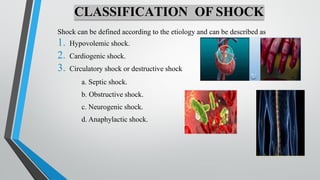
CLASSIFICATION OF SHOCK
Shock can be defined according to the etiology and can be described as
1. Hypovolemic shock.
2. Cardiogenic shock.
3. Circulatory shock or destructive shock
a. Septic shock.
b. Obstructive shock.
c. Neurogenic shock.
d. Anaphylactic shock.
ETIOLOGY
➢Severe allergic reaction
➢Significant blood loss
➢Heart failure
➢Blood infections
➢Dehydration
➢Poisoning
➢Burns
STAGES OF SHOCK
There are 4 stages –
1. Initial stage
2. Compensatory stage
3. Progressive (or) decompensate
4. Refractory (Irreversible)
PATHOPHYSIOLOGY OF SHOCK
Lack of oxygen supply and nutrient to cells
Cells produce energy through anaerobic metabolism to produceATP
Low energy yielding from nutrients and produces acidic intracellular environment
Normal cell function affected, cells swells and cell membrane become more permeable,
allowing fluid and electrolytes to move out and into the cells
Sodium - potassium pump impaired
Cell structure damage
Ultimately death of cells
CLINICAL MANIFESTATIONS
Clinical manifestations according to stages of shock
In compensatory stage-
• Normal blood pressure
• Metabolic acidosis
• Respiratory alkalosis
• Deep rapid respiration
• Flat neck vein
• Changes in LOC
• Irritability
• Restlessness, dilated reactive pupil
• Tachycardia bounding pulse
• Dry warm skin
Contd…
In Progressive stage-
• Confusion
• Dilated, slugging pupil.
• Thirst, rapid shallow breathing.
• Tachycardia, cool moist skin.
• Slow capillary refill, muscle weakness.
• Hypotension.
In Refractory(Irreversible) stage-
• Unconsciousness, absence of reflexes.
• Dilated sluggish pupil, severe thirst.
• Acute respiratory distress syndrome, Disseminated intravascular coagulation,
Bradycardia.
• Cyanosis
• Absence of bowel sounds.
• Immune system collapse.
• Anuria.
Contd…
HYPOVOLEMIC SHOCK
• This is the most common type of shock, due to insufficient circulatory volume.
• In hypovolemic shock there is decrease in circulatory volume to level that is
inadequate to meet body’s need for tissue oxygenation.
• This occurs when there is loss in the intravascular fluid upto 15% to 25%. This
would represent a loss of 750 to 1300 ml of blood in a 70kg person.
• Common causes are:
- Exercise
- Fluid loss from circulatory system ( e.g. bleeding, burns, blood loss from GI,
severe diarrhoea)
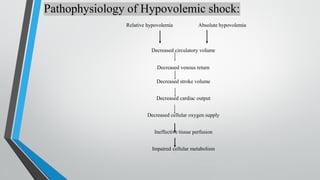
Pathophysiology of Hypovolemic shock:
Relative hypovolemia Absolute hypovolemia
Decreased circulatory volume
Decreased venous return
Decreased stroke volume
Decreased cardiac output
Decreased cellular oxygen supply
Ineffective tissue perfusion
Impaired cellular metabolism
CARDIOGENIC SHOCK
• It is caused by the failure of the heart to pump an adequate amount of blood to
the vital organs. This will lead to reduction in cardiac output.
• After due damage of heart muscles, heart’s ability to contract and pump blood
is impaired and the supply of oxygen is in adequate for the heart and muscles.
It can be result of myocardial infarction.
• Other causes include arrhythmias, cardiomyopathy, congestive heart failure,
and cardiac valve problems.
Pathophysiology of Cardiogenic shock:
Structural problem Dysrhythmias
Primary ventricular
ischemia
Ineffective forward motion of blood
Decreased stroke volume
Decreased cardiac output
Ineffective ventricular emptying
Increased pulmonary pressure
Pulmonary edema
Decreased oxygenation
Decreased cellular oxygen supply
Ineffective tissue perfusion
Impaired cellular metabolism
CIRCULATORY SHOCK OR
DISTRIBUTIVE SHOCK
• In this there is no blood loss but the shock is due to the dilation of the blood
vessels. This displacement of blood causes a relative hypovolemia because
not enough blood returns to heart which leads to subsequent inadequate tissue
perfusion.
• It is subdivided into
a. Septic shock
b. Obstructive shock
c. Neurogenic shock
d. Anaphylactic shock
SEPTIC SHOCK
• Septic shock is a serious medical condition that occurs when sepsis, which is
organ injury or damage in response to infection, leads to dangerously low
blood pressure and abnormalities in cellular metabolism.
• The primary infection is most commonly by bacteria, but can also be by
fungi , viruses or parasites , and can be located in any part of the body, but
most commonly in the lungs, brain, urinary tract, skin, or abdominal organs.
• It can cause multiple organ dysfunction syndrome (formerly known as
multiple organ failure) and death.
Obstruction of blood flow results from cardiac arrest .
E.g. Cardiac tamponade, pneumothorax, pulmonary embolism, and aortic
stenosis.
OBSTRUCTIVE SHOCK
NEUROGENIC SHOCK
• This is a very uncommon type of shock .
• It is most often seen in patients who have had an extensive spinal cord injury.
• The loss of autonomic and motor reflexes below level of injury results in loss
of sympathetic control. This leads to relaxation of vessels and peripheral
dilation and hypotension.
• This is characterized by warm, and dry skin, bradycardia, rather than other
type of shock.
ANAPHYLACTIC SHOCK
• Anaphylactic shock is caused by severe reaction to an allergen, antigen, drug
or foreign protein.
• When a patient who has already produced antibodies to a foreign substance
develops a systematic antigen antibody reaction, antigen antibody provides
mast cells to release vasoactive substance such as histamine or bradykin that
cause vasodilation.
FIRST AID MANAGEMENT OF SHOCK
• Reassure the casualty.
• Lay him down on his back comfortably with head low and turned to
one side except in case of head injury.
• Loosen the clothing around the neck, chest and waist.
• Keep the casualty warm.
• Give him sips of water if he is thirsty. Never give any alcoholic drinks.
• Never use hot water bag or massage the limbs.
• Check pulse, respiration and level of consciousness.
• Transport the casualty to the hospital immediately
TREATMENT SHOCK
Pharmacological interventions:
1. Hypovolemic shock
- Volume expanders
- Desmopressin (in case of Diabetes)
-Antidiarrheal agents for diarrhoea
2. Cardiogenic shock
- Volume expanders
- Positive cardiac ionotropics
- Vasodilators
- Vasoactive and antiarrhythmic medication
3. Distributive shock
- Volume expanders
- Positive cardiac ionotropics
- Vasoconstrictors
Contd…
4. Obstructive shock
- Volume expanders
5. Septic shock
- Broad spectrum antibiotics
6. Neurogenic shock
- Hypoglycemia : glucose is rapidly administered.
MANAGEMENT OF SHOCK
Administration of IV fluids, blood components, and medication.
These includes:
• Crystalloids (e.g. RL solution, NS)
• Ionotropic agents (e.g. Dopamine, Dobutamine and Epinephrine)
• Vasodilators (e.g. Nitro-glycerine, sodium nitroprusside)
• Diuretics
• Antibiotics
• Antihistamines (e.g. Epinephrine)
• Steroids
• Sodium bicarbonate
• Bronchodilators (e.g.Atropine,Aminophylline)
NURSING MANAGEMENT OF SHOCK
• MaintainABC of the patient.
• Provide supplemtal oxygen therapy to the patient.
• Do not deliver more than 2 lt. Of oxygen per minute if person has history
of chronic pulmonary diseases.
• Monitor forABG value to assess the patient’s response to oxygen therapy.
• Continuous monitoring of vital signs should be done.
• Check for urine output of the patient .
• Maintain nutritional status of the patient.Administer prescribed medication
to the patient.
• Give psychological support to the patient and the relatives.
SHOCK

SHOCK

  • 1.
  • 2.
    INTRODUCTION Shock is alife threatening condition. It is characterized by inadequate tissue perfusion that if untreated results in cell death. The supply of oxygen to tissue is essential in the maintenance of life and this can be ensured when circulatory system is functioning normally.
  • 3.
    DEFINITION ❑Shock can bedefined as , a condition in which systematic blood pressure is inadequate to deliver oxygen and nutrient supply to vital organs and cellular functions. ❑Shock is defined as a condition where the tissue in the body don’t receive enough oxygen and nutrients to allow the cells to function.
  • 4.
    CLASSIFICATION OF SHOCK Shockcan be defined according to the etiology and can be described as 1. Hypovolemic shock. 2. Cardiogenic shock. 3. Circulatory shock or destructive shock a. Septic shock. b. Obstructive shock. c. Neurogenic shock. d. Anaphylactic shock.
  • 5.
    ETIOLOGY ➢Severe allergic reaction ➢Significantblood loss ➢Heart failure ➢Blood infections ➢Dehydration ➢Poisoning ➢Burns
  • 6.
    STAGES OF SHOCK Thereare 4 stages – 1. Initial stage 2. Compensatory stage 3. Progressive (or) decompensate 4. Refractory (Irreversible)
  • 7.
    PATHOPHYSIOLOGY OF SHOCK Lackof oxygen supply and nutrient to cells Cells produce energy through anaerobic metabolism to produceATP Low energy yielding from nutrients and produces acidic intracellular environment Normal cell function affected, cells swells and cell membrane become more permeable, allowing fluid and electrolytes to move out and into the cells Sodium - potassium pump impaired Cell structure damage Ultimately death of cells
  • 8.
    CLINICAL MANIFESTATIONS Clinical manifestationsaccording to stages of shock In compensatory stage- • Normal blood pressure • Metabolic acidosis • Respiratory alkalosis • Deep rapid respiration • Flat neck vein • Changes in LOC • Irritability • Restlessness, dilated reactive pupil • Tachycardia bounding pulse • Dry warm skin
  • 9.
    Contd… In Progressive stage- •Confusion • Dilated, slugging pupil. • Thirst, rapid shallow breathing. • Tachycardia, cool moist skin. • Slow capillary refill, muscle weakness. • Hypotension.
  • 10.
    In Refractory(Irreversible) stage- •Unconsciousness, absence of reflexes. • Dilated sluggish pupil, severe thirst. • Acute respiratory distress syndrome, Disseminated intravascular coagulation, Bradycardia. • Cyanosis • Absence of bowel sounds. • Immune system collapse. • Anuria. Contd…
  • 11.
    HYPOVOLEMIC SHOCK • Thisis the most common type of shock, due to insufficient circulatory volume. • In hypovolemic shock there is decrease in circulatory volume to level that is inadequate to meet body’s need for tissue oxygenation. • This occurs when there is loss in the intravascular fluid upto 15% to 25%. This would represent a loss of 750 to 1300 ml of blood in a 70kg person. • Common causes are: - Exercise - Fluid loss from circulatory system ( e.g. bleeding, burns, blood loss from GI, severe diarrhoea)
  • 12.
    Pathophysiology of Hypovolemicshock: Relative hypovolemia Absolute hypovolemia Decreased circulatory volume Decreased venous return Decreased stroke volume Decreased cardiac output Decreased cellular oxygen supply Ineffective tissue perfusion Impaired cellular metabolism
  • 13.
    CARDIOGENIC SHOCK • Itis caused by the failure of the heart to pump an adequate amount of blood to the vital organs. This will lead to reduction in cardiac output. • After due damage of heart muscles, heart’s ability to contract and pump blood is impaired and the supply of oxygen is in adequate for the heart and muscles. It can be result of myocardial infarction. • Other causes include arrhythmias, cardiomyopathy, congestive heart failure, and cardiac valve problems.
  • 14.
    Pathophysiology of Cardiogenicshock: Structural problem Dysrhythmias Primary ventricular ischemia Ineffective forward motion of blood Decreased stroke volume Decreased cardiac output Ineffective ventricular emptying Increased pulmonary pressure Pulmonary edema Decreased oxygenation Decreased cellular oxygen supply Ineffective tissue perfusion Impaired cellular metabolism
  • 15.
    CIRCULATORY SHOCK OR DISTRIBUTIVESHOCK • In this there is no blood loss but the shock is due to the dilation of the blood vessels. This displacement of blood causes a relative hypovolemia because not enough blood returns to heart which leads to subsequent inadequate tissue perfusion. • It is subdivided into a. Septic shock b. Obstructive shock c. Neurogenic shock d. Anaphylactic shock
  • 16.
    SEPTIC SHOCK • Septicshock is a serious medical condition that occurs when sepsis, which is organ injury or damage in response to infection, leads to dangerously low blood pressure and abnormalities in cellular metabolism. • The primary infection is most commonly by bacteria, but can also be by fungi , viruses or parasites , and can be located in any part of the body, but most commonly in the lungs, brain, urinary tract, skin, or abdominal organs. • It can cause multiple organ dysfunction syndrome (formerly known as multiple organ failure) and death.
  • 17.
    Obstruction of bloodflow results from cardiac arrest . E.g. Cardiac tamponade, pneumothorax, pulmonary embolism, and aortic stenosis. OBSTRUCTIVE SHOCK
  • 18.
    NEUROGENIC SHOCK • Thisis a very uncommon type of shock . • It is most often seen in patients who have had an extensive spinal cord injury. • The loss of autonomic and motor reflexes below level of injury results in loss of sympathetic control. This leads to relaxation of vessels and peripheral dilation and hypotension. • This is characterized by warm, and dry skin, bradycardia, rather than other type of shock.
  • 19.
    ANAPHYLACTIC SHOCK • Anaphylacticshock is caused by severe reaction to an allergen, antigen, drug or foreign protein. • When a patient who has already produced antibodies to a foreign substance develops a systematic antigen antibody reaction, antigen antibody provides mast cells to release vasoactive substance such as histamine or bradykin that cause vasodilation.
  • 20.
    FIRST AID MANAGEMENTOF SHOCK • Reassure the casualty. • Lay him down on his back comfortably with head low and turned to one side except in case of head injury. • Loosen the clothing around the neck, chest and waist. • Keep the casualty warm. • Give him sips of water if he is thirsty. Never give any alcoholic drinks. • Never use hot water bag or massage the limbs. • Check pulse, respiration and level of consciousness. • Transport the casualty to the hospital immediately
  • 21.
    TREATMENT SHOCK Pharmacological interventions: 1.Hypovolemic shock - Volume expanders - Desmopressin (in case of Diabetes) -Antidiarrheal agents for diarrhoea 2. Cardiogenic shock - Volume expanders - Positive cardiac ionotropics - Vasodilators - Vasoactive and antiarrhythmic medication 3. Distributive shock - Volume expanders - Positive cardiac ionotropics - Vasoconstrictors
  • 22.
    Contd… 4. Obstructive shock -Volume expanders 5. Septic shock - Broad spectrum antibiotics 6. Neurogenic shock - Hypoglycemia : glucose is rapidly administered.
  • 23.
    MANAGEMENT OF SHOCK Administrationof IV fluids, blood components, and medication. These includes: • Crystalloids (e.g. RL solution, NS) • Ionotropic agents (e.g. Dopamine, Dobutamine and Epinephrine) • Vasodilators (e.g. Nitro-glycerine, sodium nitroprusside) • Diuretics • Antibiotics • Antihistamines (e.g. Epinephrine) • Steroids • Sodium bicarbonate • Bronchodilators (e.g.Atropine,Aminophylline)
  • 24.
    NURSING MANAGEMENT OFSHOCK • MaintainABC of the patient. • Provide supplemtal oxygen therapy to the patient. • Do not deliver more than 2 lt. Of oxygen per minute if person has history of chronic pulmonary diseases. • Monitor forABG value to assess the patient’s response to oxygen therapy. • Continuous monitoring of vital signs should be done. • Check for urine output of the patient . • Maintain nutritional status of the patient.Administer prescribed medication to the patient. • Give psychological support to the patient and the relatives.