VALENCE SHELL ELECTRON PAIR
REPULSION THEORY
PRESENTED
BY
ALTAMAS ALI
B.Sc – MICROBIOLOGY
SEM. – 2ND
SCHOOL OF LIFE AND ALLIED
HEALTH SCIENCE
THE GLOCAL UNIVERSITY
CONTENTS
• ABBREVIATION USED
• INTRODUCTION
• VSEPR THEORY : MAIN POSTULATES OF VSEPR
• REPULSION STRENGTHS
• CAUSE OF ALTERNATION IN SHAPE
• EFFCT OF ELECTRONEGATIVITY
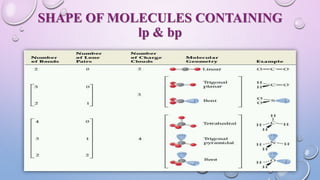
• SHAPE OF MOLECULES CONTAINING lp & bp
• REFERENCES
ABBREVIATION USED
• VSEPR THEORY – VALENCE SHARE ELECTRON PAIR REPULSION
THEORY
• lp – lone pair
• bp - bond pair
• max. – maximum
• min. - minimum
INTRODUCTION
• VSEPR theory was suggested by Sidgwick and Powell [1940]
• It was further improved by Gillespie and Nyholm in 1957.
• Based on that in a polyatomic molecule the direction bonds around the
central atom depends on the total number of bonding &non-bonding
electron pairs in its valance shell.
VSEPR THEORY
MAIN POSTULATES OF VSEPR :
• The shape of the molecule is determined by repulsions between all
of the electron present in the valance shell.
• Electron pairs in the valence shell of the central atom repel each
other and align themselves to minimize this repulsion.
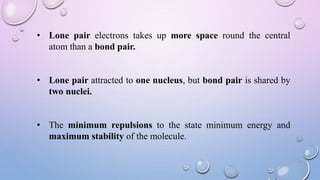
• Lone pair electrons takes up more space round the central
atom than a bond pair.
• Lone pair attracted to one nucleus, but bond pair is shared by
two nuclei.
• The minimum repulsions to the state minimum energy and
maximum stability of the molecule.
REPULSION STRENGTHS
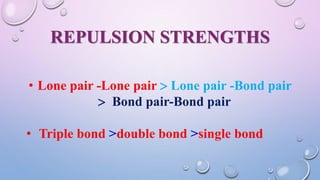
• Lone pair -Lone pair  Lone pair -Bond pair
 Bond pair-Bond pair
• Triple bond >double bond >single bond
CAUSE OF ALTERNATION IN
SHAPE
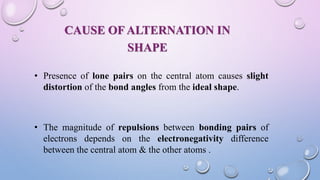
• Presence of lone pairs on the central atom causes slight
distortion of the bond angles from the ideal shape.
• The magnitude of repulsions between bonding pairs of
electrons depends on the electronegativity difference
between the central atom & the other atoms .
EFFCT OF ELECTRONEGATIVITY
Five electrons in the valance shell of
Nitrogen. [1s2 2s2 2p3]
Molecular geometry- Tetrahedral [e-pairs arrangement]
or Trigonal Pyramidal [VSEPR]
Presence of lone pair causes slight distortion from 109⁰28′ to 107⁰48′ to 102⁰30′
Repulsion between bondpair-bondpair is less in NF3 than in NH3
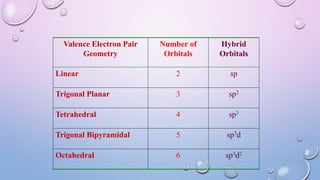
Valence Electron Pair
Geometry
Number of
Orbitals
Hybrid
Orbitals
Linear 2 sp
Trigonal Planar 3 sp2
Tetrahedral 4 sp3
Trigonal Bipyramidal 5 sp3d
Octahedral 6 sp3d2
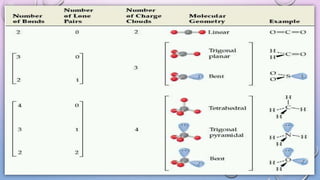
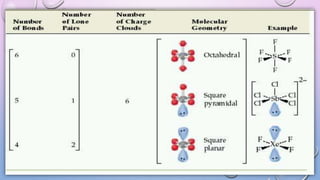
SHAPE OF MOLECULES CONTAINING
lp & bp
REFERENCES
• J.D Lee, WILEY INDIA EDITION, Concise Inorganic, Vol. 5 @ Pg. 74-80.
• Atkins, Rourke, Weller & Armstrong. Shriver & Atkins, OXFORD South Asia edition,
Inorganic Chemistry, Vol. 5. Topic 2.3 @ Pg. 36-39.
• Pictures From www.oxfordtextbooks.co.uk/orc/ichem5e/
• Pictures from Wikipedia- free encyclopedia- www. Wikipedia.org.
THANKS TO RESPECTED
TEACHERS AND STUDENTS
THEEND

Valence shell electron pair repulsion theory (VSEPR THEORY)

  • 2.
    VALENCE SHELL ELECTRONPAIR REPULSION THEORY PRESENTED BY ALTAMAS ALI B.Sc – MICROBIOLOGY SEM. – 2ND SCHOOL OF LIFE AND ALLIED HEALTH SCIENCE THE GLOCAL UNIVERSITY
  • 3.
    CONTENTS • ABBREVIATION USED •INTRODUCTION • VSEPR THEORY : MAIN POSTULATES OF VSEPR • REPULSION STRENGTHS • CAUSE OF ALTERNATION IN SHAPE • EFFCT OF ELECTRONEGATIVITY • SHAPE OF MOLECULES CONTAINING lp & bp • REFERENCES
  • 4.
    ABBREVIATION USED • VSEPRTHEORY – VALENCE SHARE ELECTRON PAIR REPULSION THEORY • lp – lone pair • bp - bond pair • max. – maximum • min. - minimum
  • 5.
    INTRODUCTION • VSEPR theorywas suggested by Sidgwick and Powell [1940] • It was further improved by Gillespie and Nyholm in 1957. • Based on that in a polyatomic molecule the direction bonds around the central atom depends on the total number of bonding &non-bonding electron pairs in its valance shell.
  • 6.
    VSEPR THEORY MAIN POSTULATESOF VSEPR : • The shape of the molecule is determined by repulsions between all of the electron present in the valance shell. • Electron pairs in the valence shell of the central atom repel each other and align themselves to minimize this repulsion.
  • 7.
    • Lone pairelectrons takes up more space round the central atom than a bond pair. • Lone pair attracted to one nucleus, but bond pair is shared by two nuclei. • The minimum repulsions to the state minimum energy and maximum stability of the molecule.
  • 8.
    REPULSION STRENGTHS • Lonepair -Lone pair  Lone pair -Bond pair  Bond pair-Bond pair • Triple bond >double bond >single bond
  • 9.
    CAUSE OF ALTERNATIONIN SHAPE • Presence of lone pairs on the central atom causes slight distortion of the bond angles from the ideal shape. • The magnitude of repulsions between bonding pairs of electrons depends on the electronegativity difference between the central atom & the other atoms .
  • 10.
    EFFCT OF ELECTRONEGATIVITY Fiveelectrons in the valance shell of Nitrogen. [1s2 2s2 2p3] Molecular geometry- Tetrahedral [e-pairs arrangement] or Trigonal Pyramidal [VSEPR] Presence of lone pair causes slight distortion from 109⁰28′ to 107⁰48′ to 102⁰30′ Repulsion between bondpair-bondpair is less in NF3 than in NH3
  • 11.
    Valence Electron Pair Geometry Numberof Orbitals Hybrid Orbitals Linear 2 sp Trigonal Planar 3 sp2 Tetrahedral 4 sp3 Trigonal Bipyramidal 5 sp3d Octahedral 6 sp3d2
  • 12.
    SHAPE OF MOLECULESCONTAINING lp & bp
  • 15.
    REFERENCES • J.D Lee,WILEY INDIA EDITION, Concise Inorganic, Vol. 5 @ Pg. 74-80. • Atkins, Rourke, Weller & Armstrong. Shriver & Atkins, OXFORD South Asia edition, Inorganic Chemistry, Vol. 5. Topic 2.3 @ Pg. 36-39. • Pictures From www.oxfordtextbooks.co.uk/orc/ichem5e/ • Pictures from Wikipedia- free encyclopedia- www. Wikipedia.org.
  • 16.
    THANKS TO RESPECTED TEACHERSAND STUDENTS THEEND