Organic Molecular Solids
Prof. Allen M. Hermann
Professor of Physics Emeritus
University of Colorado
Boulder, Colorado USA
allen.hermann@colorado.edu
Course Outline
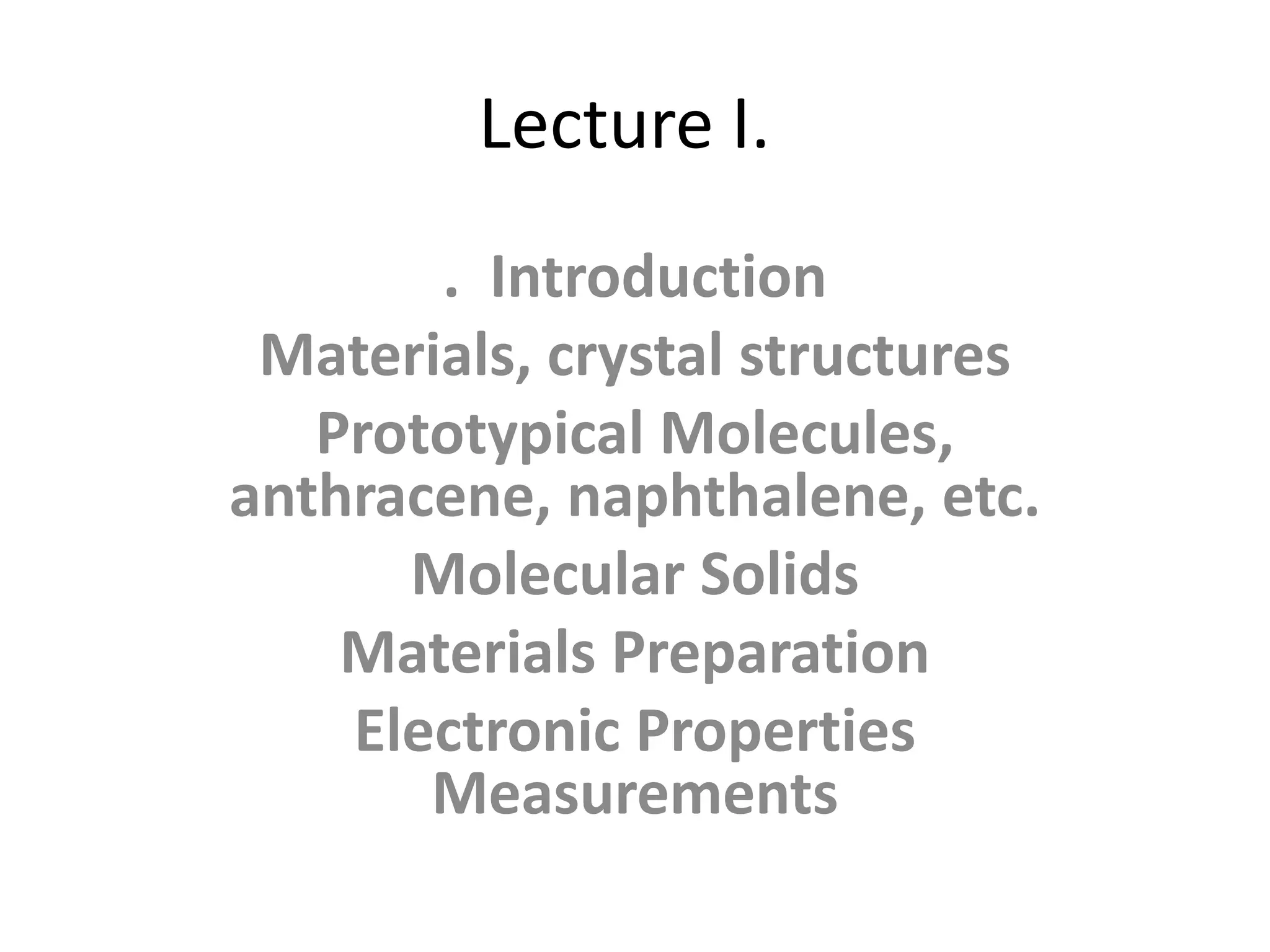
Lecture I.
. Introduction
Materials, crystal structures
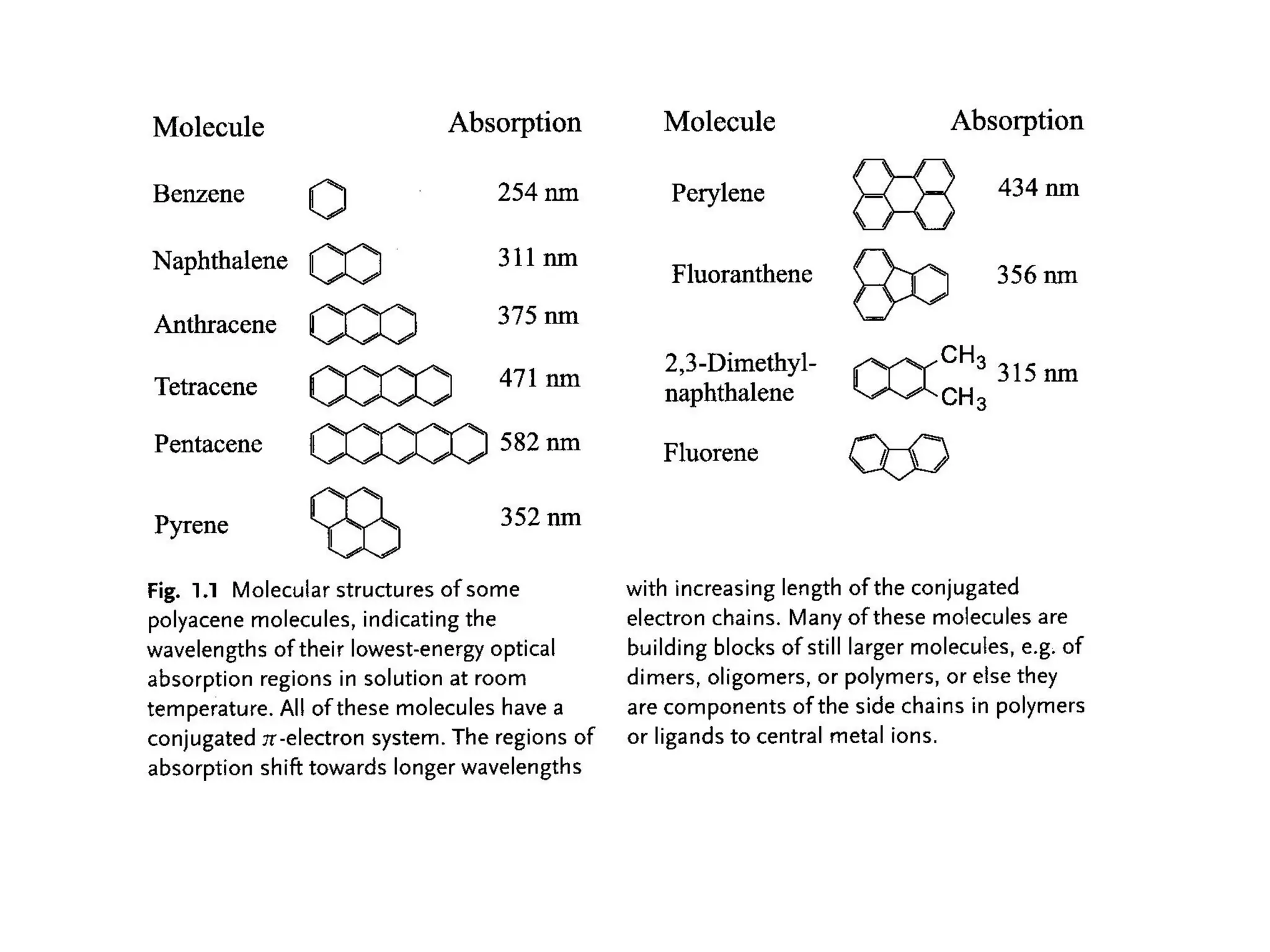
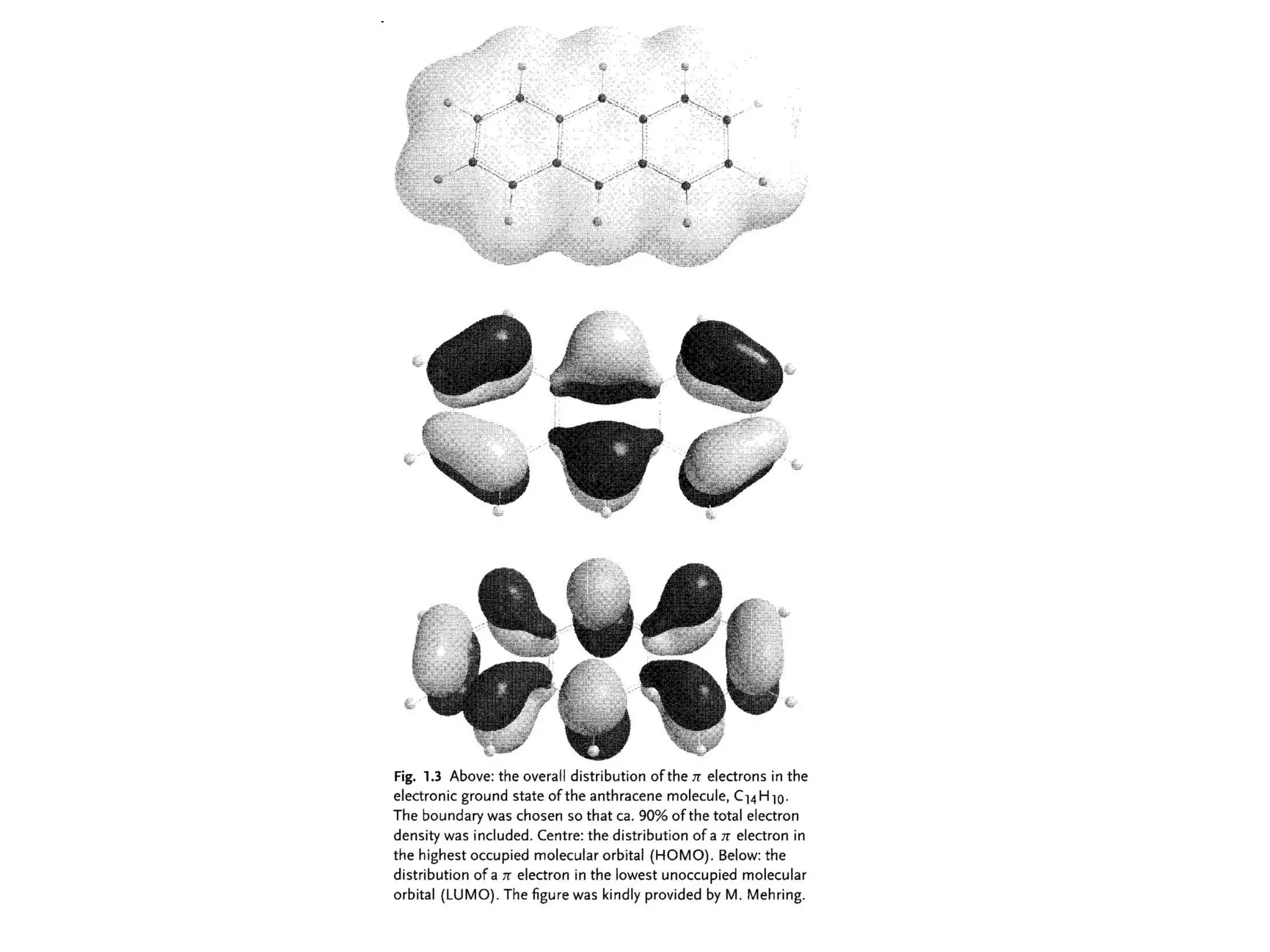
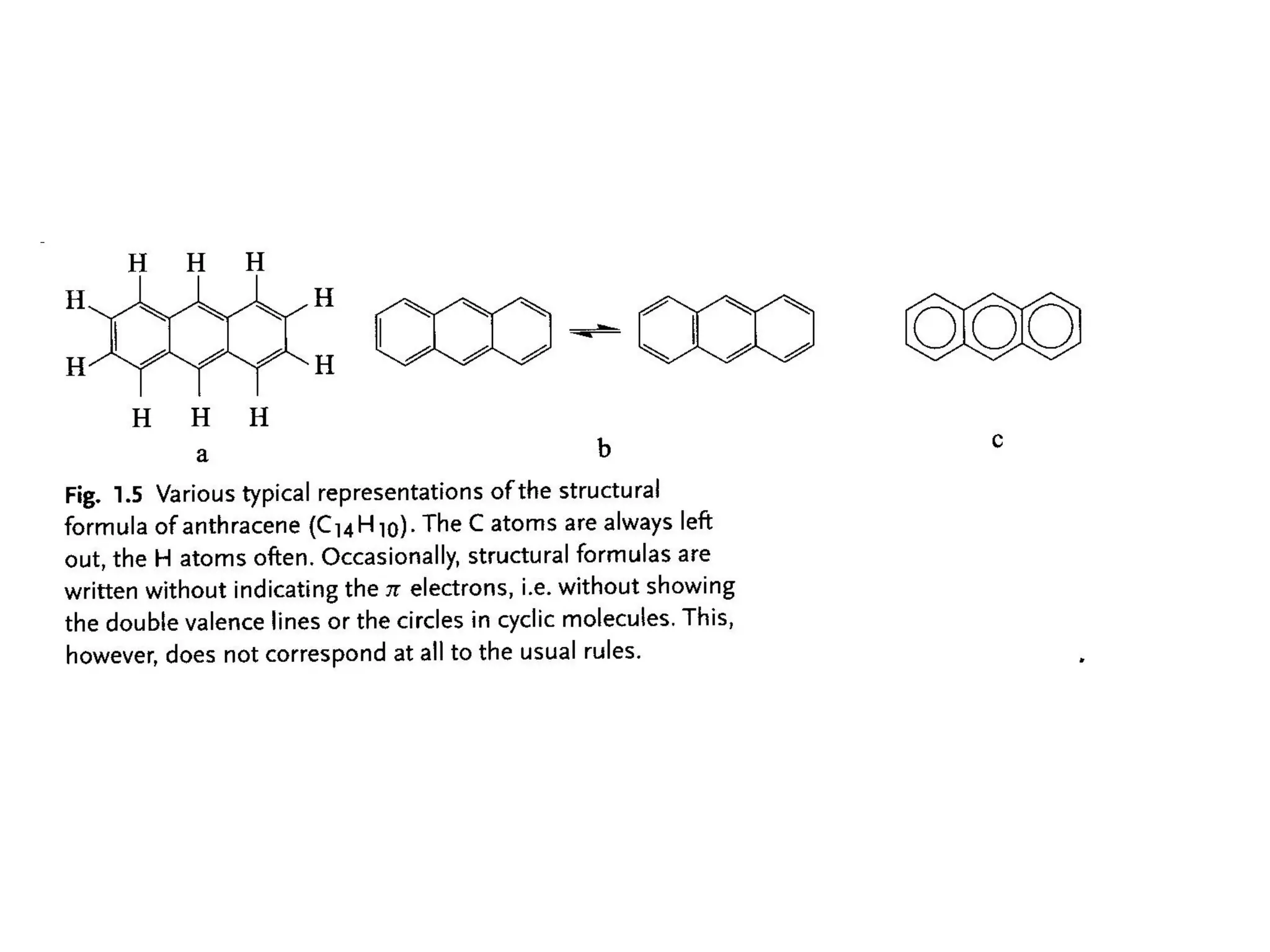
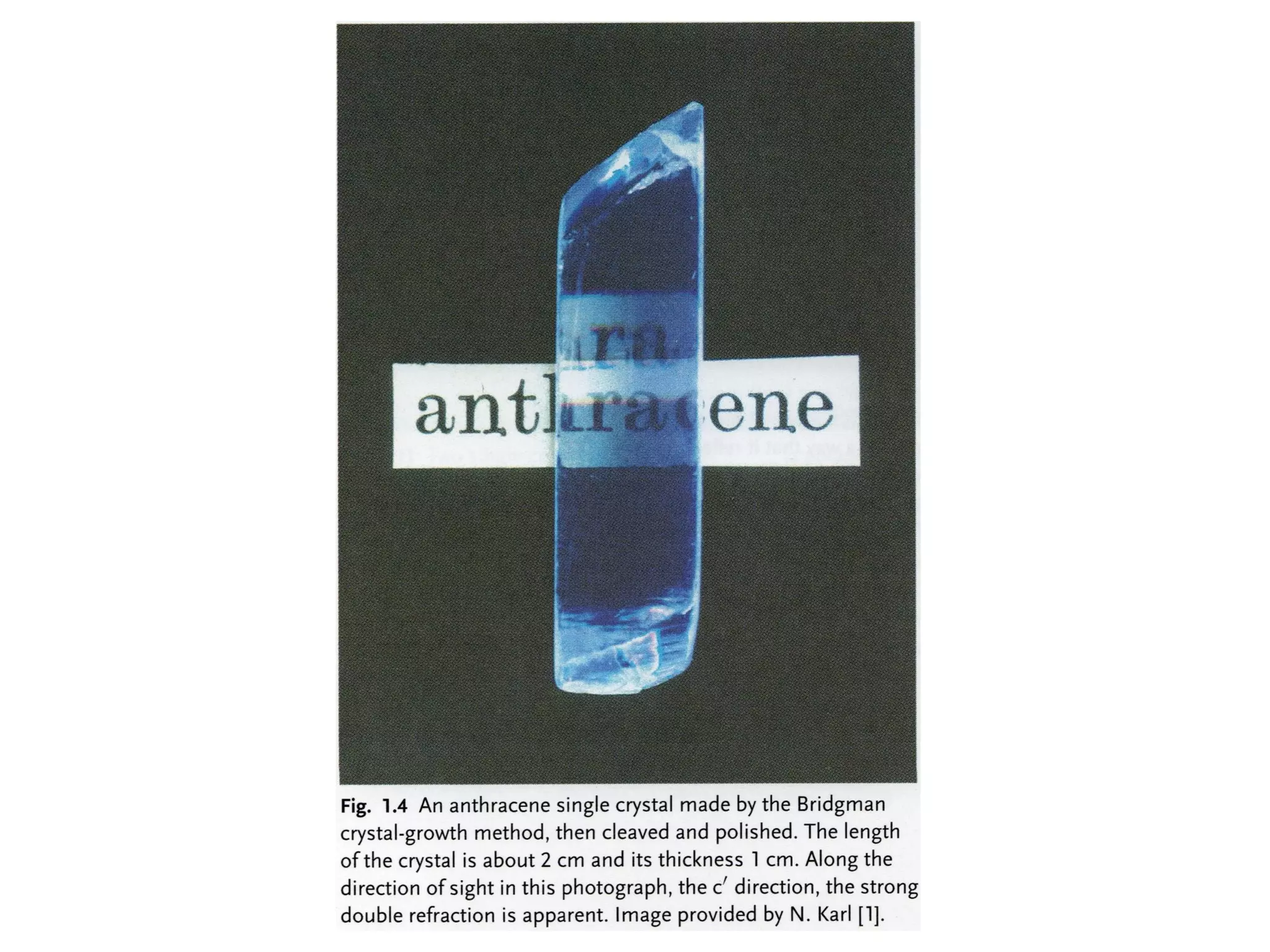
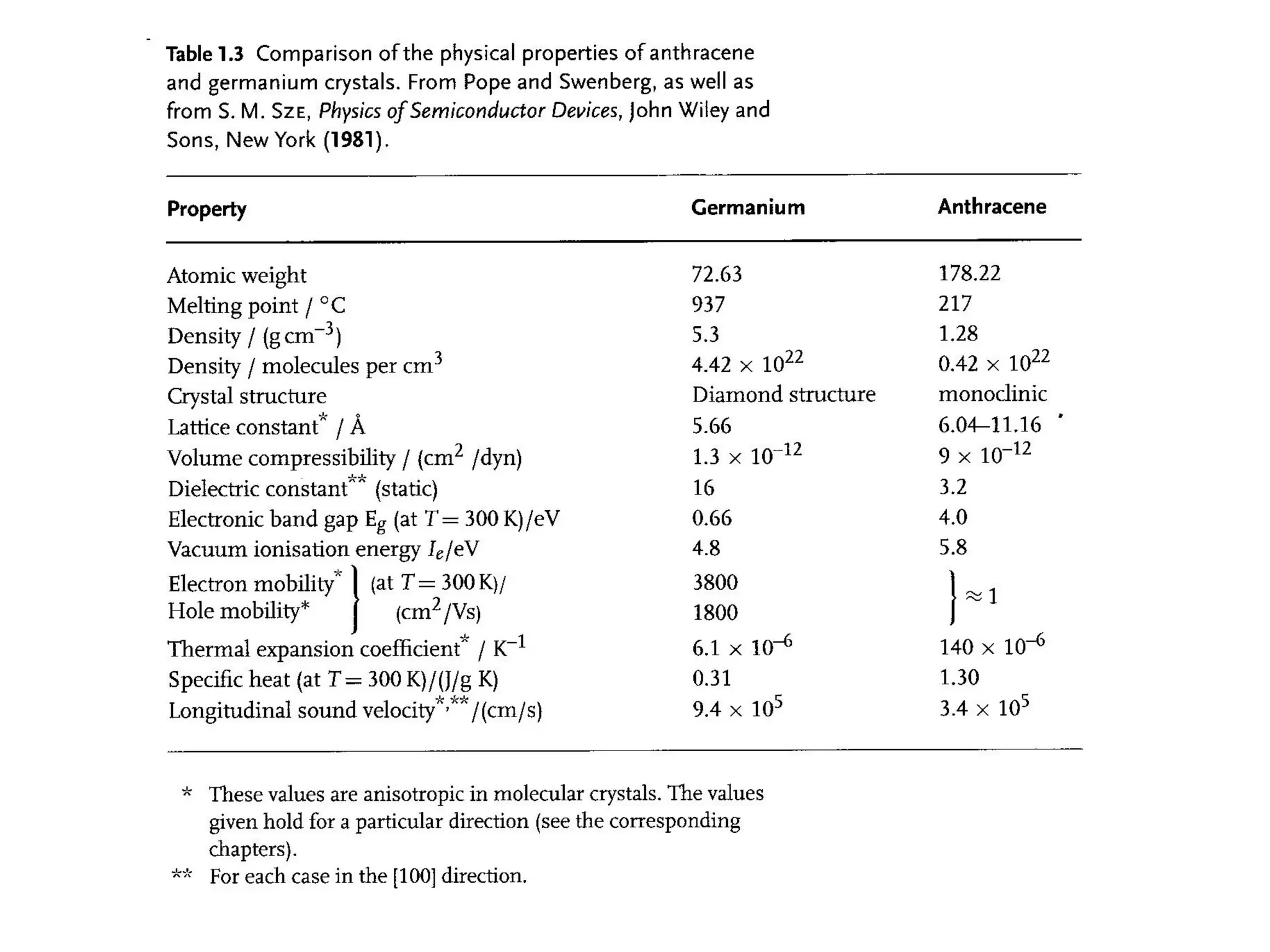
Prototypical Molecules, anthracene,
naphthalene, etc.
Molecular Solids
Materials Preparation
Electronic Properties Measurements
II. Insulators
Charge Transport Theory, narrow bands
Delocalized (Bloch) Wave Functions
Localized Wave Functions
Excitons
Peirels Distortion (1D systems)
III. Transient and Steady-state Photoconductivity in
Insulators, Theory and Experiment
Small-signal limit
Drift Mobility
Trapping (shallow and deep)
IV. Effects of Finite Charge Injection
Boundary Conditions, Space Charge Limited Currents
Pulsed, Steady-state Electric Fields and Light
Excitations
Dispersive transport
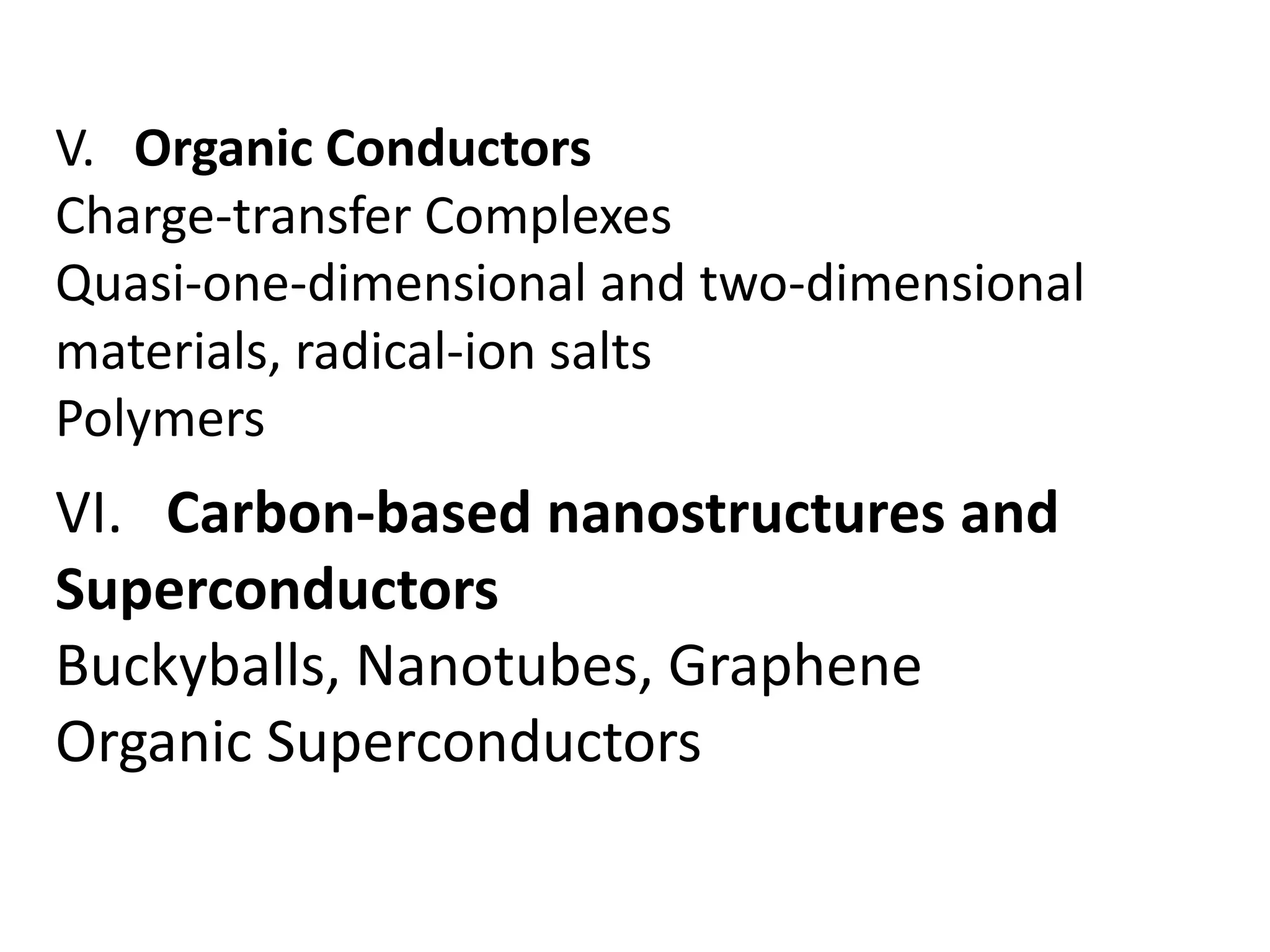
VI. Carbon-based nanostructures and
Superconductors
Buckyballs, Nanotubes, Graphene
Organic Superconductors
V. Organic Conductors
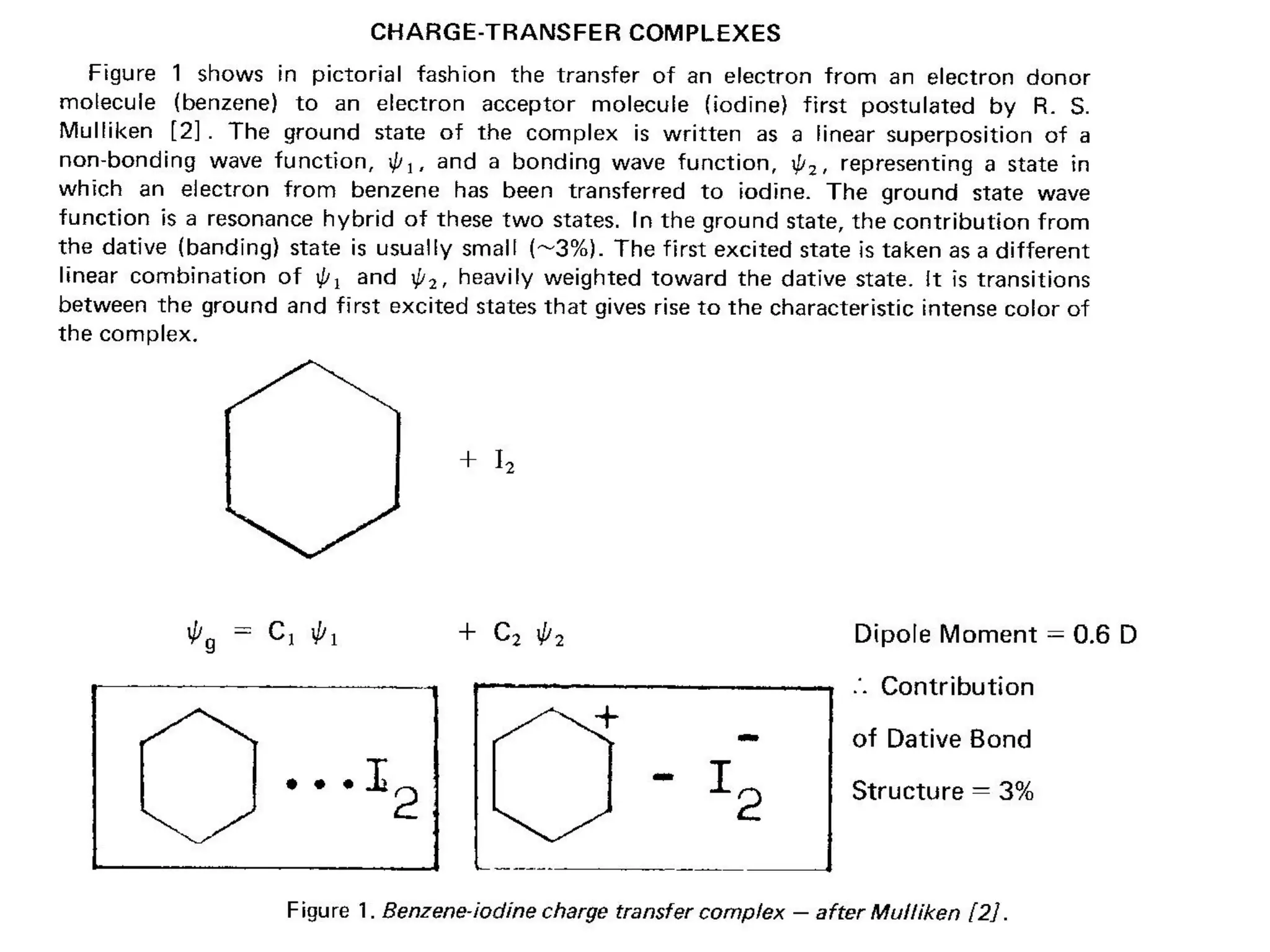
Charge-transfer Complexes
Quasi-one-dimensional and two-dimensional
materials, radical-ion salts
Polymers
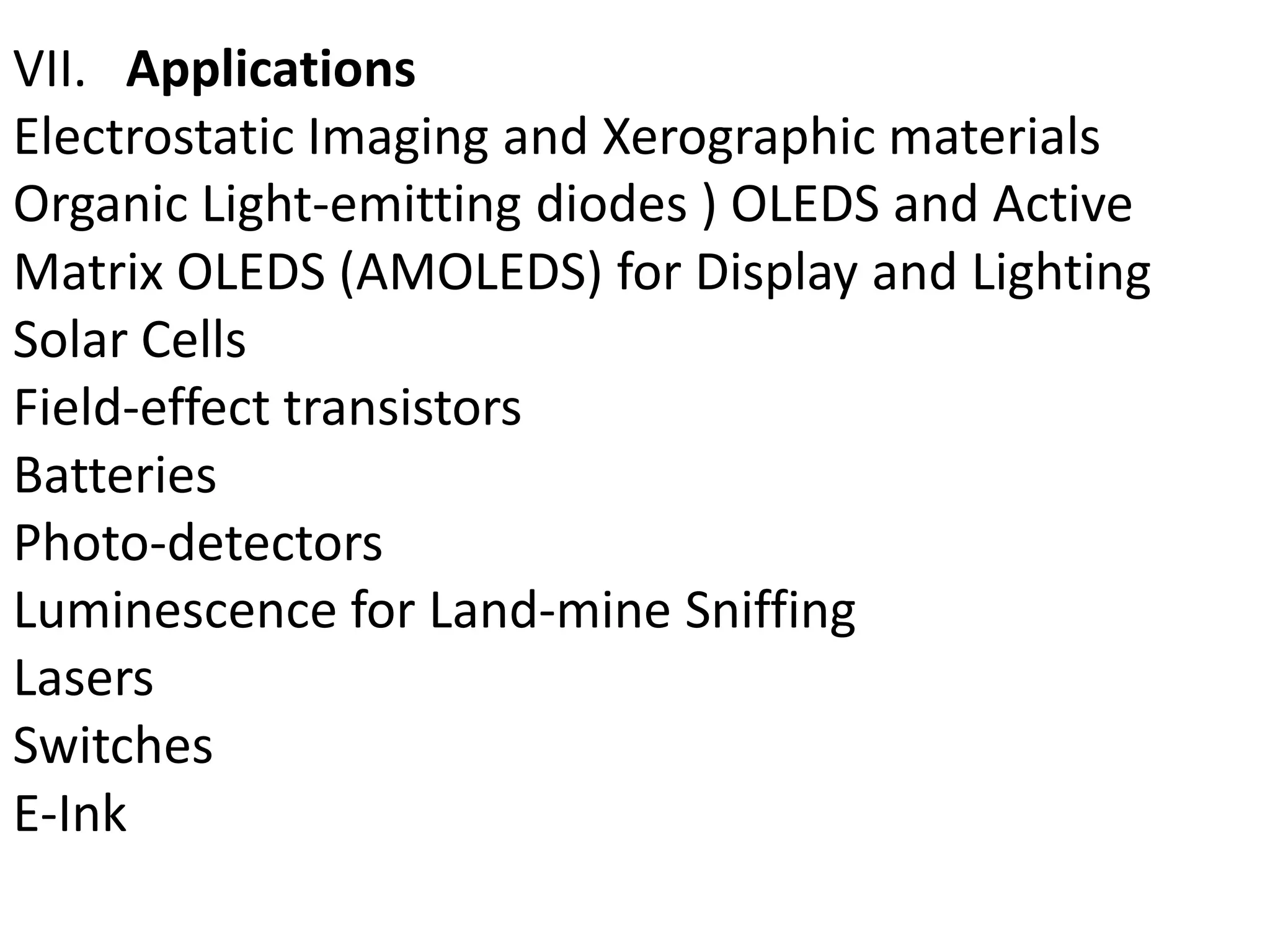
VII. Applications
Electrostatic Imaging and Xerographic materials
Organic Light-emitting diodes ) OLEDS and Active
Matrix OLEDS (AMOLEDS) for Display and Lighting
Solar Cells
Field-effect transistors
Batteries
Photo-detectors
Luminescence for Land-mine Sniffing
Lasers
Switches
E-Ink
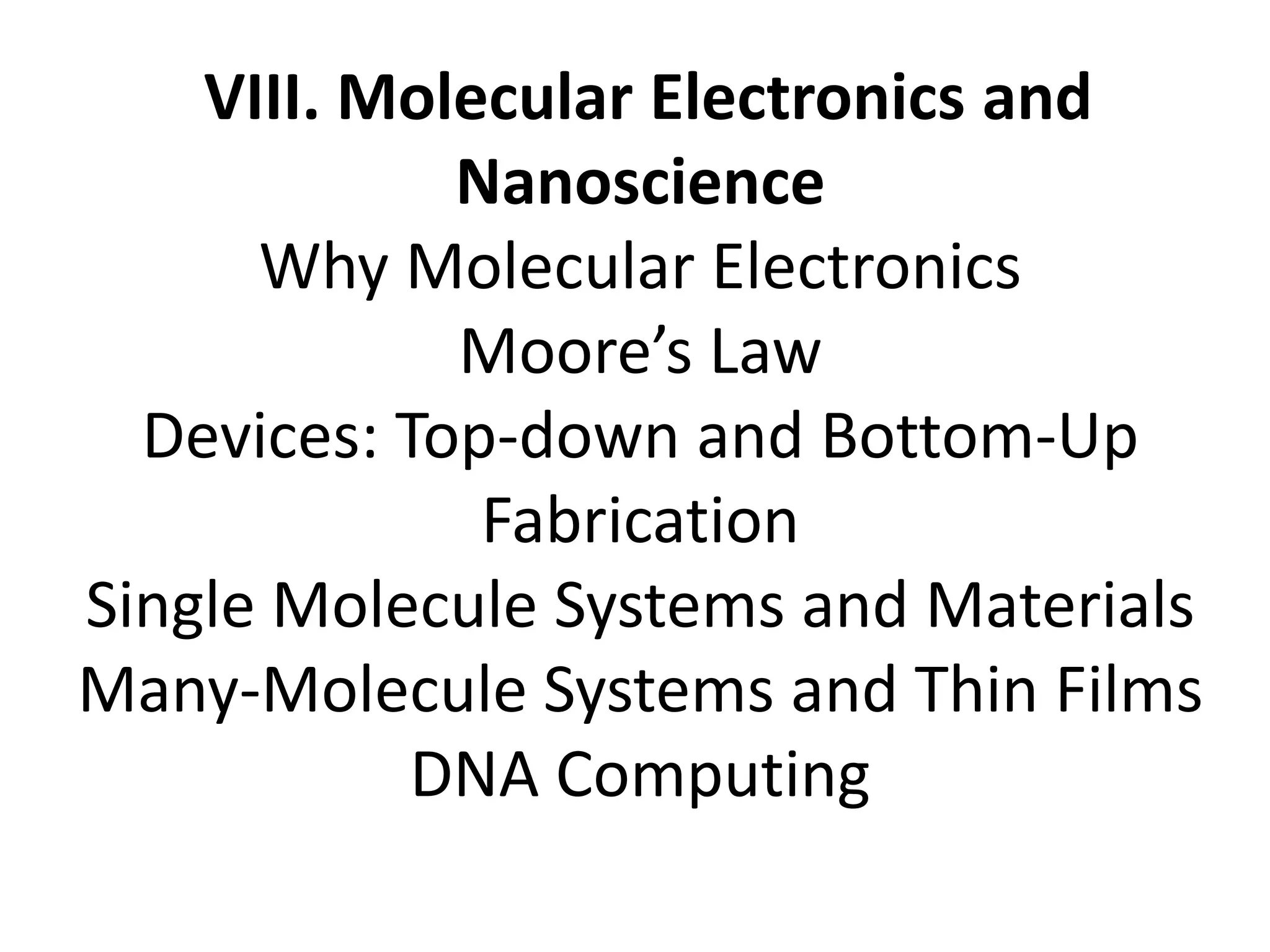
VIII. Molecular Electronics and
Nanoscience
Why Molecular Electronics
Moore’s Law
Devices: Top-down and Bottom-Up
Fabrication
Single Molecule Systems and Materials
Many-Molecule Systems and Thin Films
DNA Computing
Lecture I.
. Introduction
Materials, crystal structures
Prototypical Molecules,
anthracene, naphthalene, etc.
Molecular Solids
Materials Preparation
Electronic Properties
Measurements
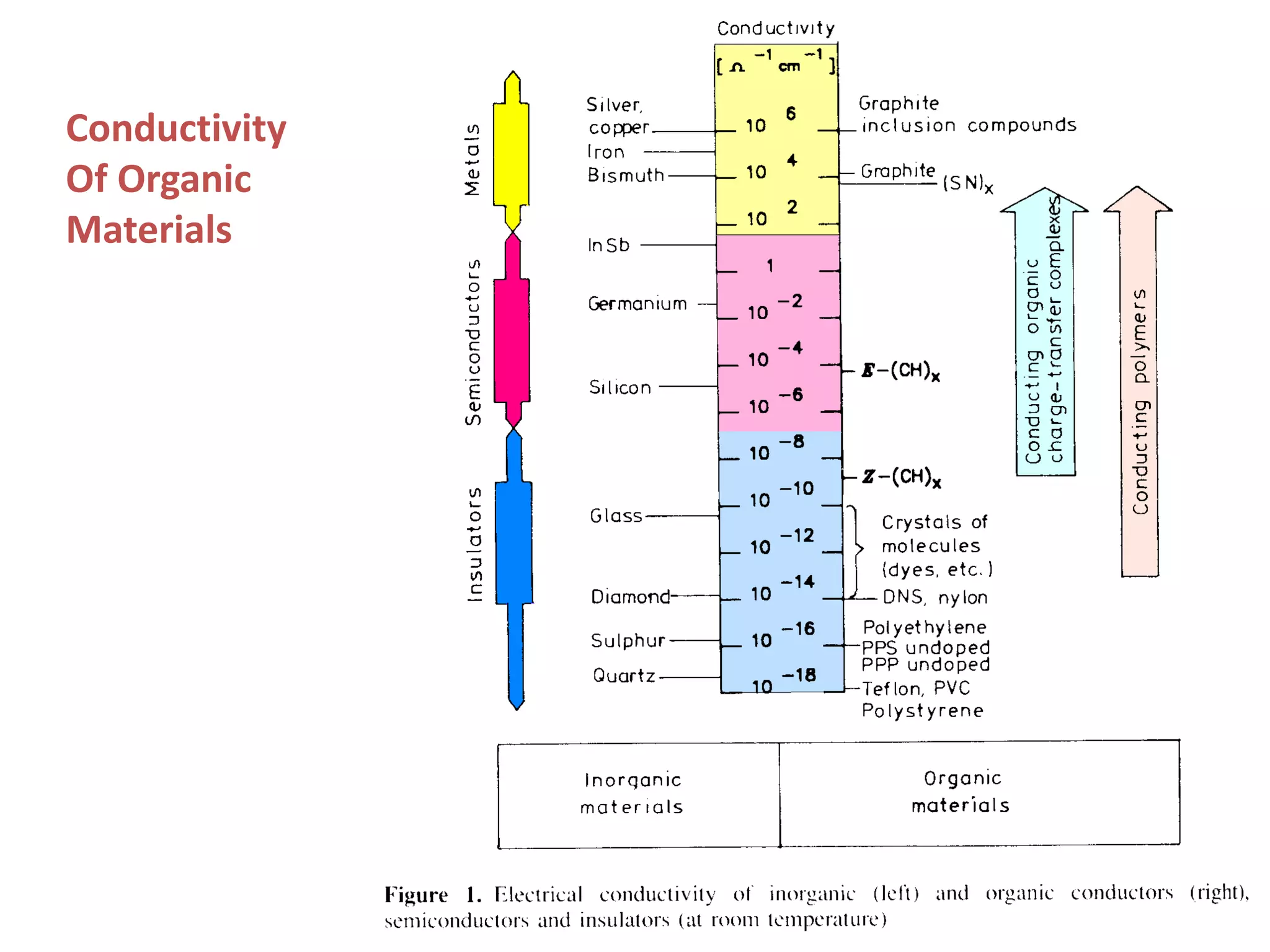
Conductivity
Of Organic
Materials
Bonds
Chapter 5 of Solymar
Introduction
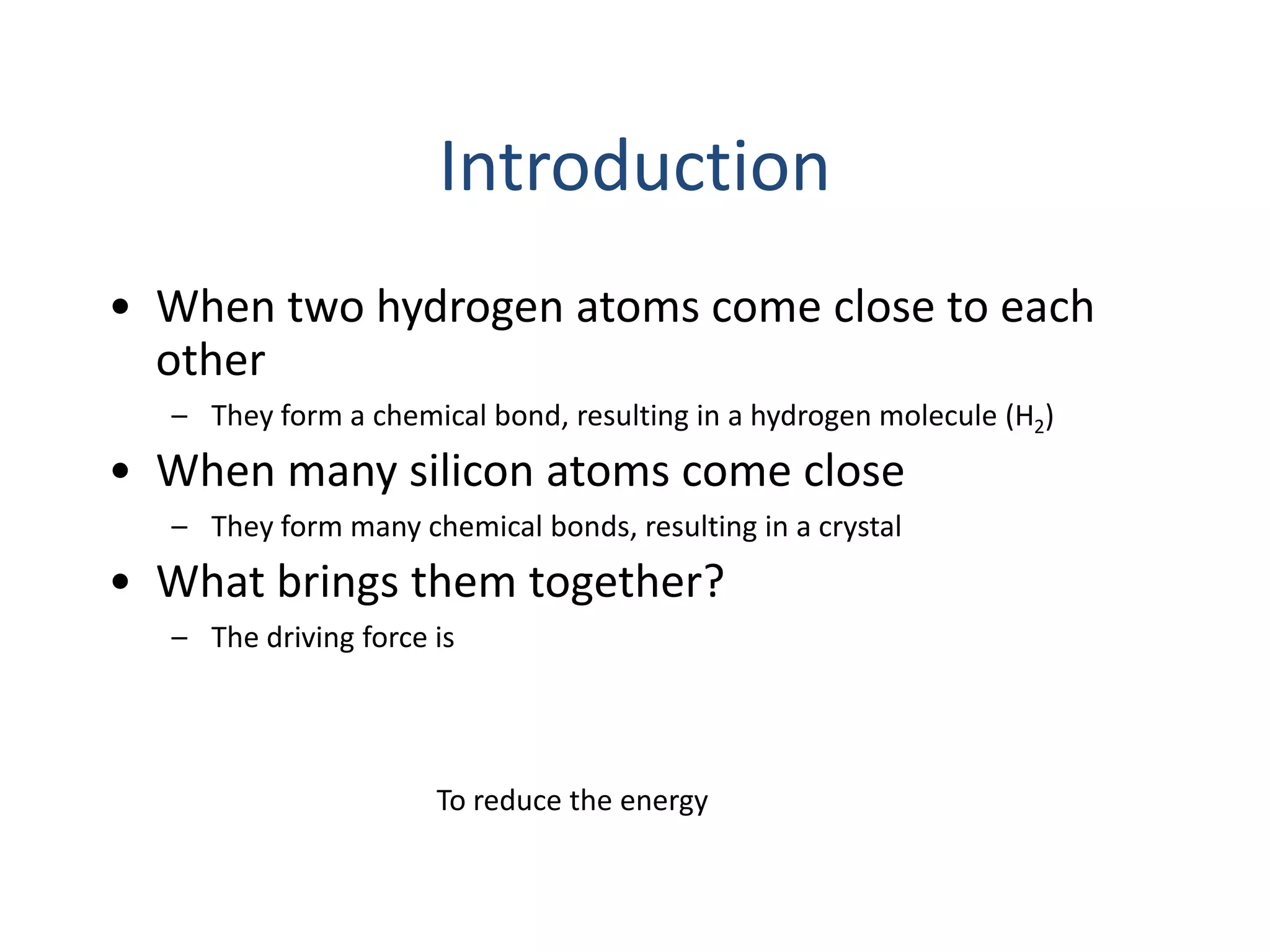
• When two hydrogen atoms come close to each
other
– They form a chemical bond, resulting in a hydrogen molecule (H2)
• When many silicon atoms come close
– They form many chemical bonds, resulting in a crystal
• What brings them together?
– The driving force is
To reduce the energy
Interactions between Atoms
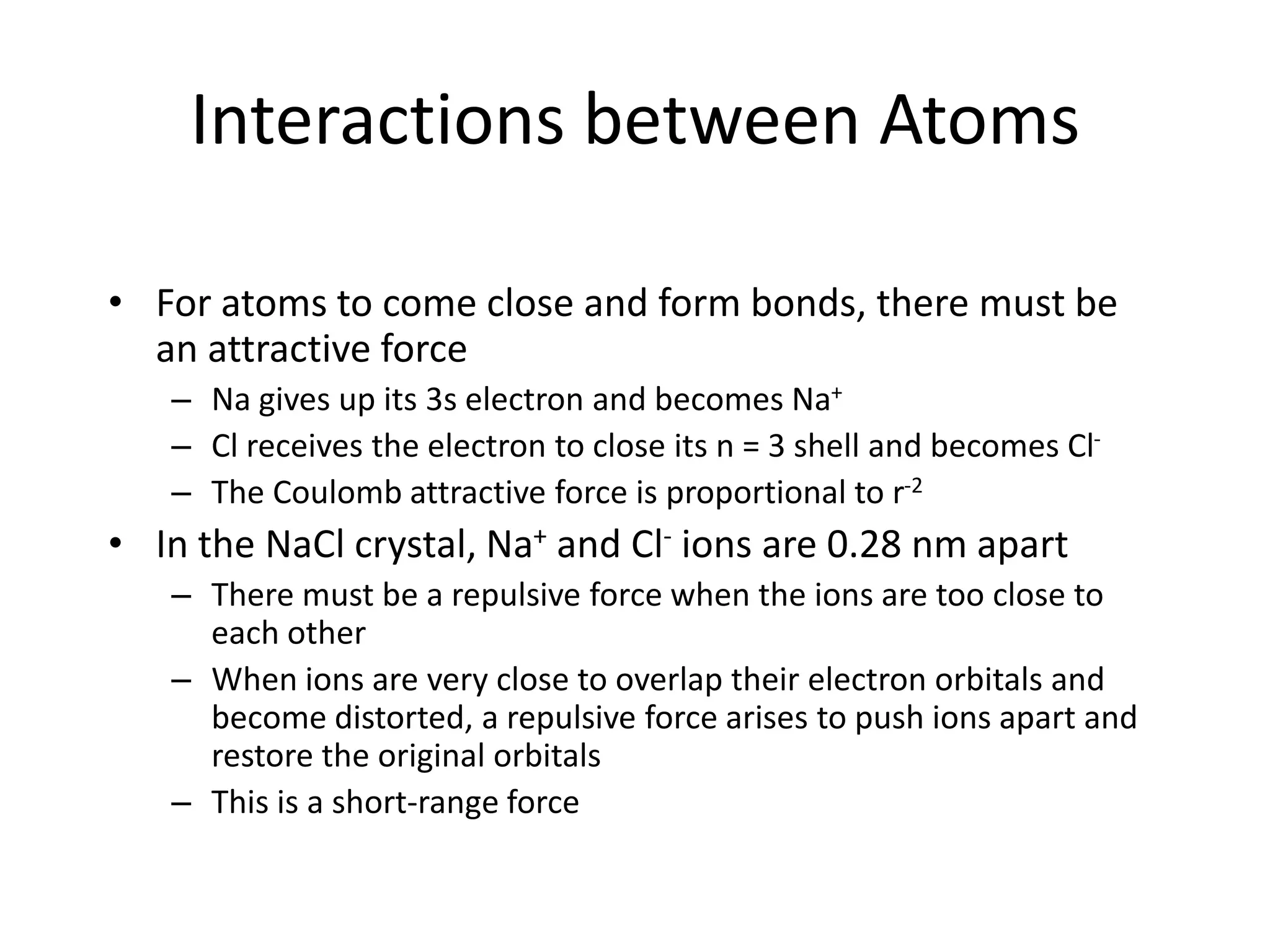
• For atoms to come close and form bonds, there must be
an attractive force
– Na gives up its 3s electron and becomes Na+
– Cl receives the electron to close its n = 3 shell and becomes Cl-
– The Coulomb attractive force is proportional to r-2
• In the NaCl crystal, Na+ and Cl- ions are 0.28 nm apart
– There must be a repulsive force when the ions are too close to
each other
– When ions are very close to overlap their electron orbitals and
become distorted, a repulsive force arises to push ions apart and
restore the original orbitals
– This is a short-range force
Equilibrium Separation
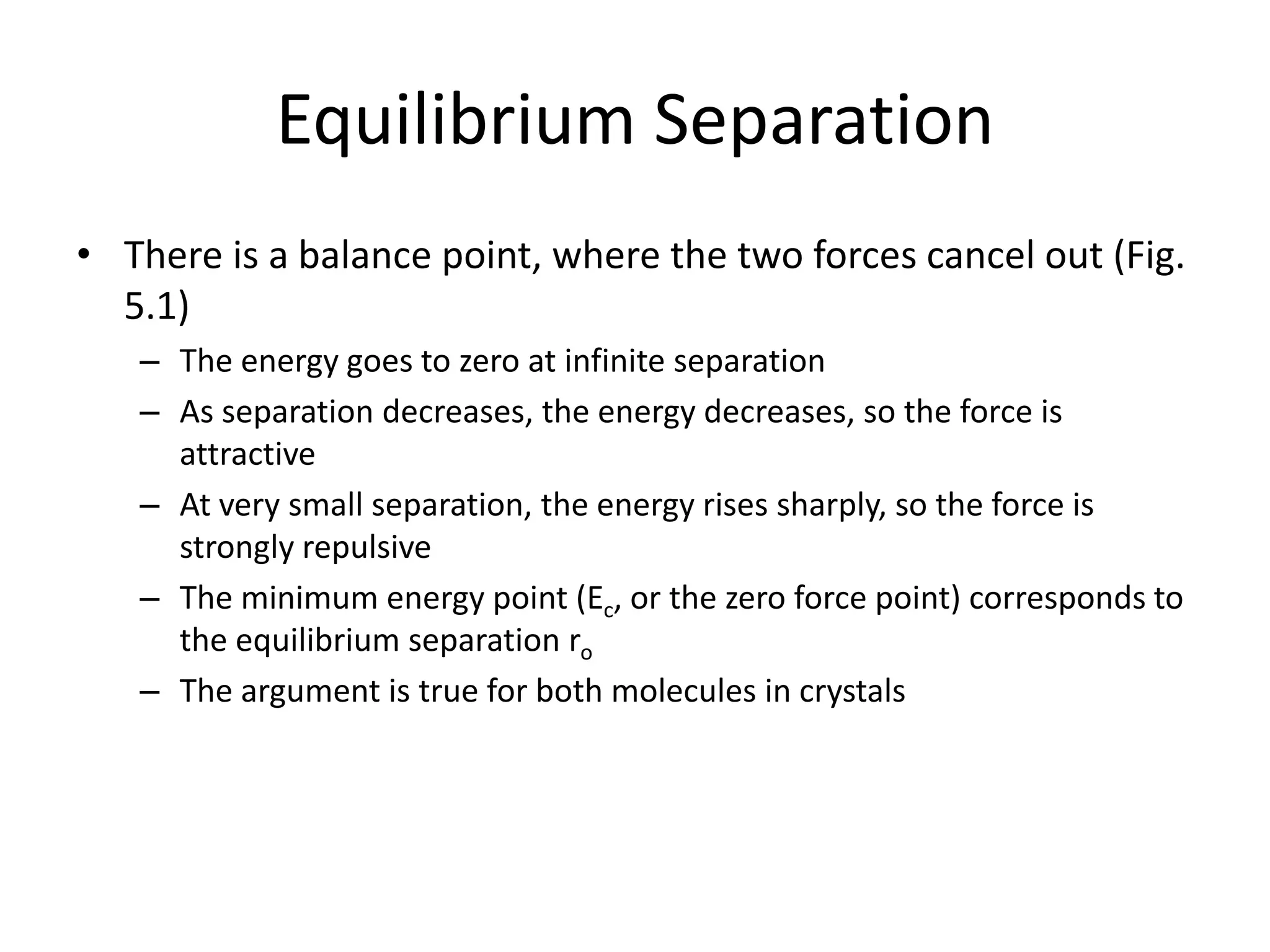
• There is a balance point, where the two forces cancel out (Fig.
5.1)
– The energy goes to zero at infinite separation
– As separation decreases, the energy decreases, so the force is
attractive
– At very small separation, the energy rises sharply, so the force is
strongly repulsive
– The minimum energy point (Ec, or the zero force point) corresponds to
the equilibrium separation ro
– The argument is true for both molecules in crystals
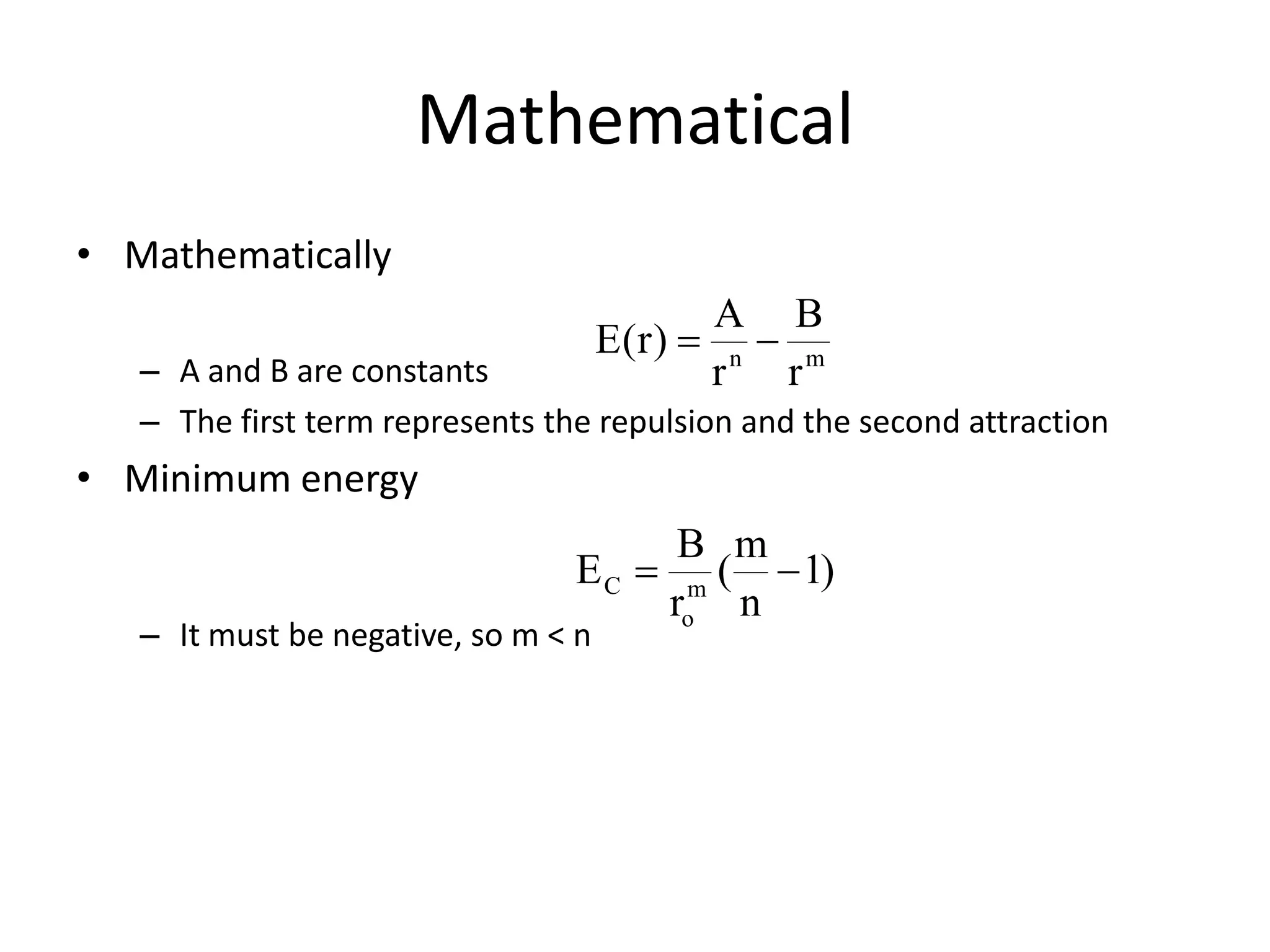
Mathematical
• Mathematically
– A and B are constants
– The first term represents the repulsion and the second attraction
• Minimum energy
– It must be negative, so m < n
mn
r
B
r
A
)r(E 
)1
n
m
(
r
B
E m
o
C 
Bond Types
• Four types in total
– Ionic
– Covalent
– Metallic
– van der Waals
Metallic Bonds
• Each atom in a metal donates one or more
electrons and becomes a lattice ion
– The electrons move around and bounce back and forth
– They form an “electron sea”, whose electrostatic
attraction holds together positive lattice ions
– The electrostatic attraction comes from all directions,
so the bond is non-directional
– Metals are ductile and malleable
Covalent Bonds
• When two identical atoms come together, a covalent bond
forms
• The hydrogen molecule
– A hydrogen atom needs two electrons to fill its 1s shell
– When two hydrogen atoms meet, one tries to snatch the electron
from the other and vice versa
– The compromise is they share the two electrons
• Both electrons orbit around both atoms and a hydrogen molecule
forms
• The chlorine molecule
– A chlorine atom has five 3p electrons and is eager to grab one more
– Two chlorine atoms share an electron pair and form a chlorine atom
Group IV
• Carbon 1s22s22p2; Si 1s22s22p63s23p2; Ge
1s22s22p63s23p63d104s24p2
• Each atom needs four extra electrons to fill the p-shell
– They are tetravalent
• sp3 hybridization
– s shell and p shell hybridize to form four equal-energy dangling
electrons
– Each of them pairs up with a dangling electron from a neighbor atom
– There are four neighbor atoms equally spaced
– Each atom is at the center of a tetrahedron
– Interbond angle 109.4
– Covalent bond is directional
Group IV
• At 0 K
– All electrons are in bonds orbiting atoms
– None can wander around to conduct electricity
– They are insulators
• At elevated temperatures
– Statistically, some electrons can have more enough energy to
escape through thermal vibrations and become free electrons
– They are semiconductors
• The C–C bond is very strong, making diamond the hardest
material known (Table 5.1)
– Diamond has excellent thermal conductivity
– It burns to CO2 at 700C
van der Waals Bonds
• Argon has outer shell completely filled
• When argon is cooled down to liquid helium temperature, it
forms a solid
– The electrons are sometimes here and sometimes there, so the
centers of the positive charge (nucleus) and negative charge
(electrons) are not always coincident
– The argon atom is a fluctuating dipole (instantaneous dipole)
– It induces an opposite dipole moment on another argon atom, so they
attract each other
– Such attraction is weak, so the materials have low melting and boiling
temperatures
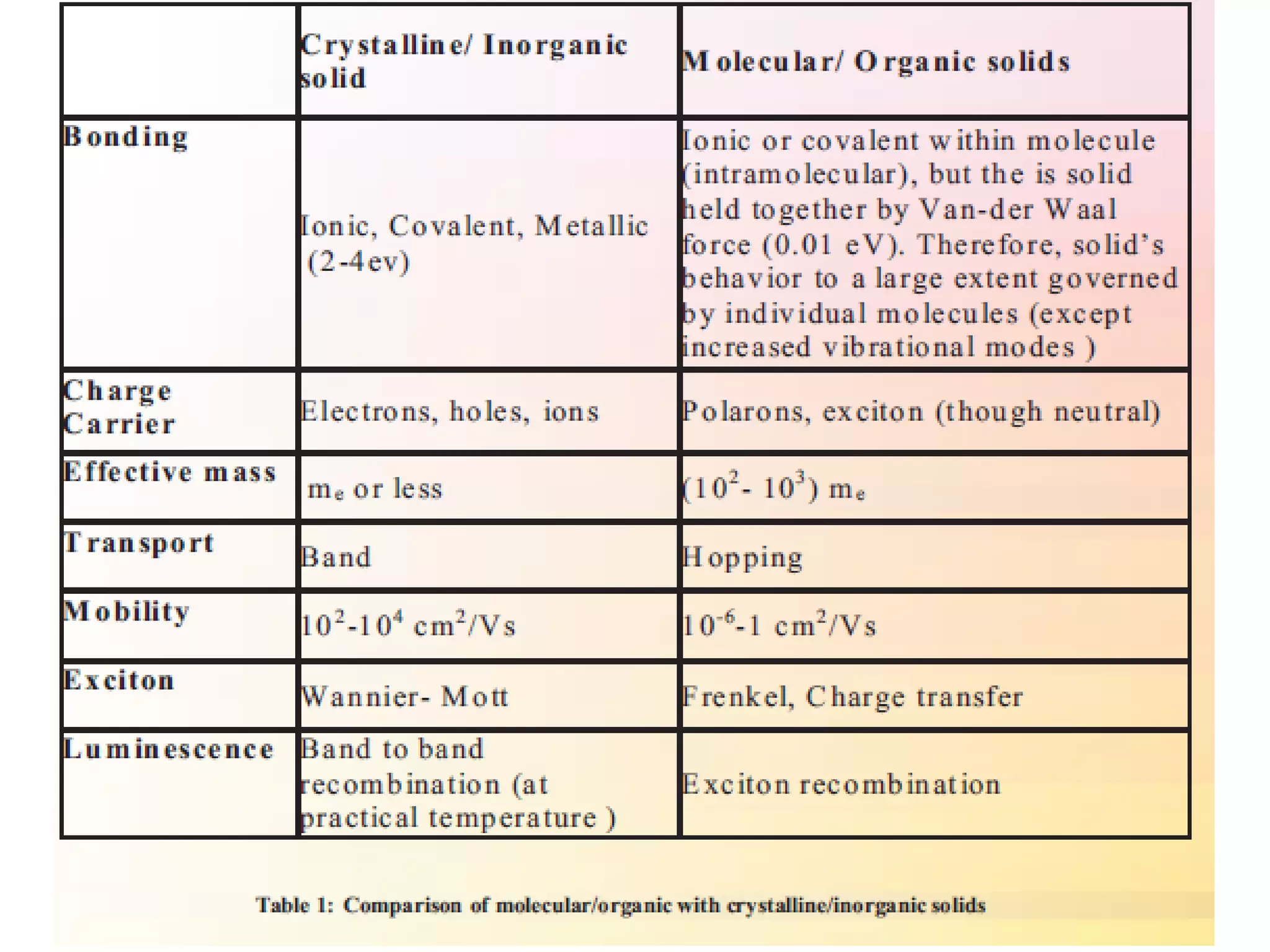
– They are often seen in organic crystals
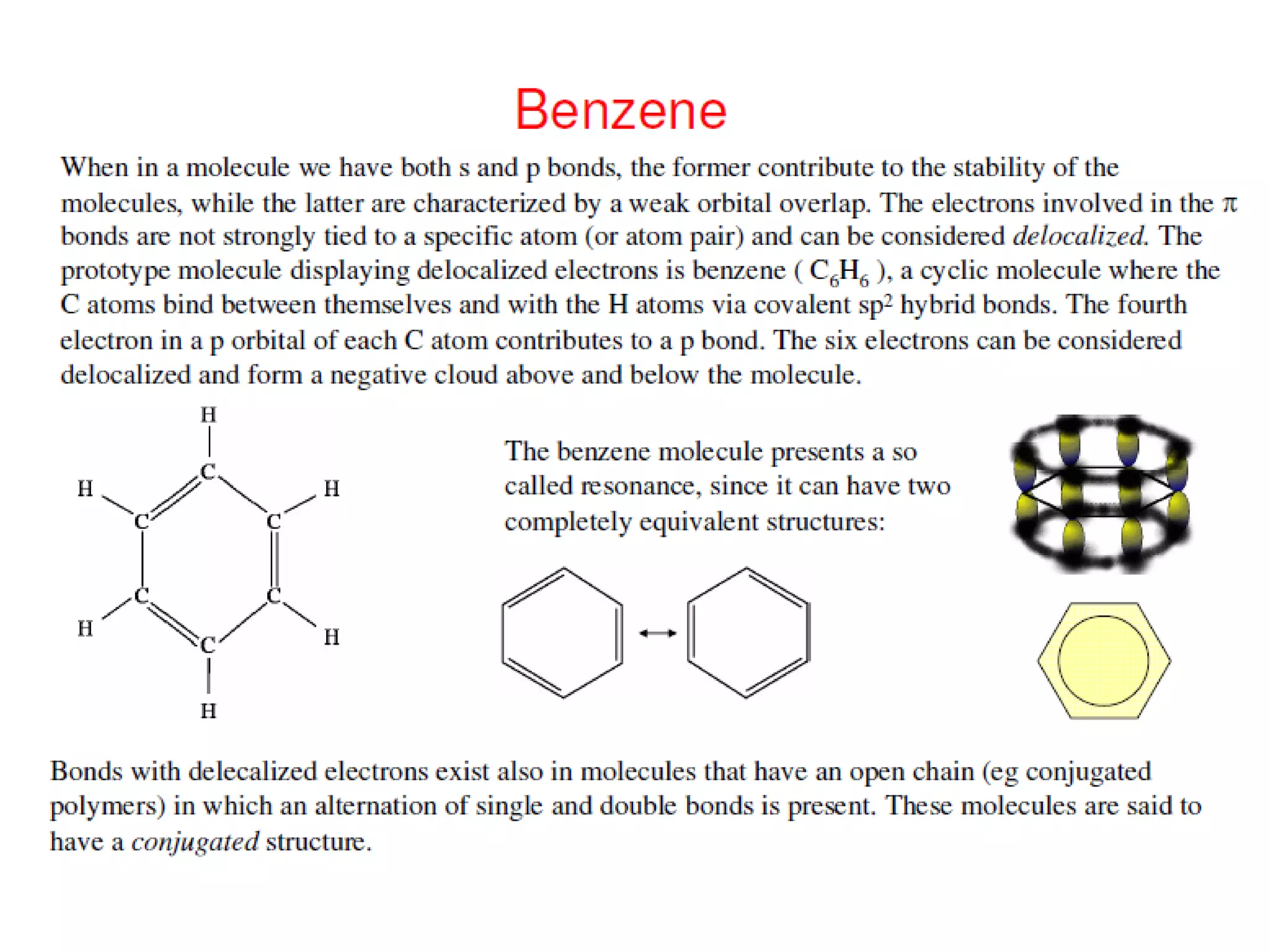
Aromatic Hydrocarbon Bonds
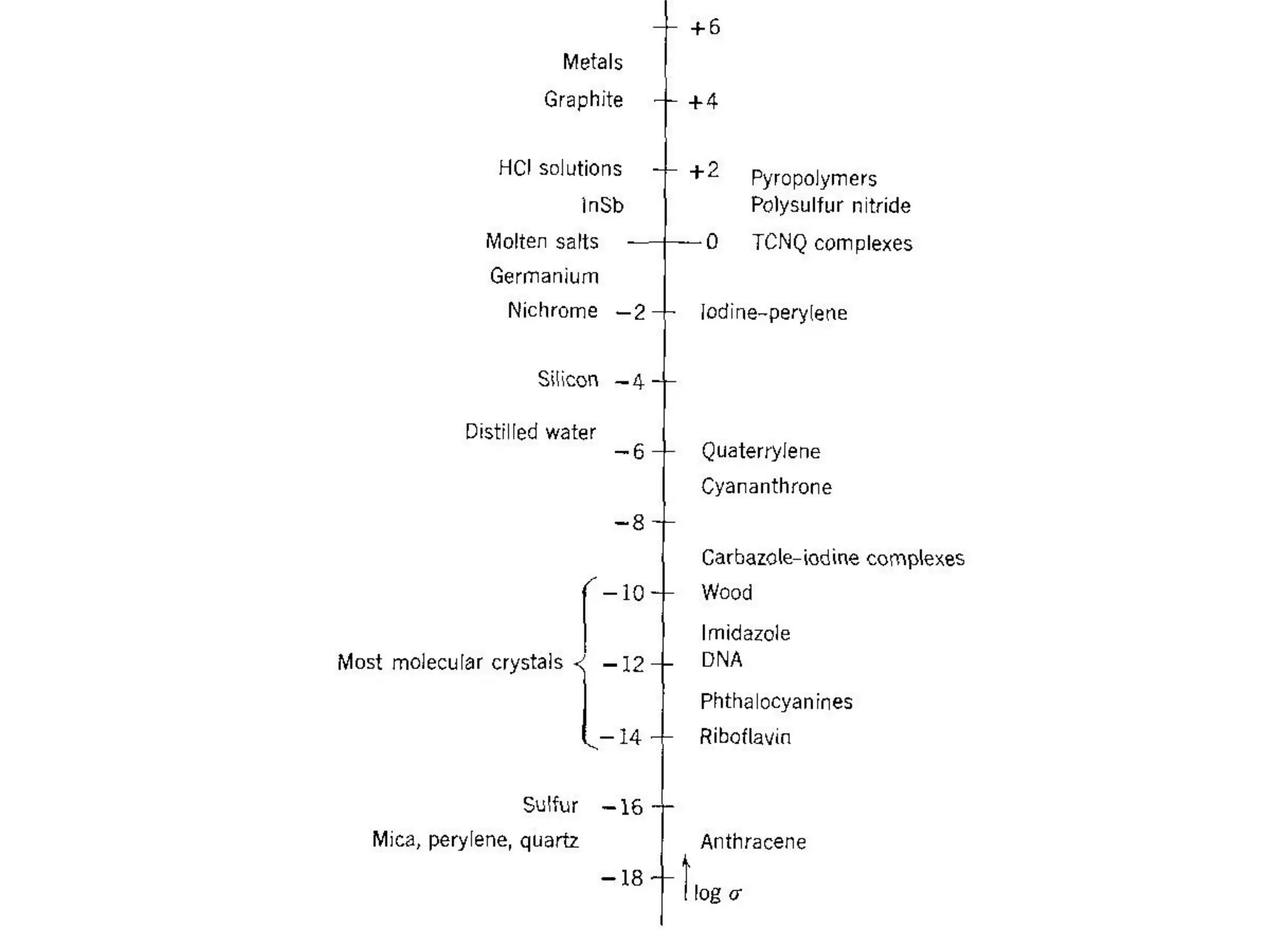
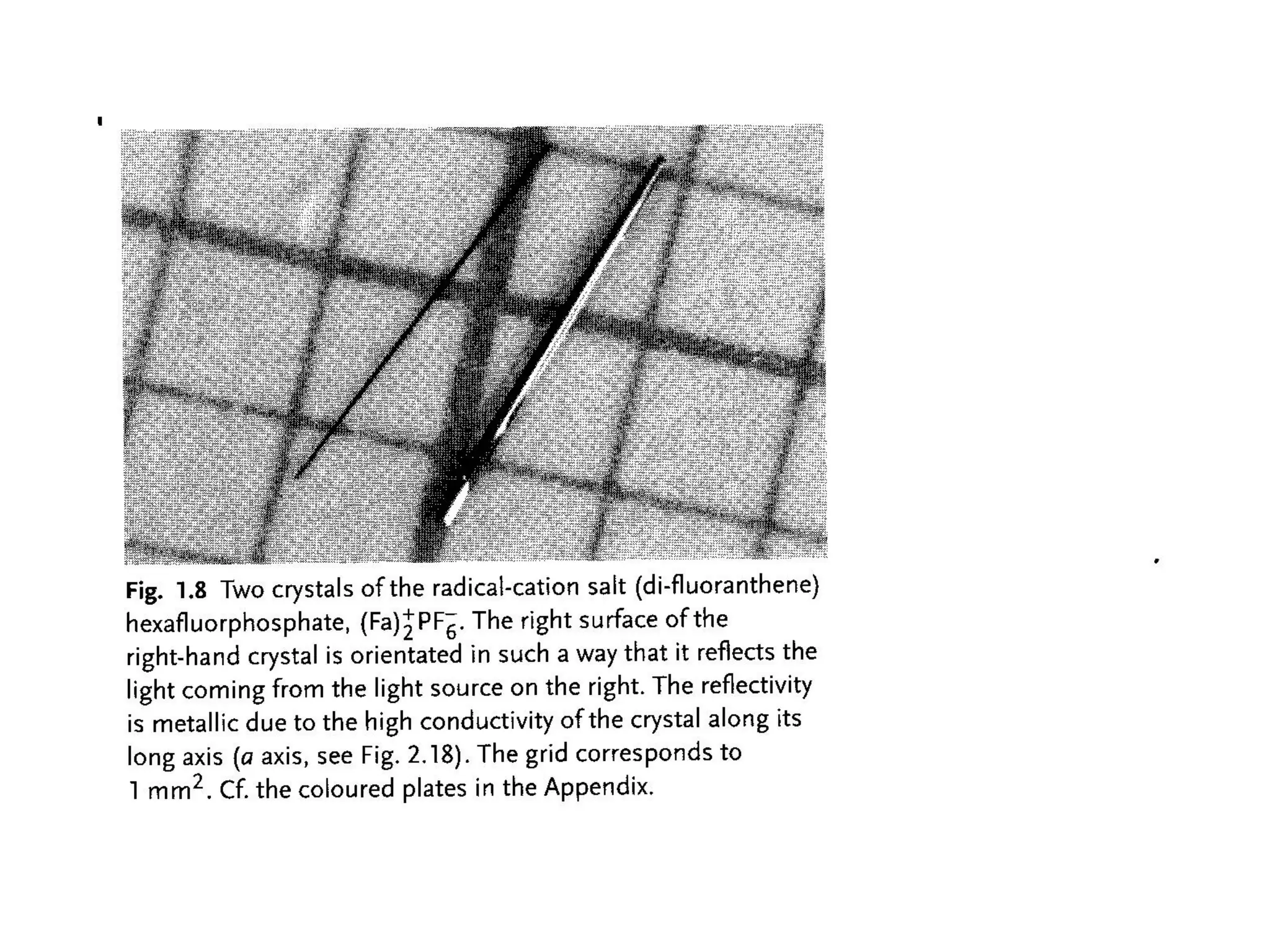
Conducting Organic Materials
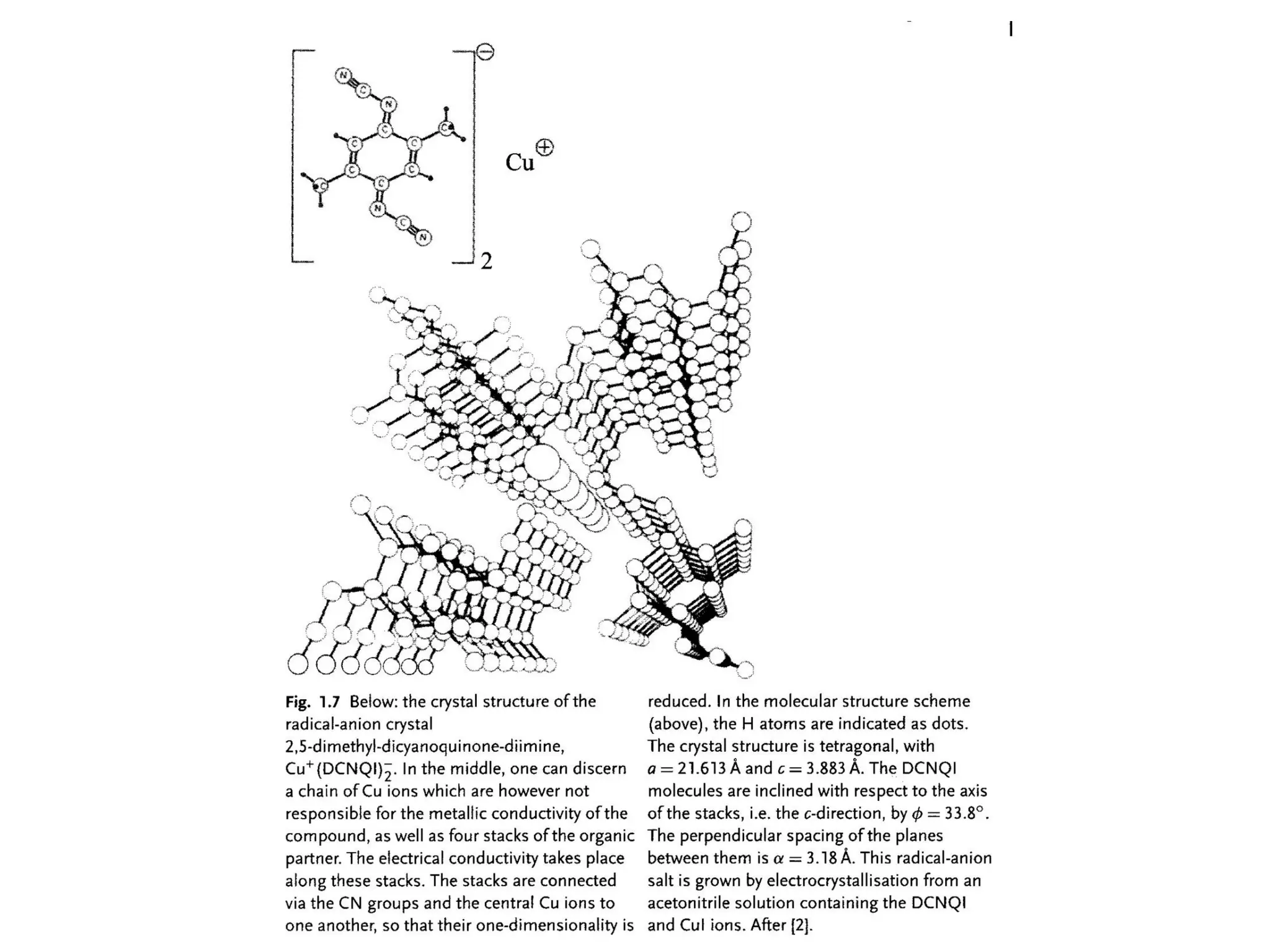
Extreme Case – Nearly Ionic Bonds
in Highly Conducting Complexes
“Charge Transfer salts”
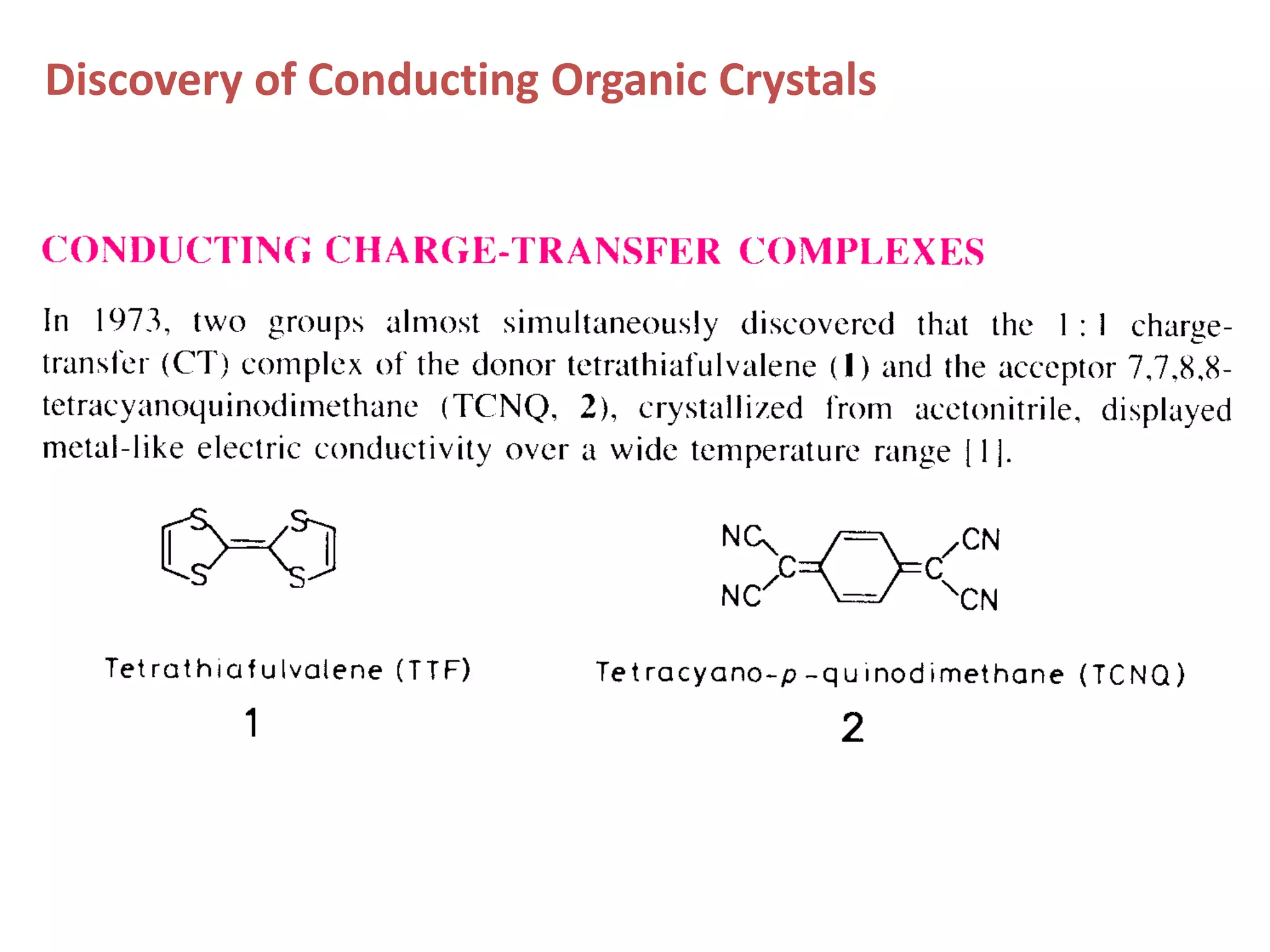
Discovery of Conducting Organic Crystals
Molecules as Electronic Devices:
Historical Perspective
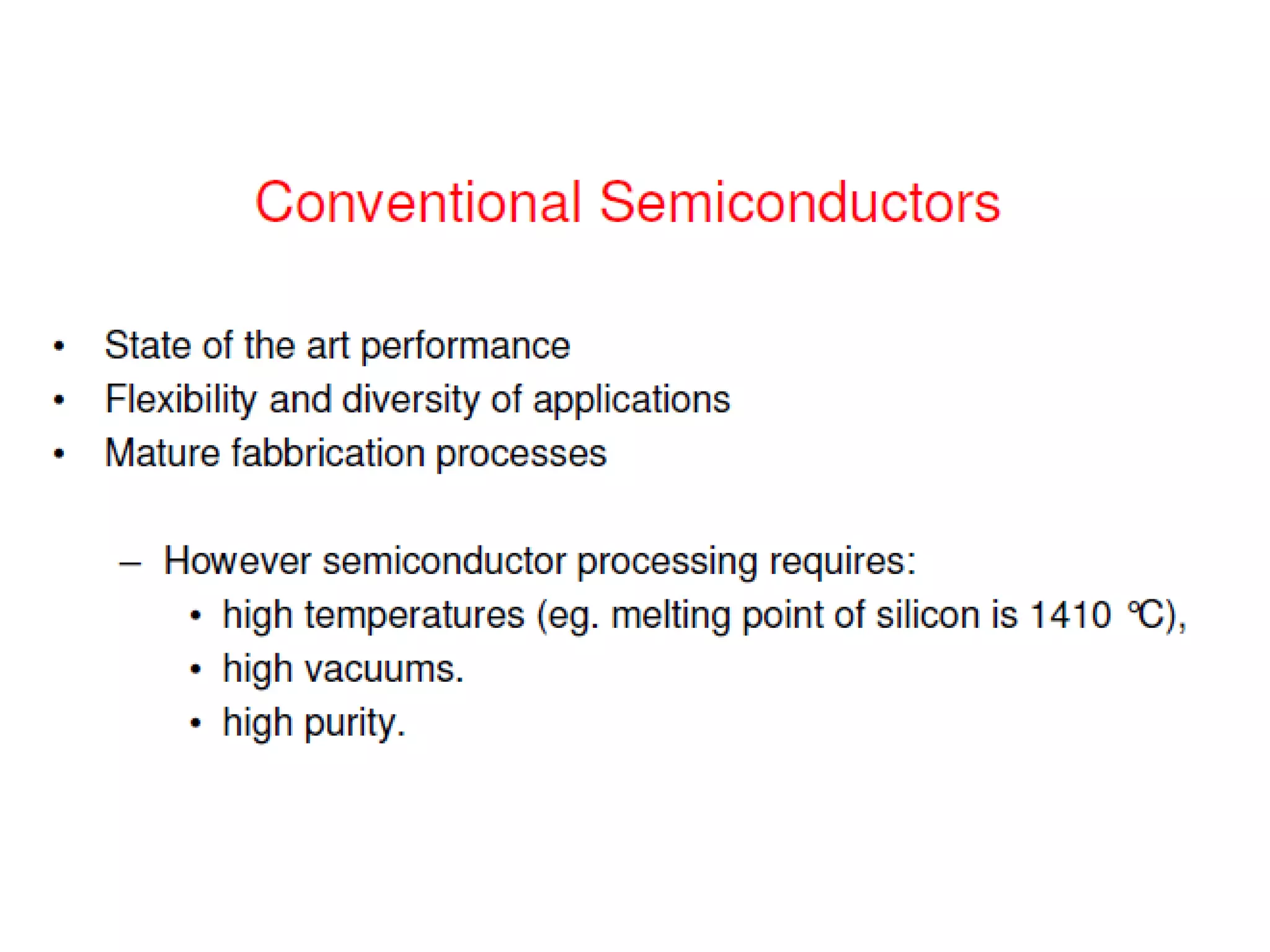
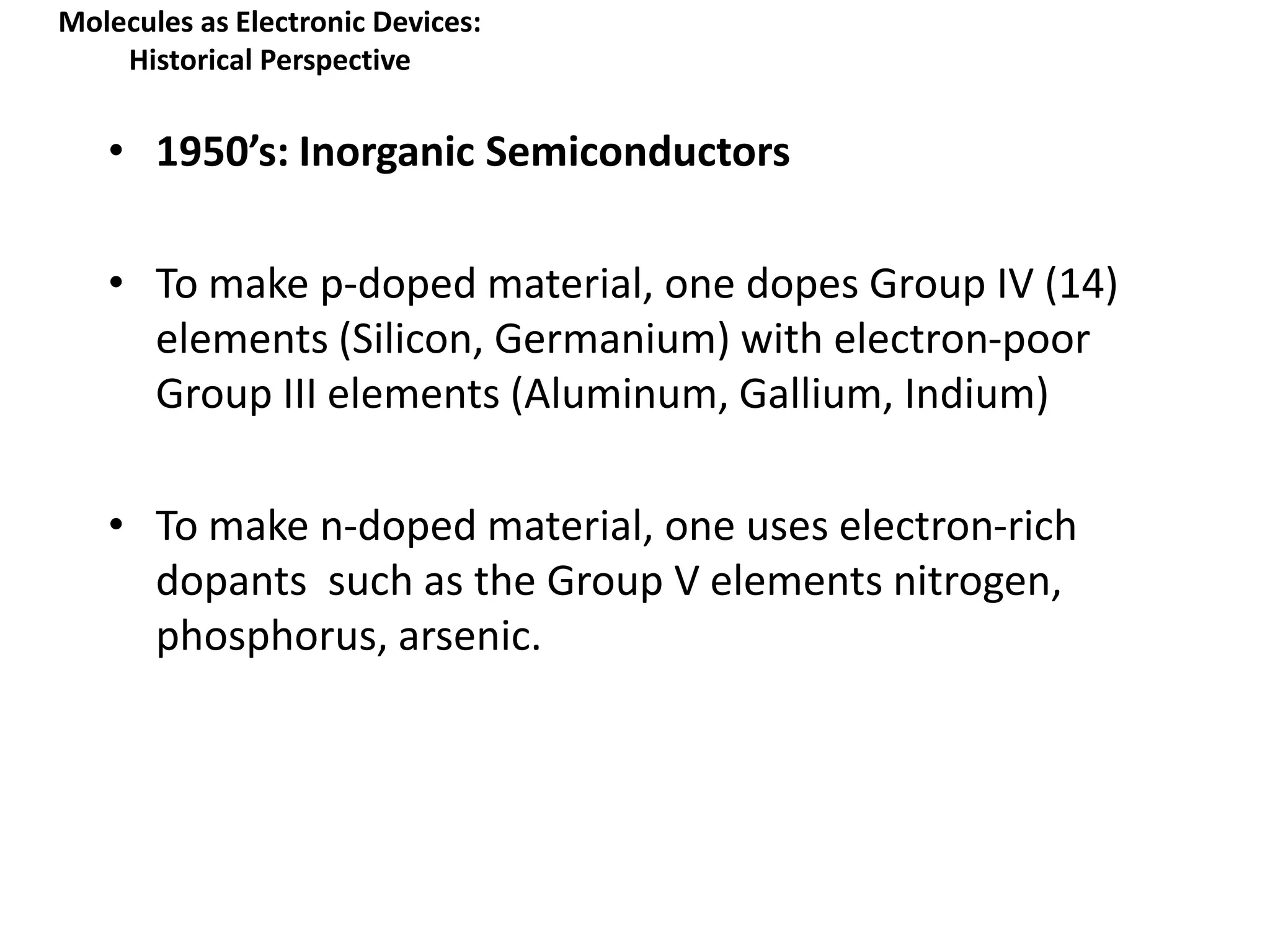
• 1950’s: Inorganic Semiconductors
• To make p-doped material, one dopes Group IV (14)
elements (Silicon, Germanium) with electron-poor
Group III elements (Aluminum, Gallium, Indium)
• To make n-doped material, one uses electron-rich
dopants such as the Group V elements nitrogen,
phosphorus, arsenic.
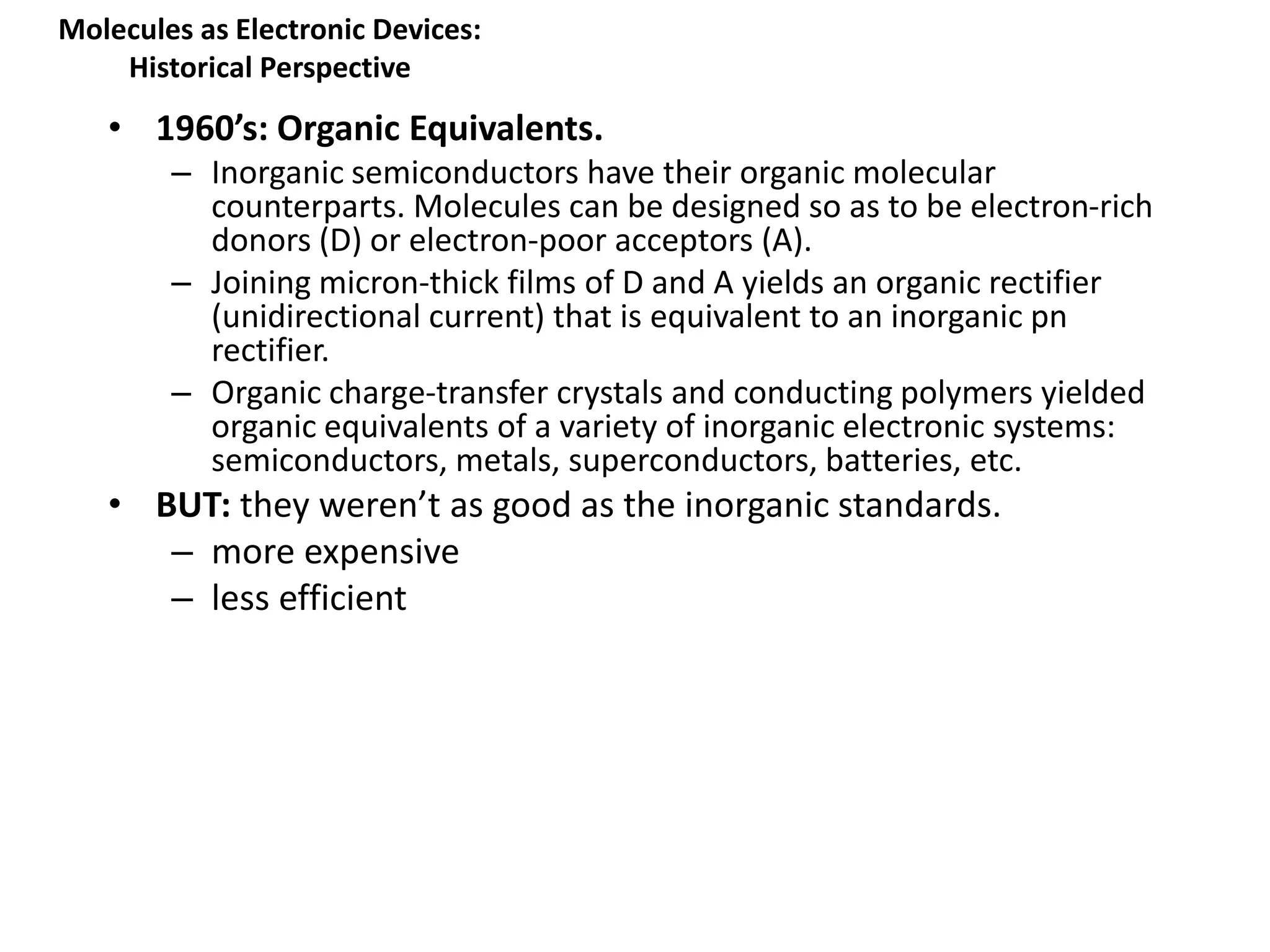
• 1960’s: Organic Equivalents.
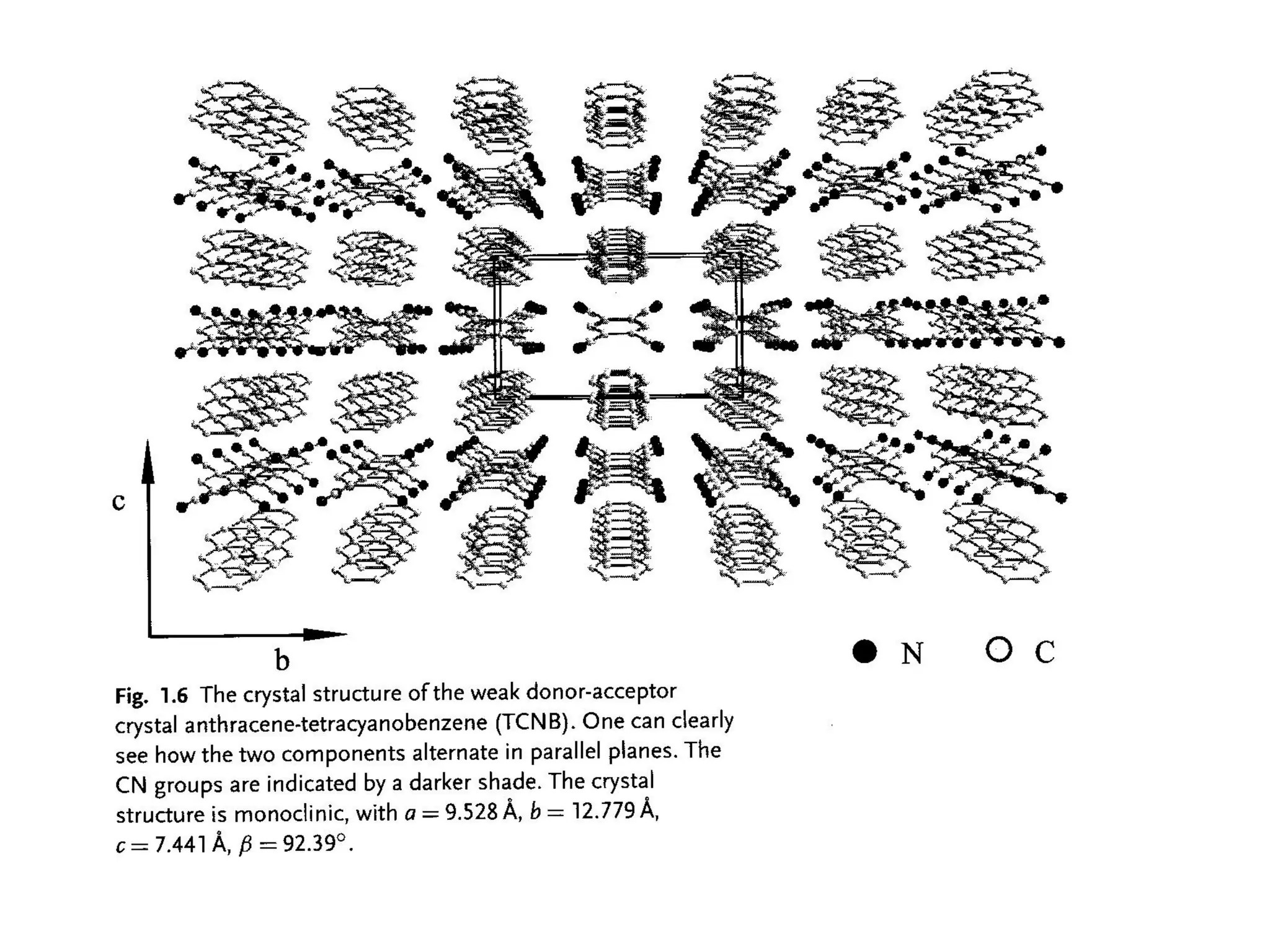
– Inorganic semiconductors have their organic molecular
counterparts. Molecules can be designed so as to be electron-rich
donors (D) or electron-poor acceptors (A).
– Joining micron-thick films of D and A yields an organic rectifier
(unidirectional current) that is equivalent to an inorganic pn
rectifier.
– Organic charge-transfer crystals and conducting polymers yielded
organic equivalents of a variety of inorganic electronic systems:
semiconductors, metals, superconductors, batteries, etc.
• BUT: they weren’t as good as the inorganic standards.
– more expensive
– less efficient
Molecules as Electronic Devices:
Historical Perspective
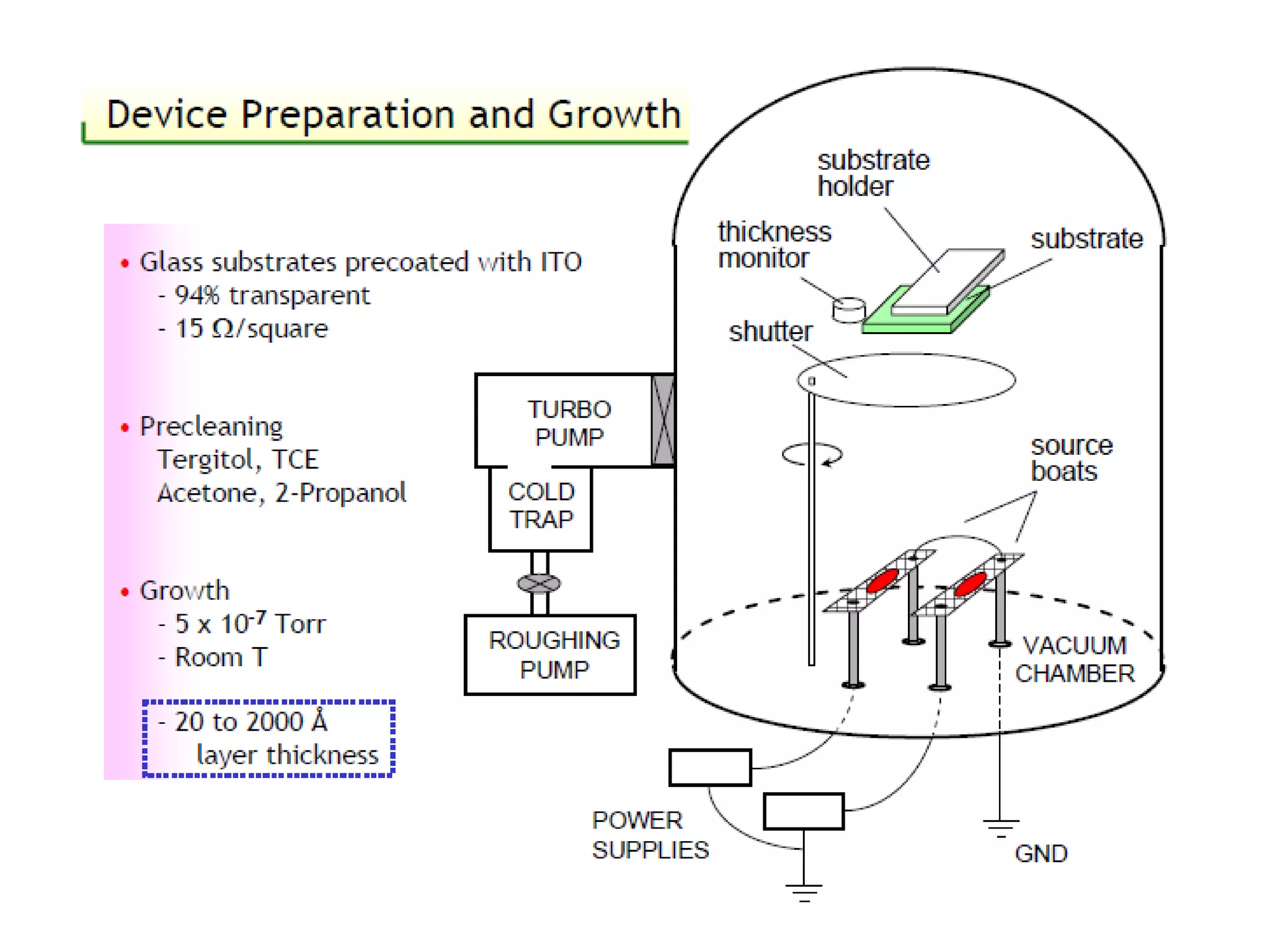
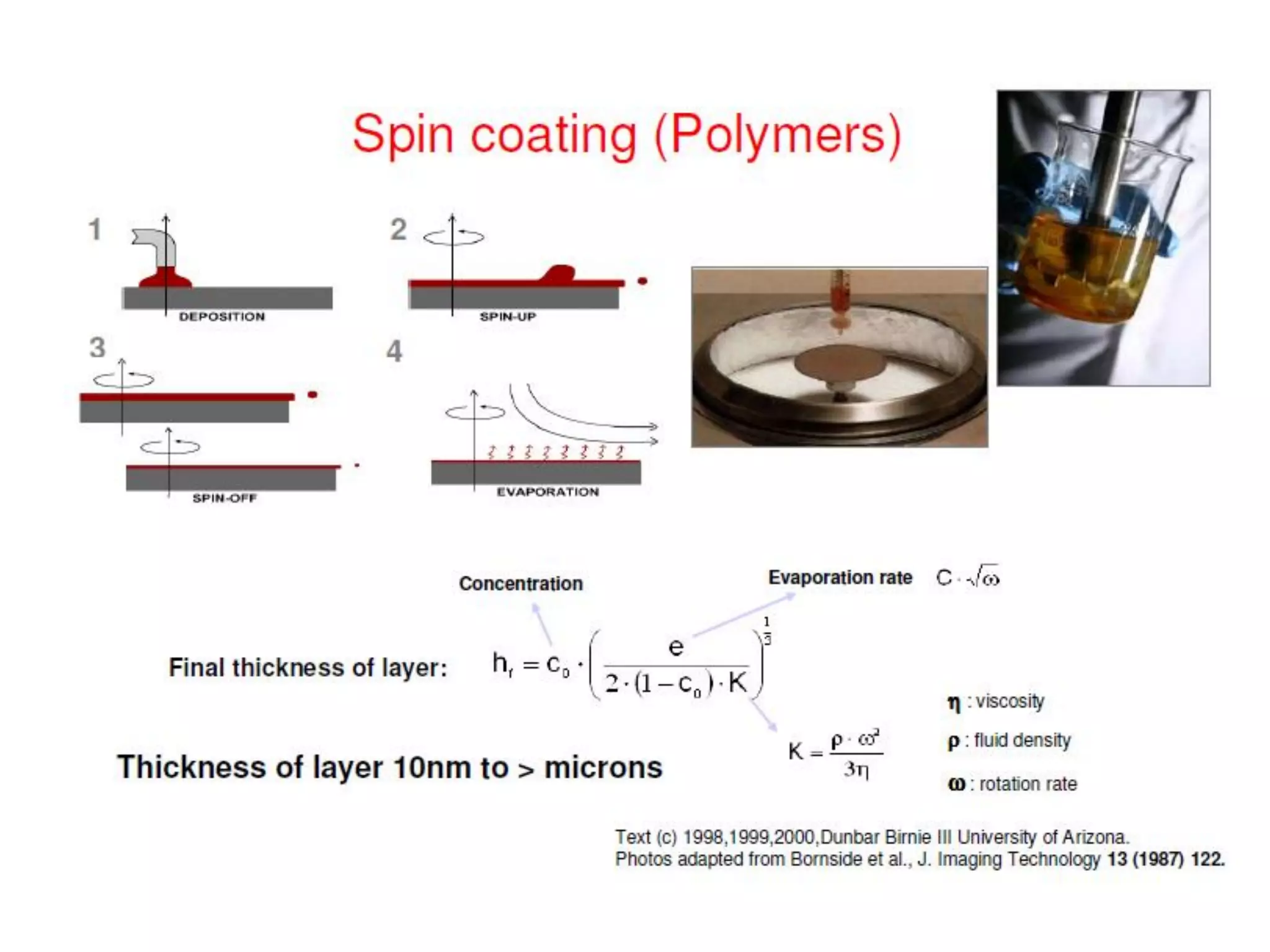
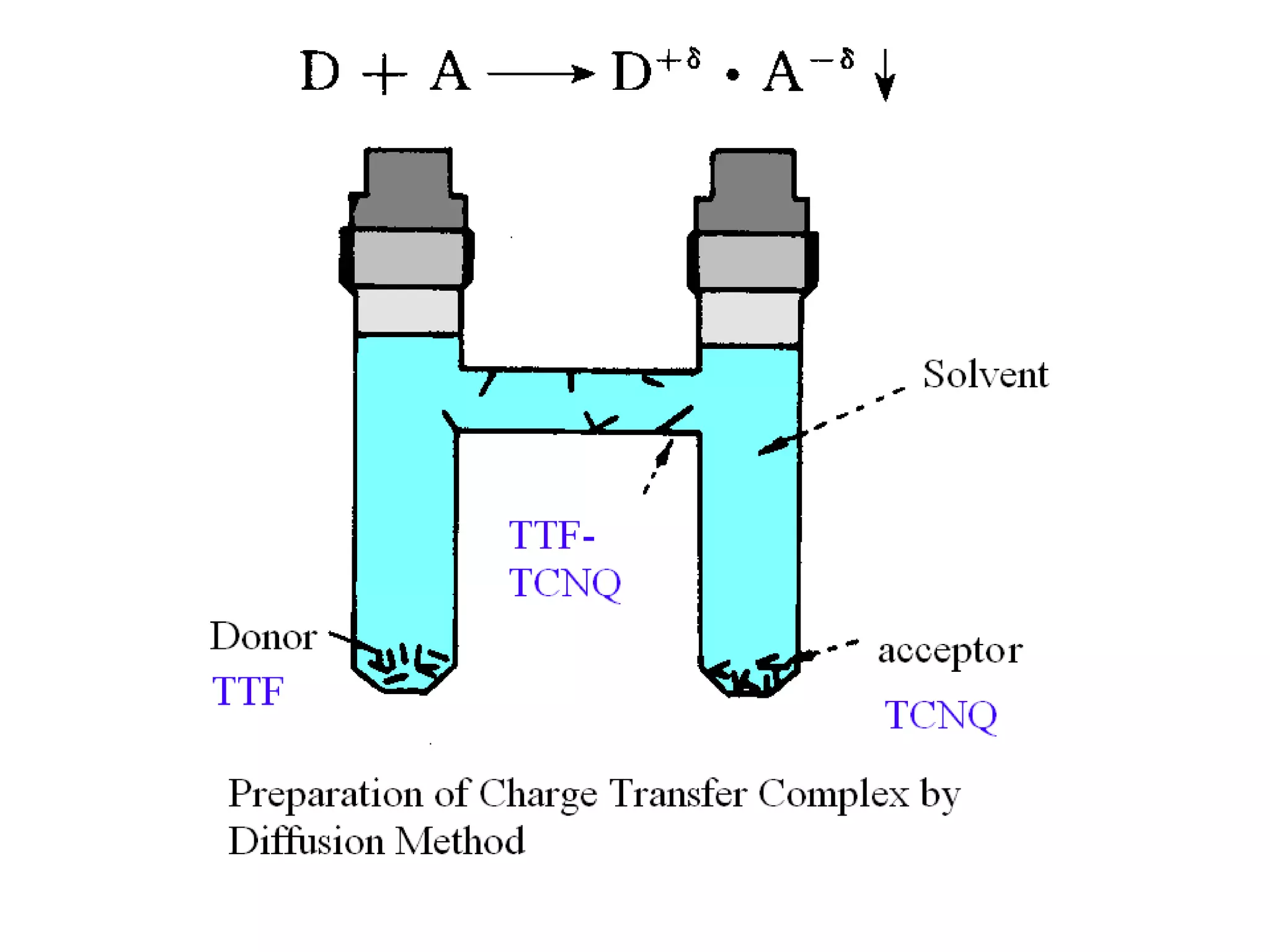
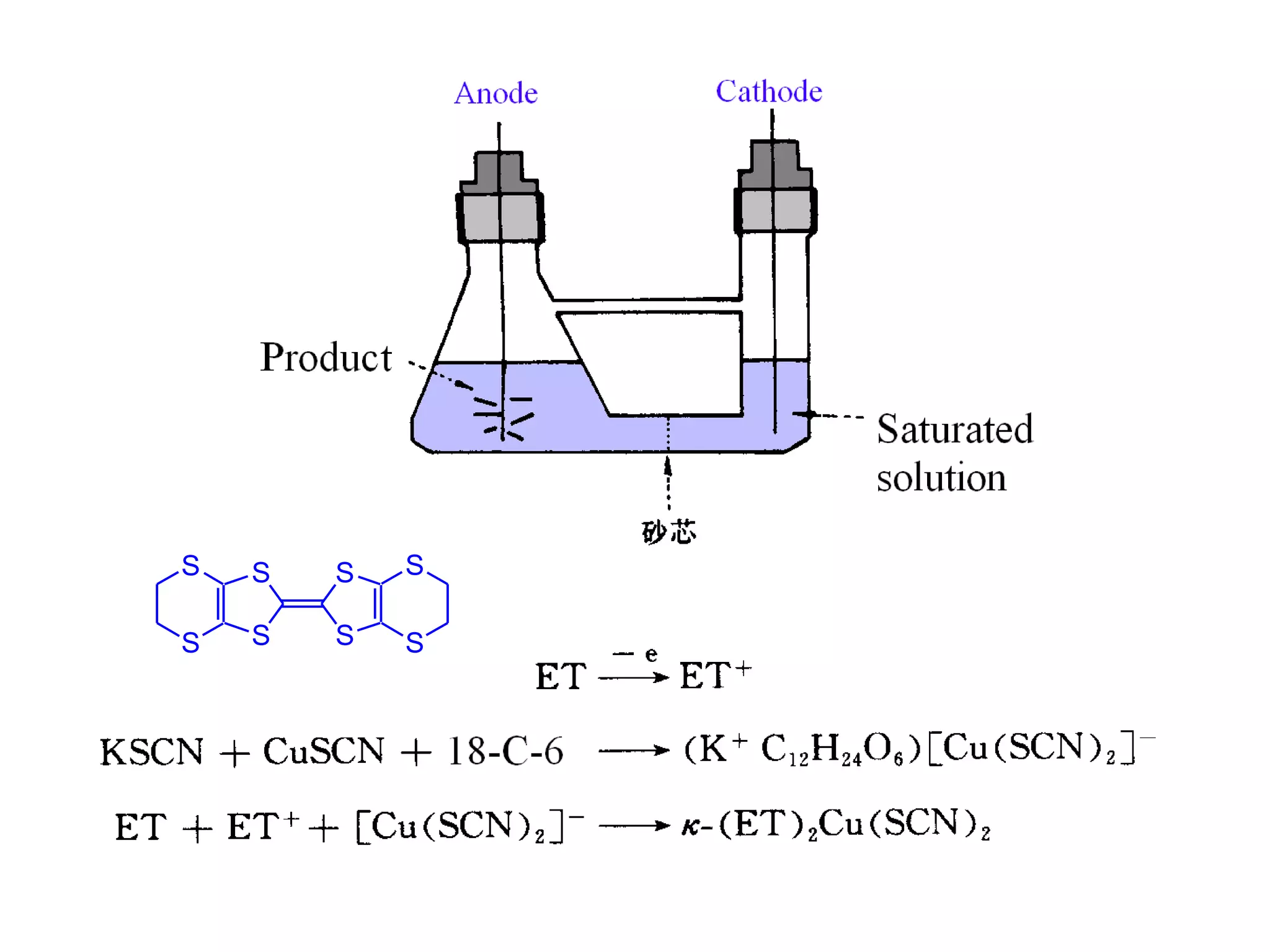
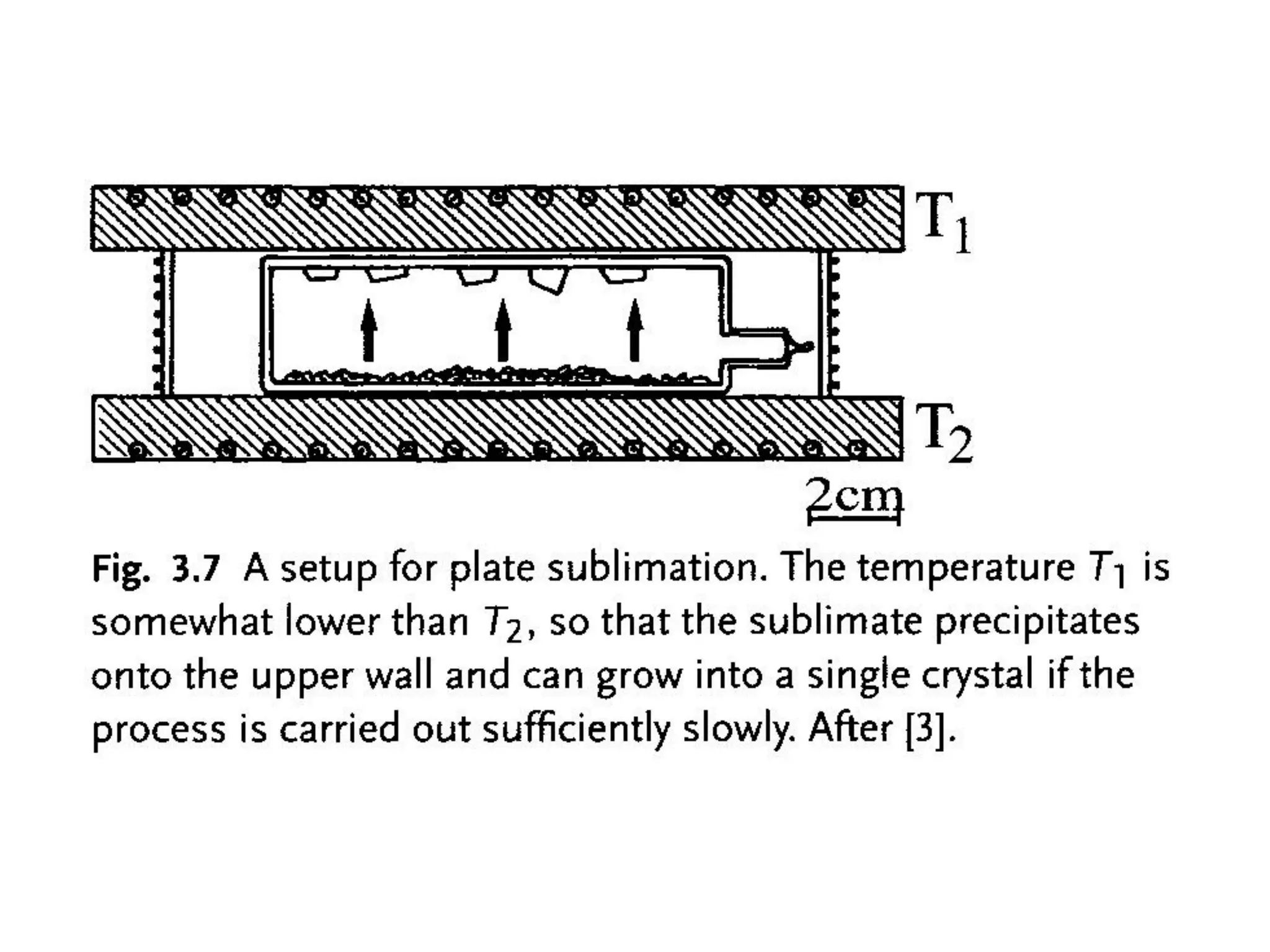
Materials Preparation
Techniques
S
S
S
S
S
S
S
S
Electronic Measurements
Conductivity (Resistivity)
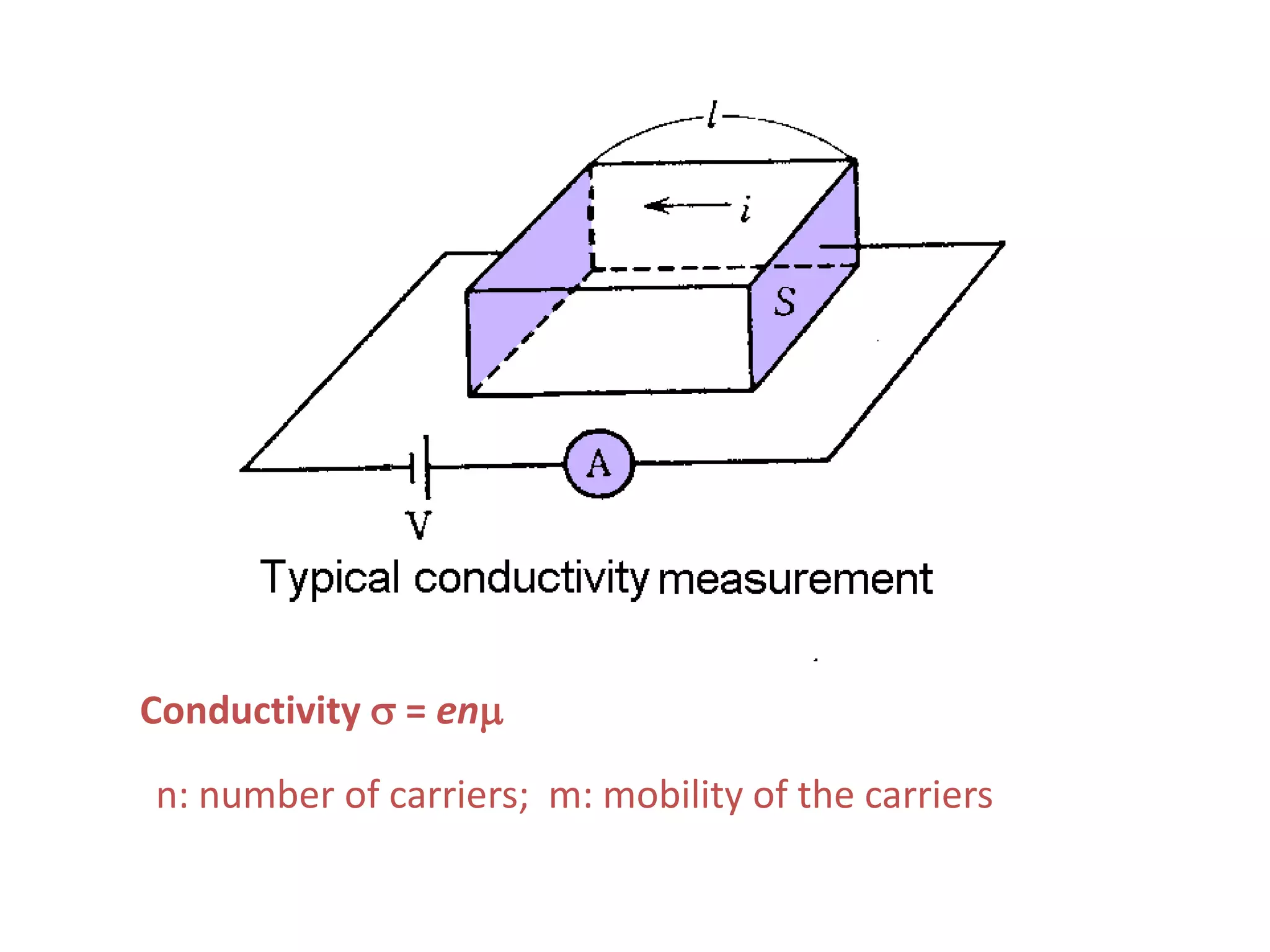
Conductivity s = enm
n: number of carriers; m: mobility of the carriers
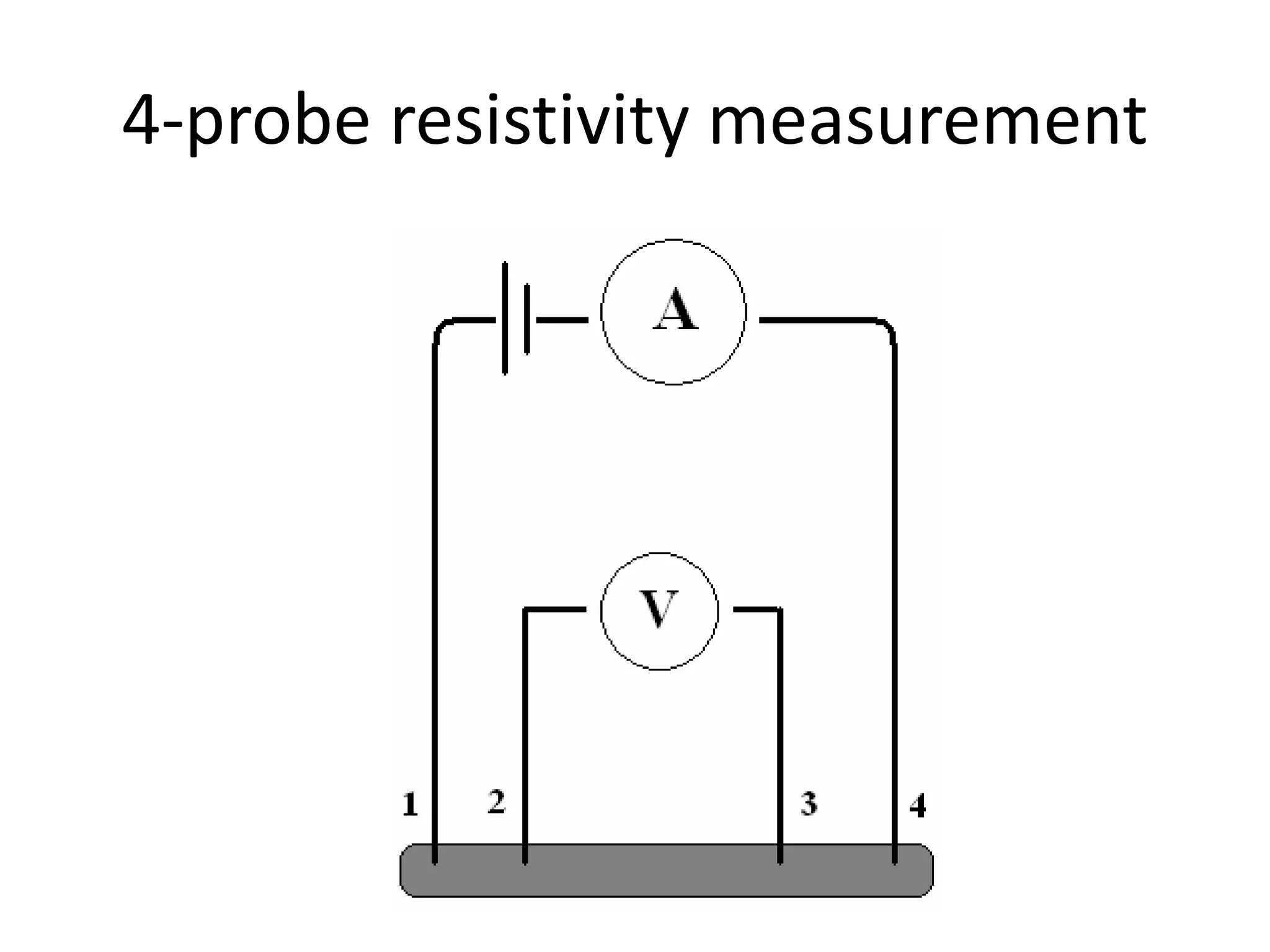
4-probe resistivity measurement
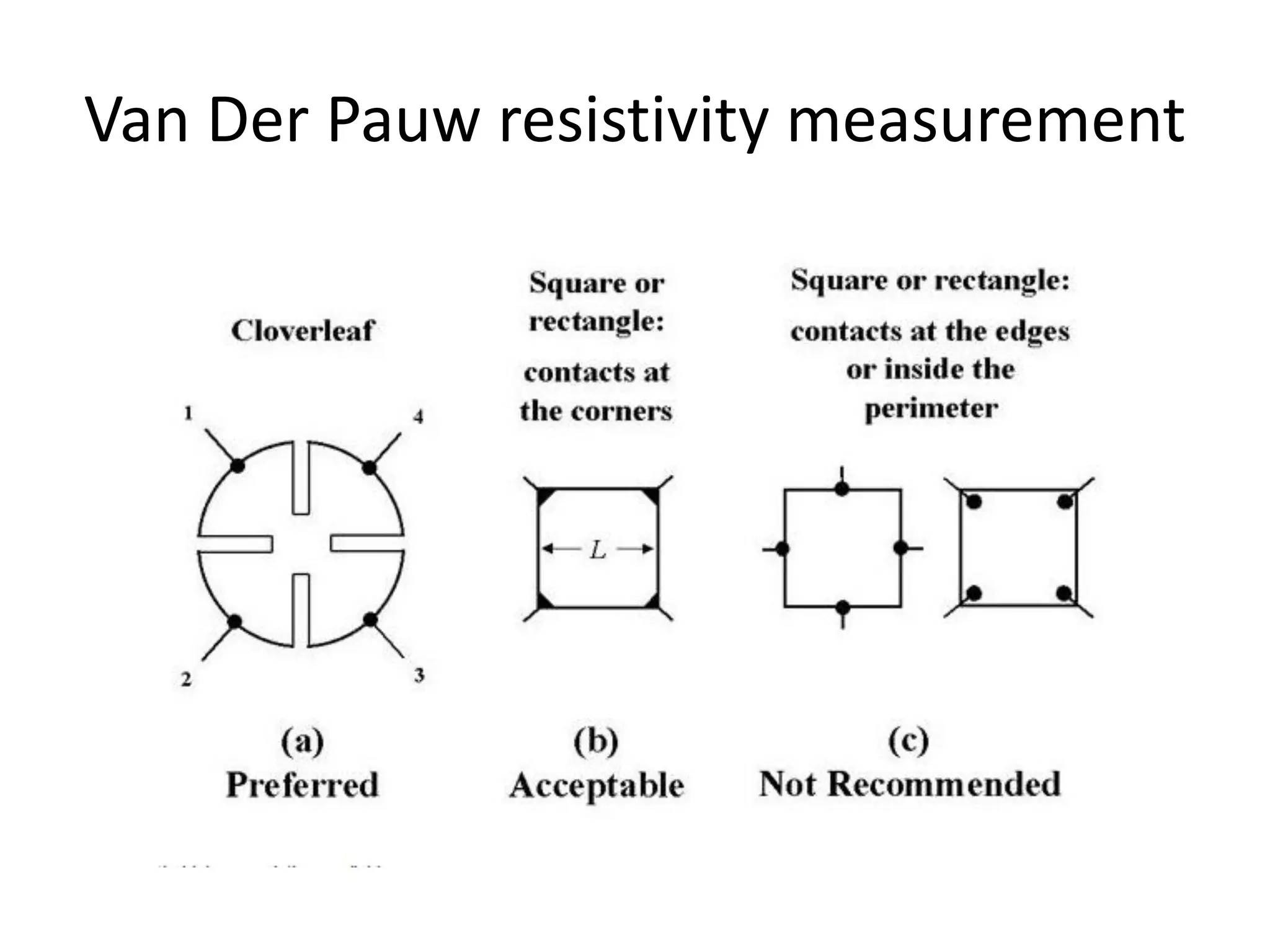
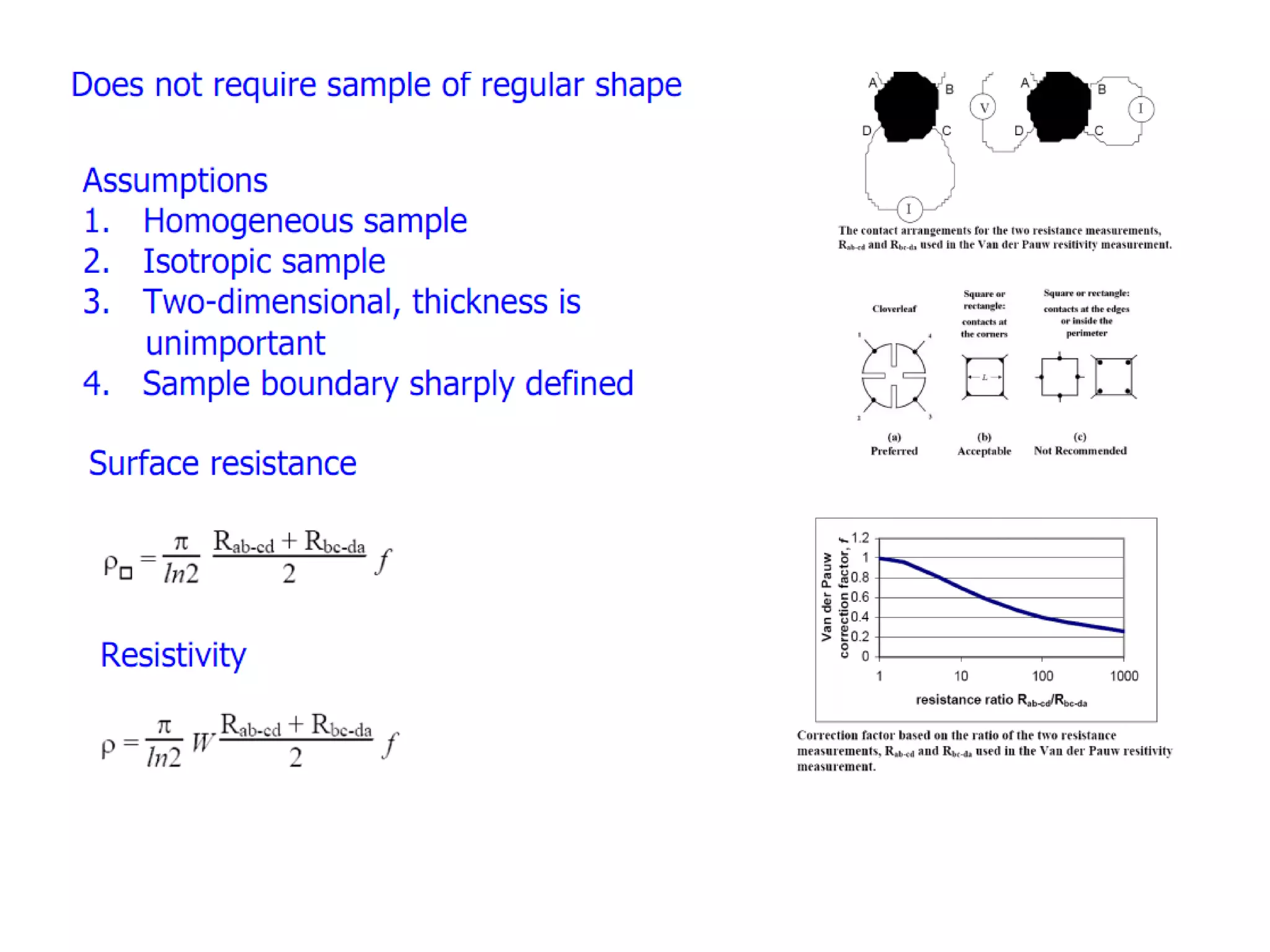
Van Der Pauw resistivity measurement
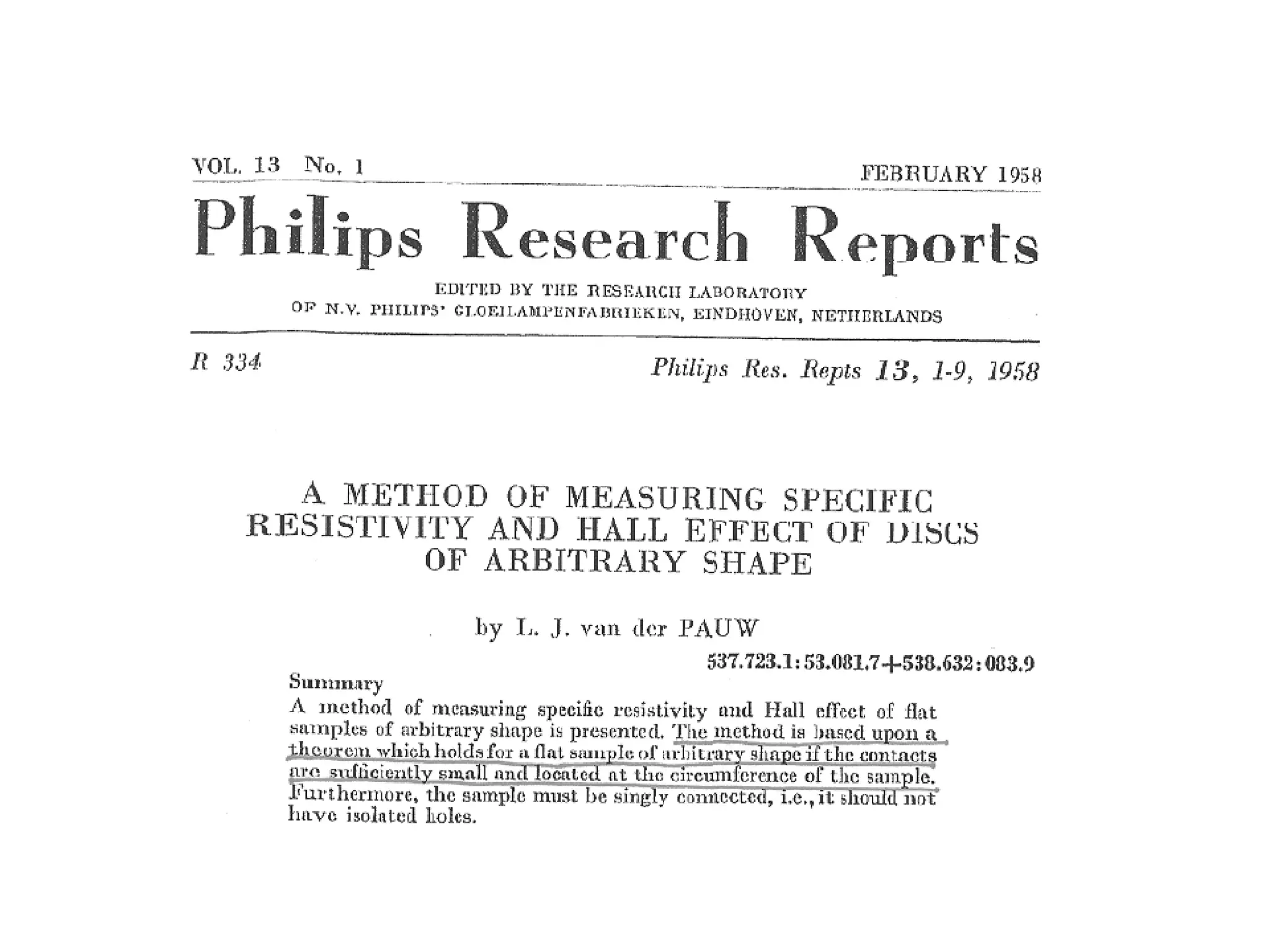
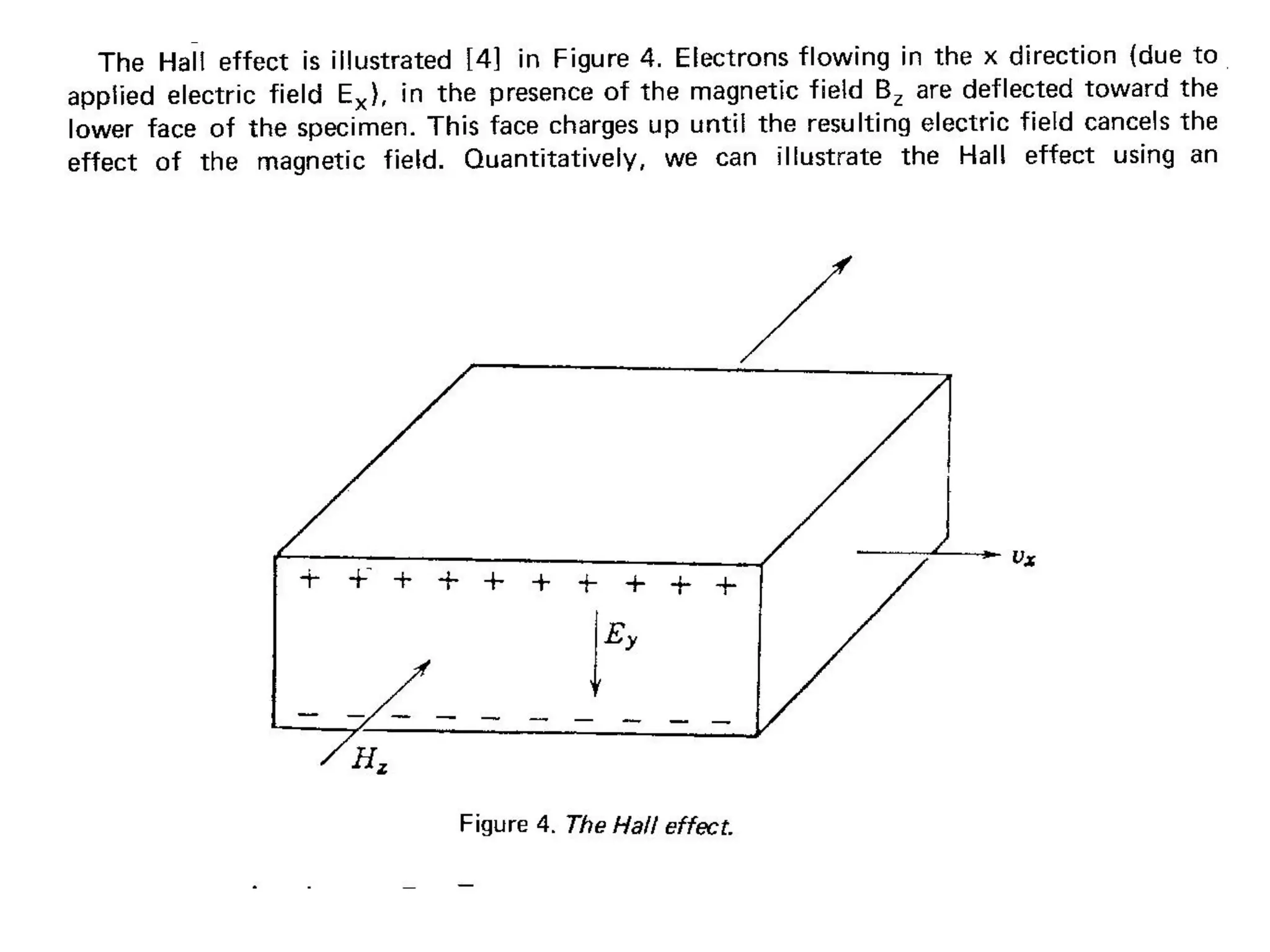
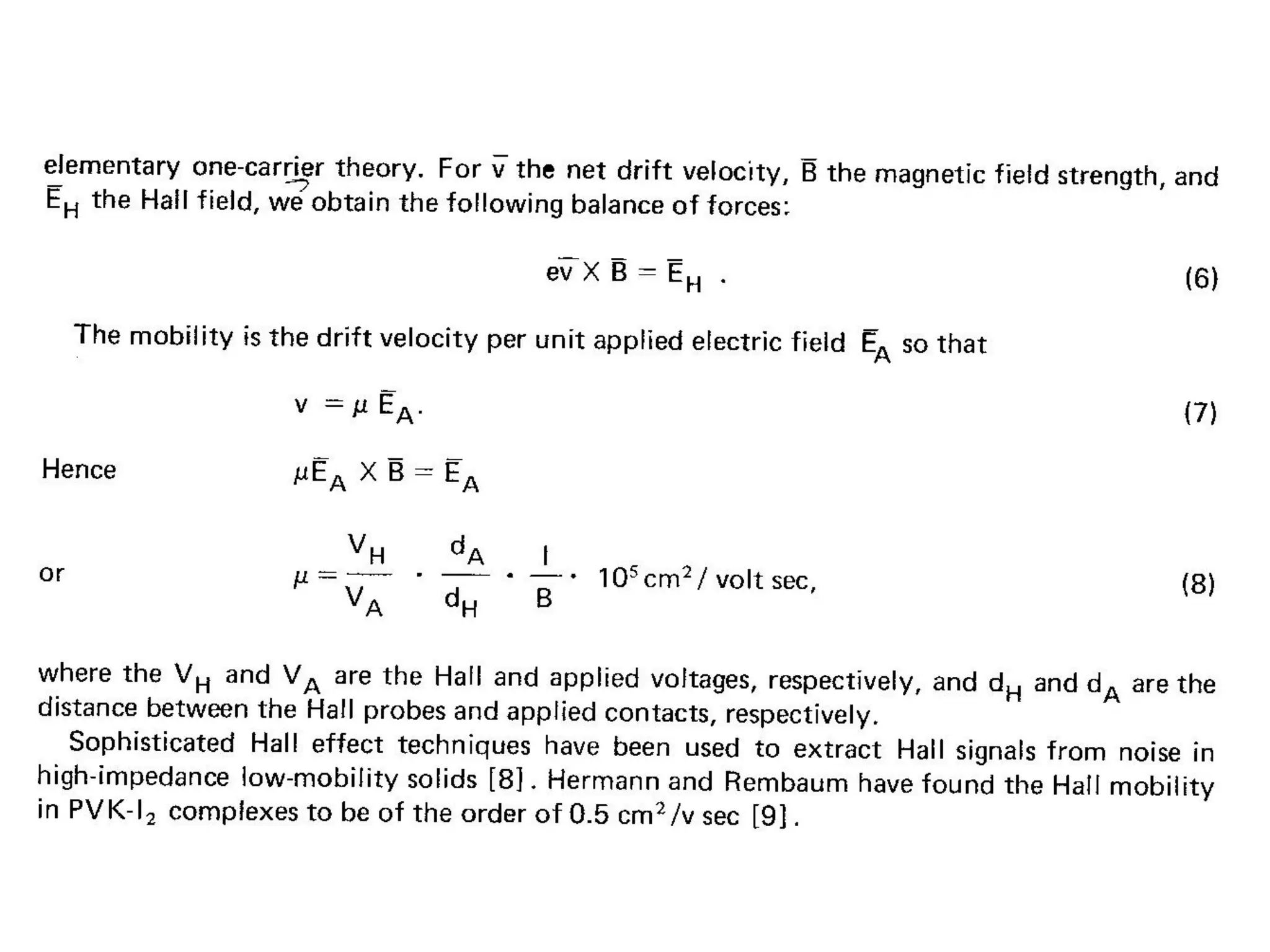
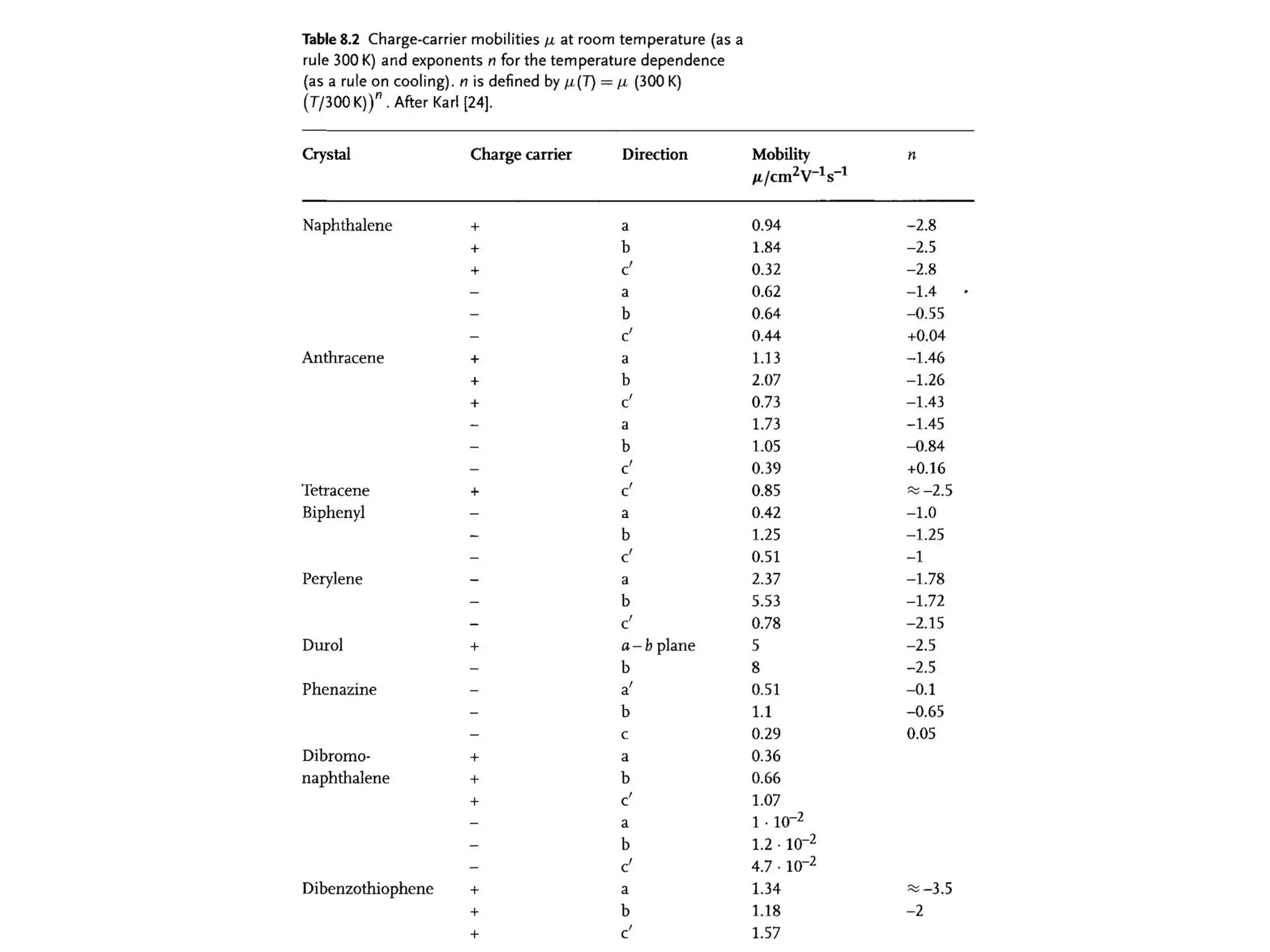
Hall effect
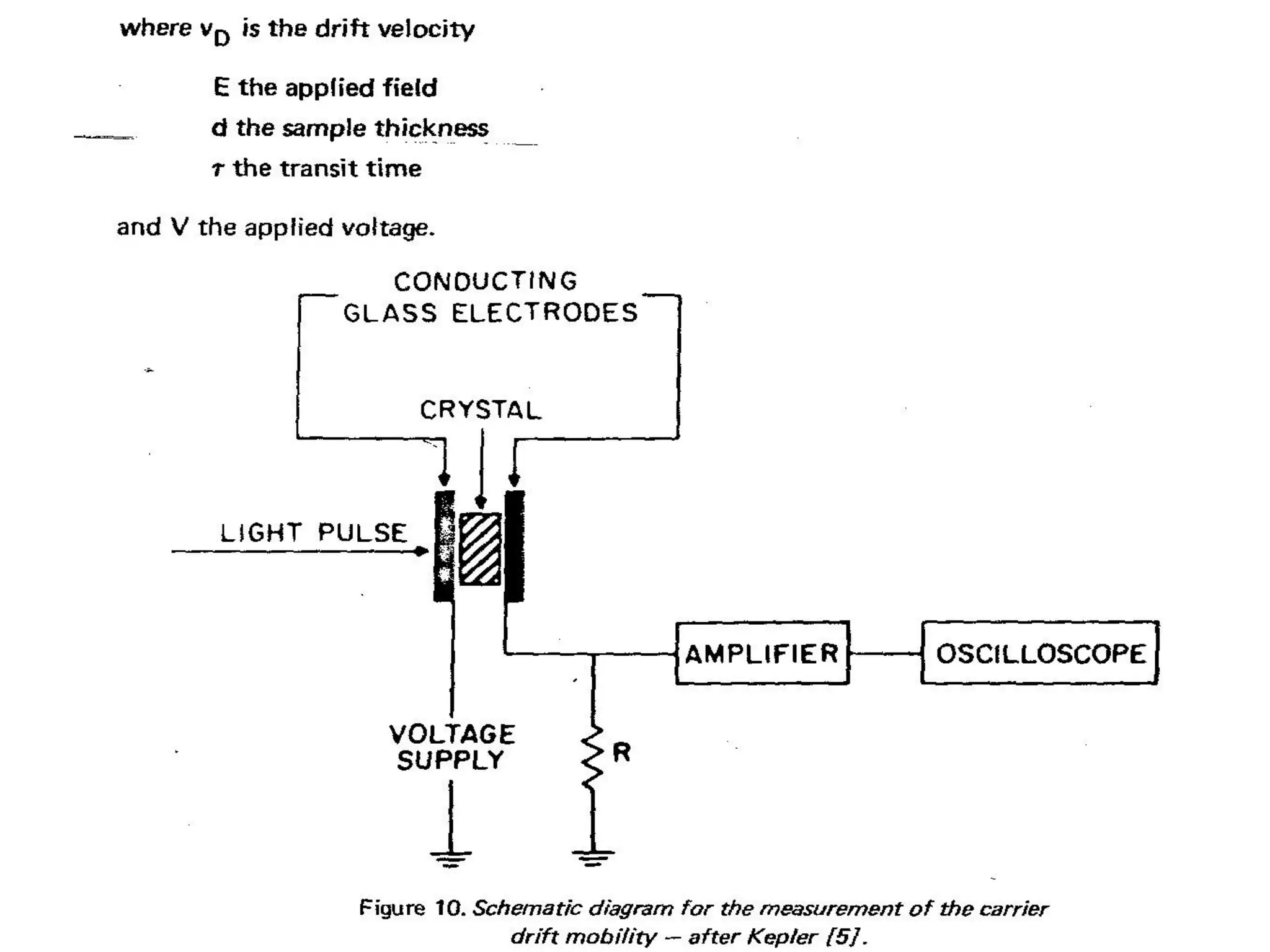
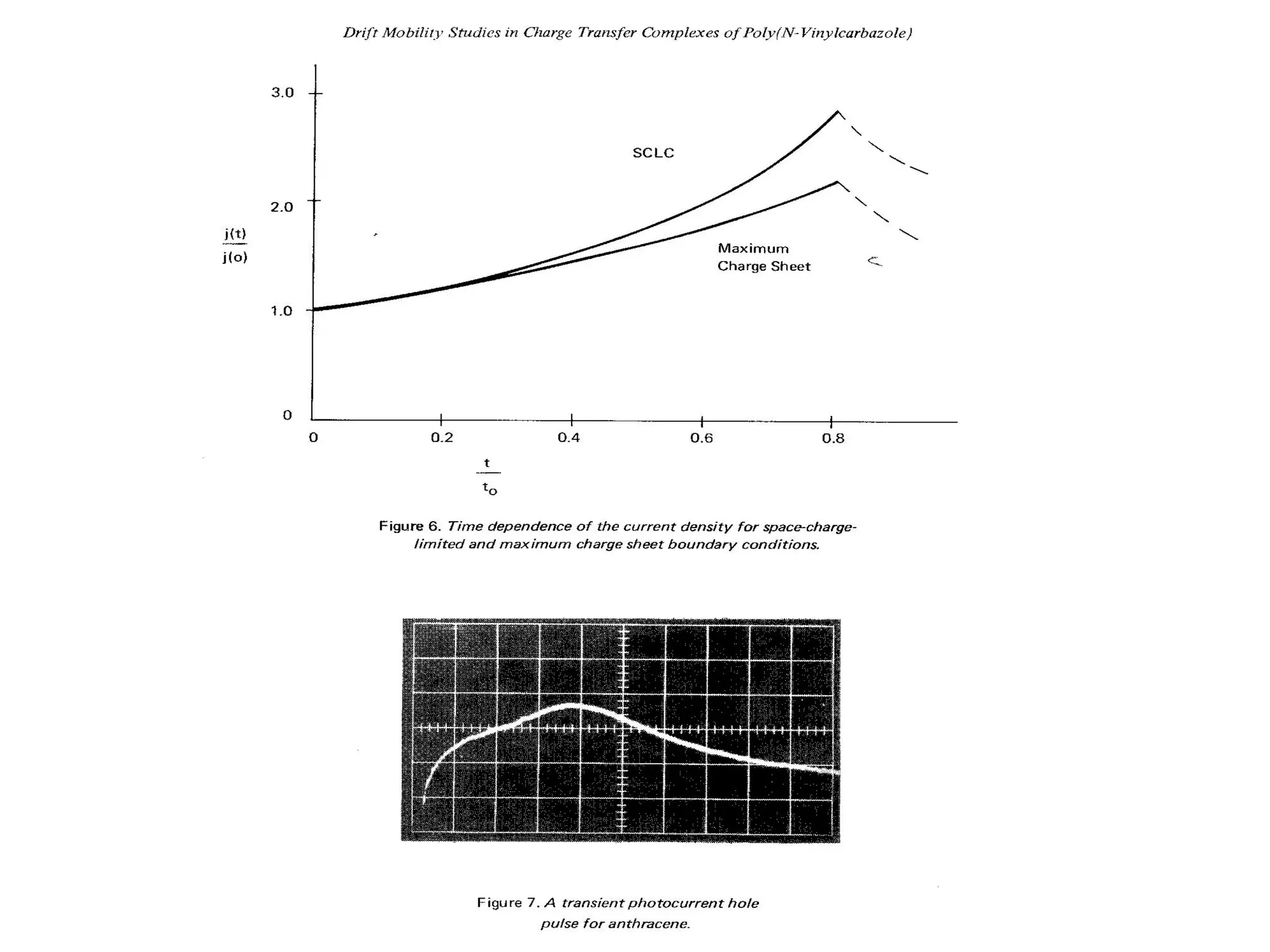
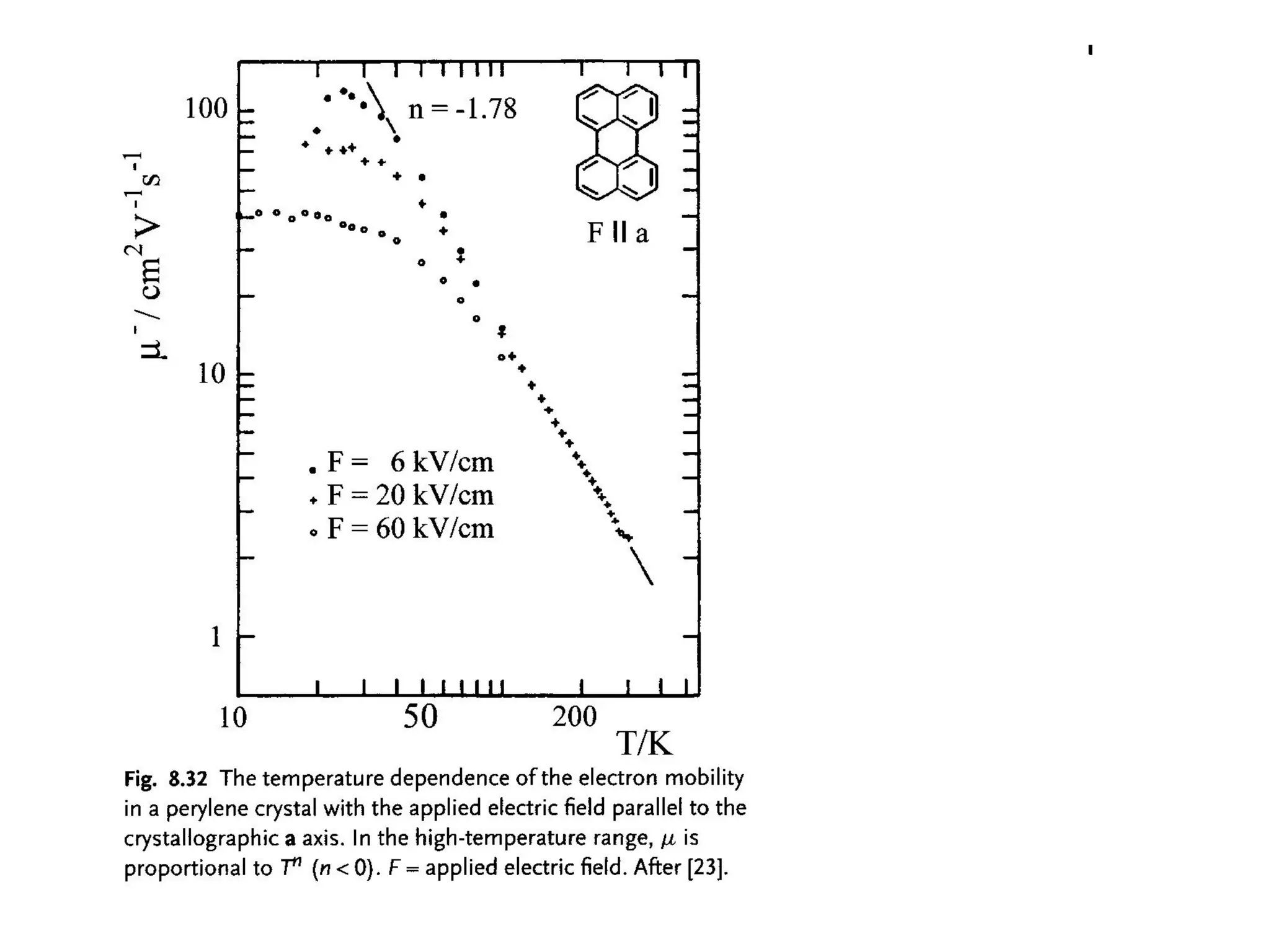
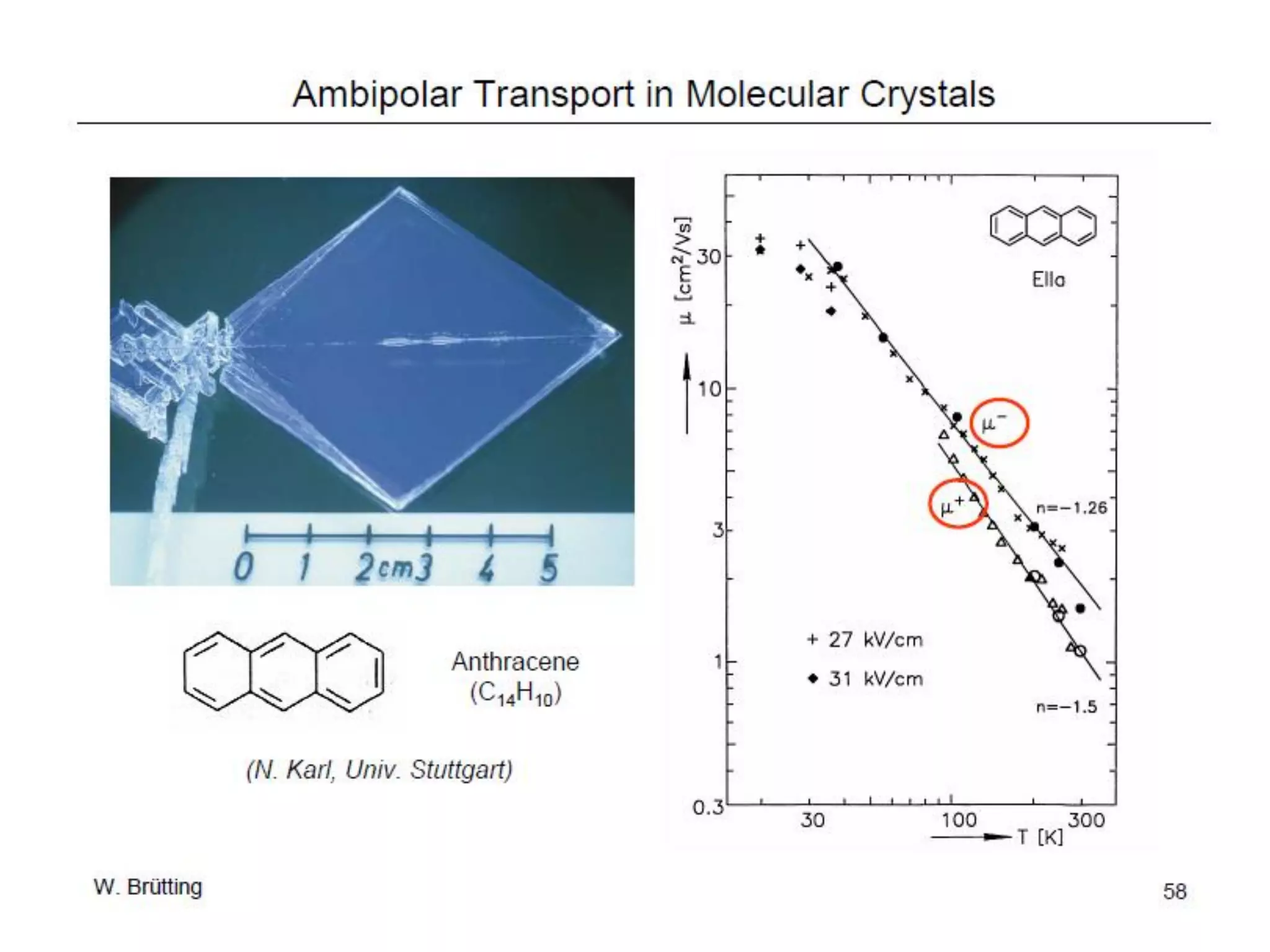
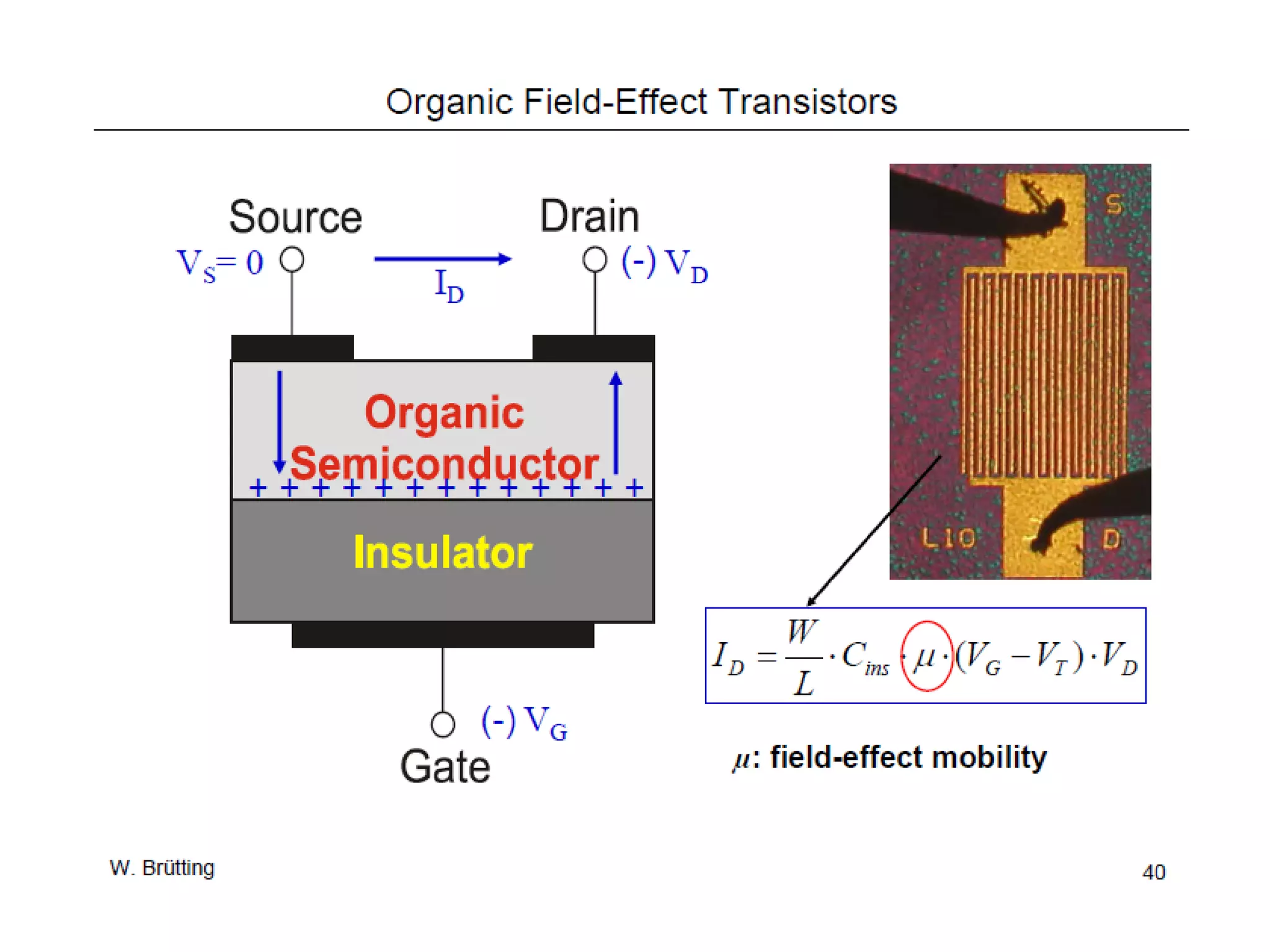
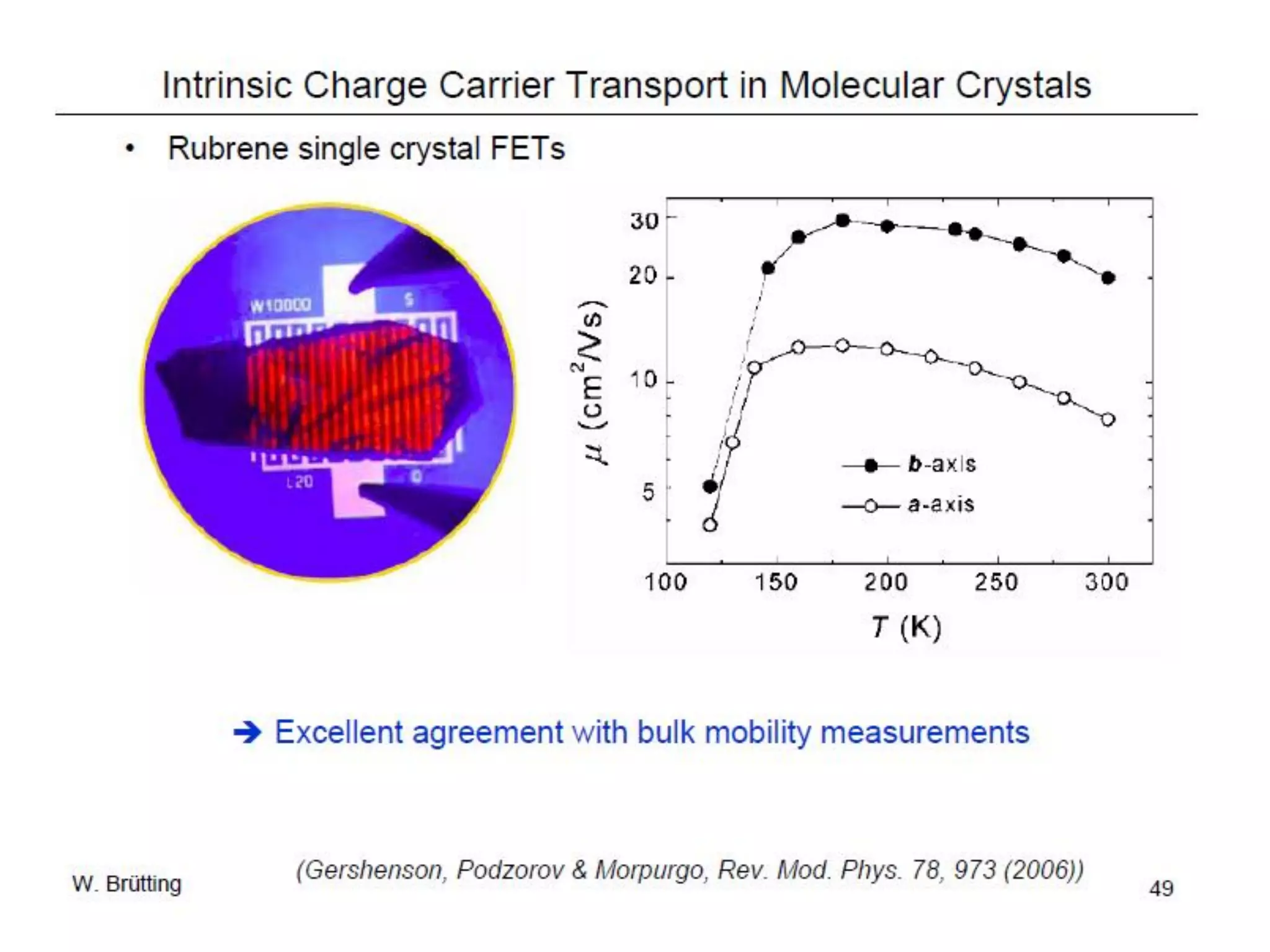
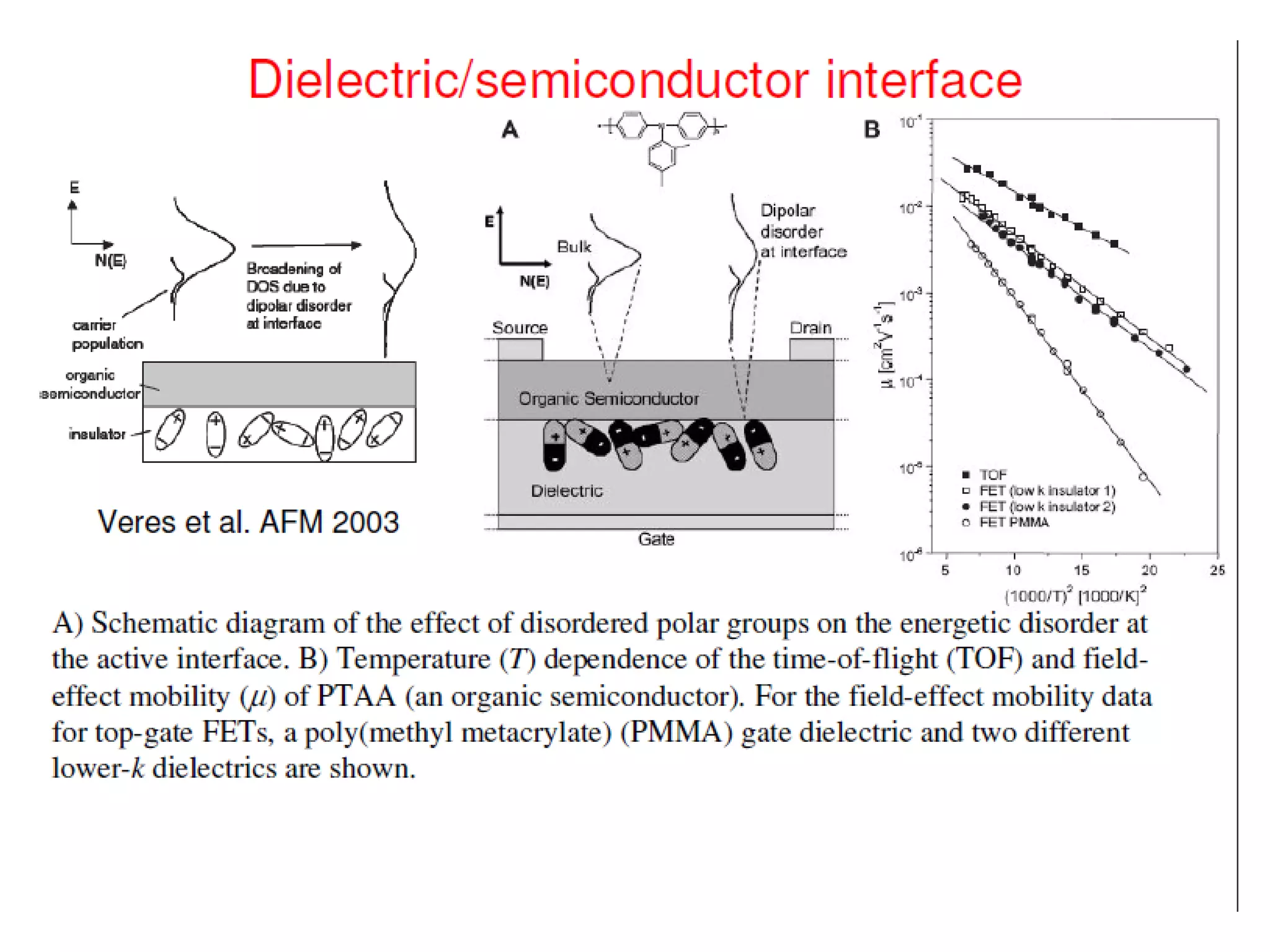
Drift Mobility from Time of
Flight Measurements and TFT
Structures
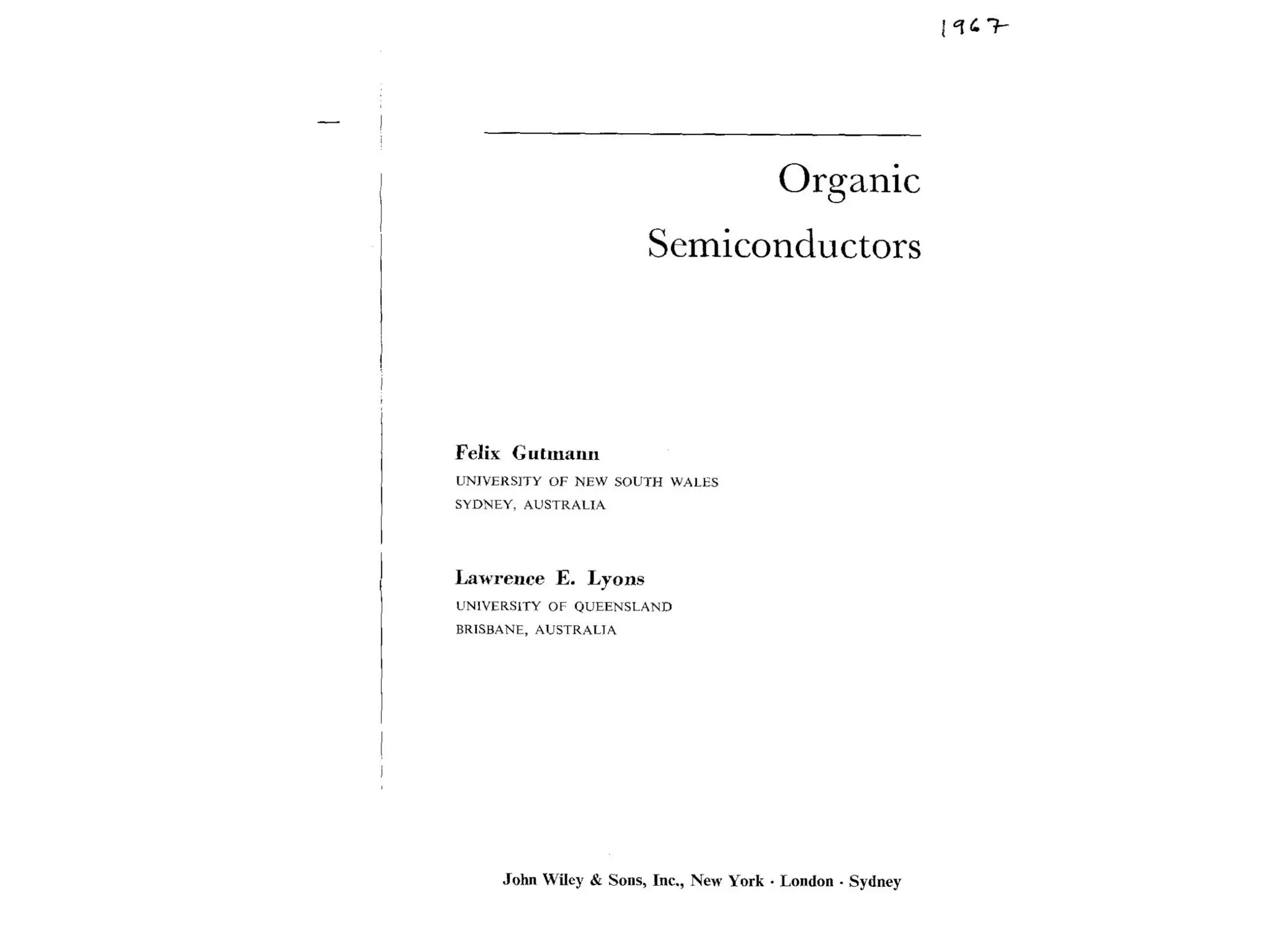
Some references to this material
Lecture 1 oms
Lecture 1 oms
Lecture 1 oms

Lecture 1 oms

  • 1.
    Organic Molecular Solids Prof.Allen M. Hermann Professor of Physics Emeritus University of Colorado Boulder, Colorado USA allen.hermann@colorado.edu
  • 2.
  • 3.
    Lecture I. . Introduction Materials,crystal structures Prototypical Molecules, anthracene, naphthalene, etc. Molecular Solids Materials Preparation Electronic Properties Measurements
  • 4.
    II. Insulators Charge TransportTheory, narrow bands Delocalized (Bloch) Wave Functions Localized Wave Functions Excitons Peirels Distortion (1D systems)
  • 5.
    III. Transient andSteady-state Photoconductivity in Insulators, Theory and Experiment Small-signal limit Drift Mobility Trapping (shallow and deep) IV. Effects of Finite Charge Injection Boundary Conditions, Space Charge Limited Currents Pulsed, Steady-state Electric Fields and Light Excitations Dispersive transport
  • 6.
    VI. Carbon-based nanostructuresand Superconductors Buckyballs, Nanotubes, Graphene Organic Superconductors V. Organic Conductors Charge-transfer Complexes Quasi-one-dimensional and two-dimensional materials, radical-ion salts Polymers
  • 7.
    VII. Applications Electrostatic Imagingand Xerographic materials Organic Light-emitting diodes ) OLEDS and Active Matrix OLEDS (AMOLEDS) for Display and Lighting Solar Cells Field-effect transistors Batteries Photo-detectors Luminescence for Land-mine Sniffing Lasers Switches E-Ink
  • 8.
    VIII. Molecular Electronicsand Nanoscience Why Molecular Electronics Moore’s Law Devices: Top-down and Bottom-Up Fabrication Single Molecule Systems and Materials Many-Molecule Systems and Thin Films DNA Computing
  • 9.
    Lecture I. . Introduction Materials,crystal structures Prototypical Molecules, anthracene, naphthalene, etc. Molecular Solids Materials Preparation Electronic Properties Measurements
  • 11.
  • 18.
  • 19.
    Introduction • When twohydrogen atoms come close to each other – They form a chemical bond, resulting in a hydrogen molecule (H2) • When many silicon atoms come close – They form many chemical bonds, resulting in a crystal • What brings them together? – The driving force is To reduce the energy
  • 20.
    Interactions between Atoms •For atoms to come close and form bonds, there must be an attractive force – Na gives up its 3s electron and becomes Na+ – Cl receives the electron to close its n = 3 shell and becomes Cl- – The Coulomb attractive force is proportional to r-2 • In the NaCl crystal, Na+ and Cl- ions are 0.28 nm apart – There must be a repulsive force when the ions are too close to each other – When ions are very close to overlap their electron orbitals and become distorted, a repulsive force arises to push ions apart and restore the original orbitals – This is a short-range force
  • 21.
    Equilibrium Separation • Thereis a balance point, where the two forces cancel out (Fig. 5.1) – The energy goes to zero at infinite separation – As separation decreases, the energy decreases, so the force is attractive – At very small separation, the energy rises sharply, so the force is strongly repulsive – The minimum energy point (Ec, or the zero force point) corresponds to the equilibrium separation ro – The argument is true for both molecules in crystals
  • 22.
    Mathematical • Mathematically – Aand B are constants – The first term represents the repulsion and the second attraction • Minimum energy – It must be negative, so m < n mn r B r A )r(E  )1 n m ( r B E m o C 
  • 23.
    Bond Types • Fourtypes in total – Ionic – Covalent – Metallic – van der Waals
  • 24.
    Metallic Bonds • Eachatom in a metal donates one or more electrons and becomes a lattice ion – The electrons move around and bounce back and forth – They form an “electron sea”, whose electrostatic attraction holds together positive lattice ions – The electrostatic attraction comes from all directions, so the bond is non-directional – Metals are ductile and malleable
  • 25.
    Covalent Bonds • Whentwo identical atoms come together, a covalent bond forms • The hydrogen molecule – A hydrogen atom needs two electrons to fill its 1s shell – When two hydrogen atoms meet, one tries to snatch the electron from the other and vice versa – The compromise is they share the two electrons • Both electrons orbit around both atoms and a hydrogen molecule forms • The chlorine molecule – A chlorine atom has five 3p electrons and is eager to grab one more – Two chlorine atoms share an electron pair and form a chlorine atom
  • 26.
    Group IV • Carbon1s22s22p2; Si 1s22s22p63s23p2; Ge 1s22s22p63s23p63d104s24p2 • Each atom needs four extra electrons to fill the p-shell – They are tetravalent • sp3 hybridization – s shell and p shell hybridize to form four equal-energy dangling electrons – Each of them pairs up with a dangling electron from a neighbor atom – There are four neighbor atoms equally spaced – Each atom is at the center of a tetrahedron – Interbond angle 109.4 – Covalent bond is directional
  • 27.
    Group IV • At0 K – All electrons are in bonds orbiting atoms – None can wander around to conduct electricity – They are insulators • At elevated temperatures – Statistically, some electrons can have more enough energy to escape through thermal vibrations and become free electrons – They are semiconductors • The C–C bond is very strong, making diamond the hardest material known (Table 5.1) – Diamond has excellent thermal conductivity – It burns to CO2 at 700C
  • 28.
    van der WaalsBonds • Argon has outer shell completely filled • When argon is cooled down to liquid helium temperature, it forms a solid – The electrons are sometimes here and sometimes there, so the centers of the positive charge (nucleus) and negative charge (electrons) are not always coincident – The argon atom is a fluctuating dipole (instantaneous dipole) – It induces an opposite dipole moment on another argon atom, so they attract each other – Such attraction is weak, so the materials have low melting and boiling temperatures – They are often seen in organic crystals
  • 29.
  • 36.
  • 39.
    Extreme Case –Nearly Ionic Bonds in Highly Conducting Complexes “Charge Transfer salts”
  • 40.
    Discovery of ConductingOrganic Crystals
  • 44.
    Molecules as ElectronicDevices: Historical Perspective • 1950’s: Inorganic Semiconductors • To make p-doped material, one dopes Group IV (14) elements (Silicon, Germanium) with electron-poor Group III elements (Aluminum, Gallium, Indium) • To make n-doped material, one uses electron-rich dopants such as the Group V elements nitrogen, phosphorus, arsenic.
  • 45.
    • 1960’s: OrganicEquivalents. – Inorganic semiconductors have their organic molecular counterparts. Molecules can be designed so as to be electron-rich donors (D) or electron-poor acceptors (A). – Joining micron-thick films of D and A yields an organic rectifier (unidirectional current) that is equivalent to an inorganic pn rectifier. – Organic charge-transfer crystals and conducting polymers yielded organic equivalents of a variety of inorganic electronic systems: semiconductors, metals, superconductors, batteries, etc. • BUT: they weren’t as good as the inorganic standards. – more expensive – less efficient Molecules as Electronic Devices: Historical Perspective
  • 47.
  • 51.
  • 53.
  • 54.
  • 55.
    Conductivity s =enm n: number of carriers; m: mobility of the carriers
  • 56.
  • 58.
    Van Der Pauwresistivity measurement
  • 60.
  • 63.
    Drift Mobility fromTime of Flight Measurements and TFT Structures
  • 72.
    Some references tothis material