Superconductivity
Tokyo University of Science
       May, 2010

    Professor Allen Hermann
     Department of Physics
      University of Colorado
     Boulder, CO 80401 USA
               and
     Nanotech Solutions, LLC
    Lexington,KY 40506 USA
 allen.hermann@colorado.edu
Syllabus for “Superconductivity”, a 7 (1 1/2 hour) lecture series in Low-
Temperature Physics I at Tokyo University of Science, 2010
              Allen Hermann, Ph.D.
Lecture 1. Introduction
Discovery, history, and superconducting properties (zero resistance and
flux expulsion)
Type I and Type II superconductors
Low Tc and High Tc Materials
Lecture 2.Phenomenology: Superfluids and their properties
Electrodynamics and the Magnetic Penetration Length
The London Equations and magnetic effects
Fluxoids
Lecture 3. Phenomenology: Ginsburg-Landau theory and the
intermediate state
•Landau Theory of Phase Transitions
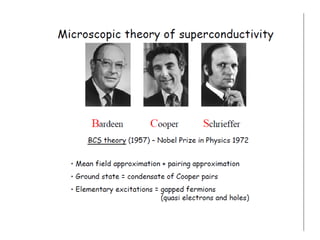
•Ginsburg-Landau Expansion
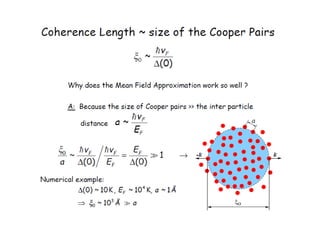
•Coherence Length
•The Ginsburg-Landau Equations
•Abrikosov Lattice and Flux Pinning
Lecture 4. Microscopic Theory
The 2-electron Problem
Annihilation and Creation Operators
Solution of the Schroedinger Equation
Cooper Pairs
The Many Electron Problem- BCS Theory
Solution of the Many Particle Schroedinger Equation by the Bogoliubov-
Valatin Transformation
The BCS Energy Gap
Lecture 5. Josephson Effects
Pair Tunneling and Weak Links
SIS Josephson Junctions
Superconducting Quantum Interference Devices (SQUIDs)
Lecture 6. Superconducting Materials and their structures
 Low Tc Metals and Alloys
Organic superconductors
High Tc materials: cuprates, borides, and AsFe superconductors
Lecture 7. Applications and Devices
Levitation
Wire applications and Superconducting Magnets
Flux Flow Issues in High Tc, High Jc Wire
Electronic devices Using Josephson Junctions and SQUIDS
Nanotechnology and Superconductivity
Lecture 1 Introduction
• Discovery, history and superconducting
  properties (zero resistance, magnetic flux
  expulsion)
• Type I and Type II superconductors
• Low Tc and High Tc materials
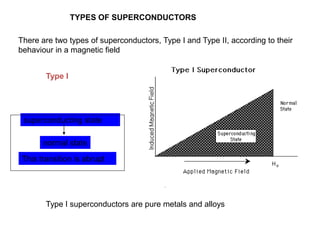
TYPES OF SUPERCONDUCTORS

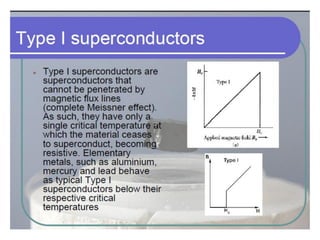
There are two types of superconductors, Type I and Type II, according to their
behaviour in a magnetic field


        Type I


 superconducting state

       normal state

 This transition is abrupt


        Type I superconductors are pure metals and alloys
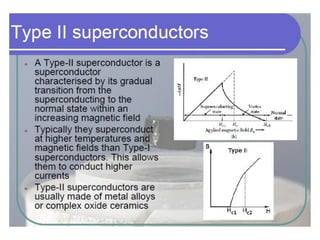
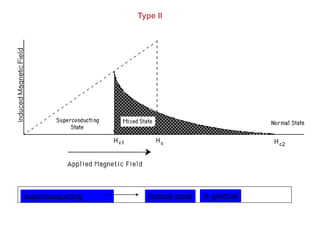
Type II


superconducting      normal state   is gradual
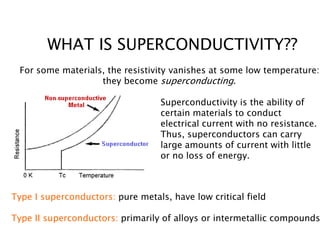
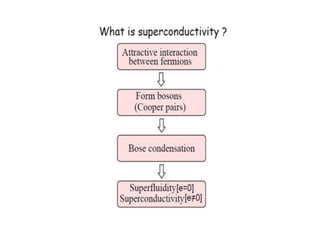
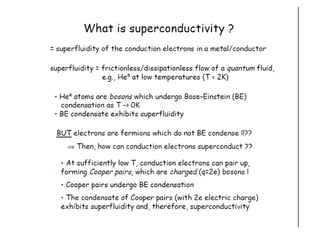
WHAT IS SUPERCONDUCTIVITY??
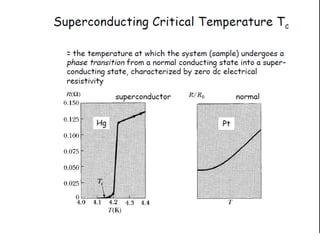
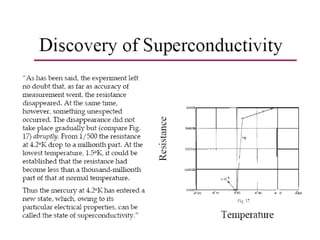
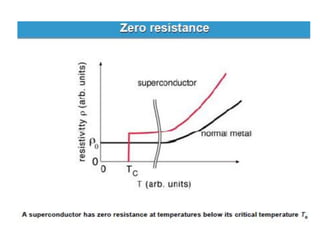
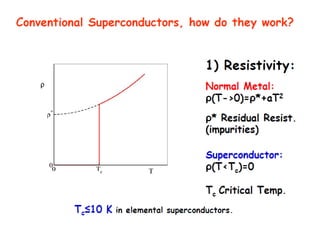
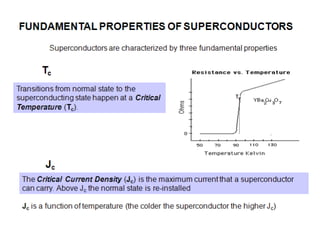
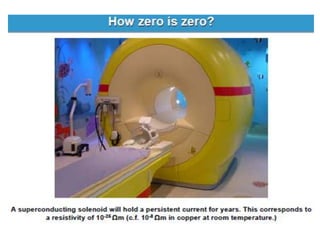
 For some materials, the resistivity vanishes at some low temperature:
                   they become superconducting.

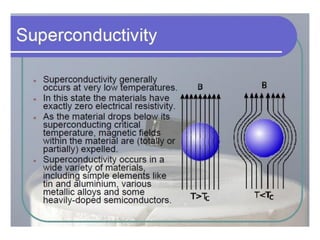
                                   Superconductivity is the ability of
                                   certain materials to conduct
                                   electrical current with no resistance.
                                   Thus, superconductors can carry
                                   large amounts of current with little
                                   or no loss of energy.


Type I superconductors: pure metals, have low critical field

Type II superconductors: primarily of alloys or intermetallic compounds
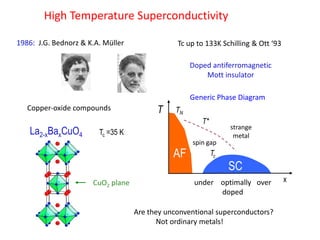
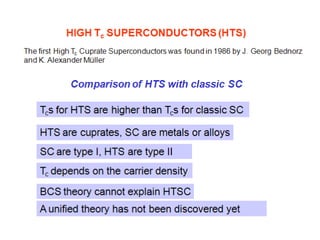
High Temperature Superconductivity

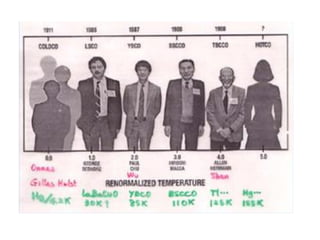
1986: J.G. Bednorz & K.A. Müller               Tc up to 133K Schilling & Ott ‘93

                                                   Doped antiferromagnetic
                                                       Mott insulator

                                                   Generic Phase Diagram
   Copper-oxide compounds                T    TN
                                                      T*
                                                                strange
   La2-xBaxCuO4         Tc =35 K                                 metal
                                                   spin gap
                                              AF           Tc
                                                                SC
                      CuO2 plane                    under optimally over           x
                                                          doped

                                   Are they unconventional superconductors?
                                          Not ordinary metals!
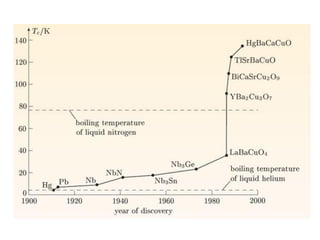
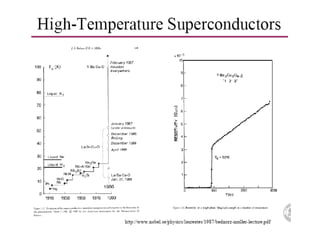
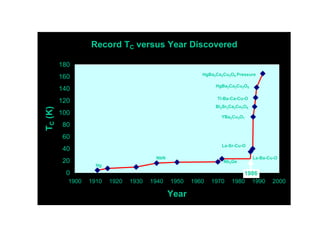
Record TC versus Year Discovered

         180
                                                        HgBa2Ca2Cu2O8 Pressure
         160
                                                             HgBa2Ca2Cu2O8
         140
                                                              Tl-Ba-Ca-Cu-O
         120
                                                             Bi2Sr2Ca2Cu3O8
TC (K)


         100
                                                               YBa2Cu3O7
         80
         60
                                                                La-Sr-Cu-O
         40
                                        NbN                                   La-Ba-Cu-O
         20                                                     Nb3Ge
                    Hg
          0                                                             1986
           1900   1910   1920   1930   1940   1950   1960   1970    1980 1990         2000

                                              Year
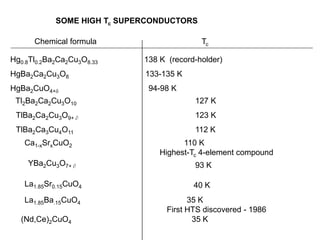
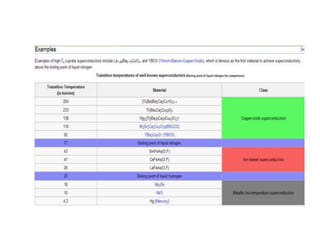
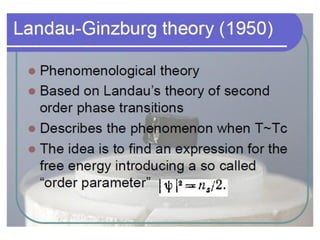
SOME HIGH Tc SUPERCONDUCTORS

      Chemical formula                      Tc

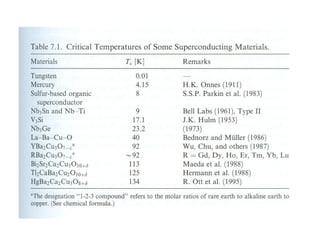
Hg0.8Tl0.2Ba2Ca2Cu3O8.33     138 K (record-holder)
HgBa2Ca2Cu3O8                133-135 K
HgBa2CuO4+                   94-98 K
 Tl2Ba2Ca2Cu3O10                          127 K
 TlBa2Ca2Cu3O9+                          123 K
 TlBa2Ca3Cu4O11                           112 K
   Ca1-xSrxCuO2                        110 K
                                 Highest-Tc 4-element compound
    YBa2Cu3O7+                           93 K

   La1.85Sr0.15CuO4                       40 K
   La1.85Ba.15CuO4                       35 K
                                   First HTS discovered - 1986
  (Nd,Ce)2CuO4                            35 K
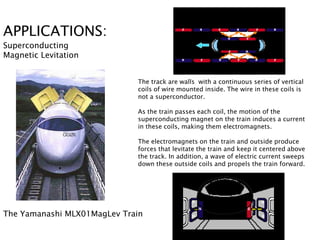
APPLICATIONS:
Superconducting
Magnetic Levitation


                             The track are walls with a continuous series of vertical
                             coils of wire mounted inside. The wire in these coils is
                             not a superconductor.

                             As the train passes each coil, the motion of the
                             superconducting magnet on the train induces a current
                             in these coils, making them electromagnets.
                             The electromagnets on the train and outside produce
                             forces that levitate the train and keep it centered above
                             the track. In addition, a wave of electric current sweeps
                             down these outside coils and propels the train forward.


The Yamanashi MLX01MagLev Train
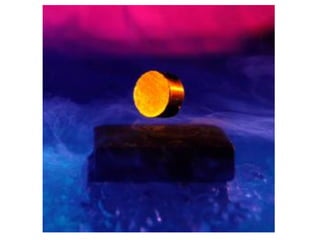
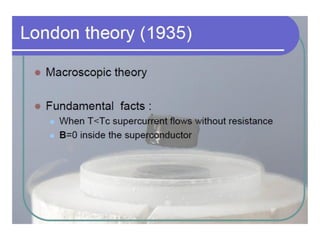
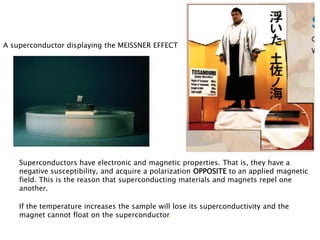
A superconductor displaying the MEISSNER EFFECT


    Superconductors have electronic and magnetic properties. That is, they have a
    negative susceptibility, and acquire a polarization OPPOSITE to an applied magnetic
    field. This is the reason that superconducting materials and magnets repel one
    another.

    If the temperature increases the sample will lose its superconductivity and the
    magnet cannot float on the superconductor.
Lecture 1 introduction

Lecture 1 introduction

  • 1.
    Superconductivity Tokyo University ofScience May, 2010 Professor Allen Hermann Department of Physics University of Colorado Boulder, CO 80401 USA and Nanotech Solutions, LLC Lexington,KY 40506 USA allen.hermann@colorado.edu
  • 2.
    Syllabus for “Superconductivity”,a 7 (1 1/2 hour) lecture series in Low- Temperature Physics I at Tokyo University of Science, 2010 Allen Hermann, Ph.D. Lecture 1. Introduction Discovery, history, and superconducting properties (zero resistance and flux expulsion) Type I and Type II superconductors Low Tc and High Tc Materials
  • 3.
    Lecture 2.Phenomenology: Superfluidsand their properties Electrodynamics and the Magnetic Penetration Length The London Equations and magnetic effects Fluxoids
  • 4.
    Lecture 3. Phenomenology:Ginsburg-Landau theory and the intermediate state •Landau Theory of Phase Transitions •Ginsburg-Landau Expansion •Coherence Length •The Ginsburg-Landau Equations •Abrikosov Lattice and Flux Pinning
  • 5.
    Lecture 4. MicroscopicTheory The 2-electron Problem Annihilation and Creation Operators Solution of the Schroedinger Equation Cooper Pairs The Many Electron Problem- BCS Theory Solution of the Many Particle Schroedinger Equation by the Bogoliubov- Valatin Transformation The BCS Energy Gap
  • 6.
    Lecture 5. JosephsonEffects Pair Tunneling and Weak Links SIS Josephson Junctions Superconducting Quantum Interference Devices (SQUIDs)
  • 7.
    Lecture 6. SuperconductingMaterials and their structures Low Tc Metals and Alloys Organic superconductors High Tc materials: cuprates, borides, and AsFe superconductors
  • 8.
    Lecture 7. Applicationsand Devices Levitation Wire applications and Superconducting Magnets Flux Flow Issues in High Tc, High Jc Wire Electronic devices Using Josephson Junctions and SQUIDS Nanotechnology and Superconductivity
  • 9.
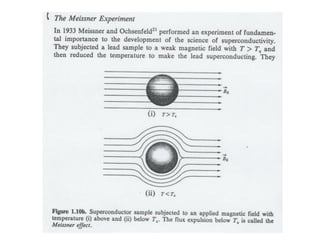
    Lecture 1 Introduction •Discovery, history and superconducting properties (zero resistance, magnetic flux expulsion) • Type I and Type II superconductors • Low Tc and High Tc materials
  • 25.
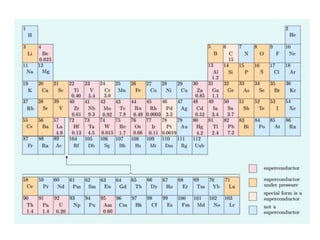
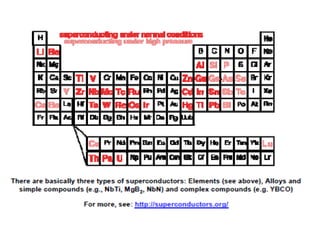
    TYPES OF SUPERCONDUCTORS Thereare two types of superconductors, Type I and Type II, according to their behaviour in a magnetic field Type I superconducting state normal state This transition is abrupt Type I superconductors are pure metals and alloys
  • 26.
    Type II superconducting normal state is gradual
  • 27.
    WHAT IS SUPERCONDUCTIVITY?? For some materials, the resistivity vanishes at some low temperature: they become superconducting. Superconductivity is the ability of certain materials to conduct electrical current with no resistance. Thus, superconductors can carry large amounts of current with little or no loss of energy. Type I superconductors: pure metals, have low critical field Type II superconductors: primarily of alloys or intermetallic compounds
  • 52.
    High Temperature Superconductivity 1986:J.G. Bednorz & K.A. Müller Tc up to 133K Schilling & Ott ‘93 Doped antiferromagnetic Mott insulator Generic Phase Diagram Copper-oxide compounds T TN T* strange La2-xBaxCuO4 Tc =35 K metal spin gap AF Tc SC CuO2 plane under optimally over x doped Are they unconventional superconductors? Not ordinary metals!
  • 55.
    Record TC versusYear Discovered 180 HgBa2Ca2Cu2O8 Pressure 160 HgBa2Ca2Cu2O8 140 Tl-Ba-Ca-Cu-O 120 Bi2Sr2Ca2Cu3O8 TC (K) 100 YBa2Cu3O7 80 60 La-Sr-Cu-O 40 NbN La-Ba-Cu-O 20 Nb3Ge Hg 0 1986 1900 1910 1920 1930 1940 1950 1960 1970 1980 1990 2000 Year
  • 58.
    SOME HIGH TcSUPERCONDUCTORS Chemical formula Tc Hg0.8Tl0.2Ba2Ca2Cu3O8.33 138 K (record-holder) HgBa2Ca2Cu3O8 133-135 K HgBa2CuO4+ 94-98 K Tl2Ba2Ca2Cu3O10 127 K TlBa2Ca2Cu3O9+  123 K TlBa2Ca3Cu4O11 112 K Ca1-xSrxCuO2 110 K Highest-Tc 4-element compound YBa2Cu3O7+  93 K La1.85Sr0.15CuO4 40 K La1.85Ba.15CuO4 35 K First HTS discovered - 1986 (Nd,Ce)2CuO4 35 K
  • 62.
    APPLICATIONS: Superconducting Magnetic Levitation The track are walls with a continuous series of vertical coils of wire mounted inside. The wire in these coils is not a superconductor. As the train passes each coil, the motion of the superconducting magnet on the train induces a current in these coils, making them electromagnets. The electromagnets on the train and outside produce forces that levitate the train and keep it centered above the track. In addition, a wave of electric current sweeps down these outside coils and propels the train forward. The Yamanashi MLX01MagLev Train
  • 65.
    A superconductor displayingthe MEISSNER EFFECT Superconductors have electronic and magnetic properties. That is, they have a negative susceptibility, and acquire a polarization OPPOSITE to an applied magnetic field. This is the reason that superconducting materials and magnets repel one another. If the temperature increases the sample will lose its superconductivity and the magnet cannot float on the superconductor.