ADVANCE ENGINEERING MATERIALS (ME-862)
DR BILAL ANJUM
EMAIL BANJUMAHMED@GMAIL.COM
MOB:00923335182000
CHAPTER 1: ATOMIC STRUCTURE AND
INTERATOMIC BONDING
CHAPTER 1A CLASSIFICATION OF METALS
OVERVIEW
• Introduction to Materials Science & Eng.
• Classification of Eng. Materials
• Electrons in Atoms
• Quantum Numbers
• Electron Configurations
• Periodic Table
• Bonding Forces and Energies
• Primary Interatomic Bonds
• Ionic Bonding
• Covalent Bonding
• Metallic Bonding
• Secondary Bonding Or Van Der Waals Bonding
• Classification of Metals
INTRODUCTION
Materials science involves investigating the structure-property relationship.
Materials engineering is, on the basis of these structure–property correlations, designing the
structure of a material to produce a predetermined set of properties.
A materials scientist - develop or synthesize new materials.
A materials engineer - create new products or systems using existing materials, and/or to
develop techniques for processing materials.
Structure of a material usually relates to the arrangement of its internal components.
• Subatomic structure involves electrons within the individual atoms and interactions with
their nuclei.
• On an atomic level structure encompasses the organization of atoms or molecules relative to
one another.
• Large groups of atoms that are normally agglomerated together, is termed microscopic,
meaning that which is subject to direct observation using some type of microscope.
• Finally, structural elements that may be viewed with the naked eye are termed macroscopic.
INTRODUCTION
A property is a material trait in terms of the kind and magnitude of response to a specific
imposed stimulus.
Broadly divided into 6 different categories:
• Mechanical properties - Elastic modulus (stiffness), strength, and toughness.
• Electrical properties - Electrical conductivity and dielectric constant.
• Thermal - heat capacity and thermal conductivity.
• Magnetic properties - the response of a material to the application of a magnetic field.
• Optical properties - the stimulus is electromagnetic or light radiation; index of refraction
and reflectivity are representative optical properties.
• Deteriorative characteristics relate to the chemical reactivity of materials.
INTRODUCTION
In addition to structure and properties, two other important components are processing
and performance.
Relationships of these four components:
the structure of a material will depend on how it is processed.
Furthermore, a material’s performance will be a function of its properties.
Same Material: Al2O3
These differences in optical properties
are a consequence of differences in
structure of these materials, which
have resulted from the way the
materials were processed.
Single Crystal
(transparent)
Polycrystalline
(translucent)
Polycrystalline with
small pores (opaque)
CLASSIFICATION OF MATERIALS
Metals One or more metallic elements
Fe, Al, Cu
Stiff, strong yet ductile
good conductors of electricity and heat
Not transparent to visible light
Ceramics Ceramics are compounds between
metallic and nonmetallic elements
Oxides, Nitrides, Carbides
Stiffnesses and strengths are comparable to those of the metals
Typically very hard.
Historically, ceramics have exhibited extreme brittleness
Newer ceramics have improved resistance to fracture.
Typically low electrical conductivities
More resistant to high temperatures and harsh environments.
Polymers Organic compounds that are
chemically based on carbon,
hydrogen, and other nonmetallic
elements (i.e., O, N, and Si)
Low densities
Not as stiff nor as strong as these other material types. extremely
Ductile and pliable (i.e., plastic), which means they are easily formed
into complex shapes.
Relatively inert chemically and unreactive in a large number of
environments.
ELECTRONS IN ATOMS
Earlier - simplified Bohr atomic model
• Electrons are assumed to revolve around the atomic nucleus
in discrete orbitals, and the position of any particular
electron is more or less well defined in terms of its orbital.
• Electron energies as being associated with energy levels or
states.
• These states do not vary continuously with energy; that is,
adjacent states are separated by finite energies
Both position
(electron orbitals)
and energy
(quantized energy
levels)
Later Wave-mechanical model
• Electron is considered to exhibit both wavelike and particle-
like characteristics.
• An electron is no longer treated as a particle moving in a
discrete orbital; rather, position is considered to be the
probability of an electron’s being at various locations around
the nucleus.
• In other words, position is described by a probability
distribution or electron cloud.
QUANTUM NUMBERS
Quantum mechanical model
Every electron in an atom is characterized by 4 parameters
called quantum numbers
Quantum numbers - describe the characteristics of
electrons and their orbitals
• Principal quantum number: n
• Angular momentum quantum number: l
• Magnetic quantum number: m1
• Spin quantum number: mg
The principal quantum number
• The principal quantum number n describes the average
distance of the orbital from the nucleus.
• It can have positive integer (whole number) values: 1, 2, 3,
4, and so on.
• The larger the value of n, the higher the energy and the
larger the orbital.
•
The angular momentum quantum number
• The angular momentum quantum
number l describes the shape of the orbital, and the
shape is limited by the principal quantum number n:
• The angular momentum quantum number l can
have positive integer values from 0 to n–1.
• For example, if the n value is 3, three values are
allowed for l: 0, 1, and 2.
• Orbitals that have the same value of n but different values
of l are called subshells.
• The following letters corresponding to the different values
of l.
The value of l defines the shape of the orbital, and the
value of n defines the size.
Letter Designations of the Subshells
Value of l (subshell)
Letter
0
s
1
p
2
QUANTUM NUMBERS
The magnetic quantum number
• This number describes how the various orbitals are
oriented in space.
• The value of this number depends on the value of l.
The values allowed are integers from –l to 0 to +l.
• For example, if the value of l = 1 (p orbital), you can
write three values for this number: –1, 0, and +1.
• This means that there are three different p
subshells for a particular orbital.
• The subshells have the same energy but different
orientations in space.
The spin quantum number
This number describes the direction the electron is
spinning in a magnetic field — either clockwise or
counterclockwise.
Only two values are allowed: +1/2 or –1/2.
For each subshell, there can be only two electrons, one
with a spin of +1/2 and another with a spin of –1/2.
ELECTRON CONFIGURATION - EXAMPLE
First, the valence electrons are those that occupy the outermost shell.
In addition, some atoms have what are termed stable electron configurations; that
is, the states within the outermost or valence electron shell are completely filled.
Kr [36] 1s2
2s2
2p6
3s2
3p6
4s2
3d10
4p6
PERIODIC TABLE
Increasing atomic number, in seven horizontal rows called periods.
Column group have similar valence electron, as well as chemical and physical properties.
Groups IIIA, IVA, and VA display
characteristics that are intermediate
between the metals and nonmetals by
virtue of their valence electrons.
Inert gases, filled
electron shells &
stable electron
configurations.
VIA One VIIA Two
Deficient in Electrons
from having stable
structures
IA one
IIA two
Electrons in Excess of
stable structures.
IIIB through IIB, are termed the transition metals, which
have partially filled d electron states
Elements situated on the right-hand side of the table are electronegative; that is, they readily accept electrons to form
negatively charged ions.
Electronegativity increases in moving from left to right and from bottom to top. Atoms are more likely to accept electrons
if their outer shells are almost full, and if they are less “shielded” from (i.e., closer to) the nucleus.
BONDING FORCES AND ENERGIES
Attractive force FA - particular type of bonding between the two atoms
Repulsive forces - interactions between electron clouds of the two atoms
Important - small values of r - outer electron shells of the two atoms begin to overlap.
When FA and FR become equal, there is no net force and a state of equilibrium exists.
The centers of the two atoms will remain separated by the equilibrium spacing r0
• Large bonding energies typically also have high melting temperatures.
• Slope for stiff material at the r = r0 position on the curve will be quite steep
• Evs r curve-deep and narrow “trough,” - a low coefficient of thermal expansion
The minimum in the net energy curve corresponds to the equilibrium spacing, r0.
Bonding energy for these two atoms, E0, corresponds to the energy at this
minimum point. (Stable State – Minimum Potential Energy)
IONIC BONDING
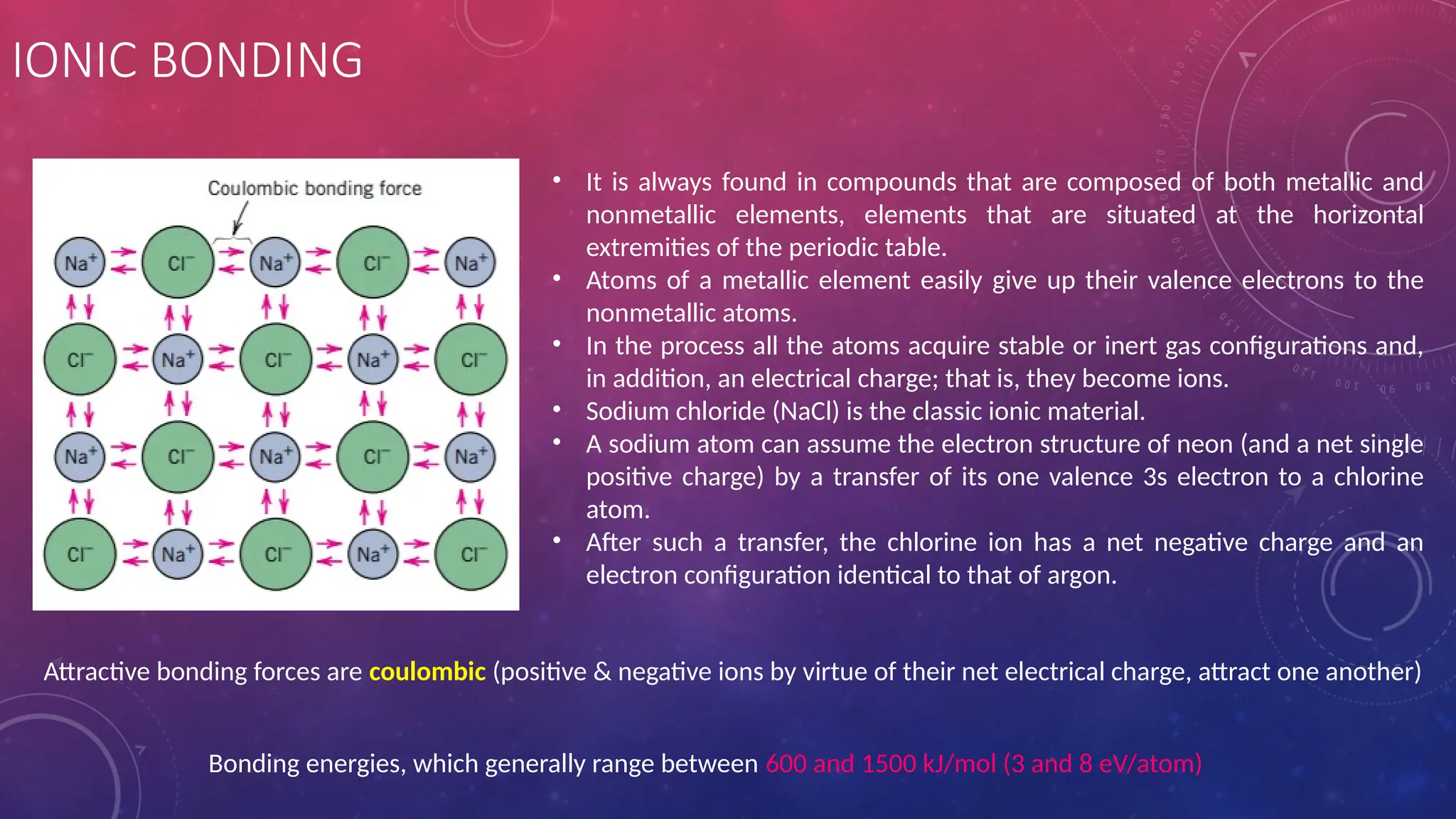
• It is always found in compounds that are composed of both metallic and
nonmetallic elements, elements that are situated at the horizontal
extremities of the periodic table.
• Atoms of a metallic element easily give up their valence electrons to the
nonmetallic atoms.
• In the process all the atoms acquire stable or inert gas configurations and,
in addition, an electrical charge; that is, they become ions.
• Sodium chloride (NaCl) is the classic ionic material.
• A sodium atom can assume the electron structure of neon (and a net single
positive charge) by a transfer of its one valence 3s electron to a chlorine
atom.
• After such a transfer, the chlorine ion has a net negative charge and an
electron configuration identical to that of argon.
Attractive bonding forces are coulombic (positive & negative ions by virtue of their net electrical charge, attract one another)
Bonding energies, which generally range between 600 and 1500 kJ/mol (3 and 8 eV/atom)
COVALENT BONDING
• In covalent bonding, stable electron configurations are assumed by the sharing
of electrons between adjacent atoms. Two atoms that are covalently bonded will
each contribute at least one electron to the bond, and the shared electrons may
be considered to belong to both atoms.
• Covalent bonding for a molecule of methane (CH4).
• The carbon atom has four valence electrons, whereas each of the four hydrogen
atoms has a single valence electron.
• Each hydrogen atom can acquire a helium electron configuration (two 1s valence
electrons) when the carbon atom shares with it one electron.
• The carbon now has four additional shared electrons, one from each hydrogen,
for a total of eight valence electrons, and the electron structure of neon.
• The covalent bond is directional; that is, it is between specific atoms and may
exist only in the direction between one atom and another that participates in the
electron sharing.
METALLIC BONDING
• Metallic bonding, the final primary bonding type, is found in metals and their
alloys.
• Metallic materials have one, two, or at most, three valence electrons.
• These valence electrons are not bound to any particular atom in the solid and are
more or less free to drift throughout the entire metal.
• They may be thought of as belonging to the metal as a whole, or forming a “sea of
electrons” or an “electron cloud.”
• The remaining nonvalence electrons and atomic nuclei form what are called ion
cores, which possess a net positive charge equal in magnitude to the total valence
electron charge per atom.
• Metals are good conductors of both electricity and heat, as a consequence of
their free electrons
SECONDARY BONDING
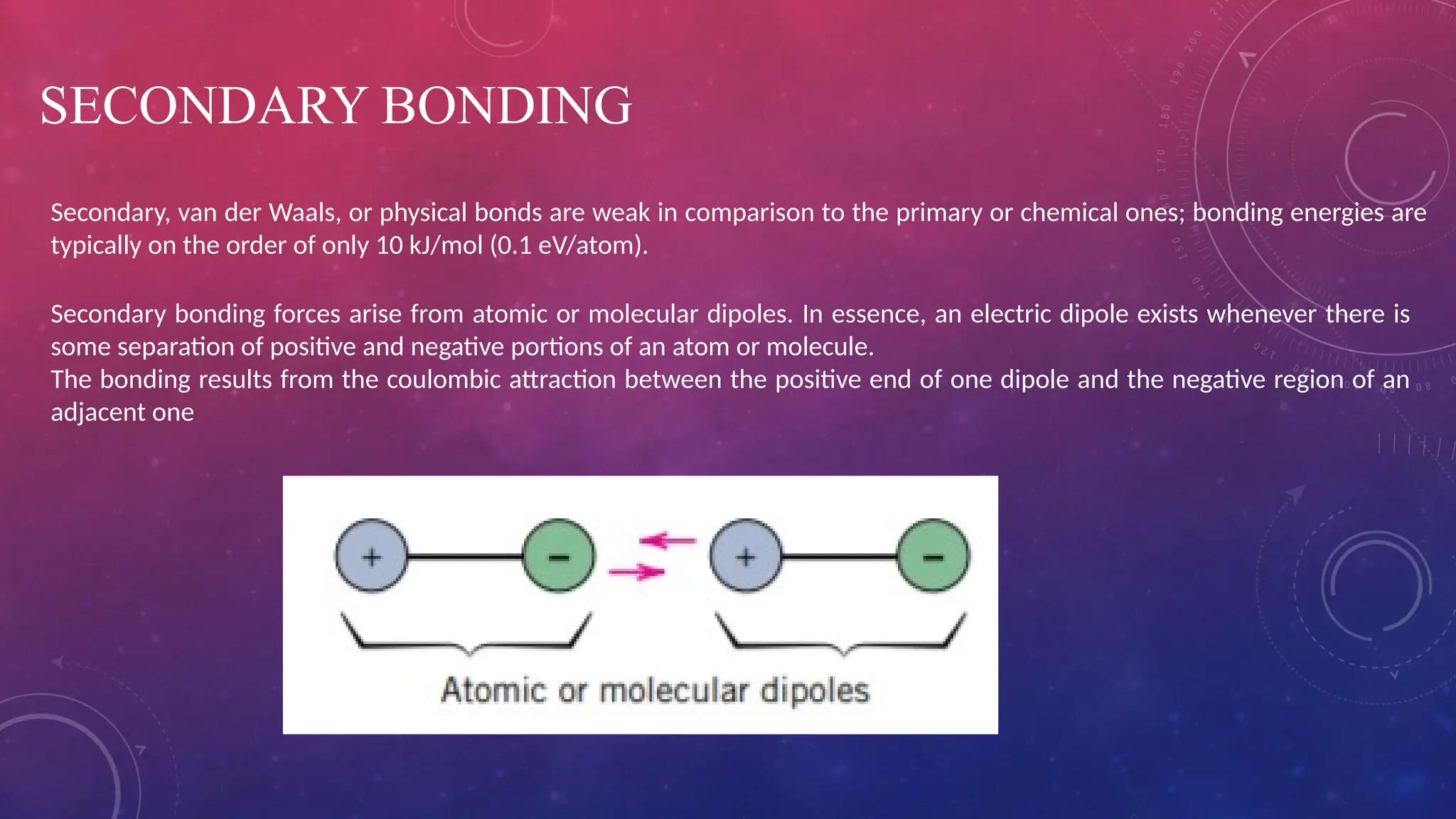
Secondary, van der Waals, or physical bonds are weak in comparison to the primary or chemical ones; bonding energies are
typically on the order of only 10 kJ/mol (0.1 eV/atom).
Secondary bonding forces arise from atomic or molecular dipoles. In essence, an electric dipole exists whenever there is
some separation of positive and negative portions of an atom or molecule.
The bonding results from the coulombic attraction between the positive end of one dipole and the negative region of an
adjacent one
SECONDARY BONDING
Fluctuating Induced Dipole Bonds Polar Molecule-Induced Dipole Bonds
• All atoms are experiencing constant vibrational motion
that can cause instantaneous and short-lived distortions
of this electrical symmetry for some of the atoms or
molecules, and the creation of small electric dipoles.
• One of these dipoles can in turn produce a displacement
of the electron distribution of an adjacent molecule or
atom, which induces the second one also to become a
dipole that is then weakly attracted or bonded to the first
• This is one type of van der Waals bonding.
• These attractive forces may exist between large numbers
of atoms or molecules, which forces are temporary and
fluctuate with time.
• Permanent dipole moments exist in some molecules by
virtue of an asymmetrical arrangement of positively and
negatively charged regions; such molecules are termed polar
molecules. Hydrogen chloride molecule; a permanent dipole
moment arises from net positive and negative charges that
are respectively associated with the hydrogen and chlorine
ends of the HCl molecule.
Permanent Dipole Bonds
Van der Waals forces will also exist between adjacent polar
molecules. The associated bonding energies are significantly
greater than for bonds involving induced dipoles.
CLASSIFICATION OF METALS
Metals
Ferrous
Steels Cast Iron
Non-
Ferrous
Copper Aluminum Magnesium Titanium
Steels
<1.4wt%C
Cast Irons
3-4.5wt%C
microstructure:
ferrite, graphite
cementite
Steels
Low Alloy
Low
carbon (<
0.25 wt.%)
Plain
None
1010
0
-
+
High
strength low
alloy (HSLA)
Cr, V, Ni,
Mo
4310
+
0
+
Medium Carbon
(0.25-0.6 wt.%)
Plain
None
1040
+
+
0
Heat
Treatable
Cr, Ni, Mo
4340
++
++
-
High Carbon
(0.6-1.4 wt.
%)
Plain
None
1095
++
+
-
Tool Steels
Cr, V, W,
Mo
4190
+++
++
--
High Alloy
Austenitic
SS
Cr, Ni, Mo
304
0
0
++
increasing strength, cost, decreasing ductility
NAME
ADDITIONS
EXAMPLE
Hardenability
TS
EL
USES
auto
structure
sheet
bridges
towers
pressure
vessels
crank
shafts
bolts
hammers
blades
pistons
gears
wear
application
wear
applications
drills
saws
dies
high Temperature
applications
turbines
furnaces
Very corrosion
resistant
20
FERROUS ALLOYS
Iron containing – Steels
Nomenclature AISI (American Iron and Steel Institute)
10xx Plain Carbon Steels
11xx Plain Carbon Steels (resulfurized for machinability)
15xx Mn (10 ~ 20%)
40xx Mo (0.20 ~ 0.30%)
43xx Ni (1.65 - 2.00%), Cr (0.4 - 0.90%), Mo (0.2 - 0.3%)
where xx is wt% C x 100
Example: 1060 steel – plain carbon steel with 0.60 wt% C
Stainless Steel -- >11% Cr
NONFERROUS ALLOYS
NonFerrous
Alloys
• Al Alloys
-lower r : 2.7g/cm3
-Cu, Mg, Si, Mn, Zn additions
-solid sol. or precip.
strengthened (struct.
aircraft parts
& packaging)
• Mg Alloys
-very low r : 1.7g/cm3
-ignites easily
- aircraft, missiles
• Refractory metals
-high melting T
-Nb, Mo, W, Ta
• Noble metals
-Ag, Au, Pt
- oxid./corr. resistant
• Ti Alloys
-lower r : 4.5g/cm3
vs 7.9 for steel
-reactive at high T
- space applic.
• Cu Alloys
Brass: Zn is subst. impurity
(costume jewelry, coins,
corrosion resistant)
Bronze : Sn, Al, Si, Ni are
subst. impurity
(bushings, landing
gear)
Cu-Be :
precip. hardened
for strength

Introduction to Materials Science and Engineering.pptx

  • 1.
    ADVANCE ENGINEERING MATERIALS(ME-862) DR BILAL ANJUM EMAIL BANJUMAHMED@GMAIL.COM MOB:00923335182000 CHAPTER 1: ATOMIC STRUCTURE AND INTERATOMIC BONDING CHAPTER 1A CLASSIFICATION OF METALS
  • 2.
    OVERVIEW • Introduction toMaterials Science & Eng. • Classification of Eng. Materials • Electrons in Atoms • Quantum Numbers • Electron Configurations • Periodic Table • Bonding Forces and Energies • Primary Interatomic Bonds • Ionic Bonding • Covalent Bonding • Metallic Bonding • Secondary Bonding Or Van Der Waals Bonding • Classification of Metals
  • 3.
    INTRODUCTION Materials science involvesinvestigating the structure-property relationship. Materials engineering is, on the basis of these structure–property correlations, designing the structure of a material to produce a predetermined set of properties. A materials scientist - develop or synthesize new materials. A materials engineer - create new products or systems using existing materials, and/or to develop techniques for processing materials. Structure of a material usually relates to the arrangement of its internal components. • Subatomic structure involves electrons within the individual atoms and interactions with their nuclei. • On an atomic level structure encompasses the organization of atoms or molecules relative to one another. • Large groups of atoms that are normally agglomerated together, is termed microscopic, meaning that which is subject to direct observation using some type of microscope. • Finally, structural elements that may be viewed with the naked eye are termed macroscopic.
  • 4.
    INTRODUCTION A property isa material trait in terms of the kind and magnitude of response to a specific imposed stimulus. Broadly divided into 6 different categories: • Mechanical properties - Elastic modulus (stiffness), strength, and toughness. • Electrical properties - Electrical conductivity and dielectric constant. • Thermal - heat capacity and thermal conductivity. • Magnetic properties - the response of a material to the application of a magnetic field. • Optical properties - the stimulus is electromagnetic or light radiation; index of refraction and reflectivity are representative optical properties. • Deteriorative characteristics relate to the chemical reactivity of materials.
  • 5.
    INTRODUCTION In addition tostructure and properties, two other important components are processing and performance. Relationships of these four components: the structure of a material will depend on how it is processed. Furthermore, a material’s performance will be a function of its properties. Same Material: Al2O3 These differences in optical properties are a consequence of differences in structure of these materials, which have resulted from the way the materials were processed. Single Crystal (transparent) Polycrystalline (translucent) Polycrystalline with small pores (opaque)
  • 6.
    CLASSIFICATION OF MATERIALS MetalsOne or more metallic elements Fe, Al, Cu Stiff, strong yet ductile good conductors of electricity and heat Not transparent to visible light Ceramics Ceramics are compounds between metallic and nonmetallic elements Oxides, Nitrides, Carbides Stiffnesses and strengths are comparable to those of the metals Typically very hard. Historically, ceramics have exhibited extreme brittleness Newer ceramics have improved resistance to fracture. Typically low electrical conductivities More resistant to high temperatures and harsh environments. Polymers Organic compounds that are chemically based on carbon, hydrogen, and other nonmetallic elements (i.e., O, N, and Si) Low densities Not as stiff nor as strong as these other material types. extremely Ductile and pliable (i.e., plastic), which means they are easily formed into complex shapes. Relatively inert chemically and unreactive in a large number of environments.
  • 7.
    ELECTRONS IN ATOMS Earlier- simplified Bohr atomic model • Electrons are assumed to revolve around the atomic nucleus in discrete orbitals, and the position of any particular electron is more or less well defined in terms of its orbital. • Electron energies as being associated with energy levels or states. • These states do not vary continuously with energy; that is, adjacent states are separated by finite energies Both position (electron orbitals) and energy (quantized energy levels) Later Wave-mechanical model • Electron is considered to exhibit both wavelike and particle- like characteristics. • An electron is no longer treated as a particle moving in a discrete orbital; rather, position is considered to be the probability of an electron’s being at various locations around the nucleus. • In other words, position is described by a probability distribution or electron cloud.
  • 8.
    QUANTUM NUMBERS Quantum mechanicalmodel Every electron in an atom is characterized by 4 parameters called quantum numbers Quantum numbers - describe the characteristics of electrons and their orbitals • Principal quantum number: n • Angular momentum quantum number: l • Magnetic quantum number: m1 • Spin quantum number: mg The principal quantum number • The principal quantum number n describes the average distance of the orbital from the nucleus. • It can have positive integer (whole number) values: 1, 2, 3, 4, and so on. • The larger the value of n, the higher the energy and the larger the orbital. • The angular momentum quantum number • The angular momentum quantum number l describes the shape of the orbital, and the shape is limited by the principal quantum number n: • The angular momentum quantum number l can have positive integer values from 0 to n–1. • For example, if the n value is 3, three values are allowed for l: 0, 1, and 2. • Orbitals that have the same value of n but different values of l are called subshells. • The following letters corresponding to the different values of l. The value of l defines the shape of the orbital, and the value of n defines the size. Letter Designations of the Subshells Value of l (subshell) Letter 0 s 1 p 2
  • 9.
    QUANTUM NUMBERS The magneticquantum number • This number describes how the various orbitals are oriented in space. • The value of this number depends on the value of l. The values allowed are integers from –l to 0 to +l. • For example, if the value of l = 1 (p orbital), you can write three values for this number: –1, 0, and +1. • This means that there are three different p subshells for a particular orbital. • The subshells have the same energy but different orientations in space. The spin quantum number This number describes the direction the electron is spinning in a magnetic field — either clockwise or counterclockwise. Only two values are allowed: +1/2 or –1/2. For each subshell, there can be only two electrons, one with a spin of +1/2 and another with a spin of –1/2.
  • 10.
    ELECTRON CONFIGURATION -EXAMPLE First, the valence electrons are those that occupy the outermost shell. In addition, some atoms have what are termed stable electron configurations; that is, the states within the outermost or valence electron shell are completely filled. Kr [36] 1s2 2s2 2p6 3s2 3p6 4s2 3d10 4p6
  • 11.
    PERIODIC TABLE Increasing atomicnumber, in seven horizontal rows called periods. Column group have similar valence electron, as well as chemical and physical properties. Groups IIIA, IVA, and VA display characteristics that are intermediate between the metals and nonmetals by virtue of their valence electrons. Inert gases, filled electron shells & stable electron configurations. VIA One VIIA Two Deficient in Electrons from having stable structures IA one IIA two Electrons in Excess of stable structures. IIIB through IIB, are termed the transition metals, which have partially filled d electron states Elements situated on the right-hand side of the table are electronegative; that is, they readily accept electrons to form negatively charged ions. Electronegativity increases in moving from left to right and from bottom to top. Atoms are more likely to accept electrons if their outer shells are almost full, and if they are less “shielded” from (i.e., closer to) the nucleus.
  • 12.
    BONDING FORCES ANDENERGIES Attractive force FA - particular type of bonding between the two atoms Repulsive forces - interactions between electron clouds of the two atoms Important - small values of r - outer electron shells of the two atoms begin to overlap. When FA and FR become equal, there is no net force and a state of equilibrium exists. The centers of the two atoms will remain separated by the equilibrium spacing r0 • Large bonding energies typically also have high melting temperatures. • Slope for stiff material at the r = r0 position on the curve will be quite steep • Evs r curve-deep and narrow “trough,” - a low coefficient of thermal expansion The minimum in the net energy curve corresponds to the equilibrium spacing, r0. Bonding energy for these two atoms, E0, corresponds to the energy at this minimum point. (Stable State – Minimum Potential Energy)
  • 13.
    IONIC BONDING • Itis always found in compounds that are composed of both metallic and nonmetallic elements, elements that are situated at the horizontal extremities of the periodic table. • Atoms of a metallic element easily give up their valence electrons to the nonmetallic atoms. • In the process all the atoms acquire stable or inert gas configurations and, in addition, an electrical charge; that is, they become ions. • Sodium chloride (NaCl) is the classic ionic material. • A sodium atom can assume the electron structure of neon (and a net single positive charge) by a transfer of its one valence 3s electron to a chlorine atom. • After such a transfer, the chlorine ion has a net negative charge and an electron configuration identical to that of argon. Attractive bonding forces are coulombic (positive & negative ions by virtue of their net electrical charge, attract one another) Bonding energies, which generally range between 600 and 1500 kJ/mol (3 and 8 eV/atom)
  • 14.
    COVALENT BONDING • Incovalent bonding, stable electron configurations are assumed by the sharing of electrons between adjacent atoms. Two atoms that are covalently bonded will each contribute at least one electron to the bond, and the shared electrons may be considered to belong to both atoms. • Covalent bonding for a molecule of methane (CH4). • The carbon atom has four valence electrons, whereas each of the four hydrogen atoms has a single valence electron. • Each hydrogen atom can acquire a helium electron configuration (two 1s valence electrons) when the carbon atom shares with it one electron. • The carbon now has four additional shared electrons, one from each hydrogen, for a total of eight valence electrons, and the electron structure of neon. • The covalent bond is directional; that is, it is between specific atoms and may exist only in the direction between one atom and another that participates in the electron sharing.
  • 15.
    METALLIC BONDING • Metallicbonding, the final primary bonding type, is found in metals and their alloys. • Metallic materials have one, two, or at most, three valence electrons. • These valence electrons are not bound to any particular atom in the solid and are more or less free to drift throughout the entire metal. • They may be thought of as belonging to the metal as a whole, or forming a “sea of electrons” or an “electron cloud.” • The remaining nonvalence electrons and atomic nuclei form what are called ion cores, which possess a net positive charge equal in magnitude to the total valence electron charge per atom. • Metals are good conductors of both electricity and heat, as a consequence of their free electrons
  • 16.
    SECONDARY BONDING Secondary, vander Waals, or physical bonds are weak in comparison to the primary or chemical ones; bonding energies are typically on the order of only 10 kJ/mol (0.1 eV/atom). Secondary bonding forces arise from atomic or molecular dipoles. In essence, an electric dipole exists whenever there is some separation of positive and negative portions of an atom or molecule. The bonding results from the coulombic attraction between the positive end of one dipole and the negative region of an adjacent one
  • 17.
    SECONDARY BONDING Fluctuating InducedDipole Bonds Polar Molecule-Induced Dipole Bonds • All atoms are experiencing constant vibrational motion that can cause instantaneous and short-lived distortions of this electrical symmetry for some of the atoms or molecules, and the creation of small electric dipoles. • One of these dipoles can in turn produce a displacement of the electron distribution of an adjacent molecule or atom, which induces the second one also to become a dipole that is then weakly attracted or bonded to the first • This is one type of van der Waals bonding. • These attractive forces may exist between large numbers of atoms or molecules, which forces are temporary and fluctuate with time. • Permanent dipole moments exist in some molecules by virtue of an asymmetrical arrangement of positively and negatively charged regions; such molecules are termed polar molecules. Hydrogen chloride molecule; a permanent dipole moment arises from net positive and negative charges that are respectively associated with the hydrogen and chlorine ends of the HCl molecule. Permanent Dipole Bonds Van der Waals forces will also exist between adjacent polar molecules. The associated bonding energies are significantly greater than for bonds involving induced dipoles.
  • 18.
    CLASSIFICATION OF METALS Metals Ferrous SteelsCast Iron Non- Ferrous Copper Aluminum Magnesium Titanium Steels <1.4wt%C Cast Irons 3-4.5wt%C microstructure: ferrite, graphite cementite
  • 19.
    Steels Low Alloy Low carbon (< 0.25wt.%) Plain None 1010 0 - + High strength low alloy (HSLA) Cr, V, Ni, Mo 4310 + 0 + Medium Carbon (0.25-0.6 wt.%) Plain None 1040 + + 0 Heat Treatable Cr, Ni, Mo 4340 ++ ++ - High Carbon (0.6-1.4 wt. %) Plain None 1095 ++ + - Tool Steels Cr, V, W, Mo 4190 +++ ++ -- High Alloy Austenitic SS Cr, Ni, Mo 304 0 0 ++ increasing strength, cost, decreasing ductility NAME ADDITIONS EXAMPLE Hardenability TS EL USES auto structure sheet bridges towers pressure vessels crank shafts bolts hammers blades pistons gears wear application wear applications drills saws dies high Temperature applications turbines furnaces Very corrosion resistant
  • 20.
    20 FERROUS ALLOYS Iron containing– Steels Nomenclature AISI (American Iron and Steel Institute) 10xx Plain Carbon Steels 11xx Plain Carbon Steels (resulfurized for machinability) 15xx Mn (10 ~ 20%) 40xx Mo (0.20 ~ 0.30%) 43xx Ni (1.65 - 2.00%), Cr (0.4 - 0.90%), Mo (0.2 - 0.3%) where xx is wt% C x 100 Example: 1060 steel – plain carbon steel with 0.60 wt% C Stainless Steel -- >11% Cr
  • 21.
    NONFERROUS ALLOYS NonFerrous Alloys • AlAlloys -lower r : 2.7g/cm3 -Cu, Mg, Si, Mn, Zn additions -solid sol. or precip. strengthened (struct. aircraft parts & packaging) • Mg Alloys -very low r : 1.7g/cm3 -ignites easily - aircraft, missiles • Refractory metals -high melting T -Nb, Mo, W, Ta • Noble metals -Ag, Au, Pt - oxid./corr. resistant • Ti Alloys -lower r : 4.5g/cm3 vs 7.9 for steel -reactive at high T - space applic. • Cu Alloys Brass: Zn is subst. impurity (costume jewelry, coins, corrosion resistant) Bronze : Sn, Al, Si, Ni are subst. impurity (bushings, landing gear) Cu-Be : precip. hardened for strength