TRANSMISSION ELECTRON MICROSCOPY
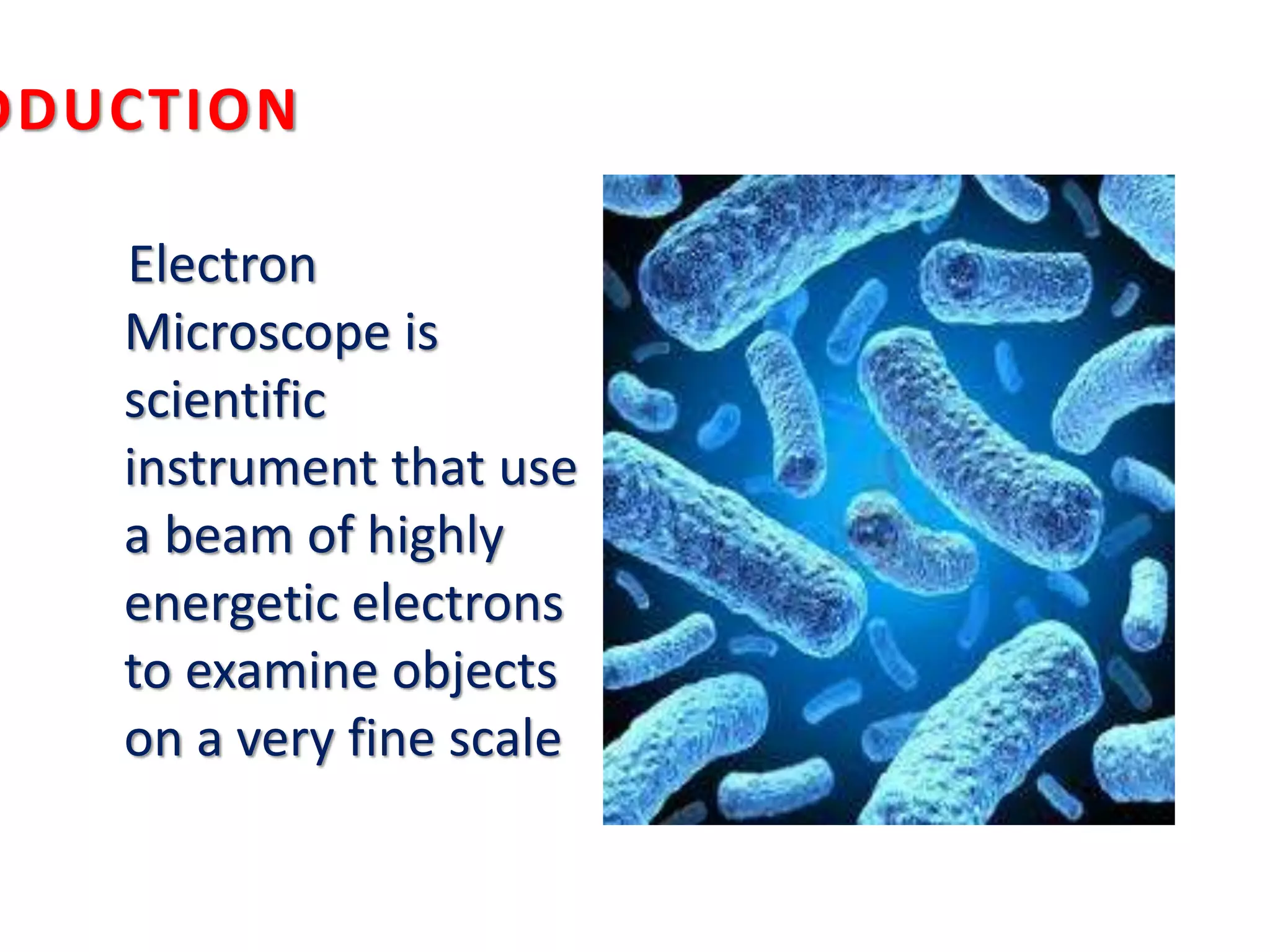
Electron
Microscope is
scientific
instrument that use
a beam of highly
energetic electrons
to examine objects
on a very fine scale
ODUCTION
DIFFERENCE BETWEEN
OPTICAL MICROSCOPE
AND
ELECTRON MICROSCOPE
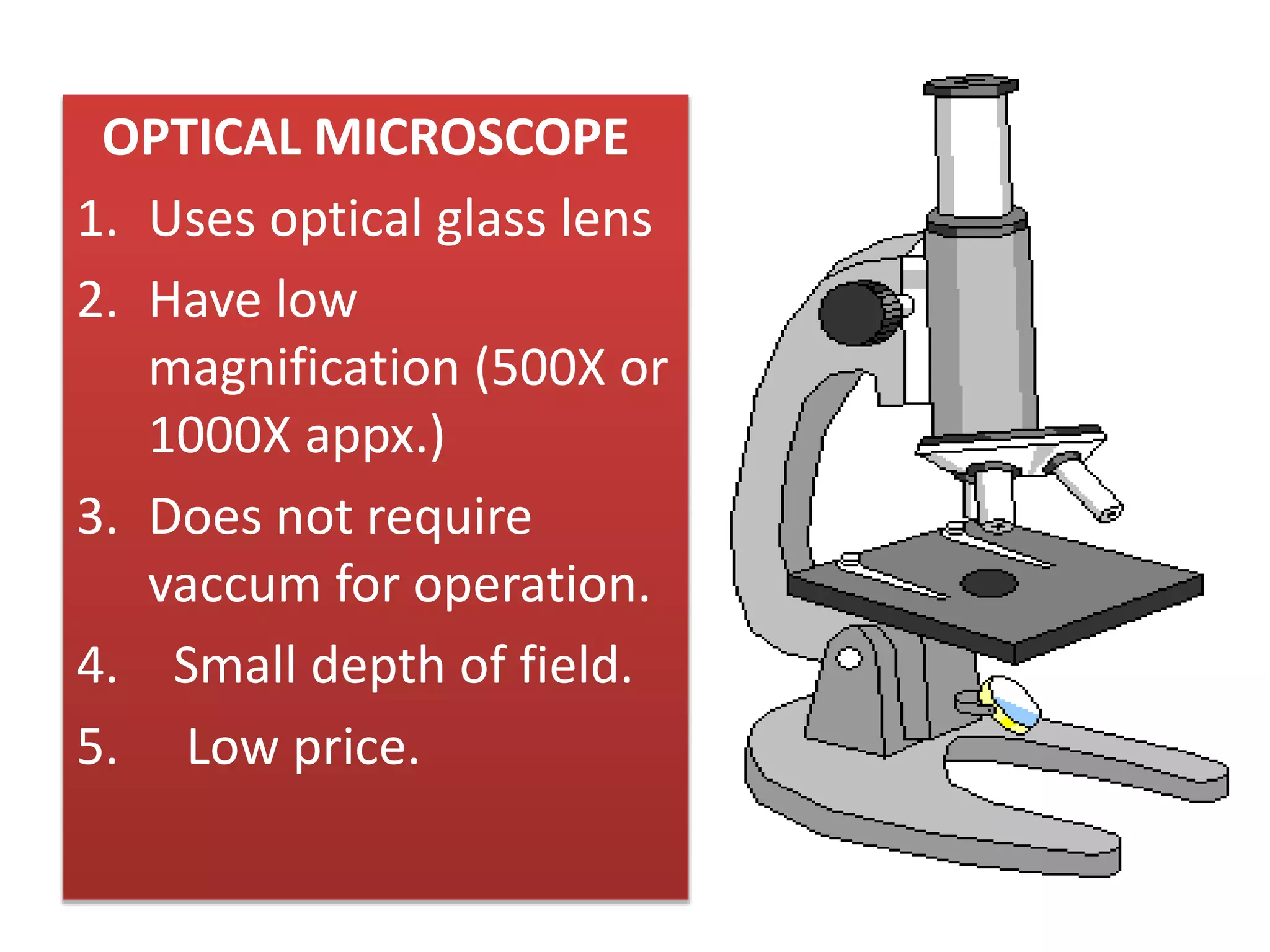
OPTICAL MICROSCOPE
1. Uses optical glass lens
2. Have low
magnification (500X or
1000X appx.)
3. Does not require
vaccum for operation.
4. Small depth of field.
5. Low price.
ELECTRON
MICROSCOPE
1. Uses magnetic
lens.
2. Have high
magnification
(10000X appx.)
3. Require vaccum
for operation
4. Large depth of
field.
5. High price.
Beam of electrons is transmitted through an ultra thin
specimen,
An image is formed from the interaction of the
electrons transmitted through the specimen,
The image is magnified and focused onto an imaging
device, such as a fluorescent screen, on a layer of
photographic film, or to be detected by a sensor such as
a CCD camera
TRANSMISSION ELECTRON MICROSCOPE
ERNEST RUSKA
DEVELOPER OF
TEM
TEM gives Information about ,
Topography :
The surface features of an object
Morphology:
The shape and size of the particles
Composition:
The elements and compounds that the object is
composed
Crystallographic Information:
How the atoms are arranged in the object
MAIN COMPONENTS OF TEM
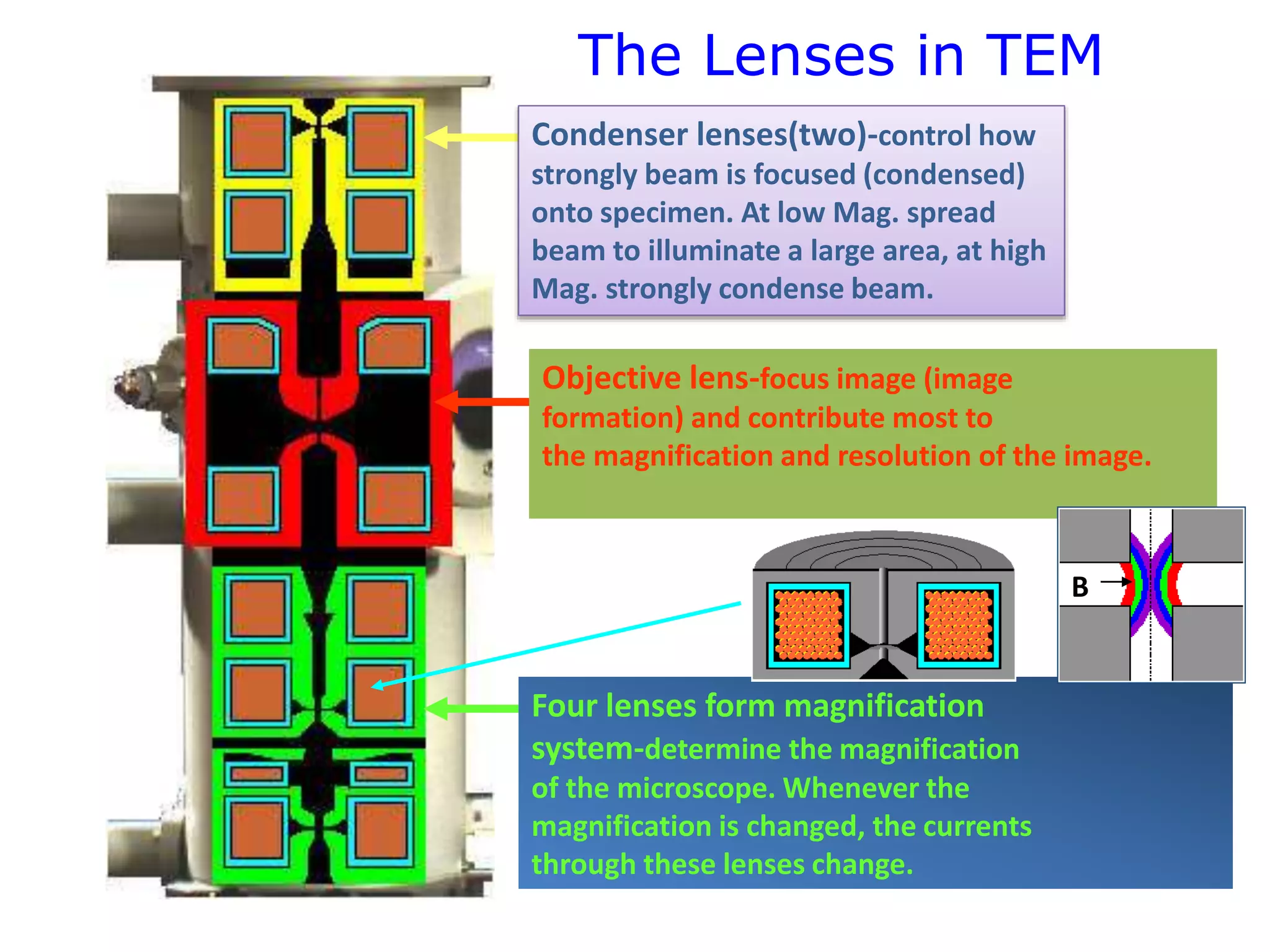
The Lenses in TEM
Condenser lenses(two)-control how
strongly beam is focused (condensed)
onto specimen. At low Mag. spread
beam to illuminate a large area, at high
Mag. strongly condense beam.
Objective lens-focus image (image
formation) and contribute most to
the magnification and resolution of the image.
Four lenses form magnification
system-determine the magnification
of the microscope. Whenever the
magnification is changed, the currents
through these lenses change.
B
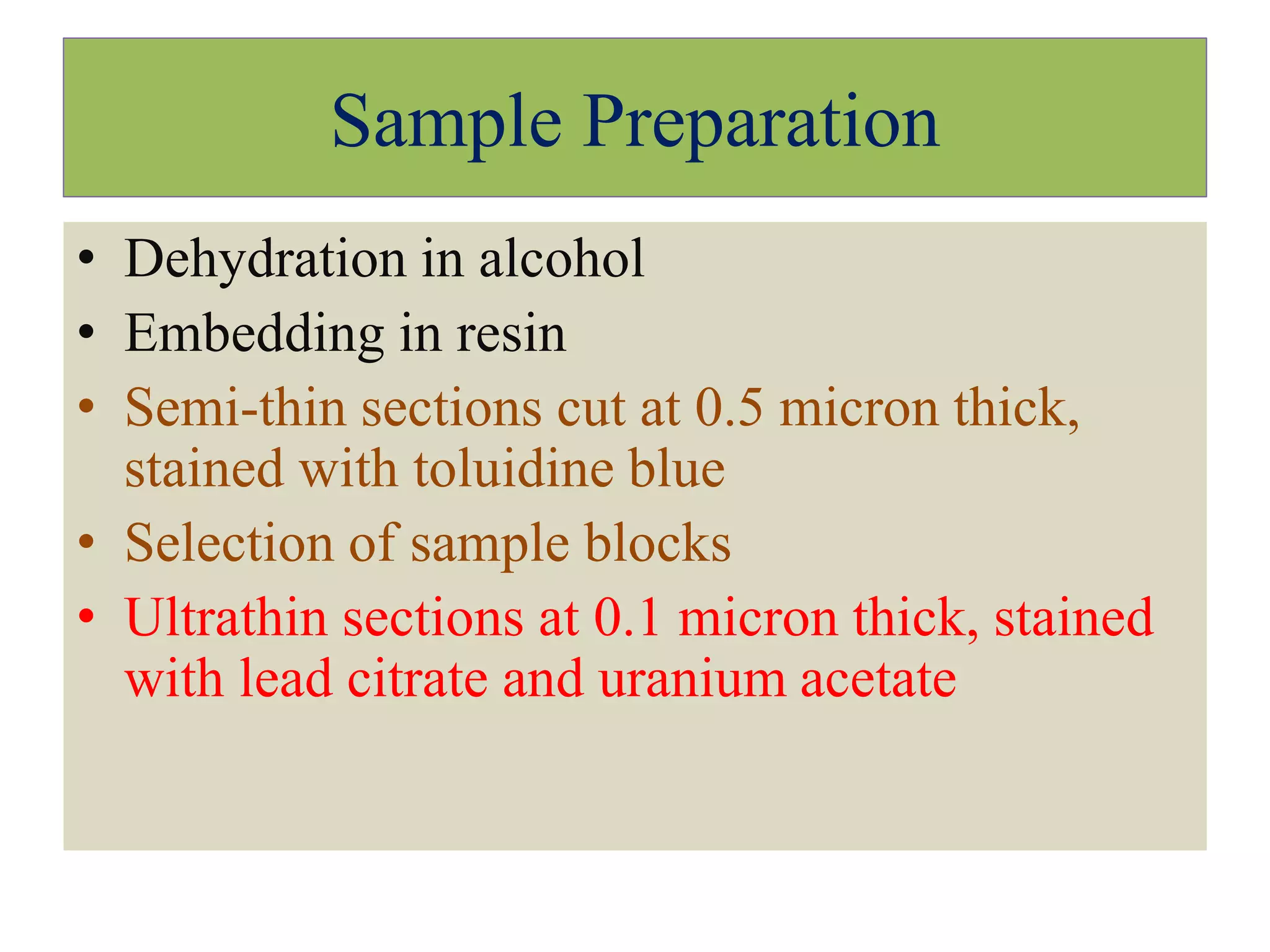
Sample Preparation
• Dehydration in alcohol
• Embedding in resin
• Semi-thin sections cut at 0.5 micron thick,
stained with toluidine blue
• Selection of sample blocks
• Ultrathin sections at 0.1 micron thick, stained
with lead citrate and uranium acetate
Principle of TEM
• Illumination - Source is a beam of high
velocity electrons accelerated under vacuum,
focused by condenser lens (electromagnetic
bending of electron beam) onto specimen.
• Image formation - Loss and scattering of
electrons by individual parts of the specimen.
Emergent electron beam is focused by
objective lens. Final image forms on a
fluorescent screen for viewing
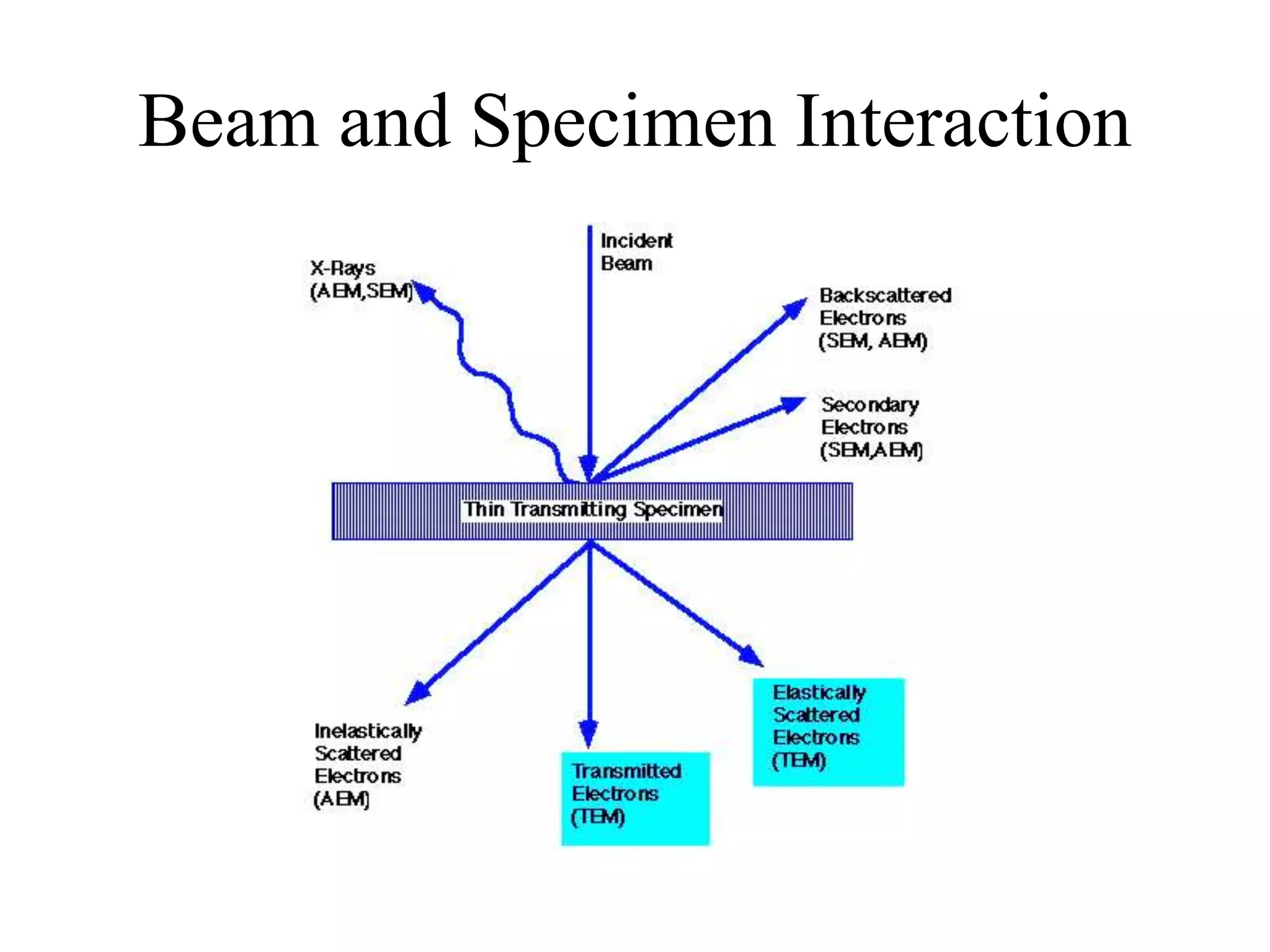
Beam and Specimen Interaction
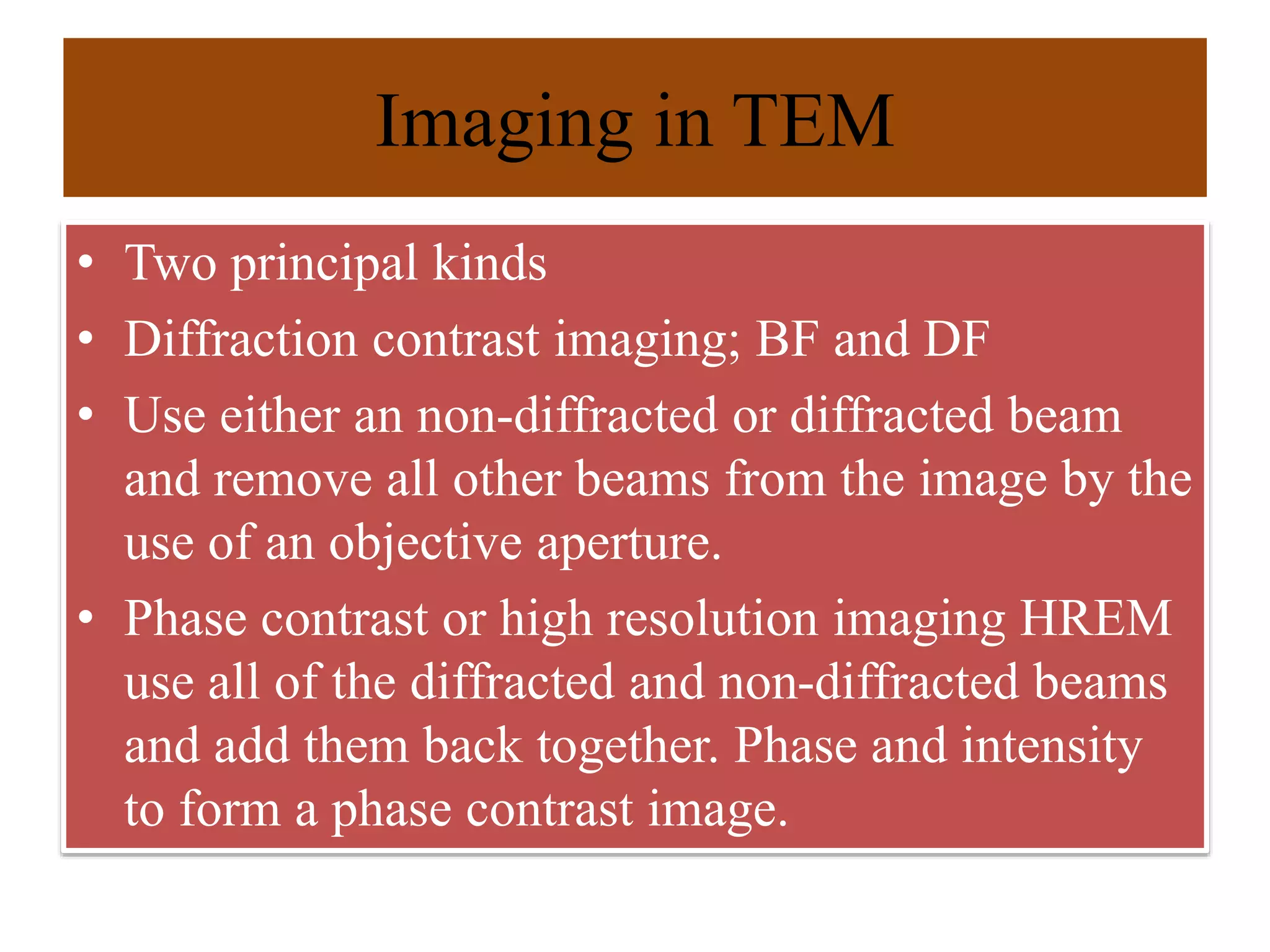
Imaging in TEM
• Two principal kinds
• Diffraction contrast imaging; BF and DF
• Use either an non-diffracted or diffracted beam
and remove all other beams from the image by the
use of an objective aperture.
• Phase contrast or high resolution imaging HREM
use all of the diffracted and non-diffracted beams
and add them back together. Phase and intensity
to form a phase contrast image.
TEM Operation
• Tedious operation
• Time consuming
• Works in the dark
• Photography required
Working of TEM
• High electron beam bombardment.
• Lenses focus it onto the specimen
• Electrons are used for image construction
• Image is constructed by the transmitted
electrons
• Thicker region occlude more beam
Working of TEM
• In areas in the object where these electrons
encounter atoms with a heavy atomic nucleus,
they rebound.
• In regions where the material consists of
lighter atoms , the electron are able to pass
through.
TEM Uses in Biomedical
• Renal diseases
• Typing of tumors
• Muscle diseases
• Skin diseases
• Miscellaneous diseases
Advantages
• High resolution and magnification
• Give information of Element and Compound
• Detailed image obtain
Disadvantages
• Expensive
• Images are black and white
• Instrument in very large
Limitation
• Samples are limited to those that are electron
transparent.
• Difficult to handle
• Tricky sample preparation
Transmission electron microscopy (1) (1)

Transmission electron microscopy (1) (1)

  • 1.
  • 2.
    Electron Microscope is scientific instrument thatuse a beam of highly energetic electrons to examine objects on a very fine scale ODUCTION
  • 3.
  • 4.
    OPTICAL MICROSCOPE 1. Usesoptical glass lens 2. Have low magnification (500X or 1000X appx.) 3. Does not require vaccum for operation. 4. Small depth of field. 5. Low price.
  • 5.
    ELECTRON MICROSCOPE 1. Uses magnetic lens. 2.Have high magnification (10000X appx.) 3. Require vaccum for operation 4. Large depth of field. 5. High price.
  • 6.
    Beam of electronsis transmitted through an ultra thin specimen, An image is formed from the interaction of the electrons transmitted through the specimen, The image is magnified and focused onto an imaging device, such as a fluorescent screen, on a layer of photographic film, or to be detected by a sensor such as a CCD camera TRANSMISSION ELECTRON MICROSCOPE
  • 7.
  • 8.
    TEM gives Informationabout , Topography : The surface features of an object Morphology: The shape and size of the particles Composition: The elements and compounds that the object is composed Crystallographic Information: How the atoms are arranged in the object
  • 9.
  • 10.
    The Lenses inTEM Condenser lenses(two)-control how strongly beam is focused (condensed) onto specimen. At low Mag. spread beam to illuminate a large area, at high Mag. strongly condense beam. Objective lens-focus image (image formation) and contribute most to the magnification and resolution of the image. Four lenses form magnification system-determine the magnification of the microscope. Whenever the magnification is changed, the currents through these lenses change. B
  • 11.
    Sample Preparation • Dehydrationin alcohol • Embedding in resin • Semi-thin sections cut at 0.5 micron thick, stained with toluidine blue • Selection of sample blocks • Ultrathin sections at 0.1 micron thick, stained with lead citrate and uranium acetate
  • 12.
    Principle of TEM •Illumination - Source is a beam of high velocity electrons accelerated under vacuum, focused by condenser lens (electromagnetic bending of electron beam) onto specimen. • Image formation - Loss and scattering of electrons by individual parts of the specimen. Emergent electron beam is focused by objective lens. Final image forms on a fluorescent screen for viewing
  • 13.
    Beam and SpecimenInteraction
  • 14.
    Imaging in TEM •Two principal kinds • Diffraction contrast imaging; BF and DF • Use either an non-diffracted or diffracted beam and remove all other beams from the image by the use of an objective aperture. • Phase contrast or high resolution imaging HREM use all of the diffracted and non-diffracted beams and add them back together. Phase and intensity to form a phase contrast image.
  • 16.
    TEM Operation • Tediousoperation • Time consuming • Works in the dark • Photography required
  • 17.
    Working of TEM •High electron beam bombardment. • Lenses focus it onto the specimen • Electrons are used for image construction • Image is constructed by the transmitted electrons • Thicker region occlude more beam
  • 18.
    Working of TEM •In areas in the object where these electrons encounter atoms with a heavy atomic nucleus, they rebound. • In regions where the material consists of lighter atoms , the electron are able to pass through.
  • 19.
    TEM Uses inBiomedical • Renal diseases • Typing of tumors • Muscle diseases • Skin diseases • Miscellaneous diseases
  • 20.
    Advantages • High resolutionand magnification • Give information of Element and Compound • Detailed image obtain
  • 21.
    Disadvantages • Expensive • Imagesare black and white • Instrument in very large
  • 22.
    Limitation • Samples arelimited to those that are electron transparent. • Difficult to handle • Tricky sample preparation