BY,
VELLAICHAMY P
MSC BIOINFORMATICS
MSFBI1724
TRANSMISSION &
SCANNING ELECTRON
MICROSCOPE
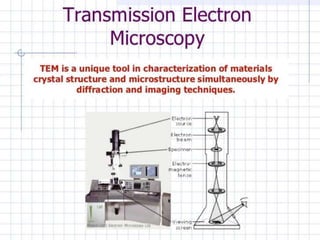
Transmission Electron microscopy
INTRODUCTION
 In 1931, while conducting research for his
masters at the technical college of Berlin, Ernst
Ruska and Max Knoll designed first TEM.
 Electron Microscopes are scientific instruments that
use a beam of highly energetic electrons to examine
objects on a very fine scale.
Mainly 2 types:
Transmission Electron Microscope (TEM) -allows
one the study of the inner structures
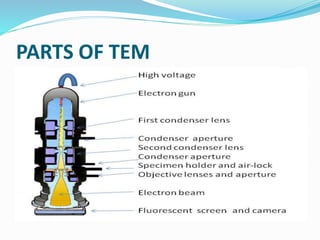
PARTS OF TEM
ADVANTAGES &
DISADVANTAGES OF TEM
Advantages
TEMs offer very powerful magnification and
resolution.
TEMs have a wide-range of applications and can be
utilized in a variety of different scientific, educational
and industrial fields
TEMs provide information on element and compound
structure .
Images are high-quality and detailed
Disadvantages
 TEMs are large and very expensive.
 Laborious sample preparation.
 Operation and analysis requires special training.
 Samples are limited to those that are electron
transparent.
 TEMs require special housing and maintenance.
 Images are black and white
In medicine as a diagnostic tool –important in
renal biopsies.
Cancer research -studies of tumor cell ultra
structure .
Toxicology–to study the impacts of environmental
pollution on the different levels of biological
organization.
BIOLOGICAL APPLICATIONS
TEM
Tem ppt

Tem ppt

  • 1.
  • 2.
  • 4.
    Transmission Electron microscopy INTRODUCTION In 1931, while conducting research for his masters at the technical college of Berlin, Ernst Ruska and Max Knoll designed first TEM.  Electron Microscopes are scientific instruments that use a beam of highly energetic electrons to examine objects on a very fine scale. Mainly 2 types: Transmission Electron Microscope (TEM) -allows one the study of the inner structures
  • 6.
  • 7.
    ADVANTAGES & DISADVANTAGES OFTEM Advantages TEMs offer very powerful magnification and resolution. TEMs have a wide-range of applications and can be utilized in a variety of different scientific, educational and industrial fields TEMs provide information on element and compound structure . Images are high-quality and detailed
  • 8.
    Disadvantages  TEMs arelarge and very expensive.  Laborious sample preparation.  Operation and analysis requires special training.  Samples are limited to those that are electron transparent.  TEMs require special housing and maintenance.  Images are black and white
  • 9.
    In medicine asa diagnostic tool –important in renal biopsies. Cancer research -studies of tumor cell ultra structure . Toxicology–to study the impacts of environmental pollution on the different levels of biological organization. BIOLOGICAL APPLICATIONS TEM