LECTURE 2:
EARTH AND EARTH
SYSTEMS
Earth as a SYSTEM
SYSTEM
 A set of interconnected
components that are
interacting to form a unified
whole.
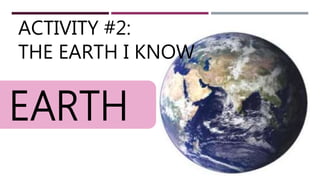
EARTH
ACTIVITY #2:
THE EARTH I KNOW
OBJECTIVES
In this chapter, you must be able to:
1. recognize the uniqueness of earth being
only planet in the solar system with
properties necessary to support life;
2. identify the layers of the Earth; and
3. differentiate the layers of the Earth
EARTH
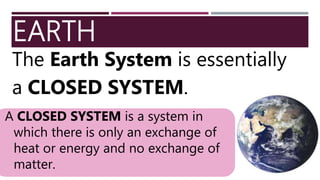
The Earth System is essentially
a CLOSED SYSTEM.
A CLOSED SYSTEM is a system in
which there is only an exchange of
heat or energy and no exchange of
matter.
6
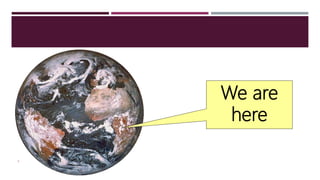
We are
here
7
EARTH
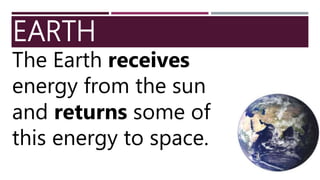
The Earth receives
energy from the sun
and returns some of
this energy to space.
EARTH SCIENCE
also known as GEOSCIENCE
includes all sciences related to
geology, meteorology,
oceanography etc.
Major Themes
 Scale
 Energy
 Cycle
 SCALE
 processes in the Earth system:
• length scales (microns to
thousands of kilometers)
• time scales (milliseconds to
millions of years)
 ENERGY
 External Source: SUN
 Internal Sources:
• Radioactive decay
• Gravitational energy
 CYCLES
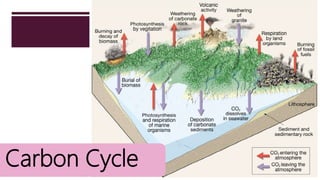
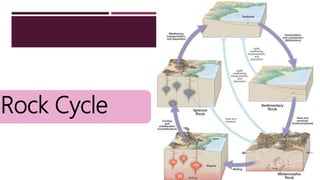
 material in the Earth system is
continually recycled in numerous
overlapping cycles.
Carbon Cycle
Rock Cycle
Water Cycle
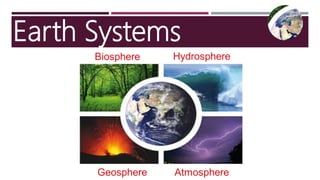
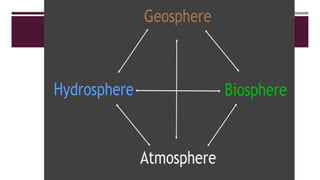
Earth Systems
BIOSPHERE
 it includes all life forms on Earth
 it covers all ecosystems—from the
soil to the rainforest, from mangroves
to coral reefs, and from the plankton-
rich ocean surface to the deep sea.
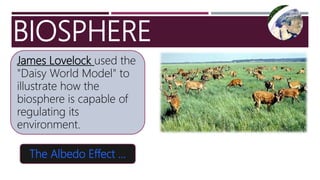
BIOSPHERE
James Lovelock used the
"Daisy World Model" to
illustrate how the
biosphere is capable of
regulating its
environment.
The Albedo Effect …
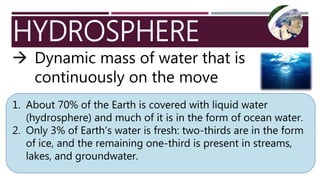
HYDROSPHERE
 Dynamic mass of water that is
continuously on the move
1. About 70% of the Earth is covered with liquid water
(hydrosphere) and much of it is in the form of ocean water.
2. Only 3% of Earth's water is fresh: two-thirds are in the form
of ice, and the remaining one-third is present in streams,
lakes, and groundwater.
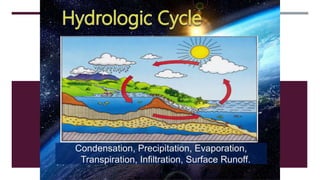
Condensation, Precipitation, Evaporation,
Transpiration, Infiltration, Surface Runoff.
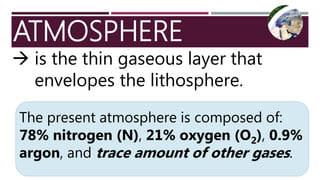
ATMOSPHERE
 is the thin gaseous layer that
envelopes the lithosphere.
The present atmosphere is composed of:
78% nitrogen (N), 21% oxygen (O2), 0.9%
argon, and trace amount of other gases.
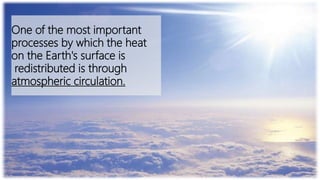
One of the most important
processes by which the heat
on the Earth's surface is
redistributed is through
atmospheric circulation.
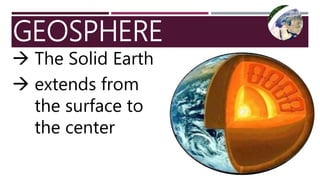
GEOSPHERE
 The Solid Earth
 extends from
the surface to
the center
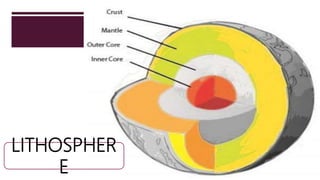
LITHOSPHER
E
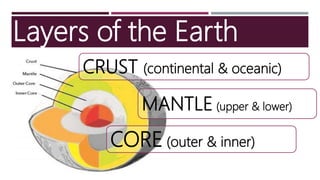
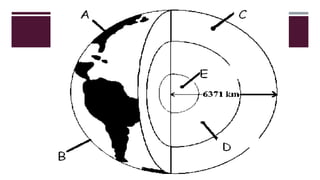
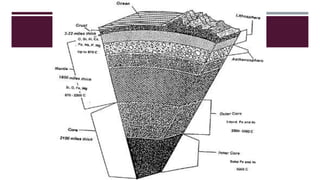
Layers of the Earth
CRUST (continental & oceanic)
MANTLE (upper & lower)
CORE (outer & inner)
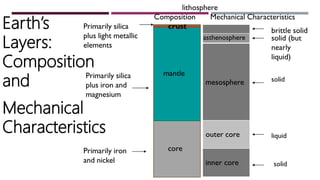
Earth’s
Layers:
Composition
and
Mechanical
Characteristics
CRUST
 It’s the light and very thin outer
skin of the Earth.
 The outermost layer where energy
and mineral resources are derived.
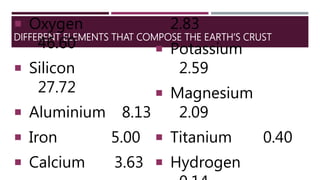
DIFFERENT ELEMENTS THAT COMPOSE THE EARTH’S CRUST
 Oxygen
46.60
 Silicon
27.72
 Aluminium 8.13
 Iron 5.00
 Calcium 3.63
2.83
 Potassium
2.59
 Magnesium
2.09
 Titanium 0.40
 Hydrogen
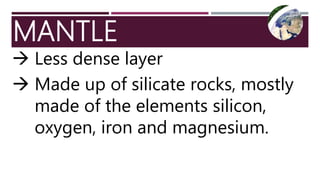
MANTLE
 Less dense layer
 Made up of silicate rocks, mostly
made of the elements silicon,
oxygen, iron and magnesium.
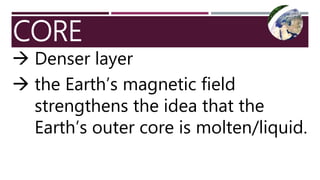
CORE
 Denser layer
 the Earth’s magnetic field
strengthens the idea that the
Earth’s outer core is molten/liquid.
I.B Earth and Earth Systems

I.B Earth and Earth Systems