Earth as a
SYSTEM
SYSTEM - A set of interconnected components
that are interacting to form a unified whole.
EXAMPLE of a system- ECOSYSTEM.
(Organisms are interrelated and interacting)
The Earth system is essentially a CLOSED
SYSTEM.
A closed system is a system in which
there is only an exchange of heat or
energy and no exchange of matter.
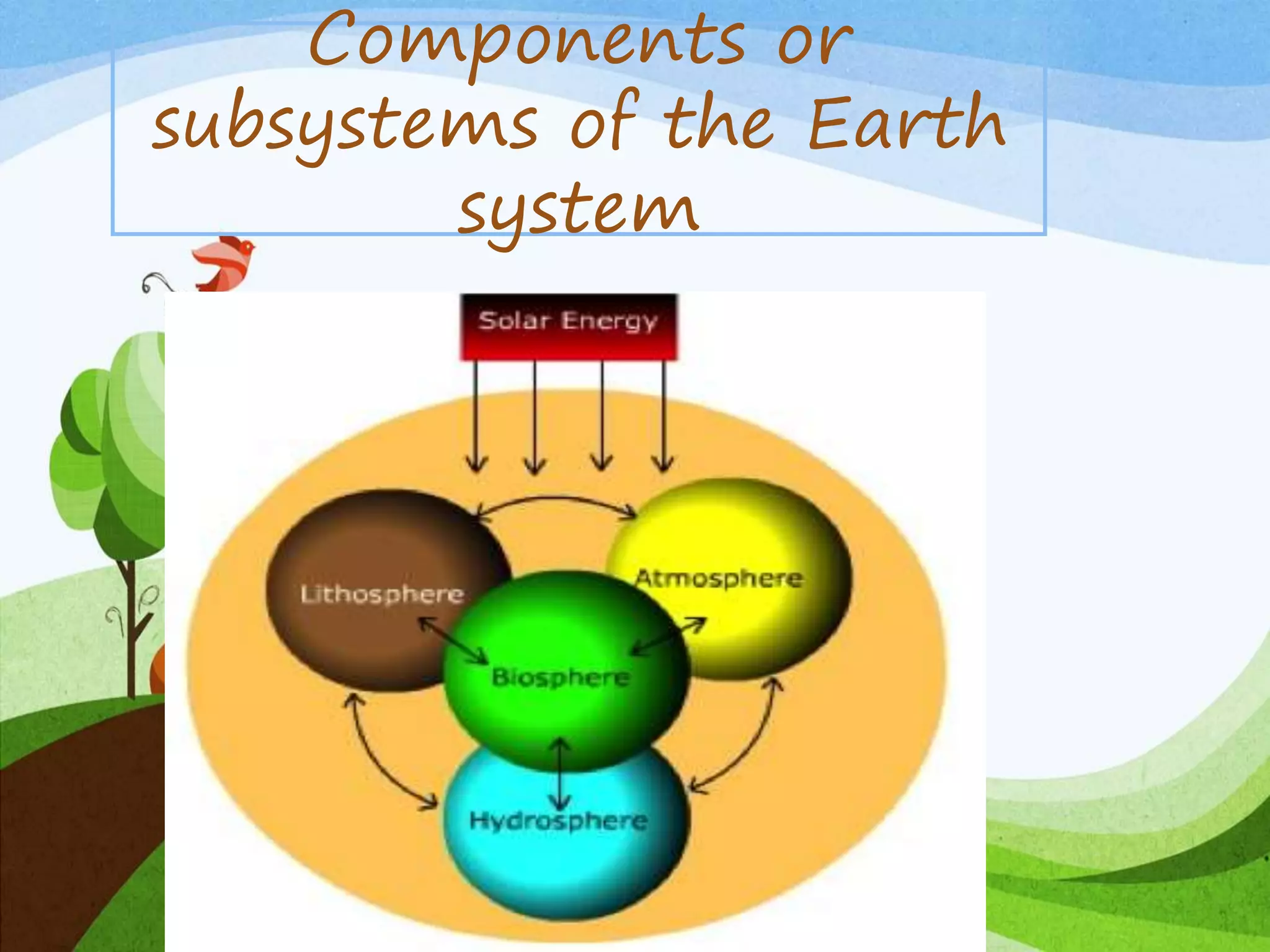
The Earth receives energy from the sun
and
returns some of this energy to space.
Components or
subsystems of the Earth
system
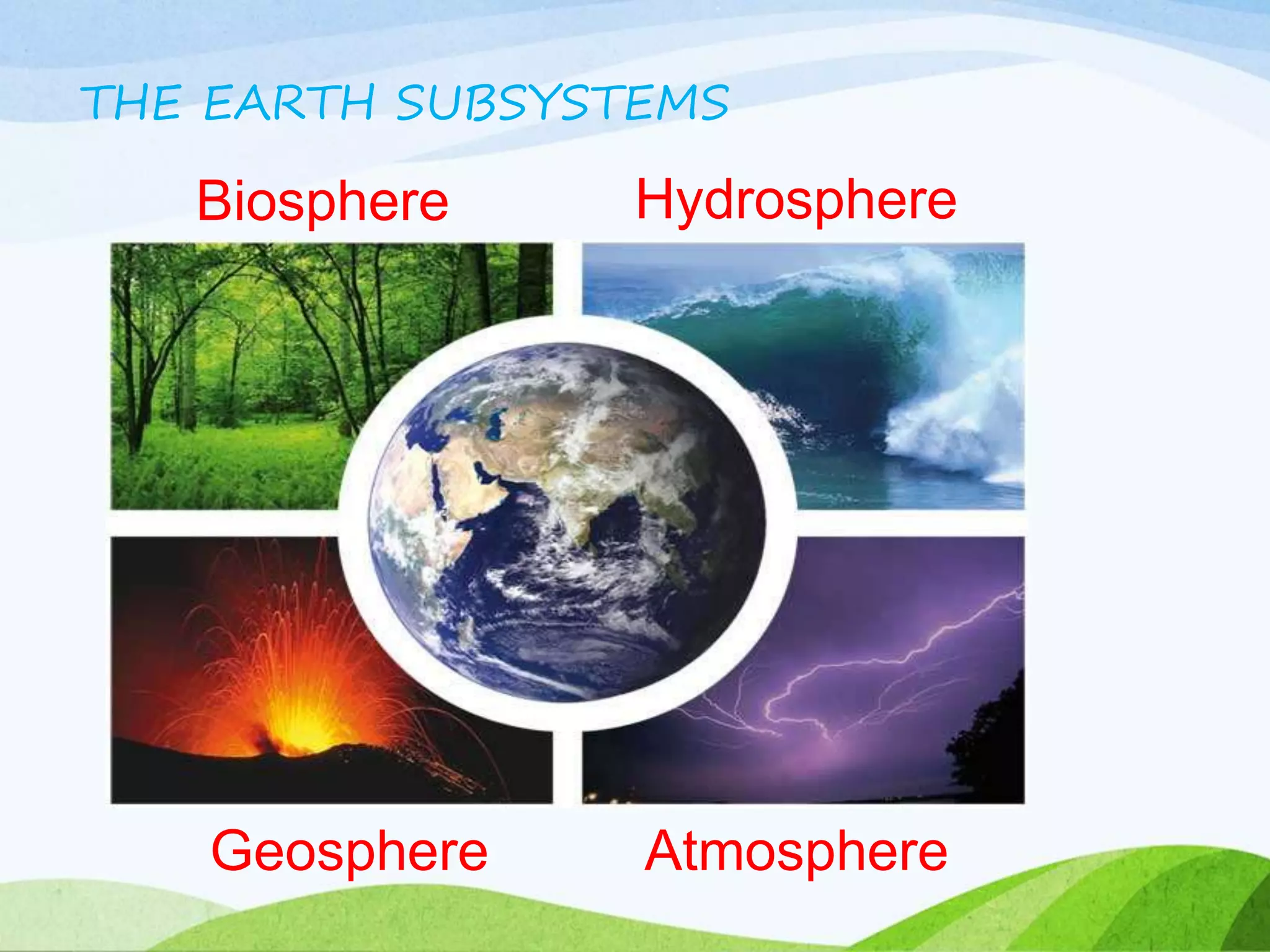
THE EARTH SUBSYSTEMS
Biosphere Hydrosphere
Geosphere Atmosphere
Major Themes
SCALE ENERGY CYCLE
Scale
Processes in the Earth system act on length
scales of microns to thousands of kilometers,
and on time scales of milliseconds to
millions of years.
Major Themes
Energy
The Earth system is powered by one external
source: the Sun
and two internal ones:
- radioactive decay
- gravitational energy (heat still being lost from
planetary formation).
Major Themes
Cycles
Material in the Earth system is continually
recycled in numerous overlapping cycles.
Major Themes
The
Carbon
Cycle
The
Rock
Cycle
The Hydrologic (Water)
Cycle
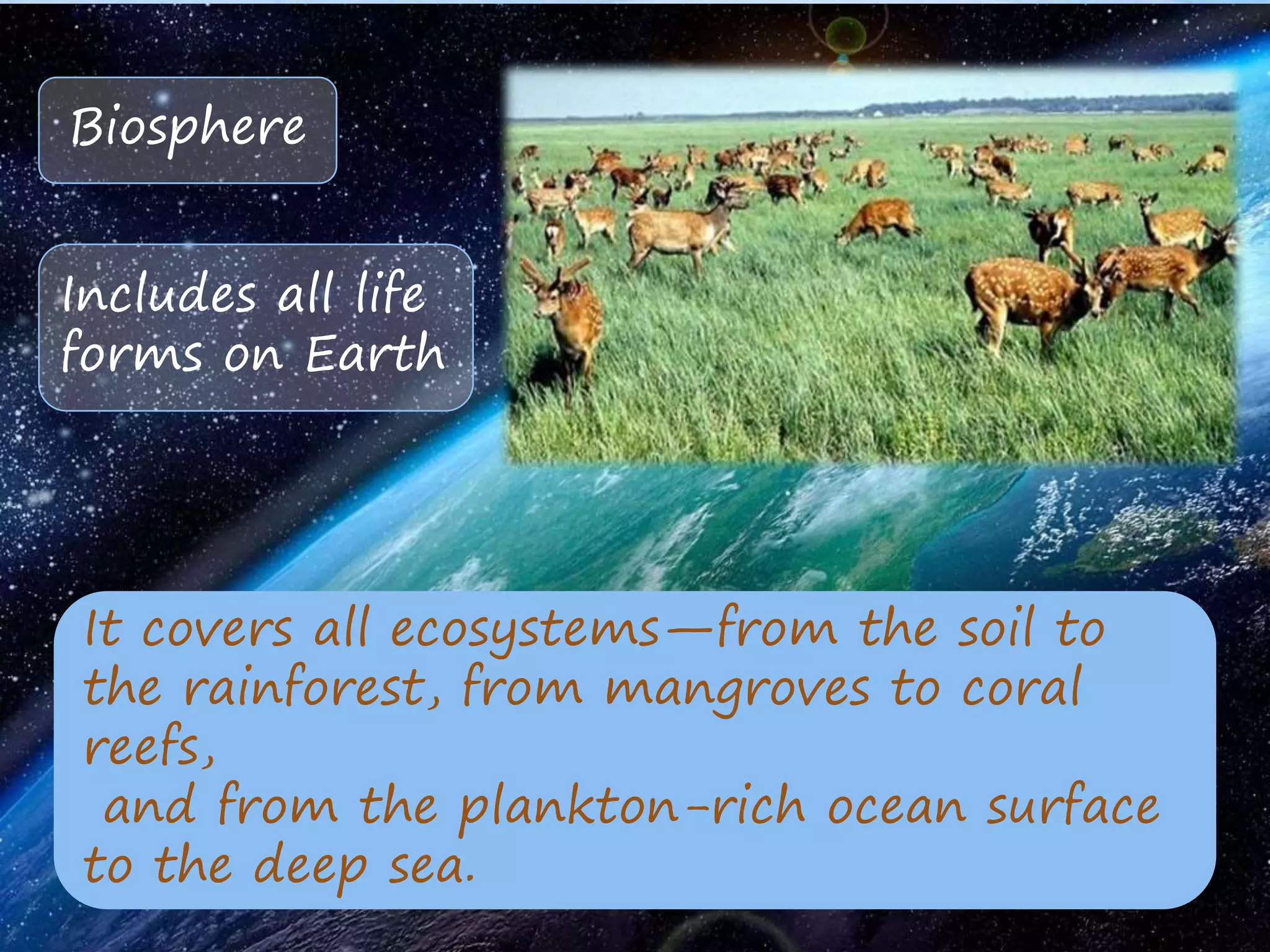
Includes all life
forms on Earth
Biosphere
It covers all ecosystems—from the soil to
the rainforest, from mangroves to coral
reefs,
and from the plankton-rich ocean surface
to the deep sea.
Photosynthesis
The Carbon Cycle
Dynamic mass of
water that is
continuously on
the move
Hydrosphere
Precipitation, Evaporation, Runoff, Infiltration, etc...
The Hydrologic (Water) Cycle
1. About 70% of the Earth is covered with
liquid water (hydrosphere) and much of it
is in the form of ocean water.
2. Only 3% of Earth's water is fresh: two-
thirds are in the form of ice, and the
remaining
one-third is present in streams, lakes,
and groundwater.
Condensation, Precipitation, Evaporation,
Transpiration, Infiltration, Surface Runoff.
The atmosphere is
the thin gaseous
layer that envelopes
the lithosphere.
Atmosphere
The present atmosphere is composed of
78% nitrogen (N), 21% oxygen (O2),
0.9% argon, and trace amount of other
gases.
Why is nitrogen the most abundant
element in the atmosphere?
• Volatile in most of its forms
• Unreactive with materials
that make up the solid earth
• Stable in the presence of
solar radiation
One of the most important processes
by which the heat on the Earth's
surface is redistributed is through
atmospheric circulation.
Basic Principle:
Warm air rises, cold
air sinks.
Why is the ocean blue?
• Ocean is blue because it’s reflecting
the blue sky.
FALSE
• It absorbs sunlight (long and short
wavelength light)
• Ocean may take other hues, if light
bounces off objects floating near the
surface of the water e.g algae and
sediments
WHY IS THE SKY BLUE?
• Molecules in the air scatter blue light from the sun more than they
scatter red light.
• It travels as shorter, smaller waves
WHY IS THE SKY RED DURING SUNSET?
Blue light has been scattered out and away from the line of sight.
Carbon-Oxygen Cycle
Layers of the Atmosphere
Do you know what Aurora lights are?
• Aurora borealis (Northern lights)
• Aurora australis (Southern lights)
• Form when charged particles emitted from the
sun during a solar flare penetrate the earth’s
magnetic field and collide with atoms and
molecules in the atmosphere.
• The result produces countless little burst of
light (photons)
• Collision with Oxygen (red and green auroras)
• Collision with Nitrogen (Pink and purple
auroras)
The Solid Earth
extends from the
surface to the center
Geosphere
Connect to Earth
Create a concept map which explains
how the geosphere, hydrosphere,
atmosphere, and biosphere are
interconnected.
Use arrows and simple illustrations.
Geosphere
Atmosphere
Biosphere
Hydrosphere
4.6 Billion Years
of Interaction
The lithosphere
includes the crust
and the upper part
of the mantle.
LITHOSPHERE
Layers of the Earth
CRUST (continental
& oceanic)
MANTLE (upper &
lower)
CORE (outer &
inner)
Which layer is it?
CRUST
- It’s the light and very thin
outer skin of the Earth.
- The outermost layer where
energy and mineral resources
are derived.
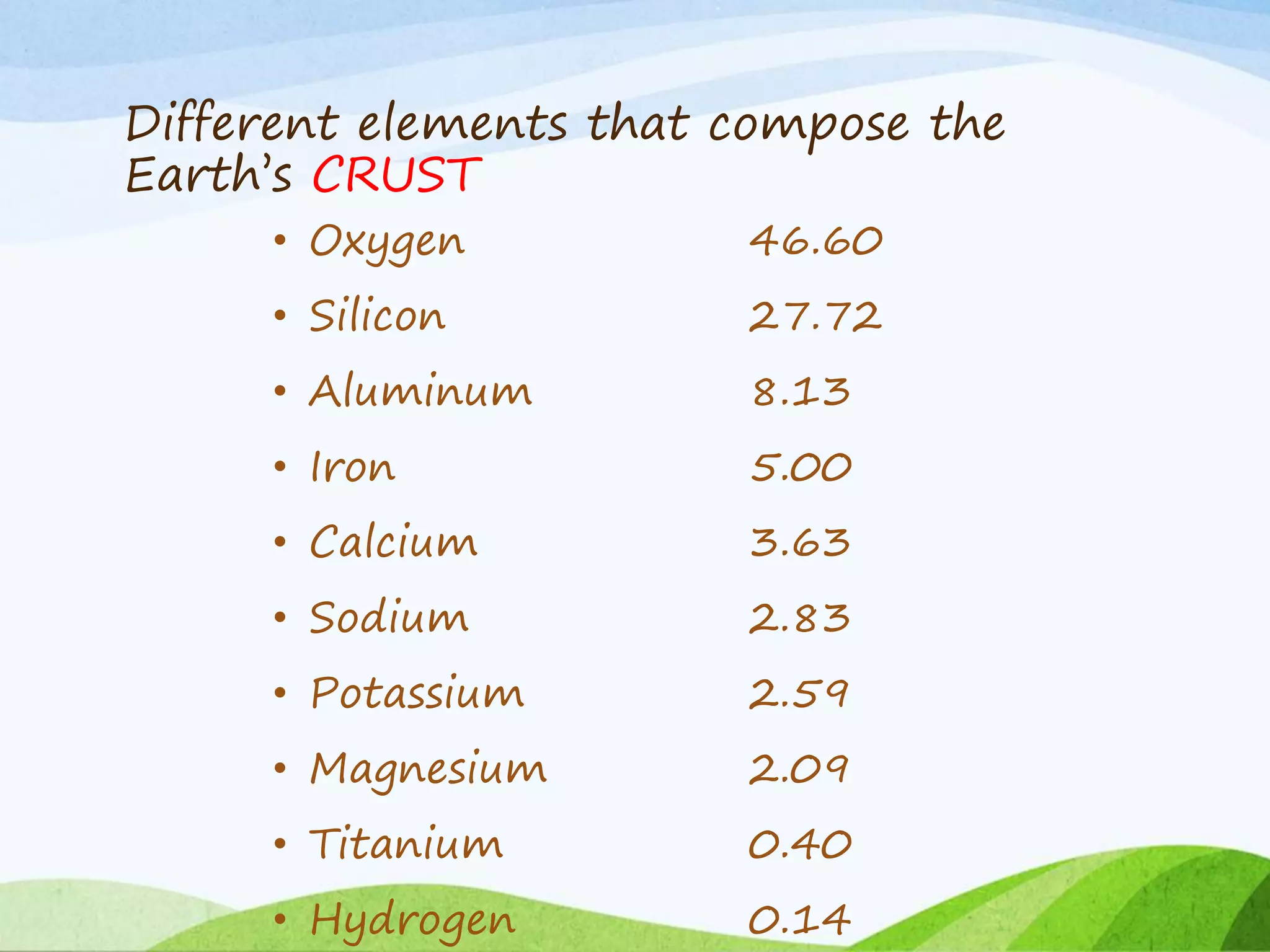
Different elements that compose the
Earth’s CRUST
• Oxygen 46.60
• Silicon 27.72
• Aluminum 8.13
• Iron 5.00
• Calcium 3.63
• Sodium 2.83
• Potassium 2.59
• Magnesium 2.09
• Titanium 0.40
• Hydrogen 0.14
MANTLE
- Less dense layer
- Made up of silicate rocks,
mostly made of the elements
silicon, oxygen, iron and
magnesium.
CORE
- Denser layer
- the Earth’s magnetic field
- strengthens the idea that the
Earth’s outer core is
molten/liquid.
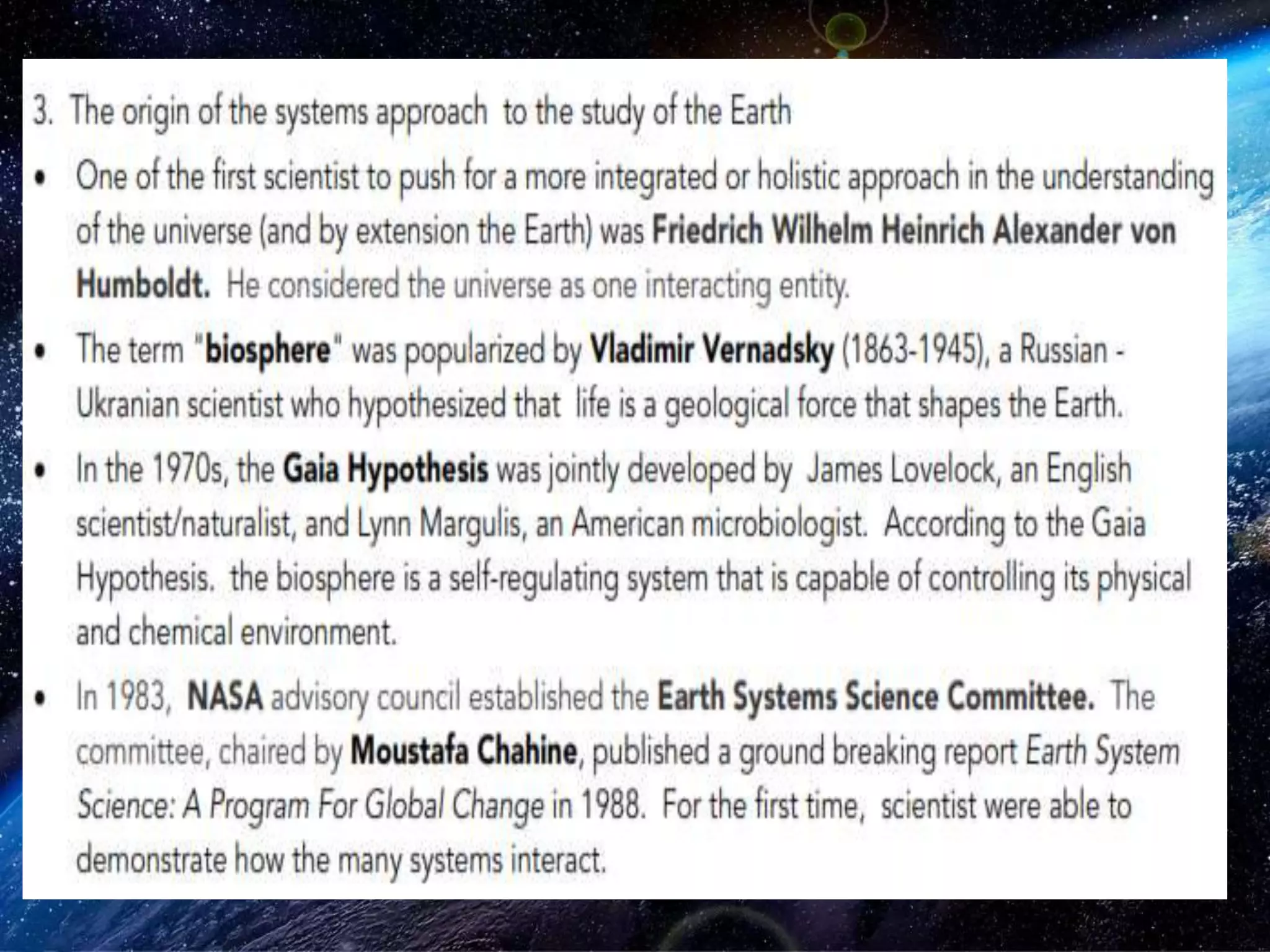
Historical Development of
the concept of EARTH
SYSTEM
Sources:
1. Ms. Laguda ppt. (Regional
SHS Mass Training of Grade
11 Teachers)
2.TG Earth & Life Science

Earth subsystems

  • 2.
  • 3.
    SYSTEM - Aset of interconnected components that are interacting to form a unified whole.
  • 4.
    EXAMPLE of asystem- ECOSYSTEM. (Organisms are interrelated and interacting)
  • 5.
    The Earth systemis essentially a CLOSED SYSTEM. A closed system is a system in which there is only an exchange of heat or energy and no exchange of matter. The Earth receives energy from the sun and returns some of this energy to space.
  • 6.
  • 7.
    THE EARTH SUBSYSTEMS BiosphereHydrosphere Geosphere Atmosphere
  • 8.
  • 9.
    Scale Processes in theEarth system act on length scales of microns to thousands of kilometers, and on time scales of milliseconds to millions of years. Major Themes
  • 10.
    Energy The Earth systemis powered by one external source: the Sun and two internal ones: - radioactive decay - gravitational energy (heat still being lost from planetary formation). Major Themes
  • 11.
    Cycles Material in theEarth system is continually recycled in numerous overlapping cycles. Major Themes
  • 12.
  • 13.
  • 14.
  • 15.
    Includes all life formson Earth Biosphere It covers all ecosystems—from the soil to the rainforest, from mangroves to coral reefs, and from the plankton-rich ocean surface to the deep sea.
  • 16.
  • 17.
    Dynamic mass of waterthat is continuously on the move Hydrosphere
  • 18.
    Precipitation, Evaporation, Runoff,Infiltration, etc... The Hydrologic (Water) Cycle 1. About 70% of the Earth is covered with liquid water (hydrosphere) and much of it is in the form of ocean water. 2. Only 3% of Earth's water is fresh: two- thirds are in the form of ice, and the remaining one-third is present in streams, lakes, and groundwater.
  • 19.
  • 20.
    The atmosphere is thethin gaseous layer that envelopes the lithosphere. Atmosphere The present atmosphere is composed of 78% nitrogen (N), 21% oxygen (O2), 0.9% argon, and trace amount of other gases.
  • 21.
    Why is nitrogenthe most abundant element in the atmosphere? • Volatile in most of its forms • Unreactive with materials that make up the solid earth • Stable in the presence of solar radiation
  • 22.
    One of themost important processes by which the heat on the Earth's surface is redistributed is through atmospheric circulation. Basic Principle: Warm air rises, cold air sinks.
  • 23.
    Why is theocean blue? • Ocean is blue because it’s reflecting the blue sky. FALSE • It absorbs sunlight (long and short wavelength light) • Ocean may take other hues, if light bounces off objects floating near the surface of the water e.g algae and sediments
  • 24.
    WHY IS THESKY BLUE? • Molecules in the air scatter blue light from the sun more than they scatter red light. • It travels as shorter, smaller waves
  • 25.
    WHY IS THESKY RED DURING SUNSET? Blue light has been scattered out and away from the line of sight.
  • 26.
  • 27.
    Layers of theAtmosphere
  • 28.
    Do you knowwhat Aurora lights are? • Aurora borealis (Northern lights) • Aurora australis (Southern lights) • Form when charged particles emitted from the sun during a solar flare penetrate the earth’s magnetic field and collide with atoms and molecules in the atmosphere. • The result produces countless little burst of light (photons) • Collision with Oxygen (red and green auroras) • Collision with Nitrogen (Pink and purple auroras)
  • 29.
    The Solid Earth extendsfrom the surface to the center Geosphere
  • 30.
    Connect to Earth Createa concept map which explains how the geosphere, hydrosphere, atmosphere, and biosphere are interconnected. Use arrows and simple illustrations.
  • 31.
  • 32.
    The lithosphere includes thecrust and the upper part of the mantle. LITHOSPHERE
  • 33.
    Layers of theEarth CRUST (continental & oceanic) MANTLE (upper & lower) CORE (outer & inner)
  • 34.
  • 35.
    CRUST - It’s thelight and very thin outer skin of the Earth. - The outermost layer where energy and mineral resources are derived.
  • 36.
    Different elements thatcompose the Earth’s CRUST • Oxygen 46.60 • Silicon 27.72 • Aluminum 8.13 • Iron 5.00 • Calcium 3.63 • Sodium 2.83 • Potassium 2.59 • Magnesium 2.09 • Titanium 0.40 • Hydrogen 0.14
  • 37.
    MANTLE - Less denselayer - Made up of silicate rocks, mostly made of the elements silicon, oxygen, iron and magnesium.
  • 38.
    CORE - Denser layer -the Earth’s magnetic field - strengthens the idea that the Earth’s outer core is molten/liquid.
  • 40.
    Historical Development of theconcept of EARTH SYSTEM
  • 42.
    Sources: 1. Ms. Lagudappt. (Regional SHS Mass Training of Grade 11 Teachers) 2.TG Earth & Life Science

Editor's Notes

  • #3  Photos for the Earth’s spheres
  • #4  Photos for the Earth’s spheres
  • #5  Photos for the Earth’s spheres
  • #6  Photos for the Earth’s spheres
  • #7  Photos for the Earth’s spheres
  • #16 Most life is concentrated near the surface *insert photo for biosphere
  • #17 Most life is concentrated near the surface *insert photo for biosphere
  • #18 Global ocean – 71% *insert photo for hydrosphere
  • #20  Photos for the Earth’s spheres
  • #21 Weather & Climate – Energy exchanges (atmosphere-earth’s surface and atmosphere-space) Lunar surface – has not changed in 3 billion years *insert photo for atmosphere
  • #23 Why is there an wind when we whistle?
  • #25 Why not violet? Because of eye sensitivity and color receptor r b g
  • #30 Soil – may be thought of as part of all four spheres *insert photo for geosphere
  • #33 Soil – may be thought of as part of all four spheres *insert photo for geosphere
  • #35 Soil – may be thought of as part of all four spheres *insert photo for geosphere
  • #41  Photos for the Earth’s spheres
  • #42  Photos for the Earth’s spheres
  • #43  Photos for the Earth’s spheres