z
The
Earth
System
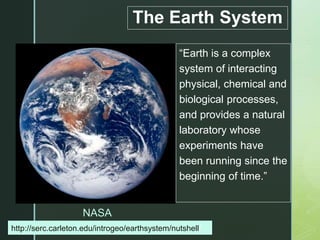
The Earth System
“Earth is a complex
system of interacting
physical, chemical and
biological processes,
and provides a natural
laboratory whose
experiments have
been running since the
beginning of time.”
http://serc.carleton.edu/introgeo/earthsystem/nutshell/
NASA
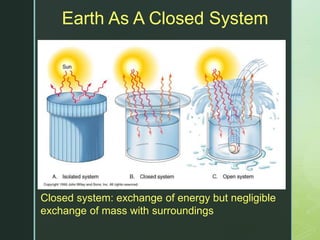
Earth As A Closed System
Closed system: exchange of energy but negligible
exchange of mass with surroundings
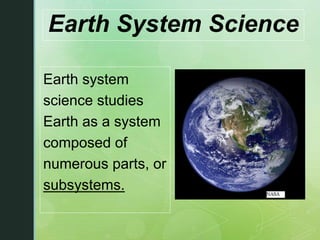
Earth System Science
Earth system
science studies
Earth as a system
composed of
numerous parts, or
subsystems.
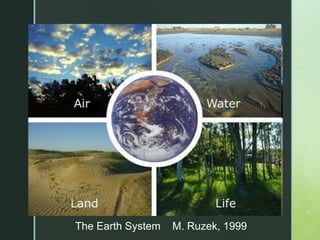
The Earth System M. Ruzek, 1999
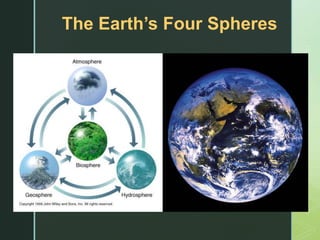
The Earth’s Four Spheres
z
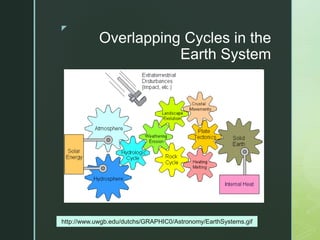
Overlapping Cycles in the
Earth System
http://www.uwgb.edu/dutchs/GRAPHIC0/Astronomy/EarthSystems.gif
z
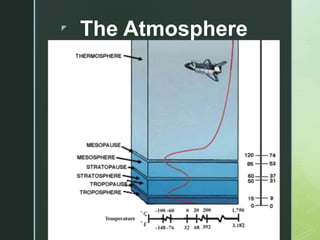
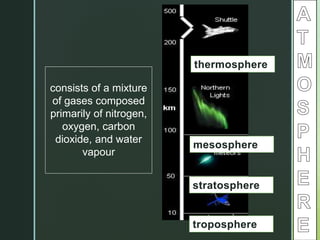
The Atmosphere
consists of a mixture
of gases composed
primarily of nitrogen,
oxygen, carbon
dioxide, and water
vapour
thermosphere
mesosphere
stratosphere
troposphere
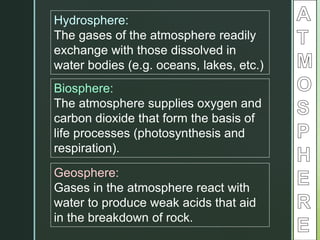
Hydrosphere:
The gases of the atmosphere readily
exchange with those dissolved in
water bodies (e.g. oceans, lakes, etc.)
Biosphere:
The atmosphere supplies oxygen and
carbon dioxide that form the basis of
life processes (photosynthesis and
respiration).
Geosphere:
Gases in the atmosphere react with
water to produce weak acids that aid
in the breakdown of rock.
z
I
N
T
E
R
A
C
T
I
O
N
S
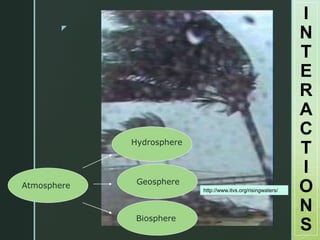
Atmosphere
Hydrosphere
Geosphere
Biosphere
http://www.itvs.org/risingwaters/
z
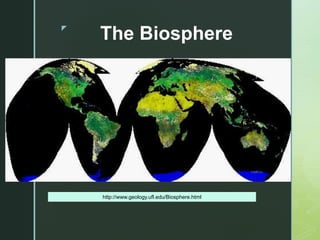
The Biosphere
http://www.geology.ufl.edu/Biosphere.html
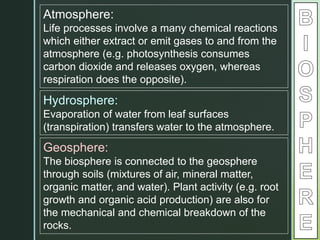
Atmosphere:
Life processes involve a many chemical reactions
which either extract or emit gases to and from the
atmosphere (e.g. photosynthesis consumes
carbon dioxide and releases oxygen, whereas
respiration does the opposite).
Hydrosphere:
Evaporation of water from leaf surfaces
(transpiration) transfers water to the atmosphere.
Geosphere:
The biosphere is connected to the geosphere
through soils (mixtures of air, mineral matter,
organic matter, and water). Plant activity (e.g. root
growth and organic acid production) are also for
the mechanical and chemical breakdown of the
rocks.
z
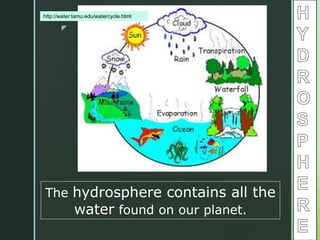
The hydrosphere contains all the
water found on our planet.
http://water.tamu.edu/watercycle.html
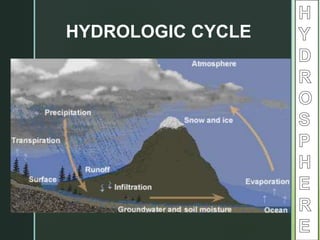
HYDROLOGIC CYCLE
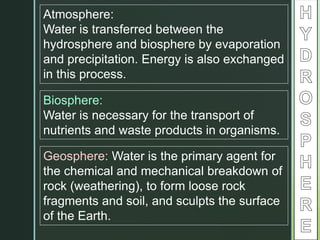
Atmosphere:
Water is transferred between the
hydrosphere and biosphere by evaporation
and precipitation. Energy is also exchanged
in this process.
Biosphere:
Water is necessary for the transport of
nutrients and waste products in organisms.
Geosphere: Water is the primary agent for
the chemical and mechanical breakdown of
rock (weathering), to form loose rock
fragments and soil, and sculpts the surface
of the Earth.
z
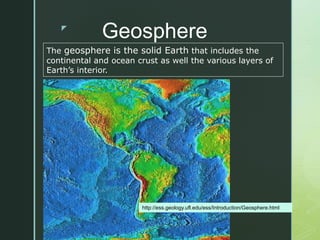
Geosphere
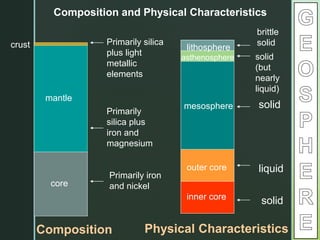
The geosphere is the solid Earth that includes the
continental and ocean crust as well the various layers of
Earth’s interior.
http://ess.geology.ufl.edu/ess/Introduction/Geosphere.html
crust
mantle
core
lithosphere
asthenosphere
mesosphere
outer core
inner core
Composition Physical Characteristics
Primarily iron
and nickel
Primarily
silica plus
iron and
magnesium
Primarily silica
plus light
metallic
elements
liquid
solid
solid
brittle
solid
solid
(but
nearly
liquid)
Composition and Physical Characteristics
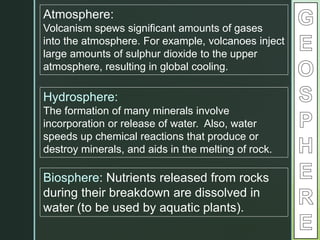
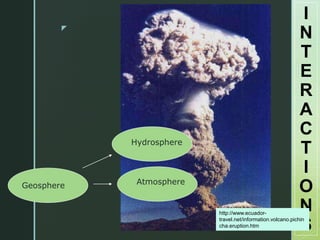
Atmosphere:
Volcanism spews significant amounts of gases
into the atmosphere. For example, volcanoes inject
large amounts of sulphur dioxide to the upper
atmosphere, resulting in global cooling.
Hydrosphere:
The formation of many minerals involve
incorporation or release of water. Also, water
speeds up chemical reactions that produce or
destroy minerals, and aids in the melting of rock.
Biosphere: Nutrients released from rocks
during their breakdown are dissolved in
water (to be used by aquatic plants).
z
I
N
T
E
R
A
C
T
I
O
N
S
Geosphere
Hydrosphere
Atmosphere
http://www.ecuador-
travel.net/information.volcano.pichin
cha.eruption.htm
z
I. Give two examples of how the Earth
system’s four parts can interact with
each other.
 Example: Animals (biosphere) can wear
paths in Earth’s surface (geosphere).
II. Identify the parts involved in the
following scenarios:
 Wind blows a sailboat across a lake.
 A bear digs under a log to search for
good.
A
S
S
I
G
N
M
E
N
T

Earth's subsystem

  • 1.
  • 2.
    The Earth System “Earthis a complex system of interacting physical, chemical and biological processes, and provides a natural laboratory whose experiments have been running since the beginning of time.” http://serc.carleton.edu/introgeo/earthsystem/nutshell/ NASA
  • 3.
    Earth As AClosed System Closed system: exchange of energy but negligible exchange of mass with surroundings
  • 4.
    Earth System Science Earthsystem science studies Earth as a system composed of numerous parts, or subsystems.
  • 5.
    The Earth SystemM. Ruzek, 1999
  • 6.
  • 7.
    z Overlapping Cycles inthe Earth System http://www.uwgb.edu/dutchs/GRAPHIC0/Astronomy/EarthSystems.gif
  • 8.
  • 9.
    consists of amixture of gases composed primarily of nitrogen, oxygen, carbon dioxide, and water vapour thermosphere mesosphere stratosphere troposphere
  • 10.
    Hydrosphere: The gases ofthe atmosphere readily exchange with those dissolved in water bodies (e.g. oceans, lakes, etc.) Biosphere: The atmosphere supplies oxygen and carbon dioxide that form the basis of life processes (photosynthesis and respiration). Geosphere: Gases in the atmosphere react with water to produce weak acids that aid in the breakdown of rock.
  • 11.
  • 12.
  • 13.
    Atmosphere: Life processes involvea many chemical reactions which either extract or emit gases to and from the atmosphere (e.g. photosynthesis consumes carbon dioxide and releases oxygen, whereas respiration does the opposite). Hydrosphere: Evaporation of water from leaf surfaces (transpiration) transfers water to the atmosphere. Geosphere: The biosphere is connected to the geosphere through soils (mixtures of air, mineral matter, organic matter, and water). Plant activity (e.g. root growth and organic acid production) are also for the mechanical and chemical breakdown of the rocks.
  • 14.
    z The hydrosphere containsall the water found on our planet. http://water.tamu.edu/watercycle.html
  • 15.
  • 16.
    Atmosphere: Water is transferredbetween the hydrosphere and biosphere by evaporation and precipitation. Energy is also exchanged in this process. Biosphere: Water is necessary for the transport of nutrients and waste products in organisms. Geosphere: Water is the primary agent for the chemical and mechanical breakdown of rock (weathering), to form loose rock fragments and soil, and sculpts the surface of the Earth.
  • 17.
    z Geosphere The geosphere isthe solid Earth that includes the continental and ocean crust as well the various layers of Earth’s interior. http://ess.geology.ufl.edu/ess/Introduction/Geosphere.html
  • 18.
    crust mantle core lithosphere asthenosphere mesosphere outer core inner core CompositionPhysical Characteristics Primarily iron and nickel Primarily silica plus iron and magnesium Primarily silica plus light metallic elements liquid solid solid brittle solid solid (but nearly liquid) Composition and Physical Characteristics
  • 19.
    Atmosphere: Volcanism spews significantamounts of gases into the atmosphere. For example, volcanoes inject large amounts of sulphur dioxide to the upper atmosphere, resulting in global cooling. Hydrosphere: The formation of many minerals involve incorporation or release of water. Also, water speeds up chemical reactions that produce or destroy minerals, and aids in the melting of rock. Biosphere: Nutrients released from rocks during their breakdown are dissolved in water (to be used by aquatic plants).
  • 20.
  • 21.
    z I. Give twoexamples of how the Earth system’s four parts can interact with each other.  Example: Animals (biosphere) can wear paths in Earth’s surface (geosphere). II. Identify the parts involved in the following scenarios:  Wind blows a sailboat across a lake.  A bear digs under a log to search for good. A S S I G N M E N T