RHS Level 2 Certificate Week 10 – Review and revision of photosynthesis, secondary thickening and pollination/fertilization
RHS Level 2 Certificate Week 10 – Revision week. Photosynthesis and respiration review Secondary thickening Pollination – cell division in pollen germination
Learning outcomes To identify the end product and waste product of photosynthesis To state the equation for photosynthesis in words To describe the light dependent and light independent phases of photosynthesis in overview To state the limiting factors of photosynthesis To state the equation for respiration in words To identify the end product and waste products of respiration To identify the tissue involved in secondary thickening To describe the process of secondary thickening To define pollination To describe the process of fertilization
 
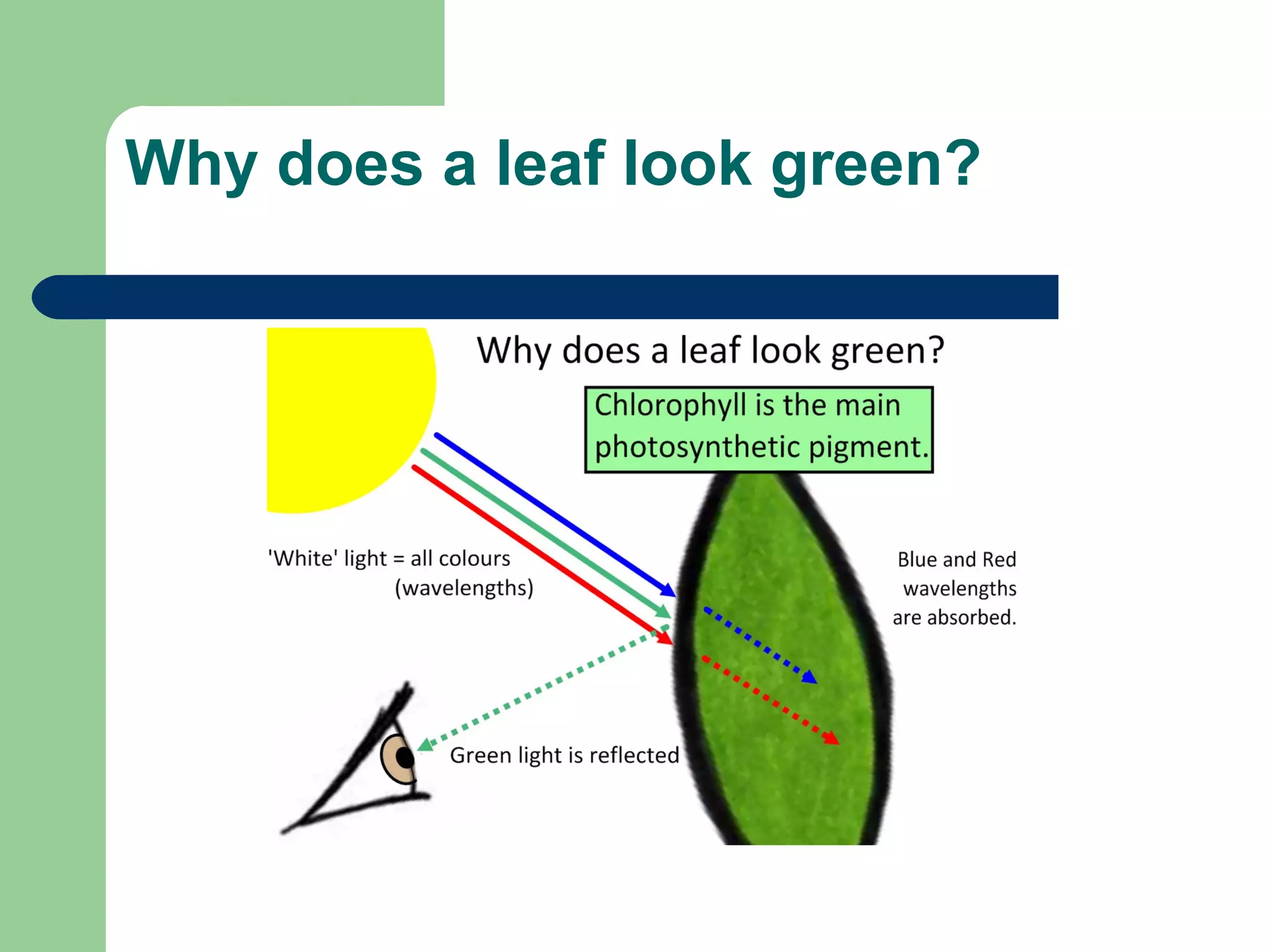
Why does a leaf look green?
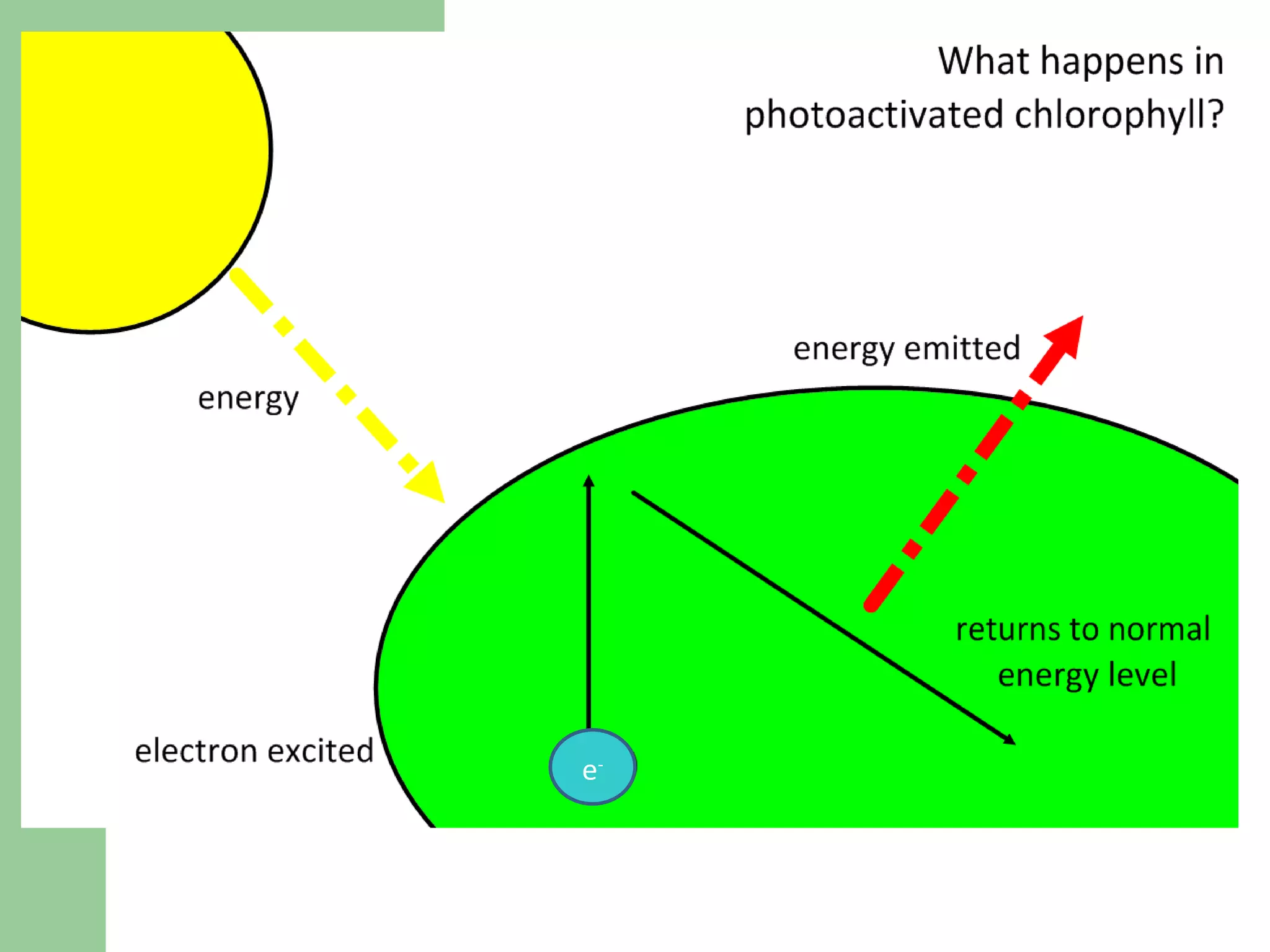
e -
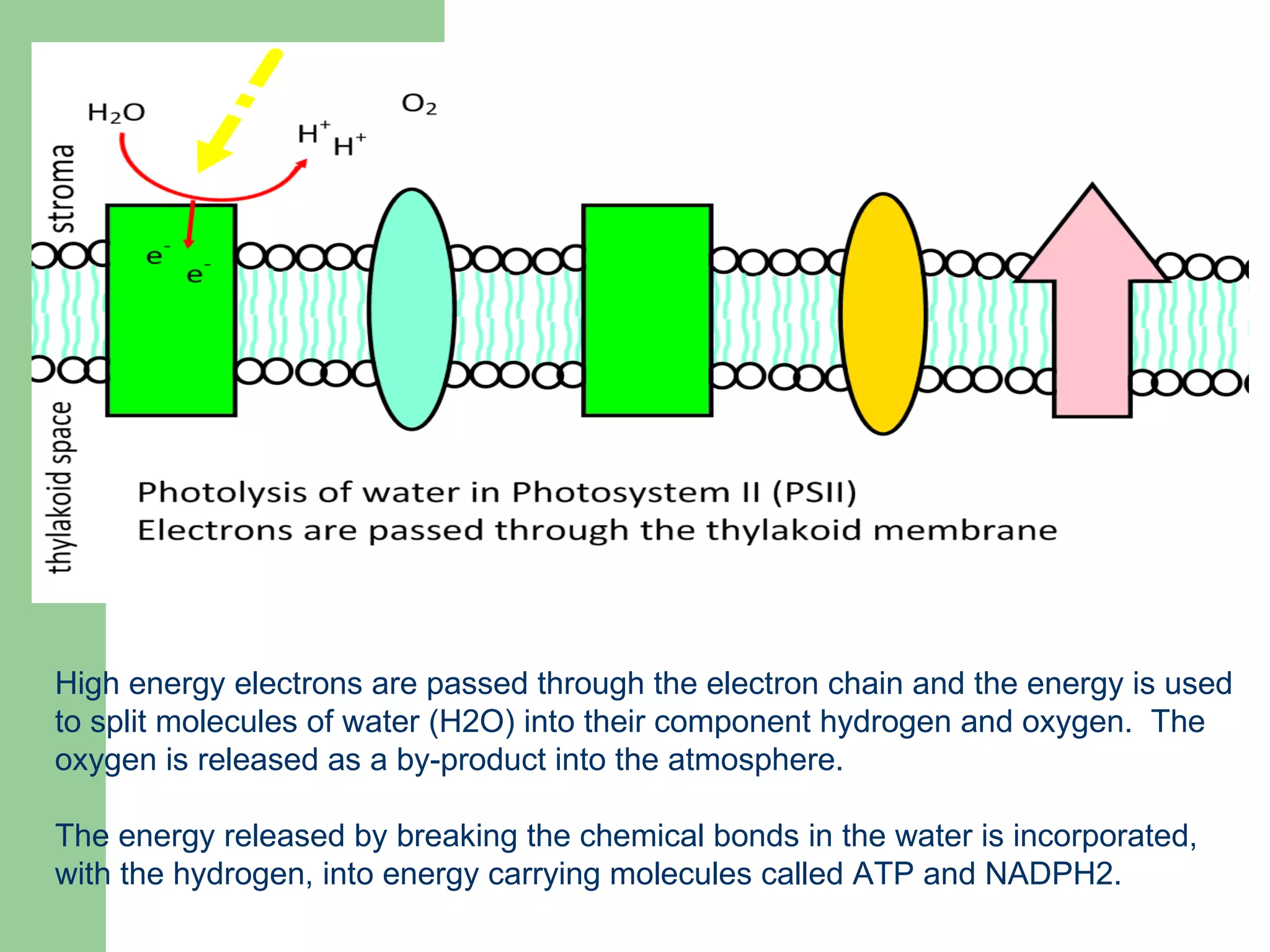
High energy electrons are passed through the electron chain and the energy is used to split molecules of water (H2O) into their component hydrogen and oxygen.  The oxygen is released as a by-product into the atmosphere. The energy released by breaking the chemical bonds in the water is incorporated, with the hydrogen, into energy carrying molecules called ATP and NADPH2.
 
 
Limiting factors If a process is influenced by more than one factor, the rate of the process will be limited by the factor that is in lowest supply Therefore if temperature is low (10 °C) increasing light intensity or carbon dioxide concentration will not increase the rate of photosynthesis. Why does this matter ?  The slower the rate of photosynthesis the slower the rate of growth.
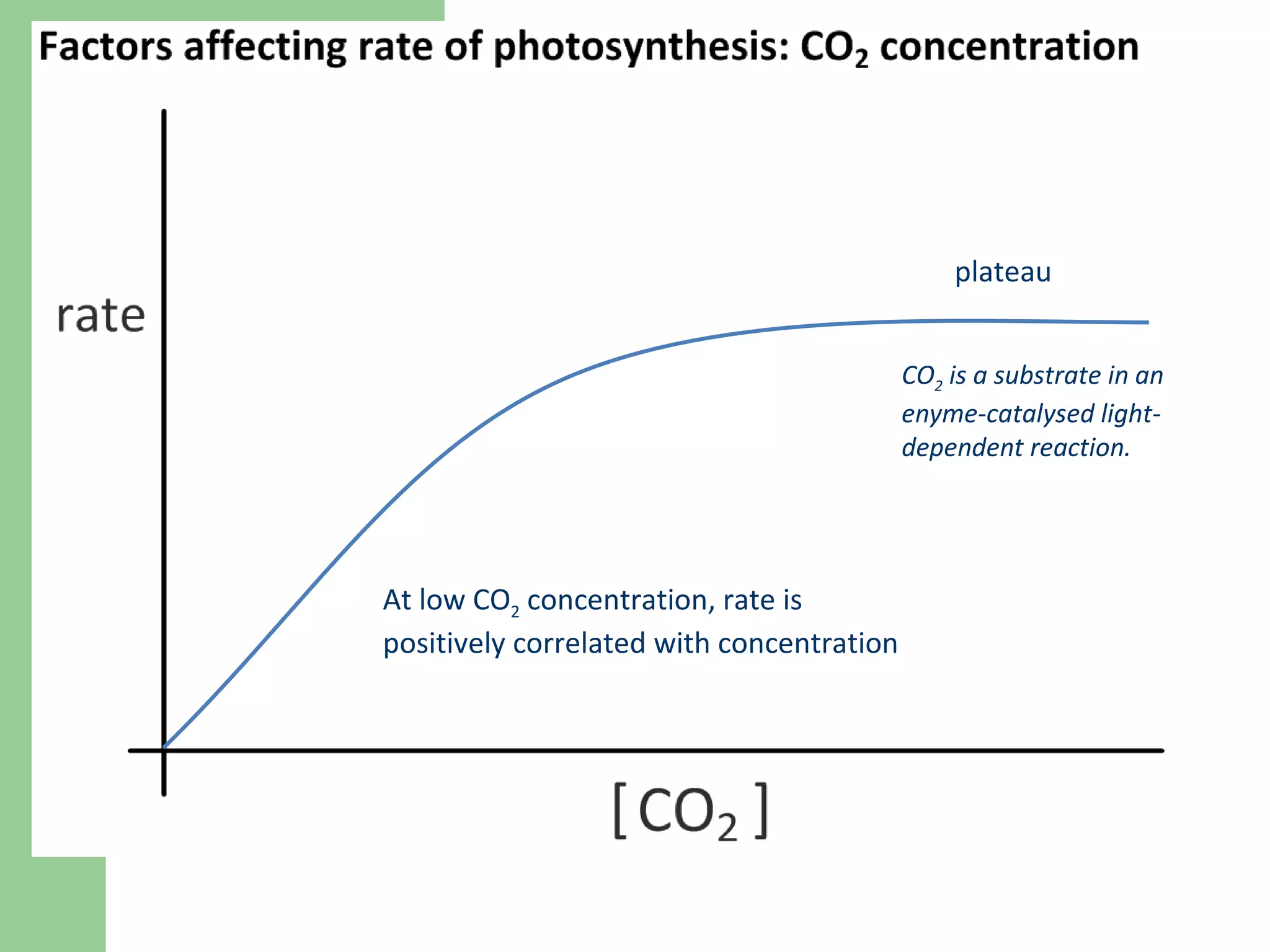
plateau At low CO 2  concentration, rate is positively correlated with concentration CO 2  is a substrate in an enyme-catalysed light-dependent reaction.
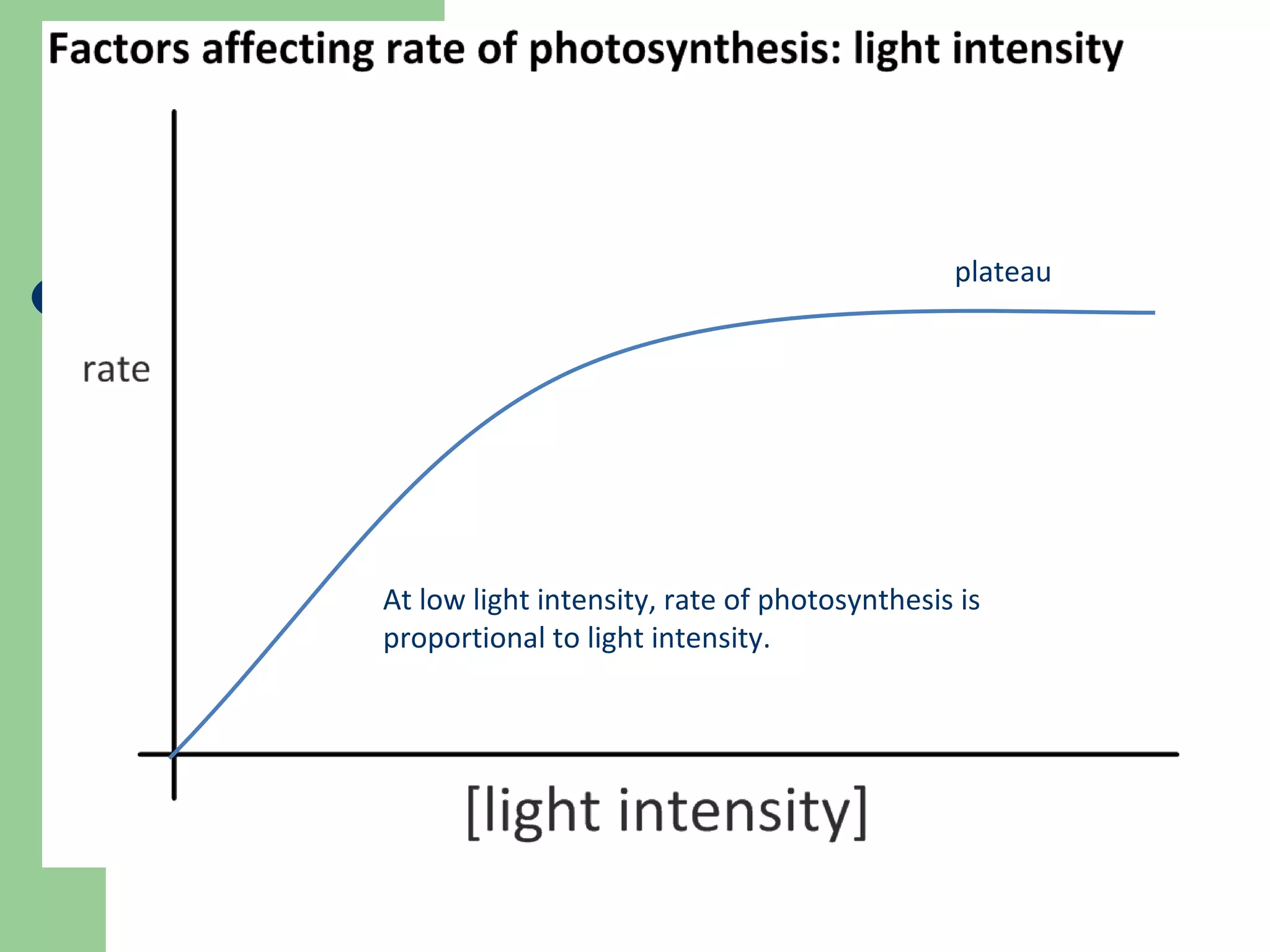
At low light intensity, rate of photosynthesis is proportional to light intensity.  plateau
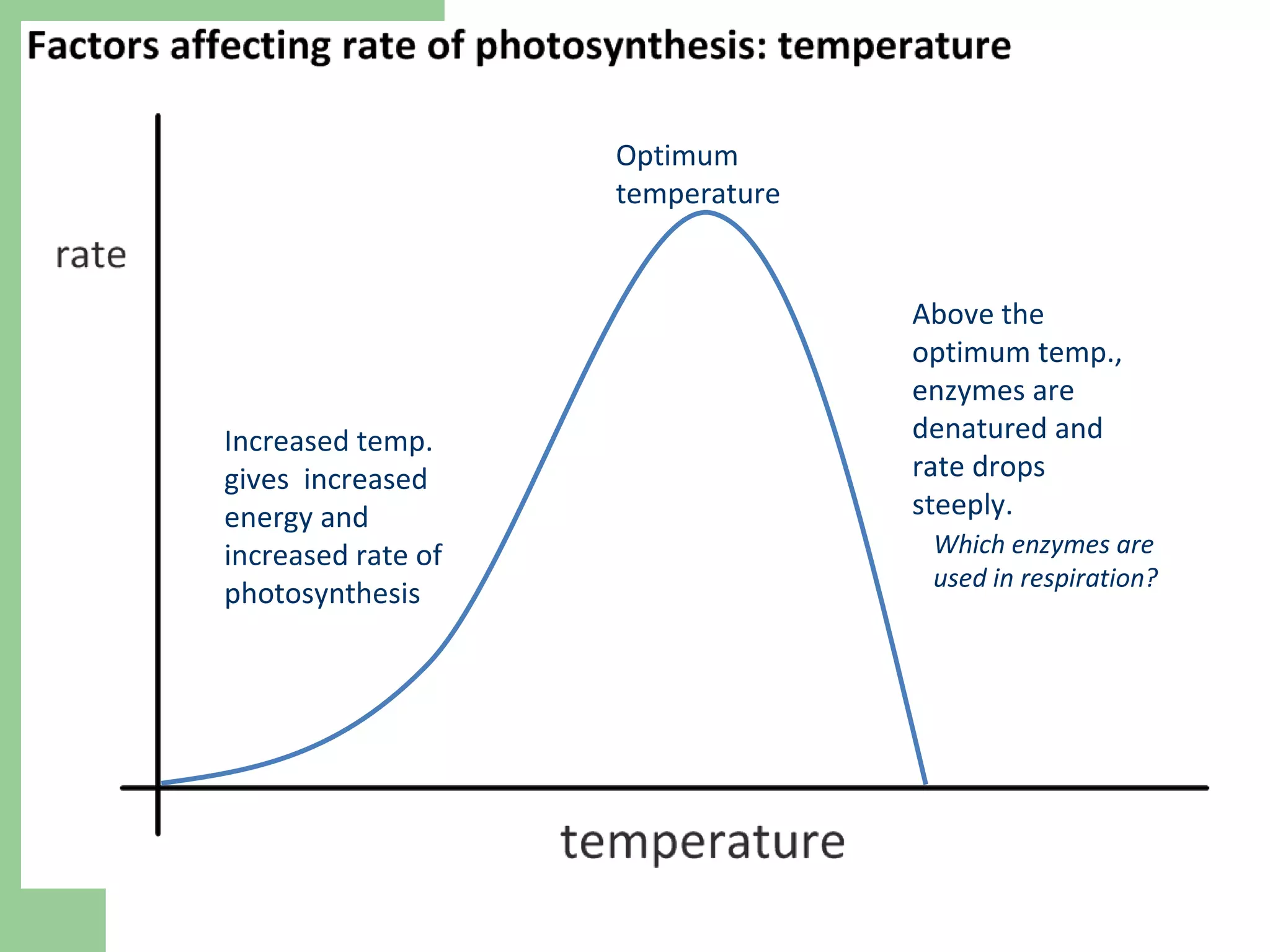
Increased temp. gives  increased energy and increased rate of photosynthesis Optimum temperature Above the optimum temp., enzymes are denatured and rate drops steeply.  Which enzymes are used in respiration?
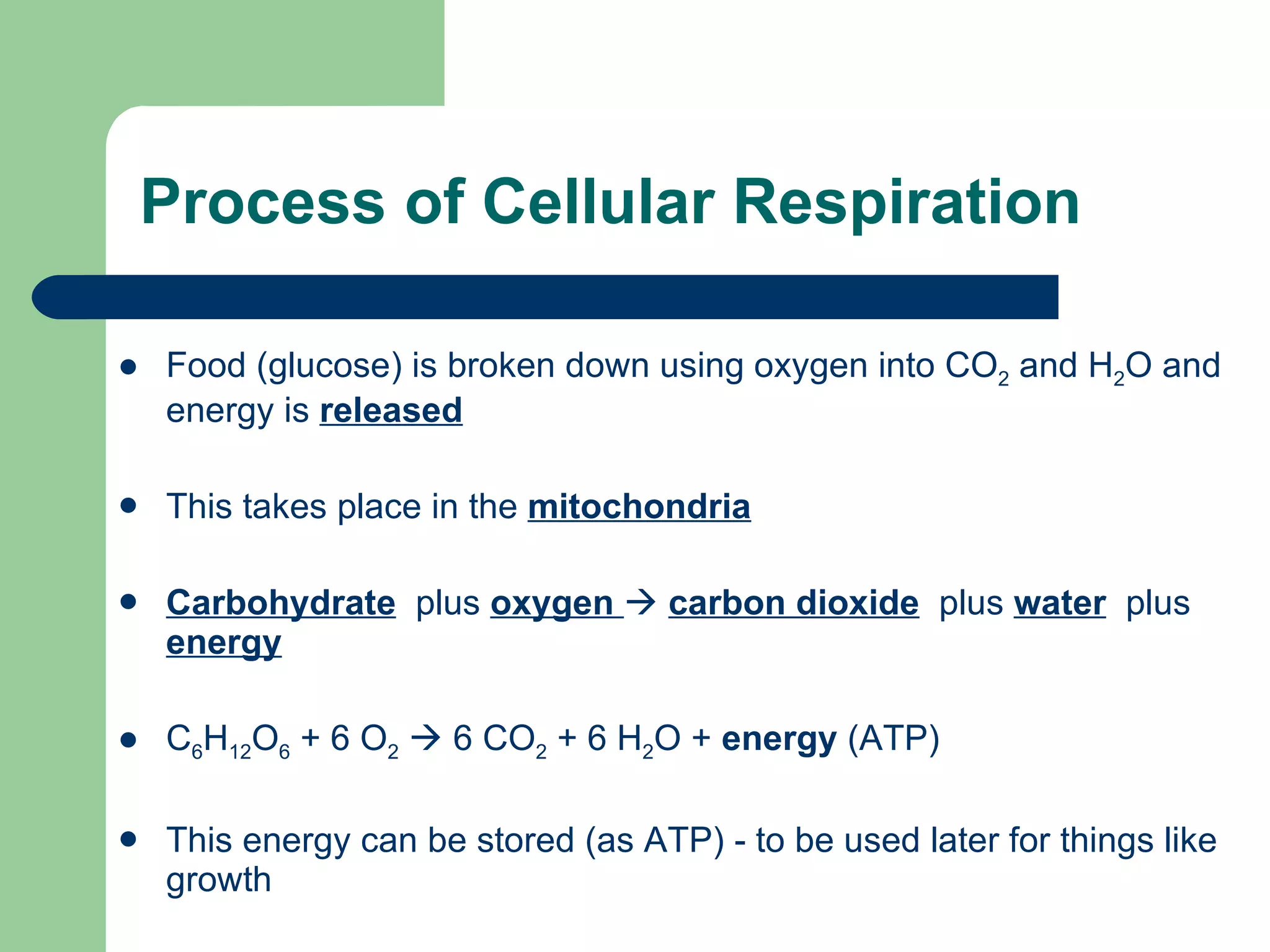
Process of Cellular Respiration Food (glucose) is broken down using oxygen into CO 2  and H 2 O and energy is  released This takes place in the  mitochondria Carbohydrate   plus  oxygen     carbon dioxide   plus  water   plus  energy C 6 H 12 O 6  + 6 O 2     6 CO 2  + 6 H 2 O +  energy  (ATP) This energy can be stored (as ATP) - to be used later for things like growth
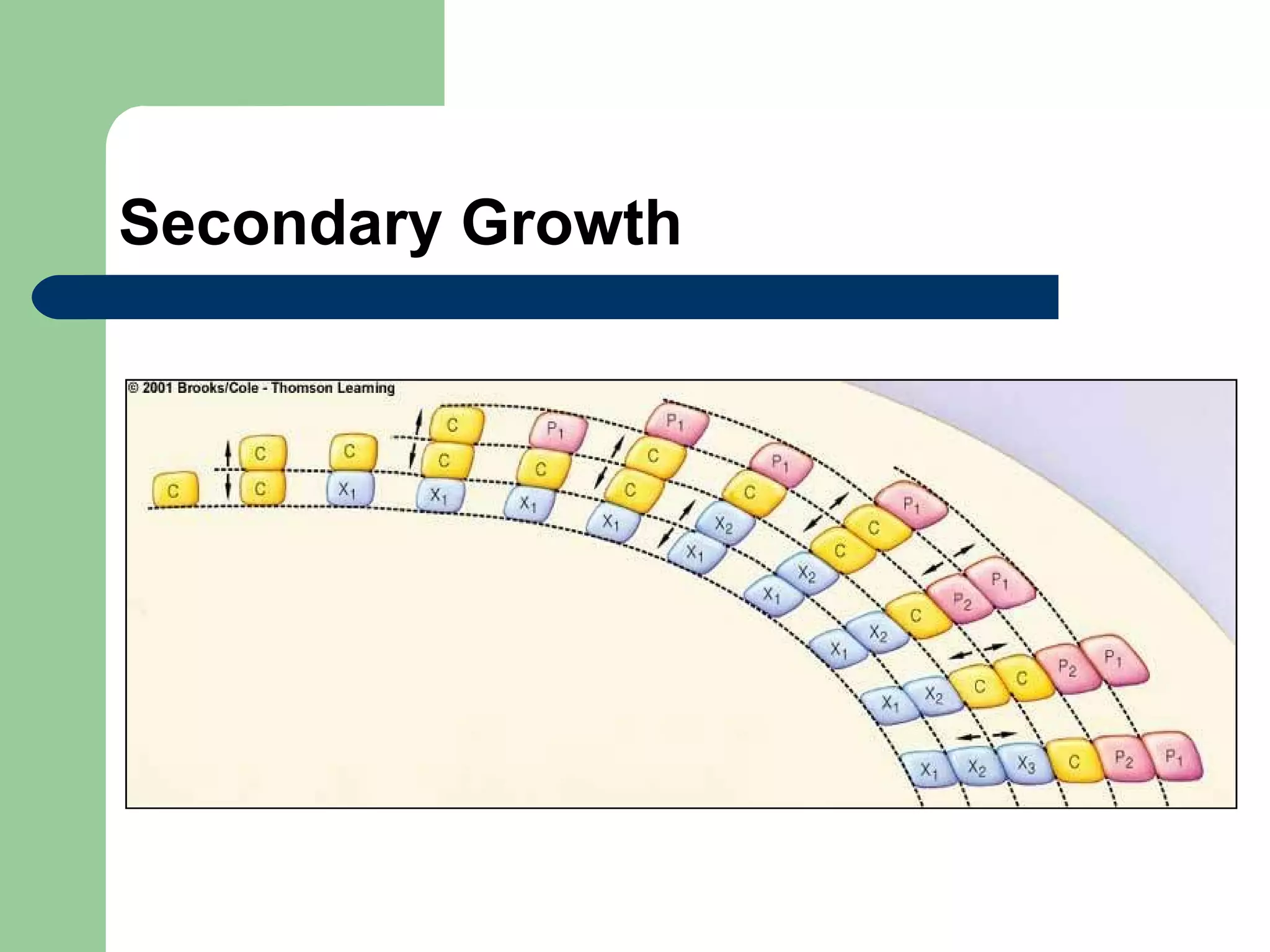
Secondary Growth Occurs in  perennials A ring of vascular cambium produces secondary xylem and phloem Wood is the accumulation of these secondary tissues, especially xylem http://www.cnr.vt.edu/dendro/forestbiology/syllabus3.htm#
Secondary Growth
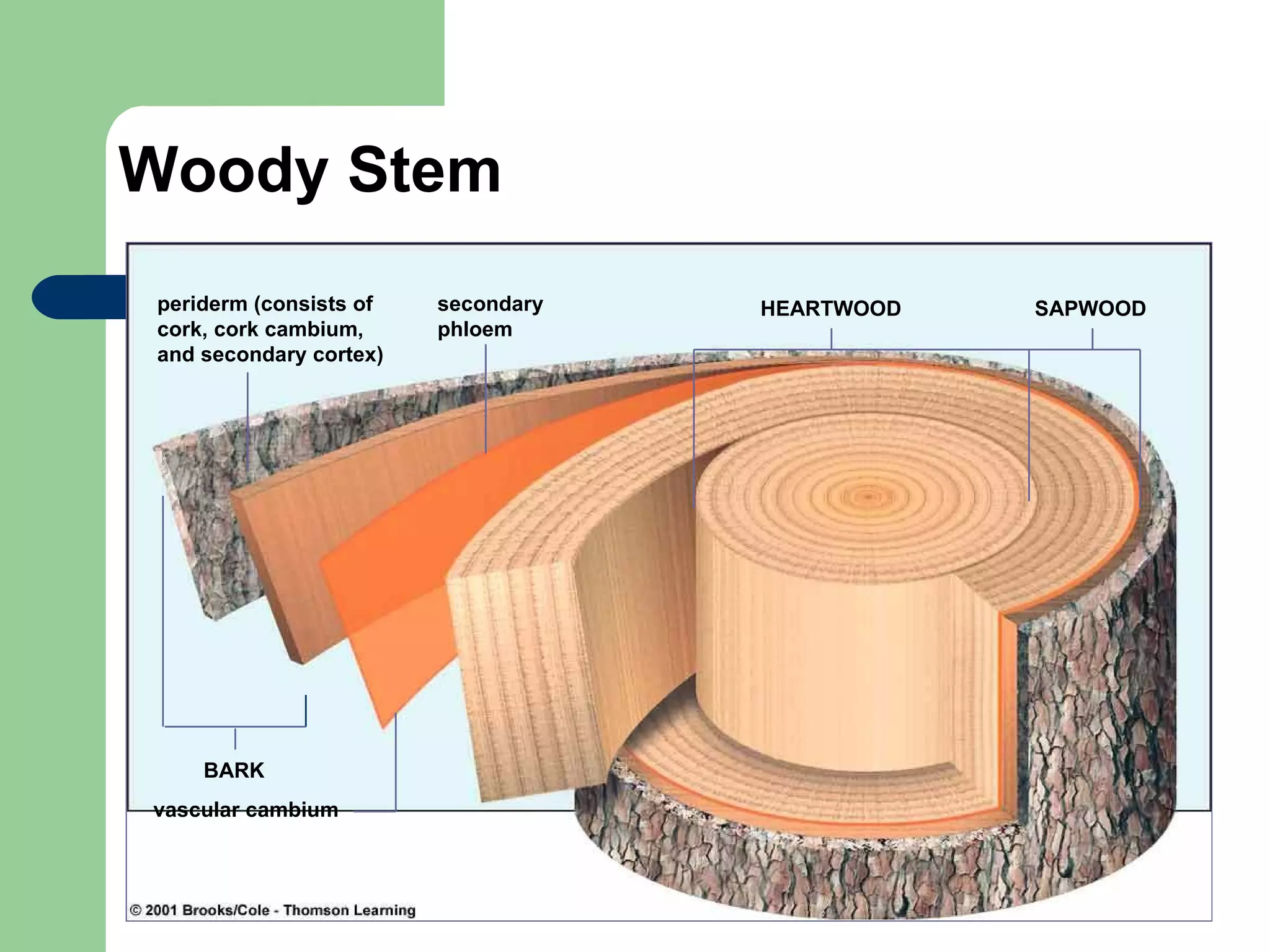
Woody Stem periderm (consists of cork, cork cambium, and secondary cortex) secondary phloem BARK HEARTWOOD SAPWOOD vascular cambium
Annual Rings Concentric rings of secondary xylem Alternating bands of early and late wood Early wood Xylem cells with large diameter, thin walls Late wood Xylem cells with smaller diameter, thicker walls
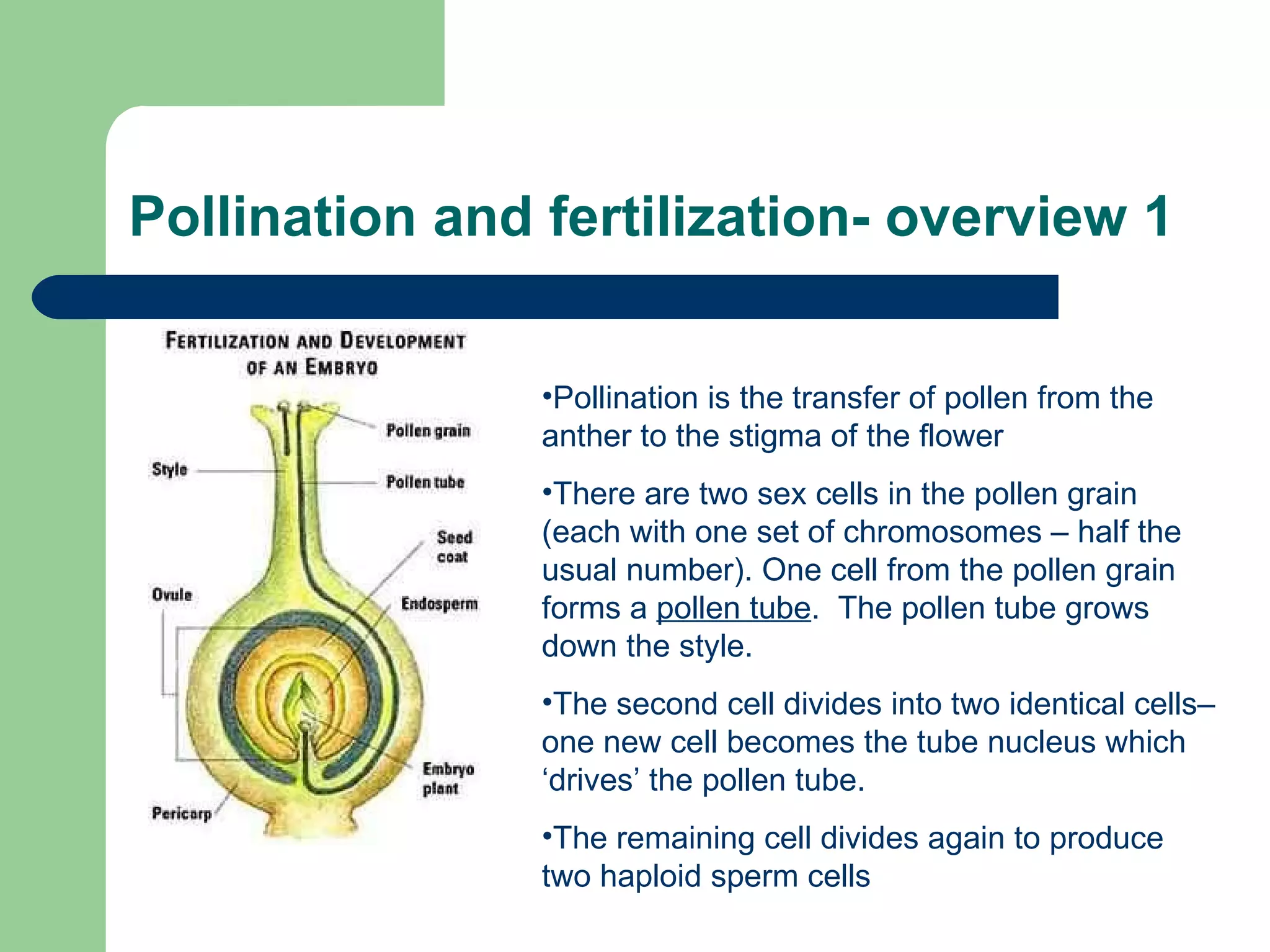
Pollination and fertilization- overview 1 Pollination is the transfer of pollen from the anther to the stigma of the flower  There are two sex cells in the pollen grain (each with one set of chromosomes – half the usual number). One cell from the pollen grain forms a  pollen tube .  The pollen tube grows down the style. The second cell divides into two identical cells– one new cell becomes the tube nucleus which ‘drives’ the pollen tube.  The remaining cell divides again to produce two haploid sperm cells
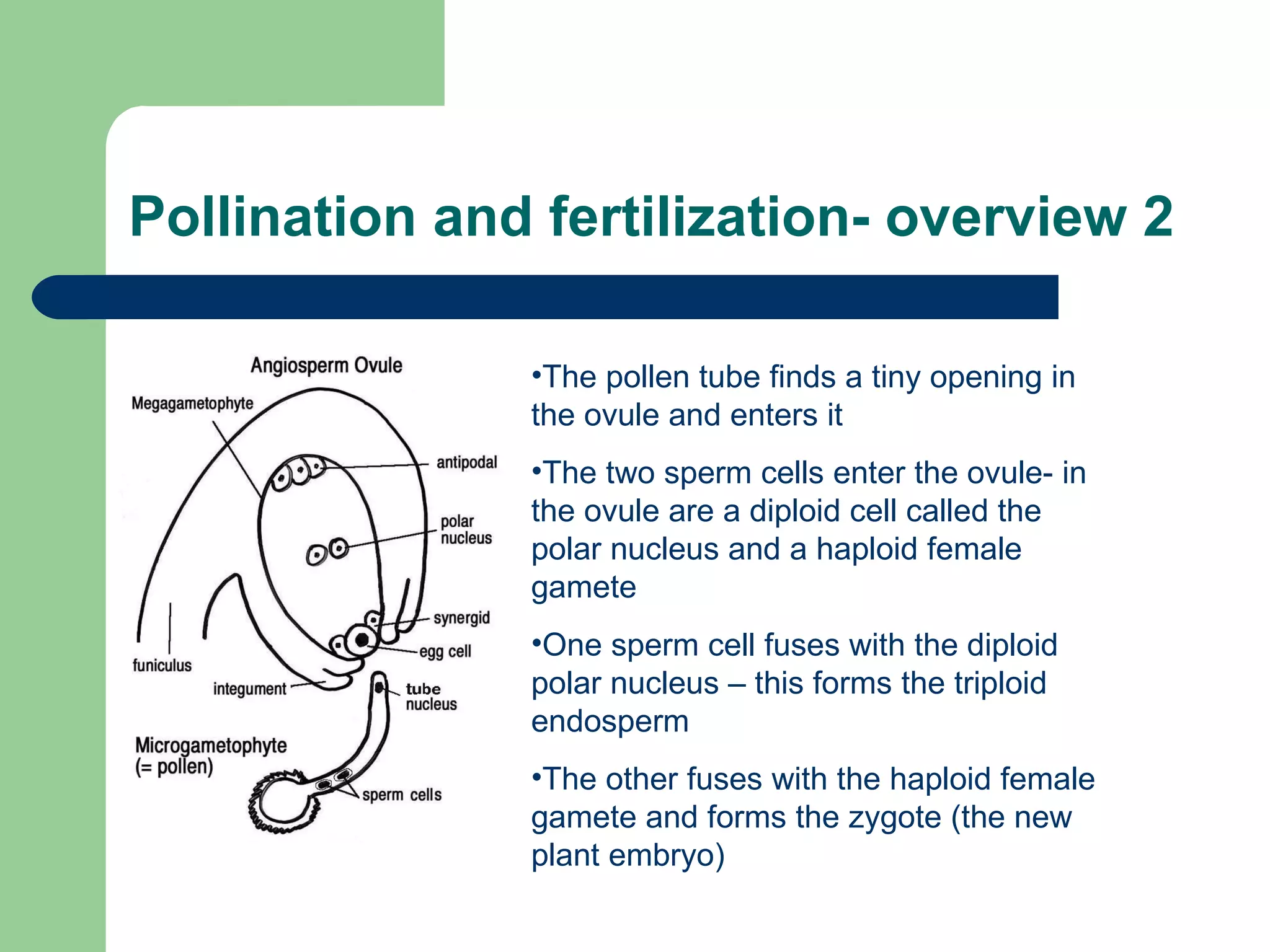
Pollination and fertilization- overview 2 The pollen tube finds a tiny opening in the ovule and enters it  The two sperm cells enter the ovule- in the ovule are a diploid cell called the polar nucleus and a haploid female gamete One sperm cell fuses with the diploid polar nucleus – this forms the triploid endosperm The other fuses with the haploid female gamete and forms the zygote (the new plant embryo)
Learning outcomes To identify the end product and waste product of photosynthesis To state the equation for photosynthesis in words To describe the light dependent and light independent phases of photosynthesis in overview To state the limiting factors of photosynthesis To state the equation for respiration in words To identify the end product and waste products of respiration To identify the tissue involved in secondary thickening To describe the process of secondary thickening To define pollination To describe the process of fertilization

RHS Level 2 Certificate Week 10 overview

  • 1.
    RHS Level 2Certificate Week 10 – Review and revision of photosynthesis, secondary thickening and pollination/fertilization
  • 2.
    RHS Level 2Certificate Week 10 – Revision week. Photosynthesis and respiration review Secondary thickening Pollination – cell division in pollen germination
  • 3.
    Learning outcomes Toidentify the end product and waste product of photosynthesis To state the equation for photosynthesis in words To describe the light dependent and light independent phases of photosynthesis in overview To state the limiting factors of photosynthesis To state the equation for respiration in words To identify the end product and waste products of respiration To identify the tissue involved in secondary thickening To describe the process of secondary thickening To define pollination To describe the process of fertilization
  • 4.
  • 5.
    Why does aleaf look green?
  • 6.
  • 7.
    High energy electronsare passed through the electron chain and the energy is used to split molecules of water (H2O) into their component hydrogen and oxygen. The oxygen is released as a by-product into the atmosphere. The energy released by breaking the chemical bonds in the water is incorporated, with the hydrogen, into energy carrying molecules called ATP and NADPH2.
  • 8.
  • 9.
  • 10.
    Limiting factors Ifa process is influenced by more than one factor, the rate of the process will be limited by the factor that is in lowest supply Therefore if temperature is low (10 °C) increasing light intensity or carbon dioxide concentration will not increase the rate of photosynthesis. Why does this matter ? The slower the rate of photosynthesis the slower the rate of growth.
  • 11.
    plateau At lowCO 2 concentration, rate is positively correlated with concentration CO 2 is a substrate in an enyme-catalysed light-dependent reaction.
  • 12.
    At low lightintensity, rate of photosynthesis is proportional to light intensity. plateau
  • 13.
    Increased temp. gives increased energy and increased rate of photosynthesis Optimum temperature Above the optimum temp., enzymes are denatured and rate drops steeply. Which enzymes are used in respiration?
  • 14.
    Process of CellularRespiration Food (glucose) is broken down using oxygen into CO 2 and H 2 O and energy is released This takes place in the mitochondria Carbohydrate plus oxygen  carbon dioxide plus water plus energy C 6 H 12 O 6 + 6 O 2  6 CO 2 + 6 H 2 O + energy (ATP) This energy can be stored (as ATP) - to be used later for things like growth
  • 15.
    Secondary Growth Occursin perennials A ring of vascular cambium produces secondary xylem and phloem Wood is the accumulation of these secondary tissues, especially xylem http://www.cnr.vt.edu/dendro/forestbiology/syllabus3.htm#
  • 16.
  • 17.
    Woody Stem periderm(consists of cork, cork cambium, and secondary cortex) secondary phloem BARK HEARTWOOD SAPWOOD vascular cambium
  • 18.
    Annual Rings Concentricrings of secondary xylem Alternating bands of early and late wood Early wood Xylem cells with large diameter, thin walls Late wood Xylem cells with smaller diameter, thicker walls
  • 19.
    Pollination and fertilization-overview 1 Pollination is the transfer of pollen from the anther to the stigma of the flower There are two sex cells in the pollen grain (each with one set of chromosomes – half the usual number). One cell from the pollen grain forms a pollen tube . The pollen tube grows down the style. The second cell divides into two identical cells– one new cell becomes the tube nucleus which ‘drives’ the pollen tube. The remaining cell divides again to produce two haploid sperm cells
  • 20.
    Pollination and fertilization-overview 2 The pollen tube finds a tiny opening in the ovule and enters it The two sperm cells enter the ovule- in the ovule are a diploid cell called the polar nucleus and a haploid female gamete One sperm cell fuses with the diploid polar nucleus – this forms the triploid endosperm The other fuses with the haploid female gamete and forms the zygote (the new plant embryo)
  • 21.
    Learning outcomes Toidentify the end product and waste product of photosynthesis To state the equation for photosynthesis in words To describe the light dependent and light independent phases of photosynthesis in overview To state the limiting factors of photosynthesis To state the equation for respiration in words To identify the end product and waste products of respiration To identify the tissue involved in secondary thickening To describe the process of secondary thickening To define pollination To describe the process of fertilization

Editor's Notes

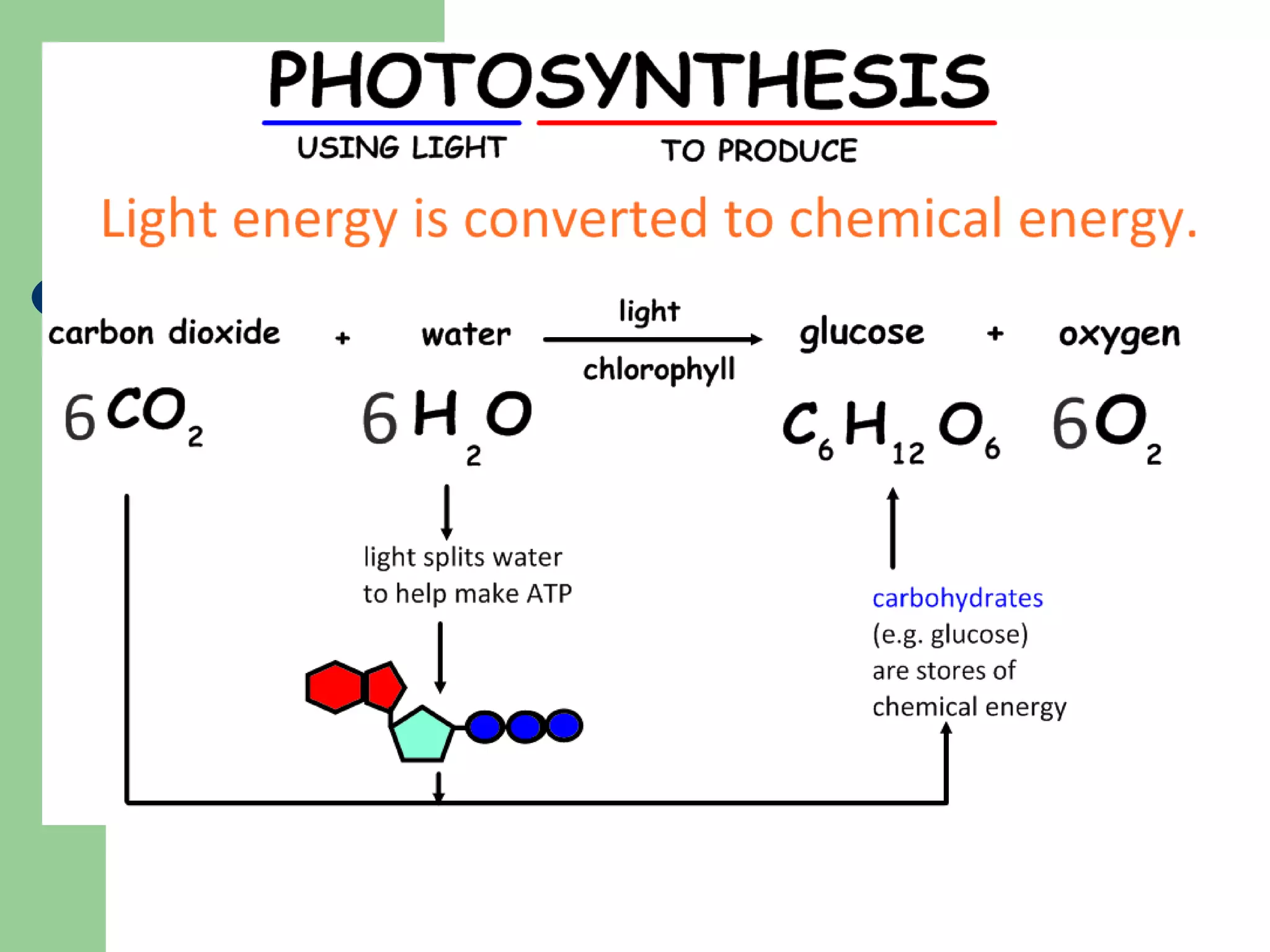
  • #5 Photosynthesis title, definition and equation.
  • #7 Photoactivation of chlorophyll – electrons are excited and return to their original state, releasing oxygen.
  • #8 Photolysis of water produces high-energy electrons, H+ protons and oxygen.
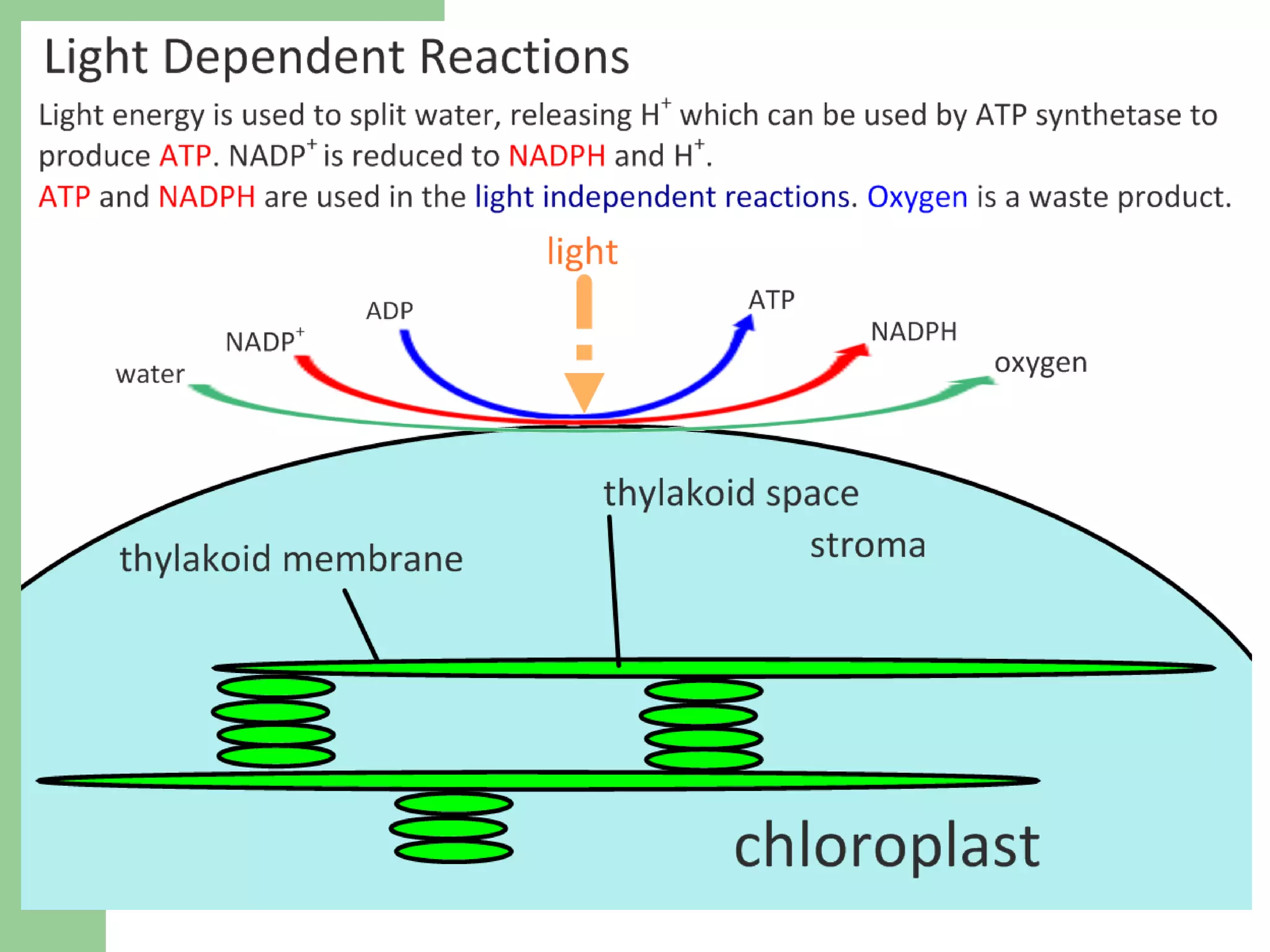
  • #9 Light Dependent Reactions title and brief overview.
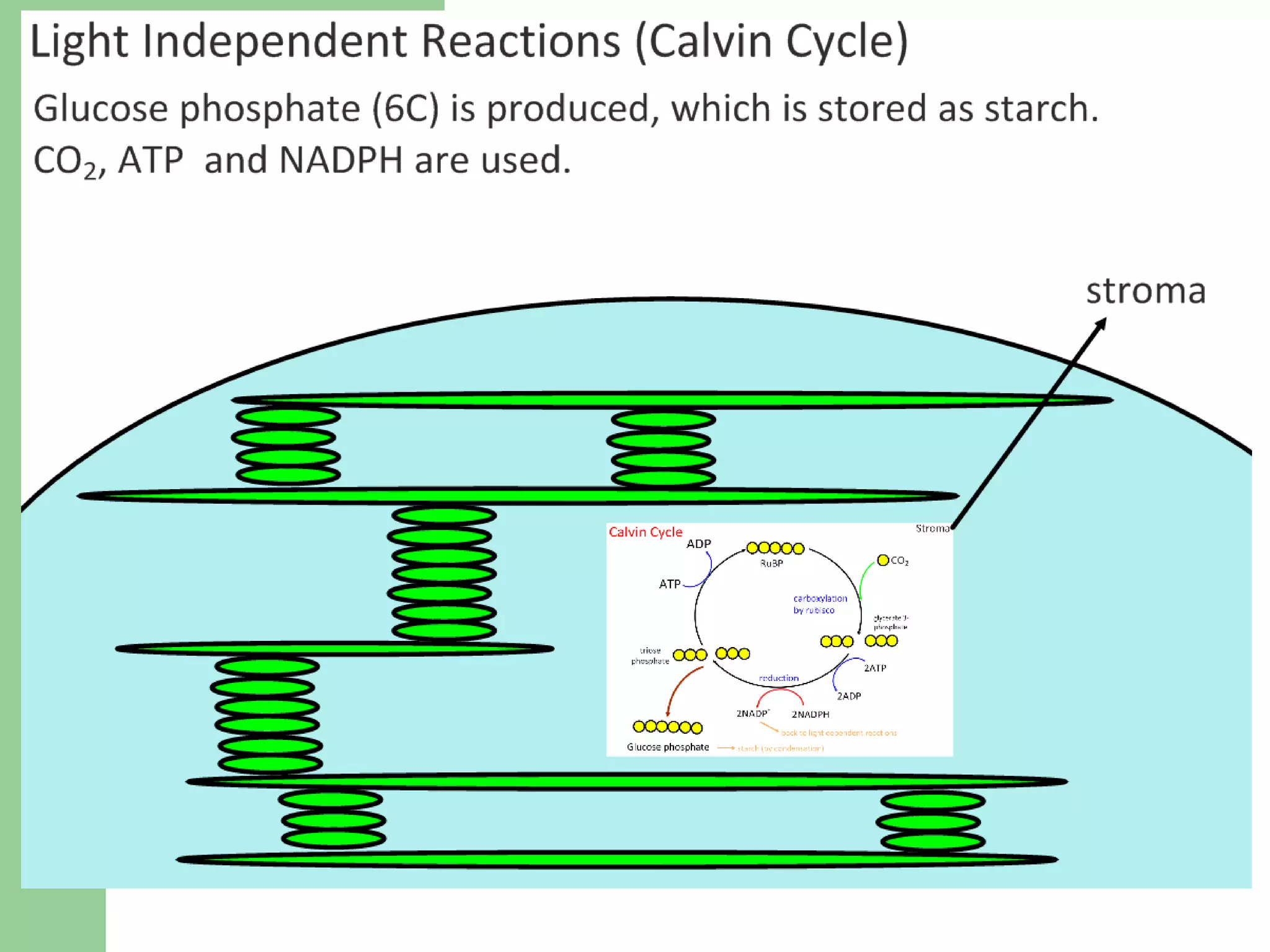
  • #10 Light Independent Reactions title – quick overview.
  • #12 CO2 affects rate of photosynthesis. CO2 is the substrate in carbon fixation (Calvin cycle) – rubisco is the enzyme.
  • #13 Light intensity affects rate of photosynthesis.
  • #14 Temperature affects the rate of photosynthesis. Remember enzyme theory. Enzymes used in respiration: rubisco is the main one. ATP synthase can also be denatured.