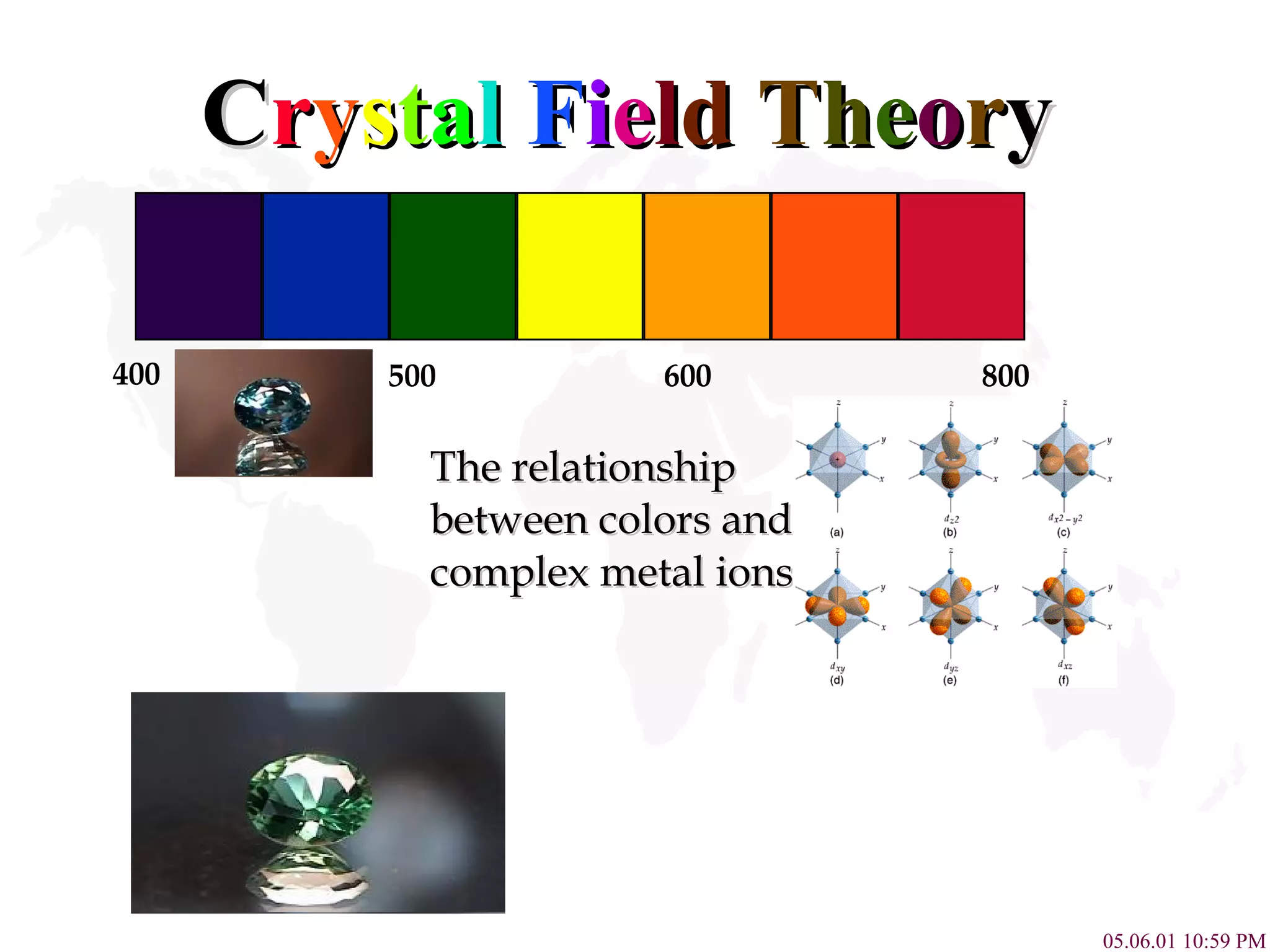
C r y s t a l  F i e l d  T h e o r y The relationship between colors and complex metal ions 400 500 600 800
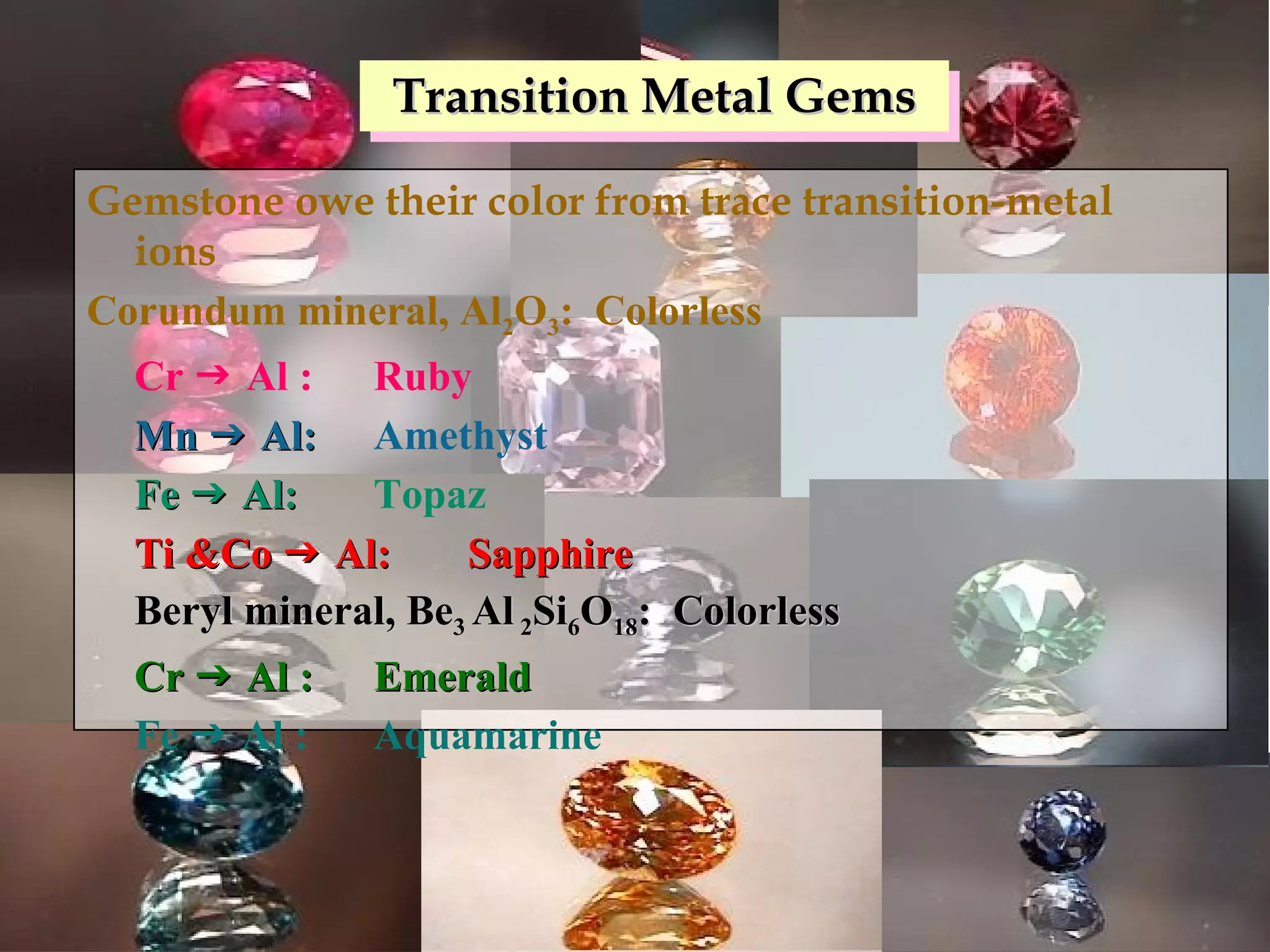
Transition Metal Gems Gemstone owe their color from trace transition-metal ions Corundum mineral, Al 2 O 3 :  Colorless Cr    Al :  Ruby Mn    Al: Amethyst Fe    Al: Topaz Ti &Co    Al: Sapphire Beryl mineral, Be 3  Al  2 Si 6 O 18 :  Colorless Cr    Al :  Emerald Fe    Al :  Aquamarine
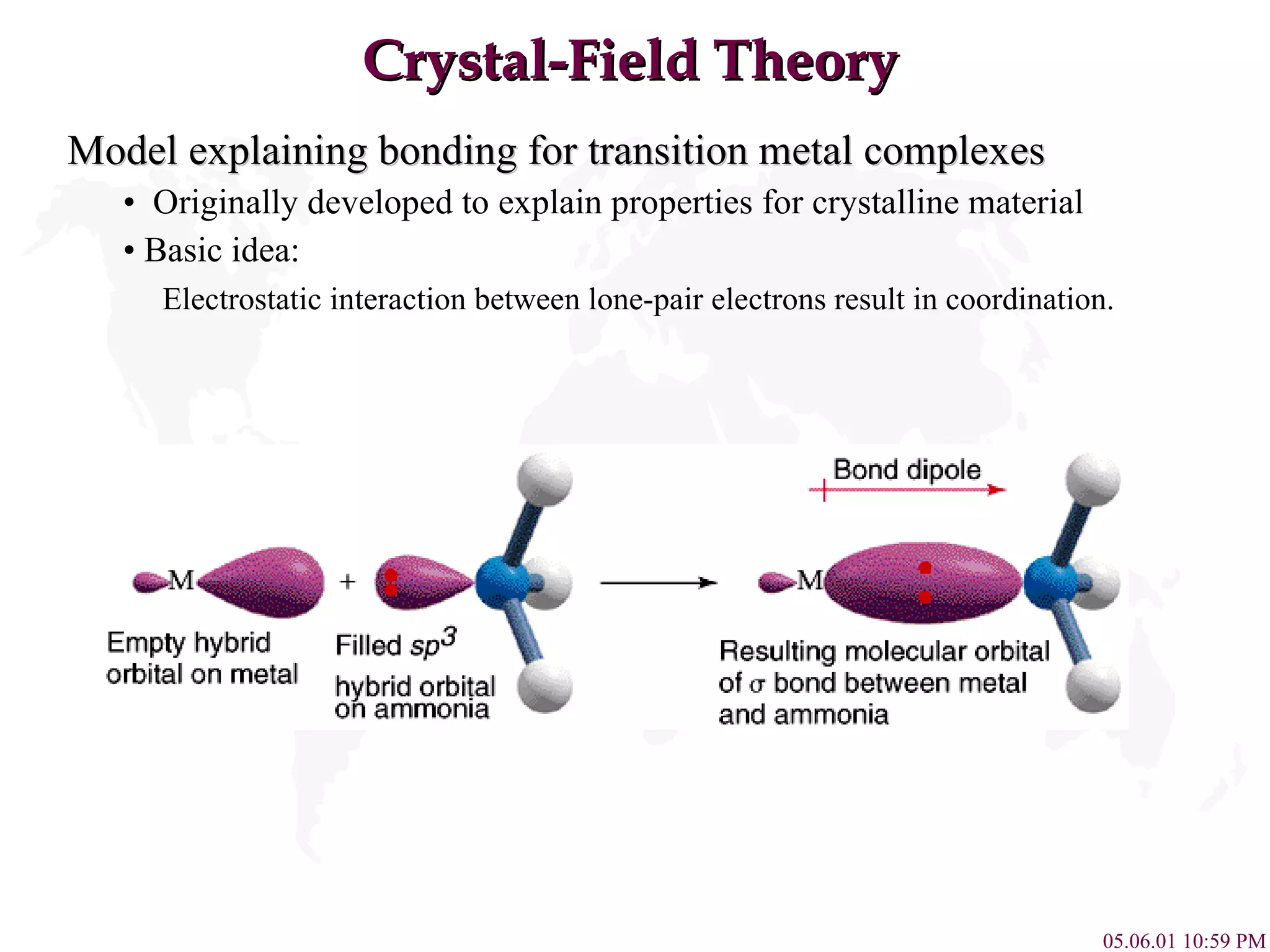
Crystal-Field Theory Model explaining bonding for transition metal complexes •  Originally developed to explain properties for crystalline material •  Basic idea: Electrostatic interaction between lone-pair electrons result in coordination.
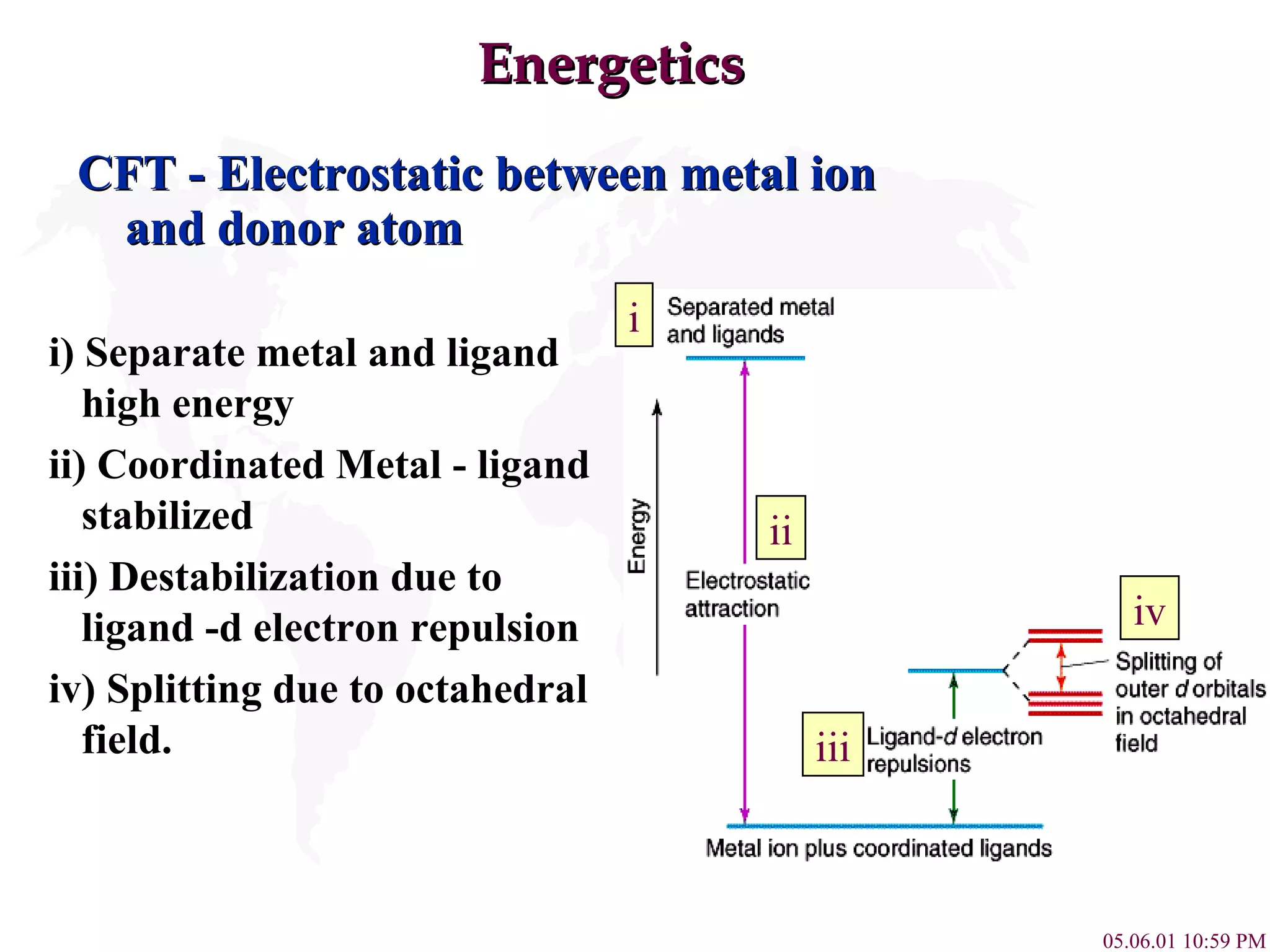
Energetics CFT - Electrostatic between metal ion and donor atom i) Separate metal and ligand  high energy ii) Coordinated Metal - ligand stabilized iii) Destabilization due to ligand -d electron repulsion iv) Splitting due to octahedral field. i ii iii iv
Ligand-Metal Interaction Crystal Field Theory - Describes bonding in Metal Complexes Basic Assumption in CFT: Electrostatic interaction between ligand and metal d-orbitals align along the octahedral axis will be affected the most. More directly the ligand attacks the metal orbital, the higher the the energy of the d-orbital. In an octahedral field the degeneracy of the five d-orbitals is lifted
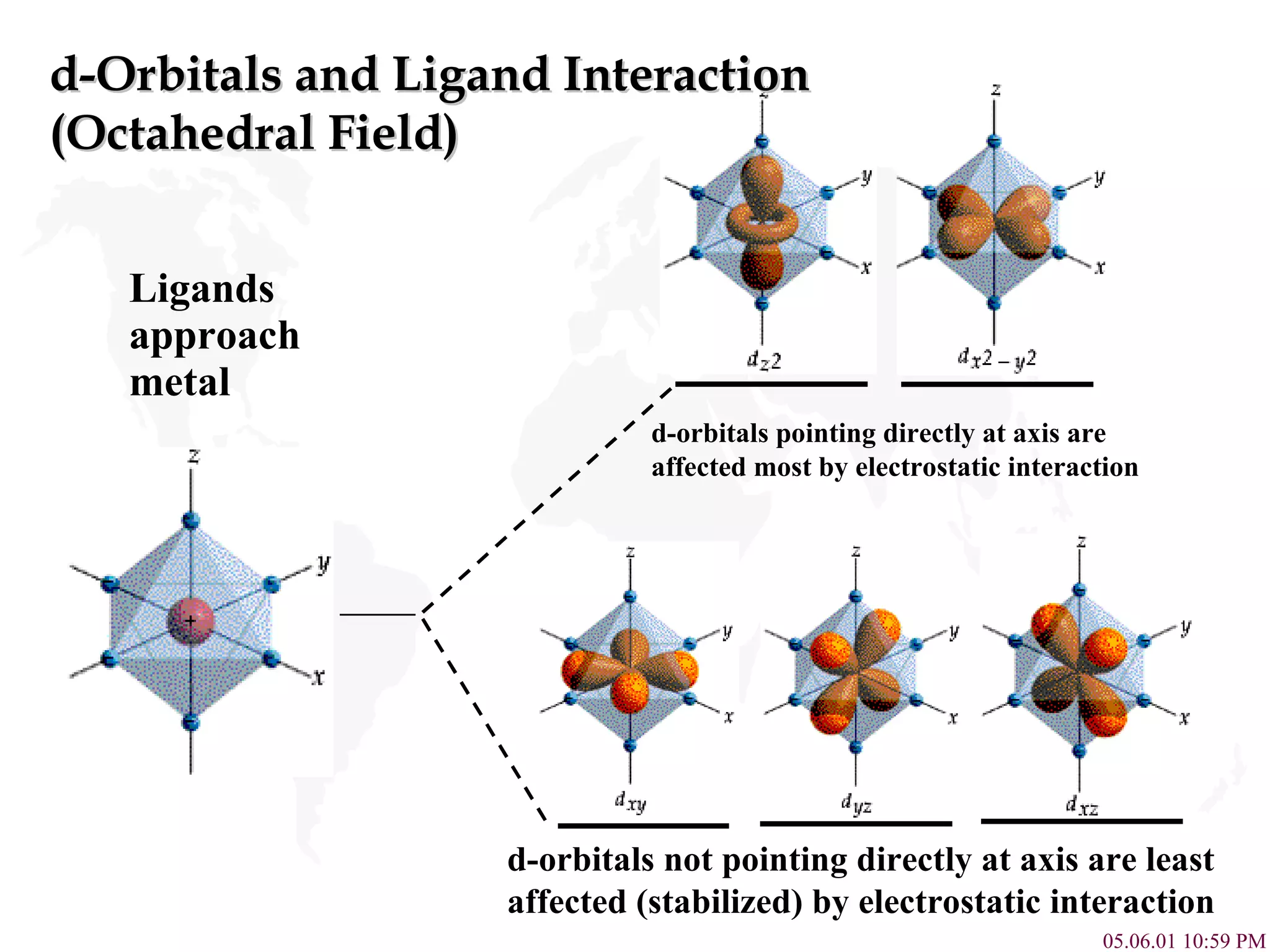
d-Orbitals and Ligand Interaction (Octahedral Field) Ligands approach metal d-orbitals not pointing directly at axis are least affected (stabilized) by electrostatic interaction  d-orbitals pointing directly at axis are affected most by electrostatic interaction
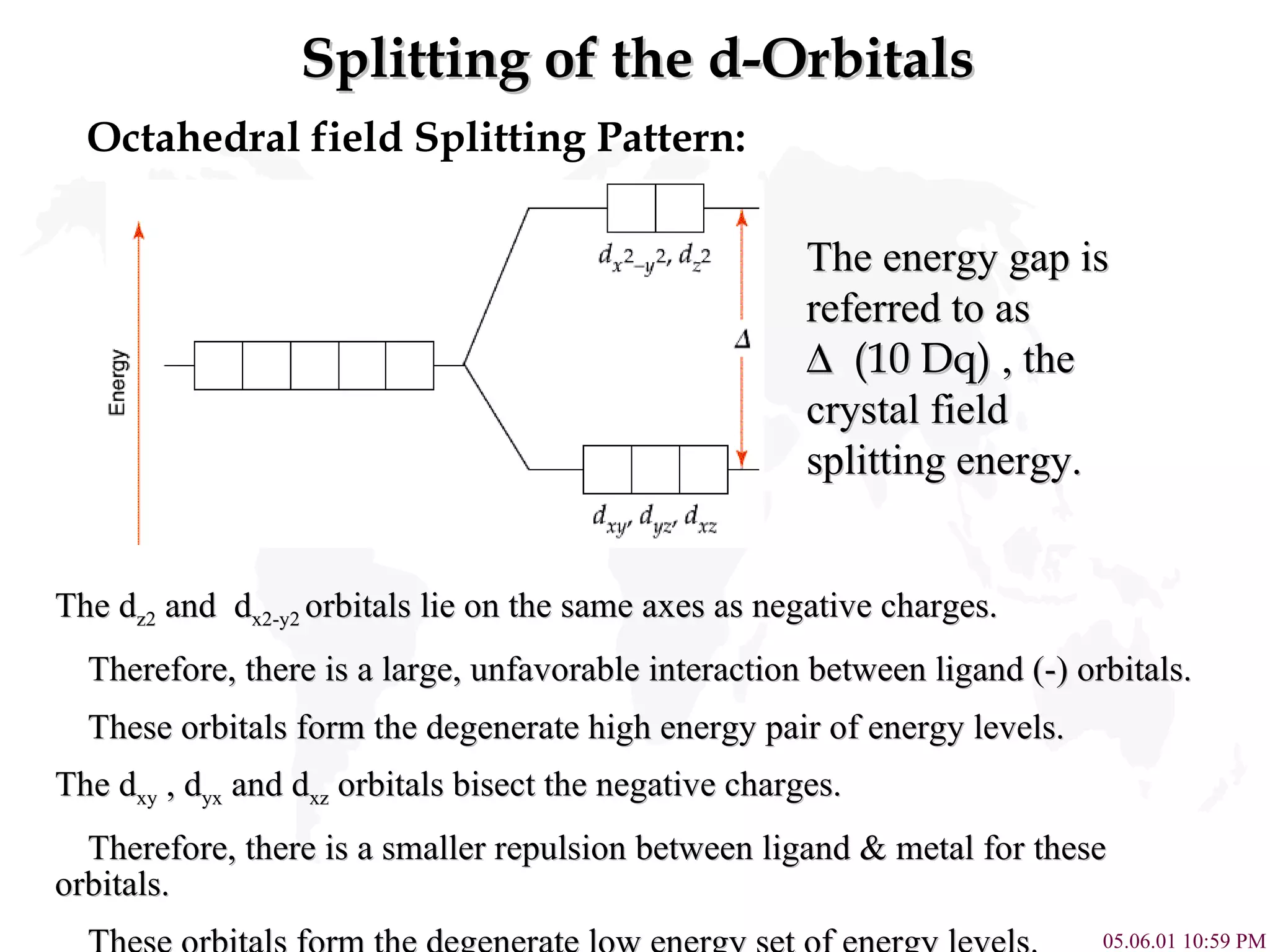
Splitting of the d-Orbitals Octahedral field Splitting Pattern: The energy gap is referred to as   (10 Dq)  , the crystal field splitting energy. The d z2  and  d x2-y2  orbitals lie on the same axes as negative charges. Therefore, there is a large, unfavorable interaction between ligand (-) orbitals. These orbitals form the degenerate high energy pair of energy levels. The d xy  , d yx  and d xz  orbitals bisect the negative charges. Therefore, there is a smaller repulsion between ligand & metal for these orbitals. These orbitals form the degenerate low energy set of energy levels.
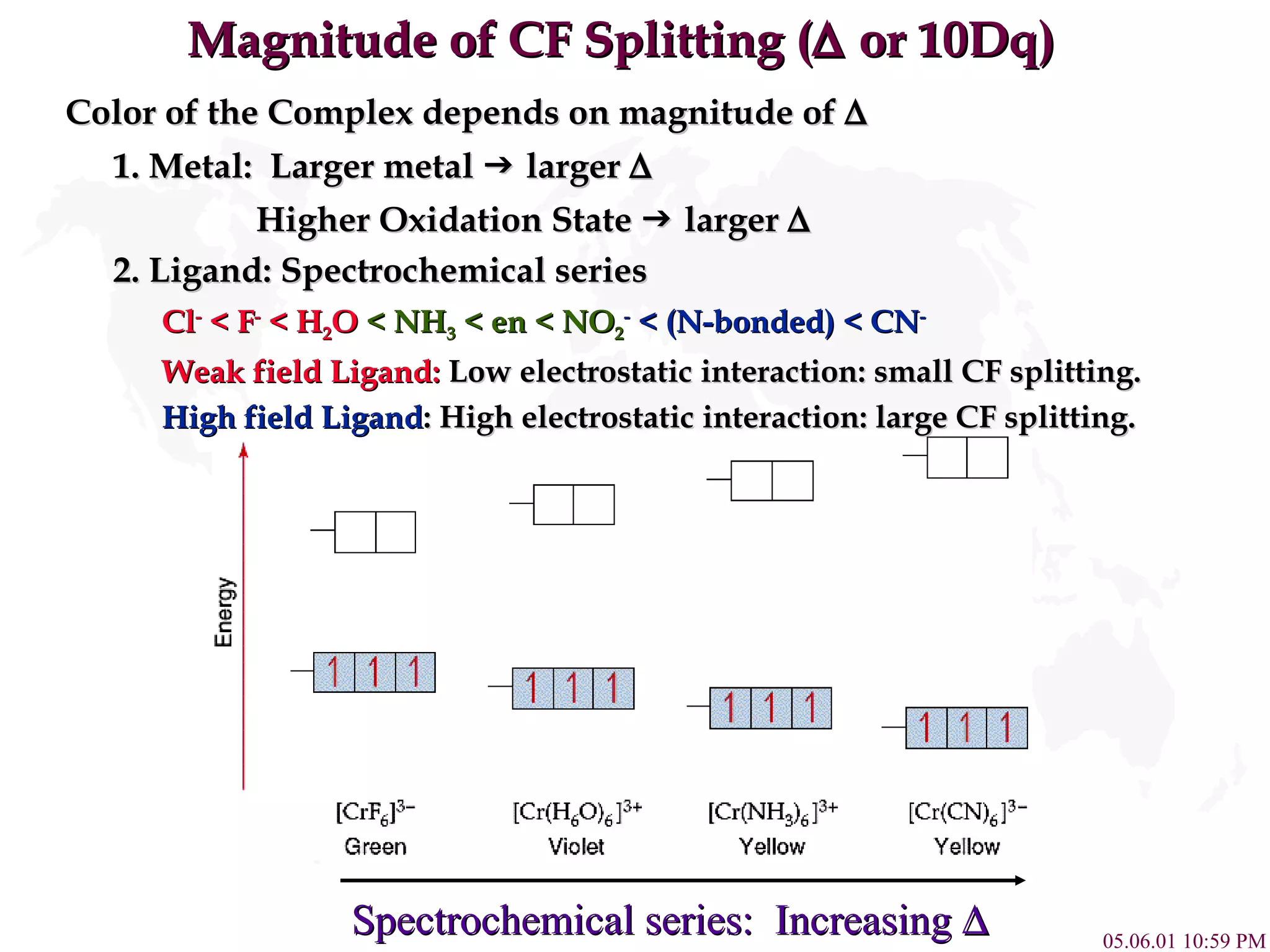
Magnitude of CF Splitting (   or 10Dq) Color of the Complex depends on magnitude of   1. Metal:  Larger metal    larger   Higher Oxidation State    larger   2. Ligand: Spectrochemical series Cl -  < F -  < H 2 O  < NH 3  < en < NO 2 -  < (N-bonded) < CN - Weak field Ligand:  Low electrostatic interaction: small CF splitting. High field Ligand : High electrostatic interaction: large CF splitting. Spectrochemical series:  Increasing  
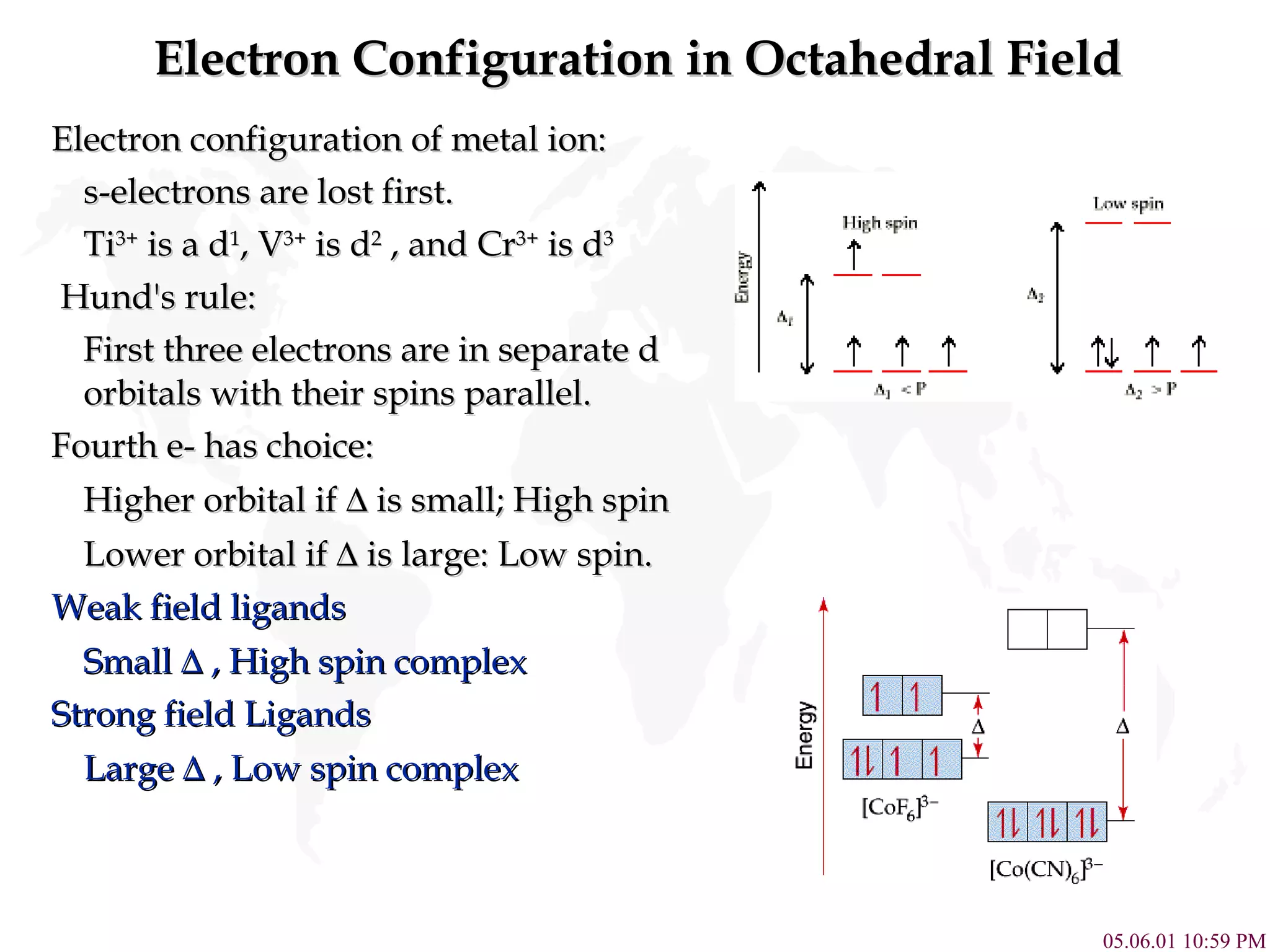
Electron Configuration in Octahedral Field Electron configuration of metal ion: s-electrons are lost first.  Ti 3+  is a d 1 , V 3+  is d 2  , and Cr 3+  is d 3   Hund's rule: First three electrons are in separate d orbitals with their spins parallel. Fourth e- has choice: Higher orbital if    is small; High spin Lower orbital if    is large: Low spin. Weak field ligands Small    , High spin complex Strong field Ligands Large    , Low spin complex
High Spin Vs. Low Spin (d 1  to d 10 ) Electron Configuration for Octahedral complexes of metal ion having d 1  to d 10  configuration [M(H 2 O) 6 ] +n .  Only the d 4  through d 7  cases have both high-spin and low spin configuration . Electron configurations for octahedral complexes of metal ions having from d 1  to d 10  configurations.  Only the d 4  through d 7  cases have both high-spin and low-spin configurations.
Color Absorption of Co 3+  Complexes The Colors of Some Complexes of the Co 3+  Ion The complex with fluoride ion, [CoF 6 ] 3+  , is high spin and has one absorption band. The other complexes are low spin and have two absorption bands. In all but one case, one of these absorptionsis in the visible region of the spectrum. The wavelengths refer to the center of that absorption band. Complex Ion Wavelength of  Color of Light  Color of Complex   light absorbed   Absorbed [CoF 6 ]  3+   700 (nm) Red Green [Co(C 2 O 4 ) 3 ]  3+   600, 420 Yellow, violet Dark green [Co(H 2 O) 6 ]  3+   600, 400 Yellow, violet Blue-green [Co(NH 3 ) 6 ]  3+   475, 340 Blue, violet Yellow-orange [Co(en) 3 ]  3+ 470, 340  Blue, ultraviolet Yellow-orange [Co(CN) 6 ]  3+ 310  Ultraviolet Pale Yellow
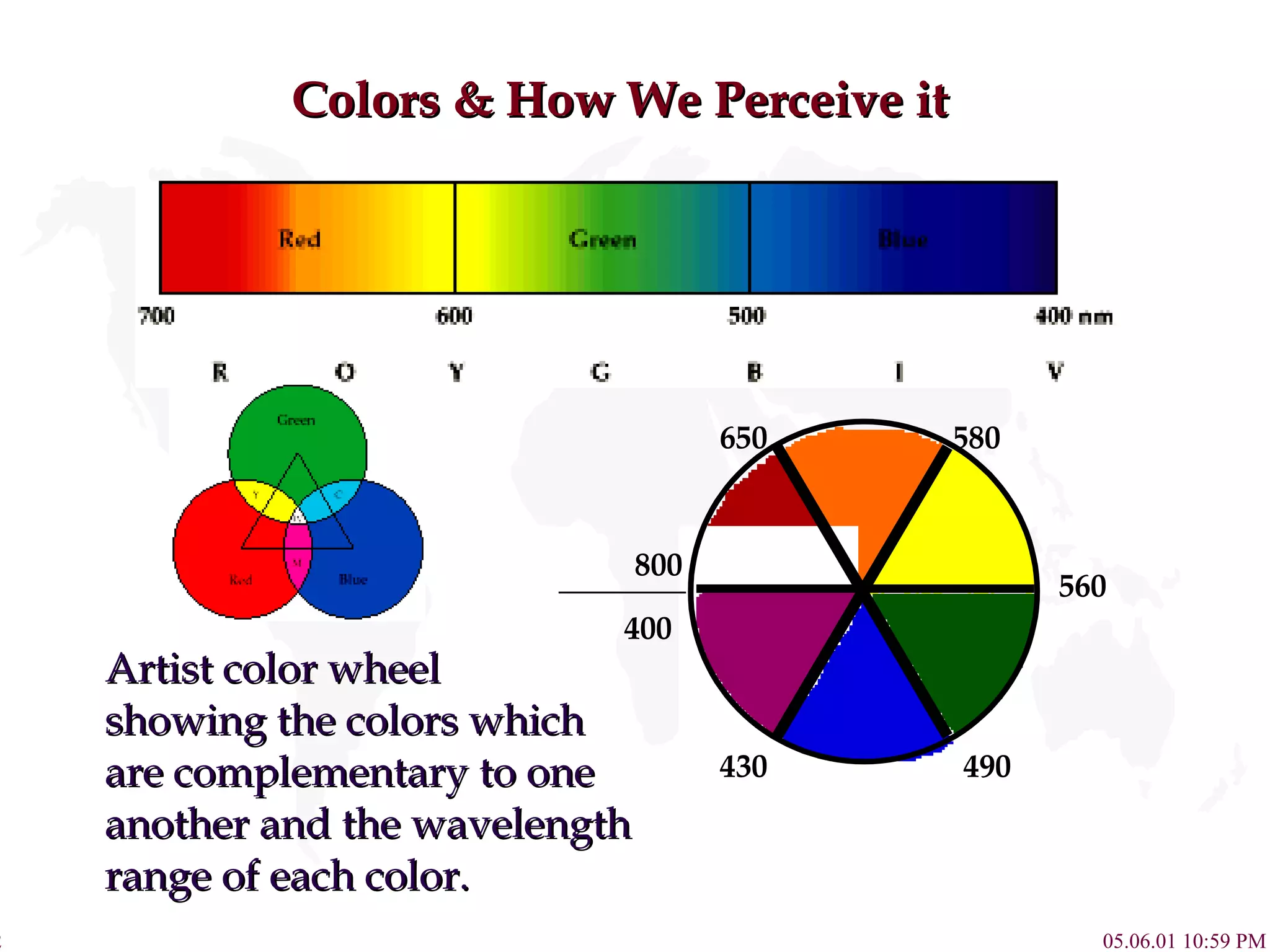
Colors & How We Perceive it 800 430 650 580 560 490 Artist color wheel showing the colors which are complementary to one another and the wavelength range of each color. 400
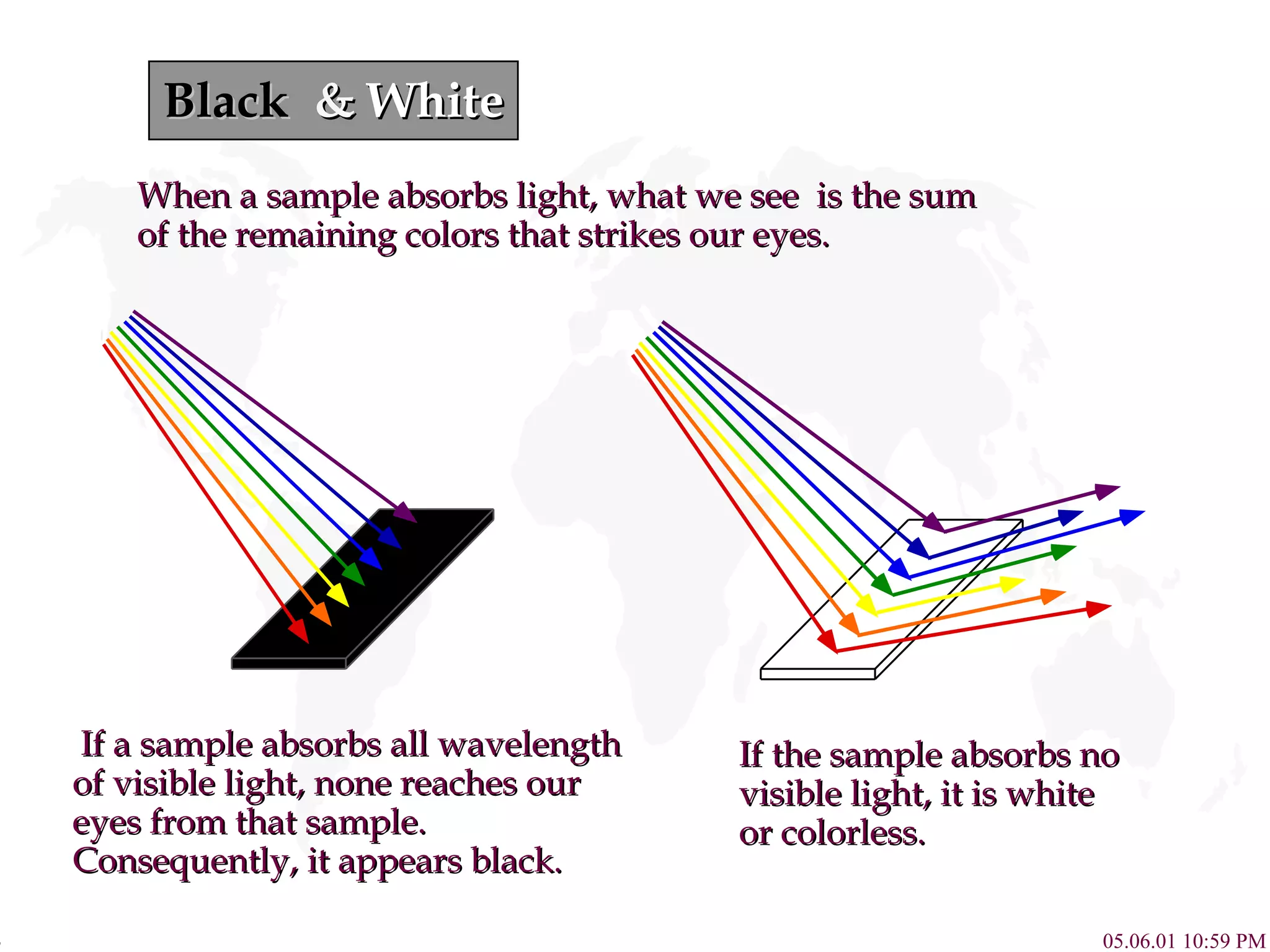
Black  &  White If a sample absorbs all wavelength of visible light, none reaches our eyes from that sample.  Consequently, it appears black. When a sample absorbs light, what we see  is the sum  of the remaining colors that strikes our eyes. If the sample absorbs no visible light, it is white  or colorless.
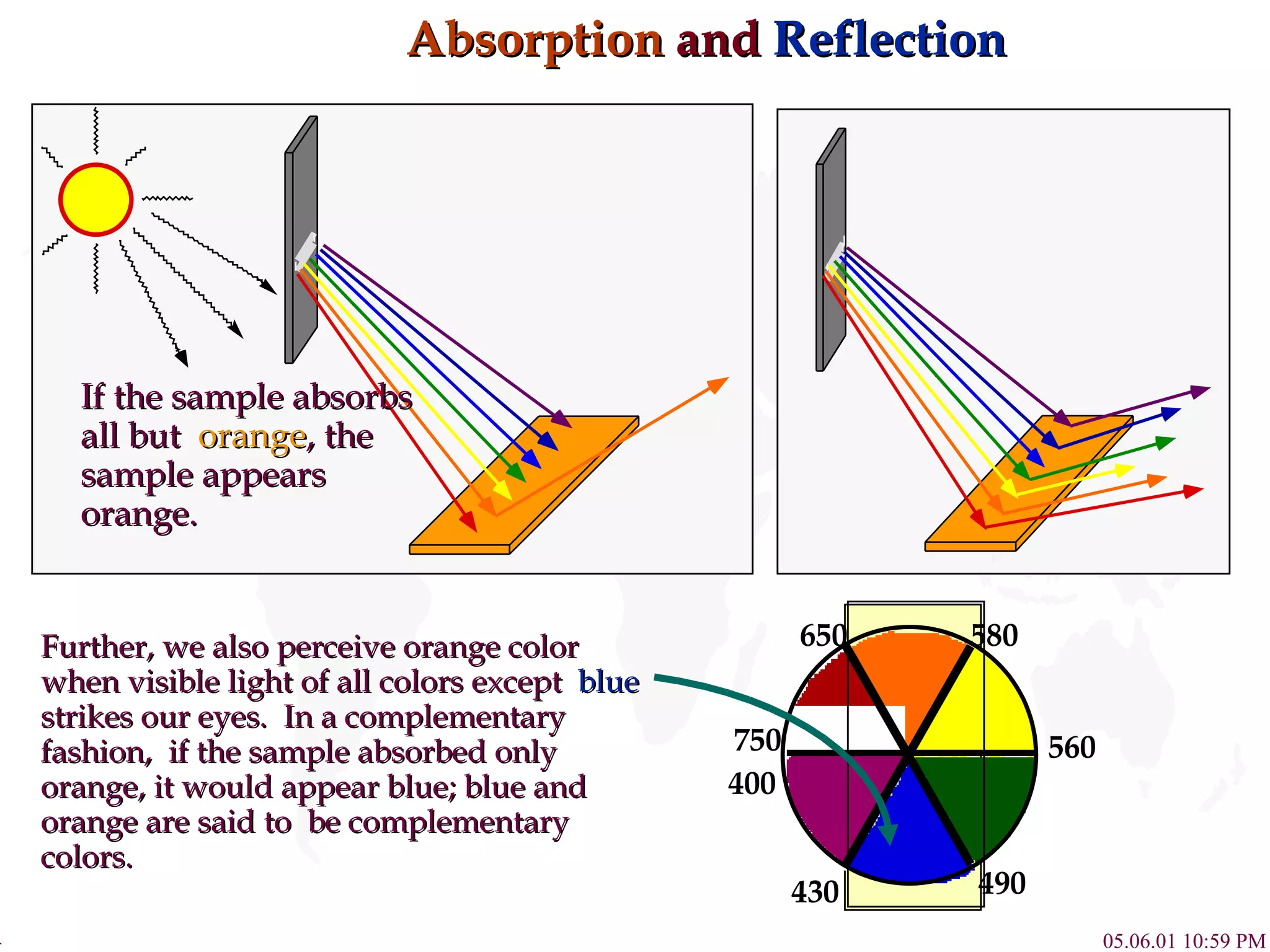
Absorption  and  Reflection If the sample absorbs all but  orange , the sample appears orange. Further, we also perceive orange color when visible light of all colors except  blue  strikes our eyes.  In a complementary  fashion,  if the sample absorbed only orange, it would appear blue; blue and orange are said to  be complementary colors. 750 430 650 580 560 490 400
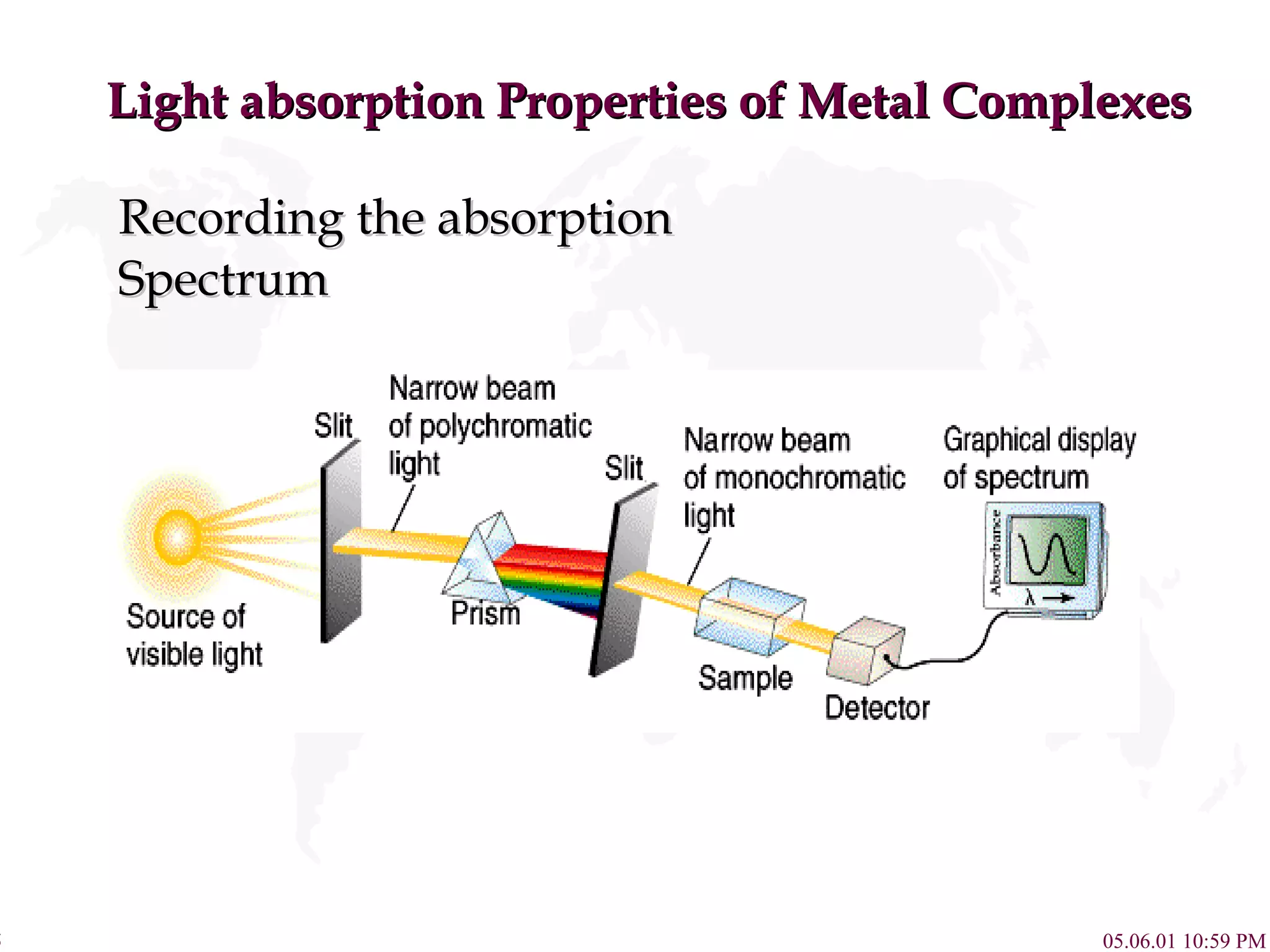
Light absorption Properties of Metal Complexes Recording the absorption Spectrum
Complex Influence on Color Compounds of Transition metal complexes solution. [Fe(H 2 O) 6 ] 3+ [Co(H 2 O) 6 ] 2+ [Ni(H 2 O) 6 ] 2+ [Cu(H 2 O) 6 ] 2+ [Zn(H 2 O) 6 ] 2+ 800 430 650 580 560 490 400
Color Absorption of Co 3+  Complexes The Colors of Some Complexes of the Co 3+  Ion The complex with fluoride ion, [CoF 6 ] 3+  , is high spin and has one absorption band. The other complexes are low spin and have two absorption bands. In all but one case, one of these absorptionsis in the visible region of the spectrum. The wavelengths refer to the center of that absorption band.
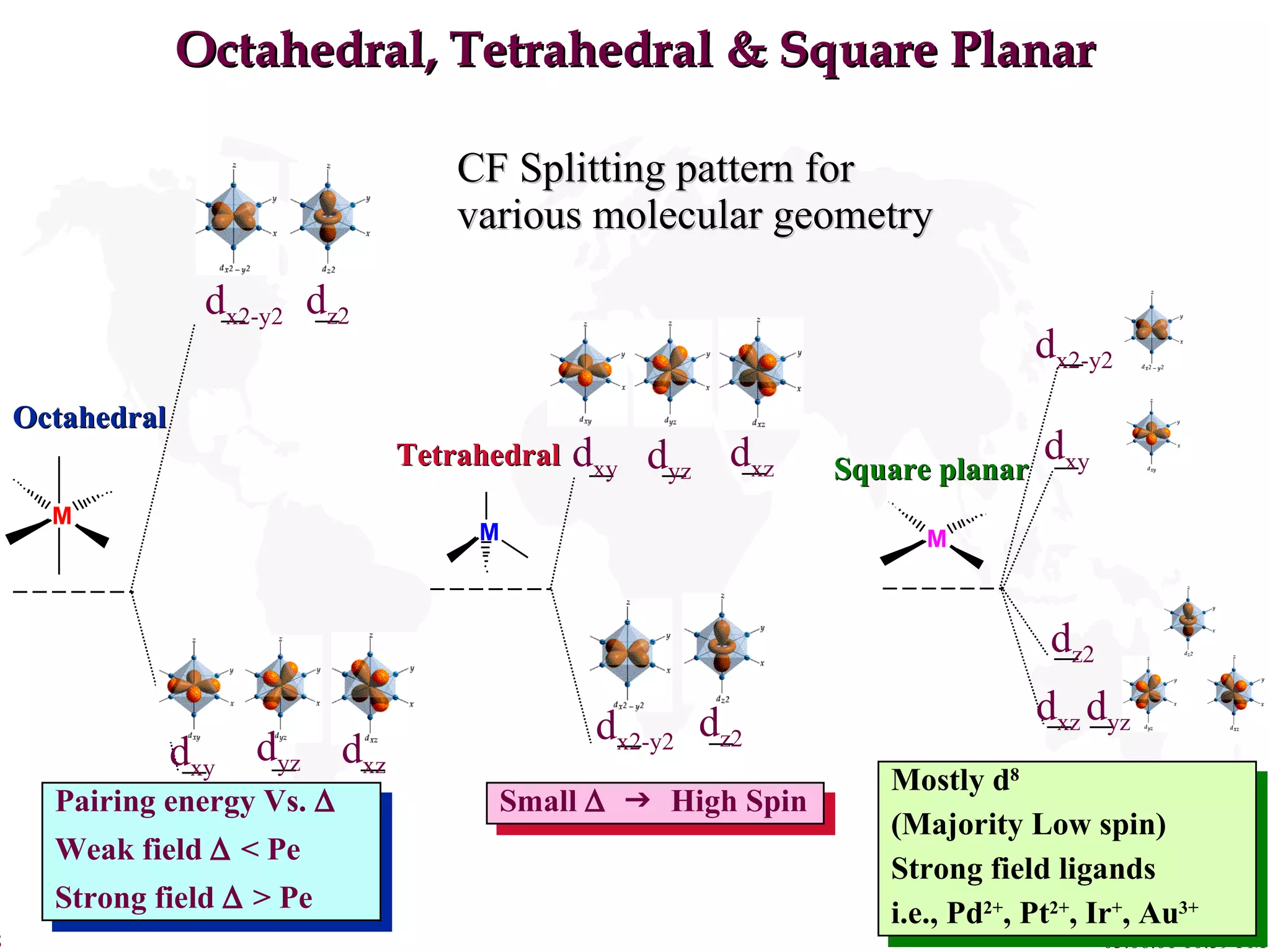
Octahedral, Tetrahedral & Square Planar CF Splitting pattern for various molecular geometry Octahedral Tetrahedral Square planar Pairing energy Vs.   Weak field    < Pe Strong field    > Pe Small        High Spin Mostly d 8 (Majority Low spin) Strong field ligands i.e., Pd 2+ , Pt 2+ , Ir + , Au 3+ d z2 d x2-y2 d xz d xy d yz d x2-y2 d z2 d xz d xy d yz d xz d z2 d x2-y2 d xy d yz
Summary Crystal Field Theory provides a basis for explaining many features of transition-metal complexes.  Examples include why transition metal complexes are highly colored, and why some are paramagnetic while others are diamagnetic.  The spectrochemical series for ligands explains nicely the origin of color and magnetism for these compounds.  There is evidence to suggest that the metal-ligand bond has covalent character which explains why these complexes are very stable.  Molecular Orbital Theory can also be used to describe the bonding scheme in these complexes.  A more in depth analysis is required however.

Crystal field theory

  • 1.
    C r ys t a l F i e l d T h e o r y The relationship between colors and complex metal ions 400 500 600 800
  • 2.
    Transition Metal GemsGemstone owe their color from trace transition-metal ions Corundum mineral, Al 2 O 3 : Colorless Cr  Al : Ruby Mn  Al: Amethyst Fe  Al: Topaz Ti &Co  Al: Sapphire Beryl mineral, Be 3 Al 2 Si 6 O 18 : Colorless Cr  Al : Emerald Fe  Al : Aquamarine
  • 3.
    Crystal-Field Theory Modelexplaining bonding for transition metal complexes • Originally developed to explain properties for crystalline material • Basic idea: Electrostatic interaction between lone-pair electrons result in coordination.
  • 4.
    Energetics CFT -Electrostatic between metal ion and donor atom i) Separate metal and ligand high energy ii) Coordinated Metal - ligand stabilized iii) Destabilization due to ligand -d electron repulsion iv) Splitting due to octahedral field. i ii iii iv
  • 5.
    Ligand-Metal Interaction CrystalField Theory - Describes bonding in Metal Complexes Basic Assumption in CFT: Electrostatic interaction between ligand and metal d-orbitals align along the octahedral axis will be affected the most. More directly the ligand attacks the metal orbital, the higher the the energy of the d-orbital. In an octahedral field the degeneracy of the five d-orbitals is lifted
  • 6.
    d-Orbitals and LigandInteraction (Octahedral Field) Ligands approach metal d-orbitals not pointing directly at axis are least affected (stabilized) by electrostatic interaction d-orbitals pointing directly at axis are affected most by electrostatic interaction
  • 7.
    Splitting of thed-Orbitals Octahedral field Splitting Pattern: The energy gap is referred to as  (10 Dq) , the crystal field splitting energy. The d z2 and d x2-y2 orbitals lie on the same axes as negative charges. Therefore, there is a large, unfavorable interaction between ligand (-) orbitals. These orbitals form the degenerate high energy pair of energy levels. The d xy , d yx and d xz orbitals bisect the negative charges. Therefore, there is a smaller repulsion between ligand & metal for these orbitals. These orbitals form the degenerate low energy set of energy levels.
  • 8.
    Magnitude of CFSplitting (  or 10Dq) Color of the Complex depends on magnitude of  1. Metal: Larger metal  larger  Higher Oxidation State  larger  2. Ligand: Spectrochemical series Cl - < F - < H 2 O < NH 3 < en < NO 2 - < (N-bonded) < CN - Weak field Ligand: Low electrostatic interaction: small CF splitting. High field Ligand : High electrostatic interaction: large CF splitting. Spectrochemical series: Increasing 
  • 9.
    Electron Configuration inOctahedral Field Electron configuration of metal ion: s-electrons are lost first. Ti 3+ is a d 1 , V 3+ is d 2 , and Cr 3+ is d 3 Hund's rule: First three electrons are in separate d orbitals with their spins parallel. Fourth e- has choice: Higher orbital if  is small; High spin Lower orbital if  is large: Low spin. Weak field ligands Small  , High spin complex Strong field Ligands Large  , Low spin complex
  • 10.
    High Spin Vs.Low Spin (d 1 to d 10 ) Electron Configuration for Octahedral complexes of metal ion having d 1 to d 10 configuration [M(H 2 O) 6 ] +n . Only the d 4 through d 7 cases have both high-spin and low spin configuration . Electron configurations for octahedral complexes of metal ions having from d 1 to d 10 configurations. Only the d 4 through d 7 cases have both high-spin and low-spin configurations.
  • 11.
    Color Absorption ofCo 3+ Complexes The Colors of Some Complexes of the Co 3+ Ion The complex with fluoride ion, [CoF 6 ] 3+ , is high spin and has one absorption band. The other complexes are low spin and have two absorption bands. In all but one case, one of these absorptionsis in the visible region of the spectrum. The wavelengths refer to the center of that absorption band. Complex Ion Wavelength of Color of Light Color of Complex light absorbed Absorbed [CoF 6 ] 3+ 700 (nm) Red Green [Co(C 2 O 4 ) 3 ] 3+ 600, 420 Yellow, violet Dark green [Co(H 2 O) 6 ] 3+ 600, 400 Yellow, violet Blue-green [Co(NH 3 ) 6 ] 3+ 475, 340 Blue, violet Yellow-orange [Co(en) 3 ] 3+ 470, 340 Blue, ultraviolet Yellow-orange [Co(CN) 6 ] 3+ 310 Ultraviolet Pale Yellow
  • 12.
    Colors & HowWe Perceive it 800 430 650 580 560 490 Artist color wheel showing the colors which are complementary to one another and the wavelength range of each color. 400
  • 13.
    Black & White If a sample absorbs all wavelength of visible light, none reaches our eyes from that sample. Consequently, it appears black. When a sample absorbs light, what we see is the sum of the remaining colors that strikes our eyes. If the sample absorbs no visible light, it is white or colorless.
  • 14.
    Absorption and Reflection If the sample absorbs all but orange , the sample appears orange. Further, we also perceive orange color when visible light of all colors except blue strikes our eyes. In a complementary fashion, if the sample absorbed only orange, it would appear blue; blue and orange are said to be complementary colors. 750 430 650 580 560 490 400
  • 15.
    Light absorption Propertiesof Metal Complexes Recording the absorption Spectrum
  • 16.
    Complex Influence onColor Compounds of Transition metal complexes solution. [Fe(H 2 O) 6 ] 3+ [Co(H 2 O) 6 ] 2+ [Ni(H 2 O) 6 ] 2+ [Cu(H 2 O) 6 ] 2+ [Zn(H 2 O) 6 ] 2+ 800 430 650 580 560 490 400
  • 17.
    Color Absorption ofCo 3+ Complexes The Colors of Some Complexes of the Co 3+ Ion The complex with fluoride ion, [CoF 6 ] 3+ , is high spin and has one absorption band. The other complexes are low spin and have two absorption bands. In all but one case, one of these absorptionsis in the visible region of the spectrum. The wavelengths refer to the center of that absorption band.
  • 18.
    Octahedral, Tetrahedral &Square Planar CF Splitting pattern for various molecular geometry Octahedral Tetrahedral Square planar Pairing energy Vs.  Weak field  < Pe Strong field  > Pe Small   High Spin Mostly d 8 (Majority Low spin) Strong field ligands i.e., Pd 2+ , Pt 2+ , Ir + , Au 3+ d z2 d x2-y2 d xz d xy d yz d x2-y2 d z2 d xz d xy d yz d xz d z2 d x2-y2 d xy d yz
  • 19.
    Summary Crystal FieldTheory provides a basis for explaining many features of transition-metal complexes. Examples include why transition metal complexes are highly colored, and why some are paramagnetic while others are diamagnetic. The spectrochemical series for ligands explains nicely the origin of color and magnetism for these compounds. There is evidence to suggest that the metal-ligand bond has covalent character which explains why these complexes are very stable. Molecular Orbital Theory can also be used to describe the bonding scheme in these complexes. A more in depth analysis is required however.