Digital Libraries of the Future Use of Semantic Web and Social Bookmarking to  support E-learning in Digital Libraries Sebastian Ryszard Kruk Digital Enterprise Research Institute National University of Ireland, Galway sebastian.kruk @deri.org http:// corrib.deri.ie /
Presentation outline Motivation Short Introduction to Semantic Web 2.0 Building Social Semantic Digital Library Semantic Digital Libraries Towards Online Communities for Digital Libraries JeromeDL and other Corrib components JeromeDL in Action e-Learning 2.0 Conclusions
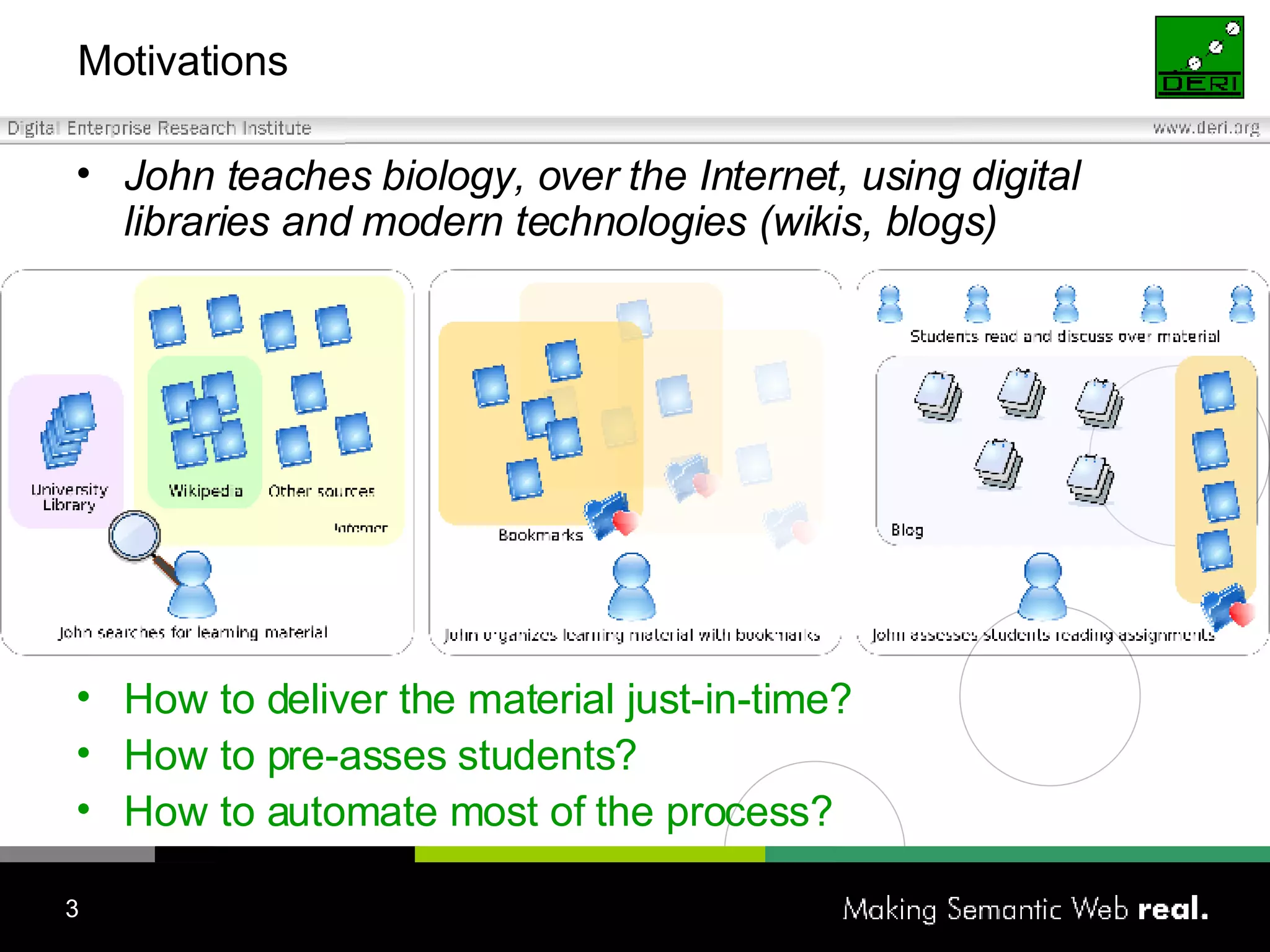
Motivations John teaches biology, over the Internet, using digital libraries and modern technologies (wikis, blogs) How to deliver the material just-in-time? How to pre-asses students? How to automate most of the process?
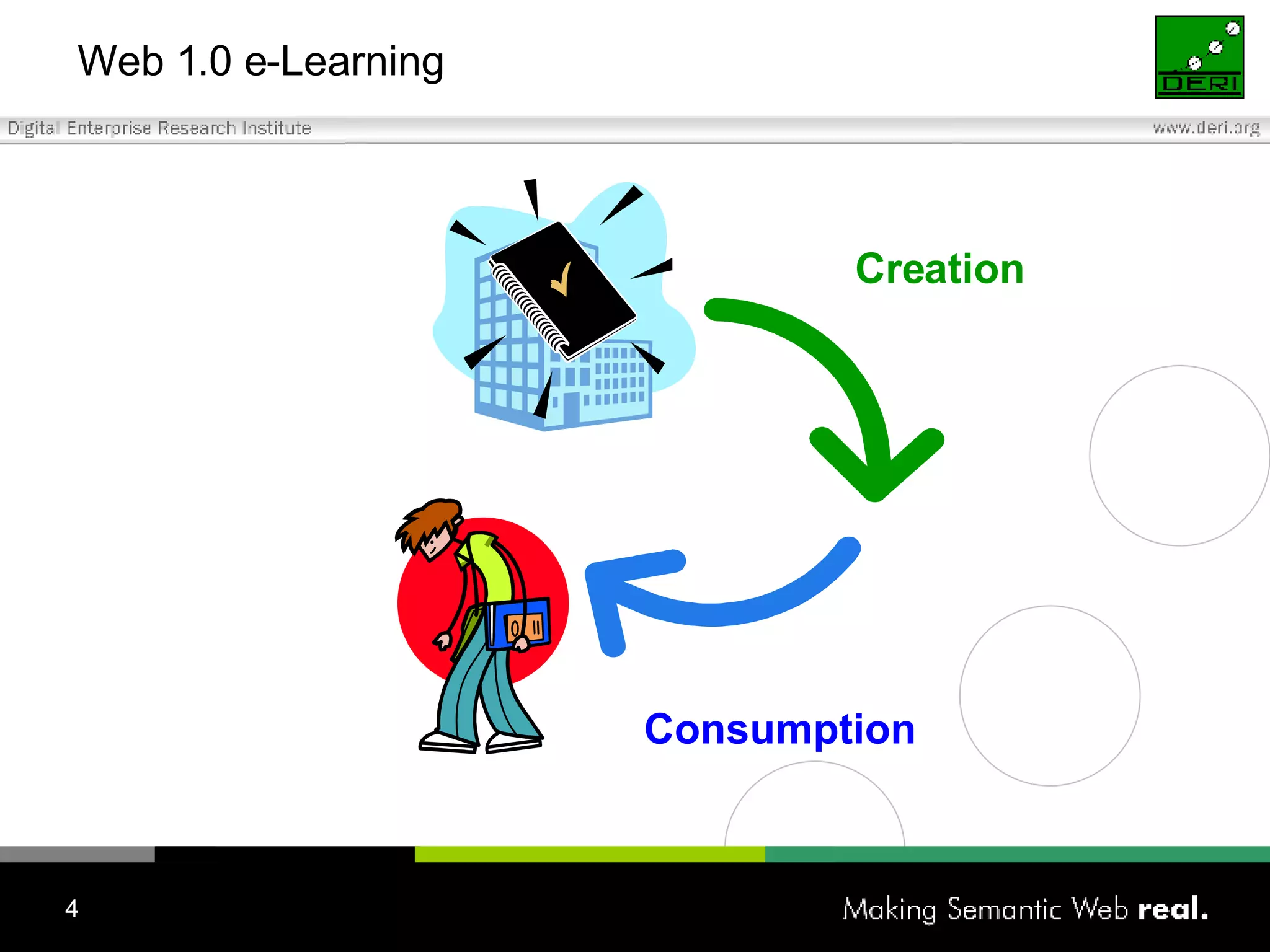
Web 1.0 e-Learning Creation Consumption
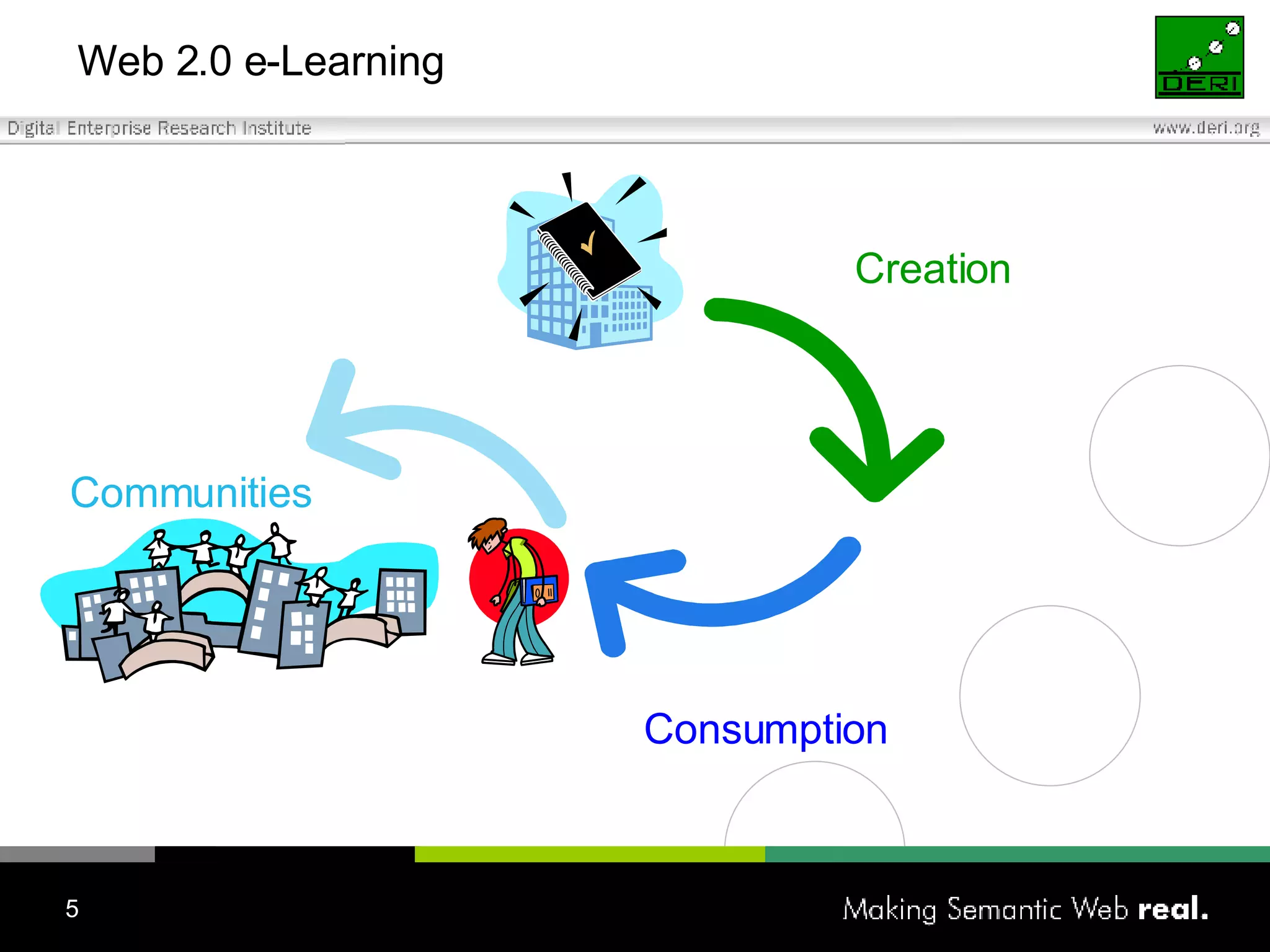
Web 2.0 e-Learning Creation Communities Consumption
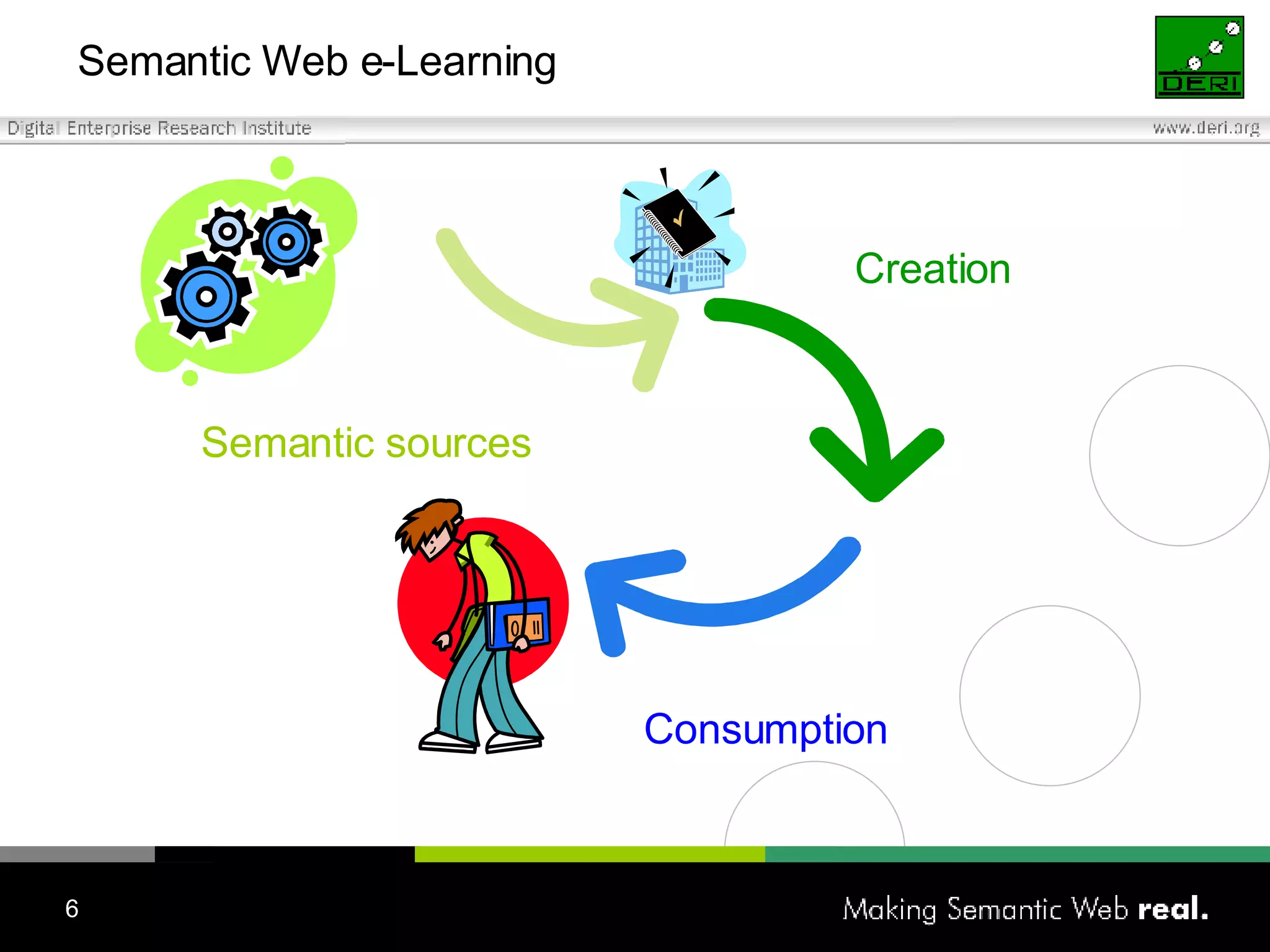
Semantic Web e-Learning Semantic sources Creation Consumption
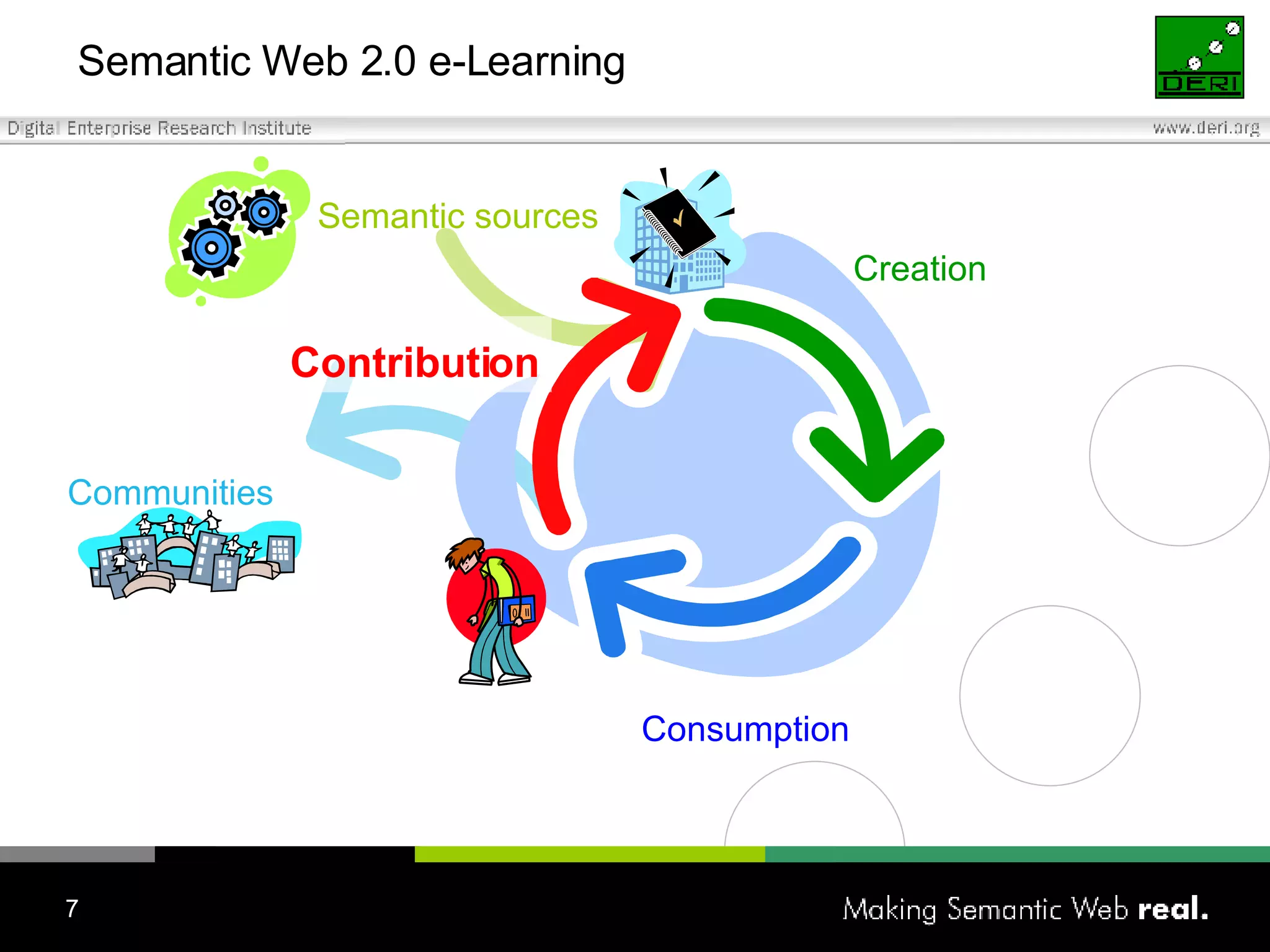
Semantic Web 2.0 e-Learning Contribution Creation Consumption Communities Semantic sources
The Semantic Web – A Brief Introduction Current Web vs. Semantic Web? An extension of the current Web in which information is given well-defined meaning, better enabling computers and people to work in cooperation.  [Tim Berners-Lee] Current Web was designed for humans, and there is little information usable for machines Was the Web meant to be more? Objects with well defined attributes as opposed to untyped hyperlinks between Internet resources A  network of relationships  amongst named objects, yielding unified information management tasks What do you mean by “Semantic”? the  semantics  of something is the  meaning  of something Semantic Web is able to describe things in a way that computers can understand
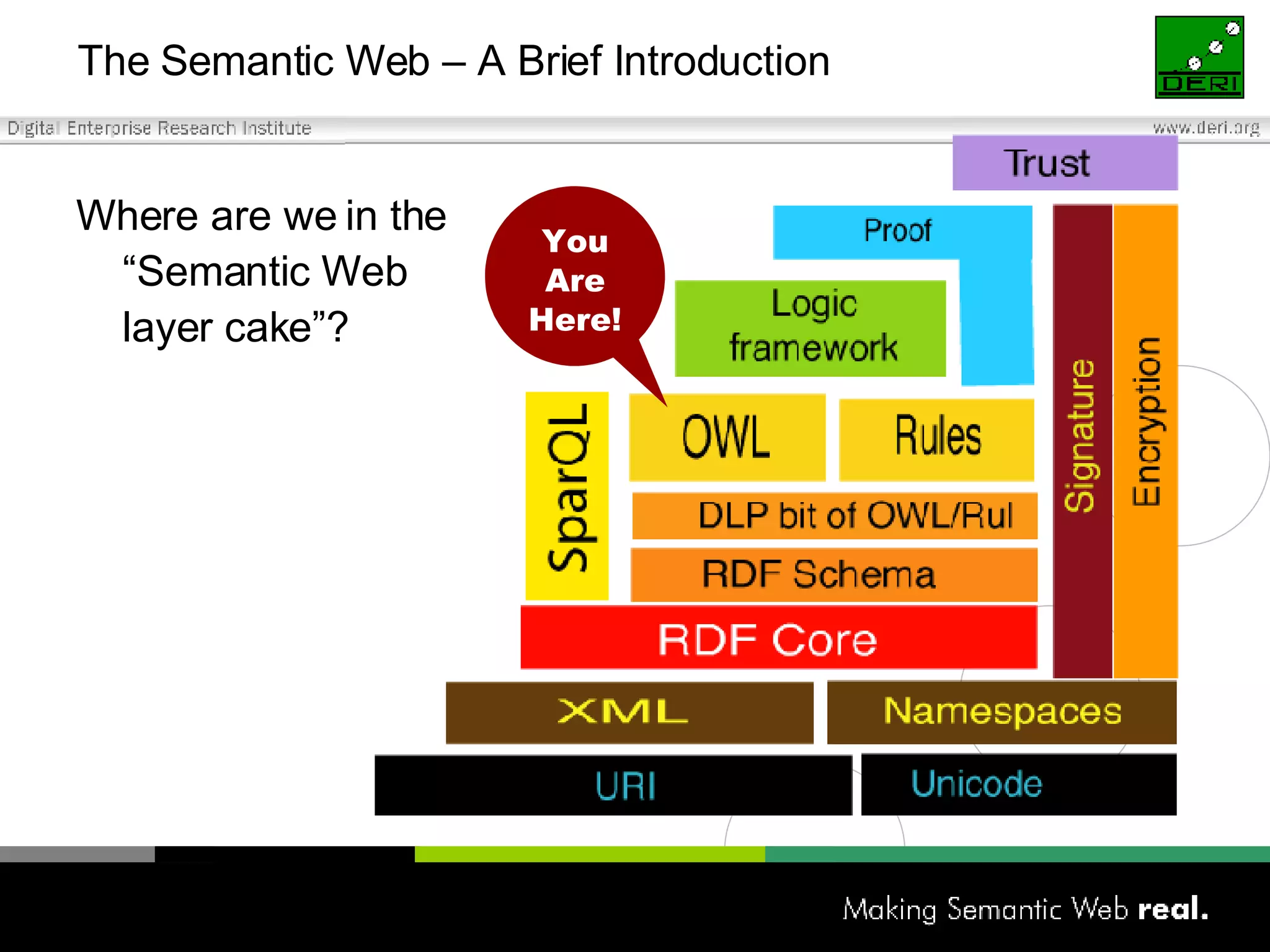
The Semantic Web – A Brief Introduction Where are we in the  “Semantic Web  layer cake”? You Are Here!
The Semantic Web – A Brief Introduction The challenge for the Semantic Web The Semantic Web can’t work all by itself For example, it is not very likely that you will be able to sell your car just by putting your RDF file on the Web Need society-scale applications: Semantic Web agents and/or services, consumers and processors for semantic data, more advanced collaborative applications
The Semantic Web – What is RDF ? Describing things on the Semantic Web RDF (Resource Description Framework) a  data format  for describing information and resources,  the fundamental data model for the Semantic Web Using RDF, we can describe relationships between things like: A is a  part  of B or Y is a  member  of  Z and their properties ( size ,  weight ,  age ,  price …) in a machine-understandable format where each thing has a RDF graph-based model delivers straightforward machine processing Putting information into RDF files makes it possible for “scutters” or RDF crawlers to  search ,  discover ,  pick up ,  collect ,  analyse  and  process  information from the Web
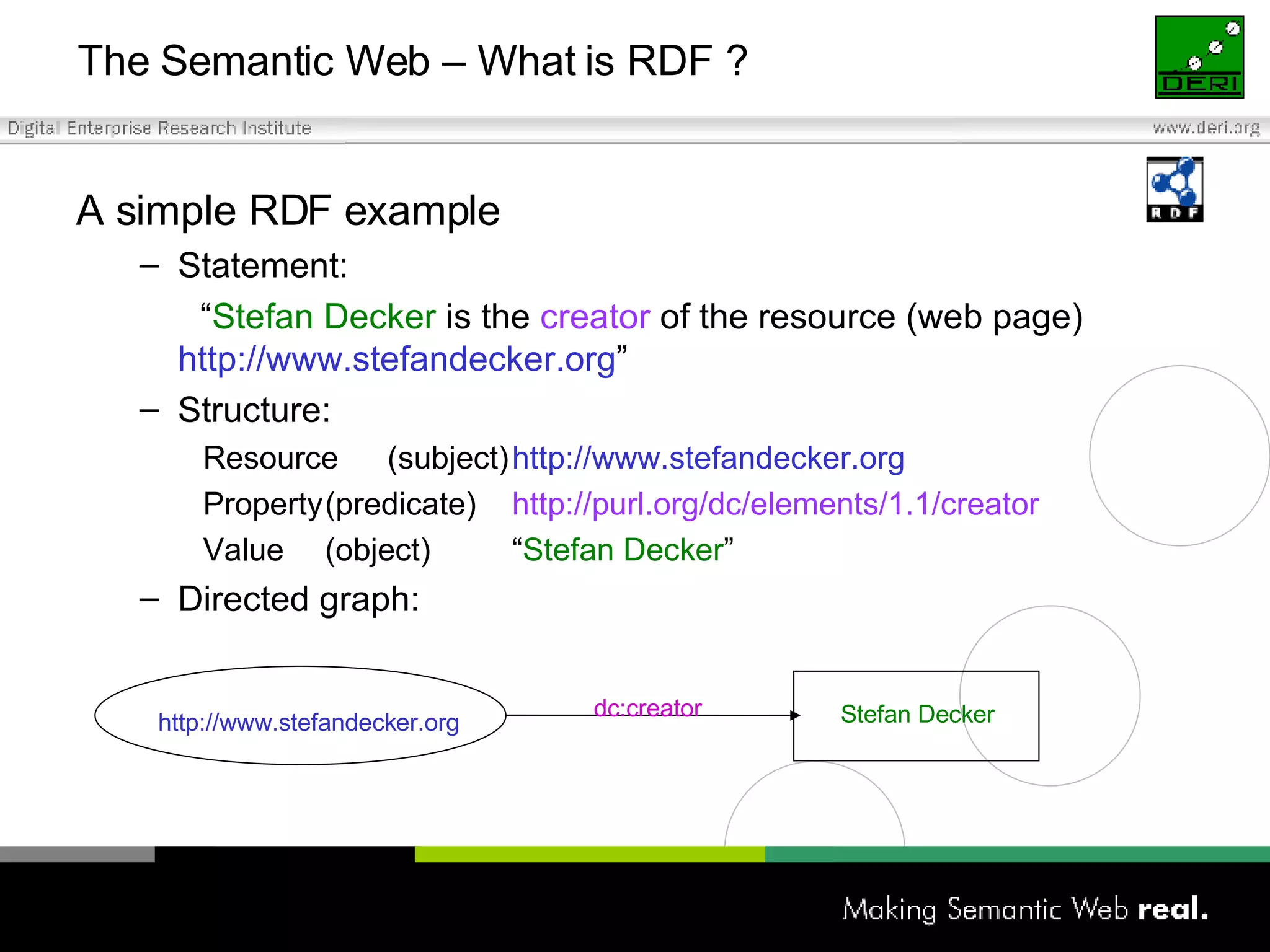
The Semantic Web – What is RDF ? A simple RDF example Statement: “ Stefan Decker  is the  creator  of the resource (web page)  http://www.stefandecker.org ” Structure: Resource (subject) http://www.stefandecker.org Property (predicate)  http://purl.org/dc/elements/1.1/creator Value (object)  “ Stefan Decker ” Directed graph: http://www.stefandecker.org dc:creator Stefan Decker
The Semantic Web – How RDF can help us? How RDF can help us? identify objects establish relationships express a new relationship   just add a new RDF statement  integrate information from different sources    copy all the RDF data together RDF allows many points of view
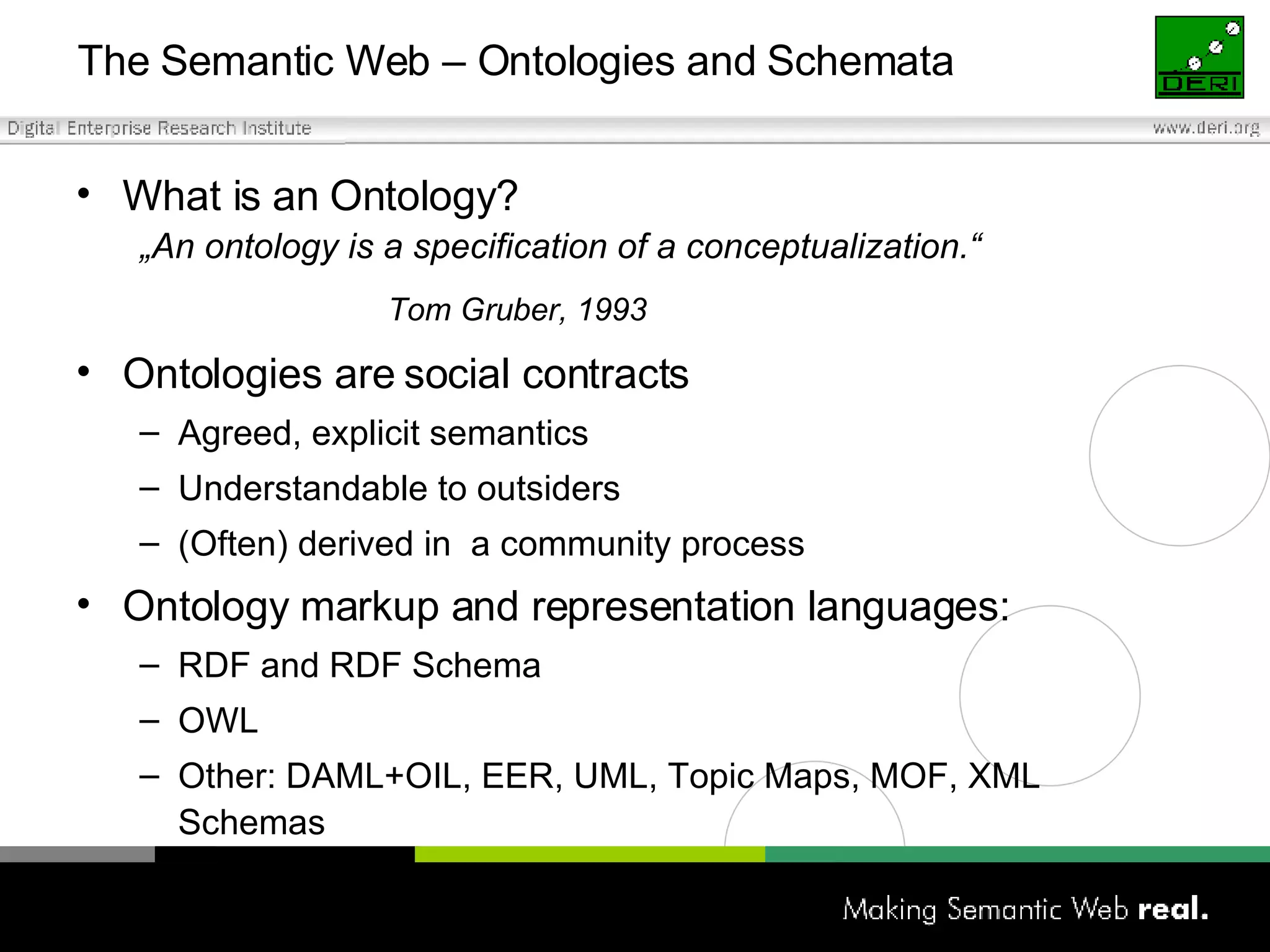
The Semantic Web – Ontologies and Schemata What is an Ontology? „ An ontology is a specification of a conceptualization.“ Tom Gruber, 1993 Ontologies are social contracts Agreed, explicit semantics Understandable to outsiders (Often) derived in  a community process Ontology markup and representation languages: RDF and RDF Schema OWL Other: DAML+OIL, EER, UML, Topic Maps, MOF, XML Schemas
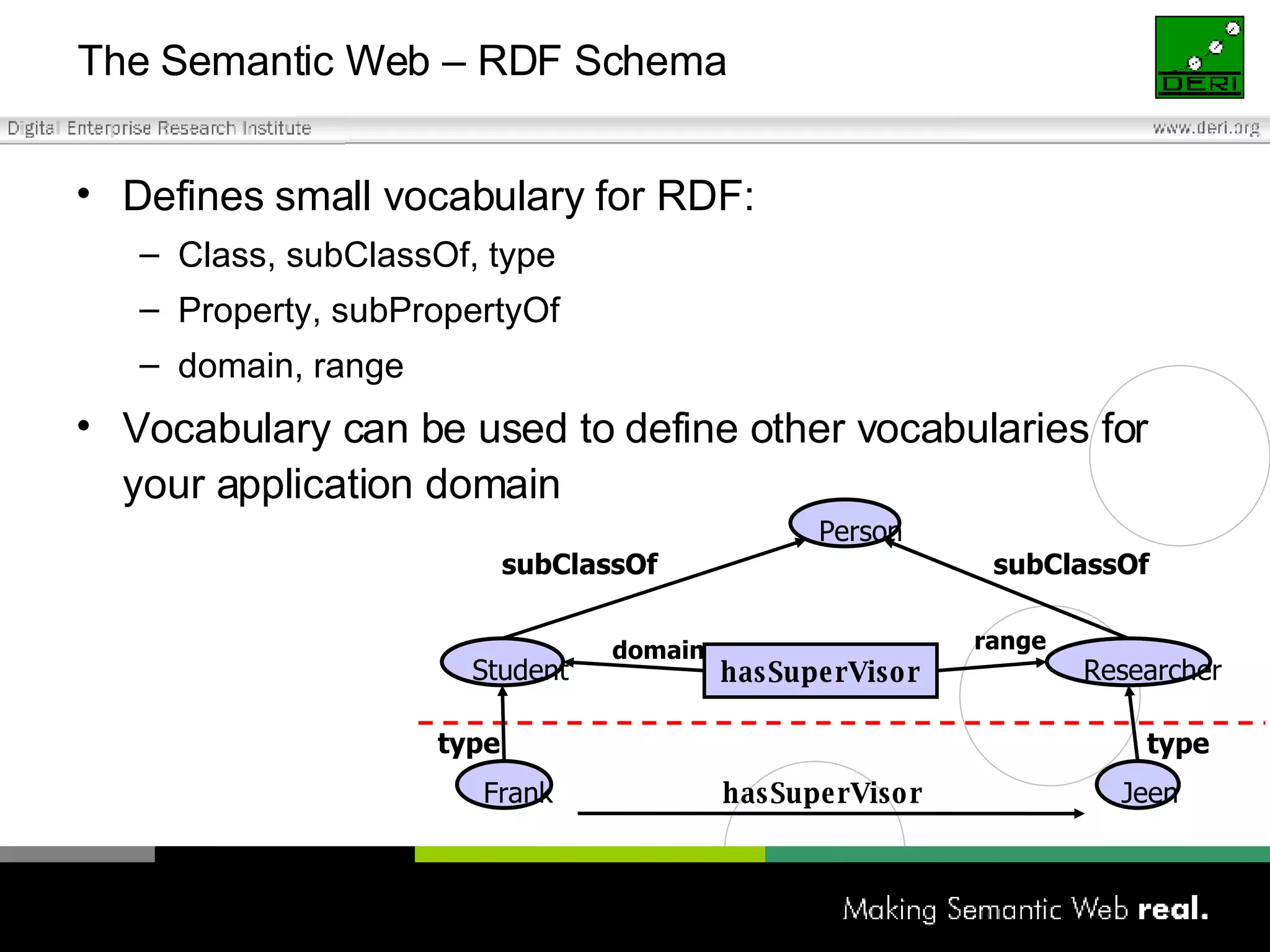
The Semantic Web – RDF Schema Defines small vocabulary for RDF:  Class, subClassOf, type Property, subPropertyOf domain, range Vocabulary can be used to define other vocabularies for your application domain Person Student Researcher subClassOf subClassOf Jeen type hasSuperVisor domain range Frank type hasSuperVisor
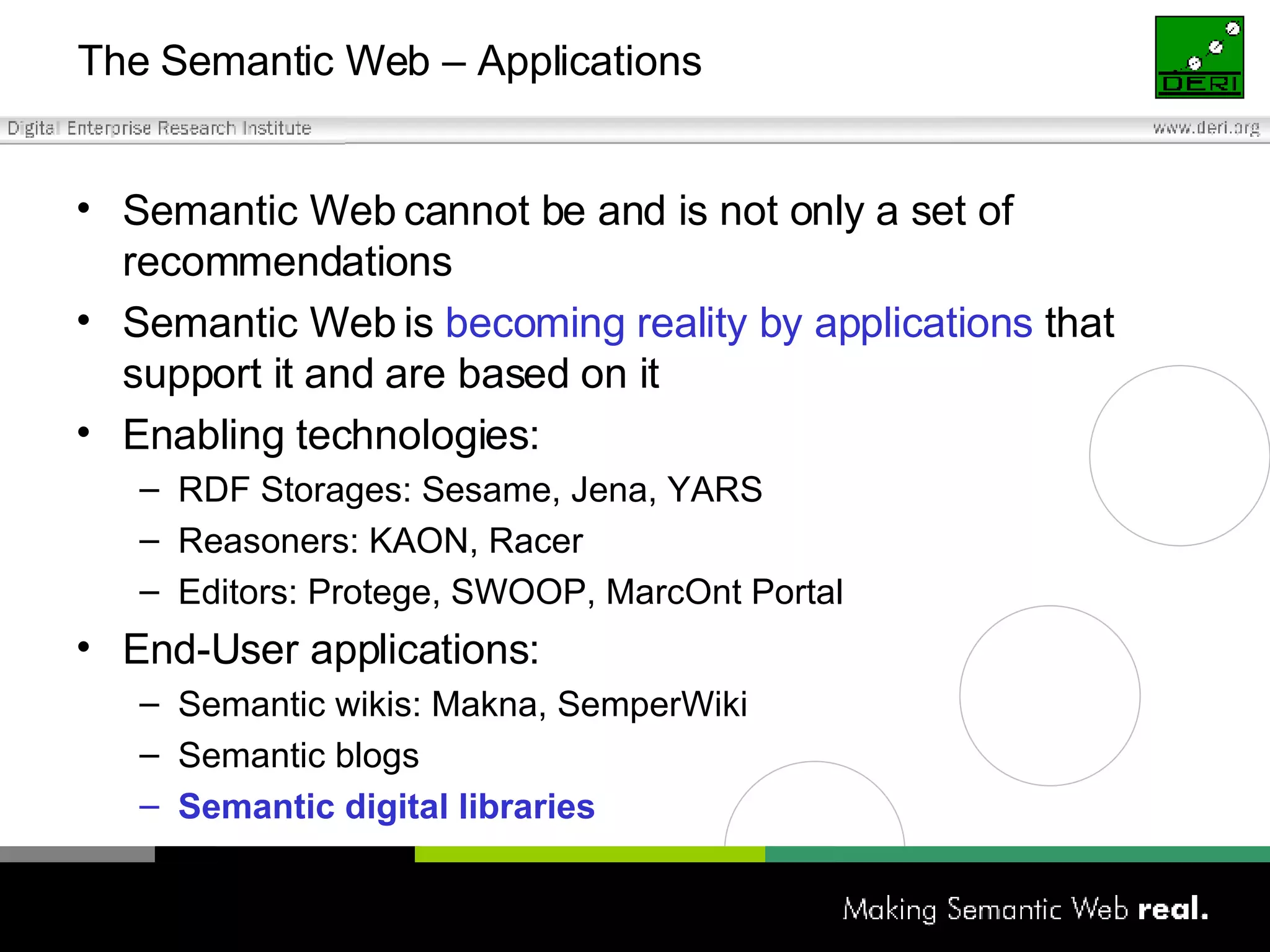
The Semantic Web – Applications Semantic Web cannot be and is not only a set of recommendations Semantic Web is  becoming reality by applications  that support it and are based on it Enabling technologies: RDF Storages: Sesame, Jena, YARS Reasoners: KAON, Racer  Editors: Protege, SWOOP, MarcOnt Portal End-User applications: Semantic wikis: Makna, SemperWiki Semantic blogs Semantic digital libraries
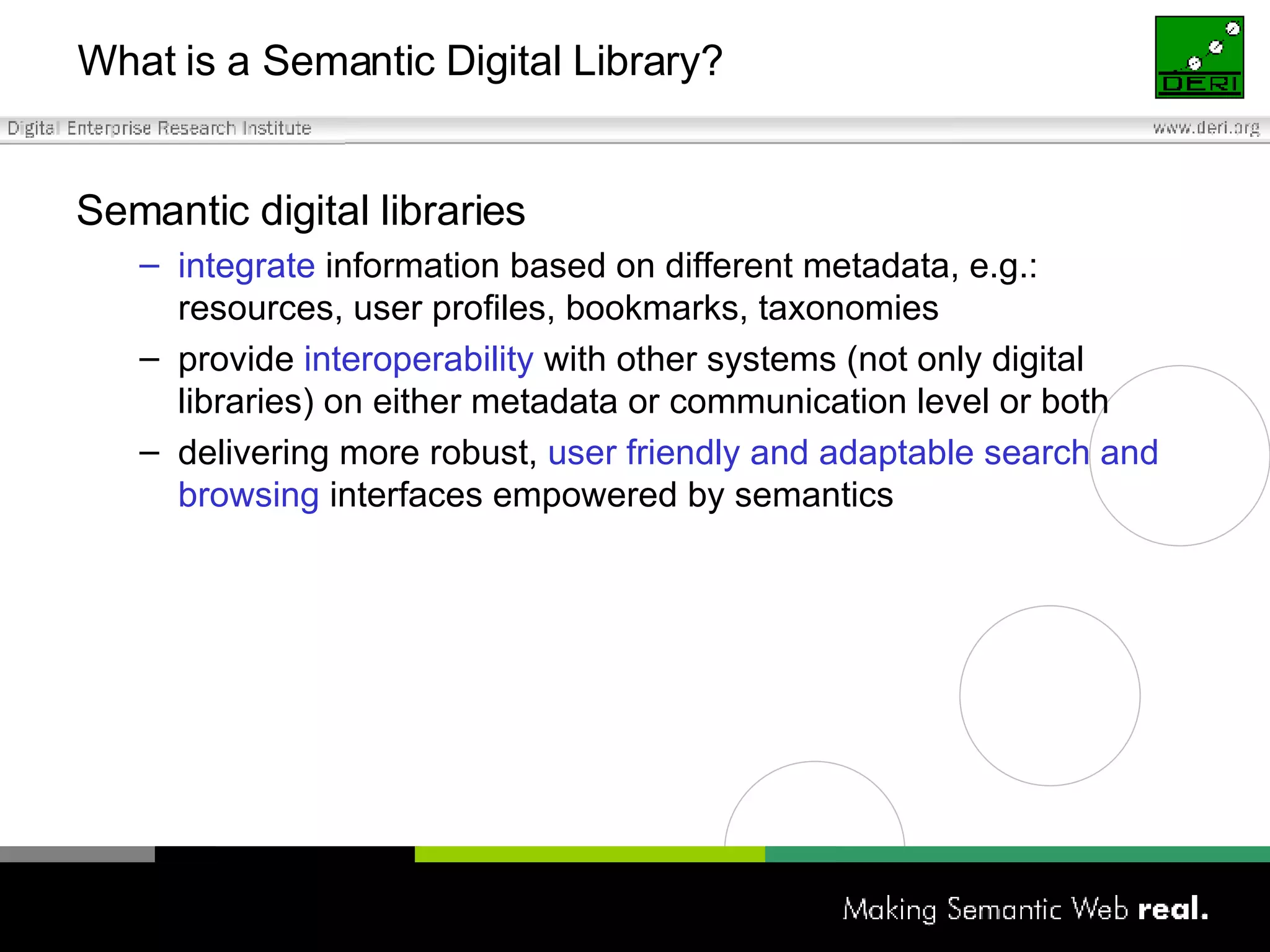
What is a Semantic Digital Library? Semantic digital libraries integrate  information based on different metadata, e.g.: resources, user profiles, bookmarks, taxonomies provide  interoperability  with other systems (not only digital libraries) on either metadata or communication level or both  delivering more robust,  user friendly and adaptable search and browsing  interfaces empowered by semantics
How are Semantic Digital Libraries different? Semantic digital libraries extend digital libraries by describing and exposing its resources in a machine ‘understandable’ way resources can be contents, digital artefacts organization of objects (e.g. collections) users, user communities controlled vocabularies, thesauri,  taxonomies expose the semantics of their metadata  in terms of an ontology defined using a formal language deliver mediation services for communication  with other systems
Semantic Web Technologies for Digital Libraries? Metadata is the key concept the Web  does not have  metadata the idea of a Semantic Web is nice but difficult to implement many digital libraries  do have  metadata in place we simply must make them available in a machine understandable format the Semantic Web provides the format: RDF
Semantic Web Technologies for Digital Libraries? Knowledge in bibliographic records Digital Libraries  already have  controlled vocabularies, taxonomies or even ontologies in place  the challenge is to model this knowledge in a machine understandable way the Semantic Web provides ontology languages:  RDF Schema OWL SKOS
Benefits of Semantic Digital Libraries  Problems of today’s libraries  rapidly growing islands of highly organized information How to find things in a growing information space? is it enough to have a full-text index (à la Google)? typical “end-users” versus “expert users” converging digital library systems e.g. uniform access to Europe’s digital libraries and cultural heritage
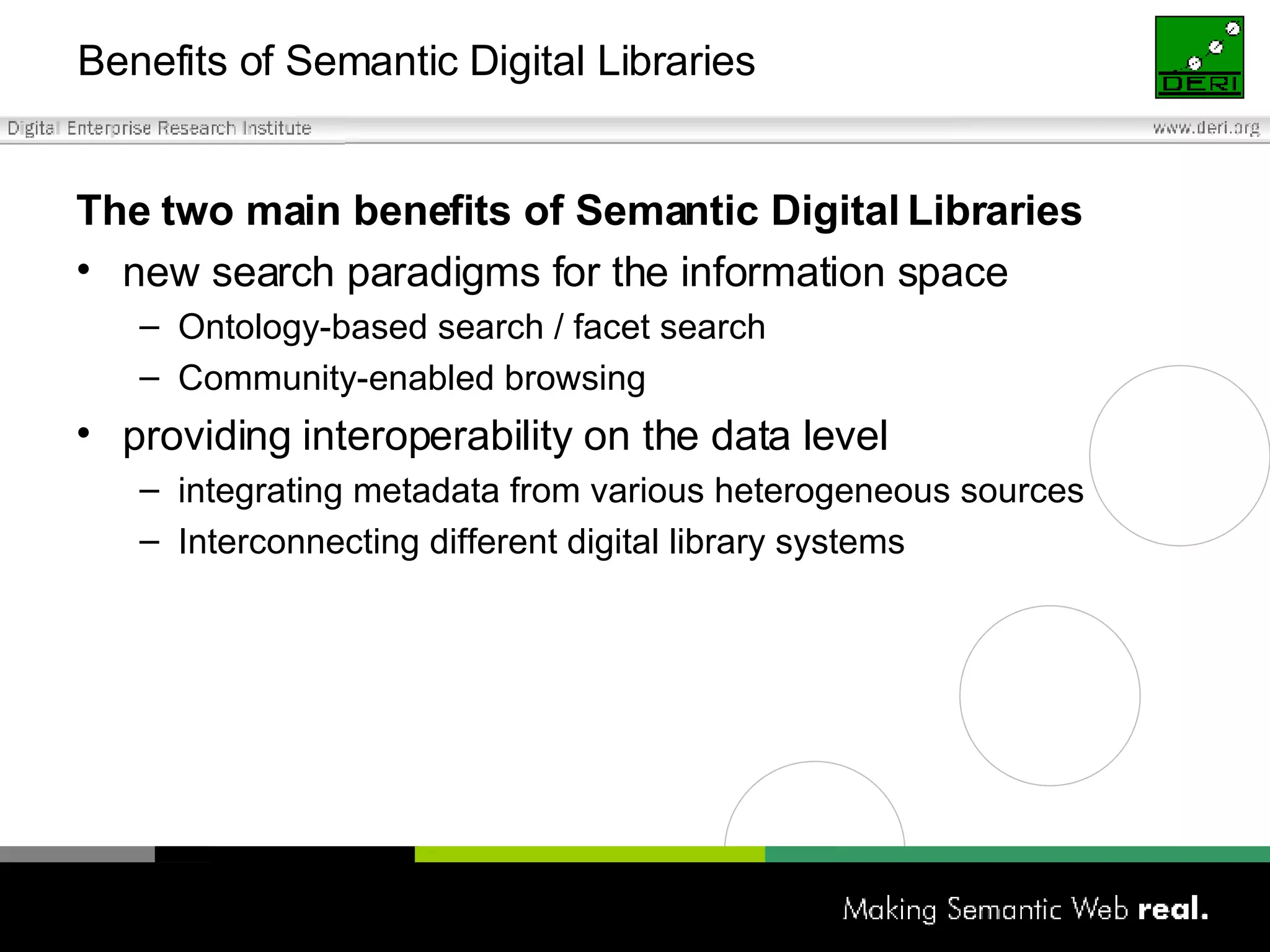
Benefits of Semantic Digital Libraries  The two main benefits of Semantic Digital Libraries new search paradigms for the information space Ontology-based search / facet search Community-enabled browsing providing interoperability on the data level integrating metadata from various heterogeneous sources Interconnecting different digital library systems
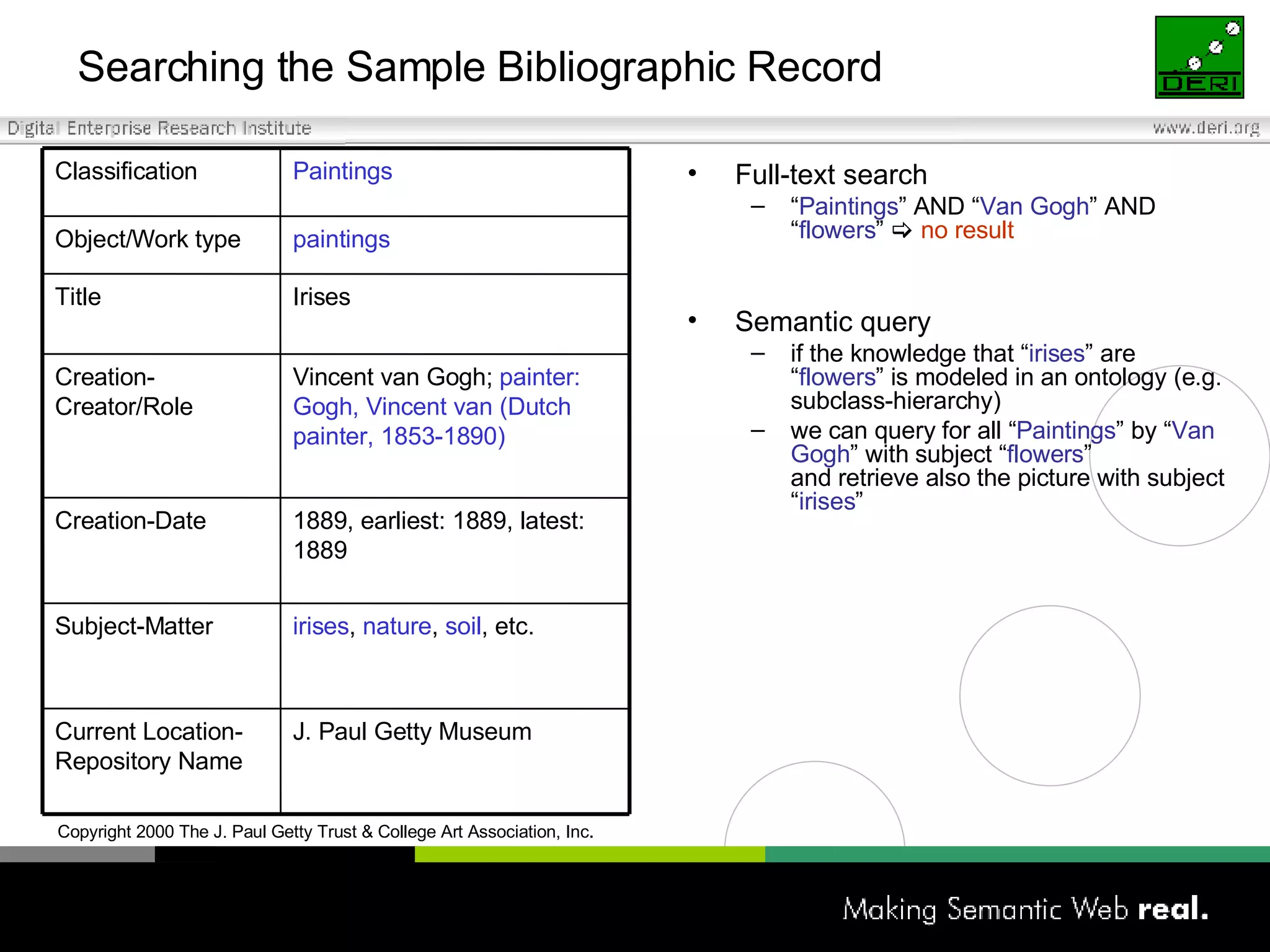
Searching the Sample Bibliographic Record Full-text search “ Paintings ” AND “ Van Gogh ” AND “ flowers ”      no result Semantic query if the knowledge that “ irises ” are “ flowers ” is modeled in an ontology (e.g. subclass-hierarchy) we can query for all “ Paintings ” by “ Van Gogh ” with subject “ flowers ”   and retrieve also the picture with subject “ irises ” Copyright 2000 The J. Paul Getty Trust & College Art Association, Inc . Vincent van Gogh;  painter: Gogh, Vincent van (Dutch painter, 1853-1890) Creation-Creator/Role J. Paul Getty Museum Current Location-Repository Name irises ,  nature ,  soil , etc. Subject-Matter 1889, earliest: 1889, latest: 1889 Creation-Date Irises Title paintings Object/Work type Paintings Classification
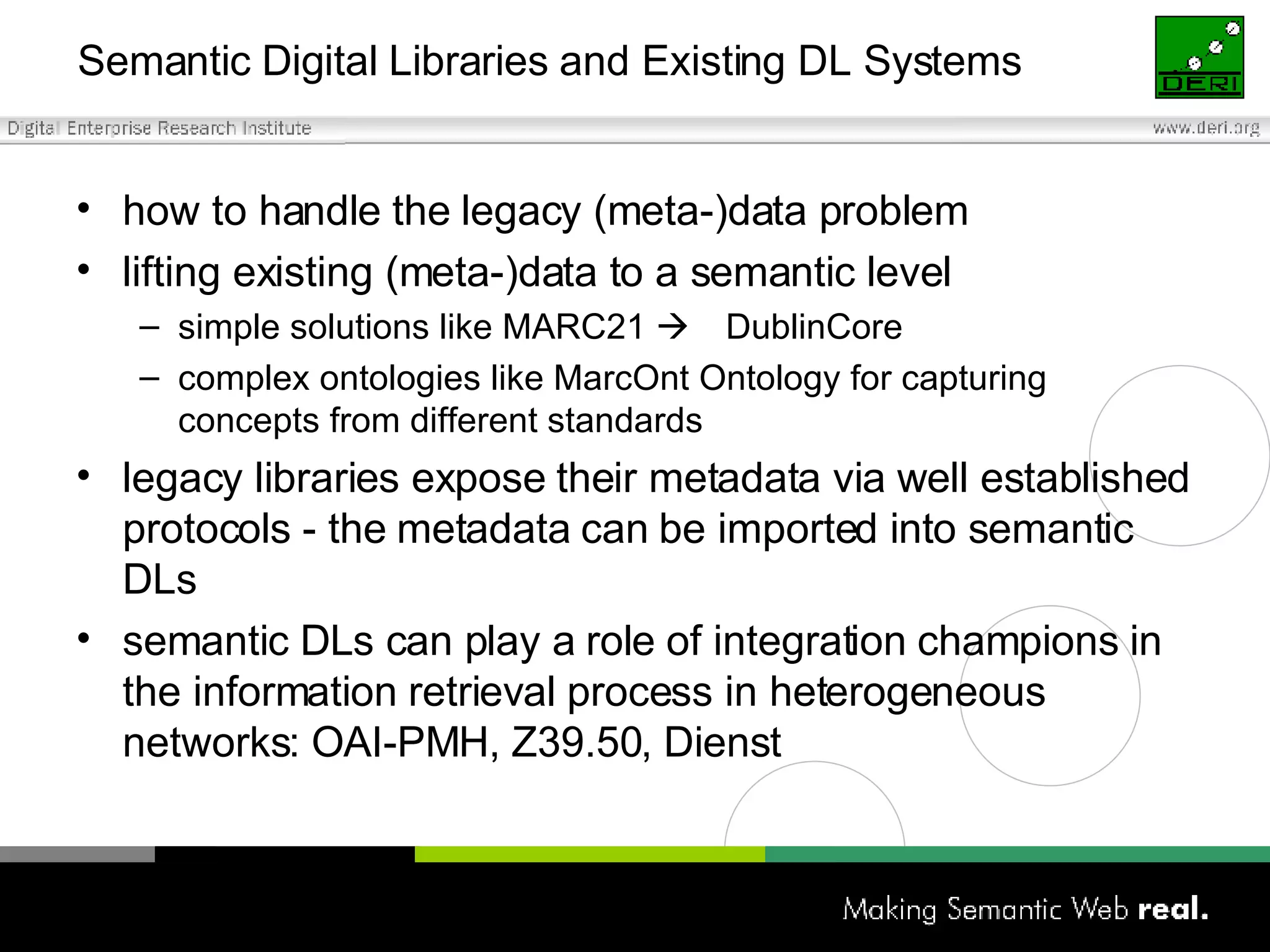
Semantic Digital Libraries and Existing DL Systems how to handle the legacy (meta-)data problem  lifting existing (meta-)data to a semantic level simple solutions like MARC21   DublinCore complex ontologies like MarcOnt Ontology for capturing concepts from different standards legacy libraries expose their metadata via well established protocols - the metadata can be imported into semantic DLs semantic DLs can play a role of integration champions in the information retrieval process in heterogeneous networks:   OAI-PMH ,  Z39.50 ,  Dienst
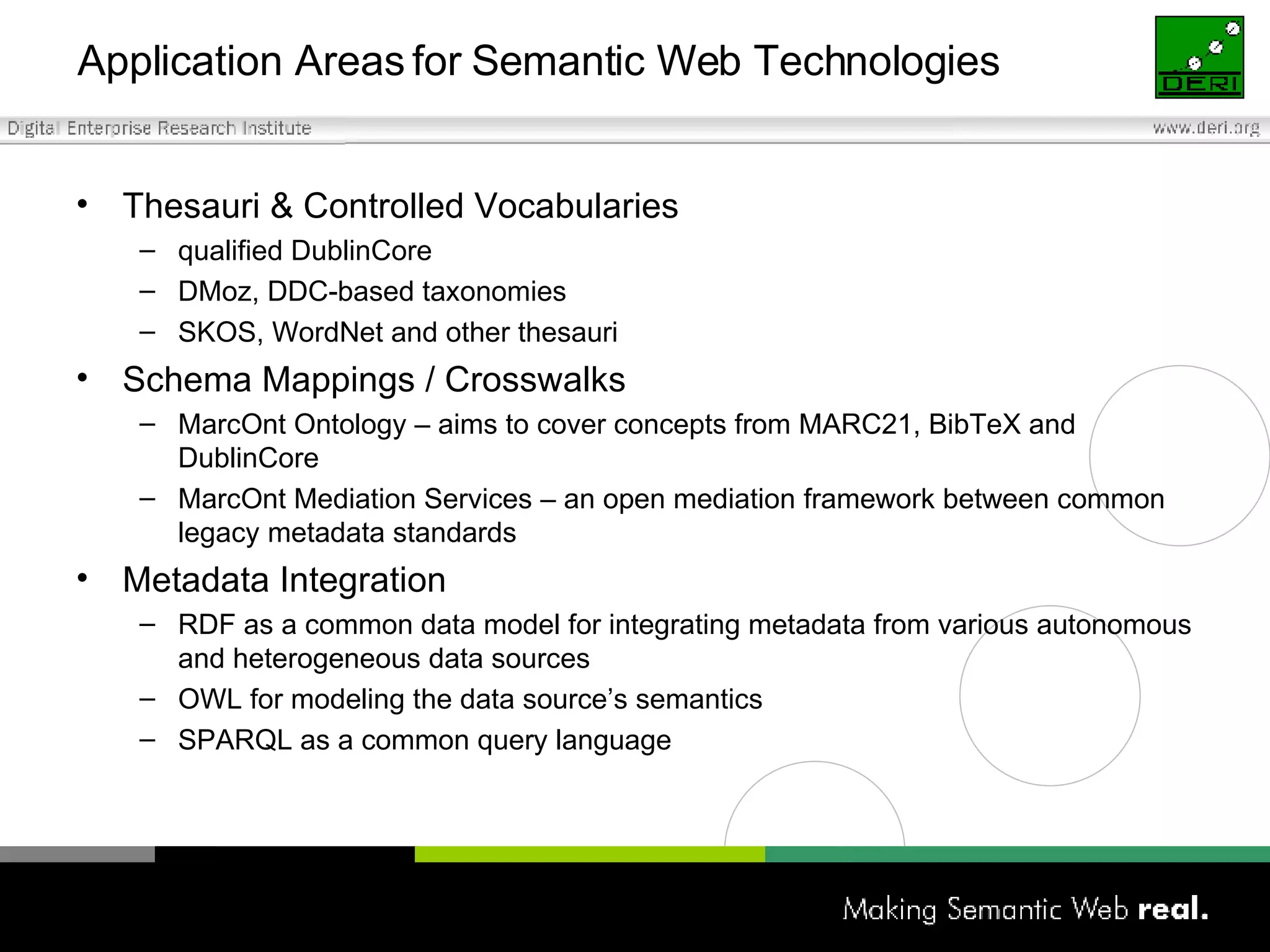
Application Areas for Semantic Web Technologies Thesauri & Controlled Vocabularies qualified DublinCore DMoz, DDC-based taxonomies SKOS, WordNet and other thesauri Schema Mappings / Crosswalks MarcOnt Ontology – aims to cover concepts from MARC21, BibTeX and DublinCore MarcOnt Mediation Services – an open mediation framework between common legacy metadata standards  Metadata Integration RDF as a common data model for integrating metadata from various autonomous and heterogeneous data sources OWL for modeling the data source’s semantics SPARQL as a common query language
Semantic DL as Evolving Knowledge Space In state-of-the-art digital libraries users are  consumers Retrieve contents based on available bibliographic records Recent trends: user communities Connetea Flickr In Semantic digital libraries users are  contributers  as well Tagging (Web 2.0) Social Semantic Collaborative Filtering Annotations Semantic Digital libraries enforce the transition from a static information to a  dynamic (collaborative) knowledge space
Why current (semantic) digital libraries are not enough? digital libraries should not be for librarians only but for average people they concentrate on delivering content/information, not on knowledge sharing within a community of users digital libraries have lost human-part of their predecessors What could be the solution? make users/readers involved in the content annotation process allow users/readers to share their knowledge within a community provide better communication between users in and across communities The future - Social Semantic Digital Libraries
The future - Social Semantic Digital Libraries What is Web 2.0? The Web where “ordinary” users can meet, collaborate, and share using whatever is newly popular on the Web (tagged content, social bookmarking, AJAX, etc.) The term Web 2.0 was made popular by Tim O’Reilly: http://www.oreillynet.com/pub/a/oreilly/tim/news/2005/09/30/what-is-web-20.html Popular examples include: Bebo, del.icio.us, digg, Flickr, Google Maps, Skype, Technorati, Wikipedia…
The future - Social Semantic Digital Libraries Web 2.0 focuses include: The Web as a platform for social and collaborative exchange Reusable community contributions Subscriptions to information, news, data flows, services Mass-publishing using web-based social software Social software for communication and collaboration: IM, IRC, Forums, Blogs, Wikis, Social Network Services, Social Bookmarks, MMOGs…
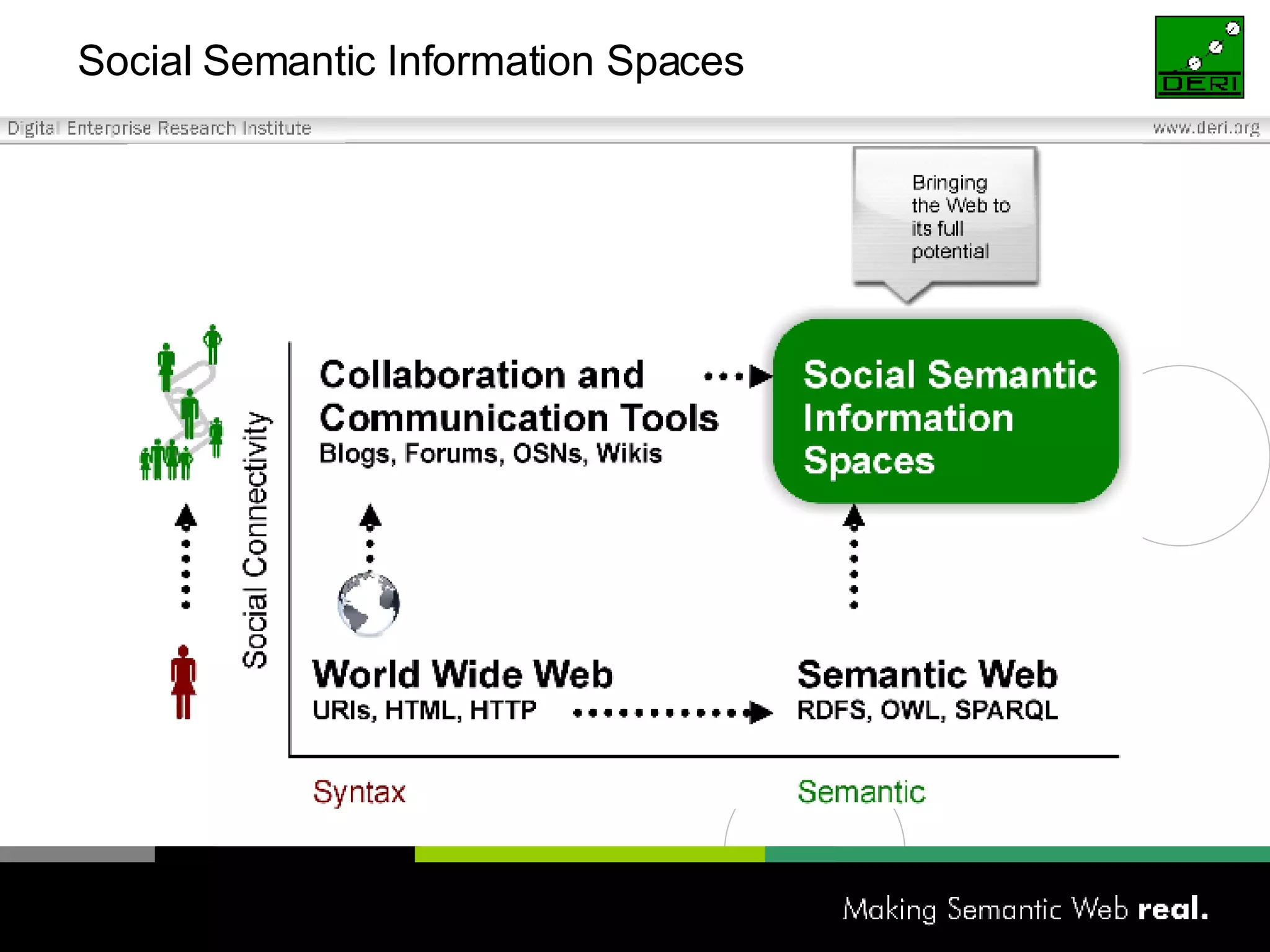
Social Semantic Information Spaces
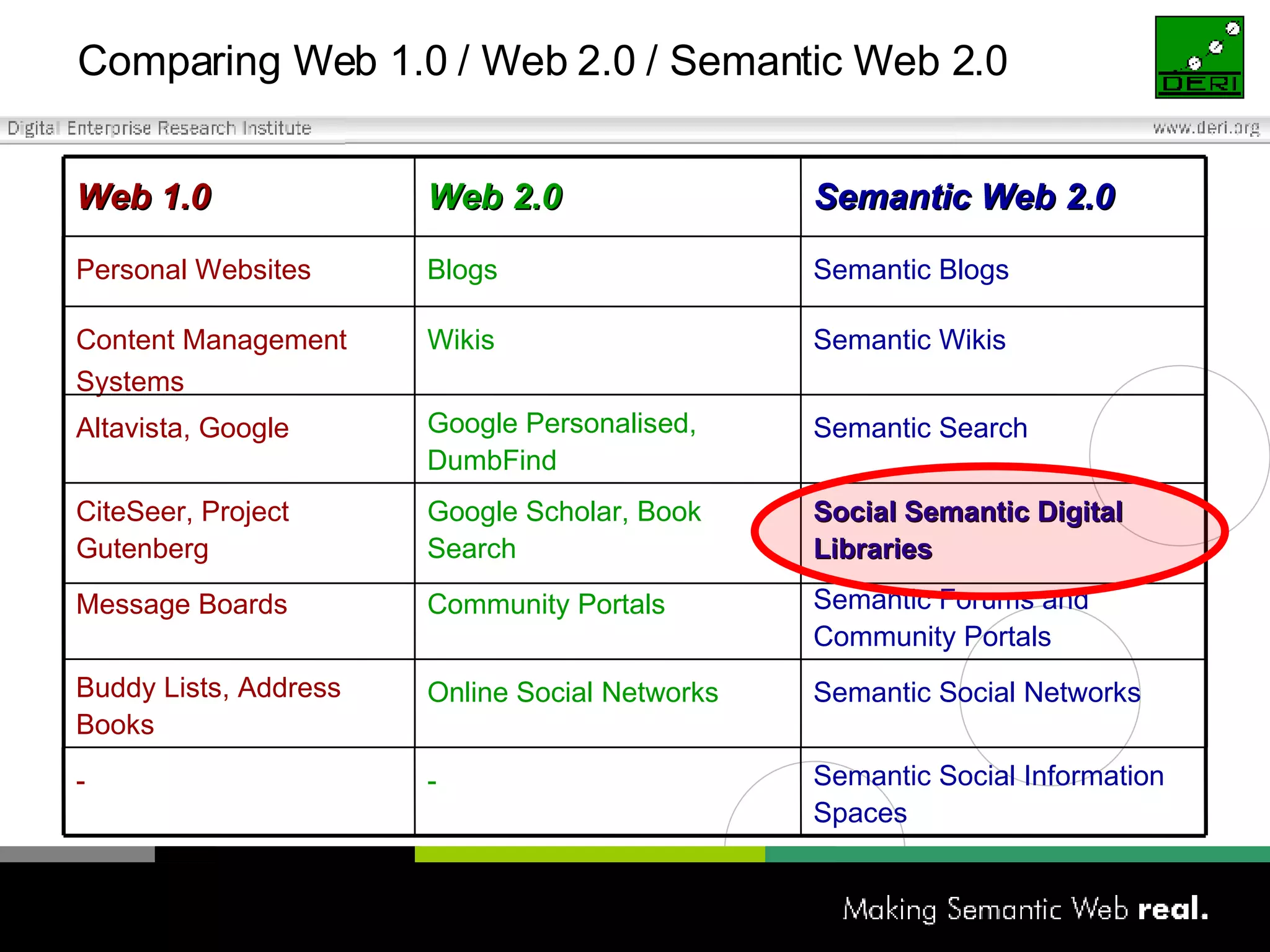
Comparing Web 1.0 / Web 2.0 / Semantic Web 2.0 Semantic Social Networks Online Social Networks Buddy Lists, Address Books Semantic Social Information Spaces - - Social Semantic Digital Libraries Google Scholar, Book Search CiteSeer, Project Gutenberg Semantic Forums and Community Portals Community Portals Message Boards Semantic Blogs Blogs Personal Websites Semantic Search Google Personalised, DumbFind Altavista, Google Semantic Wikis Wikis Content Management Systems Semantic Web 2.0 Web 2.0 Web 1.0
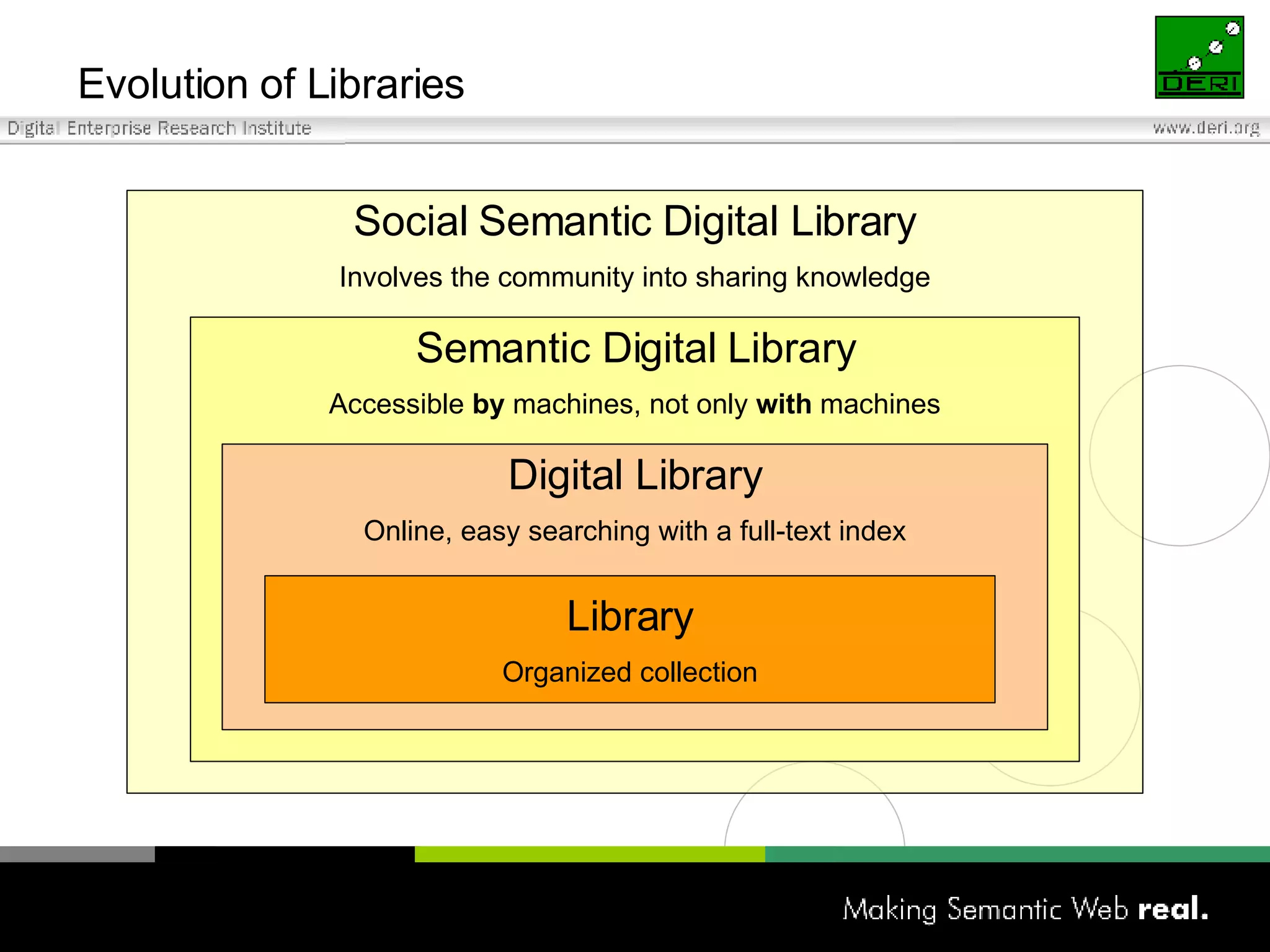
Evolution of Libraries Social Semantic Digital Library Involves the community into sharing knowledge Semantic Digital Library Accessible  by  machines, not only  with  machines Digital Library Online, easy searching with a full-text index Library Organized collection
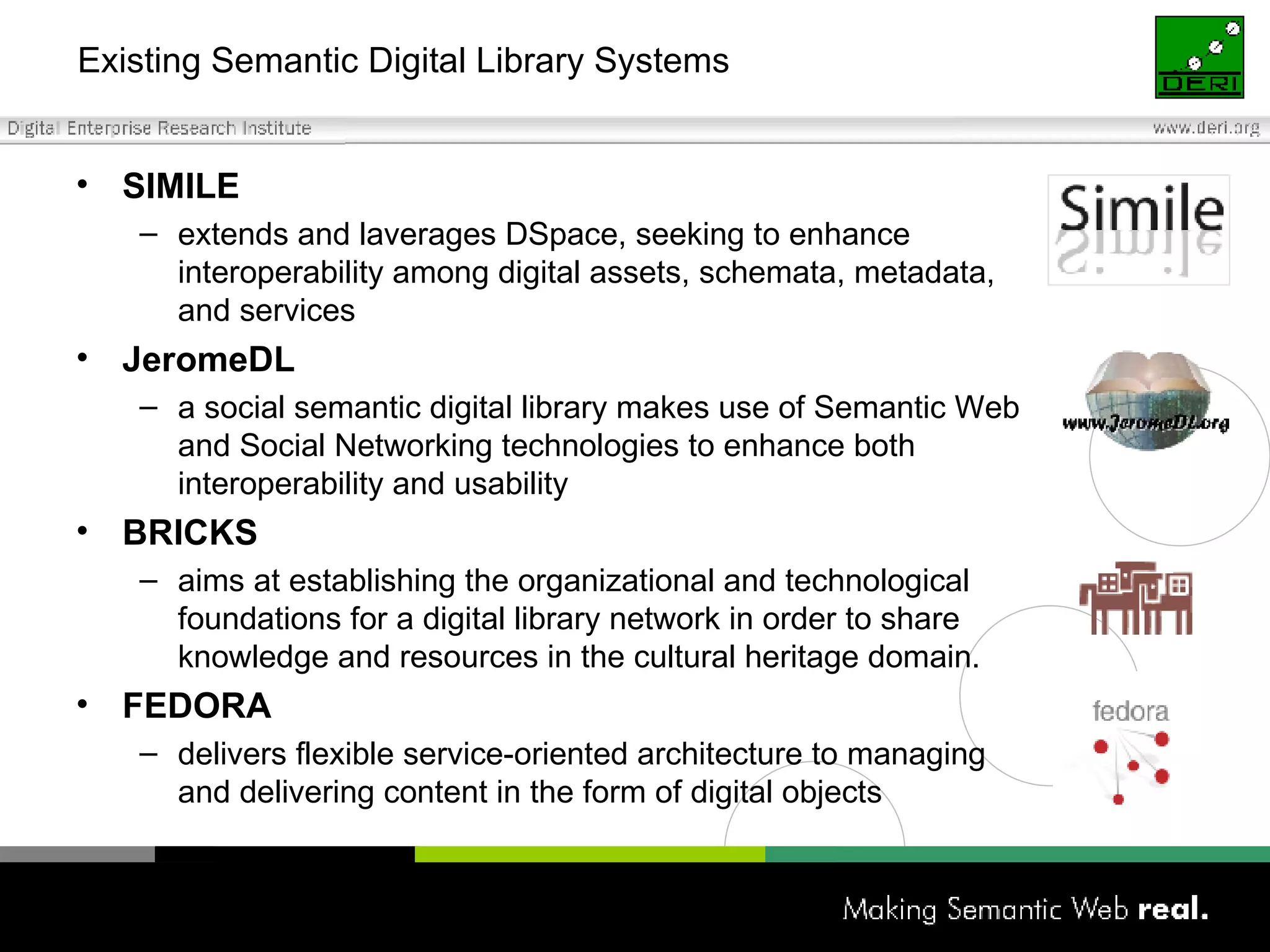
Existing Semantic Digital Library Systems SIMILE extends and laverages DSpace, seeking to enhance interoperability among digital assets, schemata, metadata, and services JeromeDL a social semantic digital library makes use of Semantic Web and Social Networking technologies to enhance both interoperability and usability BRICKS aims at establishing the organizational and technological foundations for a digital library network in order to share knowledge and resources in the cultural heritage domain. FEDORA delivers flexible service-oriented architecture to managing and delivering content in the form of digital objects
JeromeDL -  Introduction Joint effort of DERI International and Gdansk University of Technology (GUT) Distributed under BSD Open Source license Digital library build on semantic web technologies to answer requirements from: librarians, scientists and everyone. A successor for prototype  semantic digital library  – Elvis-DL build at GUT
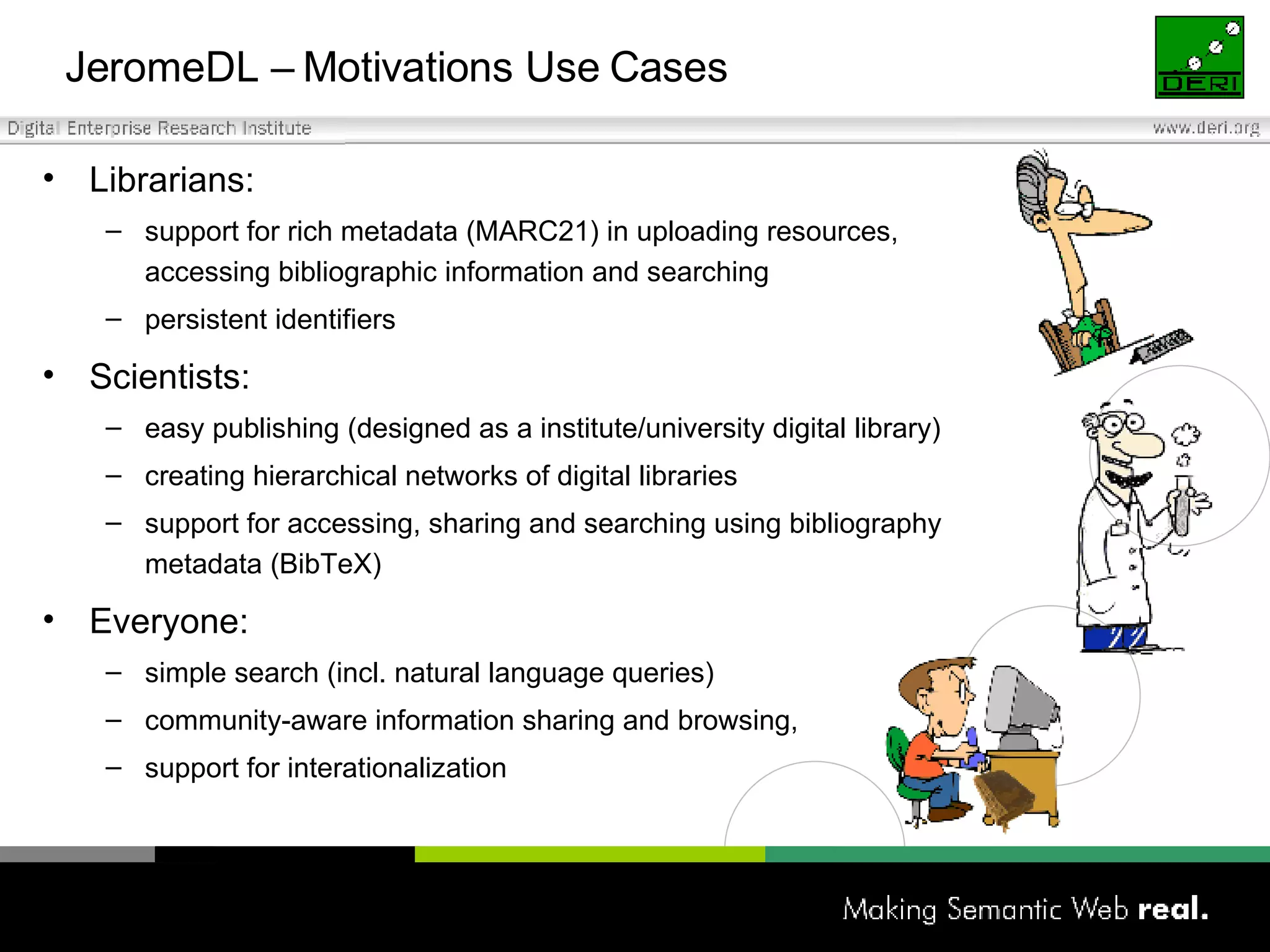
JeromeDL –  Motivations Use Cases Librarians: support for rich metadata (MARC21) in uploading resources,  accessing bibliographic information and searching persistent identifiers Scientists:  easy publishing (designed as a institute/university digital library) creating hierarchical networks of digital libraries support for accessing, sharing and searching using bibliography  metadata (BibTeX) Everyone: simple search (incl. natural language queries)  community-aware information sharing and browsing,  support for interationalization
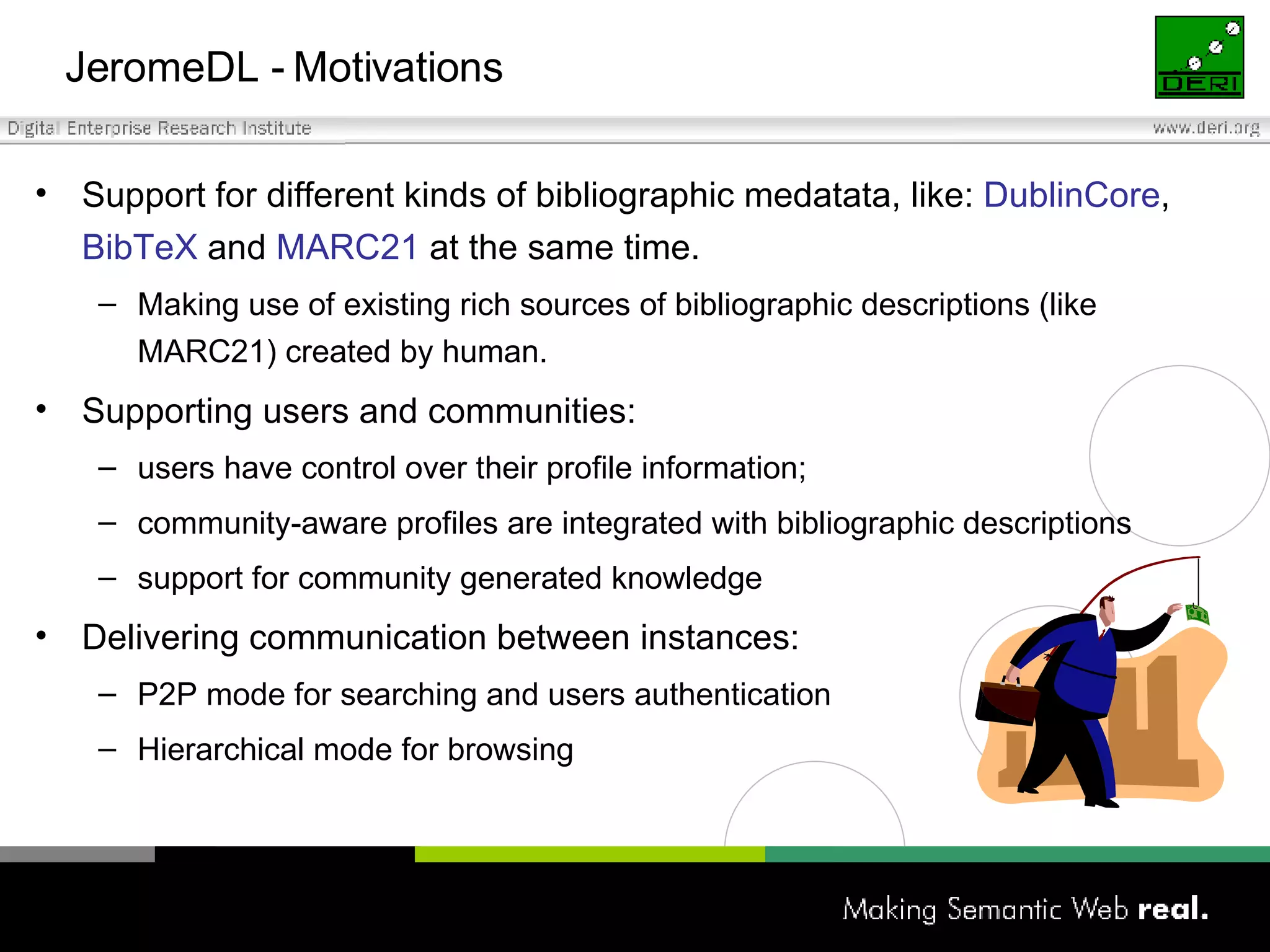
JeromeDL - Motivations Support for different kinds of bibliographic medatata, like:  DublinCore ,  BibTeX  and  MARC21  at the same time. Making use of existing  rich sources  of bibliographic descriptions  (like MARC21) created by human. Supporting users and communities: user s  ha ve  control over  their  profile information ; community-aware profiles are integrated with bibliographic descriptions support for community generated knowledge Delivering communication between instances: P2P mode for searching and users authentication Hierarchical mode for browsing
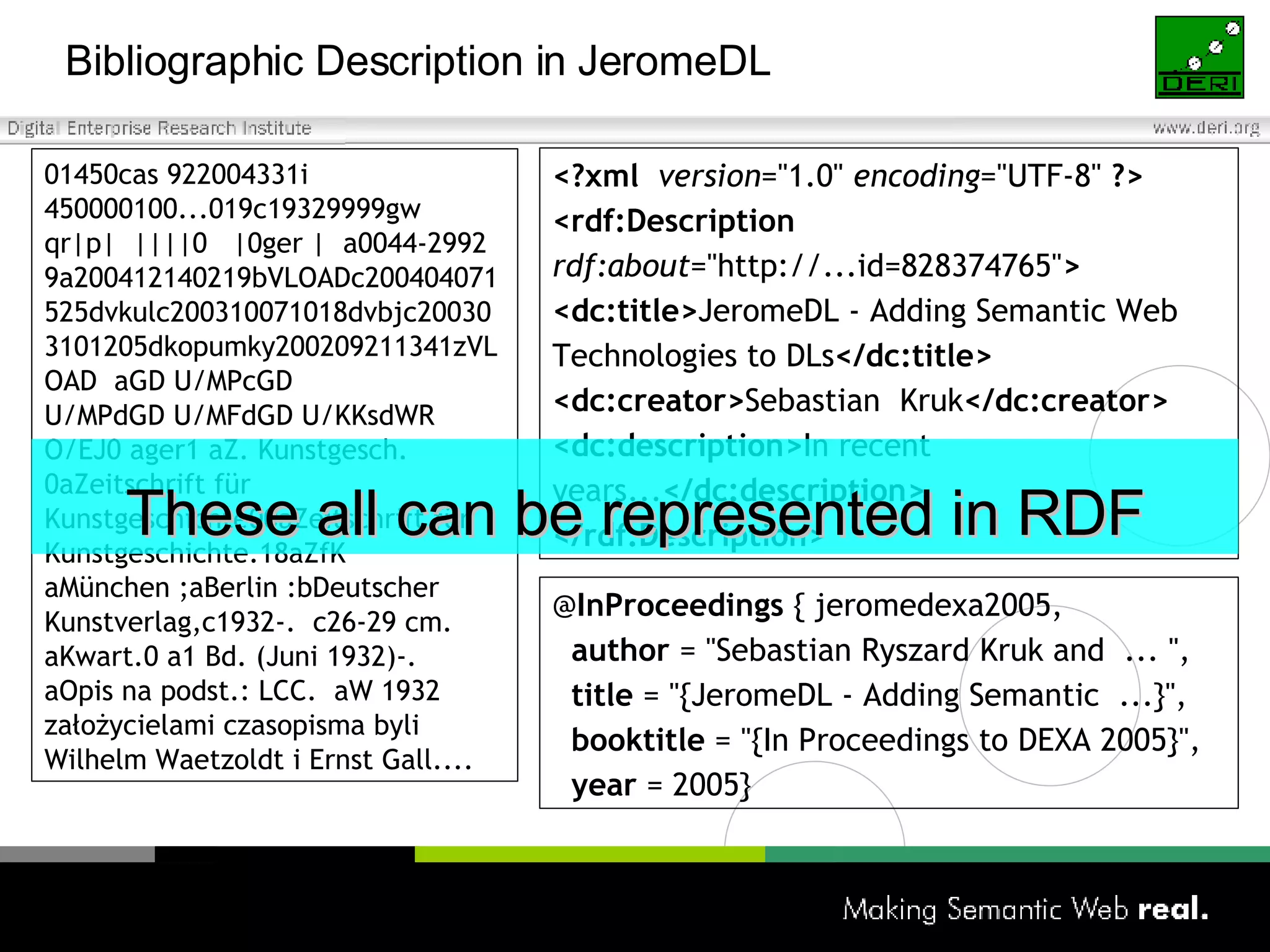
Bibliographic Description in JeromeDL <?xml  version =&quot;1.0&quot;  encoding =&quot;UTF-8&quot;  ?> <rdf:Description   rdf:about =&quot;http://...id=828374765&quot; > <dc:title> JeromeDL - Adding Semantic Web Technologies to DLs </dc:title> <dc:creator> Sebastian  Kruk </dc:creator> <dc:description> In recent  years... </dc:description> </rdf:Description> 01450cas 922004331i 450000100...019c19329999gw  qr|p|  ||||0  |0ger |  a0044-2992 9a200412140219bVLOADc200404071525dvkulc200310071018dvbjc200303101205dkopumky200209211341zVLOAD  aGD U/MPcGD  U/MPdGD U/MFdGD U/KKsdWR O/EJ0 ager1 aZ. Kunstgesch. 0aZeitschrift für Kunstgeschichte00aZeitschrift für Kunstgeschichte.18aZfK  aMünchen ;aBerlin :bDeutscher Kunstverlag,c1932-.  c26-29 cm.  aKwart.0 a1 Bd. (Juni 1932)-.  aOpis na podst.: LCC.  aW 1932 założycielami czasopisma byli Wilhelm Waetzoldt i Ernst Gall....  These all can be represented in RDF @ InProceedings  { jeromedexa2005, author  = &quot;Sebastian Ryszard Kruk and  ... &quot;, title  = &quot;{JeromeDL - Adding Semantic  ...}&quot;, booktitle  = &quot;{In Proceedings to DEXA 2005}&quot;, year  = 2005}
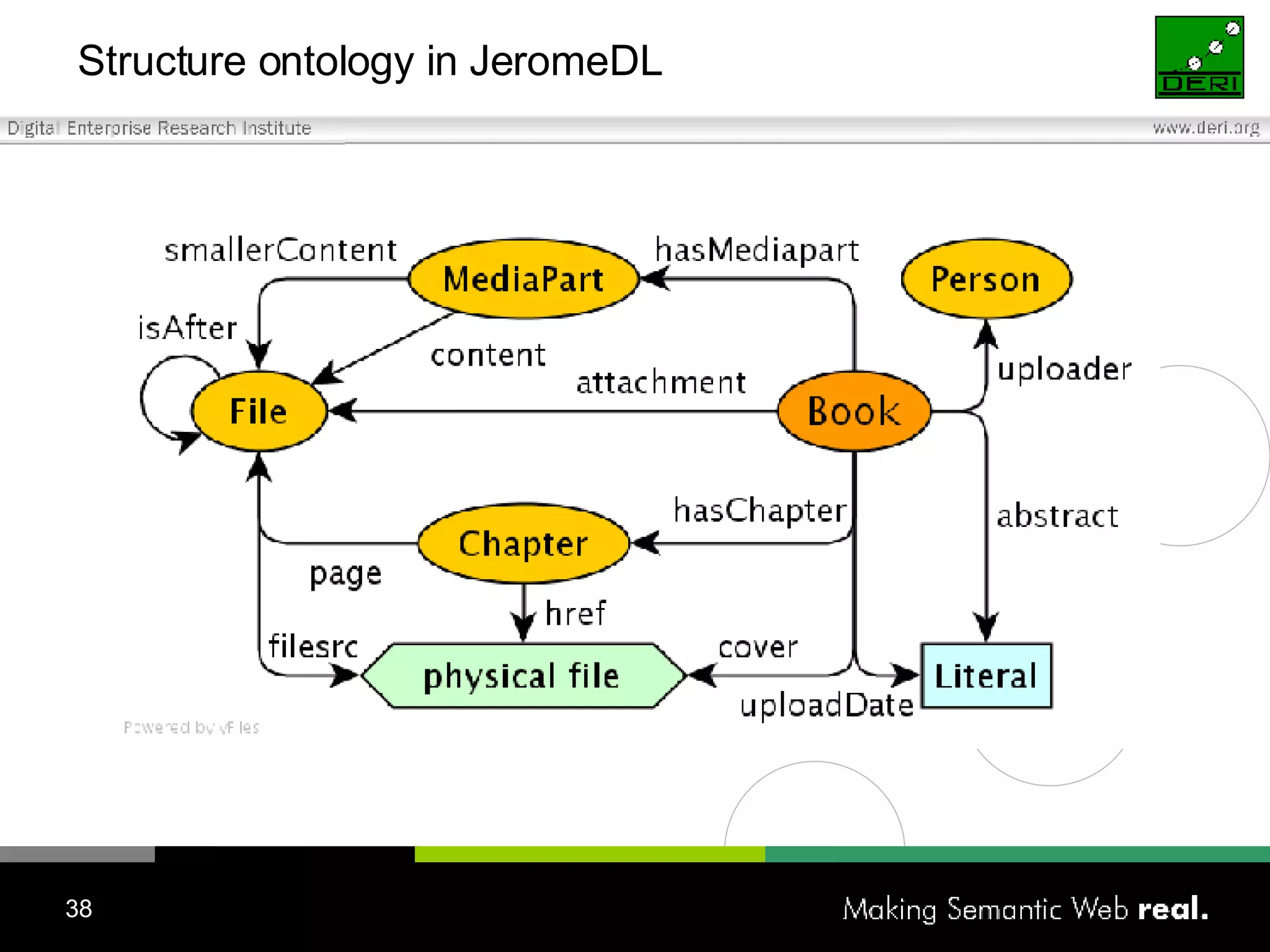
Structure ontology in JeromeDL
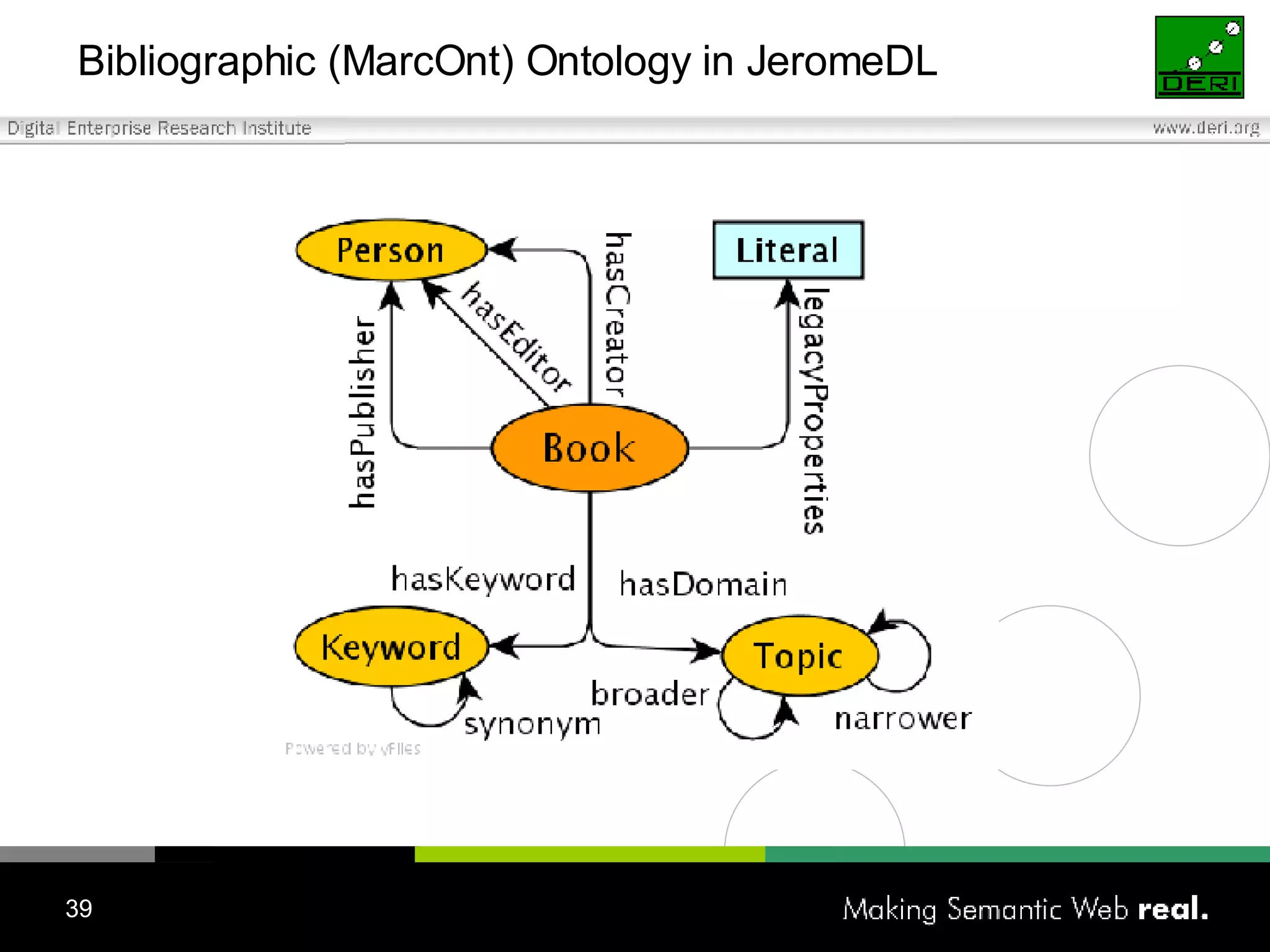
Bibliographic (MarcOnt) Ontology in JeromeDL
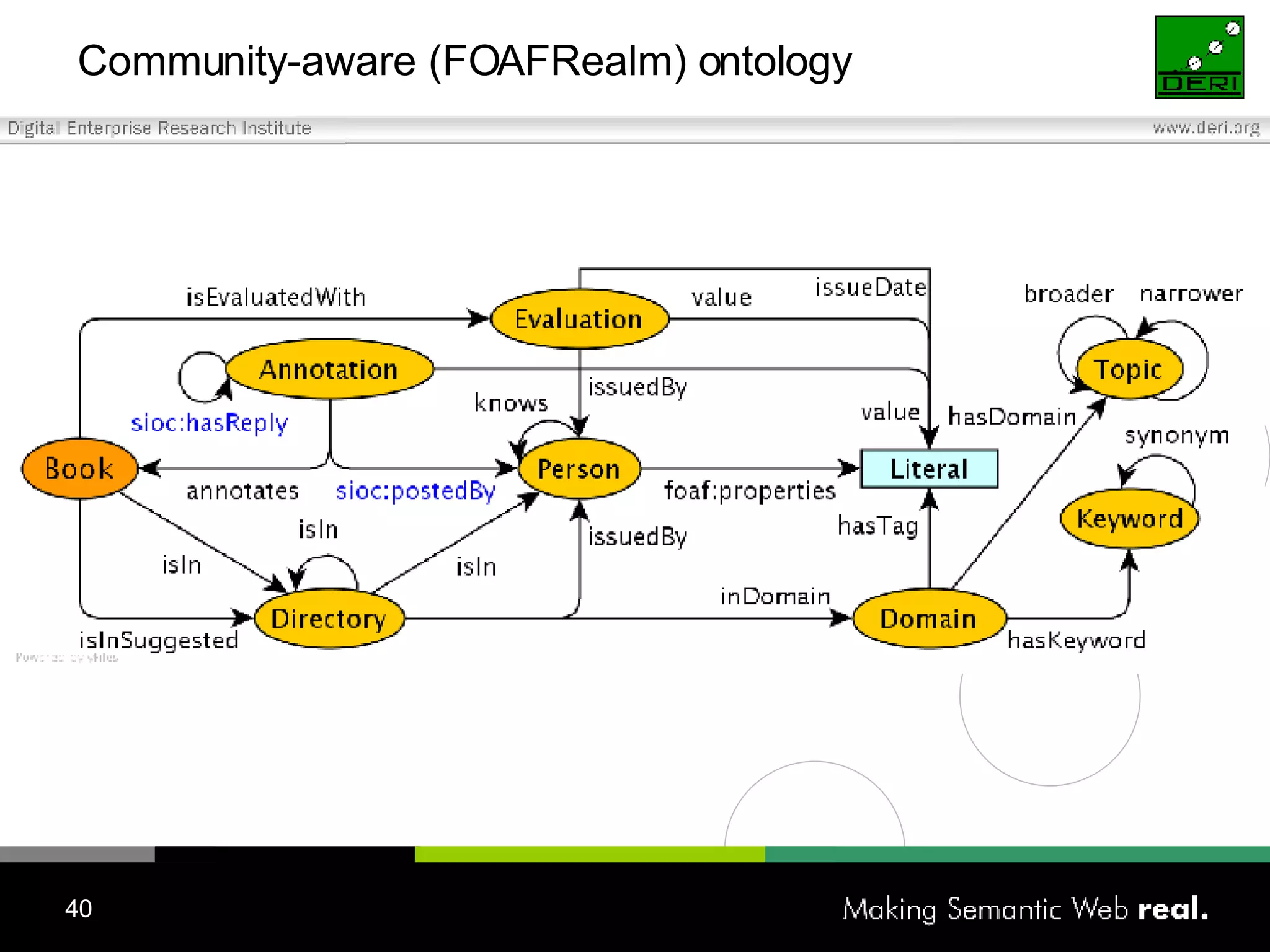
Community-aware (FOAFRealm) ontology
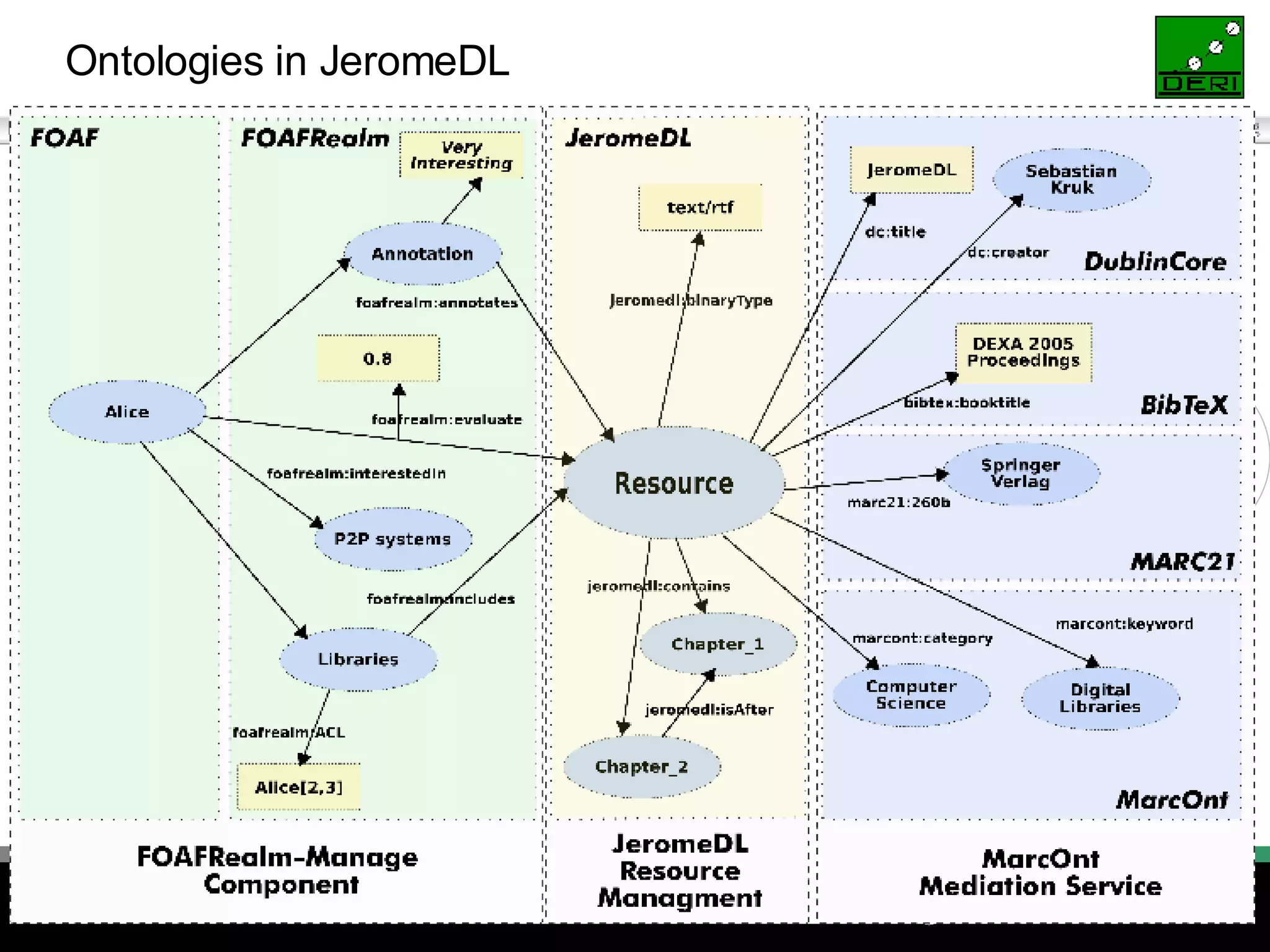
Ontologies in JeromeDL
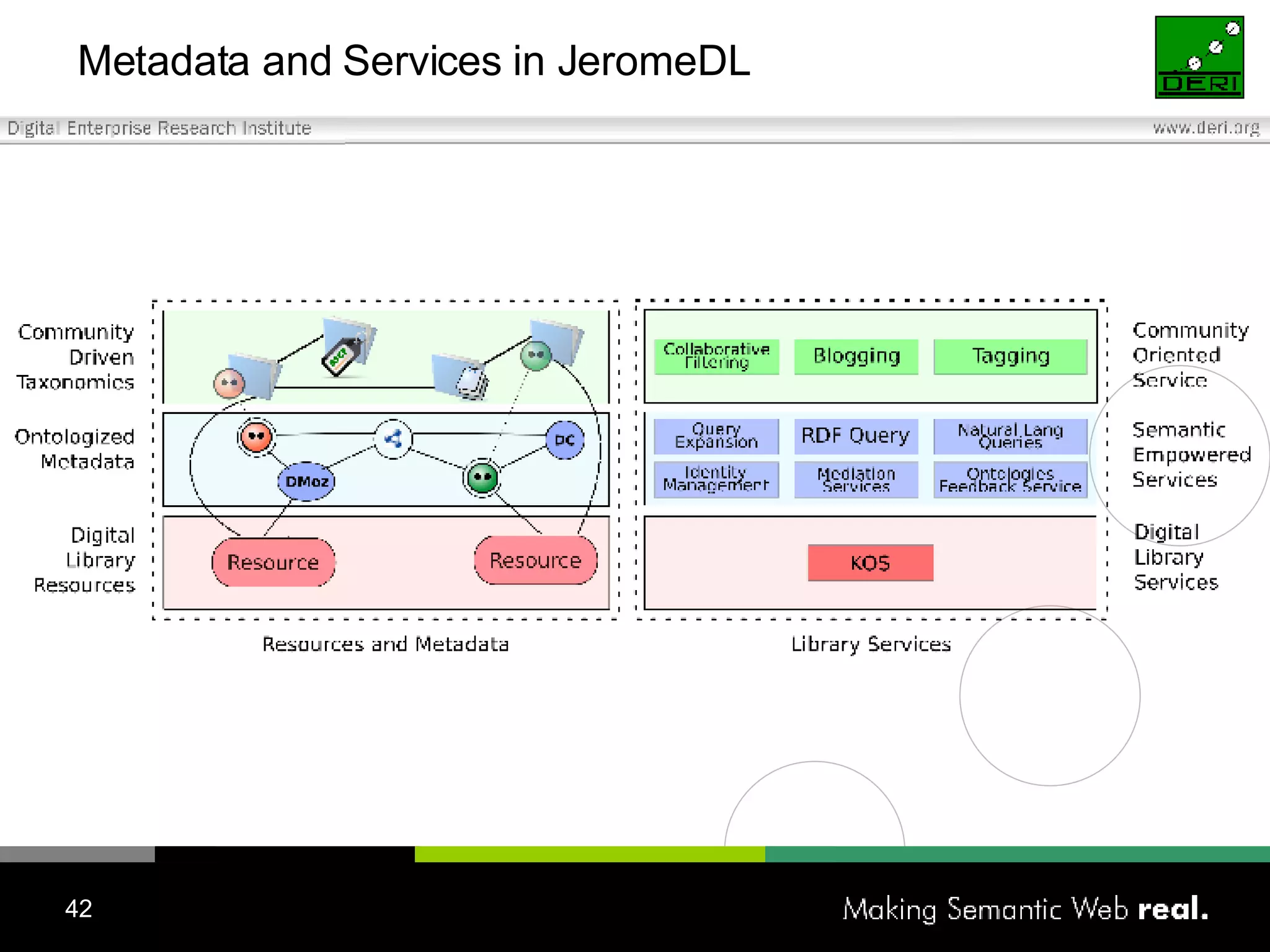
Metadata and Services in JeromeDL
Social Services in JeromeDL Involve users into sharing knowledge Blogs – comments and discussions about documents and resources  Tagging – collaborative classification Wikis – collaboratively edited additional descriptions, such as summaries and interesting facts Preserve knowledge for future use Users can learn from experience of others instantly Recommend new, interesting resources based on users’ profiles
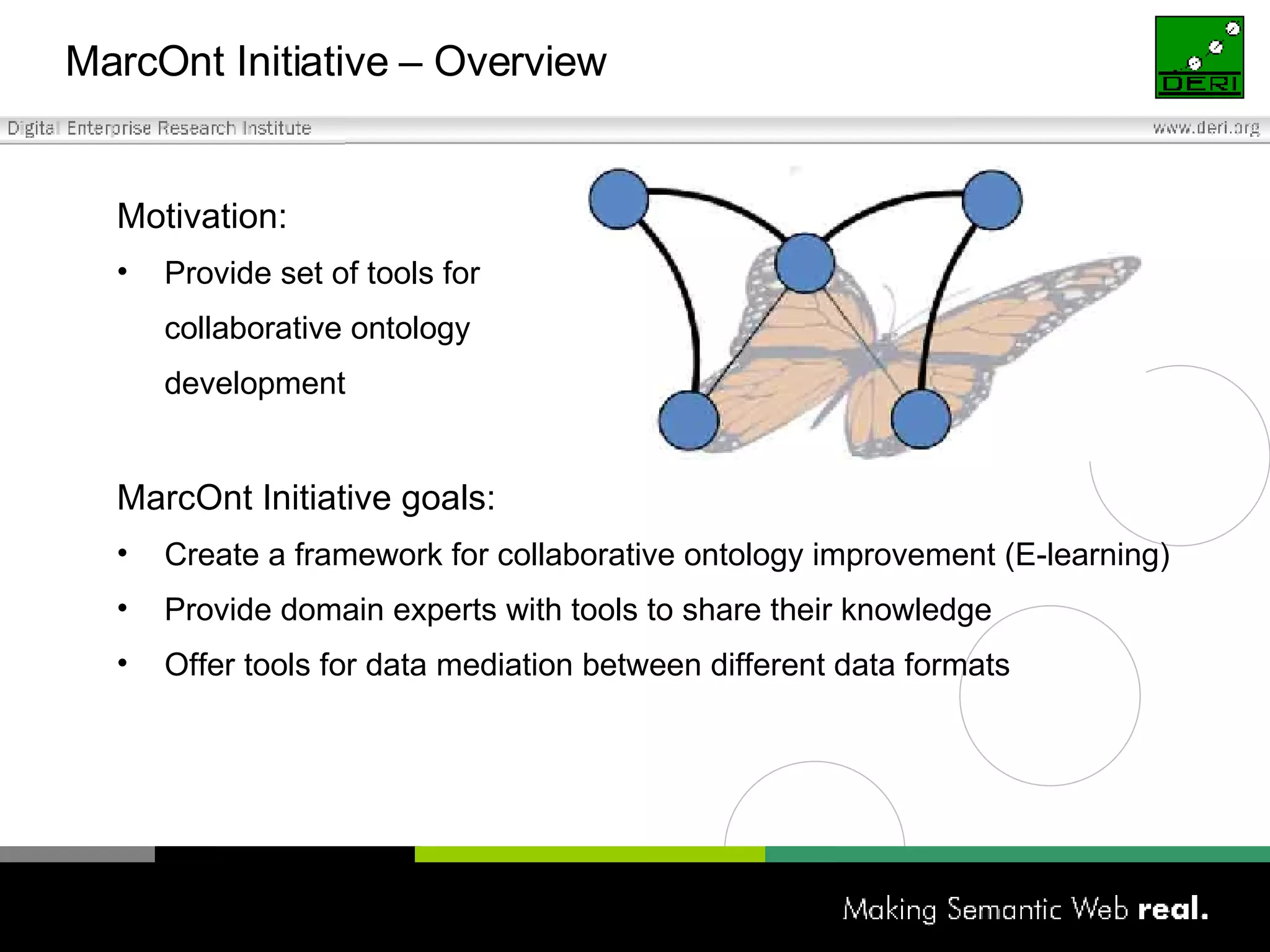
MarcOnt Initiative – Overview Motivation: Provide set of tools for  collaborative ontology development MarcOnt Initiative goals: Create a framework for collaborative ontology improvement (E-learning) Provide domain experts with tools to share their knowledge Offer tools for data mediation between different data formats
MarcOnt Portal and MarcOnt Ontology MarcOnt Ontology: Central point of MarcOnt Initiative Translation and mediation format Continuos collaborative ontology improvement Knowledge from the domain experts MarcOnt Portal (source of knowledge): Suggestions Annotations Versioning Ontology editor
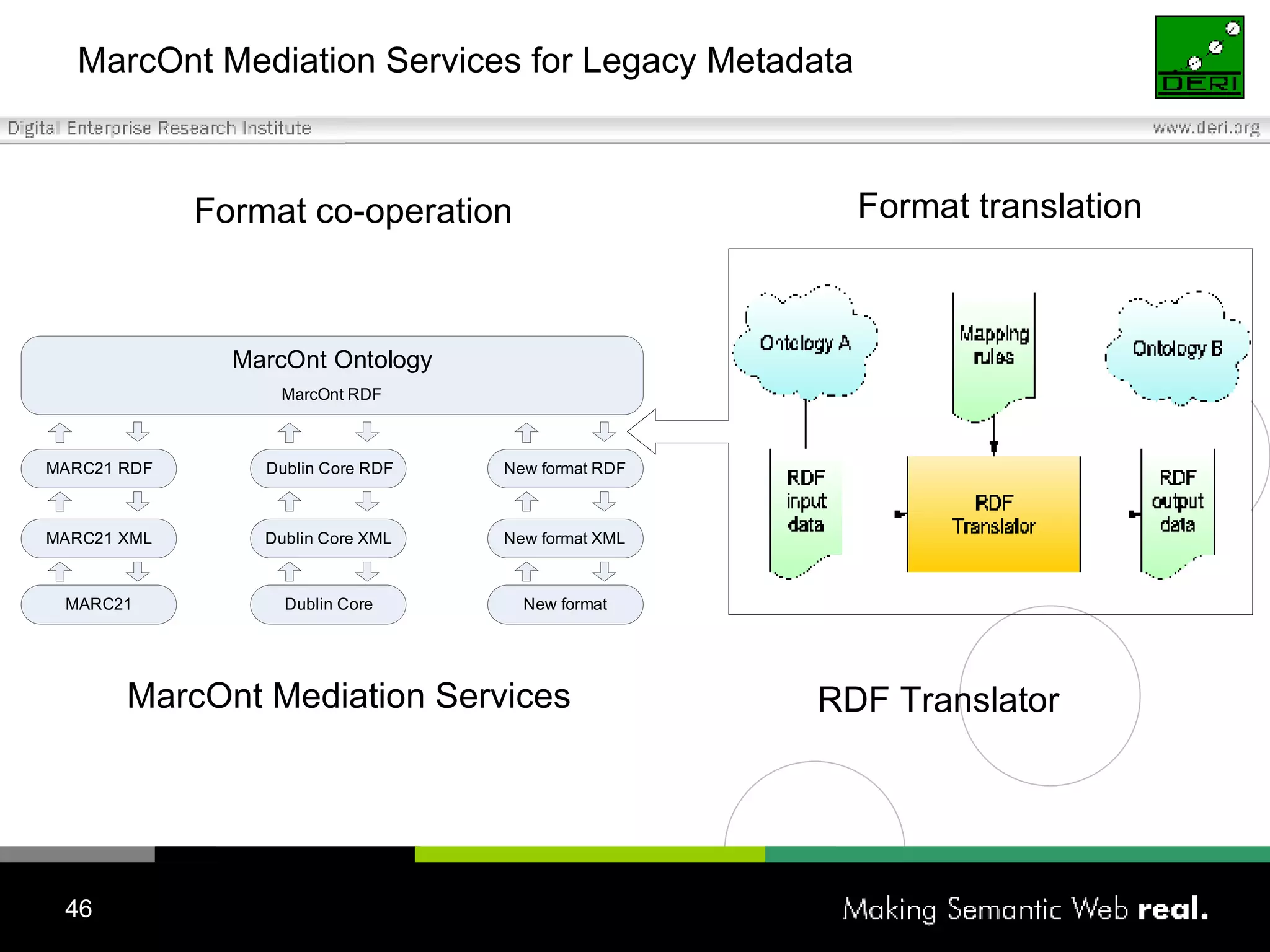
MarcOnt Mediation Services for Legacy Metadata Format translation RDF Translator Format co-operation MarcOnt Mediation Services
FOAF - Describing Social Networks FOAF - Stands for Friend-of-a-Friend Defines properties for a person (but it does not have to be a person, can be an “agent”) Does not only have to contain one person per file Can build a network of people with foaf:knows links FOAF can be easily extended to meet requirements, as in the case of FOAFRealm for identity management…
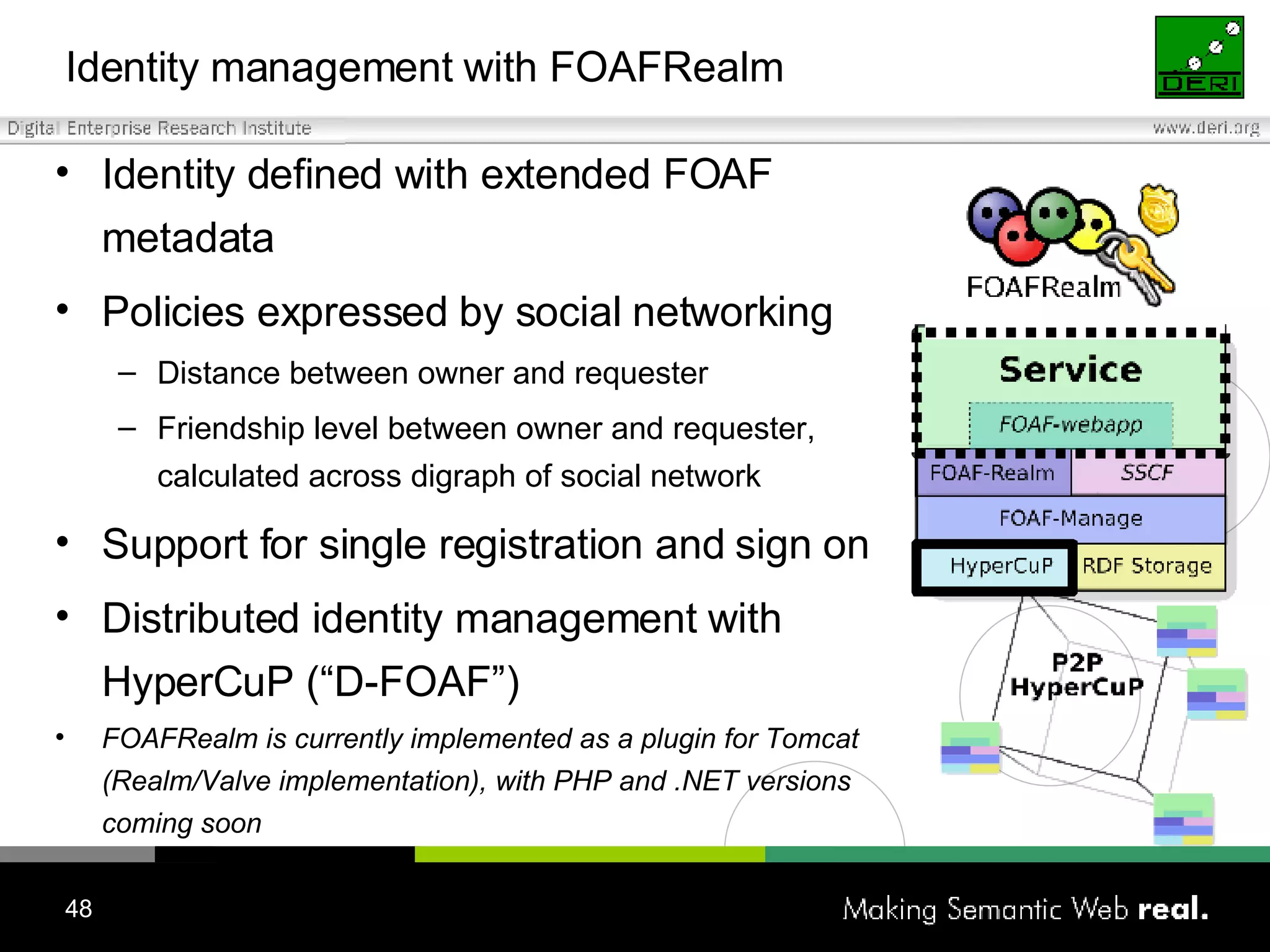
Identity management with FOAFRealm Identity defined with extended FOAF metadata Policies expressed by social networking  Distance between owner and requester Friendship level between owner and requester, calculated across digraph of social network Support for single registration and sign on Distributed identity management with HyperCuP (“D-FOAF”) FOAFRealm is currently implemented as a plugin for Tomcat (Realm/Valve implementation), with PHP and .NET versions coming soon
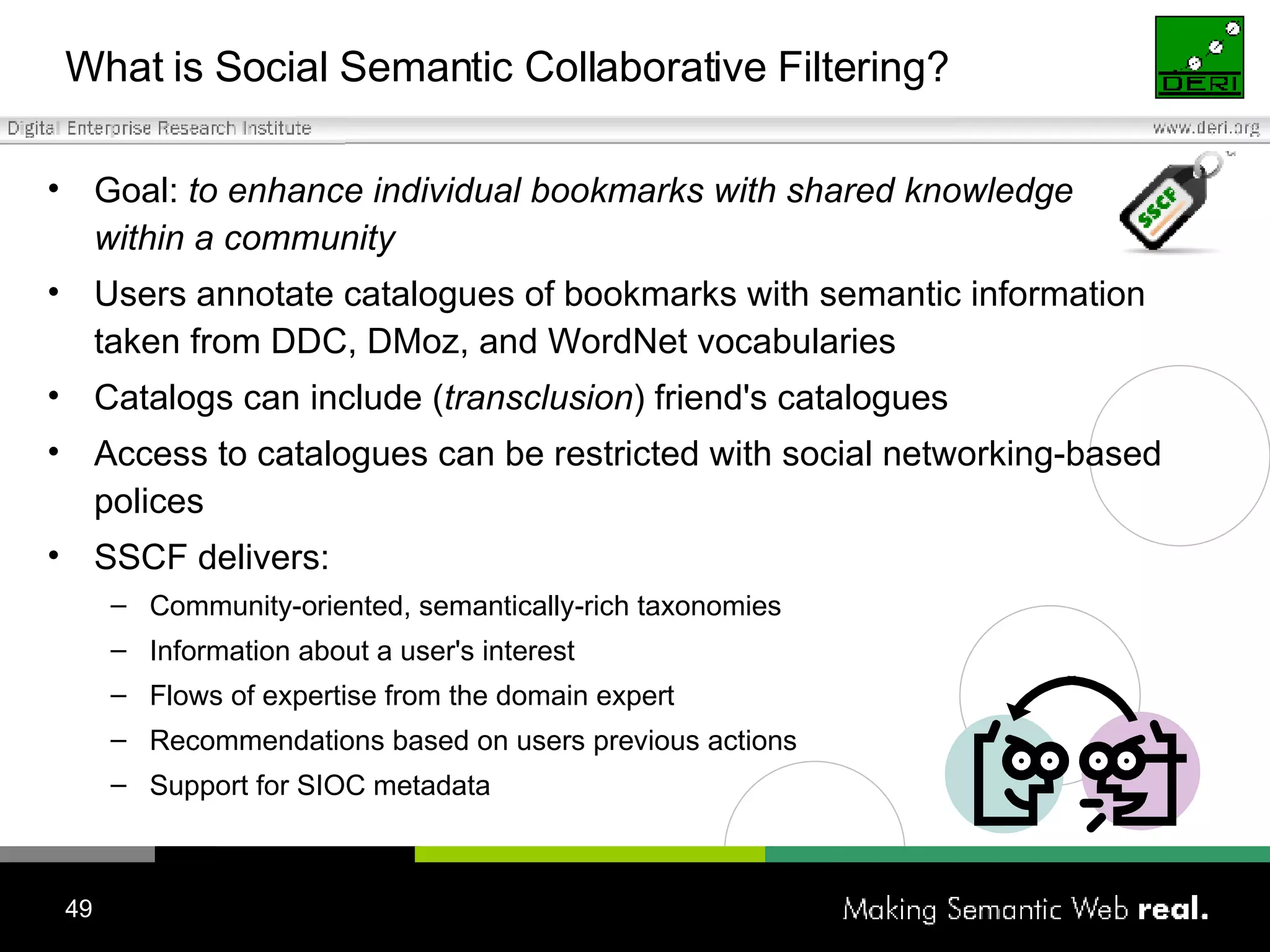
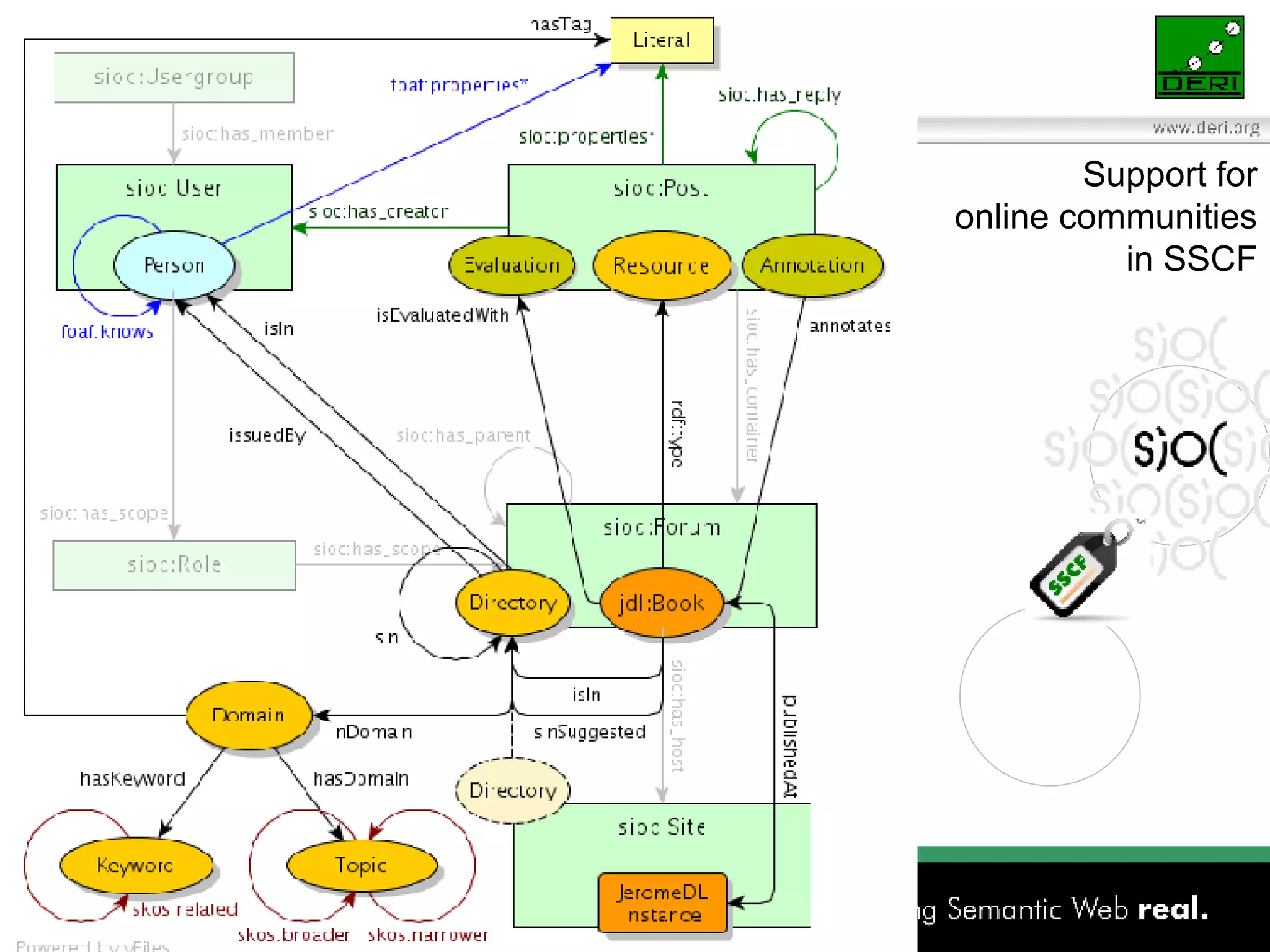
What is Social Semantic Collaborative Filtering? Goal:   t o enhance individual bookmarks with shared knowledge  within a community Users annotate catalogues of bookmarks with semantic information taken from  DDC,  DM oz,   and  WordNet vocabularies Catalogs can include ( transclusion ) friend's catalogues Access to catalogues can be restricted with social networking-based polices SSCF delivers: Community-oriented, semantically-rich taxonomies Information about a user's interest  Flows of expertise from the domain expert Recommendations based on users previous actions Support for SIOC metadata
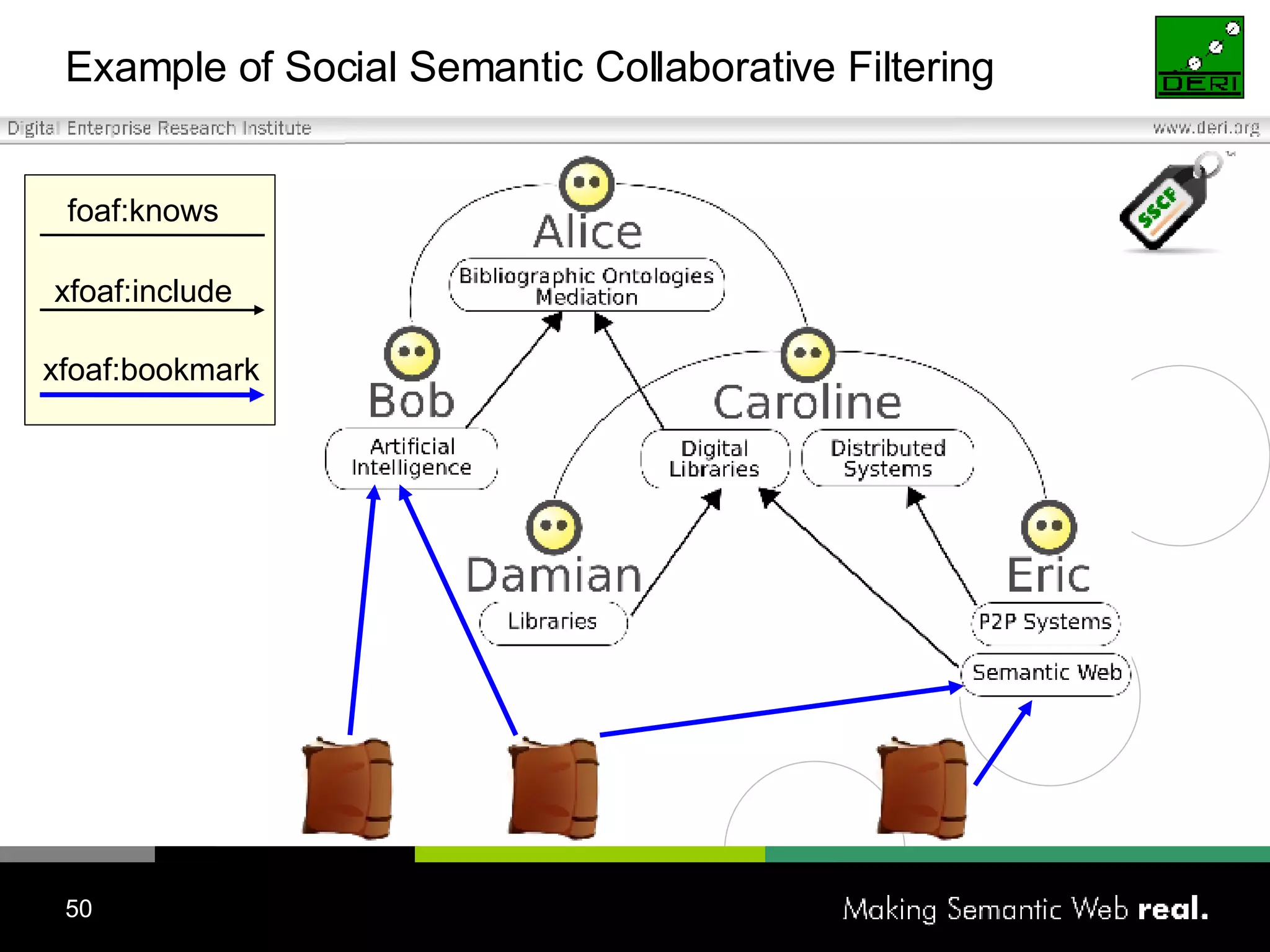
Example of Social Semantic Collaborative Filtering foaf:knows xfoaf:include xfoaf:bookmark
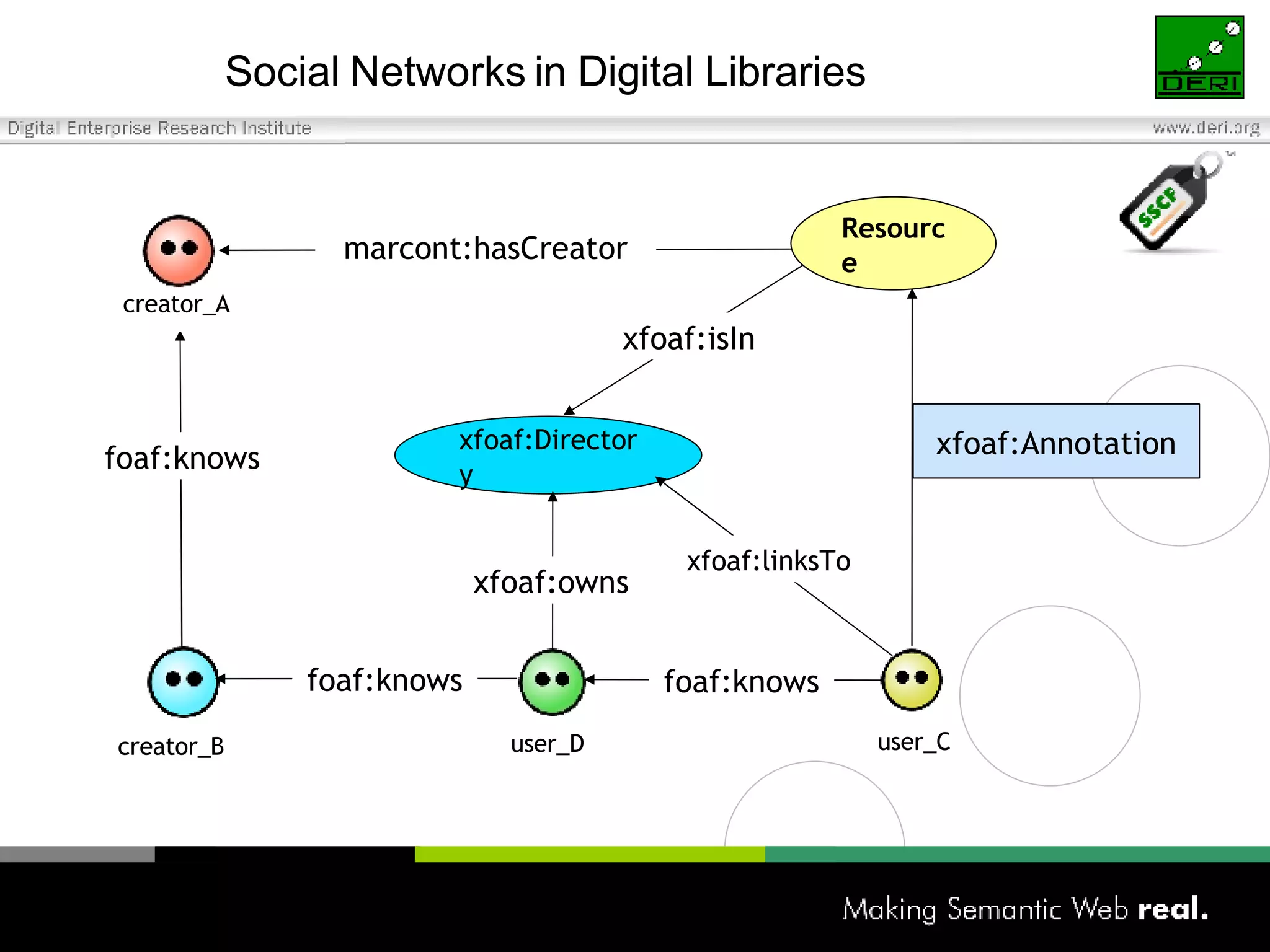
Social Networks in Digital Libraries Resource xfoaf:Annotation user_C creator_B foaf:knows marcont:hasCreator creator_A foaf:knows foaf:knows xfoaf:Directory user_D xfoaf:owns xfoaf:linksTo xfoaf:isIn
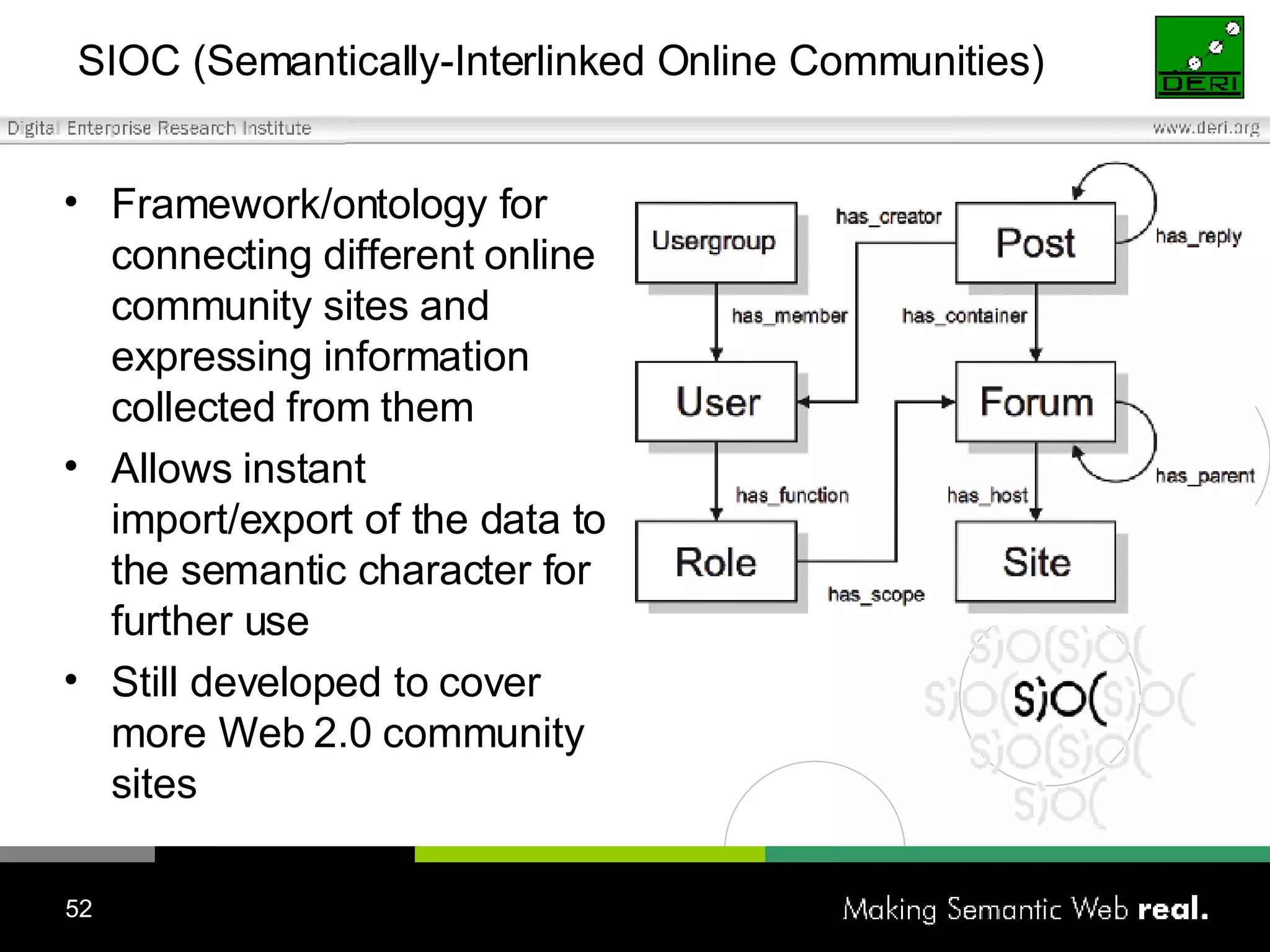
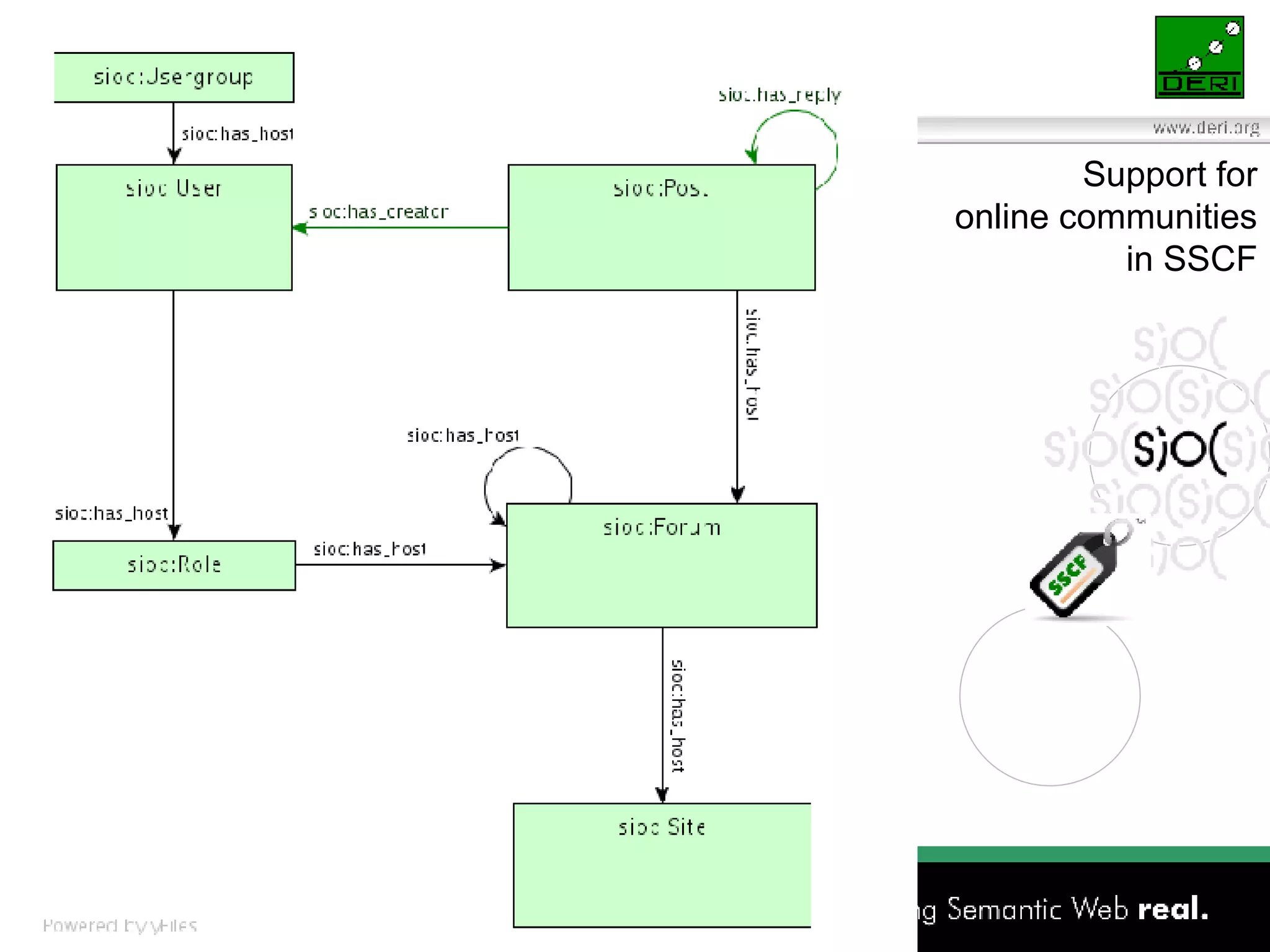
SIOC (Semantically-Interlinked Online Communities) Framework/ontology for connecting different online community sites and expressing information collected from them Allows instant import/export of the data to the semantic character for further use Still developed to cover more Web 2.0 community sites
Support for online communities in SSCF
JeromeDL in Action
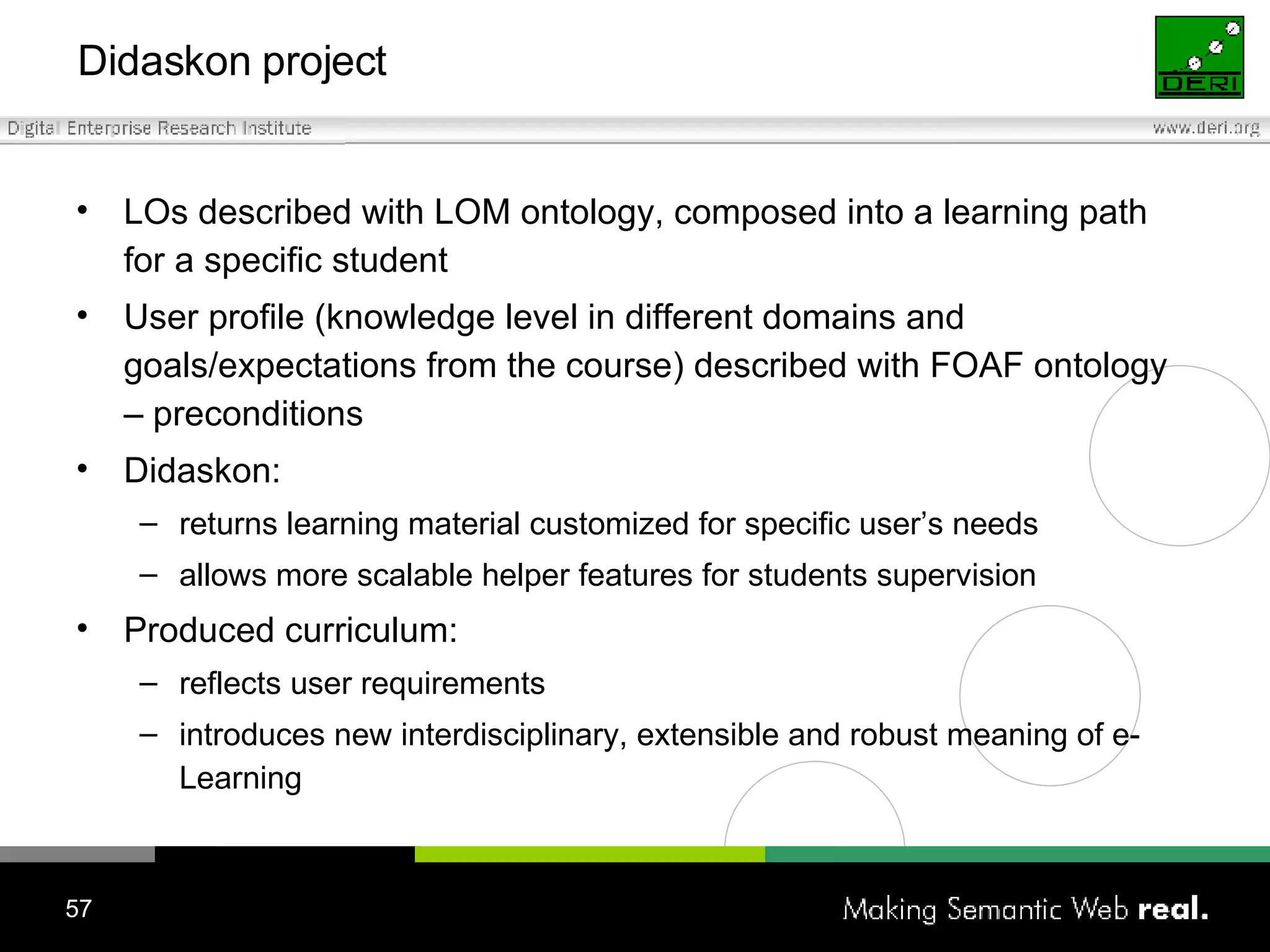
Didaskon project Deliver a framework for assemblying an ondemand curriculum from existing Learning Objects (LOs) provided by e-Learning services Connection between formal and informal learning: Repository of couses prepared by specialists (formal LOs) Transform data collected from SSIS into LOs (informal knowledge) Used o ntolog ies link  user needs and the  characteristics of the   learning material
Didaskon project LOs described with LOM ontology,  composed into a learning path for a specific student User profile (knowledge level in different domains and goals/expectations from the course) described with FOAF ontology – preconditions Didaskon: returns learning material customized for specific user’s needs allows more scalable helper features for students supervision Produced curriculum: reflects user requirements introduces new interdisciplinary, extensible and robust meaning of e-Learning
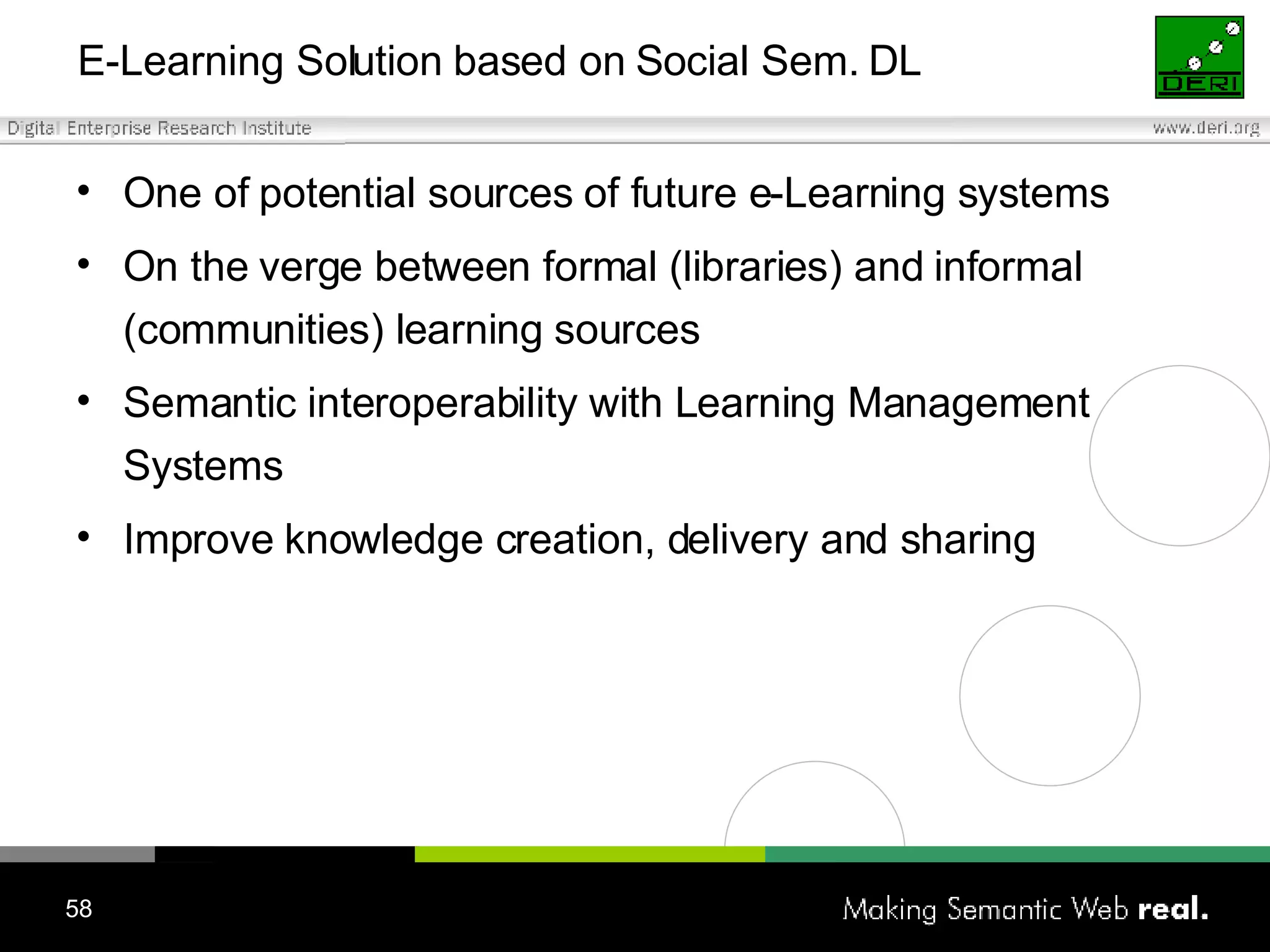
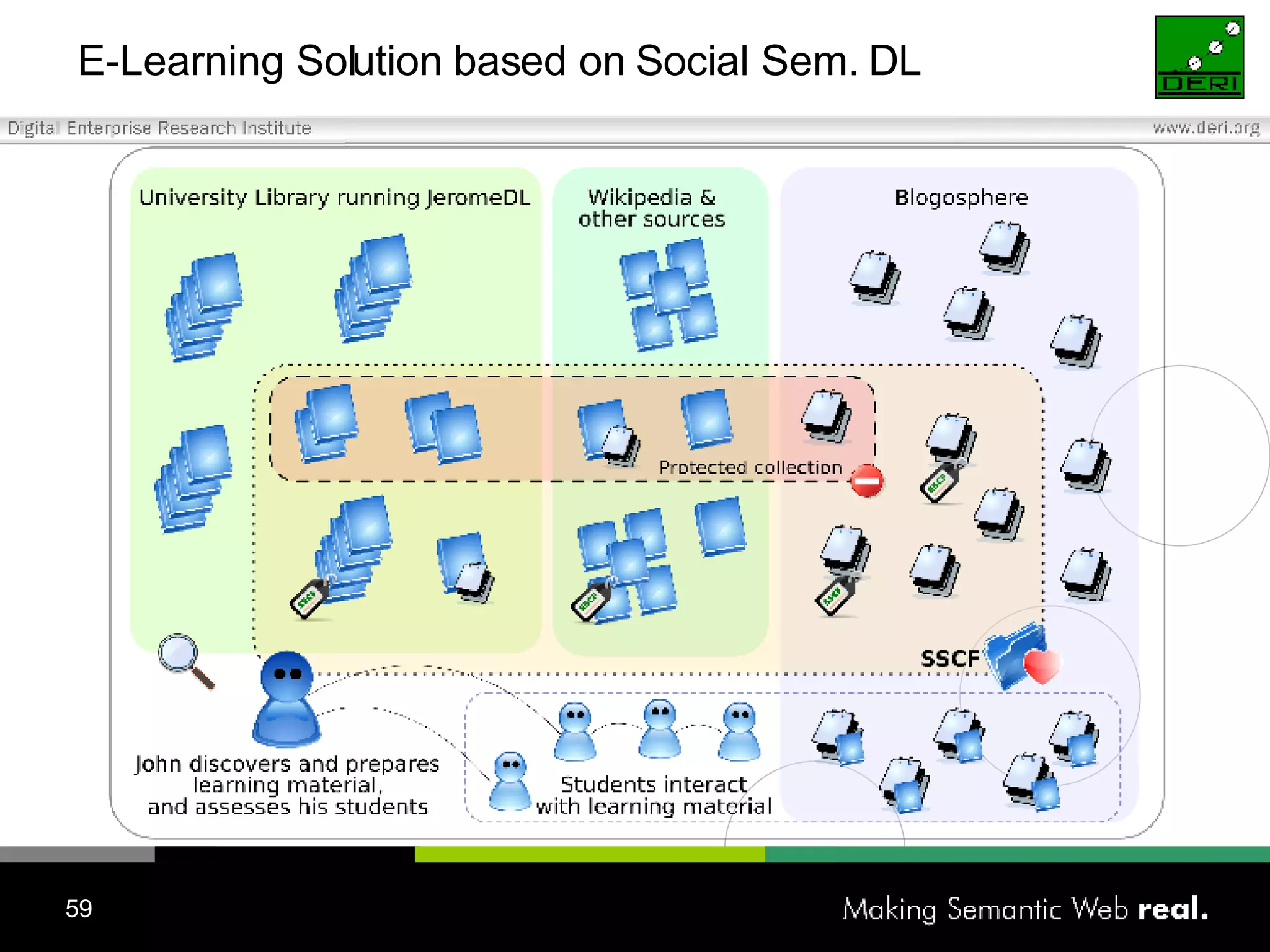
One of potential sources of future e-Learning systems On the verge between formal (libraries) and informal (communities) learning sources Semantic interoperability with Learning Management Systems Improve knowledge creation, delivery and sharing  E-Learning Solution based on Social Sem. DL
E-Learning Solution based on Social Sem. DL
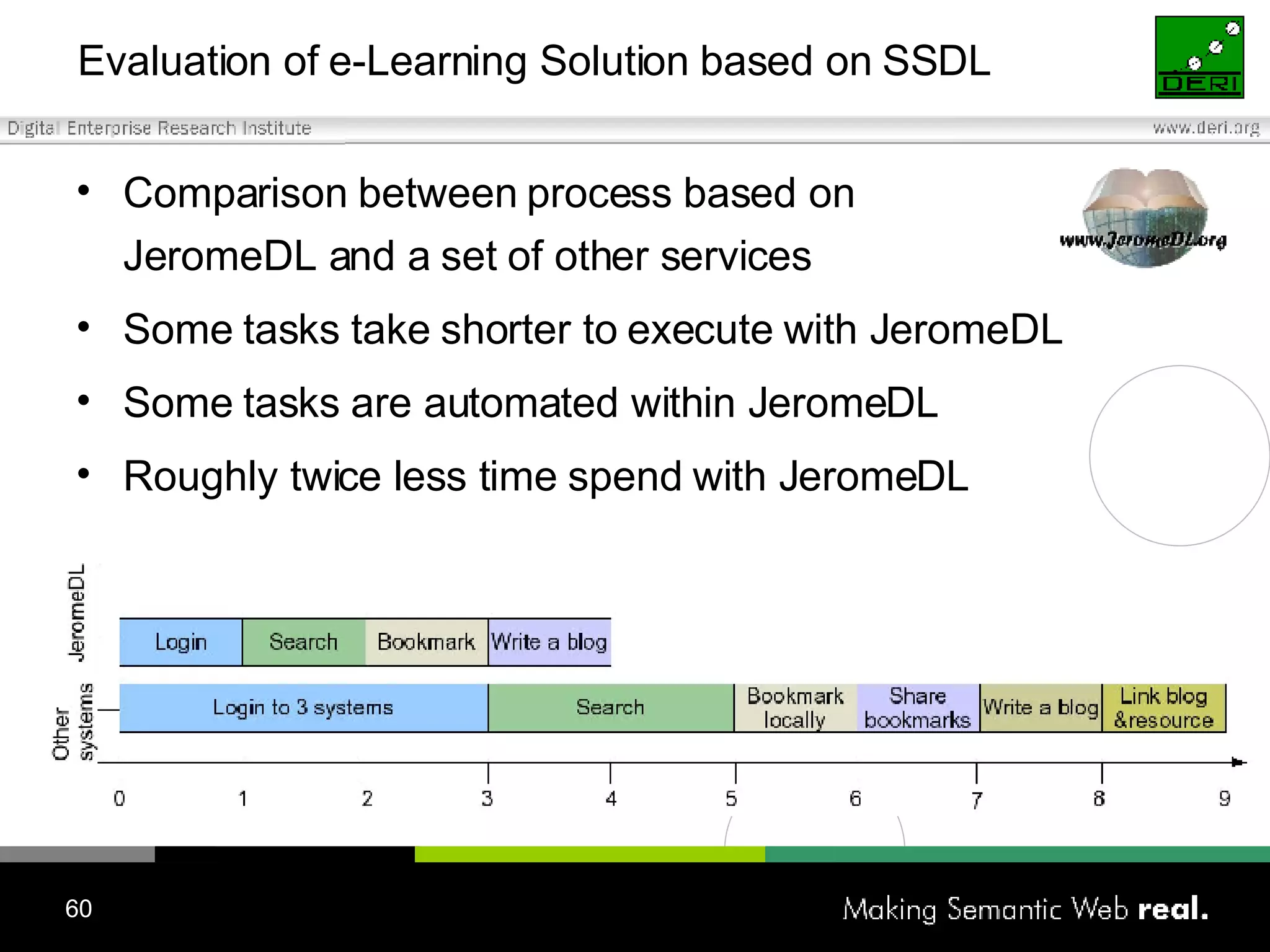
Comparison between process based on  JeromeDL and a set of other services Some tasks take shorter to execute with JeromeDL Some tasks are automated within JeromeDL Roughly twice less time spend with JeromeDL Evaluation of e-Learning Solution based on SSDL
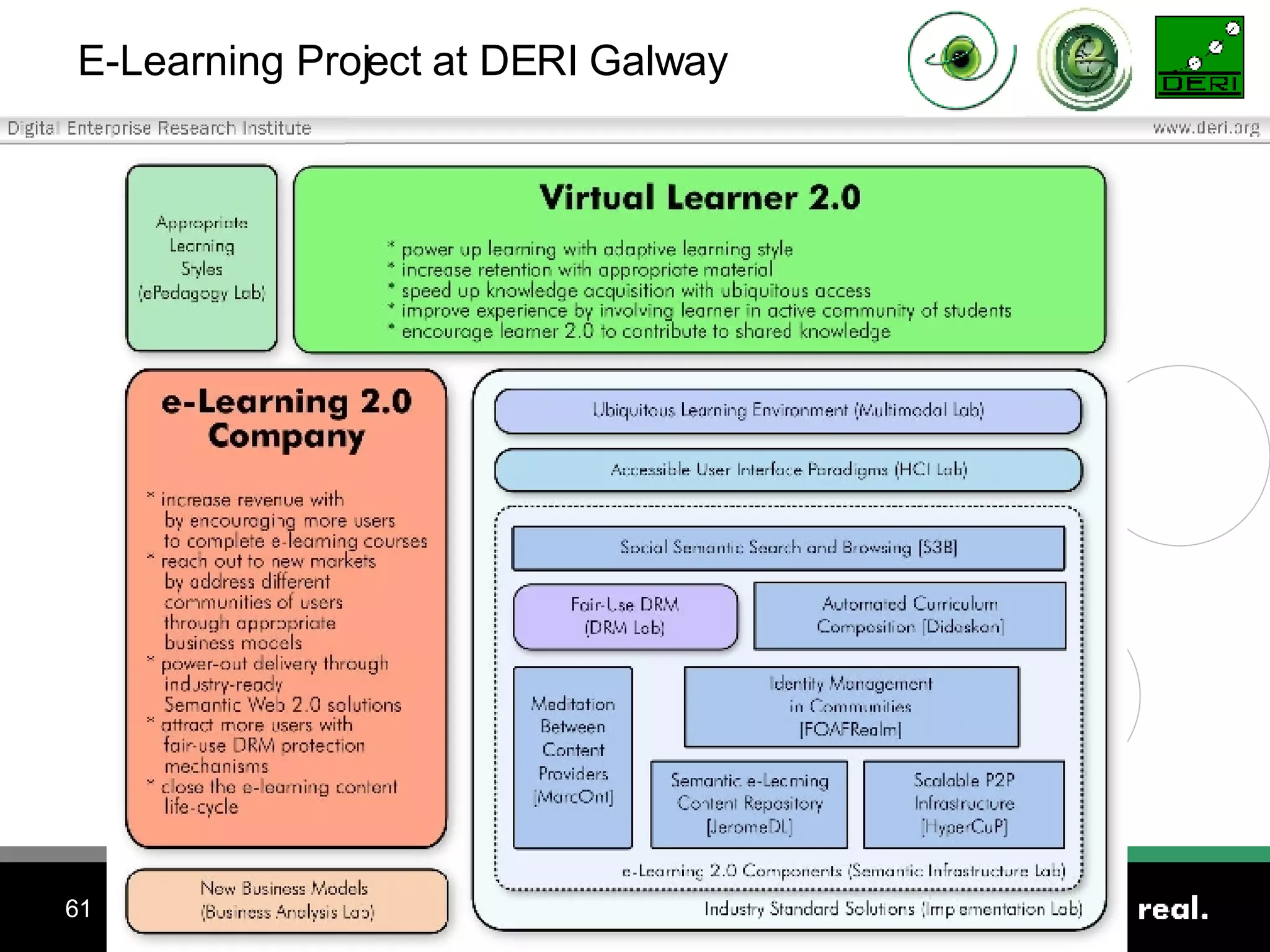
E-Learning Project at DERI Galway
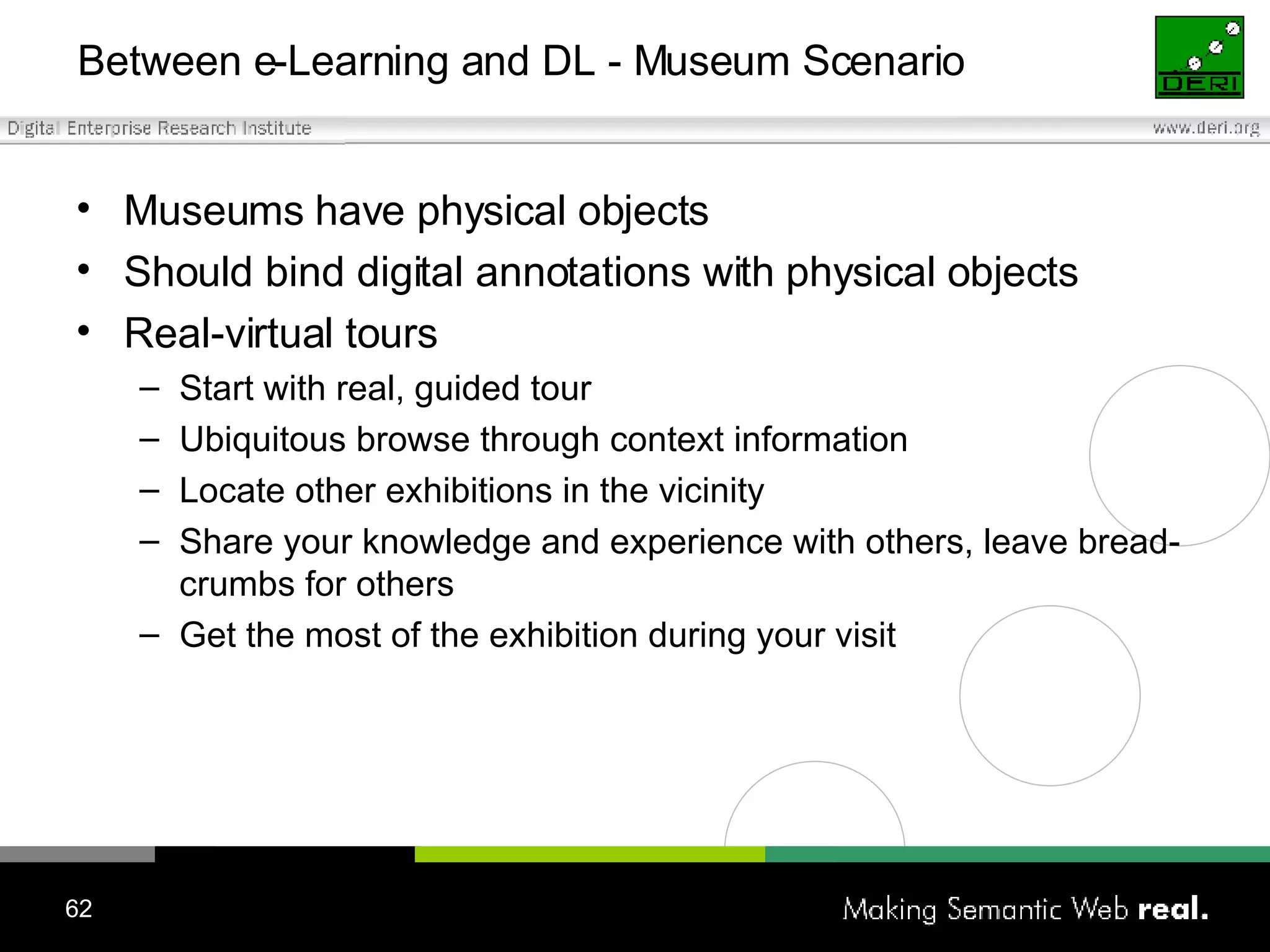
Between e-Learning and DL - Museum Scenario Museums have physical objects Should bind digital annotations with physical objects Real-virtual tours Start with real, guided tour Ubiquitous browse through context information Locate other exhibitions in the vicinity  Share your knowledge and experience with others, leave bread-crumbs for others Get the most of the exhibition during your visit
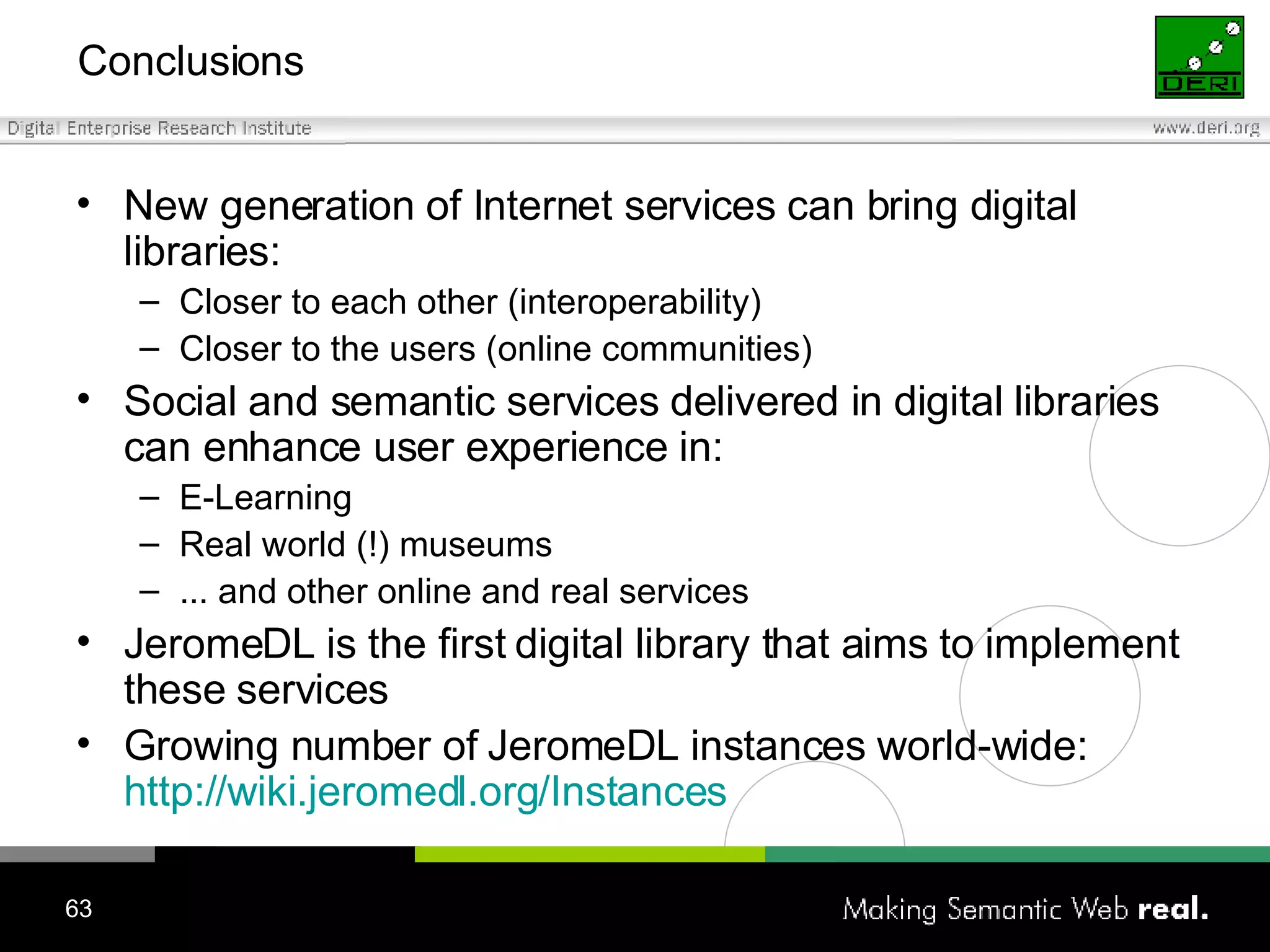
Conclusions New generation of Internet services can bring digital libraries: Closer to each other (interoperability) Closer to the users (online communities) Social and semantic services delivered in digital libraries can enhance user experience in: E-Learning Real world (!) museums ... and other online and real services JeromeDL is the first digital library that aims to implement these services Growing number of JeromeDL instances world-wide:  http://wiki.jeromedl.org/Instances
J eromeDL answer s various expectations as  the Digital Library on  Social Semantic Information  Spaces http://www.jeromedl.org/ http://wiki.jeromedl.org/ Sebastian Ryszard Kruk DERI, NUI Galway, Ireland  [email_address]

Digital Libraries of the Future

  • 1.
    Digital Libraries ofthe Future Use of Semantic Web and Social Bookmarking to support E-learning in Digital Libraries Sebastian Ryszard Kruk Digital Enterprise Research Institute National University of Ireland, Galway sebastian.kruk @deri.org http:// corrib.deri.ie /
  • 2.
    Presentation outline MotivationShort Introduction to Semantic Web 2.0 Building Social Semantic Digital Library Semantic Digital Libraries Towards Online Communities for Digital Libraries JeromeDL and other Corrib components JeromeDL in Action e-Learning 2.0 Conclusions
  • 3.
    Motivations John teachesbiology, over the Internet, using digital libraries and modern technologies (wikis, blogs) How to deliver the material just-in-time? How to pre-asses students? How to automate most of the process?
  • 4.
    Web 1.0 e-LearningCreation Consumption
  • 5.
    Web 2.0 e-LearningCreation Communities Consumption
  • 6.
    Semantic Web e-LearningSemantic sources Creation Consumption
  • 7.
    Semantic Web 2.0e-Learning Contribution Creation Consumption Communities Semantic sources
  • 8.
    The Semantic Web– A Brief Introduction Current Web vs. Semantic Web? An extension of the current Web in which information is given well-defined meaning, better enabling computers and people to work in cooperation. [Tim Berners-Lee] Current Web was designed for humans, and there is little information usable for machines Was the Web meant to be more? Objects with well defined attributes as opposed to untyped hyperlinks between Internet resources A network of relationships amongst named objects, yielding unified information management tasks What do you mean by “Semantic”? the semantics of something is the meaning of something Semantic Web is able to describe things in a way that computers can understand
  • 9.
    The Semantic Web– A Brief Introduction Where are we in the “Semantic Web layer cake”? You Are Here!
  • 10.
    The Semantic Web– A Brief Introduction The challenge for the Semantic Web The Semantic Web can’t work all by itself For example, it is not very likely that you will be able to sell your car just by putting your RDF file on the Web Need society-scale applications: Semantic Web agents and/or services, consumers and processors for semantic data, more advanced collaborative applications
  • 11.
    The Semantic Web– What is RDF ? Describing things on the Semantic Web RDF (Resource Description Framework) a data format for describing information and resources, the fundamental data model for the Semantic Web Using RDF, we can describe relationships between things like: A is a part of B or Y is a member of Z and their properties ( size , weight , age , price …) in a machine-understandable format where each thing has a RDF graph-based model delivers straightforward machine processing Putting information into RDF files makes it possible for “scutters” or RDF crawlers to search , discover , pick up , collect , analyse and process  information from the Web
  • 12.
    The Semantic Web– What is RDF ? A simple RDF example Statement: “ Stefan Decker is the creator of the resource (web page) http://www.stefandecker.org ” Structure: Resource (subject) http://www.stefandecker.org Property (predicate) http://purl.org/dc/elements/1.1/creator Value (object) “ Stefan Decker ” Directed graph: http://www.stefandecker.org dc:creator Stefan Decker
  • 13.
    The Semantic Web– How RDF can help us? How RDF can help us? identify objects establish relationships express a new relationship  just add a new RDF statement integrate information from different sources  copy all the RDF data together RDF allows many points of view
  • 14.
    The Semantic Web– Ontologies and Schemata What is an Ontology? „ An ontology is a specification of a conceptualization.“ Tom Gruber, 1993 Ontologies are social contracts Agreed, explicit semantics Understandable to outsiders (Often) derived in a community process Ontology markup and representation languages: RDF and RDF Schema OWL Other: DAML+OIL, EER, UML, Topic Maps, MOF, XML Schemas
  • 15.
    The Semantic Web– RDF Schema Defines small vocabulary for RDF: Class, subClassOf, type Property, subPropertyOf domain, range Vocabulary can be used to define other vocabularies for your application domain Person Student Researcher subClassOf subClassOf Jeen type hasSuperVisor domain range Frank type hasSuperVisor
  • 16.
    The Semantic Web– Applications Semantic Web cannot be and is not only a set of recommendations Semantic Web is becoming reality by applications that support it and are based on it Enabling technologies: RDF Storages: Sesame, Jena, YARS Reasoners: KAON, Racer Editors: Protege, SWOOP, MarcOnt Portal End-User applications: Semantic wikis: Makna, SemperWiki Semantic blogs Semantic digital libraries
  • 17.
    What is aSemantic Digital Library? Semantic digital libraries integrate information based on different metadata, e.g.: resources, user profiles, bookmarks, taxonomies provide interoperability with other systems (not only digital libraries) on either metadata or communication level or both delivering more robust, user friendly and adaptable search and browsing interfaces empowered by semantics
  • 18.
    How are SemanticDigital Libraries different? Semantic digital libraries extend digital libraries by describing and exposing its resources in a machine ‘understandable’ way resources can be contents, digital artefacts organization of objects (e.g. collections) users, user communities controlled vocabularies, thesauri, taxonomies expose the semantics of their metadata in terms of an ontology defined using a formal language deliver mediation services for communication with other systems
  • 19.
    Semantic Web Technologiesfor Digital Libraries? Metadata is the key concept the Web does not have metadata the idea of a Semantic Web is nice but difficult to implement many digital libraries do have metadata in place we simply must make them available in a machine understandable format the Semantic Web provides the format: RDF
  • 20.
    Semantic Web Technologiesfor Digital Libraries? Knowledge in bibliographic records Digital Libraries already have controlled vocabularies, taxonomies or even ontologies in place the challenge is to model this knowledge in a machine understandable way the Semantic Web provides ontology languages: RDF Schema OWL SKOS
  • 21.
    Benefits of SemanticDigital Libraries Problems of today’s libraries rapidly growing islands of highly organized information How to find things in a growing information space? is it enough to have a full-text index (à la Google)? typical “end-users” versus “expert users” converging digital library systems e.g. uniform access to Europe’s digital libraries and cultural heritage
  • 22.
    Benefits of SemanticDigital Libraries The two main benefits of Semantic Digital Libraries new search paradigms for the information space Ontology-based search / facet search Community-enabled browsing providing interoperability on the data level integrating metadata from various heterogeneous sources Interconnecting different digital library systems
  • 23.
    Searching the SampleBibliographic Record Full-text search “ Paintings ” AND “ Van Gogh ” AND “ flowers ”  no result Semantic query if the knowledge that “ irises ” are “ flowers ” is modeled in an ontology (e.g. subclass-hierarchy) we can query for all “ Paintings ” by “ Van Gogh ” with subject “ flowers ” and retrieve also the picture with subject “ irises ” Copyright 2000 The J. Paul Getty Trust & College Art Association, Inc . Vincent van Gogh; painter: Gogh, Vincent van (Dutch painter, 1853-1890) Creation-Creator/Role J. Paul Getty Museum Current Location-Repository Name irises , nature , soil , etc. Subject-Matter 1889, earliest: 1889, latest: 1889 Creation-Date Irises Title paintings Object/Work type Paintings Classification
  • 24.
    Semantic Digital Librariesand Existing DL Systems how to handle the legacy (meta-)data problem lifting existing (meta-)data to a semantic level simple solutions like MARC21  DublinCore complex ontologies like MarcOnt Ontology for capturing concepts from different standards legacy libraries expose their metadata via well established protocols - the metadata can be imported into semantic DLs semantic DLs can play a role of integration champions in the information retrieval process in heterogeneous networks: OAI-PMH , Z39.50 , Dienst
  • 25.
    Application Areas forSemantic Web Technologies Thesauri & Controlled Vocabularies qualified DublinCore DMoz, DDC-based taxonomies SKOS, WordNet and other thesauri Schema Mappings / Crosswalks MarcOnt Ontology – aims to cover concepts from MARC21, BibTeX and DublinCore MarcOnt Mediation Services – an open mediation framework between common legacy metadata standards Metadata Integration RDF as a common data model for integrating metadata from various autonomous and heterogeneous data sources OWL for modeling the data source’s semantics SPARQL as a common query language
  • 26.
    Semantic DL asEvolving Knowledge Space In state-of-the-art digital libraries users are consumers Retrieve contents based on available bibliographic records Recent trends: user communities Connetea Flickr In Semantic digital libraries users are contributers as well Tagging (Web 2.0) Social Semantic Collaborative Filtering Annotations Semantic Digital libraries enforce the transition from a static information to a dynamic (collaborative) knowledge space
  • 27.
    Why current (semantic)digital libraries are not enough? digital libraries should not be for librarians only but for average people they concentrate on delivering content/information, not on knowledge sharing within a community of users digital libraries have lost human-part of their predecessors What could be the solution? make users/readers involved in the content annotation process allow users/readers to share their knowledge within a community provide better communication between users in and across communities The future - Social Semantic Digital Libraries
  • 28.
    The future -Social Semantic Digital Libraries What is Web 2.0? The Web where “ordinary” users can meet, collaborate, and share using whatever is newly popular on the Web (tagged content, social bookmarking, AJAX, etc.) The term Web 2.0 was made popular by Tim O’Reilly: http://www.oreillynet.com/pub/a/oreilly/tim/news/2005/09/30/what-is-web-20.html Popular examples include: Bebo, del.icio.us, digg, Flickr, Google Maps, Skype, Technorati, Wikipedia…
  • 29.
    The future -Social Semantic Digital Libraries Web 2.0 focuses include: The Web as a platform for social and collaborative exchange Reusable community contributions Subscriptions to information, news, data flows, services Mass-publishing using web-based social software Social software for communication and collaboration: IM, IRC, Forums, Blogs, Wikis, Social Network Services, Social Bookmarks, MMOGs…
  • 30.
  • 31.
    Comparing Web 1.0/ Web 2.0 / Semantic Web 2.0 Semantic Social Networks Online Social Networks Buddy Lists, Address Books Semantic Social Information Spaces - - Social Semantic Digital Libraries Google Scholar, Book Search CiteSeer, Project Gutenberg Semantic Forums and Community Portals Community Portals Message Boards Semantic Blogs Blogs Personal Websites Semantic Search Google Personalised, DumbFind Altavista, Google Semantic Wikis Wikis Content Management Systems Semantic Web 2.0 Web 2.0 Web 1.0
  • 32.
    Evolution of LibrariesSocial Semantic Digital Library Involves the community into sharing knowledge Semantic Digital Library Accessible by  machines, not only with machines Digital Library Online, easy searching with a full-text index Library Organized collection
  • 33.
    Existing Semantic DigitalLibrary Systems SIMILE extends and laverages DSpace, seeking to enhance interoperability among digital assets, schemata, metadata, and services JeromeDL a social semantic digital library makes use of Semantic Web and Social Networking technologies to enhance both interoperability and usability BRICKS aims at establishing the organizational and technological foundations for a digital library network in order to share knowledge and resources in the cultural heritage domain. FEDORA delivers flexible service-oriented architecture to managing and delivering content in the form of digital objects
  • 34.
    JeromeDL - Introduction Joint effort of DERI International and Gdansk University of Technology (GUT) Distributed under BSD Open Source license Digital library build on semantic web technologies to answer requirements from: librarians, scientists and everyone. A successor for prototype semantic digital library – Elvis-DL build at GUT
  • 35.
    JeromeDL – Motivations Use Cases Librarians: support for rich metadata (MARC21) in uploading resources, accessing bibliographic information and searching persistent identifiers Scientists: easy publishing (designed as a institute/university digital library) creating hierarchical networks of digital libraries support for accessing, sharing and searching using bibliography metadata (BibTeX) Everyone: simple search (incl. natural language queries) community-aware information sharing and browsing, support for interationalization
  • 36.
    JeromeDL - MotivationsSupport for different kinds of bibliographic medatata, like: DublinCore , BibTeX and MARC21 at the same time. Making use of existing rich sources of bibliographic descriptions (like MARC21) created by human. Supporting users and communities: user s ha ve control over their profile information ; community-aware profiles are integrated with bibliographic descriptions support for community generated knowledge Delivering communication between instances: P2P mode for searching and users authentication Hierarchical mode for browsing
  • 37.
    Bibliographic Description inJeromeDL <?xml version =&quot;1.0&quot; encoding =&quot;UTF-8&quot; ?> <rdf:Description rdf:about =&quot;http://...id=828374765&quot; > <dc:title> JeromeDL - Adding Semantic Web Technologies to DLs </dc:title> <dc:creator> Sebastian Kruk </dc:creator> <dc:description> In recent years... </dc:description> </rdf:Description> 01450cas 922004331i 450000100...019c19329999gw qr|p| ||||0 |0ger | a0044-2992 9a200412140219bVLOADc200404071525dvkulc200310071018dvbjc200303101205dkopumky200209211341zVLOAD aGD U/MPcGD U/MPdGD U/MFdGD U/KKsdWR O/EJ0 ager1 aZ. Kunstgesch. 0aZeitschrift für Kunstgeschichte00aZeitschrift für Kunstgeschichte.18aZfK aMünchen ;aBerlin :bDeutscher Kunstverlag,c1932-. c26-29 cm. aKwart.0 a1 Bd. (Juni 1932)-. aOpis na podst.: LCC. aW 1932 założycielami czasopisma byli Wilhelm Waetzoldt i Ernst Gall.... These all can be represented in RDF @ InProceedings { jeromedexa2005, author = &quot;Sebastian Ryszard Kruk and ... &quot;, title = &quot;{JeromeDL - Adding Semantic ...}&quot;, booktitle = &quot;{In Proceedings to DEXA 2005}&quot;, year = 2005}
  • 38.
  • 39.
  • 40.
  • 41.
  • 42.
  • 43.
    Social Services inJeromeDL Involve users into sharing knowledge Blogs – comments and discussions about documents and resources Tagging – collaborative classification Wikis – collaboratively edited additional descriptions, such as summaries and interesting facts Preserve knowledge for future use Users can learn from experience of others instantly Recommend new, interesting resources based on users’ profiles
  • 44.
    MarcOnt Initiative –Overview Motivation: Provide set of tools for collaborative ontology development MarcOnt Initiative goals: Create a framework for collaborative ontology improvement (E-learning) Provide domain experts with tools to share their knowledge Offer tools for data mediation between different data formats
  • 45.
    MarcOnt Portal andMarcOnt Ontology MarcOnt Ontology: Central point of MarcOnt Initiative Translation and mediation format Continuos collaborative ontology improvement Knowledge from the domain experts MarcOnt Portal (source of knowledge): Suggestions Annotations Versioning Ontology editor
  • 46.
    MarcOnt Mediation Servicesfor Legacy Metadata Format translation RDF Translator Format co-operation MarcOnt Mediation Services
  • 47.
    FOAF - DescribingSocial Networks FOAF - Stands for Friend-of-a-Friend Defines properties for a person (but it does not have to be a person, can be an “agent”) Does not only have to contain one person per file Can build a network of people with foaf:knows links FOAF can be easily extended to meet requirements, as in the case of FOAFRealm for identity management…
  • 48.
    Identity management withFOAFRealm Identity defined with extended FOAF metadata Policies expressed by social networking Distance between owner and requester Friendship level between owner and requester, calculated across digraph of social network Support for single registration and sign on Distributed identity management with HyperCuP (“D-FOAF”) FOAFRealm is currently implemented as a plugin for Tomcat (Realm/Valve implementation), with PHP and .NET versions coming soon
  • 49.
    What is SocialSemantic Collaborative Filtering? Goal: t o enhance individual bookmarks with shared knowledge within a community Users annotate catalogues of bookmarks with semantic information taken from DDC, DM oz, and WordNet vocabularies Catalogs can include ( transclusion ) friend's catalogues Access to catalogues can be restricted with social networking-based polices SSCF delivers: Community-oriented, semantically-rich taxonomies Information about a user's interest Flows of expertise from the domain expert Recommendations based on users previous actions Support for SIOC metadata
  • 50.
    Example of SocialSemantic Collaborative Filtering foaf:knows xfoaf:include xfoaf:bookmark
  • 51.
    Social Networks inDigital Libraries Resource xfoaf:Annotation user_C creator_B foaf:knows marcont:hasCreator creator_A foaf:knows foaf:knows xfoaf:Directory user_D xfoaf:owns xfoaf:linksTo xfoaf:isIn
  • 52.
    SIOC (Semantically-Interlinked OnlineCommunities) Framework/ontology for connecting different online community sites and expressing information collected from them Allows instant import/export of the data to the semantic character for further use Still developed to cover more Web 2.0 community sites
  • 53.
    Support for onlinecommunities in SSCF
  • 54.
    Support for onlinecommunities in SSCF
  • 55.
  • 56.
    Didaskon project Delivera framework for assemblying an ondemand curriculum from existing Learning Objects (LOs) provided by e-Learning services Connection between formal and informal learning: Repository of couses prepared by specialists (formal LOs) Transform data collected from SSIS into LOs (informal knowledge) Used o ntolog ies link user needs and the characteristics of the learning material
  • 57.
    Didaskon project LOsdescribed with LOM ontology, composed into a learning path for a specific student User profile (knowledge level in different domains and goals/expectations from the course) described with FOAF ontology – preconditions Didaskon: returns learning material customized for specific user’s needs allows more scalable helper features for students supervision Produced curriculum: reflects user requirements introduces new interdisciplinary, extensible and robust meaning of e-Learning
  • 58.
    One of potentialsources of future e-Learning systems On the verge between formal (libraries) and informal (communities) learning sources Semantic interoperability with Learning Management Systems Improve knowledge creation, delivery and sharing E-Learning Solution based on Social Sem. DL
  • 59.
    E-Learning Solution basedon Social Sem. DL
  • 60.
    Comparison between processbased on JeromeDL and a set of other services Some tasks take shorter to execute with JeromeDL Some tasks are automated within JeromeDL Roughly twice less time spend with JeromeDL Evaluation of e-Learning Solution based on SSDL
  • 61.
  • 62.
    Between e-Learning andDL - Museum Scenario Museums have physical objects Should bind digital annotations with physical objects Real-virtual tours Start with real, guided tour Ubiquitous browse through context information Locate other exhibitions in the vicinity Share your knowledge and experience with others, leave bread-crumbs for others Get the most of the exhibition during your visit
  • 63.
    Conclusions New generationof Internet services can bring digital libraries: Closer to each other (interoperability) Closer to the users (online communities) Social and semantic services delivered in digital libraries can enhance user experience in: E-Learning Real world (!) museums ... and other online and real services JeromeDL is the first digital library that aims to implement these services Growing number of JeromeDL instances world-wide: http://wiki.jeromedl.org/Instances
  • 64.
    J eromeDL answers various expectations as the Digital Library on Social Semantic Information Spaces http://www.jeromedl.org/ http://wiki.jeromedl.org/ Sebastian Ryszard Kruk DERI, NUI Galway, Ireland [email_address]