Semantic Technology
How Does it Work?
Graeme Wood
Business Issues
• Billions of devices and systems
connected to internet
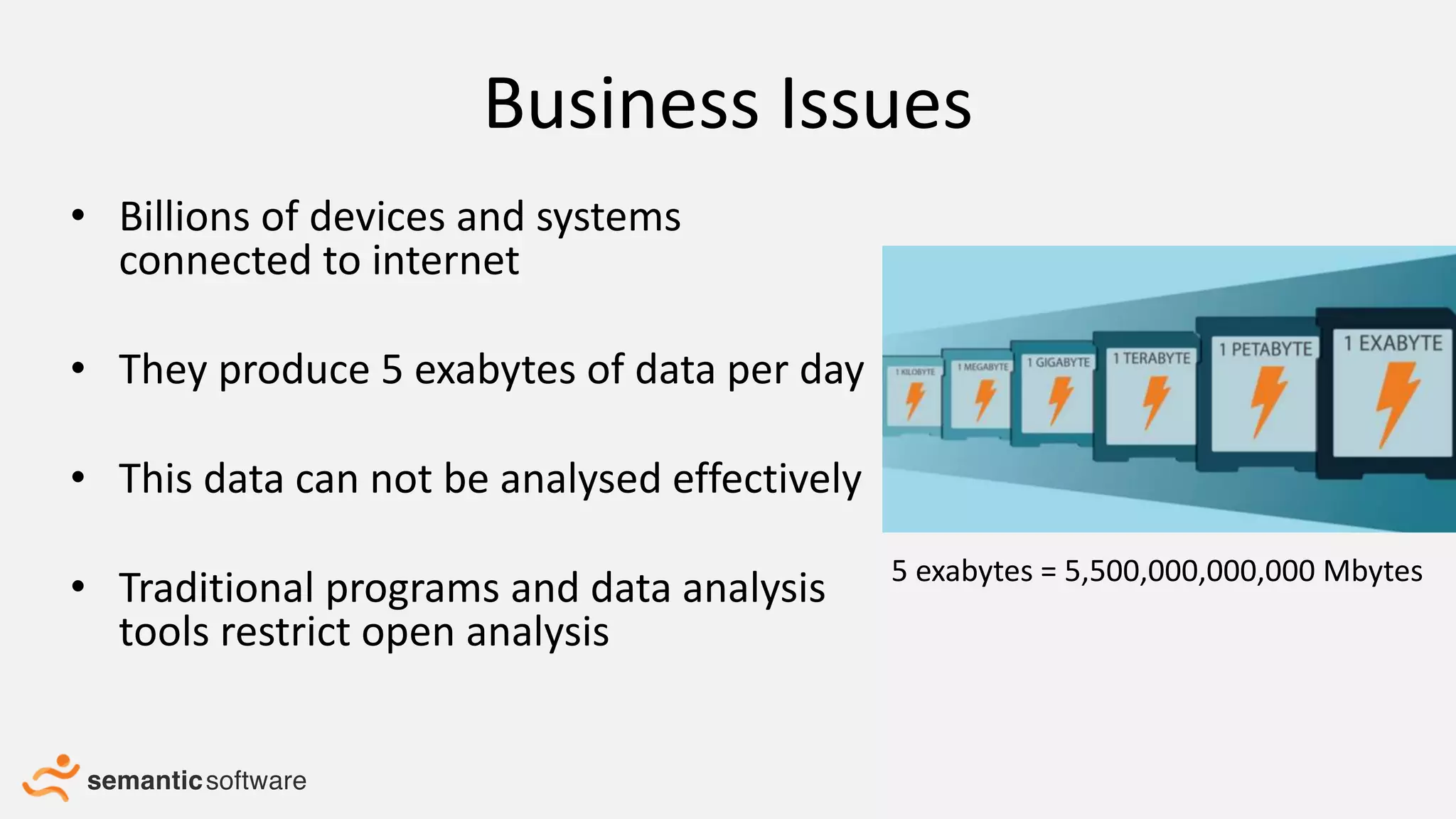
• They produce 5 exabytes of data per day
• This data can not be analysed effectively
• Traditional programs and data analysis
tools restrict open analysis
5 exabytes = 5,500,000,000,000 Mbytes
Semantic Computing
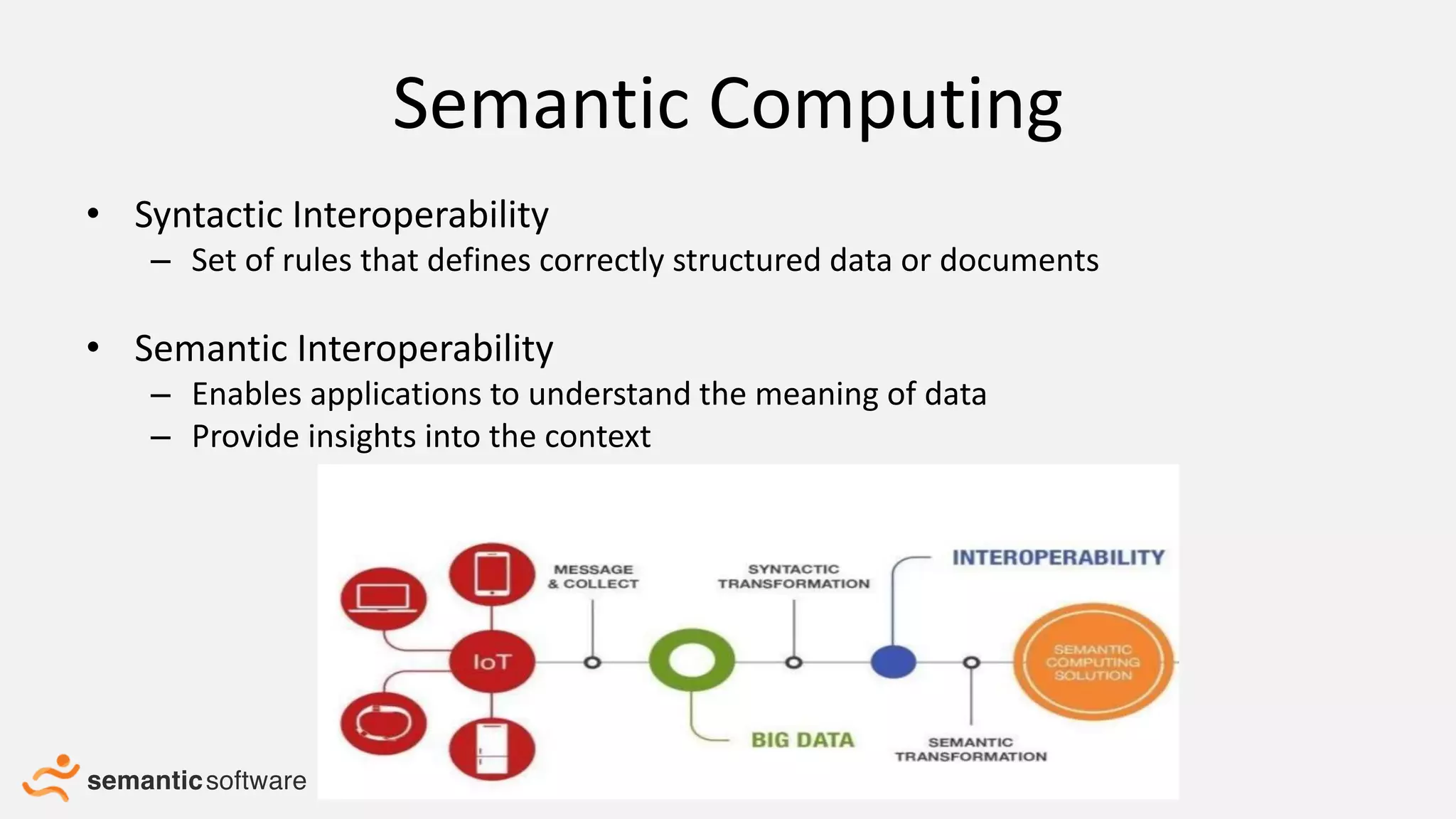
• Syntactic Interoperability
– Set of rules that defines correctly structured data or documents
• Semantic Interoperability
– Enables applications to understand the meaning of data
– Provide insights into the context
Original Semantic Web
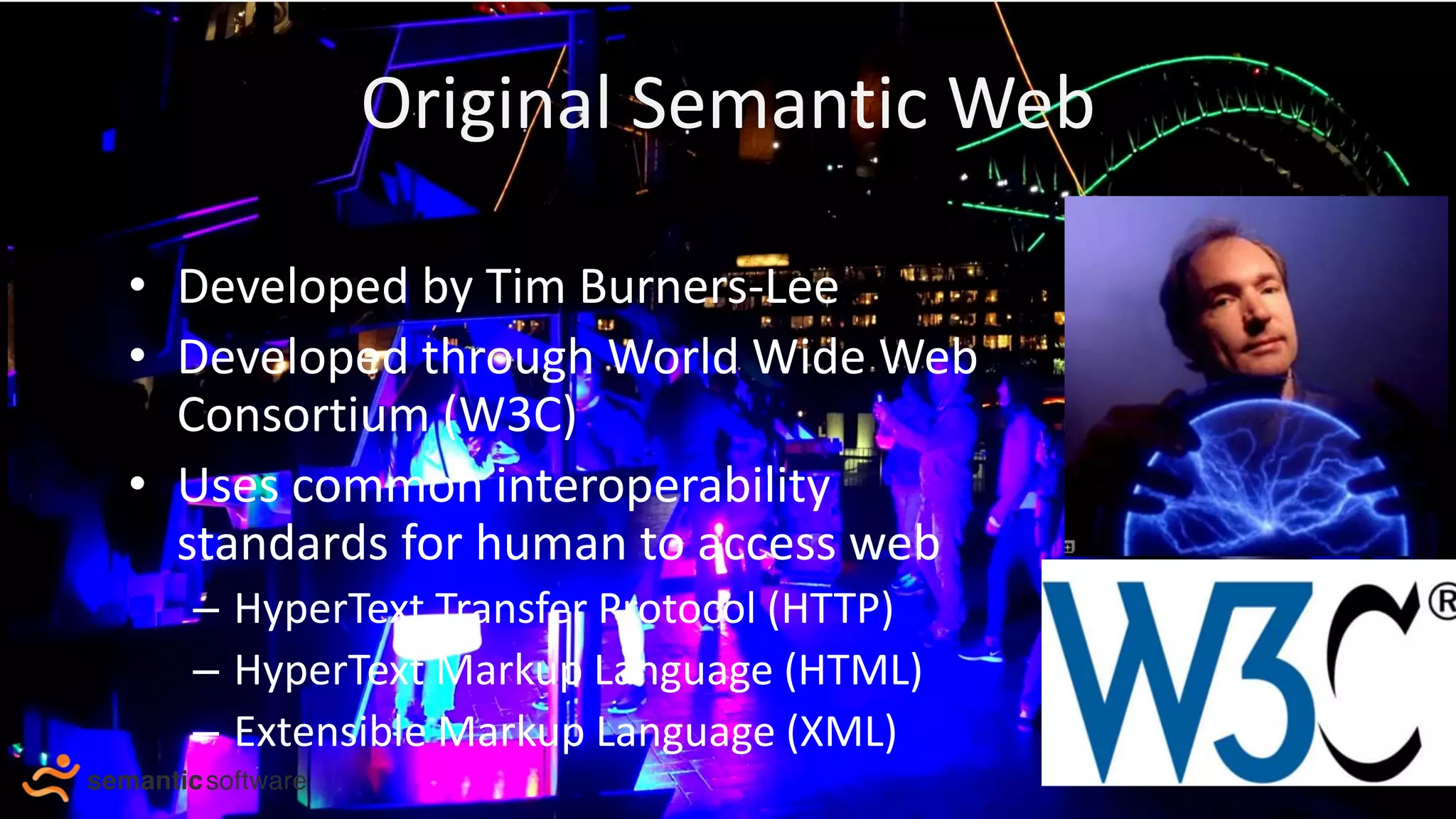
• Developed by Tim Burners-Lee
• Developed through World Wide Web
Consortium (W3C)
• Uses common interoperability
standards for human to access web
– HyperText Transfer Protocol (HTTP)
– HyperText Markup Language (HTML)
– Extensible Markup Language (XML)
Tim Burners- Lee
Semantic Web (W3C)
• Resource Description Framework (RDF)
– Makes content available to computers
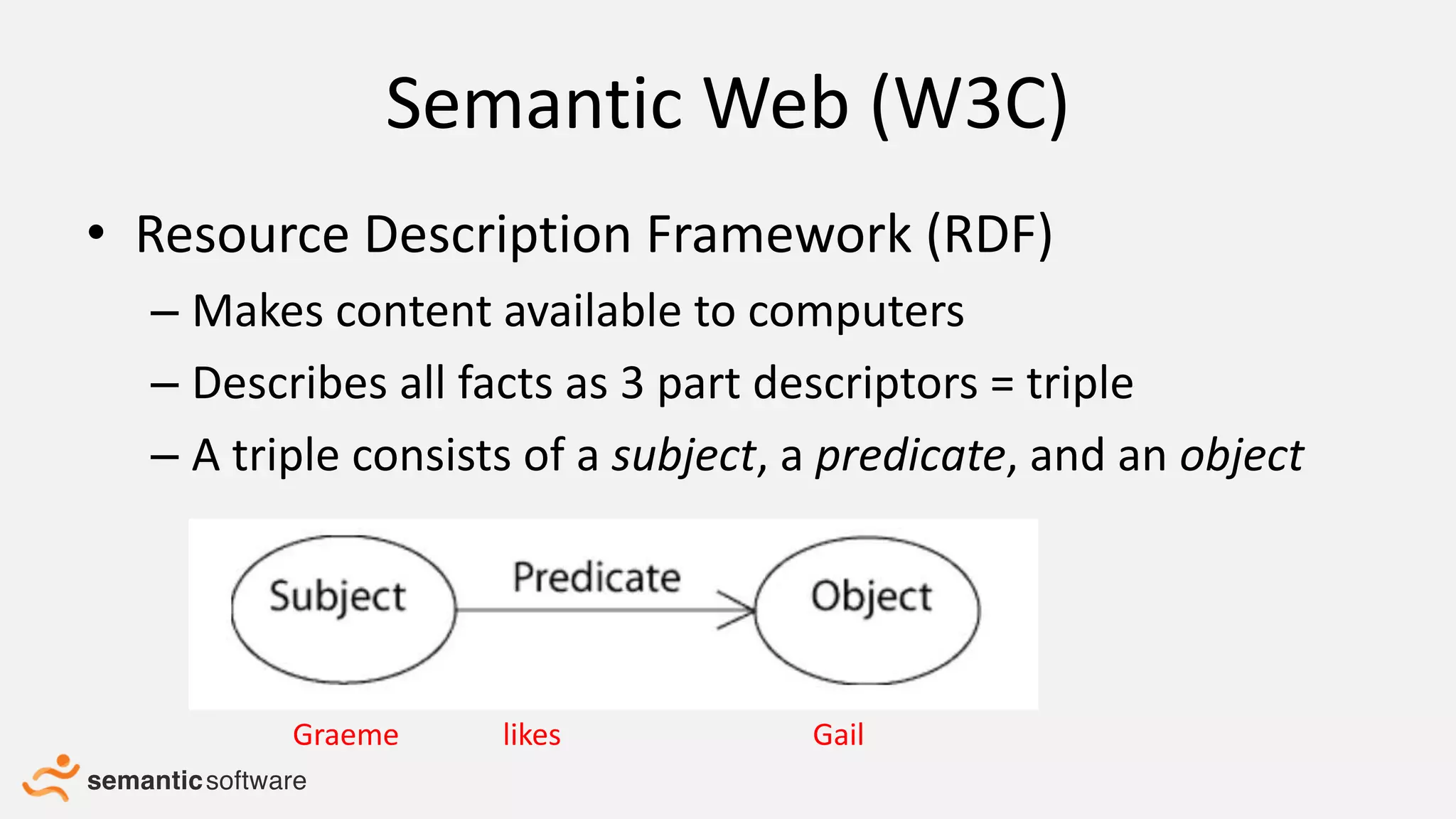
– Describes all facts as 3 part descriptors = triple
– A triple consists of a subject, a predicate, and an object
Graeme likes Gail
Semantic Web (W3C)
• Ontology
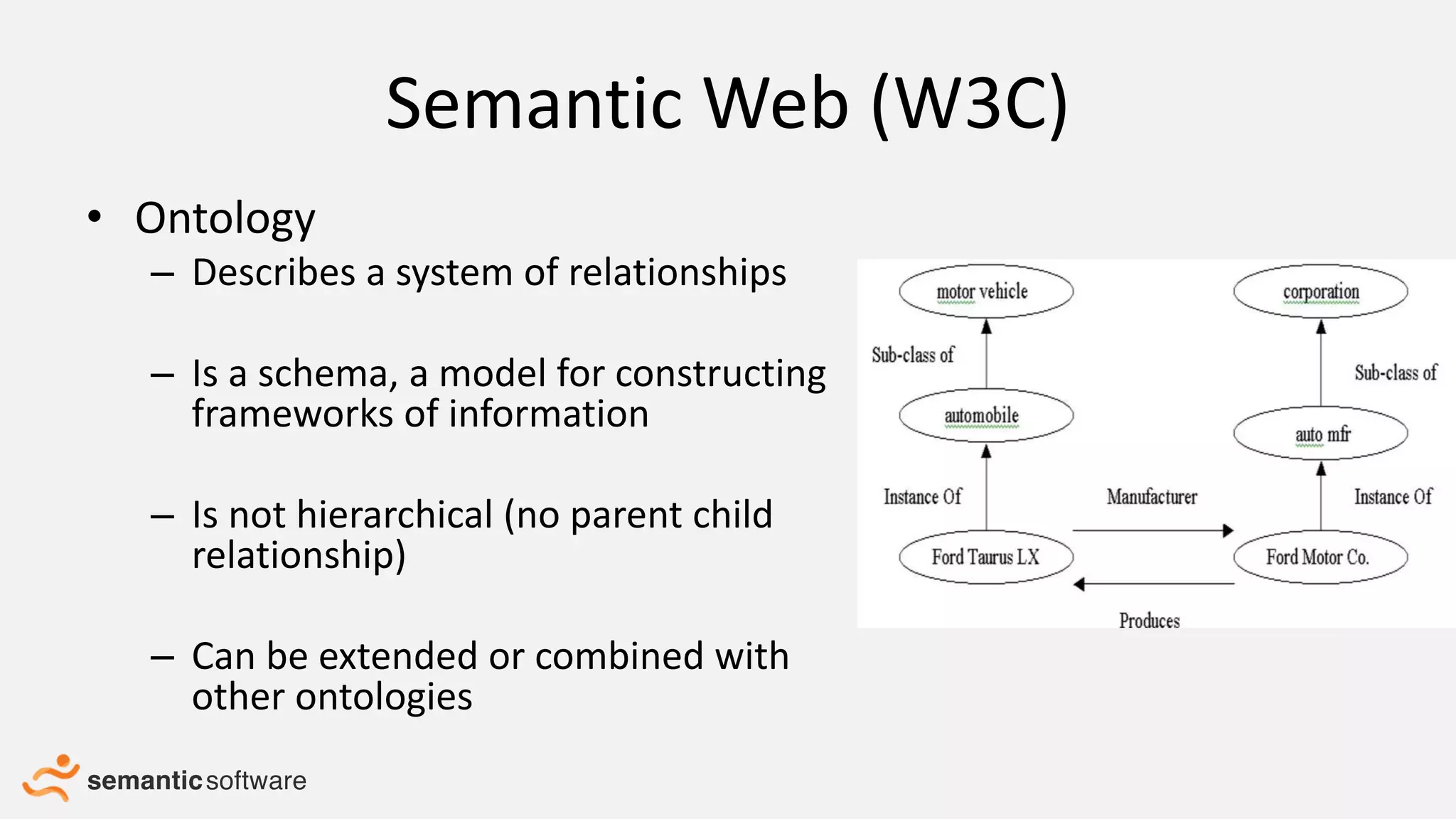
– Describes a system of relationships
– Is a schema, a model for constructing
frameworks of information
– Is not hierarchical (no parent child
relationship)
– Can be extended or combined with
other ontologies
Semantic Web (W3C)
• Web Ontology Language (OWL)
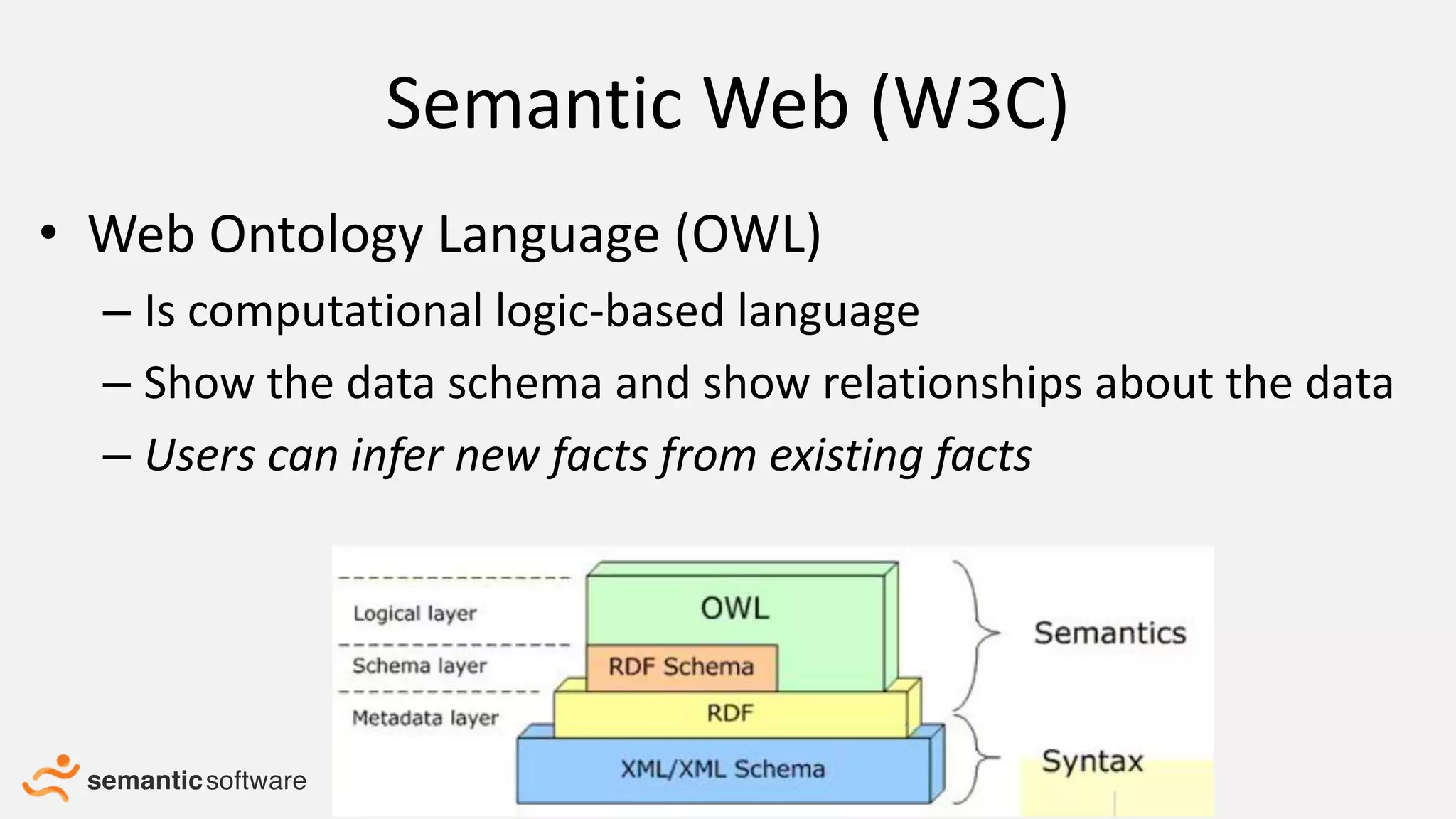
– Is computational logic-based language
– Show the data schema and show relationships about the data
– Users can infer new facts from existing facts
Semantic Web (W3C)
• SPARQL Query Language
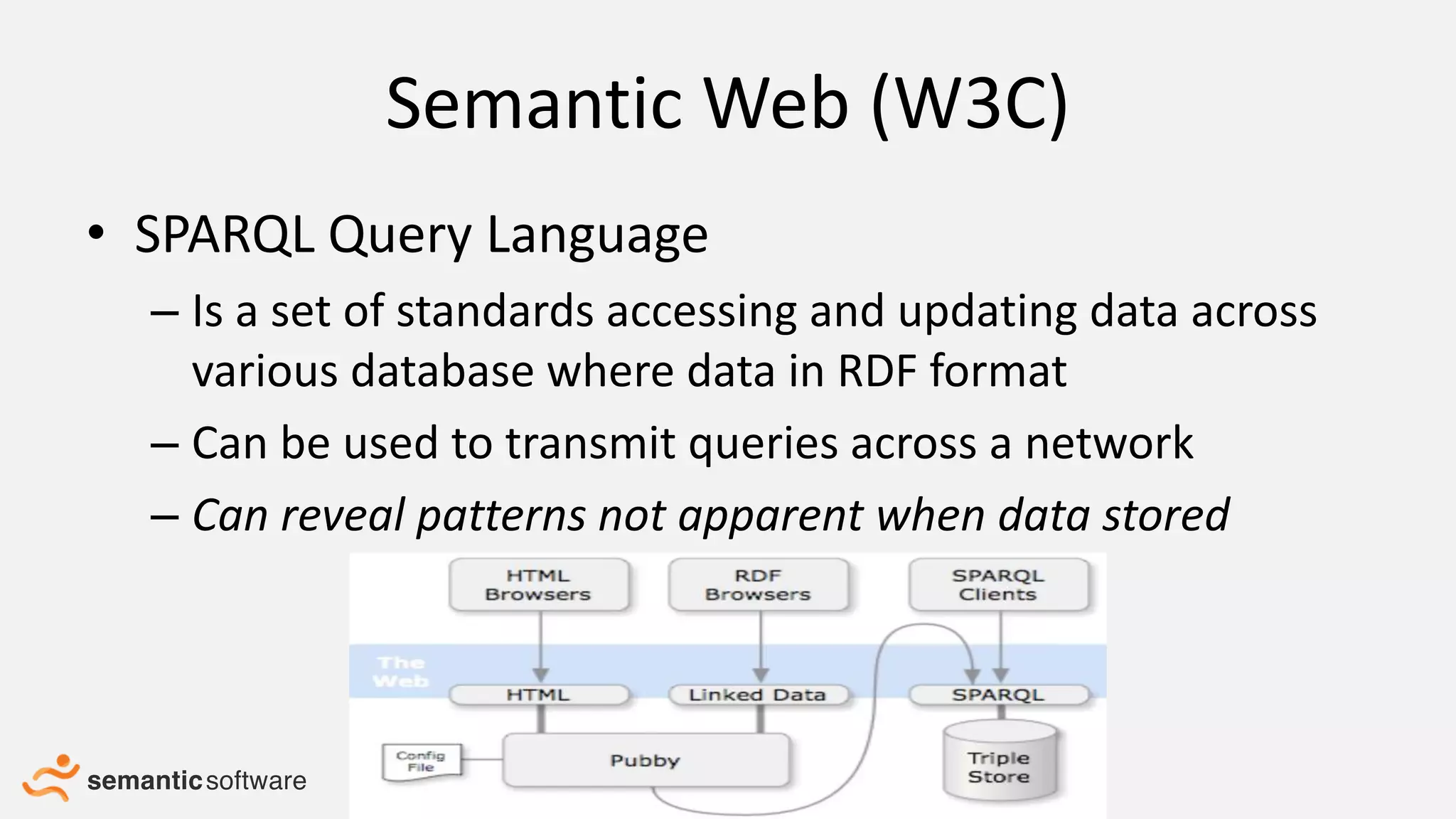
– Is a set of standards accessing and updating data across
various database where data in RDF format
– Can be used to transmit queries across a network
– Can reveal patterns not apparent when data stored
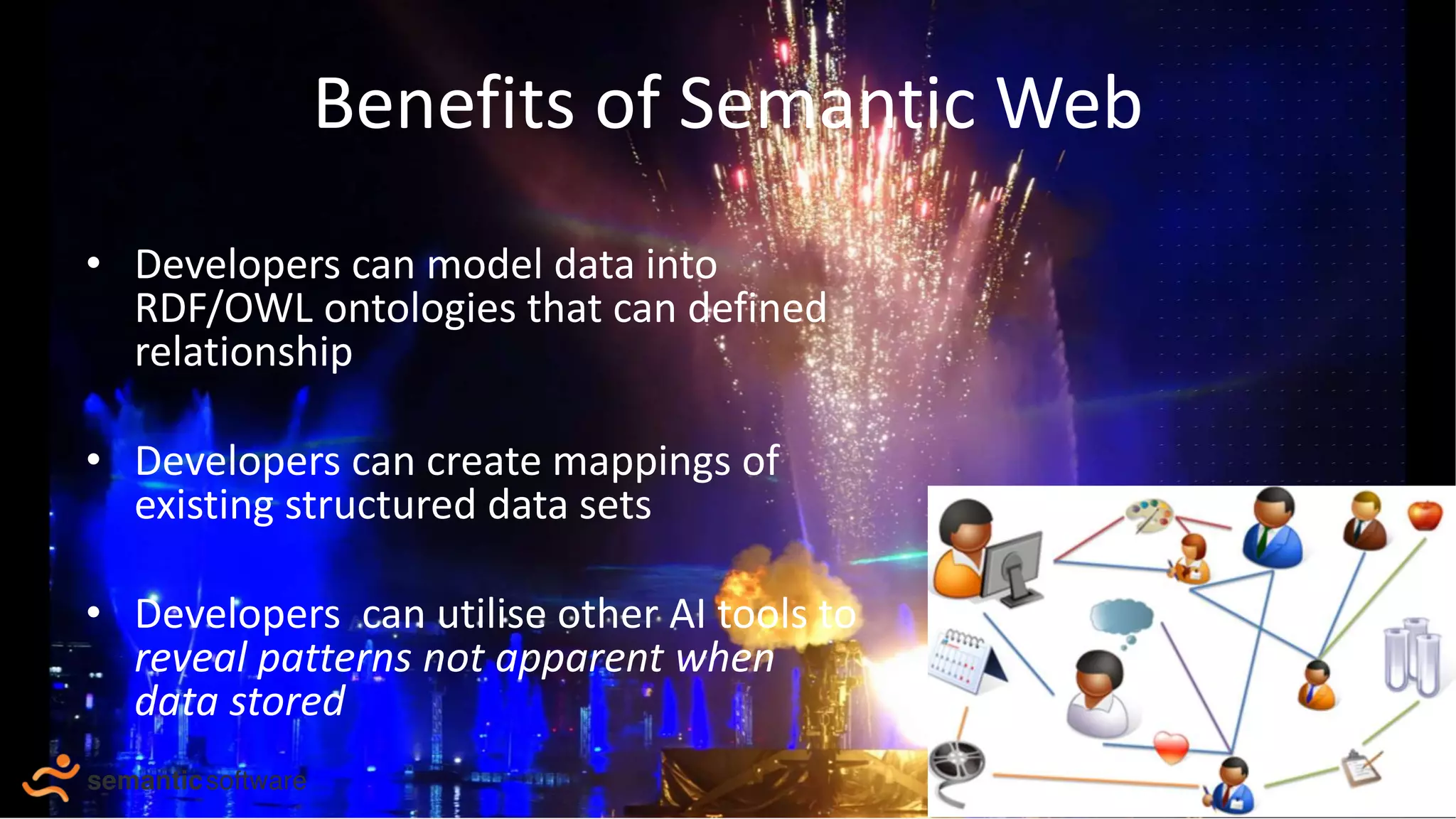
Benefits of Semantic Web
• Developers can model data into
RDF/OWL ontologies that can defined
relationship
• Developers can create mappings of
existing structured data sets
• Developers can utilise other AI tools to
reveal patterns not apparent when
data stored
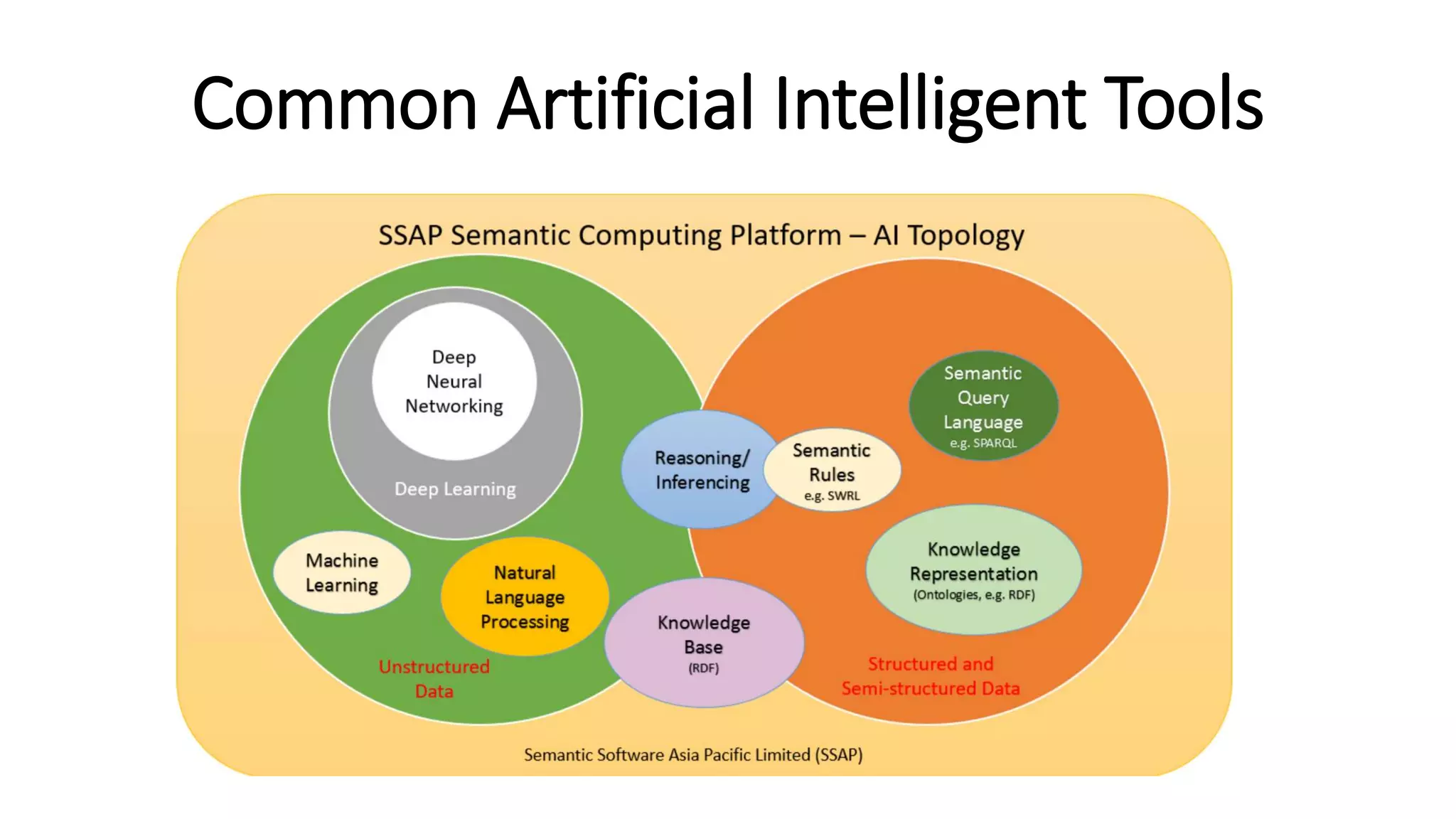
Common Artificial Intelligent Tools
Future for Semantic Computing
• Semantic developers continue to refine W3C based tools for
specialist platform
• AI vendors develop hybrid AI platform including NLP, Machine
Learning etc
• Traditional business application vendors incorporate AI tools
within their own development to create
“Intelligent versions”
How does semantic technology work?

How does semantic technology work?

  • 1.
    Semantic Technology How Doesit Work? Graeme Wood
  • 2.
    Business Issues • Billionsof devices and systems connected to internet • They produce 5 exabytes of data per day • This data can not be analysed effectively • Traditional programs and data analysis tools restrict open analysis 5 exabytes = 5,500,000,000,000 Mbytes
  • 3.
    Semantic Computing • SyntacticInteroperability – Set of rules that defines correctly structured data or documents • Semantic Interoperability – Enables applications to understand the meaning of data – Provide insights into the context
  • 4.
    Original Semantic Web •Developed by Tim Burners-Lee • Developed through World Wide Web Consortium (W3C) • Uses common interoperability standards for human to access web – HyperText Transfer Protocol (HTTP) – HyperText Markup Language (HTML) – Extensible Markup Language (XML) Tim Burners- Lee
  • 5.
    Semantic Web (W3C) •Resource Description Framework (RDF) – Makes content available to computers – Describes all facts as 3 part descriptors = triple – A triple consists of a subject, a predicate, and an object Graeme likes Gail
  • 6.
    Semantic Web (W3C) •Ontology – Describes a system of relationships – Is a schema, a model for constructing frameworks of information – Is not hierarchical (no parent child relationship) – Can be extended or combined with other ontologies
  • 7.
    Semantic Web (W3C) •Web Ontology Language (OWL) – Is computational logic-based language – Show the data schema and show relationships about the data – Users can infer new facts from existing facts
  • 8.
    Semantic Web (W3C) •SPARQL Query Language – Is a set of standards accessing and updating data across various database where data in RDF format – Can be used to transmit queries across a network – Can reveal patterns not apparent when data stored
  • 9.
    Benefits of SemanticWeb • Developers can model data into RDF/OWL ontologies that can defined relationship • Developers can create mappings of existing structured data sets • Developers can utilise other AI tools to reveal patterns not apparent when data stored
  • 10.
  • 11.
    Future for SemanticComputing • Semantic developers continue to refine W3C based tools for specialist platform • AI vendors develop hybrid AI platform including NLP, Machine Learning etc • Traditional business application vendors incorporate AI tools within their own development to create “Intelligent versions”

Editor's Notes

  • #2 To export video in Powerpoint 2010, Click the File tab, then Save & Send, the Create Video. Make sure Computers & HD Displays is set to 1280x720 and leave the other settings as is. Hit Create Video and you’re done. It takes a little while! Chris Webb http://compelling.tv