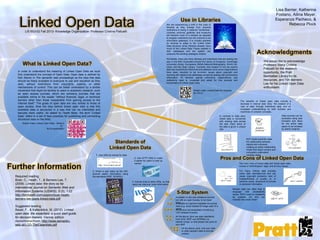
We are experiencing a shift in the roles of
libraries as they change from physical
institutions to being in essence “borderless.”
Libraries, archives, galleries, and museums
will become more of a network as opposed
to singular institutions but will continue to be
information gateways. It is virtually painless
for libraries to adapt to the Linked Open
Data structure since libraries already have
much of the Linked Data Triples needed in
their catalogues and the system can
consume the existing catalogue content.

LIS 653-02 Fall 2013- Knowledge Organization- Professor Cristina Pattuelli

Worldwide, there are many libraries and institutions that are leading the
way in this field. Examples include the Library of Congress, Cambridge
University Library, Europeana, British National Bibliography, World Cat,
Libris, and the Open Library. Currently, this mission to link the world’s
data has experienced dilemmas and setbacks since some organizations
have been reluctant to be involved, issues about copyright and
licensing still needs to be addressed as well as dealing with provenance
information. All libraries, special collections, organizations, and
institutions need to cooperate and adapt for true success and
functionality of Linked Open Data.

In order to understand the meaning of Linked Open Data we must
first understand the concept of Open Data. Open data is defined by
Karl Aberer in The semantic web proceedings as the idea that data
should be freely available to everyone to use and republish as they
wish, without restrictions from copyrights, patents, or other
mechanisms of control. This can be better understood by a similar
movement that might be familiar to users in academic research, such
as open access journals, which are scholarly journals that are
available online to the reader "without financial, legal, or technical
barriers other than those inseparable from gaining access to the
internet itself.” The goals of open data are very similar to those of
open access. Now the idea behind linked open data is that this
available data is structured in a way that can be interlinked and
become more useful. As stated by Heath Bizer, the term “Linked
Data” refers to a set of best practices for publishing and connecting
structured data on the Web.

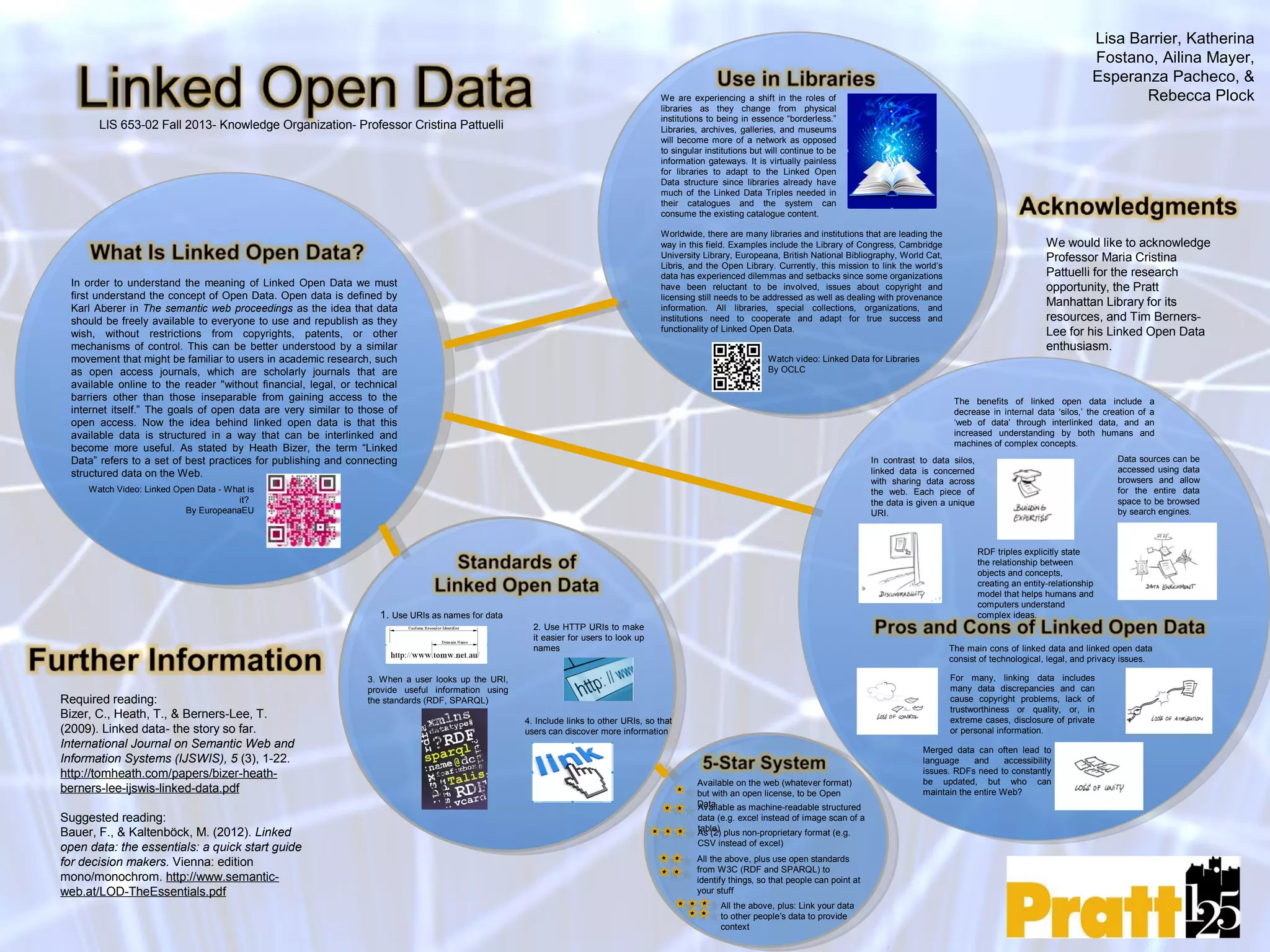
The benefits of linked open data include a
decrease in internal data ‘silos,’ the creation of a
‘web of data’ through interlinked data, and an
increased understanding by both humans and
machines of complex concepts.
Data sources can be
accessed using data
browsers and allow
for the entire data
space to be browsed
by search engines.

In contrast to data silos,
linked data is concerned
with sharing data across
the web. Each piece of
the data is given a unique
URI.

RDF triples explicitly state
the relationship between
objects and concepts,
creating an entity-relationship
model that helps humans and
computers understand
complex ideas.

1. Use URIs as names for data
2. Use HTTP URIs to make
it easier for users to look up
names

Suggested reading:
Bauer, F., & Kaltenböck, M. (2012). Linked
open data: the essentials: a quick start guide
for decision makers. Vienna: edition
mono/monochrom. http://www.semanticweb.at/LOD-TheEssentials.pdf

We would like to acknowledge
Professor Maria Cristina
Pattuelli for the research
opportunity, the Pratt
Manhattan Library for its
resources, and Tim BernersLee for his Linked Open Data
enthusiasm.

Watch video: Linked Data for Libraries
By OCLC

Watch Video: Linked Open Data - What is
it?
By EuropeanaEU

Required reading:
Bizer, C., Heath, T., & Berners-Lee, T.
(2009). Linked data- the story so far.
International Journal on Semantic Web and
Information Systems (IJSWIS), 5 (3), 1-22.
http://tomheath.com/papers/bizer-heathberners-lee-ijswis-linked-data.pdf

Lisa Barrier, Katherina
Fostano, Ailina Mayer,
Esperanza Pacheco, &
Rebecca Plock

The main cons of linked data and linked open data
consist of technological, legal, and privacy issues.
For many, linking data includes
many data discrepancies and can
cause copyright problems, lack of
trustworthiness or quality, or, in
extreme cases, disclosure of private
or personal information.

3. When a user looks up the URI,
provide useful information using
the standards (RDF, SPARQL)
4. Include links to other URIs, so that
users can discover more information

Available on the web (whatever format)
but with an open license, to be Open
Data
Available as machine-readable structured
data (e.g. excel instead of image scan of a
table)
As (2) plus non-proprietary format (e.g.
CSV instead of excel)
All the above, plus use open standards
from W3C (RDF and SPARQL) to
identify things, so that people can point at
your stuff
All the above, plus: Link your data
to other people’s data to provide
context

Merged data can often lead to
language
and
accessibility
issues. RDFs need to constantly
be updated, but who can
maintain the entire Web?
Background Image: National Geographic Atlas of the World
LIS 653-02 Knowledge Organization
Claire Dunning
Katherine Hessler
Rachel Smiley
Freya Yost

ACKNOWLEDGEMENTS
We would like to thank Dr.
Cristina Pattuelli and Bree
Midavaine for their input and
assistance with this project.

REFERENCES
Baca, M. (12/9/2009). Controlled Vocabularies for Art, Architecture, and Material Culture. Encyclopedia of Library and Information Science, Third Edition. Doi: 10.1081/E-ELIS3-120044074
Bruns, A. (2008). Folksonomies: Produsage and/of knowledge structures. In Blogs, Wikipedia, second life, and beyond: From production to produsage (171-198). Peter Lang: New York.
Furner, J. (09 Dec 2009). Folksonomies. In Encyclopedia of Library and Information Science. Retrieved from http://www.tandfonline.com/doi/full/10.1081/E-ELIS3-120043238#
Kroski, E. (2007). Folksonomies and user-based technology. In N. Courney (Ed.), Library 2.0 and beyond: Innovative technologies and tomorrow’s user (91-104). Libraries Unlimited: Westport, CT.
Levy, P. (2013). The creative conversation of collective intelligence. In A. Delwiche & J. J. Henderson (Eds.), The participatory cultures handbook (99-108). Routledge: New York.
McDaniel, C. (2012, October 11). Ontology, Taxonomy and Folksonomy. Digital History Rice. Retrieved December 1, 2013, from http://digitalhistory.blogs.rice.edu/2012/10/11/ontology-taxonomy-and-folksonomy
Mathes, A. (n.d.). Folksonomies - Cooperative Classification and Communication Through Shared Metadata. Folksonomies - Cooperative Classification and Communication Through Shared Metadata. Retrieved December 1, 2013, from
http://www.adammathes.com/academic/computer-mediated-communication/folksonomies.html
Pirmann, C. (2012). Tags in the Catalogue: Insights From a Usability Study of LibraryThing for Libraries. Library Trends, 61(1), 234-247.
Porter, J. (2011). Folksonomies in the Library: their impact on user experience and their implications for the work of librarians. The Australian Library Journal, 60(3), 248-255.
Rolla, P. (2009). User Tags versus Subject Headings: Can User-Supplied Data Improve Subject Access to Library Collections? Library Resources and Technical Services, 53(3), 174-184.
Sanderson, B. & Rigby, M. (November 2013). We’ve Reddit, have you?: What librarians can learn from a site full of memes. College and Research Libraries News, 74 (10), 518-521. http://crln.acrl.org/content/74/10/518.full.pdf+html
Terdiman, D. (01 February 2005). Folksonomies tap people power. Wired, 13 (2). Retrieved from http://www.wired.com/science/discoveries/news/2005/02/66456?currentPage=all
Trant, J. & Wyman, B. (2006). Investigating social tagging and folksonomy in art museums with steve.museum [PDF]. Retrieved 11/10/13 from http://www.ra.ethz.ch/cdstore/www2006/www.rawsugar.com/www2006/4.pdf
Vander Wal, T. (2007, February 2). Folksonomy. Home. Retrieved December 1, 2013, from http://vanderwal.net/folksonomy.html
LIS 653 fall 2013 final project posters

LIS 653 fall 2013 final project posters

  • 1.
    We are experiencinga shift in the roles of libraries as they change from physical institutions to being in essence “borderless.” Libraries, archives, galleries, and museums will become more of a network as opposed to singular institutions but will continue to be information gateways. It is virtually painless for libraries to adapt to the Linked Open Data structure since libraries already have much of the Linked Data Triples needed in their catalogues and the system can consume the existing catalogue content. LIS 653-02 Fall 2013- Knowledge Organization- Professor Cristina Pattuelli Worldwide, there are many libraries and institutions that are leading the way in this field. Examples include the Library of Congress, Cambridge University Library, Europeana, British National Bibliography, World Cat, Libris, and the Open Library. Currently, this mission to link the world’s data has experienced dilemmas and setbacks since some organizations have been reluctant to be involved, issues about copyright and licensing still needs to be addressed as well as dealing with provenance information. All libraries, special collections, organizations, and institutions need to cooperate and adapt for true success and functionality of Linked Open Data. In order to understand the meaning of Linked Open Data we must first understand the concept of Open Data. Open data is defined by Karl Aberer in The semantic web proceedings as the idea that data should be freely available to everyone to use and republish as they wish, without restrictions from copyrights, patents, or other mechanisms of control. This can be better understood by a similar movement that might be familiar to users in academic research, such as open access journals, which are scholarly journals that are available online to the reader "without financial, legal, or technical barriers other than those inseparable from gaining access to the internet itself.” The goals of open data are very similar to those of open access. Now the idea behind linked open data is that this available data is structured in a way that can be interlinked and become more useful. As stated by Heath Bizer, the term “Linked Data” refers to a set of best practices for publishing and connecting structured data on the Web. The benefits of linked open data include a decrease in internal data ‘silos,’ the creation of a ‘web of data’ through interlinked data, and an increased understanding by both humans and machines of complex concepts. Data sources can be accessed using data browsers and allow for the entire data space to be browsed by search engines. In contrast to data silos, linked data is concerned with sharing data across the web. Each piece of the data is given a unique URI. RDF triples explicitly state the relationship between objects and concepts, creating an entity-relationship model that helps humans and computers understand complex ideas. 1. Use URIs as names for data 2. Use HTTP URIs to make it easier for users to look up names Suggested reading: Bauer, F., & Kaltenböck, M. (2012). Linked open data: the essentials: a quick start guide for decision makers. Vienna: edition mono/monochrom. http://www.semanticweb.at/LOD-TheEssentials.pdf We would like to acknowledge Professor Maria Cristina Pattuelli for the research opportunity, the Pratt Manhattan Library for its resources, and Tim BernersLee for his Linked Open Data enthusiasm. Watch video: Linked Data for Libraries By OCLC Watch Video: Linked Open Data - What is it? By EuropeanaEU Required reading: Bizer, C., Heath, T., & Berners-Lee, T. (2009). Linked data- the story so far. International Journal on Semantic Web and Information Systems (IJSWIS), 5 (3), 1-22. http://tomheath.com/papers/bizer-heathberners-lee-ijswis-linked-data.pdf Lisa Barrier, Katherina Fostano, Ailina Mayer, Esperanza Pacheco, & Rebecca Plock The main cons of linked data and linked open data consist of technological, legal, and privacy issues. For many, linking data includes many data discrepancies and can cause copyright problems, lack of trustworthiness or quality, or, in extreme cases, disclosure of private or personal information. 3. When a user looks up the URI, provide useful information using the standards (RDF, SPARQL) 4. Include links to other URIs, so that users can discover more information Available on the web (whatever format) but with an open license, to be Open Data Available as machine-readable structured data (e.g. excel instead of image scan of a table) As (2) plus non-proprietary format (e.g. CSV instead of excel) All the above, plus use open standards from W3C (RDF and SPARQL) to identify things, so that people can point at your stuff All the above, plus: Link your data to other people’s data to provide context Merged data can often lead to language and accessibility issues. RDFs need to constantly be updated, but who can maintain the entire Web?
  • 2.
    Background Image: NationalGeographic Atlas of the World
  • 3.
    LIS 653-02 KnowledgeOrganization Claire Dunning Katherine Hessler Rachel Smiley Freya Yost ACKNOWLEDGEMENTS We would like to thank Dr. Cristina Pattuelli and Bree Midavaine for their input and assistance with this project. REFERENCES Baca, M. (12/9/2009). Controlled Vocabularies for Art, Architecture, and Material Culture. Encyclopedia of Library and Information Science, Third Edition. Doi: 10.1081/E-ELIS3-120044074 Bruns, A. (2008). Folksonomies: Produsage and/of knowledge structures. In Blogs, Wikipedia, second life, and beyond: From production to produsage (171-198). Peter Lang: New York. Furner, J. (09 Dec 2009). Folksonomies. In Encyclopedia of Library and Information Science. Retrieved from http://www.tandfonline.com/doi/full/10.1081/E-ELIS3-120043238# Kroski, E. (2007). Folksonomies and user-based technology. In N. Courney (Ed.), Library 2.0 and beyond: Innovative technologies and tomorrow’s user (91-104). Libraries Unlimited: Westport, CT. Levy, P. (2013). The creative conversation of collective intelligence. In A. Delwiche & J. J. Henderson (Eds.), The participatory cultures handbook (99-108). Routledge: New York. McDaniel, C. (2012, October 11). Ontology, Taxonomy and Folksonomy. Digital History Rice. Retrieved December 1, 2013, from http://digitalhistory.blogs.rice.edu/2012/10/11/ontology-taxonomy-and-folksonomy Mathes, A. (n.d.). Folksonomies - Cooperative Classification and Communication Through Shared Metadata. Folksonomies - Cooperative Classification and Communication Through Shared Metadata. Retrieved December 1, 2013, from http://www.adammathes.com/academic/computer-mediated-communication/folksonomies.html Pirmann, C. (2012). Tags in the Catalogue: Insights From a Usability Study of LibraryThing for Libraries. Library Trends, 61(1), 234-247. Porter, J. (2011). Folksonomies in the Library: their impact on user experience and their implications for the work of librarians. The Australian Library Journal, 60(3), 248-255. Rolla, P. (2009). User Tags versus Subject Headings: Can User-Supplied Data Improve Subject Access to Library Collections? Library Resources and Technical Services, 53(3), 174-184. Sanderson, B. & Rigby, M. (November 2013). We’ve Reddit, have you?: What librarians can learn from a site full of memes. College and Research Libraries News, 74 (10), 518-521. http://crln.acrl.org/content/74/10/518.full.pdf+html Terdiman, D. (01 February 2005). Folksonomies tap people power. Wired, 13 (2). Retrieved from http://www.wired.com/science/discoveries/news/2005/02/66456?currentPage=all Trant, J. & Wyman, B. (2006). Investigating social tagging and folksonomy in art museums with steve.museum [PDF]. Retrieved 11/10/13 from http://www.ra.ethz.ch/cdstore/www2006/www.rawsugar.com/www2006/4.pdf Vander Wal, T. (2007, February 2). Folksonomy. Home. Retrieved December 1, 2013, from http://vanderwal.net/folksonomy.html