Digital Libraries of the Future Use of Semantic Web and Social Bookmarking to  support E-learning in Digital Libraries Sebastian Ryszard Kruk Digital Enterprise Research Institute National University of Ireland, Galway sebastian.kruk @deri.org http:// corrib.deri.ie /
Presentation outline Motivation Building Social Semantic Digital Library Semantic Digital Libraries Towards Online Communities for Digital Libraries JeromeDL and other Corrib components Motivation and Overview Architecture and Ontologies Semantic Services Social Services Semantics in Use JeromeDL in Action e-Learning 2.0 Conclusions
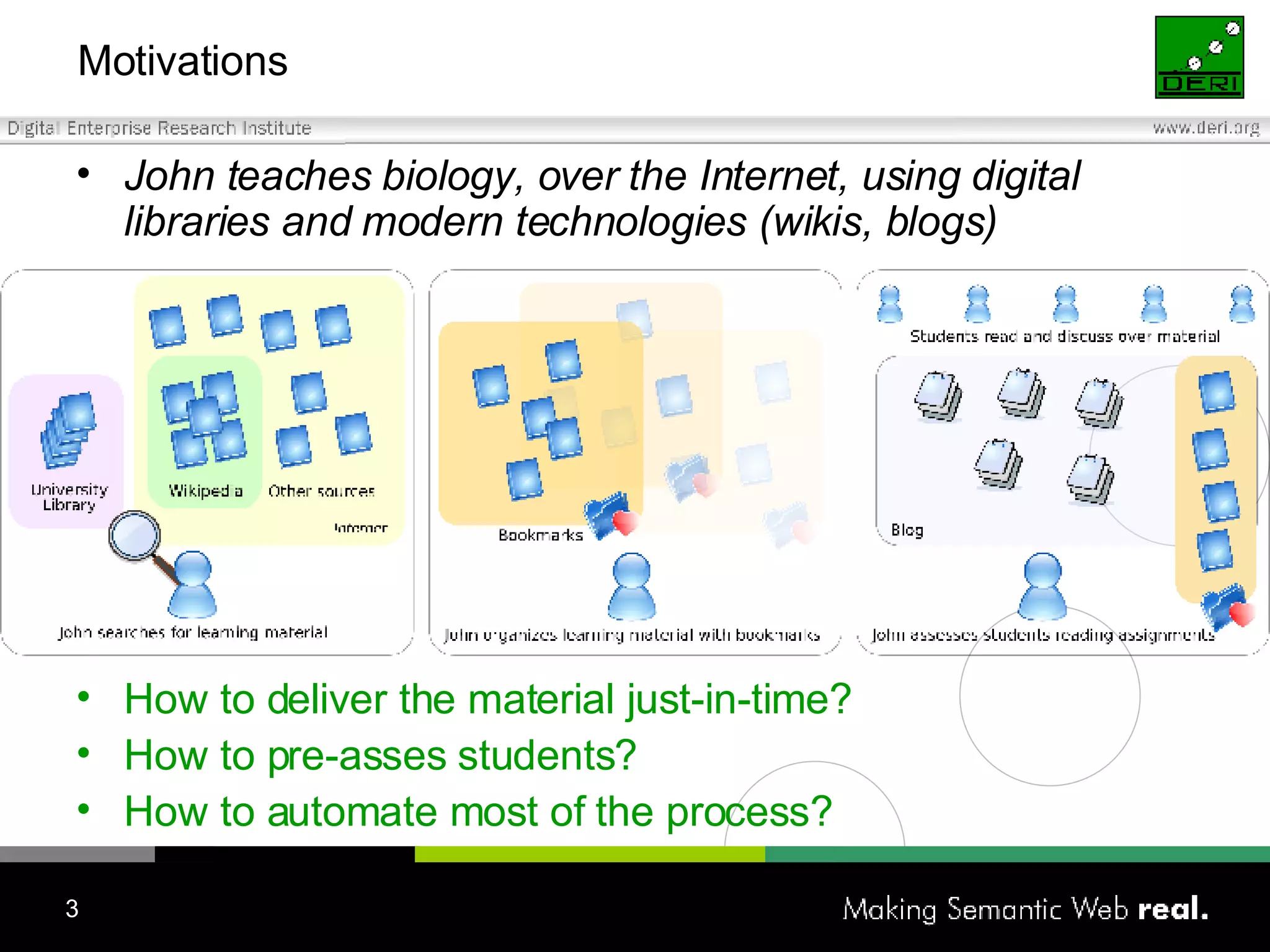
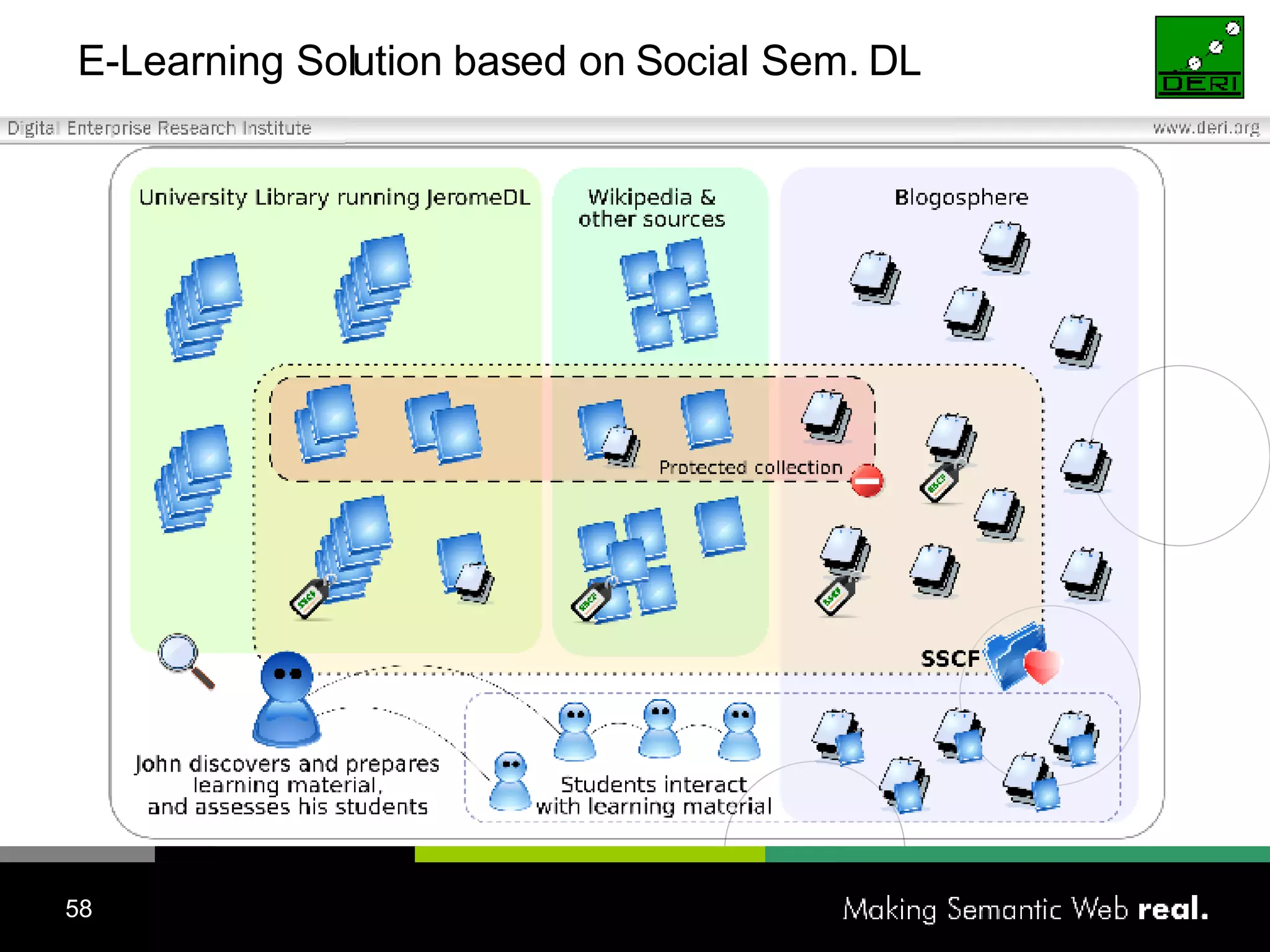
Motivations John teaches biology, over the Internet, using digital libraries and modern technologies (wikis, blogs) How to deliver the material just-in-time? How to pre-asses students? How to automate most of the process?
Presentation outline Motivation Building Social Semantic Digital Library Semantic Digital Libraries Towards Online Communities for Digital Libraries JeromeDL and other Corrib components Motivation and Overview Architecture and Ontologies Semantic Services Social Services Semantics in Use JeromeDL in Action e-Learning 2.0 Conclusions
The Semantic Web – Applications Semantic Web cannot be and is not only a set of recommendations Semantic Web is  becoming reality by applications  that support it and are based on it Enabling technologies: RDF Storages: Sesame, Jena, YARS Reasoners: KAON, Racer  Editors: Protege, SWOOP, MarcOnt Portal End-User applications: Semantic wikis: Makna, SemperWiki Semantic blogs Semantic digital libraries
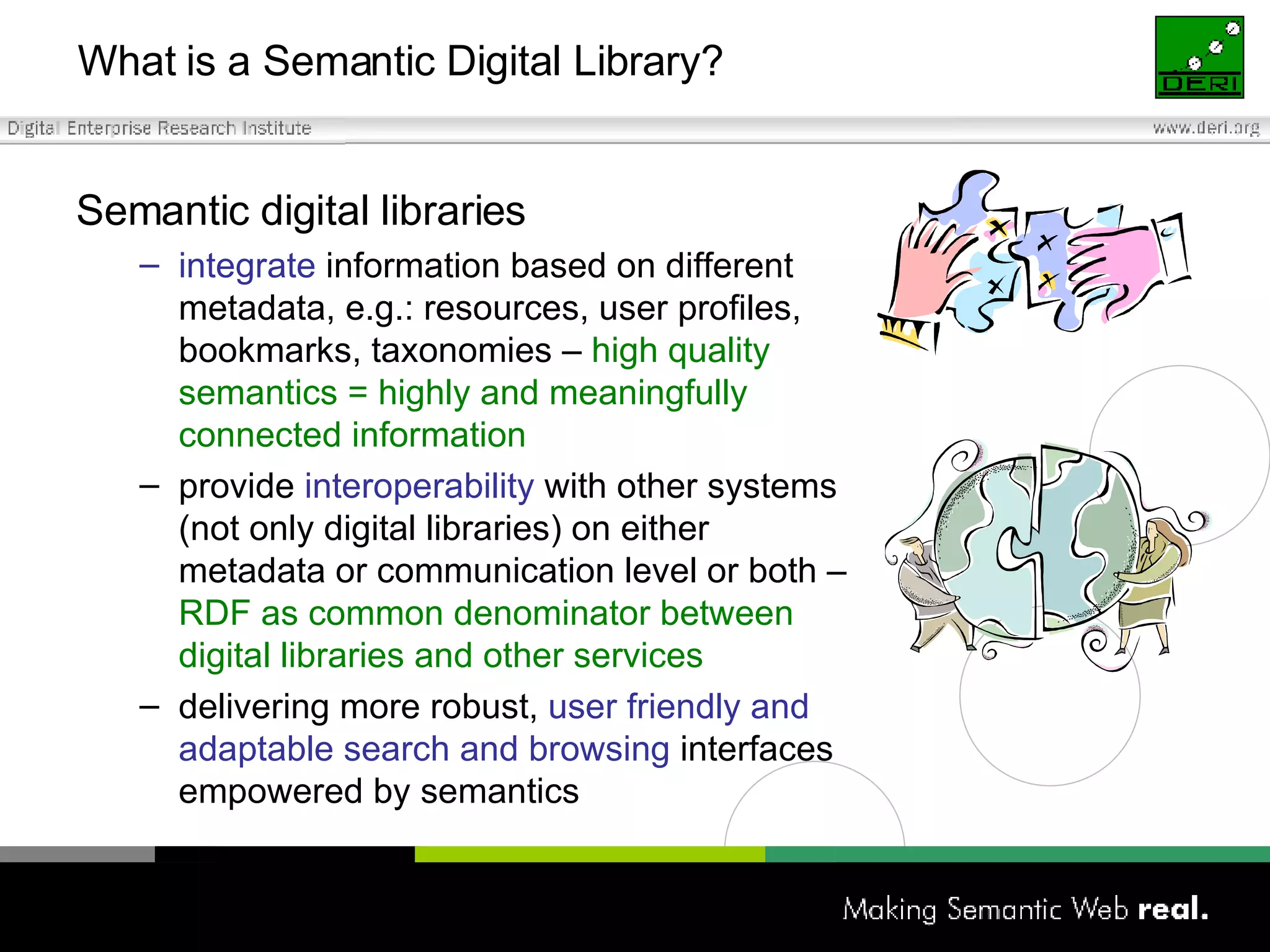
What is a Semantic Digital Library? Semantic digital libraries integrate  information based on different metadata, e.g.: resources, user profiles, bookmarks, taxonomies  –  high quality semantics = highly and meaningfully connected information provide  interoperability  with other systems (not only digital libraries) on either metadata or communication level or both –  RDF as common denominator between digital libraries and other services delivering more robust,  user friendly and adaptable search and browsing  interfaces empowered by semantics
Semantic Web Technologies for Digital Libraries? Metadata is the key concept the Web  does not have  metadata the idea of a Semantic Web is nice but difficult to implement many digital libraries  do have  metadata in place we simply must make them available in a machine understandable format the Semantic Web provides the format: RDF
Semantic Web Technologies for Digital Libraries? Knowledge in bibliographic records Digital Libraries  already have  controlled vocabularies, taxonomies or even ontologies in place  the challenge is to model this knowledge in a machine understandable way the Semantic Web provides ontology languages:  RDF Schema OWL SKOS
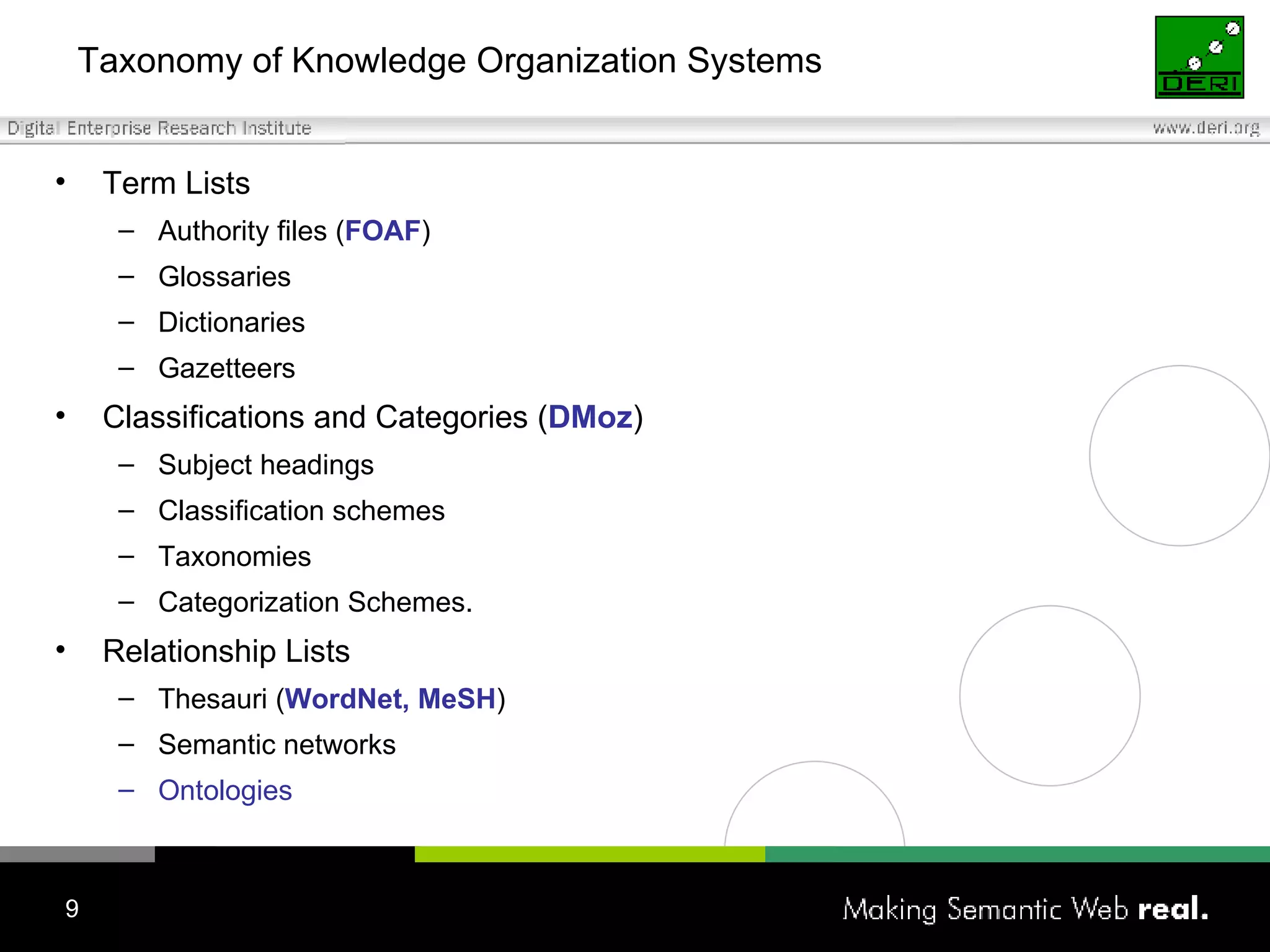
Taxonomy of Knowledge Organization Systems Term Lists  Authority files ( FOAF ) Glossaries  Dictionaries  Gazetteers  Classifications and Categories ( DMoz ) Subject headings Classification schemes Taxonomies  Categorization Schemes.  Relationship Lists Thesauri ( WordNet, MeSH ) Semantic networks Ontologies   (Hodge, 2000)
Benefits of Semantic Digital Libraries  The two main benefits of Semantic Digital Libraries new search paradigms for the information space Ontology-based search / facet search Community-enabled browsing providing interoperability on the data level integrating metadata from various heterogeneous sources Interconnecting different digital library systems
Presentation outline Motivation Building Social Semantic Digital Library Semantic Digital Libraries Towards Online Communities for Digital Libraries JeromeDL and other Corrib components Motivation and Overview Architecture and Ontologies Semantic Services Social Services Semantics in Use JeromeDL in Action e-Learning 2.0 Conclusions
Semantic DL as Evolving Knowledge Space In state-of-the-art digital libraries users are  consumers Retrieve contents based on available bibliographic records Recent trends: user communities Connetea Flickr In Semantic digital libraries users are  contributers  as well Tagging (Web 2.0) Social Semantic Collaborative Filtering Annotations Semantic Digital libraries enforce the transition from a static information to a  dynamic (collaborative) knowledge space
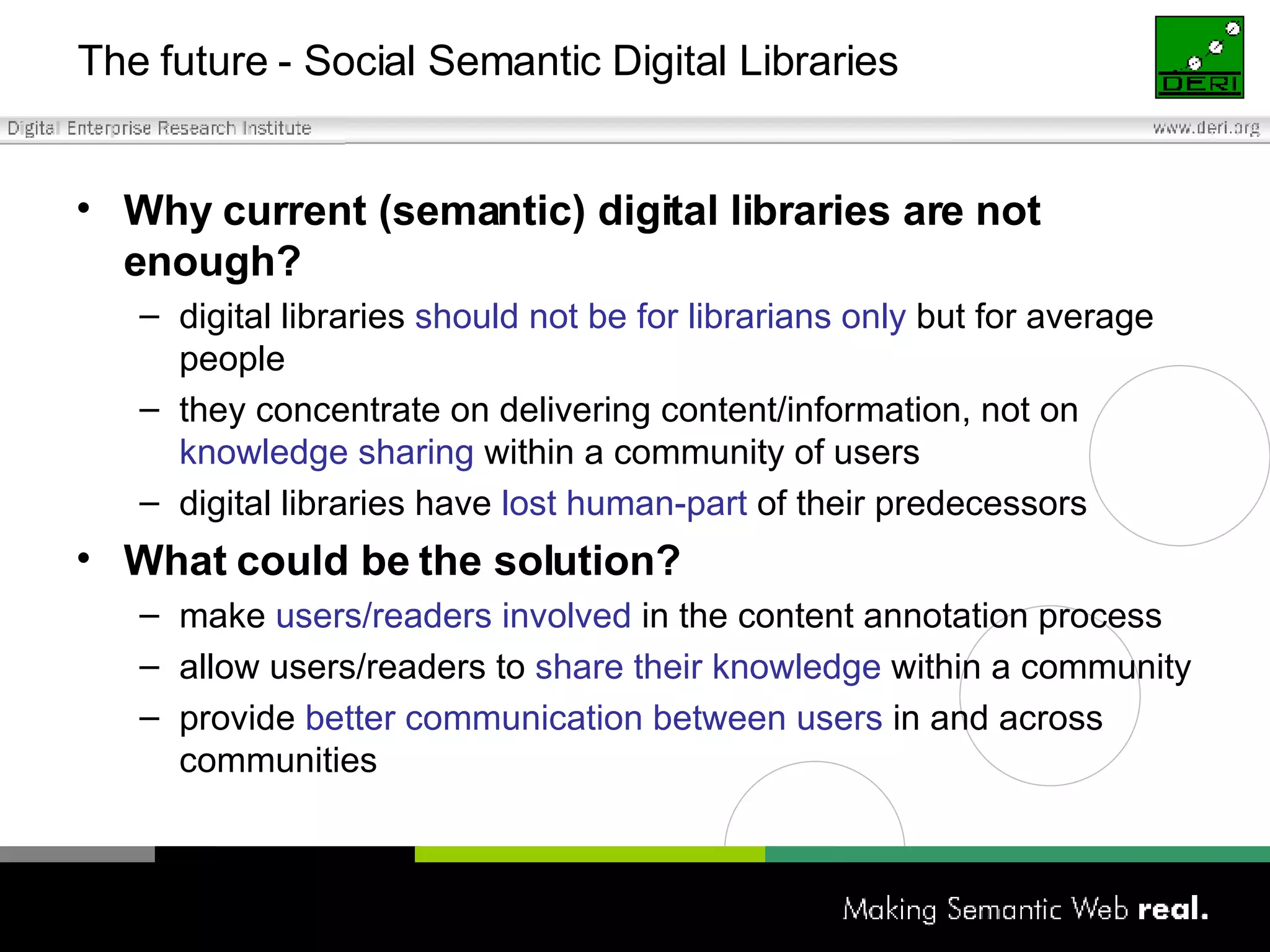
Why current (semantic) digital libraries are not enough? digital libraries  should not be for librarians   only  but for average people they concentrate on delivering content/information, not on  knowledge sharing  within a community of users digital libraries have  lost human-part  of their predecessors What could be the solution? make  users/readers involved  in the content annotation process allow users/readers to  share their knowledge  within a community provide  better communication between users  in and across communities The future - Social Semantic Digital Libraries
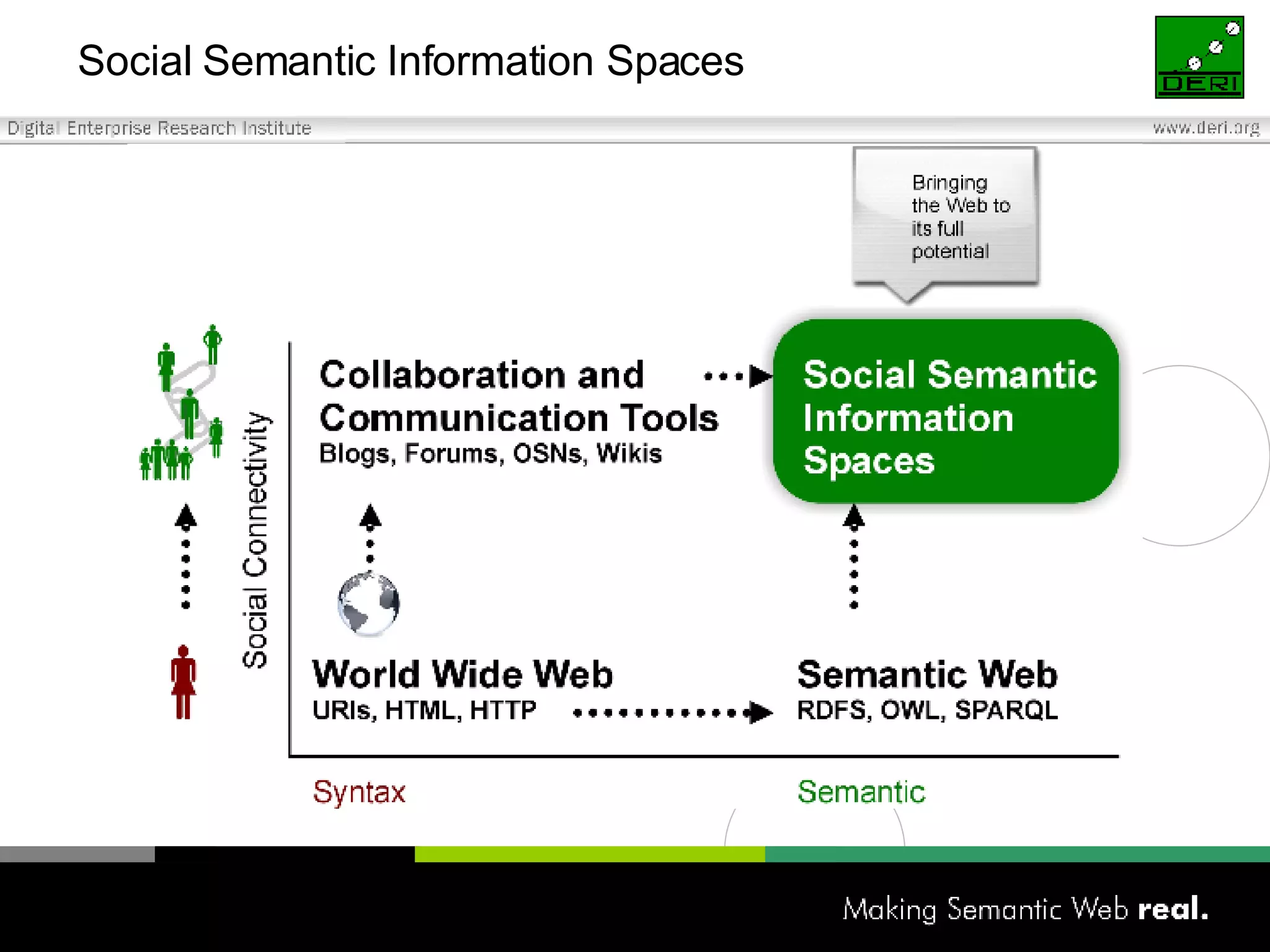
Social Semantic Information Spaces
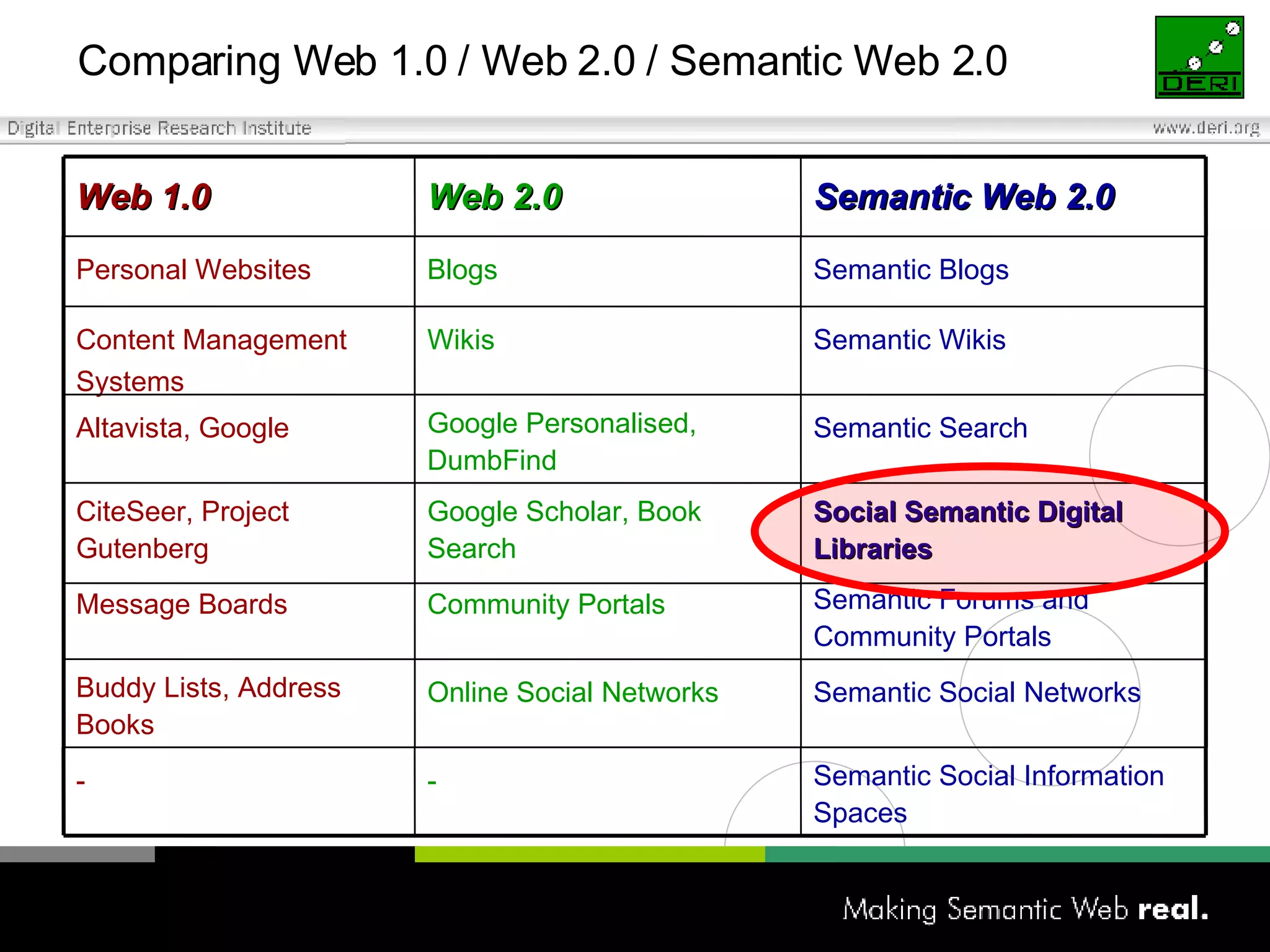
Comparing Web 1.0 / Web 2.0 / Semantic Web 2.0 Semantic Social Networks Online Social Networks Buddy Lists, Address Books Semantic Social Information Spaces - - Social Semantic Digital Libraries Google Scholar, Book Search CiteSeer, Project Gutenberg Semantic Forums and Community Portals Community Portals Message Boards Semantic Blogs Blogs Personal Websites Semantic Search Google Personalised, DumbFind Altavista, Google Semantic Wikis Wikis Content Management Systems Semantic Web 2.0 Web 2.0 Web 1.0
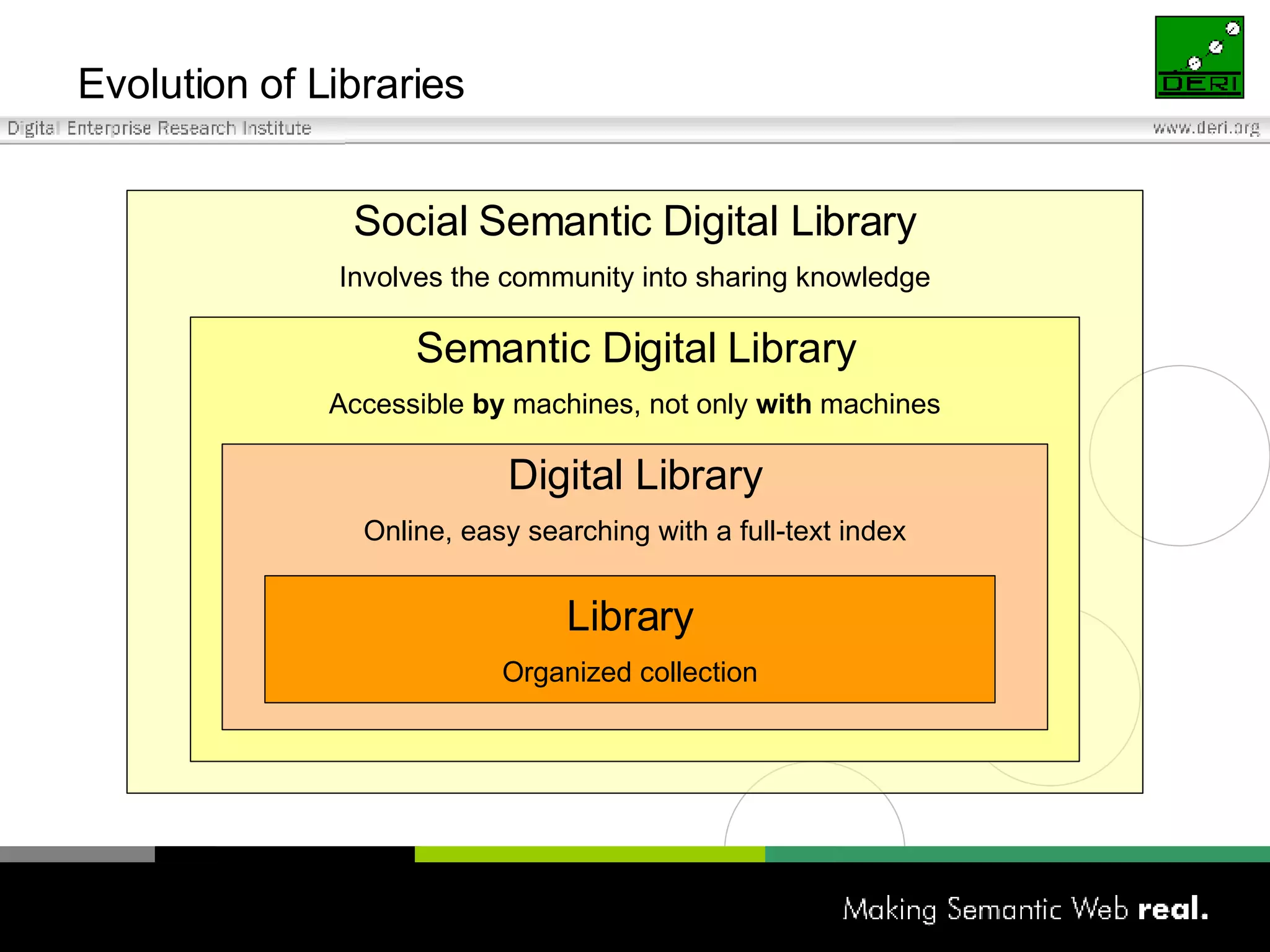
Evolution of Libraries Social Semantic Digital Library Involves the community into sharing knowledge Semantic Digital Library Accessible  by  machines, not only  with  machines Digital Library Online, easy searching with a full-text index Library Organized collection
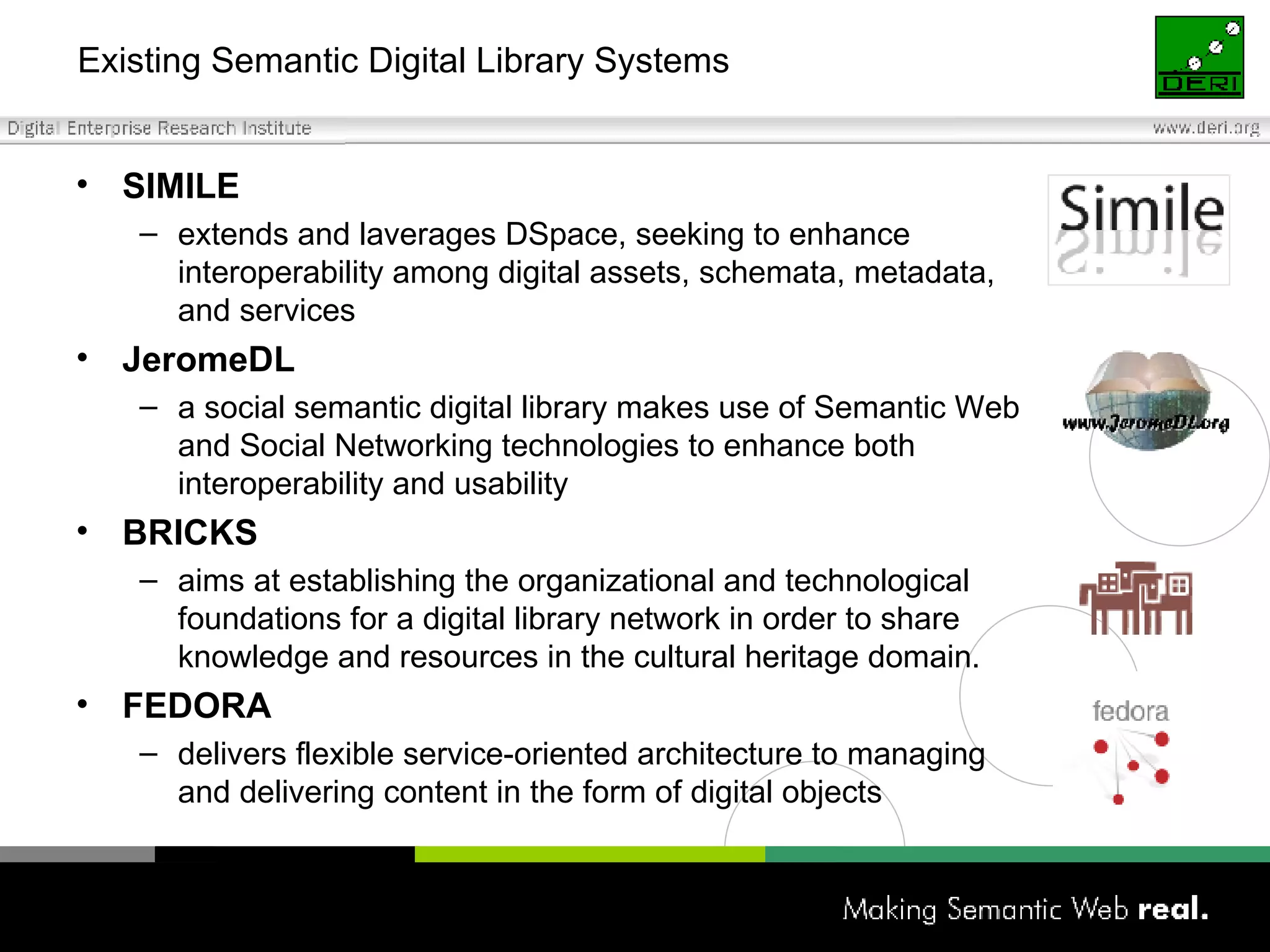
Existing Semantic Digital Library Systems SIMILE extends and laverages DSpace, seeking to enhance interoperability among digital assets, schemata, metadata, and services JeromeDL a social semantic digital library makes use of Semantic Web and Social Networking technologies to enhance both interoperability and usability BRICKS aims at establishing the organizational and technological foundations for a digital library network in order to share knowledge and resources in the cultural heritage domain. FEDORA delivers flexible service-oriented architecture to managing and delivering content in the form of digital objects
Presentation outline Motivation Building Social Semantic Digital Library Semantic Digital Libraries Towards Online Communities for Digital Libraries JeromeDL and other Corrib components Motivation and Overview Architecture and Ontologies Semantic Services Social Services Semantics in Use JeromeDL in Action e-Learning 2.0 Conclusions
JeromeDL -  Introduction Joint effort of DERI, National University of Ireland, Galway and Gdansk University of Technology (GUT) Distributed under BSD Open Source license Digital library build on semantic web technologies to answer requirements from: librarians, scientists and everyone.
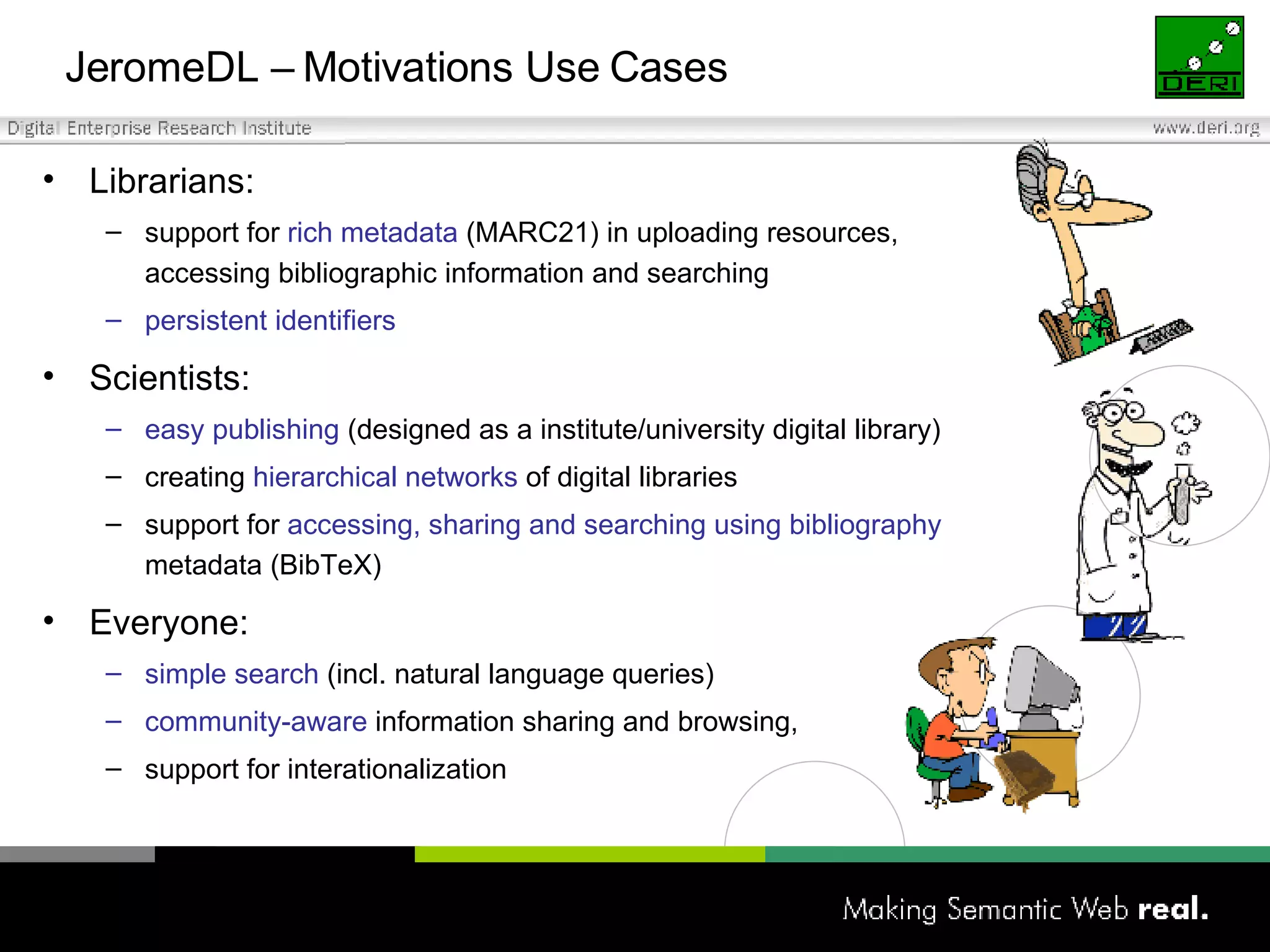
JeromeDL –  Motivations Use Cases Librarians: support for  rich metadata  (MARC21) in uploading resources,  accessing bibliographic information and searching persistent identifiers Scientists:  easy publishing  (designed as a institute/university digital library) creating  hierarchical networks  of digital libraries support for  accessing, sharing and searching using bibliography   metadata (BibTeX) Everyone: simple search  (incl. natural language queries)  community-aware  information sharing and browsing,  support for interationalization
Presentation outline Motivation Building Social Semantic Digital Library Semantic Digital Libraries Towards Online Communities for Digital Libraries JeromeDL and other Corrib components Motivation and Overview Architecture and Ontologies Semantic Services Social Services Semantics in Use JeromeDL in Action e-Learning 2.0 Conclusions
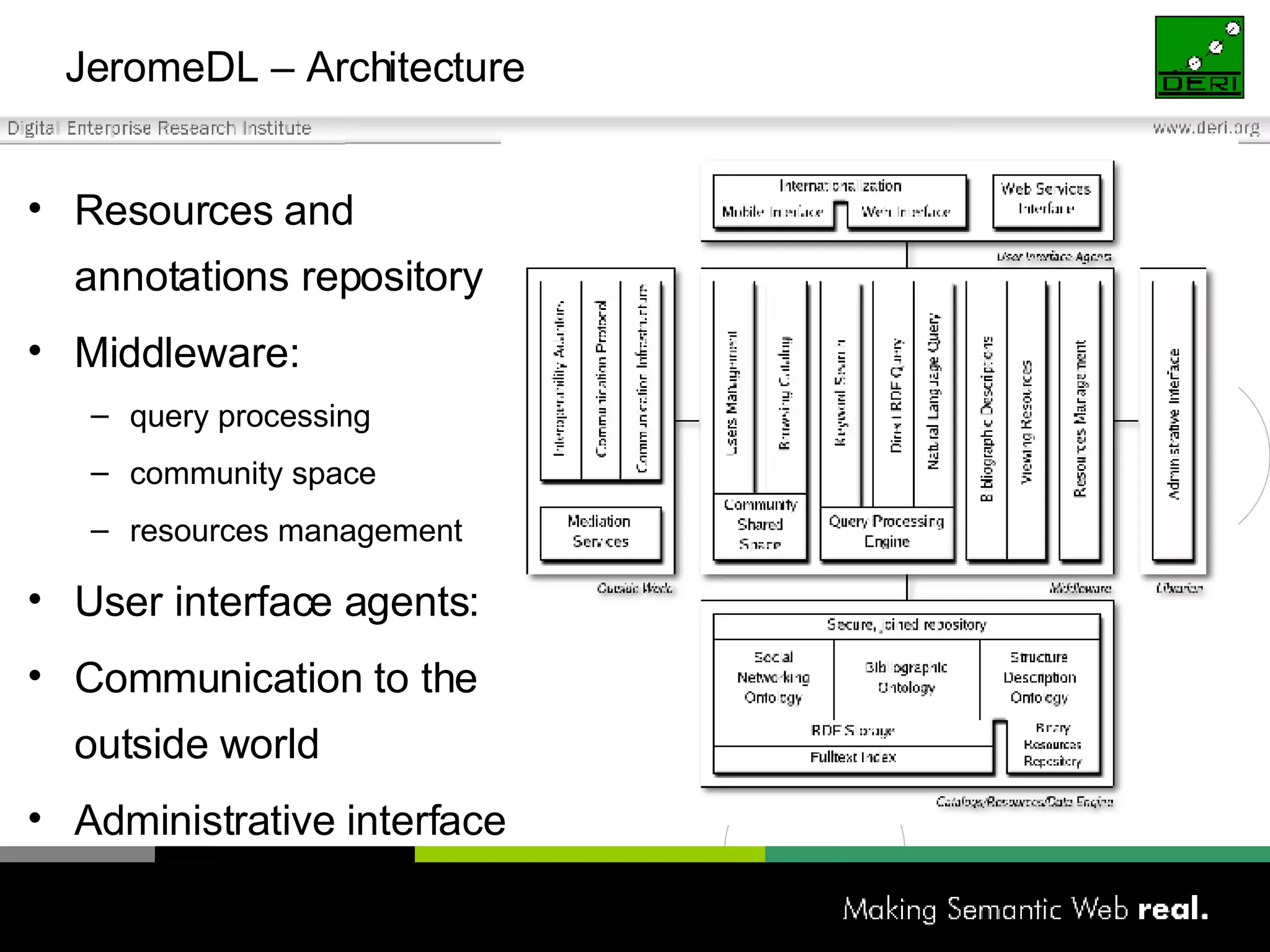
JeromeDL – Architecture Resources and annotations repository Middleware: query processing community space resources management User interface agents: Communication to the outside world Administrative interface
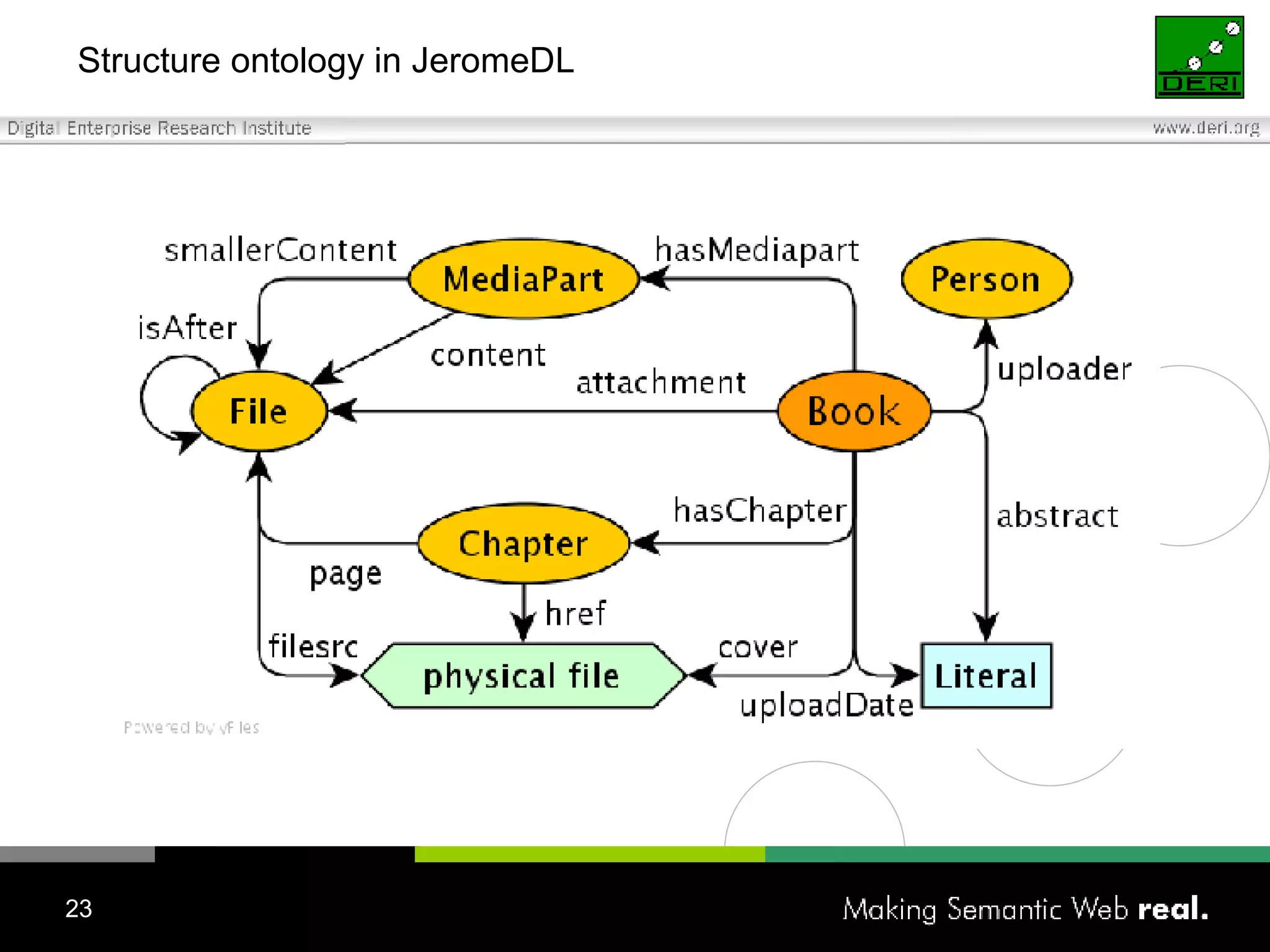
Structure ontology in JeromeDL
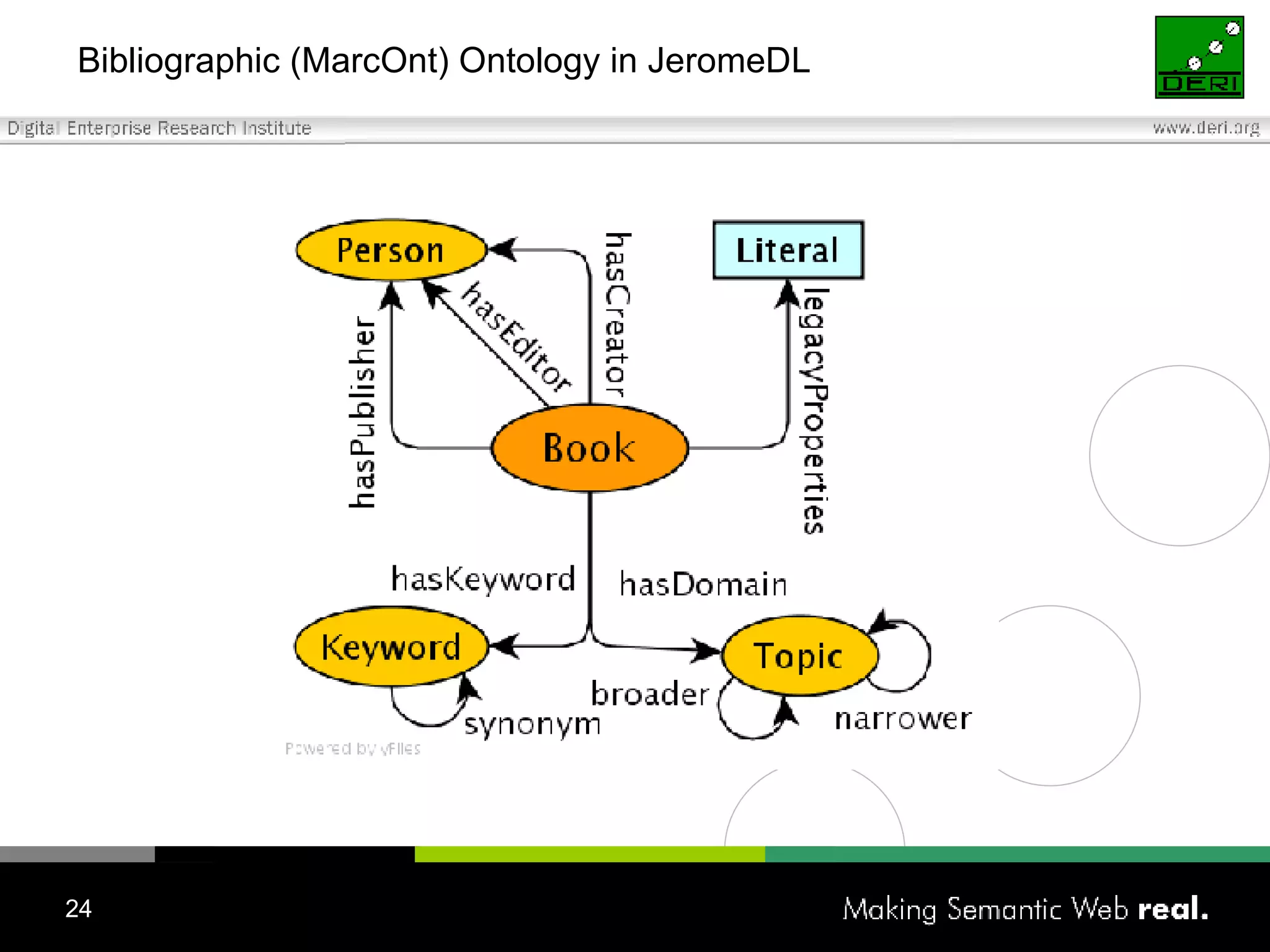
Bibliographic (MarcOnt) Ontology in JeromeDL
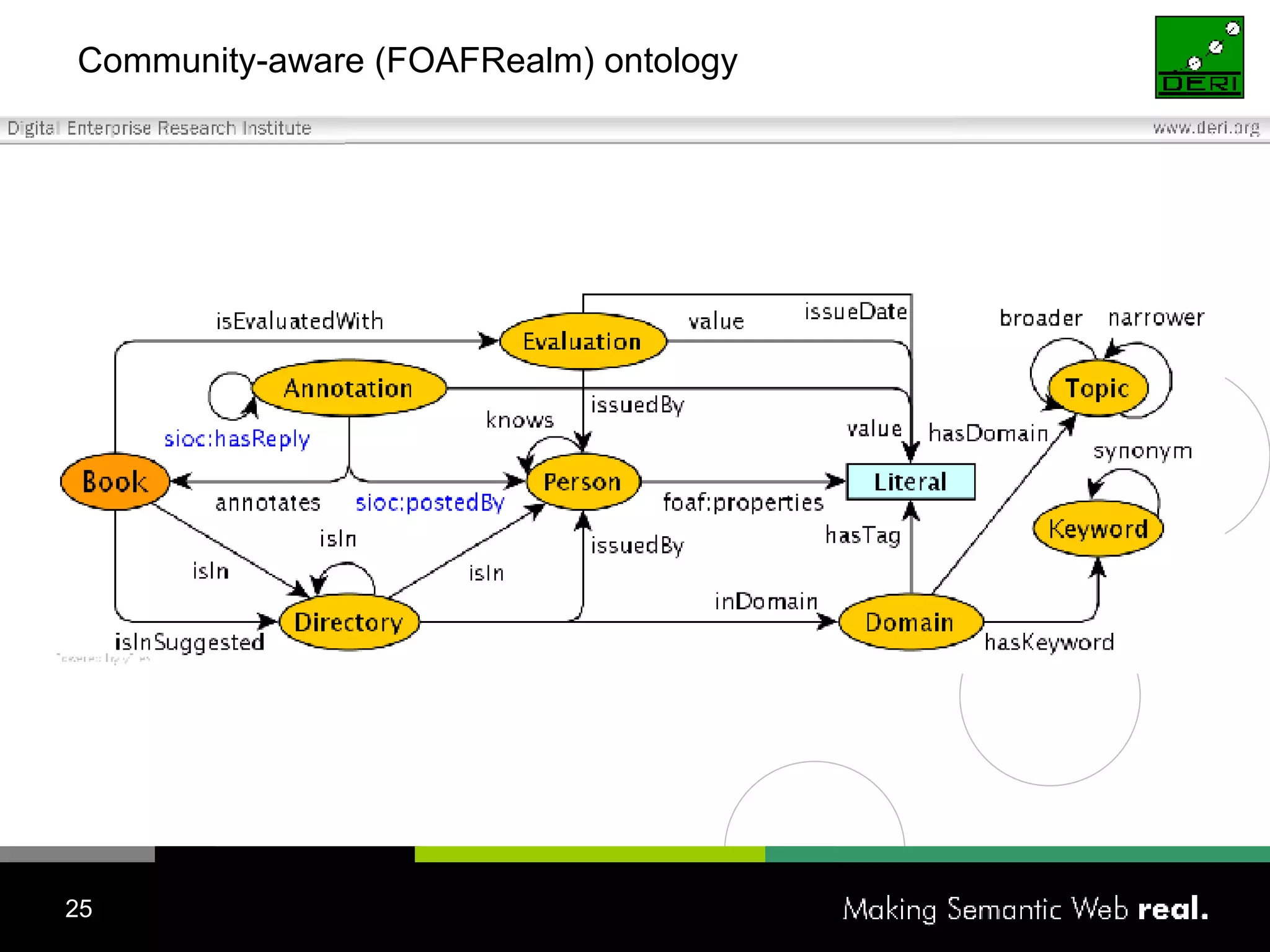
Community-aware (FOAFRealm) ontology
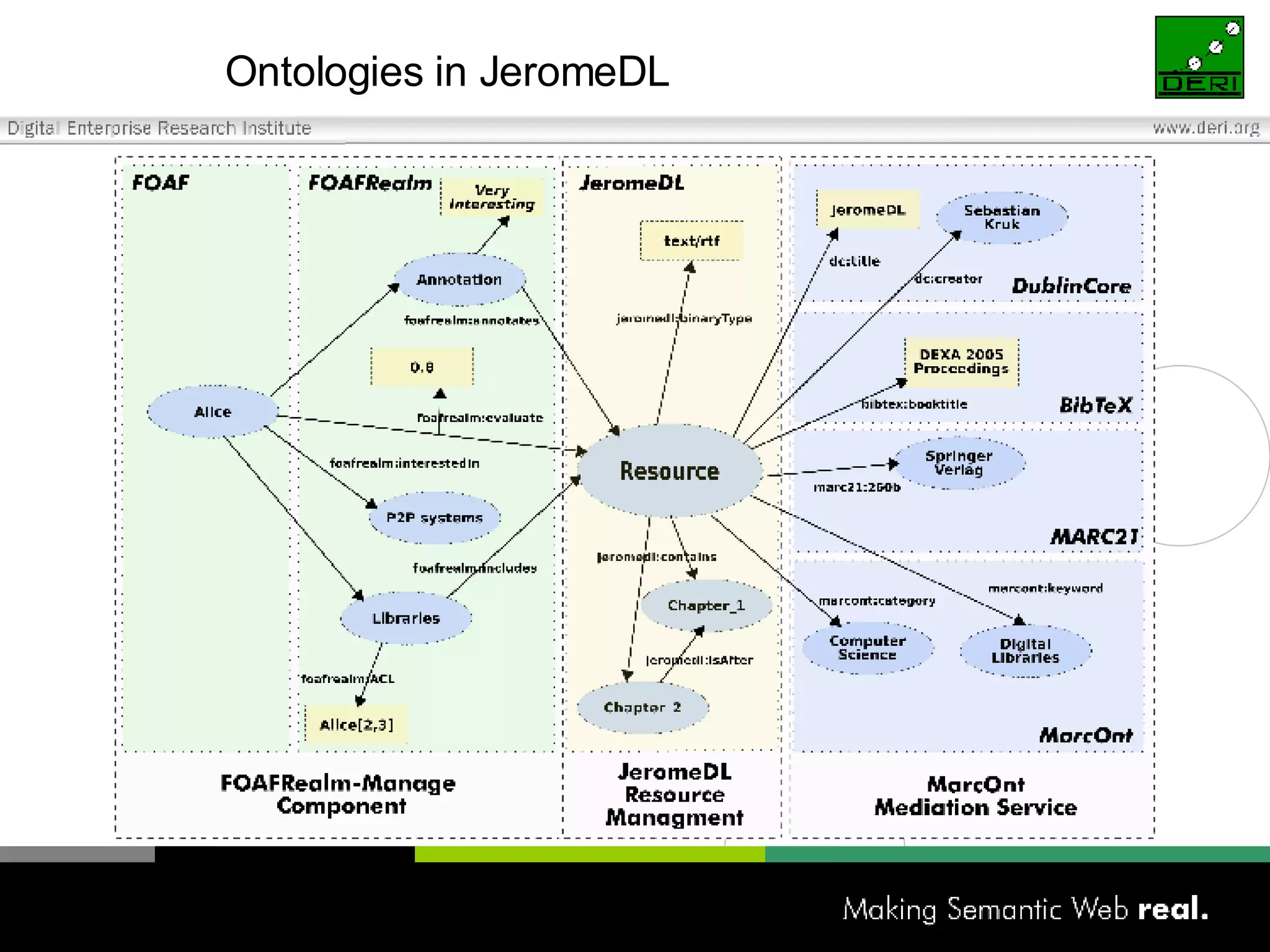
Ontologies in JeromeDL
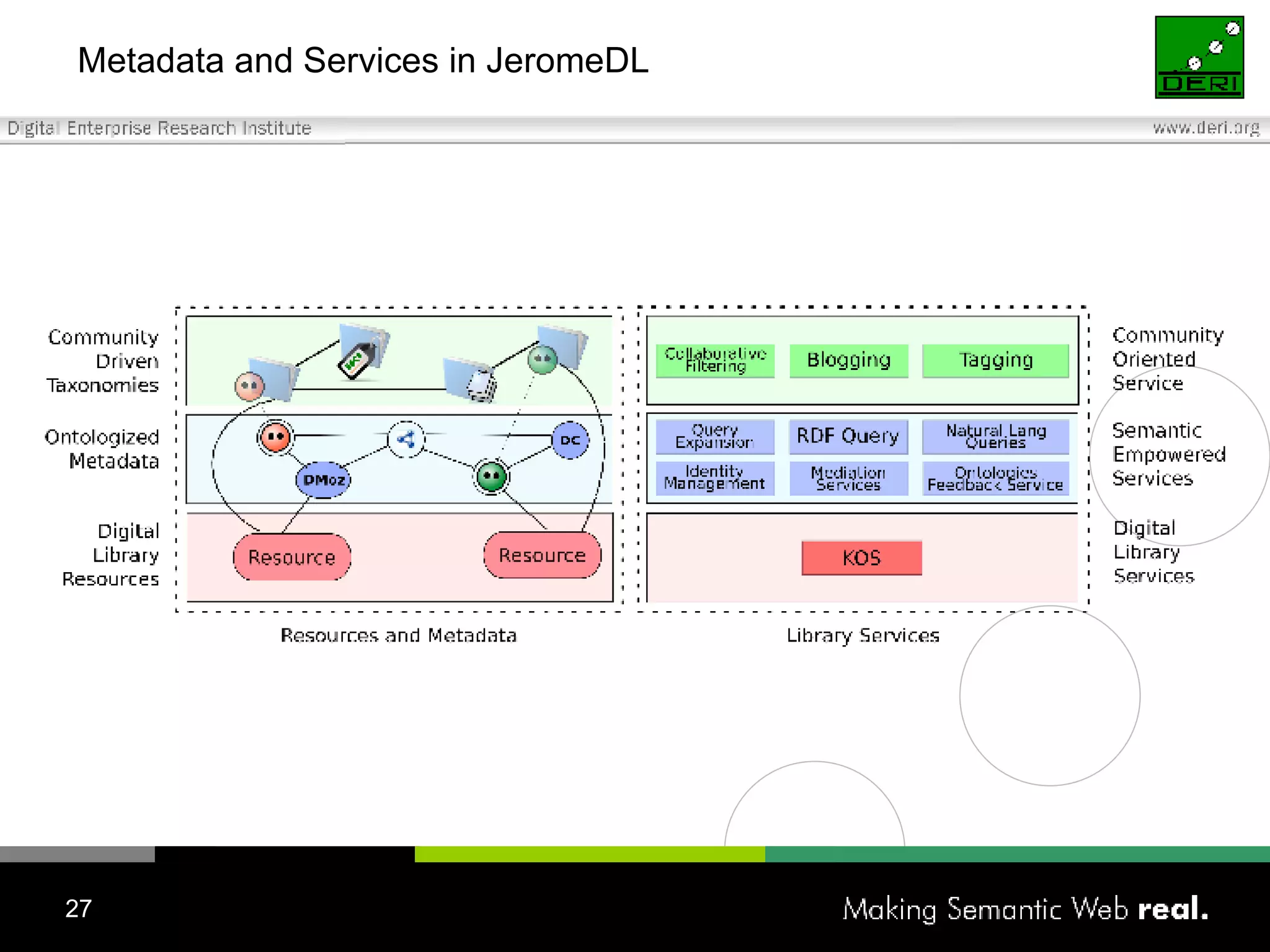
Metadata and Services in JeromeDL
Presentation outline Motivation Building Social Semantic Digital Library Semantic Digital Libraries Towards Online Communities for Digital Libraries JeromeDL and other Corrib components Motivation and Overview Architecture and Ontologies Semantic Services Social Services Semantics in Use JeromeDL in Action e-Learning 2.0 Conclusions
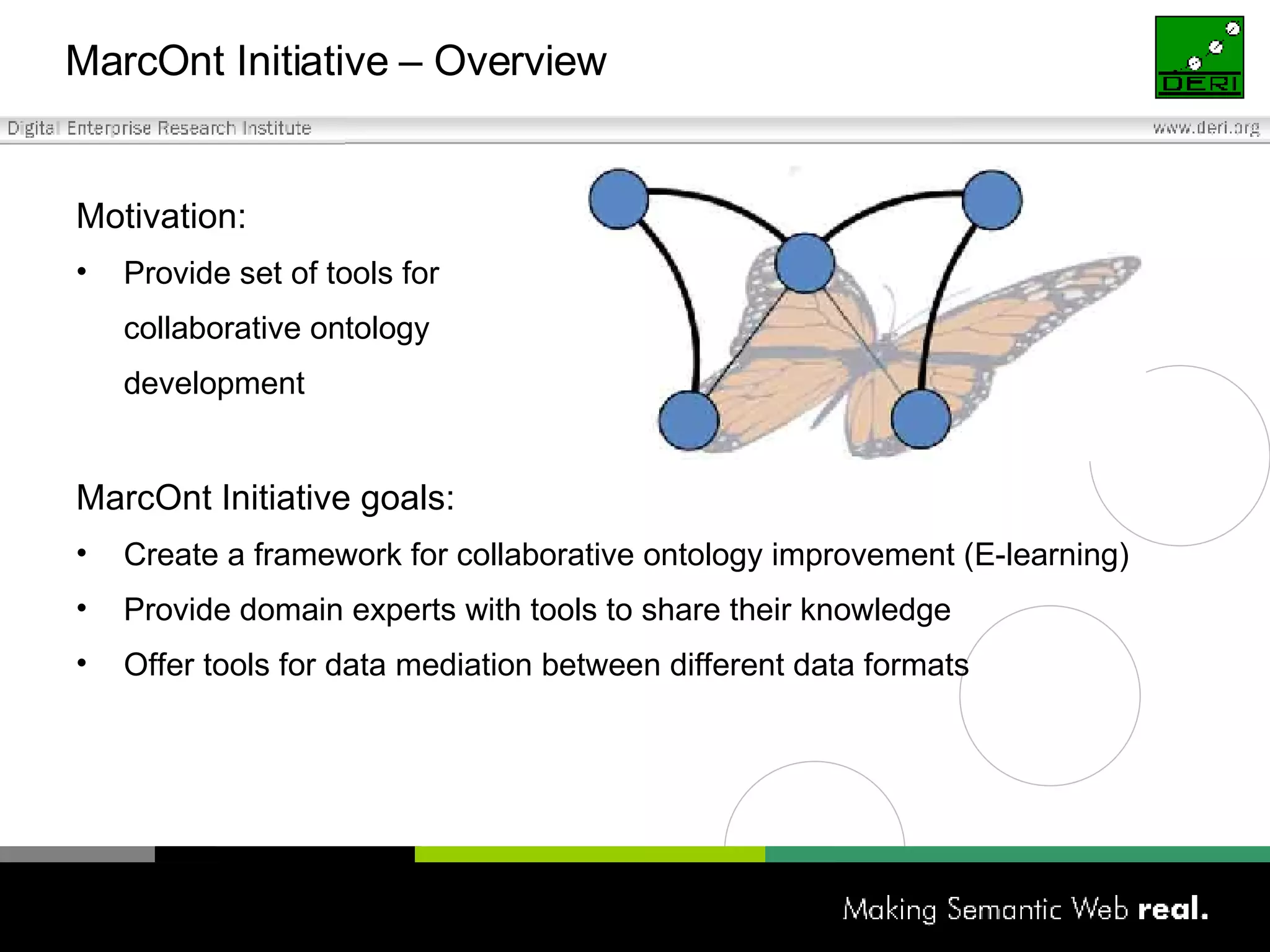
MarcOnt Initiative – Overview Motivation: Provide set of tools for  collaborative ontology development MarcOnt Initiative goals: Create a framework for collaborative ontology improvement (E-learning) Provide domain experts with tools to share their knowledge Offer tools for data mediation between different data formats
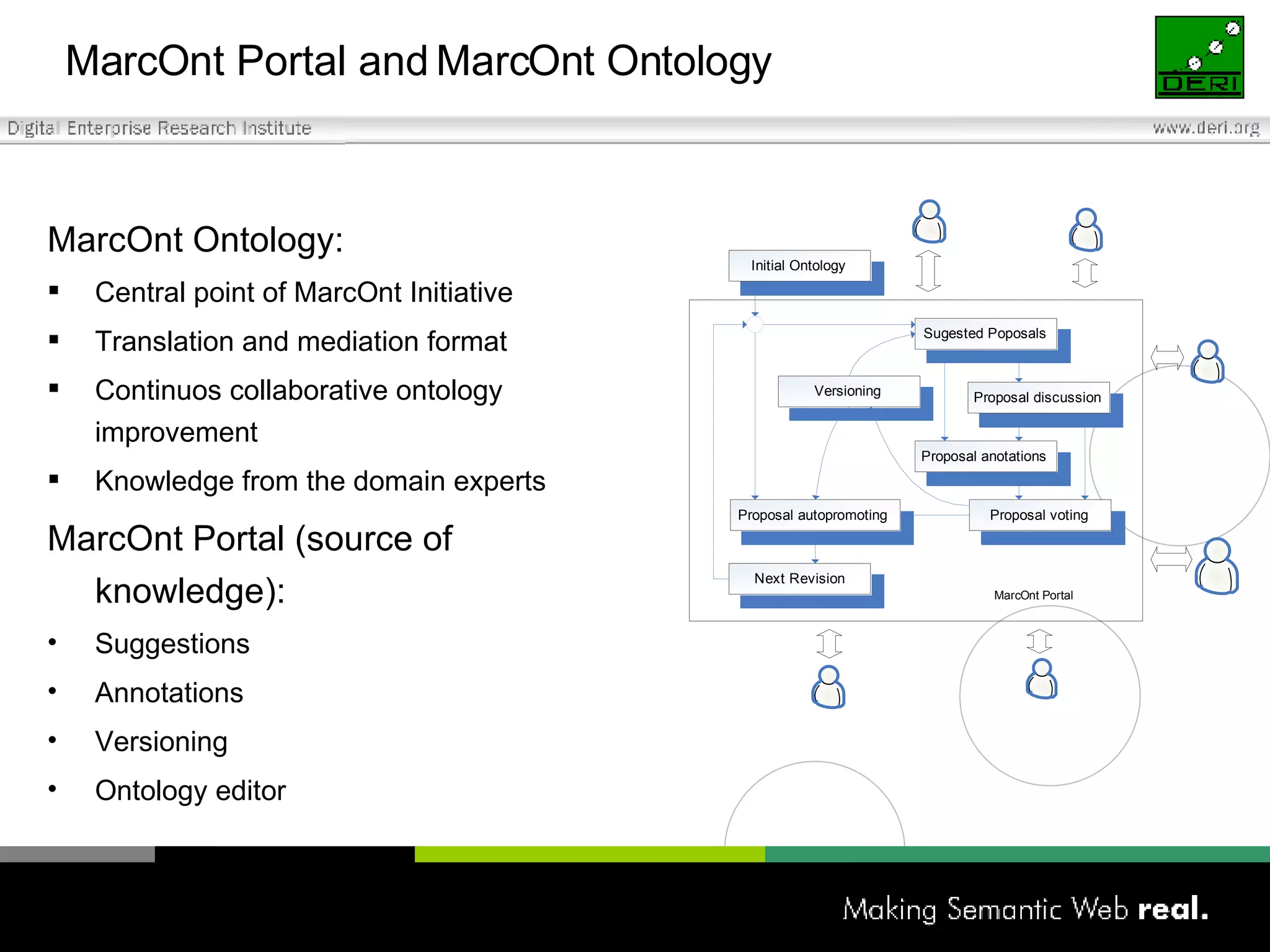
MarcOnt Portal and MarcOnt Ontology MarcOnt Ontology: Central point of MarcOnt Initiative Translation and mediation format Continuos collaborative ontology improvement Knowledge from the domain experts MarcOnt Portal (source of knowledge): Suggestions Annotations Versioning Ontology editor
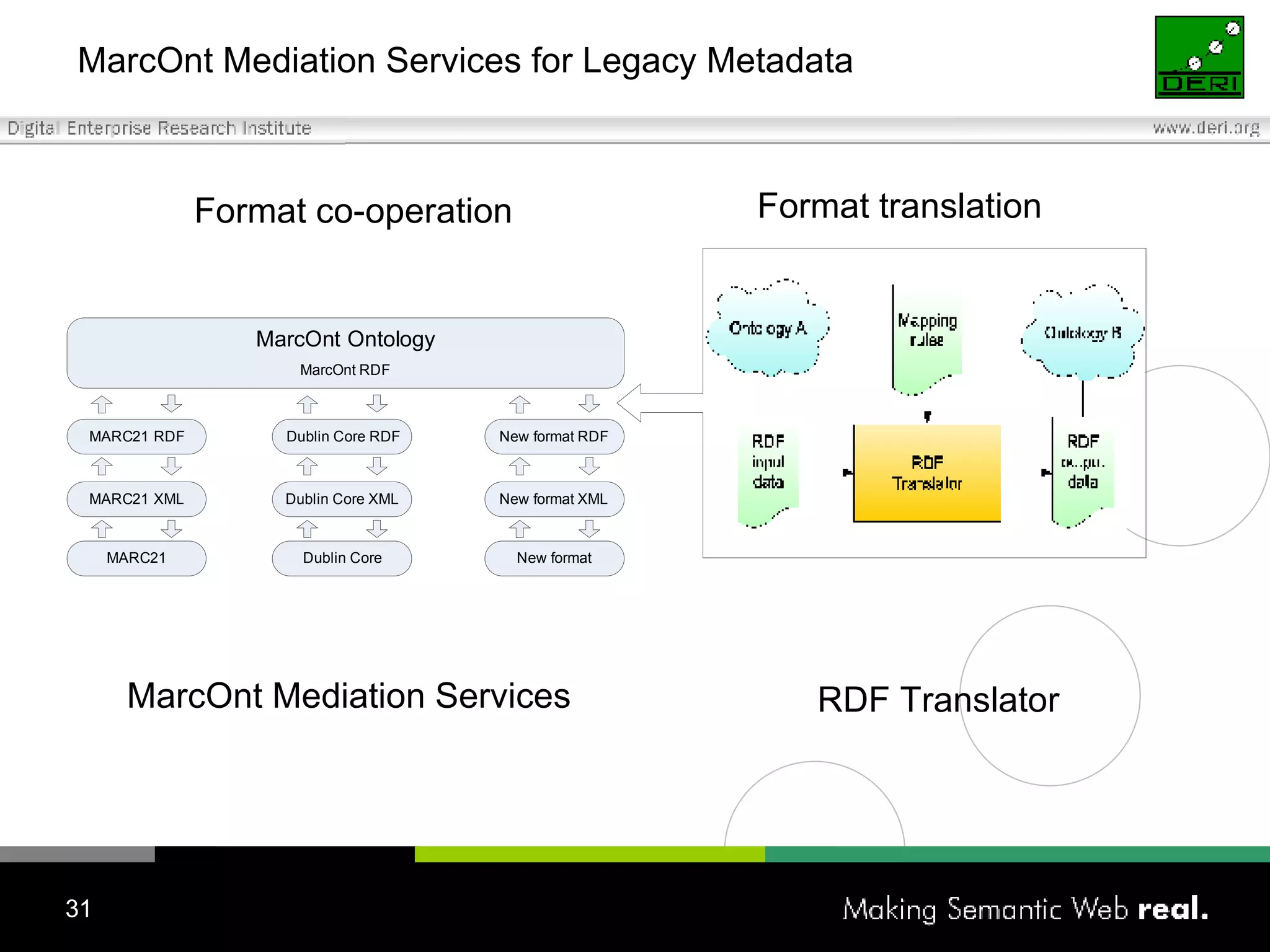
MarcOnt Mediation Services for Legacy Metadata Format translation RDF Translator Format co-operation MarcOnt Mediation Services
Presentation outline Motivation Building Social Semantic Digital Library Semantic Digital Libraries Towards Online Communities for Digital Libraries JeromeDL and other Corrib components Motivation and Overview Architecture and Ontologies Semantic Services Social Services Semantics in Use JeromeDL in Action e-Learning 2.0 Conclusions
Social Services in JeromeDL Involve users into sharing knowledge Blogs –  comments and discussions  about documents and resources  Tagging –  collaborative classification Wikis –  collaboratively edited additional descriptions , such as summaries and interesting facts Preserve knowledge for future use Users can  learn from experience of others  instantly Recommend  new, interesting resources based on users’ profiles
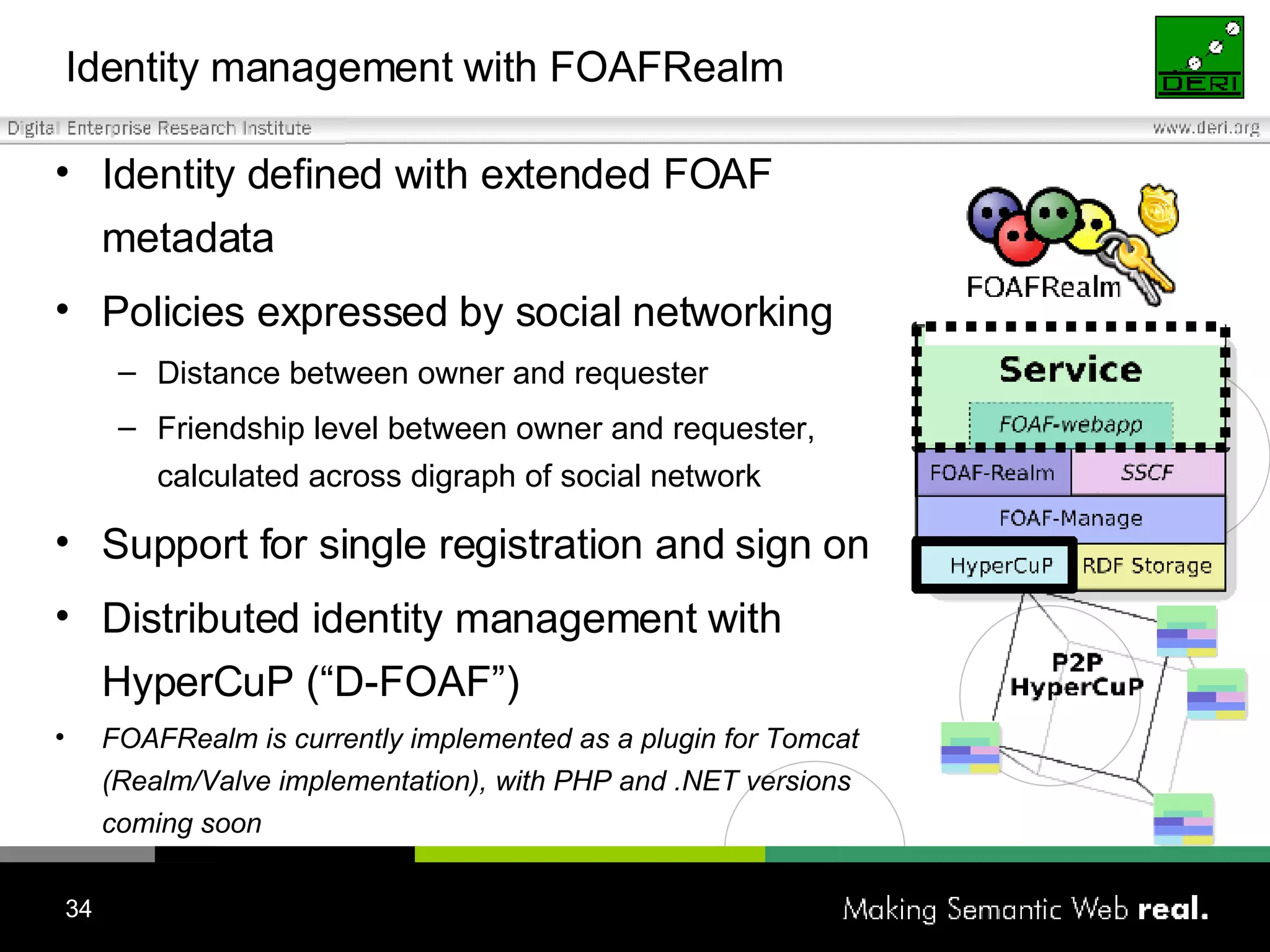
Identity management with FOAFRealm Identity defined with extended FOAF metadata Policies expressed by social networking  Distance between owner and requester Friendship level between owner and requester, calculated across digraph of social network Support for single registration and sign on Distributed identity management with HyperCuP (“D-FOAF”) FOAFRealm is currently implemented as a plugin for Tomcat (Realm/Valve implementation), with PHP and .NET versions coming soon
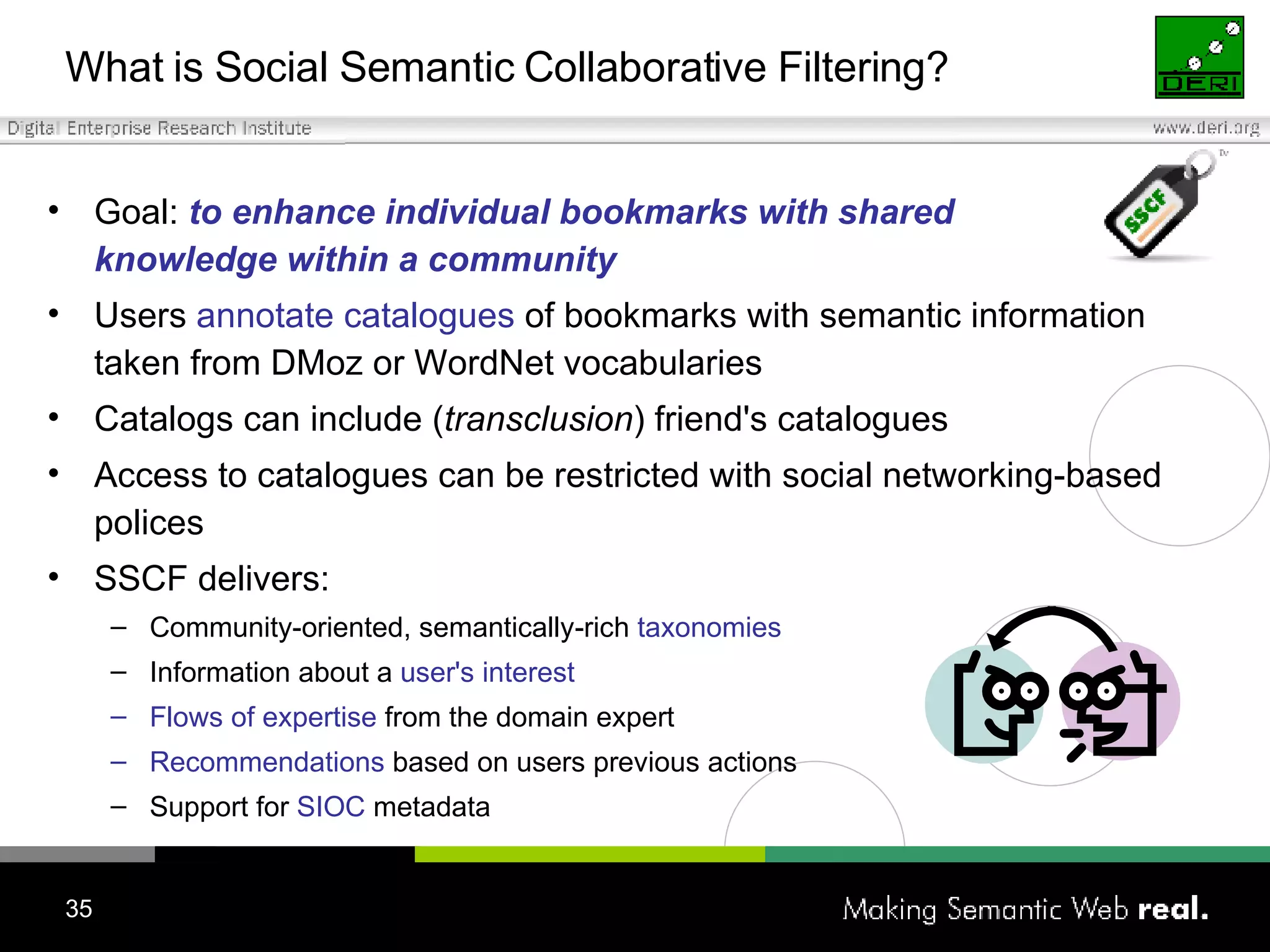
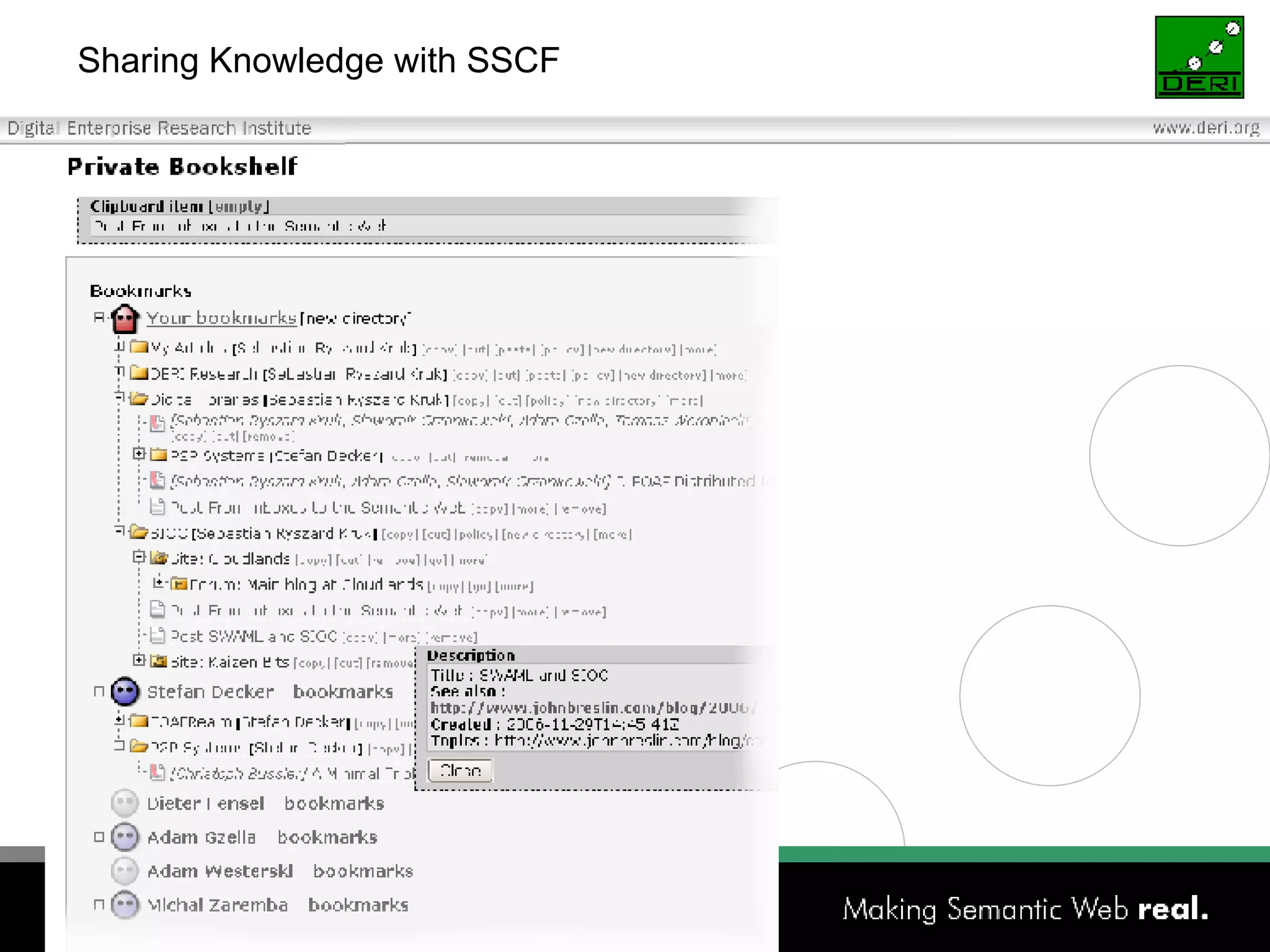
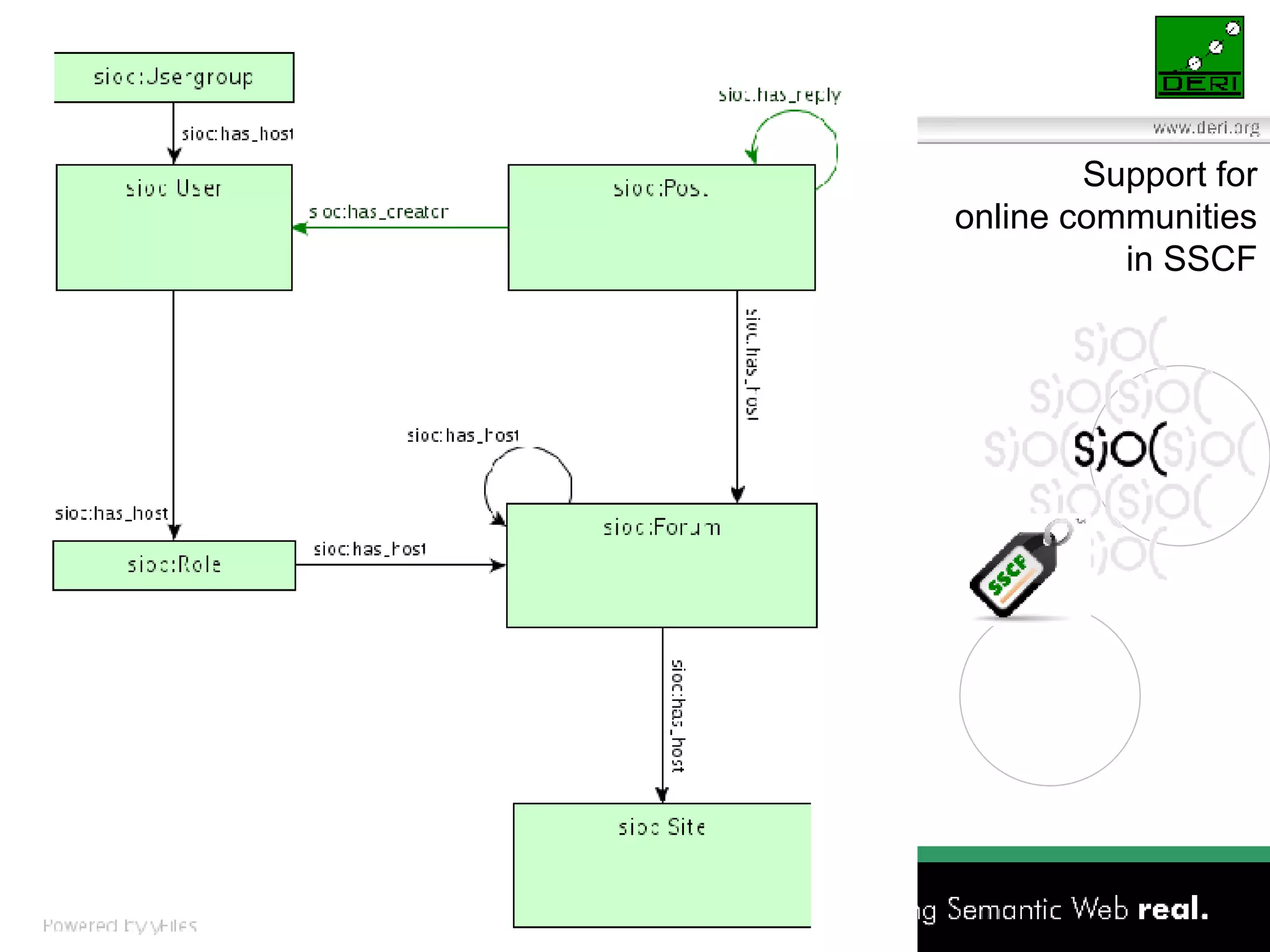
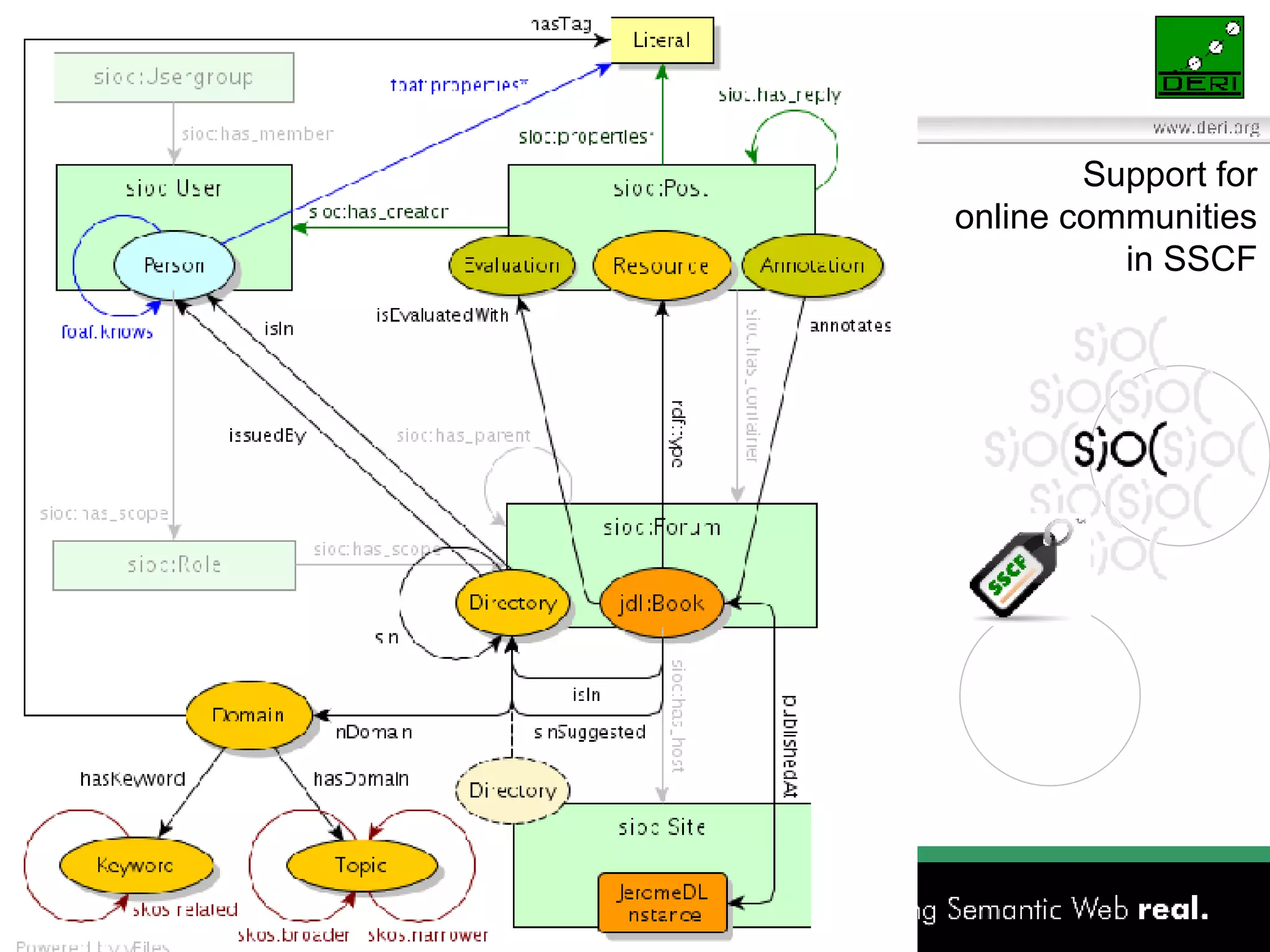
What is  S ocial  S emantic  C ollaborative  F iltering? Goal:   t o enhance individual bookmarks with shared  knowledge within a community Users  annotate catalogues  of bookmarks with semantic information taken from DM oz  or WordNet vocabularies Catalogs can include ( transclusion ) friend's catalogues Access to catalogues can be restricted with social networking-based polices SSCF delivers: Community-oriented, semantically-rich  taxonomies Information about a  user's interest   Flows of expertise  from the domain expert Recommendations  based on users previous actions Support for  SIOC  metadata
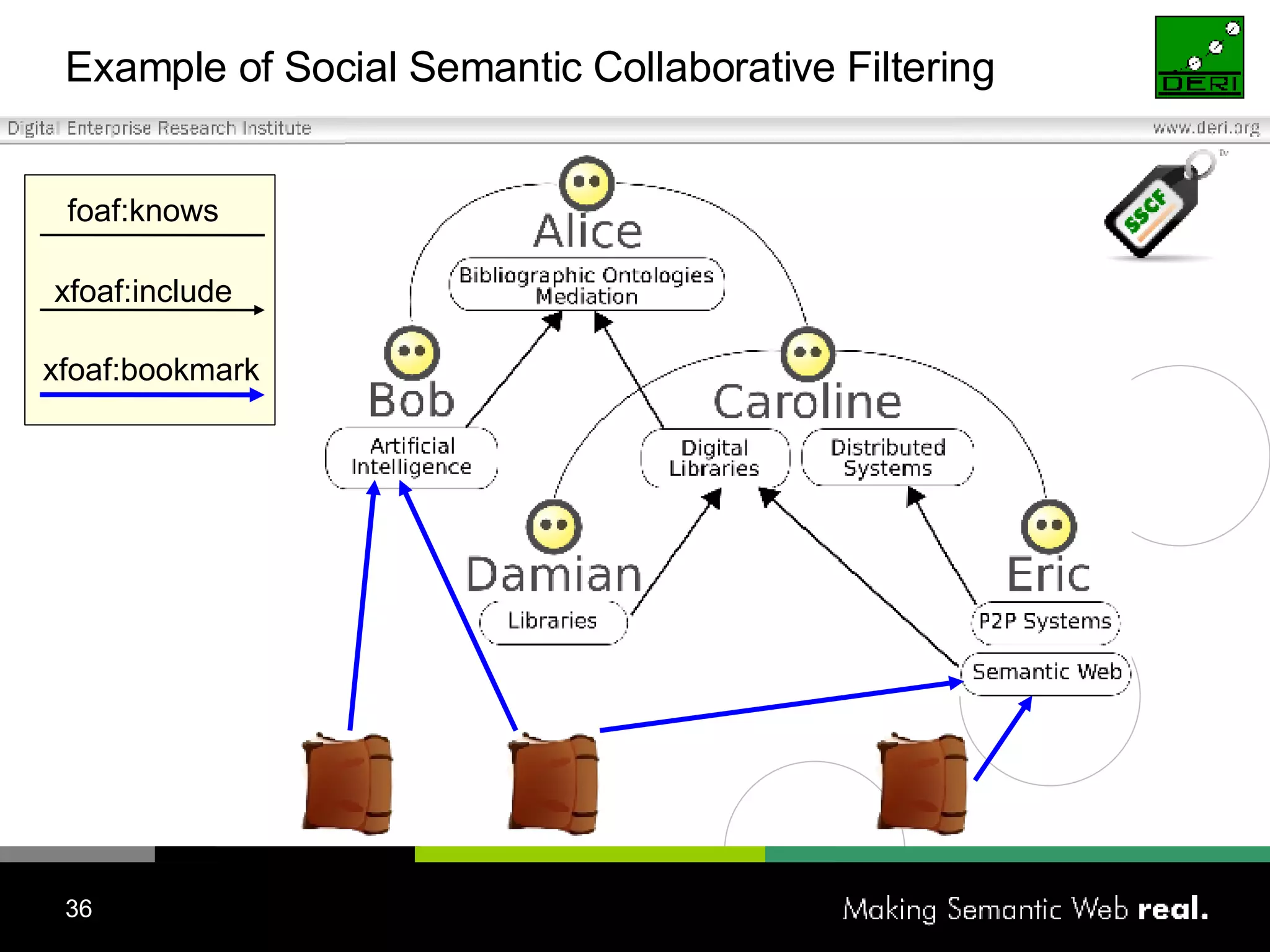
Example of  S ocial  S emantic  C ollaborative  F iltering foaf:knows xfoaf:include xfoaf:bookmark
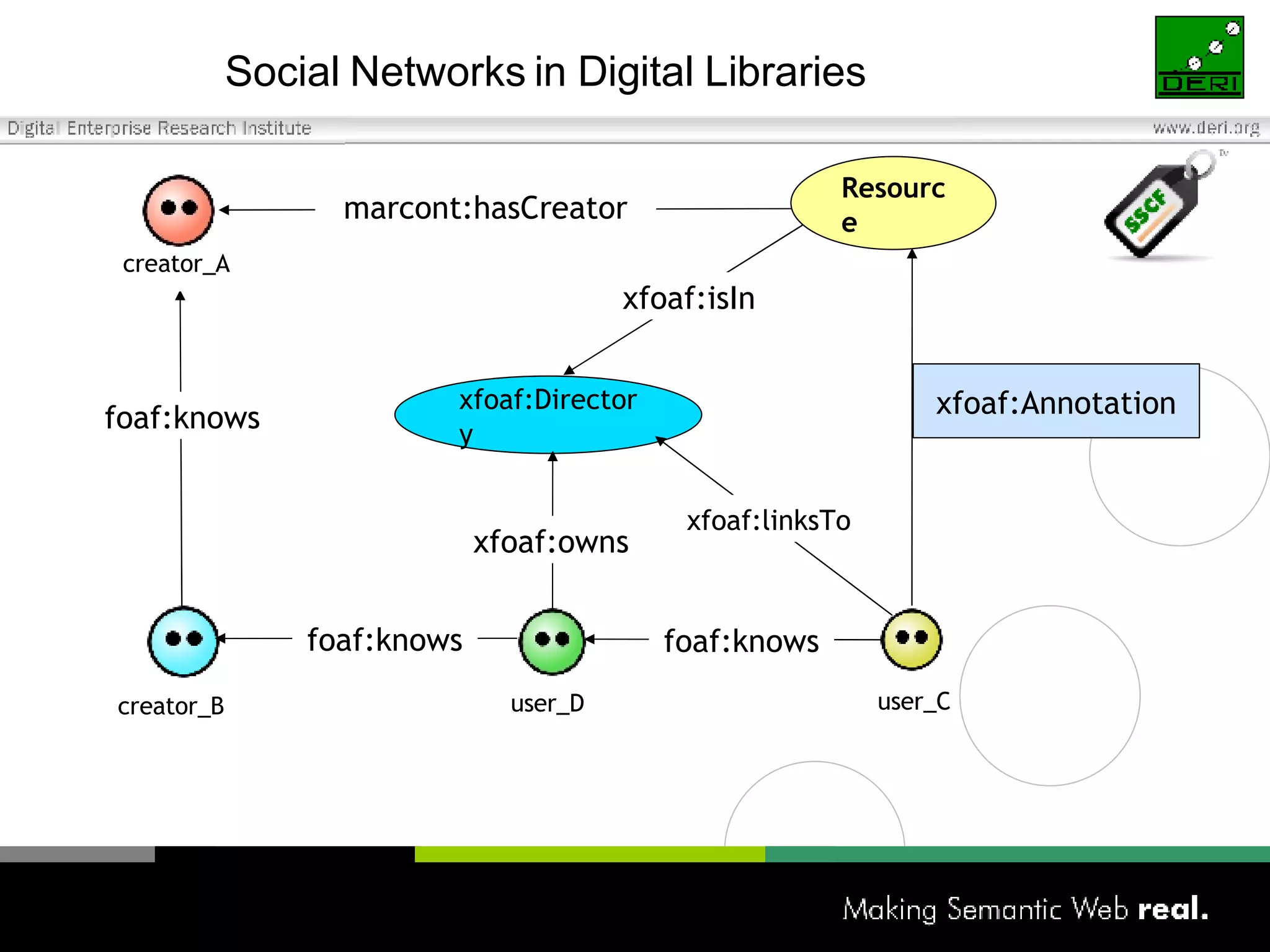
Social Networks in Digital Libraries Resource xfoaf:Annotation user_C creator_B foaf:knows marcont:hasCreator creator_A foaf:knows foaf:knows xfoaf:Directory user_D xfoaf:owns xfoaf:linksTo xfoaf:isIn
Support for online communities in SSCF
Presentation outline Motivation Building Social Semantic Digital Library Semantic Digital Libraries Towards Online Communities for Digital Libraries JeromeDL and other Corrib components Motivation and Overview Architecture and Ontologies Semantic Services Social Services Semantics in Use JeromeDL in Action e-Learning 2.0 Conclusions
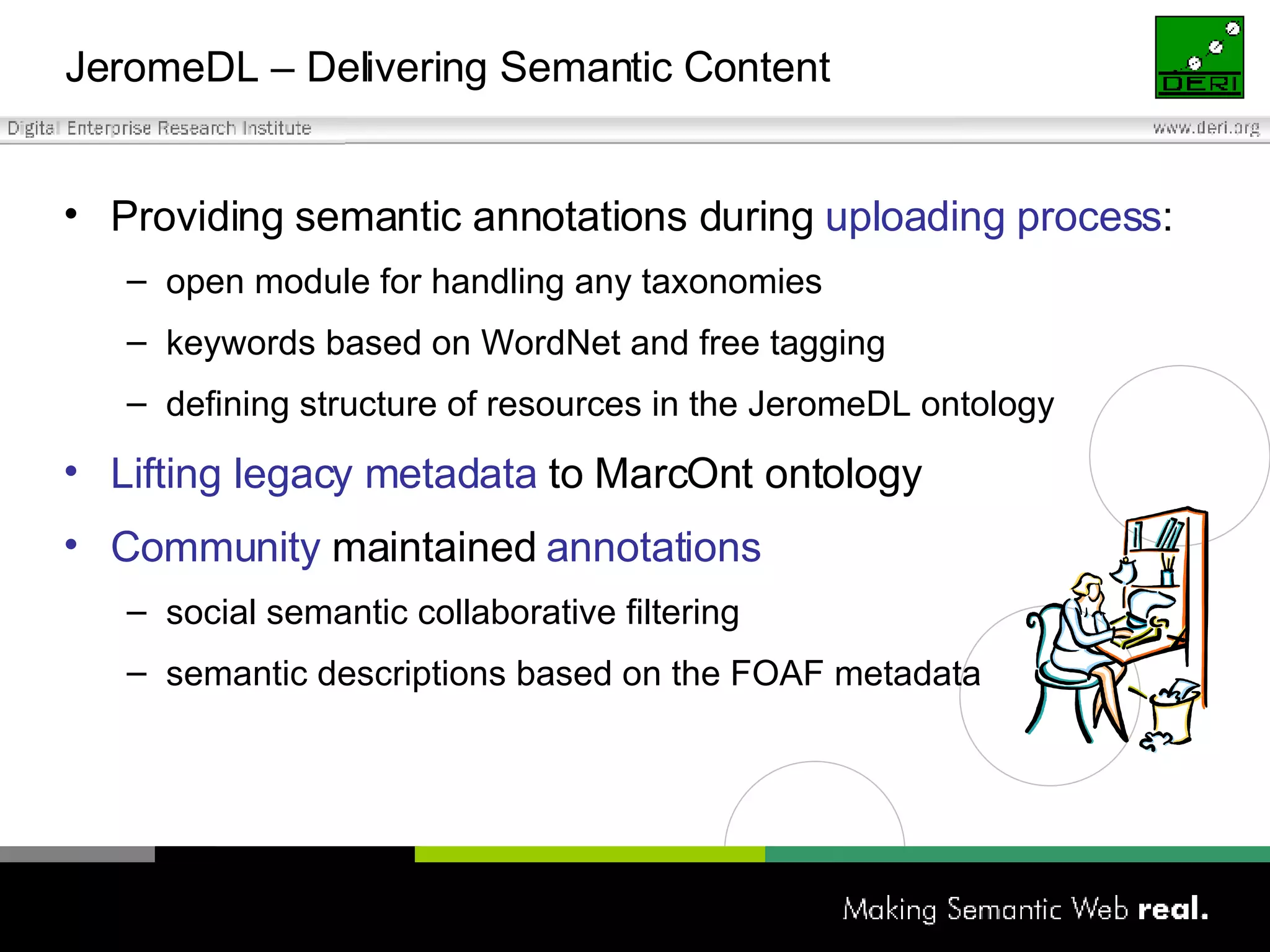
JeromeDL – Delivering Semantic Content Providing semantic annotations during  uploading process : open module for handling any taxonomies keywords based on WordNet and free tagging defining structure of resources in the JeromeDL ontology Lifting legacy metadata  to MarcOnt ontology Community  maintained  annotations social semantic collaborative filtering semantic descriptions based on the FOAF metadata
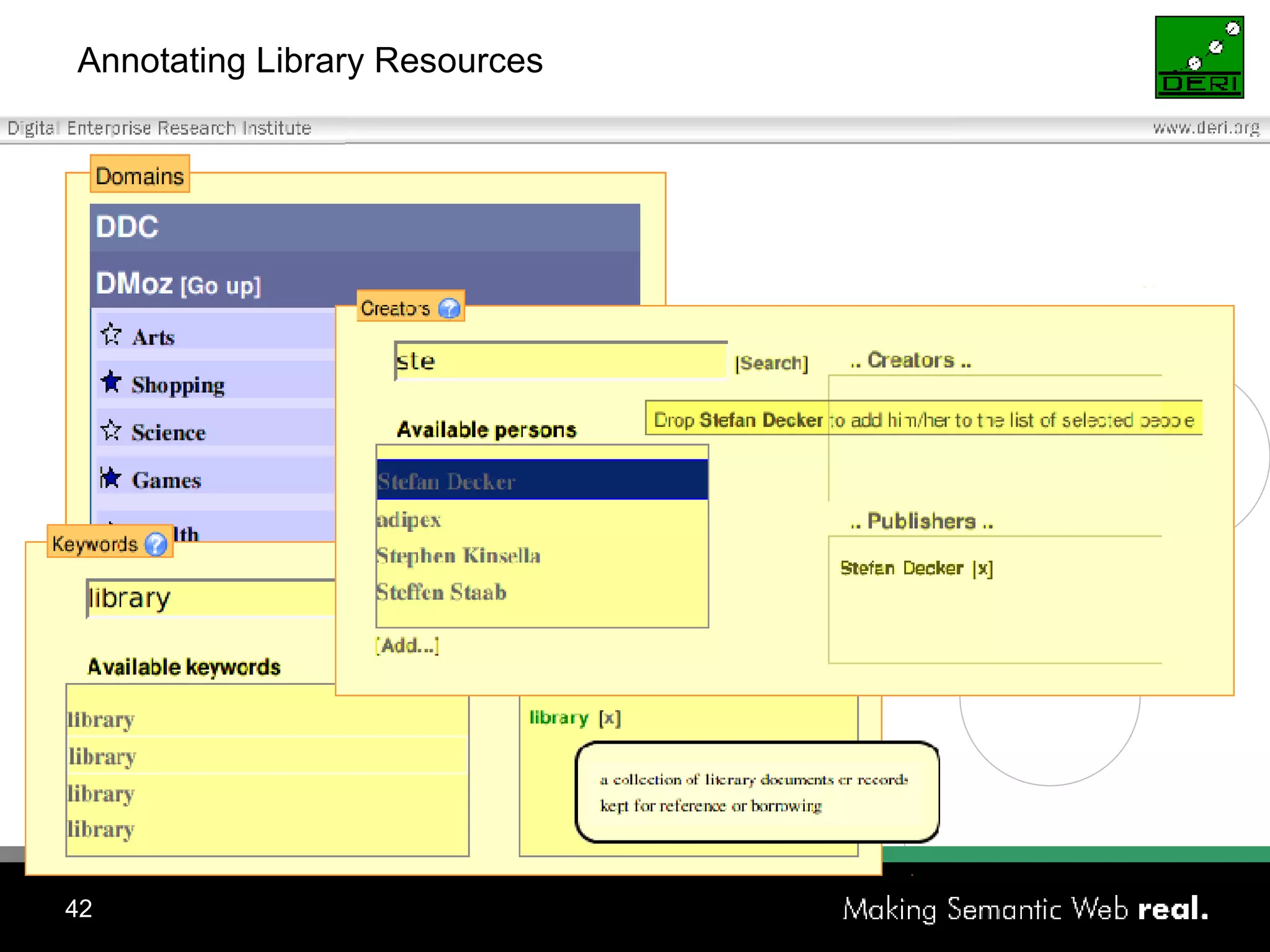
Annotating Library Resources
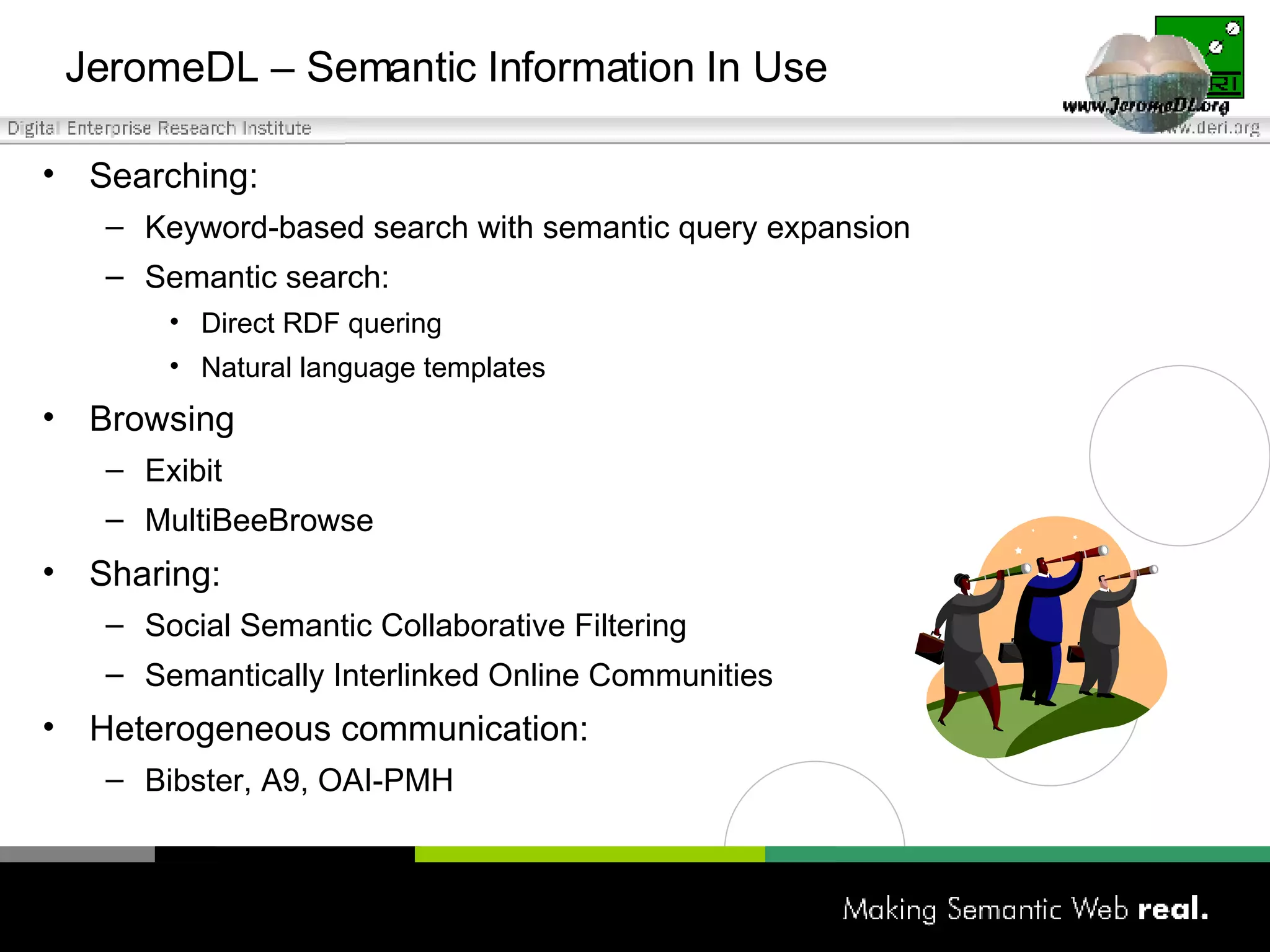
JeromeDL – Semantic Information In Use Searching: Keyword-based search with semantic query expansion Semantic search: Direct RDF quering Natural language templates Browsing Exibit MultiBeeBrowse Sharing: Social Semantic Collaborative Filtering Semantically Interlinked Online Communities Heterogeneous communication: Bibster ,  A9 ,  OAI -PMH
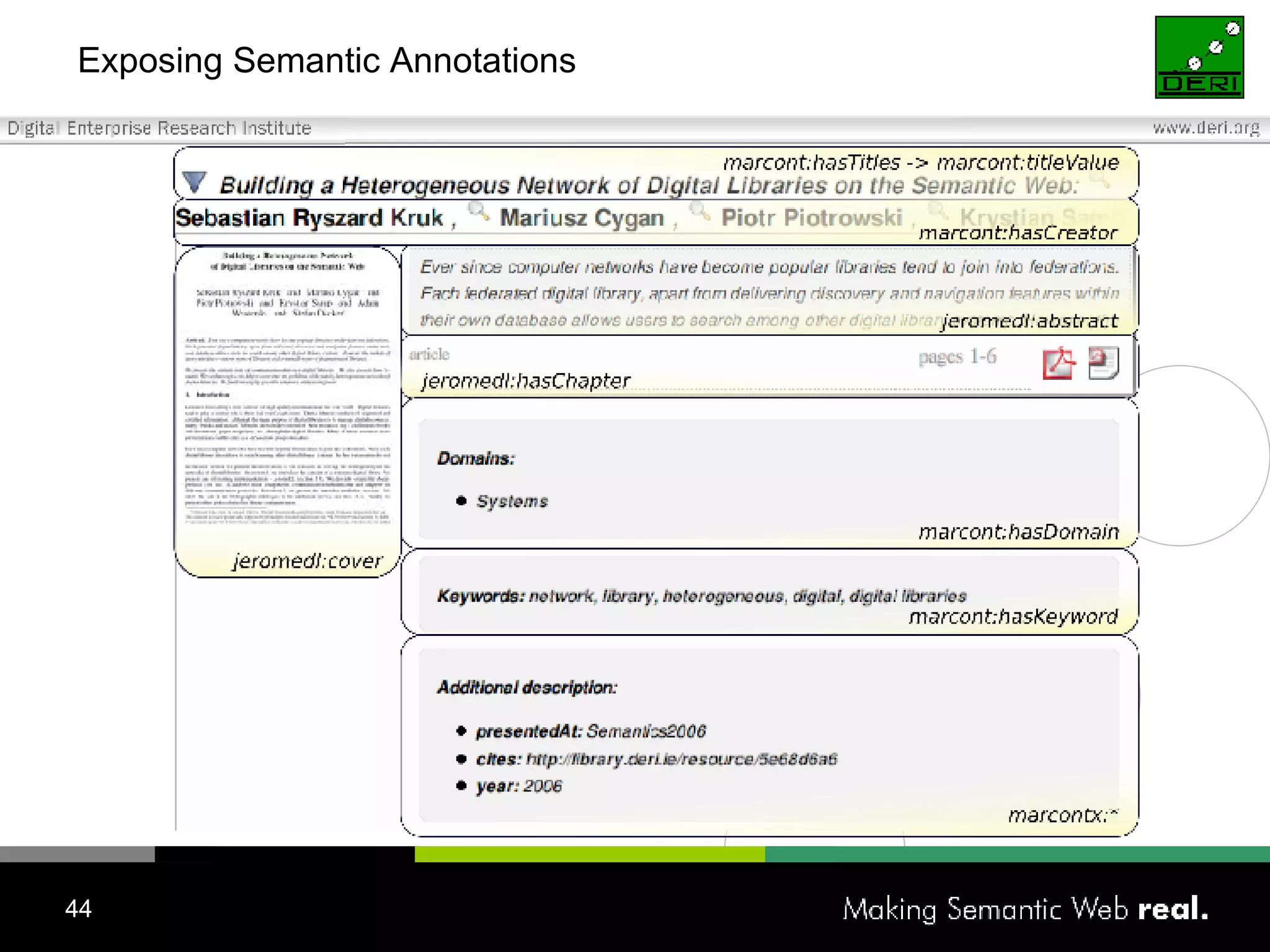
Exposing Semantic Annotations
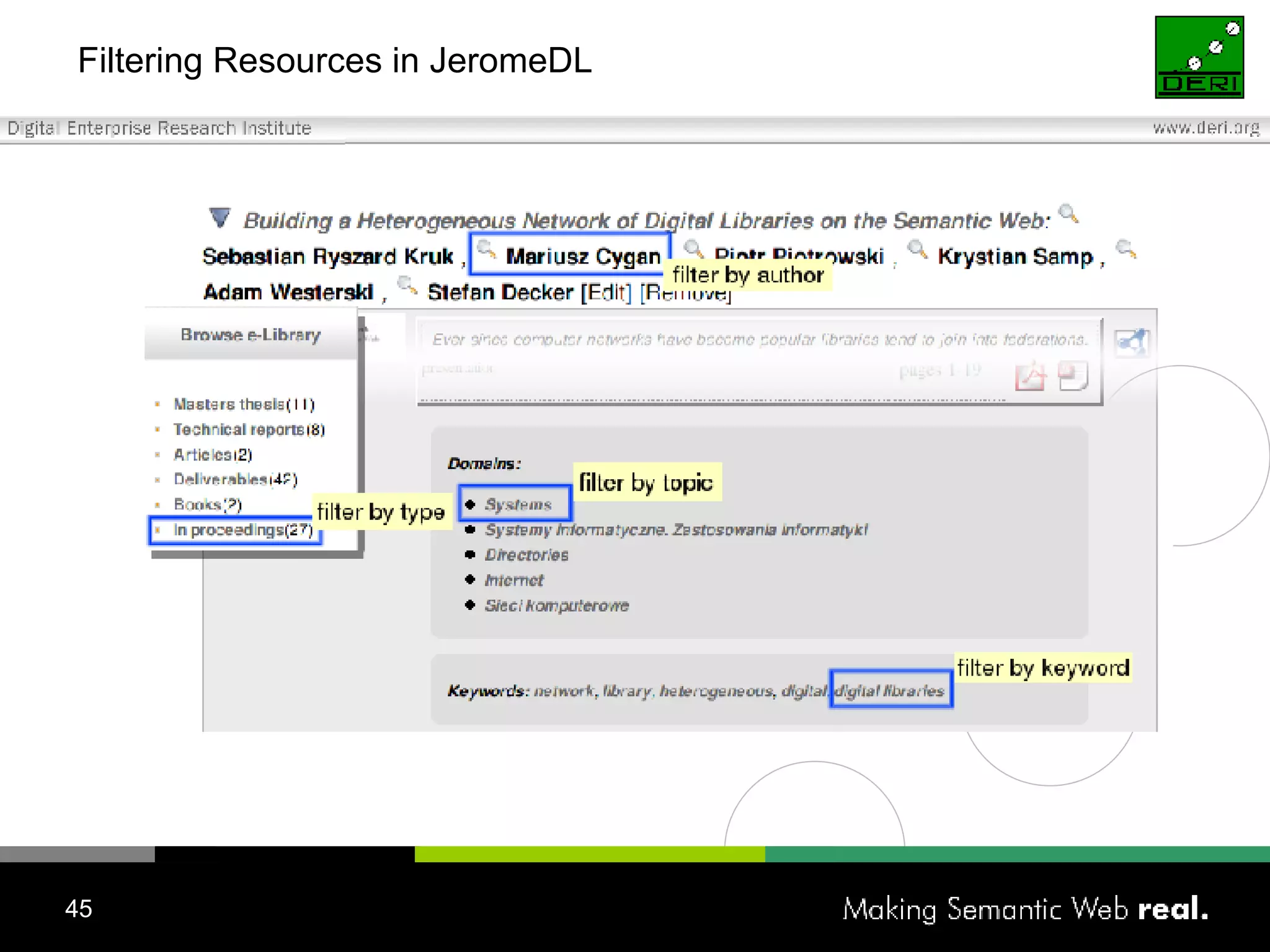
Filtering Resources in JeromeDL
Sharing Knowledge with SSCF
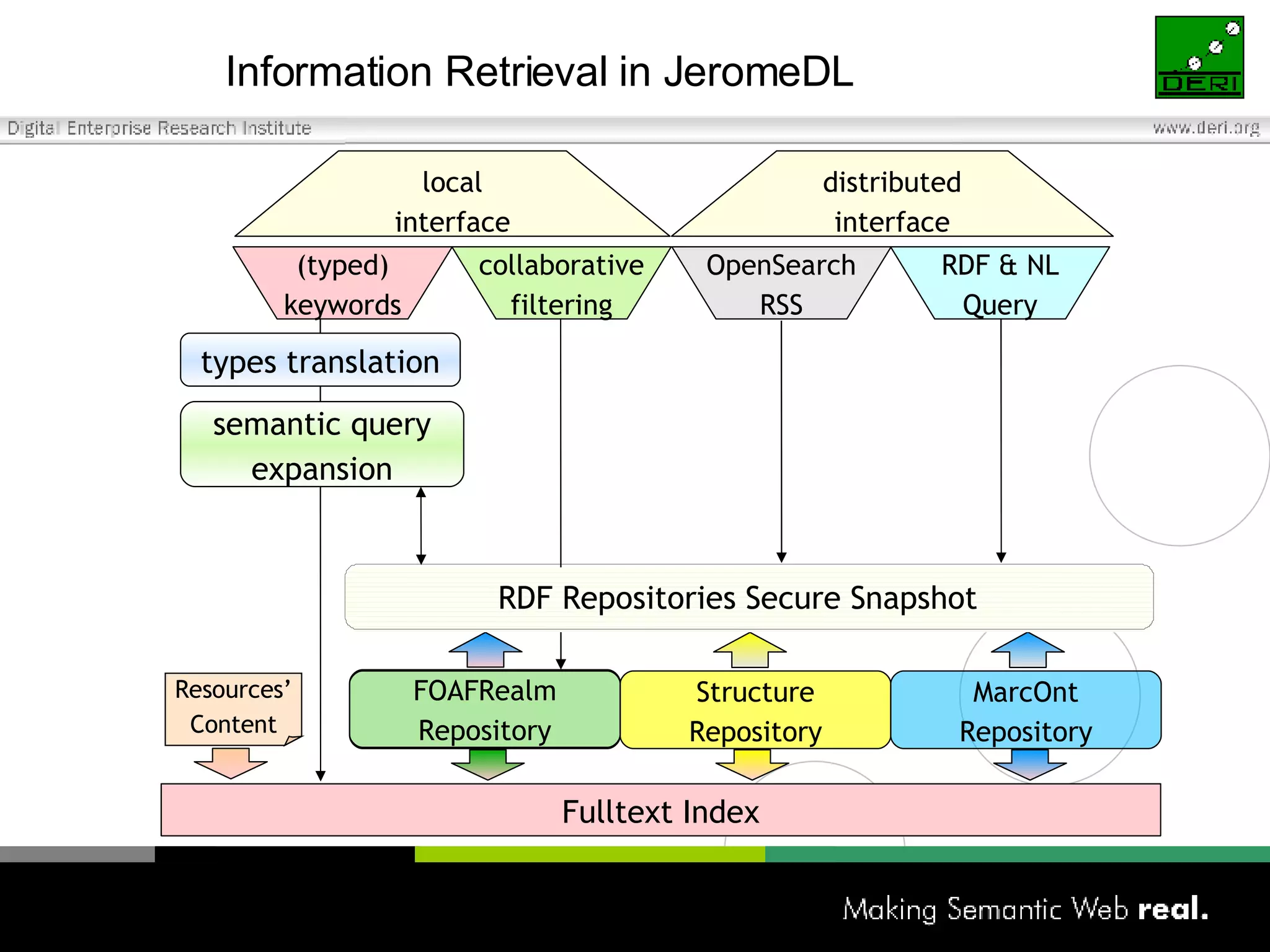
Information Retrieval in JeromeDL Fulltext Index Structure Repository MarcOnt Repository Resources’ Content FOAFRealm Repository (typed) keywords RDF & NL Query OpenSearch RSS collaborative filtering types translation semantic query expansion RDF Repositories Secure Snapshot local interface distributed interface
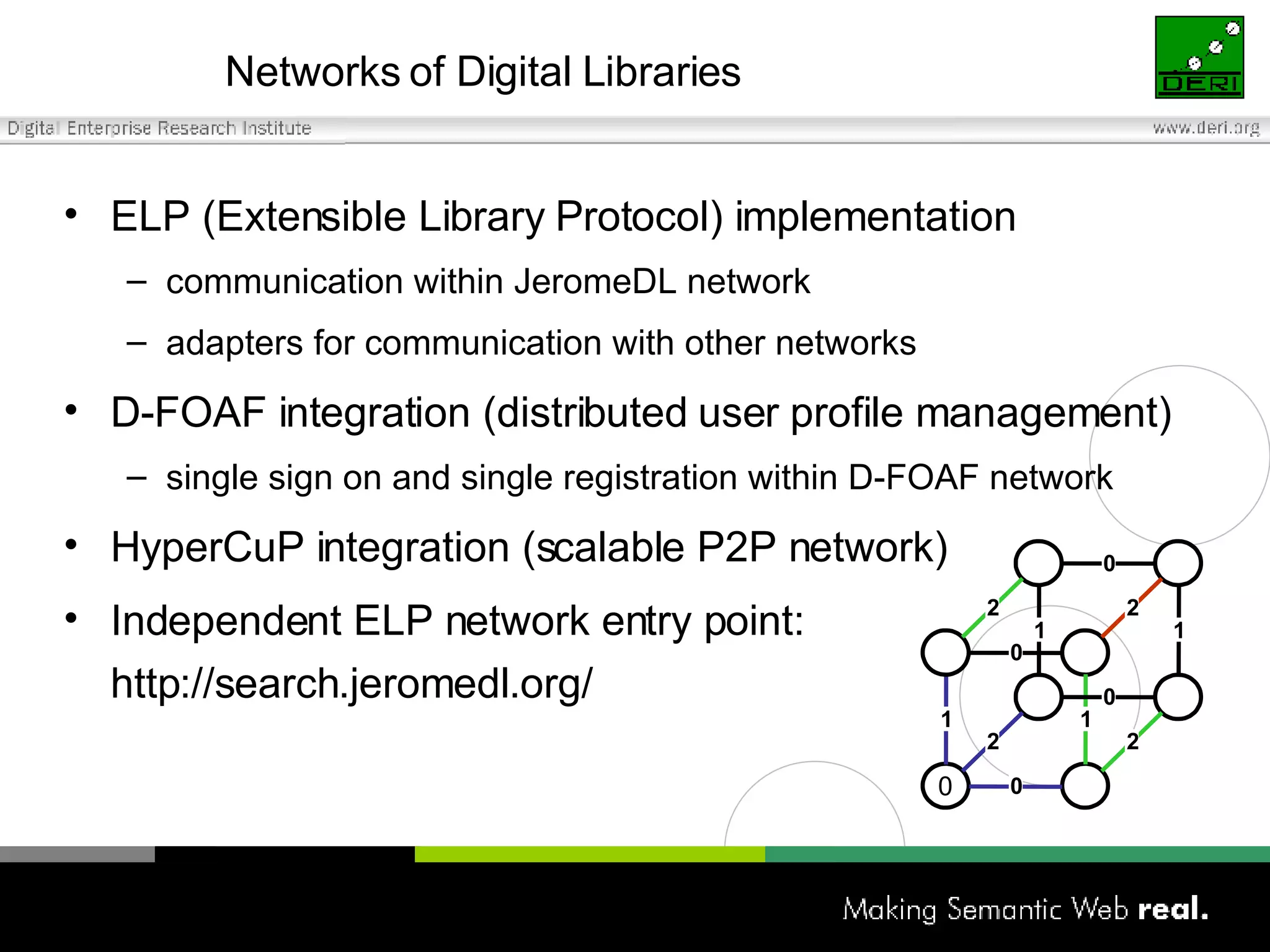
Networks of Digital Libraries  ELP (Extensible Library Protocol) implementation communication within JeromeDL network adapters for communication with other networks D-FOAF integration (distributed user profile management) single sign on and single registration within D-FOAF network HyperCuP integration (scalable P2P network) Independent ELP network entry point: http://search.jeromedl.org/ 0 0 1 1 0 0 1 1 0 2 2 2 2
JeromeDL in Action
Presentation outline Motivation Building Social Semantic Digital Library Semantic Digital Libraries Towards Online Communities for Digital Libraries JeromeDL and other Corrib components Motivation and Overview Architecture and Ontologies Semantic Services Social Services Semantics in Use JeromeDL in Action e-Learning 2.0 Conclusions
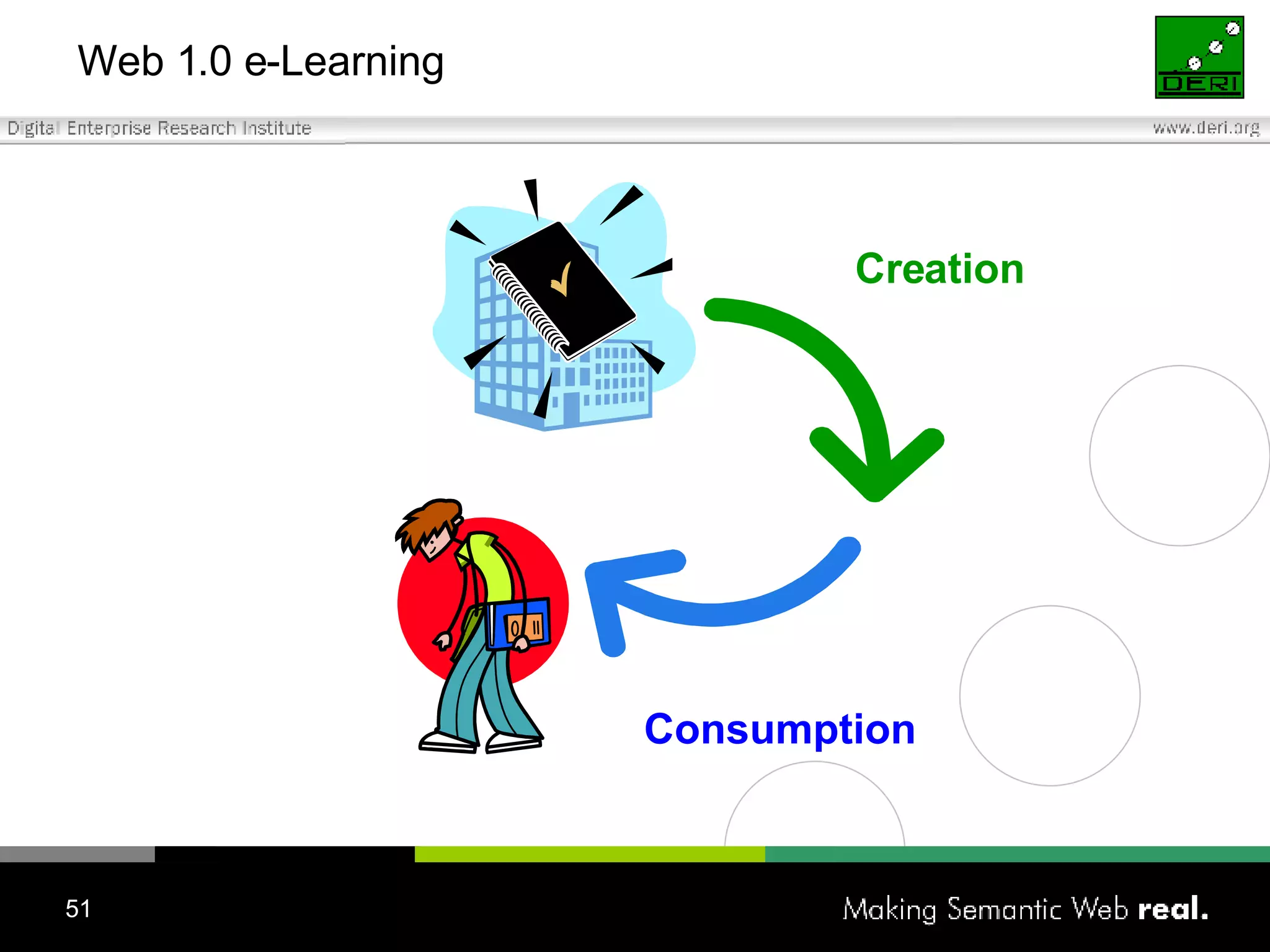
Web 1.0 e-Learning Creation Consumption
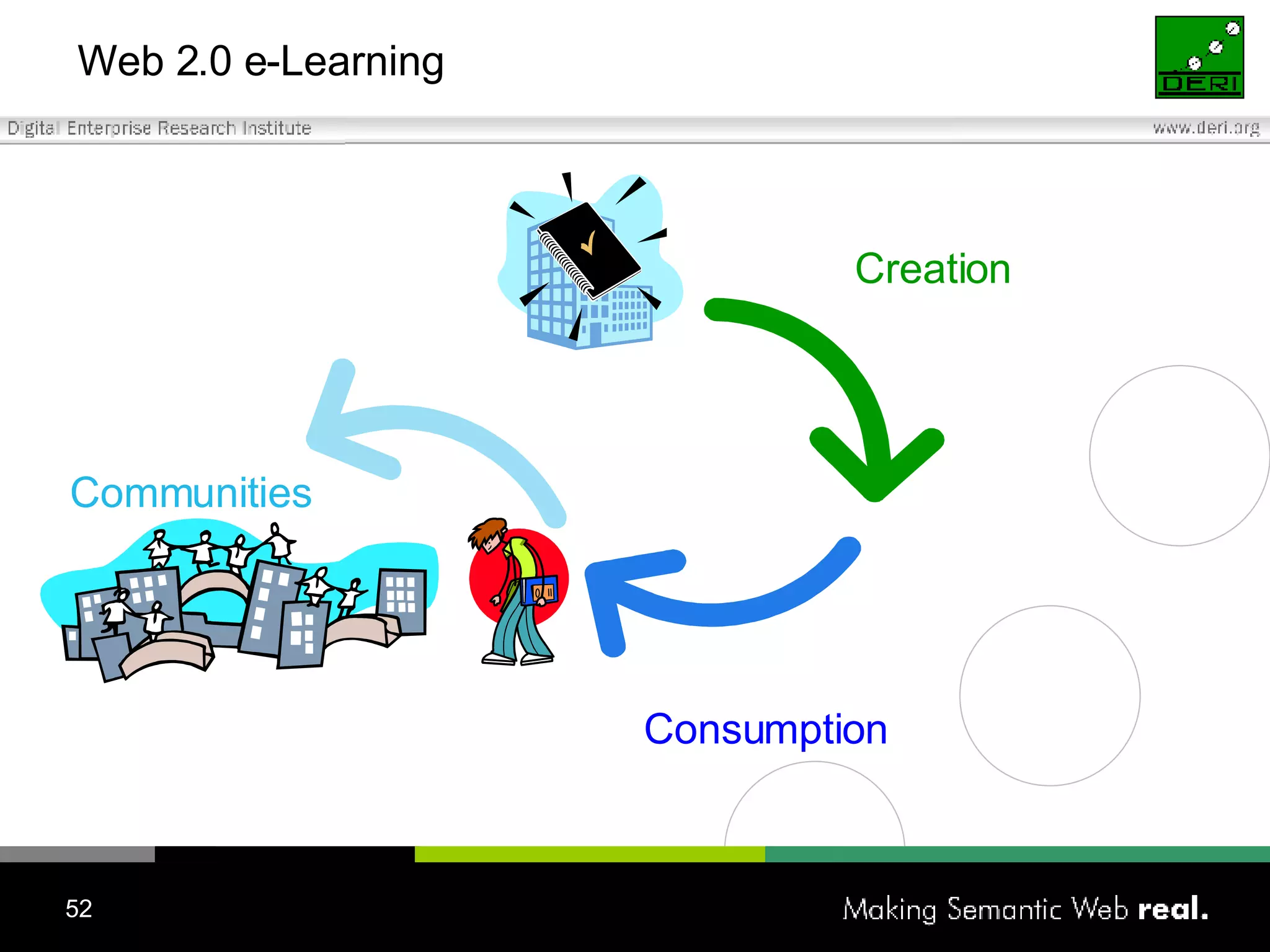
Web 2.0 e-Learning Creation Communities Consumption
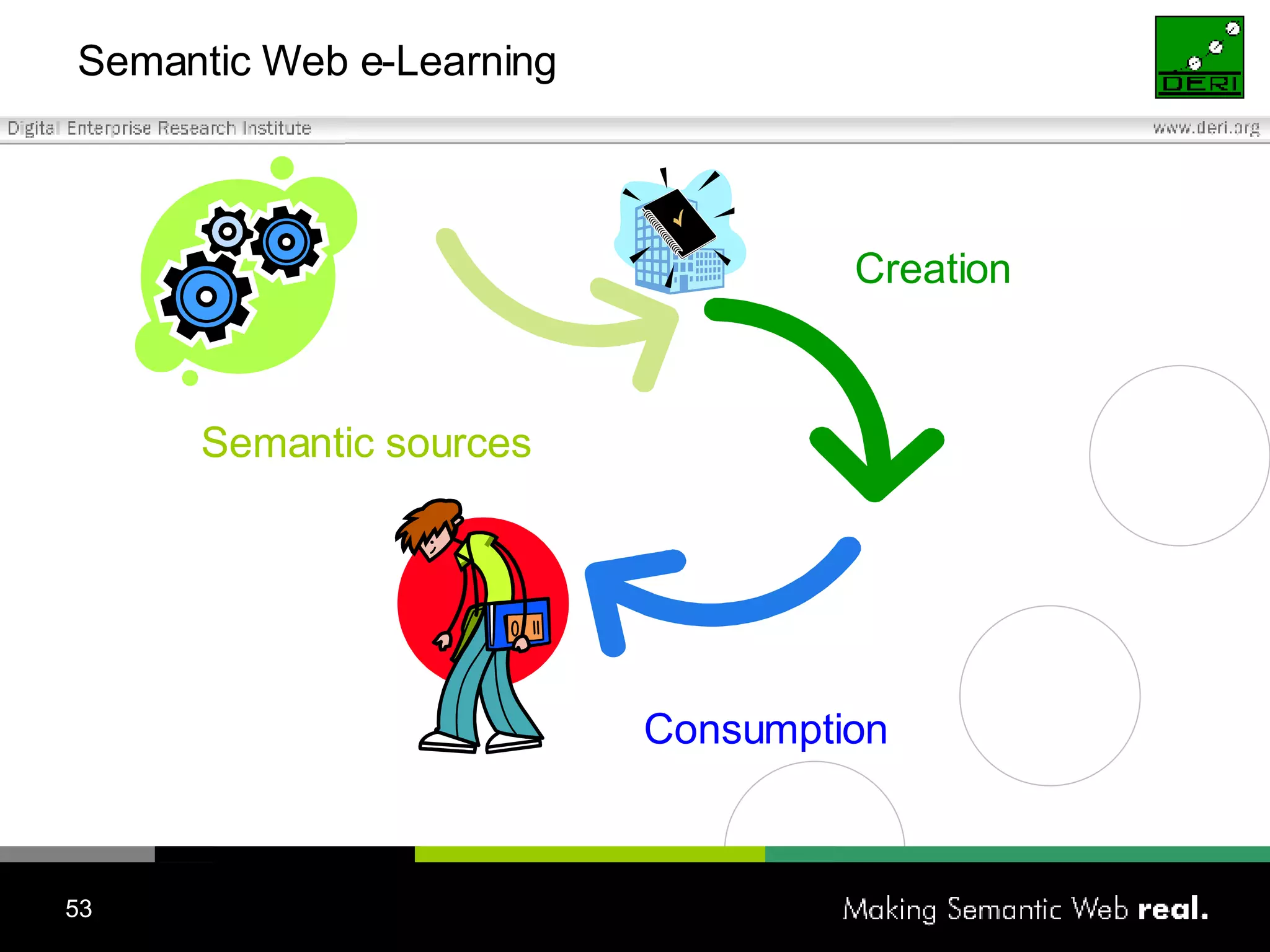
Semantic Web e-Learning Semantic sources Creation Consumption
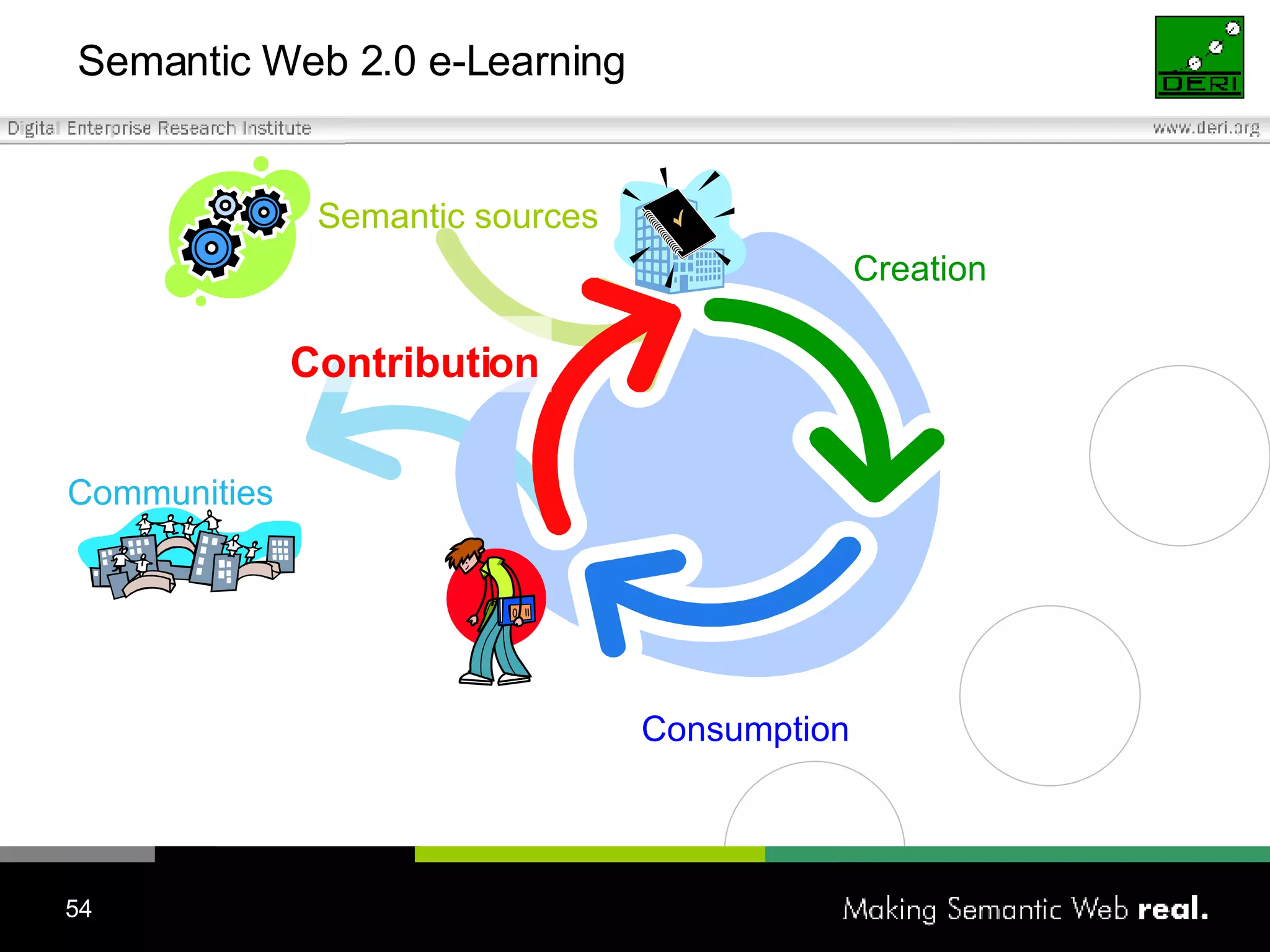
Semantic Web 2.0 e-Learning Contribution Creation Consumption Communities Semantic sources
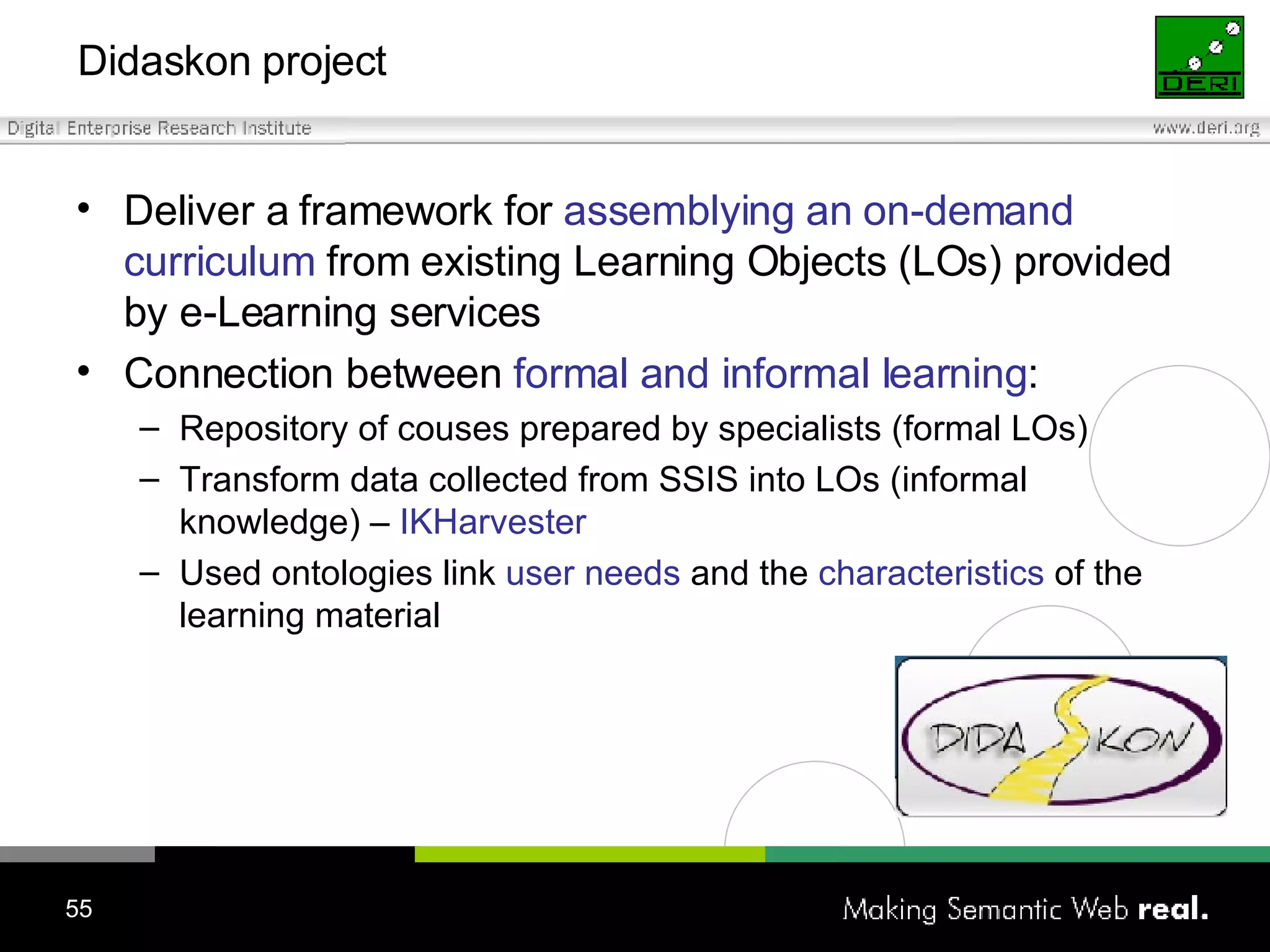
Didaskon project Deliver a framework for  assemblying an on-demand curriculum  from existing Learning Objects (LOs) provided by e-Learning services Connection between  formal and informal learning : Repository of couses prepared by specialists (formal LOs) Transform data collected from SSIS into LOs (informal knowledge) –  IKHarvester Used o ntolog ies link   user needs  and the   characteristics  of the   learning material
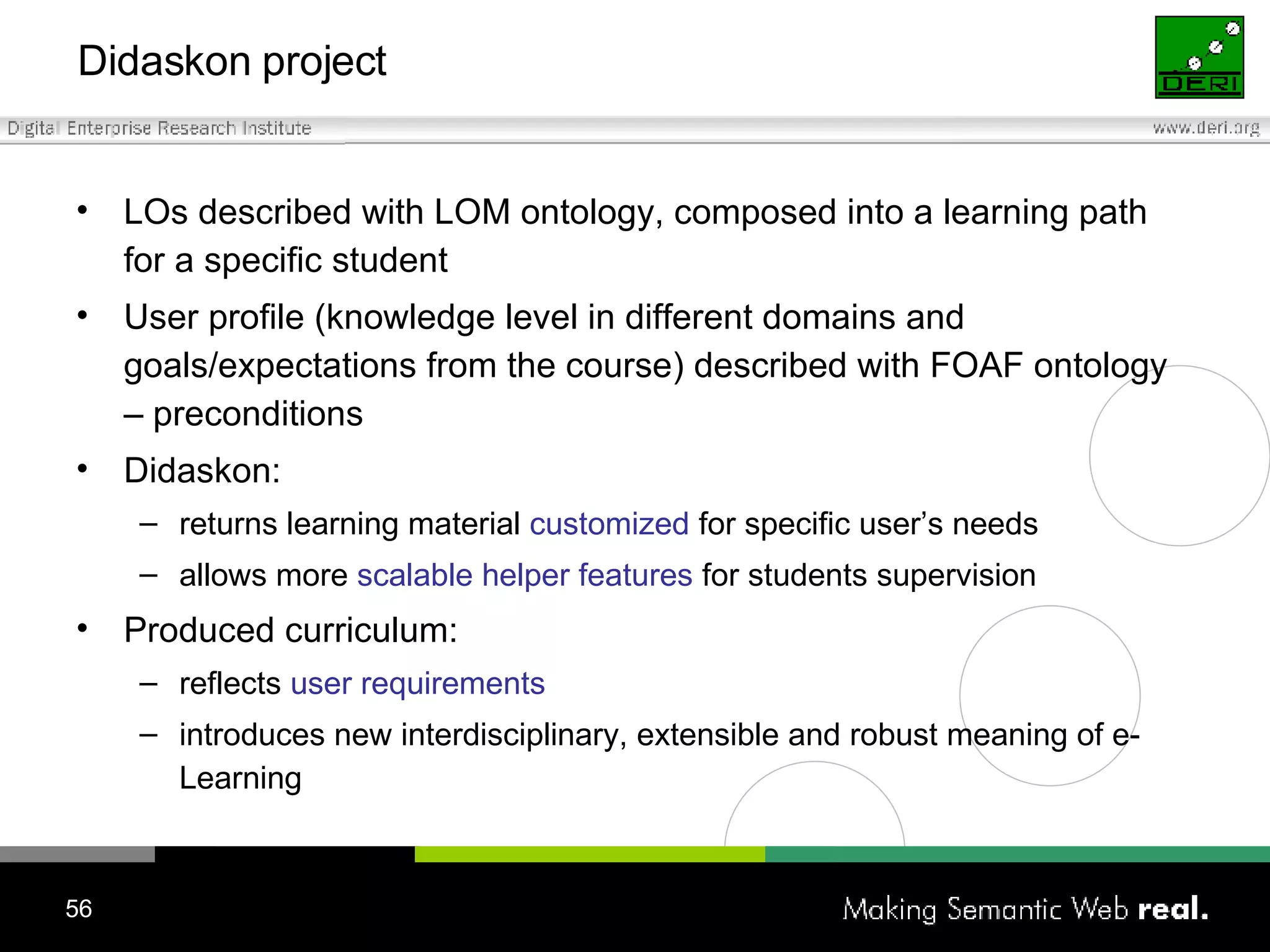
Didaskon project LOs described with LOM ontology,  composed into a learning path for a specific student User profile (knowledge level in different domains and goals/expectations from the course) described with FOAF ontology – preconditions Didaskon: returns learning material  customized  for specific user’s needs allows more  scalable helper features  for students supervision Produced curriculum: reflects  user requirements introduces new interdisciplinary, extensible and robust meaning of e-Learning
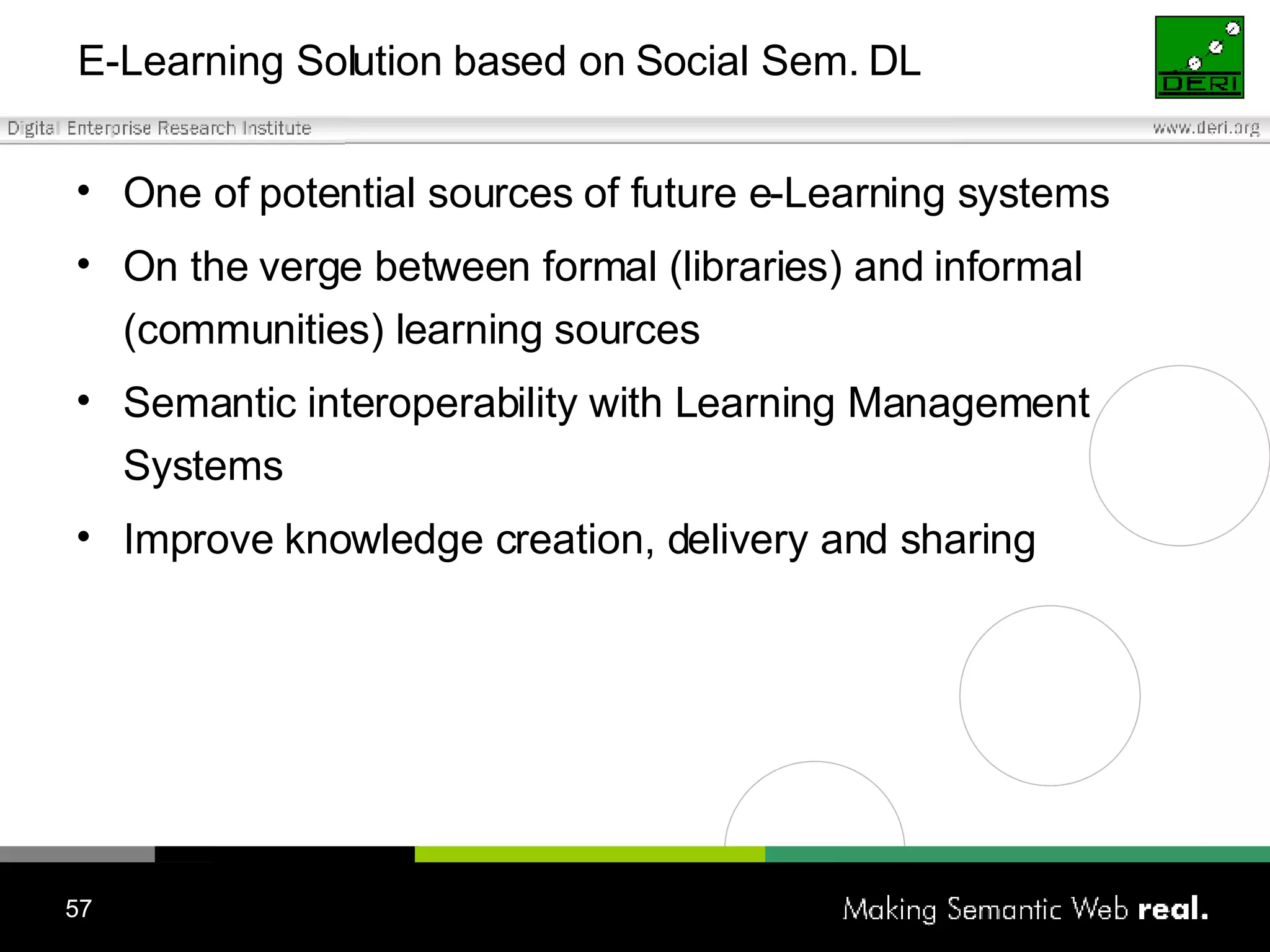
One of potential sources of future e-Learning systems On the verge between formal (libraries) and informal (communities) learning sources Semantic interoperability with Learning Management Systems Improve knowledge creation, delivery and sharing  E-Learning Solution based on Social Sem. DL
E-Learning Solution based on Social Sem. DL
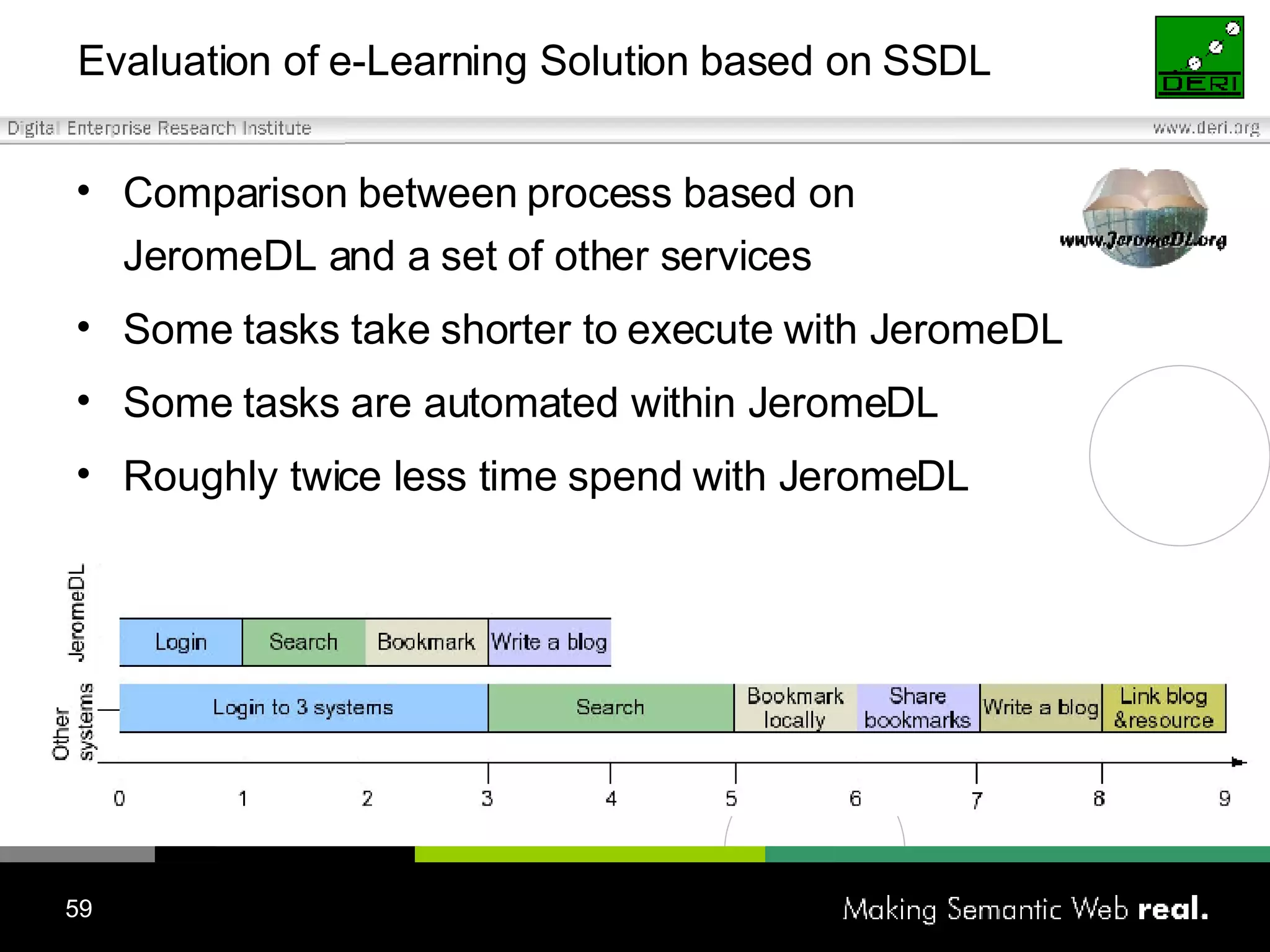
Comparison between process based on  JeromeDL and a set of other services Some tasks take shorter to execute with JeromeDL Some tasks are automated within JeromeDL Roughly twice less time spend with JeromeDL Evaluation of e-Learning Solution based on SSDL
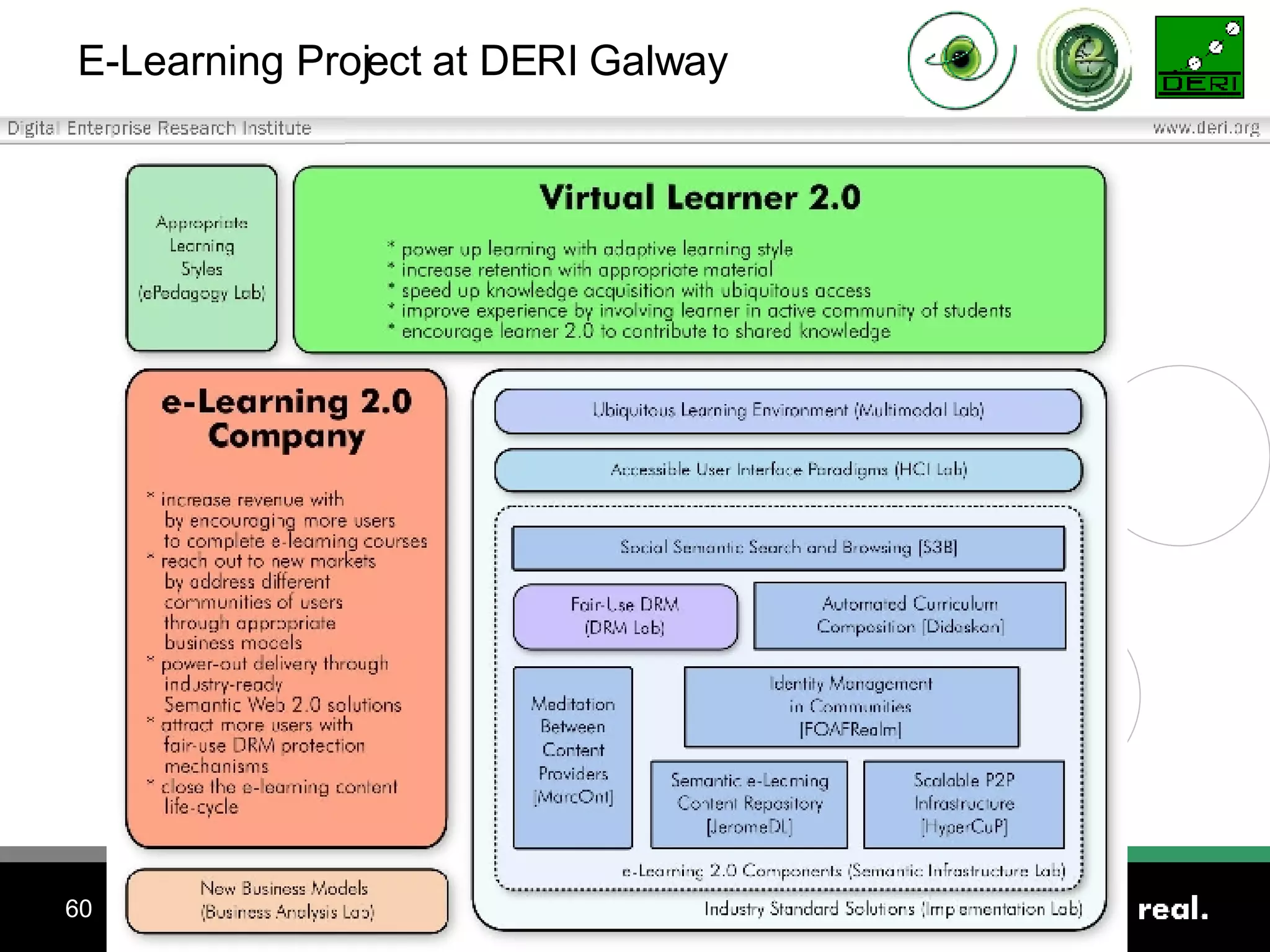
E-Learning Project at DERI Galway
Between e-Learning and DL - Museum Scenario Museums have  physical objects Should  bind  digital  annotations  with physical objects Real-virtual tours Start with real, guided tour Ubiquitous browse through context information Locate other exhibitions in the vicinity  Share your knowledge and experience with others, leave bread-crumbs for others Get the most of the exhibition during your visit
Conclusions New generation of Internet services can bring digital libraries: Closer to each other (interoperability) Closer to the users (online communities) Social and semantic services delivered in digital libraries can enhance user experience in: E-Learning Real world (!) museums ... and other online and real services JeromeDL is one of the first digital library that aims to implement these services Growing number of JeromeDL instances world-wide:  http://wiki.jeromedl.org/Instances
J eromeDL answer s  various expectations as  the Digital Library on  Social Semantic Information  Spaces http://www.jeromedl.org/ http://wiki.jeromedl.org/ Sebastian Ryszard Kruk DERI, NUI Galway, Ireland  [email_address]

Digital Libraries of the Future: Use of Semantic Web and Social Bookmarking to support E-learning in Digital Libraries

  • 1.
    Digital Libraries ofthe Future Use of Semantic Web and Social Bookmarking to support E-learning in Digital Libraries Sebastian Ryszard Kruk Digital Enterprise Research Institute National University of Ireland, Galway sebastian.kruk @deri.org http:// corrib.deri.ie /
  • 2.
    Presentation outline MotivationBuilding Social Semantic Digital Library Semantic Digital Libraries Towards Online Communities for Digital Libraries JeromeDL and other Corrib components Motivation and Overview Architecture and Ontologies Semantic Services Social Services Semantics in Use JeromeDL in Action e-Learning 2.0 Conclusions
  • 3.
    Motivations John teachesbiology, over the Internet, using digital libraries and modern technologies (wikis, blogs) How to deliver the material just-in-time? How to pre-asses students? How to automate most of the process?
  • 4.
    Presentation outline MotivationBuilding Social Semantic Digital Library Semantic Digital Libraries Towards Online Communities for Digital Libraries JeromeDL and other Corrib components Motivation and Overview Architecture and Ontologies Semantic Services Social Services Semantics in Use JeromeDL in Action e-Learning 2.0 Conclusions
  • 5.
    The Semantic Web– Applications Semantic Web cannot be and is not only a set of recommendations Semantic Web is becoming reality by applications that support it and are based on it Enabling technologies: RDF Storages: Sesame, Jena, YARS Reasoners: KAON, Racer Editors: Protege, SWOOP, MarcOnt Portal End-User applications: Semantic wikis: Makna, SemperWiki Semantic blogs Semantic digital libraries
  • 6.
    What is aSemantic Digital Library? Semantic digital libraries integrate information based on different metadata, e.g.: resources, user profiles, bookmarks, taxonomies – high quality semantics = highly and meaningfully connected information provide interoperability with other systems (not only digital libraries) on either metadata or communication level or both – RDF as common denominator between digital libraries and other services delivering more robust, user friendly and adaptable search and browsing interfaces empowered by semantics
  • 7.
    Semantic Web Technologiesfor Digital Libraries? Metadata is the key concept the Web does not have metadata the idea of a Semantic Web is nice but difficult to implement many digital libraries do have metadata in place we simply must make them available in a machine understandable format the Semantic Web provides the format: RDF
  • 8.
    Semantic Web Technologiesfor Digital Libraries? Knowledge in bibliographic records Digital Libraries already have controlled vocabularies, taxonomies or even ontologies in place the challenge is to model this knowledge in a machine understandable way the Semantic Web provides ontology languages: RDF Schema OWL SKOS
  • 9.
    Taxonomy of KnowledgeOrganization Systems Term Lists Authority files ( FOAF ) Glossaries Dictionaries Gazetteers Classifications and Categories ( DMoz ) Subject headings Classification schemes Taxonomies Categorization Schemes. Relationship Lists Thesauri ( WordNet, MeSH ) Semantic networks Ontologies (Hodge, 2000)
  • 10.
    Benefits of SemanticDigital Libraries The two main benefits of Semantic Digital Libraries new search paradigms for the information space Ontology-based search / facet search Community-enabled browsing providing interoperability on the data level integrating metadata from various heterogeneous sources Interconnecting different digital library systems
  • 11.
    Presentation outline MotivationBuilding Social Semantic Digital Library Semantic Digital Libraries Towards Online Communities for Digital Libraries JeromeDL and other Corrib components Motivation and Overview Architecture and Ontologies Semantic Services Social Services Semantics in Use JeromeDL in Action e-Learning 2.0 Conclusions
  • 12.
    Semantic DL asEvolving Knowledge Space In state-of-the-art digital libraries users are consumers Retrieve contents based on available bibliographic records Recent trends: user communities Connetea Flickr In Semantic digital libraries users are contributers as well Tagging (Web 2.0) Social Semantic Collaborative Filtering Annotations Semantic Digital libraries enforce the transition from a static information to a dynamic (collaborative) knowledge space
  • 13.
    Why current (semantic)digital libraries are not enough? digital libraries should not be for librarians only but for average people they concentrate on delivering content/information, not on knowledge sharing within a community of users digital libraries have lost human-part of their predecessors What could be the solution? make users/readers involved in the content annotation process allow users/readers to share their knowledge within a community provide better communication between users in and across communities The future - Social Semantic Digital Libraries
  • 14.
  • 15.
    Comparing Web 1.0/ Web 2.0 / Semantic Web 2.0 Semantic Social Networks Online Social Networks Buddy Lists, Address Books Semantic Social Information Spaces - - Social Semantic Digital Libraries Google Scholar, Book Search CiteSeer, Project Gutenberg Semantic Forums and Community Portals Community Portals Message Boards Semantic Blogs Blogs Personal Websites Semantic Search Google Personalised, DumbFind Altavista, Google Semantic Wikis Wikis Content Management Systems Semantic Web 2.0 Web 2.0 Web 1.0
  • 16.
    Evolution of LibrariesSocial Semantic Digital Library Involves the community into sharing knowledge Semantic Digital Library Accessible by  machines, not only with machines Digital Library Online, easy searching with a full-text index Library Organized collection
  • 17.
    Existing Semantic DigitalLibrary Systems SIMILE extends and laverages DSpace, seeking to enhance interoperability among digital assets, schemata, metadata, and services JeromeDL a social semantic digital library makes use of Semantic Web and Social Networking technologies to enhance both interoperability and usability BRICKS aims at establishing the organizational and technological foundations for a digital library network in order to share knowledge and resources in the cultural heritage domain. FEDORA delivers flexible service-oriented architecture to managing and delivering content in the form of digital objects
  • 18.
    Presentation outline MotivationBuilding Social Semantic Digital Library Semantic Digital Libraries Towards Online Communities for Digital Libraries JeromeDL and other Corrib components Motivation and Overview Architecture and Ontologies Semantic Services Social Services Semantics in Use JeromeDL in Action e-Learning 2.0 Conclusions
  • 19.
    JeromeDL - Introduction Joint effort of DERI, National University of Ireland, Galway and Gdansk University of Technology (GUT) Distributed under BSD Open Source license Digital library build on semantic web technologies to answer requirements from: librarians, scientists and everyone.
  • 20.
    JeromeDL – Motivations Use Cases Librarians: support for rich metadata (MARC21) in uploading resources, accessing bibliographic information and searching persistent identifiers Scientists: easy publishing (designed as a institute/university digital library) creating hierarchical networks of digital libraries support for accessing, sharing and searching using bibliography metadata (BibTeX) Everyone: simple search (incl. natural language queries) community-aware information sharing and browsing, support for interationalization
  • 21.
    Presentation outline MotivationBuilding Social Semantic Digital Library Semantic Digital Libraries Towards Online Communities for Digital Libraries JeromeDL and other Corrib components Motivation and Overview Architecture and Ontologies Semantic Services Social Services Semantics in Use JeromeDL in Action e-Learning 2.0 Conclusions
  • 22.
    JeromeDL – ArchitectureResources and annotations repository Middleware: query processing community space resources management User interface agents: Communication to the outside world Administrative interface
  • 23.
  • 24.
  • 25.
  • 26.
  • 27.
  • 28.
    Presentation outline MotivationBuilding Social Semantic Digital Library Semantic Digital Libraries Towards Online Communities for Digital Libraries JeromeDL and other Corrib components Motivation and Overview Architecture and Ontologies Semantic Services Social Services Semantics in Use JeromeDL in Action e-Learning 2.0 Conclusions
  • 29.
    MarcOnt Initiative –Overview Motivation: Provide set of tools for collaborative ontology development MarcOnt Initiative goals: Create a framework for collaborative ontology improvement (E-learning) Provide domain experts with tools to share their knowledge Offer tools for data mediation between different data formats
  • 30.
    MarcOnt Portal andMarcOnt Ontology MarcOnt Ontology: Central point of MarcOnt Initiative Translation and mediation format Continuos collaborative ontology improvement Knowledge from the domain experts MarcOnt Portal (source of knowledge): Suggestions Annotations Versioning Ontology editor
  • 31.
    MarcOnt Mediation Servicesfor Legacy Metadata Format translation RDF Translator Format co-operation MarcOnt Mediation Services
  • 32.
    Presentation outline MotivationBuilding Social Semantic Digital Library Semantic Digital Libraries Towards Online Communities for Digital Libraries JeromeDL and other Corrib components Motivation and Overview Architecture and Ontologies Semantic Services Social Services Semantics in Use JeromeDL in Action e-Learning 2.0 Conclusions
  • 33.
    Social Services inJeromeDL Involve users into sharing knowledge Blogs – comments and discussions about documents and resources Tagging – collaborative classification Wikis – collaboratively edited additional descriptions , such as summaries and interesting facts Preserve knowledge for future use Users can learn from experience of others instantly Recommend new, interesting resources based on users’ profiles
  • 34.
    Identity management withFOAFRealm Identity defined with extended FOAF metadata Policies expressed by social networking Distance between owner and requester Friendship level between owner and requester, calculated across digraph of social network Support for single registration and sign on Distributed identity management with HyperCuP (“D-FOAF”) FOAFRealm is currently implemented as a plugin for Tomcat (Realm/Valve implementation), with PHP and .NET versions coming soon
  • 35.
    What is S ocial S emantic C ollaborative F iltering? Goal: t o enhance individual bookmarks with shared knowledge within a community Users annotate catalogues of bookmarks with semantic information taken from DM oz or WordNet vocabularies Catalogs can include ( transclusion ) friend's catalogues Access to catalogues can be restricted with social networking-based polices SSCF delivers: Community-oriented, semantically-rich taxonomies Information about a user's interest Flows of expertise from the domain expert Recommendations based on users previous actions Support for SIOC metadata
  • 36.
    Example of S ocial S emantic C ollaborative F iltering foaf:knows xfoaf:include xfoaf:bookmark
  • 37.
    Social Networks inDigital Libraries Resource xfoaf:Annotation user_C creator_B foaf:knows marcont:hasCreator creator_A foaf:knows foaf:knows xfoaf:Directory user_D xfoaf:owns xfoaf:linksTo xfoaf:isIn
  • 38.
    Support for onlinecommunities in SSCF
  • 39.
    Support for onlinecommunities in SSCF
  • 40.
    Presentation outline MotivationBuilding Social Semantic Digital Library Semantic Digital Libraries Towards Online Communities for Digital Libraries JeromeDL and other Corrib components Motivation and Overview Architecture and Ontologies Semantic Services Social Services Semantics in Use JeromeDL in Action e-Learning 2.0 Conclusions
  • 41.
    JeromeDL – DeliveringSemantic Content Providing semantic annotations during uploading process : open module for handling any taxonomies keywords based on WordNet and free tagging defining structure of resources in the JeromeDL ontology Lifting legacy metadata to MarcOnt ontology Community maintained annotations social semantic collaborative filtering semantic descriptions based on the FOAF metadata
  • 42.
  • 43.
    JeromeDL – SemanticInformation In Use Searching: Keyword-based search with semantic query expansion Semantic search: Direct RDF quering Natural language templates Browsing Exibit MultiBeeBrowse Sharing: Social Semantic Collaborative Filtering Semantically Interlinked Online Communities Heterogeneous communication: Bibster , A9 , OAI -PMH
  • 44.
  • 45.
  • 46.
  • 47.
    Information Retrieval inJeromeDL Fulltext Index Structure Repository MarcOnt Repository Resources’ Content FOAFRealm Repository (typed) keywords RDF & NL Query OpenSearch RSS collaborative filtering types translation semantic query expansion RDF Repositories Secure Snapshot local interface distributed interface
  • 48.
    Networks of DigitalLibraries ELP (Extensible Library Protocol) implementation communication within JeromeDL network adapters for communication with other networks D-FOAF integration (distributed user profile management) single sign on and single registration within D-FOAF network HyperCuP integration (scalable P2P network) Independent ELP network entry point: http://search.jeromedl.org/ 0 0 1 1 0 0 1 1 0 2 2 2 2
  • 49.
  • 50.
    Presentation outline MotivationBuilding Social Semantic Digital Library Semantic Digital Libraries Towards Online Communities for Digital Libraries JeromeDL and other Corrib components Motivation and Overview Architecture and Ontologies Semantic Services Social Services Semantics in Use JeromeDL in Action e-Learning 2.0 Conclusions
  • 51.
    Web 1.0 e-LearningCreation Consumption
  • 52.
    Web 2.0 e-LearningCreation Communities Consumption
  • 53.
    Semantic Web e-LearningSemantic sources Creation Consumption
  • 54.
    Semantic Web 2.0e-Learning Contribution Creation Consumption Communities Semantic sources
  • 55.
    Didaskon project Delivera framework for assemblying an on-demand curriculum from existing Learning Objects (LOs) provided by e-Learning services Connection between formal and informal learning : Repository of couses prepared by specialists (formal LOs) Transform data collected from SSIS into LOs (informal knowledge) – IKHarvester Used o ntolog ies link user needs and the characteristics of the learning material
  • 56.
    Didaskon project LOsdescribed with LOM ontology, composed into a learning path for a specific student User profile (knowledge level in different domains and goals/expectations from the course) described with FOAF ontology – preconditions Didaskon: returns learning material customized for specific user’s needs allows more scalable helper features for students supervision Produced curriculum: reflects user requirements introduces new interdisciplinary, extensible and robust meaning of e-Learning
  • 57.
    One of potentialsources of future e-Learning systems On the verge between formal (libraries) and informal (communities) learning sources Semantic interoperability with Learning Management Systems Improve knowledge creation, delivery and sharing E-Learning Solution based on Social Sem. DL
  • 58.
    E-Learning Solution basedon Social Sem. DL
  • 59.
    Comparison between processbased on JeromeDL and a set of other services Some tasks take shorter to execute with JeromeDL Some tasks are automated within JeromeDL Roughly twice less time spend with JeromeDL Evaluation of e-Learning Solution based on SSDL
  • 60.
  • 61.
    Between e-Learning andDL - Museum Scenario Museums have physical objects Should bind digital annotations with physical objects Real-virtual tours Start with real, guided tour Ubiquitous browse through context information Locate other exhibitions in the vicinity Share your knowledge and experience with others, leave bread-crumbs for others Get the most of the exhibition during your visit
  • 62.
    Conclusions New generationof Internet services can bring digital libraries: Closer to each other (interoperability) Closer to the users (online communities) Social and semantic services delivered in digital libraries can enhance user experience in: E-Learning Real world (!) museums ... and other online and real services JeromeDL is one of the first digital library that aims to implement these services Growing number of JeromeDL instances world-wide: http://wiki.jeromedl.org/Instances
  • 63.
    J eromeDL answers various expectations as the Digital Library on Social Semantic Information Spaces http://www.jeromedl.org/ http://wiki.jeromedl.org/ Sebastian Ryszard Kruk DERI, NUI Galway, Ireland [email_address]