Social Semantic Search and Browsing Sebastian Ryszard Kruk Digital Enterprise Research Institute National University of Ireland, Galway [email_address] http://corrib.deri.ie/
Take away message We search in different way for different things Keyword search is not enough We create the knowledge by sharing our (search) experience
Outline Motivation How do people search Search and Browsing lifecycle Applying semantics and making use of social networks: Keyword-based search Faceted Navigation Collaborative Filtering Conclusions - Putting it all together
How do people search? Different user goals: Resource Seeking  - the user wants to find a specific resource (e.g. lyrics of a song, a program to download, a map service etc.) Navigational  - the user is searching for a specific web site whose URL s/he forgot Informational  - the user is looking for information about a topic s/he is interested in Rose and Levinson:  Understanding user goals in web search (2004)
Search and browsing lifecycle Why ? Information can be useful Information can be a garbage How ? (Search and browsing actions) [REUSE]  keyword-based search (resource seeking)  [REDUCE]  faceted navigation (navigational)  [RECYCLE]  collaborative filtering (informational) Can this process be improved with Semantic Web and Social Networking technologies?
Query refinement in keyword-based search Why  simple full-text search is not enough? Too many results (low precision) One needs to specify the exact keyword (low recall) How to distinguish between: Python and python? (high fall-out) How ?  Disambiguation through a context Query context Short-term context: User’s goal Location Time Long-term context: User’s interest Search engine specific
Query refinement in keyword-based search How ?  Query refinement) Spread activation Types mapping Pruning Acquiring the context information: Previous searches of the user Semantically annotated user’s bookmarks Community profile And ? (Manual query refinement) “Tell me why” button and  the transcript of refinement process Continue to faceted navigation
Faceted navigation on arbitrary graph Why ? The search does not end on a (long) list of results The results are not a list (!) but a graph We loose context with linear navigation A need for unified notion (UI, SOA) of filter/narrow and browse/expand services
Faceted navigation on arbitrary graph How (SOA)? Defines REST access to services and their composition Basic services: access, search, filter, similar, browse, combine Meta services: RDF serialization, subscription channels, service ID generation Context services: manage contexts, manage service calls/compositions in the context, lists contexts Statistics services: properties, values, tokens How (User interface)? Hexagons to capture the notion of non-linear browsing Selecting values from list, tag cloud or TagsTreeMap TM Context zoomable interface: List (graph) of results Browse from current results Navigate between service call Navigate between contexts (with given call)
Social Semantic Collaborative Filtering Why? The bottom-line of acquiring knowledge: informal communication (“word of mouth”)  How? Everyone classifies (filters) the information in bookmark folders (user-oriented taxonomy) Peers share (collaborate over) the information (community-driven taxonomy) Result? Knowledge “flows“ from the expert  through the social network to the user System amass a lot of information  on user/community profile (context)
Social Semantic Collaborative Filtering Problems? The horizon of a social network (2-3 degrees of separation) How to handle fine-grained information (blogs, wikis, etc.) Solutions?  (under testing) Inference engine to suggest knowledge from the outskirts of the social network Support for SIOC metadata: SIOC browser in SSCF Annotations and evaluations of “local” resources
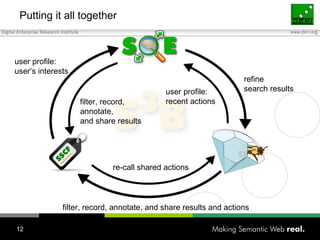
Putting it all together user profile: recent actions refine search results filter, record, annotate, and share results and actions re-call shared actions user profile: user’s interests filter, record,  annotate,  and share results

Social Semantic Search and Browsing

  • 1.
    Social Semantic Searchand Browsing Sebastian Ryszard Kruk Digital Enterprise Research Institute National University of Ireland, Galway [email_address] http://corrib.deri.ie/
  • 2.
    Take away messageWe search in different way for different things Keyword search is not enough We create the knowledge by sharing our (search) experience
  • 3.
    Outline Motivation Howdo people search Search and Browsing lifecycle Applying semantics and making use of social networks: Keyword-based search Faceted Navigation Collaborative Filtering Conclusions - Putting it all together
  • 4.
    How do peoplesearch? Different user goals: Resource Seeking - the user wants to find a specific resource (e.g. lyrics of a song, a program to download, a map service etc.) Navigational - the user is searching for a specific web site whose URL s/he forgot Informational - the user is looking for information about a topic s/he is interested in Rose and Levinson: Understanding user goals in web search (2004)
  • 5.
    Search and browsinglifecycle Why ? Information can be useful Information can be a garbage How ? (Search and browsing actions) [REUSE] keyword-based search (resource seeking) [REDUCE] faceted navigation (navigational) [RECYCLE] collaborative filtering (informational) Can this process be improved with Semantic Web and Social Networking technologies?
  • 6.
    Query refinement inkeyword-based search Why simple full-text search is not enough? Too many results (low precision) One needs to specify the exact keyword (low recall) How to distinguish between: Python and python? (high fall-out) How ? Disambiguation through a context Query context Short-term context: User’s goal Location Time Long-term context: User’s interest Search engine specific
  • 7.
    Query refinement inkeyword-based search How ? Query refinement) Spread activation Types mapping Pruning Acquiring the context information: Previous searches of the user Semantically annotated user’s bookmarks Community profile And ? (Manual query refinement) “Tell me why” button and the transcript of refinement process Continue to faceted navigation
  • 8.
    Faceted navigation onarbitrary graph Why ? The search does not end on a (long) list of results The results are not a list (!) but a graph We loose context with linear navigation A need for unified notion (UI, SOA) of filter/narrow and browse/expand services
  • 9.
    Faceted navigation onarbitrary graph How (SOA)? Defines REST access to services and their composition Basic services: access, search, filter, similar, browse, combine Meta services: RDF serialization, subscription channels, service ID generation Context services: manage contexts, manage service calls/compositions in the context, lists contexts Statistics services: properties, values, tokens How (User interface)? Hexagons to capture the notion of non-linear browsing Selecting values from list, tag cloud or TagsTreeMap TM Context zoomable interface: List (graph) of results Browse from current results Navigate between service call Navigate between contexts (with given call)
  • 10.
    Social Semantic CollaborativeFiltering Why? The bottom-line of acquiring knowledge: informal communication (“word of mouth”) How? Everyone classifies (filters) the information in bookmark folders (user-oriented taxonomy) Peers share (collaborate over) the information (community-driven taxonomy) Result? Knowledge “flows“ from the expert through the social network to the user System amass a lot of information on user/community profile (context)
  • 11.
    Social Semantic CollaborativeFiltering Problems? The horizon of a social network (2-3 degrees of separation) How to handle fine-grained information (blogs, wikis, etc.) Solutions? (under testing) Inference engine to suggest knowledge from the outskirts of the social network Support for SIOC metadata: SIOC browser in SSCF Annotations and evaluations of “local” resources
  • 12.
    Putting it alltogether user profile: recent actions refine search results filter, record, annotate, and share results and actions re-call shared actions user profile: user’s interests filter, record, annotate, and share results