MEMORY
By
Dr.Shazia Zamir
CONTENT
MEMORY
Memory in Early
Childhood
Definitions of memory
Types of memory
Explicit Memory
Episodic Memory
Semantic memory
Implicit Memory
Priming:
Procedural Memory
 Early musical training
 Mnemonics
 Mind over Matter
 Get the details
 Play memory games
 Suggest strategies
Techniques to improve early childhood
memory
 Divide and conquer
 Practice, practice,
practice
 Use rhymes
 Use acronyms
 Use acrostics
MEMORY IN EARLY
CHILDHOOD
MEMORY IN EARLY CHILDHOOD
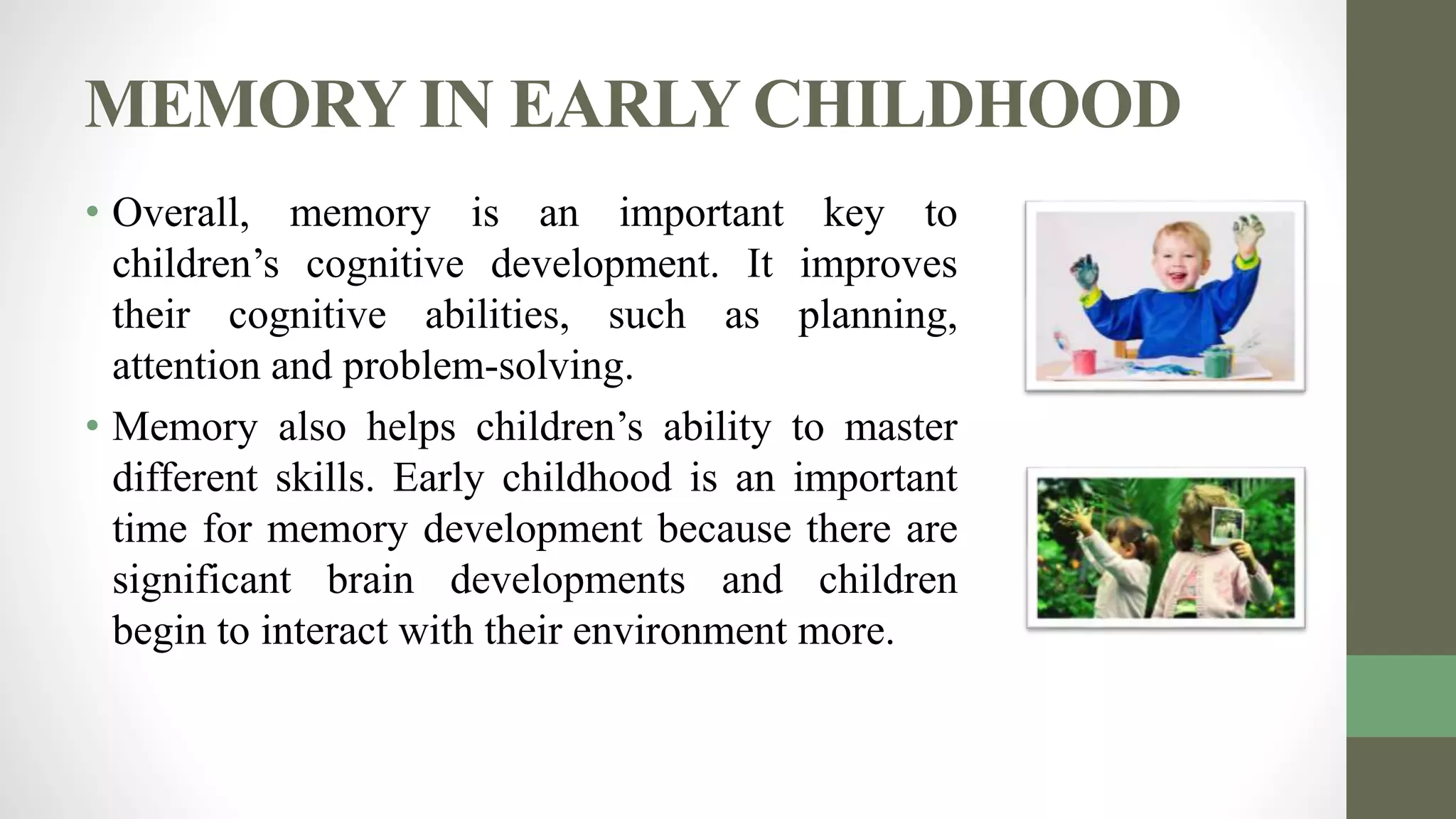
• Overall, memory is an important key to
children’s cognitive development. It improves
their cognitive abilities, such as planning,
attention and problem-solving.
• Memory also helps children’s ability to master
different skills. Early childhood is an important
time for memory development because there are
significant brain developments and children
begin to interact with their environment more.
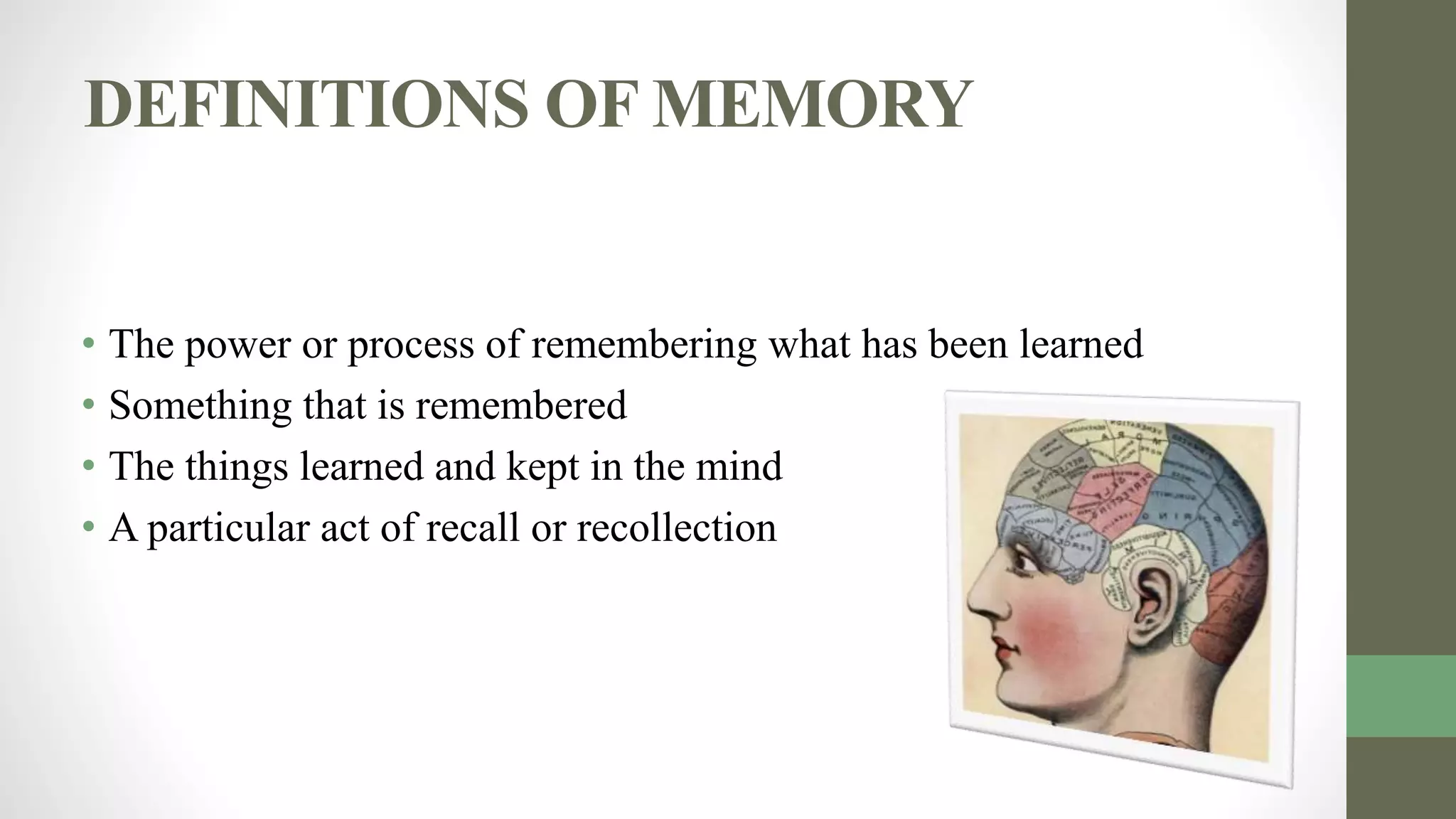
DEFINITIONS OF MEMORY
• The power or process of remembering what has been learned
• Something that is remembered
• The things learned and kept in the mind
• A particular act of recall or recollection
TYPES OF MEMORY
Explicit memory
Information that you have to consciously work to remember is
known as explicit memory.
Implicit memory
Information that you remember unconsciously and effortlessly is
known as implicit memory.
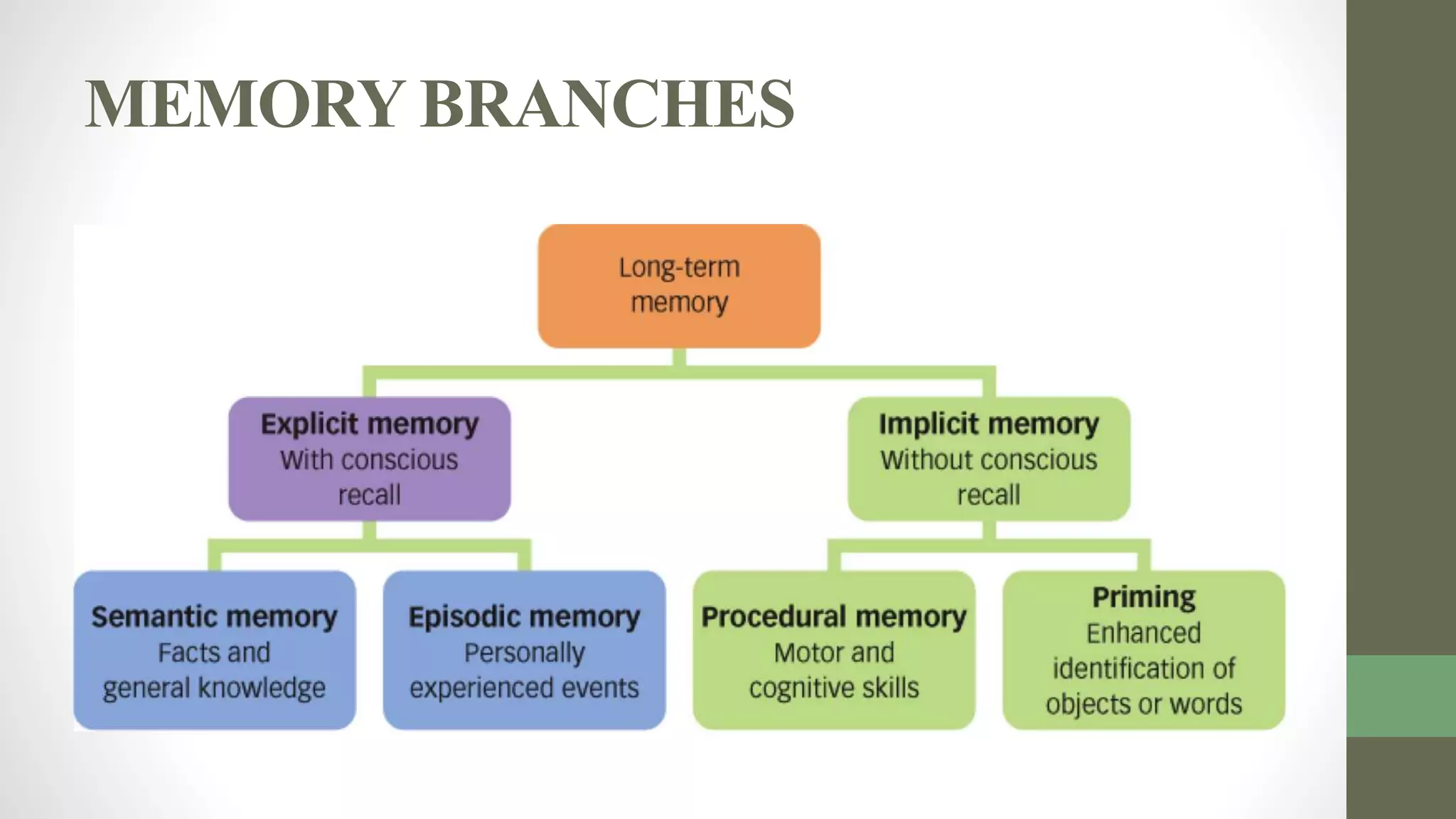
MEMORY BRANCHES
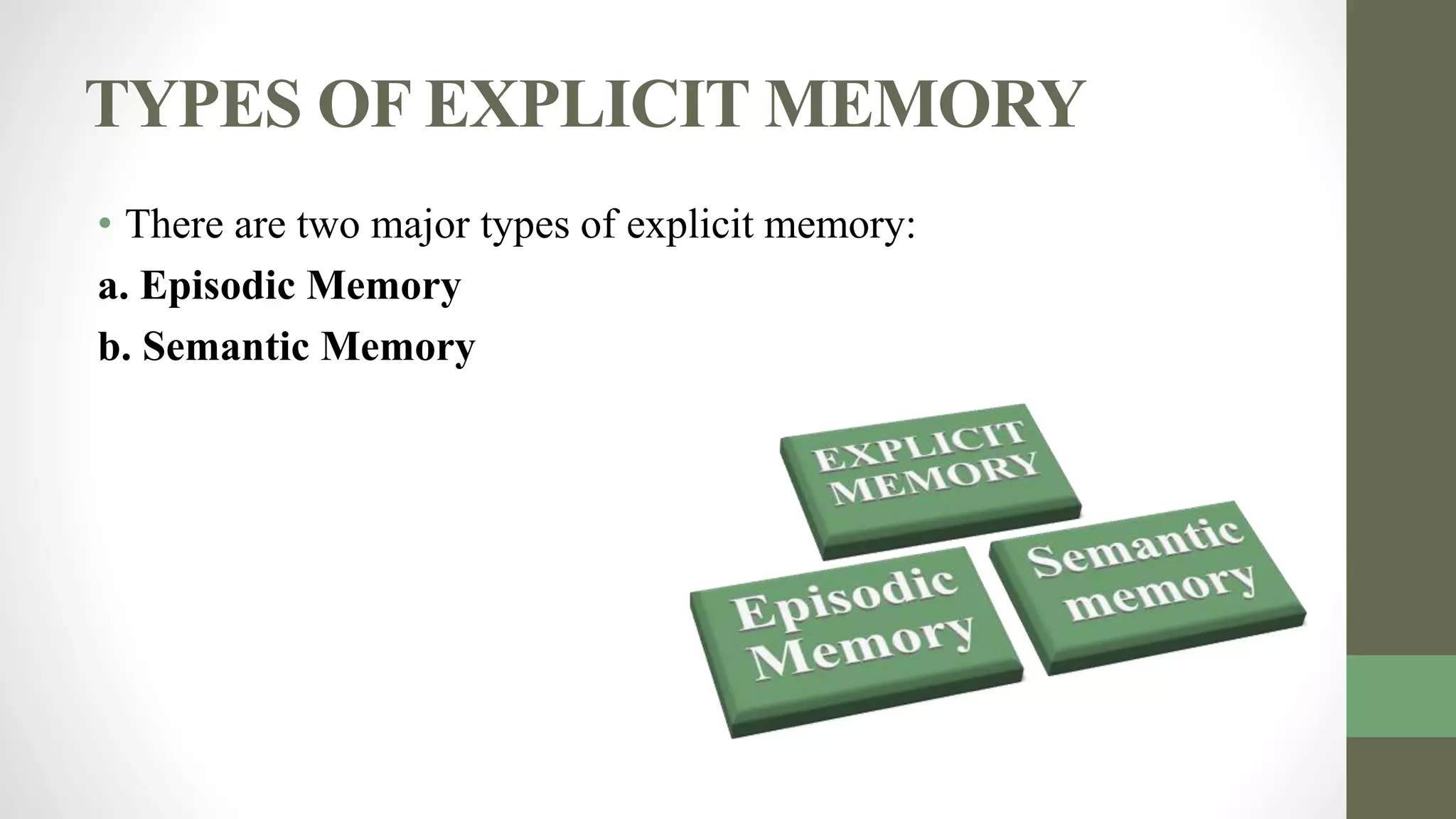
EXPLICIT MEMORY
• When you are trying to intentionally remember something (like a
formula for your statistics class or a list of dates for your history
class), this information is stored in your explicit memory. We use
these memories every day, from remembering information for a test
to recalling the date and time of a doctor's appointment.
TYPES OF EXPLICIT MEMORY
• There are two major types of explicit memory:
a. Episodic Memory
b. Semantic Memory
EPISODIC MEMORY
• These are your long-term memories of specific events, such as what
you did yesterday or your high school graduation. Episodic memory
is one type of explicit memory.
• Episodic memory is autobiographical: it provides us with a crucial
record of our personal experiences. Any past event in which we
played a part, and which we remember as an "episode" (a scene of
events) is episodic.
SEMANTIC MEMORY
• These are memories of facts, concepts, names, and other general
knowledge information another type of explicit memory is semantic
memory. It accounts for our "textbook learning" or general knowledge
about the world. It's what enables us to say, without knowing exactly
when and where we learned, that Paris is the major city in France.
2.IMPLICIT MEMORY
• Things that we don't purposely try to remember are stored in implicit
memory. This kind of memory is both unconscious and unintentional.
• Some examples of implicit memory include singing a familiar song,
typing on your computer keyboard, daily habits, and driving a car.
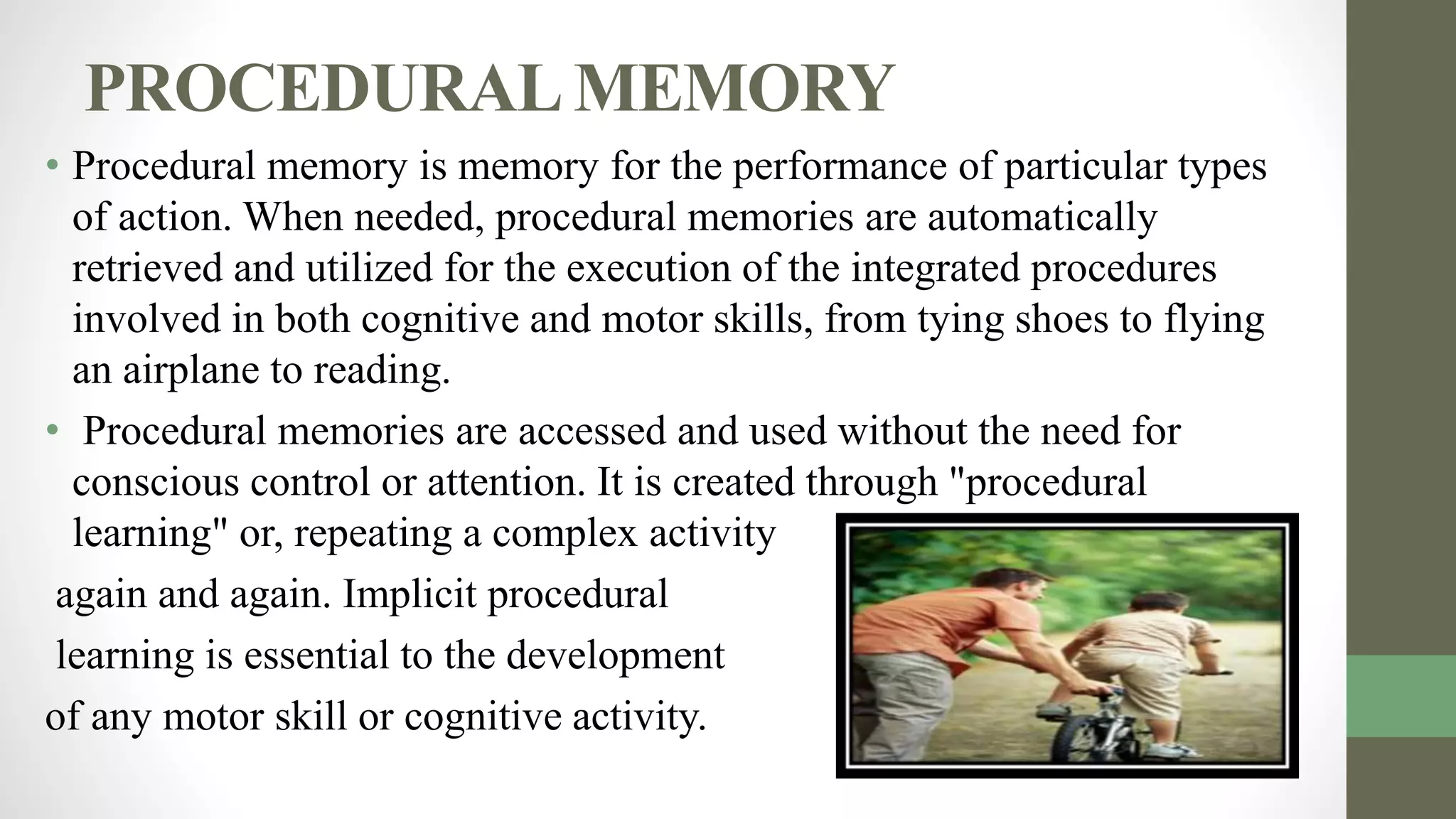
Riding a bicycle is another great example.
TYPES OF IMPLICIT MEMORY
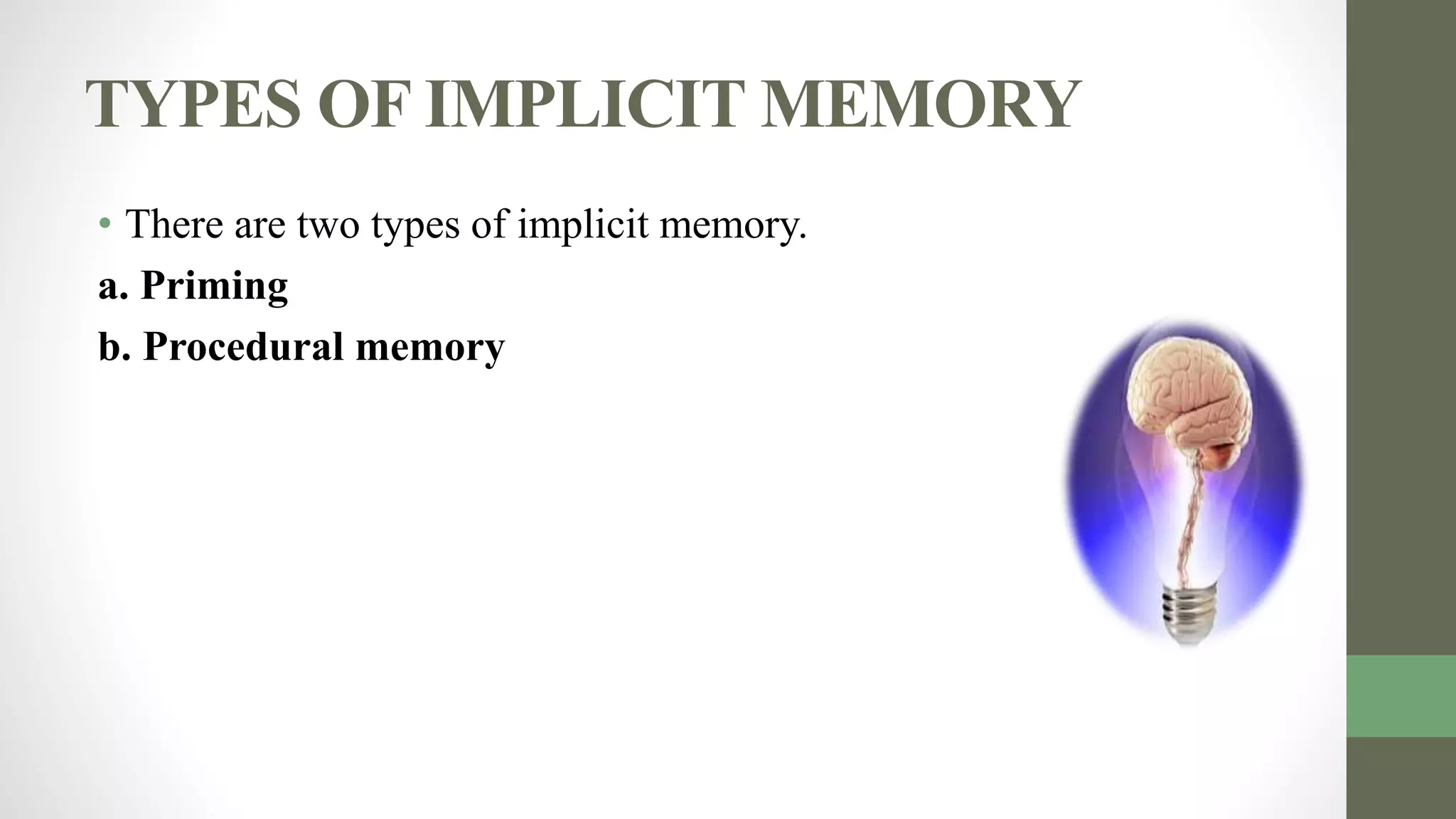
• There are two types of implicit memory.
a. Priming
b. Procedural memory
PRIMING
• Priming is a non conscious form of human memory concerned
with perceptual identification of words and objects.
• For example, if a person reads a list of words including the
word table, and is later asked to complete a word starting with tab,
the probability that he or she will answer table is greater than if
they are not primed.
PROCEDURALMEMORY
• Procedural memory is memory for the performance of particular types
of action. When needed, procedural memories are automatically
retrieved and utilized for the execution of the integrated procedures
involved in both cognitive and motor skills, from tying shoes to flying
an airplane to reading.
• Procedural memories are accessed and used without the need for
conscious control or attention. It is created through "procedural
learning" or, repeating a complex activity
again and again. Implicit procedural
learning is essential to the development
of any motor skill or cognitive activity.
Techniques
To
Improve Early Childhood
Memory
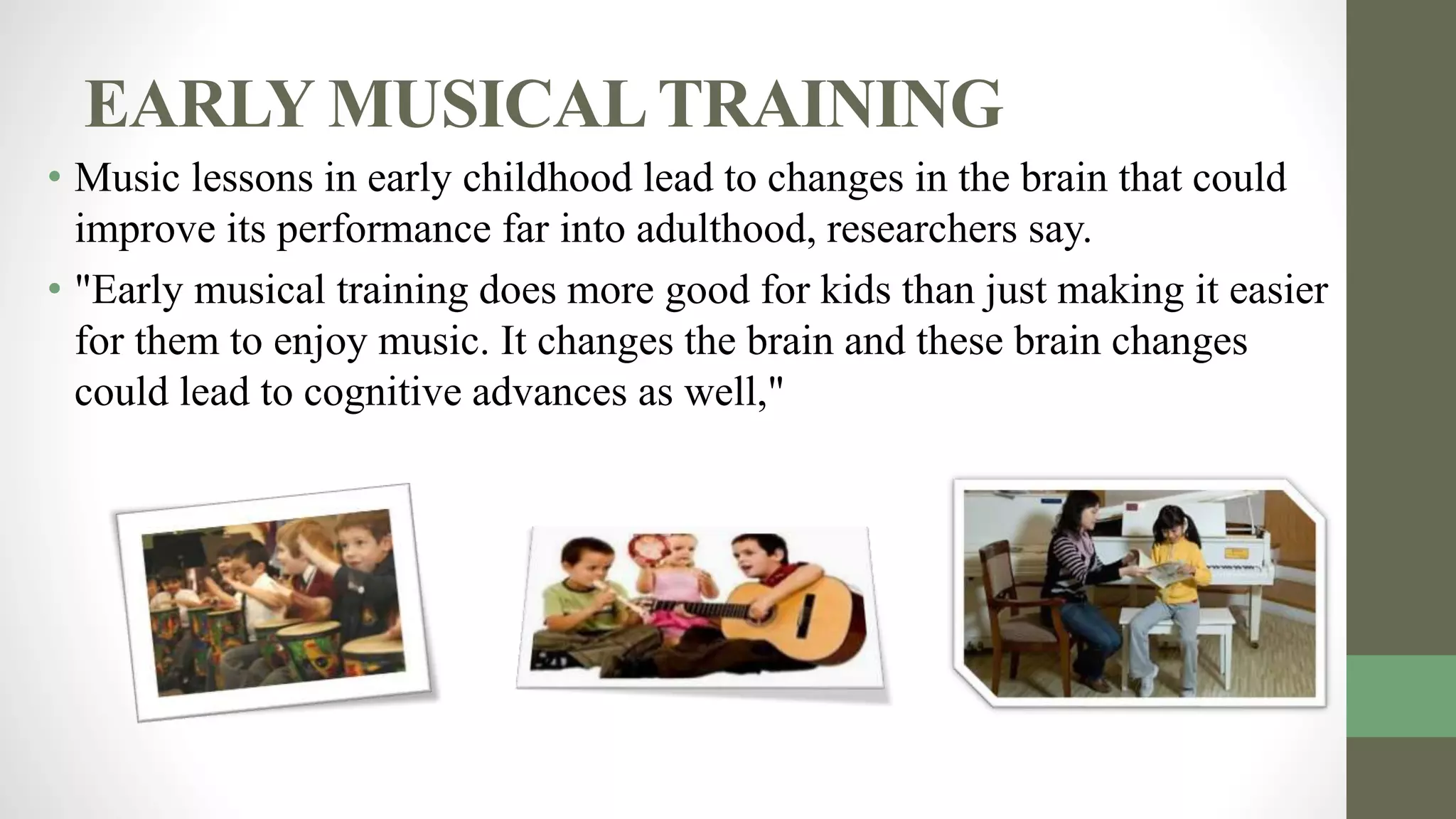
EARLY MUSICALTRAINING
• Music lessons in early childhood lead to changes in the brain that could
improve its performance far into adulthood, researchers say.
• "Early musical training does more good for kids than just making it easier
for them to enjoy music. It changes the brain and these brain changes
could lead to cognitive advances as well,"
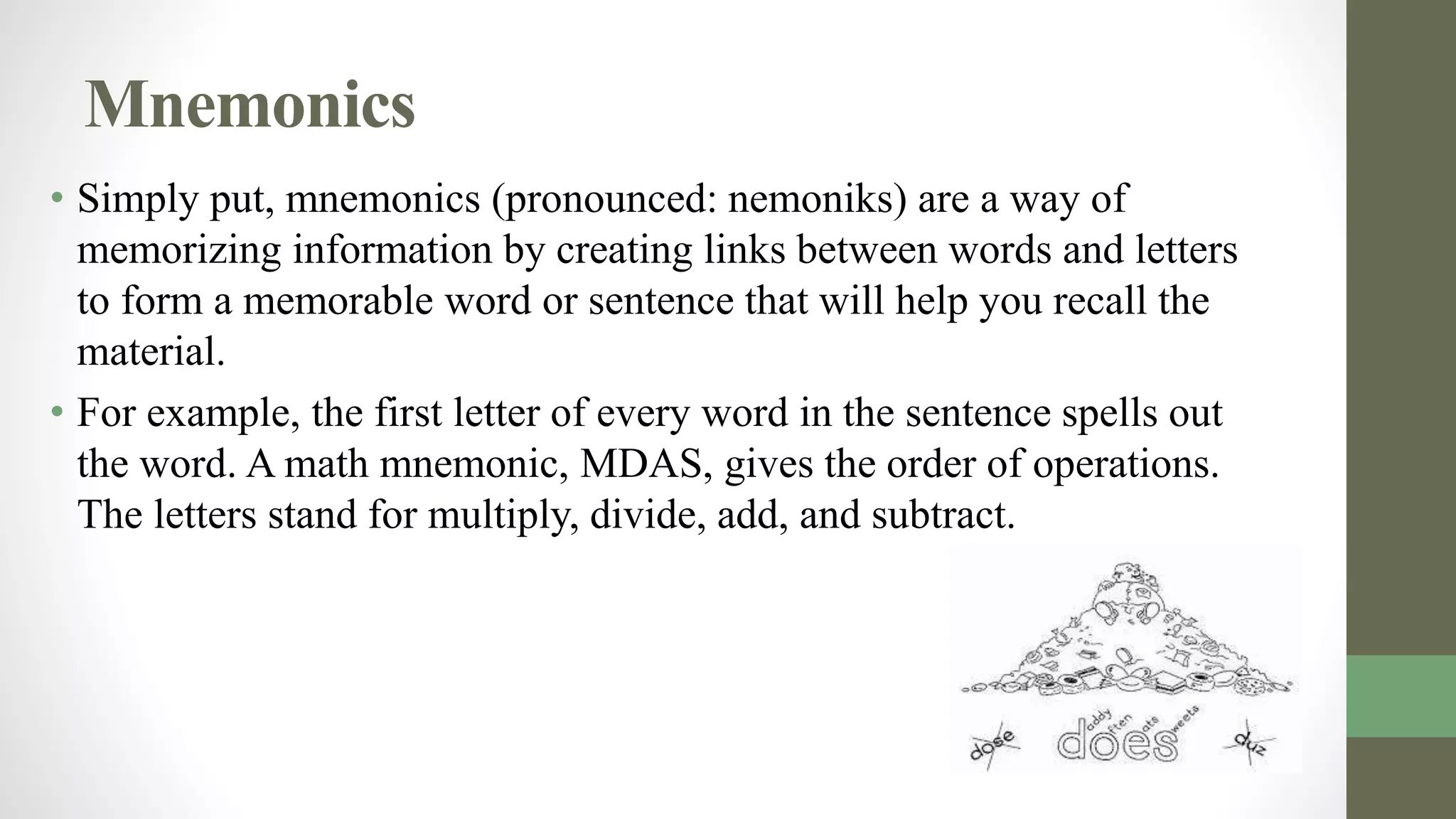
Mnemonics
• Simply put, mnemonics (pronounced: nemoniks) are a way of
memorizing information by creating links between words and letters
to form a memorable word or sentence that will help you recall the
material.
• For example, the first letter of every word in the sentence spells out
the word. A math mnemonic, MDAS, gives the order of operations.
The letters stand for multiply, divide, add, and subtract.
MIND OVER MATTER
• Memory is a complex process, and 6- to 8- year-olds are developing a range of
strategies to help them recall information. Remembering requires the ability to store
information for a few seconds (short-term memory), then for several minutes while
manipulating information (active working memory), and finally for an extended
period of time (long-term memory).
• For example, when copying spelling words from the blackboard, children must first
remember the sequence of letters, and then they need to write the words down without
spending a lot of time looking back at the board. Many whisper the words under their
breath or repeat the letters out loud to help themselves. Later, they'll have to memorize
the words for a spelling test.
GET THE DETAILS
"Studies have shown that parents can have a long-term impact
on memory development by including many questions and
specifics in conversations about past events with their children,"
When you talk about a recent trip to the circus, for instance, ask
your child, "What was your favorite act?" or "What did the big
top look like?" Fill in the details if he can't provide them.
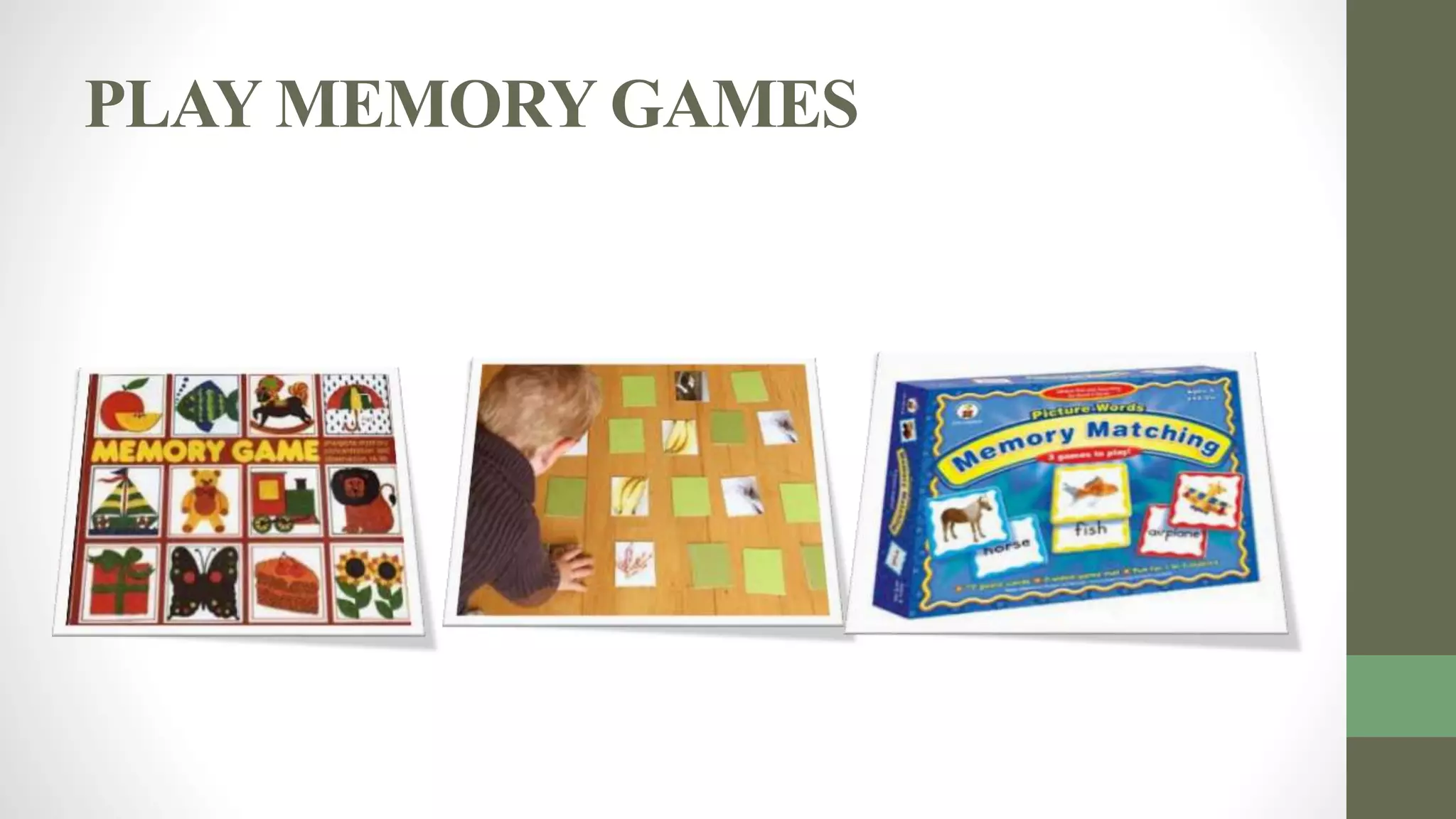
PLAY MEMORY GAMES
The card game Concentration and toys such as Simon and Bop It are
good ones. In the car, try games like "I'm going on a picnic, and I'm
taking . . . ," in which everyone has a turn adding an item and
repeating the ones said previously.
PLAY MEMORY GAMES
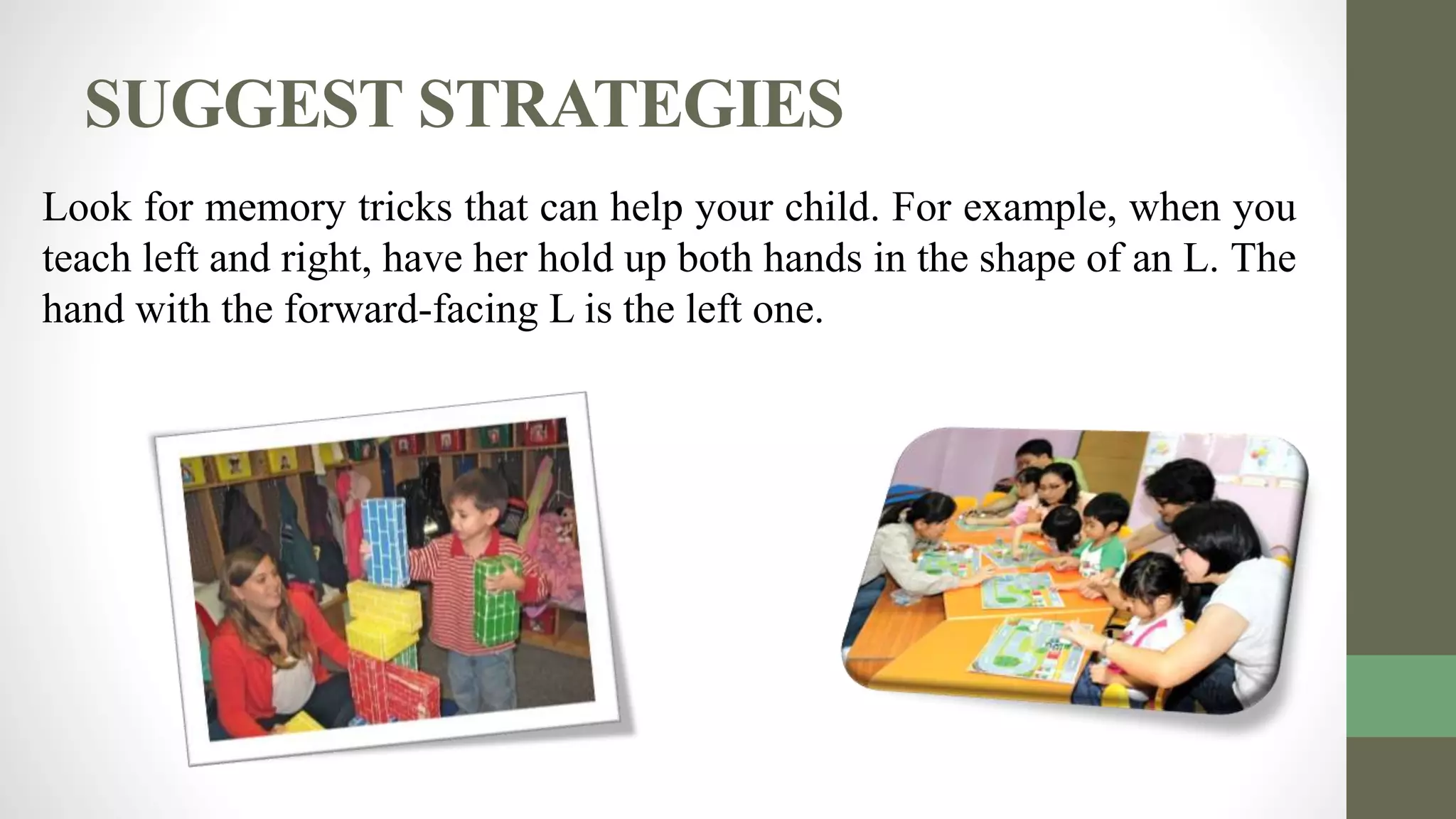
SUGGEST STRATEGIES
Look for memory tricks that can help your child. For example, when you
teach left and right, have her hold up both hands in the shape of an L. The
hand with the forward-facing L is the left one.
DIVIDEAND CONQUER
• If your child has to memorize a short poem or some lines in a class
play, have him break the task down into parts and work on the
toughest sections first.
PRACTICE, PRACTICE, PRACTICE
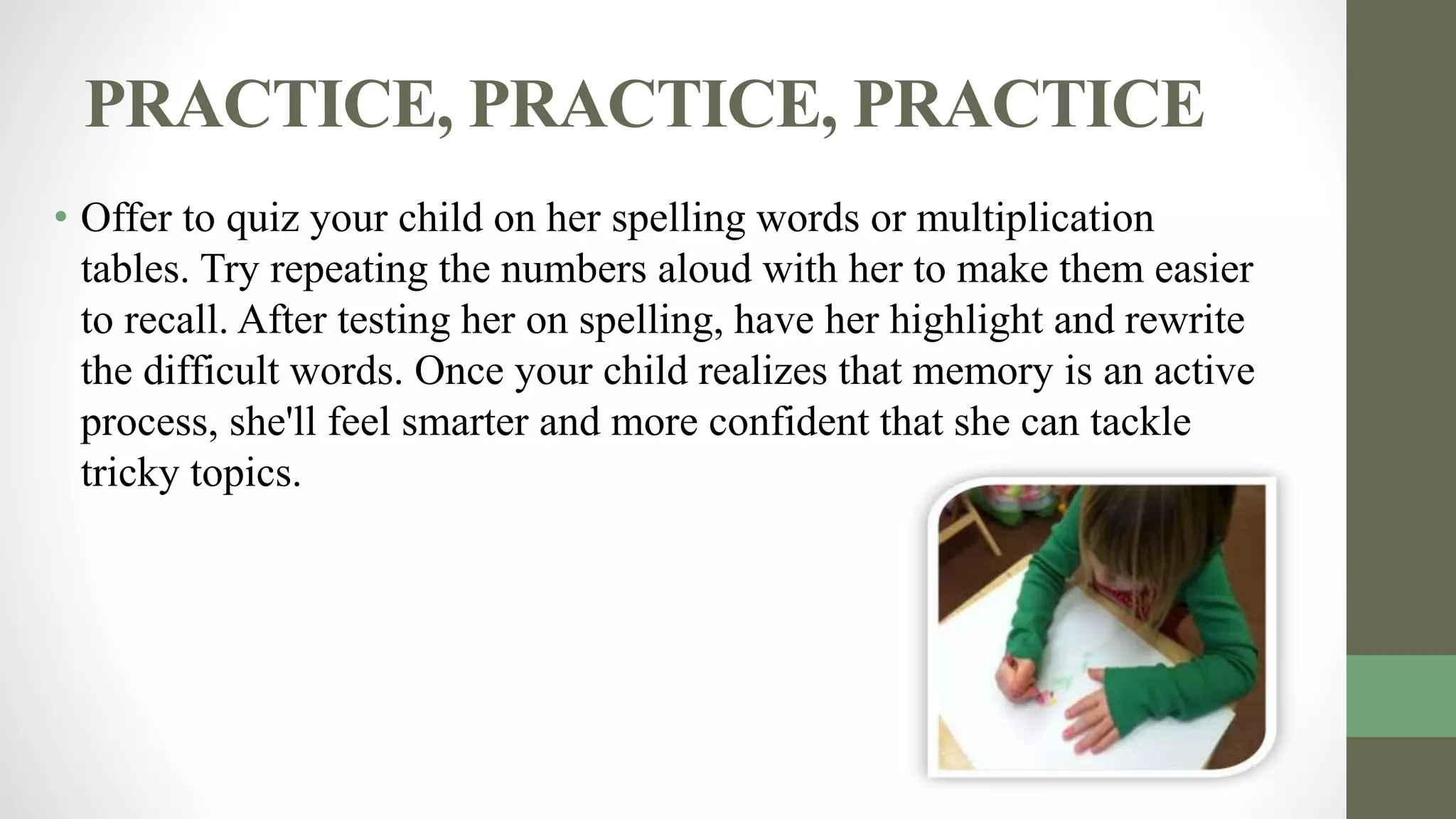
• Offer to quiz your child on her spelling words or multiplication
tables. Try repeating the numbers aloud with her to make them easier
to recall. After testing her on spelling, have her highlight and rewrite
the difficult words. Once your child realizes that memory is an active
process, she'll feel smarter and more confident that she can tackle
tricky topics.
USE RHYMES
• Using a variety of common and silly rhymes can help you recall basic
information.
• A child can learn the alphabet by singing it to the tune of "Twinkle,
Twinkle, Little Star," which makes the letters rhyme.
USEACRONYMS
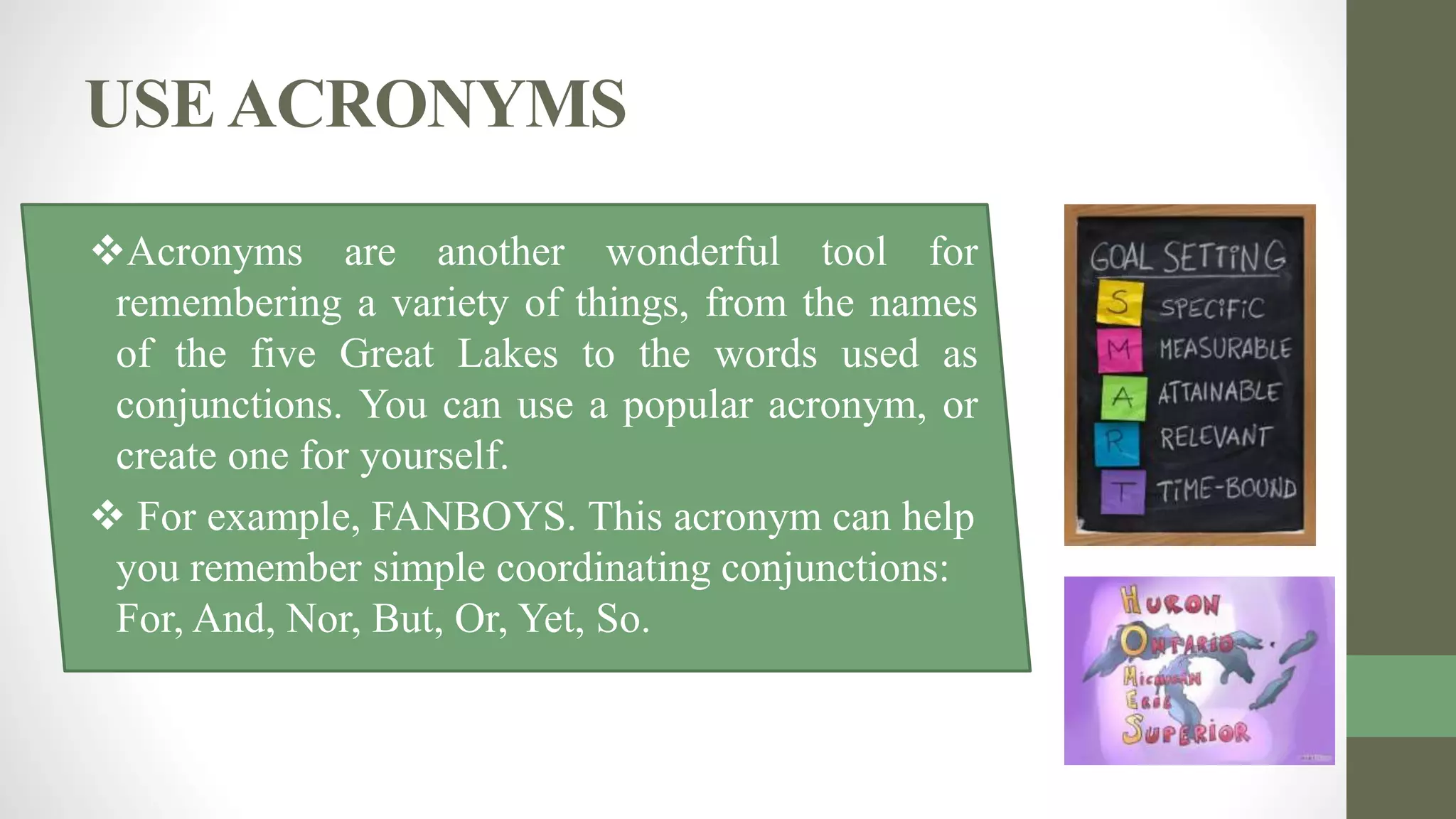
Acronyms are another wonderful tool for
remembering a variety of things, from the names
of the five Great Lakes to the words used as
conjunctions. You can use a popular acronym, or
create one for yourself.
 For example, FANBOYS. This acronym can help
you remember simple coordinating conjunctions:
For, And, Nor, But, Or, Yet, So.
USEACROSTICS
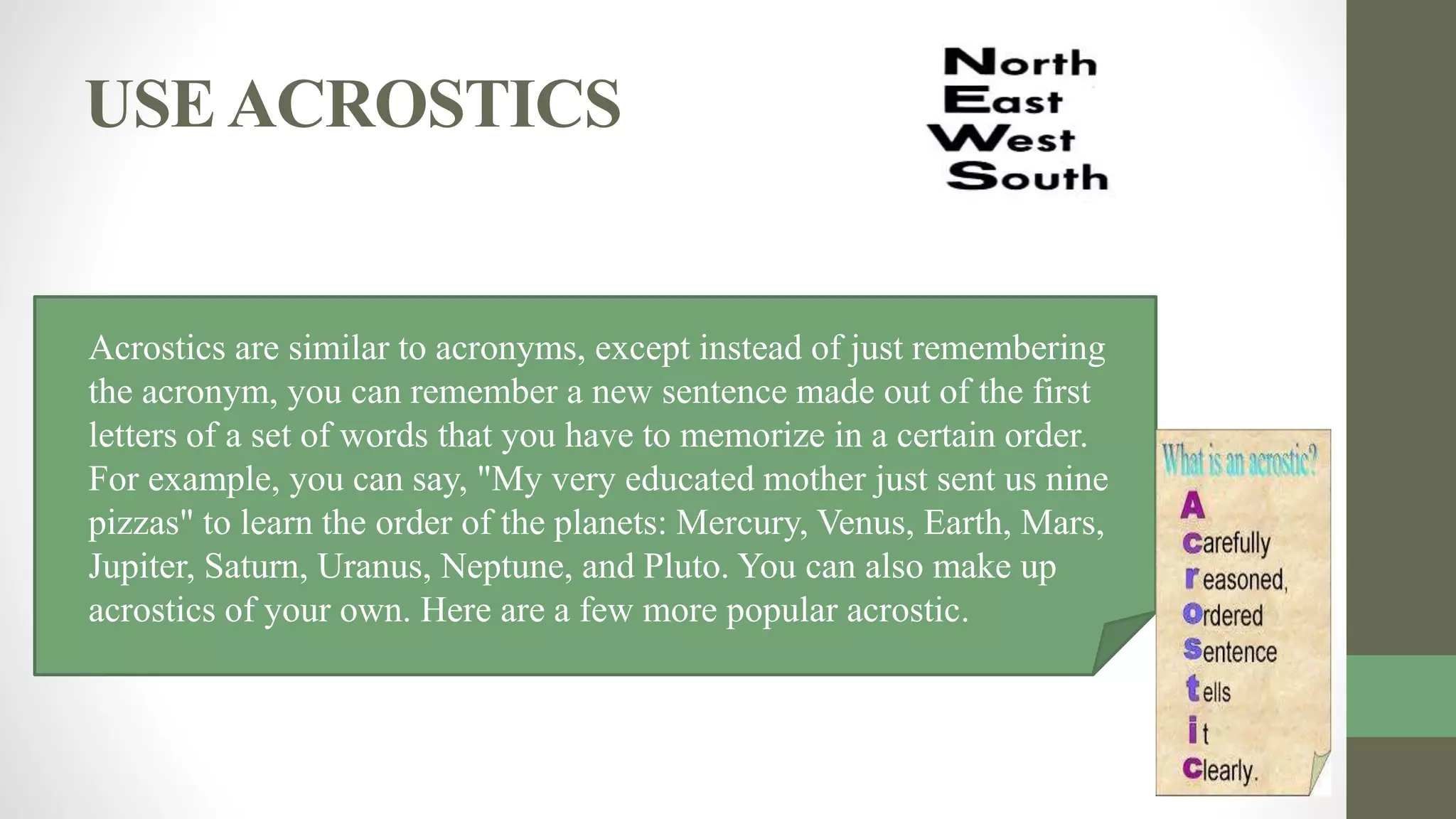
• Acrostics are similar to acronyms, except instead of just remembering
the acronym, you can remember a new sentence made out of the first
letters of a set of words that you have to memorize in a certain order.
For example, you can say, "My very educated mother just sent us nine
pizzas" to learn the order of the planets: Mercury, Venus, Earth, Mars,
Jupiter, Saturn, Uranus, Neptune, and Pluto. You can also make up
acrostics of your own. Here are a few more popular acrostic.
USEACROSTICS
Never Eat Sour Watermelons. This is used for remembering the points
of a compass in clockwise order: North, East, South, and West.
Another good example is Never Eat Shredded Wheat which also
rhymes too.
Please Excuse My Dear Aunt Sally. Use this to remember the order of
operations in mathematics: Parenthesis, Exponents, Multiplication,
Division, Addition, and Subtraction.

Memory

  • 1.
  • 2.
    CONTENT MEMORY Memory in Early Childhood Definitionsof memory Types of memory Explicit Memory Episodic Memory Semantic memory Implicit Memory Priming: Procedural Memory  Early musical training  Mnemonics  Mind over Matter  Get the details  Play memory games  Suggest strategies Techniques to improve early childhood memory  Divide and conquer  Practice, practice, practice  Use rhymes  Use acronyms  Use acrostics
  • 3.
  • 4.
    MEMORY IN EARLYCHILDHOOD • Overall, memory is an important key to children’s cognitive development. It improves their cognitive abilities, such as planning, attention and problem-solving. • Memory also helps children’s ability to master different skills. Early childhood is an important time for memory development because there are significant brain developments and children begin to interact with their environment more.
  • 5.
    DEFINITIONS OF MEMORY •The power or process of remembering what has been learned • Something that is remembered • The things learned and kept in the mind • A particular act of recall or recollection
  • 6.
    TYPES OF MEMORY Explicitmemory Information that you have to consciously work to remember is known as explicit memory. Implicit memory Information that you remember unconsciously and effortlessly is known as implicit memory.
  • 7.
  • 8.
    EXPLICIT MEMORY • Whenyou are trying to intentionally remember something (like a formula for your statistics class or a list of dates for your history class), this information is stored in your explicit memory. We use these memories every day, from remembering information for a test to recalling the date and time of a doctor's appointment.
  • 9.
    TYPES OF EXPLICITMEMORY • There are two major types of explicit memory: a. Episodic Memory b. Semantic Memory
  • 10.
    EPISODIC MEMORY • Theseare your long-term memories of specific events, such as what you did yesterday or your high school graduation. Episodic memory is one type of explicit memory. • Episodic memory is autobiographical: it provides us with a crucial record of our personal experiences. Any past event in which we played a part, and which we remember as an "episode" (a scene of events) is episodic.
  • 11.
    SEMANTIC MEMORY • Theseare memories of facts, concepts, names, and other general knowledge information another type of explicit memory is semantic memory. It accounts for our "textbook learning" or general knowledge about the world. It's what enables us to say, without knowing exactly when and where we learned, that Paris is the major city in France.
  • 12.
    2.IMPLICIT MEMORY • Thingsthat we don't purposely try to remember are stored in implicit memory. This kind of memory is both unconscious and unintentional. • Some examples of implicit memory include singing a familiar song, typing on your computer keyboard, daily habits, and driving a car. Riding a bicycle is another great example.
  • 13.
    TYPES OF IMPLICITMEMORY • There are two types of implicit memory. a. Priming b. Procedural memory
  • 14.
    PRIMING • Priming isa non conscious form of human memory concerned with perceptual identification of words and objects. • For example, if a person reads a list of words including the word table, and is later asked to complete a word starting with tab, the probability that he or she will answer table is greater than if they are not primed.
  • 15.
    PROCEDURALMEMORY • Procedural memoryis memory for the performance of particular types of action. When needed, procedural memories are automatically retrieved and utilized for the execution of the integrated procedures involved in both cognitive and motor skills, from tying shoes to flying an airplane to reading. • Procedural memories are accessed and used without the need for conscious control or attention. It is created through "procedural learning" or, repeating a complex activity again and again. Implicit procedural learning is essential to the development of any motor skill or cognitive activity.
  • 16.
  • 17.
    EARLY MUSICALTRAINING • Musiclessons in early childhood lead to changes in the brain that could improve its performance far into adulthood, researchers say. • "Early musical training does more good for kids than just making it easier for them to enjoy music. It changes the brain and these brain changes could lead to cognitive advances as well,"
  • 18.
    Mnemonics • Simply put,mnemonics (pronounced: nemoniks) are a way of memorizing information by creating links between words and letters to form a memorable word or sentence that will help you recall the material. • For example, the first letter of every word in the sentence spells out the word. A math mnemonic, MDAS, gives the order of operations. The letters stand for multiply, divide, add, and subtract.
  • 19.
    MIND OVER MATTER •Memory is a complex process, and 6- to 8- year-olds are developing a range of strategies to help them recall information. Remembering requires the ability to store information for a few seconds (short-term memory), then for several minutes while manipulating information (active working memory), and finally for an extended period of time (long-term memory). • For example, when copying spelling words from the blackboard, children must first remember the sequence of letters, and then they need to write the words down without spending a lot of time looking back at the board. Many whisper the words under their breath or repeat the letters out loud to help themselves. Later, they'll have to memorize the words for a spelling test.
  • 20.
    GET THE DETAILS "Studieshave shown that parents can have a long-term impact on memory development by including many questions and specifics in conversations about past events with their children," When you talk about a recent trip to the circus, for instance, ask your child, "What was your favorite act?" or "What did the big top look like?" Fill in the details if he can't provide them.
  • 21.
    PLAY MEMORY GAMES Thecard game Concentration and toys such as Simon and Bop It are good ones. In the car, try games like "I'm going on a picnic, and I'm taking . . . ," in which everyone has a turn adding an item and repeating the ones said previously.
  • 22.
  • 23.
    SUGGEST STRATEGIES Look formemory tricks that can help your child. For example, when you teach left and right, have her hold up both hands in the shape of an L. The hand with the forward-facing L is the left one.
  • 24.
    DIVIDEAND CONQUER • Ifyour child has to memorize a short poem or some lines in a class play, have him break the task down into parts and work on the toughest sections first.
  • 25.
    PRACTICE, PRACTICE, PRACTICE •Offer to quiz your child on her spelling words or multiplication tables. Try repeating the numbers aloud with her to make them easier to recall. After testing her on spelling, have her highlight and rewrite the difficult words. Once your child realizes that memory is an active process, she'll feel smarter and more confident that she can tackle tricky topics.
  • 26.
    USE RHYMES • Usinga variety of common and silly rhymes can help you recall basic information. • A child can learn the alphabet by singing it to the tune of "Twinkle, Twinkle, Little Star," which makes the letters rhyme.
  • 27.
    USEACRONYMS Acronyms are anotherwonderful tool for remembering a variety of things, from the names of the five Great Lakes to the words used as conjunctions. You can use a popular acronym, or create one for yourself.  For example, FANBOYS. This acronym can help you remember simple coordinating conjunctions: For, And, Nor, But, Or, Yet, So.
  • 28.
    USEACROSTICS • Acrostics aresimilar to acronyms, except instead of just remembering the acronym, you can remember a new sentence made out of the first letters of a set of words that you have to memorize in a certain order. For example, you can say, "My very educated mother just sent us nine pizzas" to learn the order of the planets: Mercury, Venus, Earth, Mars, Jupiter, Saturn, Uranus, Neptune, and Pluto. You can also make up acrostics of your own. Here are a few more popular acrostic.
  • 29.
    USEACROSTICS Never Eat SourWatermelons. This is used for remembering the points of a compass in clockwise order: North, East, South, and West. Another good example is Never Eat Shredded Wheat which also rhymes too. Please Excuse My Dear Aunt Sally. Use this to remember the order of operations in mathematics: Parenthesis, Exponents, Multiplication, Division, Addition, and Subtraction.