Suresh Babu G
Memory
Memory
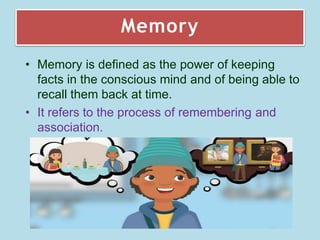
• Memory is defined as the power of keeping
facts in the conscious mind and of being able to
recall them back at time.
• It refers to the process of remembering and
association.
Definitions of Memory
• Drever – “Memory is that characteristic which
underlines all learning, the essential feature of which
is reflection. In narrow sense it is recall and
recognition”
• Woodworth and Marquis – “Memory is mental
power which consists in learning, retaining and
remembering what has previously been learnt”.
• Ryburn : “The power that we have to store our
experience, and to bring them into the field of
consciousness sometime after the experiences have
occurred, is termed as memory.
Suresh Babu G
Elements of Memory
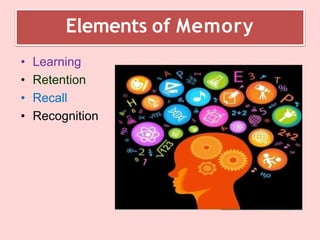
• Learning
• Retention
• Recall
• Recognition
Memorization Process
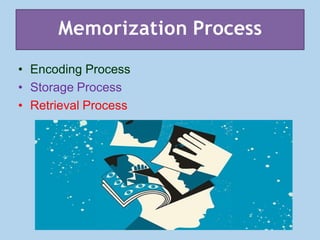
• Encoding Process
• Storage Process
• Retrieval Process
Suresh Babu G
Types Of Memory
Types of Memory
• Short Term Memory : It is a type of memory
which is temporary and short lived. It is also
called as recent memory/working memory.
• The retention time is longer than immediate
memory. It may be long as 30 second or more.
• For example : in order to understand a
sentence, the beginning of the sentence needs
to be head in mind while the rest is read.
sh Babu G
Immediate Memory/Sensory
Memory
⦁ It is also a type of short term
memory
⦁ It is the ability to retain
impressions of sensory information
after the orginal stimulus has
ceased.
⦁ Eg : We enter a cinema hall, see
the seat number given in the
ticket, after sitting we forget it.
Long Term Memory/Permanent Memory
• It is also referred as remote memory
• Here retention is of a permanent nature.
• Eg : Remembering our name, date of birth etc
Explicit Memory
• Explicit memory or Declarative memory is one of the
two main types of long-term memory
• It is the conscious, intentional recollection of factual
information, previous experiences and concepts.
• It is divided into episodic memory, which stores
specific personal experience and semantic memory,
which stores factual information.
• Episodic Memory : It is connected with
episodes and events which may consist of
personal events and experiences
associated with ones life. Eg: Describe an
accident
• Semantic memory : Helps to recollect the
relationship between events or association of
ideas. Eg : Bike and Helmet, Drinking and
driving etc.
• Procedural Memory : It is the long-term
memory of skills and procedures, or procedural
knowledge. It is considered as a form of
implicit memory. It is helpful in learning skills
and skills remain permanent always with the
person until diseased.
• Priming : It is a non-conscious from of human
memory concerned with perceptual identification
of words and objects. Eg : Try to remember the
following word in sequence – college, girlfriend,
birthday etc.
• Rote Memory : Here thinks are learned without
understanding their meaning. For example,
students mug up poems and definitions and
reproduce at the time of exam
• Logical Memory : Materials are learned with
insight, understanding and logical memory.
• Associative Memory : Here the individual
associate newly learned thinks with so many
related thinks existing in the memory and then
establish multiple connections.
Factors Influencing Memory
There are two factors that
influence the memory:
• Nature of the material to be
memorized – Meaningfulness of
the material to be memorized
and amount of the material to
be memorized.
• Methods and techniques of
memorizing
⦁ Over-learning – learn, recall it perfect, practice it
again.
⦁ Make the subject matter meaningful and organize
it sequentially
⦁ Follow the principle of association.
⦁ Utilize as many senses, as possible.
⦁ Self-recitation is helpful in the process of retention
⦁ Use the principle of learning by doing
⦁ Repetition and continuous practice
Suresh Babu G
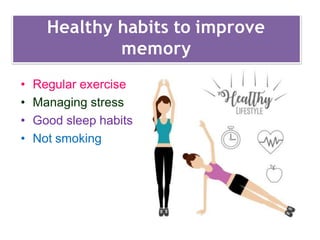
Healthy habits to improve
memory
• Regular exercise
• Managing stress
• Good sleep habits
• Not smoking
Methods of Memorizing
• Recitation Method : The learner reads a
content once or twice, then repeats and recall.
It helps in self evaluation and the learner can
write down the points that he is unable to
recall
• Whole and Part Method : Memorizing from
beginning to end at stretch or part by part. Like
memorizing a poem.
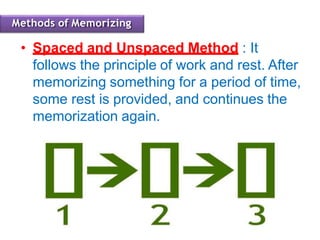
• Spaced and Unspaced Method : It
follows the principle of work and rest. After
memorizing something for a period of time,
some rest is provided, and continues the
memorization again.
Methods of Memorizing
Learning and recall can be improved by training.
Follow the techniques.
⦁ When recalling free the mid from fear and
anxiety
⦁ Have confidence in self and maintain positive
attitude.
⦁ Don’t fight with memory in recalling. Give time.
⦁ Interests and attention influence memorization.
Development or Improvement of Memory
• Adopt proper methods of memorization.
• Follow the principle of association Eg. VIBGYOR
= Color
• Grouping and Rhythm. Eg. Memorizing phone
number and months
• Utilize many senses to learn
• Maintain external (environment) and internal
factors (health)
• Proper rest, practice and repetition.
⦁ Learn from the general to the specific.
⦁ Make it meaningful – create action, make picture vivid, turn
abstract ideas into concrete or images.
⦁ Study actively
⦁ Visualize relationships
⦁ Recite and repeat
⦁ Reduce interference
⦁ Over learn
⦁ Be aware of attitudes
⦁ Distribute learning
⦁ Combine sense
🞂
🞂
🞂
Use material as many way different ways as you can
Group things in group of less then seven
Use a mnemonic technique
Specialized Techniques for
Memorization
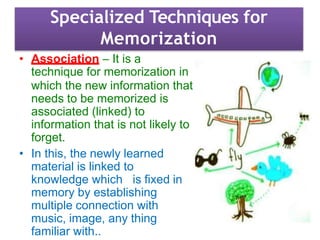
• Association – It is a
technique for memorization in
which the new information that
needs to be memorized is
associated (linked) to
information that is not likely to
forget.
• In this, the newly learned
material is linked to
knowledge which is fixed in
memory by establishing
multiple connection with
music, image, any thing
familiar with..
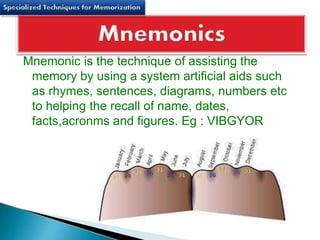
Mnemonic is the technique of assisting the
memory by using a system artificial aids such
as rhymes, sentences, diagrams, numbers etc
to helping the recall of name, dates,
facts,acronms and figures. Eg : VIBGYOR
Kinds of Mnemonic Techniques
⦁ Acronym : It is a technique for remembering the
names, phrases or steps by using the first letter
of each word from a new memorable word, Eg:
VIBGYOR
⦁ Acrostic : An unvented sentence where the first
letter of each word is a cue (indication) to an
idea we need to remember.
Eg: My Dear Aunt Sally (mathematical order of
operation: multiply and divide before you add
and subtract).
Suresh Babu G
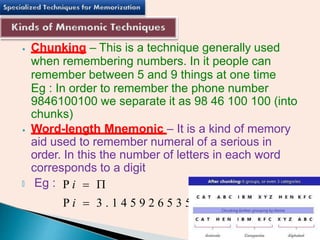
⦁ Chunking – This is a technique generally used
when remembering numbers. In it people can
remember between 5 and 9 things at one time
Eg : In order to remember the phone number
9846100100 we separate it as 98 46 100 100 (into
chunks)
⦁ Word-length Mnemonic – It is a kind of memory
aid used to remember numeral of a serious in
order. In this the number of letters in each word
corresponds to a digit
🞂 Eg : P i  
P i  3 . 1 4 5 9 2 6 5 3 5
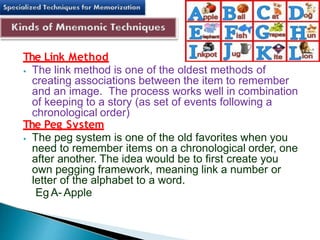
The Link Method
⦁ The link method is one of the oldest methods of
creating associations between the item to remember
and an image. The process works well in combination
of keeping to a story (as set of events following a
chronological order)
The Peg System
⦁ The peg system is one of the old favorites when you
need to remember items on a chronological order, one
after another. The idea would be to first create you
own pegging framework, meaning link a number or
letter of the alphabet to a word.
Eg A- Apple
The Image – Name Technique
This association technique works well
when you have to remember the
names of specific individuals. It
works on the principle to associate
their name with a physical aspects
of the individual. You will obviously
have to Google the person in
question for a physical.
Example:Let’s say the person to
remember is George Marx. Marx
sounds similar to mark
sh Babu G
The Journey Method
• The Journey Method combines the
Link method and the Peg
System. It makes use of a familiar
route you travel often. Consider
the route you travel everyday to
class.. The journey methods will
take landmarks and items like stop
streets, circles and robot to
associate your remember
items. The order in which the
journey takes will automatically
give a chronological advantage to
this system
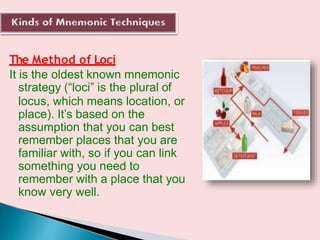
The Method of Loci
It is the oldest known mnemonic
strategy (“loci” is the plural of
locus, which means location, or
place). It’s based on the
assumption that you can best
remember places that you are
familiar with, so if you can link
something you need to
remember with a place that you
know very well.
Suresh Babu G
Thanks

memory.pptx

  • 1.
  • 2.
    Memory • Memory isdefined as the power of keeping facts in the conscious mind and of being able to recall them back at time. • It refers to the process of remembering and association.
  • 3.
    Definitions of Memory •Drever – “Memory is that characteristic which underlines all learning, the essential feature of which is reflection. In narrow sense it is recall and recognition” • Woodworth and Marquis – “Memory is mental power which consists in learning, retaining and remembering what has previously been learnt”. • Ryburn : “The power that we have to store our experience, and to bring them into the field of consciousness sometime after the experiences have occurred, is termed as memory.
  • 4.
    Suresh Babu G Elementsof Memory • Learning • Retention • Recall • Recognition
  • 5.
    Memorization Process • EncodingProcess • Storage Process • Retrieval Process
  • 6.
  • 7.
    Types of Memory •Short Term Memory : It is a type of memory which is temporary and short lived. It is also called as recent memory/working memory. • The retention time is longer than immediate memory. It may be long as 30 second or more. • For example : in order to understand a sentence, the beginning of the sentence needs to be head in mind while the rest is read.
  • 8.
    sh Babu G ImmediateMemory/Sensory Memory ⦁ It is also a type of short term memory ⦁ It is the ability to retain impressions of sensory information after the orginal stimulus has ceased. ⦁ Eg : We enter a cinema hall, see the seat number given in the ticket, after sitting we forget it.
  • 9.
    Long Term Memory/PermanentMemory • It is also referred as remote memory • Here retention is of a permanent nature. • Eg : Remembering our name, date of birth etc
  • 10.
    Explicit Memory • Explicitmemory or Declarative memory is one of the two main types of long-term memory • It is the conscious, intentional recollection of factual information, previous experiences and concepts. • It is divided into episodic memory, which stores specific personal experience and semantic memory, which stores factual information.
  • 11.
    • Episodic Memory: It is connected with episodes and events which may consist of personal events and experiences associated with ones life. Eg: Describe an accident • Semantic memory : Helps to recollect the relationship between events or association of ideas. Eg : Bike and Helmet, Drinking and driving etc.
  • 12.
    • Procedural Memory: It is the long-term memory of skills and procedures, or procedural knowledge. It is considered as a form of implicit memory. It is helpful in learning skills and skills remain permanent always with the person until diseased. • Priming : It is a non-conscious from of human memory concerned with perceptual identification of words and objects. Eg : Try to remember the following word in sequence – college, girlfriend, birthday etc.
  • 13.
    • Rote Memory: Here thinks are learned without understanding their meaning. For example, students mug up poems and definitions and reproduce at the time of exam • Logical Memory : Materials are learned with insight, understanding and logical memory. • Associative Memory : Here the individual associate newly learned thinks with so many related thinks existing in the memory and then establish multiple connections.
  • 14.
    Factors Influencing Memory Thereare two factors that influence the memory: • Nature of the material to be memorized – Meaningfulness of the material to be memorized and amount of the material to be memorized. • Methods and techniques of memorizing
  • 15.
    ⦁ Over-learning –learn, recall it perfect, practice it again. ⦁ Make the subject matter meaningful and organize it sequentially ⦁ Follow the principle of association. ⦁ Utilize as many senses, as possible. ⦁ Self-recitation is helpful in the process of retention ⦁ Use the principle of learning by doing ⦁ Repetition and continuous practice
  • 16.
    Suresh Babu G Healthyhabits to improve memory • Regular exercise • Managing stress • Good sleep habits • Not smoking
  • 17.
    Methods of Memorizing •Recitation Method : The learner reads a content once or twice, then repeats and recall. It helps in self evaluation and the learner can write down the points that he is unable to recall • Whole and Part Method : Memorizing from beginning to end at stretch or part by part. Like memorizing a poem.
  • 18.
    • Spaced andUnspaced Method : It follows the principle of work and rest. After memorizing something for a period of time, some rest is provided, and continues the memorization again. Methods of Memorizing
  • 19.
    Learning and recallcan be improved by training. Follow the techniques. ⦁ When recalling free the mid from fear and anxiety ⦁ Have confidence in self and maintain positive attitude. ⦁ Don’t fight with memory in recalling. Give time. ⦁ Interests and attention influence memorization.
  • 20.
    Development or Improvementof Memory • Adopt proper methods of memorization. • Follow the principle of association Eg. VIBGYOR = Color • Grouping and Rhythm. Eg. Memorizing phone number and months • Utilize many senses to learn • Maintain external (environment) and internal factors (health) • Proper rest, practice and repetition.
  • 21.
    ⦁ Learn fromthe general to the specific. ⦁ Make it meaningful – create action, make picture vivid, turn abstract ideas into concrete or images. ⦁ Study actively ⦁ Visualize relationships ⦁ Recite and repeat ⦁ Reduce interference ⦁ Over learn ⦁ Be aware of attitudes ⦁ Distribute learning ⦁ Combine sense 🞂 🞂 🞂 Use material as many way different ways as you can Group things in group of less then seven Use a mnemonic technique
  • 22.
    Specialized Techniques for Memorization •Association – It is a technique for memorization in which the new information that needs to be memorized is associated (linked) to information that is not likely to forget. • In this, the newly learned material is linked to knowledge which is fixed in memory by establishing multiple connection with music, image, any thing familiar with..
  • 23.
    Mnemonic is thetechnique of assisting the memory by using a system artificial aids such as rhymes, sentences, diagrams, numbers etc to helping the recall of name, dates, facts,acronms and figures. Eg : VIBGYOR
  • 24.
    Kinds of MnemonicTechniques ⦁ Acronym : It is a technique for remembering the names, phrases or steps by using the first letter of each word from a new memorable word, Eg: VIBGYOR ⦁ Acrostic : An unvented sentence where the first letter of each word is a cue (indication) to an idea we need to remember. Eg: My Dear Aunt Sally (mathematical order of operation: multiply and divide before you add and subtract).
  • 25.
  • 26.
    ⦁ Chunking –This is a technique generally used when remembering numbers. In it people can remember between 5 and 9 things at one time Eg : In order to remember the phone number 9846100100 we separate it as 98 46 100 100 (into chunks) ⦁ Word-length Mnemonic – It is a kind of memory aid used to remember numeral of a serious in order. In this the number of letters in each word corresponds to a digit 🞂 Eg : P i   P i  3 . 1 4 5 9 2 6 5 3 5
  • 27.
    The Link Method ⦁The link method is one of the oldest methods of creating associations between the item to remember and an image. The process works well in combination of keeping to a story (as set of events following a chronological order) The Peg System ⦁ The peg system is one of the old favorites when you need to remember items on a chronological order, one after another. The idea would be to first create you own pegging framework, meaning link a number or letter of the alphabet to a word. Eg A- Apple
  • 28.
    The Image –Name Technique This association technique works well when you have to remember the names of specific individuals. It works on the principle to associate their name with a physical aspects of the individual. You will obviously have to Google the person in question for a physical. Example:Let’s say the person to remember is George Marx. Marx sounds similar to mark
  • 29.
    sh Babu G TheJourney Method • The Journey Method combines the Link method and the Peg System. It makes use of a familiar route you travel often. Consider the route you travel everyday to class.. The journey methods will take landmarks and items like stop streets, circles and robot to associate your remember items. The order in which the journey takes will automatically give a chronological advantage to this system
  • 30.
    The Method ofLoci It is the oldest known mnemonic strategy (“loci” is the plural of locus, which means location, or place). It’s based on the assumption that you can best remember places that you are familiar with, so if you can link something you need to remember with a place that you know very well.
  • 31.