PRINCIPALS OF CONVENTIONAL PPV
Sergey Shushunov, MD
I have no commercial interests related to this presentation
RESPIRATTORY SYSTEM FUNCTION
Removal of carbon dioxide from blood
Oxygenation of blood
RESPIRATTORY SYSTEM FAILURE
Inability to remove carbon dioxide
Inability to oxygenate blood
Both
ORGAN / SYSTEM FUNCTION ETIOLOGY EXAMPLES
CNS Control
head injury, CNS infection, seizures, drugs, toxins,
liver and kidney failure, hypoglycemia, metabolic
PNS trauma, neuropathy, toxins, metabolic, drugs
Skeletal Mechanical trauma, deformities
Muscular
atrophy, myopathy, myolysis, NMB, electrolyte
imbalance, tetanus
Respiratory
upper airways
Gas exchange
croup syndrome, foreign body, tumor, mass,
laryngotracheomalacia, trauma, peripheral neuropathy
Respiratory
lower airways
RAD, asthma, COPD, bronchiolitis,
Respiratory
alveolar space
pneumonia, ARDS, NRDS, pulmonary edema,
aspiration, pulmonary contusion/hemorrhage, fibrosis
Gas delivery Gas delivery CHF, PHT, PE, pneumothorax, cardiac tamponade
Takes place in alveolar space
Depends on:
• Partial pressure gradient
• Alveolar surface area (mean of I and E surface area)
• Alveolar wall thickness
• Exposure time
• Gas diffusion coefficient (physical property of a gas independent
from any intervention)
CO2 REMOVAL
Depends on
• Partial pressure gradient across alveolar-
capillary membrane
• CO2 has 200 times higher than O2 diffusion
coefficient and 20 times higher diffusion
ability therefore alveolar surface area, wall
thickness and exposure time are less relevant
CO2 REMOVAL
• diffusion across alveolar-capillary membrane
takes place during inspiration.
• Alveoli don’t have to remain opened during
expiration for optimal CO2 removal
• CO2 removal is decreased in:
Hypoventilation (control, mechanical or extreme small airway
disease)
Increased dead space
• Alveolar disease does not usually lead to CO2
retention
CO2 REMOVAL
dead space
• Mechanical - different extensions of ventilator
tubing
• Anatomical - airways
• Alveolar - nonperfused alveolar space
CO2 REMOVAL
• Direct relationship with MV
• MV is required to maintain
desired PP gradient
• MV (PaCO2)is controlled by
TV (limited by over-distension)
RR (limited by auto PEEP)
CO2 REMOVAL
auto PEEP
• May lead to dynamic
hyperinflation
• Complications
include barotrauma
and hypovolemic
shock
Depends on
• Partial pressure gradient
• Alveolar surface area
• Alveolar-capillary membrane thickness
• Diffusion exposure time
• Oxygenation is decreased in
alveolar disease
large airway disease
small airway disease
OXYGENATION
• Normally O2 diffusion across alveolar-capillary
membrane takes place during inspiration and
expiration.
• Alveolar collapse during expiration shortens
diffusion exposure time
• Alveoli must remain opened during expiration
for best oxygenation
OXYGENATION
• Direct relationship with FiO2
(limited by 100%)
• Direct relationship with
Mean Airway Pressure
CONTROL OF MEAN AIRWAY
PRESSURE
Pressure
Time
PEEP
PIP
Increase I. Time
Increase
PEEP
Increase PIP
(TV)
I. Time E. Time
Increase
% Rise
(flow)
%Rise
I. Time E. Time
% Rise (flow)
PIP – limited by over distention
I. Time - limited by auto PEEP
PEEP – limited by over distention
ALVEOLAR DISEASE
• Accumulation of intra and extra alveolar fluid
• Thickening of alveolar-capillary membrane
• Alveolar collapse during expiration
EFFECT OF POSITIVE AIRWAY PRESSURE
redistribution of intra alveolar fluid
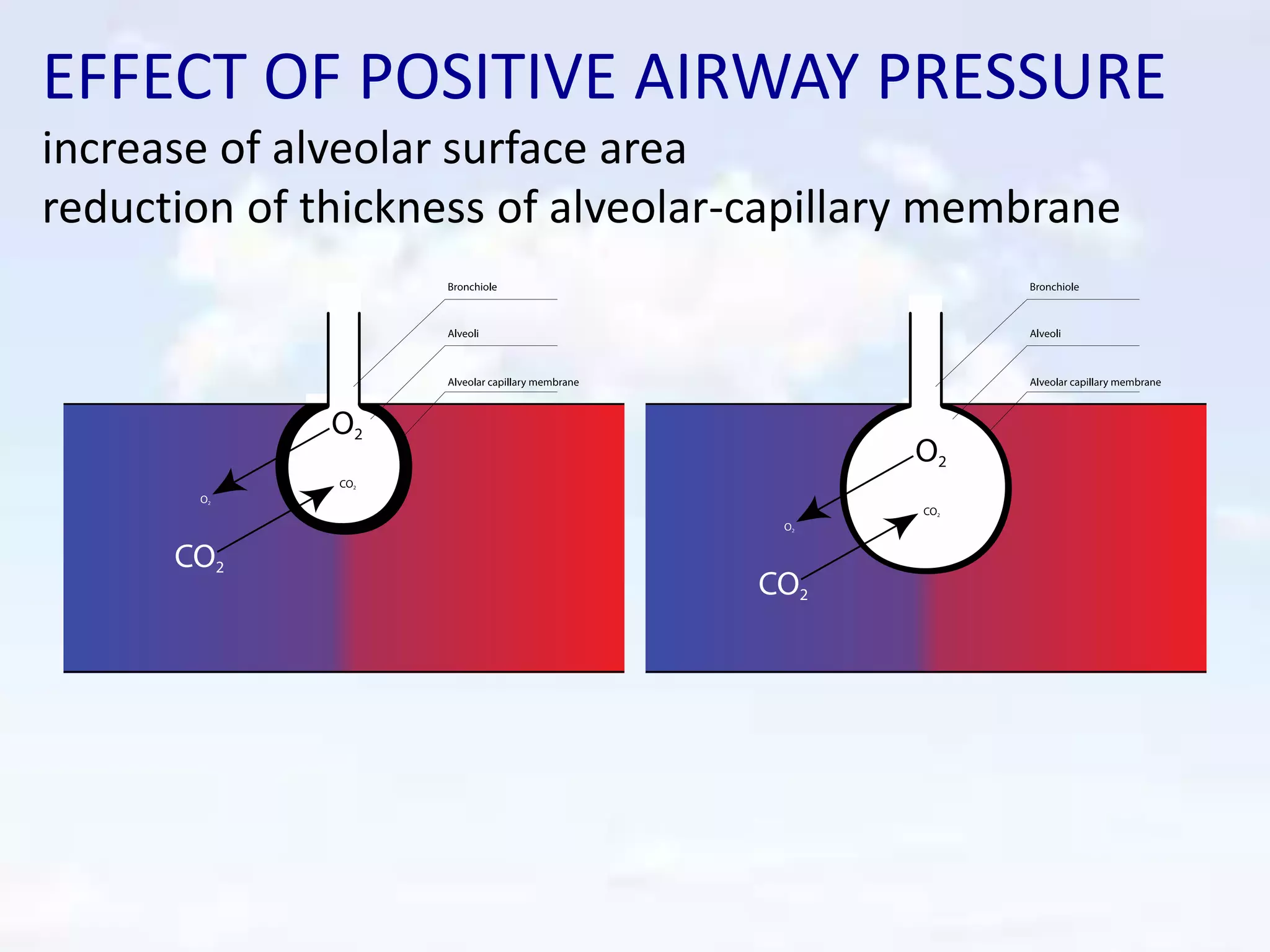
EFFECT OF POSITIVE AIRWAY PRESSURE
increase of alveolar surface area
reduction of thickness of alveolar-capillary membrane
RESPIRATORY FAILURE
Categories
• Neither alveolar nor small airway disease
• Small airway disease
• Alveolar disease
• Mixed small airway and alveolar disease
• Reasonable guess
• Patient’s age and size
• Cause of respiratory failure
• Degree of respiratory failure
PPV SETTINGS
• Mode of PPV
• PEEP
• FiO2
• TV / PIP
• Respiratory Rate
• I. Time
• Category (or etiology) of respiratory failure
• Degree of illness
• Respiratory effort
MODES OF CONVENTIONAL PPV
(BREATH DELIVERY)
• Controlled (Assist Controlled) PC or VC
Patients with no respiratory drive (NMB, anesthesia, coma)
Weaning is not imminent
• IMV (SIMV) PC or VC
All modern ventilation offer only SIMV
Patients with or without respiratory drive
• Support (PS or VS)
Patient with good respiratory drive
Moderate degree of respiratory failure
• Mixed (usually SIMV + PS or VS)
Patients with good respiratory drive
Preferred weaning mode
CMV (AC) vs. IMV (SIMV)
CMV IMV
Mandatory and spontaneous breaths
have identical TV/PIP and I. Time
Breaths vary in volume and I. Time
between mandatory and spontaneous
Hard to wean by decreasing rate Easy to wean: patient takes “own” breaths
with or without PS/VS
Minimal work of breathing Potential for increased work of breathing
with insufficient PS/VS
Feels unnatural. Patient/ventilator
asynchrony is possible in awake patients
and may need sedation +/- NMB
Feels more natural. Easier to synchronize,
requires less sedation and less likely NMB
Significant hyperventilation in agitated
patients is possible
Significant hyperventilation in agitated
patients is less likely
In heavily sedated, comatose and paralyzed patients CMV and IMV work identically
CMV (AC) vs. IMV (SIMV)
Assist control IMV
INITIAL PEEP SELECTION
Etiology of respiratory failure
Zero in small airway disease
Low (physiological) in no small airway disease / no alveolar disease
High in alveolar disease
Tricky in mixed small airway disease / alveolar disease (bronchiolitis)
Degree of hypoxemia (in alveolar disease)
Additional pathology
Increased ICP - lower
Pulmonary hypertension - lower
Increased intra-abdominal pressure - higher
FiO2 0.3 0.4 0.5 0.6 0.7 0.8 0.9 1.0
PEEP 5-6 6-8 8-10 10-12 12-14 14-16 16-18 20-24
LIMITATIONS
• Barotrauma
• Pulmonary hypertension
• Increase of anatomical
dead space (CO2)
• Decrease of CO
• Pressure vs. Volume
• TV is age independent
• Physiological - patients wit neither small airway
nor alveolar disease or patients with isolated
small airway disease
• Small – patients with alveolar disease
• Selecting TV based on ml/kg may be misleading
• Chest rise
PRESSURE vs. VOLUME
PRESSUE VOLUME
TV changes as patient’s compliance and
airway resistance changes
PIP changes as patient’s compliance and
airway resistance changes
Increase of airway resistance, or decrease
of compliance will lead to decrease of TV
and hypoventilation
Increase of airway resistance or decrease
of compliance will lead to increase of PIP
and potentially to volutrauma and
barotrauma, but not to hypoventilation
PEAK INSPIRATORY PRESSURE
• Changes of PIP in VC mode is an important parameter
which can be used as the “sixth” vital sign
• Elevation of PIP while patient receives constant TV
always indicates a problem, including mucus
accumulation, pulmonary edema, infiltrate, atelectasis,
pneumothorax, bronchospasm, artificial airway
obstruction
• Decrease of the PIP while patient receives constant TV
always indicate clinical improvement, including
resolution of atelectasis, bronchospasm, infiltrate or
pulmonary edema
RESPIRATION RATE SELECTION
main principals
• Respiratory drive and effort
• Desired pCO2
• BMR (BMR and CO2 production is elevated in
sepsis, trauma, burns, etc.)
• Age and weight
RESPIRATION RATE SELECTION
age and weight considerations
• Metabolic rate is age
dependent.
• TV per unit of weight is the
same for all ages.
• Newborn has 4 times higher
metabolic rate per unit of
weight than average adult (120
kcal/kg/day vs. 30
Kcal/kg/day).
• Newborn has 4 times higher
CO2 production per unit of
weight than average adult.
• Newborn breathes 4 times
faster than average adult and
requires 4 times faster RR.
• Use ideal body weight.
INSPIRATORY TIME SELECTION
• Respiratory Rate
• Desired Expiratory Time to Inspiratory Time ratio
• Presence of small airway disease
• Targeted Mpaw
INSPIRATORY TIME SELECTION
• I. Time, E. Time and RR are interlinked
• Example:
RR of 10/min makes respiratory cycle 6 seconds
I. Time set at 1 second makes I:E ratio of 1:5
Changing I. Time to 1.5 seconds makes I:E ratio of 1:3 (1.5:4.5 sec)
Changing RR to 15/min (resp. cycle of 4 sec.) makes I:E ration of 1:3
I.TIME, RR and I:E RATIO SELECTION
Wrong selection of I. Time/RR/I:E ration can lead
to auto-peep and air trapping
COMPLICTIONS OF AUTO PEEP
• CO2 retention
• Barotrauma
• Decreased CO and shock
SUGGETSTED INITIAL VENTILATOR
SETINGS
NO ALVEAOLAR, NO SMALL AIRWAY DISEASE
• Low FiO2
• Usual TV
• Age appropriate rate
• Match ventilator I. Time to patient’s I. Time
• I:E ratio 1:3
• Physiologic PEEP
SUGGETSTED INITIAL VENTILATOR
SETINGS
NO ALVEAOLAR, NO SMALL AIRWAY DISEASE
AGE 0-12 M 1-5 Y 6-12 Y ADULT
TV 10-12 8-12 8-12 6-10
RATE 30-40 25-40 15-25 8-15
I. TIME 0.3-0.5 0.5-0.7 0.7-0.9 0.9-1.2
SUGGETSTED INITIAL VENTILATOR
SETINGS
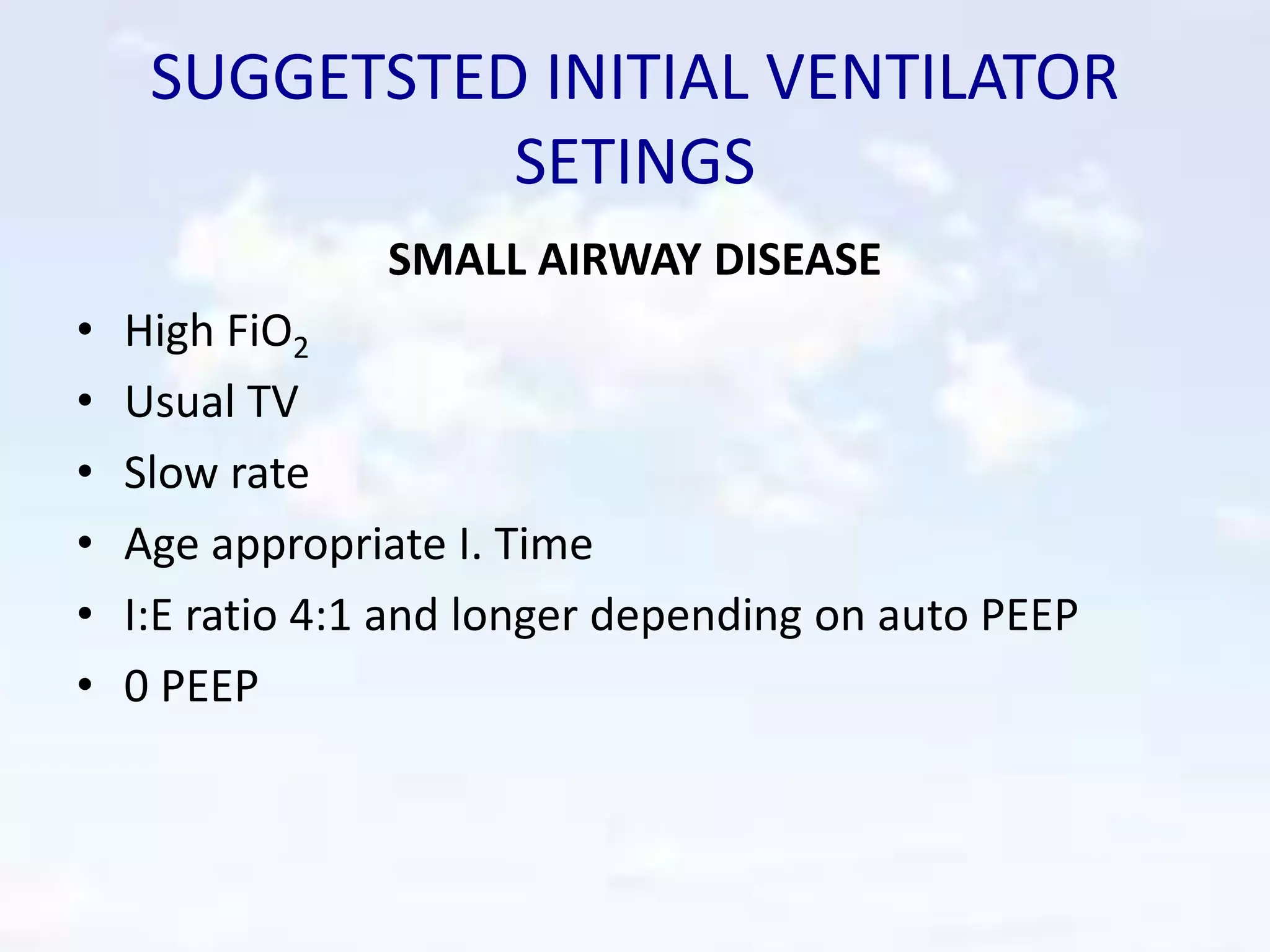
SMALL AIRWAY DISEASE
• High FiO2
• Usual TV
• Slow rate
• Age appropriate I. Time
• I:E ratio 4:1 and longer depending on auto PEEP
• 0 PEEP
SUGGETSTED INITIAL VENTILATOR
SETINGS
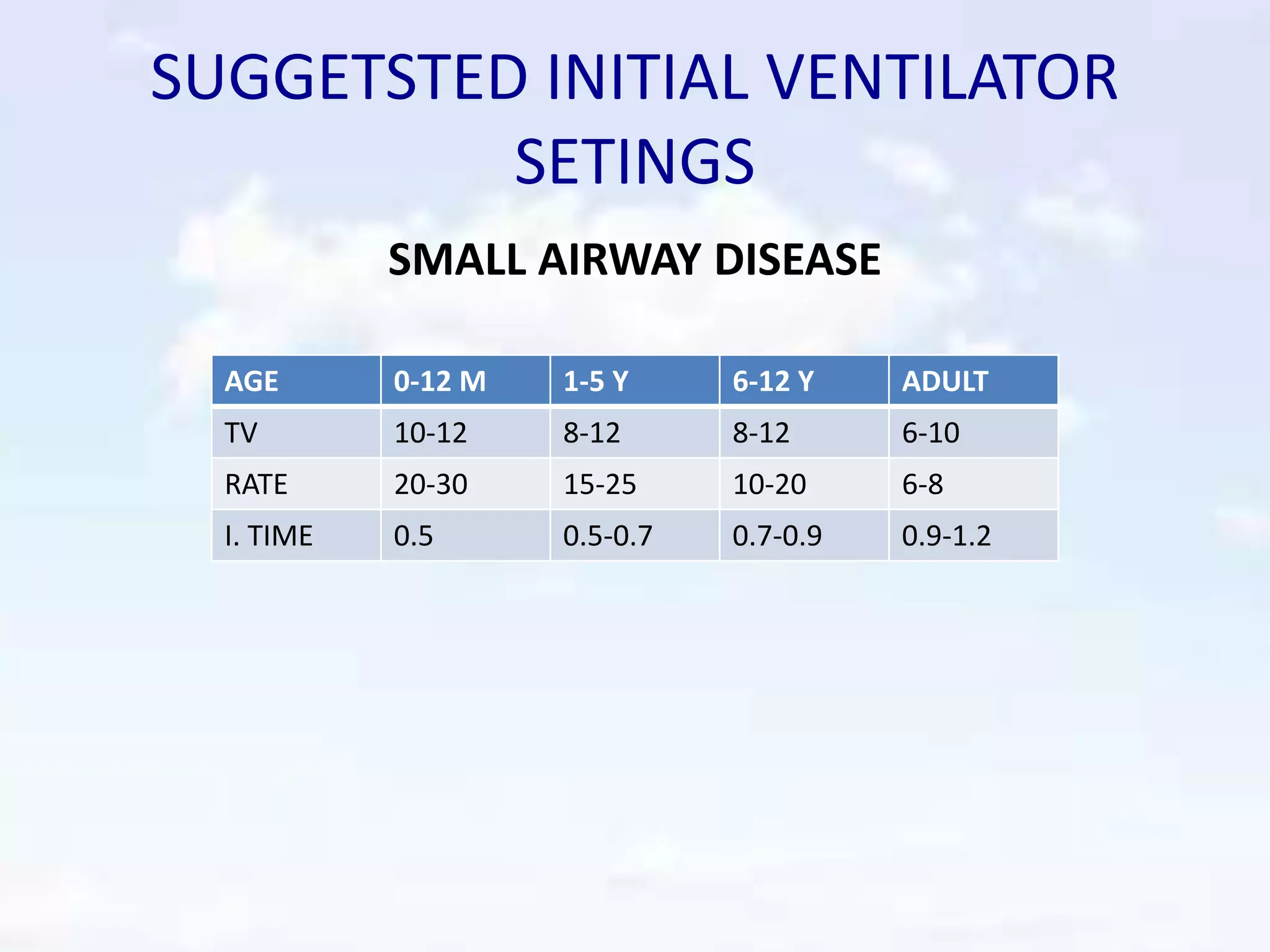
SMALL AIRWAY DISEASE
AGE 0-12 M 1-5 Y 6-12 Y ADULT
TV 10-12 8-12 8-12 6-10
RATE 20-30 15-25 10-20 6-8
I. TIME 0.5 0.5-0.7 0.7-0.9 0.9-1.2
VENTILATOR SETINGS ADJUSTMENTS
SMALL AIRWAY DISESE
• To improve oxygenation
Increase flow or decrease rise time
Increase PEEP cautiously to low levels
Increase TV/PIP cautiously (PIP reflects airway resistance
rather than alveolar compliance)
• To improve CO2 removal
Increase PEEP to 5-10 cm (slowly)
Increase E. Time
Increase TV/PIP
SUGGETSTED INITIAL VENTILATOR
SETINGS
ALVEOLAR DISEASE
• High FiO2
• Small TV
• Age appropriate rate
• Age appropriate I. Time
• I:E ratio 1:<3
• High PEEP
SUGGETSTED INITIAL VENTILATOR
SETINGS
ALVEOLAR DISEASE
AGE 0-12 M 1-5 Y 6-12 Y ADULT
TV 6-12 6-10 4-10 4-8
RATE 30-40 15-25 15-25 8-15
I. TIME 0.3-0.5 0.5-0.7 0.7-0.9 0.9-1.2
VENTILATOR SETINGS ADJUSTMENTS
ALVEOLAR DISEASE
• To improve oxygenation
Increase I. Time (Decrease I:E ratio)
Increase PEEP to 30 cm, try recruitment maneuver with PEEP
of 40 cm, aim to keep FiO2 < 0.6
Increase TV/PIP (the least desirable option) for small chest rise
• To improve CO2 removal
Increase RR
Increase TV/PIP
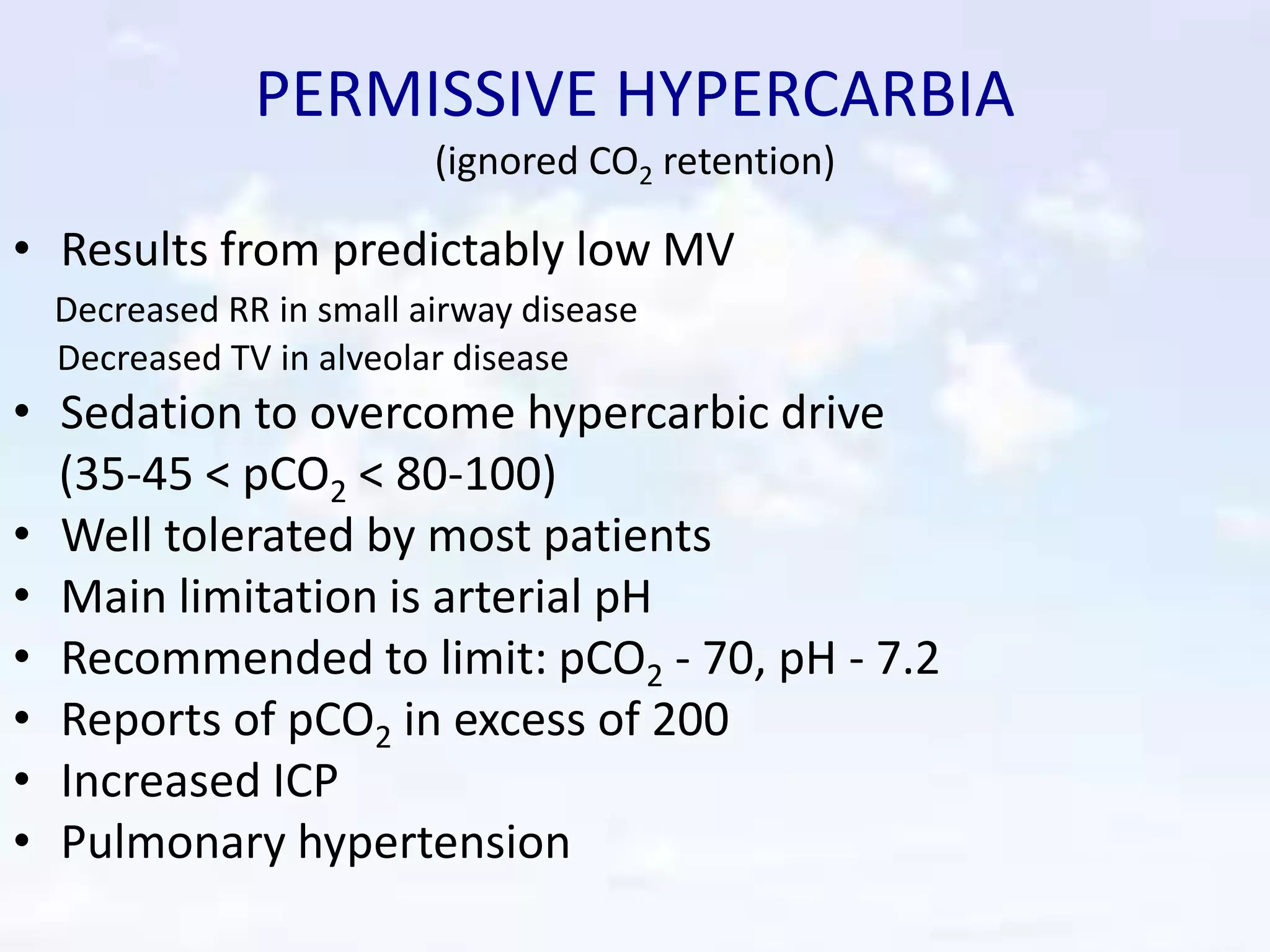
PERMISSIVE HYPERCARBIA
(ignored CO2 retention)
• Results from predictably low MV
Decreased RR in small airway disease
Decreased TV in alveolar disease
• Sedation to overcome hypercarbic drive
(35-45 < pCO2 < 80-100)
• Well tolerated by most patients
• Main limitation is arterial pH
• Recommended to limit: pCO2 - 70, pH - 7.2
• Reports of pCO2 in excess of 200
• Increased ICP
• Pulmonary hypertension
WEANING PROCESS
• Consider using SIMV + PS
• D/C NMB and wean sedation
• Wean FiO2 to < 0.4
• Wean PEEP to 3-5 cm (higher in obese patients)
• Wean RR to < ½ of “normal”
• Wean PS to 5-10 cm
• Monitor
Work of breathing (RR, use of accessory muscles)
HbO2Sat or PaO2
ET CO2 or PCO2

Principals of conventional positive pressure mechanical ventilation

  • 1.
    PRINCIPALS OF CONVENTIONALPPV Sergey Shushunov, MD I have no commercial interests related to this presentation
  • 2.
    RESPIRATTORY SYSTEM FUNCTION Removalof carbon dioxide from blood Oxygenation of blood
  • 3.
    RESPIRATTORY SYSTEM FAILURE Inabilityto remove carbon dioxide Inability to oxygenate blood Both
  • 4.
    ORGAN / SYSTEMFUNCTION ETIOLOGY EXAMPLES CNS Control head injury, CNS infection, seizures, drugs, toxins, liver and kidney failure, hypoglycemia, metabolic PNS trauma, neuropathy, toxins, metabolic, drugs Skeletal Mechanical trauma, deformities Muscular atrophy, myopathy, myolysis, NMB, electrolyte imbalance, tetanus Respiratory upper airways Gas exchange croup syndrome, foreign body, tumor, mass, laryngotracheomalacia, trauma, peripheral neuropathy Respiratory lower airways RAD, asthma, COPD, bronchiolitis, Respiratory alveolar space pneumonia, ARDS, NRDS, pulmonary edema, aspiration, pulmonary contusion/hemorrhage, fibrosis Gas delivery Gas delivery CHF, PHT, PE, pneumothorax, cardiac tamponade
  • 5.
    Takes place inalveolar space Depends on: • Partial pressure gradient • Alveolar surface area (mean of I and E surface area) • Alveolar wall thickness • Exposure time • Gas diffusion coefficient (physical property of a gas independent from any intervention)
  • 6.
    CO2 REMOVAL Depends on •Partial pressure gradient across alveolar- capillary membrane • CO2 has 200 times higher than O2 diffusion coefficient and 20 times higher diffusion ability therefore alveolar surface area, wall thickness and exposure time are less relevant
  • 7.
    CO2 REMOVAL • diffusionacross alveolar-capillary membrane takes place during inspiration. • Alveoli don’t have to remain opened during expiration for optimal CO2 removal • CO2 removal is decreased in: Hypoventilation (control, mechanical or extreme small airway disease) Increased dead space • Alveolar disease does not usually lead to CO2 retention
  • 8.
    CO2 REMOVAL dead space •Mechanical - different extensions of ventilator tubing • Anatomical - airways • Alveolar - nonperfused alveolar space
  • 9.
    CO2 REMOVAL • Directrelationship with MV • MV is required to maintain desired PP gradient • MV (PaCO2)is controlled by TV (limited by over-distension) RR (limited by auto PEEP)
  • 10.
    CO2 REMOVAL auto PEEP •May lead to dynamic hyperinflation • Complications include barotrauma and hypovolemic shock
  • 11.
    Depends on • Partialpressure gradient • Alveolar surface area • Alveolar-capillary membrane thickness • Diffusion exposure time • Oxygenation is decreased in alveolar disease large airway disease small airway disease
  • 12.
    OXYGENATION • Normally O2diffusion across alveolar-capillary membrane takes place during inspiration and expiration. • Alveolar collapse during expiration shortens diffusion exposure time • Alveoli must remain opened during expiration for best oxygenation
  • 13.
    OXYGENATION • Direct relationshipwith FiO2 (limited by 100%) • Direct relationship with Mean Airway Pressure
  • 14.
    CONTROL OF MEANAIRWAY PRESSURE Pressure Time PEEP PIP Increase I. Time Increase PEEP Increase PIP (TV) I. Time E. Time Increase % Rise (flow) %Rise I. Time E. Time % Rise (flow) PIP – limited by over distention I. Time - limited by auto PEEP PEEP – limited by over distention
  • 15.
    ALVEOLAR DISEASE • Accumulationof intra and extra alveolar fluid • Thickening of alveolar-capillary membrane • Alveolar collapse during expiration
  • 16.
    EFFECT OF POSITIVEAIRWAY PRESSURE redistribution of intra alveolar fluid
  • 17.
    EFFECT OF POSITIVEAIRWAY PRESSURE increase of alveolar surface area reduction of thickness of alveolar-capillary membrane
  • 18.
    RESPIRATORY FAILURE Categories • Neitheralveolar nor small airway disease • Small airway disease • Alveolar disease • Mixed small airway and alveolar disease
  • 19.
    • Reasonable guess •Patient’s age and size • Cause of respiratory failure • Degree of respiratory failure
  • 20.
    PPV SETTINGS • Modeof PPV • PEEP • FiO2 • TV / PIP • Respiratory Rate • I. Time
  • 21.
    • Category (oretiology) of respiratory failure • Degree of illness • Respiratory effort
  • 22.
    MODES OF CONVENTIONALPPV (BREATH DELIVERY) • Controlled (Assist Controlled) PC or VC Patients with no respiratory drive (NMB, anesthesia, coma) Weaning is not imminent • IMV (SIMV) PC or VC All modern ventilation offer only SIMV Patients with or without respiratory drive • Support (PS or VS) Patient with good respiratory drive Moderate degree of respiratory failure • Mixed (usually SIMV + PS or VS) Patients with good respiratory drive Preferred weaning mode
  • 23.
    CMV (AC) vs.IMV (SIMV) CMV IMV Mandatory and spontaneous breaths have identical TV/PIP and I. Time Breaths vary in volume and I. Time between mandatory and spontaneous Hard to wean by decreasing rate Easy to wean: patient takes “own” breaths with or without PS/VS Minimal work of breathing Potential for increased work of breathing with insufficient PS/VS Feels unnatural. Patient/ventilator asynchrony is possible in awake patients and may need sedation +/- NMB Feels more natural. Easier to synchronize, requires less sedation and less likely NMB Significant hyperventilation in agitated patients is possible Significant hyperventilation in agitated patients is less likely In heavily sedated, comatose and paralyzed patients CMV and IMV work identically
  • 24.
    CMV (AC) vs.IMV (SIMV) Assist control IMV
  • 25.
    INITIAL PEEP SELECTION Etiologyof respiratory failure Zero in small airway disease Low (physiological) in no small airway disease / no alveolar disease High in alveolar disease Tricky in mixed small airway disease / alveolar disease (bronchiolitis) Degree of hypoxemia (in alveolar disease) Additional pathology Increased ICP - lower Pulmonary hypertension - lower Increased intra-abdominal pressure - higher FiO2 0.3 0.4 0.5 0.6 0.7 0.8 0.9 1.0 PEEP 5-6 6-8 8-10 10-12 12-14 14-16 16-18 20-24
  • 26.
    LIMITATIONS • Barotrauma • Pulmonaryhypertension • Increase of anatomical dead space (CO2) • Decrease of CO
  • 27.
    • Pressure vs.Volume • TV is age independent • Physiological - patients wit neither small airway nor alveolar disease or patients with isolated small airway disease • Small – patients with alveolar disease • Selecting TV based on ml/kg may be misleading • Chest rise
  • 28.
    PRESSURE vs. VOLUME PRESSUEVOLUME TV changes as patient’s compliance and airway resistance changes PIP changes as patient’s compliance and airway resistance changes Increase of airway resistance, or decrease of compliance will lead to decrease of TV and hypoventilation Increase of airway resistance or decrease of compliance will lead to increase of PIP and potentially to volutrauma and barotrauma, but not to hypoventilation
  • 29.
    PEAK INSPIRATORY PRESSURE •Changes of PIP in VC mode is an important parameter which can be used as the “sixth” vital sign • Elevation of PIP while patient receives constant TV always indicates a problem, including mucus accumulation, pulmonary edema, infiltrate, atelectasis, pneumothorax, bronchospasm, artificial airway obstruction • Decrease of the PIP while patient receives constant TV always indicate clinical improvement, including resolution of atelectasis, bronchospasm, infiltrate or pulmonary edema
  • 30.
    RESPIRATION RATE SELECTION mainprincipals • Respiratory drive and effort • Desired pCO2 • BMR (BMR and CO2 production is elevated in sepsis, trauma, burns, etc.) • Age and weight
  • 31.
    RESPIRATION RATE SELECTION ageand weight considerations • Metabolic rate is age dependent. • TV per unit of weight is the same for all ages. • Newborn has 4 times higher metabolic rate per unit of weight than average adult (120 kcal/kg/day vs. 30 Kcal/kg/day). • Newborn has 4 times higher CO2 production per unit of weight than average adult. • Newborn breathes 4 times faster than average adult and requires 4 times faster RR. • Use ideal body weight.
  • 32.
    INSPIRATORY TIME SELECTION •Respiratory Rate • Desired Expiratory Time to Inspiratory Time ratio • Presence of small airway disease • Targeted Mpaw
  • 33.
    INSPIRATORY TIME SELECTION •I. Time, E. Time and RR are interlinked • Example: RR of 10/min makes respiratory cycle 6 seconds I. Time set at 1 second makes I:E ratio of 1:5 Changing I. Time to 1.5 seconds makes I:E ratio of 1:3 (1.5:4.5 sec) Changing RR to 15/min (resp. cycle of 4 sec.) makes I:E ration of 1:3
  • 34.
    I.TIME, RR andI:E RATIO SELECTION Wrong selection of I. Time/RR/I:E ration can lead to auto-peep and air trapping
  • 35.
    COMPLICTIONS OF AUTOPEEP • CO2 retention • Barotrauma • Decreased CO and shock
  • 36.
    SUGGETSTED INITIAL VENTILATOR SETINGS NOALVEAOLAR, NO SMALL AIRWAY DISEASE • Low FiO2 • Usual TV • Age appropriate rate • Match ventilator I. Time to patient’s I. Time • I:E ratio 1:3 • Physiologic PEEP
  • 37.
    SUGGETSTED INITIAL VENTILATOR SETINGS NOALVEAOLAR, NO SMALL AIRWAY DISEASE AGE 0-12 M 1-5 Y 6-12 Y ADULT TV 10-12 8-12 8-12 6-10 RATE 30-40 25-40 15-25 8-15 I. TIME 0.3-0.5 0.5-0.7 0.7-0.9 0.9-1.2
  • 38.
    SUGGETSTED INITIAL VENTILATOR SETINGS SMALLAIRWAY DISEASE • High FiO2 • Usual TV • Slow rate • Age appropriate I. Time • I:E ratio 4:1 and longer depending on auto PEEP • 0 PEEP
  • 39.
    SUGGETSTED INITIAL VENTILATOR SETINGS SMALLAIRWAY DISEASE AGE 0-12 M 1-5 Y 6-12 Y ADULT TV 10-12 8-12 8-12 6-10 RATE 20-30 15-25 10-20 6-8 I. TIME 0.5 0.5-0.7 0.7-0.9 0.9-1.2
  • 40.
    VENTILATOR SETINGS ADJUSTMENTS SMALLAIRWAY DISESE • To improve oxygenation Increase flow or decrease rise time Increase PEEP cautiously to low levels Increase TV/PIP cautiously (PIP reflects airway resistance rather than alveolar compliance) • To improve CO2 removal Increase PEEP to 5-10 cm (slowly) Increase E. Time Increase TV/PIP
  • 41.
    SUGGETSTED INITIAL VENTILATOR SETINGS ALVEOLARDISEASE • High FiO2 • Small TV • Age appropriate rate • Age appropriate I. Time • I:E ratio 1:<3 • High PEEP
  • 42.
    SUGGETSTED INITIAL VENTILATOR SETINGS ALVEOLARDISEASE AGE 0-12 M 1-5 Y 6-12 Y ADULT TV 6-12 6-10 4-10 4-8 RATE 30-40 15-25 15-25 8-15 I. TIME 0.3-0.5 0.5-0.7 0.7-0.9 0.9-1.2
  • 43.
    VENTILATOR SETINGS ADJUSTMENTS ALVEOLARDISEASE • To improve oxygenation Increase I. Time (Decrease I:E ratio) Increase PEEP to 30 cm, try recruitment maneuver with PEEP of 40 cm, aim to keep FiO2 < 0.6 Increase TV/PIP (the least desirable option) for small chest rise • To improve CO2 removal Increase RR Increase TV/PIP
  • 44.
    PERMISSIVE HYPERCARBIA (ignored CO2retention) • Results from predictably low MV Decreased RR in small airway disease Decreased TV in alveolar disease • Sedation to overcome hypercarbic drive (35-45 < pCO2 < 80-100) • Well tolerated by most patients • Main limitation is arterial pH • Recommended to limit: pCO2 - 70, pH - 7.2 • Reports of pCO2 in excess of 200 • Increased ICP • Pulmonary hypertension
  • 45.
    WEANING PROCESS • Considerusing SIMV + PS • D/C NMB and wean sedation • Wean FiO2 to < 0.4 • Wean PEEP to 3-5 cm (higher in obese patients) • Wean RR to < ½ of “normal” • Wean PS to 5-10 cm • Monitor Work of breathing (RR, use of accessory muscles) HbO2Sat or PaO2 ET CO2 or PCO2