May 12, 2014
University of Milano Bicocca
URBEUR-QUASI PhD Programme
Internet today:
problems and
perspectives
Roberto Polillo
Department of Informatics, Systems and Communications
University of Milano Bicocca
Topics
 A (very) short history of the Web
A summary of the milestones / paradigms of the
evolution of the Web: 1990-today
 A (very) short discussion of the driving forces
A summary of market mechanisms that drive the
growth of the Web online services, and resulting
problems
R.Polillo - March 2015
The evolution of the Web
 From the first Web site (1991), the Web is
continuously growing and changing its nature
 In parallel, telephony is drastically changed
(fixed → mobile)
 Drivers of this evolution: tecnology, market,
people behaviour
R.Polillo - March 2015
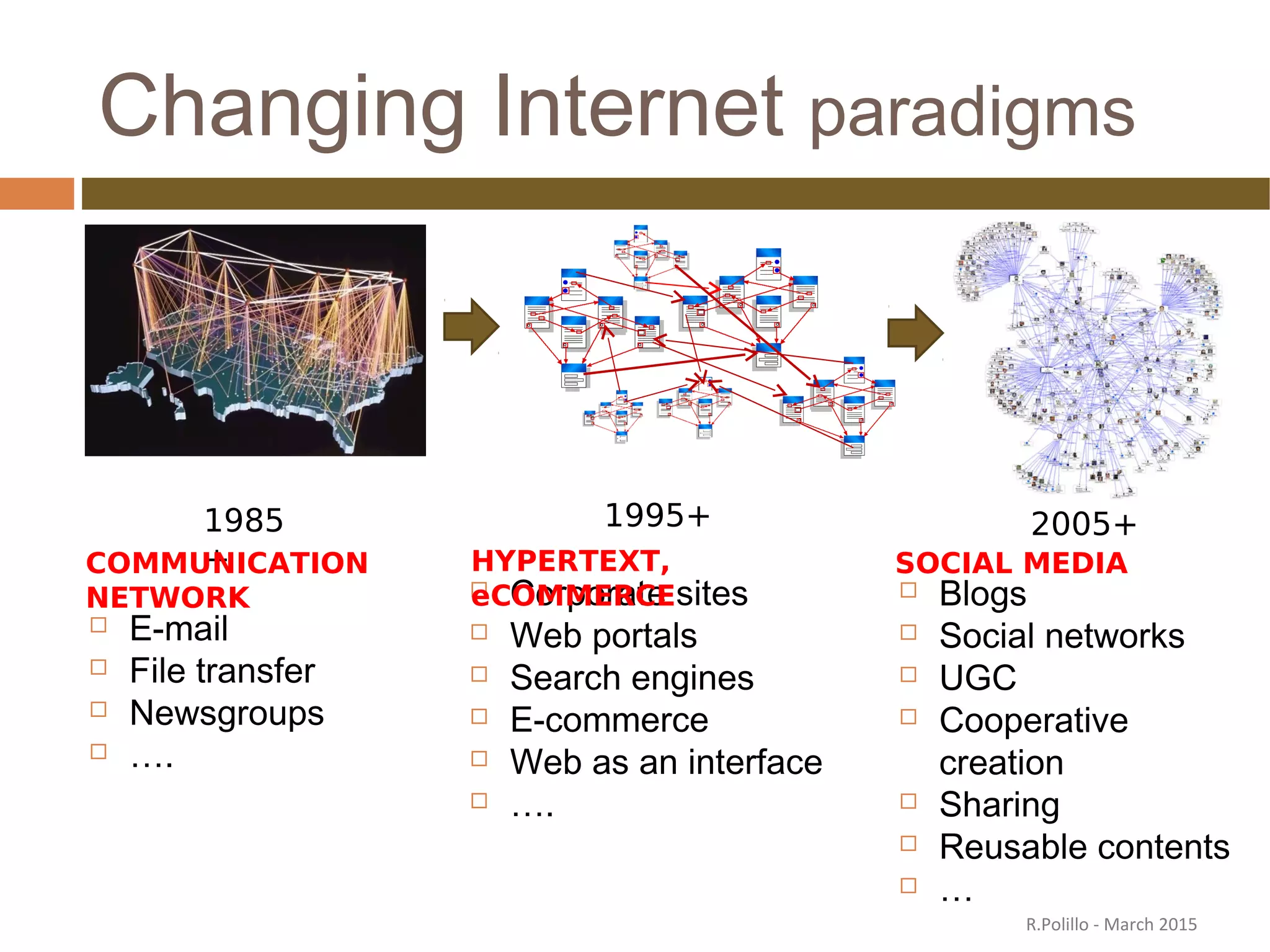
Changing Internet paradigms
1995+
 Corporate sites
 Web portals
 Search engines
 E-commerce
 Web as an interface
 ….
HYPERTEXT,
eCOMMERCE
2005+
 Blogs
 Social networks
 UGC
 Cooperative
creation
 Sharing
 Reusable contents
 …
SOCIAL MEDIA
1985
+
 E-mail
 File transfer
 Newsgroups
 ….
COMMUNICATION
NETWORK
R.Polillo - March 2015
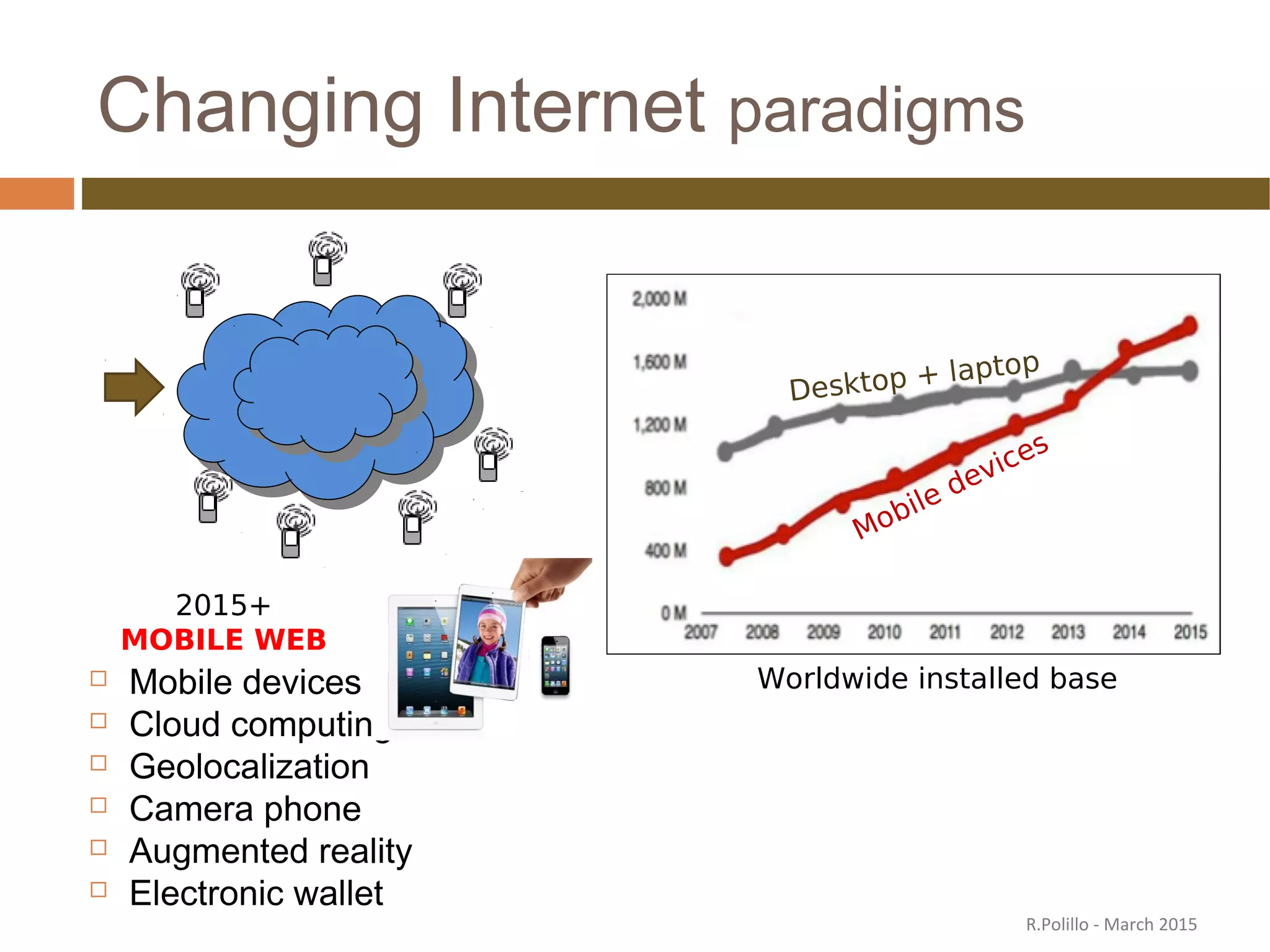
2015+
MOBILE WEB
 Mobile devices
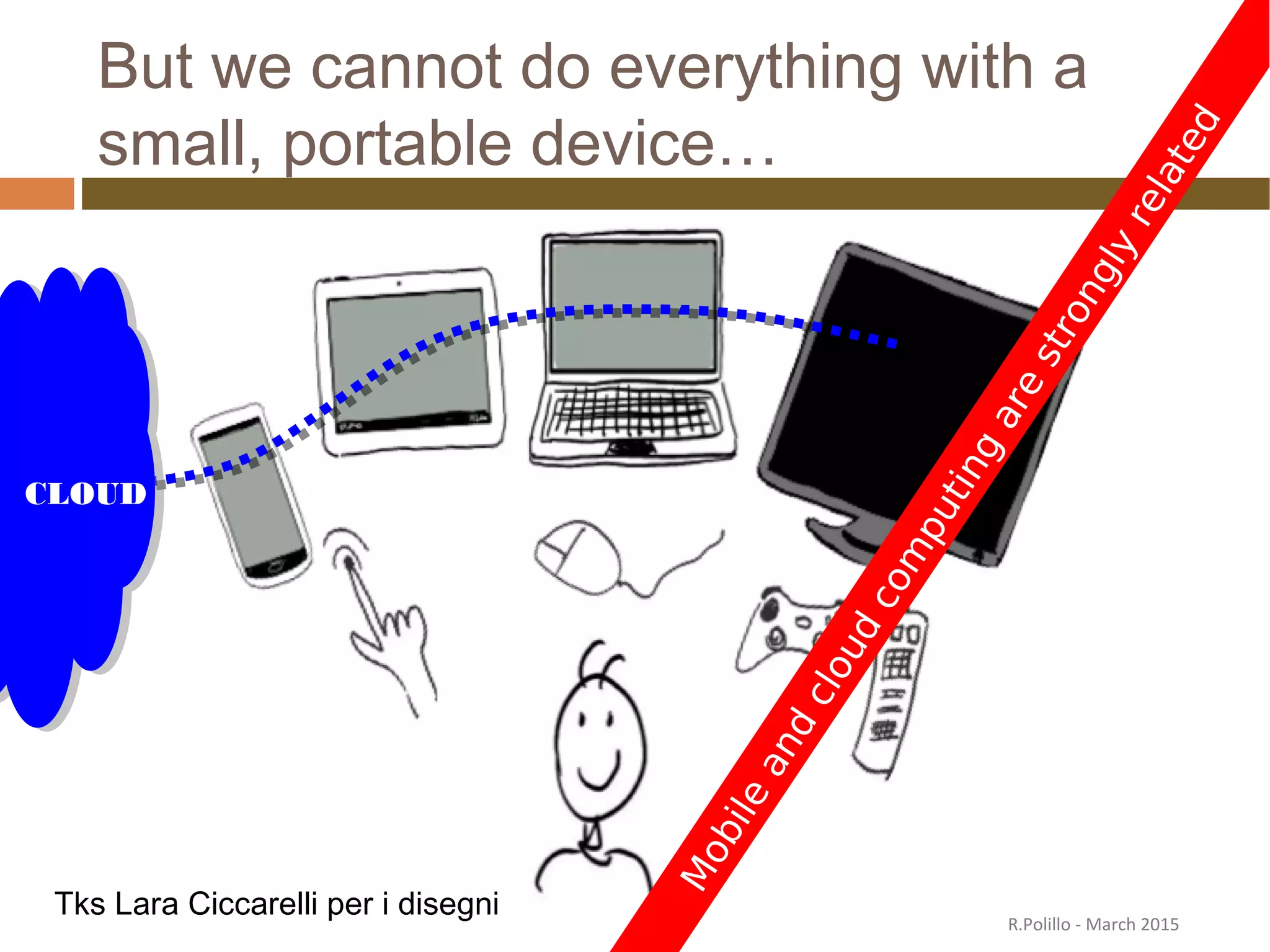
 Cloud computing
 Geolocalization
 Camera phone
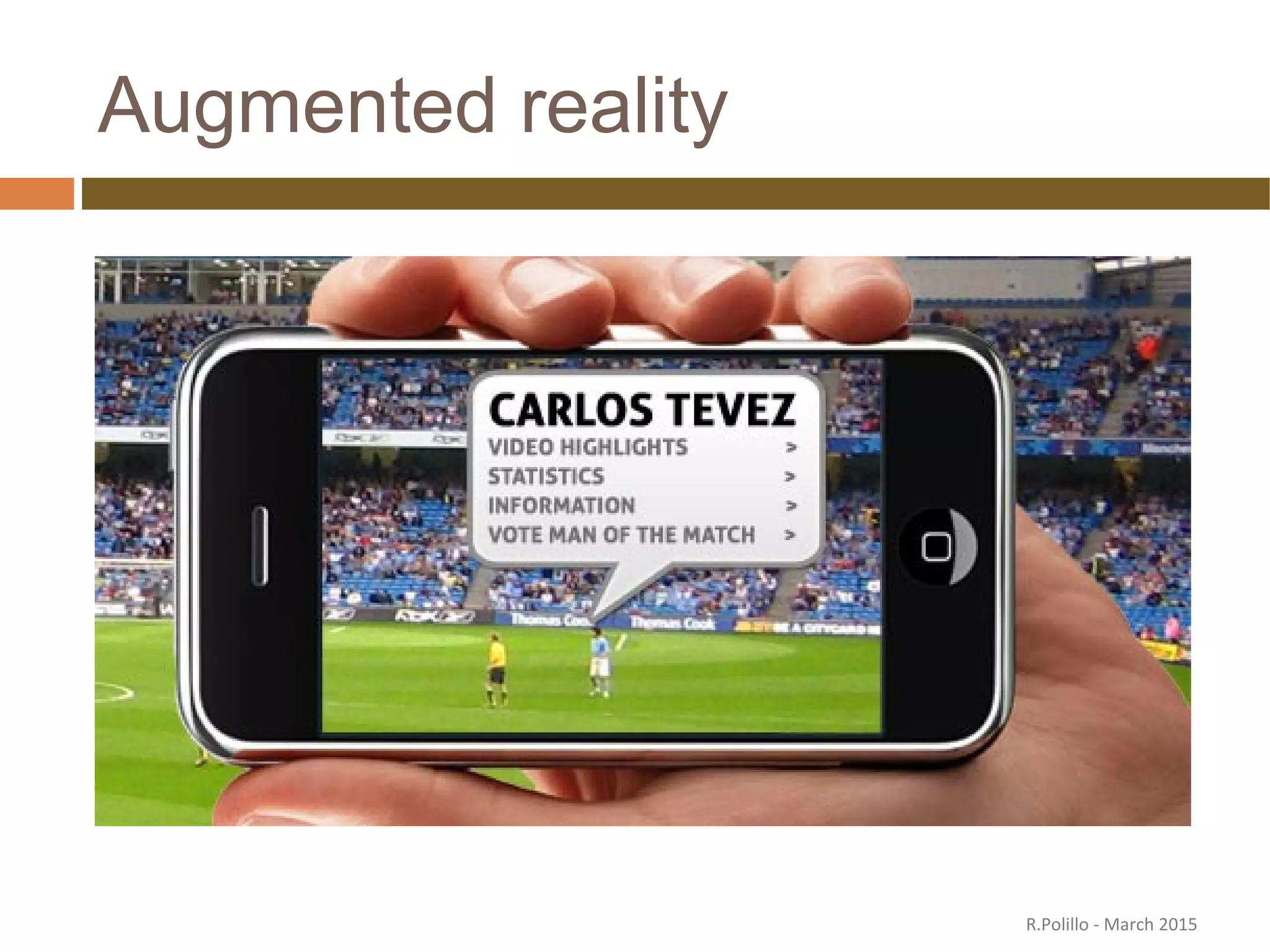
 Augmented reality
 Electronic wallet
Changing Internet paradigms
Mobile devices
Desktop + laptop
Worldwide installed base
R.Polillo - March 2015
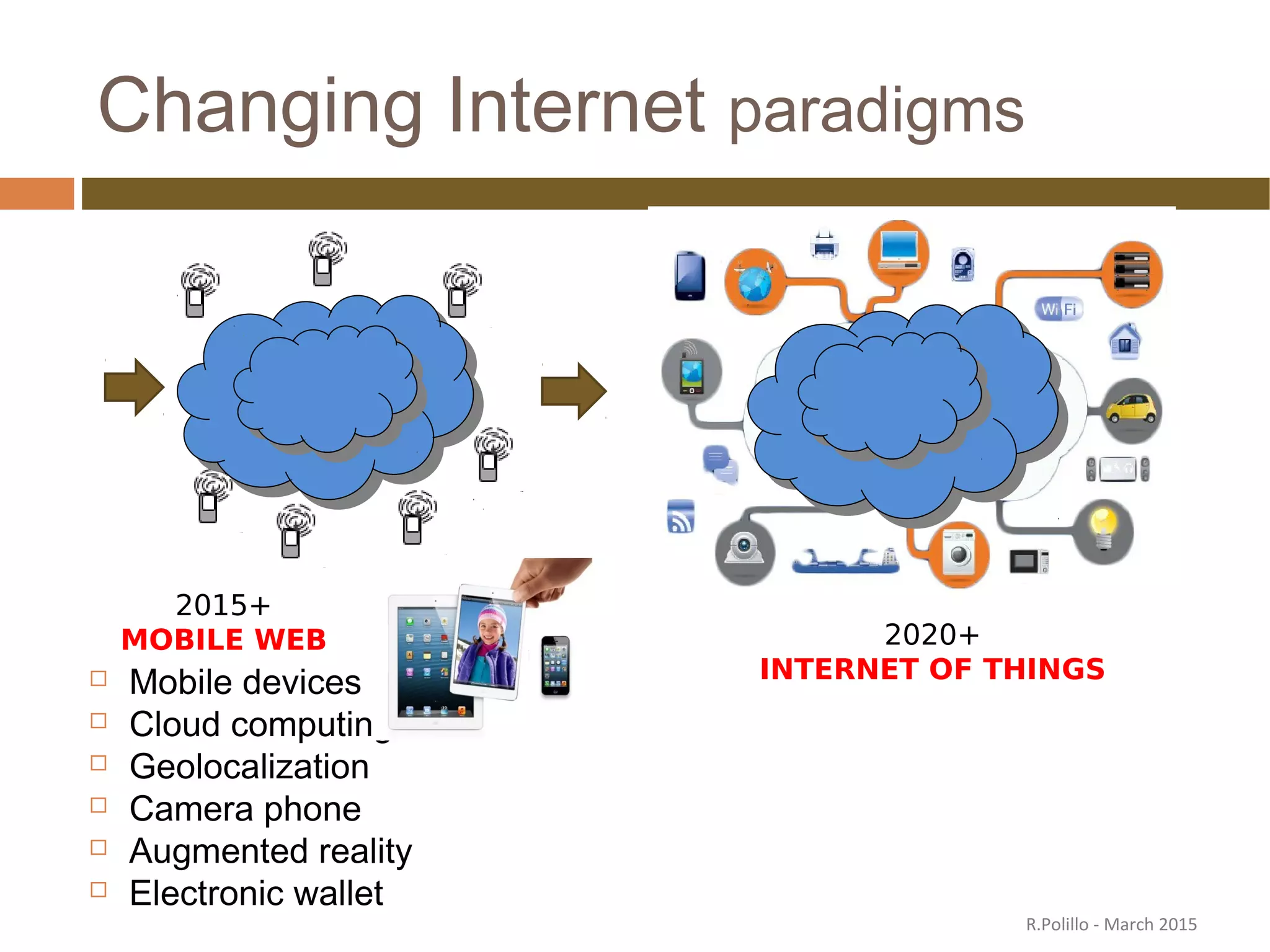
2015+
MOBILE WEB
 Mobile devices
 Cloud computing
 Geolocalization
 Camera phone
 Augmented reality
 Electronic wallet
2020+
INTERNET OF THINGS
Changing Internet paradigms
R.Polillo - March 2015
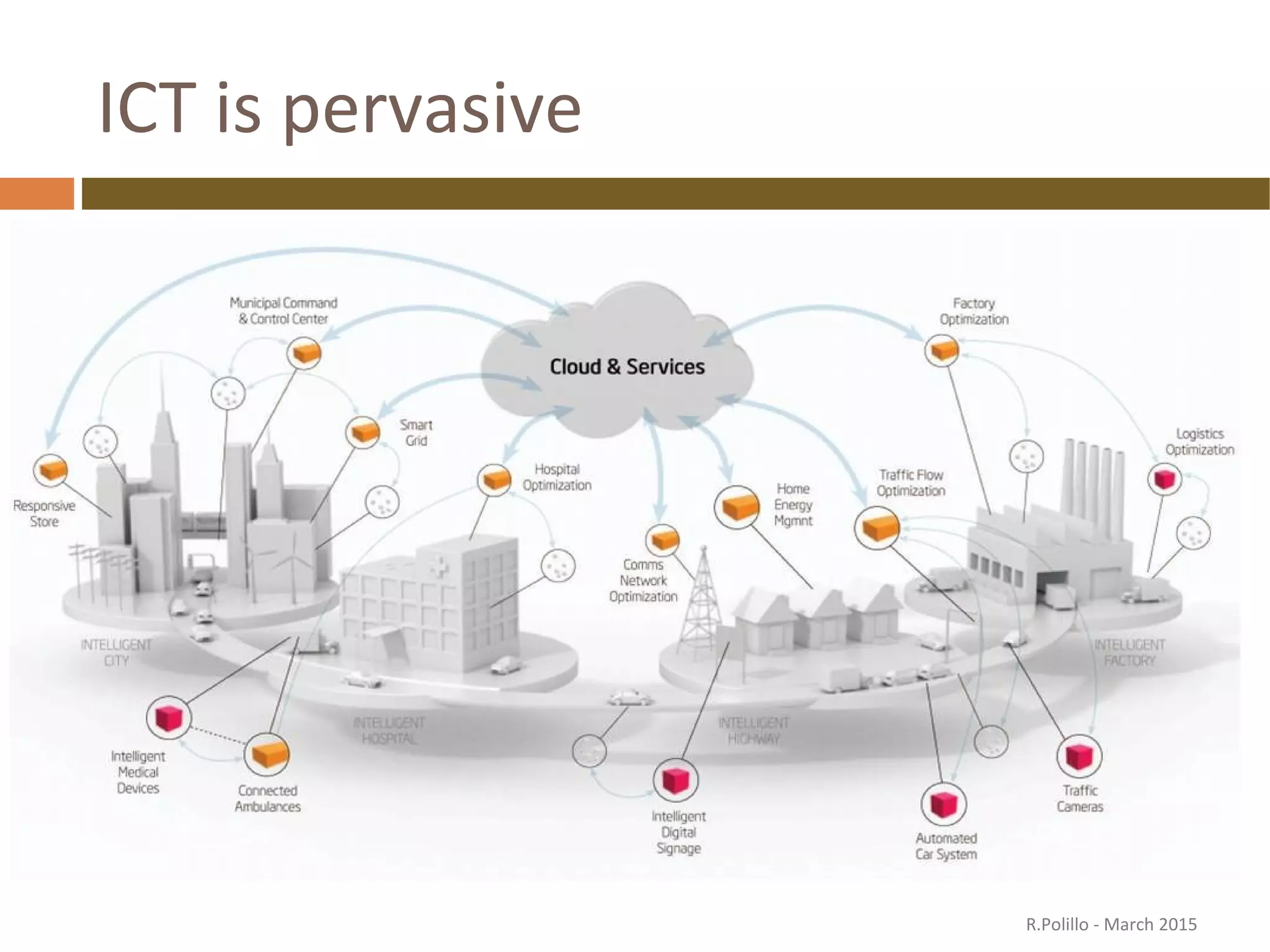
ICT is pervasive
R.Polillo - March 2015
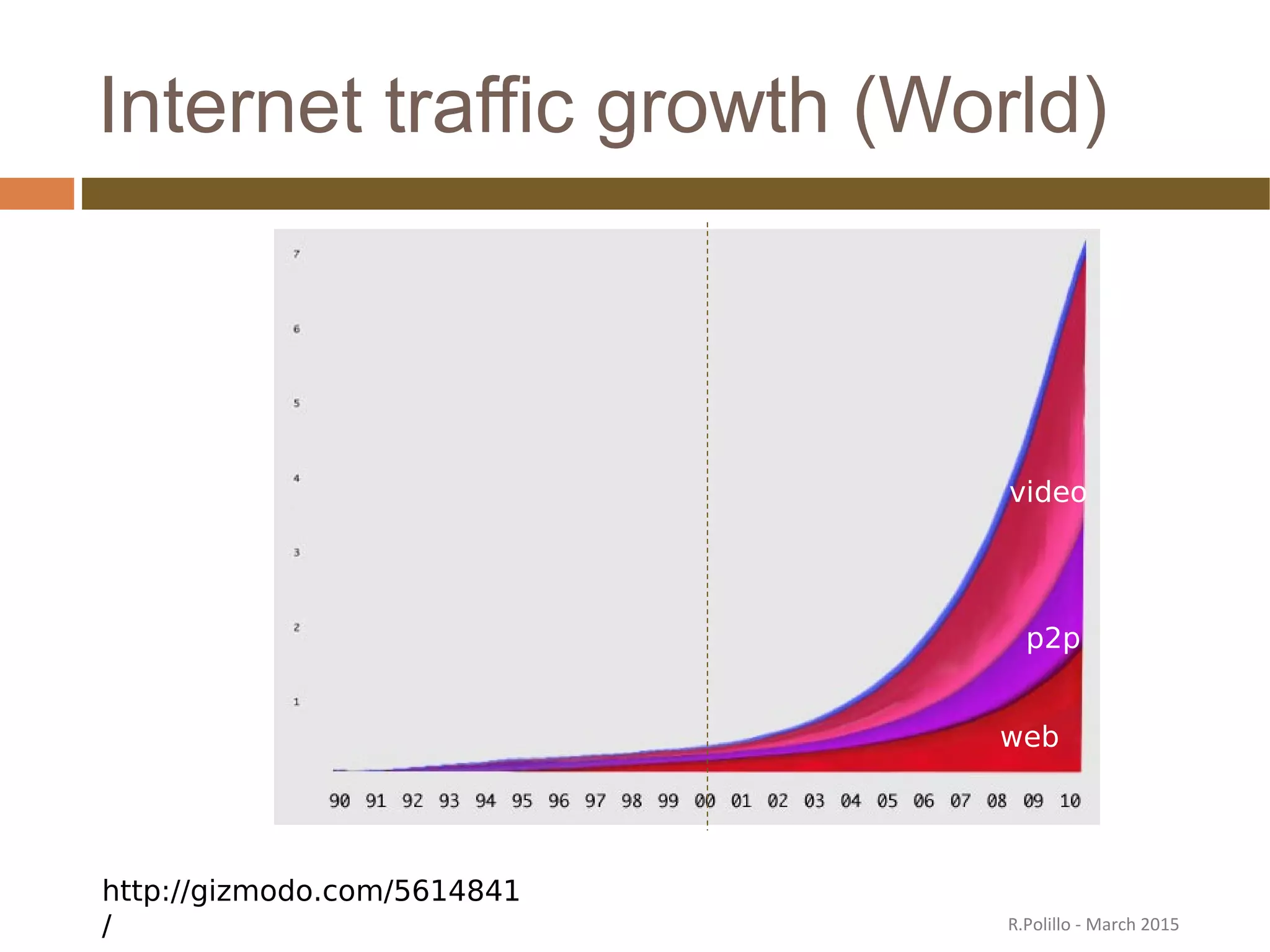
Internet traffic growth (World)
http://gizmodo.com/5614841
/
web
video
p2p
R.Polillo - March 2015
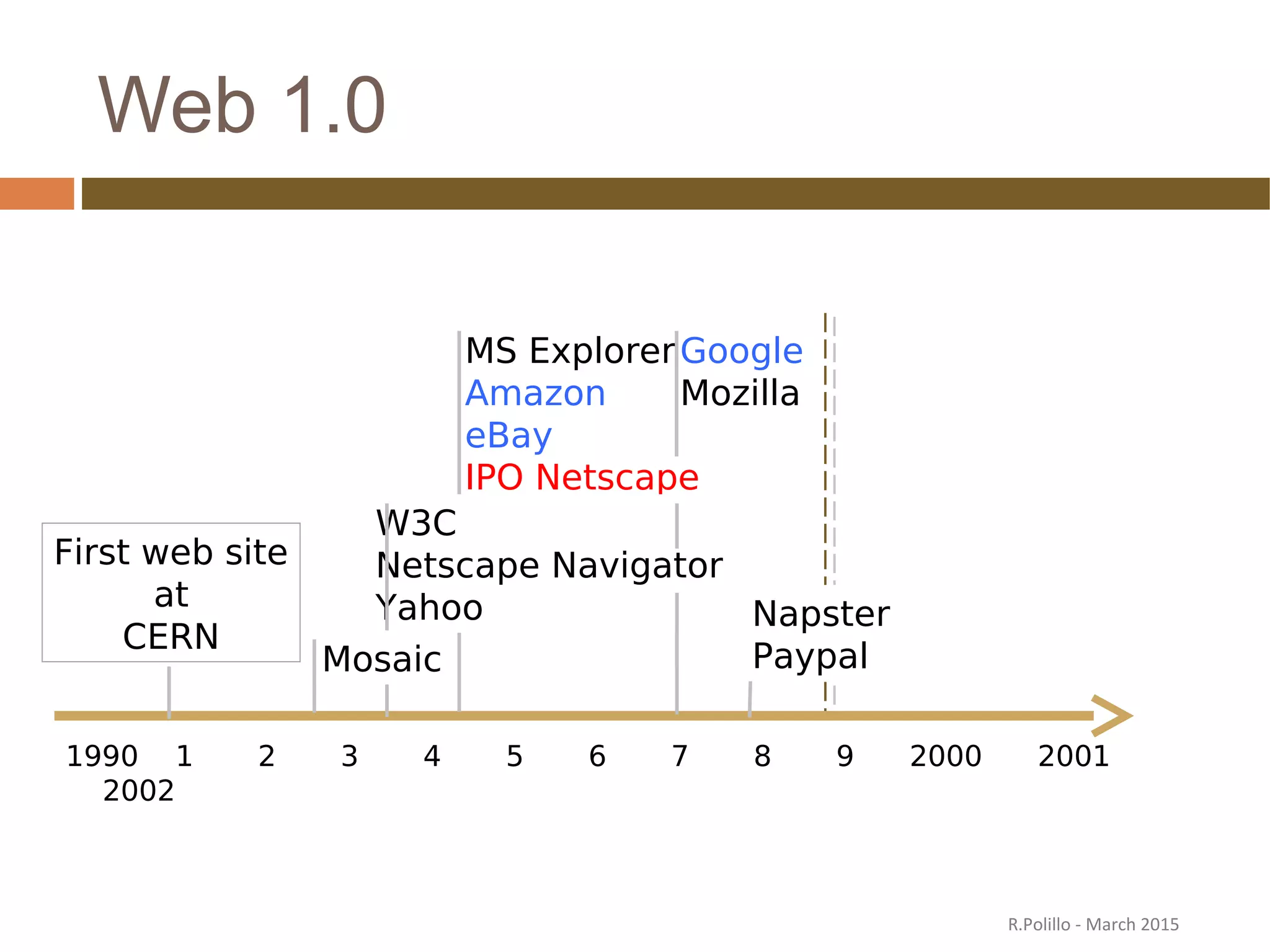
Paradigm #1: Web 1.0
Web 1.0
MS Explorer
Amazon
eBay
IPO Netscape
1990 1 2 3 4 5 6 7 8 9 2000 2001
2002
First web site
at
CERN
W3C
Netscape Navigator
Yahoo
Mosaic
Google
Mozilla
Napster
Paypal
R.Polillo - March 2015
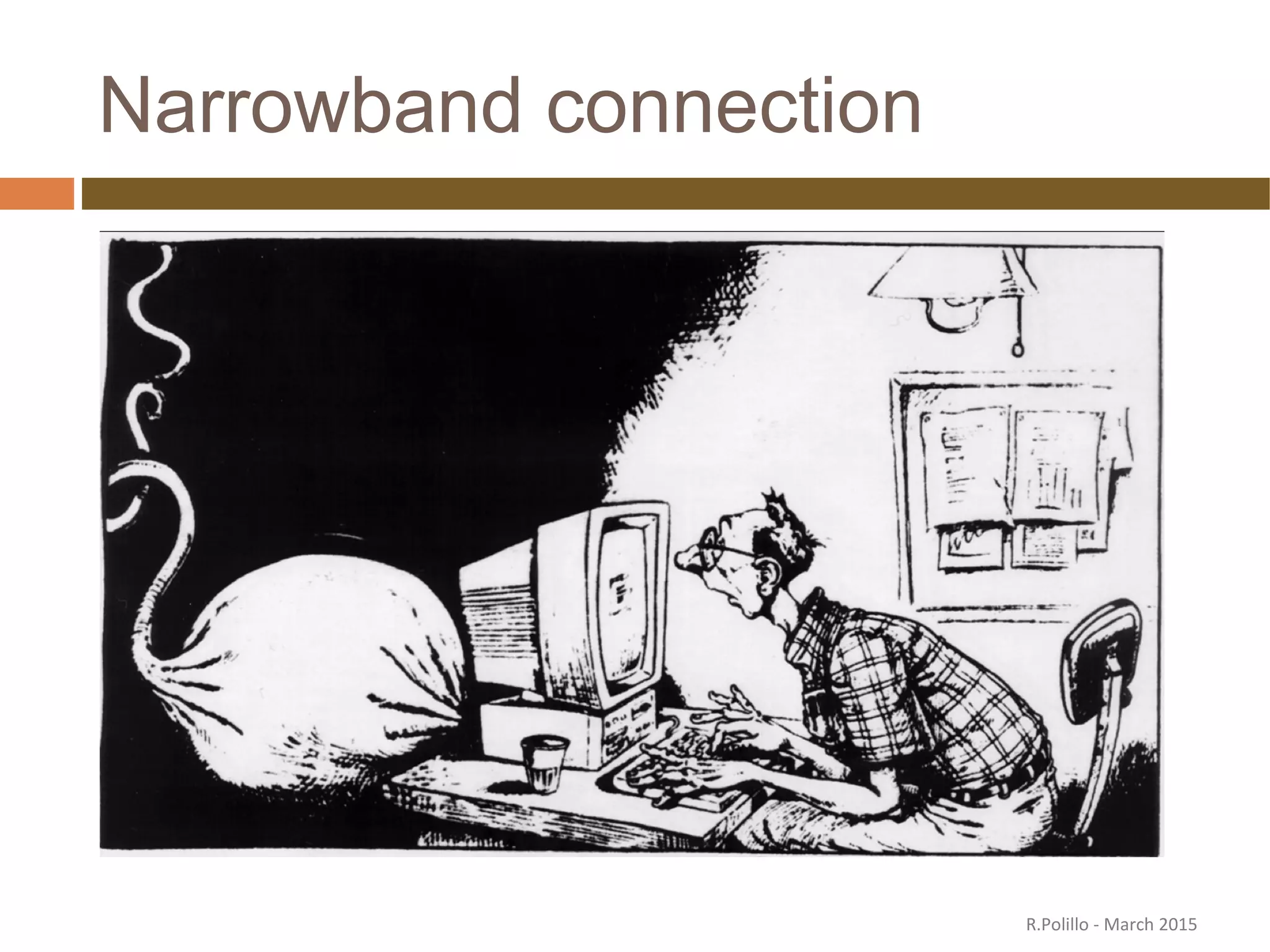
Narrowband connection
R.Polillo - March 2015
Web 1.0 Typical applications
 Corporate Web sites
 Portals and search engines
 eCommerce
 [Corporate portals]
R.Polillo - March 2015
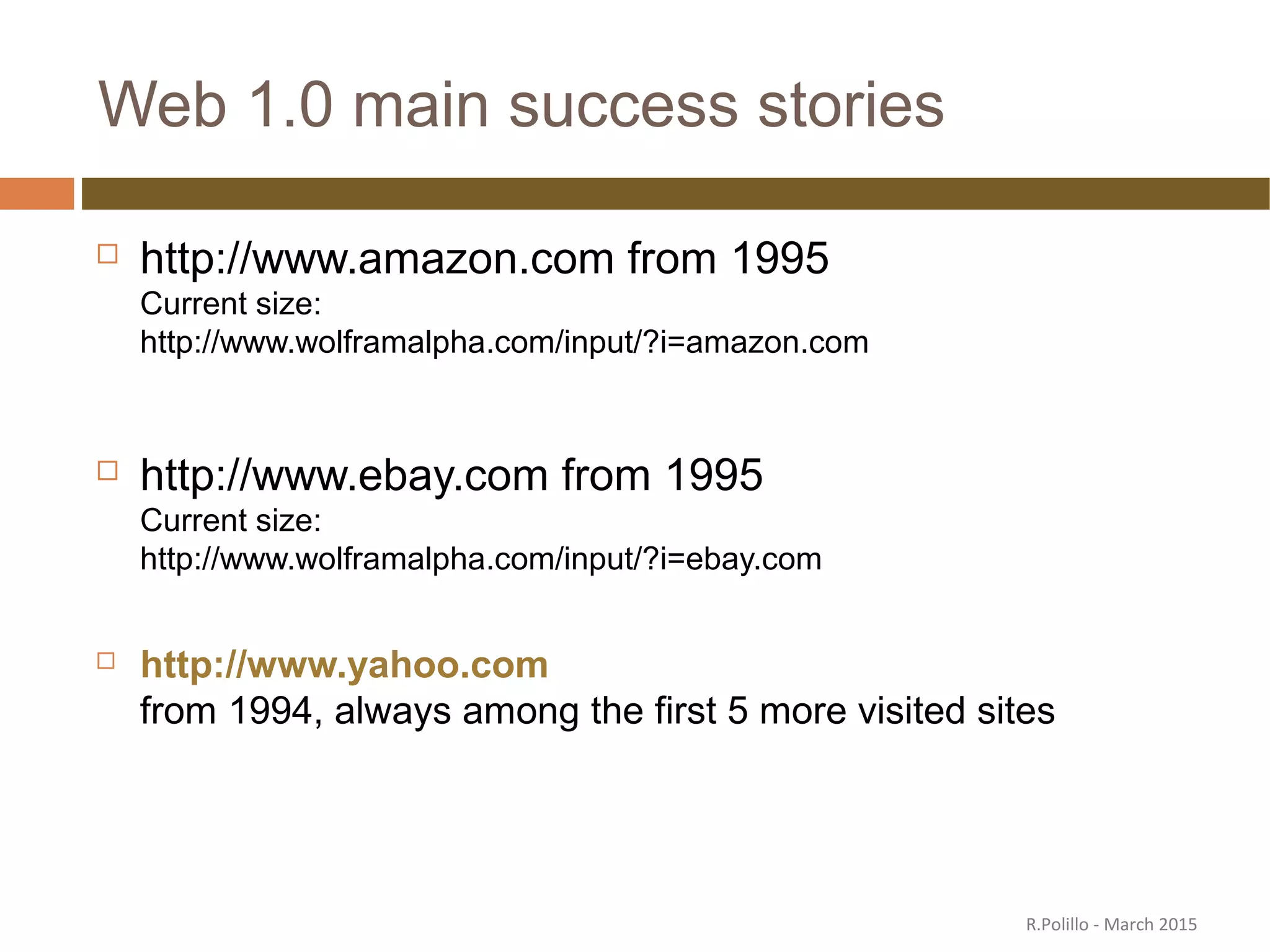
Web 1.0 main success stories
 http://www.amazon.com from 1995
Current size:
http://www.wolframalpha.com/input/?i=amazon.com
 http://www.ebay.com from 1995
Current size:
http://www.wolframalpha.com/input/?i=ebay.com
 http://www.yahoo.com
from 1994, always among the first 5 more visited sites
R.Polillo - March 2015
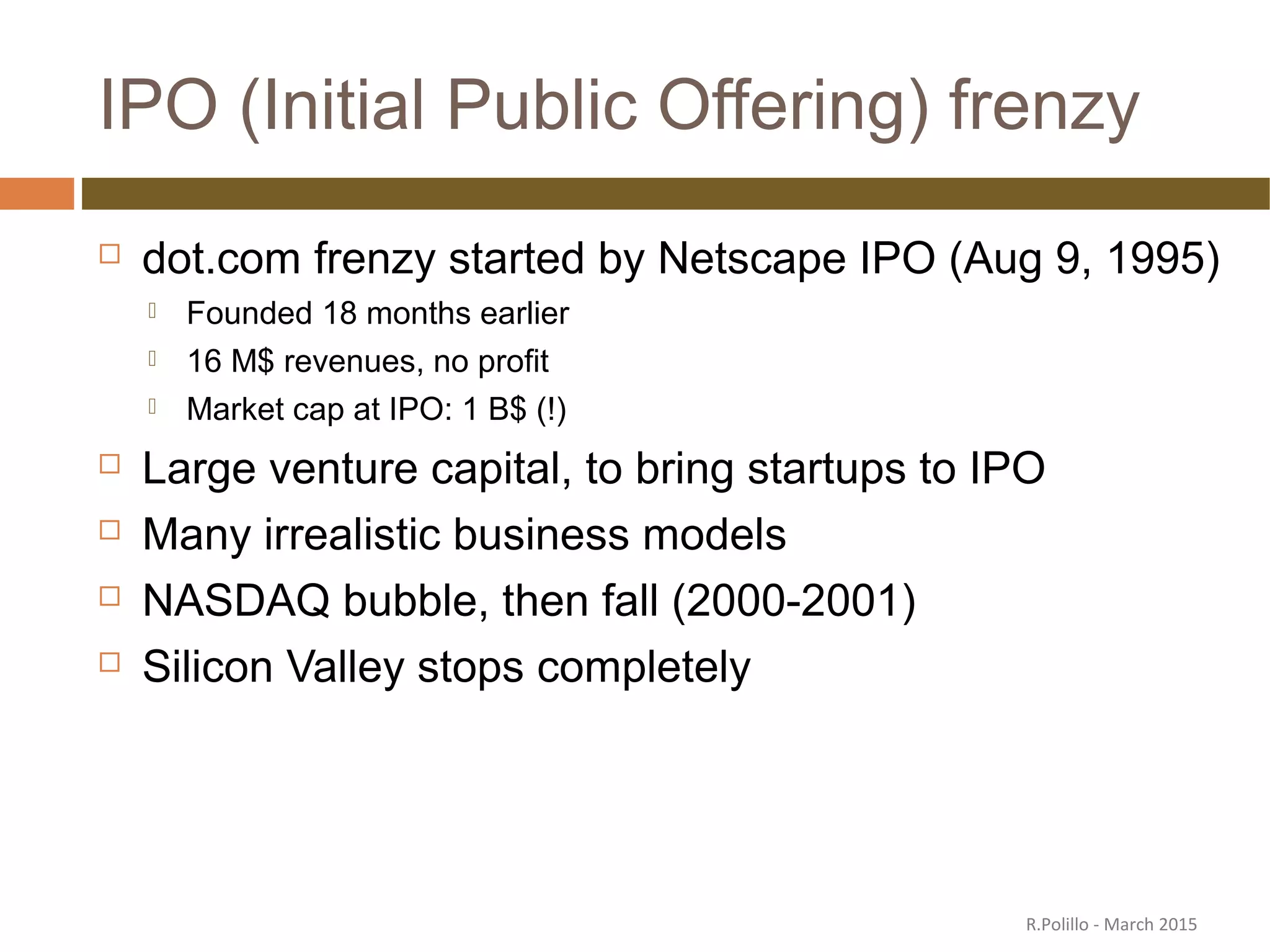
IPO (Initial Public Offering) frenzy
 dot.com frenzy started by Netscape IPO (Aug 9, 1995)
 Founded 18 months earlier
 16 M$ revenues, no profit
 Market cap at IPO: 1 B$ (!)
 Large venture capital, to bring startups to IPO
 Many irrealistic business models
 NASDAQ bubble, then fall (2000-2001)
 Silicon Valley stops completely
R.Polillo - March 2015
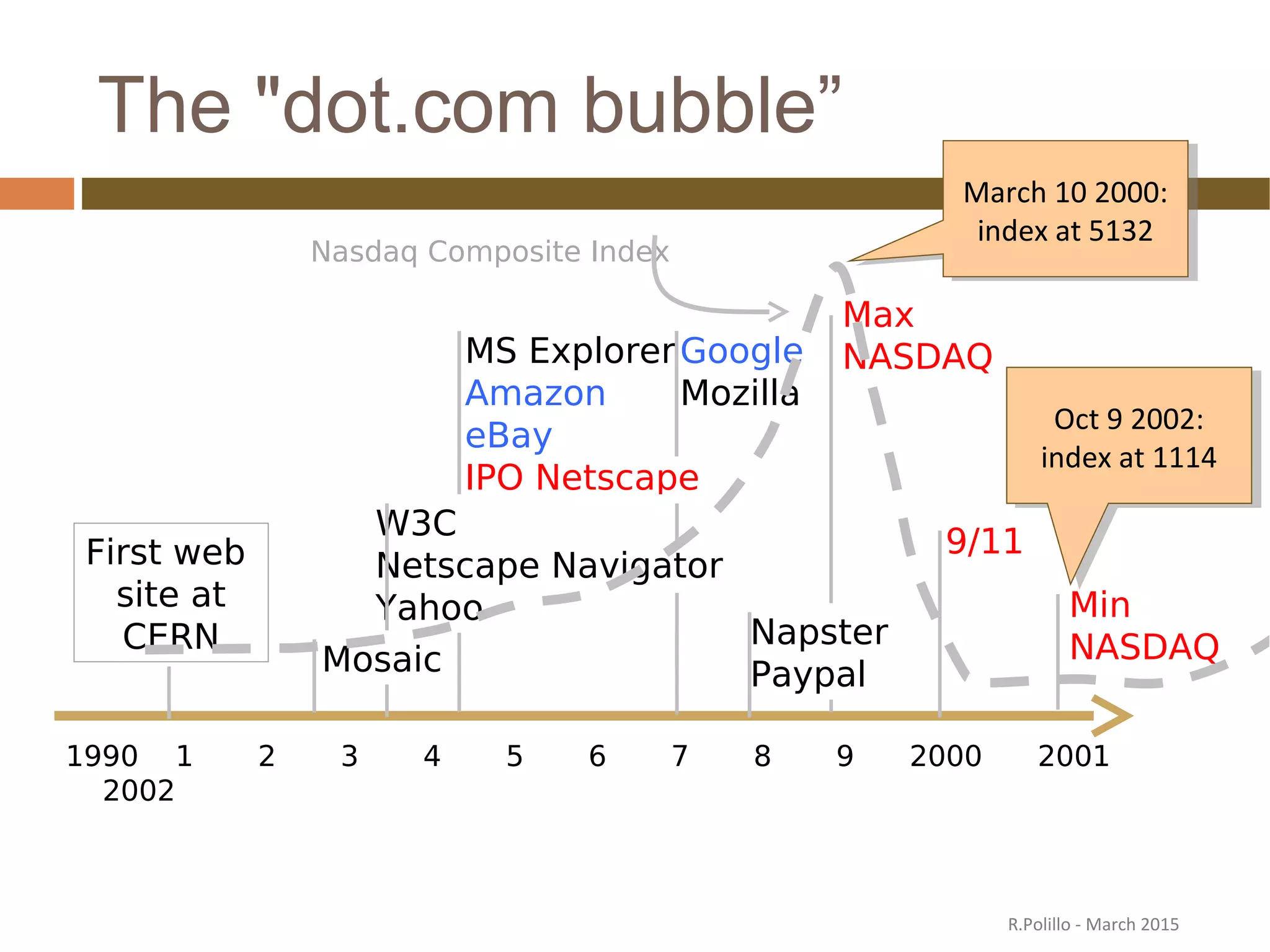
The "dot.com bubble”
MS Explorer
Amazon
eBay
IPO Netscape
1990 1 2 3 4 5 6 7 8 9 2000 2001
2002
First web
site at
CERN
W3C
Netscape Navigator
Yahoo
Mosaic
Google
Mozilla
Napster
Paypal
Max
NASDAQ
9/11
Min
NASDAQ
Nasdaq Composite Index
March 10 2000:
index at 5132
March 10 2000:
index at 5132
Oct 9 2002:
index at 1114
Oct 9 2002:
index at 1114
R.Polillo - March 2015
Paradigm #2: Web 2.0
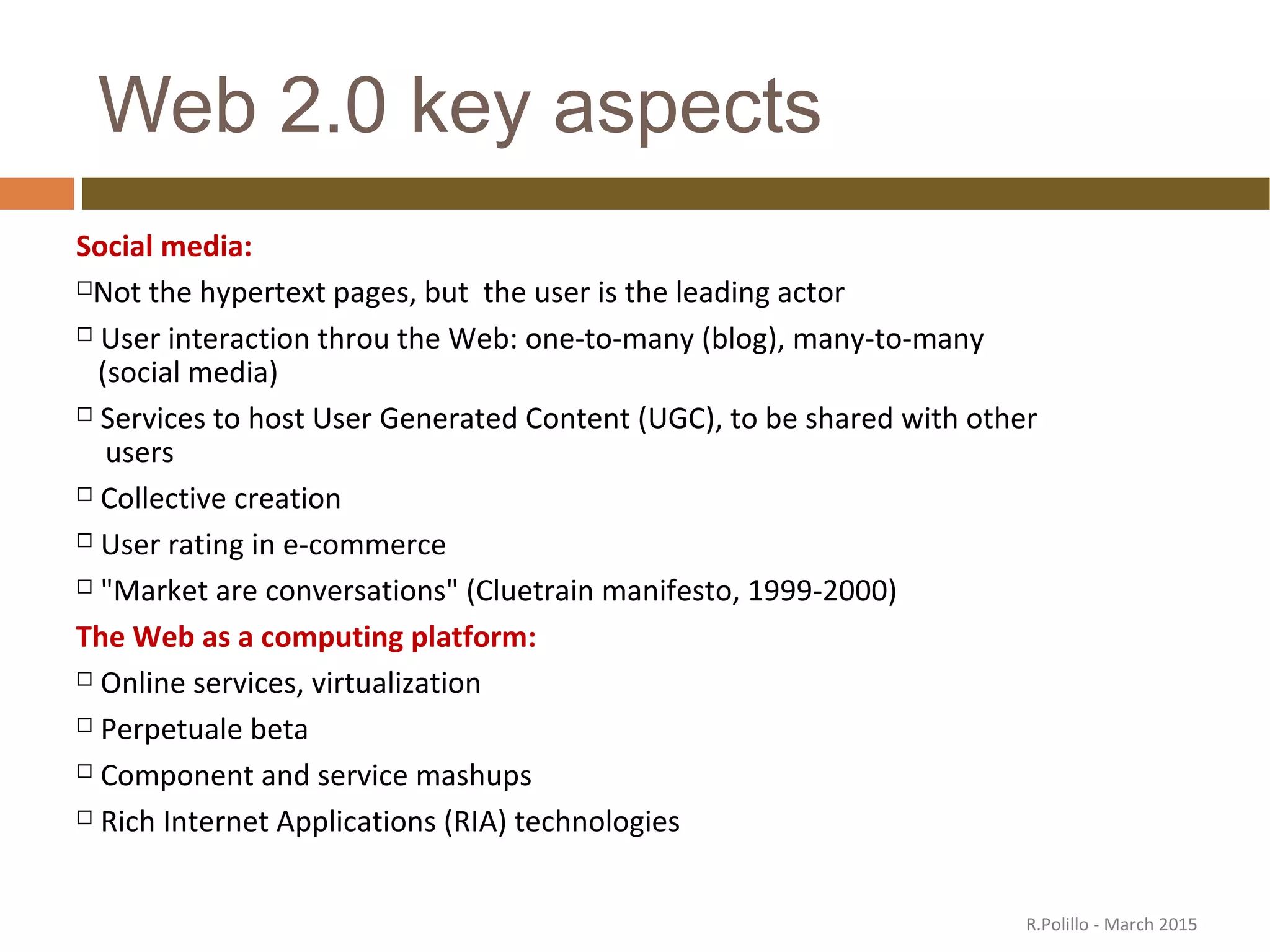
Web 2.0 key aspects
Social media:
Not the hypertext pages, but the user is the leading actor
 User interaction throu the Web: one-to-many (blog), many-to-many
(social media)
 Services to host User Generated Content (UGC), to be shared with other
users
 Collective creation
 User rating in e-commerce
 "Market are conversations" (Cluetrain manifesto, 1999-2000)
The Web as a computing platform:
 Online services, virtualization
 Perpetuale beta
 Component and service mashups
 Rich Internet Applications (RIA) technologies
R.Polillo - March 2015
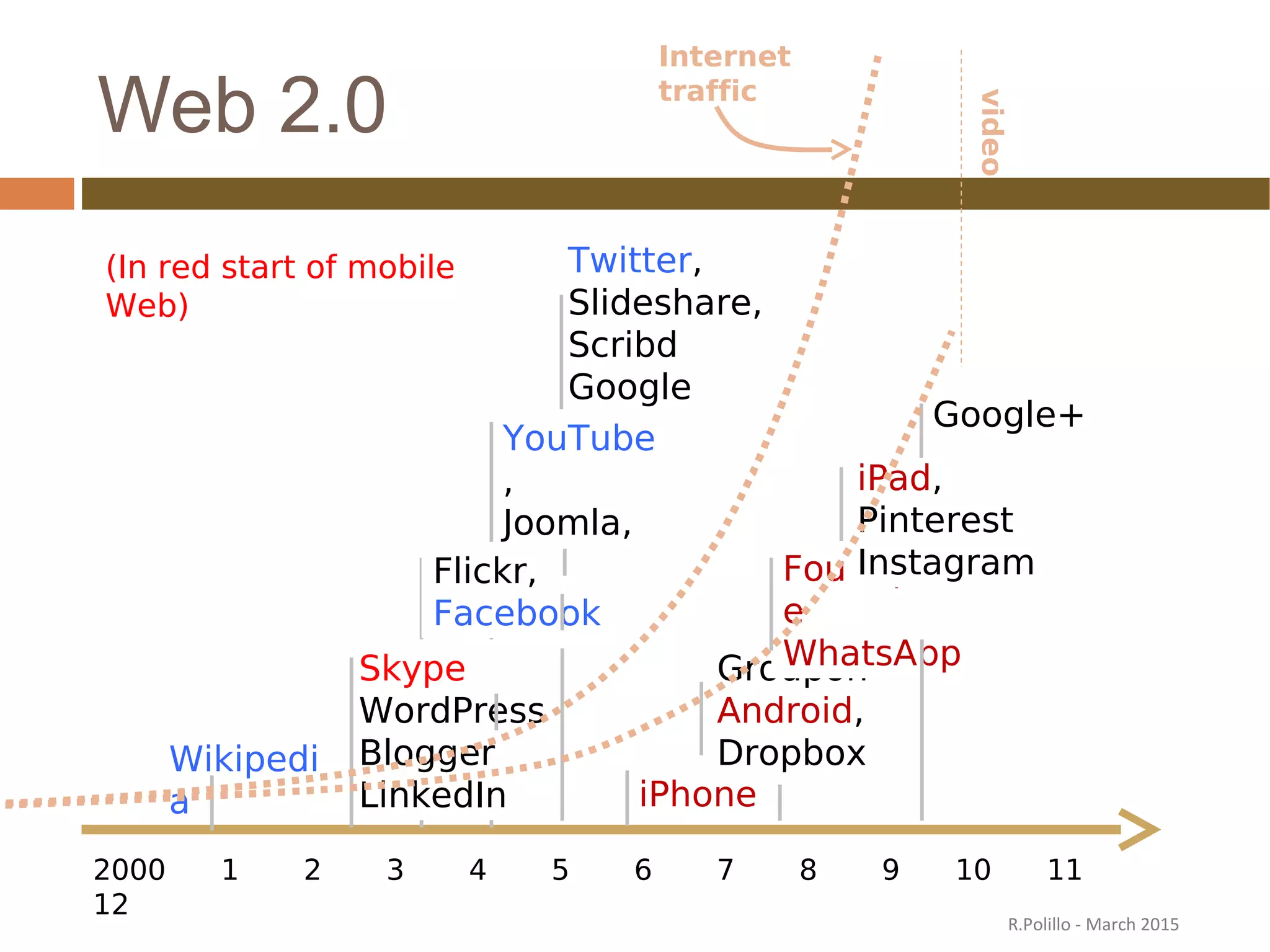
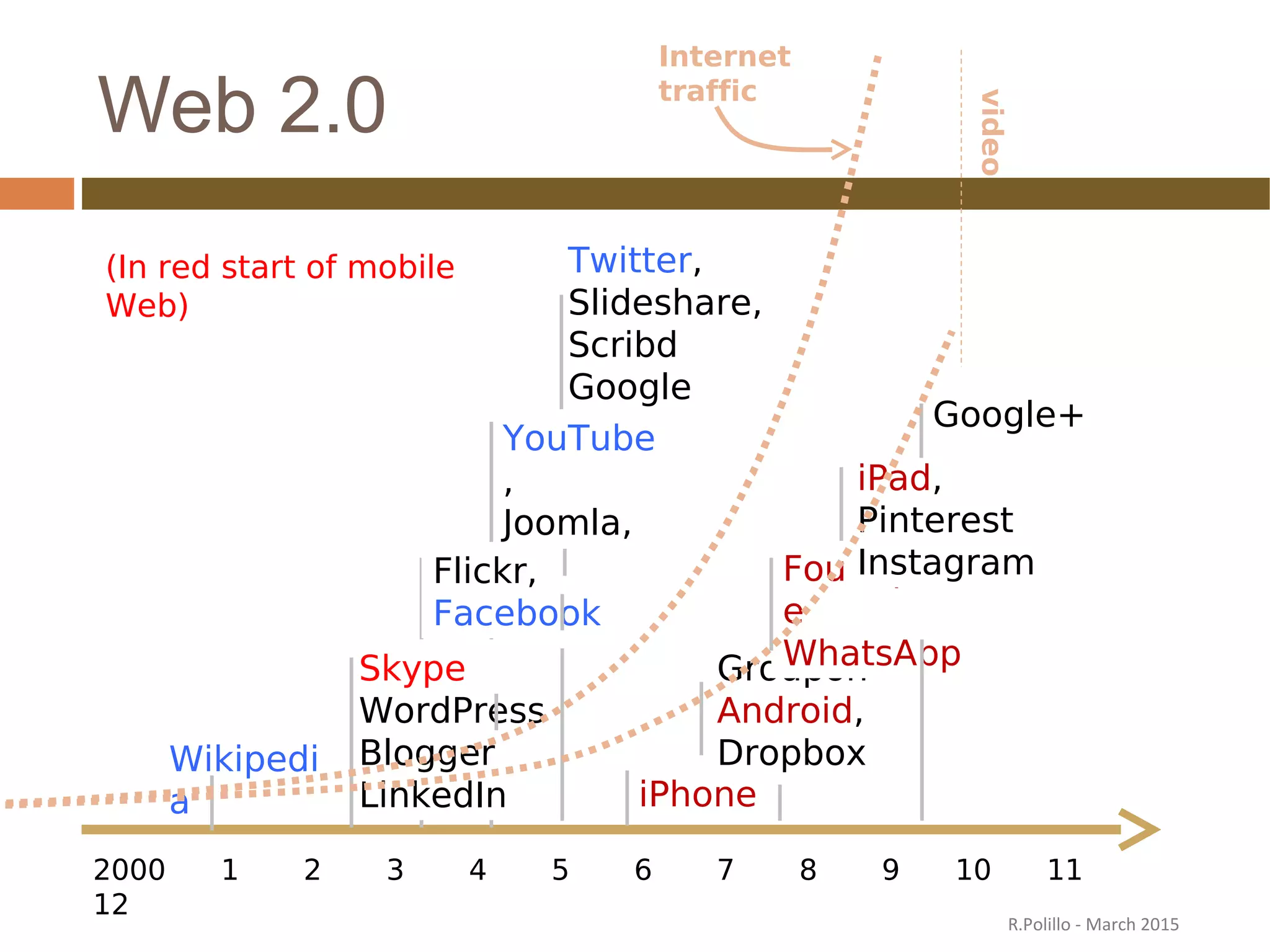
Web 2.0
2000 1 2 3 4 5 6 7 8 9 10 11
12
Twitter,
Slideshare,
Scribd
Google
DocsYouTube
,
Joomla,
NingFlickr,
Facebook
Skype
WordPress
Blogger
LinkedIn iPhone
Groupon
Android,
Dropbox
Foursquar
e
WhatsApp
iPad,
Pinterest
Instagram
Google+
Wikipedi
a
(In red start of mobile
Web)
Internet
traffic
video
R.Polillo - March 2015
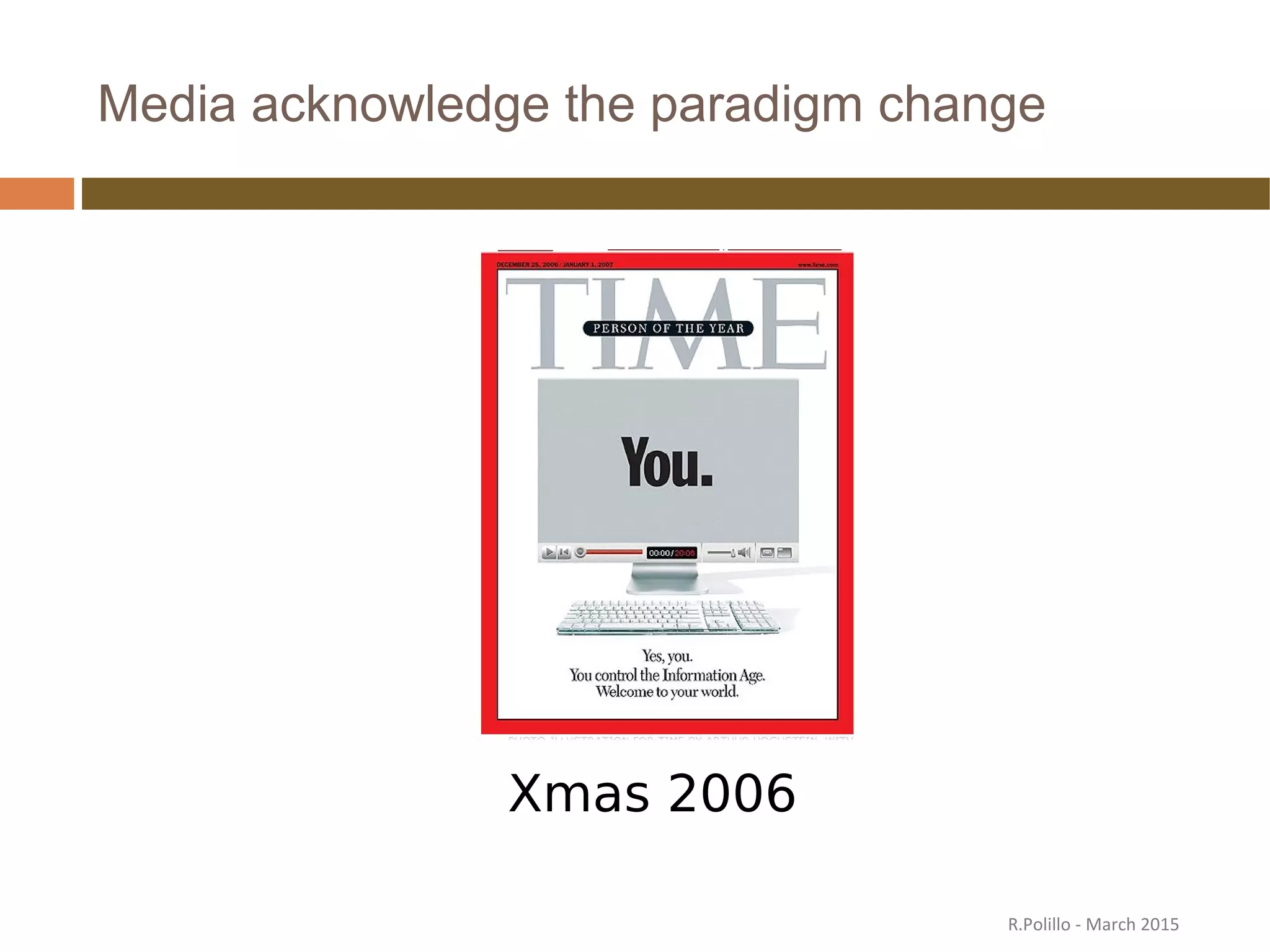
Xmas 2006
Media acknowledge the paradigm change
R.Polillo - March 2015
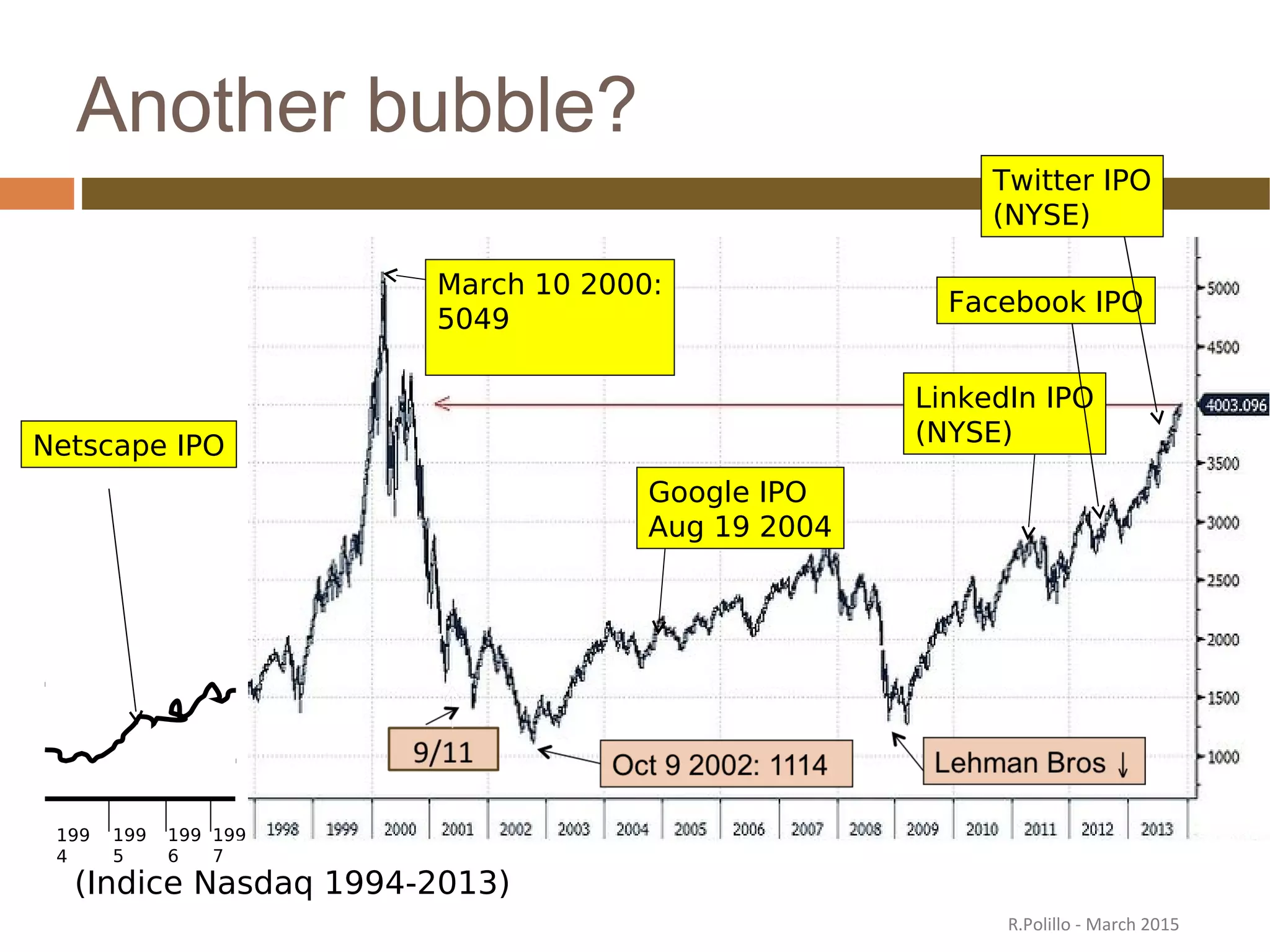
Another bubble?
Netscape IPO
Google IPO
Aug 19 2004
LinkedIn IPO
(NYSE)
Facebook IPO
Twitter IPO
(NYSE)
199
4
199
5
199
7
199
6
March 10 2000:
5049
(Indice Nasdaq 1994-2013)
R.Polillo - March 2015
In the meanwhile, telephony changes…
R.Polillo - March 2015
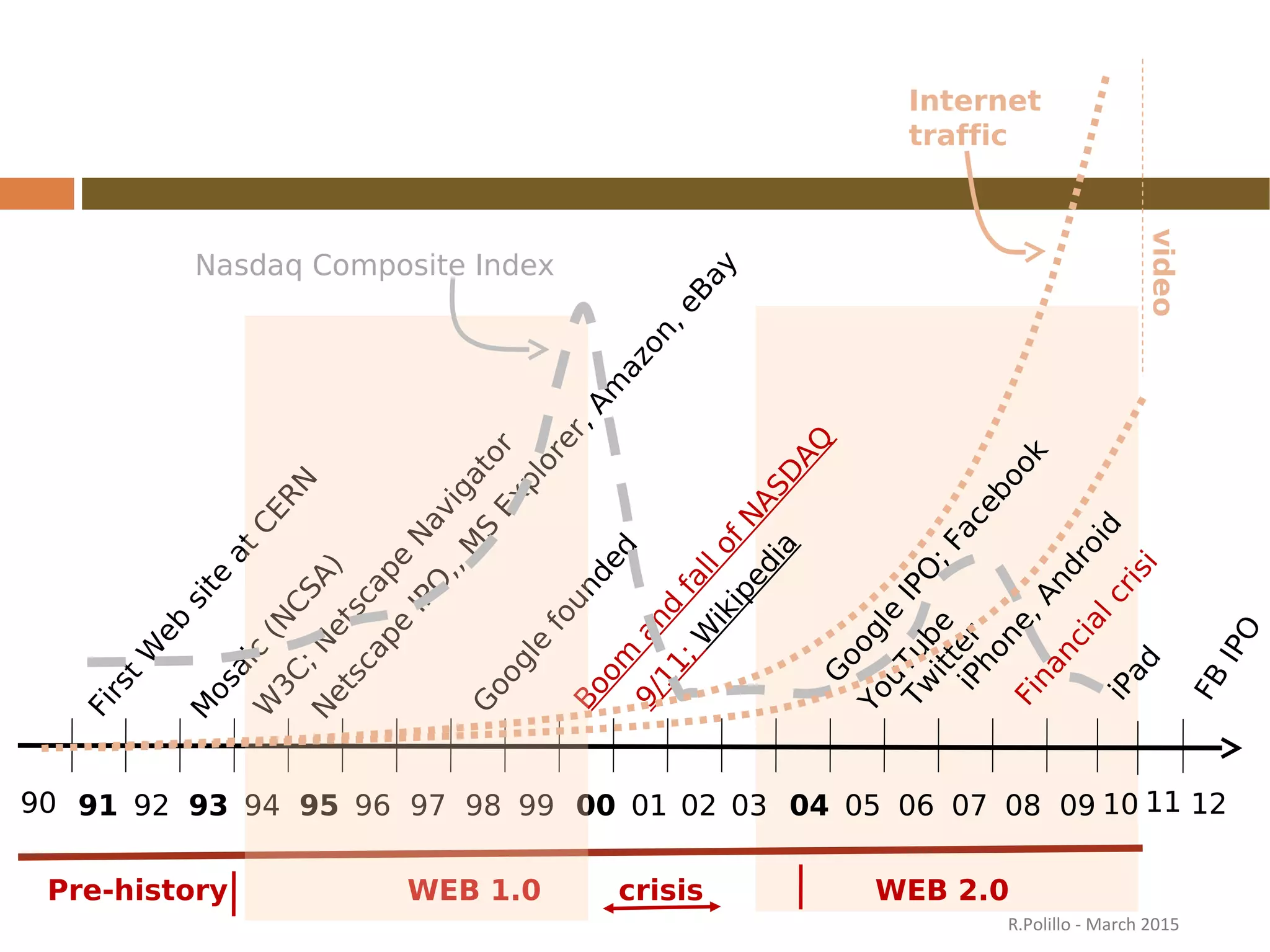
FirstW
eb
site
atCERN
M
osaic
(N
CSA)
W
3C;N
etscape
N
avigator
Netscape
IPO
,,M
S
Explorer,Am
azon,eBay
Boom
and
fallofNASD
AQ
G
oogle
IPO
;Facebook
91 92 93 94 95 96 97 98 99 00 01 02 03 04 05 06 07 08 0990 10 11 12
WEB 1.0 WEB 2.0crisisPre-history
G
oogle
founded
9/11;W
ikipedia
Financialcrisi
iPhone,Android
Tw
itter
iPad
FB
IPO
Nasdaq Composite Index
YouTube
Internet
traffic
video
R.Polillo - March 2015
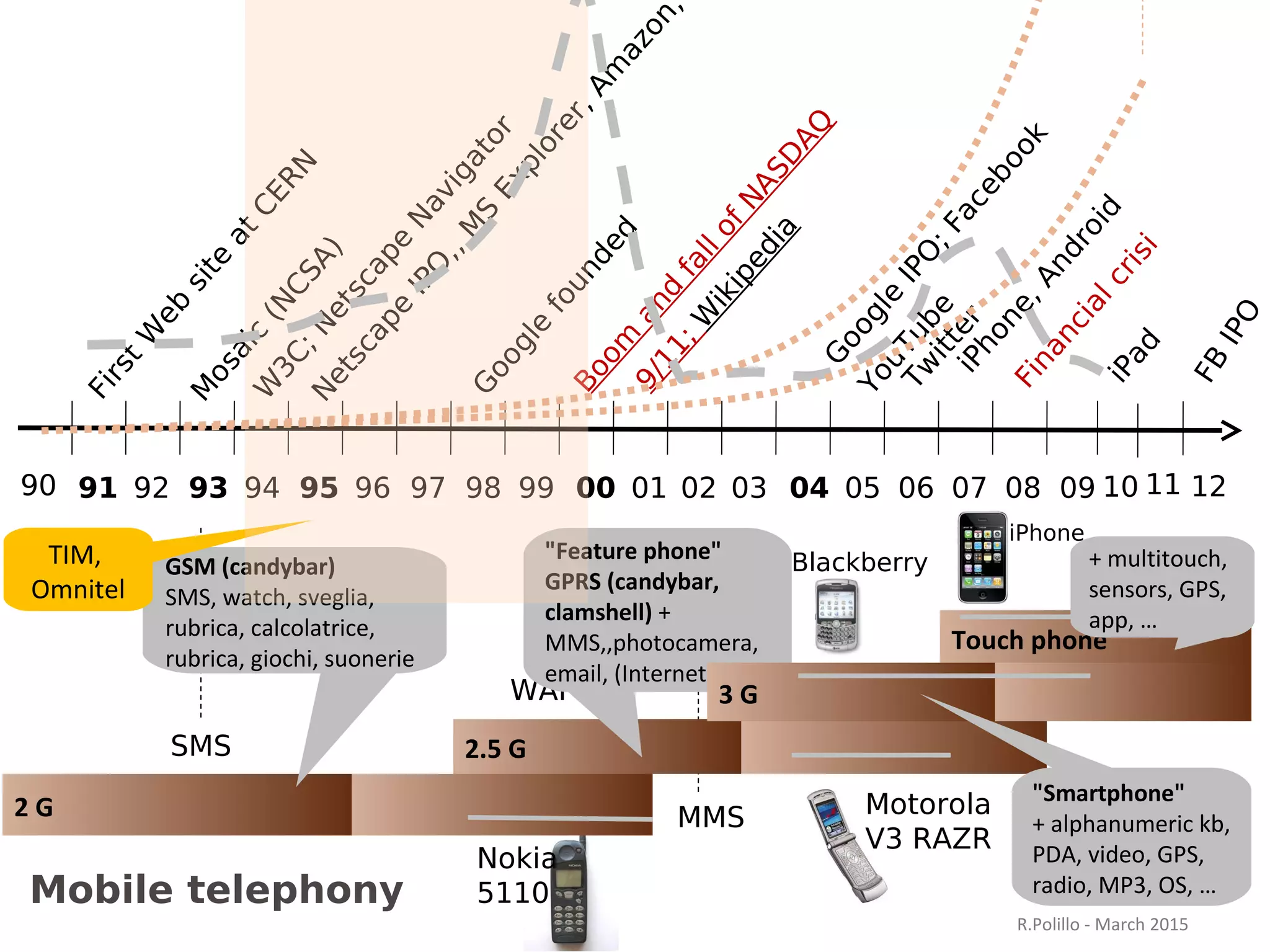
SMS
2 G
Nokia
5110
GSM (candybar)
SMS, watch, sveglia,
rubrica, calcolatrice,
rubrica, giochi, suonerie
MMS
WAP
2.5 G
Motorola
V3 RAZR
"Feature phone"
GPRS (candybar,
clamshell) +
MMS,,photocamera,
email, (Internet)
Touch phone
iPhone
+ multitouch,
sensors, GPS,
app, …
3 G
Blackberry
"Smartphone"
+ alphanumeric kb,
PDA, video, GPS,
radio, MP3, OS, …Mobile telephony
TIM,
Omnitel
FirstW
eb
site
atCERN
M
osaic
(N
CSA)
W
3C;N
etscape
N
avigator
Netscape
IPO
,,M
S
Explorer,Am
azon,
Boom
and
fallofNASD
AQ
G
oogle
IPO
;Facebook
91 92 93 94 95 96 97 98 99 00 01 02 03 04 05 06 07 08 0990 10 11 12G
oogle
founded
9/11;W
ikipedia
Financialcrisi
iPhone,Android
Tw
itter
iPad
FB
IPO
YouTube R.Polillo - March 2015
IP telephony
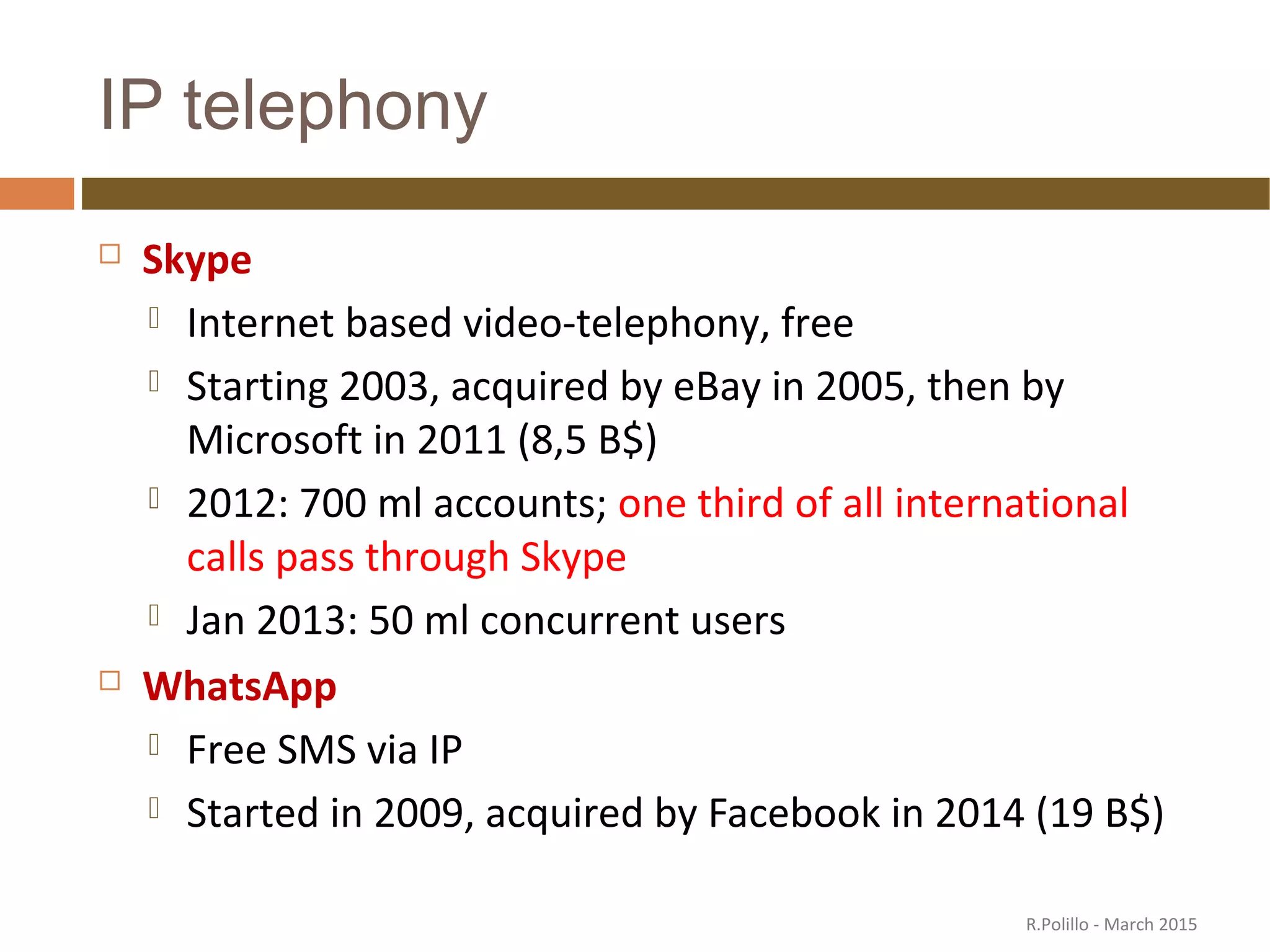
 Skype
 Internet based video-telephony, free
 Starting 2003, acquired by eBay in 2005, then by
Microsoft in 2011 (8,5 B$)
 2012: 700 ml accounts; one third of all international
calls pass through Skype
 Jan 2013: 50 ml concurrent users
 WhatsApp
 Free SMS via IP
 Started in 2009, acquired by Facebook in 2014 (19 B$)
R.Polillo - March 2015
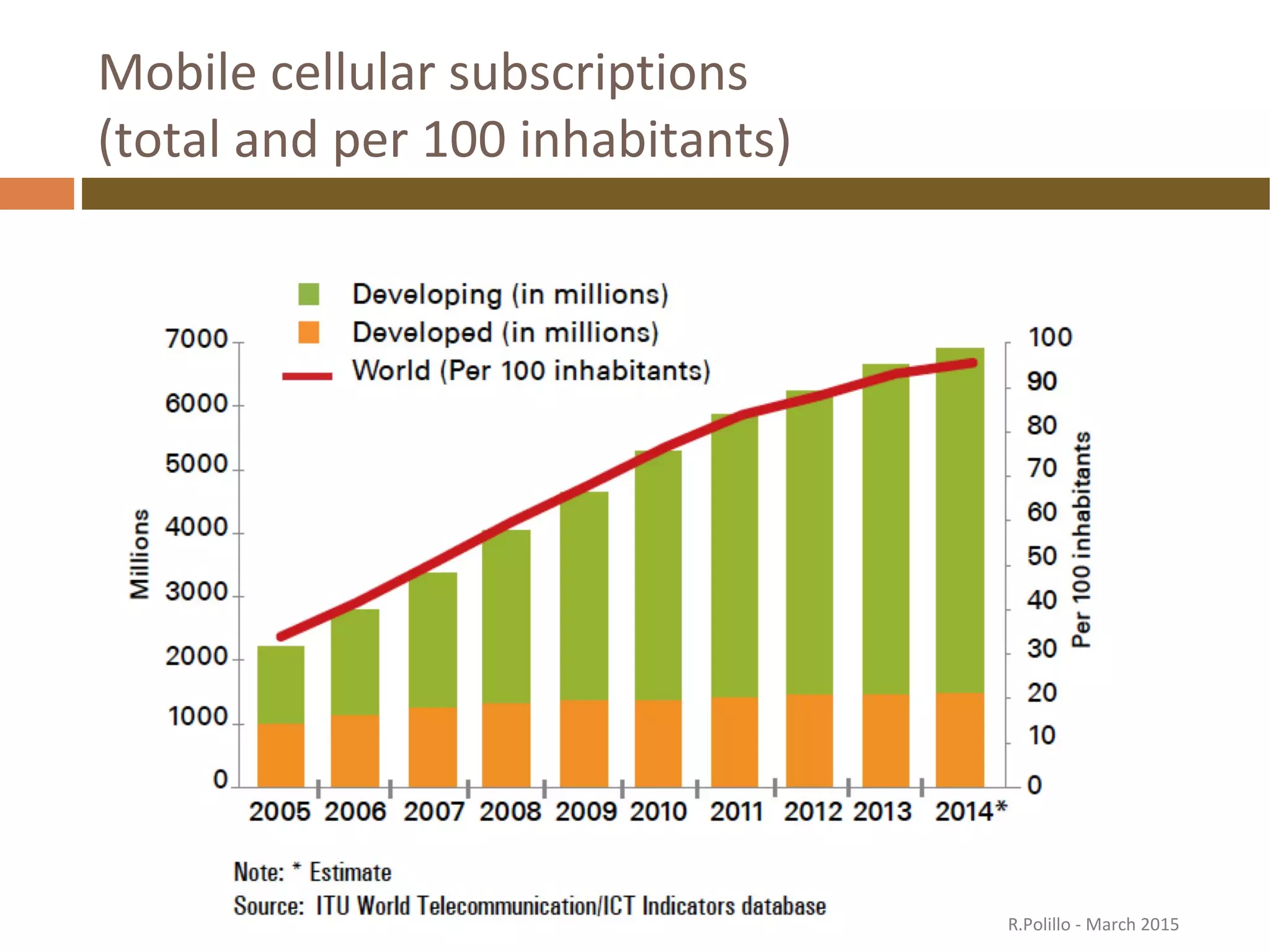
Mobile cellular subscriptions
(total and per 100 inhabitants)
R.Polillo - March 2015
Paradigm #3: Mobile Web
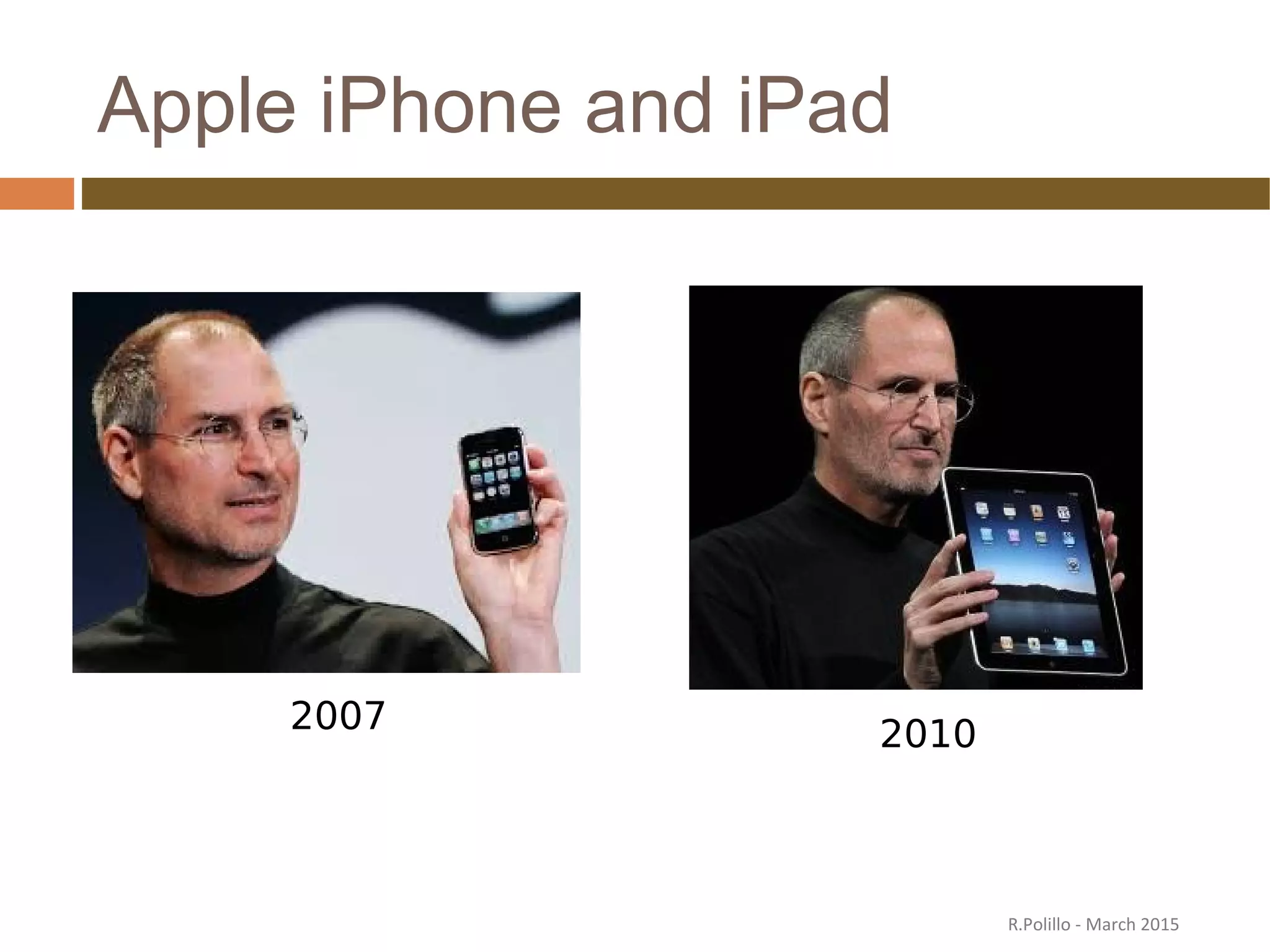
Apple iPhone and iPad
2007 2010
R.Polillo - March 2015
Web 2.0
2000 1 2 3 4 5 6 7 8 9 10 11
12
Twitter,
Slideshare,
Scribd
Google
DocsYouTube
,
Joomla,
NingFlickr,
Facebook
Skype
WordPress
Blogger
LinkedIn iPhone
Groupon
Android,
Dropbox
Foursquar
e
WhatsApp
iPad,
Pinterest
Instagram
Google+
Wikipedi
a
(In red start of mobile
Web)
Internet
traffic
video
R.Polillo - March 2015
Android
 Linux based mobile OS
 Initially developed by Android Inc., acquired by Google
in 2005
 Open-source
 First android phone: end 2008
 Today the largest market share for mobile OS
R.Polillo - March 2015
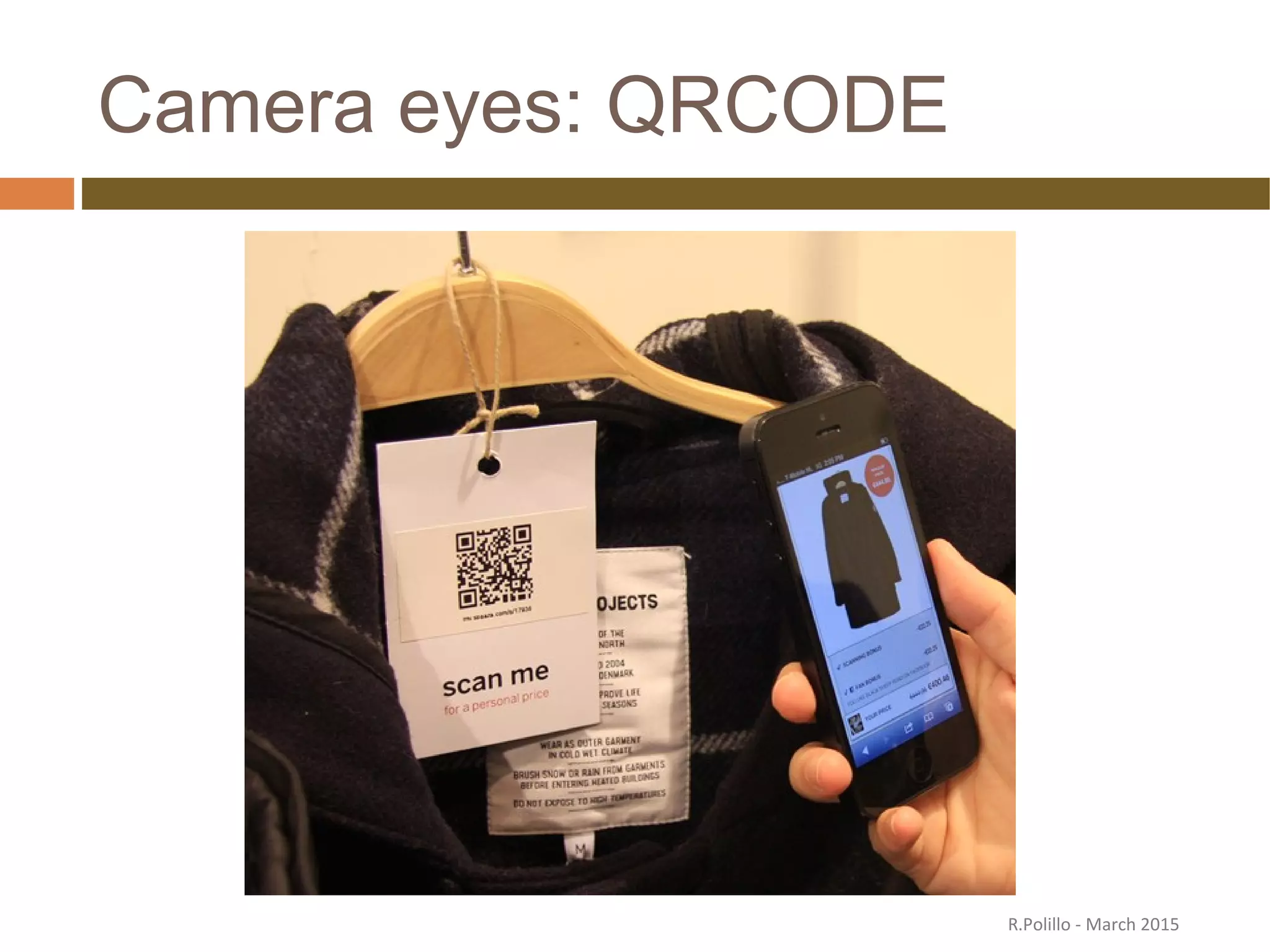
Camera eyes: QRCODE
R.Polillo - March 2015
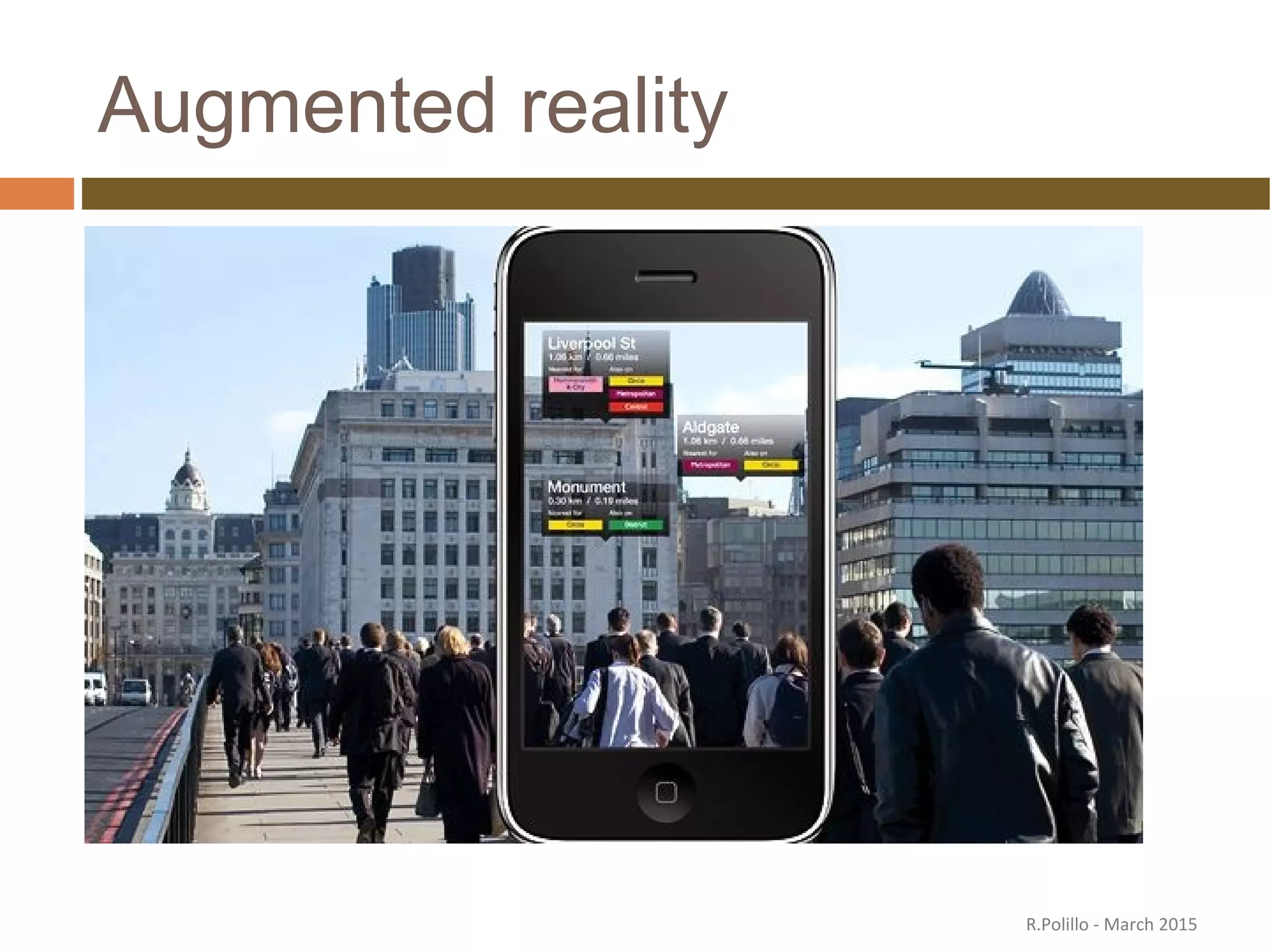
Augmented reality
R.Polillo - March 2015
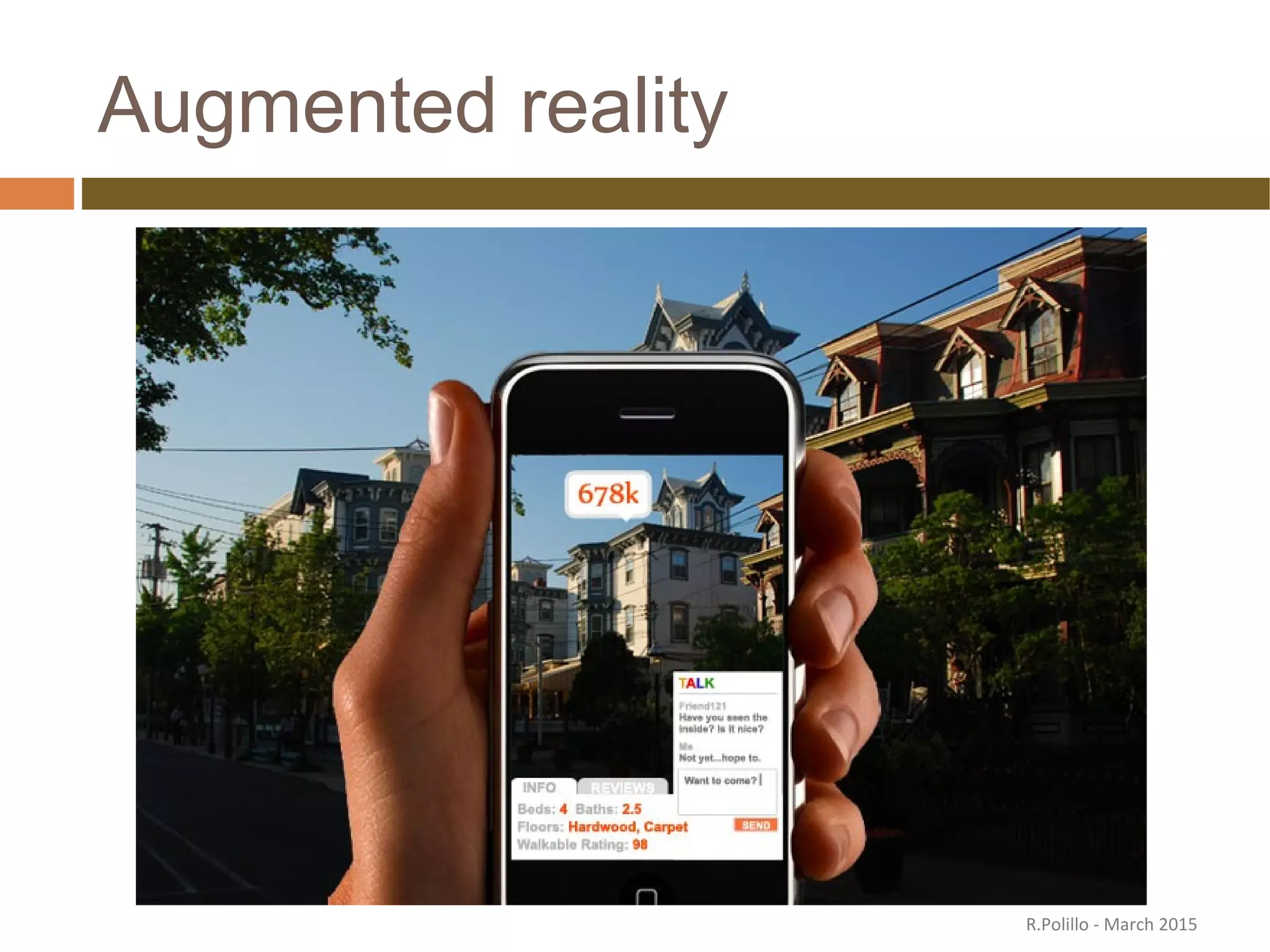
Augmented reality
R.Polillo - March 2015
Augmented reality
R.Polillo - March 2015
But we cannot do everything with a
small, portable device…
Mobile
and
cloud
com
puting
are
strongly
related
CLOUD
Tks Lara Ciccarelli per i disegni R.Polillo - March 2015
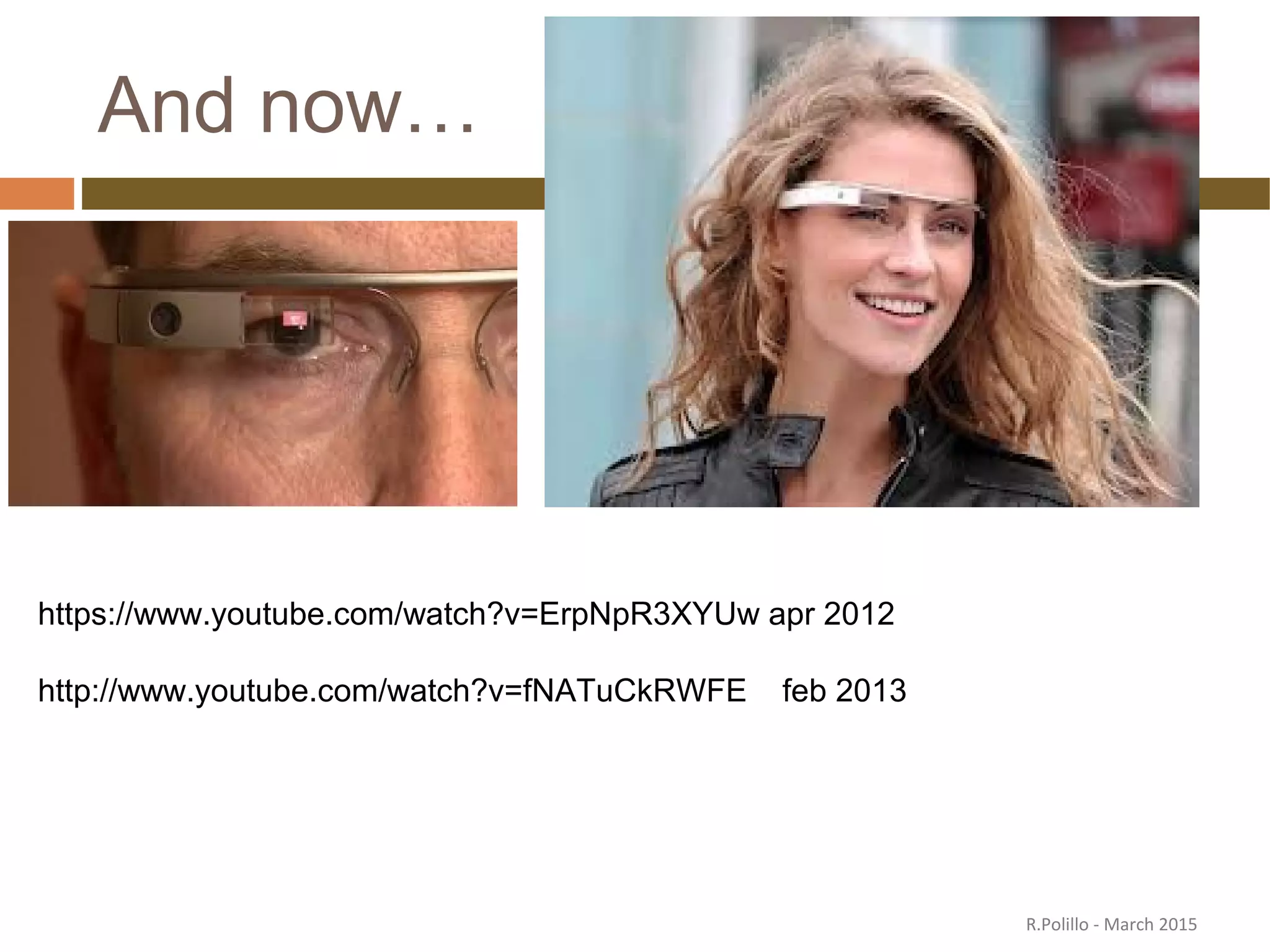
And now…
https://www.youtube.com/watch?v=ErpNpR3XYUw apr 2012
http://www.youtube.com/watch?v=fNATuCkRWFE feb 2013
R.Polillo - March 2015
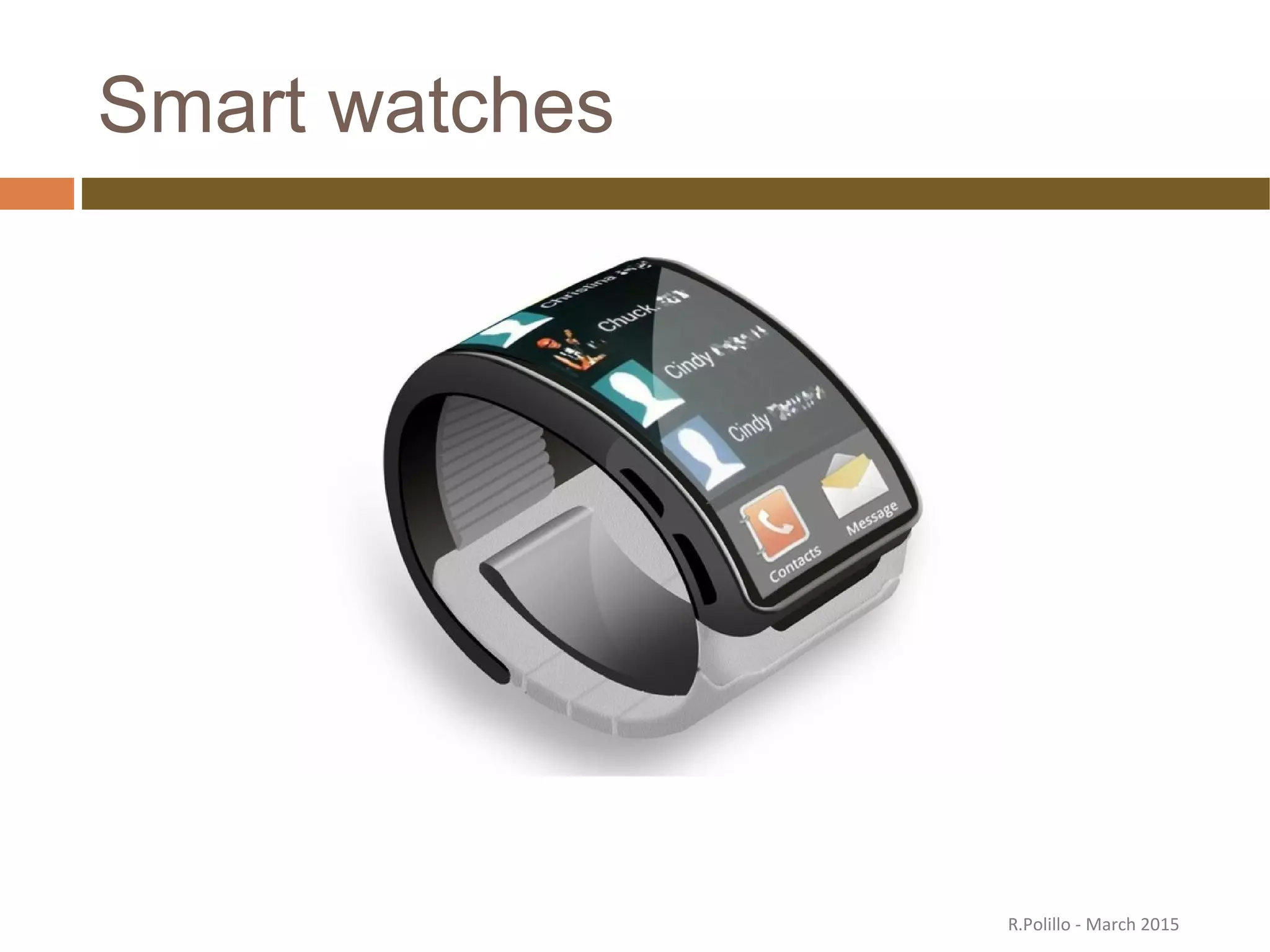
Smart watches
R.Polillo - March 2015
Driving forces
Network effects
More users of a service → more attractive the
service ("positive externalities")
Examples:
•Telephone
•Sms
•Skype
•Facebook
•WhatsApp
•….
R.Polillo - March 2015
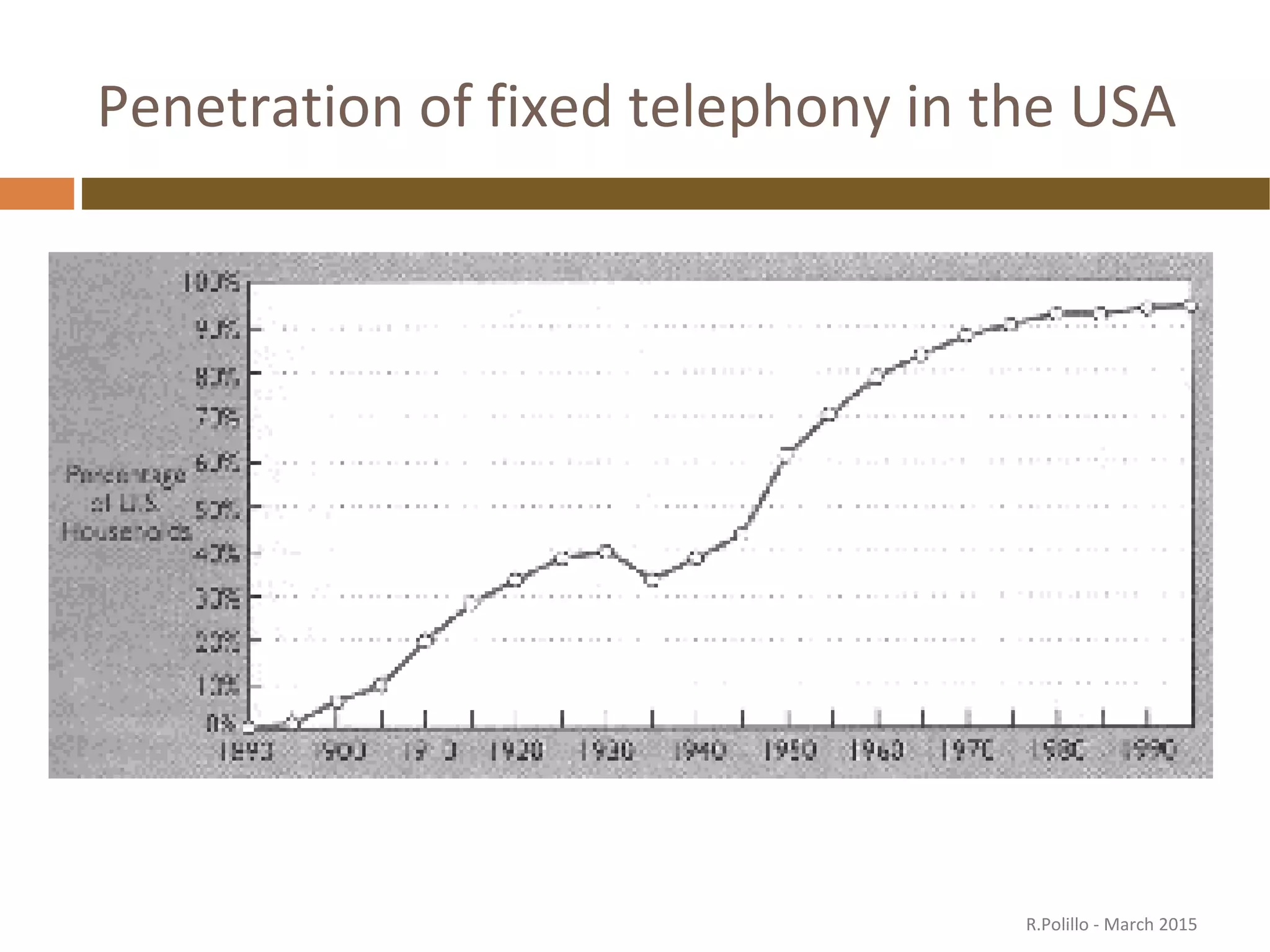
Penetration of fixed telephony in the USA
R.Polillo - March 2015
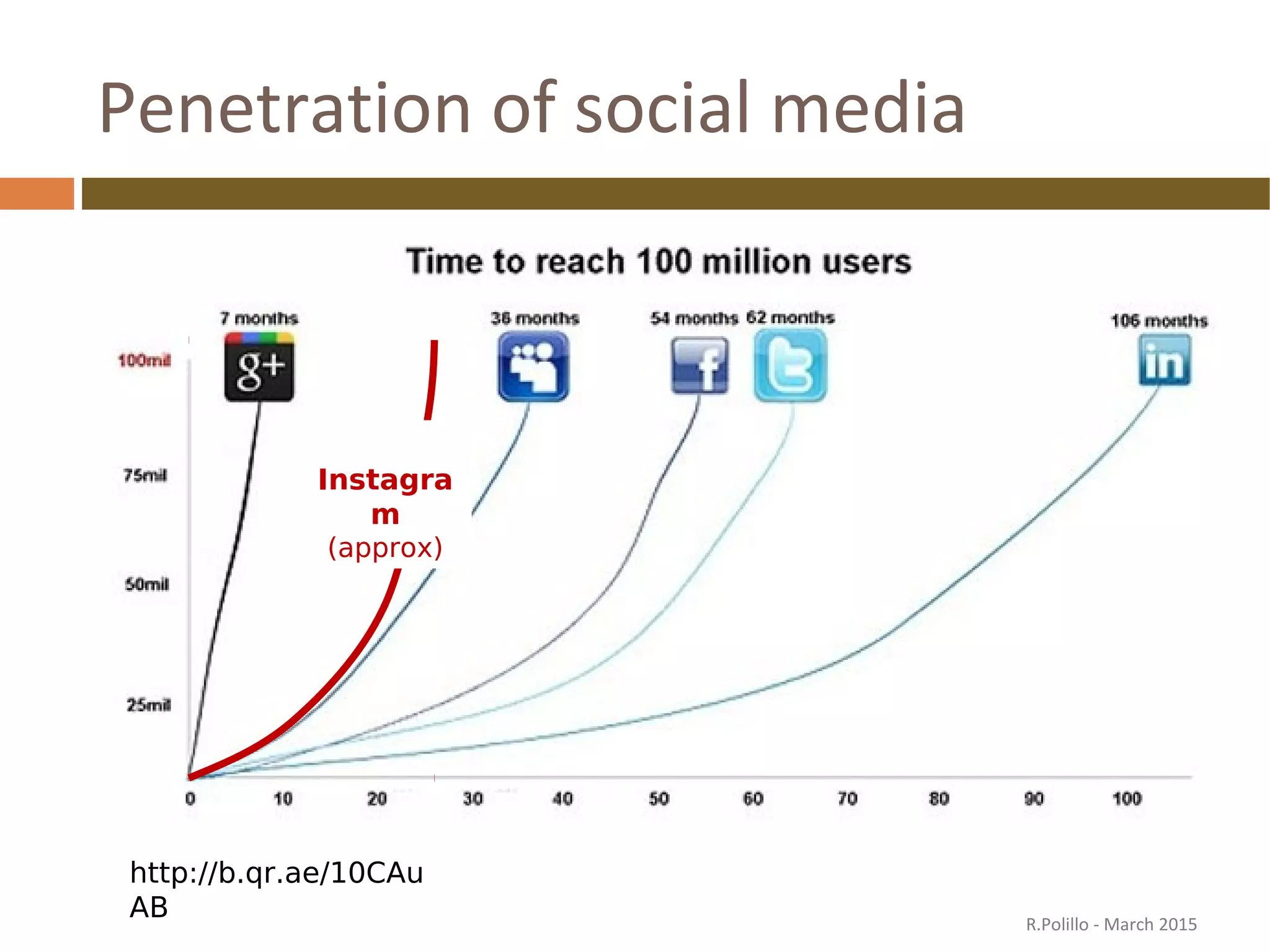
Penetration of social media
http://b.qr.ae/10CAu
AB
Instagra
m
(approx)
R.Polillo - March 2015
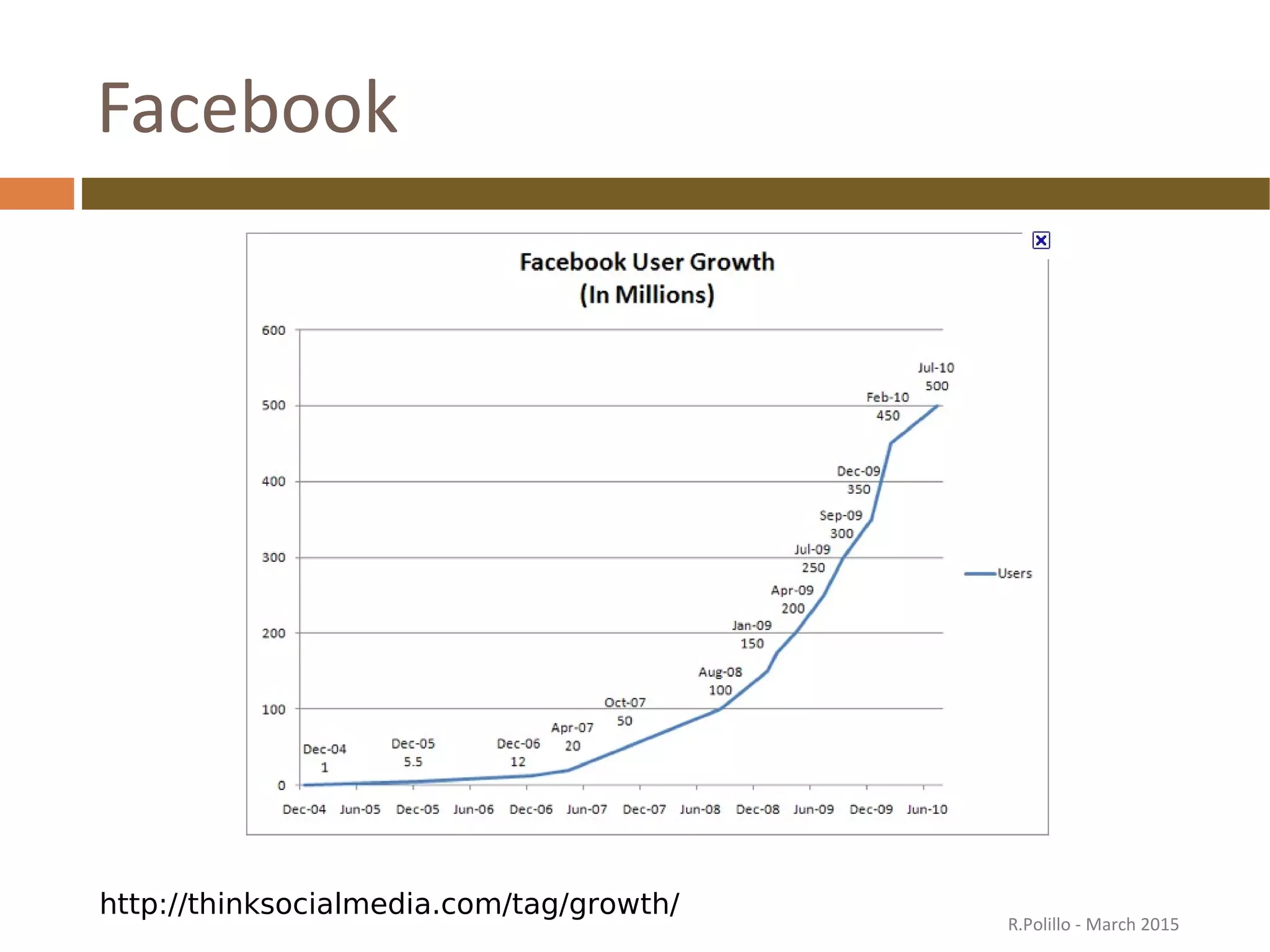
Facebook
http://thinksocialmedia.com/tag/growth/
R.Polillo - March 2015
Positive externalities: consequences
 The number of subscribers of services based on networks
can grow extremely fast
 When there are many subscribers, they may accept to pay
an higher price for the service
 Typical example: a service is initially free to grow the user
base, then paid
R.Polillo - March 2015
Positive feedback
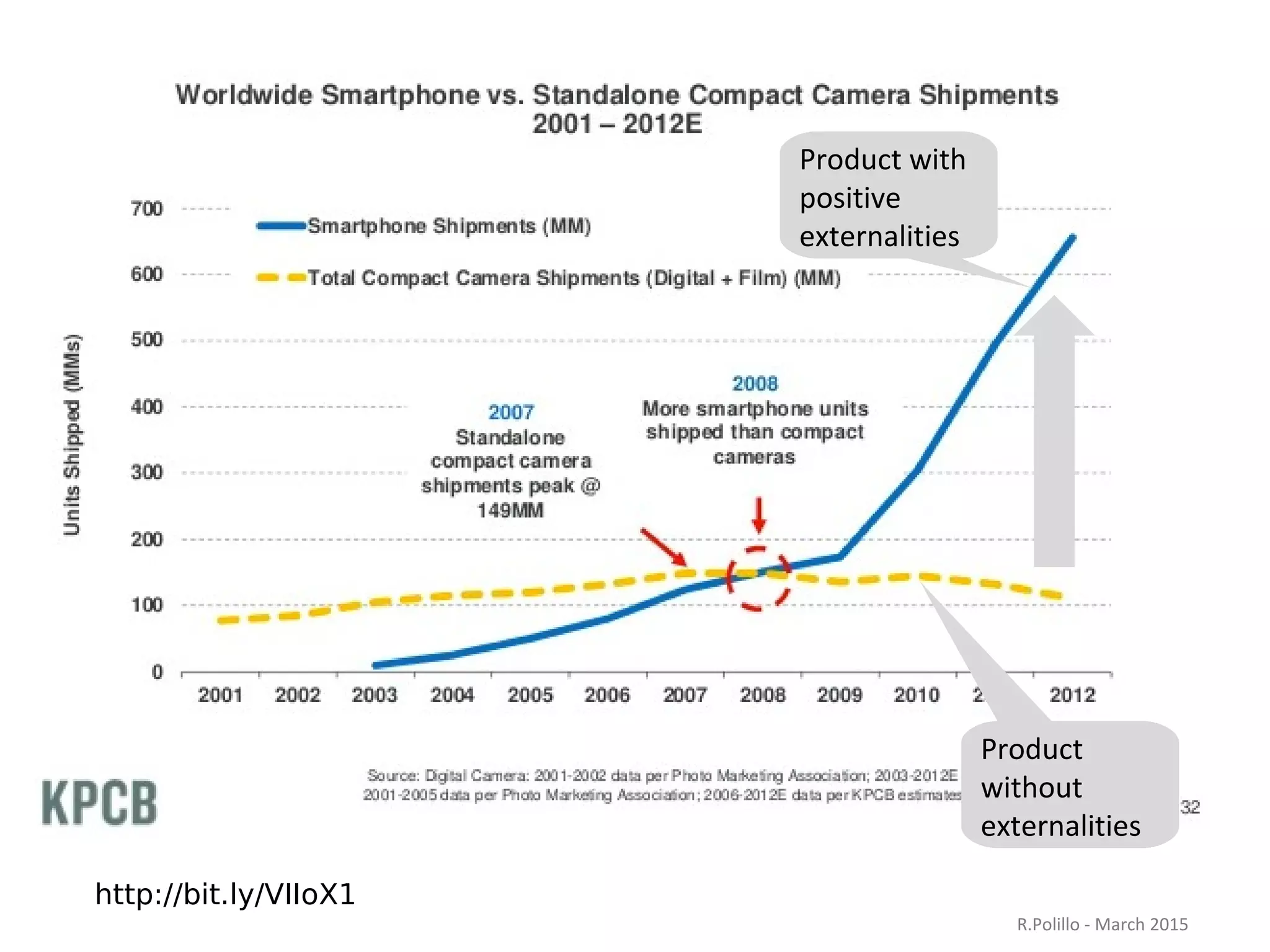
If a product / service with positive externalities gains a larger market
share with respect to its competitor, it will obtain larger and larger
market shares, toward the 100% market share
W.Brian Arthur, “Increasing Returns and
Path
Dependence in the Economy”, 1994
« For whoever has
will be given more,
and they will have an
abundance. Whoever
does not have, even
what they have will
be taken from
them. »
Matthew, 25-
29
Positive feedback,
"Law of increasing
returns",
"Winner takes all"
R.Polillo - March 2015
http://bit.ly/VIIoX1
Product with
positive
externalities
Product
without
externalities
R.Polillo - March 2015
Consequences
 First mover advantage: he who gains market shares before his
competitor has a very large competitive advantage
 Butterfly effect: the success of a technology may depend on
fortuitous facts which afford small advantages at the beginning,
which start an "avalanche effect" which may have nothing to do
with its technical qualities
 Standard de facto: computer industry is dominated by de-facto
standards dictated by first movers (de-iure standards aften fail)
R.Polillo - March 2015
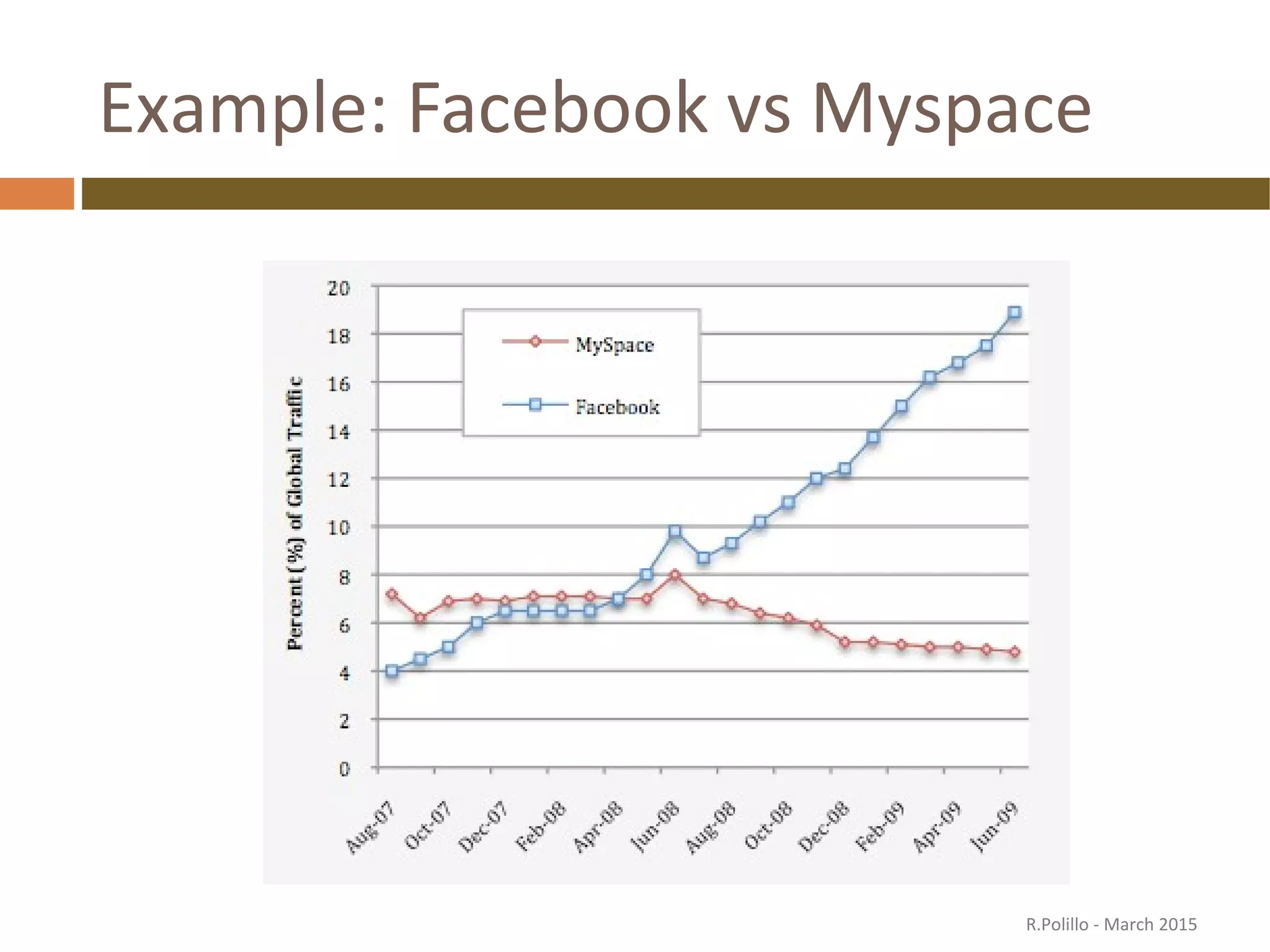
Example: Facebook vs Myspace
R.Polillo - March 2015
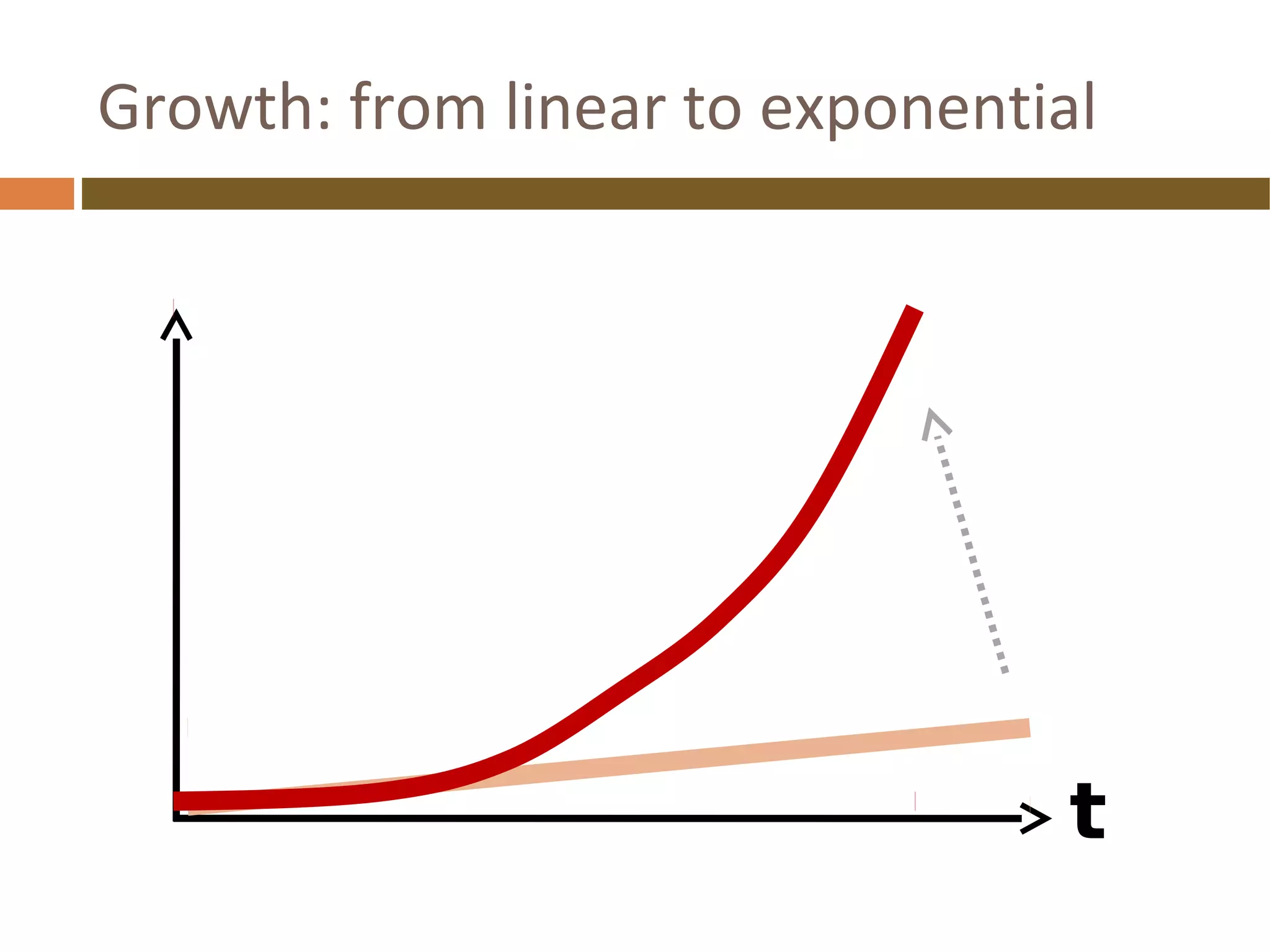
Growth: from linear to exponential
t
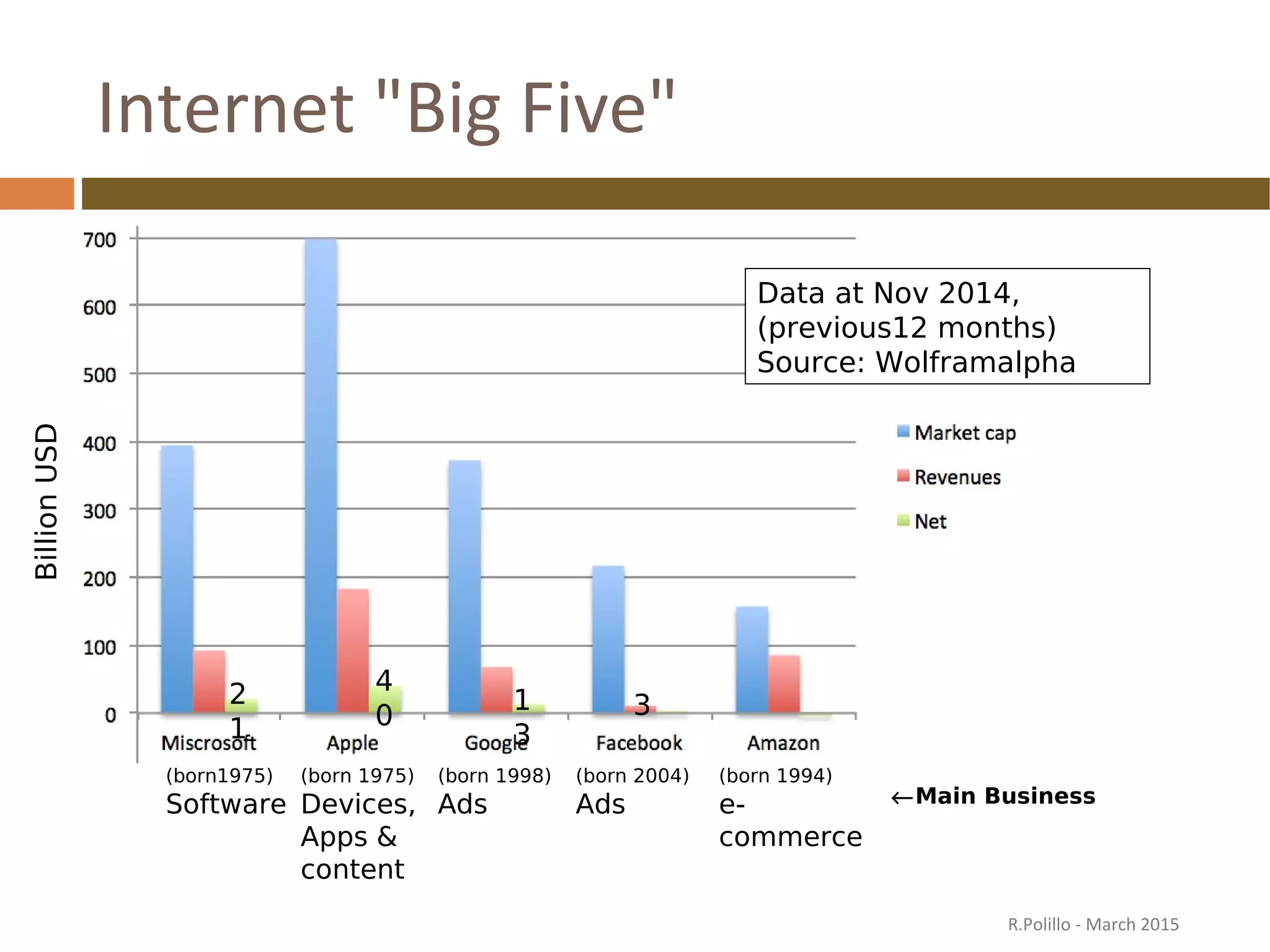
Internet "Big Five"
(born 1975)
Devices,
Apps &
content
(born 1998)
Ads
(born1975)
Software
(born 1994)
e-
commerce
(born 2004)
Ads ←Main Business
Data at Nov 2014,
(previous12 months)
Source: Wolframalpha
4
0
2
1
1
3
3
BillionUSD
R.Polillo - March 2015
The myth of free services
 The prevalence of business models in which it is not
evident who pays for what
 N-side markets
"There is no free lunch
The question is how you are paying it
and if you are willing to do it"
Anonymous
R.Polillo - March 2015
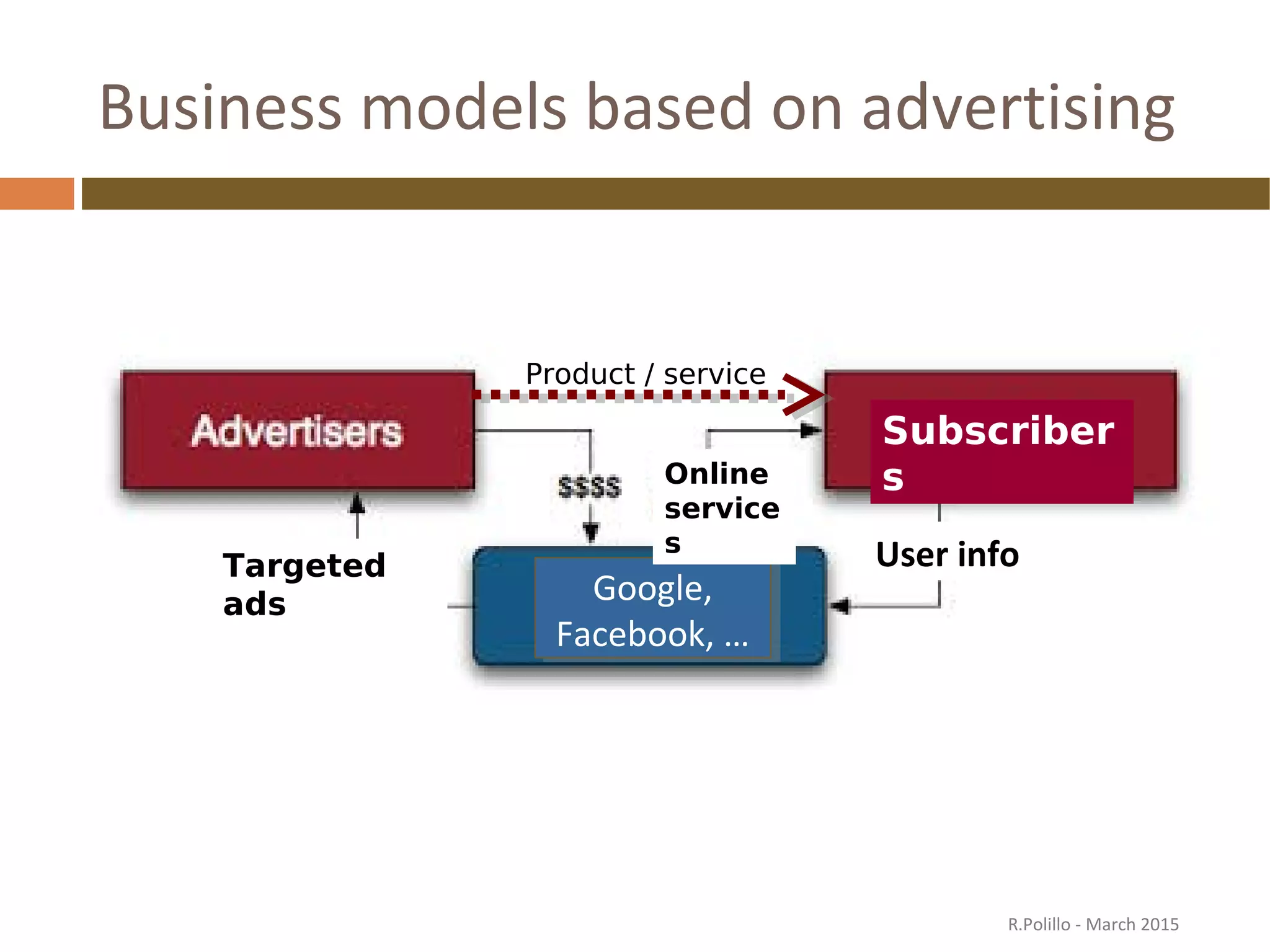
Business models based on advertising
Product / service
Google,
Facebook, …
Google,
Facebook, …
User info
Subscriber
s
Targeted
ads
Online
service
s
R.Polillo - March 2015
Some conclusions
Where are we now and where are we
going?
The two sides of the net
R.Polillo - March 2015
The two sides of the net - 1
Free services
The end of the privacy”
We stop paying with money, but withinformation about ourselves
The citizen as a consumer
R.Polillo - March 2015
The two sides of the net - 2
Every information
at our fingertips
…. but unreliable”
“The distinction between trained experts and uninformed amateurs
becomes dangerously blurred, truth becomes a commodity to be bought,
sold, packaged and reinvented “ (A.Keen)
R.Polillo - March 2015
The two sides of the net - 3
Individualized
assistance
The “filter bubble””
The variety of information is reduced by filtering algorithms,
which filter away what we and our social network do not "like”
“Imagine a world where you never discover new ideas” (E.Parisier)
R.Polillo - March 2015
The two sides of the net - 4
Freedom of
expression
Ease of control”
Our opinions can be easily monitored
E.g. E.Snowden case
R.Polillo - March 2015
The two sides of the net - 5
Augmented
socialization
Social interaction overload
500 ml photos shared daily on Facebook
The “dictatorship” of notification systems
”
R.Polillo - March 2015
The two sides of the net - 6
Powerful
cognitive
augmentation
Unknown cognitive reshaping ”
“Is Google making us stupid?” (N.Carr)
R.Polillo - March 2015
The two sides of the net - 7
The quality
of access
The end of the “net neutrality””
What we access online may be regulated and filtered
by complex, multi-sided market agreements
R.Polillo - March 2015
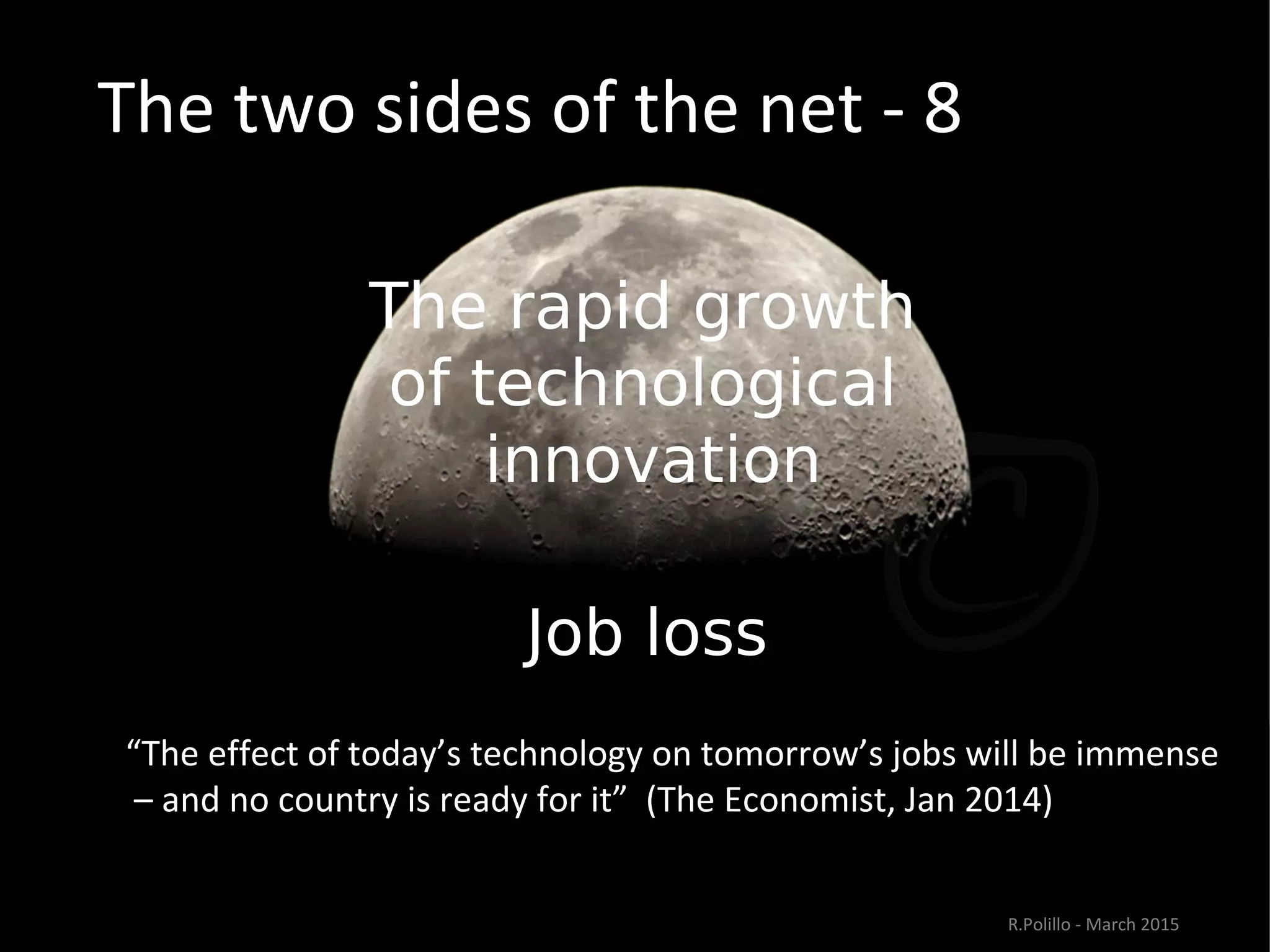
The two sides of the net - 8
The rapid growth
of technological
innovation
Job loss
“The effect of today’s technology on tomorrow’s jobs will be immense
– and no country is ready for it” (The Economist, Jan 2014)
R.Polillo - March 2015
It is a difficult world, take care
of it!
R.Polillo - March 2015
Thank you!
www.rpolillo.it
R.Polillo - March 2015
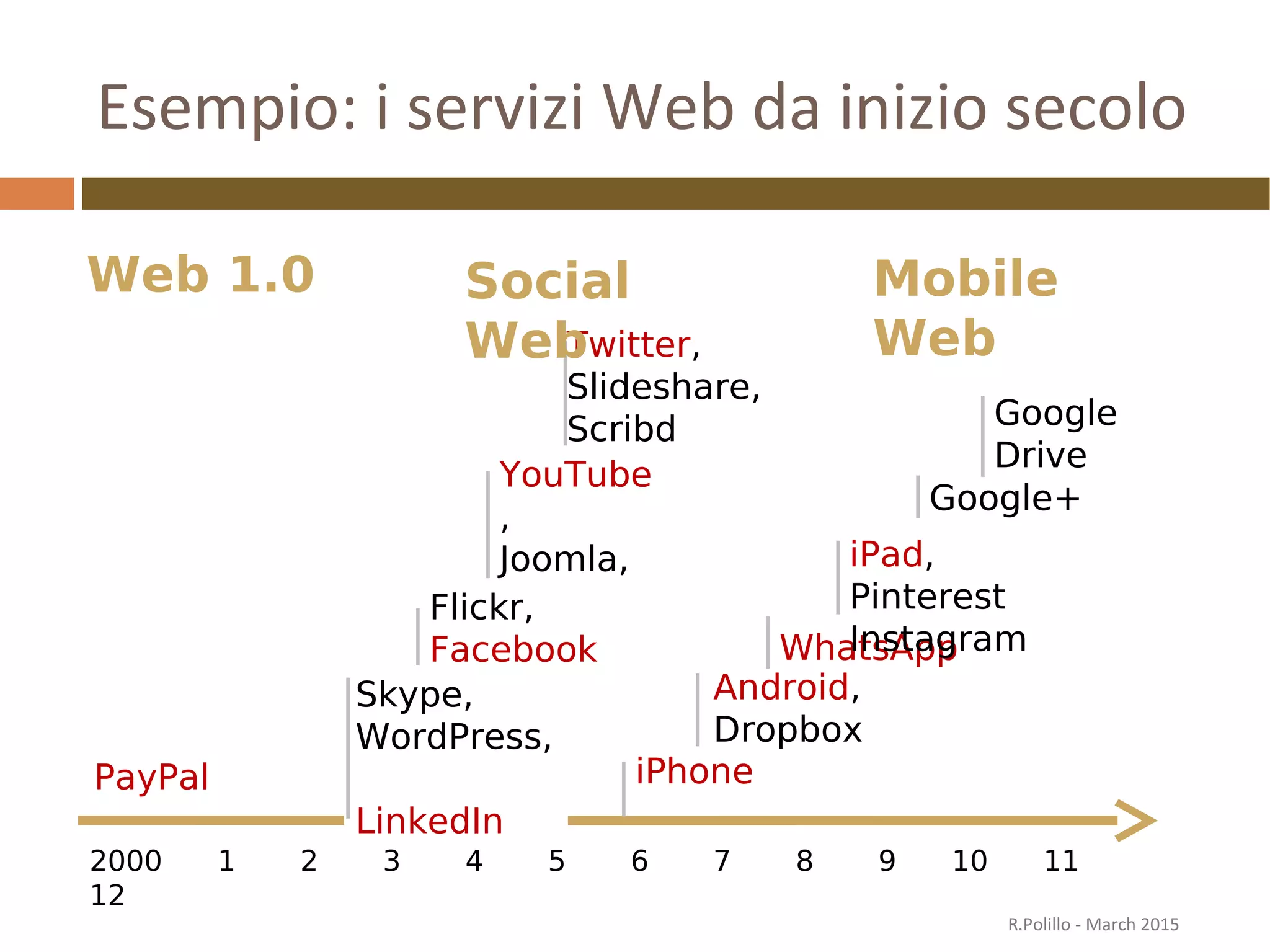
Esempio: i servizi Web da inizio secolo
2000 1 2 3 4 5 6 7 8 9 10 11
12
PayPal
Twitter,
Slideshare,
Scribd
YouTube
,
Joomla,
NingFlickr,
Facebook
Skype,
WordPress,
LinkedIn
iPhone
Android,
Dropbox
WhatsApp
iPad,
Pinterest
Instagram
Google+
Google
Drive
Social
Web
Mobile
Web
Web 1.0
R.Polillo - March 2015

The Web: evolution and perspective

  • 1.
    May 12, 2014 Universityof Milano Bicocca URBEUR-QUASI PhD Programme Internet today: problems and perspectives Roberto Polillo Department of Informatics, Systems and Communications University of Milano Bicocca
  • 2.
    Topics  A (very)short history of the Web A summary of the milestones / paradigms of the evolution of the Web: 1990-today  A (very) short discussion of the driving forces A summary of market mechanisms that drive the growth of the Web online services, and resulting problems R.Polillo - March 2015
  • 3.
    The evolution ofthe Web  From the first Web site (1991), the Web is continuously growing and changing its nature  In parallel, telephony is drastically changed (fixed → mobile)  Drivers of this evolution: tecnology, market, people behaviour R.Polillo - March 2015
  • 4.
    Changing Internet paradigms 1995+ Corporate sites  Web portals  Search engines  E-commerce  Web as an interface  …. HYPERTEXT, eCOMMERCE 2005+  Blogs  Social networks  UGC  Cooperative creation  Sharing  Reusable contents  … SOCIAL MEDIA 1985 +  E-mail  File transfer  Newsgroups  …. COMMUNICATION NETWORK R.Polillo - March 2015
  • 5.
    2015+ MOBILE WEB  Mobiledevices  Cloud computing  Geolocalization  Camera phone  Augmented reality  Electronic wallet Changing Internet paradigms Mobile devices Desktop + laptop Worldwide installed base R.Polillo - March 2015
  • 6.
    2015+ MOBILE WEB  Mobiledevices  Cloud computing  Geolocalization  Camera phone  Augmented reality  Electronic wallet 2020+ INTERNET OF THINGS Changing Internet paradigms R.Polillo - March 2015
  • 7.
  • 8.
    Internet traffic growth(World) http://gizmodo.com/5614841 / web video p2p R.Polillo - March 2015
  • 9.
  • 10.
    Web 1.0 MS Explorer Amazon eBay IPONetscape 1990 1 2 3 4 5 6 7 8 9 2000 2001 2002 First web site at CERN W3C Netscape Navigator Yahoo Mosaic Google Mozilla Napster Paypal R.Polillo - March 2015
  • 11.
  • 12.
    Web 1.0 Typicalapplications  Corporate Web sites  Portals and search engines  eCommerce  [Corporate portals] R.Polillo - March 2015
  • 13.
    Web 1.0 mainsuccess stories  http://www.amazon.com from 1995 Current size: http://www.wolframalpha.com/input/?i=amazon.com  http://www.ebay.com from 1995 Current size: http://www.wolframalpha.com/input/?i=ebay.com  http://www.yahoo.com from 1994, always among the first 5 more visited sites R.Polillo - March 2015
  • 14.
    IPO (Initial PublicOffering) frenzy  dot.com frenzy started by Netscape IPO (Aug 9, 1995)  Founded 18 months earlier  16 M$ revenues, no profit  Market cap at IPO: 1 B$ (!)  Large venture capital, to bring startups to IPO  Many irrealistic business models  NASDAQ bubble, then fall (2000-2001)  Silicon Valley stops completely R.Polillo - March 2015
  • 15.
    The "dot.com bubble” MSExplorer Amazon eBay IPO Netscape 1990 1 2 3 4 5 6 7 8 9 2000 2001 2002 First web site at CERN W3C Netscape Navigator Yahoo Mosaic Google Mozilla Napster Paypal Max NASDAQ 9/11 Min NASDAQ Nasdaq Composite Index March 10 2000: index at 5132 March 10 2000: index at 5132 Oct 9 2002: index at 1114 Oct 9 2002: index at 1114 R.Polillo - March 2015
  • 16.
  • 17.
    Web 2.0 keyaspects Social media: Not the hypertext pages, but the user is the leading actor  User interaction throu the Web: one-to-many (blog), many-to-many (social media)  Services to host User Generated Content (UGC), to be shared with other users  Collective creation  User rating in e-commerce  "Market are conversations" (Cluetrain manifesto, 1999-2000) The Web as a computing platform:  Online services, virtualization  Perpetuale beta  Component and service mashups  Rich Internet Applications (RIA) technologies R.Polillo - March 2015
  • 18.
    Web 2.0 2000 12 3 4 5 6 7 8 9 10 11 12 Twitter, Slideshare, Scribd Google DocsYouTube , Joomla, NingFlickr, Facebook Skype WordPress Blogger LinkedIn iPhone Groupon Android, Dropbox Foursquar e WhatsApp iPad, Pinterest Instagram Google+ Wikipedi a (In red start of mobile Web) Internet traffic video R.Polillo - March 2015
  • 19.
    Xmas 2006 Media acknowledgethe paradigm change R.Polillo - March 2015
  • 20.
    Another bubble? Netscape IPO GoogleIPO Aug 19 2004 LinkedIn IPO (NYSE) Facebook IPO Twitter IPO (NYSE) 199 4 199 5 199 7 199 6 March 10 2000: 5049 (Indice Nasdaq 1994-2013) R.Polillo - March 2015
  • 21.
    In the meanwhile,telephony changes… R.Polillo - March 2015
  • 22.
    FirstW eb site atCERN M osaic (N CSA) W 3C;N etscape N avigator Netscape IPO ,,M S Explorer,Am azon,eBay Boom and fallofNASD AQ G oogle IPO ;Facebook 91 92 9394 95 96 97 98 99 00 01 02 03 04 05 06 07 08 0990 10 11 12 WEB 1.0 WEB 2.0crisisPre-history G oogle founded 9/11;W ikipedia Financialcrisi iPhone,Android Tw itter iPad FB IPO Nasdaq Composite Index YouTube Internet traffic video R.Polillo - March 2015
  • 23.
    SMS 2 G Nokia 5110 GSM (candybar) SMS,watch, sveglia, rubrica, calcolatrice, rubrica, giochi, suonerie MMS WAP 2.5 G Motorola V3 RAZR "Feature phone" GPRS (candybar, clamshell) + MMS,,photocamera, email, (Internet) Touch phone iPhone + multitouch, sensors, GPS, app, … 3 G Blackberry "Smartphone" + alphanumeric kb, PDA, video, GPS, radio, MP3, OS, …Mobile telephony TIM, Omnitel FirstW eb site atCERN M osaic (N CSA) W 3C;N etscape N avigator Netscape IPO ,,M S Explorer,Am azon, Boom and fallofNASD AQ G oogle IPO ;Facebook 91 92 93 94 95 96 97 98 99 00 01 02 03 04 05 06 07 08 0990 10 11 12G oogle founded 9/11;W ikipedia Financialcrisi iPhone,Android Tw itter iPad FB IPO YouTube R.Polillo - March 2015
  • 24.
    IP telephony  Skype Internet based video-telephony, free  Starting 2003, acquired by eBay in 2005, then by Microsoft in 2011 (8,5 B$)  2012: 700 ml accounts; one third of all international calls pass through Skype  Jan 2013: 50 ml concurrent users  WhatsApp  Free SMS via IP  Started in 2009, acquired by Facebook in 2014 (19 B$) R.Polillo - March 2015
  • 25.
    Mobile cellular subscriptions (totaland per 100 inhabitants) R.Polillo - March 2015
  • 26.
  • 27.
  • 28.
    Apple iPhone andiPad 2007 2010 R.Polillo - March 2015
  • 29.
    Web 2.0 2000 12 3 4 5 6 7 8 9 10 11 12 Twitter, Slideshare, Scribd Google DocsYouTube , Joomla, NingFlickr, Facebook Skype WordPress Blogger LinkedIn iPhone Groupon Android, Dropbox Foursquar e WhatsApp iPad, Pinterest Instagram Google+ Wikipedi a (In red start of mobile Web) Internet traffic video R.Polillo - March 2015
  • 30.
    Android  Linux basedmobile OS  Initially developed by Android Inc., acquired by Google in 2005  Open-source  First android phone: end 2008  Today the largest market share for mobile OS R.Polillo - March 2015
  • 31.
  • 32.
  • 33.
  • 34.
  • 35.
    But we cannotdo everything with a small, portable device… Mobile and cloud com puting are strongly related CLOUD Tks Lara Ciccarelli per i disegni R.Polillo - March 2015
  • 36.
    And now… https://www.youtube.com/watch?v=ErpNpR3XYUw apr2012 http://www.youtube.com/watch?v=fNATuCkRWFE feb 2013 R.Polillo - March 2015
  • 37.
  • 38.
  • 39.
    Network effects More usersof a service → more attractive the service ("positive externalities") Examples: •Telephone •Sms •Skype •Facebook •WhatsApp •…. R.Polillo - March 2015
  • 40.
    Penetration of fixedtelephony in the USA R.Polillo - March 2015
  • 41.
    Penetration of socialmedia http://b.qr.ae/10CAu AB Instagra m (approx) R.Polillo - March 2015
  • 42.
  • 43.
    Positive externalities: consequences The number of subscribers of services based on networks can grow extremely fast  When there are many subscribers, they may accept to pay an higher price for the service  Typical example: a service is initially free to grow the user base, then paid R.Polillo - March 2015
  • 44.
    Positive feedback If aproduct / service with positive externalities gains a larger market share with respect to its competitor, it will obtain larger and larger market shares, toward the 100% market share W.Brian Arthur, “Increasing Returns and Path Dependence in the Economy”, 1994 « For whoever has will be given more, and they will have an abundance. Whoever does not have, even what they have will be taken from them. » Matthew, 25- 29 Positive feedback, "Law of increasing returns", "Winner takes all" R.Polillo - March 2015
  • 45.
  • 46.
    Consequences  First moveradvantage: he who gains market shares before his competitor has a very large competitive advantage  Butterfly effect: the success of a technology may depend on fortuitous facts which afford small advantages at the beginning, which start an "avalanche effect" which may have nothing to do with its technical qualities  Standard de facto: computer industry is dominated by de-facto standards dictated by first movers (de-iure standards aften fail) R.Polillo - March 2015
  • 47.
    Example: Facebook vsMyspace R.Polillo - March 2015
  • 48.
    Growth: from linearto exponential t
  • 49.
    Internet "Big Five" (born1975) Devices, Apps & content (born 1998) Ads (born1975) Software (born 1994) e- commerce (born 2004) Ads ←Main Business Data at Nov 2014, (previous12 months) Source: Wolframalpha 4 0 2 1 1 3 3 BillionUSD R.Polillo - March 2015
  • 50.
    The myth offree services  The prevalence of business models in which it is not evident who pays for what  N-side markets "There is no free lunch The question is how you are paying it and if you are willing to do it" Anonymous R.Polillo - March 2015
  • 51.
    Business models basedon advertising Product / service Google, Facebook, … Google, Facebook, … User info Subscriber s Targeted ads Online service s R.Polillo - March 2015
  • 52.
    Some conclusions Where arewe now and where are we going?
  • 53.
    The two sidesof the net R.Polillo - March 2015
  • 54.
    The two sidesof the net - 1 Free services The end of the privacy” We stop paying with money, but withinformation about ourselves The citizen as a consumer R.Polillo - March 2015
  • 55.
    The two sidesof the net - 2 Every information at our fingertips …. but unreliable” “The distinction between trained experts and uninformed amateurs becomes dangerously blurred, truth becomes a commodity to be bought, sold, packaged and reinvented “ (A.Keen) R.Polillo - March 2015
  • 56.
    The two sidesof the net - 3 Individualized assistance The “filter bubble”” The variety of information is reduced by filtering algorithms, which filter away what we and our social network do not "like” “Imagine a world where you never discover new ideas” (E.Parisier) R.Polillo - March 2015
  • 57.
    The two sidesof the net - 4 Freedom of expression Ease of control” Our opinions can be easily monitored E.g. E.Snowden case R.Polillo - March 2015
  • 58.
    The two sidesof the net - 5 Augmented socialization Social interaction overload 500 ml photos shared daily on Facebook The “dictatorship” of notification systems ” R.Polillo - March 2015
  • 59.
    The two sidesof the net - 6 Powerful cognitive augmentation Unknown cognitive reshaping ” “Is Google making us stupid?” (N.Carr) R.Polillo - March 2015
  • 60.
    The two sidesof the net - 7 The quality of access The end of the “net neutrality”” What we access online may be regulated and filtered by complex, multi-sided market agreements R.Polillo - March 2015
  • 61.
    The two sidesof the net - 8 The rapid growth of technological innovation Job loss “The effect of today’s technology on tomorrow’s jobs will be immense – and no country is ready for it” (The Economist, Jan 2014) R.Polillo - March 2015
  • 62.
    It is adifficult world, take care of it! R.Polillo - March 2015
  • 63.
  • 64.
    Esempio: i serviziWeb da inizio secolo 2000 1 2 3 4 5 6 7 8 9 10 11 12 PayPal Twitter, Slideshare, Scribd YouTube , Joomla, NingFlickr, Facebook Skype, WordPress, LinkedIn iPhone Android, Dropbox WhatsApp iPad, Pinterest Instagram Google+ Google Drive Social Web Mobile Web Web 1.0 R.Polillo - March 2015