Out of the box
How ICT reshapes the work question
Henri ISAAC
Associate Dean for Research, Rouen Business School, France
 The invisible industrial revolution ?
 Temporal effects of ICT
 Spatial effects of ICT
 Socio-economic consequences of the digital revolution
 new type of economic organization
 Toward a new work regulation
2-3/12/10 UNI Europa P&MS Conference
Agenda
2
 We experience an on-going industrial revolution:
– Digitilisation is a structural trend (money, sound, text,
image, video)
– A new raw material : information
– And now economic value
 Source of value:
– No longer based upon capital or goods ownership
– The age of access (Rifkin, 2000)
– Intellectual capital versus physical capital
– Positive externalities of electronic networks
 Cognitive capitalism
2-3/12/10 UNI Europa P&MS Conference
The invisible industrial revolution?
3
2-3/12/10 UNI Europa P&MS Conference 4
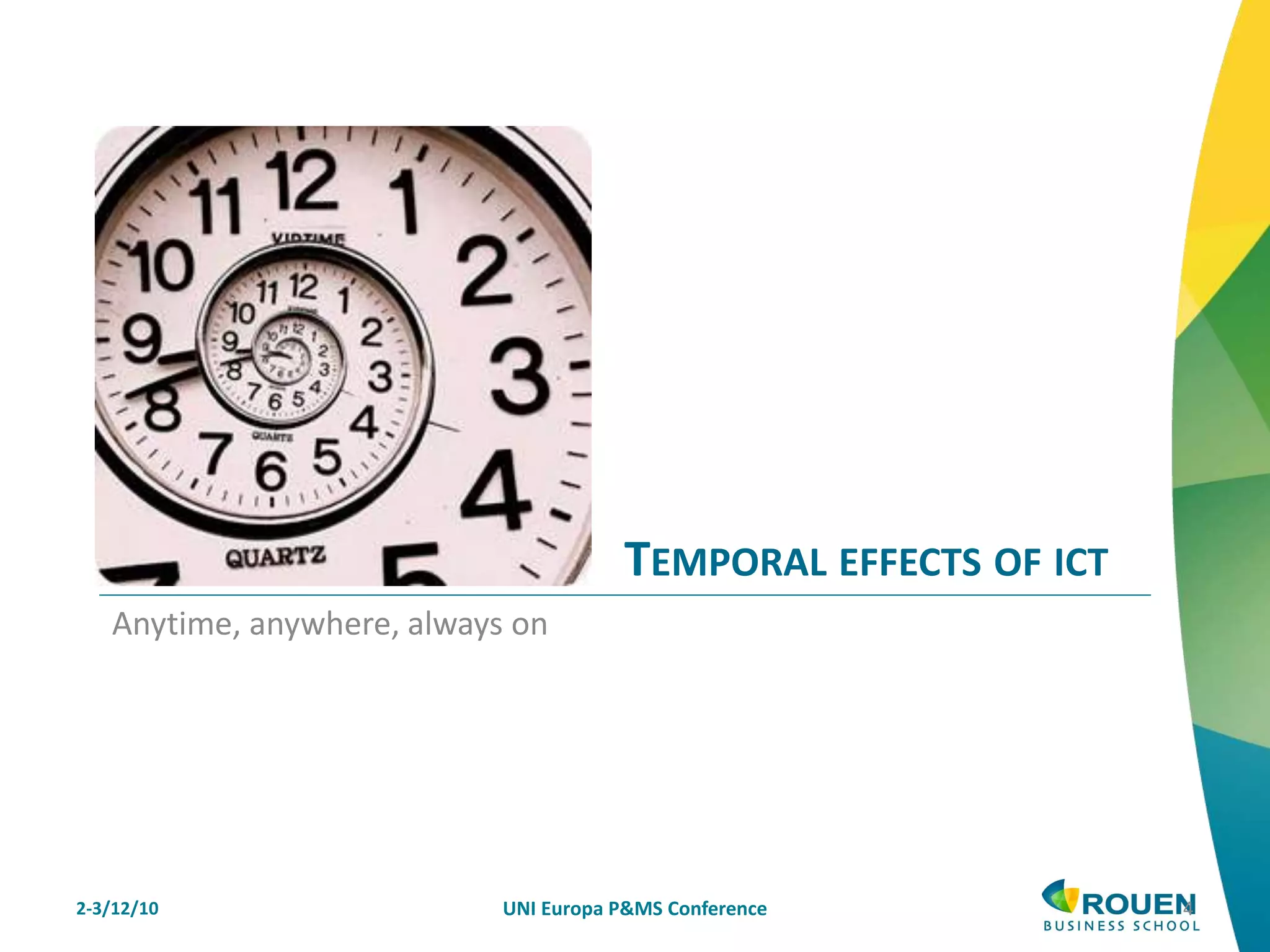
TEMPORAL EFFECTS OF ICT
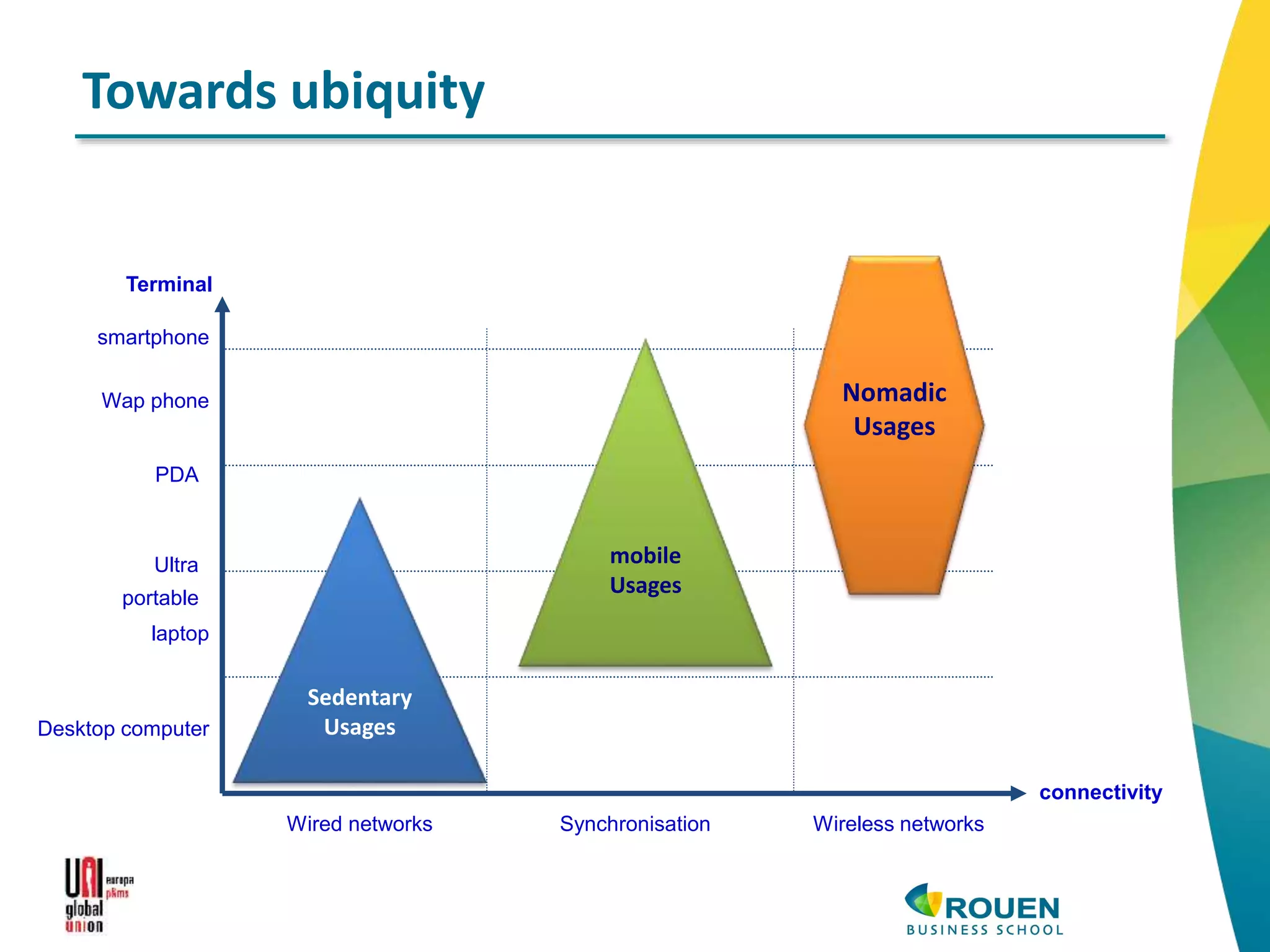
Anytime, anywhere, always on
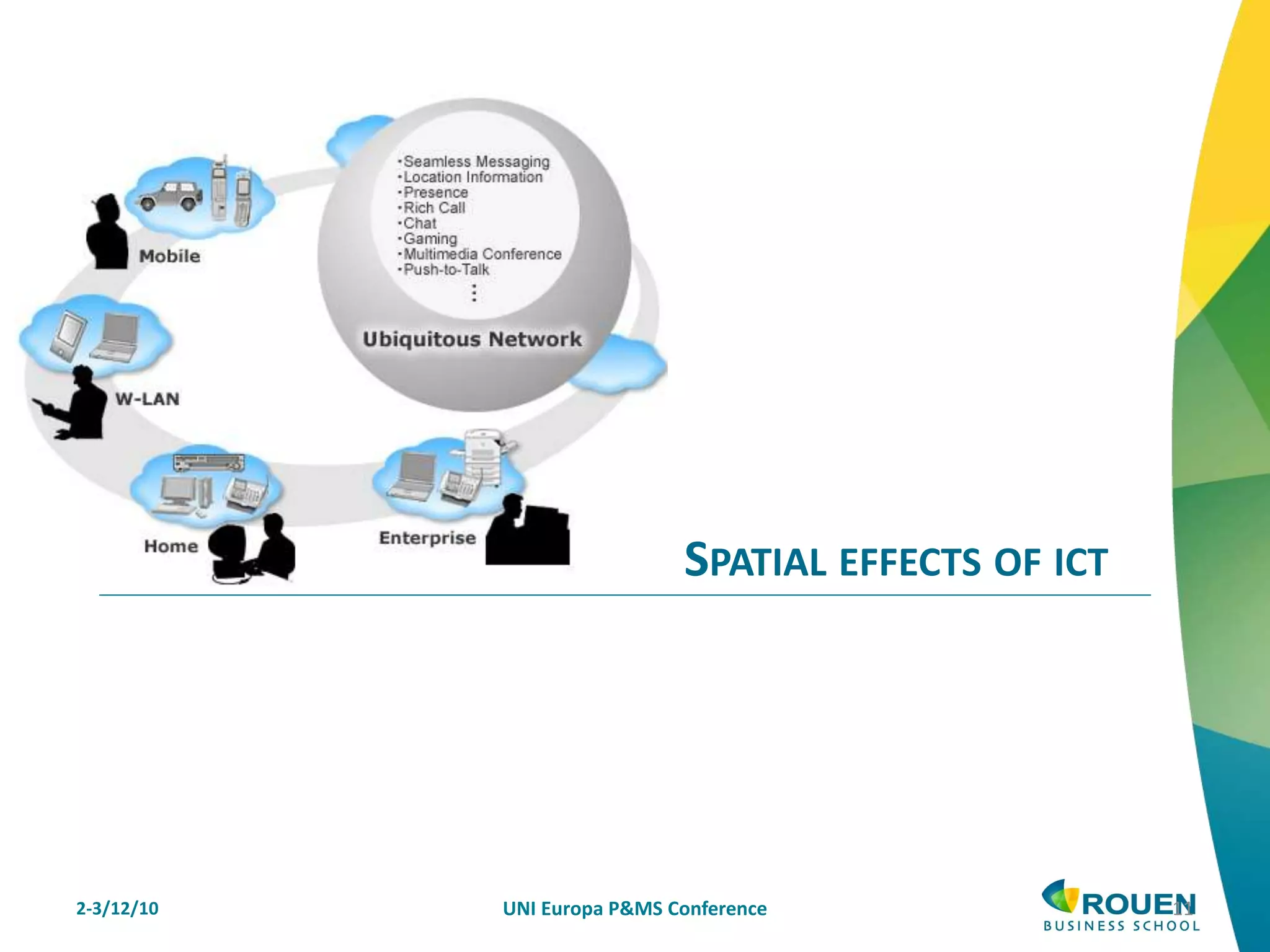
Towards ubiquity
Wired networks Synchronisation Wireless networks
connectivity
Desktop computer
laptop
Ultra
portable
PDA
Wap phone
smartphone
Terminal
Sedentary
Usages
mobile
Usages
Nomadic
Usages
 Time compression
 Time extension
 Mixed times
 Parallel times
UNI Europa P&MS Conference 6
Temporal effects of ICT
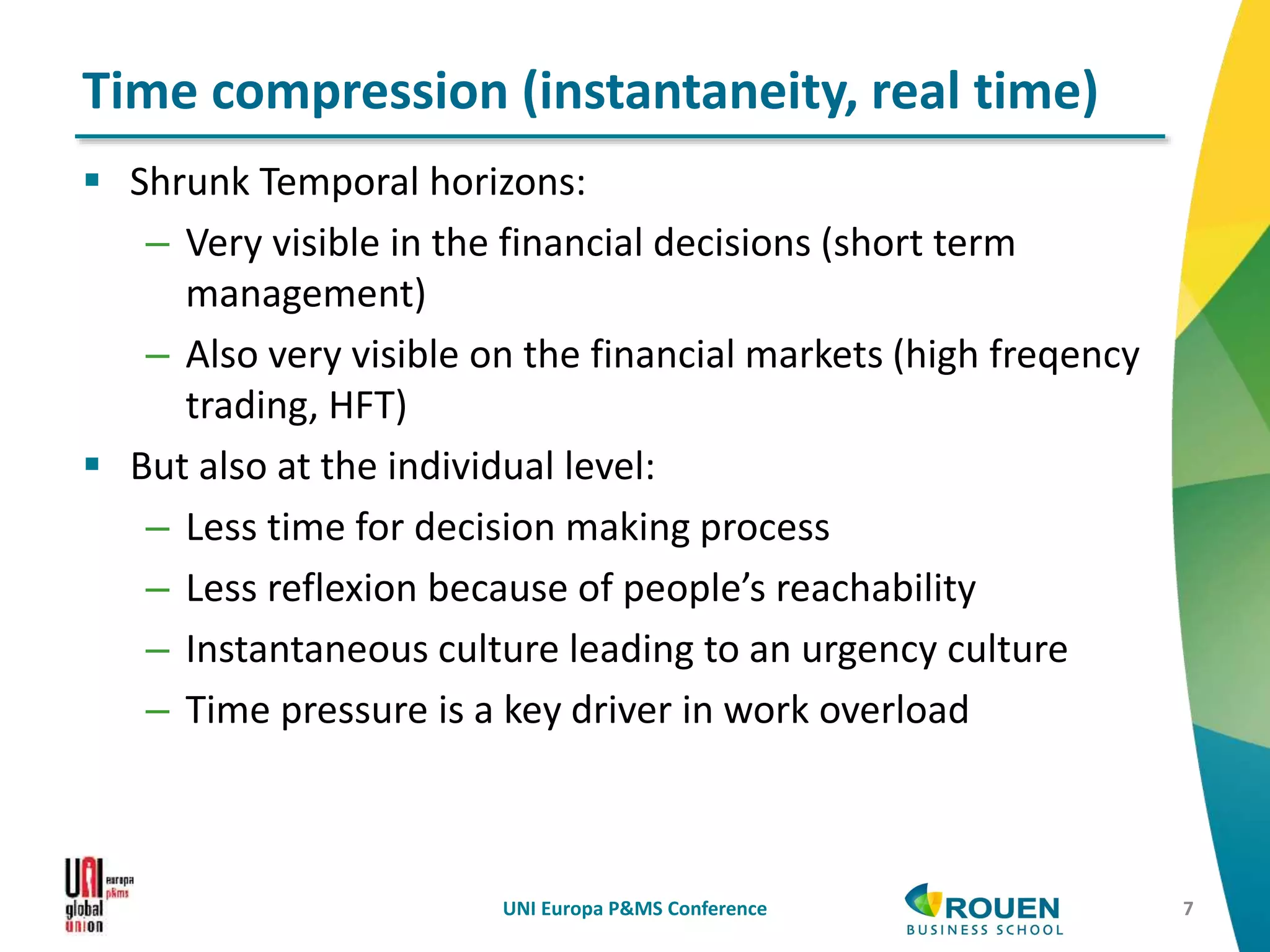
 Shrunk Temporal horizons:
– Very visible in the financial decisions (short term
management)
– Also very visible on the financial markets (high freqency
trading, HFT)
 But also at the individual level:
– Less time for decision making process
– Less reflexion because of people’s reachability
– Instantaneous culture leading to an urgency culture
– Time pressure is a key driver in work overload
UNI Europa P&MS Conference 7
Time compression (instantaneity, real time)
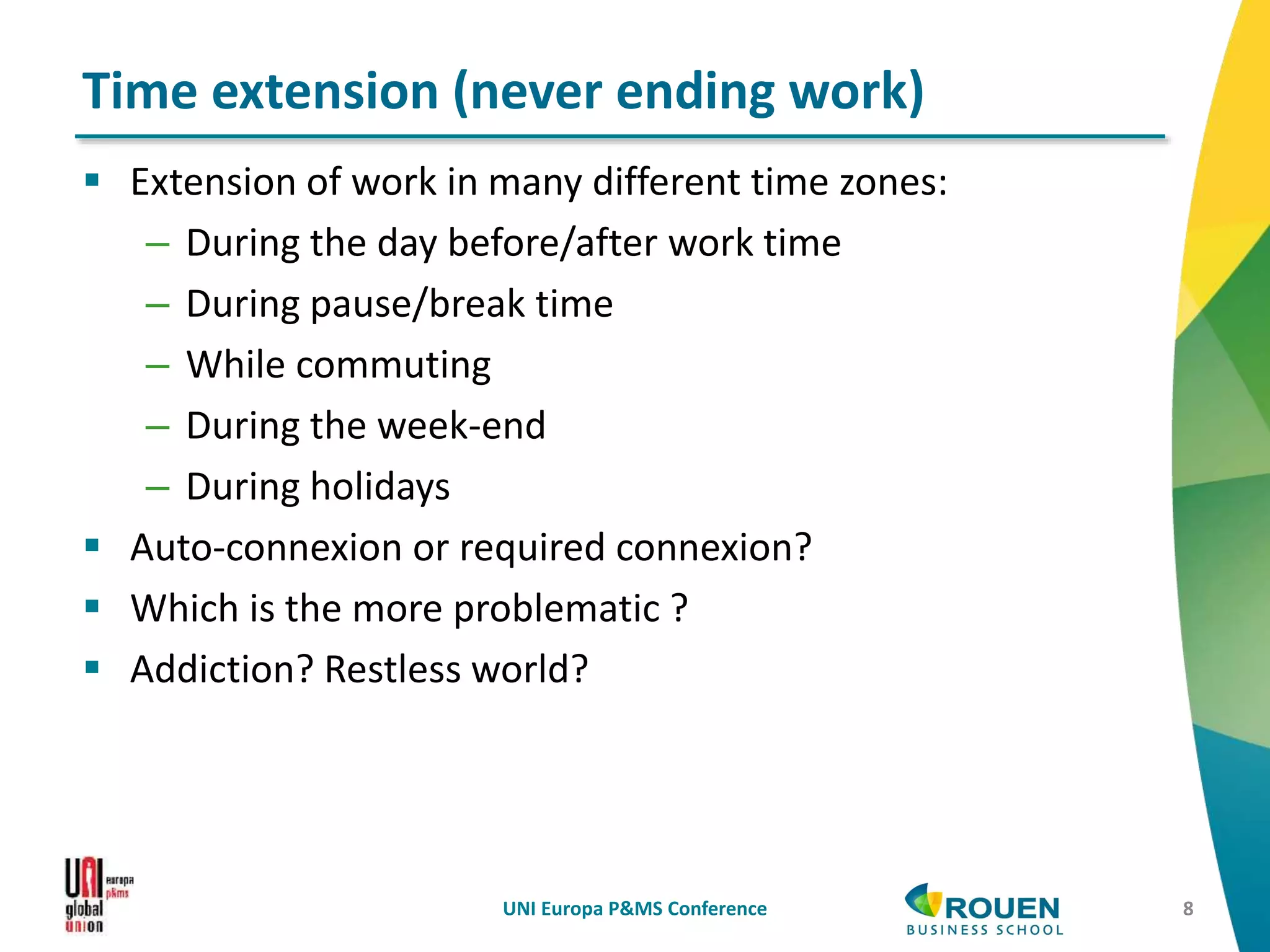
 Extension of work in many different time zones:
– During the day before/after work time
– During pause/break time
– While commuting
– During the week-end
– During holidays
 Auto-connexion or required connexion?
 Which is the more problematic ?
 Addiction? Restless world?
UNI Europa P&MS Conference 8
Time extension (never ending work)
 Private life enter the work time
 Work enter the private time
 Interweaving of different social times
 Historically, Capitalism has separed those two different
social activities
 Question:
– Is the blurring of this frontier a new step in the
development of capitalism?
– Exploitation of skills and values developed in the private
sphere?
UNI Europa P&MS Conference 9
Mixed time
 Ubiquity: capacity to be in different time & space zones at
the same time
 Practices that have grown over the years
 Very visible in business meetings
 Questions:
– Are we able to manage simultaneous tasks?
– Are there differences among people (so called Gen Y) ?
– Phenomena contributing to work load
UNI Europa P&MS Conference 10
Parallel times (simultaneity)
2-3/12/10 UNI Europa P&MS Conference 11
SPATIAL EFFECTS OF ICT
 ICT drove the communication prices to almost zero
 Local/global reinvented
 But distance doesn’t disappear
– In e-commerce : goods support distance no longer the
customer
– People: Increase number of people traveling
 But, increase broadband (FFTH) will develop telepresence
tools
UNI Europa P&MS Conference 12
It’s a small world
 Working everywhere !
– Train, tube, airplane, aiport, stations, cars, etc.
 The world is the office !
 Historically, we have been creating spaces dedicated to
work
 Many activities are based on work commuting
 Sustainable development ?
 Socialization ?
 Professional identity ?
 What can of society do we want?
UNI Europa P&MS Conference 13
Spatial effects
2-3/12/10 UNI Europa P&MS Conference 14
NEW TYPE OF PRODUCTIVE ORGANIZATIONS
UNI Europa P&MS Conference 15
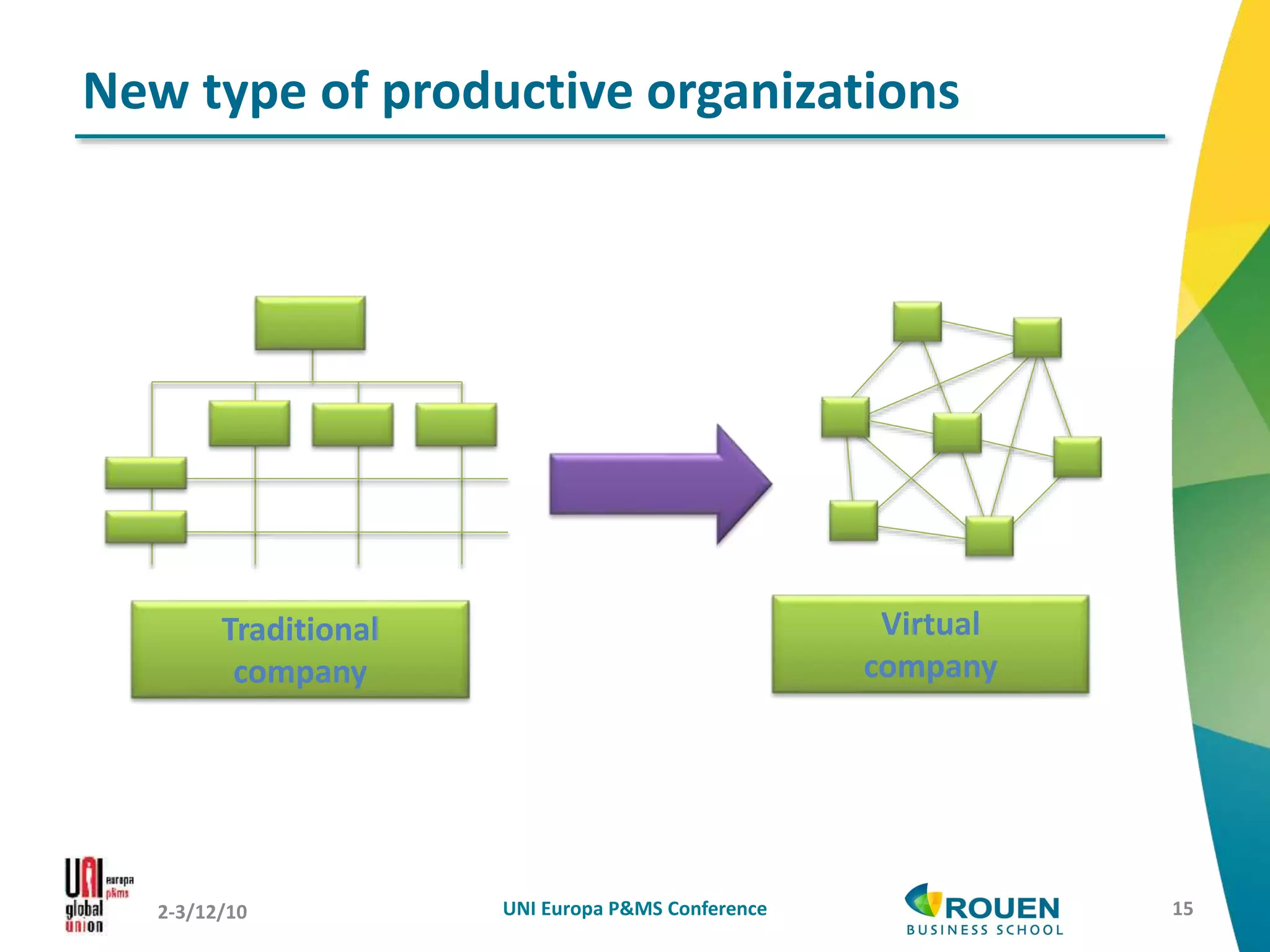
New type of productive organizations
2-3/12/10
Virtual
company
Traditional
company
Université d'été 2009 16
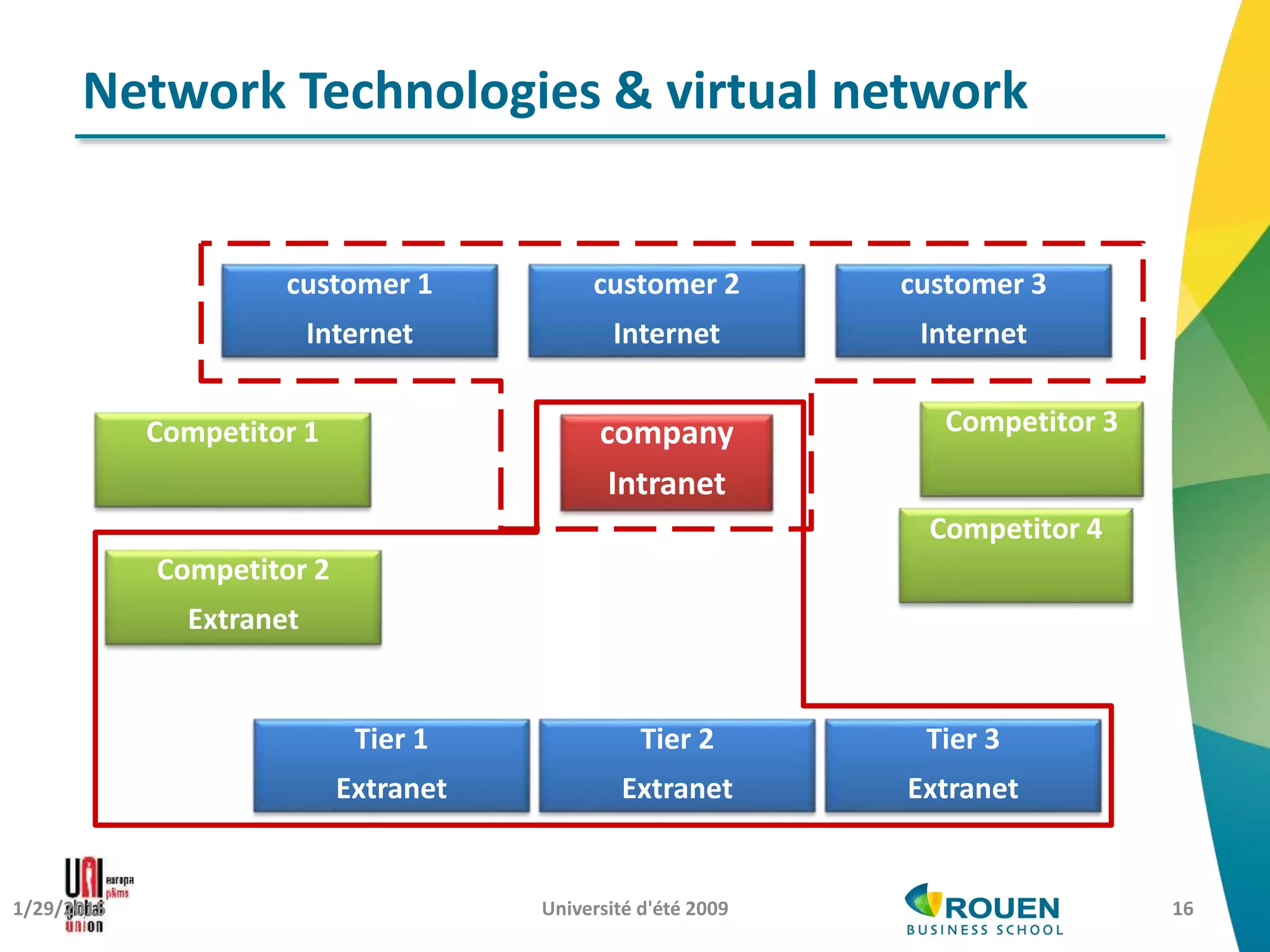
Network Technologies & virtual network
1/29/2015
company
Intranet
Tier 1
Extranet
Tier 2
Extranet
Tier 3
Extranet
customer 3
Internet
Competitor 1
Competitor 2
Extranet
Competitor 3
Competitor 4
customer 2
Internet
customer 1
Internet
Traditional company vs. Virtual company
 Traditional company
– Hierarchy (cf. R. Coase)
– Subordination principle
– Salariat
– Unicity of time
– Unicity of location
– Value creation based upon
internal physical
ressources.
 Virtual company
– Network of contracts
– Access to ressource
through a network
– Electronic networks
– Asynchronous work in a
distributed network
– Value creation based upon
distributed ressources
connected by electronic
networks
2-3/12/10 17UNI Europa P&MS Conference
2-3/12/10 UNI Europa P&MS Conference 18
TOWARDS NEW REGULATIONS
 Rethinking the work question in other ways is key
 Why ?
– Increase in the lifetime (ageing society)
– We should consider different periods over the lifetime
– We should reconsider the frontier between private and
professional life because of the modern individualism
– We should reconsider time as the only measure of work
– We should consider quality of life as a starting point
 It is time to start answering these questions !
UNI Europa P&MS Conference 19
Towards new regulations
Thanks for your attention
his@rouenbs.fr
2-3/12/10 UNI Europa P&MS Conference 20

Out of the Box: How ICT reshapes the work question

  • 1.
    Out of thebox How ICT reshapes the work question Henri ISAAC Associate Dean for Research, Rouen Business School, France
  • 2.
     The invisibleindustrial revolution ?  Temporal effects of ICT  Spatial effects of ICT  Socio-economic consequences of the digital revolution  new type of economic organization  Toward a new work regulation 2-3/12/10 UNI Europa P&MS Conference Agenda 2
  • 3.
     We experiencean on-going industrial revolution: – Digitilisation is a structural trend (money, sound, text, image, video) – A new raw material : information – And now economic value  Source of value: – No longer based upon capital or goods ownership – The age of access (Rifkin, 2000) – Intellectual capital versus physical capital – Positive externalities of electronic networks  Cognitive capitalism 2-3/12/10 UNI Europa P&MS Conference The invisible industrial revolution? 3
  • 4.
    2-3/12/10 UNI EuropaP&MS Conference 4 TEMPORAL EFFECTS OF ICT Anytime, anywhere, always on
  • 5.
    Towards ubiquity Wired networksSynchronisation Wireless networks connectivity Desktop computer laptop Ultra portable PDA Wap phone smartphone Terminal Sedentary Usages mobile Usages Nomadic Usages
  • 6.
     Time compression Time extension  Mixed times  Parallel times UNI Europa P&MS Conference 6 Temporal effects of ICT
  • 7.
     Shrunk Temporalhorizons: – Very visible in the financial decisions (short term management) – Also very visible on the financial markets (high freqency trading, HFT)  But also at the individual level: – Less time for decision making process – Less reflexion because of people’s reachability – Instantaneous culture leading to an urgency culture – Time pressure is a key driver in work overload UNI Europa P&MS Conference 7 Time compression (instantaneity, real time)
  • 8.
     Extension ofwork in many different time zones: – During the day before/after work time – During pause/break time – While commuting – During the week-end – During holidays  Auto-connexion or required connexion?  Which is the more problematic ?  Addiction? Restless world? UNI Europa P&MS Conference 8 Time extension (never ending work)
  • 9.
     Private lifeenter the work time  Work enter the private time  Interweaving of different social times  Historically, Capitalism has separed those two different social activities  Question: – Is the blurring of this frontier a new step in the development of capitalism? – Exploitation of skills and values developed in the private sphere? UNI Europa P&MS Conference 9 Mixed time
  • 10.
     Ubiquity: capacityto be in different time & space zones at the same time  Practices that have grown over the years  Very visible in business meetings  Questions: – Are we able to manage simultaneous tasks? – Are there differences among people (so called Gen Y) ? – Phenomena contributing to work load UNI Europa P&MS Conference 10 Parallel times (simultaneity)
  • 11.
    2-3/12/10 UNI EuropaP&MS Conference 11 SPATIAL EFFECTS OF ICT
  • 12.
     ICT drovethe communication prices to almost zero  Local/global reinvented  But distance doesn’t disappear – In e-commerce : goods support distance no longer the customer – People: Increase number of people traveling  But, increase broadband (FFTH) will develop telepresence tools UNI Europa P&MS Conference 12 It’s a small world
  • 13.
     Working everywhere! – Train, tube, airplane, aiport, stations, cars, etc.  The world is the office !  Historically, we have been creating spaces dedicated to work  Many activities are based on work commuting  Sustainable development ?  Socialization ?  Professional identity ?  What can of society do we want? UNI Europa P&MS Conference 13 Spatial effects
  • 14.
    2-3/12/10 UNI EuropaP&MS Conference 14 NEW TYPE OF PRODUCTIVE ORGANIZATIONS
  • 15.
    UNI Europa P&MSConference 15 New type of productive organizations 2-3/12/10 Virtual company Traditional company
  • 16.
    Université d'été 200916 Network Technologies & virtual network 1/29/2015 company Intranet Tier 1 Extranet Tier 2 Extranet Tier 3 Extranet customer 3 Internet Competitor 1 Competitor 2 Extranet Competitor 3 Competitor 4 customer 2 Internet customer 1 Internet
  • 17.
    Traditional company vs.Virtual company  Traditional company – Hierarchy (cf. R. Coase) – Subordination principle – Salariat – Unicity of time – Unicity of location – Value creation based upon internal physical ressources.  Virtual company – Network of contracts – Access to ressource through a network – Electronic networks – Asynchronous work in a distributed network – Value creation based upon distributed ressources connected by electronic networks 2-3/12/10 17UNI Europa P&MS Conference
  • 18.
    2-3/12/10 UNI EuropaP&MS Conference 18 TOWARDS NEW REGULATIONS
  • 19.
     Rethinking thework question in other ways is key  Why ? – Increase in the lifetime (ageing society) – We should consider different periods over the lifetime – We should reconsider the frontier between private and professional life because of the modern individualism – We should reconsider time as the only measure of work – We should consider quality of life as a starting point  It is time to start answering these questions ! UNI Europa P&MS Conference 19 Towards new regulations
  • 20.
    Thanks for yourattention his@rouenbs.fr 2-3/12/10 UNI Europa P&MS Conference 20