WEB 2.0 The web is certainly making an impact  somewhere near you. Laurent HAUG [email_address] www.liftconference.com
Table of contents Defining web 2.0 What’s happening? You’re in (try to enjoy the ride) Business 2.0 What’s next?
DEFINING WEB 2.0 A billion people, a billion definitions.
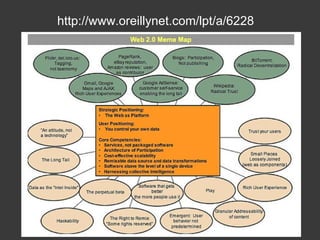
http://www.oreillynet.com/lpt/a/6228
Tim O ’Reilly’s Web 2.0 The Web As Platform Harnessing Collective Intelligence Data is the Next Intel Inside  End of the Software Release Cycle Lightweight Programming Models Software Above the Level of a Single Device Rich User Experiences
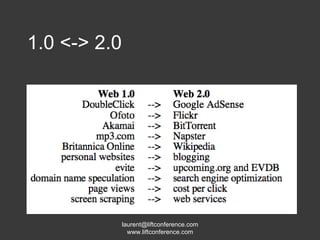
1.0 <-> 2.0
Core Competencies of Web 2.0 Companies Services, not packaged software. Control over unique, hard-to-recreate data sources that get richer as more people use them Trusting users as co-developers Harnessing collective intelligence Leveraging the long tail through customer self-service Lightweight user interfaces, development models, AND business models Source: O’Reilly
A disputed term No real boundaries Multiple interpretations Defining a moving concept Web can’t be versioned Original vision of the web
A disputed term World Economic Forum Annual Meeting 2007 - The Impact of Web 2.0 (check the video on videos.google.com) “ Web 2.0 definitely is a buzzword, and it’s overused. But the movement is only starting. That movement is about leveraging the power of people” CHAD HURLEY “ What we’re seeing is a return to the roots of the web.” CATARINA FAKE Web 2.0 “is enabling a fundamental shift in power that really is giving power to the consumer” MARK PARKER “ It’s a way to collaborate with your customers, to allow them to co-create with you”. PETER SCHWARTZ
WHAT’S HAPPENING (AND WHY?) Why you can’t not care about the internet anymore
New players
ONLINE $
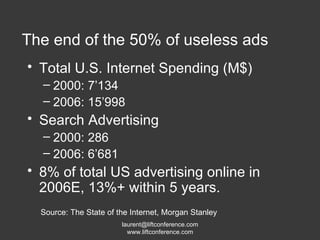
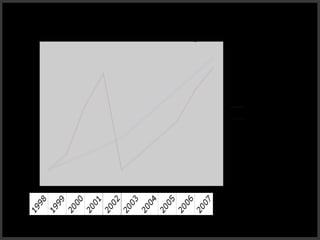
The end of the 50% of useless ads Total U.S. Internet Spending (M$) 2000: 7’134 2006: 15’998 Search Advertising  2000: 286 2006: 6’681 8% of total US advertising online in 2006E, 13%+ within 5 years. Source: The State of the Internet, Morgan Stanley
NEW TOOLS AND INFRASTRUCTURE
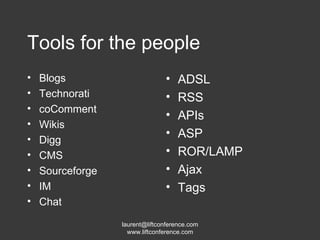
Tools for the people Blogs Technorati coComment Wikis Digg CMS Sourceforge IM Chat ADSL RSS APIs ASP ROR/LAMP Ajax Tags
CONNECTED PEOPLE
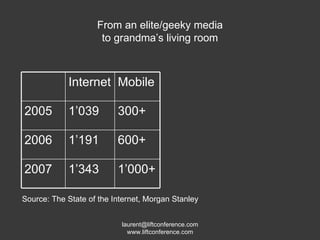
From an elite/geeky media to grandma’s living room Source: The State of the Internet, Morgan Stanley Mobile Internet 1’000+ 1’343 2007 600+ 1’191 2006 300+ 1’039 2005
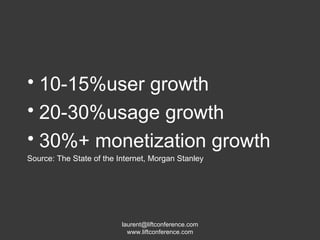
10-15%user growth 20-30%usage growth 30%+ monetization growth Source: The State of the Internet, Morgan Stanley
 
GETTING TO MARKET IS EASY
Idea = business Cheap hardware Cheap platforms (Linux, Apache) Open source = you never start from scratch Coders everywhere Money, reputation, location, network don’t matter as much as before.
Startuping is cheap DropSend: Build $48,012 / Monthly $3,625 Freshbooks Build $20,000 / Monthly $46,000 Maya’s Mom: Build $70,000 / Monthly $30,000  Mobissimo: Build $60,000 / Monthly $150,000 Wesabe: Build $200,000 / Monthly: $3,000 http://thebankwatch.com/2007/03/15/how-much-does-it-cost-to-build-the-best-web-apps-today-and-how-should-banks-react/
 
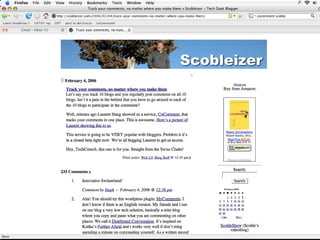
scoble
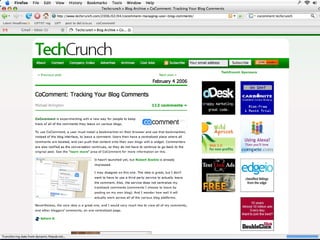
Techcrunch
 
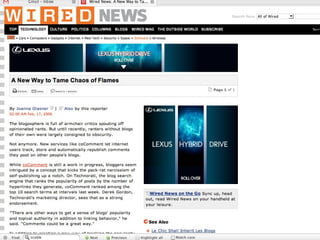
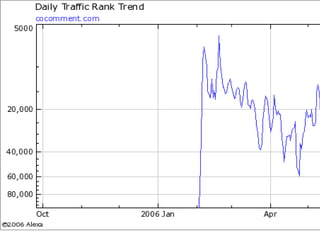
[email_address] www.liftconference.com technorati technorati.com/search/cocomment
 
BUZZWORD?
A new reality Customer as the new center of gravity Global competition, open world New markets (china, russia, senior citizens, long tail) and  spaces (online worlds, TVoip, voip, advertising, work collaboration) New audiences Impact on all aspects of business
New rules New balance of power  New workforce  New tools New competition New business models New lifestyle New environment
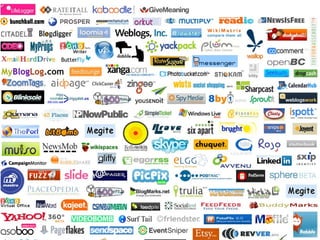
New players GYM Amazon Ebay Wikipedia Feedburner Flickr, blogger, Skype, technorati, techcrunch, mybloglog, cocomment, weblogs inc, numsum, writely, etc etc…
New opportunities New possibilities New audiences New markets New worlds
New challenges Share control Competition everywhere Ideas everywhere Privacy / transparency Sustainability of business models Bubble? etc…
New concepts and ideas Markets are conversations Customer is king Folksonomies Wisdom of the crowds Crowdsourcing Network effect Open is sustainable Co-creation Social Network Perpetual beta Open source Mashups Long tail The world is flat
Markets are conversations Micro publication Blogs, podcasting, vlogs Decentralization of information gathering Barrier to entry is talent Audiences are up for grab Somebody out there is talking about you Nobody can control the online conversation “ The cluetrain manifesto”, Doc Searls, David Weinberger, etc… “ Naked conversations”, Robert Scoble and Shel Israel.
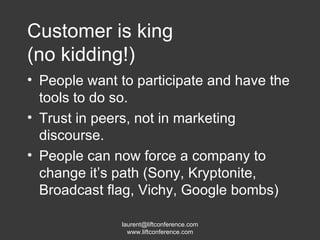
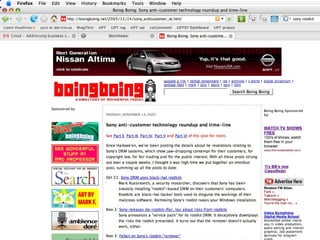
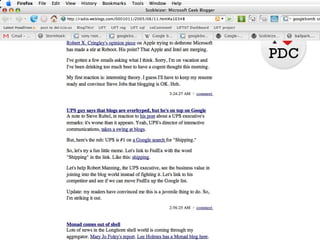
Customer is king (no kidding!) People want to participate and have the tools to do so. Trust in peers, not in marketing discourse. People can now force a company to change it’s path (Sony, Kryptonite, Broadcast flag, Vichy, Google bombs)
 
Google bombs
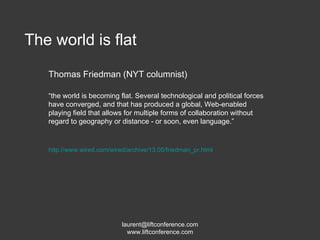
The world is flat Thomas Friedman (NYT columnist) “ the world is becoming flat. Several technological and political forces have converged, and that has produced a global, Web-enabled playing field that allows for multiple forms of collaboration without regard to geography or distance - or soon, even language.” http://www.wired.com/wired/archive/13.05/friedman_pr.html
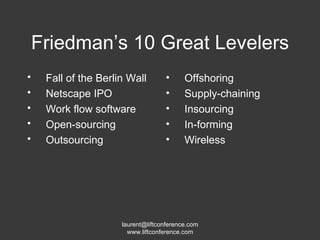
Friedman’s 10 Great Levelers Fall of the Berlin Wall Netscape IPO Work flow software Open-sourcing Outsourcing Offshoring Supply-chaining Insourcing In-forming Wireless
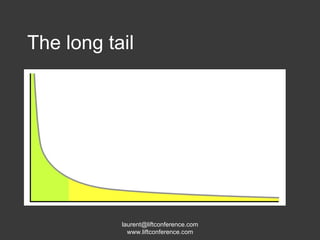
The long tail
ONE THING TO REMEMBER
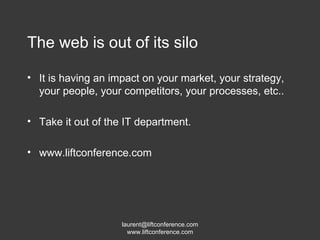
The web is out of its silo It is having an impact on your market, your strategy, your people, your competitors, your processes, etc.. Take it out of the IT department. www.liftconference.com
YOU’RE IN You are already making the new web better.
Passive contributions Every time you search, you make Google better Amazon Gmail Analytics
Active contributions Blogging Commenting  Tagging Digging Wikiing
People are talking about you Technorati coComment Video/audio search Flickr
BUSINESS 2.0 Buckle up
A few examples User generated content  Communities Co-creation Outsourcing Global microbrand 3D
Youtube User generated content Targeted ads See also: vPod, DailyMotion, mySpace
MTV Following changes in audience habits Moving from TV to community Complete change in business model Complete change in competitive landscape See also: Le Monde, Guardian, BBC BREAKING NEWS: Read the latest State of the Media 2007 report! http://www.stateofthemedia.org/2007/
Lego Co-creation with customer Lego mindstorm And also: Lafraise, Microsoft, Google.
L’oréal Outsourcing of critical (and fun) tasks to customers Focus on practical side current_TV ( tinyurl.com/25kr3v ) See also: IBM brainstorm, Apple, Wikipedia.
Stormhoek Global microbrands, leveraging the long tail And also: Moo.com, 37signals, English Cut, Thingamy, TVBgone, Cafepress, Stardoll “ most of our members are girls and boys between the ages of 7 and 17. Stardoll is one of few places on the Internet developed with an emphasis on girls’ self-expression and fantasy fashion play”
World of warcraft Persistent 3D world Parallel economy See also: Second Life, Playstation home, Xbox live
WEB 2.0 BUSINESS MODELS
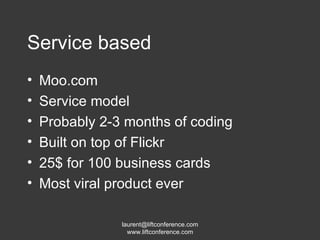
Service based Moo.com Service model Probably 2-3 months of coding Built on top of Flickr 25$ for 100 business cards Most viral product ever
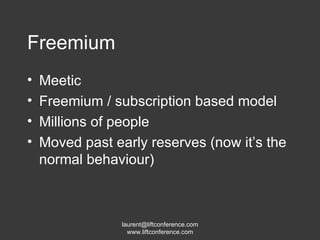
Meetic Freemium / subscription based model Millions of people Moved past early reserves (now it’s the normal behaviour) Freemium
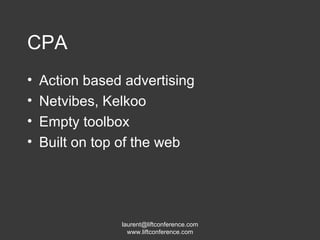
Action based advertising Netvibes, Kelkoo Empty toolbox Built on top of the web CPA
CPM Mass (but targeted) display advertising Joost, feedburner Precise knowledge of audience location and behavior
Revenue sharing Make money on users’ content Revver
Flickr camera info Data mining Creating value from data without violating privacy Datamining
BEYOND WEB2.0
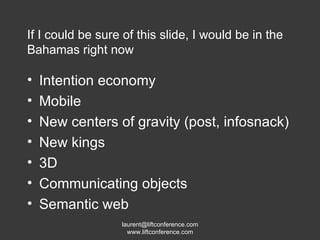
If I could be sure of this slide, I would be in the Bahamas right now Intention economy Mobile New centers of gravity (post, infosnack) New kings  3D Communicating objects Semantic web

Web 2.0

  • 1.
    WEB 2.0 Theweb is certainly making an impact somewhere near you. Laurent HAUG [email_address] www.liftconference.com
  • 2.
    Table of contentsDefining web 2.0 What’s happening? You’re in (try to enjoy the ride) Business 2.0 What’s next?
  • 3.
    DEFINING WEB 2.0A billion people, a billion definitions.
  • 4.
  • 5.
    Tim O ’Reilly’sWeb 2.0 The Web As Platform Harnessing Collective Intelligence Data is the Next Intel Inside End of the Software Release Cycle Lightweight Programming Models Software Above the Level of a Single Device Rich User Experiences
  • 6.
  • 7.
    Core Competencies ofWeb 2.0 Companies Services, not packaged software. Control over unique, hard-to-recreate data sources that get richer as more people use them Trusting users as co-developers Harnessing collective intelligence Leveraging the long tail through customer self-service Lightweight user interfaces, development models, AND business models Source: O’Reilly
  • 8.
    A disputed termNo real boundaries Multiple interpretations Defining a moving concept Web can’t be versioned Original vision of the web
  • 9.
    A disputed termWorld Economic Forum Annual Meeting 2007 - The Impact of Web 2.0 (check the video on videos.google.com) “ Web 2.0 definitely is a buzzword, and it’s overused. But the movement is only starting. That movement is about leveraging the power of people” CHAD HURLEY “ What we’re seeing is a return to the roots of the web.” CATARINA FAKE Web 2.0 “is enabling a fundamental shift in power that really is giving power to the consumer” MARK PARKER “ It’s a way to collaborate with your customers, to allow them to co-create with you”. PETER SCHWARTZ
  • 10.
    WHAT’S HAPPENING (ANDWHY?) Why you can’t not care about the internet anymore
  • 11.
  • 12.
  • 13.
    The end ofthe 50% of useless ads Total U.S. Internet Spending (M$) 2000: 7’134 2006: 15’998 Search Advertising 2000: 286 2006: 6’681 8% of total US advertising online in 2006E, 13%+ within 5 years. Source: The State of the Internet, Morgan Stanley
  • 14.
    NEW TOOLS ANDINFRASTRUCTURE
  • 15.
    Tools for thepeople Blogs Technorati coComment Wikis Digg CMS Sourceforge IM Chat ADSL RSS APIs ASP ROR/LAMP Ajax Tags
  • 16.
  • 17.
    From an elite/geekymedia to grandma’s living room Source: The State of the Internet, Morgan Stanley Mobile Internet 1’000+ 1’343 2007 600+ 1’191 2006 300+ 1’039 2005
  • 18.
    10-15%user growth 20-30%usagegrowth 30%+ monetization growth Source: The State of the Internet, Morgan Stanley
  • 19.
  • 20.
  • 21.
    Idea = businessCheap hardware Cheap platforms (Linux, Apache) Open source = you never start from scratch Coders everywhere Money, reputation, location, network don’t matter as much as before.
  • 22.
    Startuping is cheapDropSend: Build $48,012 / Monthly $3,625 Freshbooks Build $20,000 / Monthly $46,000 Maya’s Mom: Build $70,000 / Monthly $30,000 Mobissimo: Build $60,000 / Monthly $150,000 Wesabe: Build $200,000 / Monthly: $3,000 http://thebankwatch.com/2007/03/15/how-much-does-it-cost-to-build-the-best-web-apps-today-and-how-should-banks-react/
  • 23.
  • 24.
  • 25.
  • 26.
  • 27.
  • 28.
  • 29.
  • 30.
    A new realityCustomer as the new center of gravity Global competition, open world New markets (china, russia, senior citizens, long tail) and spaces (online worlds, TVoip, voip, advertising, work collaboration) New audiences Impact on all aspects of business
  • 31.
    New rules Newbalance of power New workforce New tools New competition New business models New lifestyle New environment
  • 32.
    New players GYMAmazon Ebay Wikipedia Feedburner Flickr, blogger, Skype, technorati, techcrunch, mybloglog, cocomment, weblogs inc, numsum, writely, etc etc…
  • 33.
    New opportunities Newpossibilities New audiences New markets New worlds
  • 34.
    New challenges Sharecontrol Competition everywhere Ideas everywhere Privacy / transparency Sustainability of business models Bubble? etc…
  • 35.
    New concepts andideas Markets are conversations Customer is king Folksonomies Wisdom of the crowds Crowdsourcing Network effect Open is sustainable Co-creation Social Network Perpetual beta Open source Mashups Long tail The world is flat
  • 36.
    Markets are conversationsMicro publication Blogs, podcasting, vlogs Decentralization of information gathering Barrier to entry is talent Audiences are up for grab Somebody out there is talking about you Nobody can control the online conversation “ The cluetrain manifesto”, Doc Searls, David Weinberger, etc… “ Naked conversations”, Robert Scoble and Shel Israel.
  • 37.
    Customer is king(no kidding!) People want to participate and have the tools to do so. Trust in peers, not in marketing discourse. People can now force a company to change it’s path (Sony, Kryptonite, Broadcast flag, Vichy, Google bombs)
  • 38.
  • 39.
  • 40.
    The world isflat Thomas Friedman (NYT columnist) “ the world is becoming flat. Several technological and political forces have converged, and that has produced a global, Web-enabled playing field that allows for multiple forms of collaboration without regard to geography or distance - or soon, even language.” http://www.wired.com/wired/archive/13.05/friedman_pr.html
  • 41.
    Friedman’s 10 GreatLevelers Fall of the Berlin Wall Netscape IPO Work flow software Open-sourcing Outsourcing Offshoring Supply-chaining Insourcing In-forming Wireless
  • 42.
  • 43.
    ONE THING TOREMEMBER
  • 44.
    The web isout of its silo It is having an impact on your market, your strategy, your people, your competitors, your processes, etc.. Take it out of the IT department. www.liftconference.com
  • 45.
    YOU’RE IN Youare already making the new web better.
  • 46.
    Passive contributions Everytime you search, you make Google better Amazon Gmail Analytics
  • 47.
    Active contributions BloggingCommenting Tagging Digging Wikiing
  • 48.
    People are talkingabout you Technorati coComment Video/audio search Flickr
  • 49.
  • 50.
    A few examplesUser generated content Communities Co-creation Outsourcing Global microbrand 3D
  • 51.
    Youtube User generatedcontent Targeted ads See also: vPod, DailyMotion, mySpace
  • 52.
    MTV Following changesin audience habits Moving from TV to community Complete change in business model Complete change in competitive landscape See also: Le Monde, Guardian, BBC BREAKING NEWS: Read the latest State of the Media 2007 report! http://www.stateofthemedia.org/2007/
  • 53.
    Lego Co-creation withcustomer Lego mindstorm And also: Lafraise, Microsoft, Google.
  • 54.
    L’oréal Outsourcing ofcritical (and fun) tasks to customers Focus on practical side current_TV ( tinyurl.com/25kr3v ) See also: IBM brainstorm, Apple, Wikipedia.
  • 55.
    Stormhoek Global microbrands,leveraging the long tail And also: Moo.com, 37signals, English Cut, Thingamy, TVBgone, Cafepress, Stardoll “ most of our members are girls and boys between the ages of 7 and 17. Stardoll is one of few places on the Internet developed with an emphasis on girls’ self-expression and fantasy fashion play”
  • 56.
    World of warcraftPersistent 3D world Parallel economy See also: Second Life, Playstation home, Xbox live
  • 57.
  • 58.
    Service based Moo.comService model Probably 2-3 months of coding Built on top of Flickr 25$ for 100 business cards Most viral product ever
  • 59.
    Meetic Freemium /subscription based model Millions of people Moved past early reserves (now it’s the normal behaviour) Freemium
  • 60.
    Action based advertisingNetvibes, Kelkoo Empty toolbox Built on top of the web CPA
  • 61.
    CPM Mass (buttargeted) display advertising Joost, feedburner Precise knowledge of audience location and behavior
  • 62.
    Revenue sharing Makemoney on users’ content Revver
  • 63.
    Flickr camera infoData mining Creating value from data without violating privacy Datamining
  • 64.
  • 65.
    If I couldbe sure of this slide, I would be in the Bahamas right now Intention economy Mobile New centers of gravity (post, infosnack) New kings 3D Communicating objects Semantic web