Web 2.0   blog, wiki, tag, social network: what are they, how to use them and why they are important
This material is distributed under the Creative Commons "Attribution - NonCommercial - Share Alike - 3.0", available at  http://creativecommons.org/licenses/by-nc-sa/3.0/  . Part of the slides is the result of a welcome distance collaboration with prof. Roberto Polillo, University Milan Bicocca ( http://www.rpolillo.it )
Program * Introduction, course program and start course tools * New Web  trends * The "old" Web and Web 2.0 * Web 2.0 in general * What is a blog * Microblogging - Twitter * What is a wiki * Wikipedia in theory and in practice * Technical Web 2.0 Specifications (Ajax, RSS, ...) * Tagging and social networks (Flickr, facebook, ...) in theory and in practice * The Google World: the algorithm, docs.google, Android, ... * Web 2.0 and Social characteristics : users number and characteristics * Social bookmarking and mash-up in theory and in practice Some theory: * Metcalfe's Law, Reed and Pareto, power curves, long tail, network theory, ...
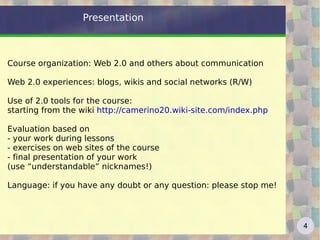
Presentation Course organization: Web 2.0 and others about communication Web 2.0 experiences: blogs, wikis and social networks (R/W) Use of 2.0 tools for the course:  starting from the wiki  http://camerino20.wiki-site.com/index.php   Evaluation based on  - your work during lessons  - exercises on web sites of the course - final presentation of your work (use “understandable”  nicknames!) Language: if you have any doubt or any question: please stop me!
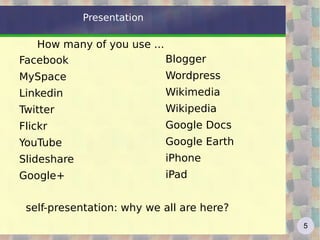
Presentation Facebook
MySpace
Linkedin
Twitter
Flickr
YouTube
Slideshare
Google+ Blogger
Wordpress
Wikimedia

Web2.0 2012 - lesson 1

  • 1.
    Web 2.0 blog, wiki, tag, social network: what are they, how to use them and why they are important
  • 2.
    This material isdistributed under the Creative Commons "Attribution - NonCommercial - Share Alike - 3.0", available at http://creativecommons.org/licenses/by-nc-sa/3.0/ . Part of the slides is the result of a welcome distance collaboration with prof. Roberto Polillo, University Milan Bicocca ( http://www.rpolillo.it )
  • 3.
    Program * Introduction,course program and start course tools * New Web trends * The "old" Web and Web 2.0 * Web 2.0 in general * What is a blog * Microblogging - Twitter * What is a wiki * Wikipedia in theory and in practice * Technical Web 2.0 Specifications (Ajax, RSS, ...) * Tagging and social networks (Flickr, facebook, ...) in theory and in practice * The Google World: the algorithm, docs.google, Android, ... * Web 2.0 and Social characteristics : users number and characteristics * Social bookmarking and mash-up in theory and in practice Some theory: * Metcalfe's Law, Reed and Pareto, power curves, long tail, network theory, ...
  • 4.
    Presentation Course organization:Web 2.0 and others about communication Web 2.0 experiences: blogs, wikis and social networks (R/W) Use of 2.0 tools for the course: starting from the wiki http://camerino20.wiki-site.com/index.php Evaluation based on - your work during lessons - exercises on web sites of the course - final presentation of your work (use “understandable” nicknames!) Language: if you have any doubt or any question: please stop me!
  • 5.
  • 6.
  • 7.
  • 8.
  • 9.
  • 10.
  • 11.
  • 12.
  • 13.
  • 14.
  • 15.
  • 16.
  • 17.
  • 18.
  • 19.
    iPad How manyof you use ... self-presentation: why we all are here?
  • 20.
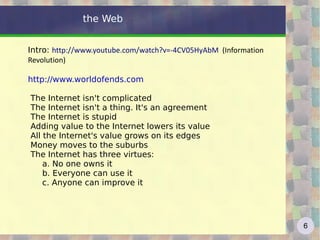
    the Web Intro: http://www.youtube.com/watch?v=-4CV05HyAbM (Information Revolution) http://www.worldofends.com The Internet isn't complicated
  • 21.
    The Internet isn'ta thing. It's an agreement
  • 22.
  • 23.
    Adding value tothe Internet lowers its value
  • 24.
    All the Internet'svalue grows on its edges
  • 25.
    Money moves tothe suburbs
  • 26.
    The Internet hasthree virtues: a. No one owns it b. Everyone can use it c. Anyone can improve it
  • 27.
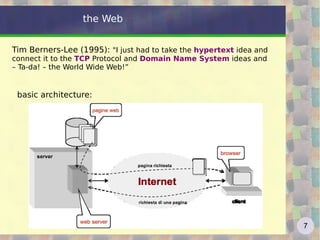
    the Web TimBerners-Lee (1995): "I just had to take the hypertext idea and connect it to the TCP Protocol and Domain Name System ideas and – Ta-da! – the World Wide Web!” basic architecture:
  • 28.
    the Web todayhttp://www.internetworldstats.com/stats.htm http://www.hitwise.com/us/resources/data-center Net Neutrality: - "dumb, minimal network" with smart terminals, vs. the previous paradigm of the smart network with dumb terminals - no data discrimination (all bits are equal) - access freedom http://en.wikipedia.org/wiki/Network_neutrality http://www.savetheinternet.com/
  • 29.
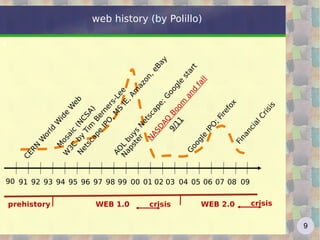
    web history (byPolillo) CERN World Wide Web Mosaic (NCSA) W3C by Tim Berners-Lee Netscape IPO, MS IE, Amazon, eBay NASDAQ Boom and fall Google IPO; Firefox WEB 1.0 WEB 2.0 crisis prehistory AOL buys Netscape; Google start 9/11 Napster Financial Crisis crisis 91 92 93 94 95 96 97 98 99 00 01 02 03 04 05 06 07 08 09 90
  • 30.
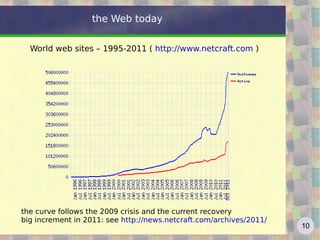
    the Web todayWorld web sites – 1995-2011 ( http://www.netcraft.com ) the curve follows the 2009 crisis and the current recovery
  • 31.
    big increment in2011: see http://news.netcraft.com/archives/2011/
  • 32.
    the Web todayKeyTrends from http://www.readwriteweb.com/ : Location (eg http://www.google.com/support/websearch/bin/answer.py?answer=179386
  • 33.
    App Stores: http://www.apple.com/mac/app-store/ ma anche https://market.android.com/?hl=en e http://www.amazon.com/mobile-apps/b?ie=UTF8&node=2350149011
  • 34.
    Internet of things: http://blogs.cisco.com/news/the-internet-of-things-infographic/
  • 35.
  • 36.
    Structured Data: Open(LInked) Data - final lesson
  • 37.
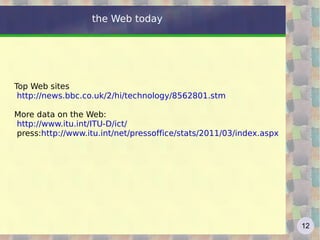
    the Web todayTop Web sites http://news.bbc.co.uk/2/hi/technology/8562801.stm More data on the Web: http://www.itu.int/ITU-D/ict/
  • 38.
  • 39.
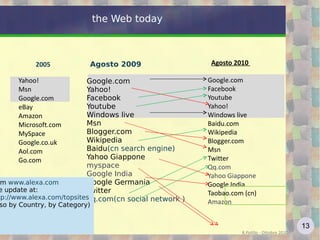
    the Web todayAgosto 2009 Google.com
  • 40.
  • 41.
  • 42.
  • 43.
  • 44.
  • 45.
  • 46.
  • 47.
  • 48.
  • 49.
  • 50.
  • 51.
  • 52.
  • 53.
    qq.com 
(cn socialnetwork ) R.Polillo - Ottobre 2010 from www.alexa.com see update at: http://www.alexa.com/topsites (also by Country, by Category) Agosto 2010 Google.com
  • 54.
  • 55.
  • 56.
  • 57.
  • 58.
  • 59.
  • 60.
  • 61.
  • 62.
  • 63.
  • 64.
  • 65.
  • 66.
  • 67.
  • 68.
  • 69.
  • 70.
  • 71.
  • 72.
  • 73.
  • 74.
  • 75.
  • 76.
  • 77.
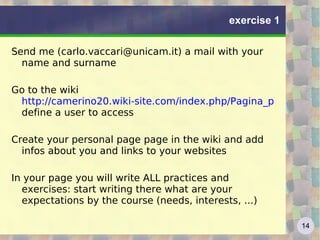
    exercise 1 Sendme (carlo.vaccari@unicam.it) a mail with your name and surname
  • 78.
    Go to thewiki http://camerino20.wiki-site.com/index.php/Pagina_principale define a user to access
  • 79.
    Create your personalpage page in the wiki and add infos about you and links to your websites
  • 80.
    In your pageyou will write ALL practices and exercises: start writing there what are your expectations by the course (needs, interests, ...)