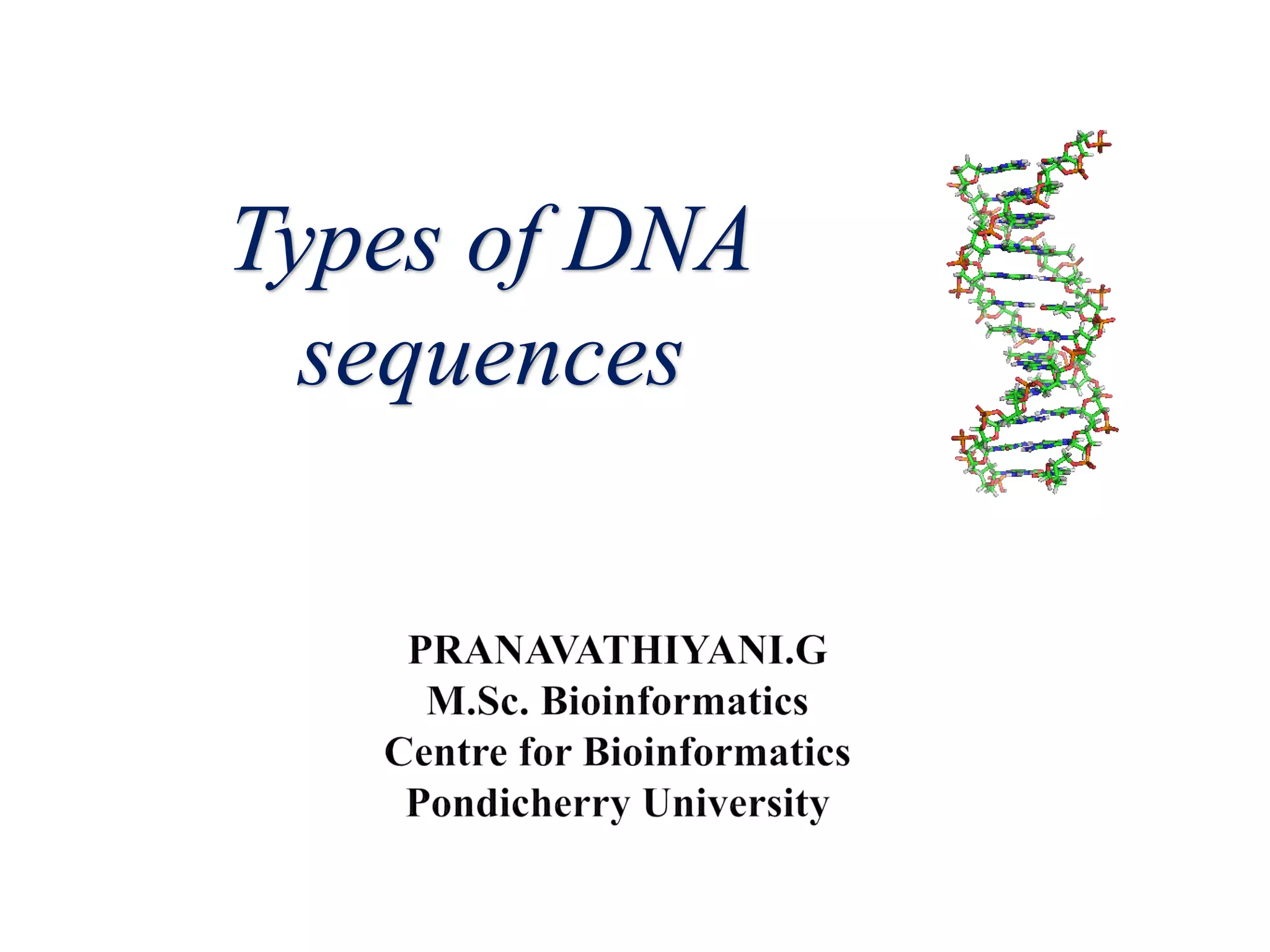
Types of DNA
sequences
INTRODUCTION
• Complex organisms- Cell- Protein.
Proteins specified for a particular
function is controlled by a set of
molecules called nucleic acids.
• Nucleic acids are very large
molecules made up of a sugar-
backbone, phosphate molecule and
nucleotide base.
• The genetic information of every
living organism is stored inside these
nucleic acid molecules
An illustration showing an example of the structure and organization of DNA in the nucleus of a
human cell. (Image couresty of the National Institute on Aging/National Institutes of Health.)
There are two types of nucleic acids namely:
•DNA- Deoxyribonucleic acid
•RNA - Ribonucleic acid
http://www.classhelp.info/Biology/AUnit6Heredity.htm
TYPES
→ In most living organisms (except for viruses), genetic information is stored in the form
of DNA.
→ DNA is present in the nucleus of every cell.
→ The nucleotide bases present in the DNA are adenine (A), cytosine (C), guanine (G),
and thymine (T).
→ The original structure of the DNA molecule is a double helix. DNA is a double
stranded structure.
Types of DNA
There are two major types of DNA: Genomic DNA and Mitochondrial DNA
Genomic DNA / Nuclear DNA:
• This comprises the genome of an organism. This genomic DNA is spread across 46
chromosomes leading to an expression of genetic traits.
• The genomic DNA controls expression of the various traits in an organism. The
genomic DNA was sequenced as part of the Human Genome Project to study the
various functions of the different regions of the genome.
• Usually, during DNA replication there is a recombination of genes bringing about a
change in sequence leading to individual specific characteristics.
• This way the difference in sequence could be studied from individual to individual.
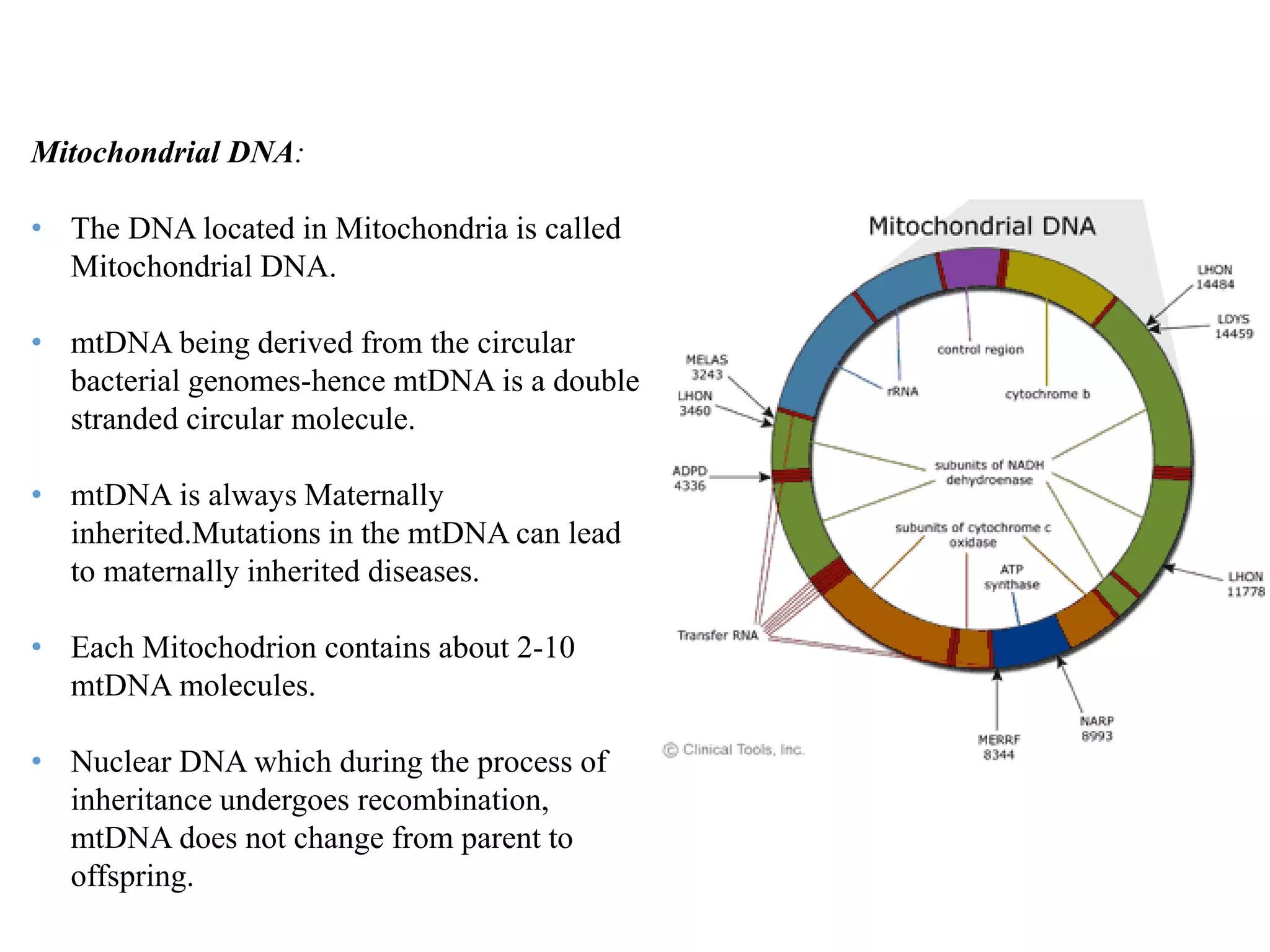
Mitochondrial DNA:
• The DNA located in Mitochondria is called
Mitochondrial DNA.
• mtDNA being derived from the circular
bacterial genomes-hence mtDNA is a double
stranded circular molecule.
• mtDNA is always Maternally
inherited.Mutations in the mtDNA can lead
to maternally inherited diseases.
• Each Mitochodrion contains about 2-10
mtDNA molecules.
• Nuclear DNA which during the process of
inheritance undergoes recombination,
mtDNA does not change from parent to
offspring.
cDNA
 cDNA is a DNA copy synthesized from
mRNA.
 The enzyme used is reverse transcriptase
an RNA-dependent DNA polymerase
isolated from a retrovirus
 Complementary DNA is often used in
gene cloning or as gene probes or in the
creation of a cDNA library
STS
Sequence-Tagged Site (STS):
 A short (200 to 500 base pair) DNA sequence that occurs but once in the genome and
whose location and base sequence are known.
 STSs are detectable by polymerase chain reaction (PCR), are useful for localizing and
orienting the mapping and sequence data, and serve as landmarks on the physical map of
a genome.
 The DNA sequence of an STS may contain repetitive elements, sequences that appear
elsewhere in the genome, but as long as the sequences at both ends of the site are unique
and conserved, researches can uniquely identify this portion of genome using tools
usually present in any laboratory.
ESTs
 Expressed sequence tags (ESTs) are fragments
of mRNA sequences derived through single
sequencing reactions performed on randomly
selected clones from cDNA libraries.
 300-700bp
 Fast & Cheap
 Sequences of multiple ESTs can reconstitute a
full-length cDNA
 SNP data mining
 To date, over 45 million ESTs have been
generated from over 1400 different species of
eukaryotes
 Expressed sequence tags (ESTs) are STSs
derived from cDNAs (complementary DNAs).
http://www.maizegdb.org/documentation/mgdp/education/finding.php
GSS
Genome Survey Sequences (GSS):
 GSS are nucleotide sequences similar to EST's that the only difference is that most
of them are genomic in origin, rather than cDNA (mRNA, RNA transcript).
 Current genome sequencing approaches are mostly high-throughput shotgun
methods, and GSS is often used on the first step of sequencing.
 It has coding and non-coding DNA and contain repetitive section of the genome
unlike ESTs
 http://www.tutorvista.com/biology/types-of-dna-and-rna
 http://dwb4.unl.edu/Chem/CHEM869N/CHEM869NLinks/www.dur.ac.uk/~dbl0w
ww/Staff/Croy/cDNAfigs.htm
 http://en.wikipedia.org/wiki/Complementary_DNA
 http://www.ncbi.nlm.nih.gov/pubmed/19277571
 http://www.ch.embnet.org/CoursEMBnet/Zurich04/slides/EST.pdf
 http://www.medicinenet.com/script/main/art.asp?articlekey=5464
THANK

Types of DNA sequences

  • 1.
  • 2.
    INTRODUCTION • Complex organisms-Cell- Protein. Proteins specified for a particular function is controlled by a set of molecules called nucleic acids. • Nucleic acids are very large molecules made up of a sugar- backbone, phosphate molecule and nucleotide base. • The genetic information of every living organism is stored inside these nucleic acid molecules An illustration showing an example of the structure and organization of DNA in the nucleus of a human cell. (Image couresty of the National Institute on Aging/National Institutes of Health.)
  • 3.
    There are twotypes of nucleic acids namely: •DNA- Deoxyribonucleic acid •RNA - Ribonucleic acid http://www.classhelp.info/Biology/AUnit6Heredity.htm TYPES
  • 4.
    → In mostliving organisms (except for viruses), genetic information is stored in the form of DNA. → DNA is present in the nucleus of every cell. → The nucleotide bases present in the DNA are adenine (A), cytosine (C), guanine (G), and thymine (T). → The original structure of the DNA molecule is a double helix. DNA is a double stranded structure.
  • 5.
    Types of DNA Thereare two major types of DNA: Genomic DNA and Mitochondrial DNA Genomic DNA / Nuclear DNA: • This comprises the genome of an organism. This genomic DNA is spread across 46 chromosomes leading to an expression of genetic traits. • The genomic DNA controls expression of the various traits in an organism. The genomic DNA was sequenced as part of the Human Genome Project to study the various functions of the different regions of the genome. • Usually, during DNA replication there is a recombination of genes bringing about a change in sequence leading to individual specific characteristics. • This way the difference in sequence could be studied from individual to individual.
  • 6.
    Mitochondrial DNA: • TheDNA located in Mitochondria is called Mitochondrial DNA. • mtDNA being derived from the circular bacterial genomes-hence mtDNA is a double stranded circular molecule. • mtDNA is always Maternally inherited.Mutations in the mtDNA can lead to maternally inherited diseases. • Each Mitochodrion contains about 2-10 mtDNA molecules. • Nuclear DNA which during the process of inheritance undergoes recombination, mtDNA does not change from parent to offspring.
  • 8.
    cDNA  cDNA isa DNA copy synthesized from mRNA.  The enzyme used is reverse transcriptase an RNA-dependent DNA polymerase isolated from a retrovirus  Complementary DNA is often used in gene cloning or as gene probes or in the creation of a cDNA library
  • 9.
    STS Sequence-Tagged Site (STS): A short (200 to 500 base pair) DNA sequence that occurs but once in the genome and whose location and base sequence are known.  STSs are detectable by polymerase chain reaction (PCR), are useful for localizing and orienting the mapping and sequence data, and serve as landmarks on the physical map of a genome.  The DNA sequence of an STS may contain repetitive elements, sequences that appear elsewhere in the genome, but as long as the sequences at both ends of the site are unique and conserved, researches can uniquely identify this portion of genome using tools usually present in any laboratory.
  • 10.
    ESTs  Expressed sequencetags (ESTs) are fragments of mRNA sequences derived through single sequencing reactions performed on randomly selected clones from cDNA libraries.  300-700bp  Fast & Cheap  Sequences of multiple ESTs can reconstitute a full-length cDNA  SNP data mining  To date, over 45 million ESTs have been generated from over 1400 different species of eukaryotes  Expressed sequence tags (ESTs) are STSs derived from cDNAs (complementary DNAs). http://www.maizegdb.org/documentation/mgdp/education/finding.php
  • 11.
    GSS Genome Survey Sequences(GSS):  GSS are nucleotide sequences similar to EST's that the only difference is that most of them are genomic in origin, rather than cDNA (mRNA, RNA transcript).  Current genome sequencing approaches are mostly high-throughput shotgun methods, and GSS is often used on the first step of sequencing.  It has coding and non-coding DNA and contain repetitive section of the genome unlike ESTs
  • 12.
     http://www.tutorvista.com/biology/types-of-dna-and-rna  http://dwb4.unl.edu/Chem/CHEM869N/CHEM869NLinks/www.dur.ac.uk/~dbl0w ww/Staff/Croy/cDNAfigs.htm http://en.wikipedia.org/wiki/Complementary_DNA  http://www.ncbi.nlm.nih.gov/pubmed/19277571  http://www.ch.embnet.org/CoursEMBnet/Zurich04/slides/EST.pdf  http://www.medicinenet.com/script/main/art.asp?articlekey=5464
  • 13.