IB Chemistry Power Points

                            Topic 18
                         Acids and Bases
www.pedagogics.ca


     Buffer
  Solutions
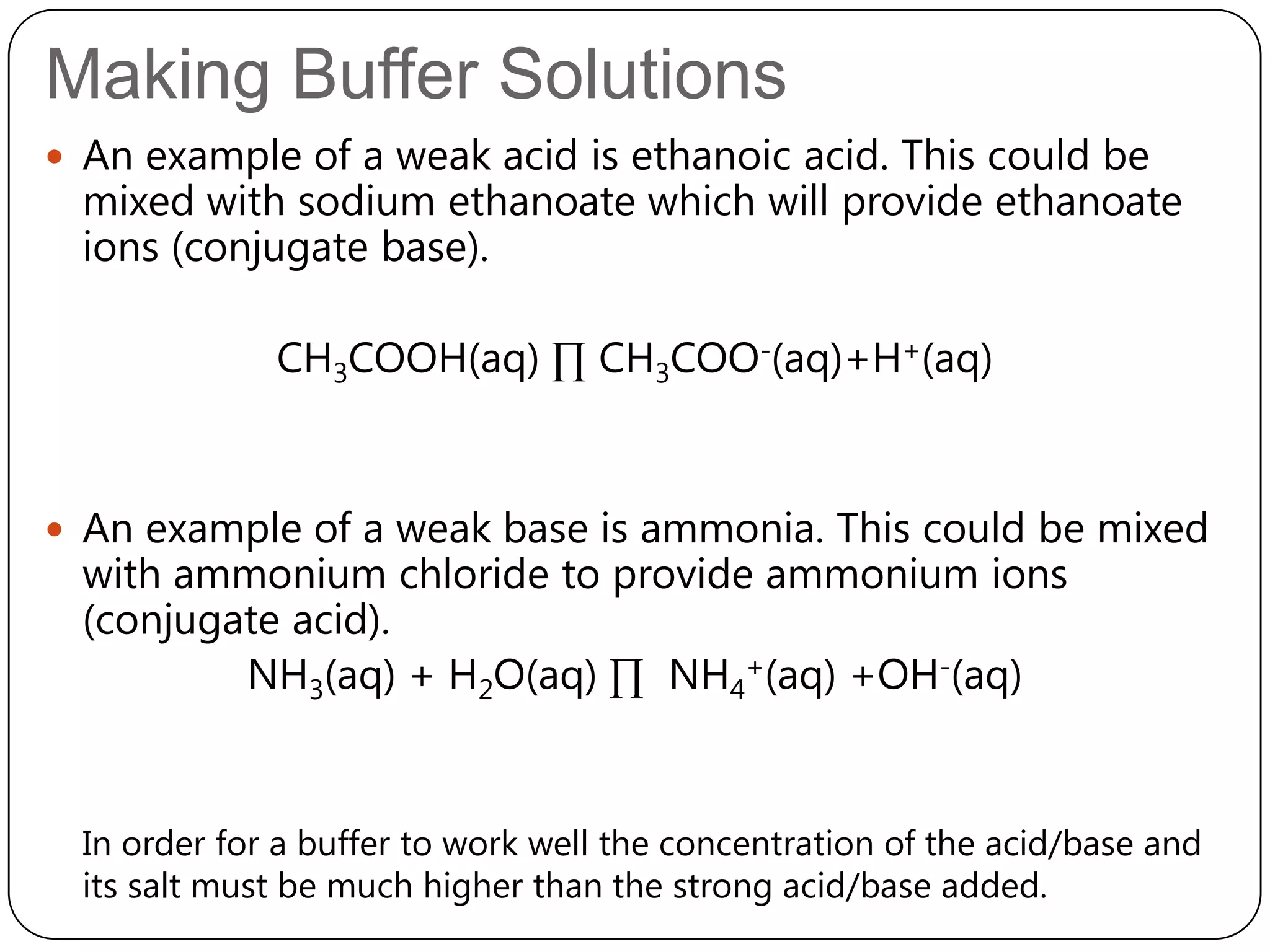
Buffer Solutions
 DEFINITION: A buffer solution contains a weak acid mixed
  with its conjugate base (or weak base and conjugate acid)
 Buffers resist changes in pH when a small amount of a
  strong acid or base is added to it.


                                      HA ∏ H+ + A-
 If a small amount of a strong acid (H+) is added eqm
  shifts to the left as [H+] increases so system adjusts to
  increase [HA] and reduce [H+] again.
                     HA ∏ H+ + A-
 A small amount of a strong base will react with H+ to
  form H2O and eqm will shift to the right to increase
  [H+] again.
                    HA ∏ H+ + A-
Making Buffer Solutions
 An example of a weak acid is ethanoic acid. This could be
  mixed with sodium ethanoate which will provide ethanoate
  ions (conjugate base).

              CH3COOH(aq) ∏ CH3COO-(aq)+H+(aq)


 An example of a weak base is ammonia. This could be mixed
  with ammonium chloride to provide ammonium ions
  (conjugate acid).
          NH3(aq) + H2O(aq) ∏ NH4+(aq) +OH-(aq)


  In order for a buffer to work well the concentration of the acid/base and
  its salt must be much higher than the strong acid/base added.
Optimum Buffer
 A buffer is most effective when the concentration
  of weak acid and its salt (the conjugate base) are
  equal and the pH is equal to pKa.

 In practice it will work reasonably well with similar
  concentrations and the effective buffer range of
  any weak acid/ base is pKa 1.
Blood has buffering capacity
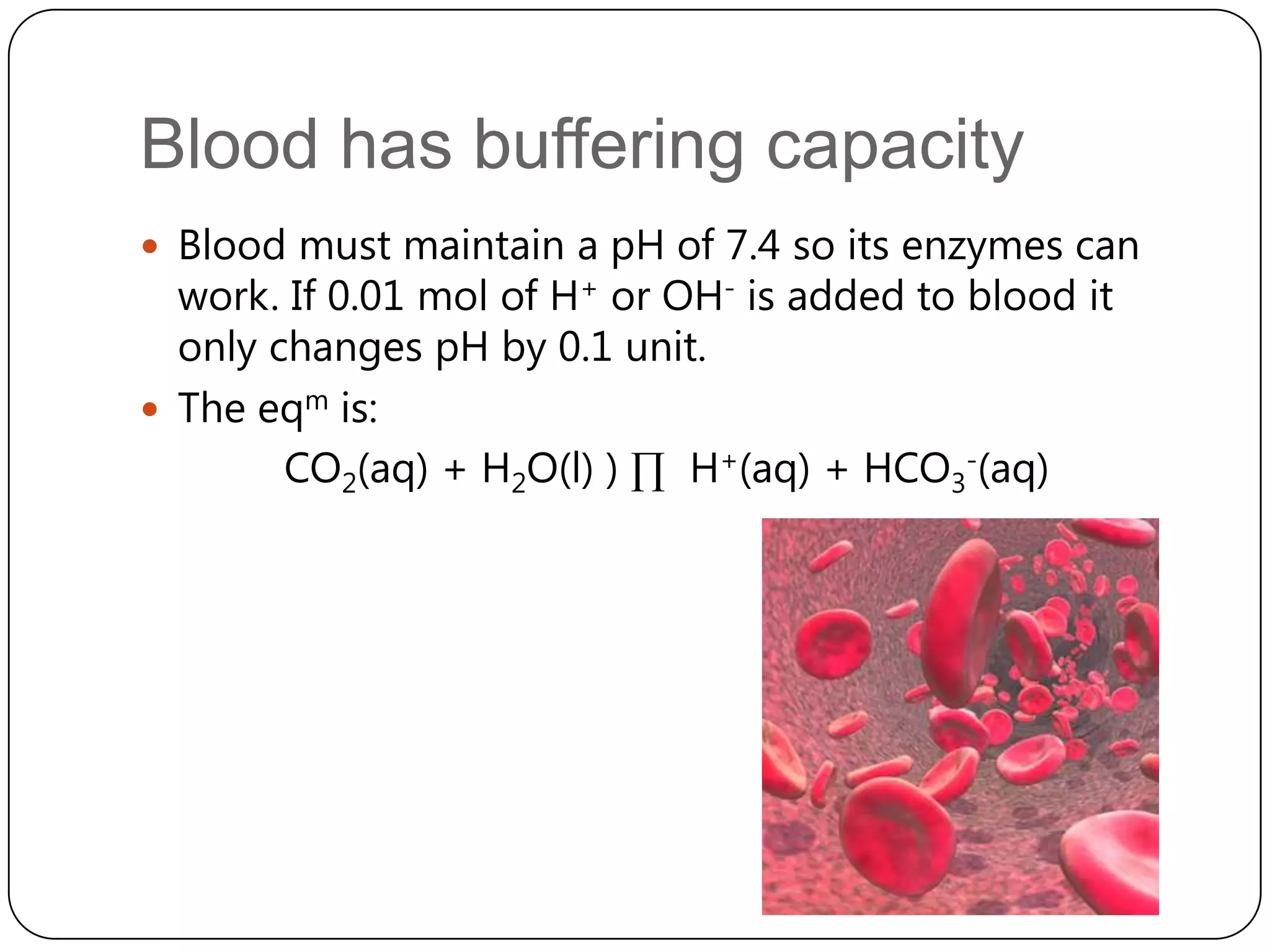
 Blood must maintain a pH of 7.4 so its enzymes can
  work. If 0.01 mol of H+ or OH- is added to blood it
  only changes pH by 0.1 unit.
 The eqm is:
        CO2(aq) + H2O(l) ) ∏ H+(aq) + HCO3-(aq)
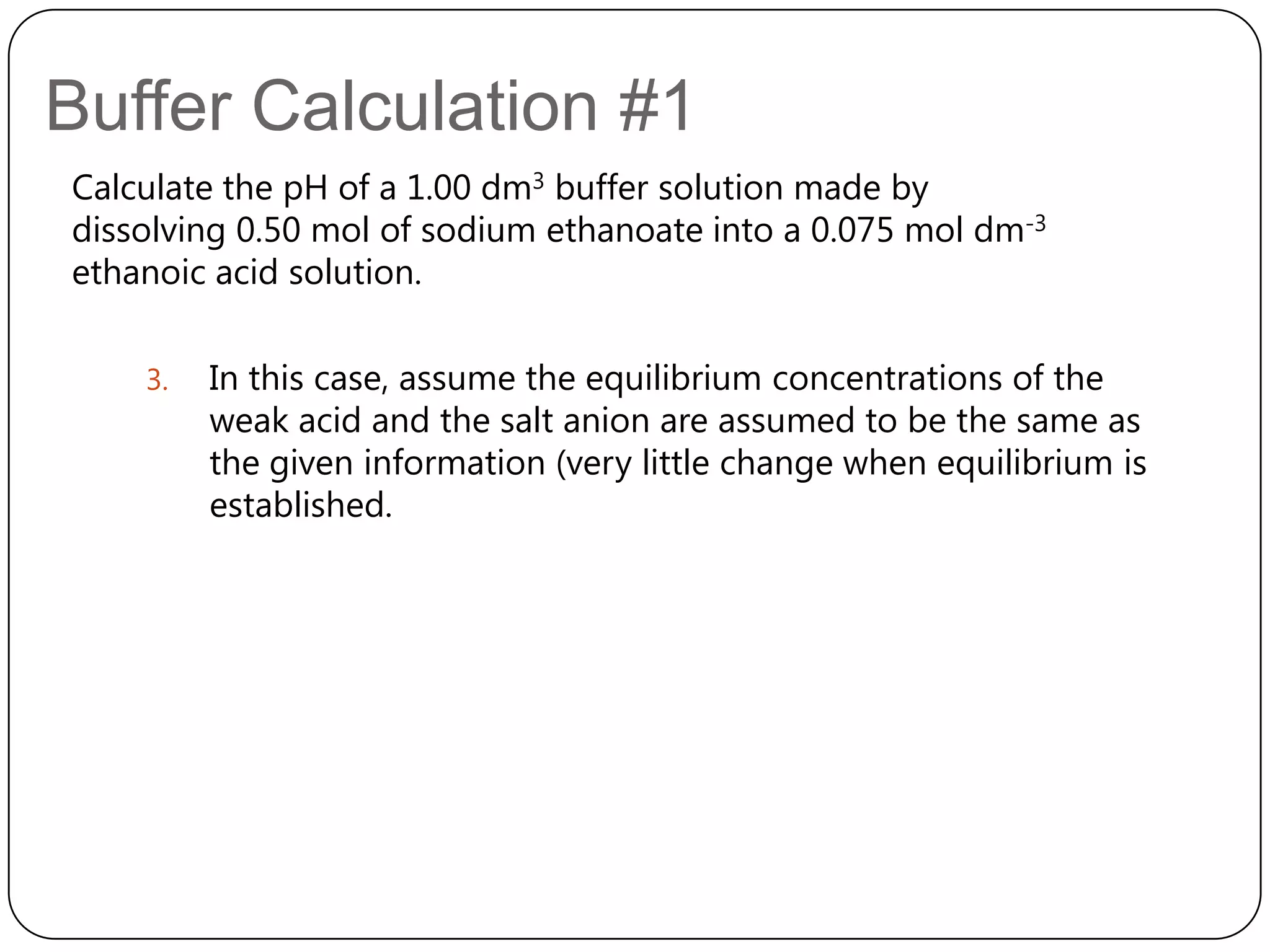
Buffer Calculation #1
Calculate the pH of a 1.00 dm3 buffer solution made by
dissolving 0.50 mol of sodium ethanoate into a 0.075 mol dm-3
ethanoic acid solution.

   1.   Identify the weak acid / conjugate base OR weak base /
        conjugate acid pair. Determine their concentrations.
Buffer Calculation #1
Calculate the pH of a 1.00 dm3 buffer solution made by
dissolving 0.50 mol of sodium ethanoate into a 0.075 mol dm-3
ethanoic acid solution.

   1.   Identify the weak acid / conjugate base OR weak base /
        conjugate acid pair. Determine their concentrations.

   weak acid             [CH3COOH] = 0.075 mol dm-3

   conjugate base        [CH3COO-] = 0.50 mol dm-3
Buffer Calculation #1
Calculate the pH of a 1.00 dm3 buffer solution made by
dissolving 0.50 mol of sodium ethanoate into a 0.075 mol dm-3
ethanoic acid solution.

   2.   Write the equilibrium equation and expression
Buffer Calculation #1
Calculate the pH of a 1.00 dm3 buffer solution made by
dissolving 0.50 mol of sodium ethanoate into a 0.075 mol dm-3
ethanoic acid solution.

   2.   Write the equilibrium equation and expression

                     CH3COOH ∏ H+ + CH3COO-


                      [H + ][CH 3COO - ]     - pK
                 Ka =                    = 10 a
                        [CH 3COOH ]
Buffer Calculation #1
Calculate the pH of a 1.00 dm3 buffer solution made by
dissolving 0.50 mol of sodium ethanoate into a 0.075 mol dm-3
ethanoic acid solution.

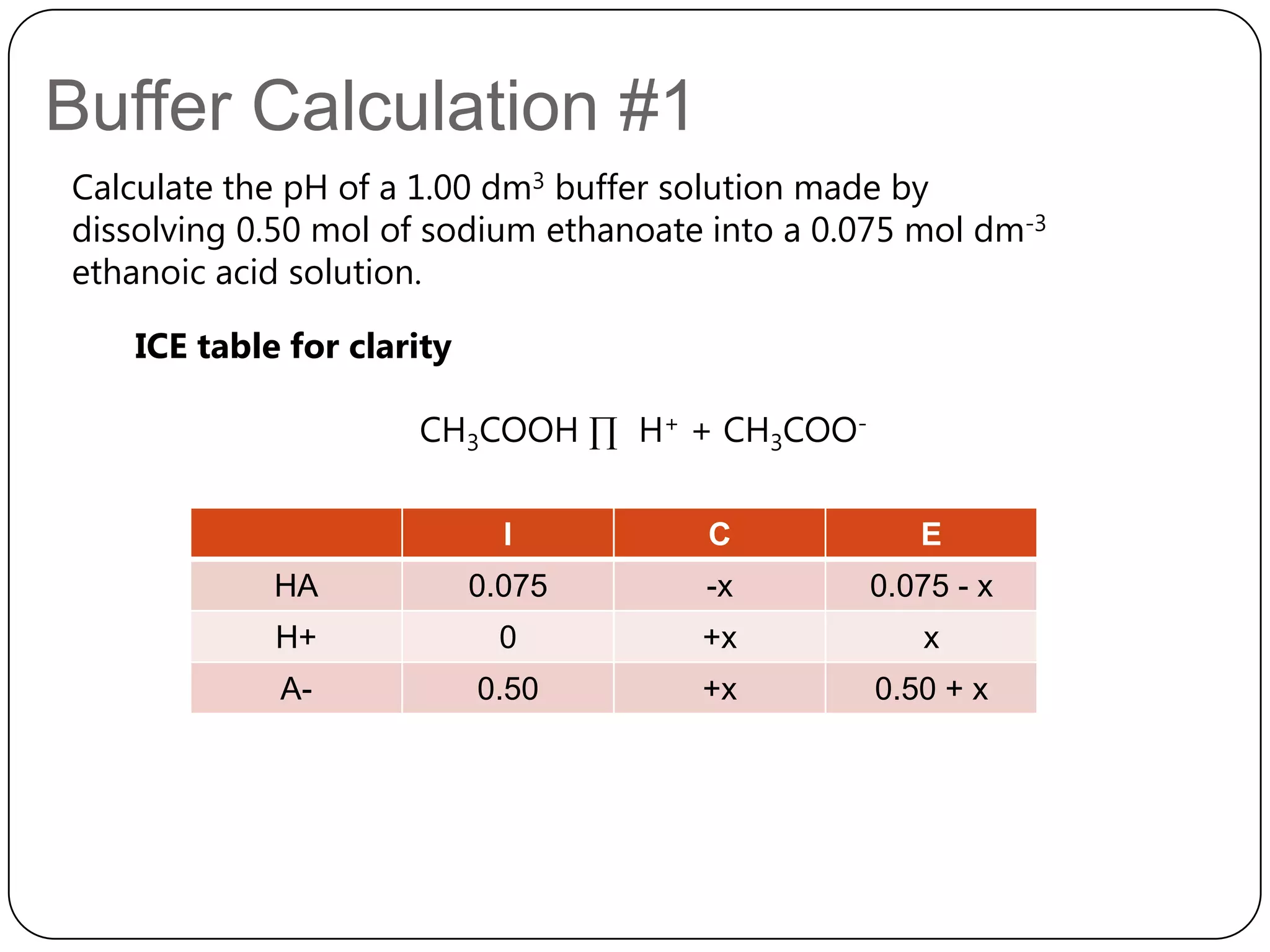
   ICE table for clarity

                     CH3COOH ∏ H+ + CH3COO-

                             I         C             E
            HA             0.075       -x        0.075 - x
            H+              0          +x            x
             A-            0.50        +x         0.50 + x
Buffer Calculation #1
Calculate the pH of a 1.00 dm3 buffer solution made by
dissolving 0.50 mol of sodium ethanoate into a 0.075 mol dm-3
ethanoic acid solution.

    3.   In this case, assume the equilibrium concentrations of the
         weak acid and the salt anion are assumed to be the same as
         the given information (very little change when equilibrium is
         established.
Buffer Calculation #1
Calculate the pH of a 1.00 dm3 buffer solution made by
dissolving 0.50 mol of sodium ethanoate into a 0.075 mol dm-3
ethanoic acid solution.

    3.   In this case, assume the equilibrium concentrations of the
         weak acid and the salt anion are assumed to be the same as
         the given information (very little change when equilibrium is
         established.


                      [H + ][0.50]
                 Ka =              = 10-4.76
                       [0.075]
                                          æ 0.075´10-4.76 ö
                 pH = -log[H + ] = -log ç                 ÷
                                          è     0.50      ø
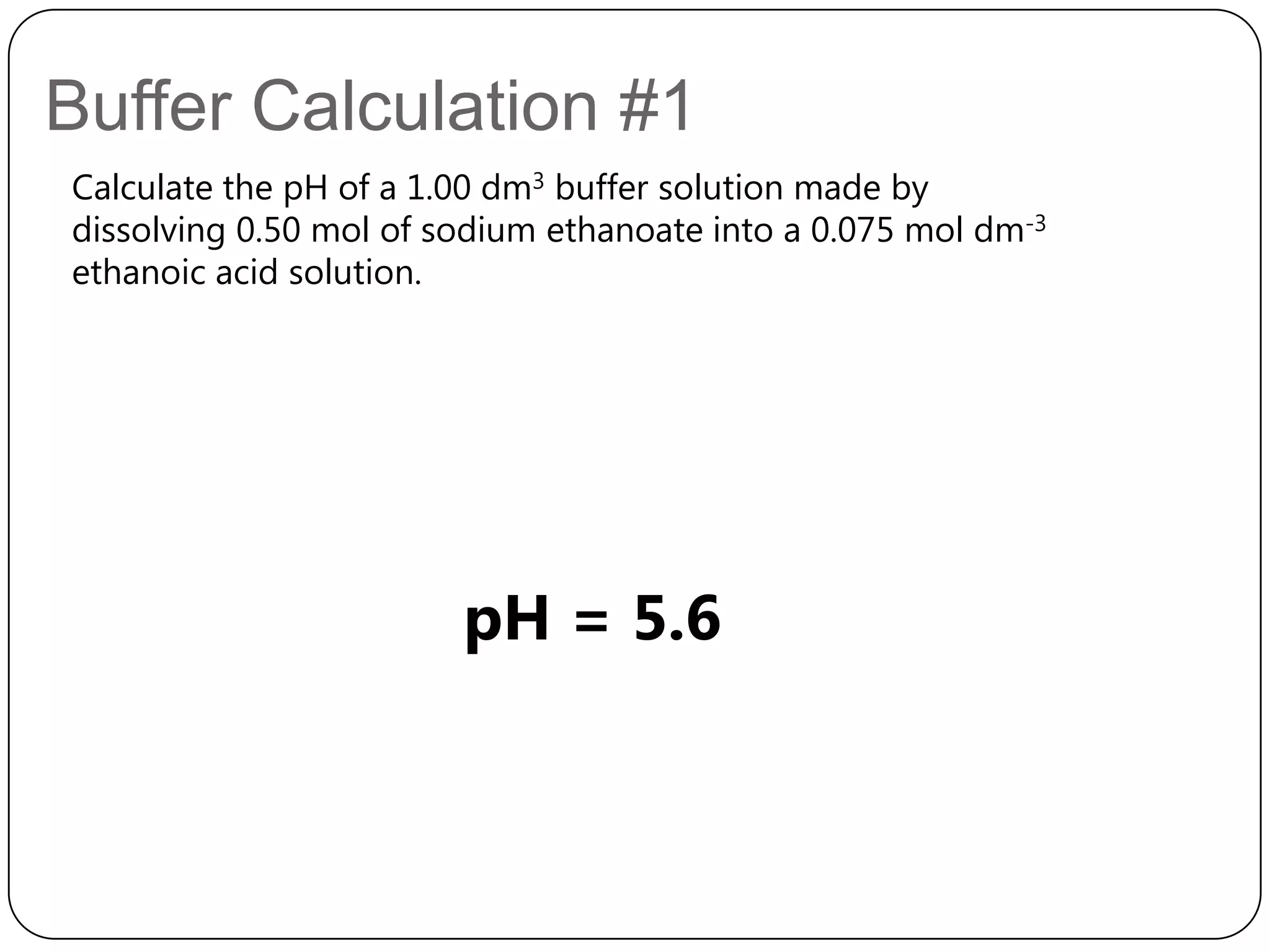
Buffer Calculation #1
Calculate the pH of a 1.00 dm3 buffer solution made by
dissolving 0.50 mol of sodium ethanoate into a 0.075 mol dm-3
ethanoic acid solution.


                        pH = 5.6
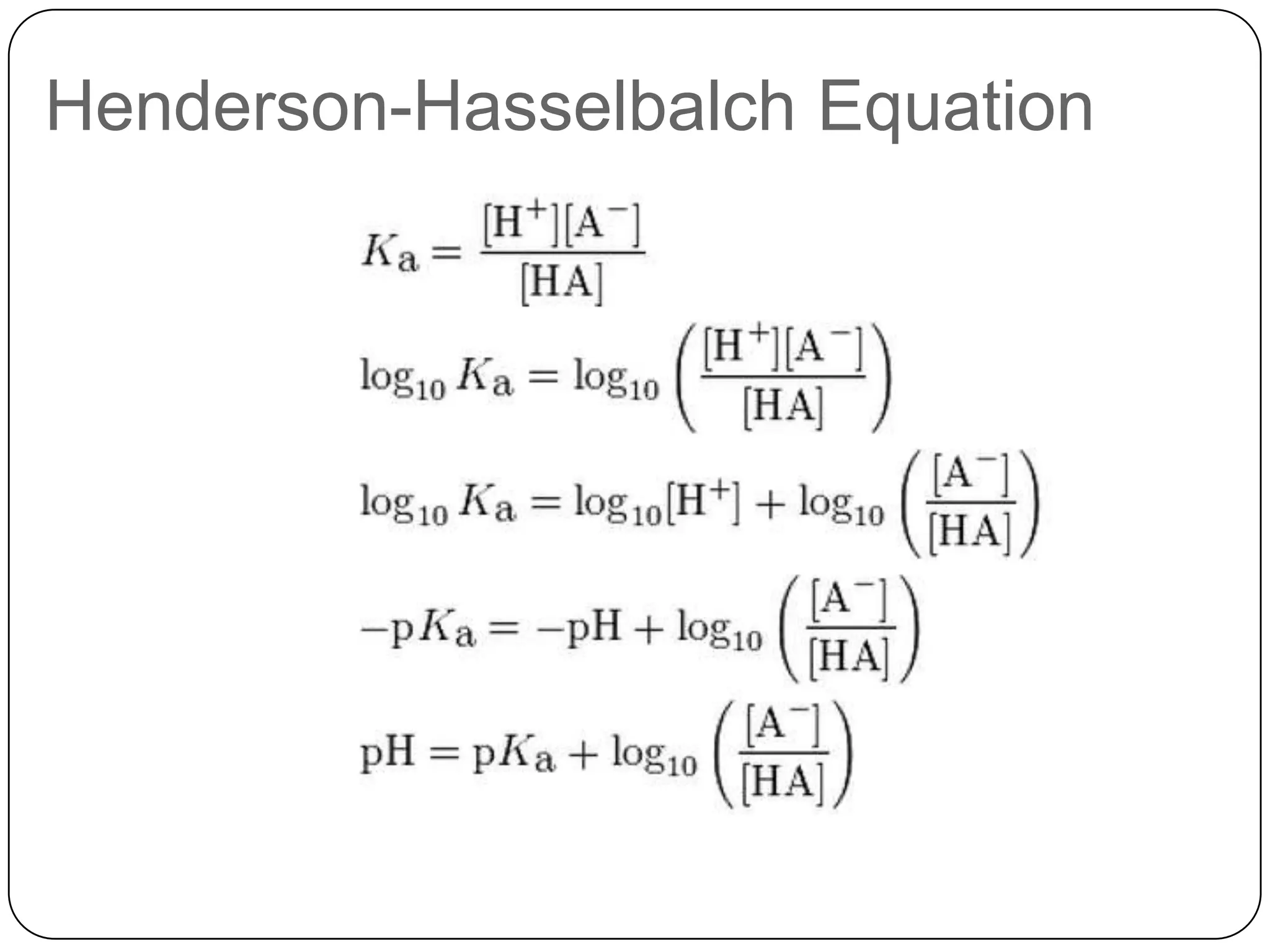
Henderson-Hasselbalch Equation

                      æ [A- ] ö
      pH = pK a + log ç       ÷
                      è [HA] ø
                      æ 0.50 ö
      pH = 4.76 + log ç        ÷
                      è 0.075 ø
      pH = 5.58
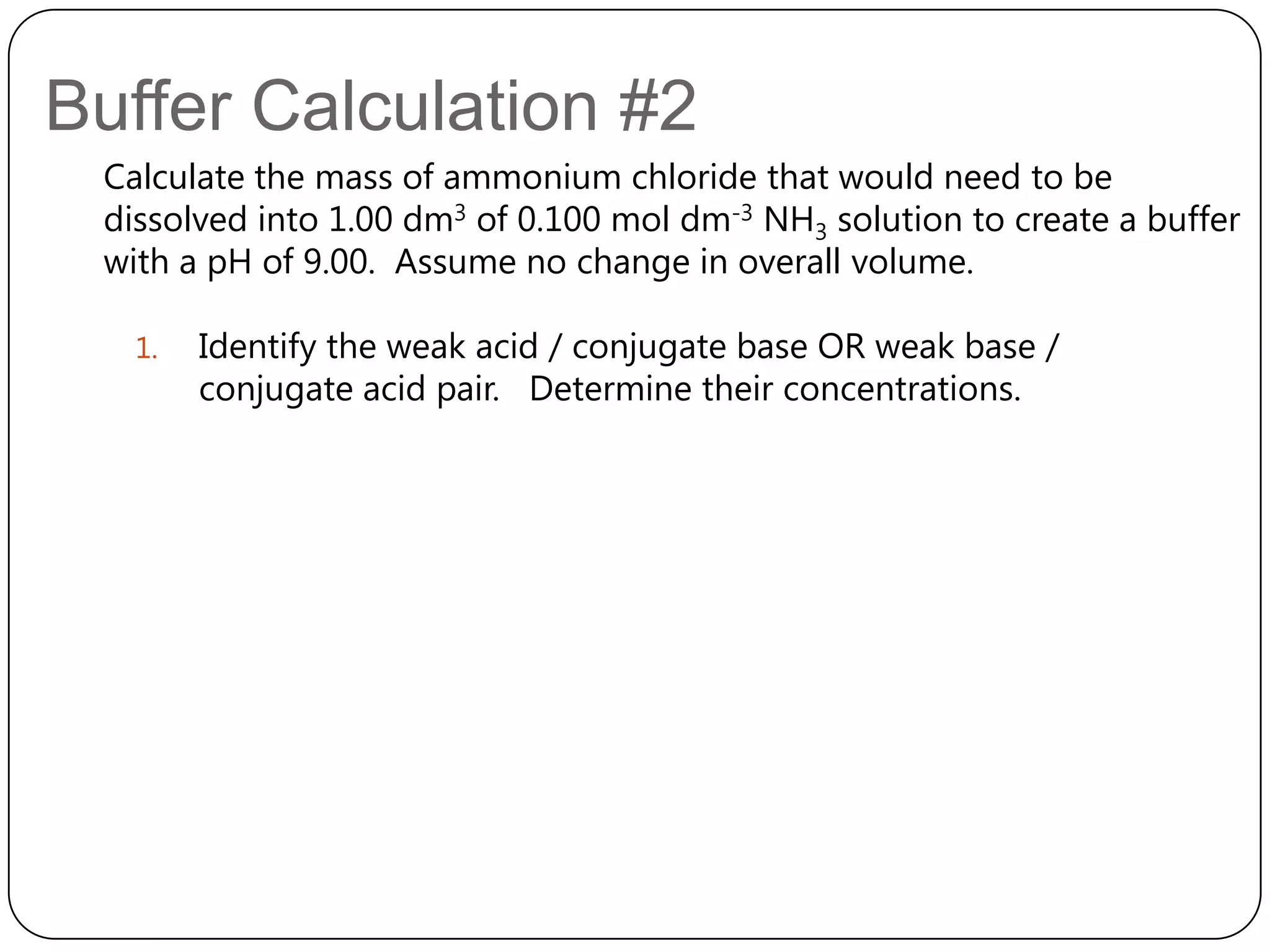
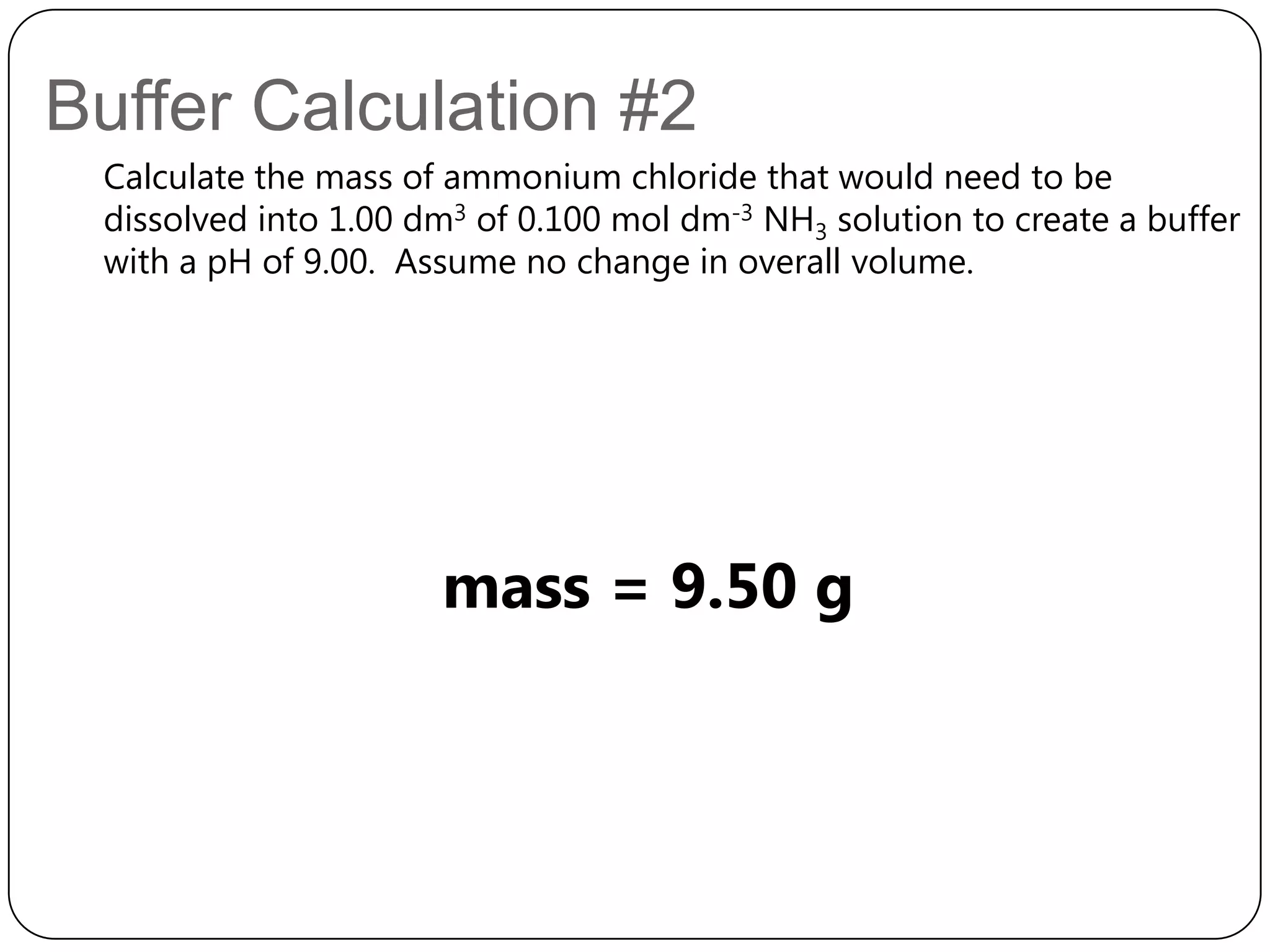
Buffer Calculation #2
 Calculate the mass of ammonium chloride that would need to be
 dissolved into 1.00 dm3 of 0.100 mol dm-3 NH3 solution to create a buffer
 with a pH of 9.00. Assume no change in overall volume.

   1.   Identify the weak acid / conjugate base OR weak base /
        conjugate acid pair. Determine their concentrations.
Buffer Calculation #2
 Calculate the mass of ammonium chloride that would need to be
 dissolved into 1.00 dm3 of 0.100 mol dm-3 NH3 solution to create a buffer
 with a pH of 9.00. Assume no change in overall volume.

   1.   Identify the weak acid / conjugate base OR weak base /
        conjugate acid pair. Determine their concentrations.

   weak base             [NH3] = 0.100 mol dm-3

   conjugate acid        [NH4+] = ?
Buffer Calculation #2
 Calculate the mass of ammonium chloride that would need to be
 dissolved into 1.00 dm3 of 0.100 mol dm-3 NH3 solution to create a buffer
 with a pH of 9.00. Assume no change in overall volume.

   2.   Write the equilibrium equation and expression
Buffer Calculation #2
 Calculate the mass of ammonium chloride that would need to be
 dissolved into 1.00 dm3 of 0.100 mol dm-3 NH3 solution to create a buffer
 with a pH of 9.00. Assume no change in overall volume.

   2.   Write the equilibrium equation and expression

                      NH3+ H2O ∏ NH4+ + OH-


                          [NH 4+ ][OH - ]          - pKb
                   Kb =                     = 10
                             [NH 3 ]
Buffer Calculation #2
 Calculate the mass of ammonium chloride that would need to be
 dissolved into 1.00 dm3 of 0.100 mol dm-3 NH3 solution to create a buffer
 with a pH of 9.00. Assume no change in overall volume.

  3.   In this case, assume the equilibrium concentrations of the
       weak base is the same as the given information (very little
       change when equilibrium is established. Calculate [OH-]
       from desired pH

                                  (14 pH )
                    [ NH 4 ][10              ]        4.75
              kb                                 10
                          [0.100]
                         0.100 10 4.75
              [ NH 4 ]                           0.1778 mol dm-3
                            10 (14 9)
Buffer Calculation #2
 Calculate the mass of ammonium chloride that would need to be
 dissolved into 1.00 dm3 of 0.100 mol dm-3 NH3 solution to create a buffer
 with a pH of 9.00. Assume no change in overall volume.

  3.   In this case, assume the equilibrium concentrations of the
       weak base is the same as the given information (very little
       change when equilibrium is established. Calculate [OH-]
       from desired pH
Buffer Calculation #2
 Calculate the mass of ammonium chloride that would need to be
 dissolved into 1.00 dm3 of 0.100 mol dm-3 NH3 solution to create a buffer
 with a pH of 9.00. Assume no change in overall volume.


                      mass = 9.50 g
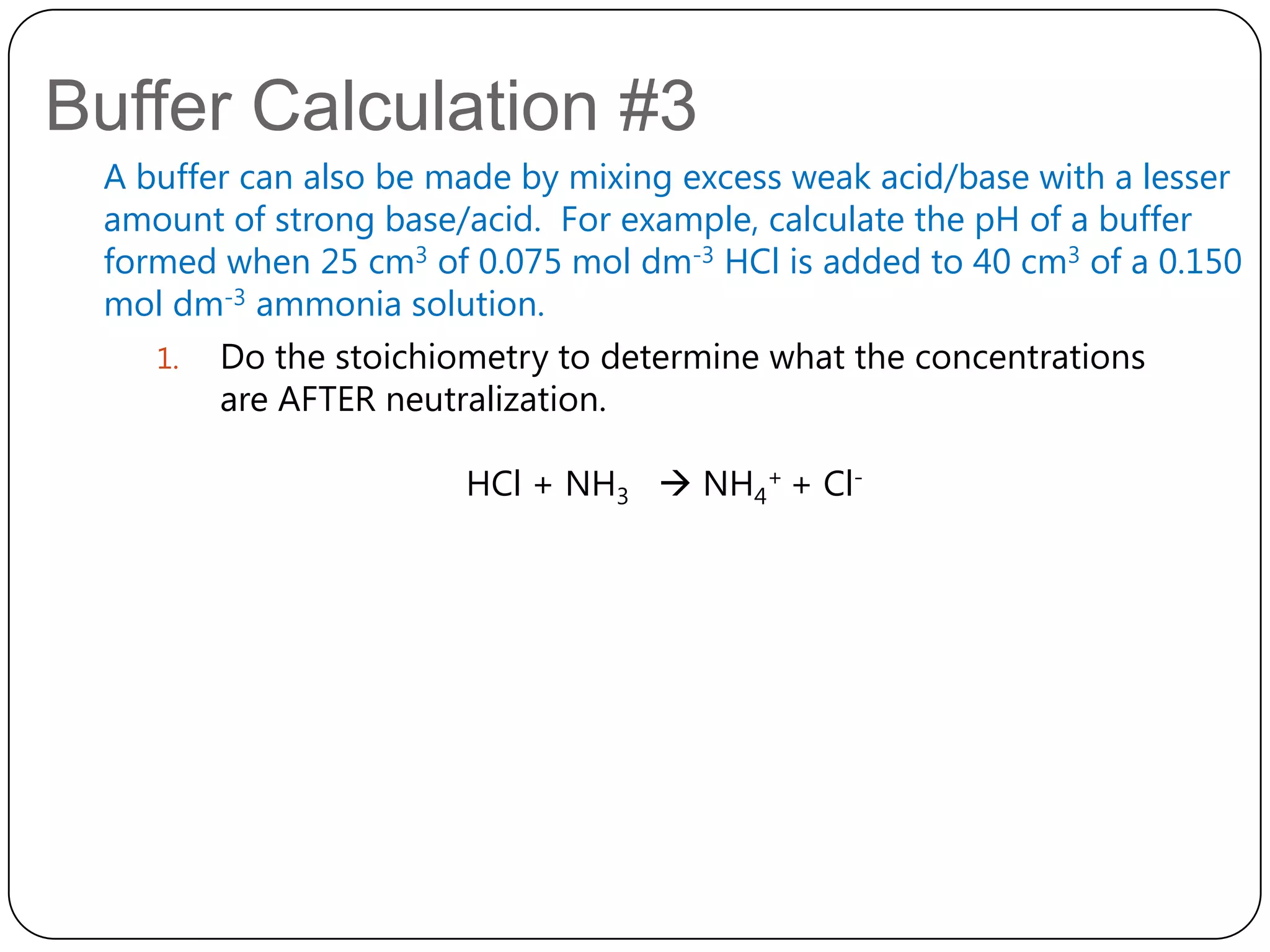
Buffer Calculation #3
 A buffer can also be made by mixing excess weak acid/base with a lesser
 amount of strong base/acid. For example, calculate the pH of a buffer
 formed when 25 cm3 of 0.075 mol dm-3 HCl is added to 40 cm3 of a 0.150
 mol dm-3 ammonia solution.
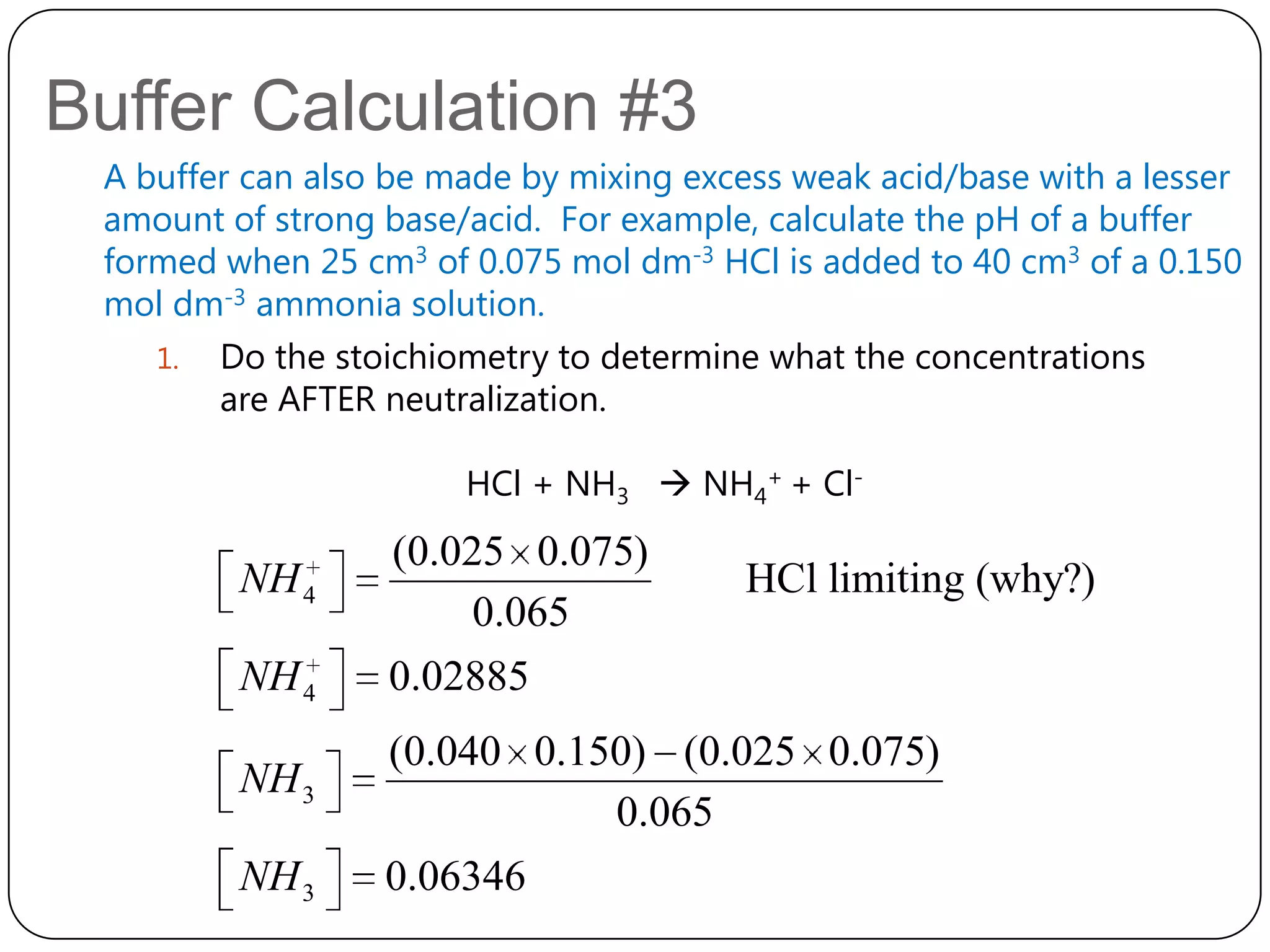
    1. Do the stoichiometry to determine what the concentrations
        are AFTER neutralization.
                                   -
Buffer Calculation #3
 A buffer can also be made by mixing excess weak acid/base with a lesser
 amount of strong base/acid. For example, calculate the pH of a buffer
 formed when 25 cm3 of 0.075 mol dm-3 HCl is added to 40 cm3 of a 0.150
 mol dm-3 ammonia solution.
    1. Do the stoichiometry to determine what the concentrations
        are AFTER neutralization.

                       HCl + NH3  NH4+ + Cl-
Buffer Calculation #3
 A buffer can also be made by mixing excess weak acid/base with a lesser
 amount of strong base/acid. For example, calculate the pH of a buffer
 formed when 25 cm3 of 0.075 mol dm-3 HCl is added to 40 cm3 of a 0.150
 mol dm-3 ammonia solution.
    1. Do the stoichiometry to determine what the concentrations
        are AFTER neutralization.

                       HCl + NH3  NH4+ + Cl-
                  (0.025 0.075)
         NH 4                            HCl limiting (why?)
                       0.065
         NH 4     0.02885
                  (0.040 0.150) (0.025 0.075)
         NH 3
                             0.065
         NH 3     0.06346
Buffer Calculation #3
     A buffer can also be made by mixing excess weak acid/base with a lesser
     amount of strong base/acid. For example, calculate the pH of a buffer
     formed when 25 cm3 of 0.075 mol dm-3 HCl is added to 40 cm3 of a 0.150
     mol dm-3 ammonia solution.


2.   Write the equilibrium equation and expression
Buffer Calculation #3
     A buffer can also be made by mixing excess weak acid/base with a lesser
     amount of strong base/acid. For example, calculate the pH of a buffer
     formed when 25 cm3 of 0.075 mol dm-3 HCl is added to 40 cm3 of a 0.150
     mol dm-3 ammonia solution.


2.   Write the equilibrium equation and expression

                    NH3+ H2O ∏ NH4+ + OH-

                           [NH 4+ ][OH - ]          - pKb
                    Kb =                     = 10
                              [NH 3 ]
Buffer Calculation #3
 A buffer can also be made by mixing excess weak acid/base with a lesser
 amount of strong base/acid. For example, calculate the pH of a buffer
 formed when 25 cm3 of 0.075 mol dm-3 HCl is added to 40 cm3 of a 0.150
 mol dm-3 ammonia solution.

 3.   In this case, assume the equilibrium concentrations of the
      weak base and cation are the same as determined by
      stoichiometry (very little change when equilibrium is
      established.
Buffer Calculation #3
 A buffer can also be made by mixing excess weak acid/base with a lesser
 amount of strong base/acid. For example, calculate the pH of a buffer
 formed when 25 cm3 of 0.075 mol dm-3 HCl is added to 40 cm3 of a 0.150
 mol dm-3 ammonia solution.

 3.   In this case, assume the equilibrium concentrations of the
      weak base and cation are the same as determined by
      stoichiometry (very little change when equilibrium is
      established.


                       [0.02885][OH - ]
                  Kb =                  = 10-4.75
                          [0.06346]
                              æ 0.06346 ´10-4.75 ö
                  pOH = -log ç                    ÷
                              è     0.02885       ø
Buffer Calculation #3
 A buffer can also be made by mixing excess weak acid/base with a lesser
 amount of strong base/acid. For example, calculate the pH of a buffer
 formed when 25 cm3 of 0.075 mol dm-3 HCl is added to 40 cm3 of a 0.150
 mol dm-3 ammonia solution.


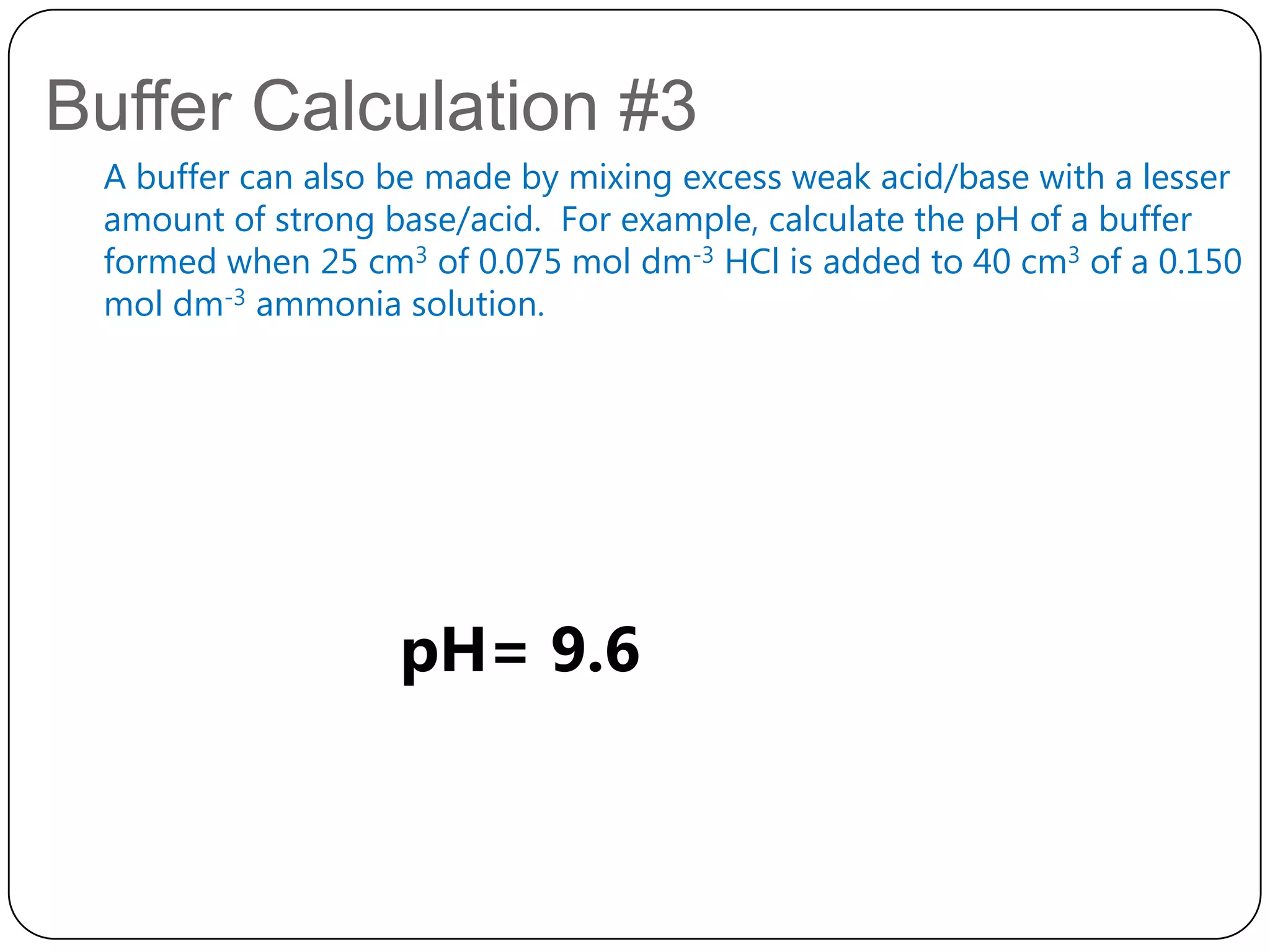
                   pH= 9.6

2012 topic 18 2 buffer solutions

  • 1.
    IB Chemistry PowerPoints Topic 18 Acids and Bases www.pedagogics.ca Buffer Solutions
  • 2.
    Buffer Solutions  DEFINITION:A buffer solution contains a weak acid mixed with its conjugate base (or weak base and conjugate acid)  Buffers resist changes in pH when a small amount of a strong acid or base is added to it. HA ∏ H+ + A-
  • 3.
     If asmall amount of a strong acid (H+) is added eqm shifts to the left as [H+] increases so system adjusts to increase [HA] and reduce [H+] again. HA ∏ H+ + A-
  • 4.
     A smallamount of a strong base will react with H+ to form H2O and eqm will shift to the right to increase [H+] again. HA ∏ H+ + A-
  • 5.
    Making Buffer Solutions An example of a weak acid is ethanoic acid. This could be mixed with sodium ethanoate which will provide ethanoate ions (conjugate base). CH3COOH(aq) ∏ CH3COO-(aq)+H+(aq)  An example of a weak base is ammonia. This could be mixed with ammonium chloride to provide ammonium ions (conjugate acid). NH3(aq) + H2O(aq) ∏ NH4+(aq) +OH-(aq) In order for a buffer to work well the concentration of the acid/base and its salt must be much higher than the strong acid/base added.
  • 6.
    Optimum Buffer  Abuffer is most effective when the concentration of weak acid and its salt (the conjugate base) are equal and the pH is equal to pKa.  In practice it will work reasonably well with similar concentrations and the effective buffer range of any weak acid/ base is pKa 1.
  • 7.
    Blood has bufferingcapacity  Blood must maintain a pH of 7.4 so its enzymes can work. If 0.01 mol of H+ or OH- is added to blood it only changes pH by 0.1 unit.  The eqm is: CO2(aq) + H2O(l) ) ∏ H+(aq) + HCO3-(aq)
  • 8.
    Buffer Calculation #1 Calculatethe pH of a 1.00 dm3 buffer solution made by dissolving 0.50 mol of sodium ethanoate into a 0.075 mol dm-3 ethanoic acid solution. 1. Identify the weak acid / conjugate base OR weak base / conjugate acid pair. Determine their concentrations.
  • 9.
    Buffer Calculation #1 Calculatethe pH of a 1.00 dm3 buffer solution made by dissolving 0.50 mol of sodium ethanoate into a 0.075 mol dm-3 ethanoic acid solution. 1. Identify the weak acid / conjugate base OR weak base / conjugate acid pair. Determine their concentrations. weak acid [CH3COOH] = 0.075 mol dm-3 conjugate base [CH3COO-] = 0.50 mol dm-3
  • 10.
    Buffer Calculation #1 Calculatethe pH of a 1.00 dm3 buffer solution made by dissolving 0.50 mol of sodium ethanoate into a 0.075 mol dm-3 ethanoic acid solution. 2. Write the equilibrium equation and expression
  • 11.
    Buffer Calculation #1 Calculatethe pH of a 1.00 dm3 buffer solution made by dissolving 0.50 mol of sodium ethanoate into a 0.075 mol dm-3 ethanoic acid solution. 2. Write the equilibrium equation and expression CH3COOH ∏ H+ + CH3COO- [H + ][CH 3COO - ] - pK Ka = = 10 a [CH 3COOH ]
  • 12.
    Buffer Calculation #1 Calculatethe pH of a 1.00 dm3 buffer solution made by dissolving 0.50 mol of sodium ethanoate into a 0.075 mol dm-3 ethanoic acid solution. ICE table for clarity CH3COOH ∏ H+ + CH3COO- I C E HA 0.075 -x 0.075 - x H+ 0 +x x A- 0.50 +x 0.50 + x
  • 13.
    Buffer Calculation #1 Calculatethe pH of a 1.00 dm3 buffer solution made by dissolving 0.50 mol of sodium ethanoate into a 0.075 mol dm-3 ethanoic acid solution. 3. In this case, assume the equilibrium concentrations of the weak acid and the salt anion are assumed to be the same as the given information (very little change when equilibrium is established.
  • 14.
    Buffer Calculation #1 Calculatethe pH of a 1.00 dm3 buffer solution made by dissolving 0.50 mol of sodium ethanoate into a 0.075 mol dm-3 ethanoic acid solution. 3. In this case, assume the equilibrium concentrations of the weak acid and the salt anion are assumed to be the same as the given information (very little change when equilibrium is established. [H + ][0.50] Ka = = 10-4.76 [0.075] æ 0.075´10-4.76 ö pH = -log[H + ] = -log ç ÷ è 0.50 ø
  • 15.
    Buffer Calculation #1 Calculatethe pH of a 1.00 dm3 buffer solution made by dissolving 0.50 mol of sodium ethanoate into a 0.075 mol dm-3 ethanoic acid solution. pH = 5.6
  • 16.
  • 17.
    Henderson-Hasselbalch Equation æ [A- ] ö pH = pK a + log ç ÷ è [HA] ø æ 0.50 ö pH = 4.76 + log ç ÷ è 0.075 ø pH = 5.58
  • 18.
    Buffer Calculation #2 Calculate the mass of ammonium chloride that would need to be dissolved into 1.00 dm3 of 0.100 mol dm-3 NH3 solution to create a buffer with a pH of 9.00. Assume no change in overall volume. 1. Identify the weak acid / conjugate base OR weak base / conjugate acid pair. Determine their concentrations.
  • 19.
    Buffer Calculation #2 Calculate the mass of ammonium chloride that would need to be dissolved into 1.00 dm3 of 0.100 mol dm-3 NH3 solution to create a buffer with a pH of 9.00. Assume no change in overall volume. 1. Identify the weak acid / conjugate base OR weak base / conjugate acid pair. Determine their concentrations. weak base [NH3] = 0.100 mol dm-3 conjugate acid [NH4+] = ?
  • 20.
    Buffer Calculation #2 Calculate the mass of ammonium chloride that would need to be dissolved into 1.00 dm3 of 0.100 mol dm-3 NH3 solution to create a buffer with a pH of 9.00. Assume no change in overall volume. 2. Write the equilibrium equation and expression
  • 21.
    Buffer Calculation #2 Calculate the mass of ammonium chloride that would need to be dissolved into 1.00 dm3 of 0.100 mol dm-3 NH3 solution to create a buffer with a pH of 9.00. Assume no change in overall volume. 2. Write the equilibrium equation and expression NH3+ H2O ∏ NH4+ + OH- [NH 4+ ][OH - ] - pKb Kb = = 10 [NH 3 ]
  • 22.
    Buffer Calculation #2 Calculate the mass of ammonium chloride that would need to be dissolved into 1.00 dm3 of 0.100 mol dm-3 NH3 solution to create a buffer with a pH of 9.00. Assume no change in overall volume. 3. In this case, assume the equilibrium concentrations of the weak base is the same as the given information (very little change when equilibrium is established. Calculate [OH-] from desired pH (14 pH ) [ NH 4 ][10 ] 4.75 kb 10 [0.100] 0.100 10 4.75 [ NH 4 ] 0.1778 mol dm-3 10 (14 9)
  • 23.
    Buffer Calculation #2 Calculate the mass of ammonium chloride that would need to be dissolved into 1.00 dm3 of 0.100 mol dm-3 NH3 solution to create a buffer with a pH of 9.00. Assume no change in overall volume. 3. In this case, assume the equilibrium concentrations of the weak base is the same as the given information (very little change when equilibrium is established. Calculate [OH-] from desired pH
  • 24.
    Buffer Calculation #2 Calculate the mass of ammonium chloride that would need to be dissolved into 1.00 dm3 of 0.100 mol dm-3 NH3 solution to create a buffer with a pH of 9.00. Assume no change in overall volume. mass = 9.50 g
  • 25.
    Buffer Calculation #3 A buffer can also be made by mixing excess weak acid/base with a lesser amount of strong base/acid. For example, calculate the pH of a buffer formed when 25 cm3 of 0.075 mol dm-3 HCl is added to 40 cm3 of a 0.150 mol dm-3 ammonia solution. 1. Do the stoichiometry to determine what the concentrations are AFTER neutralization. -
  • 26.
    Buffer Calculation #3 A buffer can also be made by mixing excess weak acid/base with a lesser amount of strong base/acid. For example, calculate the pH of a buffer formed when 25 cm3 of 0.075 mol dm-3 HCl is added to 40 cm3 of a 0.150 mol dm-3 ammonia solution. 1. Do the stoichiometry to determine what the concentrations are AFTER neutralization. HCl + NH3  NH4+ + Cl-
  • 27.
    Buffer Calculation #3 A buffer can also be made by mixing excess weak acid/base with a lesser amount of strong base/acid. For example, calculate the pH of a buffer formed when 25 cm3 of 0.075 mol dm-3 HCl is added to 40 cm3 of a 0.150 mol dm-3 ammonia solution. 1. Do the stoichiometry to determine what the concentrations are AFTER neutralization. HCl + NH3  NH4+ + Cl- (0.025 0.075) NH 4 HCl limiting (why?) 0.065 NH 4 0.02885 (0.040 0.150) (0.025 0.075) NH 3 0.065 NH 3 0.06346
  • 28.
    Buffer Calculation #3 A buffer can also be made by mixing excess weak acid/base with a lesser amount of strong base/acid. For example, calculate the pH of a buffer formed when 25 cm3 of 0.075 mol dm-3 HCl is added to 40 cm3 of a 0.150 mol dm-3 ammonia solution. 2. Write the equilibrium equation and expression
  • 29.
    Buffer Calculation #3 A buffer can also be made by mixing excess weak acid/base with a lesser amount of strong base/acid. For example, calculate the pH of a buffer formed when 25 cm3 of 0.075 mol dm-3 HCl is added to 40 cm3 of a 0.150 mol dm-3 ammonia solution. 2. Write the equilibrium equation and expression NH3+ H2O ∏ NH4+ + OH- [NH 4+ ][OH - ] - pKb Kb = = 10 [NH 3 ]
  • 30.
    Buffer Calculation #3 A buffer can also be made by mixing excess weak acid/base with a lesser amount of strong base/acid. For example, calculate the pH of a buffer formed when 25 cm3 of 0.075 mol dm-3 HCl is added to 40 cm3 of a 0.150 mol dm-3 ammonia solution. 3. In this case, assume the equilibrium concentrations of the weak base and cation are the same as determined by stoichiometry (very little change when equilibrium is established.
  • 31.
    Buffer Calculation #3 A buffer can also be made by mixing excess weak acid/base with a lesser amount of strong base/acid. For example, calculate the pH of a buffer formed when 25 cm3 of 0.075 mol dm-3 HCl is added to 40 cm3 of a 0.150 mol dm-3 ammonia solution. 3. In this case, assume the equilibrium concentrations of the weak base and cation are the same as determined by stoichiometry (very little change when equilibrium is established. [0.02885][OH - ] Kb = = 10-4.75 [0.06346] æ 0.06346 ´10-4.75 ö pOH = -log ç ÷ è 0.02885 ø
  • 32.
    Buffer Calculation #3 A buffer can also be made by mixing excess weak acid/base with a lesser amount of strong base/acid. For example, calculate the pH of a buffer formed when 25 cm3 of 0.075 mol dm-3 HCl is added to 40 cm3 of a 0.150 mol dm-3 ammonia solution. pH= 9.6