Networks: ATM 1
AsynchronousAsynchronous
Transfer ModeTransfer Mode
(ATM)(ATM)
Networks: ATM 2
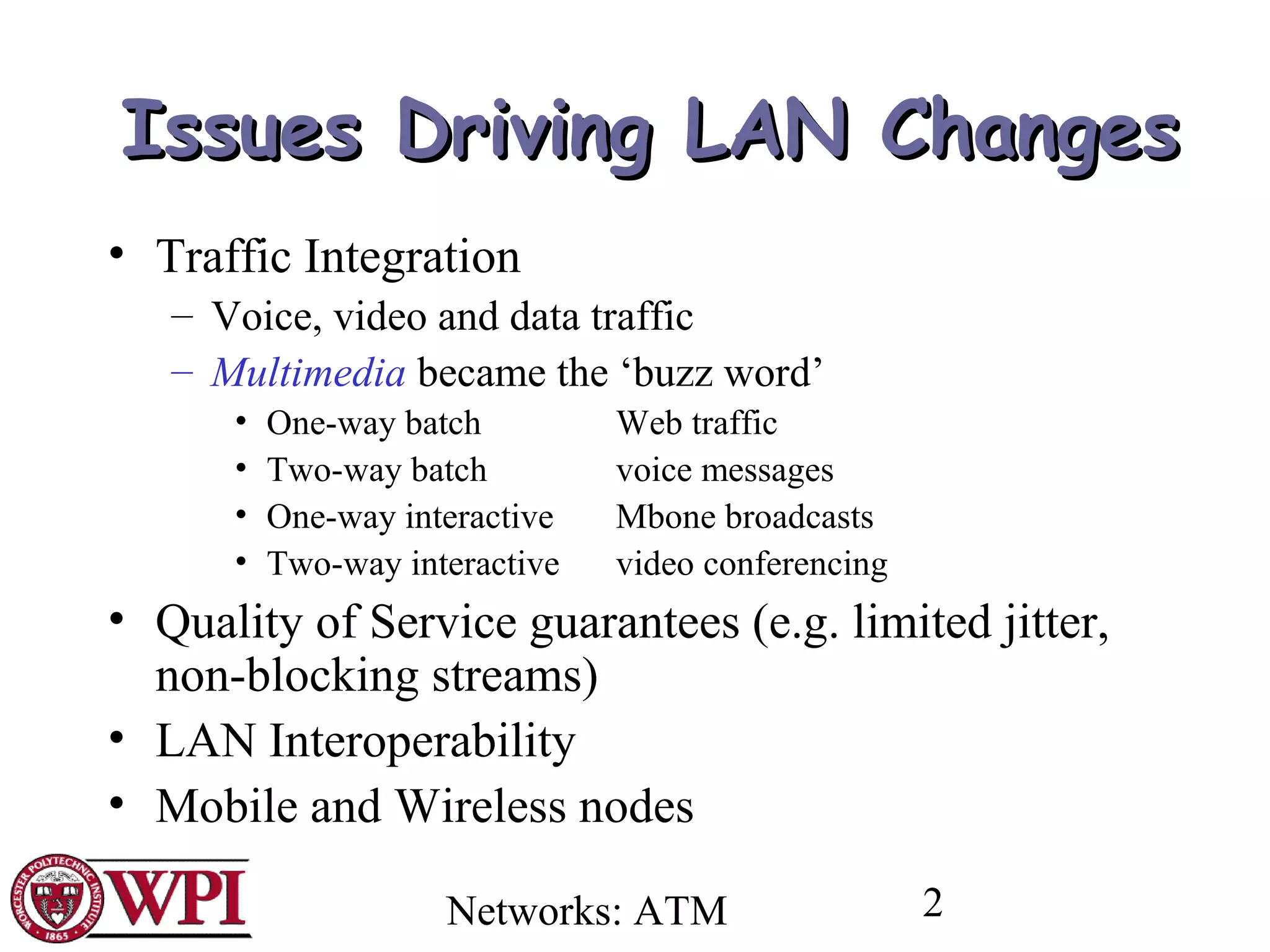
Issues Driving LAN ChangesIssues Driving LAN Changes
• Traffic Integration
– Voice, video and data traffic
– Multimedia became the ‘buzz word’
• One-way batch Web traffic
• Two-way batch voice messages
• One-way interactive Mbone broadcasts
• Two-way interactive video conferencing
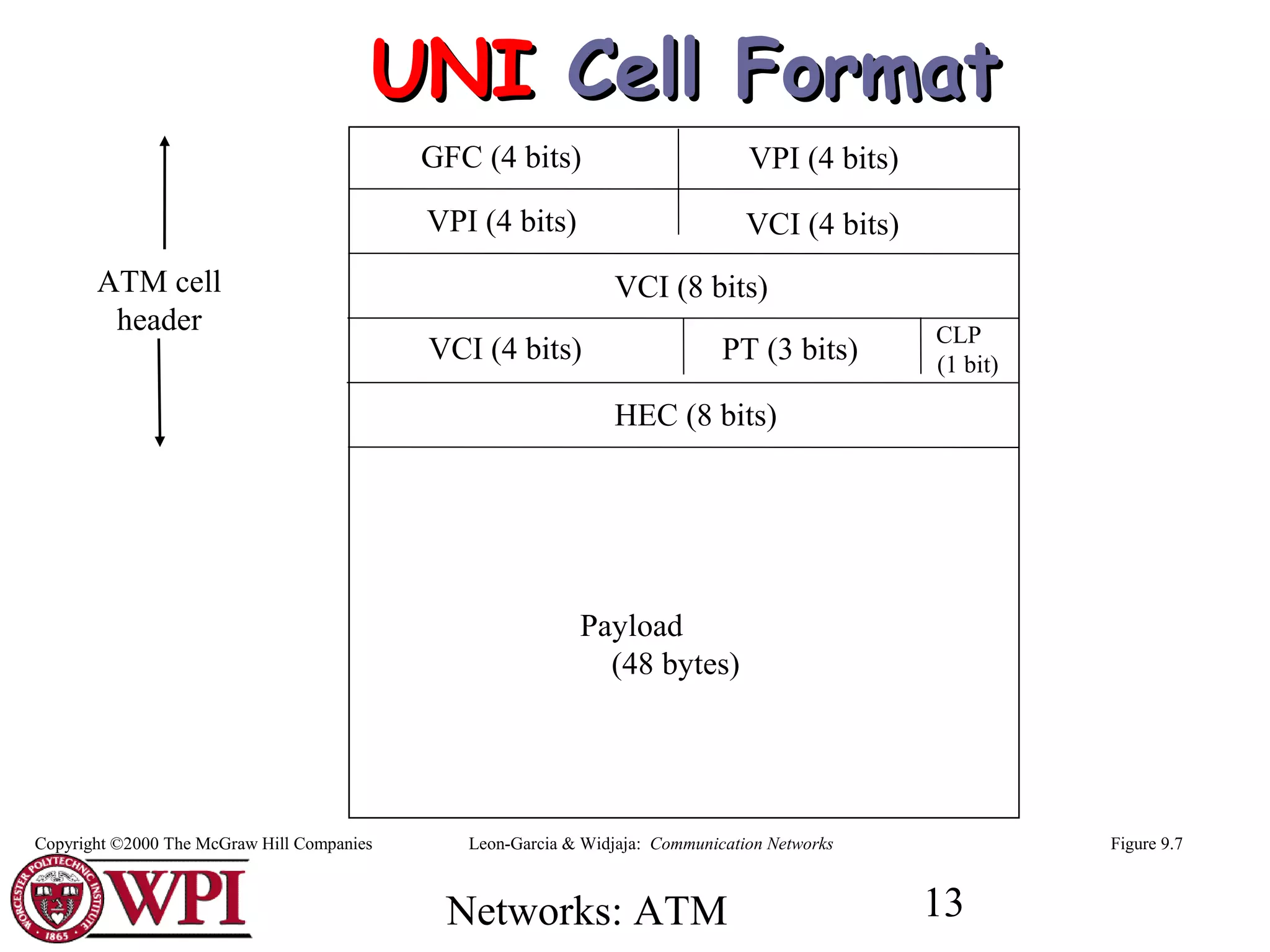
• Quality of Service guarantees (e.g. limited jitter,
non-blocking streams)
• LAN Interoperability
• Mobile and Wireless nodes
Networks: ATM 3
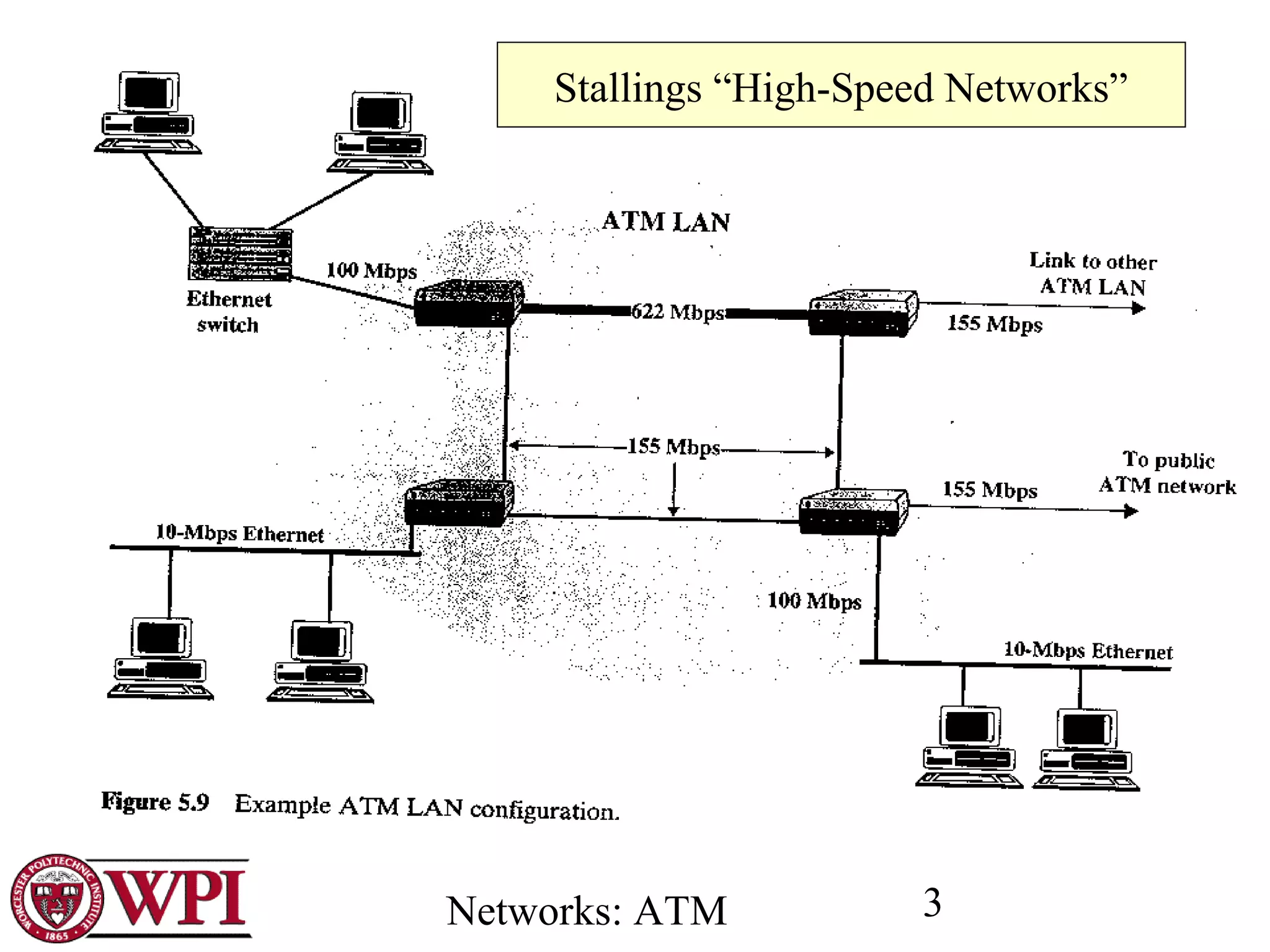
Stallings “High-Speed Networks”
Networks: ATM 4
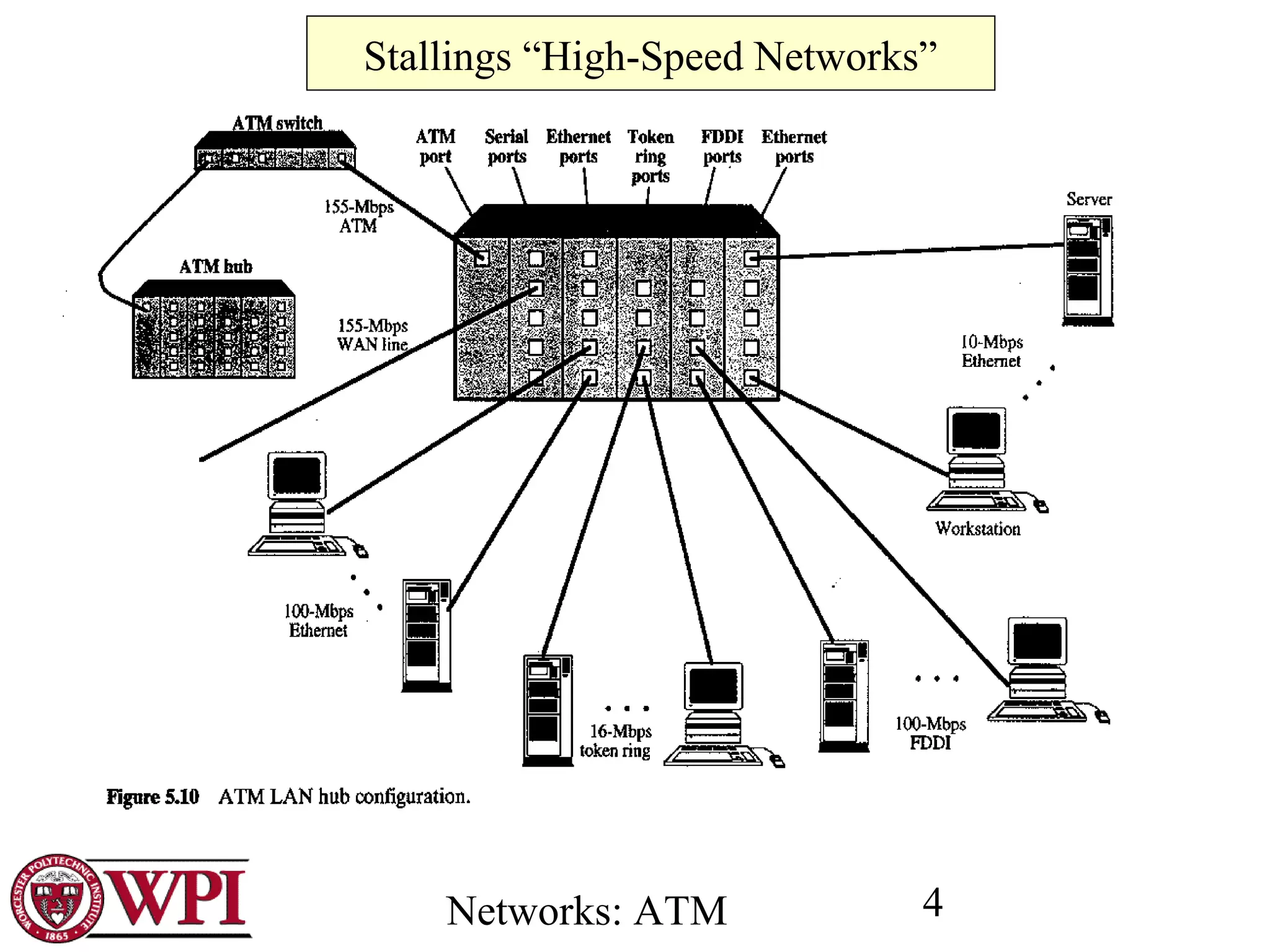
Stallings “High-Speed Networks”
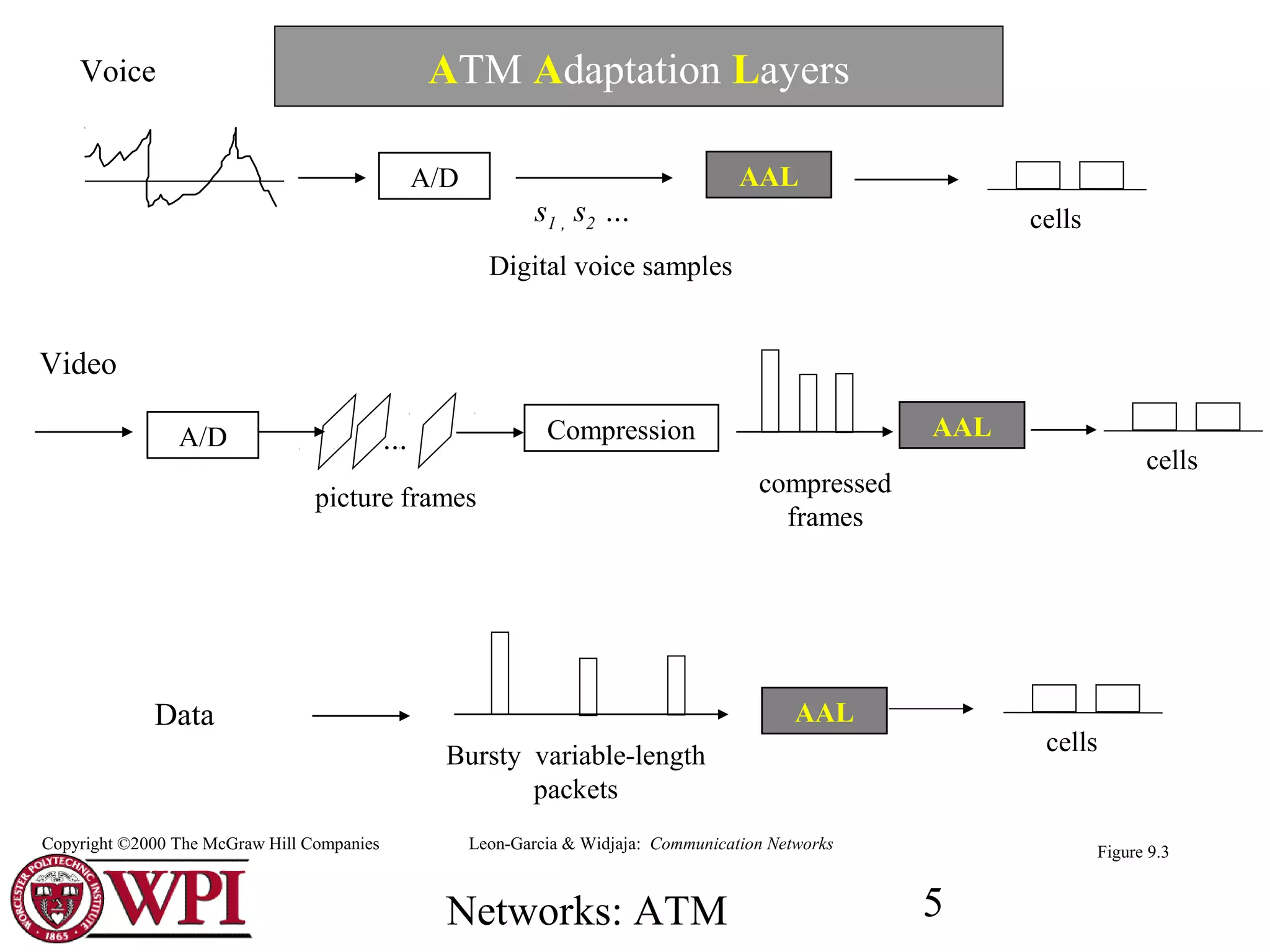
Networks: ATM 5
A/D
Voice
s1 , s2 …
Digital voice samples
A/D
Video
… Compression
compressed
frames
picture frames
Data
Bursty variable-length
packets
cells
cells
cells
Figure 9.3Leon-Garcia & Widjaja: Communication NetworksCopyright ©2000 The McGraw Hill Companies
AAL
AAL
AAL
ATM Adaptation Layers
Networks: ATM 6
MUX
`
Wasted bandwidth
ATM
TDM
4 3 2 1 4 3 2 1 4 3 2 1
4 3 1 3 2 2 1
Voice
Data
packets
Images
Figure 7.37Leon-Garcia & Widjaja: Communication NetworksCopyright ©2000 The McGraw Hill Companies
Asynchronous Transfer ModeAsynchronous Transfer Mode
(ATM)(ATM)
Networks: ATM 7
ATMATM
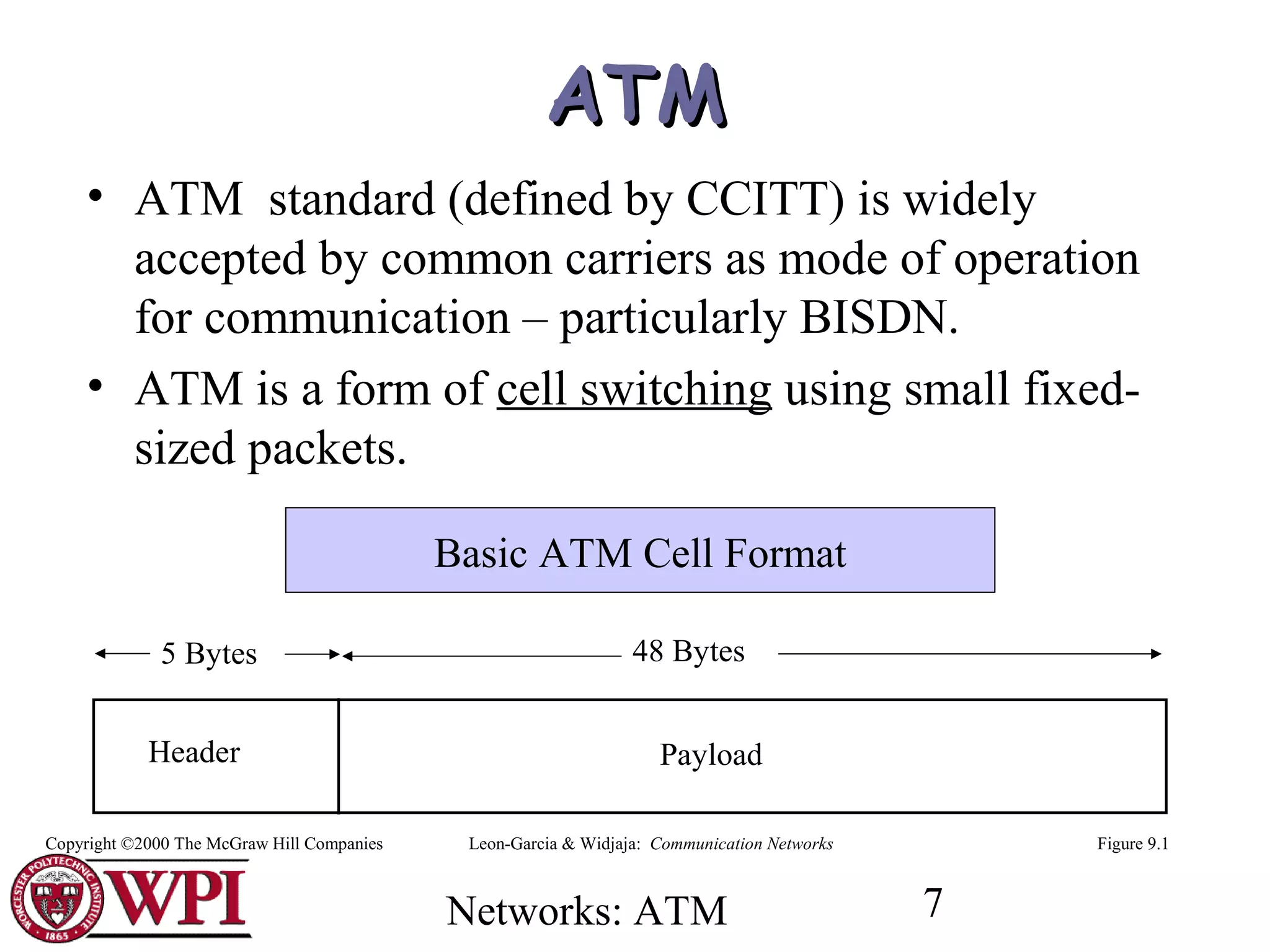
• ATM standard (defined by CCITT) is widely
accepted by common carriers as mode of operation
for communication – particularly BISDN.
• ATM is a form of cell switching using small fixed-
sized packets.
Header Payload
5 Bytes 48 Bytes
Figure 9.1
Basic ATM Cell Format
Leon-Garcia & Widjaja: Communication NetworksCopyright ©2000 The McGraw Hill Companies
Networks: ATM 8
ATMATM Conceptual ModelConceptual Model
FourFour AssumptionsAssumptions
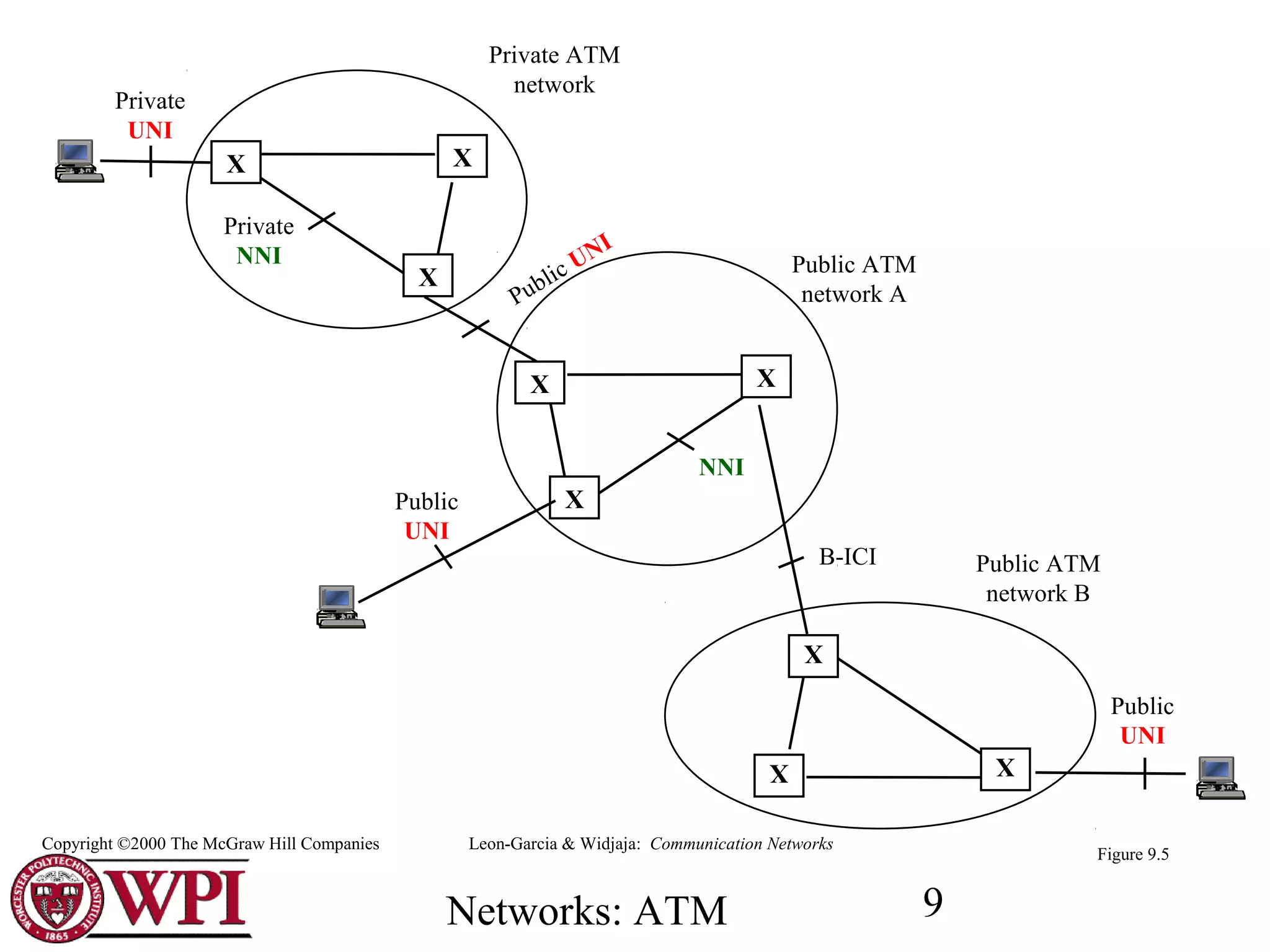
1. ATM network will be organized as a
hierarchy.
User’s equipment connects to networks via a UNI (User-
Network Interface).
Connections between provided networks are made through
NNI (Network-Network Interface).
2. ATM will be connection-oriented.
A connection (an ATM channel) must be
established before any cells are sent.
Networks: ATM 9
X
X
X
X
X
X
X
X
X
Private
UNI
Public
UNI
NNI
Private
NNI
Private ATM
network
Public
UNI
B-ICI
Public UNI
Public ATM
network A
Public ATM
network B
Figure 9.5
Leon-Garcia & Widjaja: Communication NetworksCopyright ©2000 The McGraw Hill Companies
Networks: ATM 10
ATMATM ConnectionsConnections
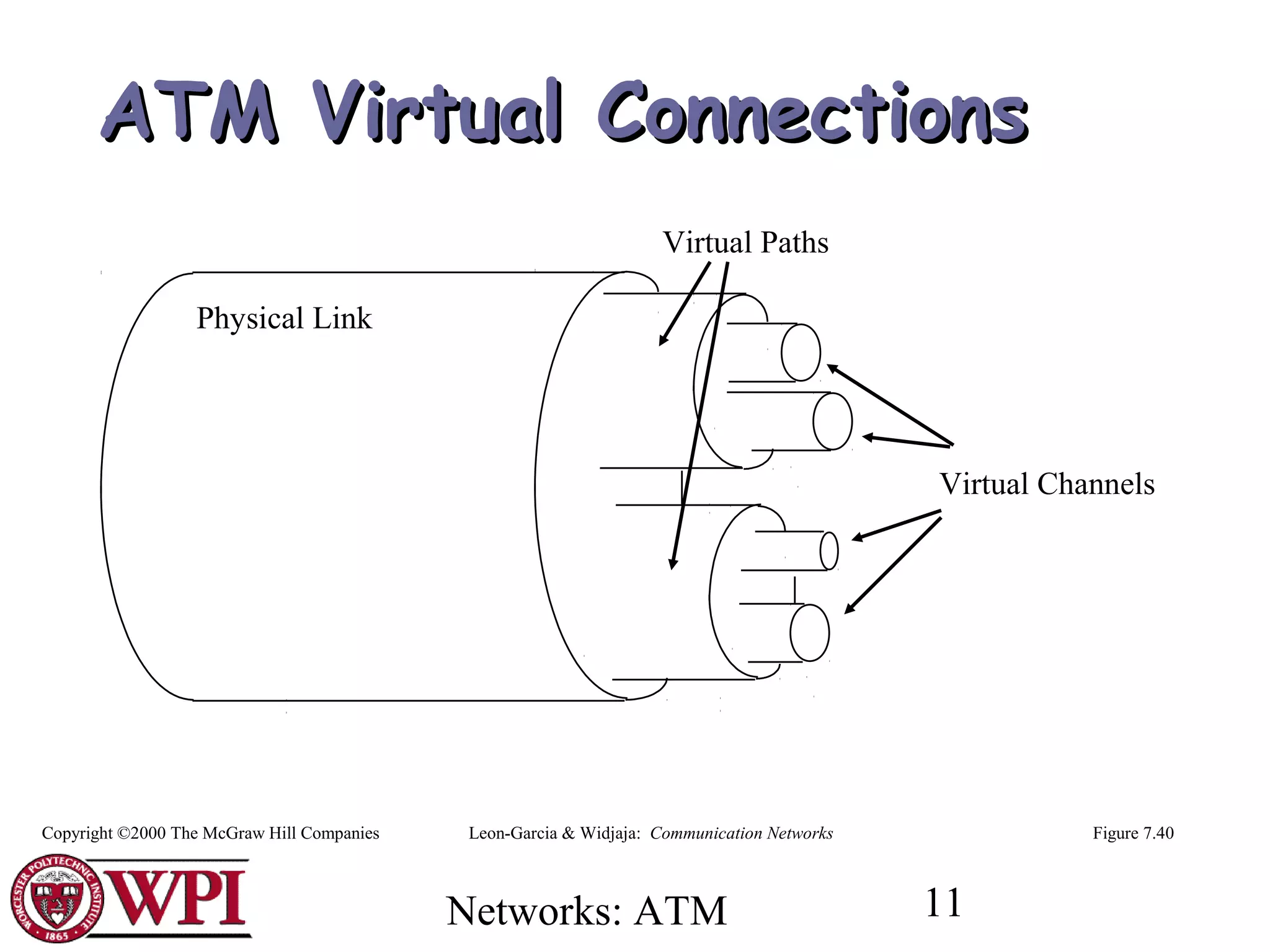
• two levels of ATM connections:
virtual path connections
virtual channel connections
• indicated by two fields in the cell header:
virtual path identifier VPI
virtual channel identifier VCI
Networks: ATM 11
Physical Link
Virtual Paths
Virtual Channels
Figure 7.40Leon-Garcia & Widjaja: Communication NetworksCopyright ©2000 The McGraw Hill Companies
ATM Virtual ConnectionsATM Virtual Connections
Networks: ATM 12
ATMATM Conceptual ModelConceptual Model
Assumptions (cont.)Assumptions (cont.)
3. Vast majority of ATM networks will run on
optical fiber networks with extremely low
error rates.
4. ATM must support low cost attachments.
• This decision lead to a significant decision – to
prohibit cell reordering in ATM networks.
 ATM switch design is more difficult.
Networks: ATM 13
GFC (4 bits) VPI (4 bits)
VPI (4 bits) VCI (4 bits)
VCI (8 bits)
VCI (4 bits) PT (3 bits)
CLP
(1 bit)
HEC (8 bits)
ATM cell
header
Payload
(48 bytes)
Figure 9.7Leon-Garcia & Widjaja: Communication NetworksCopyright ©2000 The McGraw Hill Companies
UNIUNI Cell FormatCell Format
Networks: ATM 14
2
3
N
1Switch
N
1 …
5
6
video 25
video
voice
data
32
32 61
25
32
32
61
75
67
39
67
N
1
3
2
video 75
voice 67
data 39
video 67
Figure 7.38
…
…
Leon-Garcia & Widjaja: Communication NetworksCopyright ©2000 The McGraw Hill Companies
ATM Cell SwitchingATM Cell Switching
Networks: ATM 15
c ATM
Sw
1
ATM
Sw
4
ATM
Sw
2
ATM
Sw
3
ATM
DCC
a
b
d
e
VP3 VP5
VP2
VP1
a
b
c
d
eSw = switch
Figure 7.39
Digital Cross Connect
Only switches virtual paths
Leon-Garcia & Widjaja: Communication NetworksCopyright ©2000 The McGraw Hill Companies
Networks: ATM 16
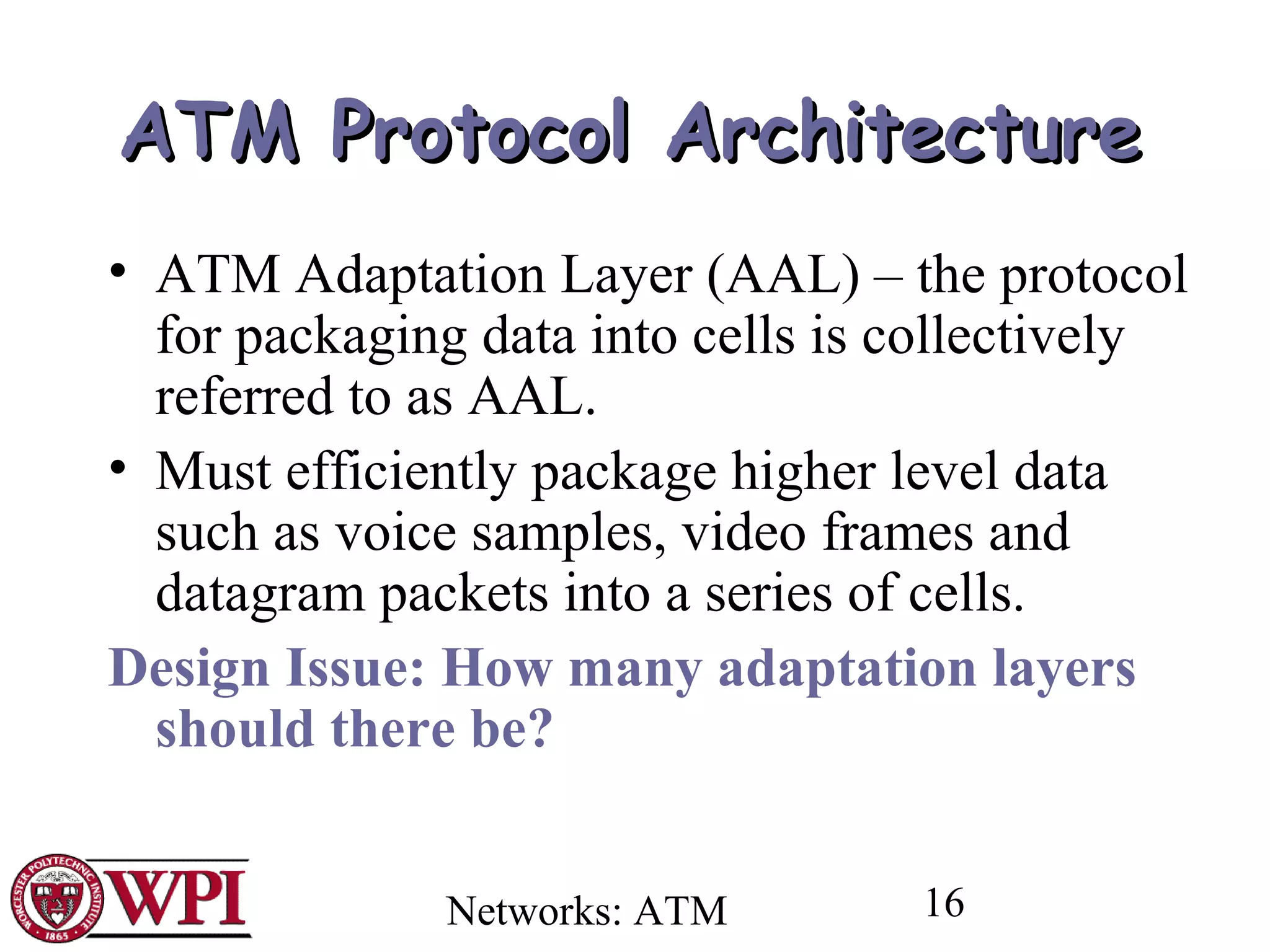
ATMATM Protocol ArchitectureProtocol Architecture
• ATM Adaptation Layer (AAL) – the protocol
for packaging data into cells is collectively
referred to as AAL.
• Must efficiently package higher level data
such as voice samples, video frames and
datagram packets into a series of cells.
Design Issue: How many adaptation layers
should there be?
Networks: ATM 17
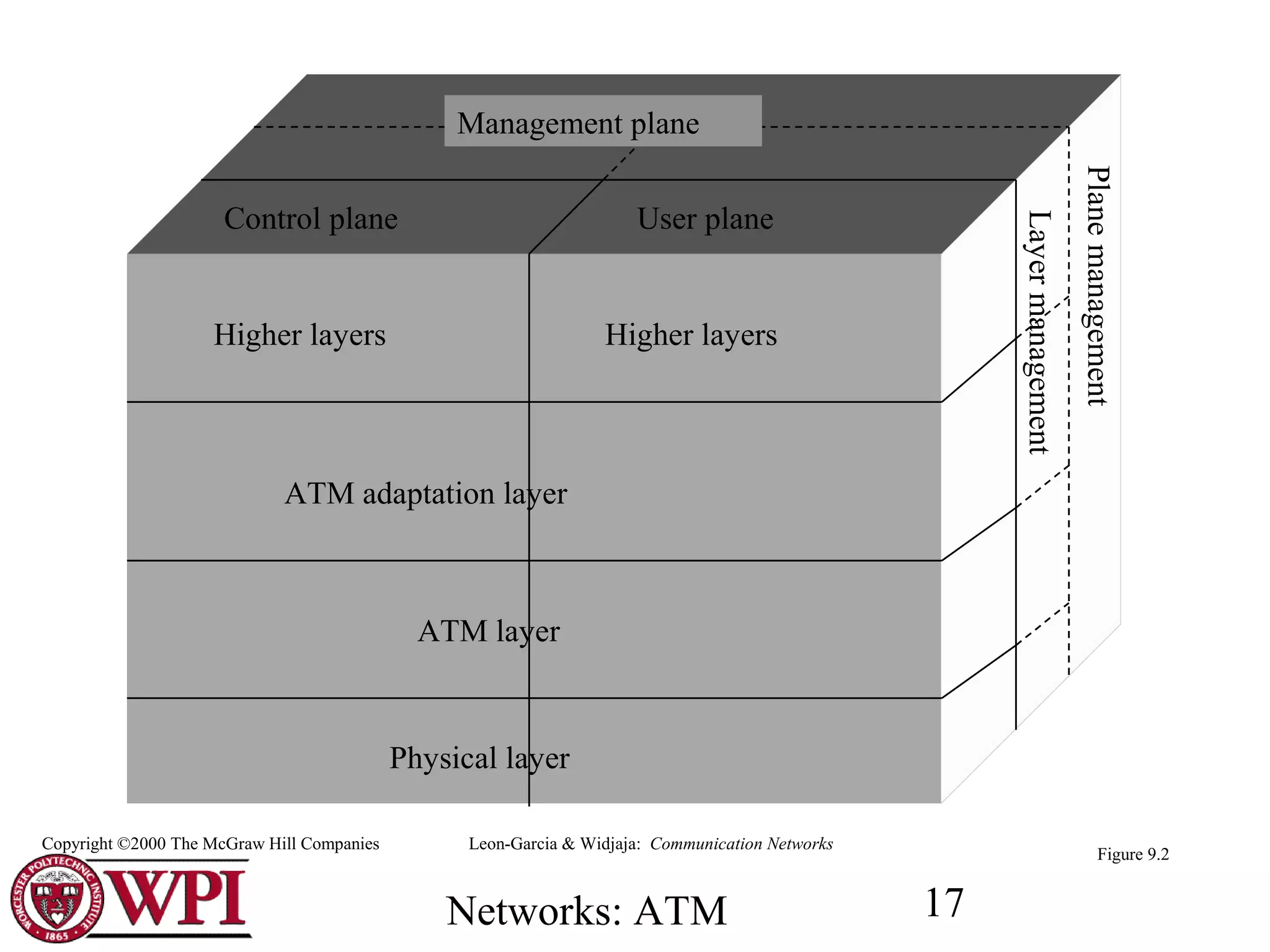
Planemanagement
Management plane
Control plane User plane
Physical layer
ATM layer
ATM adaptation layer
Higher layers Higher layers
Layermanagement
Figure 9.2
Leon-Garcia & Widjaja: Communication NetworksCopyright ©2000 The McGraw Hill Companies
Networks: ATM 18
AAL
ATM
User
information
User
information
AAL
ATM
PHYPHY
ATM
PHY
ATM
PHY
…
End system End systemNetwork
Figure 9.4Leon-Garcia & Widjaja: Communication NetworksCopyright ©2000 The McGraw Hill Companies
Networks: ATM 19
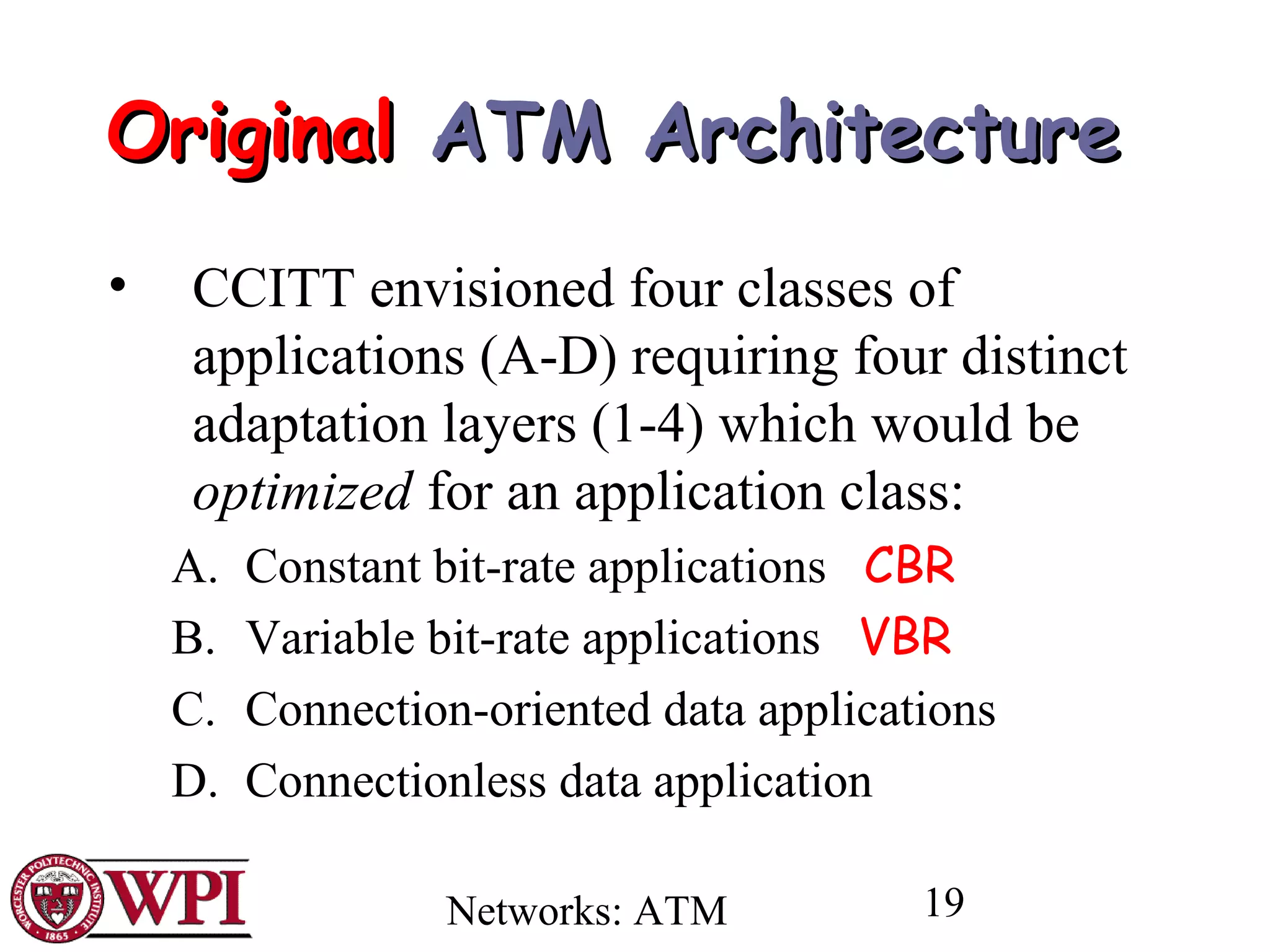
OriginalOriginal ATMATM ArchitectureArchitecture
• CCITT envisioned four classes of
applications (A-D) requiring four distinct
adaptation layers (1-4) which would be
optimized for an application class:
A. Constant bit-rate applications CBR
B. Variable bit-rate applications VBR
C. Connection-oriented data applications
D. Connectionless data application
Networks: ATM 20
ATM ArchitectureATM Architecture
An AAL is further divided into:
The Convergence Sublayer (CS)
manages the flow of data to and from SAR sublayer.
The Segmentation and Reassembly Sublayer
(SAR)
breaks data into cells at the sender and reassembles
cells into larger data units at the receiver.
Networks: ATM 21
Original ATM Architecture
Networks: ATM 22
Transmission
convergence
sublayer
Physical medium
dependent sublayer
Physical
medium
ATM layer
Physical layer
Figure 9.6Leon-Garcia & Widjaja: Communication NetworksCopyright ©2000 The McGraw Hill Companies
Networks: ATM 23
• The AAL interface was initially defined as classes A-D
with SAP (service access points) for AAL1-4.
• AAL3 and AAL4 were so similar that they were
merged into AAL3/4.
• The data communications community concluded that
AAL3/4 was not suitable for data communications
applications. They pushed for standardization of AAL5
(also referred to as SEAL – the Simple and Efficient
Adaptation Layer).
• AAL2 was not initially deployed.
OriginalOriginal ATMATM ArchitectureArchitecture
Networks: ATM 24
Revised ATM Architecture
Networks: ATM 25
RevisedRevised ATMATM Service CategoriesService Categories
Class Description Example
CBR Constant Bit Rate T1 circuit
RT-VBR Real Time Variable Bit
Rate
Real-time
videoconferencing
NRT-VBR Non-real-time Variable Bit
Rate
Multimedia email
ABR Available Bit Rate Browsing the Web
UBR Unspecified Bit Rate Background file
transfer
Networks: ATM 26
QoSQoS,, PVCPVC, and, and SVCSVC
• Quality of Service (QoS) requirements are
handled at connection time and viewed as
part of signaling.
• ATM provides permanent virtual connections
and switched virtual connections.
– Permanent Virtual Connections (PVC)
permanent connections set up manually
by network manager.
– Switched Virtual Connections (SVC)
set up and released on demand by the end user
via signaling procedures.
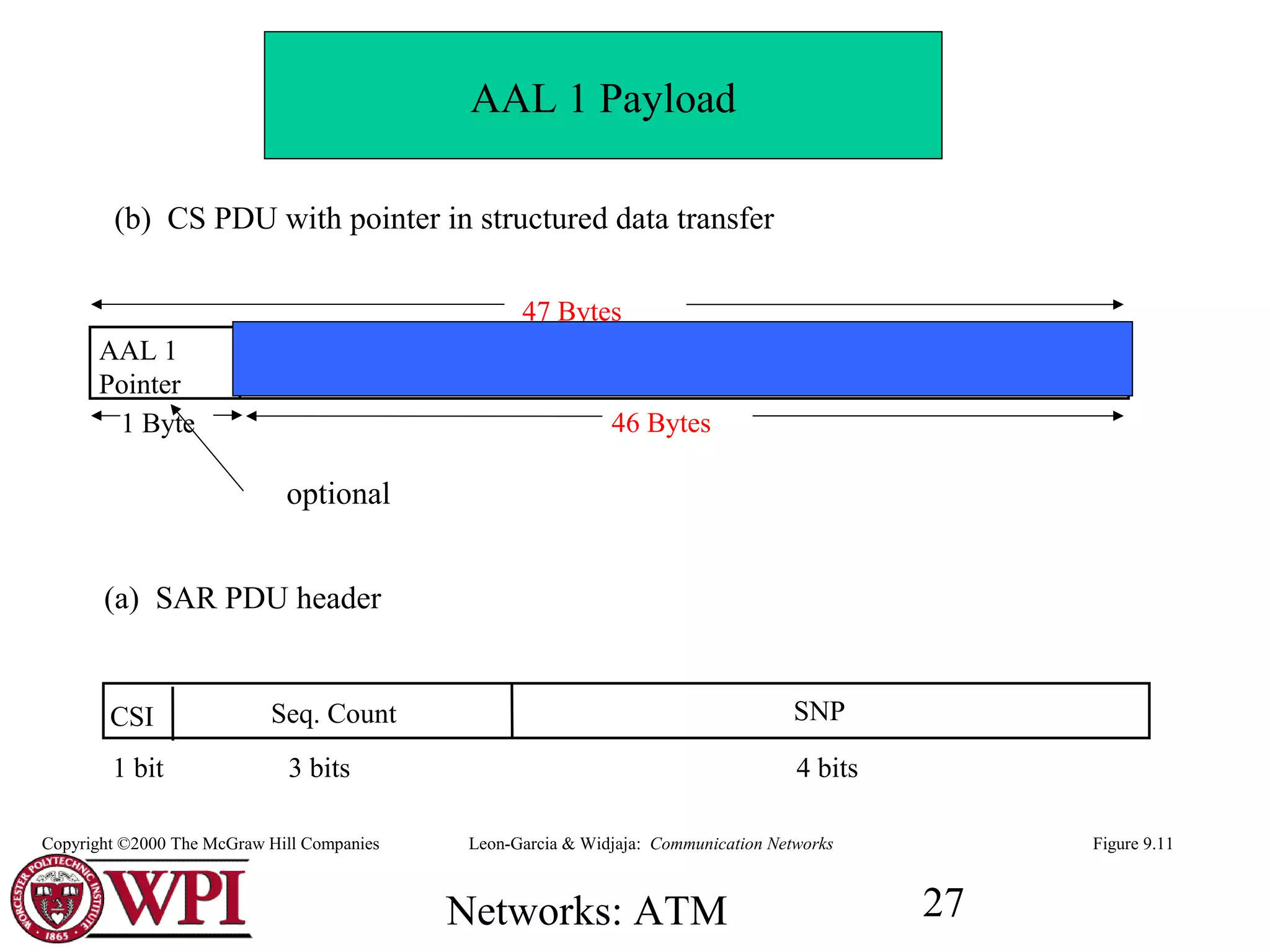
Networks: ATM 27
(b) CS PDU with pointer in structured data transfer
AAL 1
Pointer
1 Byte 46 Bytes
47 Bytes
Figure 9.11
AAL 1 Payload
Leon-Garcia & Widjaja: Communication NetworksCopyright ©2000 The McGraw Hill Companies
optional
(a) SAR PDU header
CSI SNPSeq. Count
1 bit 3 bits 4 bits
Networks: ATM 28
…
Higher layer User data stream
Convergence
sublayer
SAR sublayer
ATM layer
CS PDUs
SAR PDUs
ATM Cells
47 47 47
1 47 1 47 1 47
H H H
5 48
H
5 48
H
5 48
H
b1 b2 b3
Figure 9.10
AAL 1
Leon-Garcia & Widjaja: Communication NetworksCopyright ©2000 The McGraw Hill Companies
Networks: ATM 29
(a) CPCS-PDU format
(b) SAR PDU format
CPI Btag BASize CPCS - PDU Payload
1 1 2 1 - 65,535 0-3 1 1 2
(bytes) (bytes) (bytes)
AL Etag LengthPad
Header Trailer
ST SN MID SAR - PDU Payload
2 4 10 44 6 10
(bits) (bytes)
(bits)
LI CRC
Header
(2 bytes)
Trailer
(2 bytes)
Figure 9.16
AAL 3/4
CS and SAR PDUs
Leon-Garcia & Widjaja: Communication NetworksCopyright ©2000 The McGraw Hill Companies
Networks: ATM 30
Higher layer
Common part
convergence
sublayer
SAR sublayer
ATM layer
Service specific
convergence
sublayer
Information
Assume null
TPAD
User message
Pad message to multiple
of 4 bytes. Add header
and trailer.
Each SAR-PDU consists
of 2-byte header, 2-byte
trailer, and 44-byte
payload.
H
4 4
2 44 2 2 44 2 2 44 2
…
…
Information
Figure 9.15
AAL 3/4
Leon-Garcia & Widjaja: Communication Networks
Copyright ©2000 The McGraw Hill Companies
Networks: ATM 31
Information
0 - 65,535 0-47 1 1 2 4
(bytes) (bytes)
UU CPI Length CRCPad
Figure 9.19
AAL 5
Convergent Sublayer Format
SAR Format
48 bytes of Data
ATM
Header
1-bit end-of-datagram field (PTI)
Leon-Garcia & Widjaja: Communication Networks
Copyright ©2000 The McGraw Hill Companies
Networks: ATM 32
Higher layer
Common part
convergence
sublayer
SAR sublayer
ATM layer
PTI = 0
Service specific
convergence
sublayer Assume null
48
(1)
Information
TPAD
…
…
Information
48
(0)
48
(0)
PTI = 0
PTI = 1
Figure 9.18
AAL 5
Leon-Garcia & Widjaja: Communication Networks
Copyright ©2000 The McGraw Hill Companies

Asynchronous transfer mode

  • 1.
  • 2.
    Networks: ATM 2 IssuesDriving LAN ChangesIssues Driving LAN Changes • Traffic Integration – Voice, video and data traffic – Multimedia became the ‘buzz word’ • One-way batch Web traffic • Two-way batch voice messages • One-way interactive Mbone broadcasts • Two-way interactive video conferencing • Quality of Service guarantees (e.g. limited jitter, non-blocking streams) • LAN Interoperability • Mobile and Wireless nodes
  • 3.
    Networks: ATM 3 Stallings“High-Speed Networks”
  • 4.
    Networks: ATM 4 Stallings“High-Speed Networks”
  • 5.
    Networks: ATM 5 A/D Voice s1, s2 … Digital voice samples A/D Video … Compression compressed frames picture frames Data Bursty variable-length packets cells cells cells Figure 9.3Leon-Garcia & Widjaja: Communication NetworksCopyright ©2000 The McGraw Hill Companies AAL AAL AAL ATM Adaptation Layers
  • 6.
    Networks: ATM 6 MUX ` Wastedbandwidth ATM TDM 4 3 2 1 4 3 2 1 4 3 2 1 4 3 1 3 2 2 1 Voice Data packets Images Figure 7.37Leon-Garcia & Widjaja: Communication NetworksCopyright ©2000 The McGraw Hill Companies Asynchronous Transfer ModeAsynchronous Transfer Mode (ATM)(ATM)
  • 7.
    Networks: ATM 7 ATMATM •ATM standard (defined by CCITT) is widely accepted by common carriers as mode of operation for communication – particularly BISDN. • ATM is a form of cell switching using small fixed- sized packets. Header Payload 5 Bytes 48 Bytes Figure 9.1 Basic ATM Cell Format Leon-Garcia & Widjaja: Communication NetworksCopyright ©2000 The McGraw Hill Companies
  • 8.
    Networks: ATM 8 ATMATMConceptual ModelConceptual Model FourFour AssumptionsAssumptions 1. ATM network will be organized as a hierarchy. User’s equipment connects to networks via a UNI (User- Network Interface). Connections between provided networks are made through NNI (Network-Network Interface). 2. ATM will be connection-oriented. A connection (an ATM channel) must be established before any cells are sent.
  • 9.
    Networks: ATM 9 X X X X X X X X X Private UNI Public UNI NNI Private NNI PrivateATM network Public UNI B-ICI Public UNI Public ATM network A Public ATM network B Figure 9.5 Leon-Garcia & Widjaja: Communication NetworksCopyright ©2000 The McGraw Hill Companies
  • 10.
    Networks: ATM 10 ATMATMConnectionsConnections • two levels of ATM connections: virtual path connections virtual channel connections • indicated by two fields in the cell header: virtual path identifier VPI virtual channel identifier VCI
  • 11.
    Networks: ATM 11 PhysicalLink Virtual Paths Virtual Channels Figure 7.40Leon-Garcia & Widjaja: Communication NetworksCopyright ©2000 The McGraw Hill Companies ATM Virtual ConnectionsATM Virtual Connections
  • 12.
    Networks: ATM 12 ATMATMConceptual ModelConceptual Model Assumptions (cont.)Assumptions (cont.) 3. Vast majority of ATM networks will run on optical fiber networks with extremely low error rates. 4. ATM must support low cost attachments. • This decision lead to a significant decision – to prohibit cell reordering in ATM networks.  ATM switch design is more difficult.
  • 13.
    Networks: ATM 13 GFC(4 bits) VPI (4 bits) VPI (4 bits) VCI (4 bits) VCI (8 bits) VCI (4 bits) PT (3 bits) CLP (1 bit) HEC (8 bits) ATM cell header Payload (48 bytes) Figure 9.7Leon-Garcia & Widjaja: Communication NetworksCopyright ©2000 The McGraw Hill Companies UNIUNI Cell FormatCell Format
  • 14.
    Networks: ATM 14 2 3 N 1Switch N 1… 5 6 video 25 video voice data 32 32 61 25 32 32 61 75 67 39 67 N 1 3 2 video 75 voice 67 data 39 video 67 Figure 7.38 … … Leon-Garcia & Widjaja: Communication NetworksCopyright ©2000 The McGraw Hill Companies ATM Cell SwitchingATM Cell Switching
  • 15.
    Networks: ATM 15 cATM Sw 1 ATM Sw 4 ATM Sw 2 ATM Sw 3 ATM DCC a b d e VP3 VP5 VP2 VP1 a b c d eSw = switch Figure 7.39 Digital Cross Connect Only switches virtual paths Leon-Garcia & Widjaja: Communication NetworksCopyright ©2000 The McGraw Hill Companies
  • 16.
    Networks: ATM 16 ATMATMProtocol ArchitectureProtocol Architecture • ATM Adaptation Layer (AAL) – the protocol for packaging data into cells is collectively referred to as AAL. • Must efficiently package higher level data such as voice samples, video frames and datagram packets into a series of cells. Design Issue: How many adaptation layers should there be?
  • 17.
    Networks: ATM 17 Planemanagement Managementplane Control plane User plane Physical layer ATM layer ATM adaptation layer Higher layers Higher layers Layermanagement Figure 9.2 Leon-Garcia & Widjaja: Communication NetworksCopyright ©2000 The McGraw Hill Companies
  • 18.
    Networks: ATM 18 AAL ATM User information User information AAL ATM PHYPHY ATM PHY ATM PHY … Endsystem End systemNetwork Figure 9.4Leon-Garcia & Widjaja: Communication NetworksCopyright ©2000 The McGraw Hill Companies
  • 19.
    Networks: ATM 19 OriginalOriginalATMATM ArchitectureArchitecture • CCITT envisioned four classes of applications (A-D) requiring four distinct adaptation layers (1-4) which would be optimized for an application class: A. Constant bit-rate applications CBR B. Variable bit-rate applications VBR C. Connection-oriented data applications D. Connectionless data application
  • 20.
    Networks: ATM 20 ATMArchitectureATM Architecture An AAL is further divided into: The Convergence Sublayer (CS) manages the flow of data to and from SAR sublayer. The Segmentation and Reassembly Sublayer (SAR) breaks data into cells at the sender and reassembles cells into larger data units at the receiver.
  • 21.
    Networks: ATM 21 OriginalATM Architecture
  • 22.
    Networks: ATM 22 Transmission convergence sublayer Physicalmedium dependent sublayer Physical medium ATM layer Physical layer Figure 9.6Leon-Garcia & Widjaja: Communication NetworksCopyright ©2000 The McGraw Hill Companies
  • 23.
    Networks: ATM 23 •The AAL interface was initially defined as classes A-D with SAP (service access points) for AAL1-4. • AAL3 and AAL4 were so similar that they were merged into AAL3/4. • The data communications community concluded that AAL3/4 was not suitable for data communications applications. They pushed for standardization of AAL5 (also referred to as SEAL – the Simple and Efficient Adaptation Layer). • AAL2 was not initially deployed. OriginalOriginal ATMATM ArchitectureArchitecture
  • 24.
    Networks: ATM 24 RevisedATM Architecture
  • 25.
    Networks: ATM 25 RevisedRevisedATMATM Service CategoriesService Categories Class Description Example CBR Constant Bit Rate T1 circuit RT-VBR Real Time Variable Bit Rate Real-time videoconferencing NRT-VBR Non-real-time Variable Bit Rate Multimedia email ABR Available Bit Rate Browsing the Web UBR Unspecified Bit Rate Background file transfer
  • 26.
    Networks: ATM 26 QoSQoS,,PVCPVC, and, and SVCSVC • Quality of Service (QoS) requirements are handled at connection time and viewed as part of signaling. • ATM provides permanent virtual connections and switched virtual connections. – Permanent Virtual Connections (PVC) permanent connections set up manually by network manager. – Switched Virtual Connections (SVC) set up and released on demand by the end user via signaling procedures.
  • 27.
    Networks: ATM 27 (b)CS PDU with pointer in structured data transfer AAL 1 Pointer 1 Byte 46 Bytes 47 Bytes Figure 9.11 AAL 1 Payload Leon-Garcia & Widjaja: Communication NetworksCopyright ©2000 The McGraw Hill Companies optional (a) SAR PDU header CSI SNPSeq. Count 1 bit 3 bits 4 bits
  • 28.
    Networks: ATM 28 … Higherlayer User data stream Convergence sublayer SAR sublayer ATM layer CS PDUs SAR PDUs ATM Cells 47 47 47 1 47 1 47 1 47 H H H 5 48 H 5 48 H 5 48 H b1 b2 b3 Figure 9.10 AAL 1 Leon-Garcia & Widjaja: Communication NetworksCopyright ©2000 The McGraw Hill Companies
  • 29.
    Networks: ATM 29 (a)CPCS-PDU format (b) SAR PDU format CPI Btag BASize CPCS - PDU Payload 1 1 2 1 - 65,535 0-3 1 1 2 (bytes) (bytes) (bytes) AL Etag LengthPad Header Trailer ST SN MID SAR - PDU Payload 2 4 10 44 6 10 (bits) (bytes) (bits) LI CRC Header (2 bytes) Trailer (2 bytes) Figure 9.16 AAL 3/4 CS and SAR PDUs Leon-Garcia & Widjaja: Communication NetworksCopyright ©2000 The McGraw Hill Companies
  • 30.
    Networks: ATM 30 Higherlayer Common part convergence sublayer SAR sublayer ATM layer Service specific convergence sublayer Information Assume null TPAD User message Pad message to multiple of 4 bytes. Add header and trailer. Each SAR-PDU consists of 2-byte header, 2-byte trailer, and 44-byte payload. H 4 4 2 44 2 2 44 2 2 44 2 … … Information Figure 9.15 AAL 3/4 Leon-Garcia & Widjaja: Communication Networks Copyright ©2000 The McGraw Hill Companies
  • 31.
    Networks: ATM 31 Information 0- 65,535 0-47 1 1 2 4 (bytes) (bytes) UU CPI Length CRCPad Figure 9.19 AAL 5 Convergent Sublayer Format SAR Format 48 bytes of Data ATM Header 1-bit end-of-datagram field (PTI) Leon-Garcia & Widjaja: Communication Networks Copyright ©2000 The McGraw Hill Companies
  • 32.
    Networks: ATM 32 Higherlayer Common part convergence sublayer SAR sublayer ATM layer PTI = 0 Service specific convergence sublayer Assume null 48 (1) Information TPAD … … Information 48 (0) 48 (0) PTI = 0 PTI = 1 Figure 9.18 AAL 5 Leon-Garcia & Widjaja: Communication Networks Copyright ©2000 The McGraw Hill Companies